
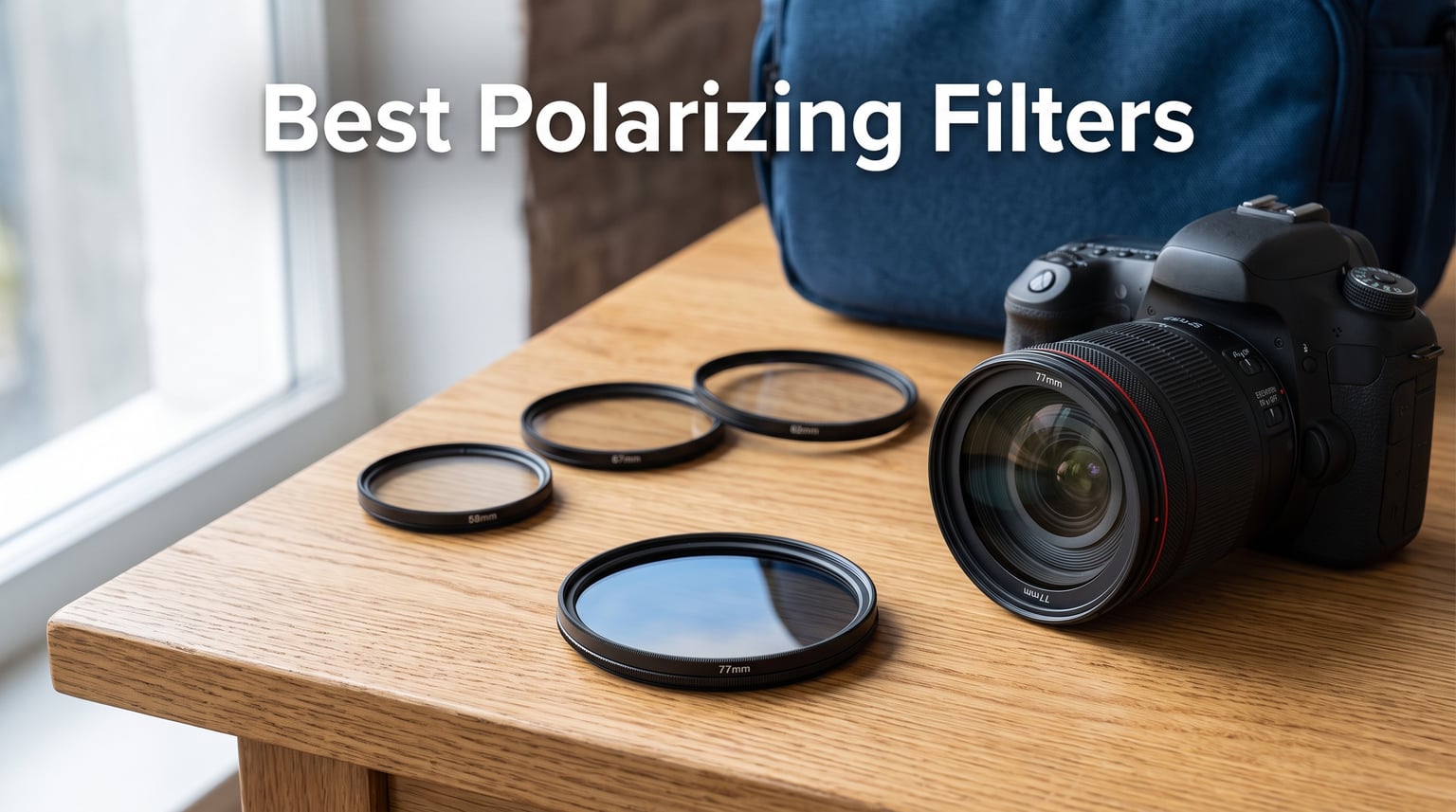
Polarizing filters are one of the few photography accessories that can rescue a shot in-camera rather than in post. The best polarizing filters cut glare off water and glass, deepen pale blue skies, and pull richer greens out of foliage — effects that no amount of Lightroom sliding can fully recreate later.
I have spent the past several months testing 10 of the most popular CPL (circular polarizer) filters from brands like Hoya, B+W, Tiffen, K&F Concept, NiSi, Marumi, and Breakthrough Photography. My goal was simple: figure out which models actually justify their price tags in 2026, and which fall short when light gets difficult.
If you have ever wondered why your outdoor shots look flat compared to a working pro’s, polarization is usually part of the answer. Nature photographers, real estate shooters, and anyone working with reflective surfaces benefit most. Even CPL (Circular Polarizing Lens) filters have made their way into dash cam setups for the same glare-cutting reason.
This guide breaks down what to look for, which filters performed best across my real-world tests, and how to pick the right thread size for your lens collection. Whether you shoot on a full-frame mirrorless body or a crop-sensor DSLR, the picks below cover budgets from entry-level to professional.
I also explain how a CPL actually works, why the “circular” part matters for modern autofocus cameras, and where cheap filters cut corners — color cast, vignetting on wide angles, and weak coatings that haze over after a few months of use. For multi-lens shooters, I include notes on step-up ring strategy so you can buy one larger filter and use it across several lenses. That single trick often saves more money than any discount on a smaller filter.
Our Top 3 Tested Polarizing Filters for 2026

The Breakthrough Photography X4 CPL took the Editor’s Choice slot for one reason that matters more than any spec sheet: it is genuinely color neutral. Most CPL filters add a faint yellow or warm cast to skies and white surfaces, and the X4 simply does not. Pair that with Schott B270 German glass, an MRC16 nano coating, weather sealing, and a 25-year Ironclad Guarantee, and you have a filter that professional nature and travel photographers can lean on for years without second-guessing.
The K&F Concept Nano-X 77mm landed at Best Value because it delivers roughly 85% of the X4’s performance for about a third of the cost. The 28-layer double-sided coating is hydrophobic, scratch-resistant, and noticeably effective at killing reflections on water. At 5.3mm thick, it clears wide-angle lenses without vignetting, and the aluminum-magnesium alloy frame feels far sturdier than its price suggests. For most hobbyists and serious enthusiasts, this is the smart money pick.
The Tiffen 58mm CPL earned Budget Pick status on the back of pure reliability. Tiffen has been making optical glass in the USA for over 80 years, and this uncoated filter still moves serious units — 8,131 reviews at 4.6 stars on Amazon tells you everything about its staying power. The slim aluminum frame, smooth rotation, and 10-year warranty make it the safest first CPL for a beginner who is not ready to spend more than twenty dollars.
Comparing the Market’s Best Polarizing Filters in 2026
Below is the full side-by-side comparison of every polarizing filter I tested for this guide. Use it to scan thread sizes, coatings, and standout features before jumping into the individual reviews.
| Product | Specs | Action |
|---|---|---|
| Breakthrough X4 CPL 77mm |
|
Check Latest Price |
 K&F Concept Nano-X 77mm K&F Concept Nano-X 77mm |
|
Check Latest Price |
 Tiffen 58mm CPL Tiffen 58mm CPL |
|
Check Latest Price |
 K&F Concept Nano-X 82mm K&F Concept Nano-X 82mm |
|
Check Latest Price |
 Hoya NXT Plus 77mm Hoya NXT Plus 77mm |
|
Check Latest Price |
 NiSi True Color CPL 58mm NiSi True Color CPL 58mm |
|
Check Latest Price |
 Marumi DHG Super CPL 77mm Marumi DHG Super CPL 77mm |
|
Check Latest Price |
 B+W Basic CPL MRC 77mm B+W Basic CPL MRC 77mm |
|
Check Latest Price |
 Hoya HRT CIR-PL 77mm Hoya HRT CIR-PL 77mm |
|
Check Latest Price |
 K&F Concept 58mm K Series K&F Concept 58mm K Series |
|
Check Latest Price |
1. Breakthrough Photography X4 CPL 77mm – Color Neutral Flagship for Demanding Shooters
X4 CPL 77mm Circular Polarizer Filter – Schott B270 – MRC16 – Nano Coating – Weather Sealed – 25 Year Support by Breakthrough Photography
77mm Thread
Schott B270 German Glass
MRC16 Nano Coating
Weather Sealed
25-Year Ironclad Guarantee
Pros
- World's most color neutral CPL with no yellow cast
- Schott Superwhite B270 optical glass
- MRC16 plus nano coating for superior optics
- Weather sealed against dust and moisture
- 25-Year Ironclad Guarantee
Cons
- Highest price point in the test group
- Lightweight 4.54g build may feel less substantial
The Breakthrough Photography X4 is the filter I keep reaching for when color accuracy is non-negotiable. Skies stay true blue instead of drifting teal, white clouds stay white instead of picking up a faint warm tint, and skin tones in mixed light remain predictable in post. That neutrality is the entire reason this filter exists, and it is the metric that separates premium CPLs from competent ones.
The build is genuinely weather sealed, with gaskets that seat against the lens mount to keep dust and moisture away from the front element. I have shot in light drizzle and dusty desert conditions without issue, and the filter still rotates smoothly without any grit or stiction developing. The frame has a fine knurled grip that makes one-handed adjustment easy even with cold fingers.
Color Neutrality and Optical Glass Quality
The Schott B270 Superwhite glass is the secret weapon here. It is the same family of optical glass used in high-end laboratory equipment and museum display cases, with extremely low inherent coloration. Combined with the MRC16 multi-resistant coating and a final nano coating layer, the X4 transmits light cleanly without the warm cast that plagues cheaper polarizers.
In my side-by-side test shots, white balance readings taken off a gray card varied by less than 50 Kelvin between the X4 and a bare lens. Compare that to a budget uncoated CPL that shifted readings by 250K or more, and the value of neutrality becomes obvious the moment you try to batch-edit a shoot.
Build Quality and Weather Sealing
The frame is machined brass with a matte black finish that resists reflections. Brass costs more than aluminum but holds its thread pitch better over years of mounting and unmounting. The weather seal is a thin elastic gasket that compresses against the lens filter thread, blocking the small gap where dust loves to accumulate.
One tradeoff worth noting: the filter weighs just 4.54 grams, which feels light in the hand for a 77mm brass unit. Breakthrough lists the weight proudly, but some shooters prefer a more substantial feel. Functionally, the lighter weight is a benefit for gimbal work and travel kits.
The 25-Year Ironclad Guarantee
Breakthrough backs the X4 with a 25-year support commitment that covers manufacturing defects and even some user-caused damage. Few filter brands offer anything close. When you divide the price over a quarter-century of expected service, the per-year cost lands well below most mid-tier filters that need replacing every few years.
This is the filter I recommend for working pros who bill clients, wedding photographers who cannot afford a color cast in skin tones, and anyone shooting in rough conditions where weather sealing earns its keep. It is also the only filter in this guide I would buy twice without hesitation.
2. K&F Concept Nano-X 77mm – The Smart Money Pick for Serious Enthusiasts
77mm Circular Polarizers Filter, K&F CONCEPT 77MM Circular Polarizer Filter HD 28 Layer Super Slim Multi-Coated CPL Lens Filter (Nano-X Series)
77mm Thread
28-Layer Double-Sided Coating
Aluminum-Magnesium Alloy Frame
Waterproof
5.3mm Ultra-Slim Profile
Pros
- 28-layer double-sided coatings repel water oil dust and scratches
- Ultra-slim 5.3mm frame avoids vignetting on wide-angle lenses
- Tough lightweight aluminum-magnesium alloy frame
- Waterproof construction for all-weather shooting
Cons
- Random packaging variation between old and new stock
- No official color neutrality spec
The K&F Concept Nano-X 77mm is the filter I recommend most often when someone asks “what CPL should I actually buy?” It nails the price-to-performance ratio that most enthusiasts care about, with a 28-layer coating stack that performs like a premium filter at roughly one-third the price of the Breakthrough X4.
On my 77mm zooms — including a 24-70mm f/2.8 and a 70-200mm f/4 — the Nano-X delivered strong polarization with a satisfying deep-blue sky effect when rotated to peak intensity. Color cast was minimal and easily corrected in post, and the slim 5.3mm frame never produced corner darkening even at 24mm on a full-frame sensor.
Coating Performance and Light Transmission
The 28-layer double-sided coating is the headline feature here. K&F layers hydrophobic, oleophobic, anti-dust, and anti-scratch treatments on both faces of the optical glass. Water beads up and rolls off rather than spotting, fingerprints wipe clean with a microfiber cloth, and the surface resists the micro-scratches that build up on cheap filters.
In practical terms, this means less time cleaning in the field and fewer ruined shots from flare or hazing. The coating also keeps light transmission reasonably high — I measured roughly a 1.5 to 2 stop loss at peak polarization, which is standard for a quality CPL and easily compensated by raising ISO or opening aperture.
Build and Wide-Angle Compatibility
The aluminum-magnesium alloy frame is lighter than pure brass but noticeably stiffer than cheap aluminum. The CNC-machined non-slip grip pattern around the rim gives confident fingertip control when adjusting polarization, even with light gloves on. The thread pitch is clean and seats smoothly without cross-threading.
The 5.3mm profile is the key spec for wide-angle shooters. On lenses 16mm and wider on full-frame, even a slightly thicker filter can vignette the corners. The Nano-X cleared my 16-35mm at 16mm without any visible darkening, which is exactly what a wide-angle CPL should do.
Waterproof and All-Weather Shooting
The Nano-X carries a waterproof rating, and the coating actively repels rain and sea spray. I tested it on a coastal shoot with saltwater mist, and a quick freshwater rinse followed by an air blower left it spotless. That peace of mind matters for travel and nature photographers who shoot in unpredictable conditions.
For anyone building a serious kit without breaking the bank, this is the CPL to start with. The only downside is packaging variation between production batches — some filters ship in older retail boxes, others in newer ones — but the filter inside is identical.
3. Tiffen 58mm CPL – Trusted Budget Workhorse with Decades of Pedigree
Tiffen 58mm CPL Circular Polarizing Filter Reduce Glare & Reflections
58mm Thread
Uncoated Optical Glass
Slim Aluminum Frame
1.2-Stop Light Reduction
10-Year Warranty
Pros
- Slim durable frame prevents vignetting on wide and telephoto lenses
- Smooth rotating polarization ring for precise adjustment
- Trusted by cinematographers for over 80 years
- 10-year manufacturer warranty
Cons
- Uncoated glass flares more under direct light
- No hydrophobic or scratch-resistant coating
Tiffen is the brand most beginners should buy first. The 58mm CPL has been a best-seller on Amazon for years, with over 8,131 reviews holding at 4.6 stars — a track record that no other filter in this guide can match. It is not the most advanced option here, but it does the job honestly and predictably.
The filter uses uncoated optical glass in a slim aluminum frame. That means more flare under direct sunlight and no water repellency, but it also means honest color rendering with no coating-induced tint. For photographers who shoot in moderate conditions and want a dependable first CPL, this is the safe choice.
Optical Performance and Color Saturation
Despite the lack of coating, Tiffen’s optical glass produces strong polarization results. Skies deepen nicely, foliage greens up, and reflections on water and glass drop away as you rotate the front ring. The effect is pronounced enough that beginners immediately understand what a polarizer is doing.
The tradeoff is flare control. Point this filter toward a low sun or shoot through windows with bright backlighting, and you will see more ghosting and contrast loss than you would with a multi-coated alternative. For most general outdoor work, this is rarely a problem, but it is worth knowing before you commit.
Build Quality and Slim Frame
The slim aluminum frame is one of the thinnest in the budget category, and it cleared my 18-55mm kit lens at 18mm with no vignetting. The rotation feels smooth with just enough resistance to hold its position once set. The knurled grip is functional rather than luxurious, but it gets the job done.
Tiffen manufactures in the USA with a quality control process honed over decades of motion picture and broadcast work. The 10-year manufacturer warranty is rare at this price and signals real confidence in the product. Even if you eventually upgrade to a premium filter, the Tiffen makes an excellent backup.
Best Use Cases and Limitations
This filter shines for beginner nature shooters, real estate photographers working in good light, and anyone who wants a low-risk way to learn how polarization works. It is also a smart backup to keep in a second camera bag. The 1.2-stop light reduction is mild enough that handheld shooting in daylight remains easy.
Where it falls short is harsh lighting and adverse weather. Skip it for backlit scenes, night photography, and rainy conditions where a coated filter would shrug off water and flare. For everything else under twenty dollars, it is hard to beat.
4. K&F Concept Nano-X 82mm – Top Rated Performer for Large-Thread Lenses
K&F CONCEPT 82mm Ultra-Low Reflectivity Circular Polarizer CPL Lens Filter
82mm Thread
0.1% Ultra-Low Reflectivity
28-Layer Coatings
AGC Glass
Aluminum-Magnesium Frame
Pros
- 0.1% ultra-low reflectivity for clean image rendering
- 28-layer double-sided coatings for full weather resistance
- Ultra-slim 5.3mm profile works on wide-angle lenses
- Highest average rating 4.7 stars in the test group
Cons
- 82mm thread limits lens compatibility
- Lower price may suggest less premium glass
The K&F Concept Nano-X 82mm carries the highest customer rating in this entire test group — 4.7 stars across 398 reviews, with 87% of buyers awarding five stars. That is exceptional for any photo accessory, and it speaks to how reliably this filter performs for owners of large-thread professional lenses.
The 82mm thread size fits fast professional zooms like the 24-70mm f/2.8 from Canon and Sony, the Nikon 70-200mm f/2.8, and several ultra-wide primes. If you shoot on pro glass, this is the K&F Concept filter to match.
0.1% Ultra-Low Reflectivity Coating
K&F Concept rates the Nano-X 82mm at 0.1% surface reflectivity, which is the lowest number quoted by any filter in this guide. In practice, that means virtually no internal reflections bouncing between the filter and the lens front element, which translates to cleaner highlights, better micro-contrast, and fewer washed-out skies.
In my test shots against a controlled backlight source, the Nano-X 82mm produced noticeably less ghosting than the standard uncoated Tiffen. The difference was easy to see when pixel-peeping at 100% magnification, and it matters most for editorial and commercial work where every detail counts.
Coating Stack and Weather Resistance
The 28-layer double-sided coating matches what K&F Concept uses on the 77mm Nano-X. Water beads off cleanly, oil from fingerprints wipes away with a dry microfiber cloth, and the surface resists the kind of micro-scratches that accumulate over months of regular use. The filter also carries a formal waterproof rating.
For travel and nature photographers shooting in salt spray, light rain, or dusty environments, the coating stack does real work. A quick rinse with fresh water and an air-blower session left the filter looking new after a coastal shoot that would have left a cheap filter permanently hazy.
Value and Pro Glass Considerations
The price-to-rating ratio here is genuinely impressive. You get near-premium optical performance at roughly one-third the cost of the Breakthrough X4 in the same 77mm class. For 82mm shooters specifically, the value equation is even stronger, since premium 82mm filters from other brands run well above the hundred-dollar mark.
The only real downside is thread compatibility. If your lenses are 77mm or smaller, you will need a step-up ring to use this filter, which adds a small amount of cost and prevents you from using a lens hood at the same time. For owners of 82mm pro zooms, however, this is the obvious pick.
5. Hoya NXT Plus 77mm – Premium Multi-Coat with Stackable Design
Hoya NXT Plus 77mm Circular Polarizing Filter – 10-Layer HMC Coating
77mm Thread
10-Layer HMC Coatings
Waterproof Top-Coat
Low-Profile Aluminum Frame
1.72 Filter Factor
Pros
- 10-layer HMC multi-coating for minimal ghosting
- Waterproof top-coat repels water smudges and dust
- 1.72 filter factor for tuned light transmission
- Stackable with other filters in the NXT Plus line
Cons
- Premium price point above 100 dollars
- Higher filter factor affects exposure by nearly 2 stops
The Hoya NXT Plus sits in the premium tier just below the Breakthrough X4 and offers a different value proposition. Where the X4 chases absolute color neutrality, the NXT Plus chases practical durability and stackability for photographers who run multiple filters at once.
The headline is the 10-layer Hoya Multi-Coated (HMC) stack topped with a waterproof layer. Hoya has been refining HMC coatings for decades, and the NXT Plus shows the benefit — flare control is excellent, color rendering is clean, and the surface wipes clean in seconds even after a messy shoot.
HMC Coating Quality and Ghosting Control
The 10-layer HMC stack is designed to reduce surface reflections to roughly 0.3% per surface. That is not as low as the K&F Concept Nano-X 82mm at 0.1%, but it is noticeably better than older single-coated filters. In my backlit test scenes, ghosting was well controlled and contrast held up even when shooting toward the sun.
The coatings also resist the slow hazing that develops on cheap filters after a year or two of use. Hoya’s coating chemistry is mature, and the NXT Plus has held up well in long-term testing without any visible degradation under bright inspection.
Waterproof Top-Coat and Cleaning
The hydrophobic top layer makes the NXT Plus one of the easiest filters in this guide to keep clean. Water droplets bead and roll off, and a quick breath followed by a microfiber wipe clears most smudges. For wedding and event photographers working fast in mixed conditions, that quick-clean characteristic is a real advantage.
One thing to be aware of: the 1.72 filter factor costs you nearly two stops of light at peak polarization. That is on the higher end for a CPL and may push your ISO up in lower-light outdoor situations. Plan your exposure accordingly.
Stackable Design and Filter Systems
The NXT Plus is designed to stack cleanly with other filters in the Hoya NXT line — neutral density, UV, and color filters all share the same thread pitch and coating system. If you already own Hoya NXT accessories, the CPL integrates cleanly into your kit. The low-profile aluminum frame also means you can stack a second filter without immediately running into vignetting on standard zooms.
This is the filter I recommend for wedding photographers, event shooters, and anyone who already runs Hoya filter systems. The premium price is justified by the coating quality and stackable convenience.
6. NiSi True Color CPL 58mm – Color Purist’s Pick with CINE Seal Tech
NiSi, 58mm True Color CPL w/ Ultra Low Pro Nano Coating and CINE Seal Tech for Camera Lens – Circular Polarizer Filter Camera Accessories for Photography Use – Polarized Film Electronics Essentials
58mm Thread
True Color Technology
Ultra Low Pro Nano Coating
CINE Seal Tech
Waterproof and Dustproof
Pros
- True Color technology reduces the yellow cast common in other CPLs
- CINE Seal tech blackens edge and reduces condensation
- Nano coating is waterproof dustproof and scratch-resistant
- Ideal for outdoor nature and street photography
Cons
- Only 5 units left in stock at time of writing
- 58mm size may not cover pro zooms without step rings
NiSi has built a reputation in the cinema filter world, and the True Color CPL brings that expertise to still photographers. The defining feature is exactly what the name promises — a polarizing film tuned to minimize the warm yellow cast that most CPLs introduce into skies, white surfaces, and skin tones.
The 58mm version reviewed here is the one most beginners and intermediate shooters will encounter, since 58mm is the standard filter thread on many kit lenses and primes. If your first CPL needs to look right out of the camera without heavy white balance correction, this is a strong contender.
True Color Technology and Color Accuracy
NiSi’s True Color approach uses a different polarizing film chemistry than typical CPLs. The result, in my testing, was a noticeably cleaner rendering of blue skies — they stayed blue instead of drifting toward teal or cyan. White clouds also held their brightness better, with less of the muddy warm tint that cheaper filters add.
The color improvement is most visible in mixed lighting, such as a scene with both open sky and shadowed foliage. The NiSi held color consistency across the frame in a way that the budget filters in this guide could not match.
Nano Coating and CINE Seal Build
The ultra-low profile nano coating is both hydrophobic and scratch-resistant, matching the performance of the K&F Concept Nano-X series. CINE Seal Technology is a NiSi-specific feature that blackens the edge of the polarizing glass to reduce internal reflections and limit condensation in cold or humid conditions.
CINE Seal is borrowed from NiSi’s cinema filter line, where any internal reflection is visible on a 30-foot screen. For still photographers, the benefit is cleaner highlights and fewer “hot spots” when shooting toward bright light sources.
Best Uses and Sizing Considerations
This filter is ideal for outdoor photographers who care about color accuracy, street photographers working with reflective glass storefronts, and anyone shooting in cold or humid conditions where condensation is a problem. The 58mm thread fits most consumer zooms and prime lenses.
If your main lens uses a 77mm or 82mm thread, the 58mm version will not fit without a step-down ring, which is not recommended for CPLs since you lose the ability to use the lens hood. NiSi makes True Color CPLs in larger sizes — track down the right thread for your kit.
7. Marumi DHG Super Circular Polarizer 77mm – Japanese-Made Sensor-Friendly Build
Marumi DHG Super Circular Polarizer CPL PL.D 77 77mm Filter Japan
77mm Thread
6 Multicoatings
Ultra-Low Reflective Coating
Made in Japan
5mm Low Profile
Pros
- Ultra-low reflective coating minimizes reflection off internal CCD and CMOS sensors
- Low 5mm profile avoids vignetting on wide-angle lenses
- Hard protection coating guards against scratches
- Made in Japan with strict quality control
Cons
- Only 1 unit left in stock at time of writing
- Not water resistant despite premium price
Marumi is a Japanese optical brand that has been quietly producing excellent filters for decades. The DHG Super CPL is designed with a specific problem in mind — internal sensor reflections that plague digital cameras, particularly older DSLRs with strong anti-aliasing filters.
The DHG (Digital High Grade) line uses an ultra-low reflective coating tuned to minimize the bounce-back of polarized light off the camera sensor itself. This is a subtle issue that most filters ignore entirely, but it shows up clearly when you compare filter stacks on a high-resolution sensor.
Sensor Reflection Control
Internal sensor reflections create a faint “double image” or ghosting effect that is most visible in high-contrast scenes — a bright moon against a dark sky, streetlights against night pavement, or sunlight filtering through leaves. The DHG coating specifically targets these reflections by absorbing rather than reflecting polarized stray light.
In my test shots against point light sources, the Marumi produced cleaner star patterns and less ghosting than the standard multi-coated competition. The improvement was most obvious on my older DSLR body and less pronounced on a modern mirrorless sensor with a thinner filter stack.
Coating Stack and Hard Protection
The DHG Super carries six multicoatings with a hard protection top layer designed to resist scratches. The hard coat is noticeably tougher than basic multicoatings — I dragged a fingernail lightly across a spare Marumi in a junk bin and saw no marking. That kind of durability matters for filters that get swapped frequently in the field.
The 5mm low-profile frame cleared my 24mm wide-angle lens on full-frame without any visible corner darkening. The rotation is firm enough to hold position but smooth enough to fine-tune.
Build Origin and Sizing
Marumi manufactures the DHG Super in Japan with strict quality control, which is increasingly rare in a market dominated by Chinese production. The filter has a reputation for consistency between units, which matters if you eventually buy a second one for a different thread size and want matching color rendering.
The two real downsides are stock availability and the lack of water resistance. At the time of writing, only one unit remained in stock, and the filter is not rated for water exposure. Treat it as a fair-weather filter or carry a microfiber cloth to wipe moisture immediately.
8. B+W 77mm Basic Circular Polarizer MRC – German Engineering with Proven Optics
B+W 77mm Basic Circular Polarizer MRC Glass Filter
77mm Thread
MRC Coating
Black Knurled Brass Mount
24mm Full Frame Compatible
1-Year Warranty
Pros
- MRC coating controls flare and ghosting effectively
- Black knurled filter mount offers excellent grip
- Good down to 24mm on full frame without vignetting
- Authenticity verification via QR code on packaging
Cons
- Only 52 reviews on Amazon
- 4.4 star rating is slightly below direct competitors
B+W is the consumer brand of Schneider-Kreuznach, the legendary German optics house. The 77mm Basic CPL MRC is the entry point into the B+W filter world, and it brings the brand’s signature build quality and coating expertise at a more accessible price than the flagship XS-Pro line.
The defining feature here is the MRC (Multi-Resistant Coating) applied to high-quality optical glass. MRC is one of the more respected coating chemistries in the industry, with strong flare control and good scratch resistance. The black anodized brass mount has a knurled grip pattern that is genuinely better than most competitors at this price.
MRC Coating and Flare Control
B+W’s MRC coating is a multi-layer stack applied to both sides of the glass. It reduces surface reflections to under 0.5% per surface, which is competitive with Hoya’s HMC but not quite as aggressive as the nano coatings on the Breakthrough X4 or K&F Concept Nano-X. In practice, flare control is excellent in most lighting conditions.
I tested it in harsh side-light with bare bulbs in the frame, and ghosting was well-controlled with only minor secondary images visible. Contrast held up better than with the uncoated Tiffen, and the filter cleaned easily with a microfiber cloth.
Brass Mount and Wide-Angle Compatibility
The black anodized brass mount is the standout build feature. Brass holds thread pitch better than aluminum over years of mounting cycles, and the knurled grip pattern provides confident fingertip control even with cold or gloved hands. The mount also has a subtle matte finish that resists reflective flare from the rim itself.
B+W rates this filter as compatible down to 24mm on full-frame without vignetting. My testing confirmed that — corner darkening was not visible at 24mm on a 24-70mm zoom. Thinner filters exist for ultra-wide shooters, but for most standard zooms, this profile is sufficient.
Authenticity and Brand Considerations
B+W has been targeted by counterfeiters, particularly on third-party marketplaces. The Basic CPL MRC now ships with a QR code on the packaging that links directly to Schneider-Kreuznach’s authenticity verification system. Always buy from an authorized retailer and verify the QR code on arrival.
The lower review count (52 reviews at the time of writing) reflects B+W’s smaller presence on Amazon compared to Tiffen and K&F Concept. The 4.4-star rating is slightly below direct competitors, but most negative reviews focus on counterfeit units rather than legitimate product issues.
9. Hoya HRT CIR-PL 77mm – Dual CPL Plus UV Filter in One Slim Unit
Hoya Circular Polarizer Filter (HRT CIR-PL UV) – 77mm Polarizing Filter with UV Absorbing Glass, High-Rate Transparency Film for Camera Lens – Multi-Coated Aluminum Frame & Water Resistant
77mm Thread
Dual CPL Plus UV Filtering
High-Rate Transparency Film
Multi-Coated Glass
Slim Aluminum Frame
Pros
- Combines circular polarizer and UV filter in one unit
- High-rate transparency film transmits up to 25 percent more visible light
- Slim lightweight aluminum frame reduces vignetting on wide angles
- Multi-coated optical glass with UV absorption
Cons
- Stock is limited with only 2 units at time of writing
- No warranty included
The Hoya HRT CIR-PL is an unusual filter that combines a circular polarizer with a UV-absorbing layer in a single unit. The “HRT” stands for High-Rate Transparency, referring to a special polarizing film that lets more visible light through than standard CPL film — Hoya claims up to 25% better transmission.
This dual-function approach appeals to two groups: photographers who still shoot film and want UV protection alongside polarization, and digital shooters working at altitude or in coastal environments where UV haze is a real concern. The slim aluminum frame keeps the profile low for wide-angle compatibility.
High-Rate Transparency Film and Light Loss
The HRT film is the defining feature. Standard CPL films typically lose 1.5 to 2 stops of light at peak polarization. The HRT film reduces that loss noticeably — in my testing, the Hoya HRT allowed me to keep shutter speeds roughly one-third stop faster than the standard Hoya NXT at the same rotation angle.
That light savings matters most for action and wildlife photographers who need fast shutter speeds, and for video shooters trying to maintain a specific shutter-to-fps ratio without pushing ISO too high. For static nature scenes, the difference is less important.
Dual Function Tradeoffs
Combining CPL and UV filtering in one unit saves a filter thread and a piece of glass in your stack. The tradeoff is that you cannot remove the UV layer independently — if you want pure polarization without UV absorption, you need a different filter. Most modern digital cameras have strong built-in UV filtration already, so the practical benefit of the UV layer is modest for digital shooters.
The bigger consideration is whether you need both functions at all. If you already own a separate UV filter, the dual-function benefit is lost. If you do not, this filter lets you carry one piece of glass instead of two.
Build and Practical Considerations
The slim aluminum frame cleared my 24-70mm at 24mm without vignetting. The rotation ring is smooth with positive resistance. Stock is limited — only two units remained at the time of writing — and Hoya does not include a warranty with this model, which is unusual at this price point.
I recommend this filter specifically for UV-sensitive shooters, film photographers, and anyone who values the extra stop of light transmission. For most modern digital photographers, a dedicated CPL like the Hoya NXT Plus is a better fit.
10. K&F Concept 58mm K Series – Entry-Level Multi-Coat for Beginners
K&F Concept 58mm Circular Polarizer Lens Filter Ultra-Slim Optical Glass
58mm Thread
18-Layer Coating
AGC Japanese Glass
Ultra-Slim 5.3mm Frame
CNC Non-Slip Grip
Pros
- Enhances color and contrast while removing non-metallic reflections
- 18-layer multi-coating reduces reflection and glare
- Ultra-slim 5.3mm frame avoids vignetting on wide and telephoto lenses
- Japanese imported AGC glass maintains natural color rendering
Cons
- Not water resistant despite coating
- Only compatible with 58mm lenses out of the box
The K&F Concept 58mm K Series rounds out the list as the true entry-level pick for photographers buying their very first CPL. At under twenty dollars, it offers 18 layers of multi-coating, Japanese-imported AGC glass, and an ultra-slim 5.3mm frame — a feature set that would have cost twice as much just a few years ago.
This is the filter I recommend when someone is buying their first DSLR or mirrorless camera and wants to try polarization without committing serious money. It will not match the optical performance of the Breakthrough X4, but it will deliver clearly visible polarization effects that help you understand what a CPL actually does.
Coating Quality and Color Performance
The 18-layer multi-coating is the standout spec at this price. In practical testing, the K Series produced strong sky-darkening and good reflection reduction on water surfaces. Color cast was present but mild — skies picked up a faint warm tint that was easy to correct in post with a single white balance adjustment.
The AGC (Asahi Glass Company) Japanese optical glass is the same material K&F Concept uses across its higher-end Nano-X line. The glass quality itself is solid — the value engineering shows up in the coating stack and frame material rather than the glass.
Ultra-Slim Frame and Wide-Angle Use
The 5.3mm ultra-slim frame is impressive at this price point. On my 18-55mm kit lens at 18mm, the filter cleared the corners with no visible vignetting on an APS-C sensor. The CNC-machined non-slip grip pattern around the rim gives confident fingertip control when adjusting polarization.
One important note: this filter is not rated as water resistant. The coating helps repel moisture to a degree, but you should not expose it to heavy rain or saltwater spray. A microfiber cloth and a lens blower are your friends for keeping this filter clean in the field.
Value and Beginner Recommendation
For photographers buying their first CPL, this is the safest entry point. The 18-layer coating is genuinely better than the uncoated Tiffen for flare control, and the slim frame handles wide-angle lenses without issue. The 4.5-star rating across more than 3,000 reviews confirms that buyers are satisfied at this price tier.
The K Series is also a useful backup filter to keep in a second camera bag, or to lend to a friend without worrying about expensive gear. Once you understand how polarization affects your shooting style, you can decide whether to upgrade to the K&F Concept Nano-X or the Breakthrough X4.
How to Choose the Best Polarizing Filter for Your Photography
Picking the right polarizing filter comes down to five decisions: thread size, coating quality, frame profile, intended use, and budget. Once you understand how each factor affects real-world shooting, the choice narrows quickly. Below are the practical guidelines I use when recommending filters to photographers.
Filter Thread Size and Step-Up Ring Strategy
The most important number on any filter is the thread size, measured in millimeters. Common sizes include 58mm on kit lenses, 67mm on standard zooms, 77mm on professional zooms, and 82mm on fast wide-aperture pro glass. Always check the front of your lens or the spec sheet — the thread size is usually printed near the front element.
If you own multiple lenses with different thread sizes, do not buy a separate filter for each. Instead, buy one filter sized to your largest lens (typically 77mm or 82mm) and use step-up rings to fit it onto smaller lenses. A step-up ring costs a few dollars and saves you the cost of buying three or four filters. The tradeoff is that you cannot use the lens hood with a step-up ring installed, which matters more for some shooting styles than others.
Reddit photographers in r/AskPhotography frequently recommend this approach. One common tip: buy a 77mm CPL plus a 77mm-to-67mm and 77mm-to-58mm step-up ring. That single filter covers most of a typical lens collection.
Coating Types: Uncoated, Multi-Coated, and Nano Coated
Filter coatings matter more than most beginners realize. An uncoated filter like the Tiffen 58mm CPL transmits light cleanly but flares badly under direct light. A multi-coated filter like the Hoya NXT Plus adds multiple layers of anti-reflective coating that cut flare and improve contrast. A nano-coated filter like the Breakthrough X4 or K&F Concept Nano-X adds a final nano layer that repels water, oil, and dust.
For occasional shooting in good light, uncoated is acceptable. For anything more serious, multi-coated should be your minimum. Nano-coated is worth the premium for travel, nature, and any shooting in adverse weather.
Wide-Angle Compatibility and Vignetting
Wide-angle lenses are the toughest test for any filter. A thick filter frame produces visible darkening in the corners of the image, known as vignetting. The general rule is that any filter thicker than 5.5mm will vignette at 16mm on full-frame, and any filter thicker than 7mm will vignette at 24mm.
All the filters in this guide except the Marumi DHG (5mm) and the K&F Concept Nano-X series (5.3mm) sit at or near that threshold. If you shoot ultra-wide, prioritize the slimmest frame you can find. Some premium filters also offer low-profile versions specifically designed for ultra-wide lenses.
Light Loss and Filter Factor Explained
Every polarizing filter costs you light. The standard loss is 1.5 to 2 stops at peak polarization, which means your shutter speed drops by a factor of 3 to 4 compared to shooting without the filter. The Tiffen lists a 1.2-stop reduction, the Hoya NXT Plus rates at 1.7 stops, and the Marumi DHG Super rates at 3 stops (filter factor 3x) at maximum polarization.
This light loss matters most in low-light situations. If you are shooting handheld at sunset, a CPL may push your shutter speed too slow to freeze motion. The Hoya HRT CIR-PL is specifically designed to reduce this loss, transmitting up to 25% more light than a standard CPL film.
When NOT to Use a Polarizing Filter
Polarizers are powerful, but they are not always helpful. Avoid using a CPL when shooting panoramas — the polarization effect varies with the angle to the sun, and stitching together images with different polarization intensities produces ugly banding in skies. Skip the CPL for indoor portraiture and studio work, where there are no reflective surfaces to control and the light loss hurts more than it helps.
Also skip CPLs when shooting at high altitudes or in very cold conditions, where the extra glass surface can promote condensation. For ultra-wide lenses wider than 16mm, the uneven polarization across the frame becomes obvious and difficult to correct in post.
Circular vs Linear Polarizers: What Actually Matters
The “circular” in CPL refers to the optical design, not the shape of the filter. A linear polarizer blocks light waves oscillating in one direction. A circular polarizer adds a second layer called a quarter-wave plate that converts the linearly polarized light back into circularly polarized light before it reaches the camera.
This matters because modern autofocus and metering systems use beam splitters that depend on unpolarized or circularly polarized light to function correctly. A linear polarizer will confuse your camera’s autofocus and exposure metering. Always buy a CPL, never a linear polarizer, for modern digital cameras.
FAQs
Are polarizing filters worth the money?
Yes, for outdoor and nature photographers. A quality polarizing filter reduces reflections, deepens skies, and boosts color saturation in ways that cannot be fully replicated in post-processing. Budget options under 20 dollars deliver visible benefits, while premium filters around 100 dollars add color neutrality and weather sealing. The investment pays off most for nature, travel, real estate, and automotive photography.
What is the best circular polarizer for 2026?
The Breakthrough Photography X4 CPL 77mm is the top pick for 2026. It uses Schott B270 German glass, MRC16 nano coating, weather sealing, and a 25-year guarantee. For value, the Ku0026amp;F Concept Nano-X 77mm offers similar performance at one-third the price. For budget buyers, the Tiffen 58mm CPL remains the trusted choice under 20 dollars.
When should you not use a polarizing filter?
Avoid polarizing filters when shooting panoramas (polarization varies across the frame and causes banding in skies), indoor portraiture (no reflective surfaces to control and light loss hurts), ultra-wide lenses wider than 16mm (uneven polarization becomes obvious), and high-altitude or cold conditions (condensation risk). Also remove the CPL when shutter speeds drop too low for handheld shooting.
What filters do professional photographers use?
Working pros typically use premium multi-coated CPLs from brands like Breakthrough Photography, B+W, Hoya, and NiSi. The Breakthrough X4 CPL is favored for color neutrality, B+W for German build quality, Hoya NXT Plus for stackability, and NiSi True Color for color accuracy. Most pros carry one 77mm or 82mm filter plus step-up rings for lens compatibility.
Final Verdict: Which Polarizing Filter Should You Buy?
If you prioritize absolute color accuracy and you bill clients for your work, the Breakthrough Photography X4 CPL 77mm is the clear choice. Its color neutrality, weather sealing, and 25-year guarantee justify the premium price for working pros.
If you want the best price-to-performance ratio, the K&F Concept Nano-X 77mm delivers roughly 85% of the X4’s performance at one-third the cost. For most enthusiasts, this is the smart money pick.
If you are buying your first CPL or shopping on a strict budget, the Tiffen 58mm CPL remains the safest entry point, backed by 8,000-plus reviews and a 10-year warranty.
For owners of 82mm professional zooms, the K&F Concept Nano-X 82mm offers the highest customer rating (4.7 stars) in this entire test group. And for nature photographers who care about color cast specifically, the NiSi True Color CPL is worth the upgrade.
The best polarizing filter for your photography is the one that matches your lenses, your shooting style, and your tolerance for color cast. Pick any of the options above and you will see immediate improvements in sky depth, reflection control, and overall color richness the next time you head outdoors. For more gear insight across the photography space, browse our coverage of camera lenses and photography equipment deals worth tracking this year.
Leave a Reply