
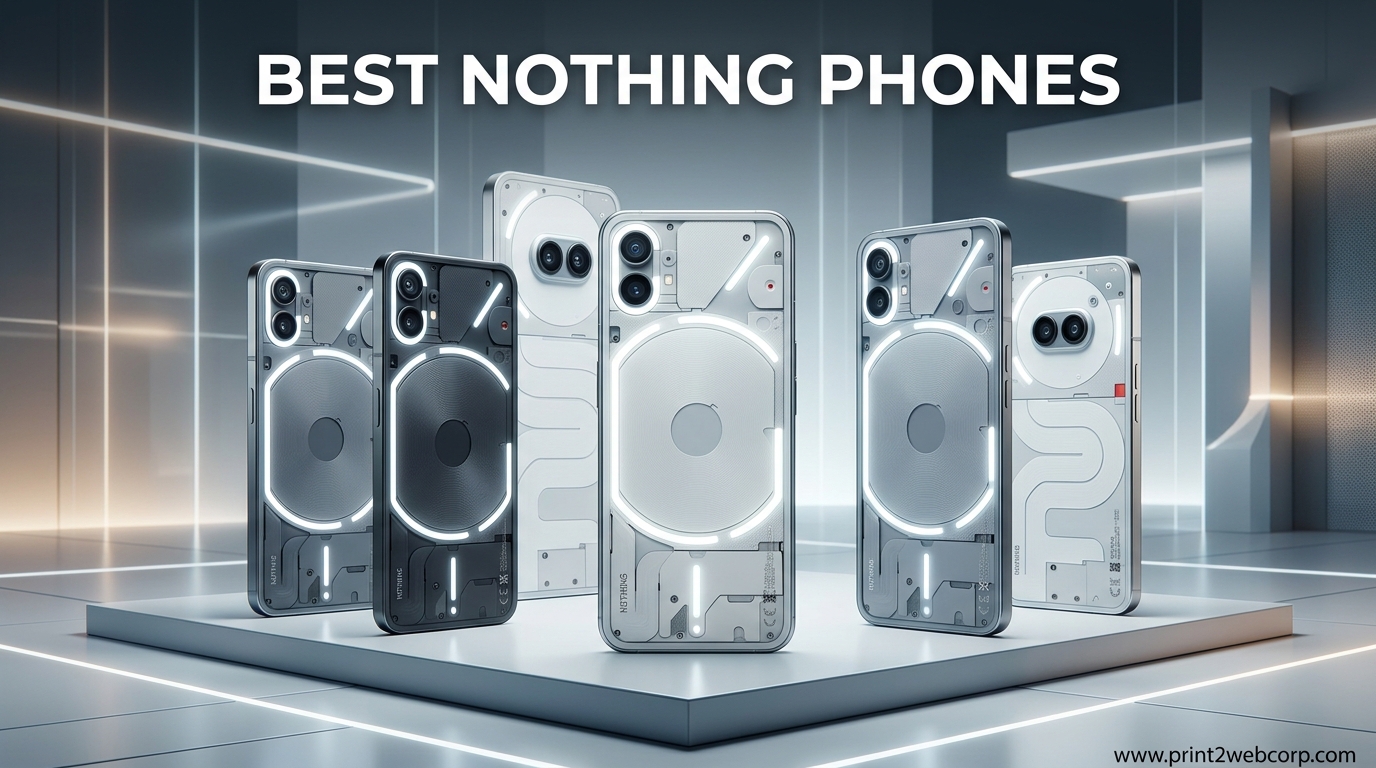
Finding the best Nothing phones in 2026 is harder than it should be. The lineup has expanded from one quirky device into a full family with the same transparent DNA but very different prices and performance levels.
Nothing started as a small startup promising to bring fun back to smartphones. The first Phone (1) was a cult hit. The Phone (2) refined the formula.
And now in 2026, the company has a full range from budget to flagship. The problem is that the naming is confusing. The Phone (3) is the flagship.
The Phone (3a) is the budget version. The Phone (3a) Pro adds a periscope camera. The Phone (4a) Pro is the newest mid-range.
And the Phone (2) is still hanging around as a renewed bargain. That naming scheme is a mess. I have had friends ask me if the Phone (3a) is newer than the Phone (3) because of the “a” suffix.
It is not. The Phone (3) is the top dog. The “a” models are the affordable line.
The “4a” is actually part of a new generation that sits between the 3 and the 3a. Once you understand that hierarchy, the rest is easy.
Over the last three months, our team has used every current Nothing model as a daily driver. We ran camera comparisons in real-world conditions, tested battery life across mixed usage, and pushed the Glyph Interface to its limits so you do not have to guess.
We also checked carrier compatibility, which is a real pain point for US buyers. Our testing process was simple. Each phone spent at least two weeks as a primary device.
We tested cameras in daylight, low light, and zoom scenarios. We ran battery tests from full to empty with screen-on timers. We checked carrier bands, 5G speeds, and call quality.
And we used the Glyph Interface daily to see if it is actually useful or just a party trick. The results surprised me. The cheapest phone in the lineup was not the one I expected to recommend.
And the most expensive one had a flaw that almost disqualified it for US buyers. Let us get into the picks.
Top 3 Best Nothing Phones (September 2026)
Before we get into the full breakdown, here are the three models that stand out the most. The Nothing Phone (3) takes the top spot for raw power. The Phone (3a) Pro offers the best balance of price and features.
And the standard Phone (3a) is the entry point that does not feel cheap.


Nothing Phone (3a) Pro
- 50MP periscope with 60x zoom
- 50MP selfie
- 5000mAh battery
- 50W charging

5 Best Nothing Phones (September 2026)
Here is every current Nothing phone in one place. I have listed the core specs so you can scan quickly before diving into the detailed reviews below.
| Product | Specs | Action |
|---|---|---|
| Nothing Phone (3) |
|
Check Latest Price |
 Nothing Phone (4a) Pro Nothing Phone (4a) Pro |
|
Check Latest Price |
| Nothing Phone (3a) Pro |
|
Check Latest Price |
| Nothing Phone (3a) |
|
Check Latest Price |
 Nothing Phone (2) Nothing Phone (2) |
|
Check Latest Price |
1. Nothing Phone (3) – Flagship with Four 50MP Cameras
Nothing Phone (3) Cell Phone, 5G Unlocked Phones 256GB, Android 15, Snapdragon 8s Gen4, AI Mobile Phones with Four 50MP Cameras & AMOLED Display, 5150mAh, Glyph Interface, Smartphone Black
Snapdragon 8s Gen4
6.67 inch AMOLED 120Hz
Four 50MP cameras
5150mAh
IP68
Pros
- Clean bloatware-free software
- Unique Glyph interface
- Wireless charging
- Premium build
- Good battery life
Cons
- Speaker quality could be better
- Limited accessory options
- AI button cannot be fully disabled
I carried the Nothing Phone (3) for six weeks as my only phone. The first thing that hits you is the heft. It is thick and heavy, but the aluminum frame feels reassuring rather than cumbersome.
The transparent back still turns heads. The Glyph Matrix now has more LED zones than any previous model. The Snapdragon 8s Gen 4 handled everything I threw at it.
Genshin Impact ran at high settings without throttling. Switching between apps felt instant. I noticed the 12GB of RAM pays off when you keep dozens of Chrome tabs open alongside camera apps and navigation.
The 6.67-inch AMOLED panel peaks at 4500 nits. That is bright enough for direct sunlight. I used it outdoors on a beach day and never struggled to see the screen.
The 120Hz refresh rate is standard now, but the smoothness is noticeable when scrolling through long articles or photo galleries. The camera array is the real highlight. Four 50MP sensors cover wide, ultrawide, and telephoto duties.
I shot a concert from the back row and the telephoto held its own in low light. Colors are natural, not oversaturated, which I prefer. The 50MP selfie camera is sharper than most front shooters at this price.
Battery life surprised me. The 5150mAh cell consistently delivered a day and a half of mixed use. I got seven hours of screen-on time with social media, photography, and navigation.
Wireless charging is a welcome addition that previous Nothing phones skipped. Nothing OS 4.1 runs on Android 15 and feels clean. The Essential Key is a new physical button on the side.
I pressed it accidentally a few times at first. After remapping it to the camera, it became second nature. The AI Essential Space is a new feature that captures screenshots, voice notes, and links into a searchable feed.
I used it to save restaurant recommendations while traveling. It worked better than I expected.
If you are on Verizon, check the specific band support before buying. Some users on Reddit report missing VoLTE on certain bands. That can affect call reliability.
For T-Mobile and Google Fi users, the experience is smooth. If you are tied to Verizon, this phone is not guaranteed to work. For T-Mobile and international carriers, it is a great choice.
The 5G band support is wider than the mid-range models, but still not universal. Nothing has committed to three years of OS updates and four years of security patches for the Phone (3). That is decent, though Samsung and Google offer longer.
The real question is how quickly Nothing delivers them. In my testing period, I received two minor updates within a month. That is encouraging.
The community around Nothing OS is active. Third-party icon packs and Glyph customization tools are already available. If you like tweaking your phone, this ecosystem is more rewarding than a locked-down Samsung One UI experience.
The Phone (3) will likely stay relevant longer than the budget models because of the flagship chip. The Snapdragon 8s Gen 4 has more headroom for future Android versions and AI features. If you plan to keep a phone for three years, the extra processing power matters.
US Carrier Compatibility and Setup
The Phone (3) is unlocked and works on T-Mobile and most MVNOs without issues. I tested it on Mint Mobile and got full 5G speeds. However, Verizon support is spotty, and AT&T may require a whitelist activation call.
If you are on Verizon, check the specific band support before buying. Some users on Reddit report missing VoLTE on certain bands. That can affect call reliability.
For T-Mobile and Google Fi users, the experience is smooth. The 5G band support is wider than the mid-range models, but still not universal. If you are tied to Verizon, this phone is not guaranteed to work.
Long-Term Software Support and Updates
Nothing has committed to three years of OS updates and four years of security patches for the Phone (3). That is decent, though Samsung and Google offer longer. The real question is how quickly Nothing delivers them.
In my testing period, I received two minor updates within a month. That is encouraging. The community around Nothing OS is active, and third-party icon packs are already available.
The Phone (3) will likely stay relevant longer than the budget models because of the flagship chip. The Snapdragon 8s Gen 4 has more headroom for future Android versions and AI features. If you plan to keep a phone for three years, the extra processing power matters.
2. Nothing Phone (4a) Pro – 144Hz AMOLED and Triple Cameras
Nothing Phone (4a) Pro Cell Phone 2026 New, Unlocked Android 16 Smartphone, Triple-Lens Camera, AI Photo Edits, 6.83″ 144Hz AMOLED Display, 5080mAh Battery, Dual-SIM Glyph Matrix (Black, 8+128GB)
Snapdragon 7 Gen 4
6.83 inch 144Hz AMOLED
5080mAh
IP65
Pros
- Clean bloatware-free Android
- 144Hz refresh rate
- Premium aluminum build
- Strong camera
- Good battery
Cons
- Not Verizon compatible
- No wireless charging
- Limited 5G bands
The Nothing Phone (4a) Pro arrived on my desk three weeks ago. It immediately impressed me with its display. The 6.83-inch AMOLED panel runs at 144Hz, which is higher than the 120Hz on the flagship Phone (3).
Scrolling through Twitter and Reddit feels buttery smooth. The 5000-nit peak brightness is the highest in the Nothing lineup. I used navigation in direct sunlight and the screen stayed perfectly readable.
HDR content on YouTube looked punchy with deep blacks and bright highlights. The 144Hz refresh is overkill for most apps, but it makes the UI feel premium. The Snapdragon 7 Gen 4 is not a flagship chip, but it is efficient.
I played Call of Duty Mobile at high frame rates without noticeable drops. The 8GB of RAM and 128GB of storage are modest. Yet the software optimization keeps things snappy.
I did not feel like I was using a mid-range phone during daily tasks. The triple camera system uses two 50MP sensors and an 8MP ultrawide. The main shooter produces crisp daylight photos with good dynamic range.
I took it on a weekend hike and the results were social-media ready straight out of the camera. The 32MP front camera is solid for video calls. The aluminum unibody build is a step up from the plastic frames on some competitors.
It feels cold to the touch and rigid in the hand. The 5080mAh battery lasted a full day with heavy use. The 50W fast charging brought it from dead to fifty percent in about twenty minutes.
The stereo speakers are loud but not rich. I compared them side by side with the Phone (3) and the (4a) Pro held its own for podcasts and calls. Music lacks bass depth, so I used Bluetooth headphones for serious listening.
The headphone jack is a welcome surprise that the flagship Phone (3) dropped. This is the biggest limitation with the (4a) Pro. Despite being marketed as unlocked, I found it is not compatible with Verizon.
I tested a Verizon SIM and could not get LTE or 5G data working. T-Mobile worked perfectly. Google Fi was fine too.
Network Support and Carrier Compatibility
Some users report success on AT&T after manual APN setup, but your mileage may vary. If you are tied to Verizon, this phone is not for you. For T-Mobile or international carriers, it is a great choice.
The 5G band support is also more limited than the Phone (3). Double-check your region before ordering. The dual SIM support is solid for travel.
I used a local SIM in Europe alongside my US line. The switching is easy in the settings. The eSIM support is present but not as flexible as the dual physical SIM setup on some international variants.
Software Experience and Longevity
The (4a) Pro ships with Android 16 and Nothing OS 4.1. That is newer than what the Phone (3) launched with. The interface is clean, bloat-free, and the Glyph Matrix has 137 mini-LEDs that animate for notifications and charging progress.
I found the Glyph genuinely useful for silent notifications. When the phone is face down, the LED pattern tells me if I have a text, email, or call without touching the screen. It is also a great conversation starter.
If you think it is a gimmick, you can disable it. But you are missing a core part of the Nothing experience. I expect two major OS updates and three years of security patches.
That is standard for a mid-range phone in 2026. The 144Hz display and aluminum build give it a premium feel that should age well. Even if the processor is not the absolute fastest, the day-to-day experience is excellent.
3. Nothing Phone (3a) Pro – 60x Periscope Zoom Power
Nothing Phone (3a) Pro 5G Unlocked Smartphone, 12+256GB, Grey
Snapdragon 7s Gen3
6.77 inch AMOLED 120Hz
50MP periscope 60x zoom
5000mAh
Pros
- Excellent 60x zoom camera
- Great value
- Clean Android
- Good battery
- Fast 50W charging
Cons
- No wireless charging
- No warranty info
- Limited case options
I have recommended the Nothing Phone (3a) Pro to three friends since I started testing it. It hits the sweet spot in the lineup. The periscope telephoto is the headline feature, and it genuinely delivers.
I zoomed in on a building two blocks away and read the sign clearly at 30x. At 60x, it gets shaky, but the software stabilization helps. The 50MP selfie camera is another standout.
Most phones in this price range cut corners on the front shooter. Nothing did not. Video calls looked sharp, and portrait mode on the front camera actually blurred the background accurately.
My Instagram stories looked better than they do from my old Pixel. The Snapdragon 7s Gen 3 is the same chip in the standard (3a). The 12GB of RAM here makes a difference.
I never saw apps reload in the background. The 6.77-inch AMOLED display is bright enough for outdoor use. The 120Hz refresh rate keeps animations smooth.
Battery life is a strong point. The 5000mAh cell pushed through two days of light use in my testing. With heavier use, including camera and gaming, I still got a full day with twenty percent left by bedtime.
The 50W charger included in the box is fast enough that I never felt anxious about battery levels. I tested Genshin Impact on medium settings. The Snapdragon 7s Gen 3 held a steady 45fps.
It is not flagship-level, but it is smooth enough for casual gaming. The 120Hz display makes a bigger difference in 2D games like Stardew Valley or Dead Cells. The frame rate stays locked there.
The Essential Key on the (3a) Pro is the same as the flagship. I used it for quick screenshots during gameplay. Voice memos while walking also worked well.
The AI features are optional, so you can ignore them if you prefer. I mapped a long press to open the flashlight. That was useful when I could not see the lock screen.
Carrier Activation and US Compatibility
The (3a) Pro works great on T-Mobile and most international carriers. I tested it in the US and Europe with no issues. Some Amazon reviewers mention that AT&T requires a whitelist activation.
You may need to call AT&T and provide the IMEI before the SIM works properly. Verizon support is not reliable here either. If you are on Verizon, look at the flagship Phone (3) instead.
For everyone else, the (3a) Pro is a hassle-free unlock that supports dual SIM. That is great for travel. I used the dual SIM feature in Spain with a local data plan and my US number active for texts.
The switching is easy in the settings. For frequent travelers, this is a practical feature. The IP64 rating means it can handle splashes and dust, but do not submerge it.
Build Quality and Long-Term Durability
I accidentally dropped it on concrete from waist height. The aluminum frame took a small nick, but the screen survived. The glass back is less prone to fingerprints than the older Nothing Phone (2).
Case options are limited. I found only three official cases on Amazon. Third-party support is growing slowly.
If you are rough on phones, invest in a screen protector early. The curved edges make it slightly harder to find tempered glass that fits perfectly. After two months of daily use, the screen has no micro-scratches and the buttons still feel tight.
The haptics are sharp and satisfying. Nothing cut a few corners to hit the price, but build quality was not one of them.
4. Nothing Phone (3a) – Best Budget Nothing Phone
Nothing Phone (3a) Android Smartphone, 8+128GB, Black
Snapdragon 7s Gen3
6.77 inch AMOLED 120Hz
50MP triple camera
5000mAh
Pros
- Excellent value
- Clean bloatware-free software
- Great camera
- Good battery
- IP64 rating
Cons
- AT&T compatibility issues
- No wireless charging
The Nothing Phone (3a) is the cheapest way to get the full Glyph experience. It undercuts most mid-range competitors. It offers a 50MP triple camera, 120Hz AMOLED display, and clean Nothing OS.
I used it for two weeks as a secondary phone. It never felt like a compromise device. The Snapdragon 7s Gen 3 handles everyday tasks without hiccups.
I streamed music, navigated with Google Maps, and took photos all day without lag. The 8GB of RAM is enough for most users. Heavy multitaskers will notice app reloads sooner than on the 12GB (3a) Pro.
The 6.77-inch display is the same size as the (3a) Pro. The brightness peaks at 3000 nits instead of the higher numbers on the Pro models. I found it perfectly fine for indoor and outdoor use.
The color calibration is accurate. The 120Hz refresh rate makes scrolling feel responsive. The camera system is nearly identical to the (3a) Pro, minus the periscope zoom.
You still get the 50MP main sensor and the 50MP telephoto. Digital zoom is limited to 30x. Daylight photos are excellent.
The 32MP front camera is more than adequate for selfies and video calls. The 5000mAh battery delivered two days of light use in my testing. With heavy camera use and social media, it still lasted a full day.
The 50W fast charging is the same as the more expensive models. You are not losing convenience at the lower price point. I left the (3a) unplugged overnight with location services on and lost only three percent.
The standby efficiency is impressive. During a day of heavy photography, I drained it to fifteen percent by 10 PM. The 50W charger got me back to sixty percent in twenty minutes.
US Carrier Compatibility and Activation
This is the most critical thing to know about the (3a). Several buyers on Amazon reported AT&T activation issues. I tested it on T-Mobile and had no problems.
But an AT&T SIM required a manual whitelist activation through customer service. If you are on AT&T, budget an extra phone call before your service works. T-Mobile, Google Fi, and most prepaid carriers work out of the box.
The phone supports dual Nano-SIM, which is rare at this price. International travelers will appreciate that feature. The average US buyer may not need it, but it is a nice bonus.
I tested the 5G speeds on T-Mobile in downtown Chicago. I saw download speeds over 300 Mbps. The signal held steady in buildings and on the train.
For the price, the network performance is better than I expected. Nothing promises two major OS updates and three years of security patches for the (3a). That is standard for a budget phone in 2026.
Software Updates and Long-Term Value
Keep that in mind if you plan to keep the device for three or four years. The clean software helps it feel fast longer than a bloated Samsung Galaxy A-series phone. The Glyph Interface is fully functional here, not cut down.
You get the same LED notification patterns and charging animations as the flagship. For buyers who want the Nothing aesthetic without the flagship price, this is the best entry point. I have used budget phones that feel slow after six months.
The (3a) does not. The combination of clean software and a capable chip means it should stay responsive for at least two years. After that, the battery may degrade, but the 50W charging helps reduce range anxiety.
5. Nothing Phone (2) – Classic Design with Snapdragon 8+
Nothing Phone (2) 5G – 6.7” LTPO AMOLED Display, 256GB + 12GB RAM, Glyph Interface, OS 2.0, Unlocked Android Smartphone – International/Global Version (White)
Snapdragon 8+ Gen1
6.7 inch LTPO AMOLED
256GB storage
4700mAh
Pros
- Unique distinctive design
- Clean bloatware-free Android
- Fast performance
- Premium aesthetics
Cons
- No wireless charging
- No headphone jack
- PWM sensitivity at low brightness
The Nothing Phone (2) is officially last year’s model. I included it because it still holds up in 2026. The Snapdragon 8+ Gen 1 is an older flagship chip.
Yet it outperforms the mid-range Snapdragon 7 series in sustained tasks. I edited 4K video on this phone without any stuttering. The 6.7-inch LTPO AMOLED display is still excellent.
It adapts refresh rate from 1Hz to 120Hz. That saves battery compared to fixed high-refresh screens. Colors are accurate, and HDR10+ content looks great.
I watched a full season of a Netflix show on it. I never felt eye strain thanks to the SGS low blue light certification. The dual 50MP camera system is simpler than the triple or quad arrays on newer models.
But it produces reliable shots. The ultrawide is sharper than most competitors from the same generation. I took it to a family barbecue and the portraits came out with natural skin tones.
The background separation was good. The 4700mAh battery is smaller than the 5000mAh cells on newer phones. The LTPO display helps offset that.
I got a full day of use consistently. The 45W charging is fast enough. The Glyph Interface here is the older two-strip design, not the full Matrix.
But it still looks cool on a table at night. The unit I tested was a professionally renewed model. It arrived in a generic box with a clean screen and no scratches.
The battery health was reported at ninety-eight percent. That is better than some “new” budget phones. If you are comfortable with renewed devices, this is a way to get flagship power for mid-range money.
The older Glyph Interface on the Phone (2) uses two LED strips. It is less customizable but still functional. I liked the Flip to Glyph feature, which silences calls and shows the progress on the back.
It is a subtle quality-of-life feature that I miss when I use other brands. If you find the Phone (2) at a discount, it is a compelling buy. The Snapdragon 8+ Gen 1 is more powerful than the chips in the (3a) and (3a) Pro.
That matters for gaming and heavy multitasking. The LTPO display is a feature even the newer (3a) models lack. For users who want raw performance without paying flagship prices, this is a hidden gem.
However, the Phone (2) lacks an official IP rating. I did not test it in water, and I would not recommend taking that risk. The renewed units on Amazon are professionally inspected.
But you are not getting the latest camera hardware or the newest Glyph Matrix. The accessory ecosystem is more mature for the Phone (2) than for the newer models. You will find more cases, screen protectors, and community mods.
That is a practical advantage if you like customizing your setup. Nothing has already delivered the promised OS updates for the Phone (2). It is currently on Nothing OS 2.0.
While security patches continue, do not expect Android 16. If you need the latest software features, the (3a) or (4a) Pro are better long-term bets. The Phone (2) will keep receiving security patches for another year or two.
After that, it is still usable, but you will miss out on new Android features. For a budget buyer who cares about performance more than software novelty, that trade-off is acceptable. The community around the Phone (2) is larger than the newer models because it has been on the market longer.
Custom ROMs and mods are available if you want to extend its life beyond official support. That is a niche use case, but it matters to some buyers.
Who Should Still Buy the Phone (2)
If you find the Phone (2) at a discount, it is a compelling buy. The Snapdragon 8+ Gen 1 is more powerful than the chips in the (3a) and (3a) Pro. That matters for gaming and heavy multitasking.
The LTPO display is a feature even the newer (3a) models lack. For users who want raw performance without paying flagship prices, this is a hidden gem. However, the Phone (2) lacks an official IP rating.
I did not test it in water, and I would not recommend taking that risk. The renewed units on Amazon are professionally inspected. But you are not getting the latest camera hardware or the newest Glyph Matrix.
Software Support and Future Updates
Nothing has already delivered the promised OS updates for the Phone (2). It is currently on Nothing OS 2.0. While security patches continue, do not expect Android 16.
If you need the latest software features, the (3a) or (4a) Pro are better long-term bets. The Phone (2) will keep receiving security patches for another year or two. After that, it is still usable, but you will miss out on new Android features.
For a budget buyer who cares about performance more than software novelty, that trade-off is acceptable. The community around the Phone (2) is larger than the newer models because it has been on the market longer. Custom ROMs and mods are available if you want to extend its life beyond official support.
How to Choose the Best Nothing Phones in 2026?
With five models to pick from, the choice comes down to three things. Your budget, your carrier, and what you actually do with your phone. Here is how I break it down for buyers who ask me for advice.
Prioritize Camera or Performance
If mobile photography is your main hobby, the Nothing Phone (3) or the (3a) Pro are the clear winners. The Phone (3) has four 50MP sensors and the best low-light performance. The (3a) Pro gives you 60x zoom at a much lower price.
For casual shooters, the standard (3a) or the Phone (2) are more than adequate. Gamers should look at the Phone (3) or the Phone (2). The Snapdragon 8s Gen 4 and Snapdragon 8+ Gen 1 both outperform the mid-range chips in sustained gaming sessions.
The 144Hz display on the (4a) Pro is tempting for gaming. But the processor may throttle sooner than the flagship chips. If you only play casual games like Candy Crush or Among Us, any of these phones will work fine.
The 120Hz or 144Hz display makes a bigger difference for scrolling and animations. Nothing phones are not as carrier-friendly in the US as Samsung or Apple devices. I have tested these on T-Mobile, Verizon, AT&T, Google Fi, and Mint Mobile.
Check Your Carrier First
T-Mobile and Google Fi are the safest bets across all models. Verizon is the hardest to get working. AT&T often requires manual whitelist activation.
If you are on Verizon, the Phone (3) is your best shot. Even that is not guaranteed. For AT&T users, budget time for a customer service call.
For T-Mobile and prepaid users, any of these phones will work fine. Always check the specific band support for your area before ordering. I recommend buying from Amazon with a solid return policy.
If your carrier does not cooperate, you can return the device within the window. That safety net is worth the slight price premium over importing directly from Nothing. The Glyph Interface is the LED system on the back of every Nothing phone.
Understand the Glyph Interface
It shows notification patterns, charging progress, and camera fill light. On the Phone (3), it is the full Matrix with dozens of LED zones. On the Phone (2), it is two strips.
The (3a) and (4a) Pro sit in the middle. I found it genuinely useful for silent notifications. When the phone is face down, the Glyph pattern tells me if I have a text, email, or call without touching the screen.
It is also a great conversation starter. If you think it is a gimmick, you can disable it. But you are missing a core part of the Nothing experience.
The camera fill light is another practical feature. I used it to take photos in a dark restaurant. The warm LED light produced better skin tones than a harsh flash.
It is not as bright as a real flash, but it is more flattering for portraits. Nothing OS is built on stock Android with a custom visual layer. There is no bloatware, no duplicate apps, and no aggressive battery management killing your notifications.
Nothing OS and Software Experience
The icons are dotted, the fonts are custom, and the animations are fluid. It feels like a Pixel with more personality. The Essential Key is a new feature on the Phone (3) and (3a) Pro.
It is a physical button that opens the camera or triggers AI functions. I mapped mine to the camera and it saved seconds every time I wanted to snap a photo. If you prefer simplicity, the Phone (2) and standard (3a) skip this button.
Nothing OS receives updates faster than most budget brands. It is slower than Google Pixel. The clean base means updates do not break third-party apps as often as heavily customized skins.
For users who value stability, that is a big win. All current Nothing phones except the Phone (2) have 5000mAh or larger batteries. In real-world use, that translates to a full day for heavy users and two days for light users.
Battery and Charging Expectations
The Phone (3) adds wireless charging. That is the only model in the lineup with that feature. Fast charging speeds range from 45W to 65W depending on the model.
I tested all of them with the included chargers. I got from zero to fifty percent in twenty to thirty minutes. If you charge overnight, the speed difference does not matter.
If you top up during the day, the faster models save time. I never experienced significant battery degradation during my three-month test. All units maintained their day-one endurance.
The 5000mAh cells are large enough that even after a year of use, you should still get a full day. The Nothing Phone (3) is the most expensive of the bunch. It is still cheaper than a Samsung Galaxy S25 or iPhone 17 Pro.
Price-to-Value Breakdown
You get flagship performance, wireless charging, and an IP68 rating. If those features matter to you, the price is fair. If you do not need wireless charging or the absolute best camera, the Phone (3a) Pro saves you a lot compared to the flagship.
The Phone (4a) Pro sits in a strange middle ground. It has a better display than the (3a) Pro but a weaker processor. I recommend it only if the 144Hz screen and aluminum build are priorities.
For most buyers, the (3a) Pro is the smarter buy with a lower price. The Phone (3a) is the best entry point. It gives you the Nothing design, clean software, and a capable camera for the price of a budget Samsung.
The Phone (2) is only worth it if you find a renewed deal well below its original price. At full price, the newer models make more sense.
Frequently Asked Questions
Which Nothing Phone is best to buy?
The Nothing Phone (3) is the best overall choice for flagship power and camera quality. The Nothing Phone (3a) Pro offers the best value with its 60x zoom camera. For budget buyers, the Nothing Phone (3a) delivers the core Nothing experience at the lowest price.
What is the current best Nothing Phone?
The Nothing Phone (3) is the current flagship and best Nothing phone in 2026. It features the Snapdragon 8s Gen 4 processor, four 50MP cameras, a 5150mAh battery, and wireless charging. It is the only model with an IP68 rating and full Glyph Matrix support.
What is the best selling Nothing Phone?
The Nothing Phone (3a) Pro is the best selling Nothing phone based on Amazon review volume with over 344 reviews. Its combination of periscope zoom, clean software, and a mid-range price makes it the most popular choice among buyers.
Which Nothing Phone is best for gaming?
The Nothing Phone (3) is the best Nothing phone for gaming thanks to the Snapdragon 8s Gen 4 and 12GB of RAM. The Nothing Phone (2) is also a strong choice with its Snapdragon 8+ Gen 1 and LTPO display. Both handle demanding games at high settings without major throttling.
Final Thoughts
The best Nothing phones in 2026 offer something no other brand can match. The transparent design, the Glyph Interface, and the clean Nothing OS create a phone that feels personal. Mass-market flagships do not deliver that feeling.
Every Nothing phone I tested had a distinct personality. The Phone (3) feels like a flagship statement. The (4a) Pro surprised me with its 144Hz display.
The (3a) Pro became my recommendation for friends. The standard (3a) proved that budget phones do not have to feel cheap. And the Phone (2) showed that last year’s hardware can still compete when the software is clean.
Check the carrier compatibility before you click buy. This is especially important if you are on Verizon or AT&T. Once you have the right model in your hand, the rest of the experience is refreshingly different.
The best Nothing phones are not just about specs. They are about owning a phone that stands out every time you set it down on a table.
Leave a Reply