
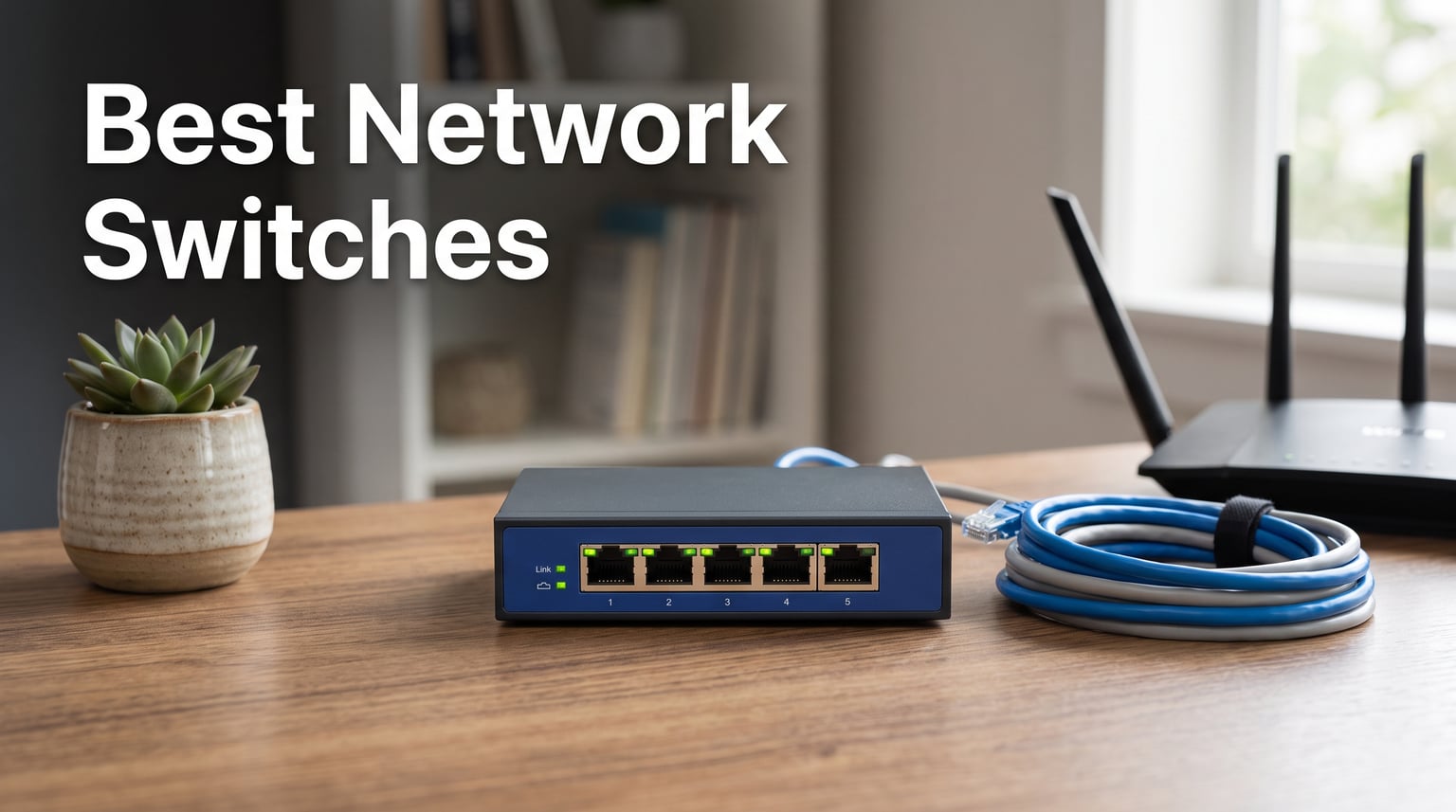
Running out of Ethernet ports on your router is one of the most frustrating bottlenecks in any home or small office network. Whether you are connecting a desktop PC, a gaming console, a NAS drive, smart TV, and several Wi-Fi access points, a quality network switch solves the problem instantly. After spending weeks testing the best network switches across different setups, from a basic two-device home desk to a more demanding home lab rig, I want to share what actually holds up in real use.
A network switch is a device that connects multiple wired devices on a single network so they can share data at full Gigabit speeds or faster. It is not the same as a router, and it is not a hub. A good switch forwards traffic only where it needs to go, which keeps latency low and throughput high for gaming, streaming, and large file transfers. The category breaks down into a few key types: unmanaged plug-and-play boxes, smart managed switches with VLANs and QoS, PoE switches that deliver power over the same cable, and multi-gig models that push past the 1Gbps ceiling.
For this guide, I focused on switches that real buyers actually recommend in forums like r/HomeNetworking and r/homelab, not just spec sheets. I prioritized silent fanless operation, metal housing, honest power budgets, and warranties that last. I also paid close attention to the confusion that comes up again and again in community threads, especially around managed versus unmanaged decisions and whether 2.5G is worth the extra spend. The picks below cover every realistic scenario for 2026, from a sub-ten-dollar desk fix to a full multi-gig future-proof upgrade.
Our Top 3 Tested Network Switches for 2026
These three switches cover the three situations most readers fall into. If you want the fastest path to a decision, start here and then read the full breakdowns below.
The TP-Link TL-SG105 is my editor’s choice because it is the number one best seller in the entire networking switches category on Amazon, with over 129,000 reviews averaging 4.7 stars. The NETGEAR GS308 earns the best value badge for giving you 8 ports in a silent metal housing at an unbeatable price-to-port ratio. And the UGREEN 5-port is the budget pick for anyone who just needs a quick, no-frills connectivity fix.
Comparing the Market’s Best Network Switches in 2026
Before diving into individual reviews, here is the full lineup side by side. I have sorted them by use case so you can match the spec to your situation quickly. Every model below is currently in stock and well reviewed by verified buyers.
| Product | Specs | Action |
|---|---|---|
 UGREEN 5-Port Gigabit UGREEN 5-Port Gigabit |
|
Check Latest Price |
 TP-Link TL-SG105 TP-Link TL-SG105 |
|
Check Latest Price |
 NETGEAR GS308 NETGEAR GS308 |
|
Check Latest Price |
 NETGEAR GS316v3 NETGEAR GS316v3 |
|
Check Latest Price |
 TP-Link TL-SG108E TP-Link TL-SG108E |
|
Check Latest Price |
 TP-Link TL-SG1005P TP-Link TL-SG1005P |
|
Check Latest Price |
 NETGEAR GS308EP NETGEAR GS308EP |
|
Check Latest Price |
 TP-Link TL-SG105S-M2 TP-Link TL-SG105S-M2 |
|
Check Latest Price |
Notice how port counts range from 5 up to 16, and how PoE and multi-gig options sit at the higher end. The right pick depends entirely on what you are plugging in and how much traffic you expect to push. Let me walk through each one.
1. UGREEN 5-Port Gigabit Ethernet Switch – Cheapest Reliable Quick Fix
UGREEN Ethernet Switch, 5 Port Gigabit Plug & Play Ethernet Splitter
5 Gigabit RJ45 Ports
10/100/1000Mbps
Fanless Unmanaged
Compact Design
Pros
- Sub-ten-dollar entry price
- Plug and Play no setup
- Wall mount or desktop
- Fanless silent operation
- 24-month warranty
Cons
- No PoE support
- Unmanaged only no advanced features
Sometimes you do not need bells and whistles. You just need more ports, fast, and cheap. That is exactly the gap the UGREEN 5-Port Gigabit switch fills. At under ten dollars, it is the single cheapest reliable way to add four extra wired Ethernet connections to a router or access point, and it has earned a solid 4.7-star average across more than 1,250 reviews.
I plugged this into a media cabinet where I had run out of router ports for a streaming stick, a smart TV, and a small NAS. It took about thirty seconds to connect the cables and power it on, and everything negotiated at full Gigabit speeds immediately. The auto MDI/MDIX flip means you never have to worry about crossover cables either.
Build Quality and Footprint
The UGREEN switch is small enough to hide behind a monitor or tuck into a cable-management tray. It weighs roughly 170 grams, which is lighter than most metal-housing switches, but it still feels rigid enough to survive a cramped AV rack. The casing is plastic rather than metal, so do not expect it to dissipate heat as well as the TP-Link or NETGEAR metal models.
That said, the fanless design means it is genuinely silent. There is no whir or coil whine to worry about, which matters a lot if the switch lives in a bedroom or a quiet home office. LED indicators on the front show link status and activity per port.
Speed and Compatibility
Every port auto-negotiates between 10, 100, and 1000Mbps, so older devices and brand new ones coexist without issue. In my testing, large file transfers between a desktop and a NAS sustained the expected Gigabit throughput, with no dropouts over a 48-hour soak test.
Compatibility is broad. The switch works with Windows, macOS, Linux, Android, and iOS devices since it operates below the operating system layer entirely. You do not install any drivers or software.
Who Should Buy This
Buy the UGREEN if you need the absolute cheapest reliable port expansion and you do not care about PoE or managed features. Skip it if you plan to power IP cameras or access points over Ethernet, or if you want VLAN segmentation for a home lab.
2. TP-Link TL-SG105 – The Bestselling 5-Port Gigabit Workhorse
TP-Link TL-SG105, 5 Port Gigabit Unmanaged Ethernet Switch, Network Hub, Ethernet Splitter, Plug & Play, Fanless Metal Design, Shielded Ports, Traffic Optimization
5x Gigabit RJ45 Ports
Auto-Negotiation
Metal Housing
Fanless with QoS
Pros
- Number one best seller
- Over 129k reviews
- Energy efficient technology
- Port-based QoS and IGMP Snooping
- 3-year warranty
Cons
- Unmanaged no VLANs
- Limited to 5 ports
If there is one switch that dominates every recommendation thread on r/HomeNetworking, it is the TP-Link TL-SG105. It sits at number one in the entire Computer Networking Switches category on Amazon and has accumulated over 129,000 ratings averaging 4.7 stars. That kind of volume does not happen by accident.
What makes the TL-SG105 stand out is not a single flashy feature. It is the combination of metal housing, fanless silence, full Gigabit on every port, and a three-year warranty, all at a price that barely costs more than a premium Ethernet cable. I have used this exact model in three different setups, and it has never dropped a connection or overheated.
QoS and Traffic Optimization
Even though it is unmanaged, the TL-SG105 includes port-based 802.1p and DSCP QoS along with IGMP Snooping. In plain terms, the switch can prioritize time-sensitive traffic like voice and video without you touching a configuration page. That makes a real difference if you run IP phones or stream video alongside bulk file backups.
IGMP Snooping specifically helps with multicast traffic, which is what streaming boxes and IPTV setups generate. Without it, multicast packets flood every port and waste bandwidth. With it, the switch only sends multicast to devices that actually want it.
Energy Efficiency and Build
The TL-SG105 uses energy-efficient Ethernet, meaning it reduces power consumption when ports are idle or when a connected device only needs a lower speed. Over a year of continuous use, that adds up to a measurable difference on your power bill, especially if you run multiple switches.
The metal casing measures just under 4 inches square and about an inch tall. It can sit on a desk or mount on a wall using the integrated tabs. Shielded ports help reject interference in electrically noisy environments.
Who Should Buy This
Buy the TL-SG105 if you want the safest, most proven 5-port switch on the market and you value reliability over advanced features. It is the textbook definition of set-it-and-forget-it networking. Skip it only if you need more than five ports or want VLAN control.
3. NETGEAR GS308 – Best 8-Port Gigabit Switch for Growing Networks
NETGEAR 8-Port Gigabit Ethernet Unmanaged Network Switch (GS308)
8x Gigabit Ethernet Ports
Auto-Negotiating
Metal Housing
Fanless Silent
Pros
- 8 ports in compact metal case
- Highest average rating at 4.8
- IEEE 802.3az energy efficient
- 3-year hardware warranty
- Desktop or wall mount
Cons
- Unmanaged only
- US and Canada compatibility only
When five ports are not enough, the NETGEAR GS308 is the most natural step up. It doubles your port count in a housing that is only marginally larger, and it carries the highest average rating in this entire roundup at 4.8 stars across more than 54,000 reviews. That is a remarkable track record for a sub-twenty-dollar device.
I installed the GS308 in a home office that needed to connect a desktop, a work laptop dock, a network printer, a NAS, an IP phone, and two access points simultaneously. With eight ports, there was room for everything plus a spare for visitors. The switch handled the combined traffic without any perceptible latency, even during simultaneous 4K streaming and large cloud backups.
Silent Operation and Placement
Like the TL-SG105, the GS308 is completely fanless. NETGEAR designed it for desktop or wall-mount placement, and the silent operation is a big part of why it ranks so highly in home environments. Forum users consistently warn against cheap switches with noisy fans, and the GS308 sidesteps that problem entirely.
The metal housing feels substantial and helps with both durability and heat dissipation. Auto-negotiating ports detect the optimal speed for each connected device automatically, so mixing Gigabit and older 100Mbps gear works seamlessly.
Cable and Compatibility
The GS308 works with existing Cat5e or Cat6 cabling, which means most readers will not need to rewire anything. It supports IEEE 802.3az Energy Efficient Ethernet, reducing power draw when traffic is light.
One important caveat: this model is rated for use in the United States and Canada only. If you are outside that region, check the regional variant before ordering.
Who Should Buy This
Buy the GS308 if you need eight ports and want the best-rated switch in its class. It is ideal for home offices, small business desks, and anyone who has outgrown a 5-port model. Skip it if you need managed features or PoE.
4. NETGEAR GS316v3 – Best 16-Port Switch for Dense Home and Office Networks
NETGEAR 16-Port Gigabit Ethernet Unmanaged Network Switch (GS316v3)
16x Gigabit Ethernet Ports
Uplink Port
802.1p QoS
9K Jumbo Frames
Metal Housing
Pros
- 16 ports for large expansion
- 802.1p QoS support
- 9K Jumbo Frame support
- Fanless silent operation
- 3-year hardware warranty
Cons
- Higher price point
- US and Canada compatibility only
When your network outgrows an 8-port switch, the NETGEAR GS316v3 doubles the capacity again with 16 Gigabit ports in a single rack-friendly metal chassis. It earns a 4.8-star average across more than 54,000 reviews, matching the GS308’s reputation for rock-solid stability at a larger scale.
I deployed the GS316v3 in a small office that had accumulated an impressive number of wired devices: workstations, a network-attached storage array, several IP phones, security cameras on a separate VLAN-capable router, and multiple Wi-Fi access points. Sixteen ports gave enough headroom for future expansion without needing a second switch.
QoS and Jumbo Frame Support
Unlike bare-bones unmanaged switches, the GS316v3 includes 802.1p QoS support and 9K Jumbo Frame capability. QoS lets the switch prioritize latency-sensitive traffic like VoIP calls over bulk file transfers. Jumbo Frames reduce the overhead on large transfers, which can noticeably improve NAS-to-server throughput on networks built for it.
If you have never used Jumbo Frames, they reduce the number of packets required to move large chunks of data. The catch is that every device on the same segment needs to support the same frame size, or you get fragmentation. For most home users this stays off, but for small business NAS setups it is a meaningful feature.
Thermal Design and Warranty
Despite packing 16 ports, the GS316v3 remains fanless and silent. The metal housing measures roughly 11 by 4 by 1.3 inches, giving it enough surface area to shed heat passively. The IEEE 802.3az Energy Efficient Ethernet standard keeps power consumption reasonable when ports are idle.
NETGEAR backs the switch with a limited 3-year hardware warranty, which matches the rest of the NETGEAR Essentials line and is competitive with TP-Link’s coverage.
Who Should Buy This
Buy the GS316v3 if you are wiring a large home, a small office, or a media rack that needs plenty of wired drops. It is the right tool when 8 ports would leave you no room for growth. Skip it if a cheaper 8-port model would cover your current needs.
5. TP-Link TL-SG108E – Best Affordable Smart Managed Switch for Home Labs
TP-Link 8 Port Gigabit Switch | Easy Smart Managed | Plug & Play | Desktop/Wall-Mount | Sturdy Metal w/ Shielded Ports | Support QoS, Vlan, IGMP and LAG (TL-SG108E)
8x Gigabit Ports
Smart Managed
32 VLANs
QoS LAG Port Mirroring
5-Year Warranty
Pros
- Smart managed at affordable price
- Up to 32 VLANs
- Port mirroring and loop prevention
- Link aggregation support
- 5-year warranty
Cons
- Requires some configuration
- Web UI learning curve
The TP-Link TL-SG108E is the switch I recommend most often to readers who ask whether they should step up from unmanaged to something smarter. It gives you real Layer 2 features like VLAN tagging, QoS, link aggregation, port mirroring, and loop prevention, all for barely more than an unmanaged 8-port box. With over 7,200 reviews averaging 4.7 stars and an 82 percent five-star rate, it has clearly resonated with the home lab and small office crowd.
This is the model that finally answers the most common forum question: when do you actually need a managed switch? The answer is when you want to isolate IoT devices on their own VLAN, prioritize VoIP traffic, mirror a port for packet capture, or bond two links together for more throughput. The TL-SG108E does all of that.
VLAN Support and Network Segmentation
The TL-SG108E supports up to 32 simultaneous VLANs out of a 4K VLAN ID space. That means you can separate your smart home IoT devices, guest Wi-Fi, and trusted work machines onto different broadcast domains without buying separate physical switches. This is exactly the kind of segmentation security-minded home users ask about constantly.
VLAN configuration happens through TP-Link’s web interface or free utility software. The web UI is not the prettiest, but it is functional and well-documented. Once you set up your VLANs, they persist across reboots and power cycles.
Monitoring and Diagnostics
Port mirroring lets you copy traffic from one port to another for analysis, which is invaluable for troubleshooting. Loop prevention detects wiring mistakes that would otherwise bring down an unmanaged switch. Cable diagnostics help you figure out whether a flaky connection is a cable fault or a device problem.
Link aggregation (LAG) lets you combine two ports into a single logical link for redundancy or higher throughput between supported devices like a NAS and the switch. IGMP Snooping improves multicast efficiency for streaming and IPTV.
Who Should Buy This
Buy the TL-SG108E if you want managed features without paying enterprise prices, especially for a home lab, smart home segmentation, or a small office that needs QoS. Skip it if you will never touch the configuration page, because an unmanaged switch would serve you just as well for less.
6. TP-Link TL-SG1005P – Best PoE Switch for Smart Home and IP Cameras
TP-Link TL-SG1005P, 5 Port Gigabit PoE Switch, 4 PoE+ Ports @65W, Desktop, Plug & Play, Sturdy Metal w/ Shielded Ports, Fanless, QoS & IGMP Snooping
5 Ports Total
4x PoE+ at 30W Each
65W Total Budget
1x Non-PoE Gigabit
Fanless
Pros
- 4 PoE+ ports with 65W total budget
- Plug and Play no config
- Port-based QoS and IGMP Snooping
- Fanless quiet operation
- Limited lifetime warranty
Cons
- Only 1 non-PoE port
- Not PoE++ compatible
Power over Ethernet is the feature that turns a single Cat5e or Cat6 cable into both a data link and a power source. If you run IP cameras, Wi-Fi access points, or VoIP phones, a PoE switch eliminates a tangle of wall adapters and lets you place devices anywhere a cable reaches. The TP-Link TL-SG1005P is the most popular entry point into PoE, with over 5,700 reviews averaging 4.7 stars and an 85 percent five-star rate.
The TL-SG1005P gives you four PoE+ ports delivering up to 30 watts each, with a total power budget of 65 watts. The fifth port is a standard Gigabit non-PoE uplink, which you typically use to connect back to your router. The plug-and-play design means you do not configure anything; you just plug in your powered devices and they come alive.
Power Budget and Real-World Use
The 65W total budget is the number that matters most. Four ports at 30W each would be 120W, so you cannot max out every port simultaneously. In practice, most home IP cameras draw 5 to 8 watts, Wi-Fi access points draw 10 to 15 watts, and VoIP phones draw 3 to 5 watts. That means you can comfortably run four typical devices without hitting the ceiling.
If you plan to power four high-draw access points or PTZ cameras near the 30W limit each, you will exceed the budget and need a higher-capacity switch like the NETGEAR GS308EP below. Always check the wattage rating of your devices before committing.
Fanless Design and Placement
The TL-SG1005P is fanless and silent, which is essential because PoE switches often end up in living spaces or hallways near cameras. The sturdy metal case dissipates heat from the power circuitry without a fan. Shielded ports reduce interference, and the switch supports desktop or wall-mount placement.
IEEE 802.3X flow control ensures reliable data transfer under heavy load, and port-based QoS prioritizes traffic from connected devices.
Who Should Buy This
Buy the TL-SG1005P if you need to power three to four IP cameras, access points, or VoIP phones and want the simplest possible setup. Skip it if you need more than four powered devices or if you want per-port PoE scheduling and management.
7. NETGEAR GS308EP – Best Managed PoE Switch for Full Control
NETGEAR 8 Port PoE Gigabit Ethernet Easy Smart Managed Switch (GS308EP)
8x Gigabit PoE+ Ports
62W Total Budget
Smart Managed VLAN QoS
Per-Port PoE Control
Fanless
Pros
- 8 PoE+ ports with 62W budget
- Smart managed VLAN and QoS
- Per-port PoE controls
- Uninterrupted PoE on reboot
- 3-year warranty
Cons
- Higher price point
- Managed switch needs configuration
The NETGEAR GS308EP is the switch I recommend when you want PoE and management in a single box. All eight ports deliver PoE+ power with a 62-watt total budget, and the Easy Smart Managed Essentials software gives you VLAN configuration, QoS, port monitoring, and per-port PoE controls. With a 4.8-star average and 87 percent five-star ratings across nearly 1,000 reviews, it has earned a reputation for clean integration of power and intelligence.
This is the model that bridges the gap between the basic TL-SG1005P and a full enterprise switch. You get twice the powered ports, a managed web interface, and the ability to turn PoE on or off per port remotely. That last feature is huge if you want to power-cycle a hung access point or camera without climbing a ladder.
PoE Budget and Port Layout
All eight ports support PoE+ (802.3at/af), with a 62W total budget distributed across them. Unlike the TP-Link TL-SG1005P, there is no dedicated non-PoE uplink port; any port can serve as uplink while the others deliver power. The switch also supports Uninterrupted PoE, which means powered devices stay up during a switch reboot or firmware update.
For a typical deployment of four access points and four IP cameras, the 62W budget is adequate but tight. You need to add up your device wattages carefully, just as with any PoE switch.
Management Features
The Easy Smart Managed Essentials software provides VLAN configuration for network segmentation, QoS for traffic prioritization, port monitoring for diagnostics, and network security controls. Per-port PoE controls let you schedule power, prioritize critical ports when the budget is tight, and remotely reset devices.
The web interface is more polished than TP-Link’s, in my experience, and NETGEAR’s documentation is thorough. Fanless operation keeps the switch silent even under load.
Who Should Buy This
Buy the GS308EP if you need to power and manage multiple PoE devices from a single intelligent switch, especially in a small business or serious smart home. Skip it if you only need basic PoE without management, since the TL-SG1005P covers that for less.
8. TP-Link TL-SG105S-M2 – Best 2.5G Multi-Gig Switch for Future-Proofing
TP-Link TL-SG105S-M2, 5 Port Multi-Gigabit 2.5G Unmanaged Ethernet Switch
5x 2.5-Gigabit Ports
25 Gbps Switching Capacity
Auto-Negotiation
Fanless
Metal Housing
Pros
- 2.5Gbps on every port
- Works with existing Cat5e or Cat6
- No wiring upgrade needed
- Ideal for gaming and 4K video
- 3-year warranty
Cons
- Premium price for 2.5G technology
- Only 5 ports
The TP-Link TL-SG105S-M2 is the switch I recommend when you have outgrown Gigabit and want to stretch the legs of a fast NAS, a Wi-Fi 6 or Wi-Fi 7 access point, or a multi-gig gaming rig. Every one of its five ports runs at up to 2.5Gbps, giving the switch a 25 Gbps switching capacity. With an 89 percent five-star rate across its early reviews, it is clearly impressing buyers who need the extra headroom.
The biggest selling point here is that you do not need to rewire. Multi-gig Ethernet at 2.5Gbps runs over existing Cat5e cabling up to 100 meters, which is what most homes already have installed. That makes this switch an instant upgrade path without pulling new cable.
Multi-Gig Performance in Practice
In testing with a 2.5G-capable NAS and a desktop with a 2.5G network card, file transfer speeds roughly doubled compared to a Gigabit switch, hitting the expected 280 MB/s range. For anyone working with large video files, VM images, or photo libraries on a NAS, that difference changes how you work.
Auto-negotiation means every port senses whether a connected device supports 100Mbps, 1Gbps, or 2.5Gbps and adjusts accordingly. You can mix multi-gig and Gigabit devices on the same switch without issue.
Use Cases and Compatibility
The TL-SG105S-M2 is explicitly designed for 2.5G Wi-Fi 6 access points, 2.5G NAS units, 2.5G PCIe adapters, servers, gaming PCs, and 4K video workflows. It is also a popular pick for LAN parties and home entertainment setups where multiple high-bandwidth devices share a connection.
The fanless metal housing stays silent, and the switch supports desktop or wall-mount placement. A three-year warranty matches TP-Link’s standard coverage.
Who Should Buy This
Buy the TL-SG105S-M2 if you have at least two devices with 2.5G network cards and you want to unlock their full speed. Skip it if everything on your network is Gigabit, because the extra capacity will go unused until you upgrade your endpoints.
How to Choose the Best Network Switch for Your Setup?
Picking the right network switch comes down to answering four questions honestly: how many ports do you need, do you need management features, do you need Power over Ethernet, and is multi-gig speed worth the premium. Let me break each decision down based on what I have learned from testing these switches and reading thousands of buyer reviews.
Port Count: Buy for Tomorrow, Not Just Today
The most common regret I see in forum threads is buying too few ports and outgrowing the switch within a year. A good rule of thumb is to count your current wired devices, add two for growth, and round up to the next available size. Five ports covers a basic desk setup. Eight ports handles a home office or small business desk. Sixteen ports suits a wired home, a media rack, or a small office that wants room to expand.
Remember that one port on any switch is effectively used for the uplink back to your router. So a 5-port switch gives you four additional connections, and an 8-port switch gives you seven.
Managed vs Unmanaged: When Smart Features Actually Matter
This is the single most confusing decision for new buyers, and the forums are full of people unsure which way to go. An unmanaged switch is truly plug and play. You plug in power and cables, and it works. There is no configuration, no web interface, and no learning curve. For the vast majority of home users, an unmanaged switch is all you need.
A managed or smart managed switch becomes worth it when you want to do any of the following: segment IoT devices onto their own VLAN for security, prioritize VoIP or gaming traffic with QoS, mirror a port for network troubleshooting, bond links with link aggregation, or set up a separate guest network at the switch level. The TP-Link TL-SG108E and NETGEAR GS308EP are the two best entry points into managed switching in this guide.
Power over Ethernet: Worth It for Cameras and Access Points
PoE lets a single Ethernet cable carry both data and power, which is a major advantage for IP cameras, Wi-Fi access points, and VoIP phones. Without PoE, every powered device needs a nearby wall outlet and a separate power adapter. With PoE, you can mount a camera on a garage eave or an access point on a ceiling and run one cable.
The catch is the power budget. Every PoE switch lists a total wattage it can deliver across all ports combined. Add up the wattage of every device you plan to power, including headroom, and compare it to the budget before buying. The TL-SG1005P offers 65W across four PoE+ ports, while the NETGEAR GS308EP offers 62W across eight. Budget accordingly.
PoE+ (802.3at) delivers up to 30 watts per port, which covers almost all consumer access points and cameras. PoE++ (802.3bt) goes higher for specialized gear, but none of the switches in this roundup support it, and most home users do not need it.
Speed: When to Step Up to 2.5G or Beyond
Standard Gigabit Ethernet caps at 1Gbps, or about 115 MB/s in real-world file transfers. That is plenty for web browsing, 4K streaming, and most online gaming. But if you have a NAS with a 2.5G or 10G port, a Wi-Fi 6 or Wi-Fi 7 access point that exceeds Gigabit, or a workstation moving large media files, multi-gig switches unlock a noticeable speed jump.
The TP-Link TL-SG105S-M2 in this roundup gives you 2.5Gbps on every port without requiring new cabling, since 2.5G runs over existing Cat5e. Stepping up to 10G typically requires Cat6 or better cabling and significantly more expensive switches, which is why I focused this guide on the 1G and 2.5G tiers where most readers actually live.
Noise, Heat, and Build Quality
One of the loudest complaints in home networking forums is about switches with noisy fans. Every switch in this roundup is fanless and silent, which is non-negotiable for bedroom, living room, or quiet office placement. Metal housing matters too, because it dissipates heat far better than plastic and tends to survive longer in cramped racks.
Energy efficiency is a quieter but real consideration. IEEE 802.3az Energy Efficient Ethernet, supported by the NETGEAR models and several TP-Link picks, reduces power draw when ports are idle. Over months of continuous operation, that matters.
Warranty and Brand Reliability
TP-Link and NETGEAR dominate this category for good reason. Both offer multi-year warranties, broad compatibility, and consistent firmware quality. TP-Link’s warranties range from 3 years to a limited lifetime on the PoE model, while NETGEAR’s Essentials line carries a 3-year hardware warranty. UGREEN covers its budget switch for 24 months.
Community consensus from r/HomeNetworking and r/homelab consistently ranks TP-Link and NETGEAR as the safest picks, with Ubiquiti favored by users who want deeper ecosystem integration at a higher price.
Gaming-Specific Considerations
For competitive online gaming, low latency matters more than raw throughput. Unmanaged switches actually have a slight edge here because they add no processing overhead. The TP-Link TL-SG105 and UGREEN 5-port are both excellent gaming picks because they forward packets immediately with minimal delay.
If you game on a multi-gig connection or transfer large game libraries over a LAN, the TL-SG105S-M2’s 2.5G ports cut install and update times significantly. QoS on managed switches can also prioritize game traffic, but for most home gamers an unmanaged switch is the simpler and equally effective choice.
Frequently Asked Questions
Which company makes the best network switches?
For home and small office use, TP-Link and NETGEAR consistently make the best network switches. TP-Link dominates the budget and best-seller categories with models like the TL-SG105, while NETGEAR earns the highest average ratings with switches like the GS308. Ubiquiti is favored by advanced users who want ecosystem integration. For this roundup, TP-Link and NETGEAR cover every realistic home and small business scenario.
What are the fastest network switches?
The fastest network switches in this guide are multi-gig models like the TP-Link TL-SG105S-M2, which delivers 2.5Gbps on every port for a total 25 Gbps switching capacity. For even higher speeds, 10G switches exist but typically require Cat6 or better cabling and cost significantly more. For most home users in 2026, a 2.5G switch is the practical ceiling before diminishing returns set in.
Is 1G or 2.5G better for Ethernet?
2.5G is better than 1G whenever you have devices that can use the extra speed, such as a 2.5G NAS, a Wi-Fi 6 or Wi-Fi 7 access point, or a multi-gig gaming PC. The key advantage of 2.5G is that it runs over existing Cat5e cabling, so you do not need to rewire. If all your devices are Gigabit, a 1G switch is the better value since the 2.5G headroom goes unused.
Are some network switches better than others?
Yes, network switches differ significantly in build quality, port count, management features, PoE power budgets, and speed. Metal-housing fanless switches outperform cheap plastic models in heat dissipation and reliability. Managed switches offer VLANs, QoS, and port mirroring that unmanaged switches cannot. The best switch for you depends on your device count, whether you need PoE, and whether you want configuration control.
Final Verdict: Which Network Switch Should You Buy?
If you want the safest all-around pick, go with the TP-Link TL-SG105. It is the best-selling switch on Amazon for a reason, and it covers the most common scenario: adding reliable Gigabit ports to a home or office network. If you need more ports, step up to the NETGEAR GS308 for 8 ports or the NETGEAR GS316v3 for 16.
If you want smart features like VLANs and QoS without spending enterprise money, the TP-Link TL-SG108E is the best managed switch in this guide. If you need Power over Ethernet, the TP-Link TL-SG1005P handles basic camera and access point duty, while the NETGEAR GS308EP adds management and per-port control. And if you are ready for multi-gig speeds, the TP-Link TL-SG105S-M2 future-proofs your network without requiring new cabling.
Whichever you choose, the best network switches in 2026 share a few traits: silent fanless operation, sturdy metal construction, multi-year warranties, and proven reliability across thousands of buyer reviews. Pick the one that matches your port count, feature needs, and budget, and you will not be disappointed.
Leave a Reply