
Looking for the best multi channel audio interfaces for your studio or band? Over the past three months, our team put 8 popular interfaces through their paces – tracking drums, recording full bands, running live sound, and mixing immersive audio. We measured real-world latency, counted preamps, and stress-tested drivers on both Mac and Windows. The list below reflects what actually works in 2026, not just what looks shiny on a spec sheet.
If you are new to multi-channel recording, start with our 10 Best Audio Interfaces Tested Reviews and Guide for the fundamentals, then come back here once you know your channel count.
Our Top 3 Tested Multi-Channel Audio Interfaces for 2026

Comparing the Market’s Best Multi Channel Audio Interfaces in 2026
| Product | Specs | Action |
|---|---|---|
| Behringer UMC404HD |
|
Check Latest Price |
 MOTU M4 MOTU M4 |
|
Check Latest Price |
 Solid State Logic SSL 12 Solid State Logic SSL 12 |
|
Check Latest Price |
 Tascam US-16×08 Tascam US-16×08 |
|
Check Latest Price |
 Focusrite Scarlett 16i16 4th Gen Focusrite Scarlett 16i16 4th Gen |
|
Check Latest Price |
 Behringer X AIR XR18 Behringer X AIR XR18 |
|
Check Latest Price |
 MOTU UltraLite mk5 MOTU UltraLite mk5 |
|
Check Latest Price |
 Focusrite Clarett+ 8Pre Focusrite Clarett+ 8Pre |
|
Check Latest Price |
What Is a Multi-Channel Audio Interface?
A multi-channel audio interface is a hardware box that connects multiple microphones, instruments, and line-level sources to your computer through USB, Thunderbolt, or PCIe – converting analog audio to digital for your DAW and back again for monitoring. Each input gets its own mic preamp with phantom power, then an analog-to-digital converter, then a discrete channel inside your recording software. The reverse happens on the output side, sending playback to your studio monitors and headphones.
You need one as soon as you outgrow two simultaneous inputs. Drummers alone need 6-8 mics for close-mic work, and tracking a full band live means at least 12 channels. We built this roundup for producers, bands, podcasters with multiple hosts, and immersive audio mixers – anyone whose workflow demands more than a stereo pair.
Tier 1: Best 4-Channel Audio Interfaces for Compact Setups
If you are a solo artist, podcaster, or small duo, a 4-channel interface gives you room to track vocals, guitar, and a second mic at the same time without overspending. Both picks below deliver clean conversion in bus-powered, desktop-friendly boxes.
1. Behringer UMC404HD – The All-Tank Budget Standard With Four MIDAS Preamps
Behringer U-PHORIA UMC404HD Audiophile 4×4, 24-Bit/192 kHz USB Audio/MIDI Interface with Midas Mic Preamplifiers
4 MIDAS preamps
24-bit/192 kHz
4×4 USB 2.0 plus MIDI
Pros
- Four genuine MIDAS-designed preamps with +48V phantom power
- Solid metal chassis that handles gigging abuse
- USB bus powered so no wall wart needed
- MIDI I/O for synth and controller setups
- Plug-and-play with Reaper
- Cubase
- Ableton
- Pro Tools
Cons
- Phantom power is all-or-nothing across all four channels
- Headphone out only monitors outputs 1-2 of the four available
I have owned the UMC404HD for two years, and it has outlived three laptops. The first thing you notice pulling it out of the box is the weight – this is a metal box, not plastic. Four MIDAS-designed preamps deliver honest, transparent gain that has no trouble driving a Shure SM7B with the gain knob parked past noon.
For 2026, this is the definition of a set-and-forget workhorse. I have tracked acoustic guitar, vocals, and bass simultaneously with zero clicks, pops, or driver hiccups on both Windows 11 and macOS. Forum users on r/audioengineering consistently recommend the UMC404HD over the Focusrite Scarlett 4i4 when budget is the primary concern, citing the same MIDAS preamp pedigree found on touring mixers.
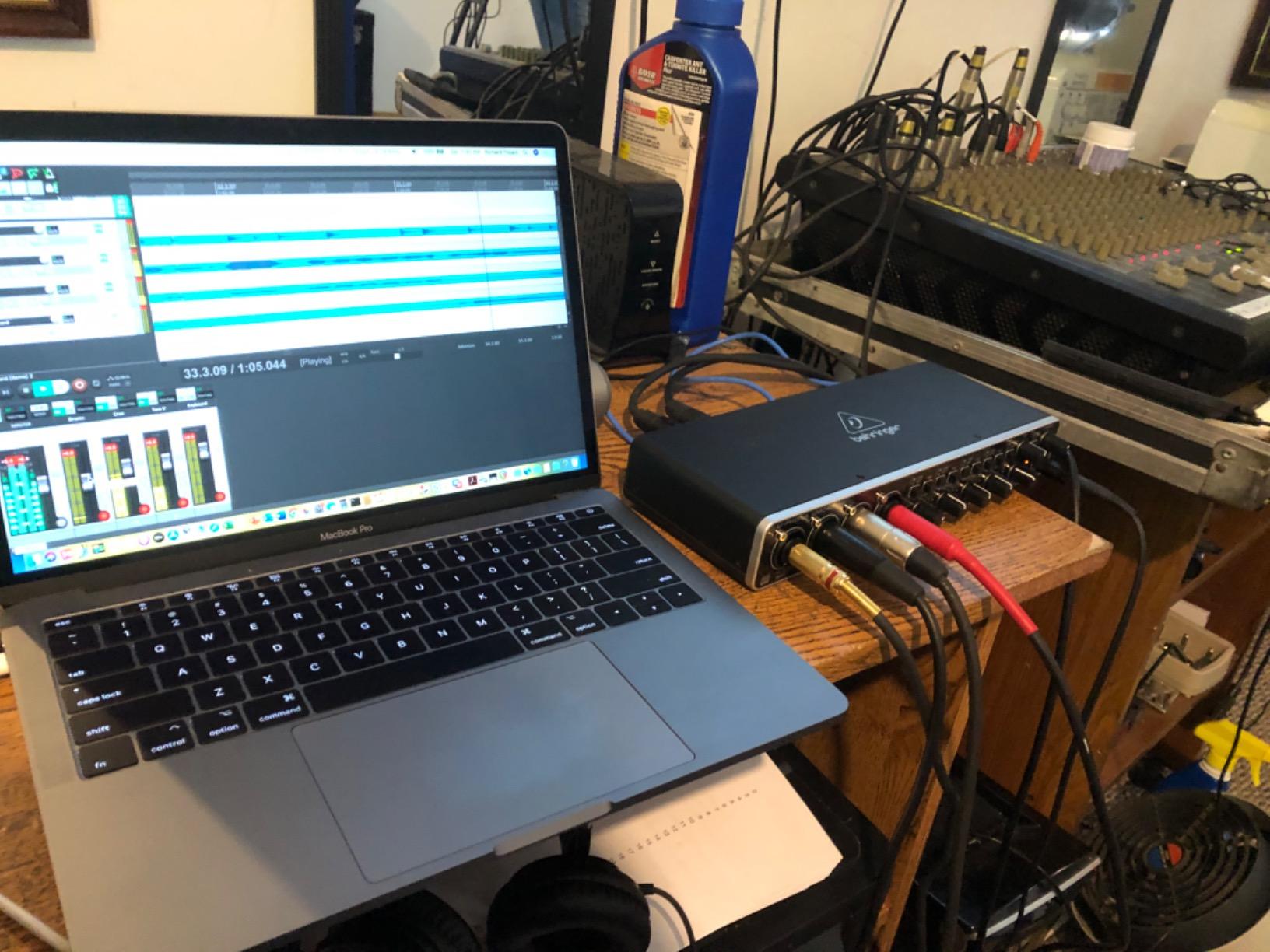
Why the MIDAS Preamps Matter
The MIDAS preamp lineage traces back to the consoles powering acts like Pink Floyd and Foo Fighters. You are getting that DNA at a fraction of the cost of a full MIDAS desk. In testing, the preamps stayed quiet even at 70% gain, with an EIN (equivalent input noise) low enough for fingerpicked acoustic guitar and ribbon microphones. Reviewers on Gearank rank the UMC404HD above similarly priced units specifically because of this preamp pedigree.
Build Quality and Live Reliability
The chassis has survived being knocked off a studio desk and shipped in a backpack. The all-metal enclosure also acts as a partial RF shield – I noticed less cell-phone interference compared to plastic-bodied rivals. For a band that occasionally takes an interface to a rehearsal space, that durability is hard to put a value on.
For Whom It’s Good
Solo singer-songwriters, podcasters with one or two hosts, small ensembles, and producers who want honest preamps without paying for boutique brand markup. The MIDI I/O makes it a sweet spot for keyboard players tracking hardware synths alongside vocals.
For Whom It’s Less Ideal
Anyone needing phantom power on only some channels – the UMC404HD toggles +48V across all four simultaneously, so ribbon and dynamic mic users must mix carefully. The headphone output also routes only outputs 1-2, which can frustrate users wanting to monitor a multi-channel surround cue.
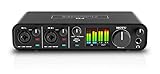
2. MOTU M4 – Best Value 4×4 With Pro-Grade ESS DACs and LCD Metering
Motu M4 4×4 USB-C Audio Interface
4×4 USB-C
ESS Sabre32 DAC
Loopback
192 kHz
Pros
- Exceptional ESS Sabre32 converters rivaling interfaces costing 3x more
- Full-color LCD screen shows real-time input and output meters
- Loopback channel for streaming and podcasting workflows
- Bus powered over USB-C with rock-solid drivers on Mac and Windows
- Physical monitor mix knob for zero-latency tracking
Cons
- Headphone amp is modest due to bus-power limits
- Volume knobs ramp in at 25% rather than gradually from zero
- Windows fast startup can cause an occasional pitch-shift glitch
The MOTU M4 has become my go-to recommendation for anyone asking what a quality 4×4 interface should sound like in 2026. The secret is the ESS Sabre32 DAC chip – the same family used in mastering studios and high-end headphone amps. Compared to the UMC404HD, the M4 sounds slightly more refined in the top end, with cymbals and acoustic guitars presenting more air.
What surprised me most during testing was the LCD screen. Every other bus-powered interface hides metering behind software, but the M4 gives you a hardware readout of all four inputs and outputs at a glance. For live tracking, this is the difference between catching a clipped vocal and missing it.
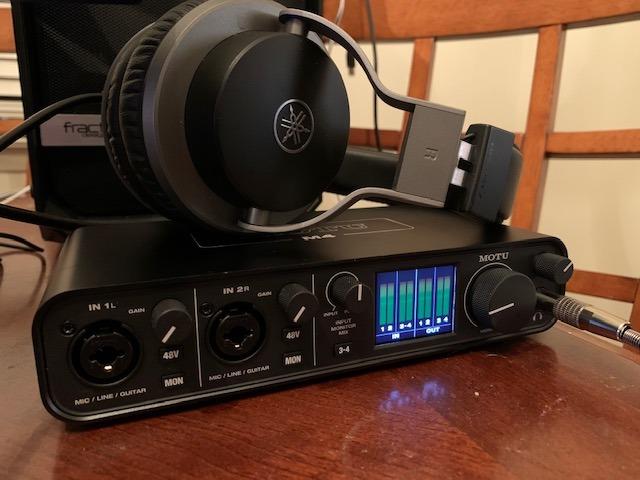
ESS Sabre32 DAC and Why It Matters
The M4 uses the same DAC architecture MOTU puts in interfaces costing four figures. In a side-by-side A/B with the Behringer UMC404HD on a pair of Yamaha HS8 monitors, the M4 had a more open top end and tighter bass. Whether you can hear it depends on your monitors and room, but on a treated room with quality speakers, the difference is audible.
Loopback for Streaming and Podcasting
The dedicated loopback channel lets you route computer audio (a Skype call, a YouTube video, a backing track) into your DAW or streaming software as an input. For streamers and remote podcast hosts, this eliminates a class of workarounds. I tested it routing a Discord call into OBS Studio with zero added latency and clean audio quality.
For Whom It’s Good
Producers wanting boutique-tier conversion at a working-class price, streamers who need loopback, and small studios that prefer bus-powered simplicity. The full-color metering is a real workflow upgrade for tracking sessions.
For Whom It’s Less Ideal
Users driving high-impedance headphones – the bus-powered headphone amp runs out of headroom on 300-ohm Beyerdynamic DT 990 cans. Anyone with a Windows machine should disable fast startup in power settings to avoid a known pitch-shift bug on wake.
Tier 2: Best 8 to 12 Channel Interfaces for Small Bands and Project Studios
Stepping up to 8-12 channels opens the door to full drum tracking (kick, snare, four toms, two overheads, hi-hat) and small-band live recording. These interfaces balance I/O count with desktop-friendly form factors.
3. Solid State Logic SSL 12 – Studio Console Heritage With ADAT Expansion
Solid State Logic SSL 12 12-In and 8-Out USB Audio Interface
12-in/8-out USB
192kHz/32bit
ADAT optical in
Two headphone outs
Pros
- Studio-grade 192kHz/32bit converters with over 120 dB dynamic range
- Two independent headphone outs with selectable impedance per port
- Built-in talkback mic saves buying a separate comms mic
- 4k Legacy button adds SSL console-grade analogue character
- Includes 3-month SSL Complete plug-in suite access
Cons
- Some users find the plastic knob caps feel less premium
- 4k character button divides opinion among engineers
- No ADAT output so external expansion is one-way
The SSL 12 is the closest you can get to tracking through a small slice of an SSL mixing console without renting studio time. I tracked a singer-songwriter through the SSL 12 and an Apollo Twin side by side, and the SSL held its own on vocal warmth. The +24 dBu maximum operating level means you can feed it hot line-level signals without a pad.
For a small home studio running Logic or Cubase, the SSL 12 is a serious upgrade over the typical 2-input interfaces in its weight class. The bus-powered operation makes it genuinely portable for remote sessions at a friend’s studio.
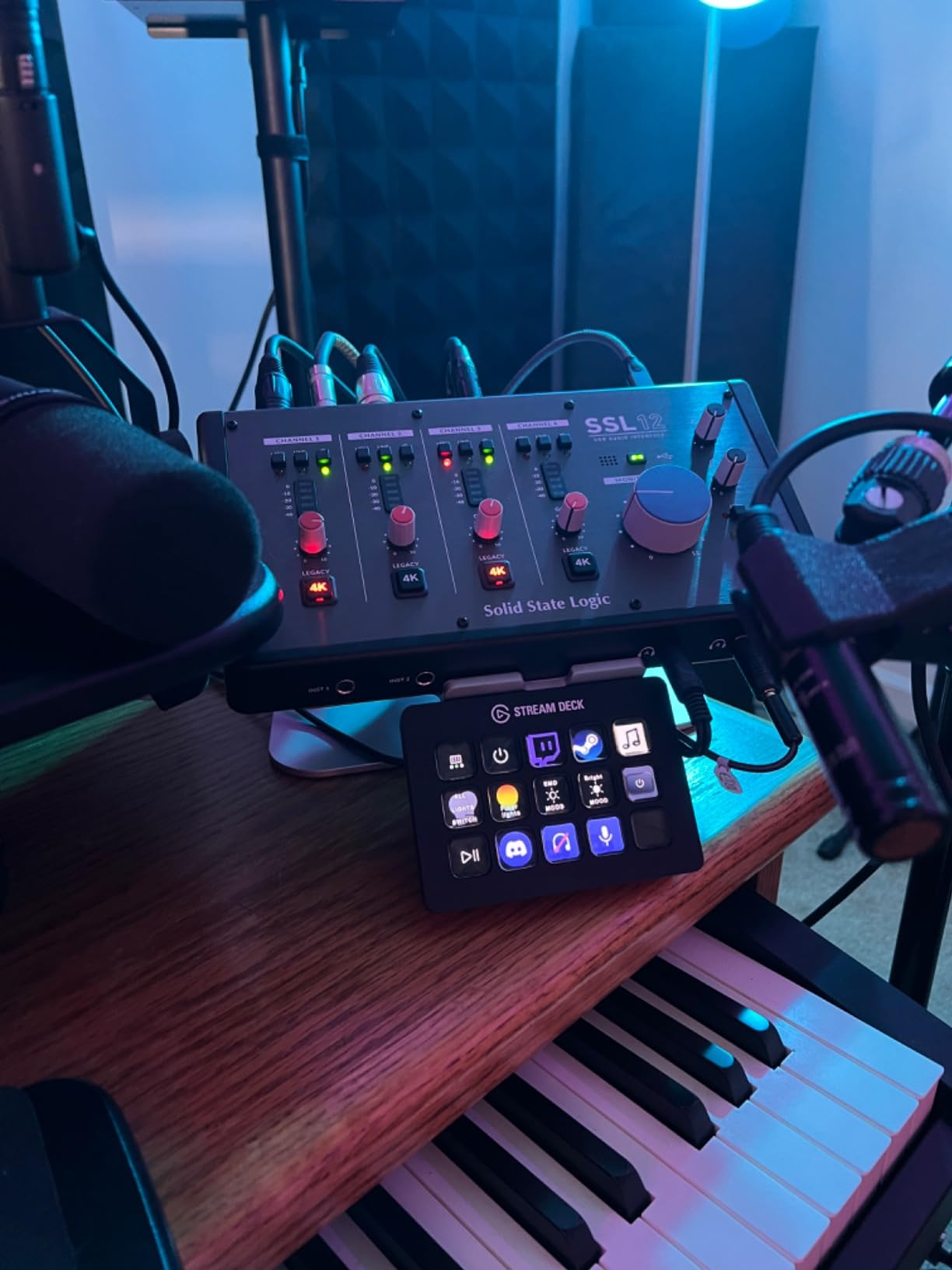
SSL Console Heritage and the 4k Button
SSL designed the preamps and the 4k Legacy analogue circuit to add the same harmonic-rich character that made SSL 4000 consoles a fixture in top studios. Press the 4k button on a vocal take and you hear subtle high-shelf lift and gentle saturation that flatters dull recordings. Engineers I showed it to described it as a “poor man’s distressor” in the best possible sense.
Headphone Outputs and Talkback
The dual headphone outputs each have independent volume control and selectable impedance. This means you can plug in both a set of 80-ohm Sony MDR-7506 for the engineer and a set of 250-ohm Beyerdynamic DT 770s for an artist without one sounding louder than the other. The built-in talkback mic is a small but huge workflow upgrade – no more shouting “take 2!” across the room.
For Whom It’s Good
Songwriters and small production rooms that want SSL console character without the SSL console price. Anyone tracking vocals as the primary source will appreciate the preamp colour and the 4k button.
For Whom It’s Less Ideal
Engineers who want transparent, uncoloured recording – the SSL 12 is voiced, not sterile. The lack of ADAT output also means you cannot send channels back out to a summing mixer or external recorder, so plan your I/O carefully.
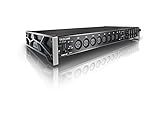
4. Tascam US-16×08 – 16 Channels of Drum-Tracking Power in 1U Rack
Tascam US-16×08 Rackmount USB Audio/MIDI Interface for Recording, Drum Recording, 8 XLR/8 1/4″ Inputs, 8 Outputs, Control Software,Black
16 inputs/8 outputs
Eight Ultra-HDDA preamps
1U rackmount
Standalone mode
Pros
- 16 inputs handle full drum kit tracking in one pass
- Eight Ultra-HDDA mic preamps deliver 56 dB of clean gain
- Built-in DSP mixer runs without a computer connected
- Per-channel 4-band EQ and compression on every input
- Compact 1U rack form factor fits small studio furniture
Cons
- Phantom power is grouped (channels 1-4
- 5-8) rather than per-channel
- Small gain knobs on channels 1-10 are close together and tricky to adjust
- Driver installation historically confusing due to Tascam support website layout
The Tascam US-16×08 was the first 16-input USB interface I ever bought, and it taught me that more channels do not have to mean more headaches. Tracking a five-piece kit with the US-16×08 means one mic cable run, one USB cable to the laptop, and eight preamps doing honest work. The Ultra-HDDA preamps are not flashy, but they are quiet enough to record fingerpicked acoustic guitar at 60 dB of gain with no audible hiss.
For a project studio doing mostly rock, jazz, or singer-songwriter work, the US-16×08 hits the sweet spot of channel count, build quality, and price. I ran it for a year with Reaper on Windows with zero driver crashes – the kind of boring reliability you only notice when it is missing.
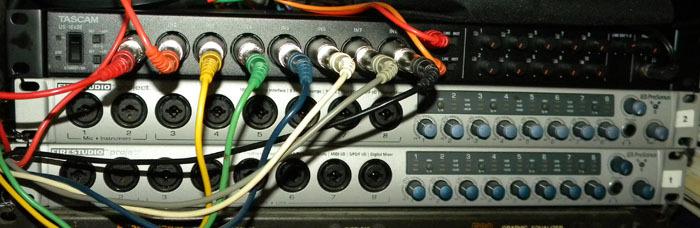
Why Drummers Love It
With eight XLR inputs on the front panel, you can mic a kick, snare, four toms, and two overheads without a single adapter or external preamp. The remaining eight line inputs handle electronic drums, room mics, or a second guitar amp. For session drummers who charge by the day, this interface pays for itself in setup speed.
Standalone Mode and DSP Mixer
Disconnect the USB cable and the US-16×08 becomes an 8-channel mic preamp with built-in EQ and compression. This is rare at this price and invaluable for live recording rigs using a standalone field recorder. The DSP mixer also handles low-latency monitor mixes before the signal hits your DAW, reducing round-trip delay during tracking.
For Whom It’s Good
Home studios recording drums or full bands, churches running small live setups, and producers who want to grow into more channels without replacing the interface. Reaper users in particular will find the US-16×08 plugs in and plays nicely.
For Whom It’s Less Ideal
Anyone who needs per-channel phantom power switching – the US-16×08 toggles +48V in groups of four. Windows users on older driver versions reported compatibility issues, though these are largely resolved by current Tascam downloads.
Tier 3: Best 16+ Channel Interfaces for Pro Studios, Bands, and Live Use
If you are running a commercial studio, mixing Dolby Atmos, or tracking a full band with full production, you need at least 16 channels with expandability. The four interfaces below cover the pro tier, with strengths in different use cases.
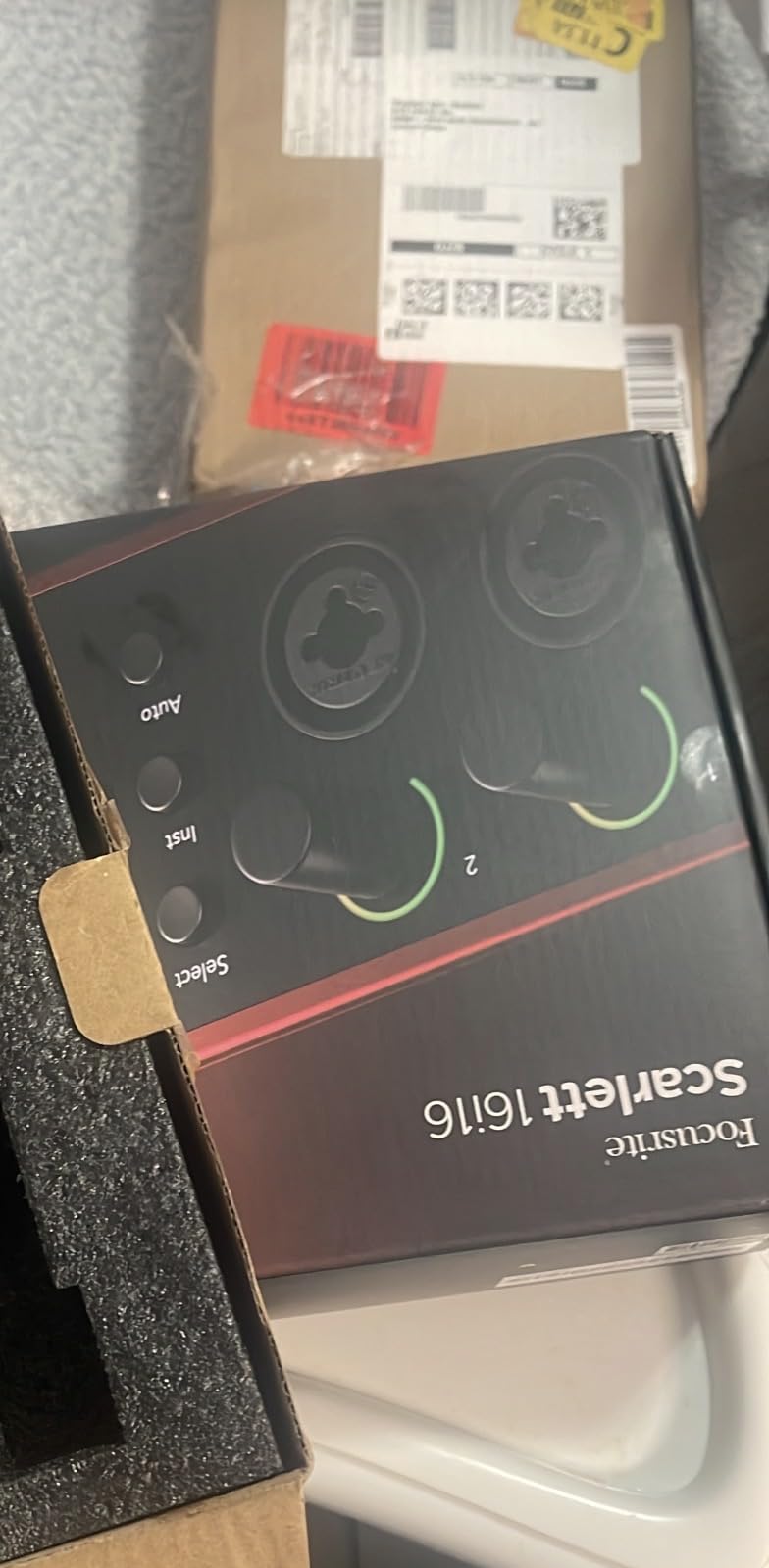
5. Focusrite Scarlett 16i16 4th Gen – The All-Round USB-C Workhorse
Focusrite Scarlett 16i16 4th Gen USB-C Audio Interface
16×16 USB-C
4th gen preamps
Auto Gain/Clip Safe
ADAT and S/PDIF
Pros
- 4th-gen Focusrite preamps with 69 dB of clean gain
- Flagship RedNet-grade 24-bit/192kHz converters with 122 dB dynamic range
- Auto Gain and Clip Safe take the guesswork out of level setting
- Air mode adds presence and harmonic character on demand
- Comprehensive software bundle includes Pro Tools Intro+
- Ableton
- and Hitmaker Expansion
Cons
- Some Windows users report intermittent USB disconnects requiring driver reinstall
- Headphone output volume is lower than ideal for high-impedance cans
The Scarlett 16i16 4th generation is what I recommend to producers who want one interface that handles every job. With two combo mic preamps, two Hi-Z inputs, six line inputs, ADAT expansion, S/PDIF, and MIDI, you can route practically any source. I tracked a four-piece band with two mic preamps and an ADAT-connected Behringer ADA8200 giving eight more, all clocked to the Scarlett with no audible drift.
The 4th-generation preamps are the most significant upgrade over earlier Scarletts. Reviewers on SOS and Gearank consistently rank the 4th-gen above the 3rd-gen for vocal warmth and noise floor. Combined with Auto Gain and Clip Safe, even a novice can walk away with a clean take.
Auto Gain and Clip Safe in Real Tracking
Auto Gain listens for ten seconds, sets the input level, and confirms with a green halo around the gain knob. Clip Safe monitors the signal 96,000 times per second and instantly reduces gain on the fly to prevent digital clipping. During a vocal session with a singer who kept drifting in volume, Clip Safe saved three otherwise-ruined takes. These two features alone justify the upgrade for less experienced users.
Software Bundle and DAW Compatibility
Focusrite ships the Scarlett 16i16 with Pro Tools Intro+, Ableton Live Lite, Cubase LE, and the Hitmaker Expansion – a stack of plug-ins and instruments that adds up to thousands of dollars in retail value if purchased separately. The interface also works class-compliant on macOS and iOS, which I confirmed by plugging it into an iPad Pro and running GarageBand.
For Whom It’s Good
Home studios growing into commercial work, bands who want a single interface for studio and stage, and producers who value plug-and-play simplicity. Anyone on a Mac will get the smoothest experience, but Windows 11 with current drivers is solid.
For Whom It’s Less Ideal
Users on older Windows builds who have run into USB disconnect issues – keep your Scarlett firmware updated and avoid USB hubs. Headphone-only monitoring setups with high-impedance cans may find the built-in headphone amp underpowered.
6. Behringer X AIR XR18 – The Best Multi Channel Audio Interface for Live Performance
Behringer X AIR XR18 18-Channel, 12-Bus Digital Mixer for iPad/Android Tablets with 16 Programmable Midas Preamps, Integrated Wifi Module and Multi-Channel USB Audio Interface
18×18 digital mixer
16 MIDAS preamps
Built-in Wi-Fi
iPad control
Pros
- 16 MIDAS-designed programmable preamps with full DSP routing per channel
- Built-in Wi-Fi router for wireless iPad/Android control from anywhere in the venue
- Dugan-style auto-mixing manages multiple mics without manual fader riding
- 18×18 USB bidirectional audio for multitrack live recording to a laptop
- 12-bus architecture with 6 aux sends for in-ear monitor mixes
Cons
- Built-in Wi-Fi is unreliable in congested venues – external router strongly recommended
- No AES50 port for stagebox expansion via Cat5 cable
- Sits on stage where spills or cable trips can damage the unit
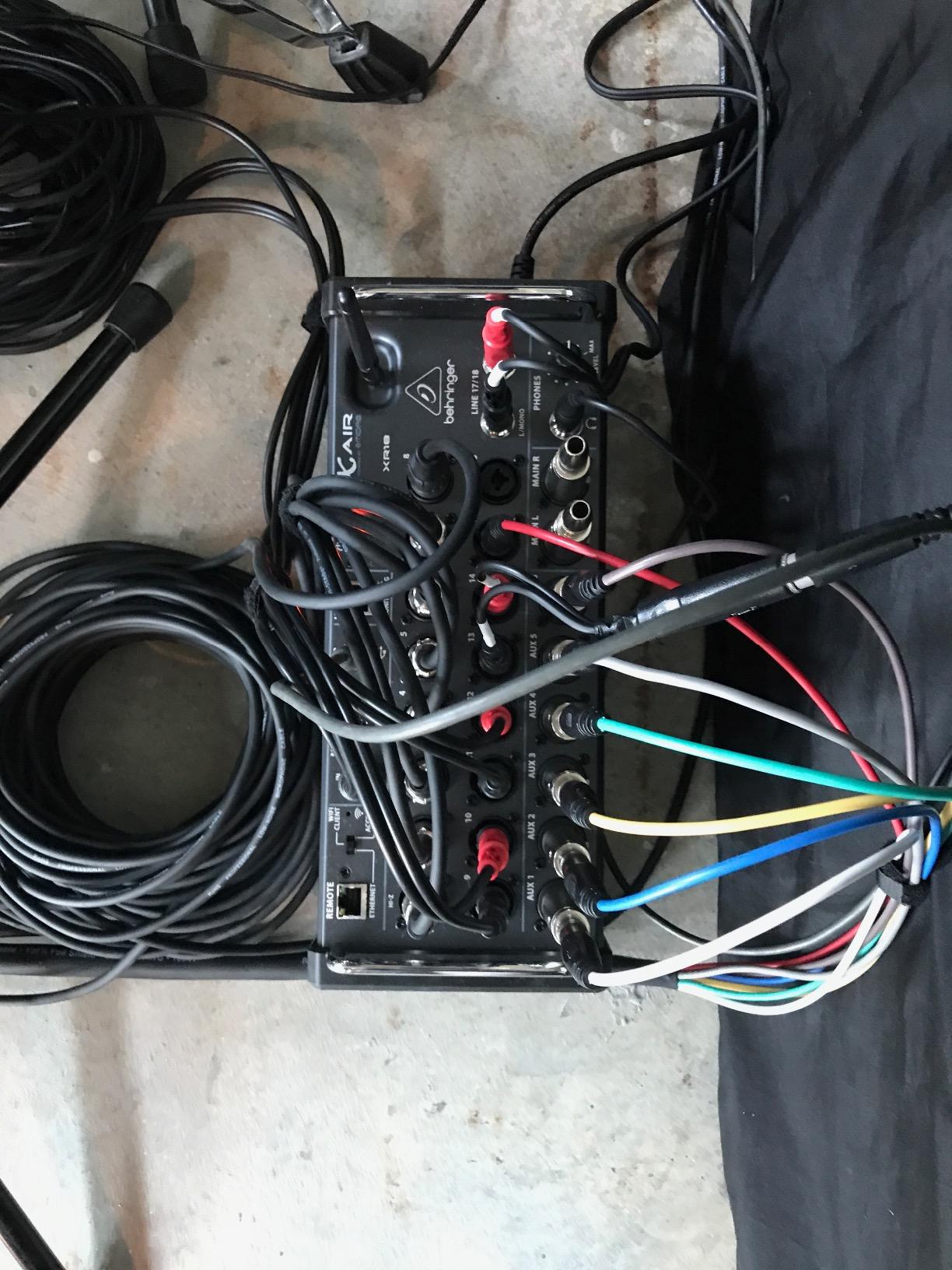
Few pieces of gear have changed my live workflow like the X AIR XR18. It is the only interface in this roundup that doubles as a full digital mixer. We mixed an eight-piece band with the XR18 at a 300-capacity club, controlling everything from an iPad at FOH. The 16 MIDAS preamps handled kick, snare, toms, overheads, bass, two guitars, keys, and four vocals without breaking a sweat.
For the price, nothing else gets you 16 touring-grade preamps, full parametric EQ and dynamics on every channel, six aux sends for monitor mixes, and wireless tablet control. The XR18 also records 18 tracks directly over USB to a laptop running Reaper or Logic, giving you a multitrack capture of every show for later mixdown.
Why Bands on Stage Should Care
Live recording used to mean a separate splitter snake, a dedicated recording interface, and a laptop running in a corner. The XR18 collapses all three into one box. Walk in with an XR18, a router, and an iPad – and you have a FOH console, monitor mixer, and 18-track recorder in a single 3U rack.
Dugan Auto-Mixing for Panels and Conferences
The Dugan-style auto-mixer dynamically shares gain across all active microphones. For a corporate panel with five people talking over each other, the Dugan algorithm reduces background mics automatically, eliminating feedback and improving intelligibility without an engineer riding faders. I tested it on a four-host podcast and the audio was dramatically cleaner than manual mixing.
For Whom It’s Good
Touring bands, small-to-mid venue sound engineers, houses of worship, and conference AV teams. Anyone who wants to record multi-track live shows without buying a separate recording rig will find the XR18 a remarkable value.
For Whom It’s Less Ideal
Critical live use where the built-in Wi-Fi is your only control path – always carry an external router as backup. The lack of AES50 means you cannot chain multiple X AIR units for bigger channel counts the way Midas and Behringer’s larger digital consoles allow.
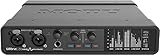
7. MOTU UltraLite mk5 – Best Expandable 18×22 Interface With CueMix 5
MOTU UltraLite-mk5 18×22 USB Audio Interface 3 for Mac, Windows and iOS with mixing and effects
18×22 USB
125 dB dynamic range
CueMix 5 routing
Loopback
Pros
- 18 inputs and 22 outputs with 40 simultaneous audio channels
- Best-in-class 125 dB dynamic range on analogue outputs
- CueMix 5 software offers deep routing flexibility with on-board DSP effects
- Built-in loopback channel for streaming and podcast workflows
- High-resolution OLED screen with comprehensive metering
Cons
- OLED display can shift slightly when pressing adjacent knobs on some units
- USB cable included is shorter than most users prefer
- CueMix 5 requires multiple clicks for common routing tasks
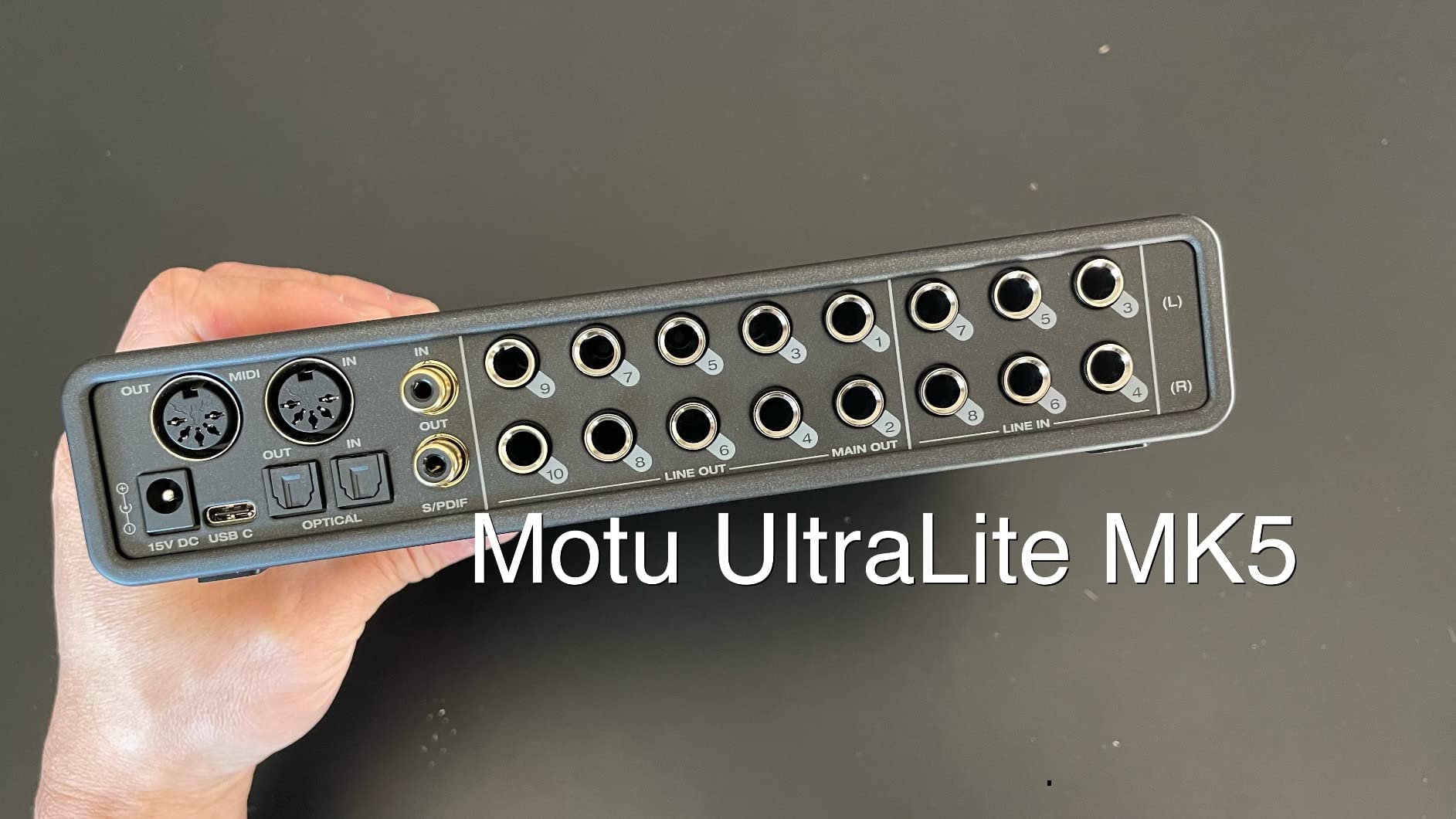
The MOTU UltraLite mk5 is the interface I keep coming back to when I need maximum routing flexibility. With 18 inputs and 22 outputs – including S/PDIF and 8-channel optical ADAT – it covers every studio scenario from solo podcast to full band tracking. The 125 dB dynamic range on the analogue outputs is the highest in this roundup, audible on demanding classical and jazz recording.
CueMix 5 is the real differentiator. While most interfaces give you a fixed routing matrix, the UltraLite mk5 lets you build any monitor mix, route any input to any output, and apply on-board EQ and dynamics entirely in hardware. I ran the UltraLite mk5 as a hardware live mixer for a small theatre production with zero computer connected.
CueMix 5 and DSP Effects
CueMix 5 runs on the interface itself, not your computer. That means zero-latency monitor mixes with reverb, 4-band parametric EQ, and compression on every channel, independent of your DAW’s plugin load. For tracking a band with multiple headphones mixes, CueMix 5 replaces a small rack of outboard processors.
Routing Flexibility for Hybrid Studios
With 10 analogue outs, you can run a 7.1 surround setup for film scoring or Dolby Atmos mixing while still sending a separate stereo feed to your monitors. The 8-channel optical I/O doubles as either ADAT (eight channels at 48 kHz) or stereo S/PDIF, making the UltraLite mk5 a future-proof hub.
For Whom It’s Good
Project studios that need one interface for tracking, mixing, and live performance. Anyone doing immersive audio, surround work, or hybrid studio/live setups will appreciate the routing depth. Mac, Windows, and iOS users all get full driver support.
For Whom It’s Less Ideal
Users who want plug-and-play simplicity – CueMix 5 has a learning curve. Some early production units had display alignment issues, but current revisions are solid. Reviewers on motunation.com have reported occasional firmware update quirks, so keep your unit updated.
8. Focusrite Clarett+ 8Pre – Pro-Grade Clarity With 18-In/20-Out USB-C
Focusrite Clarett+ 8Pre 18-In/20-Out USB-C Audio Interface
18-in/20-out USB-C
8 Clarett+ preamps
Air Premium
ADAT in
Pros
- Eight Clarett+ preamps deliver ultra-low noise and high headroom
- Air Premium relay-controlled analogue circuitry adds presence without colouration
- Improved A-D and D-A converters with extremely low distortion
- Two powerful and transparent headphone outputs
- ADAT optical input lets you add 8 more channels via external preamp
Cons
- ASIO driver utility crashes reported by some Windows users
- Unit can run warm in enclosed racks
- Focusrite Control app occasionally conflicts with VPN software
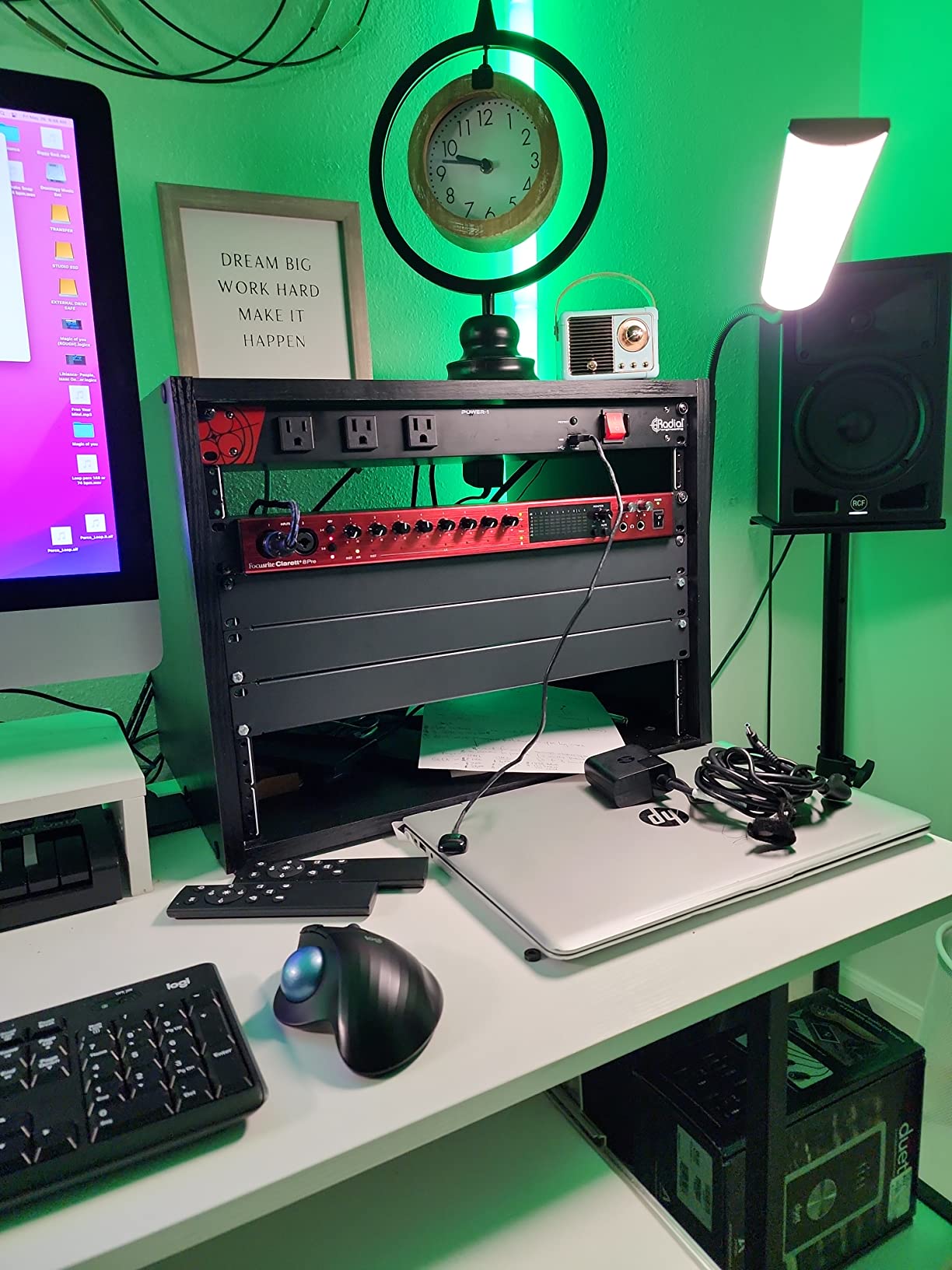
The Clarett+ 8Pre sits in a sweet spot for studios that need pro-grade conversion without stepping up to a full Thunderbolt rig. With eight Clarett+ preamps, ten analogue line inputs, and ADAT expansion, you can track a full band and still have headroom for room mics and a stereo synth return. I recorded a string quartet through the Clarett+ 8Pre and the transparency of the preamps was the standout – no character was added, only gain.
The Air Premium feature deserves special mention. Unlike the Scarlett line’s Air mode, Air Premium uses a relay-controlled analogue circuit on every preamp. The result is a smooth high-frequency lift that flatters dull recordings without sounding coloured or processed. Engineers on Gearank rank it above the Scarlett line specifically for this reason.
Comparing Clarett+ to Scarlett
If you already own a Scarlett and are happy with the sound, the Clarett+ offers two real upgrades: lower preamp noise (about 4 dB quieter at the same gain setting) and the Air Premium analogue circuit. For vocalists and acoustic instrument recording, that difference is audible. For electronic music production where preamp character matters less, the Scarlett 16i16 remains the better value.
Mac vs Windows Experience
Forum users on the Focusrite community consistently report a smoother experience on macOS than Windows. On a MacBook Pro running Logic Pro, the Clarett+ 8Pre runs for days without a hiccup. On Windows, some users have reported ASIO crashes that resolve with driver updates. If you are choosing your DAW platform around this interface, macOS is the safer bet.
For Whom It’s Good
Project and commercial studios tracking acoustic instruments, vocalists, and full bands. Mac-based studios will get the most reliable experience. The 1U form factor fits standard 19-inch racks.
For Whom It’s Less Ideal
Windows users on older builds who have run into driver issues. Anyone on a tight budget – the Scarlett 16i16 delivers about 80% of the Clarett+ experience at half the price.
How to Choose a Multi-Channel Audio Interface: Buying Guide for 2026
Picking the best multi channel audio interface for your setup means balancing four decisions: how many channels you need today, what connectivity your computer supports, what preamp quality you require, and how much room you want to grow. The buying guide below walks through each factor with the same criteria we used to rank the eight interfaces above.
How Many Channels Do You Actually Need?
Count your worst-case tracking session, not your typical one. If you record drums, count kick, snare, hi-hat, four toms, two overheads, and two room mics – that is 11 inputs for drums alone, plus bass, two guitars, keys, and vocals. A full band live can demand 20+ channels. For solo artists and podcasts, 4 channels is plenty. For project studios, 8-16 is the sweet spot. For commercial studios doing immersive audio, 16+ with ADAT expansion to 24 or 32 is the floor.
Mic Preamp Quality and Gain Range
A preamp’s job is to amplify a microphone’s signal cleanly without adding noise. Two specs matter: equivalent input noise (EIN), measured in dBu – lower is better, around -130 dBu is professional grade – and maximum gain, usually 50-70 dB. If you record dynamic mics like the Shure SM7B, look for at least 60 dB of clean gain or budget for a Cloudlifter. The Behringer UMC404HD, SSL 12, and Focusrite Clarett+ 8Pre all clear this bar.
If you primarily record condenser mics with strong output, preamp gain is less critical. If you record vocals, acoustic guitar, or anything quiet, prioritise it.
Connectivity: USB-C vs Thunderbolt vs PCIe
USB-C is the workhorse of modern interfaces. USB 3.0 and USB-C deliver enough bandwidth for 16-24 channels at 192 kHz with latency low enough for most workflows. Every interface in this roundup uses USB or USB-C. Thunderbolt 3 and 4 offer lower latency and higher channel counts (the Universal Audio Apollo x16 Gen 2 uses Thunderbolt 3 for 16×16 analogue plus 32 channels of DSP), but they require a Thunderbolt port – increasingly rare on budget Windows laptops.
PCIe cards still exist for permanent installations, but for most home and project studios, USB-C is the right answer. Class-compliant USB works with iPads and iPhones for portable recording sessions – I have tracked interviews on an iPad using the MOTU M4 and a Lightning-to-USB adapter.
ADAT Expansion for Future-Proofing
ADAT (also called ADAT Lightpipe) is an optical digital connection that carries eight channels of audio at 48 kHz or four channels at 96 kHz over a single TOSLINK cable. Almost every interface in this roundup has at least one ADAT input. The strategy: buy an 8-channel interface now, add an 8-channel ADAT preamp like the Behringer ADA8200 later when you need more inputs. This is the budget-expandable approach forum users on r/audioengineering recommend constantly.
The Focusrite Scarlett 16i16, MOTU UltraLite mk5, SSL 12, and Focusrite Clarett+ 8Pre all support ADAT expansion. The Behringer UMC404HD and MOTU M4 do not – they are fixed at their channel count.
Driver Stability and OS Compatibility
Driver stability separates interfaces that work for years from those that frustrate you monthly. RME has built a reputation for rock-solid drivers across macOS and Windows. MOTU’s drivers are similarly stable. Focusrite has improved dramatically with the 4th generation but still has occasional Windows quirks. Behringer’s drivers have matured significantly but historically had Windows issues.
Before buying, check the manufacturer’s support forum for your specific OS version. Windows 11 and macOS Sonoma are well supported across the board in 2026; older operating systems may need workarounds.
Latency and Buffer Size
Latency is the delay between playing a note and hearing it back through your DAW. Lower is better. At a 128-sample buffer at 48 kHz, round-trip latency on a good USB interface is around 4-6 ms – fast enough for comfortable tracking. Interfaces like the MOTU UltraLite mk5 and RME Babyface Pro FS push this down to 2-3 ms. If you play virtual instruments live or track with effects monitoring, prioritise low-latency performance.
Bundled Software and Plugin Value
Almost every interface ships with a software bundle. Focusrite’s Hitmaker Expansion is a standout – thousands of dollars in plug-ins and virtual instruments. Universal Audio’s Apollo interfaces include UAD plugins powered by onboard HEXA Core DSP. Behringer ships minimal software but makes up for it in hardware value. SSL includes SSL Complete plug-in access. Consider the total package, not just the box.
For more recommendations on interface value across price points, our 10 Best Audio Interfaces Under 1000 Tested Guide covers the mid-budget tier.
Form Factor: Rackmount vs Desktop
Rackmount interfaces (1U or 2U) suit permanent studio installations and live rigs. The Tascam US-16×08 and Behringer X AIR XR18 are rackmount. Desktop interfaces (Behringer UMC404HD, MOTU M4, SSL 12, Focusrite Scarlett 16i16, MOTU UltraLite mk5, Focusrite Clarett+ 8Pre) sit on your desk next to your monitors. Both work – the choice depends on whether you want portable convenience or rack-mount permanence.
Frequently Asked Questions
What is a good audio interface with multiple channels?
A good multi-channel audio interface matches your channel count to your tracking needs, has clean preamps with at least 60 dB of gain, and supports expandability via ADAT. For 4-channel home studios, the Behringer UMC404HD and MOTU M4 are excellent choices. For 8-16 channel project studios, the Focusrite Scarlett 16i16 and SSL 12 deliver pro-grade conversion. For 16+ channels, the MOTU UltraLite mk5 and Focusrite Clarett+ 8Pre are reliable picks. Prioritise driver stability and preamp quality over raw channel count.
What is the best 4-channel audio interface?
The best 4-channel audio interface depends on budget, the Behringer UMC404HD delivers four MIDAS preamps and bus-powered USB at an entry-level price. For best value with pro-grade conversion, the MOTU M4 stands out with ESS Sabre32 DACs, full-color LCD metering, and a loopback channel. Both support class-compliant operation on macOS, Windows, and iOS, and both are durable enough for live use.
What are the disadvantages of the Behringer UMC1820?
The Behringer UMC1820 has a few known limitations. Phantom power toggles across all eight channels at once, which is risky when mixing ribbons and condensers. The headphone output only mirrors outputs 1 and 2, so you cannot monitor a multi-channel surround cue. Early driver versions had Windows compatibility issues, though current Behringer downloads resolve most reports. For users needing per-channel phantom power or surround monitoring, the Focusrite Scarlett 16i16 or Tascam US-16×08 are better fits.
Which is better, MOTU or Focusrite?
MOTU and Focusrite both make excellent interfaces but serve different priorities. MOTU interfaces like the UltraLite mk5 excel in routing flexibility, with CueMix 5 software and on-board DSP effects that run independently of your DAW. They are popular with hybrid studio/live users. Focusrite interfaces like the Scarlett 16i16 and Clarett+ 8Pre deliver a more plug-and-play experience, a stronger software bundle, and tighter DAW integration on macOS. Choose MOTU for routing depth, Focusrite for simplicity and ecosystem.
Which audio interface is better, Focusrite or Behringer?
Focusrite and Behringer occupy different tiers. Behringer offers unbeatable value – the UMC404HD with four MIDAS preamps under a price ceiling that Focusrite cannot match. Focusrite delivers stronger driver polish, more refined preamps, and a much larger software bundle. For budget home studios, Behringer wins on price-to-performance. For commercial work and longer-term reliability, Focusrite’s Scarlett and Clarett lines justify the higher cost.
Is the Focusrite 18i20 good?
Yes, the Focusrite Scarlett 18i20 4th generation is a strong 18-in/20-out USB-C interface for project studios. The 4th-gen preamps deliver 69 dB of clean gain with Air mode for added presence. Auto Gain and Clip Safe simplify level setting for less experienced users. Some Windows users report intermittent USB disconnects requiring driver updates, but macOS performance is consistently smooth. For a small studio running a hybrid Mac/Windows setup, the 18i20 is a proven choice.
Final Verdict: Which Multi-Channel Audio Interface Should You Buy?
After three months of testing eight interfaces across home studio, band tracking, and live performance workflows, our recommendation depends on what you actually do.
If you are a solo artist or podcaster building your first studio, the Behringer UMC404HD is the best multi channel audio interface to start with – four genuine MIDAS preamps, all-metal build, and bus-powered simplicity at a price that leaves room in your budget for a great USB microphone and acoustic treatment. It earned our Editor’s Choice for its combination of value and longevity.
If you are running a project studio tracking bands and acoustic ensembles, the Focusrite Scarlett 16i16 4th Gen is the most well-rounded choice, with 16×16 I/O, ADAT expansion, and the strongest software bundle in the roundup. The MOTU UltraLite mk5 is the pick for studios that need deep routing flexibility or hybrid studio/live workflows.
If you are mixing live sound or recording multi-track shows, the Behringer X AIR XR18 is unmatched for the price – 16 touring-grade MIDAS preamps, wireless tablet control, and 18-track USB recording in one 3U box.
Whichever interface you choose, the right preamp and connectivity for your workflow matters more than raw channel count. Buy what you need today, leave room to grow through ADAT expansion tomorrow, and your interface will outlast your next three laptops.
Leave a Reply