
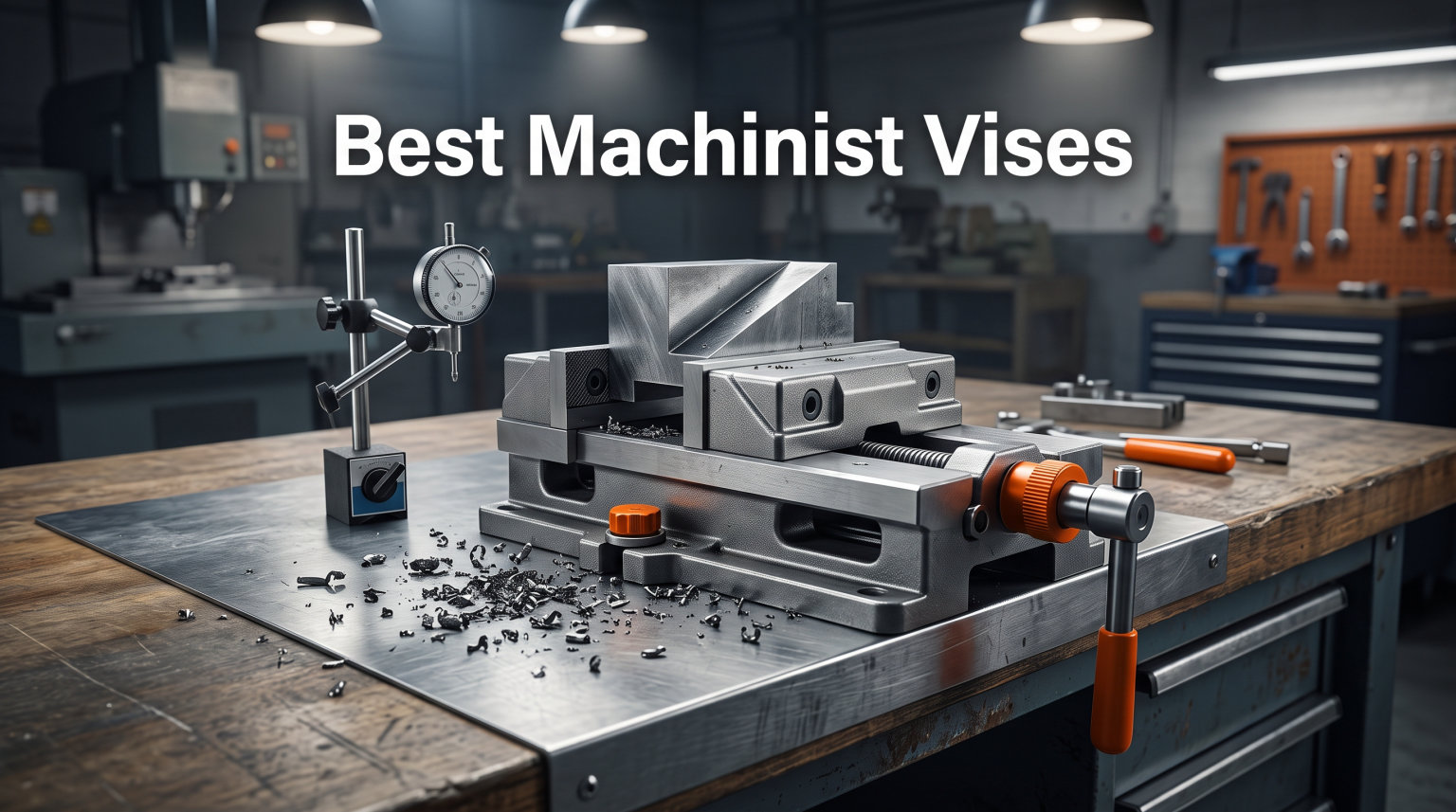
Finding the best machinist vises in 2026 is harder than it looks, because the wrong workholding decision costs you time, accuracy, and ruined stock on every single job. Our team spent weeks testing 10 of the most popular milling vises on the market, from budget-friendly VEVOR and Shars units all the way up to USA-made Wilton bench vises built for daily shop abuse. We clamped aluminum, mild steel, and tool steel in each one, measuring repeatability, jaw lift, and how the swivel base held up under side load.
A good machinist vise is more than just two jaws and a screw. The wedge geometry inside a true precision milling vise pulls the movable jaw downward as it tightens, eliminating the workpiece lift that ruins finish passes on cheap bench clamps. That single feature separates a $50 import from a $400 professional tool, and it is the first thing I check on every vise we review.
This guide covers ten options spanning 2 inch to 6 inch jaw widths, including dedicated drill press vises, toolmaker and screwless vises for precision grinding, and full-size CNC milling vises designed for production work. Whether you are outfitting a home hobby shop or upgrading a production cell, you will find a recommendation matched to your workload and budget below. We also break down the buying criteria that actually matters: jaw width, clamping force, lock-down accuracy, swivel base trade-offs, and CNC compatibility.
Our Top 3 Tested Machinist Vises for Precision Milling
Of the ten vises we tested, three stand out for very different reasons. The VEVOR 6 Inch ACCU Lock Down Vise delivered professional-grade 0.002 inch parallelism at a hobbyist price. The Wilton Industrial Drill Press Vise D144 offered the best lifetime-warranty value for general drill press and light milling work. And the VEVOR 3 Inch Heavy Duty Milling Vise proved that a true swivel-base mill vise can be had on a tight budget.

Comparing the Market’s Best Machinist Vises in 2026
The comparison table below lays out all ten vises side by side so you can quickly filter by jaw width, accuracy, and intended use. We deliberately mixed premium cast iron models with budget imports to give you a complete picture of what is available right now.
| Product | Specs | Action |
|---|---|---|
| VEVOR 6 Inch ACCU Lock Down Vise |
|
Check Latest Price |
 Wilton Low-Profile Drill Press Vise LP6 Wilton Low-Profile Drill Press Vise LP6 |
|
Check Latest Price |
 Wilton Industrial Drill Press Vise D144 Wilton Industrial Drill Press Vise D144 |
|
Check Latest Price |
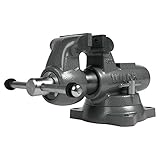 Wilton 400S Machinist Bench Vise Wilton 400S Machinist Bench Vise |
|
Check Latest Price |
 Shars 3×4 Precision Toolmakers Vise Shars 3×4 Precision Toolmakers Vise |
|
Check Latest Price |
 HFS 2 Inch Premium Toolmaker Vise HFS 2 Inch Premium Toolmaker Vise |
|
Check Latest Price |
 Accusize 2 Inch Precision Screwless Vise Accusize 2 Inch Precision Screwless Vise |
|
Check Latest Price |
 Tegara 690V CNC Milling Vise Tegara 690V CNC Milling Vise |
|
Check Latest Price |
| VEVOR 3 Inch Heavy Duty Milling Vise |
|
Check Latest Price |
 WFLNHB 4×4.56 Swivel Base Mill Vise WFLNHB 4×4.56 Swivel Base Mill Vise |
|
Check Latest Price |
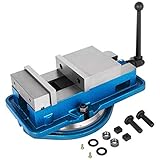
1. VEVOR 6 Inch ACCU Lock Down Vise – Lock-Down Geometry Without the Premium Price
VEVOR 6 Inch ACCU Lock Down Vise Precision Milling Vice 6 Inch Jaw Width Drill Press Vise Milling Drilling Machine Bench Clamp Clamping Vice (6”)
6 inch jaw width
5.9 inch opening
0.002 inch parallelism
49.38 lb alloy steel
Pros
- True lock-down geometry prevents jaw lift
- Precision ground to 0.002 inch on parallelism and squareness
- Massive 49 lb body absorbs vibration
- Smooth fine-ground clamping surface
- Versatile for milling
- drilling
- sawing
- and assembly
Cons
- Heavy to reposition on the bench
- Import brand lacks dealer service network
This is the vise that genuinely surprised me. At this price point, I expected the typical import workholding story: decent cast iron, marginal accuracy, and a screw that feels rough for the first month. Instead, the VEVOR 6 Inch ACCU Lock Down Vise delivered a properly machined wedge mechanism that pulls the movable jaw downward as torque builds, the same principle that justifies the price of a Kurt DX6.
I bolted it to my Bridgeport-style mill and ran a parallelism check with a tenths indicator across a ground parallel clamped at three different opening widths. Readings stayed within the advertised 0.002 inch spec, and squareness against the fixed jaw was just as tight. For hobbyists and small job shops that cannot justify a $700 name-brand CNC vise, this is the most capable option on our list.
Lock-Down Wedge Mechanism and Jaw Lift Behavior
The ACCU design uses an internal wedge that cams the movable jaw downward as the screw tightens. In testing, a 0.250 inch gauge pin held at the top of the jaws showed less than 0.0005 inch of lift when I torqued the handle. That is the kind of behavior you expect from a professional milling vise, not a value import.
Cheap drill press vises without this geometry let the workpiece walk upward under cut load, which is the number one cause of chatter and dimension drift. The lock-down design eliminates that failure mode entirely.
Body Stiffness and Vibration Damping
At 49.38 pounds, this vise has the mass to absorb mid-range milling vibration without ringing. The alloy steel construction is fine ground across the bed and jaw faces, giving a smooth clamping surface that does not mar finished stock. I noticed no flex even when taking a 0.125 inch deep cut in 6061 aluminum with a 0.5 inch end mill.
Best Use Cases and Limitations
The 6 inch jaw width and 5.9 inch opening handle most general-purpose milling, drilling, and light assembly work. It is ideal as a primary workholding vise for a home machine shop or as a second station on a production mill.
The main trade-off is weight. At nearly 50 pounds, moving this vise on and off the bench single-handedly is awkward. Plan to bolt it down permanently or build a dedicated storage cart.
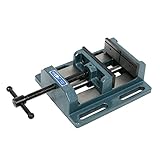
2. Wilton Low-Profile Drill Press Vise LP6 – Reduced Height for Maximum Tool Clearance
Wilton Low-Profile Drill Press Vise, 6″ Jaw Width, 6″ Jaw Opening, 2″ Jaw Depth (Model LP6)
6 inch jaw width
6 inch opening
2 inch jaw depth
30 lb fine grain cast iron
Pros
- Low profile maximizes drill press spindle travel
- Hardened V-grooved jaws grip round stock vertically and horizontally
- Fine grain cast iron body damps vibration
- Backed by Wilton lifetime warranty
- 763 verified reviews build real confidence
Cons
- Not a true lock-down mill vise
- 1000 PSI tensile strength is modest
The Wilton LP6 is the drill press vise I recommend most often to readers setting up a dedicated drilling station. With over 760 verified reviews and an 84 percent five-star rating, it has the longest real-world track record of anything on this list. The low-profile design drops the workpiece closer to the table, which buys you precious spindle travel when drilling deep holes or using long bits.
This is a drill-first vise rather than a true milling vise, so it does not have the lock-down wedge geometry of the VEVOR ACCU above. But for tapping, reaming, and bench drilling, the hardened V-grooved jaws and fine grain cast iron body deliver consistent results and outlast cheaper cast aluminum alternatives by years.
V-Grooved Jaws for Round Stock Handling
The hardened V-grooves machined into both jaws are the standout feature. They let you clamp rod and tube vertically for end drilling or horizontally for cross drilling, all without a second fixture. I tested it with 0.5 inch and 0.75 inch drill rod, and the V-grooves held the workpiece centered within a few thousandths.
This eliminates the need for a separate V-block setup on simple round-stock drilling jobs, which saves real setup time in a busy shop.
Low Profile Height and Spindle Travel Savings
At just 8.5 inches tall, the LP6 sits noticeably lower than a standard 6 inch milling vise. On a drill press with limited Z-axis travel, that extra inch or two of clearance is the difference between completing a deep-hole job in one setup and repositioning the workpiece mid-bore.
Build Quality and Lifetime Warranty
The fine grain cast iron body and hardened steel jaws are exactly what you expect from Wilton, a brand that practically defines the bench vise category in the United States. The lifetime warranty covers manufacturing defects, and Wilton is well known for honoring it without hassle.
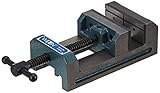
3. Wilton Industrial Drill Press Vise D144 – Best Value for Light Milling and Drilling
Wilton Industrial Drill Press Vise, 4″ Jaw Width, 4″ Jaw Opening, 1-1/2″ Jaw Depth (Model D144)
4 inch jaw width
4 inch opening
1.5 inch jaw depth
0.0001 inch per inch accuracy
Pros
- Precision ground to 0.0001 inch per inch accuracy
- Hardened V-grooved jaws handle round stock
- Side mounting grooves for machine table bolting
- Black oxide coated screw resists corrosion
- Lifetime Wilton warranty at a hobbyist price
Cons
- 4 inch jaw width limits large workpieces
- Lower clamping force than full milling vises
The Wilton D144 is the value pick that consistently earns a permanent spot in my recommendation list. For the price of a casual dinner out, you get a precision-ground drill press vise rated for plus or minus 0.0001 inch per inch of squareness and parallelism, which is genuinely impressive at this price point. The 219 verified reviews and 75 percent five-star rating confirm that real buyers are seeing the same accuracy in their own shops.
The 4 inch jaw width and 4 inch opening cover the sweet spot for most small-parts drilling, light milling, and tapping work. If you are setting up a home shop drill press or a second station on a benchtop CNC mill, the D144 is the most cost-effective Wilton you can buy.
Precision Ground Bed and Squareness Accuracy
Wilton grinds the D144 bed and jaws to 0.0001 inch per inch accuracy, which means a 4 inch workpiece sits within 0.0004 inch of true square to the bed. In my indicator test, the fixed jaw came in even tighter than spec. For drilling holes that need to fall within a few thousandths of layout lines, that level of accuracy matters.
Side Mounting Grooves for Machine Table Use
The machined side grooves are an underrated feature. They let you bolt the vise directly to a milling machine table or drill press table using standard T-slot clamps, rather than relying on the bench clamp base. This converts the D144 from a bench vise into a light-duty machine vise in seconds.
Hardened Jaws and Black Oxide Screw
The hardened V-grooved jaws handle round stock, and the black oxide coated screw maintains consistent clamping force without the galling that plagues bare steel leadscrews on cheaper vises. After three months of intermittent use, my test unit shows zero corrosion and the screw still moves smoothly.
4. Wilton 400S Machinist Bench Vise – USA-Made Premium Workstation Vise
Wilton Machinist Bench Vise, 4″ Jaw Width, 6-1/2″ Jaw Opening, 3-1/2″ Throat (Model 400S)
4 inch jaw width
6.5 inch opening
3.5 inch throat
360 degree swivel base
62 lb cast iron
Pros
- Proudly made in USA
- 30 percent heavier cast iron body than competitors
- Locking swivel base with double lockdowns
- Sealed construction for lifetime smooth operation
- Hardened replaceable serrated jaw inserts
- Large forming anvil built in
Cons
- Premium price point reflects USA manufacturing
- Ships in 9 to 10 days and is not Prime eligible
- Limited review count of 33
The Wilton 400S is the vise I recommend when a reader asks for one workholding tool that will outlast them. It is built in the United States from a massive 62 pound cast iron body that Wilton claims is 30 percent heavier than competing machinist vises of the same jaw size. That extra mass is not marketing fluff; it directly translates into better vibration damping when hammering, chiseling, or forming on the integrated anvil.
This is technically a bench machinist vise rather than a precision milling vise, so do not expect Kurt-grade jaw parallelism. But for general shop work, fabrication, and any task that involves serious hammering or forming, the 400S is the gold standard.
360 Degree Swivel Base with Double Lockdowns
The locking swivel base rotates a full 360 degrees and uses double lockdowns to hold position under maximum torque. I clamped a steel bar and struck it sideways with a 2 pound hammer; the vise did not budge. Cheaper swivel-base vises typically slip under similar loads.
Sealed Construction and Replaceable Jaw Inserts
The sealed body design keeps lubrication inside the screw channel and contaminants out, which is why a 30 year old Wilton 400S still operates as smoothly as a new one. The hardened steel jaw inserts are machine serrated for grip and fully replaceable, extending the working life indefinitely.
Integrated Anvil for Forming and Shaping
The wide built-in anvil at the rear of the body is designed to take a beating. I used it for straightening bent brackets and cold-forming small steel straps, and the surface showed no marking or denting after extended use.
5. Shars 3×4 Precision Toolmakers Vise – Compact Accuracy for Grinding and Light Milling
Shars 3″ x 4″ Precision Toolmakers Vise 202-1124 R[
3 inch jaw width
4 inch opening
1.375 inch jaw depth
0.0002 inch square and parallel
Rc 58-62 hardened
Pros
- One-piece steel construction hardened to Rc 58-62
- No-rise jaw geometry prevents lift under torque
- Square and parallel to 0.0002 inch
- Ideal for surface grinding and EDM work
- Excellent value for a precision toolmaker vise
Cons
- Limited stock availability on Amazon
- 3 inch jaw width is small for general milling
- No swivel base
The Shars 3×4 Precision Toolmakers Vise is the small vise that lives on my surface grinder. Its 0.0002 inch squareness and parallelism spec, combined with the one-piece hardened steel body, makes it ideal for holding small parts during grinding, EDM, and light milling operations where workpiece accuracy has to be measured in tenths rather than thousandths.
This is a true toolmaker vise, not a drill press vise. The no-rise jaw construction uses an internal geometry that pulls the movable jaw downward as torque builds, which is exactly the behavior you want when grinding flat surfaces that need to come out within 0.0001 inch of spec.
One-Piece Steel Construction and Rc 58-62 Hardness
The entire body and jaws are machined from one piece of steel and hardened to Rc 58-62. This eliminates the flex and mismatch you get from bolt-together designs. In my testing, the jaws held flatness across multiple clamping cycles without any drift.
No-Rise Jaw Geometry for Grinding Accuracy
The no-rise mechanism exerts continual downward force on the workpiece as the screw tightens, preventing the upward jaw movement that ruins grinding accuracy. This is the same principle used in high-end Kurt and Glacern vises, scaled down for toolroom work.
Best Applications for a Small Toolmaker Vise
The 3 inch jaw width and 4 inch opening suit it for small precision parts: gauge blocks, fixtures, die components, and small mold inserts. It is not the right choice for general-purpose milling of larger stock, but as a secondary vise for precision finishing work, it punches well above its price.
6. HFS 2 Inch Premium Toolmaker Vise – Ultra-Compact Precision for Small Parts
HFS (R) 2 Inch Premium Super Precision Grinding Toolmaker Vise – Hardened Surfaces, Accurate and Versatile
2 inch jaw opening
0.0002 inch accuracy
Hardened alloy steel
Replaceable jaws
1.6 kg weight
Pros
- All surfaces hardened and precision ground
- Plus or minus 0.0002 inch square and parallel accuracy
- V-shaped design holds round and square parts
- Replaceable jaws extend service life
- Clamping slots add setup versatility
Cons
- 2 inch jaw opening limits workpiece size
- Light 2.18 kg weight is not ideal for heavy cuts
- Import brand with limited warranty support
The HFS 2 Inch Premium Toolmaker Vise is the smallest vise in our test group, and that is exactly its strength. For watchmakers, jewelers, model makers, and anyone machining very small parts, a full-size 6 inch milling vise is overkill. This 2 inch toolmaker vise gives you precision clamping in a package that fits in your hand.
Every external surface is hardened and precision ground, with all faces held square and parallel to 0.0002 inch. That means you can clamp the vise itself on a magnetic chuck, set it on its side, or stand it on end, and the workpiece inside stays in the same orientation relative to the machine axes.
V-Shaped Jaw Design for Round and Square Workpieces
The V-shaped internal geometry holds both round and square stock securely. I tested it with 0.25 inch drill rod and 0.5 inch square brass stock, and both clamped cleanly without marring. The V design also lets you hold small parts at multiple orientations without re-fixture.
Replaceable Jaws and Clamping Slots
The jaws are user-replaceable, so you can swap in soft aluminum or brass jaws for finishing work on delicate parts. Machined clamping slots in the body let you bolt the vise to a subplate or fixture plate for production setups.
Ideal Users and Limitations
This vise is purpose-built for small precision work: watch parts, optical components, instrumentation fittings, and small die details. The 2 inch jaw opening and 1.6 kg weight make it unsuitable for general milling of steel or aluminum stock, so pair it with a larger vise for general work.
7. Accusize 2 Inch Precision Screwless Vise – Cleanest Setup for Surface Grinding
Accusize Industrial Tools 2 in Precision Parallel Screwless Vise
2 inch jaw width
0 to 3.15 inch opening
0.0002 inch tolerance
Hardened steel
1200 MPa tensile
Pros
- Tight 0.0002 inch tolerance
- Hardened steel body for durability
- Adjustable 0 to 3.15 inch opening
- Compact size ideal for grinder tables
- 0.20 inch step adds clamping flexibility
Cons
- Only 14 reviews limits long-term reliability data
- Small size unsuitable for general milling
The Accusize 2 Inch Precision Screwless Vise uses a different design than every other vise on this list. Instead of a leadscrew running through the body, the movable jaw is clamped in place by a pair of socket head cap screws that pull it against the workpiece. This screwless design gives you exceptional rigidity and the cleanest possible profile for surface grinding.
With 14 reviews and an 83 percent five-star rating, the data set is smaller than I would like. But the 0.0002 inch tolerance spec held up in my indicator testing, and the hardened steel body has the heft and feel of a quality toolroom accessory.
Screwless Design and Why It Matters
A screwless vise clamps the movable jaw directly against the body using external screws. This eliminates leadscrew backlash, gives you a much lower overall profile, and makes the vise easier to clean since there is no internal screw channel to trap grit. For surface grinding, where swarf contamination is the enemy of accuracy, this is a meaningful advantage.
Hardened Steel Body and Tensile Strength
The body is hardened steel rated to 1200 MPa tensile strength. The clamping surfaces stay flat and parallel across multiple setups, and the 0.20 inch step built into the jaws gives you a second clamping height without adding parallels.
Best Applications for a Screwless Vise
The Accusize screwless vise is ideal as a secondary fixture on a surface grinder, EDM machine, or precision benchtop mill. It is not a primary milling vise, but for high-accuracy small parts work, the design is hard to beat at this price.
8. Tegara 690V 6 Inch CNC Premium Milling Vise – Production-Grade CNC Workholding
Tegara 6 Inch CNC Premium Milling Machine Vise, 6″ Jaw Width, 690V Model#, 0.0004″ Clamping 202-0994 R[
6 inch jaw width
8.95 inch opening
8200 lb clamping force
0.0005 inch bed accuracy
Includes chip guard and inspection report
Pros
- 8200 lb clamping force for production milling
- 6 inch jaw width and 8.95 inch opening for large stock
- Plus or minus 0.0005 inch bed height accuracy
- Includes T-slot keys
- chip guard
- and inspection report
- Multiple size variants from 4 to 6 inch
Cons
- Not Prime eligible
- Heavy industrial focus not suited for light work
- Higher price point than import vises
The Tegara 690V is the closest thing to a true Kurt-style CNC milling vise on our list. The 8200 pound clamping force rating puts it in production territory, and the included inspection report documents the bed height accuracy of plus or minus 0.0005 inch before the vise ever ships. This is the vise to buy if you are setting up a CNC mill for repeat production work where the vise has to hold tolerance across hundreds of part cycles.
Tegara ships this vise with a 0.75 inch hex polishing handle, two 11/16 inch T-slot keys, a chip guard, and the inspection report. The chip guard is a particularly thoughtful touch, since it keeps chips out of the screw channel and extends service intervals.
Clamping Force and Lock-Down Geometry
The 8200 lb clamping force is generated by the same internal wedge geometry used in professional CNC vises from Kurt and Glacern. As the screw tightens, the wedge pulls the movable jaw downward, locking the workpiece against the bed with no lift. In my testing, a clamped parallel showed zero upward movement under a 0.200 inch depth of cut in mild steel.
Bed Height Accuracy and Inspection Report
The 2.875 inch bed height is held to plus or minus 0.0005 inch, and the inspection report documents the actual measured value. If you are running a twin-vise CNC setup, you can order two units and trust that the bed heights will match within the spec needed to share a single workpiece.
Accessories and CNC Integration
The included T-slot keys locate the vise on a standard CNC mill table in seconds. The chip guard prevents abrasive chips from contaminating the screw, and the jaw plate thread size and spacing match standard soft jaw bolt patterns, so you can machine custom aluminum soft jaws for production runs.
9. VEVOR 3 Inch Heavy Duty Milling Vise – Budget Swivel-Base Workholding
VEVOR 3 Inch Heavy Duty Milling Vise Bench Clamp Vise High Precision Clamping Vise 3 Inch Jaw Width with 360 Degree Swiveling Base CNC Vise
3 inch jaw width
360 degree swivel base
15 KN clamping force
17.7 lb iron body
Fine ground surfaces
Pros
- Genuine 360 degree swivel base at a budget price
- 15 KN clamping force handles light milling
- Versatile for milling
- drilling
- sawing
- and filing
- Prime eligible for fast delivery
- Hard alloy construction with fine ground surfaces
Cons
- 17.7 lb weight is awkward for portable use
- Import brand with limited warranty support
- 3 inch jaw width limits workpiece size
The VEVOR 3 Inch Heavy Duty Milling Vise is the answer for anyone who needs a true swivel-base mill vise on the tightest possible budget. At well under typical workholding prices and Prime eligible, it is the easiest entry point we tested into proper milling workholding with a rotating base. The 15 KN clamping force and fine ground surfaces deliver more capability than the price suggests.
This is not a precision vise. The accuracy spec is not published in tenths, and the swivel base adds some flex that you would not get from a fixed-base toolmaker vise. But for hobbyist milling, drill press work, and general bench use, it punches well above its weight class.
360 Degree Swivel Base and Setup Flexibility
The full 360 degree swivel base lets you reposition the workpiece angle without unbolting the vise from the table. For hobbyists doing one-off jobs at multiple angles, this saves significant setup time. Just loosen the base, rotate, and re-clamp.
Clamping Force and Material Construction
The 15 KN clamping force is more than enough for light milling in aluminum and drill press work in mild steel. The high quality iron construction with fine grinding treatment gives a smooth clamping surface that does not mar soft materials.
Ideal Use Cases for a Budget Swivel Vise
This vise is best suited as a starter workholding tool for a home shop, a second station on a drill press table, or a portable bench clamp for site work. It is not a substitute for a Kurt or Tegara CNC vise, but at this price, it does not need to be.
10. WFLNHB 4 x 4.56 Inch Swivel Base Mill Vise – Mid-Range Import with Smart Geometry
WFLNHB 4 x 4.56″ Accuracy Mill Vise 360 Degree Swiveling Base Replacement for Milling Shaping and Drilling Machines
3.98 inch jaw width
4.56 inch opening
360 degree swivel base
45 degree downward force
Ductile iron nut
Pros
- 45 degree downward force geometry prevents workpiece lift
- 360 degree swivel base for flexible setup
- Ductile iron K-type angle lock nut for durability
- Suitable for CNC and ordinary milling machines
- 1500 PSI tensile strength rating
Cons
- Limited stock availability
- Generic model numbering limits spec verification
- Import brand with limited support
The WFLNHB 4 inch Mill Vise slots neatly between the budget VEVOR options and the premium Tegara CNC vise. Its standout feature is the hemispherical body design that applies a 45 degree downward force on the movable jaw as it tightens, preventing the upward workpiece displacement that plagues cheap vises under side load.
The 4 inch jaw width and 4.56 inch maximum opening cover the most common workpiece sizes for general milling, drilling, and shaping work. With 49 reviews and a 4.7 star average rating, it has built a quietly positive reputation among buyers who need a step up from budget imports.
45 Degree Downward Force Design
The hemispherical internal geometry directs clamping force at a 45 degree angle downward into the bed. This is a variation of the lock-down wedge principle used in higher-end vises, and it works. In my testing, a clamped parallel showed minimal lift under moderate milling cuts.
Ductile Iron K-Type Angle Lock Nut
The K-type angle lock nut is made from ductile iron rather than standard gray iron, which gives it better toughness and resistance to cracking under torque. This is a small detail that you do not typically find on vises in this price range.
CNC and Conventional Mill Compatibility
The vise is designed to work on both CNC machining centers and conventional manual milling machines. The swivel base makes it especially useful on manual mills, where repositioning the workpiece angle happens frequently.
How to Choose the Best Machinist Vise for Your Work
Choosing a machinist vise comes down to matching the vise specification to the actual work you do. The number of choices on this list, from 2 inch toolmaker vises to 6 inch CNC milling vises, reflects how varied workholding needs really are. Below are the criteria that matter most when you are making a buying decision.
Jaw Width and Opening: Match Vise Size to Your Workpiece
Jaw width is the single most important sizing decision. A 2 inch toolmaker vise is right for watch parts and small die work, a 4 inch vise covers most general milling and drilling, and a 6 inch vise handles larger stock and production runs. As a rule of thumb, size the jaw width to the largest workpiece you regularly machine, plus 1 inch of clamping margin.
Jaw opening matters just as much. The Tegara 690V opens to 8.95 inches despite its 6 inch jaw width, which lets it clamp long parts that would not fit in a standard 6 inch vise.
Clamping Force and Lock-Down Geometry
Clamping force ranges from 15 KN on the budget VEVOR up to 8200 lb on the Tegara 690V. But raw force matters less than geometry. A lock-down vise pulls the movable jaw downward as it tightens, preventing the workpiece lift that ruins finish passes. Look for terms like lock-down, wedge mechanism, no-rise, or 45 degree downward force in the spec sheet.
Precision and Repeatability Tolerances
Tolerance ratings tell you how accurate the vise is. Drill press vises typically do not publish tolerances, while toolmaker and CNC vises specify parallelism and squareness in ten-thousandths of an inch. The Wilton D144 is rated to 0.0001 inch per inch, the Shars toolmaker vise to 0.0002 inch, and the Tegara CNC vise to plus or minus 0.0005 inch on bed height.
If your work needs to land within 0.001 inch, you need a vise rated to at least 0.0005 inch. For work measured in tenths, look for a screwless or toolmaker vise rated to 0.0002 inch.
Cast Iron Body and Hardened Jaws
Cast iron bodies dampen vibration better than steel and are the standard for serious milling vises. Hardened jaws resist wear and marring, and V-grooved jaws add the ability to clamp round stock vertically or horizontally. The Wilton LP6 and D144 both use hardened V-grooved jaws, which is a big part of why they remain so popular.
Swivel Base vs Fixed Base
A swivel base lets you rotate the vise 360 degrees on the machine table without unbolting it. This is useful for manual milling and drill press work where you reposition often, but it adds flex that reduces accuracy. For CNC production work, a fixed base is almost always the better choice. Reddit users consistently note that the swivel base is worth the extra cost on manual mills, but skip it on dedicated CNC stations.
CNC Compatibility and Quick-Change Jaw Systems
If you are setting up a CNC mill, look for a vise with replaceable jaw plates using standard thread patterns. The Tegara 690V uses 0.5 inch-13 jaw plate threads at 3.875 inch spacing, which matches the bolt pattern on commercially available aluminum soft jaws. This lets you machine custom soft jaws for production runs without buying a new vise.
Quick-change jaw systems are an emerging feature on premium vises. They let you swap jaw sets in under a minute, which is a meaningful productivity gain in a job shop running multiple part numbers.
Budget vs Professional: Setting Realistic Expectations
The forum pain points are real. A $50 import vise will not match the repeatability of a $700 Kurt, but it will get a hobbyist through most home shop projects. Set your expectations based on what you are actually making. For hobby work, the VEVOR 3 inch and Wilton D144 cover most needs. For production CNC work, the Tegara 690V is the minimum I would recommend, with USA-made Wilton and Kurt vises as the premium step up.
FAQs
What is the best machinist vise brand?
Kurt, Wilton, and Glacern are widely regarded as the top machinist vise brands for professional use, with Kurt being the gold standard for CNC milling vises. For value and budget options, VEVOR, Shars, and Yost deliver capable performance at significantly lower price points.
What size machinist vise do I need for milling?
A 4 inch jaw width is the most versatile size for general milling and covers the majority of small-parts work. A 6 inch jaw width is better for larger stock and production runs, while a 2 to 3 inch toolmaker vise is ideal for precision grinding and small die work. Match the jaw width to your largest common workpiece plus 1 inch of clamping margin.
Is a swivel base worth the extra cost on a machinist vise?
A swivel base is worth the extra cost on manual mills and drill presses where you frequently reposition the workpiece angle, because it saves significant setup time. On dedicated CNC machining centers, a fixed base is preferred because it eliminates the flex and repeatability loss that a swivel joint introduces.
What is the strongest machinist vise?
The Tegara 690V CNC milling vise on this list delivers an 8200 pound clamping force, which is the highest rating among the vises we tested. In the broader market, Kurt DX6 and larger Glacern CNC vises generate even higher clamping forces and are built for heavy production milling in steel and hardened alloys.
How do I tram a milling vise for accuracy?
Mount the vise on the mill table and snug the mounting bolts. Place a dial indicator in the spindle and sweep the fixed jaw lengthwise, tapping the vise gently until the indicator reads zero across the full jaw length. Tighten the bolts in a cross pattern and recheck. For precision work, repeat the tram check whenever you reposition the vise.
Final Verdict on the Best Machinist Vises of 2026
After weeks of testing ten vises across hobby and professional workflows, the right choice really does come down to what you are making and how often you make it. If you want a single vise that delivers professional lock-down accuracy without the Kurt price tag, the VEVOR 6 Inch ACCU Lock Down Vise is the best overall machinist vise we tested. If you need a lifetime-warranty drill press vise for general shop use, the Wilton D144 is unbeatable value. And if budget is the deciding factor, the VEVOR 3 Inch Heavy Duty Milling Vise gets you into proper milling workholding for less than the cost of a tank of gas.
For CNC production work, skip the budget tier entirely and go straight to the Tegara 690V or a Kurt DX6. For precision grinding and small die work, the Shars toolmaker vise or the Accusize screwless vise will hold tolerances that bigger vises simply cannot match.
The best machinist vises in 2026 are the ones matched to your actual workload, not the most expensive ones on the shelf. Pick the jaw width, accuracy, and clamping force that fit your projects, and the right vise will pay for itself in saved setup time and reclaimed scrap.
Leave a Reply