
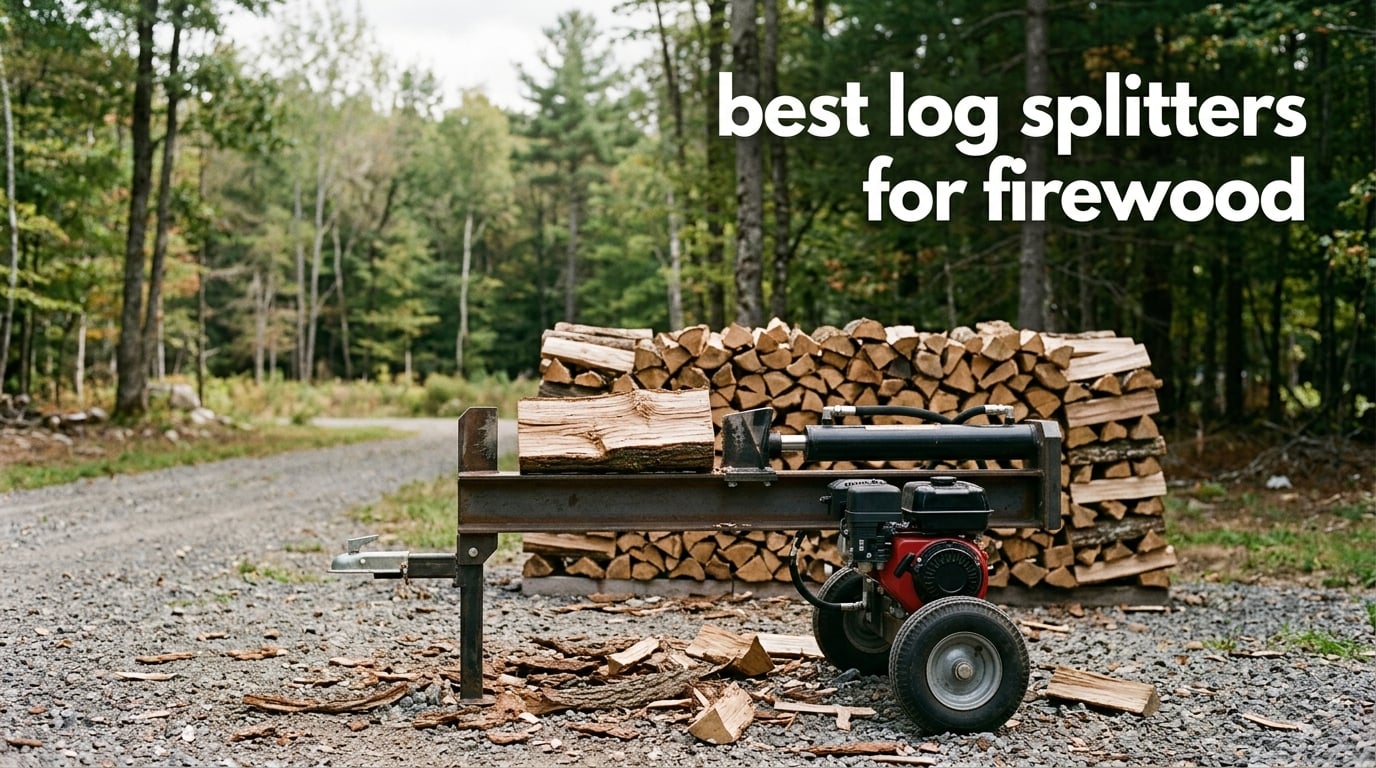
The best log splitters for firewood share one job: drive a blunt steel wedge through a round with enough force that a cord stops being a two-week project. Most people shopping in 2026 fall into one of three camps, and the camp matters more than any single number on the spec sheet.
The first camp wants quiet, simple electric power and splits a few hundred pounds of softwood a year near a garage outlet. The second camp has oak, hickory or maple on the property and needs real tonnage, which usually means a gas engine. The third camp splits more than a cord a season and quietly cares most about cycle time, because an eight-second ram return changes how a whole Saturday feels.
Our team compared 10 current log splitters across the three power classes, weighing published specifications against what buyers actually report after a season of use. We looked hard at splitting force, cycle time, log capacity, beam layout, weight, and the small details that decide whether a machine lives in your garage or becomes a job for the neighbor with the truck.
One warning before we get into the picks. Advertised tonnage is a laboratory figure measured on clean, straight, uniform rounds. Twisted grain, forks, burls and green hardwood are harder, and the honest reviews reflect that. We have flagged where owners report machines exceeding their rating and where they report stalling, because that gap is where most disappointed buyers end up.
Last reviewed and updated for 2026. If your volume is measured in armfuls rather than cords, start with our best kindling splitters for fireplace and camping instead, then come back here once you are ready for real tonnage.
Our Top 3 Picks: The Ones We’d Load in the Truck First

Landworks 20-Ton Gas Splitter
- 7 HP gas engine
- 20-ton rated force
- 7.5-second cycle
- 16-inch diameter

YARDMAX YS0650 6.5-Ton…
- Quiet 6.5-ton ram
- One-handed mode
- Overload auto shutoff
- 20.5-inch capacity

The Landworks unit wins our top slot because it combines the most owner history in this group with gas power, a 7.5-second cycle and a 148-pound machine that one person can still reposition. The YARDMAX takes the quiet, low-cost corner of the market with one of the highest average ratings of the ten. The BILT HARD 27-ton is the machine for anyone splitting live oak on acreage and willing to wrestle 494 pounds for the privilege.
Comparing 10 Log Splitters Side by Side in 2026
| Product | Specs | Action |
|---|---|---|
| Landworks Portable 20-Ton Gas Log Splitter |
|
Check Latest Price |
 SuperHandy Hydraulic Log Splitter 20 Ton SuperHandy Hydraulic Log Splitter 20 Ton |
|
Check Latest Price |
| YARDMAX YS0650 6.5 Ton Electric Log Splitter |
|
Check Latest Price |
 BILT HARD 6.5 Ton Log Splitter BILT HARD 6.5 Ton Log Splitter |
|
Check Latest Price |
| BILT HARD 27-Ton Towable Gas Log Splitter |
|
Check Latest Price |
 BILT HARD 22 Ton Gas Log Splitter BILT HARD 22 Ton Gas Log Splitter |
|
Check Latest Price |
 PowerSmart 6.5-Ton 15 Amp Electric Log Splitter PowerSmart 6.5-Ton 15 Amp Electric Log Splitter |
|
Check Latest Price |
 SuperHandy 25 Ton Gas Log Splitter SuperHandy 25 Ton Gas Log Splitter |
|
Check Latest Price |
 Ezasin 16-Ton Electric Log Splitter Ezasin 16-Ton Electric Log Splitter |
|
Check Latest Price |
 Ezasin 20-Ton Gas Log Splitter Ezasin 20-Ton Gas Log Splitter |
|
Check Latest Price |
Two quick reads of that table. Only four of these are electric, and every one of them is rated below 20 tons, which tells you where the force ceiling in this category really sits. And the rated cycle times run from 7 seconds to 20 seconds, a spread wide enough to matter more than most buyers expect.
1. Landworks Portable 20-Ton Gas Log Splitter – 7 HP Power and a 7.5-Second Cycle
Landworks Portable 20-Ton Gas Log Splitter, 7 HP, Rapid Auto Return
7 HP gas engine
20-ton rated force
Splits 20 in length by 16 in diameter
148.7 lbs
7.5-second cycle
Pros
- Starts on the first pull
- Splits rounds well past its 16-inch rating
- 7.5-second cycle with rapid auto return
- Compacts for storage
- Good welds and powder-coat finish
Cons
- Hydraulic fluid sold separately and manual understates the amount needed
- Wedge is welded on and cannot be resharpened
- No hitch point so moving it means carrying
- Push plate stops short of the wedge on long rounds
Of the ten machines we examined, this is the one with the deepest public record: 350 ratings averaging 4.4, split roughly 75 percent five-star. That history matters because the complaints are specific and survivable, which is exactly what you want to know before a season of work rather than after it.
The mechanical core is a 7 HP gas engine feeding a 2-Stage Bucher hydraulic gear pump, rated at 20 tons of splitting force, with a horizontal full beam and steel wedge. Capacity is logs up to 20 inches long and 16 inches in diameter on a 130-pound platform, and the whole assembly weighs 148.7 pounds.
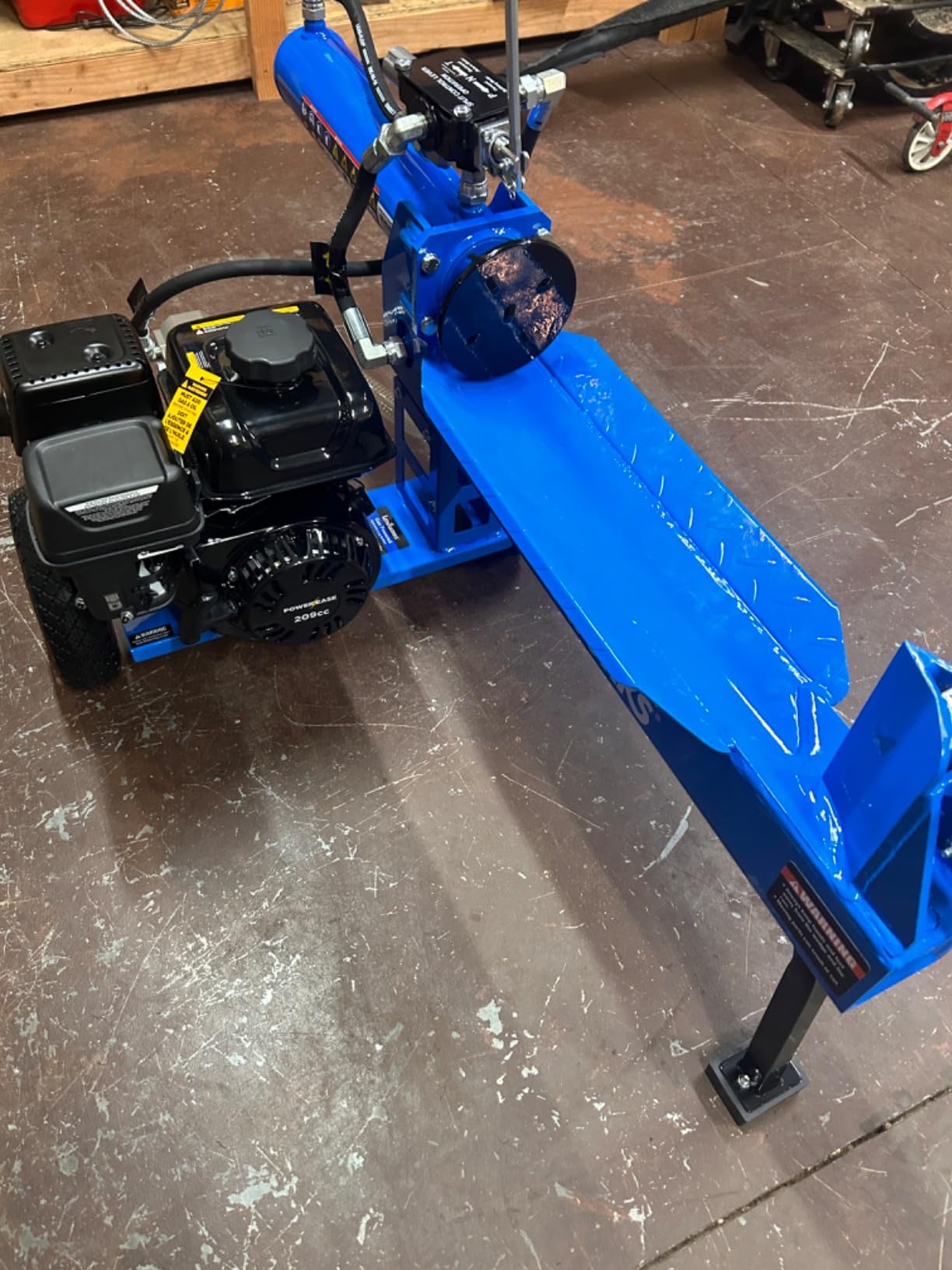
Owners repeatedly say the machine splits harder than its rating suggests, including oversized and hard hardwood rounds. Several describe it starting on the first pull and running smoothly, and the 7.5-second cycle with rapid auto return is the number that makes a 20-ton machine feel responsive rather than ponderous.
Why the 7 HP Engine and Bucher Pump Combination Matters
The 2-Stage Bucher gear pump is the part worth caring about most on any gas splitter. A two-stage pump delivers high flow for fast ram approach, then shifts to high pressure for the split itself, so you get speed on the easy stroke and force on the hard one.
Because the engine is gas rather than electric, the force is consistent regardless of how long you run it. Electric splitters heat up and their breakers can nuisance-trip on a long afternoon; this one does not have that failure mode, which is why it suits a woodlot away from an outlet.
Cycle Time and Rapid Auto Return Through a Working Day
At 7.5 seconds per cycle, a full afternoon of splitting moves a serious volume. Owners who compared against slower hydraulic units describe the difference as the reason they stopped dreading the pile, and it is the single spec most worth comparing across this list.
Rapid auto return also means the ram comes back toward you between rounds instead of needing a separate control step. Over a long session that removes a repetitive action, and repetitive actions are what make splitting feel endless by hour three.
Beam Length, Diameter Ceiling and the 148-Pound Weight
The 20-inch beam handles most of the firewood rounds people actually cut, and the 16-inch diameter rating covers rounds well beyond what a healthy adult should swing a maul at. At 148.7 pounds the unit is heavy for one person but light enough to reposition without a trailer, which owners cite as a practical advantage over the heavier towable splitters.
Two real limitations. The push plate stops short of the wedge, so longer rounds do not split their full length, and the welded-on wedge cannot be resharpened or swapped in the field once it dulls.
Where Owners Report Trouble
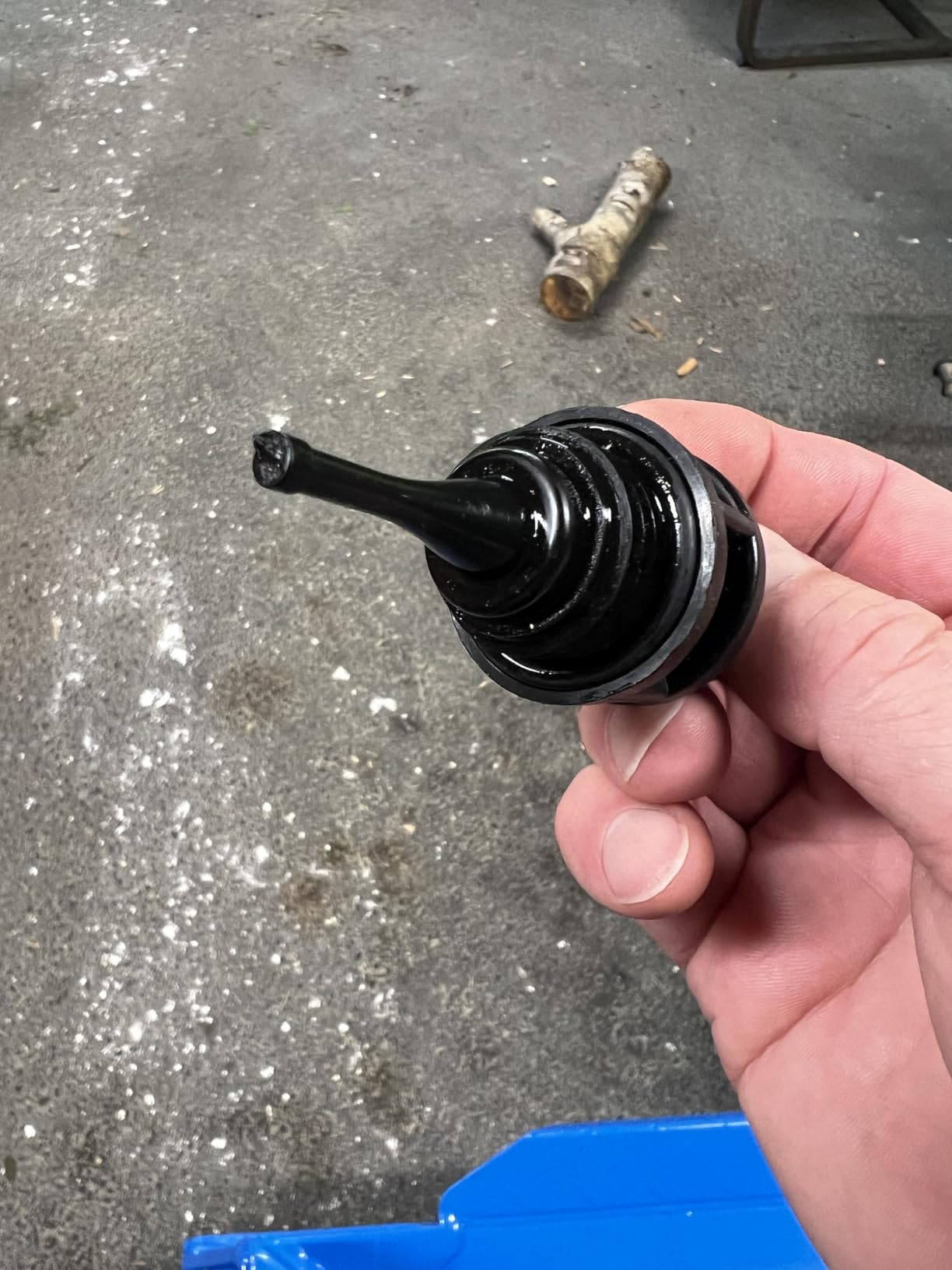
Hydraulic fluid is not included, and the manual understates the capacity needed, with several buyers buying closer to two gallons rather than the stated amount. Occasional spark plug failures show up after long periods of infrequent use, and a minority of reviews report a bent cylinder or a return hose that softens under heat and blows its fitting.
There is no hitch point, so moving it around a property means carrying or dragging. Owners also mention assembly taking about an hour, and the missing fluid is a real trip to the store before the first split. For a homeowner with mixed hardwood and a need to move the machine occasionally, it is still the most balanced package here.
2. SuperHandy 20-Ton Hydraulic Log Splitter – Fast Assembly and a Folding Handle
SuperHandy Hydraulic Log Splitter, 20 Ton, Firewood Wood Splitter
AlphaWorks 7 HP 4-stroke OHV
20-ton rated force
20 in length by 16 in diameter
7.5-second cycle
148.7 lbs
Pros
- Assembles in 30 to 45 minutes
- Starts reliably
- Punches through knots and 24-inch rounds
- Light enough to move without a hitch
- Folding handle aids storage
Cons
- Working height is low so you bend over
- No work table on the engine side
- Hydraulic filler cap thread can seep
- One short cotter pin in the kit
This is the Landworks platform in a different frame, and owners treat it that way. The AlphaWorks 7 HP 4-stroke OHV engine and 2-Stage Bucher pump produce the same 20-ton rated force, the same 7.5-second cycle, and the same 20 by 16-inch capacity.
What you get in exchange is a folding handle and 10-inch tubeless polyurethane wheels, which is where the storage and portability story differs. The 154 ratings average 4.3 with 71 percent five-star, and the assembly time buyers report, roughly 30 to 45 minutes, is the shortest in this group.
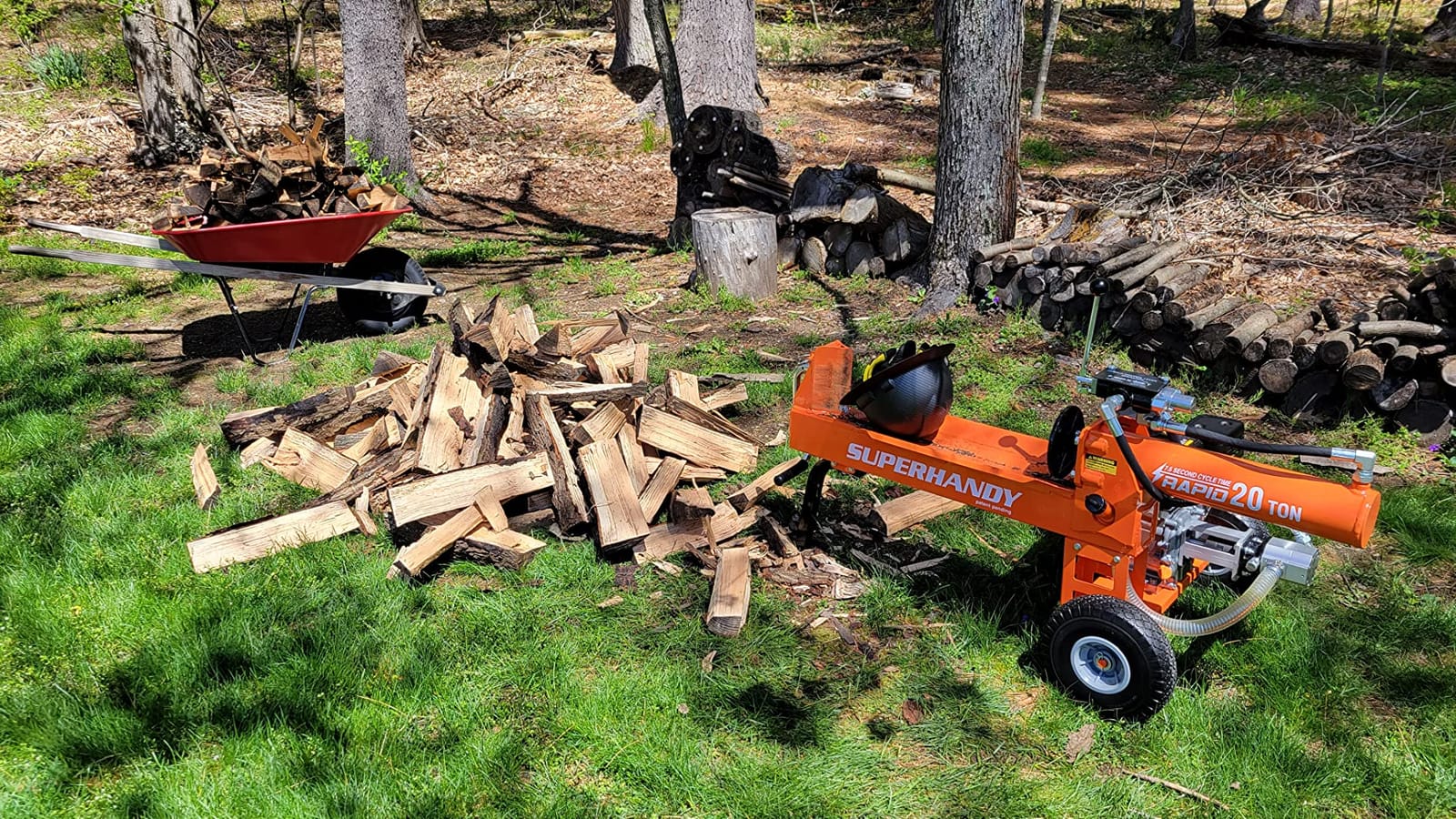
Reviewers describe it starting on the first few pulls and running steadily, with more than enough force for red oak, ash, beech and knotty juniper. Fuel economy gets mentioned often, and the ability to walk the machine to a different corner of the property without a trailer is a genuine advantage if your wood is not next to the garage.
Engine and Pump Layout Under Real Loads
A 7 HP four-stroke OHV engine is the sweet spot for a portable gas splitter: enough torque to keep pressure on the wedge, simple enough to start in cold weather, and small enough to keep the platform at 130 pounds. The horizontal full beam and steel wedge arrangement matches the top pick.
Where this unit shows its value is in messy wood. Owners report it pushing through knots, burls and rounds up to 24 inches without stalling, which is a stronger real-world claim than the rated diameter suggests.
Ergonomics: Low Profile, Folding Handle, No Work Table
The machine sits low to the ground, so the operator works bent over. That is the most common ergonomic complaint and the biggest reason to consider the raised-beam electric machines further down this list if you already have back or knee problems.
There is also no work table on the engine side, so staged rounds need to be stacked somewhere. The folding handle is a clear win for storage, letting the unit lie flat against a wall between seasons.
What 154 Owners Say About Strength and Defects
Value is the recurring theme. Buyers note it is affordable, portable and powerful enough for demanding hardwood, and the ratio of force to machine size is hard to argue with at this level.
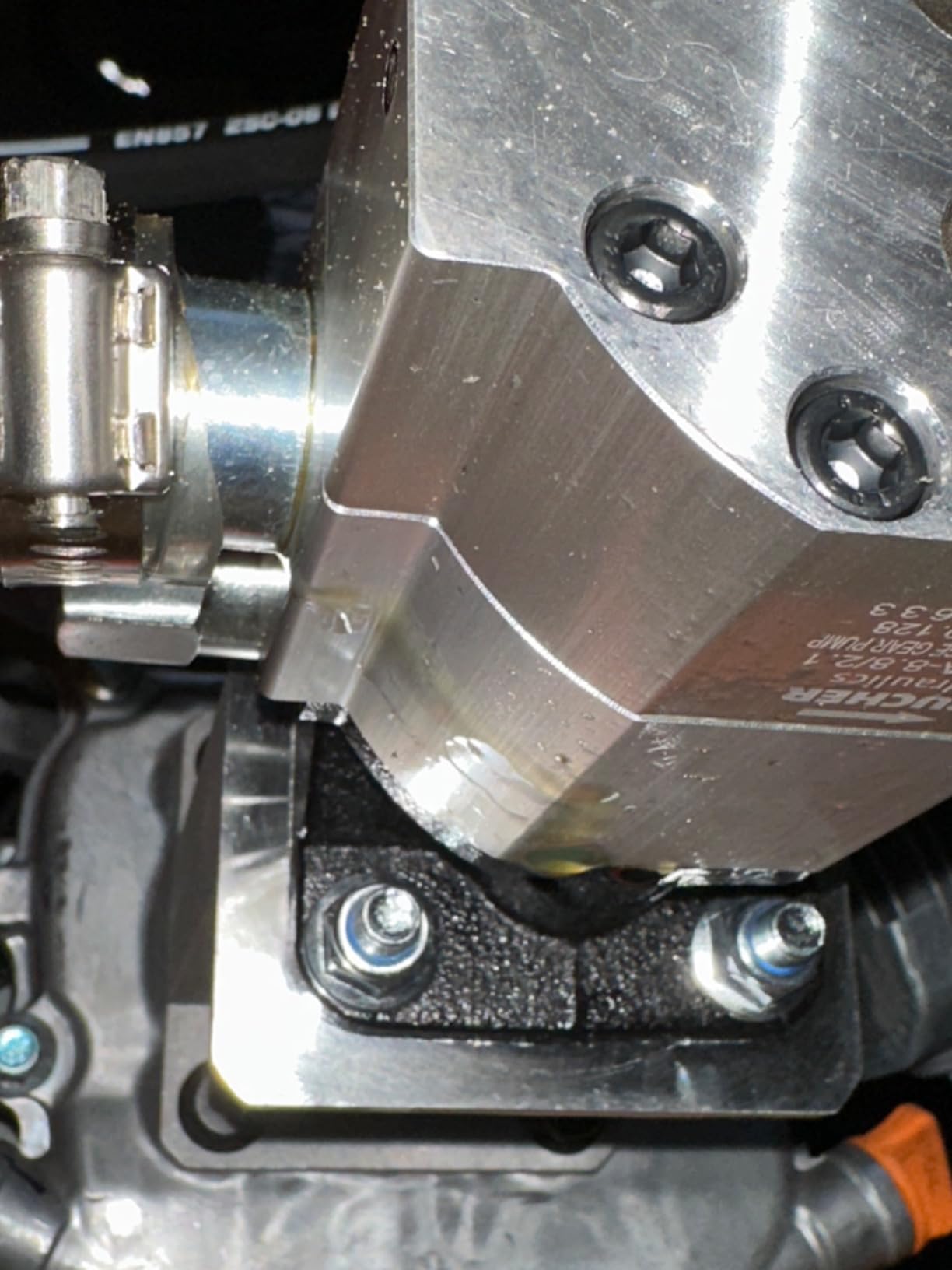
The defect list is short and specific: a hydraulic filler cap and dipstick thread that can leak slightly, one short cotter pin in the kit, and some complaints about metal frame durability after about a year. A minority also call it too slow for very large cord volumes, which is fair if your target is multiple cords a day rather than a season.
3. YARDMAX YS0650 6.5-Ton Electric Log Splitter – Quiet Power With a 4.6 Average
YARDMAX YS0650 6.5 Ton Electric Log Splitter
6.5-ton ram force
20.5 in length by 10 in diameter
One-handed mode
Overload auto shutoff
104.7 lbs
Pros
- Quiet enough for a residential driveway
- Handles 12-inch rounds despite the 10-inch rating
- Well built for the price
- One-handed mode is convenient
- Auto shutoff protects the machine on a jam
Cons
- Narrow plastic wheels wobble
- 105-pound weight means two people at unboxing
- Power cord is about 6 feet
- Cannot be stored standing on end
At 4.6 stars across 147 ratings with 79 percent five-star, this is the best-regarded electric machine in the roundup. It also sits near the top of its category on Best Sellers Rank, which tells you the quiet-electric-at-a-reasonable-cost corner of the market is where a lot of buyers have landed.
It is a 6.5-ton ram, handles logs up to 20.5 inches long and 10 inches in diameter, and offers a one-handed operation mode plus auto shutoff when log resistance exceeds capacity. The two-wheel design is for relocation rather than towing.
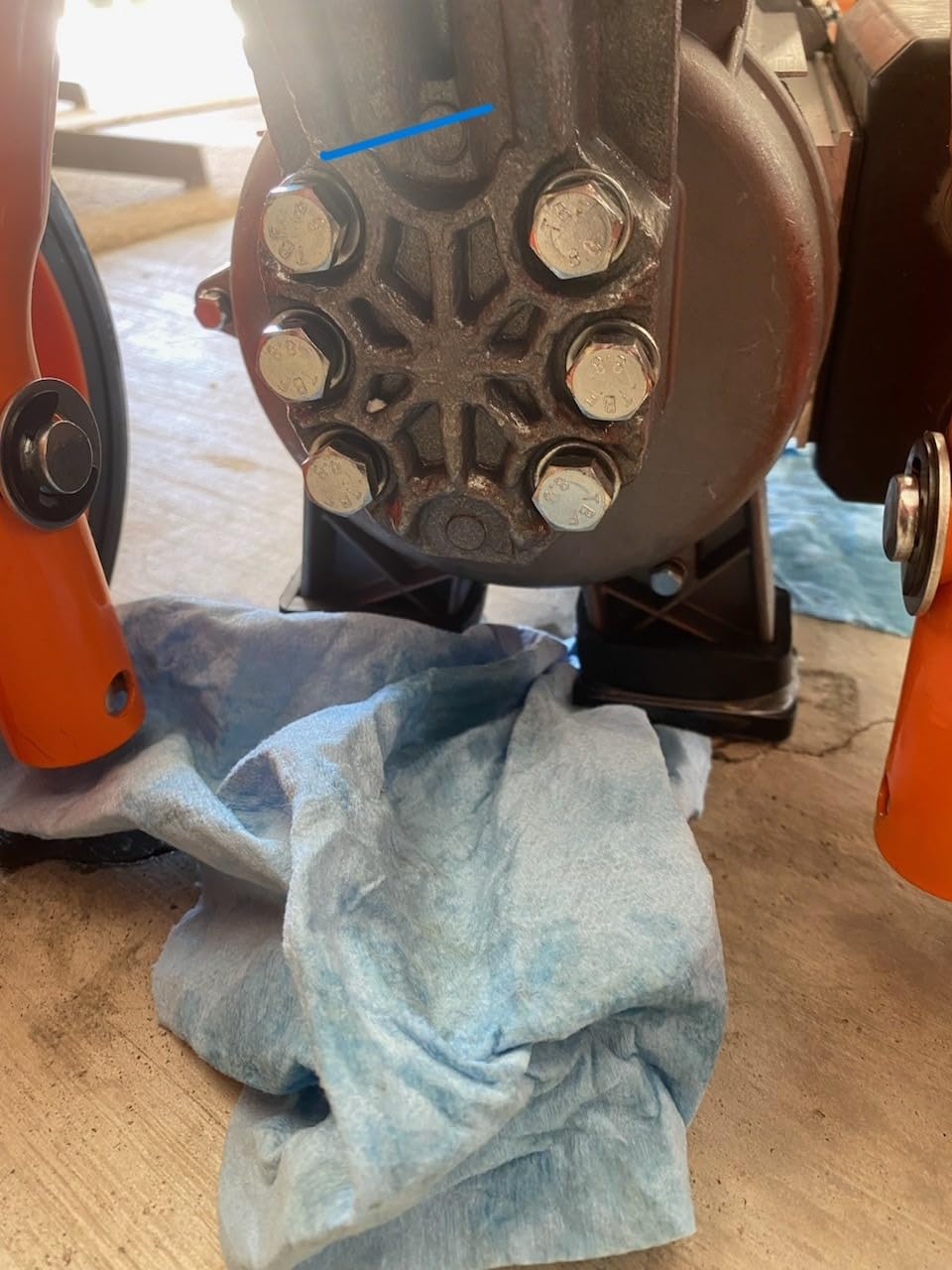
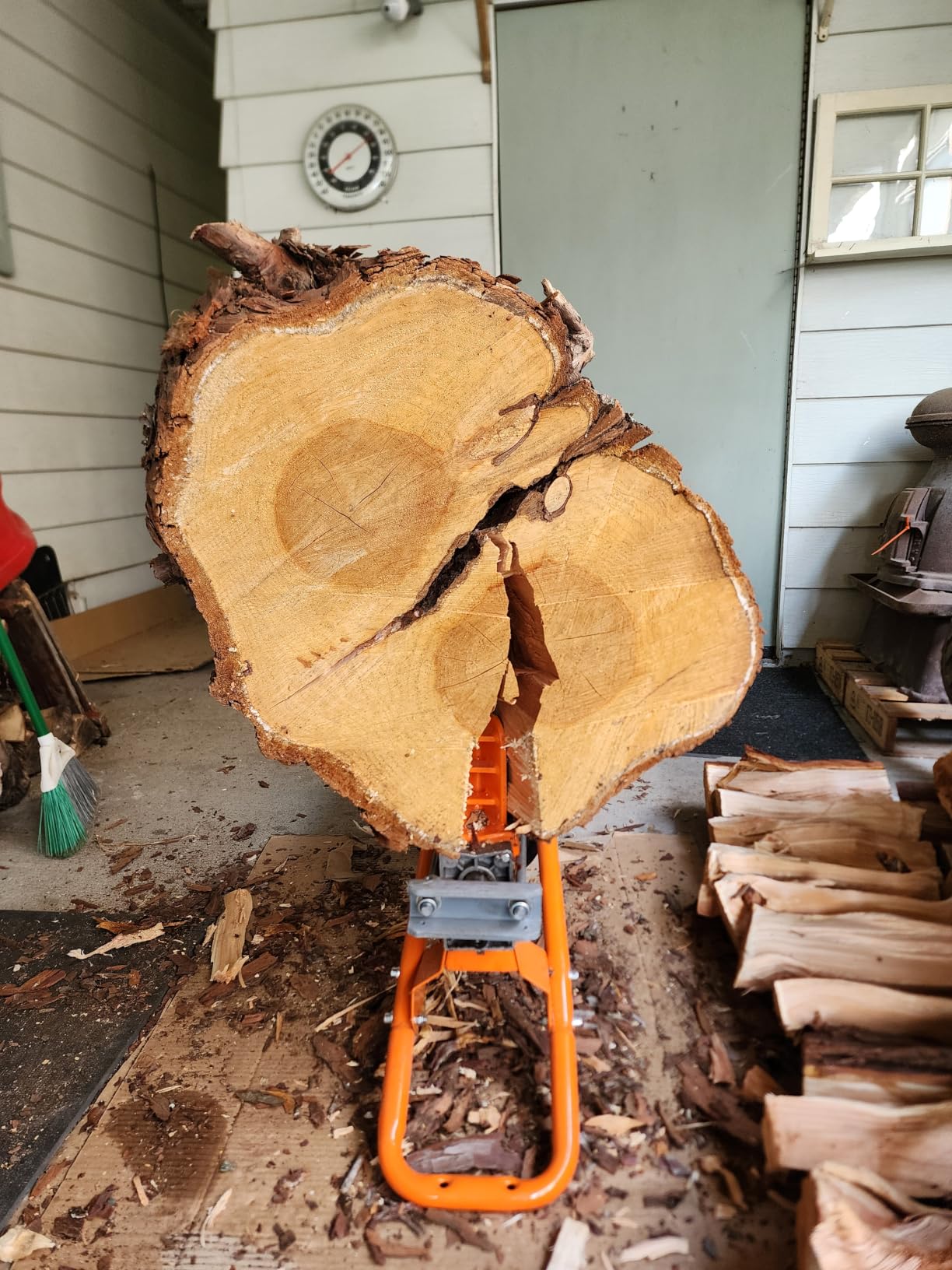
Homeowners with shoulder or back problems say it removes the physical toll of an axe or maul, and several buyers report splitting rounds larger than the stated 10-inch maximum. That is the pattern to watch in this category: the rated diameter is a conservative figure more often than a ceiling.
Quiet Electric Power Without an Engine
There is no exhaust, no pull cord and no fuel to store. For a driveway next to a house, or a garage where you split after dinner, that silence is not a minor perk. It is the entire reason to choose this class over a gas machine.
The trade is straightforward. Electric machines in this group are all rated well below the gas splitters, so a 10-inch round is the realistic comfort zone, and a genuinely large oak round is out of scope.
One-Handed Mode and the Overload Auto Shutoff
One-handed operation is the feature owners cite most warmly, especially those who add a foot switch. Two-handed control on a small splitter means restarting the stroke for every short piece, and a footswitch removes that friction entirely.
Auto shutoff when resistance exceeds capacity is a genuine safety and machine-protection feature. Instead of grinding a stalled ram against a jammed log, the unit stops, and you know to clear the tray and re-evaluate.
The 10-Inch Diameter Rating Is Conservative
Multiple buyers report handling 12-inch rounds. A 6.5-ton ram against a clean, straight round has headroom, and the manufacturers’ diameter figure tends to assume worst-case grain and worst-case loading.
This is where the honest caveat matters. A twisted round with a fork in it does not get the benefit of that headroom, and the same owners who split 12-inch pine cleanly will tell you that stubborn hardwood is a different problem entirely.
Wheels, Cord Length and the 105-Pound Unboxing
The narrow plastic wheels are the most common complaint, wobbling on uneven ground, and some owners replace them early. The power cord is about 6 feet, so a proper extension cord is not optional for full-length logs, and the machine cannot be stored standing on its end.
At 104.7 pounds, unboxing realistically takes two people. Owners who bought it specifically to avoid heavy lifting sometimes forget that a hydraulic splitter weighs about as much as a small refrigerator.
4. BILT HARD 6.5-Ton Full-Beam Electric Log Splitter – Raised Frame for Tired Backs
BILT HARD 6.5 Ton Log Splitter, Wood Splitter, Portable Firewood Splitting Machine
6.5-ton splitting force
20.5 in length by 9.8 in diameter
Full-beam steel frame
5.7-inch rear wheels
Integrated handle
Pros
- Delivers far more force than 6.5 tons implies
- Handles 12 to 18 inch rounds
- Raised working height reduces bending
- Easy assembly
- Company honored warranty with a replacement unit
Cons
- Two-handed switch is awkward without a foot switch
- Logs can shift as the ram approaches
- Small wheels on uneven ground
- Packaged in two cartons
Structurally this is the most interesting electric unit here. A full-beam steel frame with a steel splitting wedge at a 6.5-ton rating, it runs 80 percent five-star across 132 ratings and matches the 4.6 average posted by several other machines in this roundup.
Capacity is 20.5 inches long by 9.8 inches in diameter, and it is rated to work with a standard 10 AWG extension cord. On the back are 5.7-inch wheels with an integrated handle, and the whole thing stores upright when not in use.
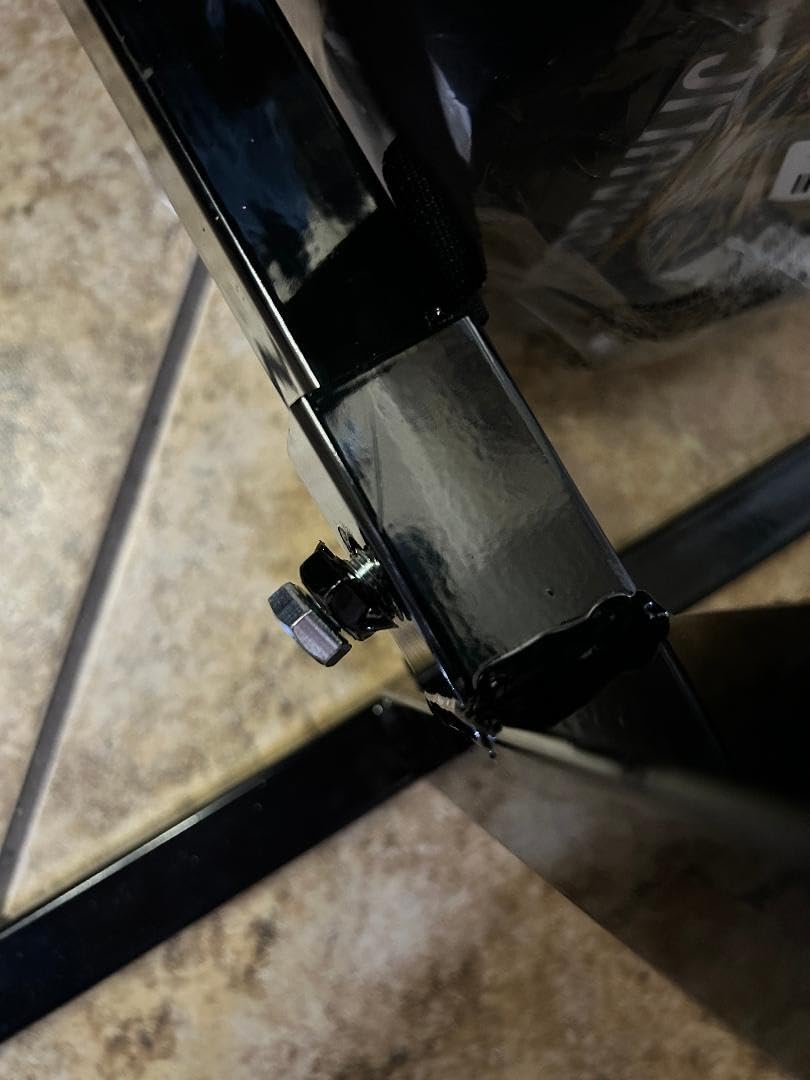
Buyers consistently report that the machine under-delivers on paper and over-performs in practice, splitting oak, cedar, elm, hickory, eucalyptus and even 18-inch rounds. One owner had a warranty claim resolved with a full replacement splitter, which is the kind of support that is worth noting on an electric unit at this level.
Why a Full Beam Matters on an Electric Machine
Full-beam construction means the frame spans the entire length of the split rather than stopping partway. On a horizontal splitter that translates into a longer usable stroke and a steadier platform under load, and piston guides keep pressure straight and even as the ram advances.
That structural rigidity is a plausible reason owners report more force than the 6.5-ton label suggests. When the frame does not flex, more of the motor’s output reaches the wood instead of deforming the chassis.
Raised Working Height and Why It Beats a Low Profile
The higher working position is singled out as a back-saver by owners who also considered low-profile machines. Splitting a full afternoon of rounds at waist height is a different experience from splitting them crouched near the ground.
This is the single most transferable lesson from the reviews in this category. If you already have a bad shoulder, back or knee, working height matters more than tonnage.
The Two-Handed Switch Problem and the Foot Switch Fix
The most common usability gripe is the two-hand control scheme, which several owners bypass by adding a foot switch. Without one, small pieces are fussy to feed because you have to operate the control and load the tray.
Logs can also shift out of position as the ram approaches, because vibration walks a round on the tray. Feeding technique and tray condition both help, but it is a real behavior to expect rather than a defect.
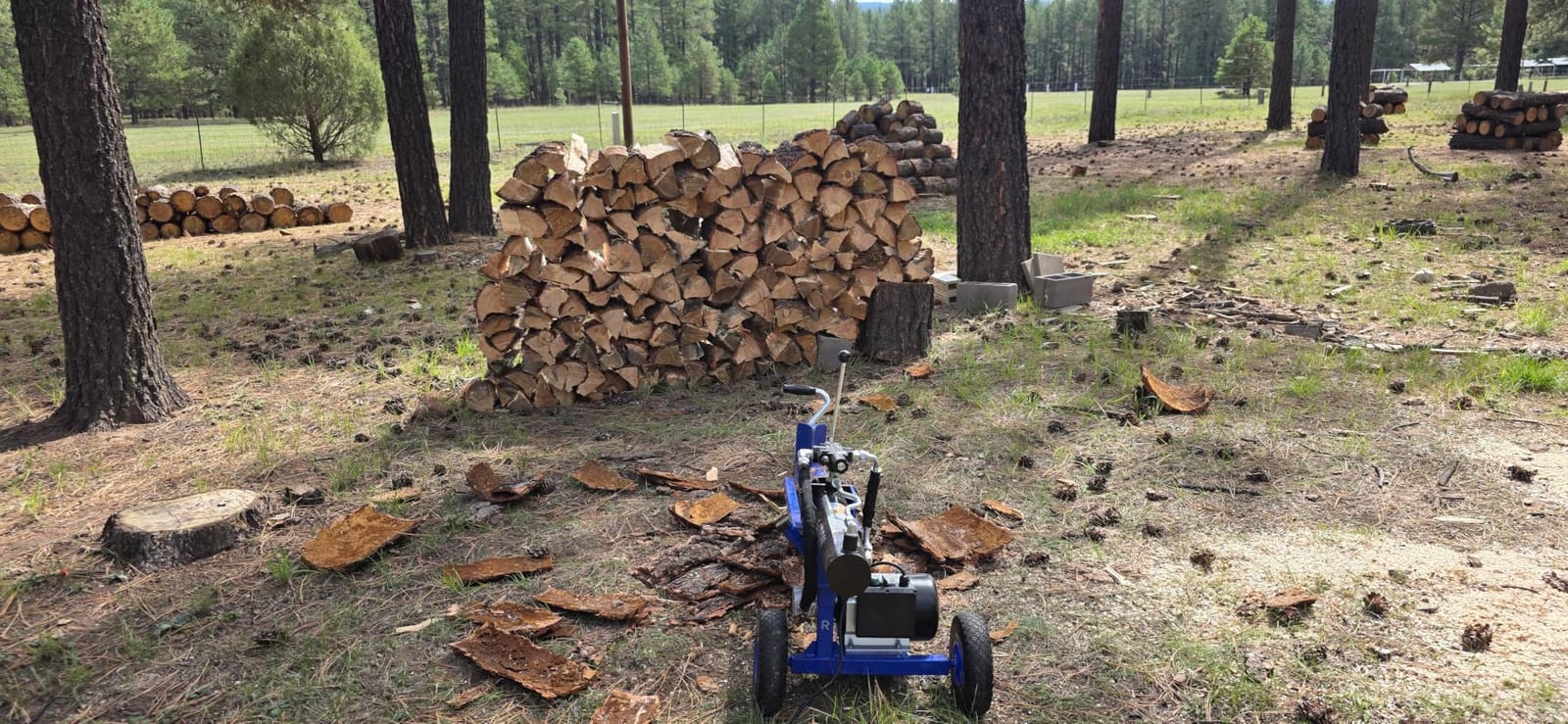
Two smaller notes. The hydraulic system needs bleeding and roughly a 1.5-gallon oil fill, which is a first-session task. And the unit is packaged in two cartons from different warehouses, only one of which is tracked, so check both boxes before assuming something is missing.
5. BILT HARD 27-Ton Towable Gas Log Splitter – Built for Live Oak and Long Days
BILT HARD 27-Ton Towable Gas Powered Log Splitter, Horizontal & Vertical Wood Splitter Gas Powered with 209cc OHV Engine & 2-Stage Pump, 16″ DOT Tires & 2″ Ball Coupler Firewood Splitting Machine
27-ton splitting force
7 HP 209cc OHV engine
Logs up to 24 inches long
494 lbs
13-second cycle
Pros
- Enormous splitting force on large rounds
- Towable behind an ATV or truck
- Horizontal to vertical conversion
- 13-second cycle
- Hydraulic and engine oil included
- Responsive support team
Cons
- 494 pounds means two people for assembly
- Arrives in three heavy cartons
- Awkward over rough terrain
- Engine can be hard to start until hydraulics are bled
This is the most powerful machine in the roundup, and the one owners with acreage describe in the most affectionate terms. At 4.6 stars across 78 ratings with 80 percent five-star, at the top of the heavy-hardwood class.
A 7 HP 209cc OHV engine produces 9.14 foot-pounds of torque and drives an 11 GPM two-stage pump against a 6-gallon hydraulic reservoir, rated at 27 tons. The 7-inch hardened steel wedge runs a 13-second cycle, and it handles logs up to 24 inches long. Hydraulic oil and engine oil are included.
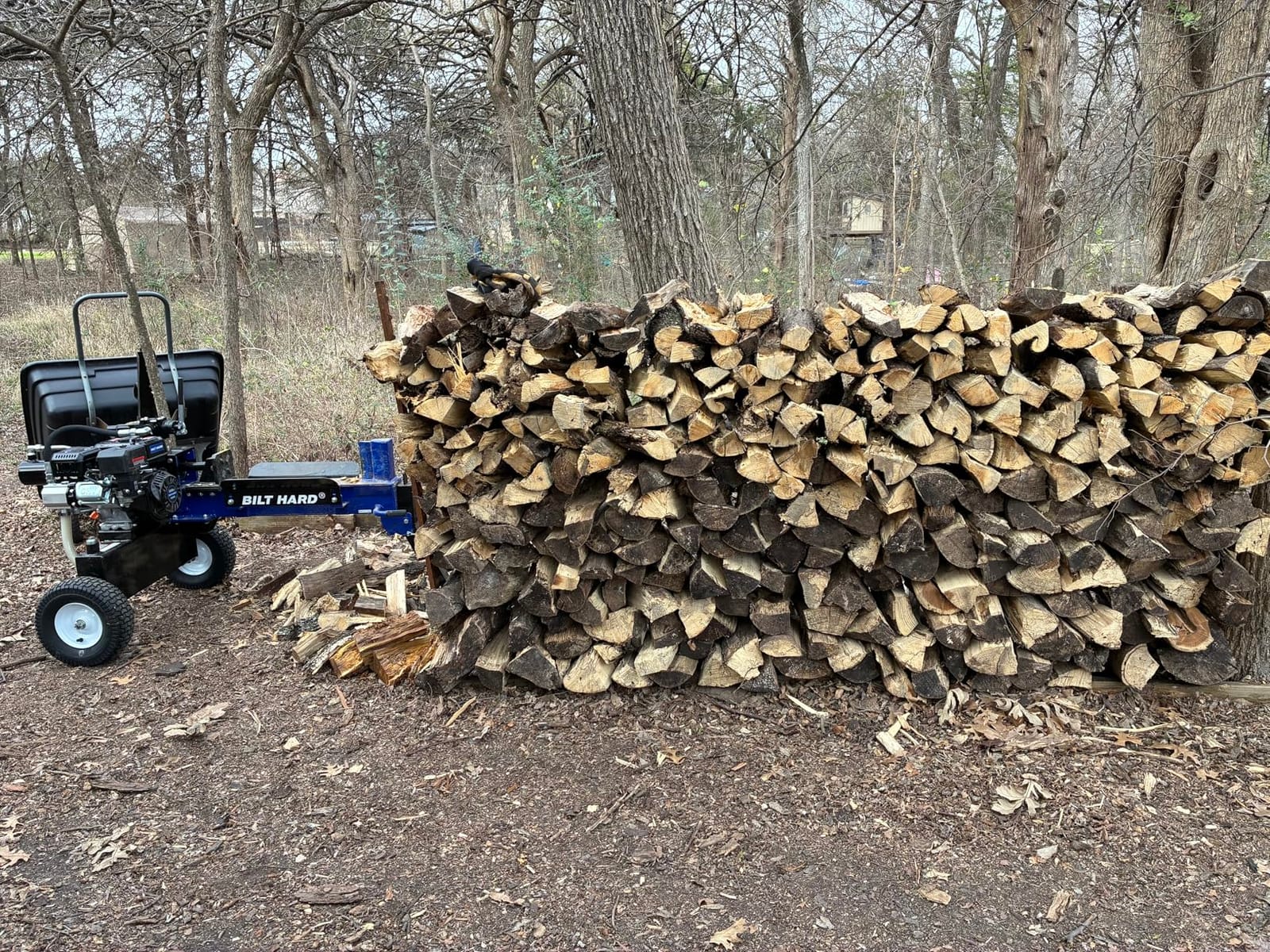
Owners described as a machine that chews through large rounds and handles long splitting sessions without straining. Towability is the standout feature for anyone whose woodlot is not next to a power source, and the vertical conversion means you can split without lifting logs into position.
209cc OHV Engine, Torque and What 27 Tons Actually Means
Seven horsepower and 9.14 foot-pounds of torque is a real increase over the 7 HP engines in the portable gas units, and it is what allows the ram to hold pressure on a round that is not cooperating. The listing itself notes some variation between 25 and 27 tons depending on the run, so treat the headline figure as a ceiling rather than a constant.
The practical difference shows up in the woods. Owners working oversized and twisted material report the machine pushing through rather than stalling, and the 6-gallon reservoir means fewer fluid-level checks during a long day than a portable unit would need.
Towability: 2-Inch Ball Coupler and DOT Tires
The 2-inch ball hitch coupler with 35-inch safety chains and 16-inch DOT-approved tires rated to 45 MPH towing means you can take the splitter to the pile instead of moving wood to the machine. For a rural woodlot, that reverses the entire logistics of a splitting day.
It is a substantial trailer, though. Owners warn that maneuvering over rough terrain is awkward, and you need a vehicle rated to pull the loaded weight. The payoff is a splitter that lives at the wood rather than in a garage.
Horizontal to Vertical Conversion and the 13-Second Cycle
Being able to switch from horizontal to vertical changes how you work rather than just how the machine is stored. Splitting in the vertical position means you do not lift a heavy round up onto the beam, which is where most back injuries in this hobby happen.
Thirteen seconds is mid-pack here. It is faster than the 18- and 20-second electric machines, slower than the 7.5- and 8-second gas splitters, and owners note you feel the difference most when the split pile gets big and the work becomes repetitive.
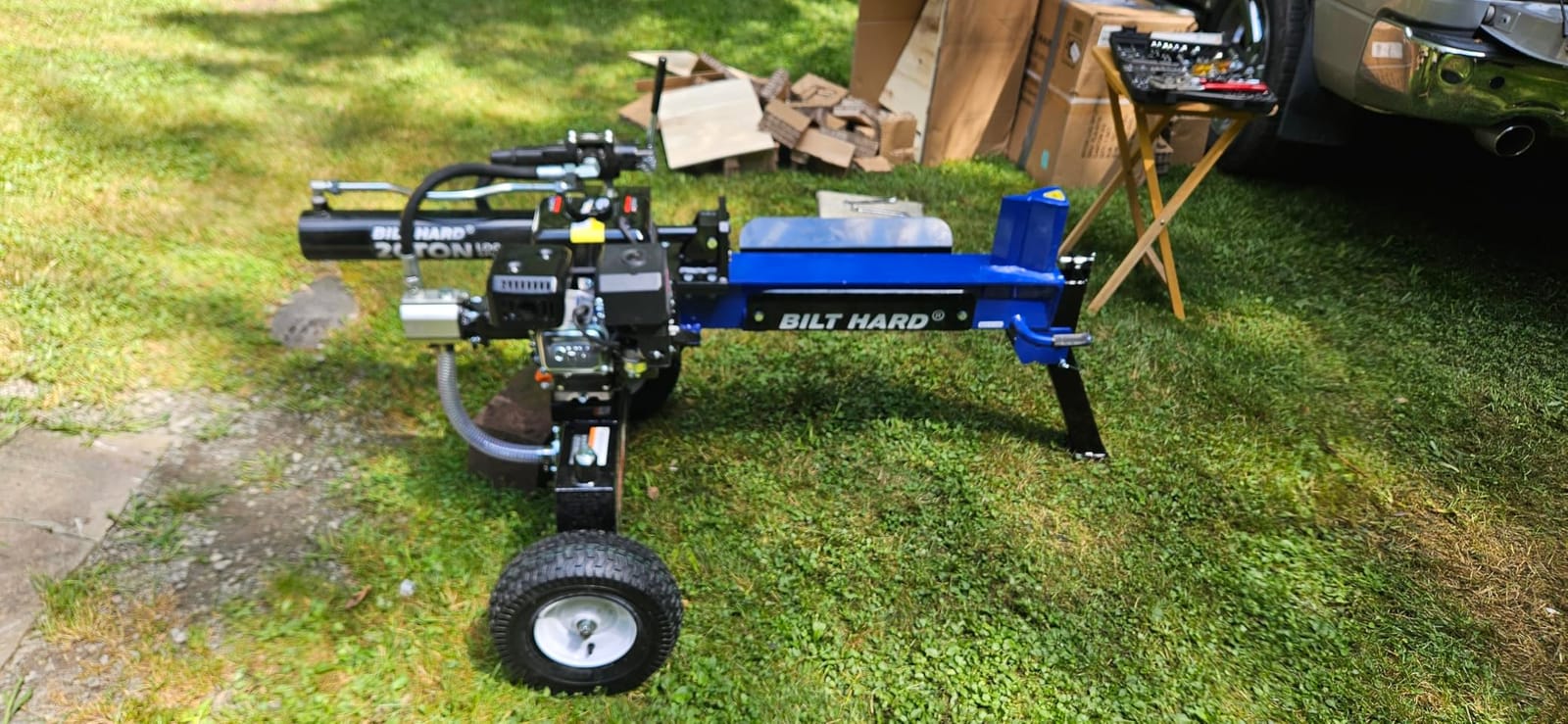
The 494-Pound Reality of Assembly and Moving
This is where expectations need adjusting. At 494 pounds, two people are needed for at least one assembly step, and the unit comes in three heavy cartons. One owner found a pre-installed hydraulic line on the cylinder had not been tightened, which is exactly the kind of thing to check before the first split.
The engine can be hard to start until trapped hydraulic air is bled out. That is normal procedure rather than a fault, but budget an hour for the first session, run it against a free log with the wedge clear, and confirm every hydraulic fitting is tight and every bolt is present before you trust it with a full load.
6. BILT HARD 22-Ton Gas Log Splitter – Fast 7-Second Cycle for Farm Volume
BILT HARD 22 Ton Gas Log Splitter, 209cc Engine with 2 Stage 14 GPM Hydraulic Pump, 21 Inch Log Capacity, Horizontal Hydraulic Firewood Splitter for Home, Farm and Outdoor Use
22-ton splitting force
209cc engine with 14 GPM pump
7-second cycle
21-inch capacity
274 lbs
Pros
- 22 tons handles demanding hardwood
- Fast 7-second cycle improves throughput
- Large 21-inch log capacity
- Steel frame and strong cylinder
- 13-inch wheels for moving around a property
Cons
- Horizontal-only so large logs must be lifted
- 274 pounds is not a one-person move
- Reviews and images are shared with the sibling 27-ton model
Of everything in this roundup, this machine posts the shortest rated cycle time of the ten: 7 seconds, driven by a 14 GPM two-stage gear pump off a 209cc gas engine rated at 22 tons of splitting force.
It handles logs up to 21 inches long on a rugged horizontal steel frame, with a 3.5 by 19-inch hydraulic cylinder rated to 25.5 MPa. It sits on 13-inch wheels and can be towed up to 25 MPH, and the whole unit weighs 274 pounds.
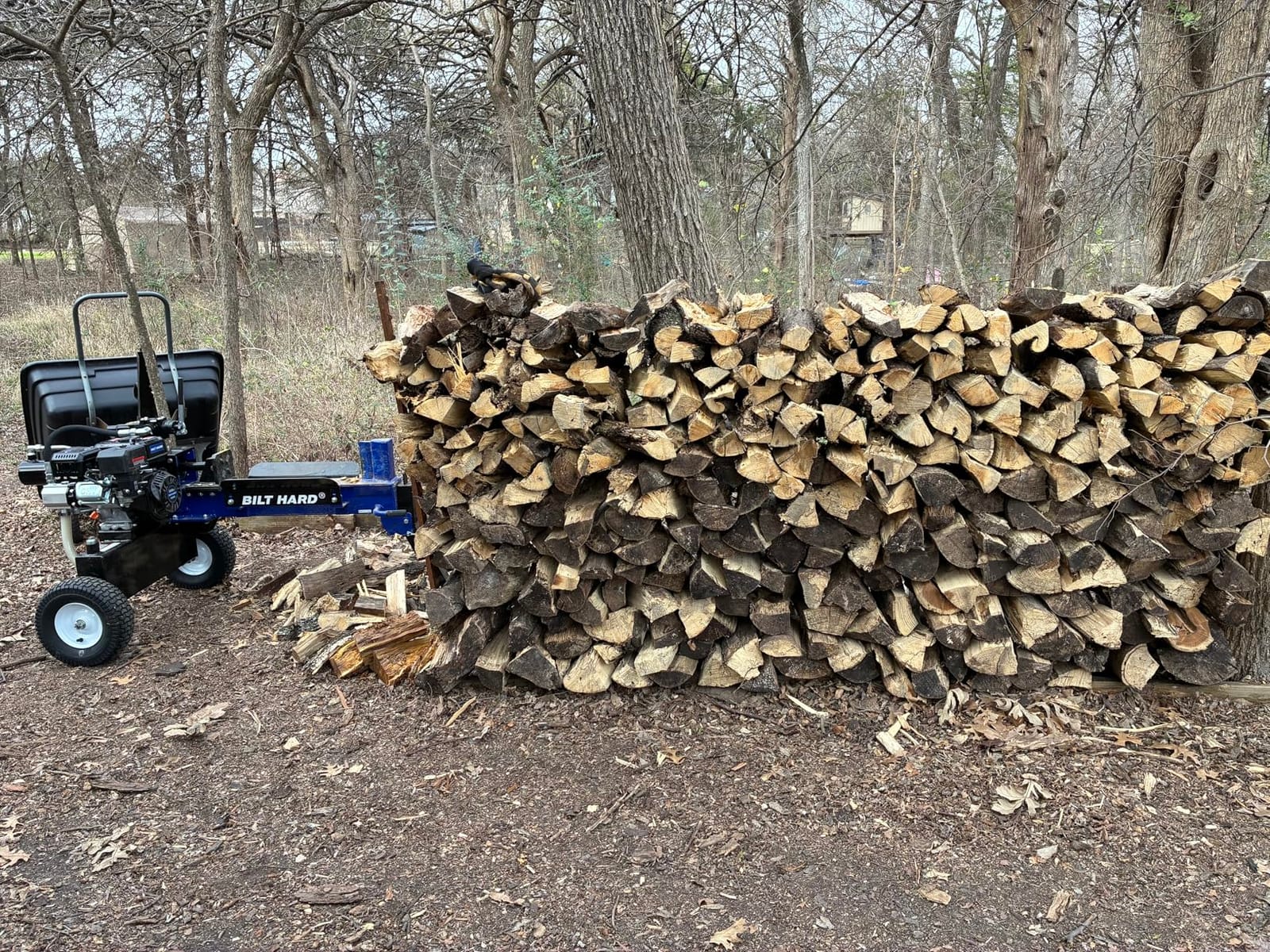
The listing carries the same 4.6 average and 78-review aggregate as the 27-ton BILT HARD, and it shares the same customer images, which tells you these are the same platform in different configurations. Buyers rate it on raw power, quick cycle time, straightforward assembly and responsive warranty support.
22 Tons from a 209cc Engine and a 14 GPM Pump
A 14 GPM two-stage pump is a meaningful upgrade over the 11 GPM pump in the 27-ton towable, and flow is what drives cycle time. The trade is that this is a horizontal-only machine, so all of the ram’s output goes into one log at a time rather than being shareable across a four-way wedge.
Owners report it handling demanding hardwood and seasoned firewood without drama, which is the workload most people buying at this tonnage actually face.
Seven-Second Cycle and 21-Inch Log Capacity
At 7 seconds per cycle, this is the fastest rated figure in the roundup, and it is fast on a machine that is not a small portable. For farm and property volume, that is the number that decides how much of a Saturday you spend watching a splitter work.
Twenty-one inches of log capacity is generous for firewood rounds. Longer sections are still handled, they just take more passes and more repositioning.
Horizontal-Only Design and Shared Reviews
Because it is horizontal only, large logs have to be lifted onto the beam. That is the single biggest ergonomic difference from the convertible units, and it is worth weighing if your wood comes out of a brush pile rather than a neatly stacked pile.
Because the reviews and images are shared with the 27-ton sibling, treat the durability feedback as platform-level rather than model-specific. Buyers flag weight, rough-terrain handling, and the need to check bolts and bleed hydraulics after unboxing.
7. PowerSmart 6.5-Ton 15 Amp Electric Log Splitter – Compact but Light on Force
PowerSmart Electric Log Splitter, 6.5-Ton, 3450 Motor Speed, 15 Amp, Horizontal Full Beam Design
15 Amp induction motor at 3450 rpm
6.5-ton hydraulic system
20-second cycle
Logs 20 in by 10 in
108 lbs
Pros
- Compact footprint that stores easily
- Corded power needs no fuel or engine maintenance
- Quick reset between rounds
- Steel construction for light-duty use
- Two-year warranty and responsive support
Cons
- Lowest rated force in the group
- One of the highest one-star shares among the electric models
- Needs a proper outlet and extension cord
This is one of the narrowest machines here, and at 4.2 stars across 52 ratings it is also among the lowest-rated in the group. That combination tells you exactly where it fits: light-duty seasonal splitting in a small space, not a winter of hardwood.
The power unit is a 15 Amp induction motor running at 3450 rpm driving a 6.5-ton hydraulic system, with a 20-second cycle and automatic reset. It handles logs up to 20 inches long and 10 inches in diameter, with wide rear wheels and a strong handle, and carries a two-year warranty.
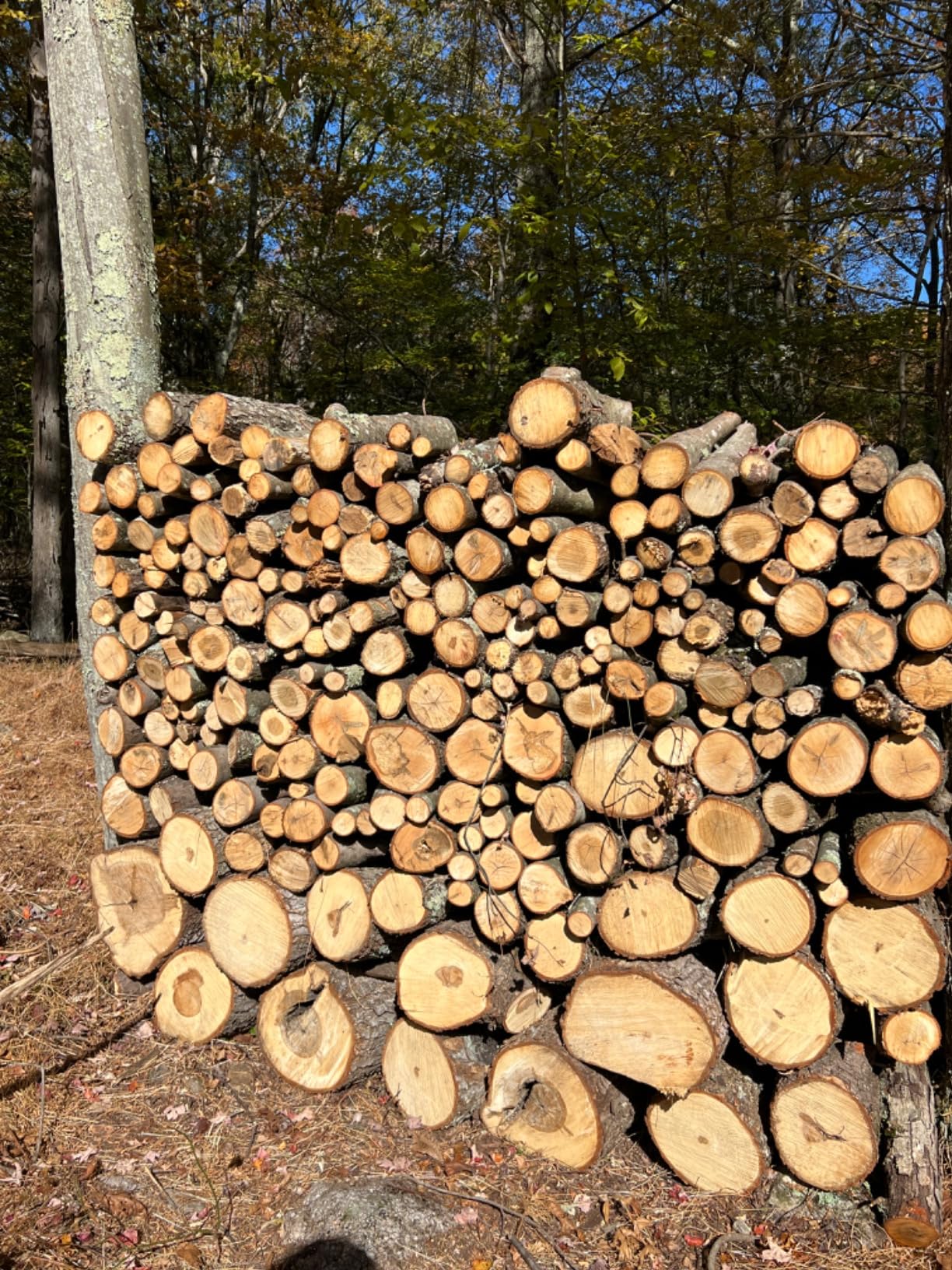
Owners who bought it for lighter seasonal work are satisfied with the compact size, quiet corded operation and quick reset. The 12 percent one-star share, tied for the highest among the electric splitters here, suggests a meaningful group of buyers ran into failures or felt the force limit hard.
3450 RPM Induction Motor and 6.5-Ton Hydraulics
An induction motor has no combustion parts to service, which means no fuel mixing, no spark plug and no oil changes on the power unit. It is a genuinely low-maintenance choice for someone who splits a few hundred pounds a year and does not want another engine in the garage.
The 6.5-ton figure is among the lowest rated forces in this roundup, and the practical ceiling is rounds under 10 inches. That is enough for softwood, ash, and small hardwood once they are reasonably straight.
A 20-Second Cycle That Shapes Your Expectations
Twenty seconds per cycle is the slowest rated figure among these ten, and it shapes what this machine is good for. On a small job that is unremarkable, and the automatic reset keeps the rhythm moving without a manual step.
On a full cord of hardwood it adds up quickly, and this is the honest limit of the budget electric class. You are buying quiet convenience, not throughput.
Where the 4.2 Average Comes From
The rating distribution explains itself: 70 percent five-star against 12 percent one-star. Early-stage buyers were satisfied with size and quietness, while a distinct group hit the force ceiling or had hardware problems they were not happy about.
It also needs a proper outlet and a correctly gauged extension cord for full-length logs. An undersized cord is the classic cause of overheating and tripping on an electric splitter, and it is the one mistake worth spending extra to avoid.
8. SuperHandy 25-Ton Gas Splitter – 24-Inch Diameter at Only 90 Pounds
SuperHandy Portable 25 Ton Gas Log Splitter with 7HP Engine, Bucher Gear Pump, and Horizontal/Vertical Half Beam Steel Wedge for Firewood Splitting and Forestry Harvesting
25-ton rated force
Logs up to 24 inches in diameter
12-second cycle
90 lb platform
Half-beam design
Pros
- Largest rated diameter in the group at 24 inches
- Switches between horizontal and vertical
- Only 90 pounds for a 25-ton machine
- 12-second cycle is quick
- 10-inch wheels and folding handle
Cons
- One of the smallest review bases here at 40 ratings
- Hydraulic fluid must be sourced separately
- 10 percent three-star share hints at build or performance issues
The most unusual machine in the roundup, and the one whose numbers do not obviously add up. It packs a 25-ton rating and a 24-inch diameter capacity onto a 90-pound platform, which is unusual, and that is exactly why it needs careful reading.
The 7 HP AlphaWorks gas engine drives a 2-Stage Bucher hydraulic gear pump, and the half-beam steel wedge configuration lets it split in horizontal or vertical position. Cycle time is 12 seconds, and 10-inch polyurethane wheels with a folding handle cover transport and storage.
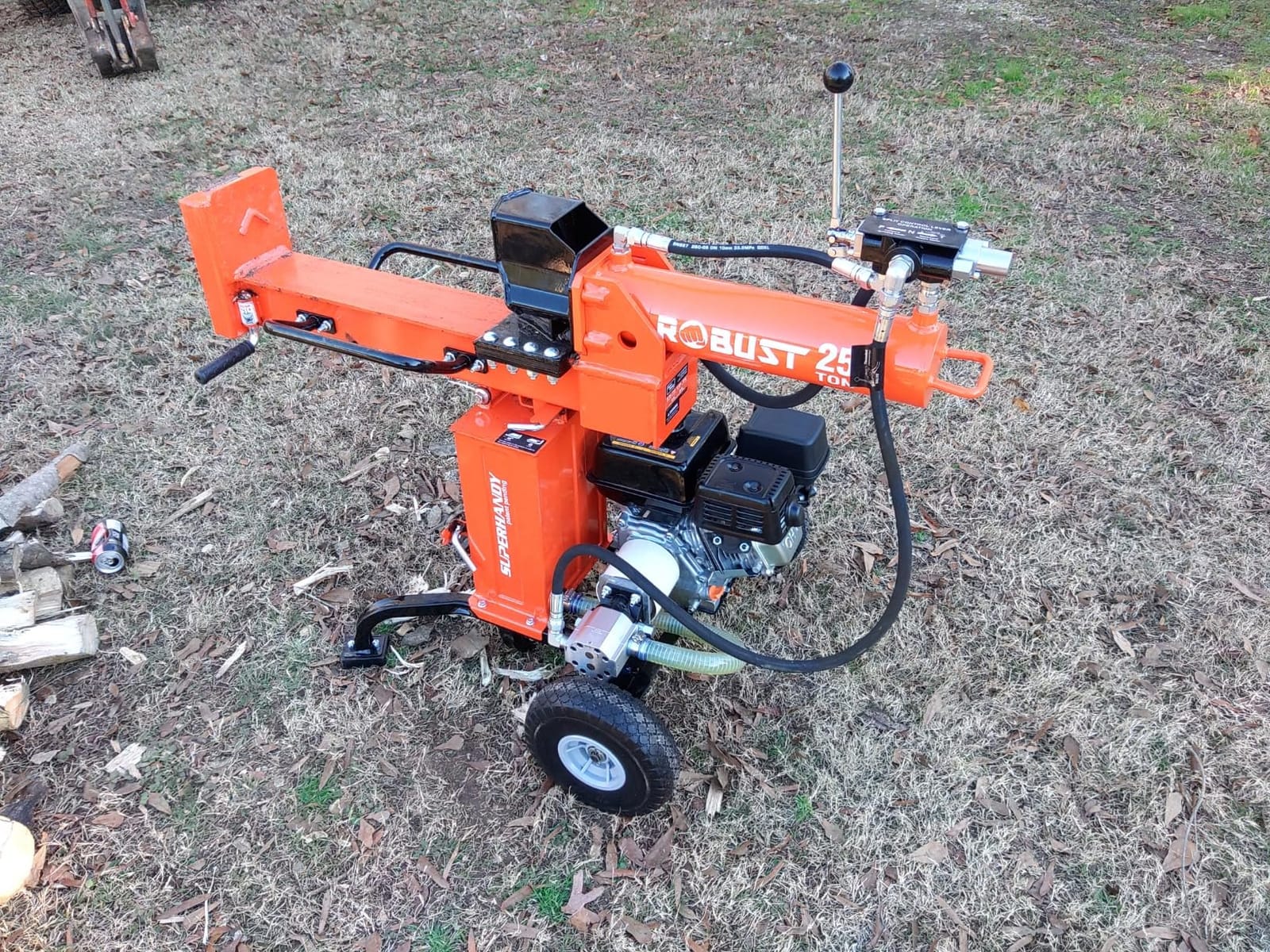
At 4.5 stars across 40 ratings, its review base is thin, with 78 percent five-star and 8 percent four-star. The 10 percent three-star cluster is the largest mid-tier share in the group, which is a signal to move carefully rather than a reason to pass.
25 Tons at Only 90 Pounds
Weight is where this unit genuinely differs. Where a 20-ton portable platform weighs about 130 pounds and the 27-ton towable weighs 494 pounds, this one is listed at 90 pounds. One person can reposition it, and that changes what jobs it can take on.
Half-beam construction is the design reason. It is lighter than a full beam, and it is why the machine can carry a 25-ton rating without the mass that usually comes with it.
Half-Beam Design and the 24-Inch Diameter Ceiling
Handling logs up to 20 inches long and 24 inches in diameter gives it the largest rated diameter of the ten. In practice, the diameter figure is the one that gets tested by reality, since a 24-inch round rarely arrives straight and clean.
The horizontal to vertical conversion is the practical feature. Splitting upright means you feed the ram instead of lifting, and on rounds this large that difference decides whether a session ends in satisfaction or in a sore back.
A 40-Review Base That Asks for Caution
Forty ratings is thin evidence for a machine in this class. The early sentiment is generally positive, but there is not enough long-term data here to say how the hydraulics and frame hold up over seasons, and that is the information you would want before committing.
Hydraulic fluid is also not included and must be sourced separately, which is a common pattern on this brand and worth planning for before the first use.
9. Ezasin 16-Ton Electric Log Splitter – Quiet Hardwood Power With Mixed QC
Ezasin Electric Log Splitter 16 Ton, Hydraulic Wood Splitter 17.4Amp for Firewood, Horizontal Full Beam Steel Wedge, 2-Stage Pump, 20.5 Inch Log Capacity for Farm, Yard, Forestry Harvesting
16-ton splitting force
17.4 Amp motor
18-second auto-return cycle
65 dB operating noise
124 lbs
Pros
- Splits hard oak within the rated envelope
- Quiet at 65 dB for residential use
- Assembly hardware bagged individually
- Seller replaced a whole machine when a part failed
- Integrated handle and 8-inch wheels
Cons
- 12 percent one-star share
- Reports of bent shafts and hydraulic leaks
- One unit arrived missing four motor bolts
- Easy to overfill with hydraulic fluid
- Inconsistent customer service response
If quiet operation and hardwood capability are both non-negotiable, this is the only machine in the roundup that delivers them. A 17.4 Amp motor drives a two-stage aluminum gear pump at 16 tons of splitting force on a horizontal full-beam steel frame, running at a stated 65 dB.
Cycle time is 18 seconds with automatic ram return, log capacity is 20.5 inches, and the frame rides on 8-inch transport wheels with an integrated handle at 124 pounds. A temperature sensor and overload protection provide auto shutoff.
Now the hard part. At 4.2 stars across 26 ratings with 12 percent one-star, this is the most polarized listing we analyzed, and you need both halves of that record before buying.
17.4 Amp Motor, Two-Stage Pump and 18-Second Cycle
Seventeen-point-four amps is a substantial step up from the 15 Amp electric splitters, and it is what allows 16 tons of force from a plug rather than an engine. For a homeowner splitting seasoned oak near the house, that is the spec combination that matters.
Eighteen seconds per cycle sits between the fast portable electric units and the 20-second budget model. It is not going to set a throughput record, and owners with a full cord of hardwood will feel it.
Temperature Sensor and Overload Auto Shutoff
The temperature sensor and overload protection are real machine-protection features. If the motor overheats or the log exceeds what the ram can handle, the unit shuts itself down rather than cooking itself or grinding a jam.
At 65 dB, the quiet claim is the one buyers mention when they describe using it in a residential area. There is no exhaust, so it can run beside a house or near a neighbor’s property line without the noise complaint a gas unit would generate.
Where the Mixed Quality Record Comes From
Happy buyers call it powerful, quiet and easy to assemble, and several praise the seller for providing a complete replacement unit when a part failed. Assembly hardware was counted and bagged individually, which is a small thing that saves an afternoon.
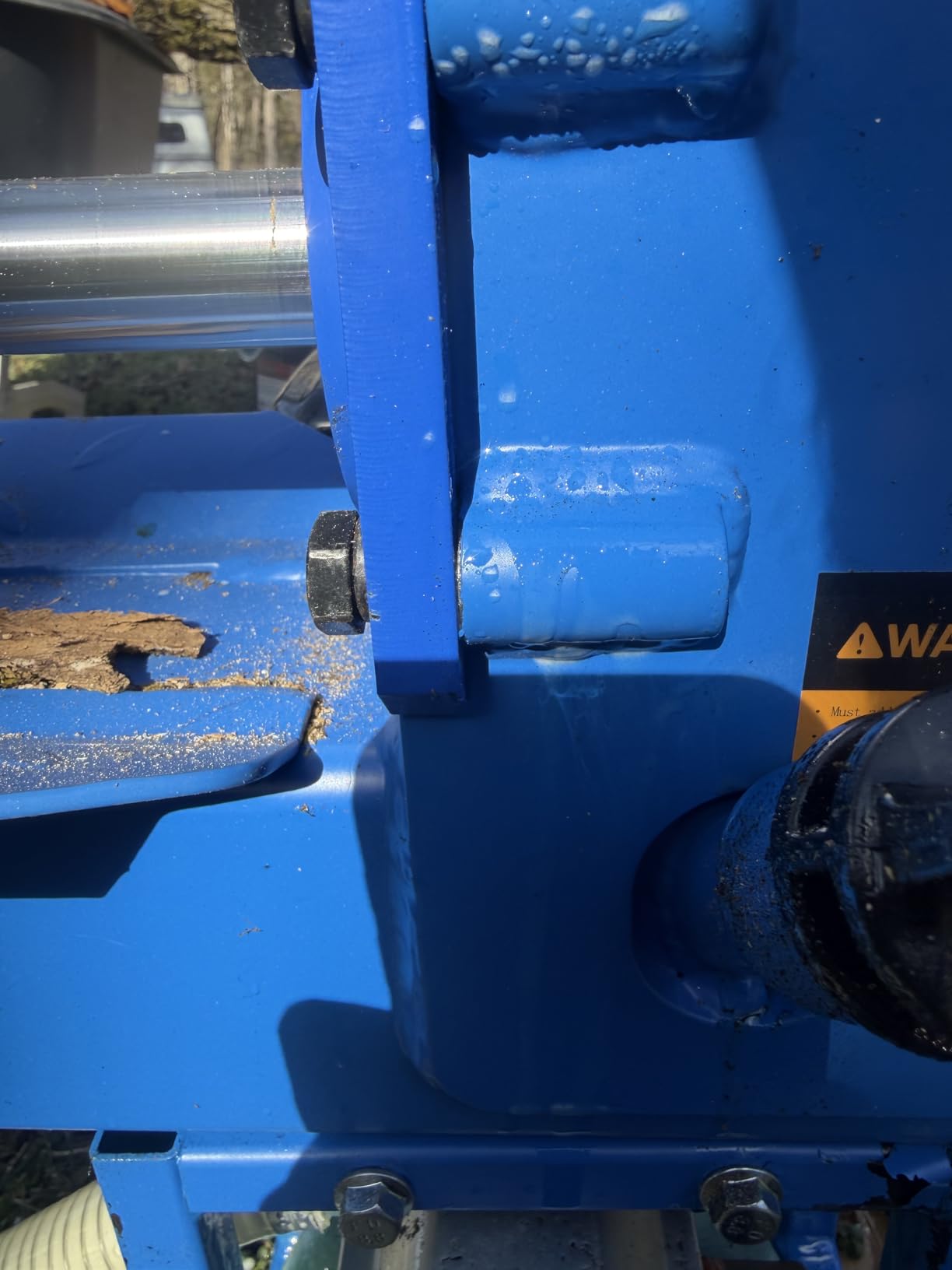
Unhappy buyers report a bent main shaft after two uses, hydraulic fluid escaping from a weld and a bolt fitting, a seized motor straight out of the box, and a unit that would not start. One owner received a machine missing four motor-mounting bolts, and some report vibration that loosened a nut during use. The 12 percent one-star share says quality control is inconsistent rather than bad, which is a harder call to make because you cannot predict which unit you will get.
Two practical notes. It needs roughly 2 quarts of hydraulic fluid after first use and is easy to overfill. And if you buy it, inspect the frame welds and every hydraulic fitting before the first log, then re-torque anything that moved after the first session.
10. Ezasin 20-Ton Gas Log Splitter – An 8-Second Cycle With Auto Return
Ezasin Gas Log Splitter 20 Ton, 209CC 7HP Hydraulic Wood Splitter, 8s Cycle
209cc 7HP gas engine
20-ton hydraulic ram
8-second cycle
Logs 20.5 in by 16 in
135 lbs
Pros
- Among the fastest rated cycles here at 8 seconds
- 20-ton ram handles hardwood and knots
- Auto-return valve removes an extra step
- Dual-stage pump balances speed and pressure
- Lightweight frame and 10-inch pneumatic tires
Cons
- Shared 26-review base with a 12 percent one-star share
- Three separate fluids must be added first
- Pneumatic tires need pressure maintenance
- Reported bent shaft and fluid loss
The specification sheet on this machine is the most ambitious in the portable gas category. A 209cc 7 HP engine, a 20-ton hydraulic ram, an 8-second cycle time rated at up to 450 logs per hour, and a 90-degree alloy steel wedge with multi-point welding.
It handles logs up to 20.5 inches long and 16 inches in diameter, uses an auto-return detent valve for hands-free ram retraction, and a dual-stage aluminum gear pump balancing speed and pressure. Ten-inch pneumatic tires sit on a lightweight steel frame at 135 pounds.
Eight-Second Cycle and Up to 450 Logs per Hour
An 8-second cycle is the second-quickest rated figure in this roundup, and the 450-logs-per-hour claim follows directly from it. Those numbers assume a clean straight round every time, so treat them as a ceiling, but the gap against a 20-second electric cycle is real.
The auto-return detent valve is the feature owners appreciate most in practice. The ram retracts without a separate control action, which removes one step from every single round and reduces the fatigue that sets in late in a session.
Auto-Return Detent Valve and Dual-Stage Aluminum Pump
A dual-stage pump is what lets the ram approach quickly at low pressure and then generate high pressure at the split, which is the whole reason an 8-second cycle is possible on a 20-ton machine rather than a 10-ton one.
The 90-degree multi-point welded alloy steel wedge is a good sign on a portable unit, where the wedge takes the most abuse. A sharp, well-supported wedge is the difference between a clean split and a piece that just gets pushed off the beam.
Three Fluids to Add and the Mixed Quality Record
Before the first split you need 1.6 gallons of AW32 or AW46 hydraulic oil, 0.145 gallons of SAE 15W-40 engine oil and 0.74 gallons of 87-octane gasoline. Budget an afternoon and set aside the fluids, because nothing works until all three are in.
The 4.2 average and 26 ratings come with a 12 percent one-star share, identical to the Ezasin 16-ton electric unit, which points to platform-level variation rather than one bad model. Owners report a bent main shaft and hydraulic fluid loss in a minority of cases. Pneumatic tires also need pressure maintenance, which is one more thing a tubeless or solid wheel would have removed from the list.
How to Choose a Log Splitter: Tonnage, Power and Wood Species
The single most common question across every firewood forum we reviewed is some version of how much tonnage a given person actually needs. It deserves a direct answer before any brand discussion, because buying 20 tons when you split pine is spending money you do not need, and buying 6.5 tons when you face live oak is buying frustration.
How Many Tons of Splitting Force Do You Actually Need?
For softwood and small rounds under 10 inches, 5 to 7 tons is genuinely enough. For mixed hardwood, seasoned oak, maple and hickory, 15 to 20 tons is the working range most home woodlots need. Above 25 tons is for genuinely large diameter rounds, storm-felled timber and commercial volume.
Most owners reporting 20-ton hydraulic units say they cover all bases for typical home hardwood, which is the short answer to whether 20 tons is enough for regular home use. It is, with the caveat that the round must be reasonably straight. A twisted fork at 18 inches will challenge a machine that sails through a clean 18-inch round.
Two things inflate or deflate the number. Green wood is significantly harder than seasoned wood, so a pile of fresh-fallen timber wants the upper end of the range. And knotty or burl-heavy sections deserve a margin, because a wedge stops at the first serious knot regardless of what the label says.
Electric vs Gas: Which Should You Buy?
Buy electric if you split close to an outlet, under roughly half a cord a season, value quiet operation, and are dealing with softwood or modest hardwood. Buy gas if you are splitting more than a cord a year, working away from power, handling oak and hickory, or processing a woodlot.
Electric wins on noise, maintenance and simplicity. There is no pull cord, no fuel storage and no engine service, and the models here run 65 dB or less, which means you can split beside a house. Gas wins decisively on force and throughput, with cycle times of 7 to 13 seconds against 18 to 20 seconds for the electric splitters in this roundup.
The most common complaint from electric owners is speed, and the most common complaint from gas owners is noise and starting. If your sessions are short and infrequent, the slower cycle rarely registers. If you plan a full Saturday of splitting, it registers every round.
Cycle Time and Duty Cycle Decide How Fast You Work
Cycle time is the number most buyers ignore and then notice most. The spread across these ten splitters runs from 7 seconds to 20 seconds, and across a full cord of firewood that difference compounds into a meaningful chunk of your day.
Duty cycle is the related concept. A machine that can run a full day without overheating, with a thermal cutoff or a motor that cools adequately between rounds, is a machine you will still be using at hour five. Electric splitters with temperature sensors have an advantage here in a narrow sense, because they cut out predictably rather than cooking themselves.
Horizontal or Vertical: Which Beam Layout Fits Your Wood?
Horizontal-only machines are the standard, and they are cheaper and simpler. The cost is lifting every round up onto the beam, which is the single most common ergonomic complaint across owner reviews, and it gets worse with large logs.
Convertible machines, whether half-beam or full-beam, let you split upright and feed the ram instead of lifting. The BILT HARD 27-ton and the SuperHandy 25-ton both do this. If you are dealing with big rounds, a brush pile, or a back that is already complaining, convertibility is worth the extra weight.
Matching Tonnage to Wood Species, Green Wood and Knots
Softwood splits easily and is where electric splitters earn their place. Poplar, ash and basswood follow, then mixed hardwood, then oak, then hickory, and live oak sits at the top of the difficulty list along with anything burl-heavy or twisted.
Green wood resists splitting far more than seasoned wood, so plan on the upper end of your tonnage range if you are cutting and splitting in the same season. Seasoned wood splits faster but is also lighter, so the force you need drops even as the wood gets easier to handle.
The most useful piece of advice from the owner community is to be honest about your round geometry. A perfectly straight, uniform round splits cleanly on almost any of these machines. Twisted, forked and irregular pieces get pushed out of the way or jammed on all of them, and no amount of tonnage fully solves it.
Safety Habits That Prevent Most Splitter Injuries
Wear safety glasses, gloves and steel-toe boots, and keep hearing protection if you are splitting for more than a few rounds. Log flyback, where a split round launches backward toward the operator, is the most common serious injury in this hobby.
Keep hands and feet clear of the wedge line and the tray, operate the controls with both hands or a foot switch rather than one, and never reach into the beam to reposition a log while the ram is moving. Load the tray, then step back before you start the stroke.
For electric splitters, use a properly gauged extension cord and a GFCI-protected outlet, and run the machine on level ground. For gas splitters, work outdoors away from dry vegetation, shut the engine off before refueling, and drain the fuel tank before storage. If you tow a splitter, check that your coupler, safety chains and tires are road-legal for the speed you travel.
Maintenance and End-of-Season Storage
Check the hydraulic fluid level before every session and top up with the recommended grade, which is AW32 on most of the machines here. Owners who ran low are the ones who ended up with pump wear, so this is the highest-value five seconds in maintenance.
On gas splitters, check the air filter and the spark plug at the start of each season, and change the engine oil at the manufacturer’s interval. Draining fuel before storage prevents varnish in the carburetor and stale fuel at the start of next year.
Electric splitters need almost nothing beyond fluid checks and keeping the ram and wedge clean of bark chips. A stiff hydraulic ram is the most common reason a splitter feels like it lost power, and it is usually cured in an afternoon with a clean and a fresh charge of fluid.
Manual Drop Splitters and Kindling Splitters as a Separate Decision
If you split less than a few hundred pounds a year, a powered hydraulic machine is more tool than you need. A manual drop splitter needs no fuel, no outlet and no maintenance, and it stores flat against a wall. It also takes real physical effort per round, which is the entire reason people buy powered machines in the first place.
For kindling, fireplace and firepit use specifically, our best kindling splitters guide covers the small wedge units built for that job, which is a different purchase from a full-size firewood splitter. If you are in an apartment or a tight urban space, these same small-footprint tools solve the same problem as a powered machine in a fraction of the space.
You can also read our leather splitter roundup if you also work hides, since the same lever-and-wedge logic applies to a completely different material.
Frequently Asked Questions
How many tons is a good log splitter?
For softwood and rounds under 10 inches, 5 to 7 tons is enough. For mixed hardwood including oak, maple and hickory, 15 to 20 tons covers most home woodlots. Above 25 tons is for large diameter rounds, storm-felled timber and commercial volume. Green wood and knotty sections need the upper end of the range.
Is a 20 ton log splitter enough for regular home use?
Yes, 20 tons is the working range most home woodlots need for seasoned hardwood, and owners commonly report that it covers their entire pile. The caveat is round geometry: a twisted or forked log resists a 20-ton machine just as it resists a cheaper one, so feed it straight, uniform rounds.
Which is better, a gas or electric log splitter?
Gas is better for more than about a cord a year, heavy hardwood, or work away from an outlet, because rated cycle times run 7 to 13 seconds against 18 to 20 seconds for electric. Electric is better for light volume near a power source, because it is quieter, needs no fuel and no engine service, and the models here run at 65 dB or less.
Are electric log splitters worth it?
They are worth it if you split under roughly half a cord a season near an outlet, mostly softwood or modest hardwood, and live near neighbors. The trade is real: every electric unit in this roundup is rated below 20 tons, and the slowest takes 20 seconds per cycle. If your wood is oak and hickory, gas is the better tool.
Can a log splitter split green wood?
Yes, but green wood resists splitting far more than seasoned wood and needs the upper end of your tonnage range. A 20-ton unit handles fresh-fallen rounds; a 6.5-ton electric unit will often stall on them. Expect a longer day and a higher risk of jamming when you cut and split in the same season.
Which Log Splitter Should You Buy?
If you want one machine that handles mixed hardwood and can be moved by one person, the Landworks 20-Ton Gas Log Splitter is the pick, backed by the largest owner record in the group and a 7.5-second cycle. If you split less than half a cord near an outlet and want quiet, the YARDMAX YS0650 is one of the highest-rated machines we examined and the least disruptive to neighbors.
If your wood is live oak, storm-felled timber or you have acreage, the BILT HARD 27-Ton Towable splitter is the only one here built for it, and towing it to the pile is worth the 494 pounds. If your back is already the limiting factor, look at beam height and vertical conversion before tonnage.
Whichever you choose, buy the right gauge of extension cord, keep the hydraulic fluid topped up, and feed it straight rounds. Those three habits do more for your output than any specification on this list.
Leave a Reply