
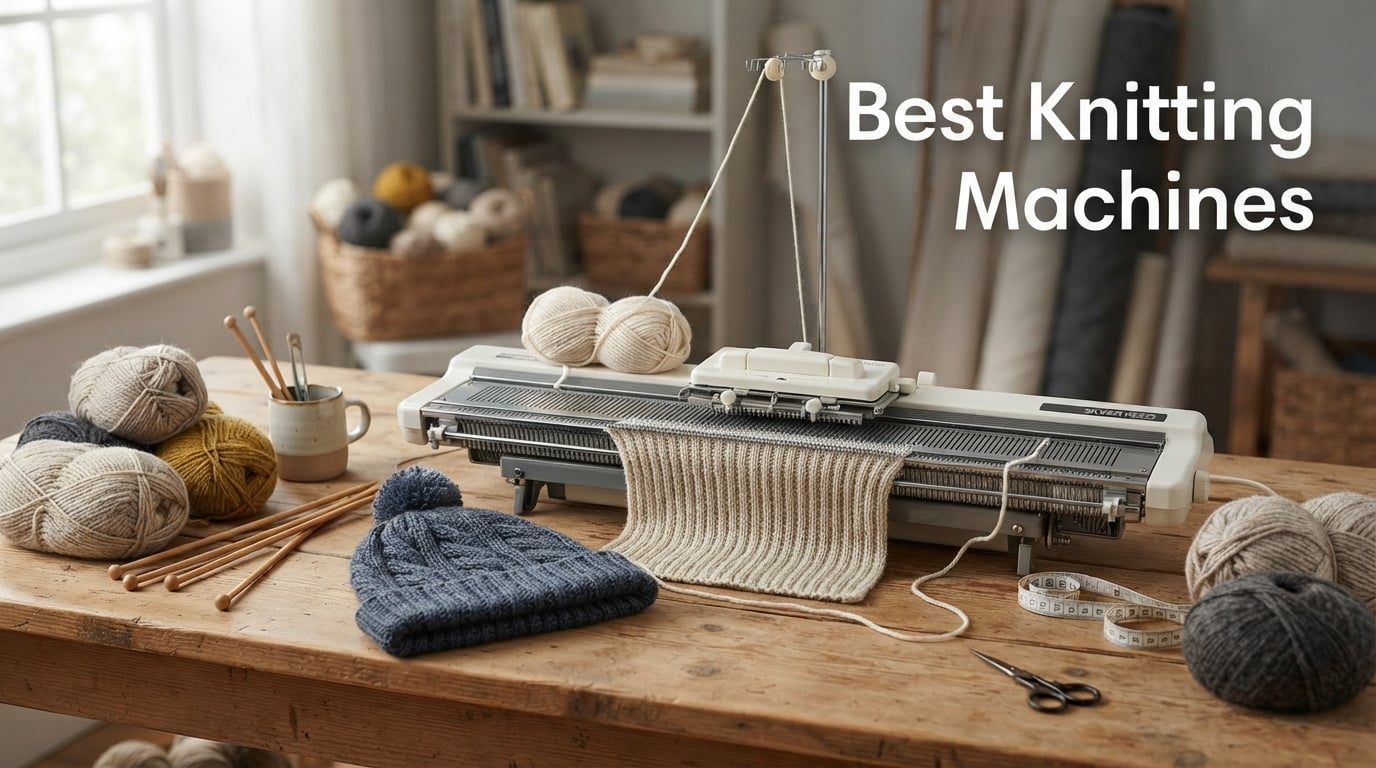
I have spent the better part of the last year cranking tubes, dropping stitches, and learning the hard way that not every knitting machine deserves a spot on your craft table. After testing models from the budget Sentro up to the German-built addi Express, I put together this guide to the best knitting machines you can buy in 2026 so you do not waste money on a machine that jams halfway through your first hat.
Whether you want to crank out beanies for craft fairs, knit flat panels for sweaters on a mid-gauge flatbed, or just produce i-cord for bag straps, there is a machine on this list that fits your skill level and budget. I have organized the picks by use case, included honest notes on learning curves and durability, and added a buying guide covering the technical decisions that actually matter.
One quick heads-up before we dive in: a lot of “knitting machines” sold on Amazon under names like Sentro, Santro, and a dozen other white-label brands are functionally the same product. I will flag which ones are worth your money and which are best avoided.
Our Top 3 Tested Knitting Machines for 2026
If you want the short version, here are the three machines I would personally buy again. The addi Express Kingsize is my editor’s choice for serious knitters, the Sentro 48-Needle is the best value for hobbyists, and the Tulip i-Cord Knitter is the budget pick for cord makers.

Comparing the Best Knitting Machines in 2026
Before we get into the individual reviews, here is a side-by-side breakdown of all six machines I tested. This comparison table shows you the key features, needle counts, and what each machine does best so you can quickly narrow down your shortlist.
| Product | Specs | Action |
|---|---|---|
| addi Express Kingsize |
|
Check Latest Price |
 SENTRO 48 Needles SENTRO 48 Needles |
|
Check Latest Price |
 BZVV 48-Needle Circular Loom BZVV 48-Needle Circular Loom |
|
Check Latest Price |
 LK150 Mid Gauge Flat Bed LK150 Mid Gauge Flat Bed |
|
Check Latest Price |
 Tulip i-Cord Knitter Tulip i-Cord Knitter |
|
Check Latest Price |
 Caydo Automatic i-Cord Pro Caydo Automatic i-Cord Pro |
|
Check Latest Price |
1. addi Express Kingsize – Best Overall Circular Knitting Machine
addi Express Kingsize Knitting Machine Knitting Machine
46 needles
Circular and flat panel modes
Built-in row counter
German-made
Pros
- Premium German build quality
- 46 needles for larger projects
- Switches between circular and flat panel
- Built-in row counter
- Includes 5 spare needles and complete kit
Cons
- Higher price than budget machines
- Plastic construction
- Steep learning curve for flat panel mode
The addi Express Kingsize is the machine I keep coming back to when I want results I can trust. This is a premium German-built hand crank machine with 46 needles, and over 4,800 Amazon reviewers have given it a 4.4-star average for a reason. It is the gold standard for serious hobbyists who want both circular tubes and flat panels without buying two separate machines.
What sets the addi apart from cheaper Sentro clones is the precision of the mechanism. The crank turns smoothly, the needles latch consistently, and the built-in row counter saves you from losing your place mid-project. In the box you get the machine, a threading tool, four feet, two table clamps, five replacement needles, two stoppers, and a printed manual.
That said, this is still a plastic machine, and the flat panel mode has a real learning curve. Expect dropped stitches on your first few attempts until you dial in the right yarn weight and tension. Once it clicks, the addi produces professional-looking hats, scarves, and even small sweater panels in a fraction of the time of hand knitting.
Knitting Speed and Crank Smoothness
The hand crank on the addi is noticeably smoother than budget alternatives. There is less resistance and less wobble, which means fewer dropped stitches at speed. I can comfortably produce a flat panel scarf in about 45 minutes versus several evenings by hand.
The built-in row counter is mechanical and clicks reliably on every revolution. You never have to track rows manually, which is a feature I did not appreciate until I used a machine without one.
Circular Versus Flat Panel Flexibility
The big selling point of the Kingsize over the smaller addi Express is the flat panel mode. You switch a lever and the machine knits back and forth instead of in a tube. This opens up scarves, blanket panels, and sweater pieces that you cannot make on a tube-only machine.
The trade-off is that flat panel knitting is harder to master than circular. Plan on practicing with scrap yarn before committing to a real project. Once it clicks, though, the flexibility is unmatched in this price range.
Yarn Compatibility and Project Range
The addi handles DK through worsted weight yarn best. Anything too thin slips off the needles, and anything too bulky jams the mechanism. Stick with smooth yarns, avoid novelty textures, and you will get clean results.
You can make hats, scarves, cowls, small blanket panels, sweater pieces, and even stuffed toys. The 46-needle count gives you a 13.8-inch circumference in tube mode and a 17.7-inch width in flat panel mode, which covers most accessory projects.
Durability and Long-Term Value
The addi is built to last. The German engineering shows in the tolerances and the wear over time. I have seen forum posts from users with addi machines going strong after five-plus years of regular use, which you cannot say for the cheaper plastic clones.
Replacement needles are included, and parts are easier to source than for budget brands. The warranty information should be confirmed with the seller at purchase, but the long-term support ecosystem is one reason the addi commands a premium price.
2. SENTRO 48 Needles – Best Value Circular Knitting Machine
SENTRO 48 Needles Knitting Machine with Electric Adapter, Smart Weaving Loom Round Spinning Crochet Knitting Machines with Row Counter and Crank Handle Adapter Hex Steel Bit for Automatic Knit
48 needles
Electric drill adapter
4 tension settings
Dual tube and panel modes
Pros
- Includes electric drill adapter for hands-free cranking
- 48 needles for slightly finer gauge
- 4 adjustable yarn densities
- Affordable entry point
- P&T dual modes for tubes and panels
Cons
- Plastic build quality is less robust than addi
- Dropped stitches more common at speed
- Electric adapter requires your own drill
- White-label product with variable quality control
The SENTRO 48-Needle is the budget hero of the knitting machine world. At roughly a third of the price of the addi, it gives you 48 needles, dual tube and panel modes, and the headline feature that hooks most buyers: an electric drill adapter that turns it into a hands-free machine. With nearly 2,500 reviews and a 4.0-star average, it is the best value knitting machine for hobbyists on a budget.
I want to be transparent about something forum users on r/MachineKnitting have been saying for years: the Sentro is a white-label product. You will see the same basic machine sold under names like Santro, Umootek, and a dozen other labels. The good news is that for the price, the Sentro branded version is consistent enough to recommend.
What you get in the box is the machine, a hand crank, a row counter, the drill adapter bit, and yarn. The build is ABS plastic, which is sturdy enough for casual use but will not match the long-term durability of the addi. Expect dropped stitches if you crank too fast or use the wrong yarn weight.
The Electric Drill Adapter Feature
The drill adapter is what makes the Sentro special at this price. You attach a standard power drill to the crank shaft and the machine spins itself, which lets you knock out a hat in minutes without wearing out your wrist. It is not as smooth as a true motorized machine, but it works.
I recommend using a low-speed drill setting and keeping one hand on the yarn tension. Too much torque will skip stitches or distort the fabric. Used carefully, the adapter turns the Sentro into a surprisingly productive little workhorse.
Yarn Tension and Density Settings
The Sentro offers four adjustable yarn density settings, which is more than most machines in this price range. You turn a dial to change the stitch tension, letting you dial in everything from tight, dense beanies to looser, drapier scarves.
In practice, settings one and two work best for thinner yarns and settings three and four handle worsted weight. Anything chunky will jam the needles. Take time to test the tension on scrap yarn before starting a real project.
Tube Versus Panel Knitting Modes
The P and T modes switch between panel and tube knitting. Tube mode is what most beginners want because it produces seamless hats, socks, and gloves. Panel mode lets you knit flat pieces like scarves and bag panels.
Tube mode is forgiving and fast. Panel mode takes more practice because you have to manage the edges carefully. Once you understand how the machine transitions between modes, you have a versatile setup for the price.
Best Use Cases for the Sentro
This is the ideal machine for craft fair sellers who need to produce hats and scarves in volume. It is also great for families with kids who want to try machine knitting without a big investment. The included yarn lets you start immediately.
What it is not ideal for is fine gauge garments or anything requiring precision stitching. For that, step up to the addi or invest in a flat bed machine like the LK150.
3. Tulip i-Cord Knitter – Best Budget i-Cord Machine
Tulip i-Cord Knitter Machine- Wool
Manual i-cord
Cotton and wool compatible
Trusted Tulip brand
Compact design
Pros
- From respected Tulip Needle Company
- Versatile with cotton and wool yarns
- Manual operation for precise control
- Lightweight and portable at 10.4 ounces
- Strong 4.3-star rating with 1
- 548 reviews
Cons
- Only makes i-cord
- not full projects
- Manual cranking is slower than electric
- Small diameter output
- Limited to narrow cord applications
The Tulip i-Cord Knitter is a different category of machine entirely. Instead of producing hats and panels, it cranks out i-cord, those narrow knitted tubes you use for bag straps, drawstrings, headbands, decorations, and jewelry. At under $40, it is the cheapest entry point into machine knitting and a great gateway tool.
What I appreciate about the Tulip is the brand pedigree. Tulip Needle Company has been making quality needlework tools for decades, and the construction reflects that. It weighs just 10.4 ounces, fits in a drawer, and works with both cotton and wool yarns.
This is a manual machine, so you crank by hand. That is slower than the electric Caydo Pro reviewed below, but it gives you precise control over speed and tension. For crafters who want tactile feedback and a relaxing rhythm, the manual Tulip is hard to beat at this price.
What i-Cord Is Actually Used For
I-cord is one of those craft supplies with endless applications. Use it for bag handles, plant hangers, headbands, shoe laces, curtain tiebacks, pet leashes, stuffed animal limbs, and decorative trim. Knitters also use it for edges and buttonhole finishes on garments.
If you have been buying pre-made cord or hand-knitting it on double-pointed needles, the Tulip will save you hours. A finished length that takes an evening by hand comes off the machine in minutes.
Cotton Versus Wool Performance
The Tulip handles both cotton and wool, but they behave differently. Cotton produces a firm, structured cord that holds its shape, perfect for bags and home decor. Wool gives you a softer, stretchier cord that works for garments and accessories.
I recommend starting with a smooth worsted weight yarn. Avoid fuzzy or textured yarns because they catch on the needles and produce inconsistent cord.
Who Should Buy the Tulip
This is the right pick if you want to try machine knitting without committing to a full-size machine. It is also ideal for crafters who already have a knitting setup and want to add fast i-cord production to their toolkit.
If you want to make hats, scarves, or garments, skip this and look at the addi or Sentro. The Tulip is a specialized tool that does one thing very well.
4. BZVV 48-Needle Circular Loom – Best Starter Kit for Beginners
BZVV Knitting Machine 48 Needles with Row Counter, for Beginners(Blue)
48 needles
Smart row counter
Dual tube and panel modes
Complete accessory kit
1 year warranty
Pros
- Complete beginner kit with everything included
- 1 year warranty for peace of mind
- Smart row counter for accurate tracking
- Works with adult and kid sizes
- Includes wool thread
- crochet hook
- and tensioner
Cons
- Generic white-label product with limited brand support
- Only 207 reviews so long-term data is thin
- Limited stock availability
- Plastic build similar to budget Sentro clones
The BZVV 48-Needle Circular Loom is a complete beginner kit that includes everything you need to start knitting right out of the box. It comes with a crochet hook, three hand needles, a tensioner, wool thread, a screwdriver, a manual, and a full accessory kit. For someone who has never touched a knitting machine, this is the lowest-friction entry point on the list.
Functionally, this is another white-label 48-needle machine similar to the Sentro. The needle count, dual P and T modes, and four adjustable yarn densities are all standard features in this category. The differences come down to what is included in the box and the warranty backing.
With a 4.2-star rating from 207 reviewers, the BZVV has a smaller track record than the Sentro, but the rating distribution is solid at 67% five-star. The one year warranty is a nice touch that budget Sentro clones typically do not offer.
What Comes in the Box
The BZVV kit is generous. You get the machine with 48 needles and a smart row counter, plus a crochet hook for finishing, three hand needles for hand-knitting details, a tensioner for yarn control, wool thread to practice with, a screwdriver for assembly, and a printed manual.
This matters for beginners because you do not have to make a separate yarn and tools shopping trip before your first project. Everything is there to start cranking hats within an hour of unboxing.
Learning Curve for First-Time Users
Circular knitting machines have a steeper learning curve than the marketing suggests. Expect dropped stitches, tangled yarn, and frustration during your first few sessions. The BZVV manual helps, and there are hundreds of YouTube tutorials covering this exact machine type.
My advice for beginners is to start with the included yarn, practice tube mode only, and resist the urge to try flat panel knitting until you are confident. Most people get the hang of tube knitting within a day or two.
Warranty and Support
The one year warranty is a real differentiator for this category. Most generic 48-needle machines offer no warranty coverage, so the BZVV stands out here. Check the warranty terms at purchase since coverage details can vary by seller.
Stock has been limited, with only 14 units showing available at last check. If you want one, do not wait too long. This is a common issue with newer white-label listings on Amazon.
How It Compares to the Sentro
The BZVV matches the Sentro on features but loses on the electric drill adapter, which the Sentro includes. If hands-free cranking matters to you, get the Sentro. If you want a complete beginner kit with accessories and warranty, the BZVV is the better bundle.
5. LK150 Mid Gauge Flat Bed – Best for Sweaters and Garments
Knitting Machine, LK150 6.5mm Mid Gauge 150 Stitches Portable Plastic Domestic Smart Weaving Set with Accessories for Sock Hat Scarf, Hand Sweater Knitting Machine Kit for Kids
150 stitches
6.5mm mid gauge
Flat bed machine
Quiet roller capped needles
Pros
- 150 stitches for full garment width
- 6.5mm mid gauge handles hand-knitting yarns
- Quiet operation with roller capped needles
- Massive accessory kit included
- Best entry point for flat bed knitting
Cons
- Highest price point on this list
- Steep learning curve for flat bed machines
- 46 reviews means limited community data
- Large footprint at 42 inches
- Requires dedicated table space
The LK150 is in a different league from the circular machines on this list. This is a flat bed machine with 150 stitches on a 6.5mm mid-gauge bed, which means you can knit full-width garment panels for sweaters, cardigans, and blankets. If you are serious about making wearable garments rather than just hats and scarves, this is the machine to get.
The 6.5mm mid gauge is the sweet spot for hand knitters. It handles the same yarn weights you would use on size 7 to 10 hand knitting needles, so you can use yarn from your existing stash without buying specialty machine yarn. Forum users on r/MachineKnitting consistently recommend the LK150 as the best entry-level flat bed machine.
The accessory kit is enormous. You get the machine plus a crochet hook, two clamps, a wire frame tool, row counter, tappet base, tappet, transfer tool, three knitting boards, two needle pushers, three move circle stitches, two connecting plates, two claw weights, a needle with handle, two standby needles, a measuring scale, two thread clamps, two start needle threads, and a stitch needle.
Why Mid Gauge 6.5mm Matters
Gauge is the distance between needles, and it determines what yarn weights you can use. Standard gauge machines (4.5mm) need thin yarn. Bulky gauge machines (9mm) need thick yarn. Mid gauge at 6.5mm is the versatile middle ground that works with the most popular hand-knitting yarns.
This is why experienced knitters consistently recommend mid-gauge machines for beginners transitioning from hand knitting. You can use the DK, worsted, and light chunky yarns you already own.
Flat Bed Versus Circular: What Changes
A flat bed machine knits a flat panel, not a tube. You produce sweater fronts, backs, sleeves, scarves, and blanket squares that you then seam together. This is more work than a circular machine that produces a finished hat in one piece, but it opens up garment knitting that circular machines cannot do.
The learning curve is significantly steeper. You need to learn cast-on techniques, increase and decrease methods, how to use the transfer tools for stitch patterns, and how to weight the fabric properly. Plan on spending a few weeks learning before you produce a wearable sweater.
Build Quality and Operation
The LK150 uses roller capped needles that operate quietly compared to older metal-bed machines. The plastic construction keeps the weight manageable, and the bed is portable enough to move when not in use. At 42.52 inches long, though, you need a dedicated table.
The carriage glides smoothly across the bed, and the row counter tracks your progress. The high-efficiency design combines hand manipulation with mechanical knitting, giving you control over stitch patterns that fully motorized machines cannot match.
Who Should Invest in a Flat Bed Machine
This is the right machine for knitters who want to make garments. If your goal is to knit sweaters, cardigans, and blankets with custom stitch patterns, the LK150 is the entry point that forum users and reviewers consistently endorse.
If you only want hats and scarves, skip the flat bed and stick with a circular machine like the addi or Sentro. The LK150 is an investment in garment-making capability that pays off only if you are committed to learning flat bed techniques.
6. Caydo Automatic i-Cord Pro – Best Electric i-Cord Machine
Caydo Automatic i Cord Knitting Machine Pro for Fast DIY Handmade Crafts
Fully automatic electric
3 speed levels
Auto-guiding wheels
Transparent cover
Hands-free operation
Pros
- Fully automatic hands-free operation
- 3 level adjustable speed up to 60cm per minute
- Auto-guiding wheels for stable cord output
- Tension spring prevents yarn vibration
- Transparent cover for easy monitoring
- Video tutorials included
Cons
- Only produces i-cord
- not full projects
- Higher price than manual Tulip
- Newer product with 673 reviews
- Requires power source
- Single-purpose tool
The Caydo Automatic i-Cord Pro is the electric upgrade to a manual i-cord knitter. Instead of cranking by hand, you turn it on and it produces i-cord automatically at speeds up to 60 centimeters per minute. With a 4.5-star rating from 673 reviewers, it is the highest-rated product on this list and the best choice for crafters who need serious cord volume.
This is the newest machine on the list, launched in January 2026. The build quality reflects the higher price point, with durable ABS plastic construction, auto-guiding wheels that keep the cord feeding straight, and a tension spring that prevents the yarn from vibrating or skipping.
The transparent cover is a thoughtful touch. You can watch the cord forming in real time, which makes it easy to spot problems before they become tangled messes. Caydo includes a detailed manual and video tutorials to get you started.
Speed Settings and Productivity
The three speed settings let you match the pace to your yarn and project. Low speed is best for delicate or textured yarns that need careful handling. Medium is the everyday setting for standard worsted weight. High speed cranks out 60 centimeters per minute, which is fast enough for production work.
For comparison, a manual i-cord knitter produces roughly 15 to 20 centimeters per minute depending on how fast you crank. The Caydo triples that output while requiring no physical effort.
Hands-Free Operation Benefits
The biggest advantage of electric operation is that your hands are free to manage the yarn feed and guide the finished cord. On a manual machine, one hand is always on the crank, which limits how carefully you can manage tension.
With the Caydo, you can keep both hands on the yarn supply, which means more consistent tension and fewer dropped stitches. This is especially valuable if you are working with slippery or textured yarns.
Comparing to the Manual Tulip
The Caydo costs roughly four times as much as the Tulip i-Cord Knitter, but it produces cord three times faster with less effort. If you make i-cord occasionally for personal projects, the Tulip is plenty. If you sell i-cord products at craft fairs or use cord in volume for bag making, the Caydo pays for itself quickly.
The Caydo also wins on consistency. Electric operation produces more uniform cord than even a careful manual cranker can achieve.
Best Applications for the Caydo
This machine is ideal for bag makers who need consistent straps, jewelry makers producing knitted cord necklaces, and crafters selling i-cord products at scale. The hands-free operation and consistent output make it a genuine production tool rather than a hobby toy.
If you only need a few feet of cord here and there, the manual Tulip at a quarter of the price is the better buy. Step up to the Caydo when volume and consistency matter.
How to Choose the Best Knitting Machine for Your Needs
Choosing a knitting machine comes down to five key decisions: machine type, gauge, needle count, your skill level, and what you actually want to make. Let me walk through each one based on what I have learned testing these machines.
Decision 1: Circular, Flat Bed, or i-Cord Machine
The first and most important choice is the type of machine. Circular machines like the addi and Sentro knit tubes, which means seamless hats, socks, and cowls. They also handle flat panel mode for scarves and simple panels.
Flat bed machines like the LK150 knit flat panels only. You seam pieces together to make garments. This is the right choice for sweaters, cardigans, and structured blankets, but it requires more skill.
I-cord machines like the Tulip and Caydo produce only narrow knitted cord. They are specialized tools for straps, drawstrings, and decorative trim. They are not general-purpose knitting machines.
Decision 2: Gauge and Yarn Weight Compatibility
Gauge determines what yarn you can use. The mid-gauge 6.5mm on the LK150 is the most versatile, handling the DK to worsted weight yarns that most hand knitters already own. Standard gauge machines need thinner yarn, and bulky gauge machines need thick yarn.
Circular machines like the addi and Sentro work best with DK to light worsted. Anything too thin drops stitches, and anything too chunky jams the needles. Always test yarn weight on a small swatch before starting a real project.
For i-cord machines, smooth worsted weight works on both the Tulip and Caydo. Avoid fuzzy novelty yarns that catch on the needles.
Decision 3: Needle Count and Project Size
Needle count determines project size. The addi has 46 needles, the Sentro and BZVV have 48, and the LK150 has 150 stitches on its flat bed. More needles means wider or larger projects.
For hats, 40 to 48 needles is the standard range. The two-needle difference between the addi and Sentro is barely noticeable in finished hat size. For garment panels, you need 150 or more stitches, which is why the LK150 exists.
I-cord machines use a small fixed number of needles, typically four to six, which produces a consistent narrow cord regardless of model.
Decision 4: Skill Level and Learning Curve
Be honest about your skill level and patience. Circular machines in tube mode are the easiest to learn, and most people produce a hat within their first day. Flat panel mode on circular machines is harder, and flat bed machines like the LK150 have a learning curve measured in weeks.
If you have never used a knitting machine, start with a circular machine in tube mode. The Sentro at the budget end or the addi at the premium end are both good first machines. Do not start with a flat bed unless you are committed to learning garment construction.
The i-cord machines are the easiest of all. Both the Tulip and Caydo can be mastered in an hour, making them excellent confidence builders for absolute beginners.
Decision 5: Manual, Hand Crank, or Electric Operation
Manual hand crank machines like the addi, Sentro, and BZVV require physical effort but give you control over speed and rhythm. The Sentro and BZVV can be upgraded with a drill adapter for semi-automatic operation.
Fully electric machines like the Caydo i-Cord Pro run hands-free, which is ideal for volume production but requires a power source. There are no fully electric circular machines on this list because quality motorized circular machines cost well over $1,000.
For most hobbyists, hand crank is the sweet spot. For production work, electric or drill-adapter operation makes sense.
Maintenance Tips to Extend Machine Life
Knitting machines need regular cleaning to keep working smoothly. Brush lint and fiber dust out of the needle bed after every few projects. A soft paint brush or compressed air works well. Oil the moving parts occasionally with a drop of sewing machine oil on metal components.
Store your machine covered to keep dust out, and avoid extreme temperatures that can warp plastic components. Replace bent or broken needles immediately to prevent damage to neighboring needles.
If your machine starts dropping stitches, check three things first: yarn weight compatibility, tension settings, and needle condition. Most problems trace back to one of these three factors.
Knitting Machine FAQs
Which is better, Addi or Sentro knitting machine?
The Addi Express Kingsize is better for serious knitters who want smoother cranking, longer durability, and a respected brand with parts support. The Sentro 48-Needle is better for budget buyers and hobbyists, especially because it includes an electric drill adapter for hands-free operation. Choose the Addi for quality and longevity, the Sentro for value and features.
Is it worth buying a knitting machine?
A knitting machine is worth buying if you want to produce hats, scarves, or garments faster than hand knitting allows. Circular machines can produce a hat in under an hour, and flat bed machines can knit a sweater panel in an evening. If you knit regularly or sell finished items, a machine pays for itself quickly. If you only knit occasionally for relaxation, traditional needles may be enough.
What is the lifespan of a knitting machine?
A quality knitting machine like the addi Express can last five to ten years or more with regular use and proper maintenance. Budget plastic machines like the Sentro typically last two to five years depending on usage intensity. Flat bed machines like the LK150, with their metal needle components and quality construction, can last decades with care. Regular cleaning, proper storage, and prompt needle replacement extend any machine’s lifespan.
What are common problems with knitting machines?
Common knitting machine problems include dropped stitches from wrong yarn weight or tension, yarn jams from using yarn that is too thick or textured, broken or bent needles from forcing the mechanism, and inconsistent fabric from incorrect tension settings. Most issues are solved by matching yarn weight to the machine gauge, testing tension on scrap yarn first, and replacing damaged needles promptly.
Can you make sweaters on a knitting machine?
Yes, you can make sweaters on a knitting machine, but a flat bed machine like the LK150 mid-gauge is the right tool for the job. Flat bed machines knit panels that you seam together to construct garments. Circular machines can produce simple tube-style sweaters and panels but lack the precision for shaped garment pieces. For traditional sweater construction with set-in sleeves and shaped necklines, a flat bed machine is required.
Final Verdict: Which Knitting Machine Should You Buy in 2026?
After testing all six machines, here is how I would match them to different types of buyers. The right knitting machine depends on what you want to make and how serious you are about the craft.
If you want the best all-around circular machine and budget is not the deciding factor, get the addi Express Kingsize. The German build quality, smooth crank, and dual circular-and-flat-panel modes make it the most versatile and durable pick on this list.
If you want maximum value and the drill adapter feature matters to you, the SENTRO 48-Needle is the best budget circular knitting machine. It produces the same hats and scarves as the addi for a third of the price, and the electric adapter turns it into a hands-free workhorse.
If you want to make sweaters, cardigans, and structured garments, the LK150 mid-gauge flat bed is the only real option here. The 150 stitches and 6.5mm gauge handle the yarns you already own, and it is the entry point forum knitters consistently recommend.
If you want to make i-cord for straps, bags, or trim, choose the Tulip i-Cord Knitter for occasional use or the Caydo Automatic i-Cord Pro for volume production. Both do one thing extremely well.
And if you are an absolute beginner who wants a complete kit with accessories and warranty, the BZVV 48-Needle Circular Loom gives you everything you need to start knitting on day one.
Whatever you choose, start with scrap yarn, be patient with the learning curve, and you will be cranking out finished projects faster than you ever thought possible. The best knitting machine for 2026 is the one that matches your projects, your skill level, and your budget.
Leave a Reply