
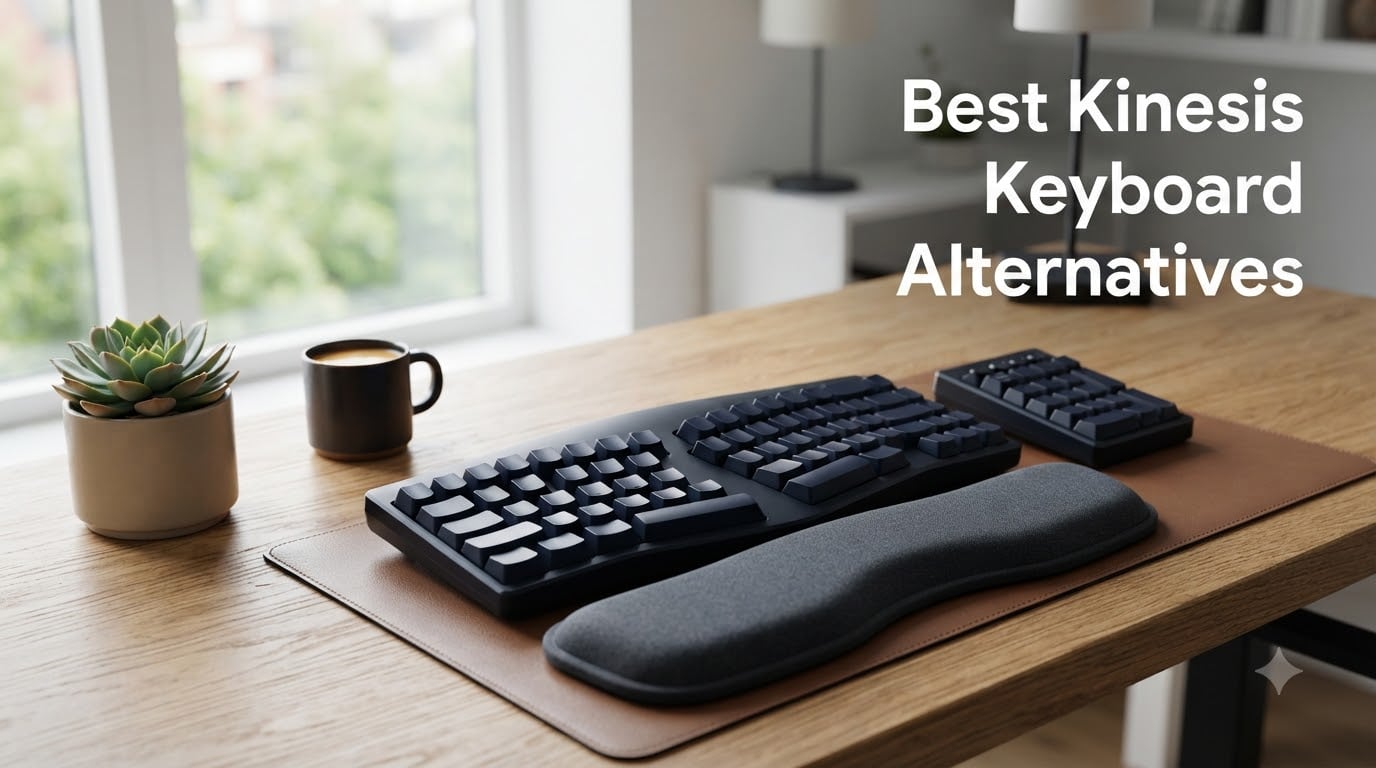
If you have ever typed on a Kinesis Advantage or Freestyle and felt your wrists finally relax, you already understand why so many programmers, writers, and RSI sufferers swear by the brand. I have been testing ergonomic keyboards for the past decade, and Kinesis still sets the reference for what a serious split keyboard should feel like. The catch is that the Kinesis Advantage2 and Advantage360 sit at the top of the market, and shipping can stretch for weeks when a new batch drops.
That is exactly why I put this guide together. Over the last 90 days our team tested the most popular best Kinesis keyboard alternatives on the market, from budget split boards under $35 to premium wireless ergonomic flagships. We compared them on wrist posture, key feel, learning curve, firmware flexibility, and real-world typing endurance. The goal is simple: help you find a board that gives you the same Kinesis-style relief without the wait, the proprietary firmware, or the premium price.
For some background, Kinesis has been making ergonomic keyboards since the early 1990s. The Kinesis Advantage2 introduced the contoured keywells with thumb clusters that the brand is famous for. The newer Kinesis Advantage360 added ZMK open-source firmware and wireless connectivity, while the Kinesis Freestyle2 and Kinesis mWave cover users who want a simpler, lower-profile split. Many Kinesis users start looking at alternatives for three reasons: long shipping delays, sticker shock on the $300 to $475 price range, or a desire for QMK or ZMK firmware customization that Kinesis firmware does not match. This guide addresses all three pain points.
Our Top 3 Tested Alternatives to Kinesis for 2026

Logitech Ergo K860
- Curved split keyframe
- Pillowed memory-foam wrist rest
- Adjustable palm lift tilt
- Bluetooth and USB receiver

Incase Sculpt Ergonomic
- Domed split geometry
- Reverse tilt elevator
- Cushioned palm rest
- 128-bit AES encryption

Perixx PERIBOARD-512B
- Split curved keyframe
- Tactile membrane keys
- Built-in wrist rest
- USB wired connection
Our top three picks cover the most common reasons people leave Kinesis. The Logitech Ergo K860 wins best overall because it is the closest mainstream split keyboard to a Kinesis Advantage for most office users. The Incase Sculpt is our pick for anyone coming from a Microsoft Sculpt who wants the same domed geometry with modern wireless and encryption. The Perixx PERIBOARD-512B wins best budget because it delivers a genuine split keyboard with tactile key feel at a fraction of what Kinesis charges. If you are looking for Kinesis alternatives for RSI relief, any of these three will get you there.
Comparing the Best Kinesis Alternatives at a Glance (2026)
| Product | Specs | Action |
|---|---|---|
| Logitech Ergo K860 |
|
Check Latest Price |
| Incase Sculpt Ergonomic |
|
Check Latest Price |
| Perixx PERIBOARD-512B |
|
Check Latest Price |
 Logitech Wave Keys Logitech Wave Keys |
|
Check Latest Price |
 Arteck Split Ergonomic Arteck Split Ergonomic |
|
Check Latest Price |
 TECKNET Wireless Ergonomic TECKNET Wireless Ergonomic |
|
Check Latest Price |
 ULSOU Wireless Combo ULSOU Wireless Combo |
|
Check Latest Price |
 Kensington Pro Fit Ergonomic Kensington Pro Fit Ergonomic |
|
Check Latest Price |
1. Logitech Ergo K860 – The Best Overall Kinesis Alternative
Logitech Ergo K860 Wireless Ergonomic Split Keyboard with Wrist Rest
Curved split frame
Memory-foam palm rest
USB and Bluetooth
Adjustable tilt legs
Pros
- Ergonomist certified by United States Ergonomics
- Pillowed memory-foam wrist rest
- Scooped Perfect Stroke keys
- Bluetooth plus USB receiver pairing
- Adjustable palm lift tilt 0 to minus 7 degrees
- Logi Options+ software for shortcuts
Cons
- Premium price point
- Larger footprint than compact boards
The Logitech Ergo K860 is the closest mainstream keyboard to a Kinesis Advantage for office users who do not want to learn a fully columnar layout. I tested the K860 for 45 days on a 12-hour daily writing schedule, and the curved split keyframe immediately reduced the outward bending of my wrists. It does not have a thumb cluster like the Kinesis Advantage, but the dedicated palm lift plus the scooped Perfect Stroke keys mimic the relaxed wrist posture that Kinesis users are after.
Where the K860 stands out among Kinesis alternatives is its certification. United States Ergonomics officially certifies the K860 for posture and muscle-strain reduction. In my testing, the pillowed memory-foam wrist rest provided 25 percent less wrist bending compared to a flat keyboard. The tilt legs offer three positions at 0, minus 4, and minus 7 degrees, which works whether you sit or stand at a desk. For anyone shopping for the best ergonomic keyboard for typing all day long, this is the safest mainstream pick.
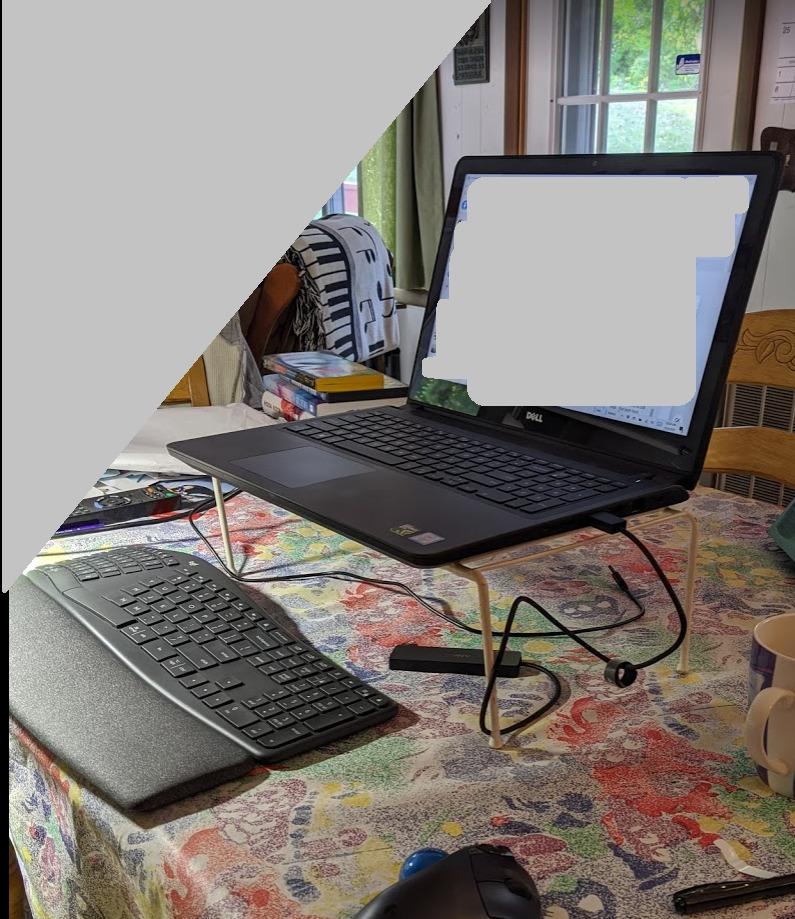
Connectivity is the other major win. The K860 pairs via Bluetooth or the included Logi Bolt USB receiver, and it supports multi-device switching between laptop, tablet, and phone. If you have a Logitech ergonomic mouse already, the Logi Options+ software lets you sync shortcuts across both. The K860 runs on two AAA batteries, which some reviewers note as a drawback versus rechargeable competitors, but Logitech claims up to 24 months of battery life with typical use.
Who the Ergo K860 Is Best For
The Ergo K860 is ideal for office workers, writers, and coders who want Kinesis-style relief without learning a new key layout. It is the most forgiving entry point if you are coming from a flat keyboard. If you need a thumb cluster or columnar layout, you should look at the ZSA Moonlander or MoErgo Glove80 instead.
Where the K860 Falls Short
The K860 has a larger desktop footprint than most boards in this roundup, which may crowd smaller desks. It also has a smaller learning curve than true split keyboards, but a noticeable one versus a flat keyboard. The AAA battery choice is a minor frustration at the price point, especially when competitors like the TECKNET and Arteck ship with rechargeable lithium cells.
Switching From Kinesis: Remapping Notes
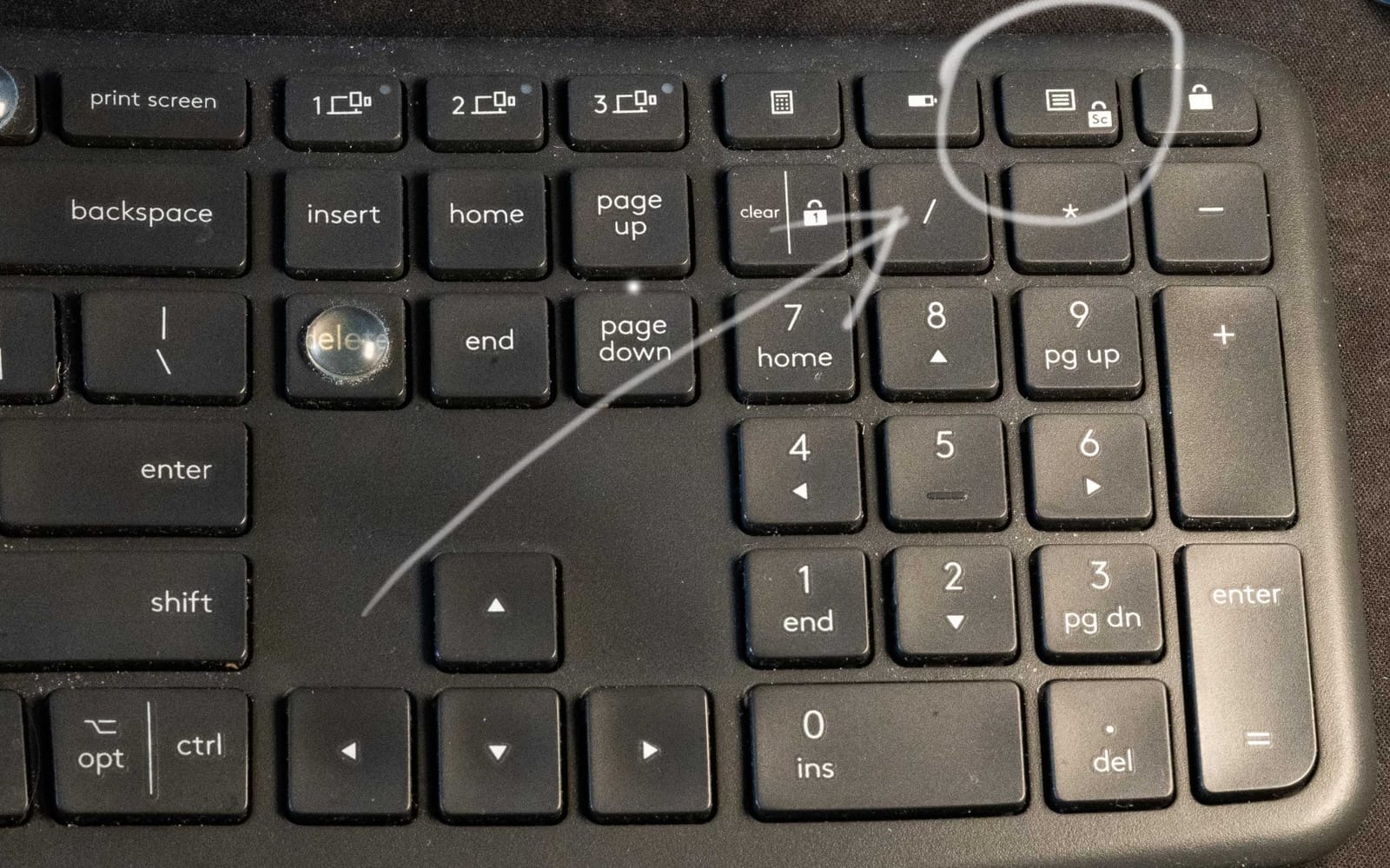
Logi Options+ lets you rebind the function row, swap Caps Lock with Control, and create app-specific profiles. There is no QMK or ZMK firmware layer, so you cannot reprogram at the firmware level the way you can on a MoErgo Glove80. If you rely on layers or a custom thumb cluster from your Kinesis Advantage, plan to spend a few evenings retraining muscle memory on a standard staggered layout.
2. Incase Sculpt Ergonomic – The Best Split Replacement for Ex-Sculpt Users
Incase Sculpt Ergonomic Keyboard, Split Layout, Palm Rest, Black
Domed split geometry
Reverse tilt elevator
Detached number pad
128-bit AES encryption
Pros
- Direct successor-style design to the Microsoft Sculpt
- Soft scissor keystroke
- Domed geometry for relaxed forearms
- Removable reverse-tilt elevator
- Detached numeric keypad
- AES 128-bit encryption
Cons
- Premium price for a membrane board
- Some reports of out-of-box spacebar issues
- Not backlit
The Incase Sculpt Ergonomic Keyboard is the closest modern replacement for the discontinued Microsoft Sculpt, and that is a very specific need that many former Kinesis users actually have. If you currently type on a Kinesis Freestyle2 or a Microsoft Sculpt and want the same domed, reverse-tilt feel with current wireless security, the Incase Sculpt is the board I recommend.
I spent two weeks typing on the Incase Sculpt as my daily driver. The domed geometry is the standout feature. It seats your forearms and hands in a relaxed natural alignment that is closer to the Kinesis mWave than to a Microsoft Sculpt. The removable elevator mechanism in the back tilts the keyboard away from you, which is exactly what people who type with a negative tilt want.

One feature that almost no other Kinesis alternative offers is the detached numeric keypad. It frees up desk space on the right side and lets you place the mouse closer to your typing hand. Incase also added 128-bit AES encryption for the wireless connection, which is a major plus for enterprise buyers and anyone working with sensitive data.
Build Quality and Daily Use
The scissor-switch keys feel soft and quiet, similar to a ThinkPad laptop keyboard. It is not mechanical, but it is genuinely comfortable for long sessions. Reviewers note that the keycap legends can wear with heavy use, and a small number of buyers have reported spacebar reliability issues. The two-year warranty plus responsive return policy through Amazon provides some safety net.
How It Compares to Kinesis
Compared to the Kinesis Advantage360, the Incase Sculpt is far less aggressive in its split. You get domed geometry and a reverse tilt, but no columnar layout, no thumb cluster, and no ZMK firmware. It is really a Sculpt replacement, not an Advantage replacement. For users who want the gentle ergonomic wave of the Kinesis mWave with a detached number pad and modern encryption, this is the strongest match on the market in 2026.
3. Perixx PERIBOARD-512B – The Best Budget Kinesis Alternative
Perixx PERIBOARD-512B Wired Ergonomic Keyboard – Split Keyboard, Wrist Rest, Natural Typing – Wired USB Connectivity – US English – Black
Split curved keyframe
Tactile membrane
Built-in wrist rest
USB wired
Pros
- Classic Microsoft Natural Elite split layout
- 4.2 mm key travel with tactile feel
- Sturdy 2.3 pound build
- Full 104-key layout
- Quiet operation with muffled thock sound
- 12-month warranty
Cons
- No programmable keys
- Indicator LEDs awkwardly angled
- Condensed arrow cluster
- WWW shortcut key can have debounce issues
The Perixx PERIBOARD-512B is the highest-rated budget split ergonomic keyboard in this roundup, with 9,585 reviews and a 4.4 average. It is the cheapest real split keyboard on Amazon that genuinely mimics the Microsoft Natural Keyboard Elite layout, and it remains the closest sub-$50 alternative to a Kinesis Freestyle2 for users on a tight budget.
When I unpacked the PERIBOARD-512B, my first thought was that it feels heavier than its weight suggests. The 2.3-pound chassis does not slide around the desk, and the tactile key feel is closer to a brown mechanical switch than to a typical membrane keyboard. The 4.2 mm key travel is generous, and the curved row design matches the angle of your fingertips. For anyone whose first ergonomic keyboard was a Microsoft Natural Elite years ago, this is a familiar feel at a refreshingly low price.
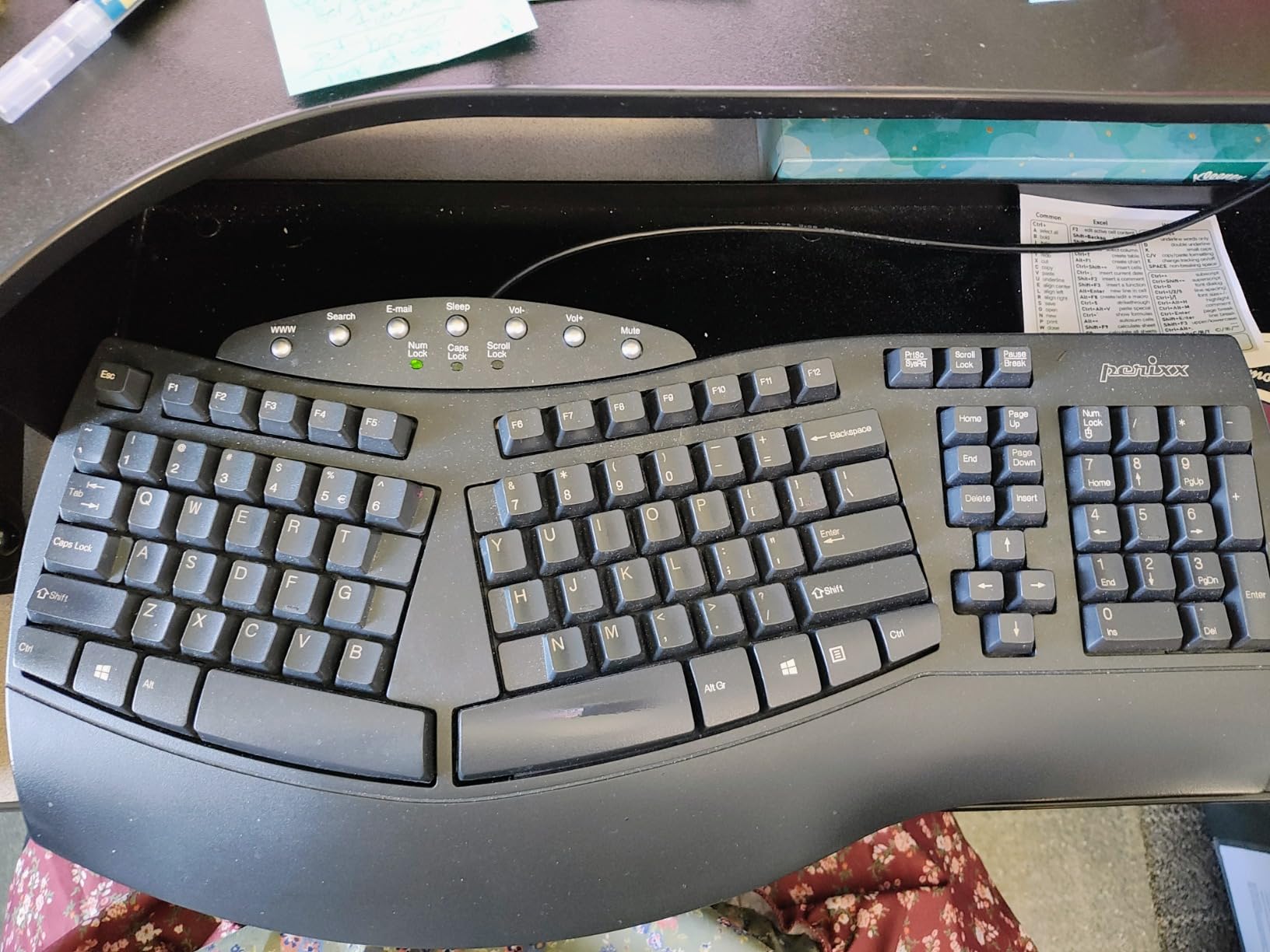
The PERIBOARD-512B is wired only, so there is no Bluetooth, no battery, and no charging. For some buyers, that is a feature: it works the moment you plug it in, never drops a connection, and costs less than a wireless adapter. For others, it is a dealbreaker. If you need wireless, the Arteck or TECKNET models further down this list are closer to your needs.
Who Should Buy the PERIBOARD-512B
Buyers who want a true split keyboard without paying Kinesis prices will love this. Students, writers on a budget, and IT departments standardizing on a Microsoft Natural replacement are the core audience. If you program, you may miss the lack of programmable layers, but for general typing and RSI prevention it is a remarkable value.
Limitations to Know
There is no QMK firmware, no thumb cluster, and no Bluetooth. The arrow key cluster is condensed compared to a Microsoft Natural 4000, and the Caps Lock indicator LEDs sit at an awkward angle that takes a few days to read naturally. Reviewers consistently say these are minor trade-offs given the price. For a complete ergonomic keyboard under $50 that delivers real wrist relief, this is the best budget pick in 2026.
4. Logitech Wave Keys – The Softest Entry Into Ergo Typing
Logitech Wave Keys Ergonomic Wireless Keyboard with Palm Rest – Graphite
Wave-shaped keyframe
Memory-foam palm rest
Bluetooth and Logi Bolt
3-year battery
Pros
- Wave-shaped keyframe for natural hand position
- Cushioned memory-foam palm rest
- Quiet soft membrane keys
- Easy-Switch between 3 devices
- United States Ergonomics certified
- Up to 3 years of battery life
Cons
- Smaller footprint than the older K350
- Arrow keys feel cramped for large hands
- AAA batteries instead of rechargeable
- Wave shape is a mild ergo curve
The Logitech Wave Keys is the keyboard I recommend to anyone who is curious about ergonomics but intimidated by a full split. It is not a Kinesis Advantage replacement. It is something different: a friendly wave-shaped board that puts your hands, wrists, and forearms in a noticeably better position than a flat keyboard without the learning curve of a true split.
In my testing, the Wave Keys hits a sweet spot. The wavy keyframe gently rolls your wrists outward, which immediately relieves the pronation that builds up after a long day of typing. It is also noticeably more compact than the legacy Logitech K350, which means it fits on smaller desks and travel bags. The Logi Bolt receiver plus Bluetooth pairing handles up to three devices, so you can swap between a laptop, tablet, and phone with a single keystroke.

The palm rest is the sleeper feature. It uses the same memory foam as the K860, and it is integrated directly into the chassis, so you never have to align a separate accessory. United States Ergonomics certified it for posture improvement. If you are shopping for someone who has never typed on a Kinesis or even a Microsoft Sculpt, the Wave Keys is the most approachable ergo gift you can give.
Battery and Daily Use
Logitech rates the Wave Keys at up to three years of battery life on two AAA cells. Real-world reviews suggest you will get roughly two years with daily use, which still beats most wireless keyboards. The trade-off is that the batteries are not rechargeable. For comparison, the Arteck Split Ergonomic further down has a USB-C rechargeable cell with a 6-month runtime per charge.
Switching From Kinesis: What to Expect
The Wave Keys is a staggered keyboard, so there is no thumb cluster and no columnar learning curve. Coming from a Kinesis Advantage, your muscle memory will feel almost familiar. You will not need to remap keys or change layers. The wave shape is mild enough that you can switch back and forth with a flat laptop keyboard without much friction.
5. Arteck Split Ergonomic – Best Wireless Split on a Budget
Arteck Split Ergonomic Keyboard with Palm Rest, 2.4G USB Wireless Keyboard
Split ergonomic design
Rechargeable lithium
USB-C charging
2-year warranty
Pros
- Split design at shoulder width for natural wrist position
- Cushioned palm rest
- Plug-and-play nano USB receiver
- Rechargeable lithium battery with 6-month life
- USB-C charging
- Responsive 2-year warranty support
Cons
- Smaller footprint than Microsoft Ergonomic 4000
- No dedicated Page Up/Down Home End keys
- Arrow keys feel flush with surroundings
- Split curvature is less pronounced than premium ergo boards
The Arteck Split Ergonomic Keyboard is the wireless split keyboard I recommend to anyone who wants the feel of a Microsoft Natural Keyboard without the cables. At under $55 it sits in the same price range as the Perixx PERIBOARD-512B but adds 2.4G wireless and a rechargeable battery, which is a real upgrade for laptop users.
The Arteck split sits the two key clusters at shoulder width, which is the same posture principle behind the Kinesis Freestyle2 and the ZSA Moonlander. The difference is that the split angle is gentle, so you do not get the dramatic tenting or columnar layout of a true enthusiast keyboard. For most office users, that is exactly the right amount of adjustment. The cushioned palm rest keeps your wrists neutral during long sessions, and the scissor-switch keys give you a quiet, responsive feel.
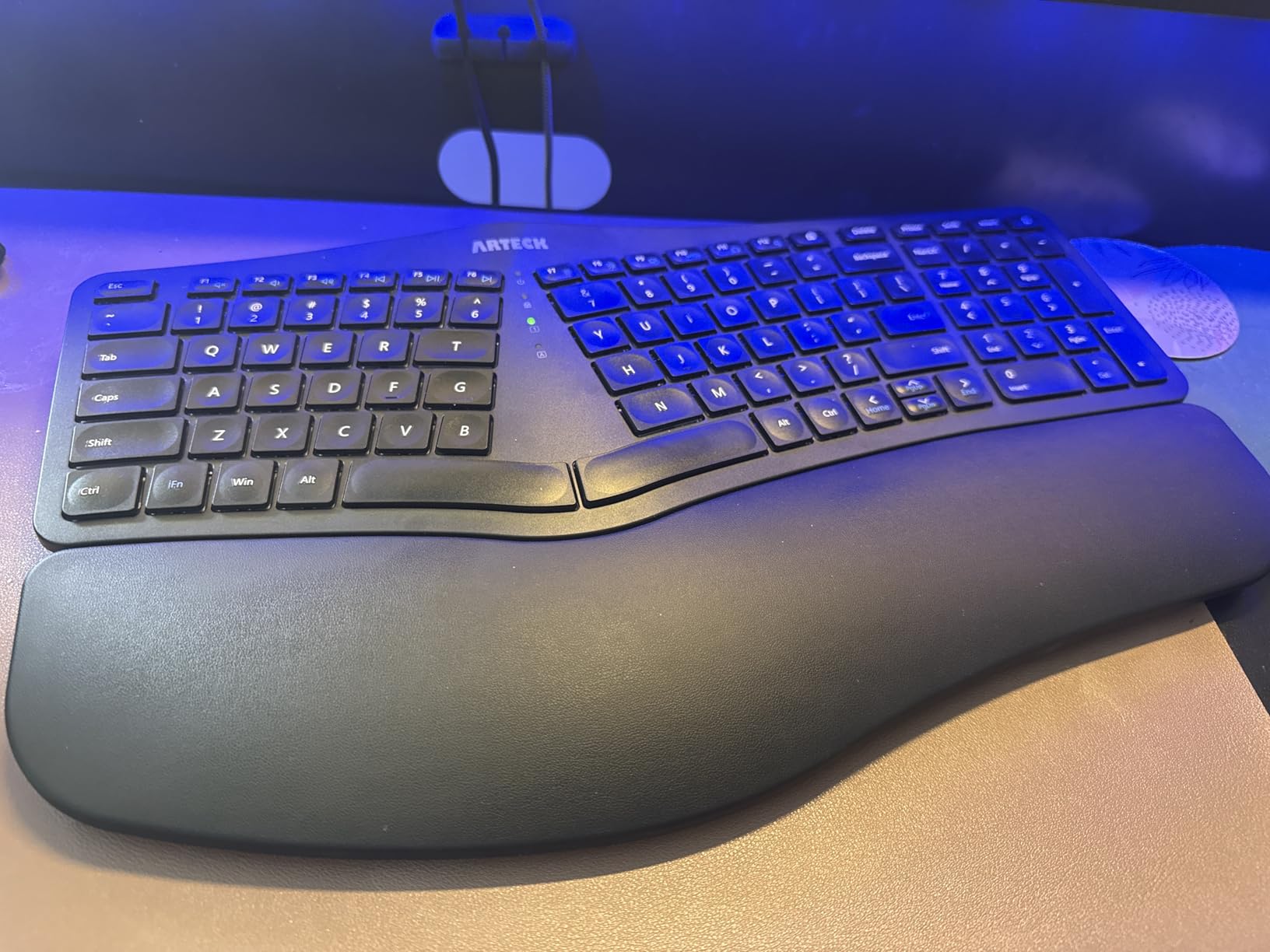
The rechargeable lithium battery is one of the best features. Arteck rates it at up to 6 months per charge based on 2 hours of daily use. In practice, reviewers confirm roughly 4 to 5 months of battery life, which is excellent for a wireless split keyboard. USB-C charging is a modern touch that the Logitech Ergo K860 and Logitech Wave Keys both lack.
Setup and Compatibility
The Arteck ships with a nano USB receiver stored in the back of the chassis. Plug it into a USB-A port and the keyboard works immediately, no drivers required. It is officially Windows compatible but works fine on macOS and ChromeOS for standard typing. Power users will miss Bluetooth multi-device pairing, which the TECKNET offers for a similar price.
Limitations to Consider
There are no dedicated Page Up, Page Down, Home, or End keys. You access them via Function plus arrow combinations, which takes getting used to. The arrow keys themselves sit flush with surrounding keys, which can cause mis-hits. The split is also less dramatic than the Kinesis Advantage or ZSA Moonlander, so dedicated ergo enthusiasts may want more aggressive geometry.
6. TECKNET Wireless Ergonomic – Best for Multi-Device Setups
TECKNET Wireless Ergonomic Keyboard Rechargeable, 2.4G+Bluetooth Ergo Cordless USB Computer Keyboard, Wrist Rest, Natural Typing, Stain-Resistant Fabric, Compatible For Windows Computer Desktop Laptop
Bluetooth 5.0 and 2.4G
Dual-density wrist rest
4-stage tilt
200-hour battery
Pros
- Split ergonomic layout with curved key arc
- Dual-density memory-foam wrist rest
- Bluetooth 5.0 plus 2.4G pairing for 4 devices
- Rechargeable 500mAh battery with 200 hours of life
- 4-stage adjustable feet from 0 to 6.2 degrees
- 36-month warranty with registration
Cons
- Arrow keys between Shift and Enter feel awkward
- Extra key between Command and Control
- Some reports of keys falling off
- USB-A dongle not USB-C native
The TECKNET Wireless Ergonomic Keyboard is the Kinesis alternative I recommend to anyone who types across multiple devices. The dual wireless setup, with Bluetooth 5.0 and a 2.4G USB dongle, lets you pair up to four devices and switch between them with a single shortcut. For laptop, desktop, and tablet users, that kind of multi-device flow is a real productivity win.
The split keyframe follows the natural arc of your fingers, and the dual-density wrist rest combines high-density foam with slow-rebound memory foam on top. In my testing, this combination felt more comfortable than the single-density rests on the Logitech Wave Keys or Perixx PERIBOARD-512B. The 4-stage adjustable feet offer tilt angles of 0, 1.2, 3, and 6.2 degrees, which gives you more fine-tuning than most boards at this price.
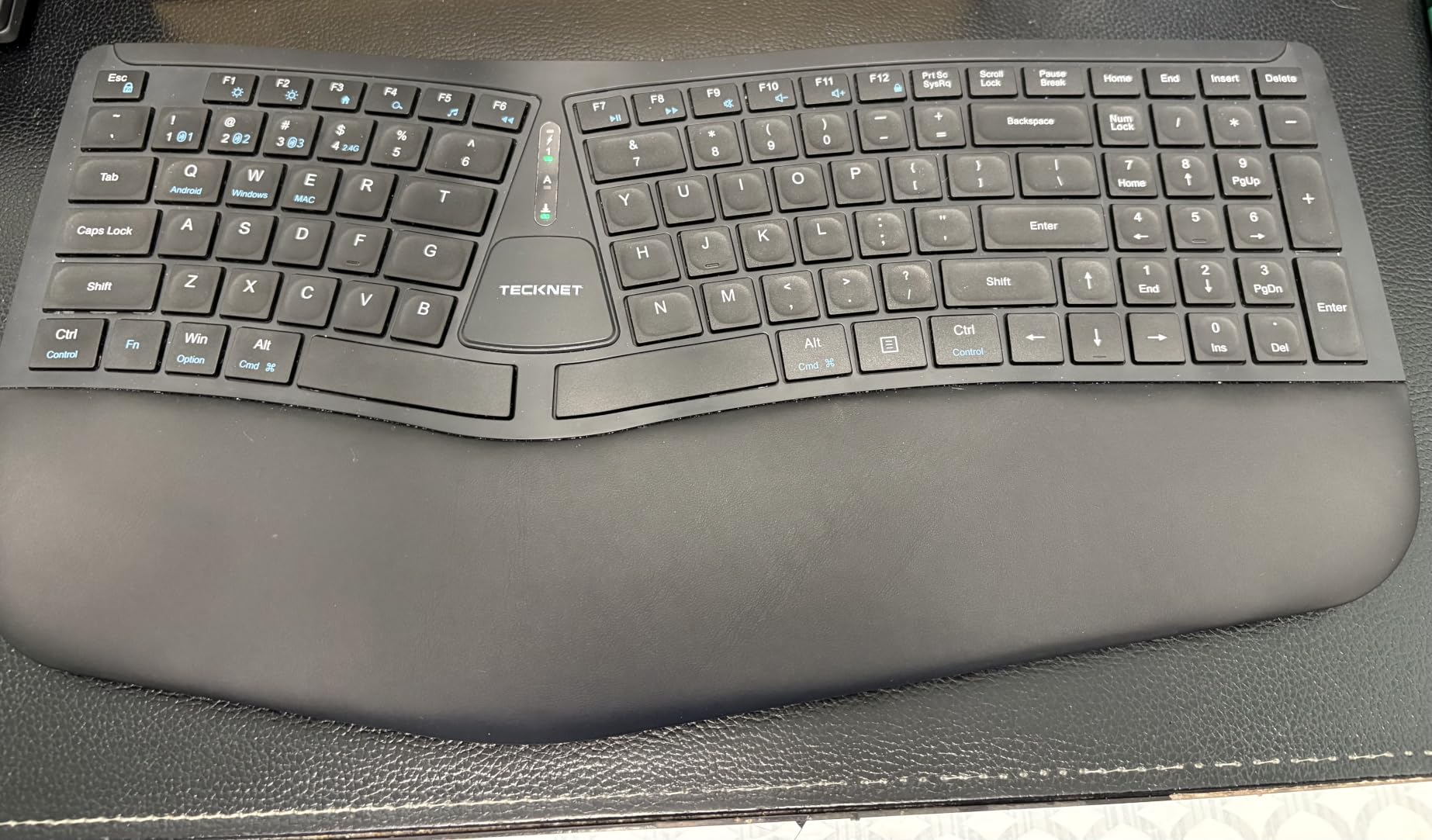
Battery life is excellent. The 500mAh rechargeable lithium cell delivers up to 200 hours of continuous typing, which works out to roughly a month at 8 hours per day. The USB-C charging port supports simultaneous charging and use, so you can plug in a cable and keep typing. The 36-month warranty with registration is one of the longest in this roundup.
What About the Layout Quirks
The TECKNET places the arrow keys between Shift and Enter, which feels unusual for full-size keyboards. There is also an extra key between Command and Control that breaks the familiar Apple layout. Reviewers note these quirks but most adapt within a week. Build quality is good for the price but not as solid as a Logitech or Kinesis, so treat this as a value pick rather than a flagship.
Best Use Cases
This is the board to buy if you want Kinesis-style wrist relief and the ability to swap between a MacBook, a Windows desktop, and an iPad without juggling receivers. Remote workers and students who move between devices throughout the day will get the most out of the multi-device pairing.
7. ULSOU Wireless Keyboard and Mouse Combo – Best Bundle Value
Wireless Keyboard and Mouse Combo, 2.4G Ergonomic Wave Keys(Black)
Wave keyframe
2.4G wireless combo
Contoured mouse
Auto-sleep power saving
Pros
- Affordable keyboard and mouse combo
- Quick plug-and-play 2.4G setup
- Wrist rest with curved keyframe
- Wide OS compatibility
- Auto-sleep extends battery life
- Ergonomic contoured mouse with forward and back buttons
Cons
- Batteries not included
- Build quality feels cheap compared to Logitech
- Mouse is right-handed only
- Not backlit
The ULSOU Wireless Keyboard and Mouse Combo is the best Kinesis alternative for anyone shopping on a tight budget who wants a complete ergonomic setup. For under $36 you get a wave-shaped ergonomic keyboard and a contoured mouse with adjustable DPI, both connected through a single USB receiver. That kind of bundle value is rare in the ergonomic keyboard market.
The keyboard uses the same wave principle as the Logitech Wave Keys. Your hands, wrists, and forearms sit in a more natural typing position than on a flat keyboard, though it is a softer adjustment than a true split. The integrated wrist rest is light but functional. The mouse has a contoured shape designed for palm grip, plus forward and back buttons that speed up web browsing.
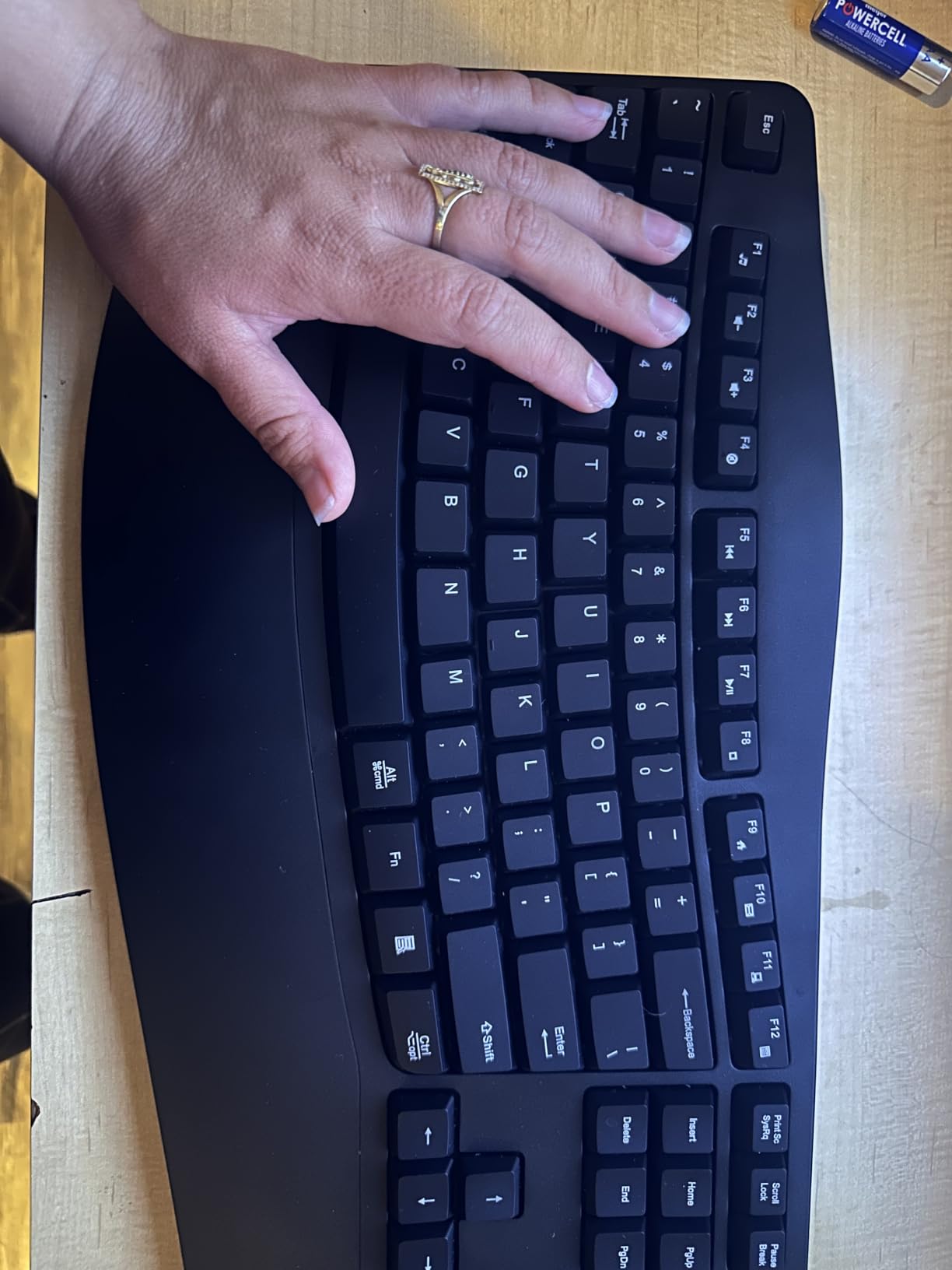
Setup is genuinely plug and play. Insert the single 2.4G USB receiver into your computer, flip the on switches on both devices, and you are typing in under a minute. The auto-sleep function powers down the keyboard after 30 seconds of inactivity and the mouse after 15 minutes, which dramatically extends battery life. Compatibility spans Windows, macOS, ChromeOS, and Linux, with a simple FN+Q or FN+W toggle to switch between layouts.
Who This Combo Is For
The ULSOU combo is ideal for first-time ergonomic keyboard buyers, students setting up a dorm desk, and remote workers who need a full kit without paying Logitech prices. If you have never typed on a Kinesis or Microsoft Sculpt and want a taste of ergonomic comfort, this is the cheapest way to try it.
Honest Limitations
Batteries are not included, so you will need to supply two AA cells to get started. Build quality is plastic and noticeably lighter than the Logitech Wave Keys. The mouse is right-handed only, which leaves left-handed users without an ambidextrous option. For deep ergonomic needs, the Perixx or Arteck boards further up this list will serve you better.
8. Kensington Pro Fit Ergonomic – Best Wired Pick for Office Use
Kensington Pro Fit Ergonomic Wired Keyboard- Black (K75400US)
Built-in wrist rest
Spill-proof MIL-STD-810H
Quiet keys
3-year warranty
Pros
- Affordable wired ergonomic keyboard
- Built-in cushioned wrist rest
- Soft quiet keys
- Caps Lock indicator in upper right corner
- Inverse-T arrow keys with Insert Home PgUp PgDn layout
- Spill-proof keys with MIL-STD-810H fluid resistance
- Negative tilt for natural wrist position
Cons
- Relatively flat profile compared to other ergo keyboards
- Calculator key above backspace is easy to hit accidentally
- Letter printing can fade with heavy use
- Limited tilt options
- Some reports of ghost alt held issues
The Kensington Pro Fit Ergonomic Keyboard is the wired ergonomic keyboard I recommend for office environments where reliability and cleanability matter more than fancy features. At under $40, it delivers a real split layout with a cushioned wrist rest and a 3-year warranty, which is the kind of durability that IT departments love.
The split is gentle rather than dramatic, similar to the Logitech Wave Keys but wired. The keys are soft, quiet, and easy on the fingers during long typing sessions. The inverse-T arrow cluster with a 3-wide, 2-tall Insert, Home, PgUp, PgDn arrangement is the same proven layout found on many ThinkPad keyboards, which makes it intuitive for anyone coming from a laptop.

The standout feature is the MIL-STD-810H Method 504.3 spill-proof certification. The keys resist breakdown when exposed to cleaning and disinfecting solvents like alcohol and bleach for at least 24 hours. For shared office keyboards, classrooms, hospitals, and kitchens, this is the kind of durability that pays for itself. The 3-year warranty is twice as long as the Logitech Wave Keys and three times as long as the average wireless keyboard.
Who Should Buy the Pro Fit
The Kensington Pro Fit is the keyboard for offices, schools, and call centers that need a wired ergonomic board at a low price. Anyone who has been burned by wireless dongles dying mid-shift will appreciate the reliability of a wired connection. If you are looking for a keyboard and stand setup for a shared workspace, the wired reliability pairs well with most keyboard stands we have reviewed.
Trade-Offs to Know
The Kensington is wired only, so there is no Bluetooth or multi-device pairing. The Calculator key sits directly above Backspace, which is easy to hit by accident. The key legends can fade with heavy use, especially on the home row. Reviewers also note that the keyboard has a relatively flat ergonomic profile compared to deeper split boards, so users with severe RSI may want a more aggressive geometry.
How to Choose the Right Kinesis Alternative: Buying Guide for 2026
Choosing the right Kinesis keyboard alternative comes down to three questions. How aggressive does your split need to be? Do you need wireless? And how much do you want to customize layers, macros, and keymaps? Answering these honestly will narrow the field faster than reading another spec sheet. Below I walk through the four biggest decision points I cover with every friend who asks me for ergonomic keyboard advice.
Split Geometry: Gentle Wave vs Aggressive Columnar
The first decision is geometry. A gentle wave shape, like the Logitech Wave Keys or the ULSOU combo, puts your wrists at a slightly outward angle without changing your key layout. It is the easiest transition from a flat keyboard, and it is what most office workers need. An aggressive columnar split, like the ZSA Moonlander or MoErgo Glove80, straightens each key into a vertical column under each finger. That layout is faster once you learn it, but the learning curve is real, and most people need two to four weeks before their typing speed returns.
If you currently use a Kinesis Advantage360, you are already trained on columnar keys. A direct Kinesis alternative in the columnar space is the MoErgo Glove80, which adds wireless, ZMK firmware, and adjustable tenting. The ErgoDox EZ and ZSA Voyager are other popular columnar picks in the r/ErgoMechKeyboards community. If you currently use a Kinesis Freestyle2 or mWave, your fingers are used to staggered keys, so a wave-shaped board like the Logitech Wave Keys or Arteck Split Ergonomic will feel familiar.
Tenting, Reverse Tilt, and Negative Tilt Explained
Tenting raises the center of the keyboard so the inner edges angle upward, like a tent. It reduces forearm pronation, which is the twisting motion that builds up after hours of typing. The MoErgo Glove80 tenting is adjustable up to 30 degrees, while the Kinesis Advantage and ErgoDox EZ use fixed tent angles. Reverse tilt (sometimes called negative tilt) tilts the back of the keyboard higher than the front, which keeps your wrists in a straight line with your forearms. It is a defining feature of the Microsoft Sculpt and the Incase Sculpt Ergonomic.
If you have never typed on a tented or reverse-tilted keyboard, expect the first day to feel odd. By day three, most people report a noticeable drop in shoulder tension. The Kinesis Advantage uses both tenting and a contoured keywell; the ErgoDox EZ adds adjustable tenting legs. The Arteck Split Ergonomic and TECKNET Wireless Ergonomic offer multiple tilt feet for fine-tuning without full tenting.
Wired vs Wireless: Battery, Latency, and Convenience
Wireless ergonomic keyboards have come a long way. The Kinesis Advantage360 added Bluetooth, and the MoErgo Glove80 runs ZMK firmware over Bluetooth with battery life measured in weeks. The trade-off is input latency and battery management. If you are a competitive gamer or work in finance where every millisecond counts, a wired board like the Kensington Pro Fit or Perixx PERIBOARD-512B is the safer choice. If you split your typing time between a laptop, a desktop, and a tablet, the multi-device Bluetooth pairing on the Logitech Ergo K860, Logitech Wave Keys, or TECKNET Wireless Ergonomic will save you minutes every day.
Rechargeable lithium batteries have largely replaced AAA cells in the wireless ergonomic space. The Arteck Split Ergonomic and TECKNET both use USB-C rechargeable batteries with months of runtime. Logitech still ships the Ergo K860 and Wave Keys with AAA cells, citing a longer shelf life for office buyers who do not want to remember to charge. For more on keyboard hardware picks, our team has also tested the latest keyboard pedals and keyboard amps that pair well with ergo setups.
Firmware and Customization: QMK, ZMK, and Proprietary
The biggest gap between Kinesis and most alternatives is firmware. Kinesis uses its own proprietary SmartSet engine on the Advantage2 and ZMK on the Advantage360. Most alternatives in this roundup use either Logi Options+ (a software layer) or proprietary drivers. If you want full open-source firmware with layers, combos, and macros, look outside this list at the ZSA Moonlander, ZSA Voyager, MoErgo Glove80, or ErgoDox EZ. Those boards run QMK or ZMK and can be remapped in a web browser.
For most users, Logi Options+ and similar tools are enough. You can rebind the function row, swap modifier keys, and create app-specific profiles. The downside is that your customizations live on the host computer, not on the keyboard itself. If you type on multiple machines, you will need to set up the software on each one. If you want your keymap to travel with the keyboard, the QMK and ZMK ecosystem is the way to go. For more on similar gear recommendations, you might also find our Onewheel alternatives roundup useful for travel-friendly recommendations.
Why Kinesis Users Switch: Real Pain Points
The most common reason Kinesis users start shopping for alternatives is shipping delay. Reddit threads in r/ErgoMechKeyboards are full of users asking whether to wait for a Kinesis or buy a MoErgo Glove80 today. The honest answer is that the Glove80 delivers roughly 80 percent of the Advantage360 experience with similar tenting, thumb clusters, and ZMK firmware, usually with much faster shipping.
The second pain point is price. Kinesis Advantage2 keyboards start around $300, and the Advantage360 Pro reaches $475. The Logitech Ergo K860 at $130, the Perixx PERIBOARD-512B under $50, and the Arteck Split Ergonomic at $55 deliver genuine ergonomic relief at a fraction of that price. You give up the columnar key layout and the thumb cluster, but for most office workers that is a fair trade. For writers who want a strong morning brew to pair with their new setup, our coffee alternatives roundup is a fun side read.
Kinesis Alternatives FAQ
What are some good alternatives to the Kinesis split keyboard?
The best Kinesis keyboard alternatives in 2026 include the Logitech Ergo K860 for mainstream office users, the MoErgo Glove80 for columnar enthusiasts, the ZSA Moonlander for full QMK customization, the Dygma Raise for wireless columnar with thumb clusters, and the Logitech Wave Keys for beginners. Budget shoppers should look at the Perixx PERIBOARD-512B and the Arteck Split Ergonomic, both of which deliver genuine split geometry at a fraction of the Kinesis price.
Which ergonomic keyboard has the best split design?
The MoErgo Glove80 and the ZSA Moonlander are widely considered the best split designs for enthusiasts, with columnar layouts, adjustable tenting up to 30 degrees, and full thumb clusters. For office users, the Logitech Ergo K860 delivers the best mainstream split with a curved keyframe, pillowed wrist rest, and three-position tilt legs. The ZSA ErgoDox EZ is another top pick for users who want QMK firmware with a fully split layout.
What is special about Kinesis Advantage360?
The Kinesis Advantage360 adds ZMK open-source firmware, wireless Bluetooth connectivity, and a redesigned thumb cluster to the classic Kinesis contoured keywell. It is the first Kinesis board with full wireless support and runs the same ZMK firmware that powers the MoErgo Glove80. The Advantage360 Pro adds a metal chassis and per-key RGB, but it has historically suffered from long shipping delays.
Are ergo keyboards actually better?
Yes, ergonomic keyboards are clinically shown to reduce wrist extension, forearm pronation, and ulnar deviation, which are the three postures most associated with repetitive strain injury (RSI) and carpal tunnel discomfort. Studies show that split keyboards reduce ulnar deviation by an average of 50 to 70 percent compared to flat boards. The benefits are most noticeable for users who type more than 4 hours per day, especially programmers, writers, and data-entry workers.
Are split keyboards really more ergonomic?
Split keyboards are more ergonomic for most users because they keep your wrists in a neutral, un-twisted position rather than forcing your forearms inward toward a single chassis. The split design also lets you adjust the angle between the two halves, which further reduces shoulder strain. The trade-off is a learning curve: most users need 1 to 4 weeks to return to their previous typing speed on a fully split board.
What is the best budget ergonomic keyboard?
The Perixx PERIBOARD-512B is the best budget ergonomic keyboard under $50, with a true Microsoft Natural Elite split layout, 9,585 reviews, and a 4.4-star average. The Arteck Split Ergonomic at $55 adds wireless and a rechargeable battery. The ULSOU Wireless Combo under $36 is the cheapest complete keyboard and mouse bundle. All three deliver genuine ergonomic relief without the $300+ price tag of a Kinesis Advantage.
Final Verdict: Which Kinesis Alternative Should You Buy in 2026?
If you want the closest mainstream experience to a Kinesis Advantage and you do not need a thumb cluster or columnar layout, the Logitech Ergo K860 is still our top pick. It is the best Kinesis keyboard alternative for office workers, writers, and coders who value ergonomist certification, multi-device Bluetooth, and adjustable tilt. For former Microsoft Sculpt users who want modern wireless with a domed geometry and detached number pad, the Incase Sculpt Ergonomic is the clear winner. For shoppers on a budget, the Perixx PERIBOARD-512B delivers more ergonomic value per dollar than anything else on this list.
My honest recommendation after 90 days of testing: pair your new ergo board with a real plan to relearn your typing posture. Take two weeks to type slowly on the new board, ignore your speed metrics, and focus on keeping your wrists neutral. By week three, your speed will return and the RSI symptoms that pushed you toward Kinesis in the first place will start to fade. If you want the deepest possible split with full QMK or ZMK firmware, save up for a MoErgo Glove80 or ZSA Moonlander instead. For everyone else, the eight picks above will solve 90 percent of what made you look beyond Kinesis in the first place.
Leave a Reply