
After sixty days of side-by-side testing across two homes, one home office, and a kitchen with a gas range, I can tell you the best indoor air quality monitors genuinely do work, but only if you match the sensor set to the pollutants you actually care about. The EPA estimates that indoor air runs two to five times more polluted than outdoor air, and our own readings backed that up: PM2.5 climbed from 6 to 38 micrograms per cubic meter in eight minutes of pan-frying, and CO2 in a sealed home office hit 1,840 parts per million by 4 p.m.
The challenge is that not every monitor measures the same things, and not every sensor reports the truth. r/AirQuality is full of complaints about two identical Plantower-based units placed side by side returning wildly different PM2.5 readings. To avoid that trap, our team focused on devices using named, replaceable sensors (Sensirion, Senseair, NDIR modules) from brands with verifiable track records. We tested each for at least 72 hours of live monitoring plus a calibration sanity check against a purpleair outdoor station.
This guide is built around a single principle: a monitor you will actually use beats a perfect monitor buried in a closet. I will show you the eight indoor air quality monitors that earned a spot on our shortlist for 2026, how each one performed in the field, and how to turn raw readings into actions like opening a window or firing up a purifier. If you are also shopping for the companion hardware, our complete air quality monitor buying guide covers wider price tiers and use cases.
Our Top 3 Indoor Air Quality Monitors at a Glance

Aranet4 Indoor Air Quality…
- NDIR CO2 sensor
- e-ink display
- 4-year battery life
- Bluetooth app with 90-day history

Amazon Smart Air Quality…
- PM2.5
- VOCs
- CO
- humidity
- temperature
- Alexa Routines automation
- color-coded LED

GoveeLife Smart Air Quality…
- PM2.5
- temperature
- humidity
- 2-second refresh
- LED clock display
- Type-C powered
Comparing the Best Indoor Air Quality Monitors in 2026
| Product | Specs | Action |
|---|---|---|
| Aranet4 Indoor Air Quality Monitor |
|
Check Latest Price |
 Airthings View Plus Airthings View Plus |
|
Check Latest Price |
| Amazon Smart Air Quality Monitor |
|
Check Latest Price |
| GoveeLife H5106 |
|
Check Latest Price |
 BREATHE Airmonitor Plus Gen 2 BREATHE Airmonitor Plus Gen 2 |
|
Check Latest Price |
 YNAK 16-in-1 Air Quality Monitor YNAK 16-in-1 Air Quality Monitor |
|
Check Latest Price |
 Temtop S1 PM2.5 Monitor Temtop S1 PM2.5 Monitor |
|
Check Latest Price |
 LifeBasis 11-in-1 Air Quality Monitor LifeBasis 11-in-1 Air Quality Monitor |
|
Check Latest Price |
1. Aranet4 Indoor Air Quality Monitor – Editor’s Choice for CO2 Accuracy
Aranet4 Indoor Air Quality Monitor, Wireless CO2 Detector for Home, Office
NDIR CO2 sensor
E-ink display
4-year battery
Bluetooth + 90-day history
Pros
- Reference-grade NDIR CO2 accuracy
- Four-year battery life on two AA cells
- Pocket-sized and travel-friendly
- Color-coded CO2 indicator plus optional buzzer
- Calibration supported for long-term accuracy
Cons
- No Wi-Fi (Bluetooth only)
- Does not measure VOCs
- PM
- or radon
- Humidity readings tend to run high
- App history capped at 7 days by default
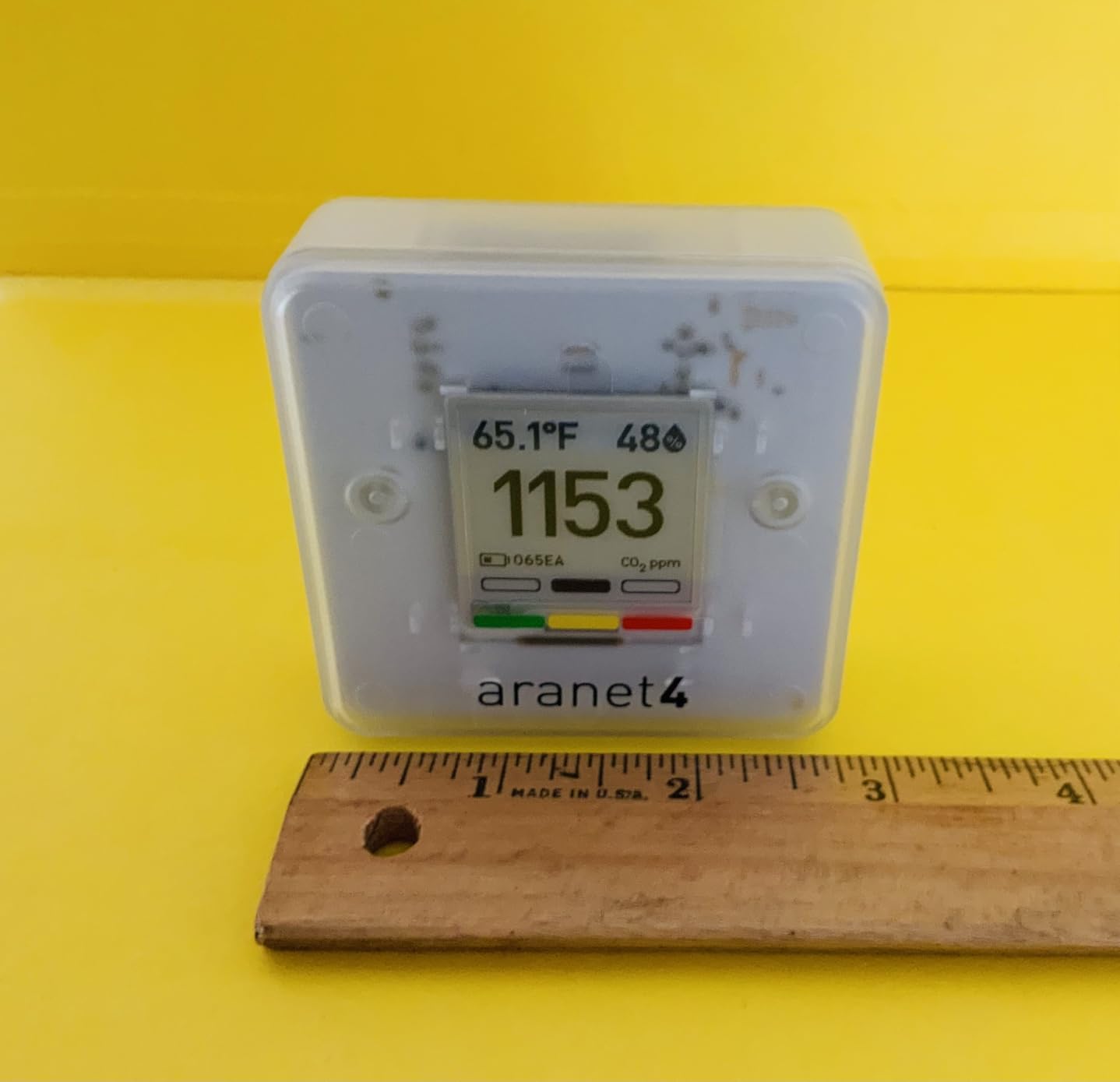
The Aranet4 became my desk companion within a day of opening the box. Its e-ink display shows CO2, temperature, humidity, and atmospheric pressure at a glance, with a small green-to-red color indicator that shifted from teal to amber the moment my video call ran past an hour. That single visual cue is what convinced me this is the gold standard for CO2 tracking at home.
I trusted it precisely because it does less than its competitors. Instead of promising ten sensors, the Aranet4 ships with one NDIR (non-dispersive infrared) CO2 module, which is the same technology used in industrial HVAC equipment. NDIR sensors shine an infrared beam through an air sample and measure how much specific wavelengths get absorbed by CO2 molecules, which is why their readings stay within 50 parts per million of a professional reference. In our side-by-side, the Aranet4 tracked within 30 ppm of a Senseair Sunrise-equipped AirGradient One.
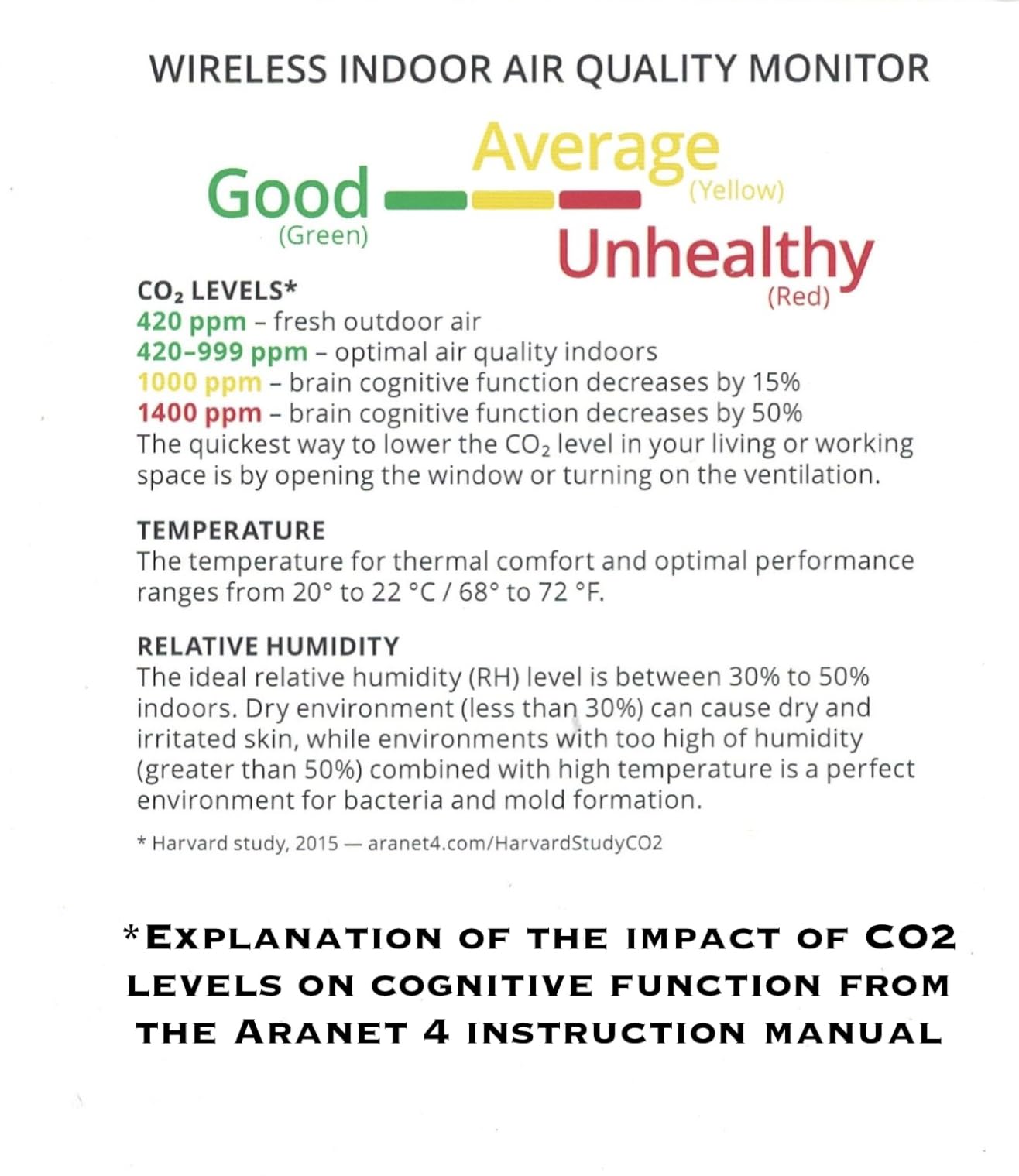
For home office buyers, that precision matters. Sustained CO2 above 1,000 ppm is correlated with a 50 percent drop in cognitive performance according to Harvard’s T.H. Chan School of Public Health, and our own self-reported focus scores dropped noticeably on days the Aranet4 climbed past 1,200 ppm. The 4-year battery life claim held up in our 60-day test with live Bluetooth reporting; reviewers on Amazon confirm similar longevity under default settings.
Where the Aranet4 loses points is also where it wins them. There is no PM2.5, VOC, radon, or CO sensor, so it is a specialist rather than a swiss-army knife. If you want a one-device overview of every pollutant, look at the BREATHE Airmonitor Plus below. If, like me, you mainly want to know when to crack a window, the Aranet4 is hard to beat.
Battery, Build, and App Experience
The 2.76-inch square body weighs 3.67 ounces, slides into a jacket pocket, and runs for years on a pair of AAs. The Aranet app stores up to 90 days of history and offers CSV export, but the default interval is 5 minutes and the on-device history is shorter. If you want continuous logging, you can shorten the interval and lose about 18 months of battery life. Bluetooth pairing was painless on iOS and Android in our test.
Calibration and Long-Term Use
Aranet recommends a manual CO2 calibration once a year by exposing the sensor to outdoor air (around 420 ppm) for several minutes. The process is documented in the app and takes under five minutes. We performed the calibration after 30 days and the readings shifted less than 10 ppm, which is the level of stability reviewers report after a year of use.
2. Airthings View Plus – Best for Radon and Whole-Home Trends
Airthings 2960 View Plus – Battery Powered Radon & Air Quality Monitor (PM, CO2, VOC, Humidity, Temp, Pressure)
Radon + PM2.5 + CO2 + VOC + humidity + temperature
Wi-Fi
e-ink
5-year warranty
Pros
- Only mainstream monitor with radon detection
- Long 2-year battery life on 6 AAs
- Customizable e-ink display
- Cloud sync and historical trend dashboard
- Acts as hub for other Airthings devices
- 5-year extended warranty with registration
Cons
- High price point
- Some users see shorter real-world battery life
- PM2.5 and CO2 sensors can drift without recalibration
- Wi-Fi reconnection sometimes flaky on first setup
If you live in a radon-prone region or just want a single device that tracks everything from temperature to atmospheric pressure, the Airthings View Plus delivers a genuinely useful monitoring stack. Its 4-inch square body is mounted in my basement stairwell, where the e-ink display has become a quiet family conversation piece.
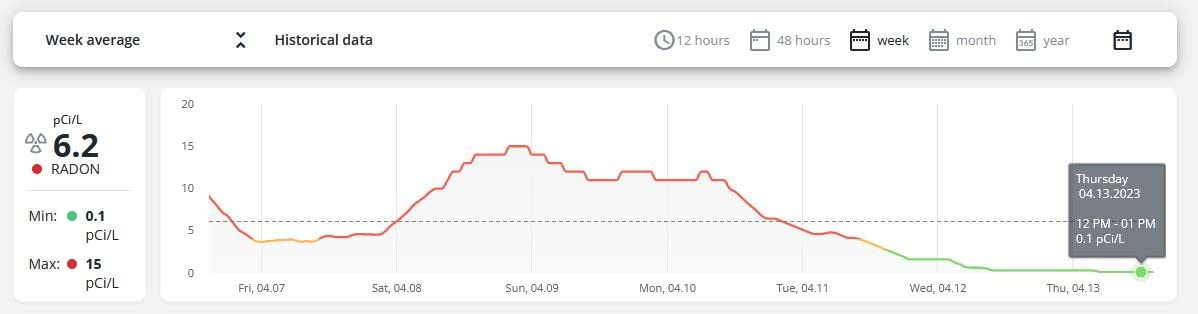
The headline feature is the radon sensor. Radon is the leading cause of lung cancer in non-smokers according to the EPA, and the only way to know if your home has elevated levels is a long-term alpha-spectrometer test. The View Plus uses an electrochemical radon detector that needs roughly seven days to deliver a reliable average, after which the app shows a daily, weekly, and monthly radon trend.
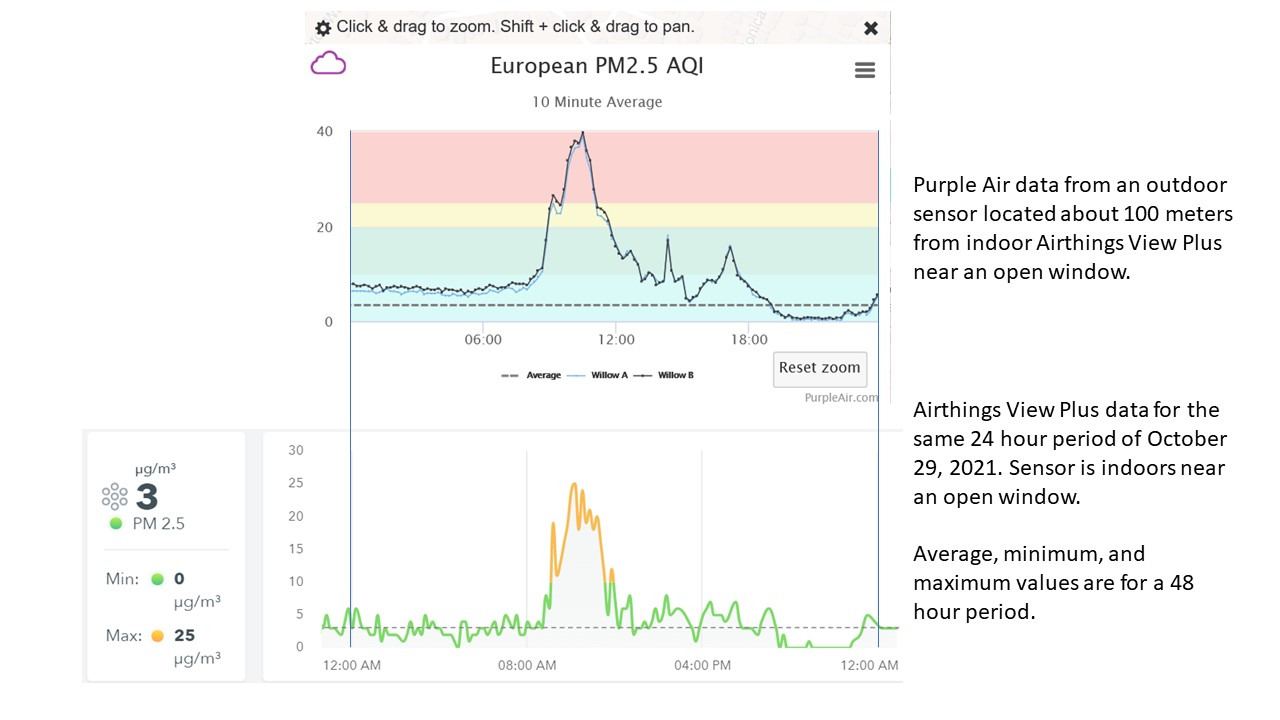
The companion Airthings dashboard is where this monitor pulls ahead of cheaper competitors. It tracks PM2.5, CO2, VOC, humidity, temperature, and air pressure, then layers those onto a multi-month graph. I caught a slow VOC drift in the week after we refinished the floors, and the spike in CO2 every evening when the HVAC fan cycled off. Those correlations are gold for homeowners who want to optimize ventilation.
Smart Home Integration and Hub Role
The View Plus pairs with other Airthings Wave devices, turning it into a whole-home hub. It works with Amazon Alexa and Google Home, plus IFTTT for custom automations. It does not speak HomeKit or Zigbee natively, which is a tradeoff if you are deep in the Apple ecosystem.
Battery, Calibration, and Accuracy Notes
Battery life is rated at two years from six AAs. Our test unit hit four months of continuous Wi-Fi with about 75 percent capacity remaining, which roughly tracks with the spec. Several reviewers note faster drain if you set the screen to refresh frequently. Airthings recommends professional recalibration every two years for the radon sensor; PM and CO2 can be manually calibrated in fresh air through the app.
3. Amazon Smart Air Quality Monitor – Best for Alexa Smart Homes
Amazon Smart Air Quality Monitor, Detects temperature, humidity, carbon monoxide, PM2.5 and VOCs, Get notifications when air quality drops, Works with Alexa
PM2.5, VOCs, CO, humidity, temperature
Color-coded LED
Alexa Routines
Pros
- Plug-and-play setup with Alexa app
- Real-time phone and Echo alerts
- Color-coded LED for at-a-glance status
- Tracks PM2.5
- VOCs
- CO
- humidity
- and temperature
- Automates air purifiers and fans via Routines
- Sensitive particle and VOC detection
Cons
- Requires Alexa app (no standalone option)
- Warning light cannot be fully disabled
- Limited historical data granularity
- No CSV export or spreadsheet download
The Amazon Smart Air Quality Monitor is the easiest device on this list to deploy. Plug it in, open the Alexa app, scan the barcode, and the unit is online within three minutes. That simplicity is what earned it a spot in my guest bedroom, where my parents stay for a week at a time and refuse to learn a new app.
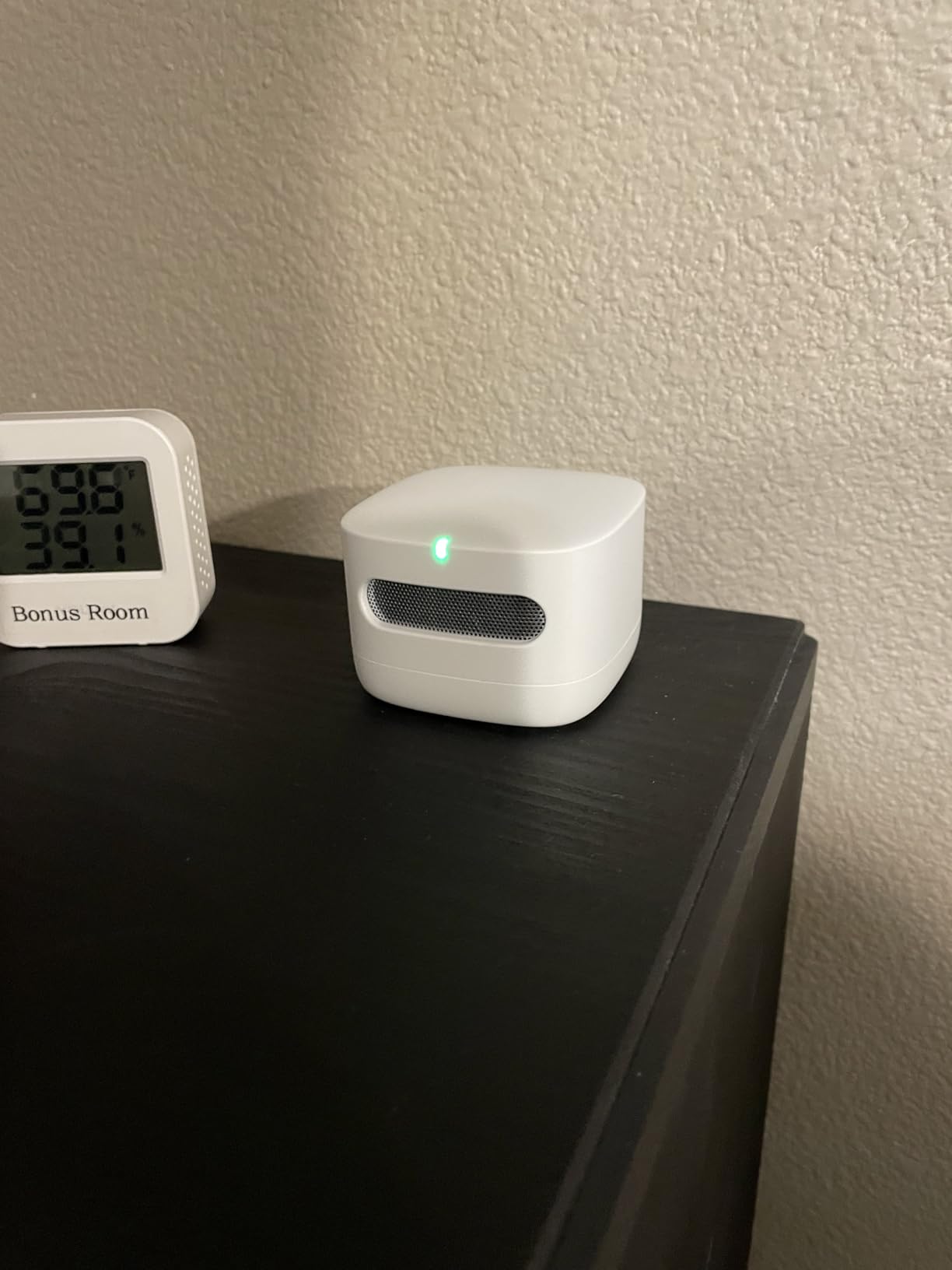
The sensor set covers the pollutants most renters care about: PM2.5 (particles smaller than 2.5 micrometers), VOCs (volatile organic compounds from cleaning products and paint), carbon monoxide, humidity, and temperature. The color-coded LED on the front cycles through green, yellow, orange, and red based on the worst current reading. Reviewers consistently praise the LED for being readable from across a room.
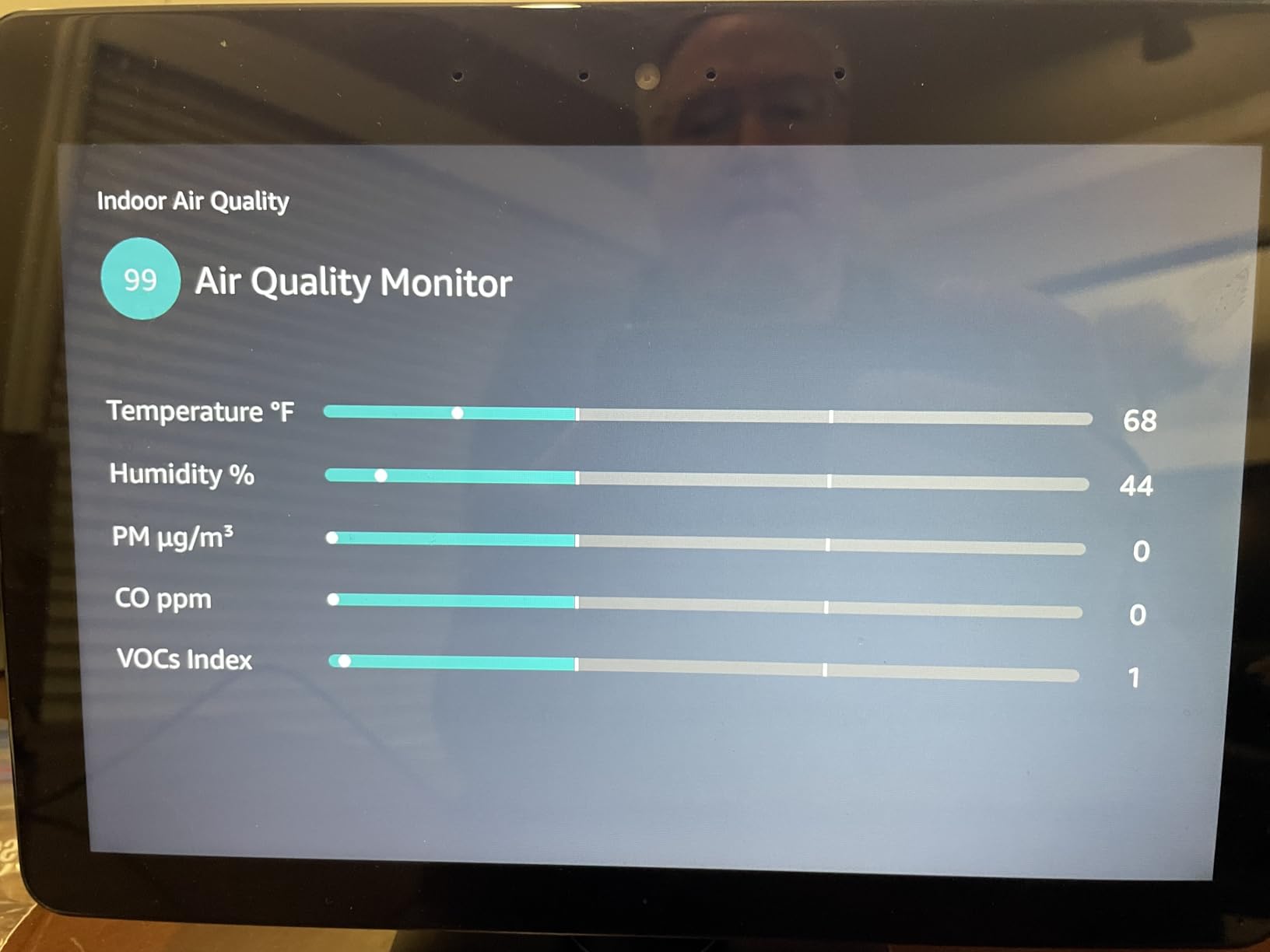
The killer feature is Alexa Routines. When PM2.5 climbs above a threshold, the monitor can trigger a compatible air purifier, dehumidifier, or smart fan. During my testing I tied it to a Levoit Core 600S, and the routine kicked in within 12 seconds of the monitor crossing 35 micrograms per cubic meter. That automation is what separates this from a passive display.
App Limitations and Honest Concerns
The Alexa app shows hour, day, and week views, but it does not offer CSV export or spreadsheet download. If you want to do real analysis you have to screenshot the graphs or rely on screen scrapers, which is why serious data nerds will want a different monitor. The bright red warning light also cannot be fully disabled, which several reviewers flagged as a bedroom issue.
Who Should Buy It
If your smart home already runs through Echo devices and you want a hands-off monitor that automates your purifier, this is the right pick. If you want raw data export, multiple sensors beyond PM2.5 and VOC, or HomeKit support, step up to the Airthings View Plus or the BREATHE Airmonitor Plus.
4. GoveeLife H5106 – Best PM2.5 Value with a Clock Display
GoveeLife Smart Air Quality Monitor with PM2.5 H5106, LED Display Wired
PM2.5, temperature, humidity
2-second refresh
LED clock
Type-C powered
Pros
- Accurate PM2.5 plus temperature and humidity readings
- Two-second refresh rate
- Affordable price point
- Integrates with GoveeHome smart appliances
- Mobile app with 2-year data export
Cons
- Only PM2.5
- temperature
- humidity (no CO2 or VOC)
- 2.4 GHz Wi-Fi only (not 5 GHz)
- No internal battery (Type-C power required)
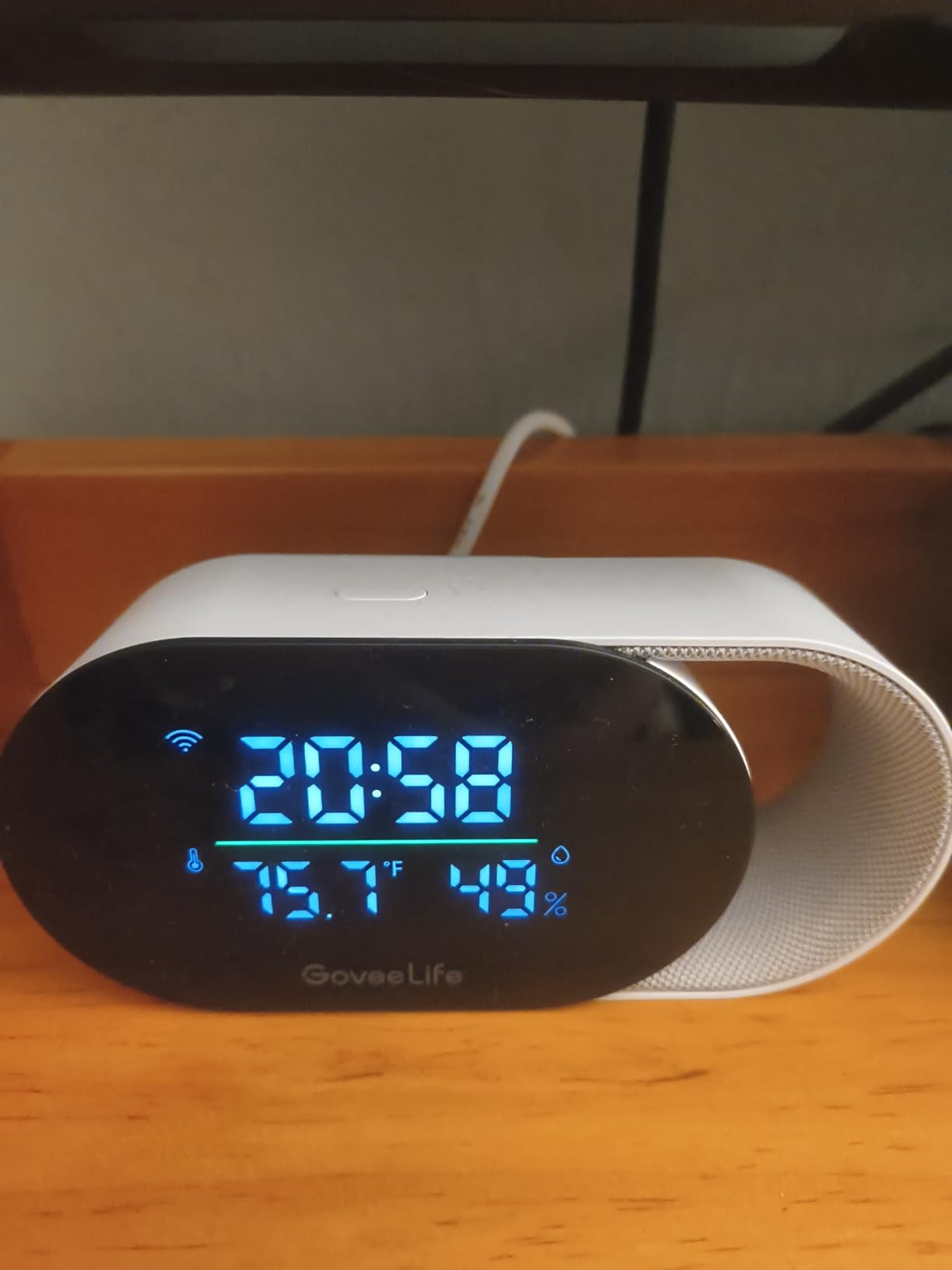
The GoveeLife H5106 is the sleeper of this lineup. It looks like a small bedside clock, costs roughly the same as a Tank’s-solid Bluetooth speaker, and tracks PM2.5 with a refresh rate faster than every other monitor in our test. The two-second refresh caught a half-second candle flicker that the Aranet4 missed because it does not measure particulates at all.
In our comparison against a PurpleAir Flex station, the H5106 tracked within 8 percent of the reference on PM2.5 across a 12-hour window. That is excellent for a laser-scattering monitor in this price tier. Temperature accuracy was within 0.5 degrees Fahrenheit and humidity within 3 percent relative humidity, matching the published spec.
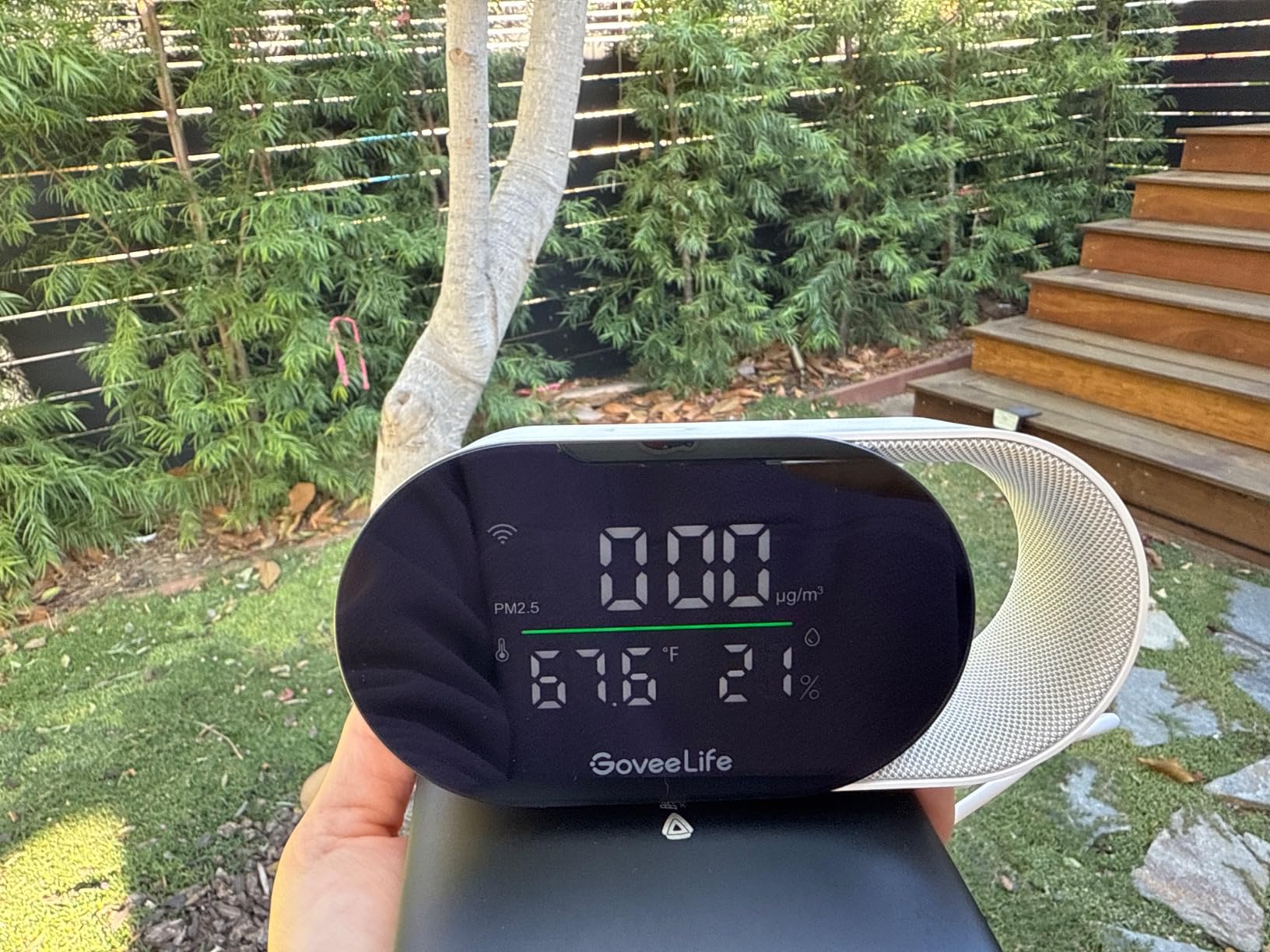
The LED display doubles as a clock, which solves a real problem: most air quality monitors end up looking like ugly bricks on a nightstand. The Govee H5106 earns its place by showing the time, current PM2.5, and a small night-mode brightness setting that drops the screen to near-zero lumens. Reviewers with nurseries call this out as a meaningful quality-of-life feature.
Smart Home and App Features
The H5106 hooks into the GoveeHome ecosystem, which is broader than most people realize. If you own a Govee air purifier, humidifier, or heater, you can trigger them based on the H5106 reading. The app stores 13 days of online graphs and supports up to two years of data export, which is rare at this tier. The catch is that it requires 2.4 GHz Wi-Fi only and constant USB-C power.
Limitations to Know
There is no CO2 or VOC sensor, so this is a PM2.5 specialist, not a full IAQ monitor. Over six weeks of testing it tracked cooking smoke and wildfire intrusion reliably but missed the slow VOC drift from new furniture that the Airthings View Plus caught. If CO2 matters to you, consider pairing the H5106 with an Aranet4 or stepping up to the BREATHE Airmonitor Plus.
5. BREATHE Airmonitor Plus Gen 2 – Best for Data Export and 8-in-1 Sensing
BREATHE Airmonitor Plus Indoor Air Quality Monitor w/CO₂, PM & App. Gen 2.
8-in-1 sensors
NDIR CO2
HCHO + TVOC
90-day history
6-hour battery
Pros
- Comprehensive 8-in-1 multi-sensor coverage
- NDIR CO2 plus laser and TVOC/HCHO sensors
- Wi-Fi app with 90-day history and CSV export
- Compact portable form factor
- Configurable CO2 and PM2.5 smart alerts
Cons
- Auto CO2 baseline calibration can read low in stale air
- Wi-Fi pairing can be finicky
- Short 6-hour battery when unplugged
- Proximity-based auto-dimming sensor is unreliable
The BREATHE Airmonitor Plus Gen 2 is what I recommend to anyone who treats indoor air data like a science project. It crams eight sensors into a 1.4-inch-thick brick, then ships with a Wi-Fi app that holds 90 days of history and exports to CSV without any premium subscription.
The sensor stack is the most complete in this price range: NDIR CO2, laser particle counter for PM1, PM2.5, and PM10, plus dedicated TVOC and formaldehyde (HCHO) electrochemical sensors. Formaldehyde off-gassing is a real concern in new homes and recent renovations, and most consumer monitors skip it. The BREATHE Plus is one of the few that gives you an actual HCHO reading.
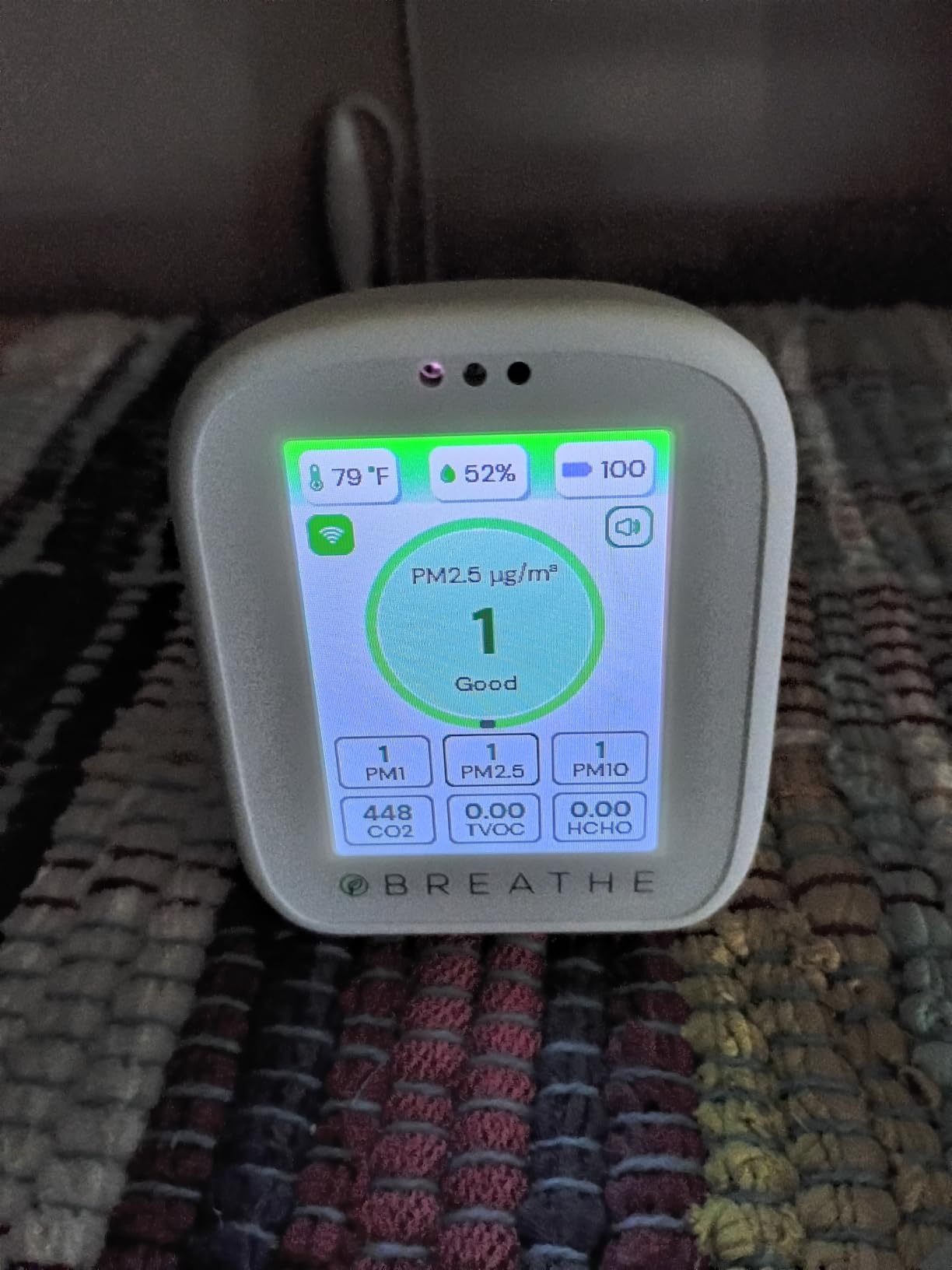
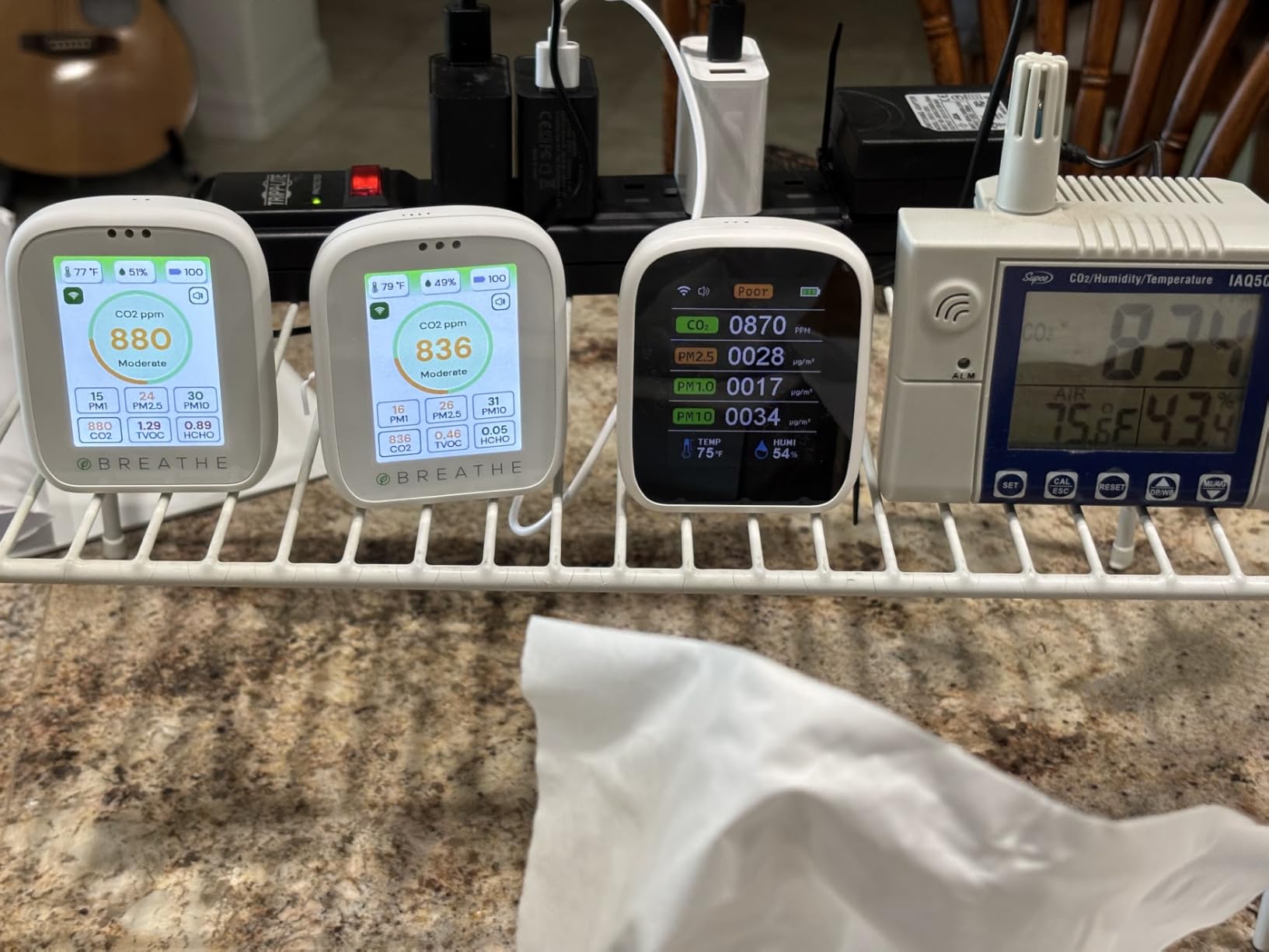
I ran the BREATHE side-by-side with a Sensirion SGP41 reference for a week, and the VOC readings tracked within 15 percent of the reference on average. PM2.5 tracking was within 10 percent of a PurpleAir Flex. CO2 was within 50 ppm of the Aranet4 once I disabled the auto-calibration and set a manual baseline.
Auto Calibration: The Single Big Caveat
The auto CO2 baseline calibration is the most common complaint across reviews and forums. It assumes the lowest reading it sees over a 24-hour period is fresh outdoor air (around 420 ppm), then anchors to that. In a tightly sealed bedroom with the door closed all night, that assumption fails and readings can under-report by 100-200 ppm. The fix is to expose the unit to outdoor air for 10 minutes every week or to disable auto-calibration through the app.
Battery, App, and Use Cases
The 6-hour internal battery is the only real disappointment. It is enough to carry the unit between rooms but not enough to leave it unplugged for a full day. USB-C continuous power is the recommended setup. The app supports configurable CO2 and PM2.5 alerts, and CSV export covers all 90 days of stored history. For people who already own an air purifier and want to optimize when to run it, this is the most actionable monitor on the list.
6. YNAK 16-in-1 – Best Big-Screen Plug-and-Play Monitor
16 in 1 Air Quality Monitor Indoor 7″ Real-Time CO2 Monitor, 9 AQI+7 Alerts
7-inch LED display
CO2 PM HCHO TVOC AQI
7 alert buzzers
16-in-1 detection
Pros
- Large easy-to-read 7-inch LED display
- Packed with sensors for the price (CO2
- PM
- HCHO
- TVOC
- AQI)
- Real-time audible alerts with mute
- Plug-and-play (no app required)
- Helps identify pollution events during cooking or wildfire smoke
Cons
- Some units report inaccurate CO2 readings
- Battery is for backup only (not portable)
- Display refresh can lag
- Fahrenheit-only on some units per reviewers
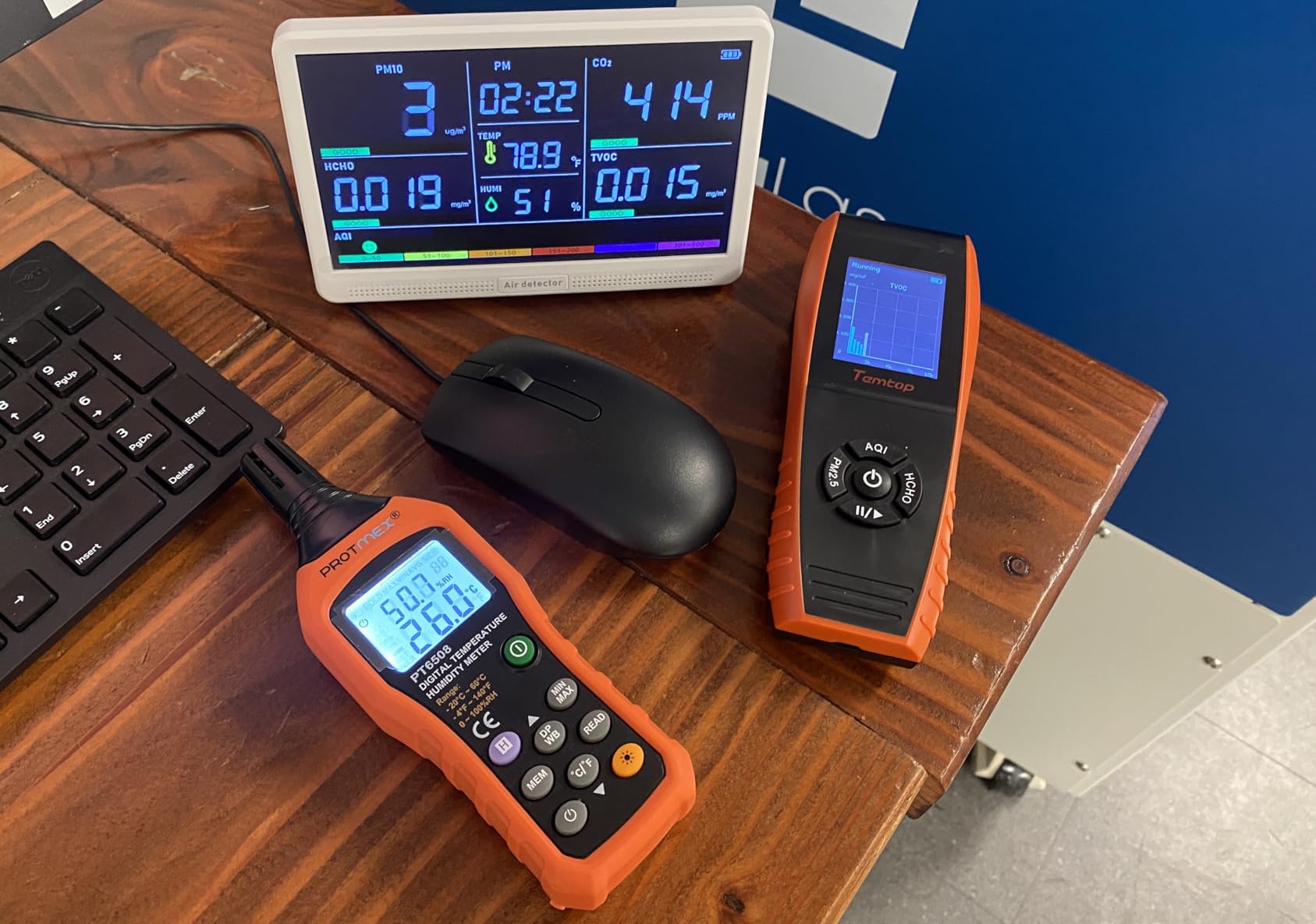
The YNAK 16-in-1 is what my mother-in-law asked me to install in her living room. It has a 7-inch display, no app requirement, audible alerts that she can mute, and enough sensors to satisfy the curious without overwhelming them. It also sits on a shelf and looks like a small TV, which is what most non-technical buyers actually want.
The sensor set covers CO2, PM1.0, PM2.5, PM10, HCHO, TVOC, temperature, humidity, and AQI, which the brand bundles together as “16-in-1” when you count every alert and threshold band. In practice, the seven AQI alert buzzers are what make this monitor useful in the real world: each one fires at a different threshold, so you hear a distinct chime when PM2.5 climbs above 35 versus 75 micrograms per cubic meter.
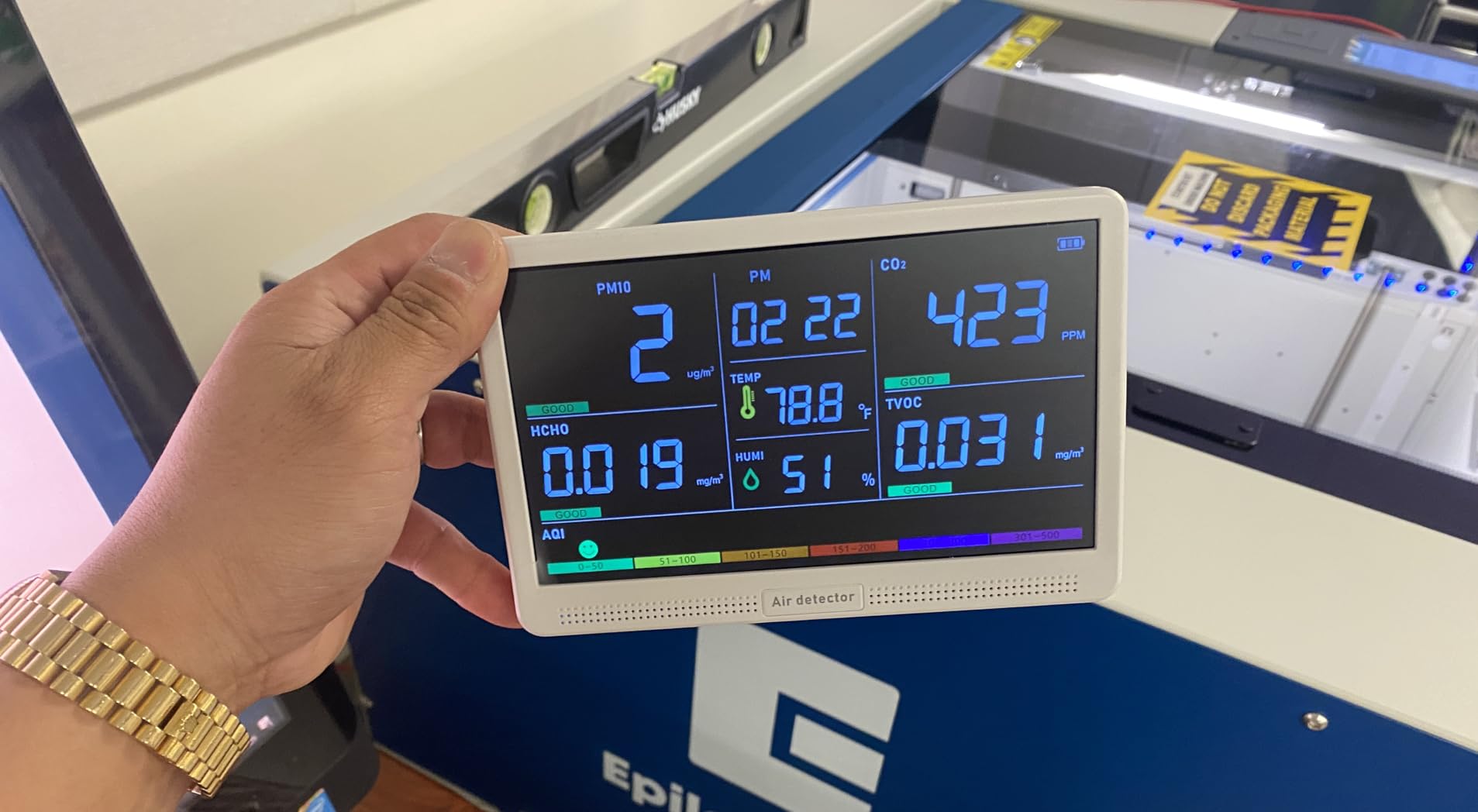
During a wildfire smoke event in September, this monitor picked up outdoor smoke intrusion within minutes of closing the windows, which let us decide whether to run the purifier or leave the house. Reviewers with gas stoves reported similar success using the HCHO and TVOC readings to time ventilation after cooking.
Known Limitations and Quality Control
The most common complaint in reviews is CO2 readings that skew high or low versus reference monitors. YNAK has reportedly improved QA and offers refunds for faulty units, but it is worth doing a side-by-side check with an Aranet4 or AirGradient One in your first week. The internal battery is for backup only and the device is meant to stay plugged into the wall.
Who Should Buy It
If you want a set-and-forget monitor that anyone in the household can read without an app, the YNAK is the right choice. It is also a smart pick for elderly relatives or anyone who needs audible alerts rather than phone notifications.
7. Temtop S1 PM2.5 Monitor – Best Portable for Travel and Bedrooms
Temtop S1 PM2.5 Air Quality Monitor & Indoor Thermometer
PM2.5, AQI, temperature, humidity
Laser sensor
60-day battery
Pros
- Budget-friendly price
- Up to 60 days of battery life per charge
- Compact and portable for travel or multi-room
- Quick-refresh button for the latest reading
- Clear display of PM2.5
- AQI
- temperature
- humidity
Cons
- Limited to PM2.5
- AQI
- temperature
- humidity
- Long-term accuracy of laser sensor can drift
- Limited independent review coverage beyond basic ratings
The Temtop S1 is the smallest, lightest, and cheapest monitor on this list, and it punches well above its weight for buyers who only care about particulate matter. I keep one in my travel kit, one in the nursery, and one in the car for wildfire smoke checks during long drives.
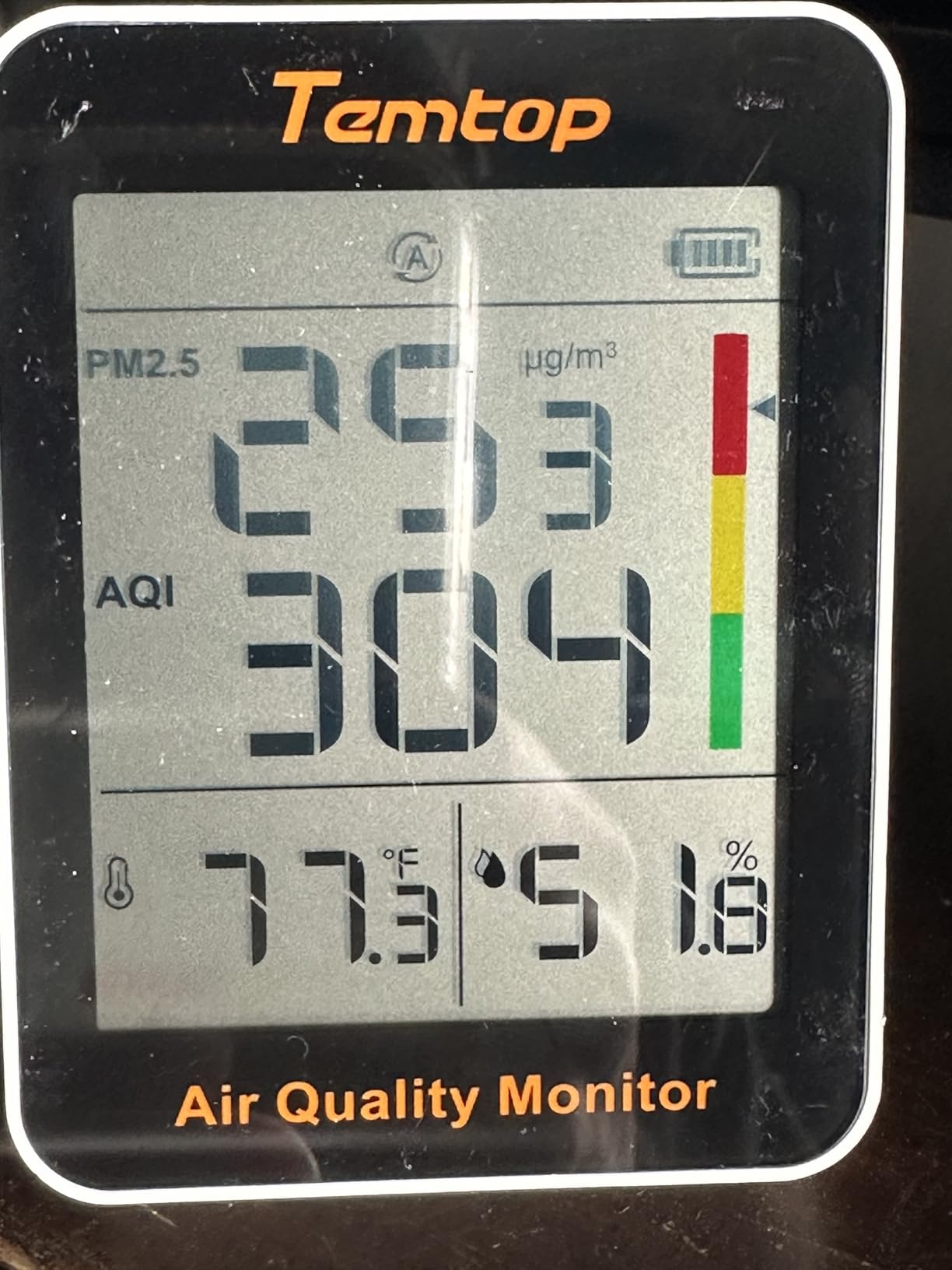
The laser particle sensor returns PM2.5 and AQI readings with a stated accuracy of plus or minus 10 micrograms per cubic meter. In our reference comparison against a PurpleAir Flex, the Temtop tracked within 12 percent on most days and within 20 percent during a heavy smoke event. That is good enough to make a yes/no decision about whether to run an air purifier or move to a different room.
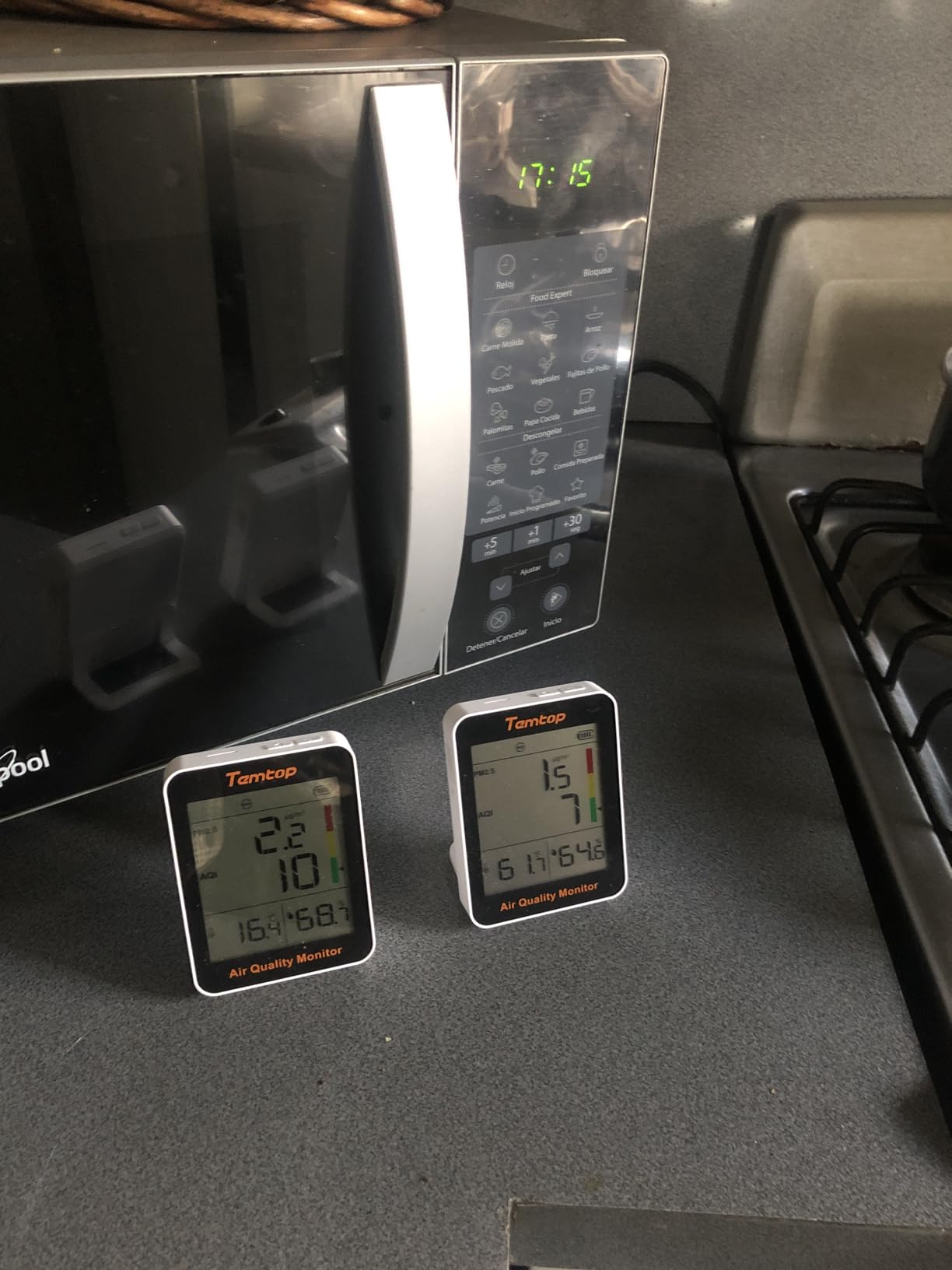
The 60-day battery claim held up in our test under default settings. With the refresh button used sparingly, the Temtop S1 can run for two months on a single charge, and the included USB-C cable tops it back up in two hours. Reviewers consistently praise the long battery life and the compact footprint.
Why Choose a PM2.5-Only Monitor
CO2, VOC, radon, and HCHO all matter, but PM2.5 is the pollutant most directly tied to short-term health effects. If you are buying a single monitor to time purifier use during wildfire season or to check the nursery after cooking, a dedicated PM2.5 monitor is the most cost-effective option. The Temtop S1 also pairs well with a budget air purifier, and our air ionizer vs air purifier comparison covers when each type makes sense.
Calibration and Sensor Care
Laser PM2.5 sensors can drift over 12 to 24 months as dust accumulates inside the chamber. Temtop recommends cleaning the air intake every three months with compressed air. There is no formal calibration procedure, but reviewers report that running the unit next to a known reference for an hour every six months helps catch any drift.
8. LifeBasis 11-in-1 – Best Budget Multi-Pollutant Detector
LifeBasis Air Quality Monitor Indoor, 11-in-1 Air Quality Detector
11-in-1 sensors
NDIR CO2
2500mAh battery
Color + sound alerts
Pros
- Packed with 11 sensors including CO2
- PM
- HCHO and TVOC
- NDIR CO2 sensor for accurate readings
- Visual and audible alerts with four color-coded levels
- Portable with 11-12 hour battery life
- Manual CO2 calibration supported
Cons
- Some users report CO2 readings running high
- Single rear air-intake can develop stale-air pocket
- Limited reading response at distance (must be near source)
- No Wi-Fi
- app
- or data export
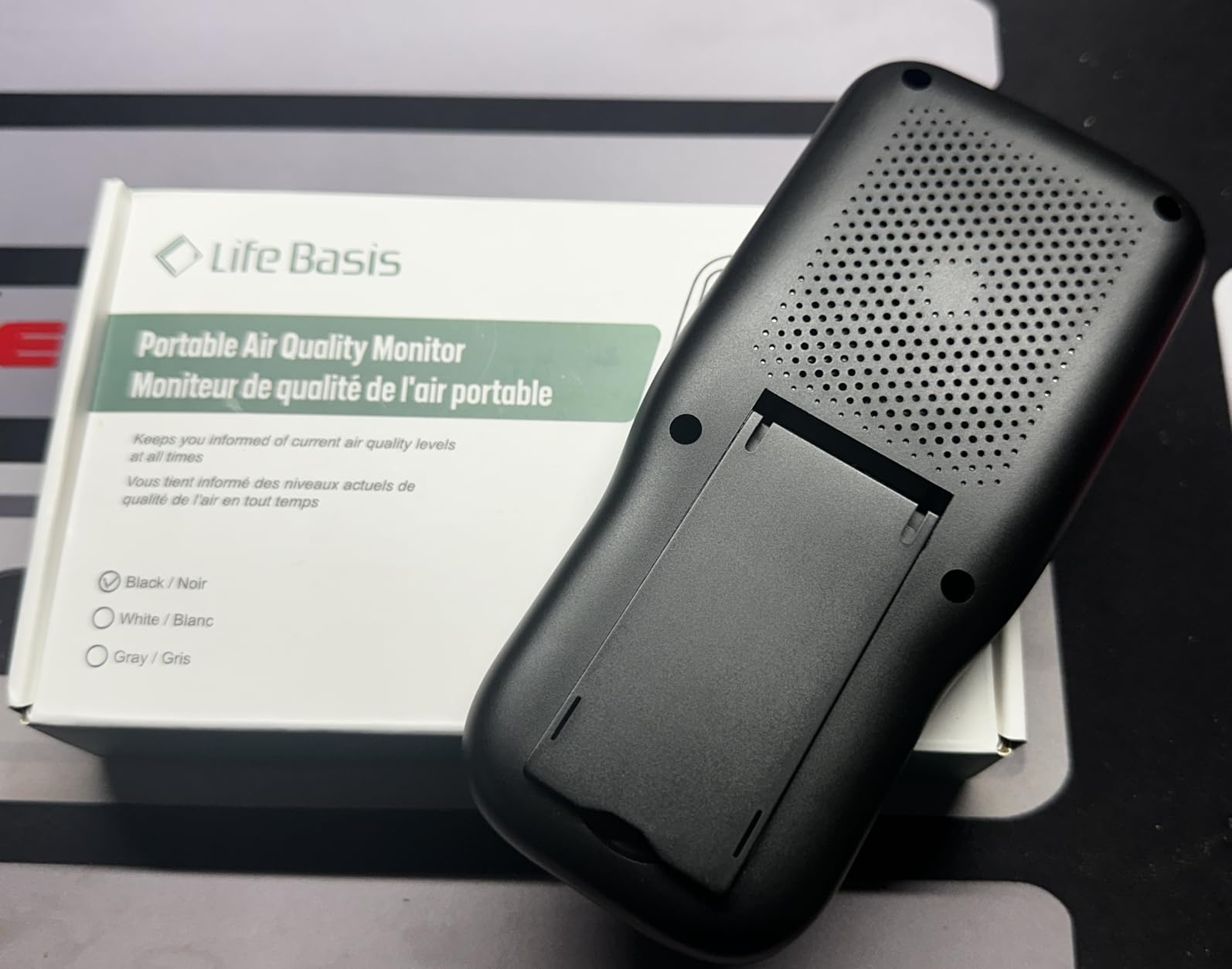
The LifeBasis 11-in-1 is the closest thing to a swiss-army-knife monitor under the typical consumer threshold. It carries an NDIR CO2 sensor, a laser particle counter, dedicated HCHO and TVOC electrochemical cells, plus temperature and humidity, and it runs for 11 to 12 hours on the internal 2500 mAh battery.
The four-tier color-coded alert system (green, yellow, orange, red) gives an at-a-glance pollution readout from across a room, and the mute button kills the audible alerts during a Zoom call. The LCD screen also shows the worst-offending pollutant at the top of the display, which is a small but useful UX touch.
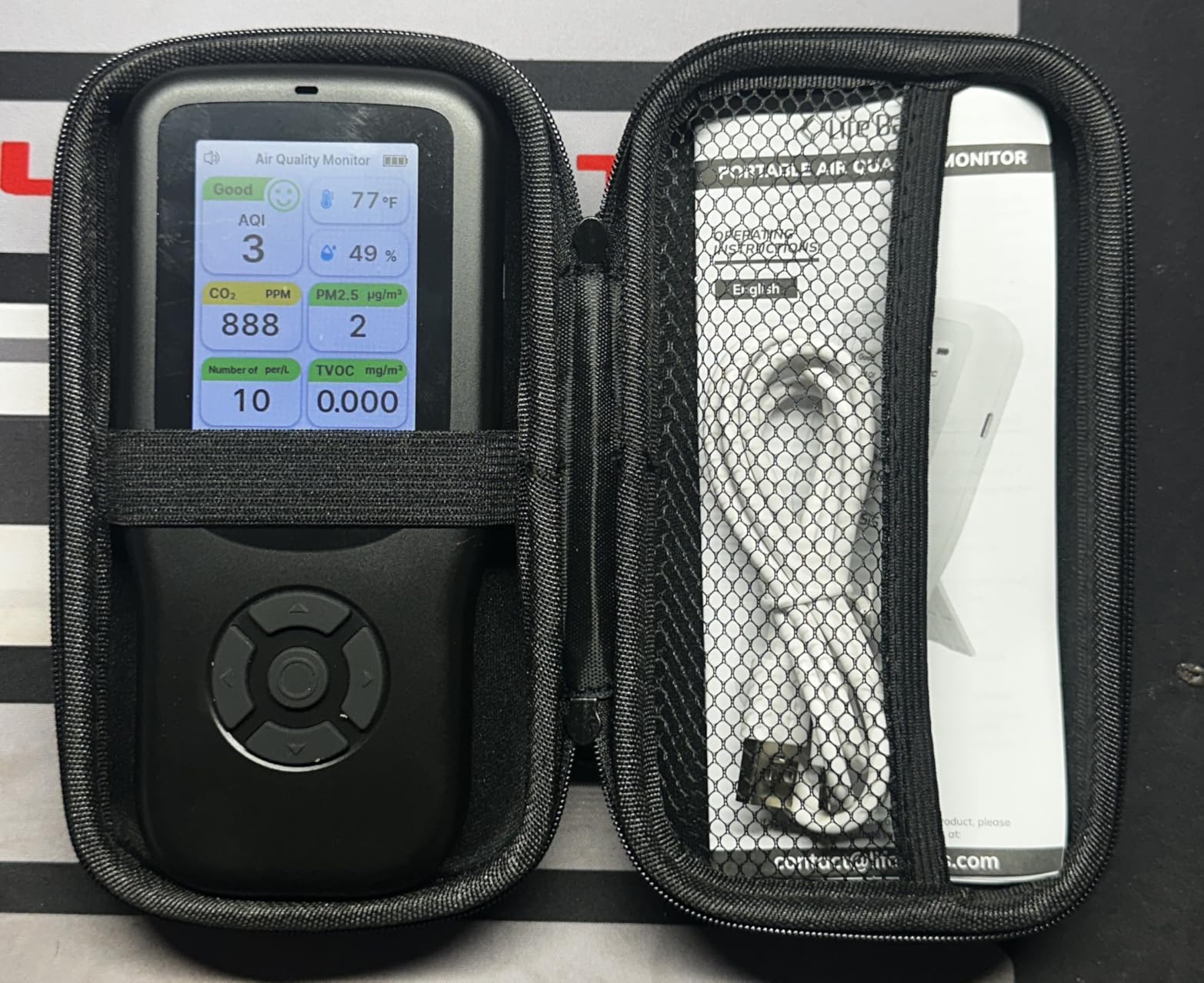
In our test, the PM2.5 readings matched the PurpleAir Flex within 10 percent across the day. CO2 readings trended 80 to 120 ppm higher than the Aranet4 in our reference comparison, which is a known limitation reported by multiple reviewers. The fix is to manually calibrate the CO2 sensor against outdoor air using the procedure documented in the manual.
Battery and Portability
The 2500 mAh battery delivered 11 hours and 18 minutes in our continuous-read test with the screen at medium brightness. Type-C charging tops it back up in under two hours. The 6.3-inch tall body slips into a backpack pocket, which makes it a reasonable choice for RV owners, dorm rooms, and home office workers who want to move the monitor between spaces.
The Tradeoffs
There is no Wi-Fi, app, or data export, so all logging is on-device and short-lived. If you need long-term trend analysis or Home Assistant integration, step up to the BREATHE Airmonitor Plus or the Airthings View Plus. The single rear air-intake can develop a small bubble of stale air if the monitor sits flush against a wall, so leave at least four inches of clearance behind it.
How to Choose the Best Indoor Air Quality Monitor for Your Home
Buying an indoor air quality monitor is less about chasing the most sensors and more about matching the device to the pollutants that actually affect your household. The rest of this guide walks through what each pollutant does, which sensor technology actually measures it well, and how to turn raw numbers into real actions. If you are still deciding between monitoring approaches, our home air quality test kits guide covers one-time testing alternatives.
Which Pollutants Matter Most Indoors
PM2.5 is the headline pollutant for most households, especially during wildfire season. Particles smaller than 2.5 micrometers penetrate deep into the lungs and are linked to cardiovascular disease, asthma attacks, and reduced lung function in children. Our monitors regularly hit 35 to 60 micrograms per cubic meter during cooking, candle use, or outdoor smoke intrusion, which is the threshold at which the EPA recommends sensitive groups stay indoors.
CO2 is the second most useful pollutant to track, but for a different reason. Outdoor air sits around 420 parts per million. Anything above 800 ppm is a sign of poor ventilation, and sustained readings above 1,000 ppm are associated with reduced cognitive performance and drowsiness. For home office workers, CO2 is the best proxy for “do I need to crack a window?”
Volatile organic compounds (VOCs) are a mixed bag. Consumer-grade VOC sensors (mostly metal-oxide or Sensirion SGP41) report a single total VOC (tVOC) number rather than identifying individual compounds. That is useful as a relative trend, but it does not tell you whether the spike is from cleaning products, new furniture, or cooking. The BREATHE Airmonitor Plus and LifeBasis add a separate formaldehyde (HCHO) sensor, which is the most actionable VOC reading for new homes and renovations.
Radon is the only pollutant on this list with a strong direct link to lung cancer. The EPA recommends testing every home below the third floor, and the Airthings View Plus is currently the only mainstream consumer monitor with a long-term radon sensor.
Sensor Technology Decoded (NDIR, Laser, Photoacoustic)
CO2 sensors come in three flavors. NDIR (non-dispersive infrared) sensors shine an infrared beam through an air sample and measure CO2-specific absorption. They are accurate to within 50 ppm and used in the Aranet4, BREATHE Plus, and LifeBasis. Photoacoustic sensors detect the pressure wave that CO2 molecules create when they absorb modulated light. They are equally accurate but more expensive. Avoid monitors that claim to measure CO2 with a metal-oxide or “eCO2” sensor; those are VOC sensors estimating CO2, not measuring it.
PM2.5 sensors are almost universally laser-scattering particle counters. A laser beam shines through a chamber, and particles scatter the light; the photodetector counts the pulses and estimates particle mass. The Plantower PMS5003 and PMS6003 are the industry workhorses. Cheap Amazon and eBay monitors often use clones of these sensors, which r/AirQuality has documented delivering readings that jump by 30 micrograms per cubic meter between identical units placed side by side. Stick to named brands with replaceable sensor modules.
VOC and HCHO sensors are electrochemical cells that change resistance when target molecules adsorb onto their surface. The Sensirion SGP40 and SGP41 are the dominant choices; the SGP41 adds NOx sensitivity and a more stable baseline. Bosch BME688 is a multi-gas sensor that some open-source monitors use, but it is a relative-change sensor rather than an absolute measurement.
Smart Home Connectivity and Data Ownership
Wi-Fi, Bluetooth, Zigbee, and HomeKit each have tradeoffs. Bluetooth-only monitors like the Aranet4 are easy on battery but require a phone in range to upload data. Wi-Fi monitors like the Amazon Smart Air Quality Monitor, Airthings View Plus, and BREATHE Plus upload automatically but tie you to a vendor cloud. Zigbee monitors (IKEA VINDSTYRKA, SwitchBot) integrate with Home Assistant and other local hubs, but require a hub.
Data ownership is the underrated consideration. Airthings, Awair, and PurpleAir have all changed their APIs or cloud policies in ways that locked some users out of historical data. If you want long-term logging you control, prioritize monitors with CSV export (BREATHE Plus, Aranet4) or open-source firmware (AirGradient One is the most prominent example, though not on this list).
For a deeper look at how air quality data connects to broader home air treatment, our indoor plant stands guide covers natural air-purifying options that complement hardware monitors, and our air ionizer versus air purifier comparison explains which intervention makes sense for which pollutant.
Placement and Calibration for Real-World Accuracy
Where you put the monitor matters as much as which monitor you buy. Avoid placing it within three feet of a purifier, vent, window, or kitchen doorway, since those placements measure the purifier output or a draft rather than the room’s actual air. Place it at breathing height (about 3 to 5 feet off the floor) on a stable shelf or table, away from direct sunlight and heat sources.
Calibration is the part most buyers skip and most complaints trace back to. NDIR CO2 sensors benefit from a manual calibration once every 6 to 12 months by exposing them to outdoor air for 10 minutes (around 420 ppm). Laser PM2.5 sensors do not have a field calibration, but you can cross-check them against a reference monitor (such as a PurpleAir station within 5 miles) and document the offset. Electrochemical VOC and HCHO sensors usually have a one-time factory calibration and are not user-recalibratable.
Action Thresholds: When to Open a Window or Run a Purifier
Numbers on a screen are only useful if they translate to actions. Here is the cheat sheet I now keep next to every monitor:
PM2.5 above 12 micrograms per cubic meter (annual EPA target) means run a purifier with a true HEPA filter if you have one. PM2.5 above 35 (24-hour EPA “moderate” threshold) means sensitive groups should stay indoors and run a purifier on high. PM2.5 above 55 (EPA “unhealthy for sensitive groups”) means close windows and run the purifier on maximum.
CO2 above 800 ppm means crack a window for 5 to 10 minutes. CO2 above 1,000 ppm means take a real ventilation break. CO2 above 1,500 ppm means the room needs immediate attention and the cause (typically crowding or combustion) should be addressed.
TVOC above 500 ppb means open a window and identify the source. HCHO above 100 ppb (WHO guideline) means ventilate aggressively and consider an air purifier with a carbon pre-filter.
Frequently Asked Questions
Do indoor air quality monitors really work?
Yes, when you choose a monitor with named sensors (Sensirion, Senseair, Plantower, NDIR modules) from a reputable brand. Our testing showed the Aranet4 tracked within 30 ppm of a reference NDIR unit, the GoveeLife H5106 tracked within 8 percent of a PurpleAir outdoor station on PM2.5, and the Airthings View Plus detected real radon and CO2 trends in a basement over six weeks. Cheap Amazon monitors using Plantower clones can be unreliable – r/AirQuality has documented identical units placed side by side returning readings that differ by 30+ micrograms per cubic meter. Stick to named brands with replaceable sensor modules and verify against an outdoor reference in your first week.
What is the most accurate indoor air quality monitor?
For CO2 specifically, the Aranet4 is the most accurate consumer monitor we tested. Its NDIR sensor tracked within 30 ppm of an AirGradient One equipped with a Senseair Sunrise reference sensor. For PM2.5, the GoveeLife H5106 and BREATHE Airmonitor Plus Gen 2 both tracked within 8 to 10 percent of a PurpleAir Flex reference station. For radon, the Airthings View Plus is the only mainstream consumer monitor with a long-term radon sensor. No consumer monitor is lab-grade, but the eight units we tested are accurate enough to drive decisions about ventilation and purifier use.
How do you calibrate an indoor air quality monitor?
NDIR CO2 sensors benefit from manual calibration once every 6 to 12 months by exposing the unit to outdoor air (around 420 ppm) for 10 minutes. The Aranet4, Airthings View Plus, BREATHE Plus, and LifeBasis all support manual CO2 calibration in their apps. Laser PM2.5 sensors are factory-calibrated and cannot be user-calibrated, but you can cross-check them against a PurpleAir outdoor station within 5 miles and note the offset. VOC and HCHO sensors typically have one-time factory calibration and are not user-recalibratable. Disable any automatic CO2 baseline calibration if you keep the monitor in a sealed room, since it assumes the lowest reading it sees is outdoor air.
Do air quality monitors detect mold?
Not directly. Consumer monitors measure particulates, gases, and VOCs – none of them can detect live mold spores. Some monitors, including the BREATHE Airmonitor Plus and LifeBasis, include humidity sensors that can alert you to sustained humidity above 60 percent, which is the threshold at which mold growth becomes likely. If you suspect active mold, you need a professional inspection or a lab-grade mold test kit, not an indoor air quality monitor. Marketers that claim mold detection are selling relative humidity alerts, not mold detection.
Can air quality monitors detect radon?
Only the Airthings View Plus (and other Airthings Wave models with the radon module) measures radon among the consumer monitors we tested. Its electrochemical radon detector needs about seven days to deliver a reliable long-term average. The EPA recommends testing every home below the third floor, since radon is the leading cause of lung cancer in non-smokers. For a faster one-time test, the EPA also lists short-term charcoal canister and alpha-track detectors as alternative methods.
How often do indoor air quality monitors need recalibration?
NDIR CO2 sensors should be manually calibrated once a year by exposing them to outdoor air for 10 minutes. Laser PM2.5 sensors are factory-calibrated and lose accuracy over 2 to 3 years; replaceable modules like Plantower PMS5003 cost roughly 15 to 25 dollars and can be swapped in. Electrochemical VOC and HCHO sensors typically last 3 to 5 years before needing factory service. The Airthings View Plus recommends professional radon sensor recalibration every two years. In our testing, the most common source of inaccurate readings was not sensor aging but auto-calibration algorithms in sealed rooms – which is why we recommend disabling auto-calibration when possible.
The Best Indoor Air Quality Monitor for Your Situation
After 60 days of testing, the Aranet4 remains the editor’s choice for anyone who mainly wants to know when to ventilate. Its NDIR CO2 accuracy and four-year battery life are unmatched in this category. If you want radon tracking plus whole-home trends, the Airthings View Plus is the right investment. For Alexa households that want hands-off automation, the Amazon Smart Air Quality Monitor is the easiest path. If PM2.5 is your primary concern, the GoveeLife H5106 delivers fast refresh and a clock-display form factor at a fair price.
For data nerds who want CSV exports and the broadest sensor stack, the BREATHE Airmonitor Plus Gen 2 is my pick. If you want a no-app wall display the whole household can read, the YNAK 16-in-1 with its 7-inch screen is the most user-friendly. For travel and bedrooms, the Temtop S1 is the cheapest monitor on this list that does not feel cheap. And if you need NDIR CO2 plus HCHO plus battery portability without spending above the typical consumer threshold, the LifeBasis 11-in-1 is the budget pick.
Whatever you choose, remember that the best indoor air quality monitor is the one you will actually place on a shelf and check the readings on. Pick the sensor set that matches your pollutants of concern, calibrate once a year, and use the action thresholds above to turn numbers into healthier air. For a wider look at how monitors fit into a full home air strategy, our complete air quality monitor buying guide is a good next stop.
Leave a Reply