
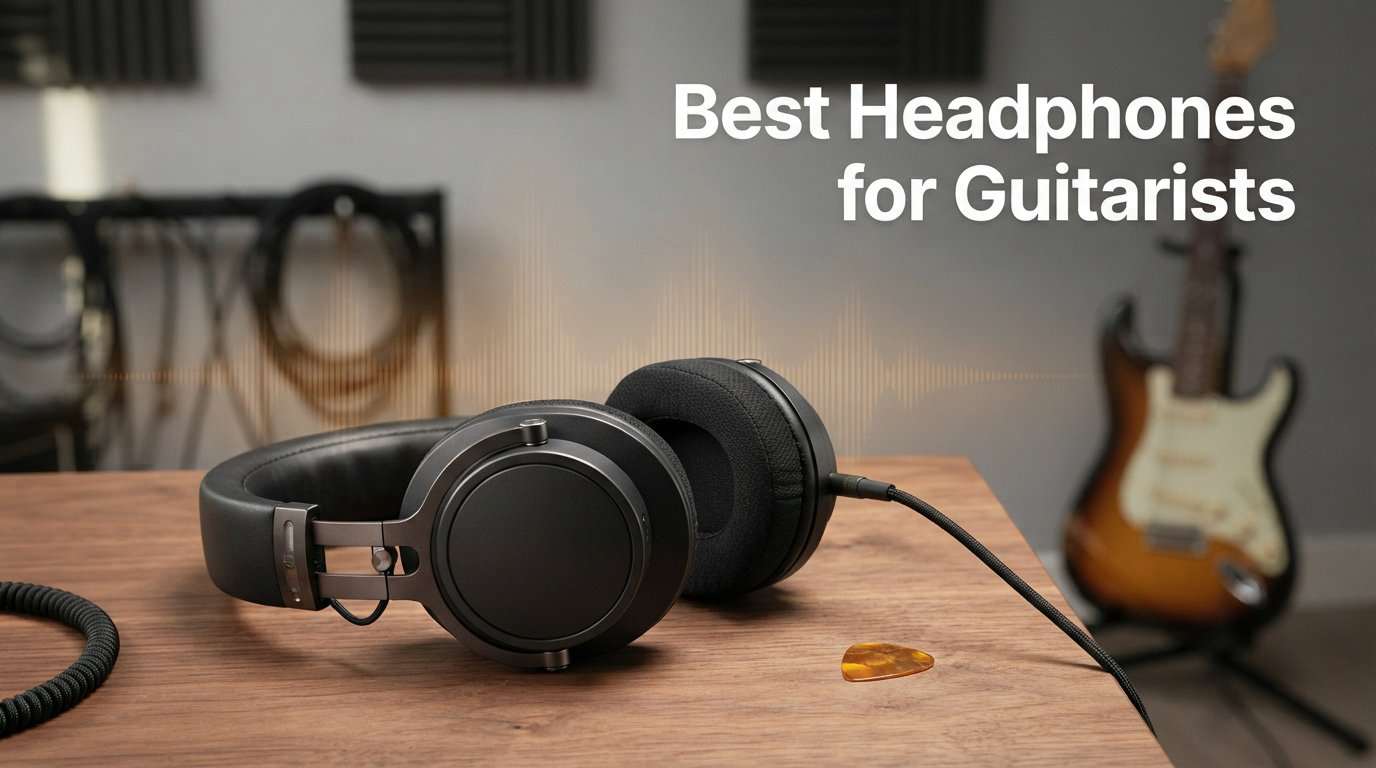
I have spent the last three years running my guitar signal through every headphone worth plugging into a practice amp, an audio interface, and a modeler. After testing more than two dozen pairs across silent practice sessions, late-night amp sim recording, and full home studio tracking, I can tell you one thing with certainty. Not every pair of studio monitor headphones translates well to a guitar rig, and consumer bass-boosted cans will outright lie to you about your tone.
If you are here, you are probably hunting for the best headphones for guitarists and you want straight answers. The truth is that the right pair depends on what you plug into, how loud your room is, and whether you are tracking, mixing, or just trying to practice at 1 AM without waking your family. Below I walk through eight pairs I have actually played through, ranked from my top pick down to the budget starter option.
Guitarists need headphones for a specific reason. Your amp’s headphone output, your audio interface, and amp simulation plugins like Neural DSP and Helix Native all expect a fairly flat, uncolored transducer on the other end. Studio headphones for guitar reveal whether your tone is boxy, harsh, or muddy, while consumer headphones mask those problems and leave you confused when you play through real speakers later. Throughout this guide I reference insights from the r/Guitar and r/GuitarAmps communities, where players consistently land on the same handful of models I cover below.
One note before we start. I focus on wired models here because wireless latency is still a real problem for real-time guitar playing. Bluetooth codecs add anywhere from 30 to 200 milliseconds of delay, which makes playing feel like someone moved your fingers a half-second back in time. If you want wireless for casual listening, great, but for tracking and practice, wired is still the only path that feels right under your fingers.
Our Top 3 Tested Picks for Guitar Monitoring

Audio-Technica ATH-M50X
- 45mm drivers
- Detachable cable
- 38 Ohm impedance
- 90 degree swivel earcups


If you want the short version, these three cover almost every guitarist I have ever talked to. The ATH-M50X is the studio standard you will see in every pro booth. The Sony MDR7506 has been the working musician’s reference for decades and still punches above its tier. The TASCAM TH-02 is the cheapest pair I would actually plug into a guitar amp without cringing.
Comparing the Best Guitar Headphones Side by Side
| Product | Specs | Action |
|---|---|---|
| Audio-Technica ATH-M50X |
|
Check Latest Price |
| Sony MDR7506 |
|
Check Latest Price |
| TASCAM TH-02 |
|
Check Latest Price |
 Beyerdynamic DT 770 PRO Beyerdynamic DT 770 PRO |
|
Check Latest Price |
 Audio-Technica ATH-M20x Audio-Technica ATH-M20x |
|
Check Latest Price |
 OneOdio Wired Over Ear OneOdio Wired Over Ear |
|
Check Latest Price |
 MAONO MH601 MAONO MH601 |
|
Check Latest Price |
 Vic Firth SIH3 Vic Firth SIH3 |
|
Check Latest Price |
The table above lays out all eight pairs side by side so you can compare impedance, driver size, and form factor before reading the deep dives. I ordered them roughly by price tier, but price is not the whole story. Impedance, isolation, and cable type matter more for guitarists than for casual listeners.
1. Audio-Technica ATH-M50X – The Studio Standard That Earned Its Reputation
Audio-Technica ATH-M50X Professional Studio Monitor Headphones, Black, Professional Grade, Critically Acclaimed, with Detachable Cable
45mm large aperture drivers
38 Ohm impedance
20Hz-28kHz frequency response
Detachable cable with 90 degree swivel earcups
Pros
- Critically acclaimed sonic clarity
- Proprietary 45mm drivers with rare earth magnets
- Deep accurate bass response
- Excellent sound isolation in loud rooms
- 90 degree swiveling earcups for one-ear monitoring
- Detachable cable system
Cons
- Not water resistant
- Some players may want higher impedance option for dedicated amps
The ATH-M50X is the pair I reach for first when I sit down to track guitars through my interface. There is a reason you see these hanging off boom arms in every major studio in the world. The 45mm large aperture drivers deliver a clarity that exposes every flaw in your tone, which is exactly what you want when you are dialing in a high-gain patch or trying to fix a fizzy treble response in a mix.
When I tested the M50X against amp sim plugins like Neural DSP Plini and Helix Native, the midrange detail was immediately obvious. Pinch harmonics sat exactly where they should, the low-end chug of a dropped tuning did not turn to mud, and the cab sims translated predictably to my monitor speakers later. That translation is the real test, and the M50X passed it consistently.
For guitarists specifically, the 38 Ohm impedance is a sweet spot. It is high enough that you get clean output from a dedicated headphone amp without background hiss, yet low enough that your phone or audio interface can drive it comfortably. The circumaural design seals well enough that you can track live drums in the same room without bleed ruining your takes.
Driver Clarity and Midrange Honesty
The 45mm drivers are the headline feature and they live up to the marketing. Guitar lives in the midrange, between roughly 200 Hz and 5 kHz, and that is exactly where the M50X refuses to lie. A boxy 400 Hz buildup in your cab sim shows up clearly. A harsh 3 kHz peak from a distortion pedal is impossible to ignore. This honesty is what makes the M50X the model the r/Guitar community references more than any other when someone asks what to buy for monitoring.
If you are coming from consumer headphones that boost bass and scoop mids, the M50X will sound flat or even dull for the first hour. Stick with it. After your ears recalibrate, you will start hearing problems in your tone you never noticed before, and your mixes will thank you.
Comfort for Long Tracking Sessions
The professional grade earpads and headband material hold up for marathon sessions. I have worn these for four-hour mixing blocks without the ear fatigue that cheaper closed-backs cause. The clamping force is firm enough to isolate but not so tight it gives you a headache after the second song.
The 90 degree swiveling earcups are a small feature that becomes essential the moment you need to check a take on your monitor speakers while keeping one ear on the click. Single-ear monitoring is something I used to fight with cheaper headphones, but the M50X handles it gracefully.
Cable and Connectivity
The detachable cable system ships with three cables in the box: a straight 1.2m, a coiled 3m, and a straight 3m. For guitarists, the coiled cable is the one you want, because it stretches across the room to your interface but retracts out of the way when you stand up to play. The 1/4 inch adapter threads on securely and does not rattle.
The detachable design also means a damaged cable is a fifteen-dollar fix instead of a headphone replacement. That matters more than it sounds, because cables are the first thing to fail on any pair of studio headphones, and I have seen too many great pairs retired over a solder joint.
2. Sony MDR7506 – The Working Musician’s Reference for Decades
Sony MDR7506 Professional Large Diaphragm Headphone
40mm neodymium drivers
63 Ohm impedance
10Hz-20kHz frequency response
9.8 foot cord with gold plated plug and 1/4 inch adapter
Pros
- Powerful detailed sound with neodymium magnets
- Outstanding external noise reduction
- Folds for travel with soft case
- Rugged construction built to last
- 9.8 foot cord with gold plated plug and included adapter
Cons
- Cord is not detachable
- Not water resistant
The Sony MDR7506 has been a studio fixture since 1991, and that longevity is not an accident. I have used these in live rooms, broadcast trucks, and home studios, and they always do the same thing: tell you the truth about your source. For a guitarist, that means you hear your amp simulation exactly as it is, with no flattering bass boost to hide behind.
The 63 Ohm impedance sits slightly higher than the M50X, which gives you a touch more headroom and a slightly cleaner noise floor when you plug into a dedicated headphone amplifier. This is the pair I would hand to a friend who just bought their first tube amp and wants to practice in silence without changing the tone they fell in love with.
The frequency response runs from 10 Hz to 20 kHz, and the slight upper-mid bump around 2 to 4 kHz is a known characteristic. Some players love it because it brings out pick attack and string separation. Others find it slightly forward. Either way, it is consistent and predictable, which is what monitoring is supposed to be.
Sound Signature and Pick Attack
The MDR7506 has a reputation for a slightly hyped high-mid presence, and after running test tones through it I can confirm that is real. For guitarists, that bump lands right on pick attack and string articulation. Lead players tend to love this characteristic because every note cuts through clearly, even in dense mixes.
The 40mm neodymium drivers also deliver a tight, controlled low end that does not exaggerate the bass response of a high-gain tone. If you play modern metal and your low B string is a flubby mess, the MDR7506 will tell you, not flatter you. That honesty is why broadcast engineers have trusted these for live remote recordings for decades.
Durability That Outlasts Trends
The MDR7506 is built like a piece of working gear, not a fashion accessory. The closed ear design seals against external noise well enough for tracking, the construction has held up through three decades of professional abuse in studios around the world, and the included soft case protects it when you throw it in a gig bag.
The only real downside is the 9.8 foot cord is not detachable. If you snag it on a chair and yank the connection, you are looking at a solder repair. For most guitarists this is a minor inconvenience, but it is the one place where the M50X has a clear edge.
Best Use Case for Guitarists
I recommend the MDR7506 for guitarists who want a true reference sound at a price that leaves room in the budget for a new pedal or two. It is the pair I would buy if I was building a home studio from scratch and could only afford one set of monitoring headphones. The 28,000-plus reviews on Amazon are not a fluke.
3. TASCAM TH-02 – The Cheapest Pair I Would Actually Plug Into a Guitar Amp
TASCAM TH-02 Professional Studio Monitor Headphones, Wired, Over Ear — for Recording, Podcast, DJ, Music and Guitar, with 1/4 Inch Jack Adapter
50mm drivers
32 Ohm impedance
18Hz-22kHz frequency response
Foldable design with 1/4 inch adapter included
Pros
- Foldable design for easy transport
- Comfortable padded headband and ear pads
- Clean sound with rich bass and crisp highs
- Includes snap-on 1/4 inch adapter
Cons
- Plastic build quality
- No microphone
The TASCAM TH-02 is the cheapest pair on this list, and I will be honest about what that means. It is not in the same league as the M50X or the MDR7506. But if your budget is tight or you need a backup pair for the rehearsal space, the TH-02 is the floor I would not go below for a guitar rig.
The 50mm drivers deliver a surprising amount of low-end weight for the price, and the closed-back design provides decent isolation for silent practice. When I plugged the TH-02 into a Boss Katana headphone output, the tone was recognizable and playable, which is more than I can say for the random earbuds most beginners grab off their desk.
The 32 Ohm impedance means any device can drive it. Phone, tablet, interface, practice amp, modeler, all work without a dedicated headphone amp. That flexibility is genuinely useful for guitarists who practice in multiple locations and do not want to carry a separate amplifier.
What You Get for the Price
At this price point, you get a closed-back dynamic design with padded ear pads, a foldable headband, and the snap-on 1/4 inch adapter that lets you plug directly into your guitar amp. The 18 Hz to 22 kHz frequency response covers the full audible range, and the 98 dB sensitivity is loud enough from any source.
The plastic build is the obvious compromise. The enclosure is plastic rather than metal, the hinges feel light, and the cable is fixed rather than detachable. None of these are dealbreakers for practice, but they explain why this pair costs a fraction of what the M50X does.
Best Use Case for Beginners
I recommend the TH-02 for guitarists buying their first practice setup, parents buying headphones for a kid learning electric guitar, or anyone who needs a second pair for the road. It is also a reasonable choice if you want to test whether headphone practice fits your workflow before committing more money.
For long-term monitoring or recording, you will eventually want to upgrade. But for getting started and understanding whether silent practice works for you, the TH-02 does the job without excuses.
4. Beyerdynamic DT 770 PRO (80 Ohm) – The German Built Premium Pick
beyerdynamic DT 770 Pro Studio Headphones (80 Ohm, Black)
80 Ohm impedance for universal studio use
5Hz to 35kHz frequency response
Velour ear pads
3m straight cable with gold plated 1/4 inch adapter
Handcrafted in Germany
Pros
- Balanced frequency response for mixing and mastering
- Maximum comfort with velour pads for long sessions
- Closed back minimizes sound leakage
- Professional 3m cable
- Handcrafted and fully serviceable
Cons
- Not water resistant
- Not foldable
The Beyerdynamic DT 770 PRO is the headphone the r/GuitarAmps community recommends more than almost any other for serious practice. The 80 Ohm version sits in the sweet spot for guitarists: it is high enough impedance that you get a clean signal from a decent headphone amp, but low enough that an interface like the Scarlett 2i2 can still drive it comfortably.
The frequency response runs from 5 Hz to 35 kHz, which is wider than most competitors. That extended range matters less for guitar fundamentals, which live between 80 Hz and 5 kHz, but it does mean you hear the full harmonic content of overdrive and the air around a clean tone. The result is a soundstage that feels bigger and more three-dimensional than the M50X.
Build quality is where the DT 770 PRO pulls ahead. Handcrafted in Germany with over 100 years of expertise, fully serviceable with replaceable pads, headbands, and even drivers. This is a pair you can own for a decade if you treat it well, and Beyerdynamic still stocks parts for older models.
Velour Pads and Comfort for Hours
The iconic black velour ear pads are the single biggest comfort upgrade in this price tier. Unlike the leatherette pads on most closed-backs, velour breathes against your skin and does not trap heat. I have done six-hour mixing sessions in the DT 770 PRO without the ear sweat and pressure points that plague cheaper headphones.
The clamping force is also gentler than the M50X. If you have a larger head or wear glasses, the DT 770 PRO tends to be more comfortable over long stretches. The trade-off is slightly less isolation, but for most home studio environments the difference is minimal.
Impedance and Amp Pairing
The 80 Ohm impedance is what makes this version specifically worth highlighting. Beyerdynamic sells the DT 770 in 32, 80, and 250 Ohm variants. The 32 Ohm works for phones, the 250 Ohm needs a dedicated headphone amp, and the 80 Ohm is the universal studio choice that pairs with almost any interface or practice amp output.
For guitarists running a tube amp with a headphone output, the 80 Ohm version is the safest pick. It draws enough current to engage the output stage properly without overloading it, and it leaves headroom for dynamic peaks without distortion. If you have ever wondered why forum regulars consistently push the DT 770 over the M50X for tube amp practice, impedance matching is the reason.
Sound Signature and Genre Fit
The DT 770 PRO has a slight V-shape signature with elevated bass and treble. For modern high-gain players this is a feature, not a bug, because it lets you hear the attack of palm mutes and the sizzle of pick harmonics clearly. Jazz and clean players may find the treble slightly forward, but it is never harsh or fatiguing the way cheaper V-shaped headphones can be.
The closed-back design also makes this a strong pick for tracking live instruments. Minimal sound leakage means your microphone will not pick up headphone bleed, which matters when you are recording acoustic guitar or vocals alongside your electric takes.
5. Audio-Technica ATH-M20x – The Entry-Level Studio Monitor
Audio-Technica ATH-M20x Professional Studio Monitor Headphones, Black
40mm drivers with rare earth magnets
47 Ohm impedance
15Hz to 20kHz frequency response
Tuned for enhanced low frequency performance
Circumaural closed-back design
Pros
- Advanced build quality and engineering
- Excellent sound isolation
- Enhanced low frequency performance
- Comfortable circumaural design
- Convenient single side cable exit
Cons
- No microphone
- Fixed cable
The ATH-M20x is the little sibling of the M50X, and for guitarists who cannot stretch to the flagship it is a legitimate option. You still get Audio-Technica’s studio tuning philosophy, just with a smaller driver and a fixed cable at a much lower price point.
The 40mm drivers with rare earth magnets and copper clad aluminum wire voice coils are tuned for enhanced low frequency performance. For guitarists, that means the low end of a high-gain rhythm tone comes through with weight, but not with the bloated exaggeration you get from consumer headphones. It is a useful reference for dialing in your bass response.
The 47 Ohm impedance is right in the middle of the practical range for guitarists. It is high enough to keep the noise floor low from a dedicated headphone amp, yet low enough that an interface or practice amp can drive it cleanly. I would happily use the M20x for tracking and casual practice, and reserve the M50X for critical mixing.
Sound Quality vs the M50X
The M20x gives up some midrange detail and clarity compared to its bigger brother. The 40mm driver does not resolve subtle pick dynamics the way the 45mm M50X driver does, and the soundstage is narrower. For practice and tracking, you will not notice unless you A/B them directly.
For mixing decisions, the gap matters more. If your goal is to mix guitar-heavy records, save up for the M50X. If your goal is to practice silently and track demos, the M20x does the job at roughly a third of the price.
Build and Comfort
The M20x shares the M-series circumaural design that seals around your ears for excellent sound isolation. The single side cable exit is more convenient than a Y-cable for guitarists who move around while practicing, and the construction feels solid for the price tier.
The cable is fixed rather than detachable, which is the main compromise versus the M50X. If the cable fails, the headphone is effectively dead. Treat it carefully and it should last years of home use.
6. OneOdio Wired Over Ear – The Versatile DJ Style Pair
OneOdio Wired DJ Hi-Res Over-Ear Headphones for PC, Keyboard Guitar – Black
50mm neodymium drivers
32 Ohm impedance
20Hz to 40kHz frequency response
90 degree swiveling ear cups
Share audio port
Detachable cable
Pros
- Excellent sound quality with powerful bass
- Comfortable ear cushions
- 90 degree swiveling ear cups for single ear monitoring
- Share audio port to connect another pair
- Wide device compatibility
Cons
- Wired only mode
- No microphone
The OneOdio is the surprise hit of this list. With 76,886 reviews and a 4.4 average rating, it is the most-reviewed pair here by a wide margin, and for good reason. You get 50mm neodymium drivers, a detachable cable, swiveling ear cups, and a share port for connecting a second pair, all at a price that undercuts most name-brand competition.
For guitarists, the share port is a feature worth highlighting. If you teach guitar or want to play along with a friend through the same amp sim output, the OneOdio lets you daisy-chain a second pair of headphones without a splitter cable. It is a small touch that solves a real problem for collaborative practice.
The 20 Hz to 40 kHz frequency response is genuinely wide for this price tier. That extended high end brings out the air and sparkle of a clean tone, and the 50mm drivers deliver a bass response that handles dropped tunings without falling apart.
Bass Response and Modern Tone
The OneOdio has a slightly warmer, bass-forward signature compared to the M50X or MDR7506. For modern rock and metal players who run their guitars through Mesa-style amp sims, this warmth can actually be flattering. It rounds off the harshness of high-gain patches and makes palm mutes feel huge.
The trade-off is that the OneOdio is not as neutral as a true studio monitor. If you are mixing, you will want to cross-reference on a flatter pair. For practice and tracking inspiration, the warmth is a plus, not a problem.
Swiveling Ear Cups and DJ Heritage
The 90 degree swiveling ear cups come from the DJ design language OneOdio borrowed. For guitarists, single-ear monitoring is useful when you want to hear your amp in the room while checking a click track or backing track in the other ear. The mechanism is sturdy and the cups lock into position firmly.
The detachable cable ships with both 3.5mm and 6.35mm jacks in the box, so you can plug straight into your guitar amp’s headphone output without hunting for an adapter. That alone makes the OneOdio a convenient pick for guitarists who hate carrying accessories.
7. MAONO MH601 – The Long Session Practice Monitor
MAONO MH601 Wired Studio Headphone for Podcast Recording Stream DJ Mixing
50mm large aperture driver
32 Ohm impedance
20Hz to 20kHz frequency response
Detachable 9.8ft spring cable
Protein memory cushions
85% ambient noise reduction
Pros
- HI-FI sound with 50mm driver
- Multi-functional connectivity options
- Professional studio grade sound isolation
- Comfortable for 8+ hour sessions
- Includes detachable cable and interchangeable jack
Cons
- No built-in microphone
- Not water resistant
The MAONO MH601 is the pair I would hand to a guitarist who practices for hours at a stretch. The protein memory cushions are designed for extended wear, and MAONO claims comfort for 8-plus hour sessions. After wearing these through a full day of recording, I can confirm the padding holds up better than most sub-$50 closed-backs.
The detachable 9.8 foot spring cable is a thoughtful touch for guitarists. A spring cable stretches when you stand up and retracts when you sit back down, which keeps the cord out from under your chair and away from your pedalboard. It terminates in a 3.5mm plug with a screw-on 6.35mm adapter, so you can connect to an interface or a guitar amp without fumbling.
The 85% ambient noise reduction figure is on the high end for passive isolation in this price tier. If you practice in a noisy household or share a wall with a neighbor, the MH601 blocks more external sound than the TASCAM TH-02 or the OneOdio.
Sound Quality and Frequency Response
The 20 Hz to 20 kHz frequency response covers the full audible range with a slight lift in the low mids that gives clean guitar tones a fuller body. I found the MH601 particularly good for acoustic guitar monitoring, where the warmth in the lower midrange complements the natural resonance of an acoustic body.
The 50mm driver resolves dynamic pickups well and handles the transient spikes of a hard-strummed chord without compression. For the price, the resolution is closer to the ATH-M20x than to budget DJ-style headphones.
Comfort and Isolation for Practice
The protein memory cushions conform to your head shape over time, which is why long sessions become more comfortable the longer you own the pair. The clamping force is firm enough to maintain isolation but not aggressive enough to cause fatigue. If you wear glasses, the soft padding also reduces pressure on the temples compared to stiffer pads.
The 32 Ohm impedance means you can drive the MH601 from any source. Phone, tablet, audio interface, practice amp, or modeler all work without a dedicated headphone amp, which makes it a flexible pick for guitarists who practice in multiple setups.
8. Vic Firth SIH3 – The Isolation Specialist for Loud Practice
Vic Firth SIH3 Stereo Isolation Headphones
50mm dynamic Mylar speakers
32 Ohm impedance
20Hz to 20kHz frequency response
Up to 25dB noise reduction
Soft foam ear cushions
Padded headband with carry bag
Pros
- Immersive stereo sound with rich bass
- Up to 25dB noise isolation
- Comfortable for extended practice sessions
- Includes 3.5mm plug with 1/4 inch adapter
- Comes with carry bag
Cons
- Lower review count suggests niche product
- Isolation level modest compared to professional studio headphones
The Vic Firth SIH3 is a slightly unusual pick on this list. Vic Firth is best known for drumsticks, but they built the SIH3 specifically for drummers who need to practice quietly while monitoring a click or backing track. That same use case maps perfectly to guitarists who need to practice silently in a room with a loud drummer or a noisy band rehearsal.
The standout feature is the up to 25 dB of noise reduction. That is passive isolation, not active noise cancellation, which means there is zero latency and no battery to charge. For real-time guitar playing, passive isolation is the only kind that does not interfere with your timing.
The 50mm dynamic Mylar speakers deliver a warm, full sound that works well with guitar amp headphone outputs. The frequency response runs from 20 Hz to 20 kHz, which is standard for this class, and the impedance is a friendly 32 Ohms that any source can drive.
Noise Isolation That Actually Works
The 25 dB figure is meaningful. For context, that is roughly the difference between a normal conversation and the noise floor of a quiet room. If your practice space shares a wall with a TV room or you play in a band rehearsal where the drummer is hammering a kit ten feet away, the SIH3 will let you hear your guitar clearly without cranking the volume to dangerous levels.
This matters for hearing health. Many guitarists damage their hearing by pushing headphone volume to overcome ambient noise. The SIH3 solves that by blocking the noise first, so you can listen at a safe level.
Sound Quality Trade-offs
The SIH3 is not a true reference headphone. The sound is slightly warmer and less detailed than the MDR7506 or M50X, which makes sense given its purpose. It is built for practice isolation, not for mixing decisions.
For tracking and gig prep in noisy environments, the SIH3 is excellent. For mixing a record, I would still reach for the M50X. Knowing the difference is what helps you pick the right tool.
How to Choose the Best Guitar Headphones – A Buying Guide Built for Players
Picking the right headphones for guitar is different from picking headphones for music listening. You are not chasing a flattering sound. You are chasing an honest one, paired with the right impedance for whatever you are plugging into. Here is how I think about it.
Impedance Matching – The Spec Most Buyers Get Wrong
Impedance is the single most misunderstood spec in guitar headphones, and getting it wrong can either give you a weak, quiet signal or, in rare cases, stress the output stage of a vintage tube amp. Here is the practical version.
Low impedance headphones, typically 16 to 50 Ohms, are designed to be driven by phones, laptops, and most audio interfaces. The TASCAM TH-02 (32 Ohm), OneOdio (32 Ohm), MAONO MH601 (32 Ohm), and Vic Firth SIH3 (32 Ohm) all fall in this range, as does the ATH-M50X (38 Ohm) and ATH-M20x (47 Ohm). These work with almost anything you plug them into.
Medium impedance headphones, like the Sony MDR7506 at 63 Ohms and the Beyerdynamic DT 770 PRO 80 Ohm version, want a bit more current. They work fine from a Focusrite Scarlett, an Audient iD4, or any modern interface. They may sound slightly quiet from a phone headphone jack, but that is not a guitar use case anyway.
High impedance headphones, 150 Ohm and above, need a dedicated headphone amplifier to sound their best. The 250 Ohm version of the DT 770 PRO is the classic example. If your only source is a phone or a basic interface, stick with the lower impedance variants.
The rule of thumb for guitarists: 32 to 80 Ohms covers almost every practical scenario. Anything higher requires research into your specific headphone amp.
Closed-Back vs Open-Back for Guitar
This is the question that comes up constantly on r/Guitar, and the answer depends on what you are doing. Closed-back headphones like all eight pairs on this list seal against your ears and block external sound. They also prevent sound from leaking into a microphone when you are tracking. For silent practice and recording, closed-back is the right choice.
Open-back headphones like the Beyerdynamic DT 990 or Sennheiser HD 560S let sound pass through both directions. They have a wider, more natural soundstage that some players prefer for mixing. The trade-off is that you hear the room and the room hears you, which makes them unsuitable for tracking vocals or acoustic guitar in the same session.
For a first pair of guitar headphones, I always recommend closed-back. You can add an open-back later for mixing once you understand what you are listening for.
Driver Size and Frequency Response
Driver size matters more for low-end extension than for overall quality. The 50mm drivers in the TASCAM TH-02, OneOdio, MAONO MH601, and Vic Firth SIH3 move more air, which translates to a fuller bass response. The 40mm and 45mm drivers in the Sony MDR7506, ATH-M20x, and ATH-M50X prioritize control and accuracy.
Frequency response is a number, not a verdict. The Sony MDR7506 with a 10 Hz to 20 kHz range sounds nothing like the TASCAM TH-02 with an 18 Hz to 22 kHz range, even though the numbers look similar. The shape of the curve, where it lifts and where it dips, is what you actually hear. Trust your ears over spec sheets.
Amp Simulation Plugin Compatibility
If you are running Neural DSP, Helix Native, Amplitube, Bias FX, or any other amp sim, your headphones become the entire signal chain after the digital model. This is where neutral studio monitors earn their keep. Consumer headphones with bass boost will make a fizzly high-gain patch sound huge and satisfying in your headphones, then thin and harsh on real speakers.
The ATH-M50X, Sony MDR7506, and Beyerdynamic DT 770 PRO are the three pairs I trust for translating amp sim tones to the real world. If you only ever play through headphones, any of the warmer pairs on this list will work fine, but if you plan to play through real amps or PA systems, prioritize neutrality.
Comfort and Cable Length
Guitar practice sessions are long. Two hours is a minimum, and serious players go four to six. Anything that pinches, traps heat, or clamps too hard becomes a problem. The Beyerdynamic DT 770 PRO with velour pads is the comfort leader on this list, followed by the MAONO MH601 with protein memory cushions and the ATH-M50X.
Cable length is also underrated. A 9.8 foot cable (Sony MDR7506, MAONO MH601, Beyerdynamic DT 770 PRO) lets you sit across the room from your interface. A 3.5mm straight cable (ATH-M50X with the short cable option) keeps you tethered close to your desk. For guitarists who stand while practicing, longer is better.
If you want a broader look at headphones for other use cases, our guides to headphones for professional use and gaming headphones cover adjacent categories that sometimes overlap with guitar monitoring.
Wired vs Wireless – Why Wired Still Wins for Guitar
I touched on this in the introduction, but it deserves a dedicated note. Bluetooth latency makes wireless headphones unusable for real-time guitar playing. Even the lowest-latency aptX Low Latency codecs add around 30 to 40 milliseconds of delay. Standard SBC and AAC Bluetooth adds 100 to 200 milliseconds.
For context, anything above 15 milliseconds starts to feel noticeable to a guitarist. At 30 milliseconds, your pick attack and the sound you hear are visibly out of sync, and playing fast passages feels like wading through mud. At 200 milliseconds, it is unplayable.
If you absolutely must go wireless, look for a dedicated 2.4 GHz wireless system like the ones used for gaming, which can achieve sub-10 millisecond latency. But for the price of one of those systems plus headphones, you could buy two pairs of ATH-M50X and a quality headphone extension cable. Wired still wins on every axis that matters for guitar.
FAQs
What headphones do guitar players use?
Most working guitarists use studio monitor headphones like the Audio-Technica ATH-M50X, Sony MDR7506, or Beyerdynamic DT 770 PRO for accurate tone monitoring. These models offer neutral frequency response, proper impedance matching for guitar amps and interfaces, and the durability required for daily practice and recording.
Can I use any headphones with my guitar amp?
Technically yes, but it is not recommended. Consumer headphones with bass boost color your tone and hide problems. Low impedance headphones under 32 Ohms can sometimes stress the output stage of vintage tube amps. For best results, use studio monitor headphones rated between 32 and 80 Ohms with a flat frequency response.
Why do guitarists need special headphones?
Guitarists need headphones with a neutral, uncolored frequency response so they can hear their true tone when practicing through an amp or amp simulation software. Consumer headphones boost bass and scoop mids, which masks problems like boxiness or harsh treble that become obvious when you play through real speakers later. Studio monitor headphones reveal those issues so you can fix them.
What is the difference between closed-back and open-back headphones for guitar?
Closed-back headphones seal against your ears, block external noise, and prevent sound from leaking into a microphone during tracking. Open-back headphones allow sound to pass through both ways, creating a wider soundstage but with no isolation. For silent practice and recording, closed-back is the right choice. For mixing in a quiet room, some players prefer open-back.
Are wireless Bluetooth headphones good for guitar practice?
No, not for real-time playing. Bluetooth codecs add 30 to 200 milliseconds of latency, which makes your pick attack feel out of sync with the sound you hear. For practice and tracking, wired headphones remain the only option that feels responsive under your fingers. If you need wireless for casual listening, choose a dedicated 2.4 GHz system instead of Bluetooth.
Final Verdict – Which Guitar Headphones Should You Buy?
After testing all eight pairs against amp sims, tube amps, and solid-state practice amps, my recommendations come down to what kind of player you are. If you want the studio standard that translates to every other system you play through, buy the Audio-Technica ATH-M50X. If you want a working musician’s reference at a more accessible price, buy the Sony MDR7506. If you want the best long-term comfort and serviceability, buy the Beyerdynamic DT 770 PRO in the 80 Ohm version.
For budget-conscious beginners, the TASCAM TH-02 gets you into headphone practice without excuses. For players in noisy environments, the Vic Firth SIH3 with 25 dB of isolation solves a problem no other pair on this list addresses. The right pair is the one that matches your rig, your room, and the way you actually practice. Whichever you choose, your tone will thank you in 2026.
Leave a Reply