
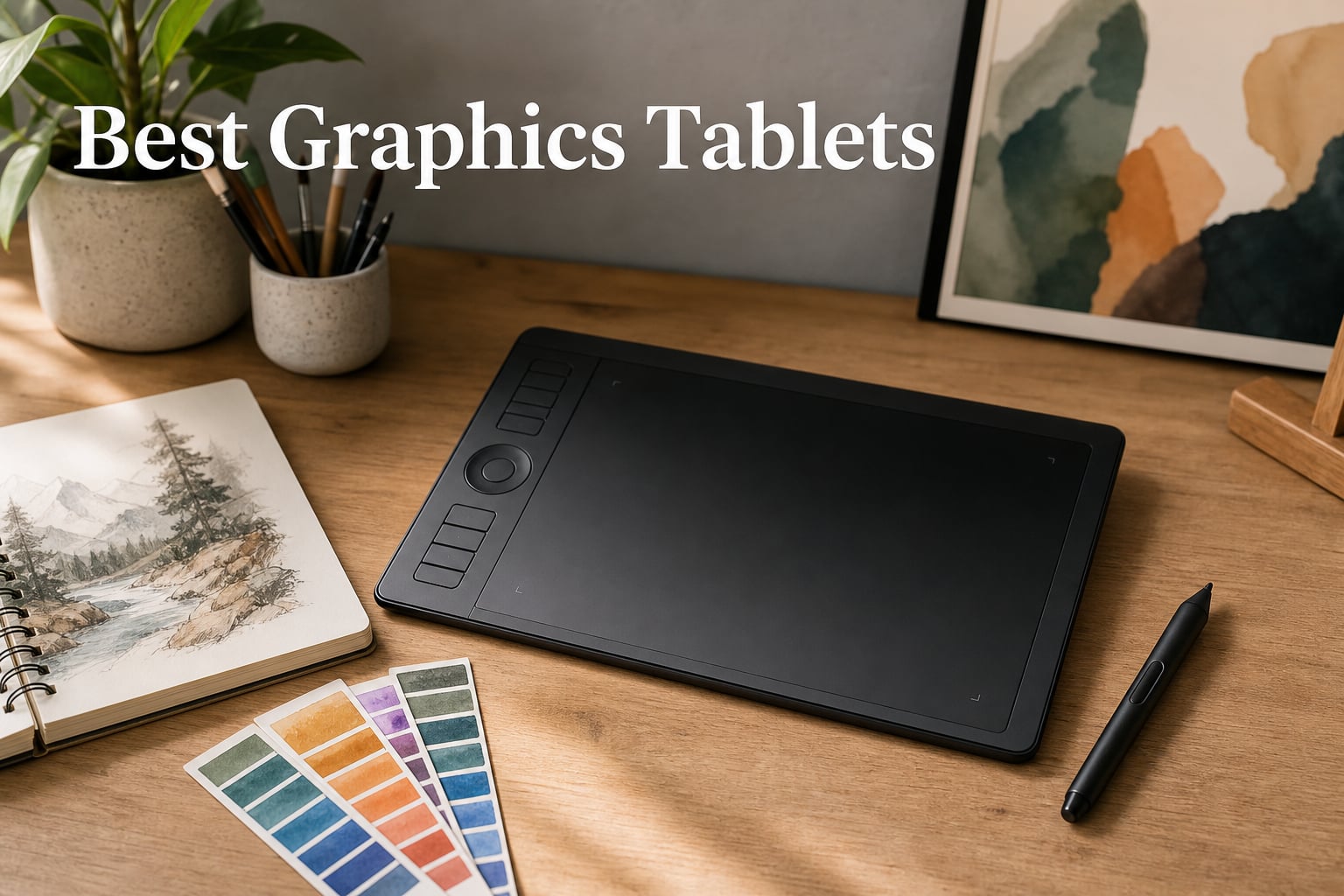
The best graphics tablets make digital drawing feel less like operating a cursor and more like putting a familiar pen to paper. I narrowed this list to 12 verified models by looking at display quality, pen pressure, shortcut controls, operating-system support, portability, and the practical split between computer-connected and standalone work.
There is no single right format. A screenless pen tablet keeps your desk clear and your posture open, a pen display lets you draw directly under the nib, and a standalone drawing tablet lets you sketch away from a computer.
My first advice for a new artist is simple: pick the workflow before the spec sheet. The community concerns behind this choice are real—many people need a week or two to adjust to a screenless surface, while others run into avoidable driver trouble by buying before checking their computer or mobile-device connection.
For a screen-focused shortlist, see our guide to drawing tablets with screen. Below, I separate portable Android options from desktop pen displays and call out verified Linux support where the manufacturer lists it.
The three best graphics tablets match three different workflows
These are the clearest starting points: the HUION Kamvas 13 (Gen 3) for a compact computer-connected display, the Wacom Intuos Pro Medium for a dependable screenless desktop setup, and the XPPen Artist13.3 Pro V2 for artists who want direct-on-screen drawing with physical controls.
The full comparison shows what each graphics tablet is built to do
Use this overview to narrow the field by display size, pressure specification, and connection style. I would not treat pressure-level numbers alone as a verdict; the active area, glass surface, pen feel, controls, and supported devices affect daily comfort just as much.
| Product | Specs | Action |
|---|---|---|
 HUION Kamvas 13 Gen 3 HUION Kamvas 13 Gen 3 |
|
View Product Details |
 XPPen Magic Drawing Pad XPPen Magic Drawing Pad |
|
View Product Details |
 Wacom Cintiq 16 Wacom Cintiq 16 |
|
View Product Details |
 Wacom Intuos Pro Medium Wacom Intuos Pro Medium |
|
View Product Details |
 Wacom MovinkPad 11 Wacom MovinkPad 11 |
|
View Product Details |
 XPPen Artist Pro 19 Gen2 XPPen Artist Pro 19 Gen2 |
|
View Product Details |
 XPPen Artist Pro 22 Gen2 XPPen Artist Pro 22 Gen2 |
|
View Product Details |
 XPPen Artist Pro 16 Gen2 XPPen Artist Pro 16 Gen2 |
|
View Product Details |
 XPPen Artist Pro 14 Gen2 XPPen Artist Pro 14 Gen2 |
|
View Product Details |
 XPPen Artist13.3 Pro V2 XPPen Artist13.3 Pro V2 |
|
View Product Details |
 PicassoTab-X11 PicassoTab-X11 |
|
View Product Details |
 UGEE UE12 UGEE UE12 |
|
View Product Details |
1. HUION Kamvas 13 (Gen 3) is the strongest compact pen display for color-aware artists
HUION Kamvas 13 (Gen 3) Drawing Tablet with Screen 16K Pressure PenTech 4.0
13.3 inch 1080p
16K pressure
99% sRGB
Pros
- Factory-calibrated color
- Dual dials
- Linux listed
- Left-handed layout
Cons
- No source-listed cons
The Kamvas 13 (Gen 3) makes a compelling case for a smaller display tablet because its 13.3-inch panel does not ask for much desk space. Its 1,920 by 1,080 resolution is paired with a 293.8 by 165.2 mm active area, so the drawing zone remains comfortably proportioned for illustration and photo retouching.
HUION lists 16,384 pressure levels, PenTech 4.0 with 2 g initial activation force, and factory calibration below Delta E 1.5. Those figures point to a pen display designed for controlled line work rather than just broad, casual sketching.
The laminated Canvas Glass keeps the drawing surface close to the image
The anti-sparkle Canvas Glass 2.0 uses nano-etching and full lamination. In practice, full lamination matters because there is less visible separation between nib and cursor, which helps when you are placing fine details or cleaning a line edge.
Its stated 99% sRGB and 90% Adobe RGB coverage give it a meaningful advantage for artists who share work online and want a more predictable canvas. Color-sensitive print work still calls for a managed desktop monitor and a calibrated workflow, not just a promising tablet spec.
The dual dials give repeatable controls without reaching for a keyboard
Two dial controllers and five silent press keys are the defining ergonomic feature here. I would map one dial to brush size and the other to canvas zoom, then reserve the buttons for undo, redo, modifier, hand tool, and a frequently used brush command.
The controls can be arranged for either hand, a point many generic tablet roundups overlook. That design gives left-handed artists an easier starting position instead of asking them to adapt around a fixed control strip.
The cross-platform support fits desktop and mobile drawing setups
The verified support list includes Windows 10 or later, macOS 10.12 or later, Ubuntu 20.04 LTS, and compatible Android devices using USB 3.1 DisplayPort 1.2 or later. Check that Android display-output requirement before treating phone connection as a given.
At 865 g and 11.7 mm thin, it is also realistic to carry between a main desk and a laptop setup. It is a computer-connected display, so it is not the right match for someone who wants to make art without another device.
2. XPPen Magic Drawing Pad is the best standalone choice for an Android-first art routine
XPPen Magic Drawing Pad 12.2 Inch Standalone Drawing Tablet No Computer Needed with 16384 Pressure Levels X3 Pro Slim Stylus Tilt Support Paper-Like Screen 8GB + 256GB for Digital Drawing Artists
Standalone Android
12.2 inch 2K
16K pressure
Pros
- No computer required
- 256GB expandable storage
- 13-hour battery
- AG etched screen
Cons
- No source-listed cons
The Magic Drawing Pad is different from a pen display: it is a complete Android 14 device rather than a second screen for a computer. That distinction makes it a practical digital art tablet for students, travelers, and anyone who wants to pull out a sketchbook-like device without cable management.
Its 12.2-inch 2,160 by 1,440 screen, X3 Pro Slim stylus, and 16,384 pressure levels create a serious drawing-focused package. The published 4.5 rating comes from 708 reviews, which is a larger response base than several newer display options in this list.
The Android 14 setup makes independent drawing possible
Google Play access gives this tablet a familiar app route, while 8 GB of RAM and 256 GB of storage provide room for art files and apps. Storage can expand by microSD up to 1 TB according to the source data, which is useful for artists who keep reference images and time-lapse files locally.
The independent workflow is the main reason to choose it. It does not replace a desktop workstation for every animation or 3D job, but it removes the computer requirement for drawing sessions.
The etched 2K screen favors long sketching sessions
The anti-glare etched surface is built to add a paper-like drawing feel, and the screen is listed at 115% sRGB with 16.77 million colors. TÜV Rheinland eye-comfort certification is also listed, though comfort still depends on your room light, display brightness, and break habits.
Compared with a large desktop pen display, the 12.2-inch canvas gives up physical workspace in return for mobility. Artists who use long strokes or place large reference panels beside the canvas may feel that limit first.
The 8,000 mAh battery supports mobile work without a daily cable routine
XPPen states up to 13 hours of creation from the 8,000 mAh battery. Battery life varies with brightness, apps, wireless use, and file activity, so regard that as a useful ceiling rather than a fixed result.
Bluetooth 5.1 and Wi-Fi support round out the tablet-like experience. At about 599 g and 6.9 mm thin, it is one of the more natural choices for drawing on a couch, in class, or while traveling.
3. Wacom Cintiq 16 is the right large-canvas Wacom display for studio artists
Wacom Cintiq 16, Drawing Tablet with QHD Screen & Pro Pen 3
16 inch 2.5K
Pro Pen 3
100% sRGB
Pros
- 2.5K IPS panel
- 99% DCI-P3
- 60 degree tilt
- Fold-out legs
Cons
- No source-listed cons
The Wacom Cintiq 16 combines a bigger 16-inch drawing surface with a 2,560 by 1,600 IPS display. Its 13.6 by 8.5-inch active area has enough room for full-arm strokes, multi-layer illustration, and detailed animation timelines without feeling like a portable compromise.
Wacom pairs it with the battery-free Pro Pen 3, 8,192 pressure levels, and 60-degree tilt. The pressure figure is lower than 16K models here, but pen performance cannot be reduced to a single number; the grip, tracking, driver behavior, and application settings matter in actual use.
The 2.5K display gives lines and interface panels more breathing room
The 16-inch WQXGA panel supports 100% sRGB and 99% DCI-P3 coverage with 8-bit color. That combination suits artists who want a larger visible canvas and broader stated gamut for concept art, illustration, animation, and game-development work.
It is not a standalone screen. The USB-C connection requires a source with DisplayPort Alt Mode or Thunderbolt 3 or 4, so confirm your desktop or laptop port before committing to it.
The pen and fold-out legs support a focused desktop posture
The Cintiq includes fold-out legs that create a 20-degree drawing angle. That is a helpful starting angle, although a dedicated stand or monitor arm can make more sense if you switch between drawing, typing, and viewing references throughout a day.
Three customizable shortcuts sit on the Pro Pen 3 itself. That is a leaner control approach than a tablet with a large button bank, so keyboard users may be happier than artists who want every command beside the screen.
The Mac and Windows focus suits established desktop workstations
The listed compatibility is Windows 10 or later and macOS 13 or later, with Android 8 or later also named in the technical details. The product data calls it a Mac and PC device, so desktop artists should treat those as its primary environments.
At 4.5 pounds, this is a stationary graphics tablet rather than a bag-friendly companion. Choose it when a generous display and a Wacom pen workflow matter more than compact travel setup.
4. Wacom Intuos Pro Medium is the best screenless tablet for shortcut-heavy desktop work
Wacom Intuos Pro Medium, Bluetooth Graphic Drawing Tablet with ProPen 3
8.7 by 5.8 active area
Bluetooth
10 ExpressKeys
Pros
- Thin magnesium build
- Two mechanical dials
- Bluetooth
- Pen grip options
Cons
- No source-listed cons
The Intuos Pro Medium is the only screenless pen tablet in this collection, and that is its central strength rather than a missing feature. You draw on an 8.7 by 5.8-inch active surface while keeping your eyes on a full-size monitor, which preserves desk space and lets your art sit beside references, palettes, and tutorials.
Community discussions often describe Wacom as dependable, especially for long desktop use. This current model combines a 5,080 LPI resolution, Pro Pen 3, 8,192 pressure levels, and a thin 4 mm magnesium body.
The 16:9 working area maps naturally to wide monitors
The 16:9 format is designed to pair with modern displays and multi-monitor arrangements. A medium surface is a sensible middle ground: it gives your arm room to move without requiring a broad sweep for every cursor movement.
Screenless drawing does require coordination between hand and monitor. Most beginners can learn it, but set aside roughly one to two weeks of regular practice before judging the format; small daily sessions are more useful than one marathon session.
The ExpressKeys and mechanical dials make repetitive actions faster
Ten ExpressKeys and two mechanical dials offer more direct control than the pen-only shortcut layout of some displays. This works particularly well for brush size, zoom, rotate, undo, redo, and layer commands that interrupt brush flow when they live on a keyboard.
The Pro Pen 3 supports tilt and arrives with slim, straight, and flared grip options. Trying each grip before a long drawing session is a small adjustment that can reduce hand fatigue better than chasing a sensitivity setting.
The Bluetooth connection keeps a desktop workspace less cluttered
You can connect through Bluetooth, USB-C to USB-C, or USB-C to USB-A. Wireless operation makes it easier to move the tablet aside for writing or editing, while a cable is useful when you prefer a fixed, predictable desk layout.
Compatibility is listed for Windows 10 or later and macOS 13 or later. Linux is not listed for this model in the provided source, so Linux artists should not assume support without checking Wacom’s current driver documentation.
5. Wacom MovinkPad 11 is the most portable Wacom option for quick standalone sketches
Wacom MovinkPad 11, Android Mobile Drawing Tablet, with Pro Pen 3
Standalone Android
11.45 inch 2K
Pro Pen 3
Pros
- Quick Draw access
- Matte etched glass
- Light 588g
- Two years Clip Studio
Cons
- No source-listed cons
The MovinkPad 11 is Wacom’s standalone Android route, with an 11.45-inch 2,200 by 1,440 display and a battery-free Slim Pro Pen 3. It is built for the artist who values immediate access: take it out, use Quick Draw, and begin a sketch without waking a laptop.
At 588 g, it is close in portability to the XPPen Magic Drawing Pad. The 8 GB RAM and 128 GB storage are enough for a focused mobile art library, although heavy collectors of source files should think about their storage habits first.
The matte etched screen favors a paper-like drawing feel
Wacom lists anti-glare etched glass, which can make bright-room drawing more comfortable and adds some tactile resistance under the pen. It also helps the device feel purpose-built for sketching rather than merely being a general tablet with a stylus.
The stated 8,192 pressure levels and battery-free pen give artists the core tools for varied line weight and shading. More pressure levels do not automatically create better art; a pen curve that matches your light or heavy hand has more immediate effect.
The Quick Draw feature supports low-friction idea capture
Quick Draw is the feature that separates this from a standard tablet workflow. For someone who loses a concept while opening apps and arranging windows, fast entry into a drawing mode can be more useful than additional desktop controls.
It also comes with two years of Clip Studio Paint DEBUT according to the verified feature list. That makes it a tidy match for artists who already expect to work in a mobile-first, Clip Studio-friendly routine.
The compatible pen options broaden the physical writing feel
The tablet supports Dr. Grip, LAMY, and STAEDTLER pens in addition to the included Slim Pro Pen 3. Different barrel shapes can matter for artists whose hands tire on narrow styluses or who prefer a familiar pen-like hold.
Bluetooth is listed for connectivity, and Android 14 runs the device. It is a self-contained drawing tablet, not a substitute for a desktop pen display where large canvas space and full computer software are the priority.
6. XPPen Artist Pro 19 Gen2 is the strongest 4K choice for detailed color-critical projects
XPPen 4K UHD Artist Pro 19 Gen2 Drawing Tablet with Screen, 156% sRGB Graphic Tablet with 1.07 Billion Colors Anti-Glare Drawing Monitor with Dual 16384 Pen Pressure Stylus, Mini Keydial, 18.4″
18.4 inch 4K
Calman verified
Dual 16K pens
Pros
- 4K detail
- Delta E under 1.5
- Dual styluses
- VESA support
Cons
- Computer required
- Large desktop footprint
The Artist Pro 19 Gen2 puts a 3,840 by 2,160 panel in an 18.4-inch pen display, creating a large and fine-grained desktop canvas. That size and resolution make the most sense for illustrators, painters, and editors who routinely inspect texture, line cleanup, and layered artwork at close range.
XPPen lists 16,384 pressure levels, 60-degree tilt, and two included X3 Pro pens: Roller and Slim. The distinction is useful because artists do not all grip a stylus the same way, and a second pen style may be more than a backup.
The 4K display gives detailed files a clearer workspace
The active area measures 16.1 by 9.06 inches, while the panel is full laminated with anti-glare etched glass. Full lamination limits the visual offset between the pen tip and the cursor, which is especially welcome on fine selection work and textured brushes.
Its 1.07 billion listed colors and 178-degree viewing angle support a spacious, detailed viewing experience. Resolution does not replace color management, but it does make it easier to examine a large asset without constant zooming.
The verified color figures fit proof-conscious creative work
Calman verification with Delta E below 1.5, 99.8% sRGB, 96% Adobe RGB, and 98% Display P3 are the key figures for this model. Those claims make it the better choice here for workflows where screen color needs close attention before a file moves to another display or print process.
Color gamut and accuracy figures describe the display, not the whole project chain. A consistent workflow still depends on application color settings and the monitor used for final review.
The Keydial and VESA support reward a permanent workstation
The ACK05 wireless shortcut keyboard has 10 customizable keys and a physical dial, while the 75 by 75 mm VESA pattern allows a compatible mount. These are practical workstation features rather than travel features.
Support is listed for Windows, macOS, ChromeOS, Android with the required display output, and Linux. It requires a computer or laptop, so choose the Artist Pro 19 Gen2 for a desk where a large 4K drawing monitor is welcome.
7. XPPen Artist Pro 22 Gen2 is the best expansive desktop canvas for large-format drawing
XPPen Artist Pro 22 Gen 2 22″ 2.5K Drawing Tablet with Screen, 16K, Calman
21.5 inch 2.5K
Delta E under 1
16K pen
Pros
- Large canvas
- Calman verified color
- Adjustable stand
- 40 Keydial controls
Cons
- Heavy body
- Limited review base
The Artist Pro 22 Gen2 delivers the biggest drawing surface in this guide: a 21.5-inch, 2,560 by 1,440 ADS-IPS screen. It gives desktop illustrators room to keep a full canvas visible while working with menus and reference windows, a real advantage for artists who find 13-inch displays restrictive.
The trade-off is physical scale. At 5,534 g, this belongs on a stable desk rather than on a lap or a compact travel kit.
The large 21.5-inch panel favors broad strokes and reference-heavy projects
The active surface is listed at 475.392 by 267.408 mm, with 178-degree viewing and a 16:9 layout. That is enough space to work from the shoulder on broad marks, then zoom in for details without the feeling of constantly running out of canvas.
Brightness is listed at 250 cd/m2 with a 1000:1 contrast ratio. Artists working in a very bright studio should still think about window placement and ambient light, since every matte drawing display benefits from sensible lighting.
The color accuracy is its clearest professional argument
XPPen lists Calman-verified Delta E below 1, plus 99% Adobe RGB, 99% sRGB, and 94% Display P3 coverage. Those figures are unusually focused on color consistency and make this a strong candidate for artists who must review hues carefully.
The source data reports 16.7 million colors and full-laminated AG nano-etched glass. That combination aims for a clear screen image and reduced parallax during direct drawing.
The included stand and Keydial help manage a large desk device
The ACS02 stand adjusts from 15 to 88 degrees, allowing a near-flat drawing angle or an upright viewing position. A 100 by 100 mm VESA pattern offers another mounting path when your desk needs greater height adjustment.
The ACK05 wireless Keydial supplies 40 customizable keys and a tactile dial, while Bluetooth 5.0 handles connection. It supports Windows, macOS, Android, ChromeOS, and Linux as listed, but it still needs a host computer.
8. XPPen Artist Pro 16 Gen2 is the most balanced 16-inch display for everyday illustration
XPPen Artist Pro 16 Gen2 2.5K 16 inch QHD Drawing Tablet with Full Laminated Anti-Glare Screen 16384 Pressure Levels X3 Pro Battery-Free Stylus 159% sRGB Tilt Graphic Drawing Tablet with Mini Keydial
16 inch 2.5K
16K pressure
Wireless Keydial
Pros
- 2.5K 16:10 panel
- Foldable stand
- Wrist rest
- 16K stylus
Cons
- Computer required
- Color accuracy below premium models
The Artist Pro 16 Gen2 takes the middle path between the compact 13-inch class and the large 19- or 22-inch desktop displays. A 16-inch, 2,560 by 1,600 panel with a 16:10 ratio creates useful vertical space for drawing apps, making it a versatile illustration tablet for regular home-studio work.
It is also one of the most established XPPen choices here, with 1,743 listed reviews. The rating is 4.4, so it has a substantial body of user feedback compared with newer high-end models.
The 16:10 2.5K screen gives a useful balance of size and sharpness
The stated active area is 340.99 by 191.81 mm, and full lamination with anti-glare glass is intended to limit cursor separation. This format is large enough for serious painting and animation work without claiming the desk space of a 21.5-inch model.
The panel lists 99% sRGB coverage and a 159% sRGB area ratio, plus Delta E below 2.2. That is good stated coverage for general digital work, while artists who require the tightest verified color accuracy should compare it with the Pro 19 or Pro 22.
The foldable stand and wrist rest address long drawing sessions
A built-in foldable stand and X-Edge wrist rest are unusually helpful inclusions for a display in this size class. They address the two physical issues that often end a session early: an overly flat screen and a hard lower edge pressing on the wrist.
The ACK05 Mini Keydial wireless remote keeps common commands near the canvas. Set it up around a handful of actions you repeat most, rather than assigning every possible command and having to memorize a control map.
The 16K X3 Pro pen supports nuanced brush response
The battery-free X3 Pro stylus offers 16,384 pressure levels, two customizable pen keys, and 60-degree tilt. Start with the application’s default pressure curve, make a few lines at your natural hand force, then adjust only if light or heavy strokes are consistently missing your intent.
Windows, macOS, Android with the stated connection requirement, ChromeOS, and Linux are listed. This remains a host-connected device, which is the main division between it and standalone models such as the Magic Drawing Pad.
9. XPPen Artist Pro 14 Gen2 is the best compact display for artists who need physical shortcuts
XPPen Artist Pro 14 Gen2 Drawing Tablet with Screen 14 inch Graphic Art Tablet with Full Laminated Anti-Glare Screen 16384 Pressure Levels X3 Pro Battery-Free Stylus 123% sRGB Tilt Stand Mini Keydial
14 inch FHD
16K pressure
Keydial and stand
Pros
- Laminated display
- Wireless remote
- Foldable stand
- Wrist rest
Cons
- Computer required
- Full HD resolution
The Artist Pro 14 Gen2 is aimed at artists who want a direct-drawing screen that stays easier to fit on a compact desk. Its 14-inch, 1,920 by 1,200 display uses a taller 16:10 format, which gives a little more vertical canvas than a standard 16:9 panel of similar size.
This is a strong middle choice for a beginner who knows they prefer drawing under the pen but does not need a large desktop monitor. It has the same 16,384-level X3 Pro pen platform used across several larger XPPen displays.
The laminated 14-inch surface puts a direct screen workflow in a smaller footprint
Its active area measures 298.94 by 186.84 mm. Full lamination and anti-glare treatment are intended to reduce parallax and reflections, two details that shape how natural a pen display feels more than a bare resolution number.
The 1,920 by 1,200 resolution is enough for drawing and general interface use, though it does not give the same dense visual detail as the 16-inch 2.5K model. That is an appropriate trade-off when workspace and portability are higher priorities.
The remote and wrist rest reduce keyboard dependence
The included wireless shortcut remote, built-in foldable stand, and X-Edge wrist rest make this a well-equipped compact setup. These parts help because a small display should not force you to sit cramped or constantly reach past the tablet for basic commands.
Its 60-degree tilt support allows more natural shading and broader brush angles in applications that recognize tilt. As with every shortcut remote, a simple personalized command layout will be faster to learn than a crowded one.
The broad compatibility is useful for mixed-device artists
The supported systems listed are Windows, macOS, ChromeOS, Linux, and Android devices with USB 3.1 DisplayPort 1.2 or later. That makes it a flexible computer-connected tablet for an artist who switches platforms.
Its stated color performance is 99% sRGB coverage, 123% sRGB area ratio, and Delta E below 2.2. It is best suited to general illustration, study, and editing rather than a workflow that demands the stricter color claims of the high-end XPPen displays.
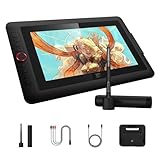
10. XPPen Artist13.3 Pro V2 is the best entry-level pen display with abundant controls
XPPen Artist 13.3 Pro V2 Drawing Tablet with Screen, 16K, Red Dial, 8 Keys
13.3 inch FHD
16K pressure
Red Dial and 8 keys
Pros
- Fast 90 ms response
- 8 shortcut keys
- Adjustable stand
- Wide stated gamut
Cons
- No Bluetooth
- Full HD resolution
The Artist13.3 Pro V2 offers a conventional computer-connected display tablet layout with a 13.3-inch, 1,920 by 1,080 panel and a large set of built-in controls. Its physical red dial and eight shortcut keys make it appealing to a beginner who wants a self-contained drawing surface rather than a separate keypad.
The source data lists a 4.4 rating across 727 reviews. Its compact 2.5-pound build and included AC42 adjustable stand make it a sensible choice when a desktop drawing setup needs to stay movable.
The red dial and eight keys put common art actions beside the display
The red dial is the defining feature, supported by eight customizable shortcut keys. This is a productive layout for zoom, brush size, rotate, undo, and layer actions because it keeps your stylus hand close to the working area.
Its driver and interface are described as beginner-friendly in the source data. Still, reserve time for driver installation, firmware checks, and per-app shortcut setup before a deadline; controls only become useful after that preparation.
The laminated screen and X3 Pro pen support a direct drawing start
The full-laminated anti-glare screen is listed with 16,384 pressure levels, 60-degree tilt, and a 90 ms response figure. XPPen also states improved accuracy, but the practical test is whether the pen tracks reliably and the pressure curve matches your preferred application.
The screen covers 99% sRGB, 89% Adobe RGB, and 95% P3 according to the product data, with 8-bit color and 16.7 million colors. These are solid stated values for illustration and learning, while the 1080p resolution is the clear ceiling compared with 2.5K alternatives.
The Linux and Android listing adds flexibility for a compact desk setup
Windows, macOS, ChromeOS, Linux, and Android with the required USB 3.1 DisplayPort 1.2 support are listed. The full-featured USB-C connection can keep a compatible setup tidy, but confirm your host device supplies the video output it needs.
There is no Bluetooth connectivity listed, and it requires a connected computer or compatible mobile device. Choose it for a desk-based screen workflow with many direct controls, not for independent mobile drawing.
11. PicassoTab-X11 is a beginner-friendly standalone kit with tutorials and drawing apps
11″ Standalone Drawing Tablet, Portable PicassoTab, No Computer Needed -X11
Standalone 11 inch 2K
4096 pressure
Apps and tutorials
Pros
- No computer needed
- Laminated 2K screen
- Accessory kit
- Included art apps
Cons
- Custom OS
- 4096 pressure levels
The PicassoTab-X11 approaches the category as a ready-to-use learning kit. It is a standalone 11-inch tablet with a 2,560 by 1,440 laminated display, supplied drawing apps, Artixo tutorial access, a stylus, glove, case, screen protector, and chargers.
That bundled approach can reduce the decision fatigue that beginners often report. Instead of selecting a computer, tablet, application, accessories, and a tutorial source separately, this option gathers the basics into one package.
The 2K laminated display keeps a portable canvas clear
The 11-inch 2K screen is laminated and described as paper-like, both features that support direct stylus work with less visible separation between pen and image. Its active surface is listed at 95.04 square inches, providing a usable portable drawing area.
The stylus supports 4,096 pressure levels. That is a lower figure than the 8K and 16K specifications elsewhere, yet it can still handle pressure-based line weight and shading; a learner should focus first on control and application brush settings.
The installed drawing apps and tutorials reduce the first-day barrier
Concepts with Lifetime PRO, Infinite Painter, and FlipaClip are included according to the product information, along with lifetime VIP access to Artixo tutorials. That combination is particularly relevant for students who want structured prompts as well as a device.
It is also a reasonable family or classroom-oriented option because the accessory kit gives a new user the physical basics. More advanced artists should confirm that their preferred application and export workflow are available in the custom operating system.
The custom operating system is the key software trade-off
The tablet has an octa-core CPU, 6 GB RAM, and 128 GB storage, with Wi-Fi connectivity. Those specifications suit a self-contained art device, but the custom graphics-tablet OS may offer fewer software choices than Android 14 or a desktop system.
This is not a computer display, so it excels at independent sketching and guided learning. Skip it if you need the specific desktop tools, plug-ins, or operating-system flexibility of a Windows or macOS art workflow.
12. UGEE UE12 is the compact computer display for straightforward cross-platform drawing
Pros
- Dual USB-C ports
- Three color spaces
- 60 degree tilt
- Wide compatibility
Cons
- Computer required
- Full HD resolution
The UGEE UE12 is a small, direct-on-screen pen display with an 11.6-inch 1,920 by 1,080 panel. It serves an artist who wants the hand-on-image experience of a display tablet, supports a computer-based workflow, and does not need a large desktop canvas.
Its product data contains both an 8,192-level specification and a 16K-level pressure claim in technical details. I would treat the manufacturer’s 16K stylus feature as the relevant current claim, while confirming the installed driver and included documentation if that distinction affects your choice.
The laminated anti-glare display reduces the usual pen-display disconnect
The UE12 has a full-laminated FHD display with anti-glare treatment and an active area reported as 57.27 square inches. Full lamination is especially welcome on a small screen, where a slight gap between nib and image can feel more noticeable during precise work.
The 11.6-inch size suits sketching, note taking, compact desks, and travel between locations. It gives up the broad forearm movement available on the 16-inch and larger models, so it is not the first choice for large-format painting.
The switchable color spaces add a useful viewing control
UGEE lists a 124% sRGB gamut and three switchable color spaces: sRGB, Adobe RGB, and DCI-P3. That is a thoughtful feature for artists who work with different display targets, provided they understand that application settings and the final monitor still shape color results.
The battery-free stylus adds 60-degree tilt recognition and the source lists 16K pressure sensitivity. Eight customizable keys use a concave-convex design, which may make them easier to identify by touch during drawing.
The two USB-C ports fit flexible computer and Android connections
Dual Type-C ports allow flexible cabling, and direct USB-C connection is listed. Supported platforms include Windows, macOS, Android, and ChromeOS, with Photoshop, Illustrator, and CorelPainter named among compatible applications.
The UE12 requires a computer connection rather than running as a standalone device. It is the clearest pick for a compact, cross-platform direct-drawing setup where a desktop or compatible Android host is already available.
The right graphics tablet starts with the screen and computer decision
A graphics tablet is an input device that turns a pressure-sensitive stylus movement into a digital brush stroke. “Drawing tablet” and “graphics tablet” are commonly used for the same category, though people often use “pen display” to mean the screen-equipped version.
A screenless pen tablet is best when desk space and monitor flexibility matter
Pick a screenless pen tablet such as the Wacom Intuos Pro Medium when you already have a good monitor and want your art, reference material, and software panels on one larger screen. It can also encourage a more upright posture because you are not looking down at a display for every stroke.
Expect an adjustment period because your hand works on one surface while your eyes watch another. Build the habit with short exercises: trace simple shapes, make controlled hatching lines, and practice moving the pointer to the same points on screen.
A pen display is best when drawing directly under the stylus feels non-negotiable
Choose a drawing tablet with screen if the hand-to-image connection makes you more confident, you are moving from paper, or you prefer seeing brush placement immediately under the nib. The HUION Kamvas 13 (Gen 3), XPPen Artist Pro 16 Gen2, and Wacom Cintiq 16 each need a host device but offer that direct drawing experience.
Compare active area, panel resolution, lamination, color claims, stand angle, and physical controls after you decide on a size. A larger screen is not automatically better if your desk cannot support a comfortable keyboard, reference display, and arm position around it.
A standalone tablet is best when the computer must stay out of the workflow
The XPPen Magic Drawing Pad, Wacom MovinkPad 11, and PicassoTab-X11 draw without a connected computer. This is ideal for portable sketching, classes, travel, or a low-friction creative habit where powering up a desk station becomes a barrier.
Check the operating system and application availability before buying. Android 14 devices provide a familiar app ecosystem, while a custom OS may be more focused but narrower in its software choices.
The pen specs matter after comfort, display size, and compatibility
Pressure sensitivity is best treated as a pen-response feature, not a scorecard
Pressure sensitivity levels describe how many force steps a stylus can report. Both 8,192 and 16,384-level pens can create expressive strokes; pen tracking, initial activation force, tilt, nib feel, and the brush engine in your art application often have a more noticeable daily effect.
Make a few light-to-heavy strokes after installation and tune the pressure curve only when your normal pressure does not produce the desired range. This is more helpful than forcing a heavy-handed or light-handed drawing style to fit a default setting.
Active area should match both your monitor and how you draw
A compact active area is easy to carry and takes less arm travel, while a large surface feels more natural for sweeping strokes. For a screenless tablet, match the format to your monitor where possible; a wide tablet maps more intuitively to a wide monitor.
For a pen display, measure your desk depth as well as width. A display that sits too upright can strain your wrist, while one that lies too flat may make you hunch, so a usable stand is a practical feature rather than decoration.
Shortcut keys and dials are best assigned to repeated actions only
Set a dial to brush size or zoom, then give buttons to undo, redo, pan, modifier, and a favorite tool. This short list supports muscle memory and keeps you working instead of looking down at controls.
Artists who work almost entirely with keyboard shortcuts may prefer a cleaner tablet and a separate keyboard. Artists who draw on a couch or work in a tight mobile arrangement may get more benefit from built-in buttons and dials.
Compatibility must be checked before you choose a graphics tablet
Driver stability and device support are major buyer concerns, and the only safe approach is to match the exact tablet to your exact computer, operating system, and port. A device that lists Android support may still require USB 3.1 DisplayPort 1.2 or a later compatible output, which many phones and tablets do not provide.
Linux support is strongest when it is listed for the specific model
The provided product data lists Linux support for the HUION Kamvas 13 (Gen 3) and several XPPen Artist Pro displays: the 19 Gen2, 22 Gen2, 16 Gen2, 14 Gen2, and Artist13.3 Pro V2. Listed support is a useful starting point, not a substitute for reviewing the current driver page for your distribution and desktop environment.
Do not infer Linux compatibility from a brand name or a similar older model. Check current driver availability, supported kernel or distribution notes, and whether your drawing application recognizes pen pressure before relying on a device for production work.
Left-handed artists should choose movable or symmetric controls
A left-handed setup works best when controls can be rotated, moved, or configured for the opposite side. The HUION Kamvas 13 (Gen 3) explicitly lists a left- and right-handed design, while separate wireless remotes such as XPPen Keydials can be placed where your free hand naturally rests.
After installation, rotate the device if its driver permits it, map the pen buttons deliberately, and move the keyboard or remote away from your drawing elbow. These small changes have a larger effect on comfort than switching pen pressure specifications.
Software should be chosen for the workflow instead of the logo
Desktop pen displays give you access to the applications already on your Mac, Windows PC, or compatible Linux system. Standalone devices need an app check first: the Magic Drawing Pad runs Android 14 with Google Play, MovinkPad 11 is Android 14, and the PicassoTab-X11 lists supplied art apps on its custom OS.
For sketching and note taking, a mobile application may be all you need. For animation pipelines, specialized plug-ins, color-managed print files, or 3D modeling, a computer-connected pen display usually leaves more room for a full production setup.
These best graphics tablets FAQs answer the buying questions artists ask first
Which graphic tablet is best for beginners?
The XPPen Artist13.3 Pro V2 is a strong beginner pick when you want to draw on a screen because it has a compact 13.3-inch laminated display, a stand, a dial, and eight shortcut keys. Choose the PicassoTab-X11 instead if you need a standalone device with supplied apps and tutorials.
Should a beginner get a drawing tablet?
Yes, if you plan to draw, retouch photos, design, or take visual notes regularly. A beginner should choose a small pen display for direct hand-to-screen drawing or a screenless tablet when they already have a good monitor and are willing to practice hand-eye coordination.
How long does it take to get used to a graphic tablet?
Most people need about one to two weeks of regular short sessions to get comfortable with a screenless graphics tablet. A pen display usually feels familiar faster because you see the mark under the stylus, though its driver settings and desk position still take time to refine.
What is the difference between a drawing tablet and a graphics tablet?
There is usually no practical difference: both names describe a pressure-sensitive stylus device for digital drawing. The useful distinction is screenless pen tablet versus pen display; a pen tablet controls a separate monitor, while a pen display lets you draw directly on its screen.
What are good beginner drawing tablets for details?
For detailed beginner work, choose a laminated screen that reduces visible pen-to-cursor separation. The HUION Kamvas 13 (Gen 3) adds factory-calibrated color and dual dials, while the XPPen Artist Pro 14 Gen2 adds a compact 16:10 display, a stand, and a wireless shortcut remote.
The best final choice depends on where and how you create
For a compact computer-connected display, I would start with the HUION Kamvas 13 (Gen 3). Choose the Wacom Intuos Pro Medium if a screenless workspace and physical controls suit your desktop, the XPPen Magic Drawing Pad or MovinkPad 11 for standalone mobility, and the XPPen Artist Pro 19 Gen2 or 22 Gen2 when a larger color-focused display is the priority.
The best graphics tablets in 2026 are the ones whose screen type, operating system, active area, and controls fit your actual art habit. Confirm your ports and software first, then choose the model that will make it easiest to sit down and draw often.
Leave a Reply