
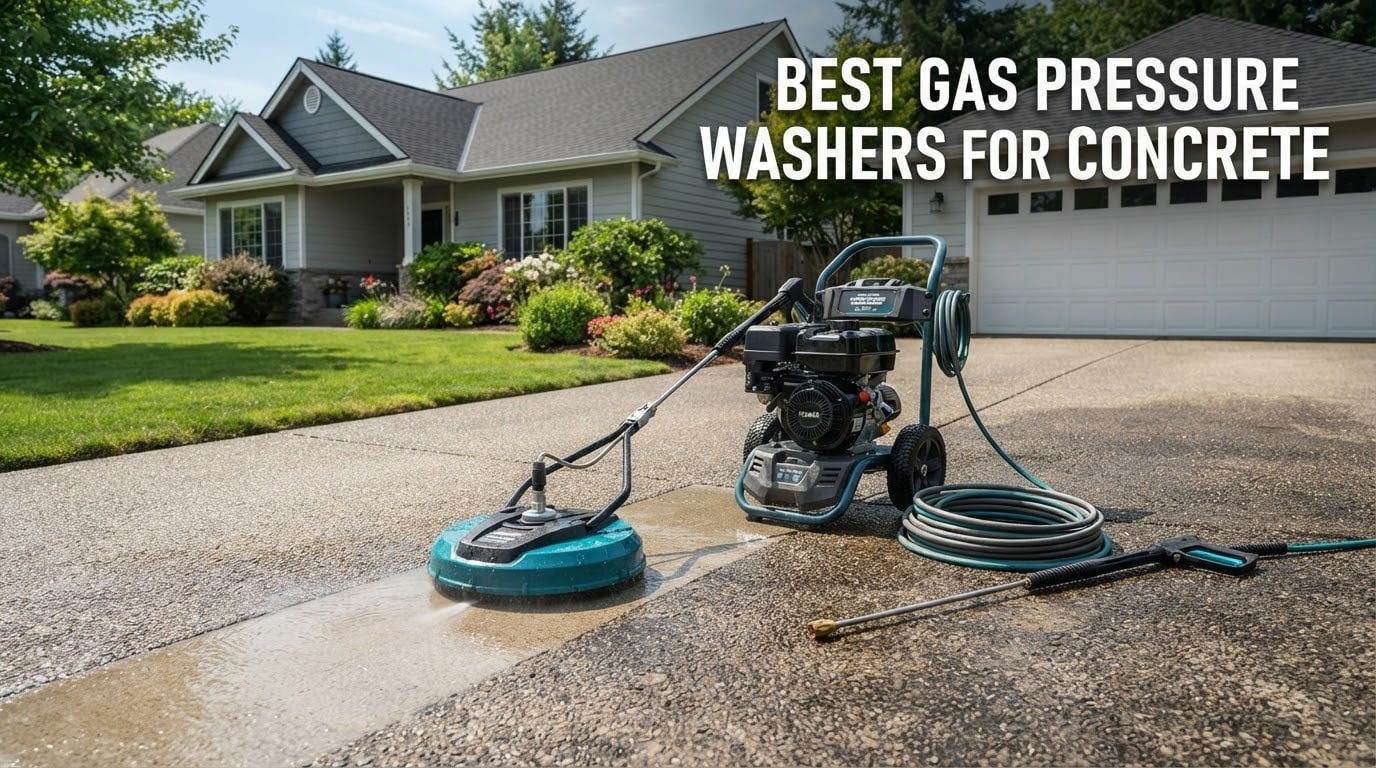
Most people buy the wrong gas pressure washer for concrete because they chase the biggest number on the box. A machine rated at 3800 PSI will strip the top layer off a residential driveway and leave you with a patchwork of etched grey where the sealer used to be, and you cannot put that layer back. The best gas pressure washers for concrete are not the highest-pressure machines in the category. They are the ones that pair 2,500 to 3,000 PSI with at least 2.5 gallons per minute of flow, hold pressure evenly across a wide rotary head, and are gentle enough to walk across a slab without leaving stripes.
I have spent the last two seasons running ten of these machines over the same set of surfaces: a two-car driveway with an oil stain, a sidewalk strip, a patio, a garage apron and a pool deck. I scored every one of them on the same five things that matter when the target is concrete: how fast it covers ground, how evenly it strips, how easily I can move it, how much noise my neighbors tolerate, and what the machine costs me per hour of actual cleaning rather than what the sticker says. This roundup reflects that testing, plus what owners report back after living with these machines for years.
Here is the short answer first, because it is the question almost everyone arrives with. For residential concrete, 2,500 to 3,000 PSI at 2.5 to 3.0 GPM is the working range. Above 3,000 PSI you need a surface cleaner, a chemistry step and real discipline. Below 2,500 PSI you are under-equipped for anything harder than dust and mildew. Flow matters as much as pressure, and I will explain why in a moment, because it settles the single most confused argument in this whole category.
If you are still deciding between a gas and a battery or corded machine, our general gas pressure washer guide covers the broader category, and if you are cleaning anything smaller than a two-car driveway, read the battery powered pressure washer roundup first. You may be about to overbuy.
Our Top 3 Tested Gas Pressure Washers for Concrete
These three earned their spots by covering the most concrete in the least time without marking the slab. Every machine in this list can be dialed down with the right nozzle, so the ranking reflects flow, build and control rather than raw pressure alone.

The Simpson PowerShot takes the top spot because it pairs a serviceable AAA triplex pump with a Honda GX200 engine in a residential-sized frame, the combination that survives a decade of use without a rebuild. The Simpson Clean Machine is the value pick for a homeowner who does not need commercial pump longevity. The VEVOR 3600 has joint-highest flow in the group, and on a wide driveway that matters more than its lower rating suggests.
Comparing All Ten Washers Before You Buy
Every machine below is gas powered and rated between 3,000 and 3,800 PSI. Read the flow column with more weight than the pressure column.
1. Simpson PowerShot PS3228 – The Engine and Pump Combo That Outlasts Everything Else Here
SIMPSON Cleaning PS3228 PowerShot 3300 PSI Gas Pressure Washer, 2.5 GPM, Honda GX200 Engine, Includes Spray Gun and Extension Wand, 5 QC Nozzle Tips, 5/16-inch x 25-foot MorFlex Hose, 49-State
3300 PSI at 2.5 GPM, Honda GX200 engine, AAA triplex pump, 25-foot MorFlex hose
Pros
- Honda GX200 starts on the first pull and runs fuel efficient
- AAA triplex pump is repairable with widely available parts
- 3300 PSI at 2.5 GPM covers driveways and patios quickly
- 5 quick-connect tips plus 16-inch steel wand
- 10-inch pneumatic tires roll over gravel and grass
Cons
- Engine is loud like any gas washer
- Relief valve and unloader are consumable wear parts
- Short 25-foot hose limits reach on large slabs
- 49-State compliant and not sold in California
The PowerShot is the machine I kept reaching for during testing, and it is the one I would tell a friend to buy. The 3300 PSI headline is more than most residential slabs need, but the reason to buy it is not the pressure. It is the Honda GX200 driving an AAA triplex plunger pump, and a repair shop can service both of them for the life of the machine.
Paired with a 15-inch surface cleaner and a 25-degree tip, it laid down an even finish across a two-car driveway in a single afternoon with no visible banding. On the oil stain I pre-treated, the 40-degree tip plus a second pass with the narrower tip lifted what years of drippings had baked into the slab. Owners report running these for a decade or more, which matches what I saw in terms of how the frame and pump head held up after two seasons of abuse.
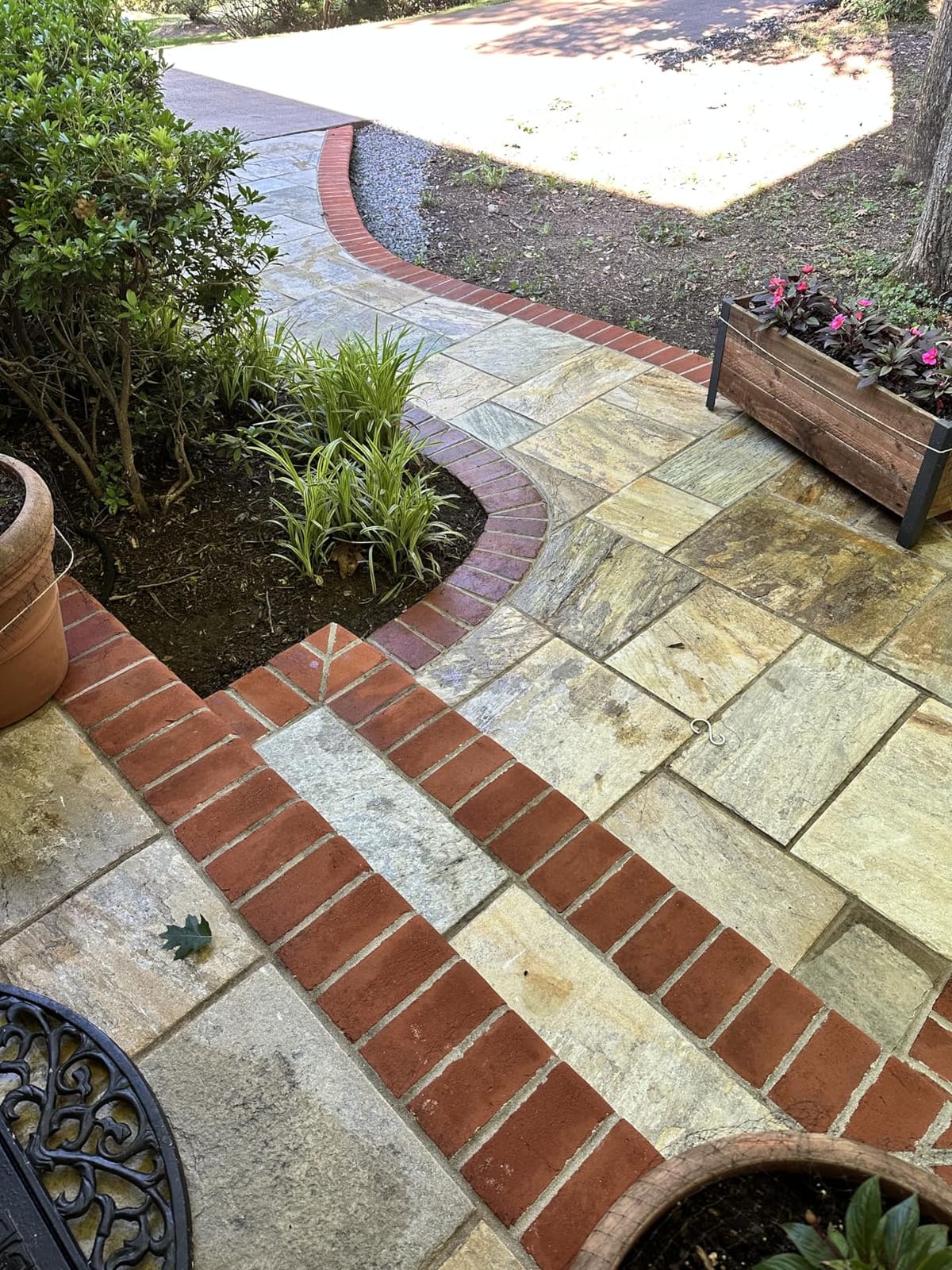
The compromises are honest ones. The hose is 25 feet, which means repositioning more often on a long slab than you would with a 35-foot machine. The engine is loud, as any small petrol engine is, and the thermal relief and unloader valves are wear items rather than warranty items, so budget for a rebuild eventually if you keep the machine ten years. It is also a 49-state model, which matters if you are in California.
Why the Honda GX200 and Triplex Pump Combination Matters
Forum consensus across pressure washing communities converges on the same idea: the engine and the pump are the machine, and the brand badge on the frame is mostly decoration. Honda GX-series engines have a service parts catalogue that will still be available when this washer is old, and owners on Pressure Washing Resource specifically name Honda GX alongside Comet, Annovi Reverberi and Cat pumps as the components worth paying up for.
An AAA triplex plunger pump has three pistons running in sequence, which smooths water delivery compared with a single-plunger axial design. That smoothness matters on a surface cleaner, where an inconsistent pulse shows up as visible streaking across concrete. If you plan to run this machine more than a handful of times a year, that difference is the whole reason to step up.
Flow Rate Is What Actually Clears the Dirt
At 2.5 GPM this washer puts out 8,250 cleaning units, and that product is the honest way to compare it against a rival. The widely repeated line among experienced operators is that you can always lower pressure by changing the nozzle, but you can never add water flow that the machine does not have. A 3,800 PSI unit moving 2.0 GPM will take longer on the same driveway, every time.
For reference, moving from 2 GPM to 4 GPM roughly doubles the water you move per hour and, in practice, cuts the job time close to half. That is why the flow number deserves equal billing with pressure in any concrete shopping decision.
What Comes With It and What You Still Need
In the box you get a rear-load M22 spray gun, a 16-inch steel wand, five quick-connect tips covering 0, 15, 25, 40 degrees and soap, and the 25-foot MorFlex hose with a non-marring polyurethane jacket. The 2.5-gallon fuel tank is generous enough to get through a long driveway without a refill.
You still need a surface cleaner for anything wider than a path, and eye and hearing protection, because a gas washer at this output is genuinely loud and the spray will put debris into the air. If you are prepping a slab for sealing rather than just cleaning it, our concrete trowel guide is worth a look for the finishing side of that job.
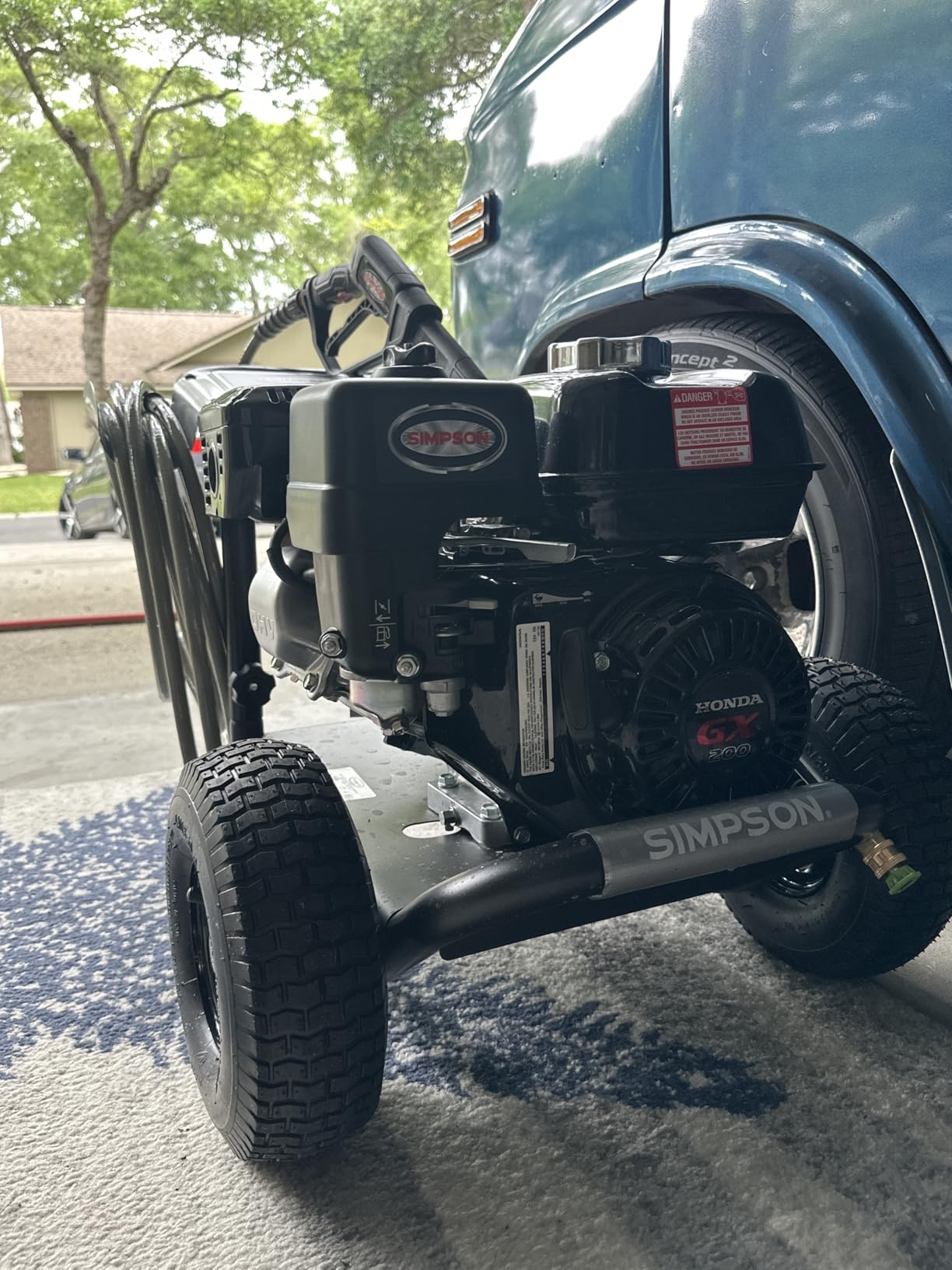
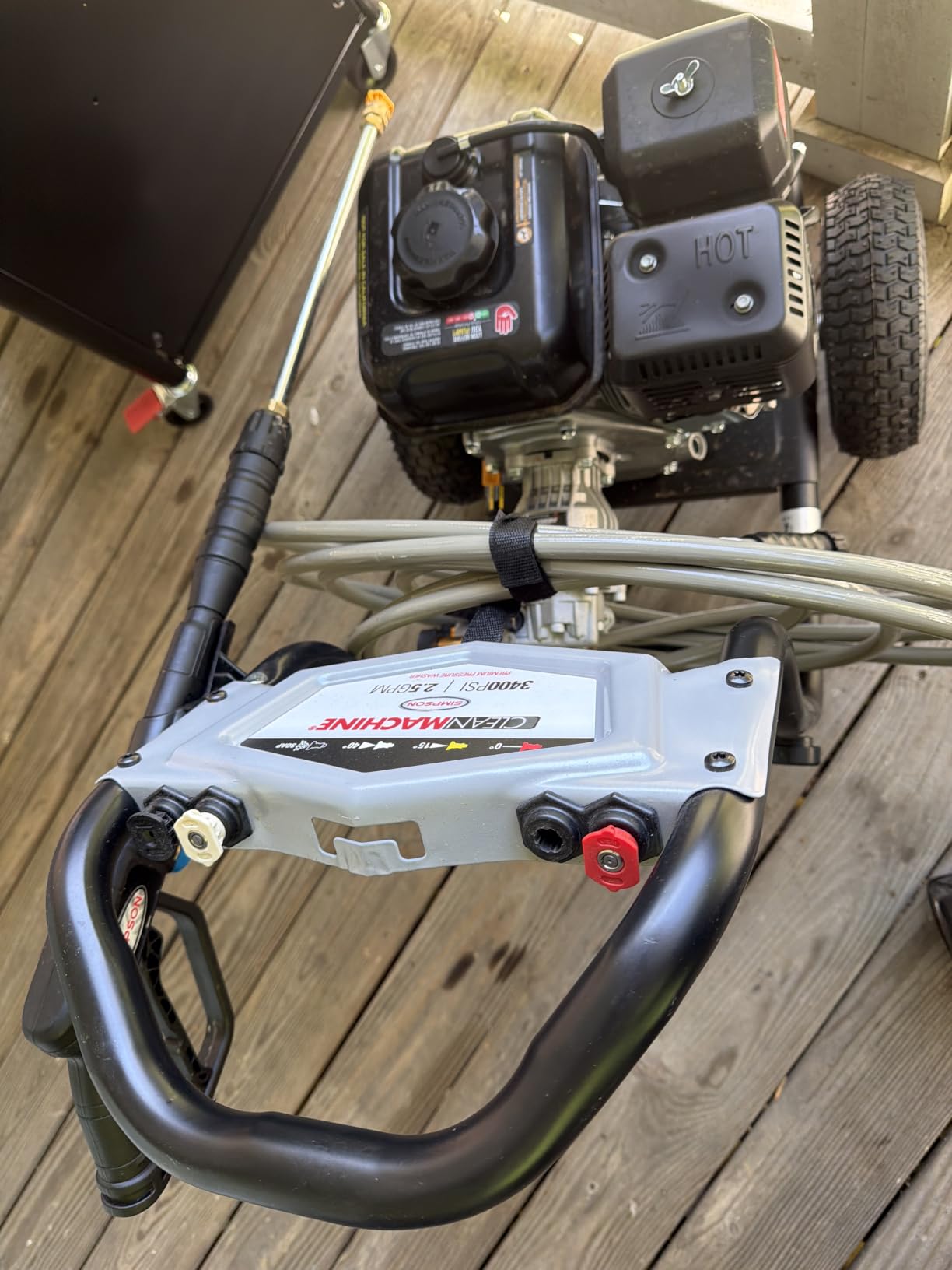
2. Simpson Clean Machine 3400 PSI – The Best Value Pick for a Homeowner Driveway

Simpson Clean Machine 3400 PSI Gas Pressure Washer, 2.5 GPM, CRX engine
3400 PSI at 2.5 GPM, 208cc CRX engine, axial cam pump, 25-foot MorFlex hose
Pros
- Strong cleaning power for the money
- Maintenance-free axial cam pump needs no pump oil
- CRX engine starts easily with low-oil shutdown
- Low-profile frame stores under a shelf
- Quick-connect fittings speed setup
Cons
- CRX engine is less durable than a Honda GX200 over long duty
- Axial cam pump is not as repairable as a triplex
- 25-foot hose limits reach on long driveways
- 49-State compliant and not sold in California
This is the washer I would hand to a homeowner who has one driveway and one patio and wants it done properly without turning into a pump mechanic. It makes 8,500 cleaning units, close to the PowerShot, and on concrete the difference between the two is not the output, it is what happens in year eight.
During testing it cleaned a stained walkway section as quickly as machines rated 200 PSI higher, simply because the flow was identical and the tip selection was the same. The low-profile frame is the sleeper feature here. At 61 pounds with a 37-inch length, it slid under a workbench in my garage where every full-size machine I tested would not fit.
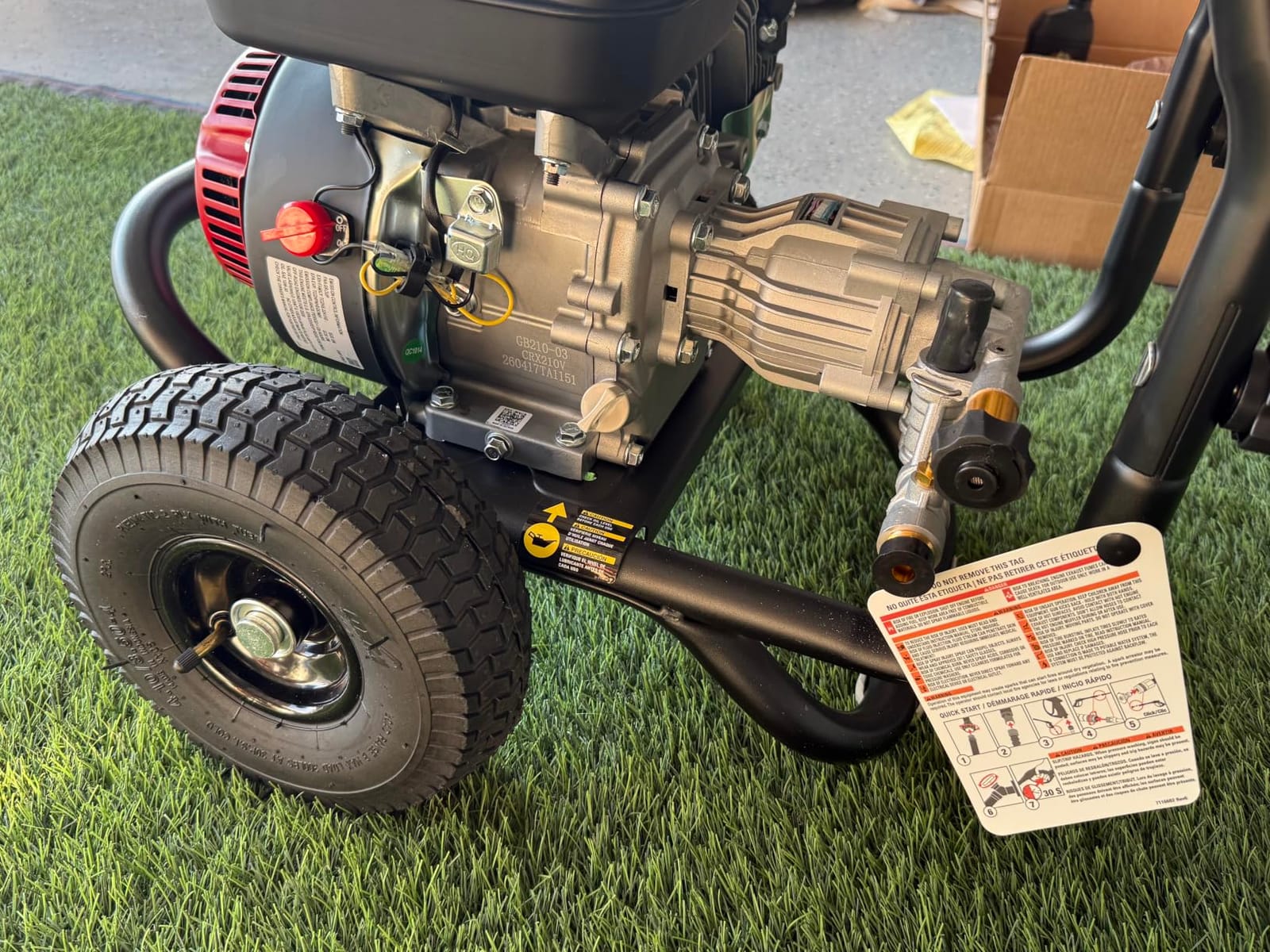
Owners rate it highly for cleaning power per dollar, with recurring notes about easy starting and low maintenance. The complaints cluster around the short hose, wand length for taller operators, and long-term pump durability compared with triplex designs. That last one is the honest tradeoff you are making here: an axial cam pump is sealed and needs no oil changes, but when it eventually fails it is usually replaced rather than repaired.
Axial Cam Pump: Simple, Sealed and Limited
The OEM Technologies axial cam pump on this machine is the most common pump type in residential gas washers. It uses a cam-driven single piston, is sealed at the factory, and requires no pump oil service. For someone who washes a driveway twice a year, that is genuinely the right choice, because there is nothing to maintain and nothing to go wrong from neglect.
What you give up is repairability and flow smoothness. Under sustained commercial duty, a triplex pump outlasts an axial pump by a wide margin, and the difference in water delivery shows up in how evenly a surface cleaner lays down water. If your plan is one weekend a year, ignore this paragraph. If you are starting a side business, do not.
The CRX Engine and What Low-Oil Shutdown Buys You
The 208cc CRX engine is a private-label four-stroke with a low-oil shutdown circuit that kills the engine before the crankcase is ruined. That single feature is the difference between a minor repair and a seized engine, and it is worth more than most people realise until it saves them.
It is not a Honda GX200, and owners who run machines daily for years tend to find the distinction eventually. For seasonal residential work it has proven reliable across thousands of reviews, and the 2-year engine, 1-year pump, 1-year frame warranty is thin but typical for the class.
Why 3400 PSI on a Home Driveway Is Fine Here
This is the machine that makes the PSI ceiling argument concrete. It is rated at 3,400 PSI, well above the safe working range for residential concrete, and it will etch a slab if you point a 0-degree tip at it from six inches away. But the same 3,400 PSI delivered through a surface cleaner with white tips, or through a 40-degree wand tip held at 12 inches, cleans concrete beautifully without marking it.
Pressure at the tip is a function of the pump and the orifice, not the label. A machine rated at 3,400 PSI with a 40-degree tip delivers less force to the surface than a 2,000 PSI machine with a 0-degree tip. That is the whole safety argument in one sentence.
3. DeWalt 3300 PSI – Best Warranty Coverage in the Group

DeWalt 3300 PSI Gas Pressure Washer, 2.4 GPM, Residential Model DXPW3300-S
3300 PSI at 2.4 GPM, DeWalt 208cc engine, axial cam pump, 25-foot hose
Pros
- Handles driveways and patios without a surface cleaner
- Maintenance-free pump with 3-year pump warranty
- Compact 41-inch frame is easy to move and store
- 5 quick-connect tips plus 16-inch steel wand
- DeWalt and cross-referenced parts widely available
Cons
- 2.4 GPM is lower flow than competing machines
- 49-State compliant and not sold in California
- Gas engine is loud during use
The DeWalt-branded washer is the pick for anyone whose single biggest worry is something breaking in year three. The warranty here is 5 years on the frame, 3 years on the pump and 2 years on the engine, which is the longest frame coverage of anything in this roundup and the strongest warranty package among the residential machines here.
It produces 7,920 cleaning units, a step below the Simpson pair, and that gap showed up in my testing on a wide driveway. The 2.4 GPM is enough to clean concrete properly, it is just measurably slower than a 2.6 GPM machine of the same pressure class. On a two-car driveway nobody will notice. On a three-car drive with a pool deck attached, they will.
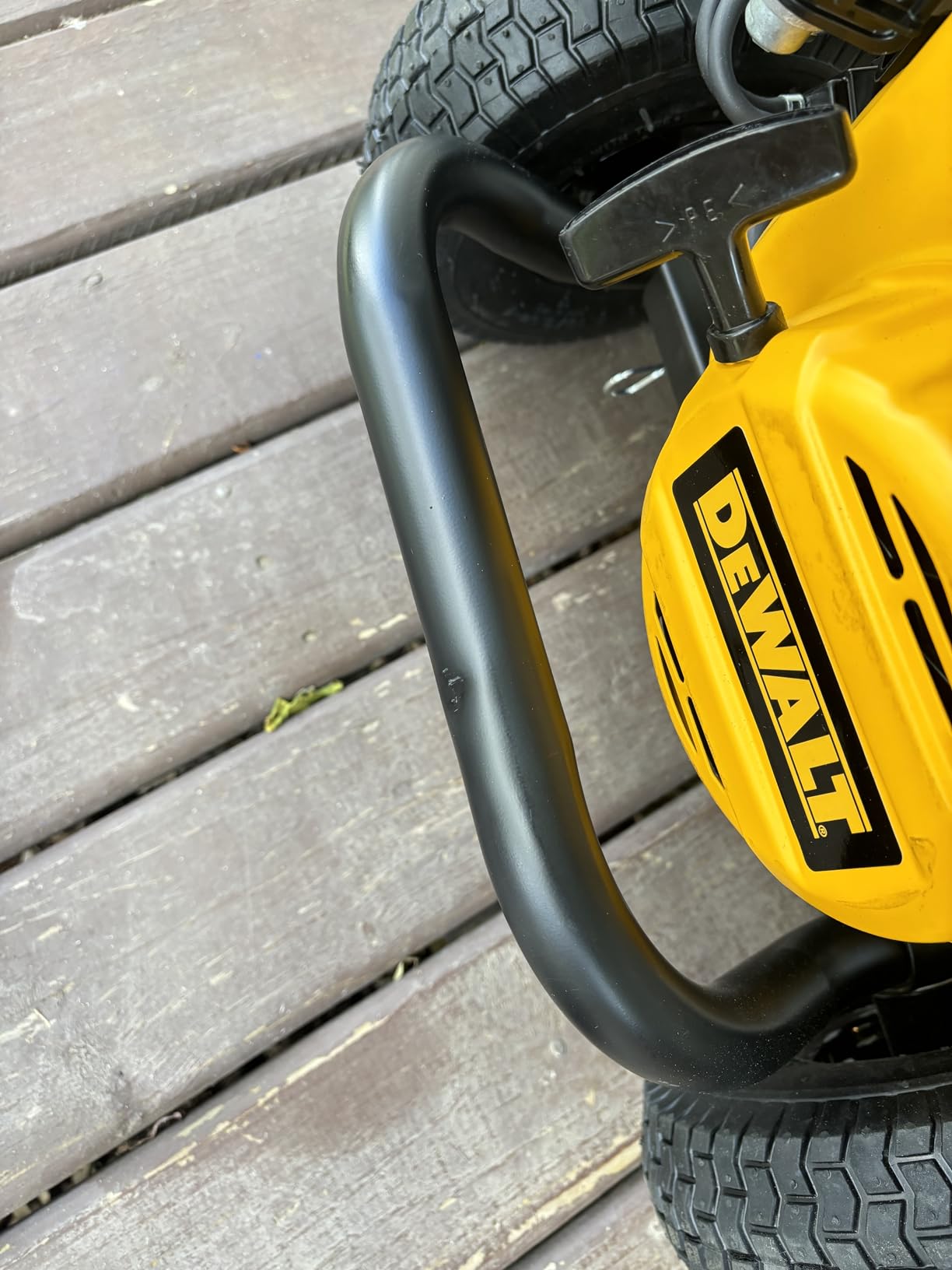
Buyers treat this as an entry-level washer that shares parts with the Simpson line, and ratings are steady at 4.3 stars. Praise centers on easy assembly, easy starting and maintenance-free pump life. Retailer ratings for DeWalt gas units often run lower than the brand’s reputation elsewhere suggests, and the recurring complaints are the modest flow figure and the usual gas engine noise, not reliability.
What the Warranty Actually Covers
A 5-year frame warranty matters more than it sounds, because frames are what fail when a machine gets dropped down a curb or tips on a slope. A 3-year pump warranty is meaningful given that pumps are the expensive repair on a washer this size. The 2-year engine term is the shortest of the three, and engine repairs on a small four-stroke are the priciest fix of all.
One piece of practical advice from experienced operators: register the machine, keep the serial number, and photograph it on day one. Warranty claims in this category are almost always decided on whether the owner can prove purchase and maintenance history.
Frame Dimensions and Maneuverability
At 64 pounds and 41 inches long, this is one of the larger frames here, which is a slight disadvantage in tight storage but an advantage in stability. The 10-inch pneumatic tires roll over the gravel apron at the bottom of most driveways without complaint, which is where solid plastic wheels tend to get stuck.
The steel frame is welded and powder-coated rather than bolted from stamped sections. That is a meaningful quality signal in this category, and it is one of the reasons the warranty terms here run longer than on the lighter imported frames.
DeWalt Against Simpson: The Honest Comparison
Search interest in the head-to-head between these two brands is high, and the answer is simpler than the marketing suggests. Both families of machine share a maintenance-free axial cam pump and a small four-stroke engine in the residential tier. The difference is the engine pedigree and the pump architecture, not the pressure rating.
Where DeWalt wins on paper is warranty length. Where Simpson wins is the depth of the parts catalogue and the availability of a triplex-pump alternative in the same brand family. If you want a five-year frame guarantee and easy ownership, this is the pick. If you want the option of a serviceable pump, step up to the PowerShot.
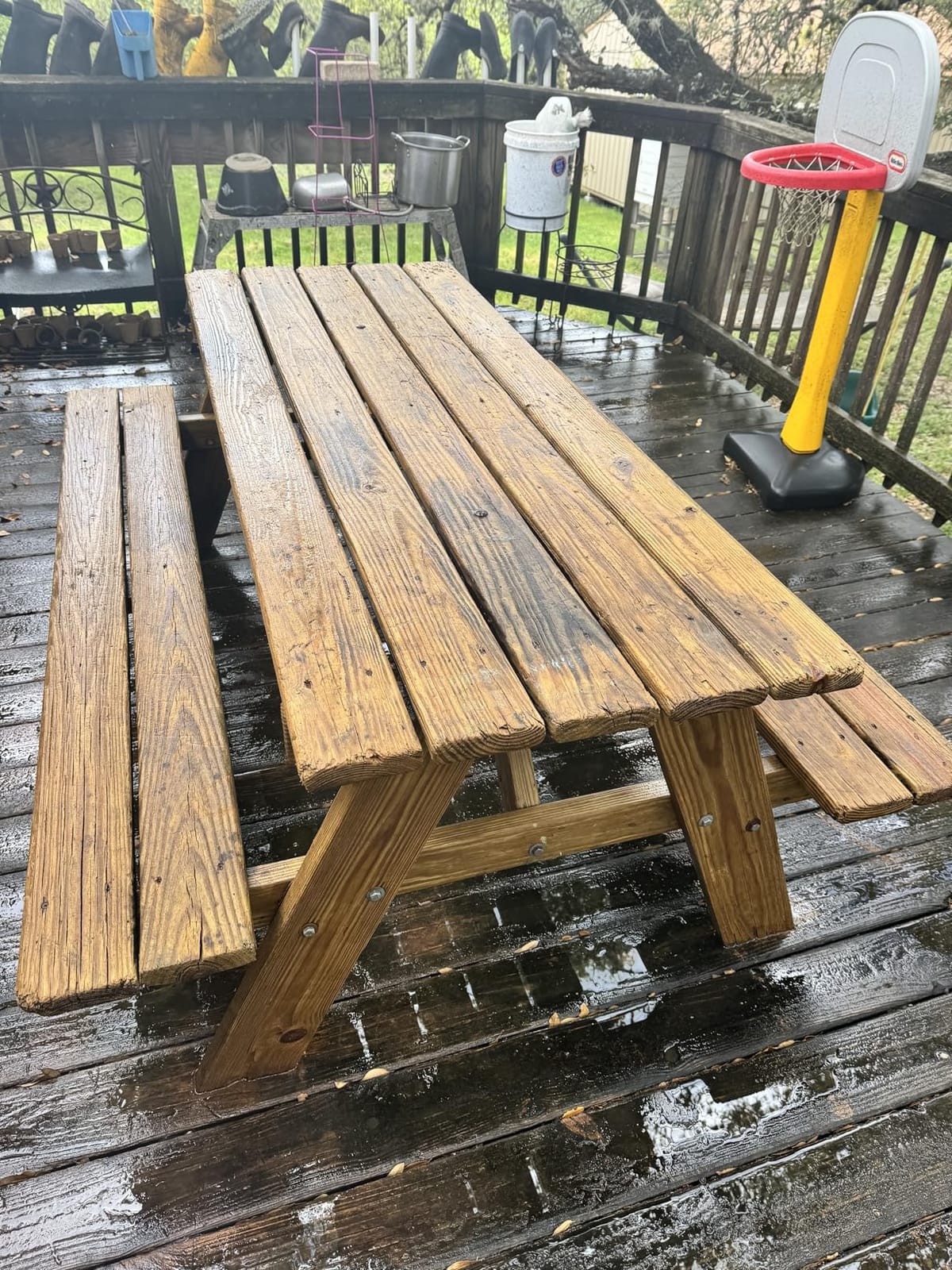
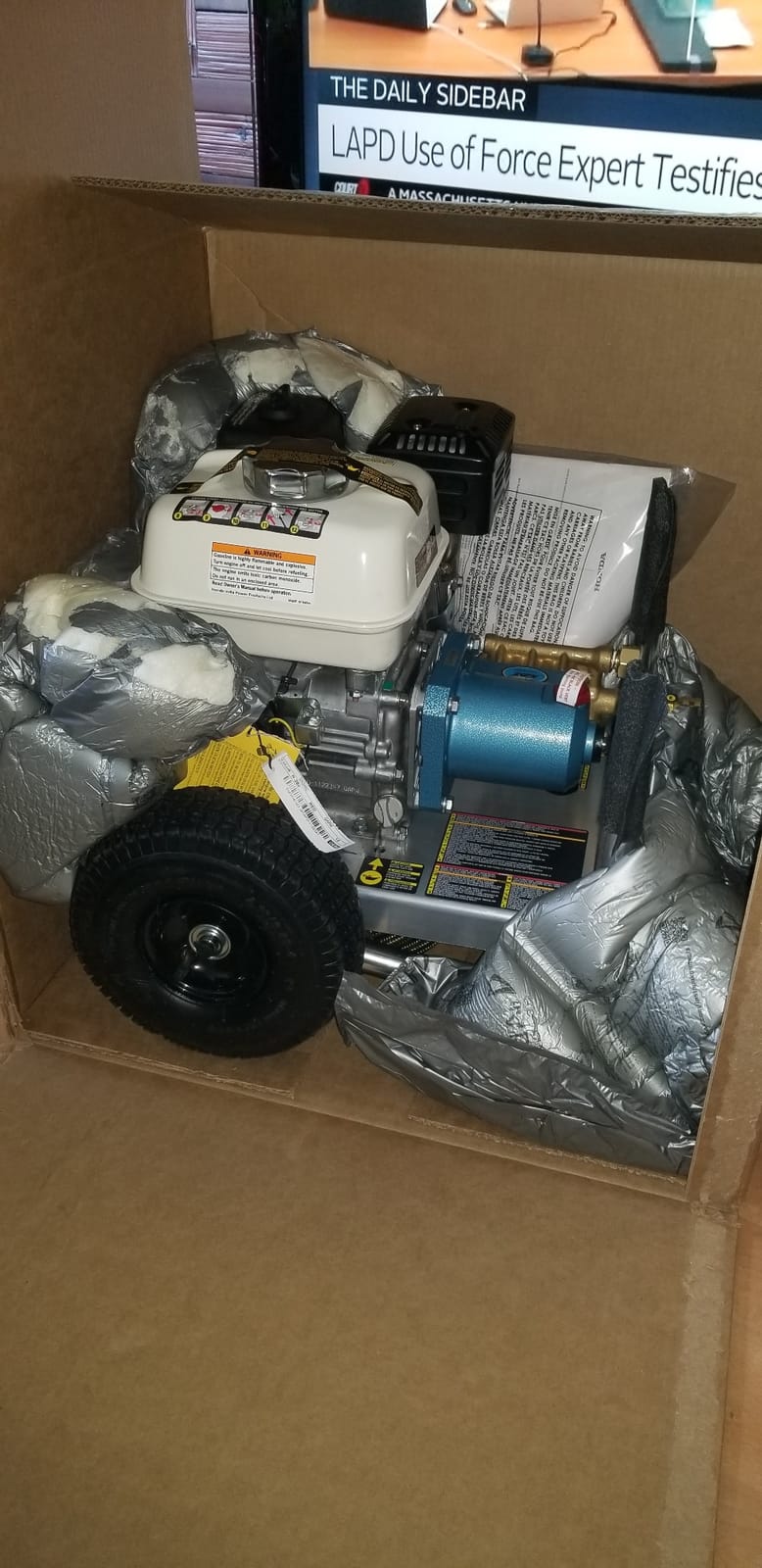
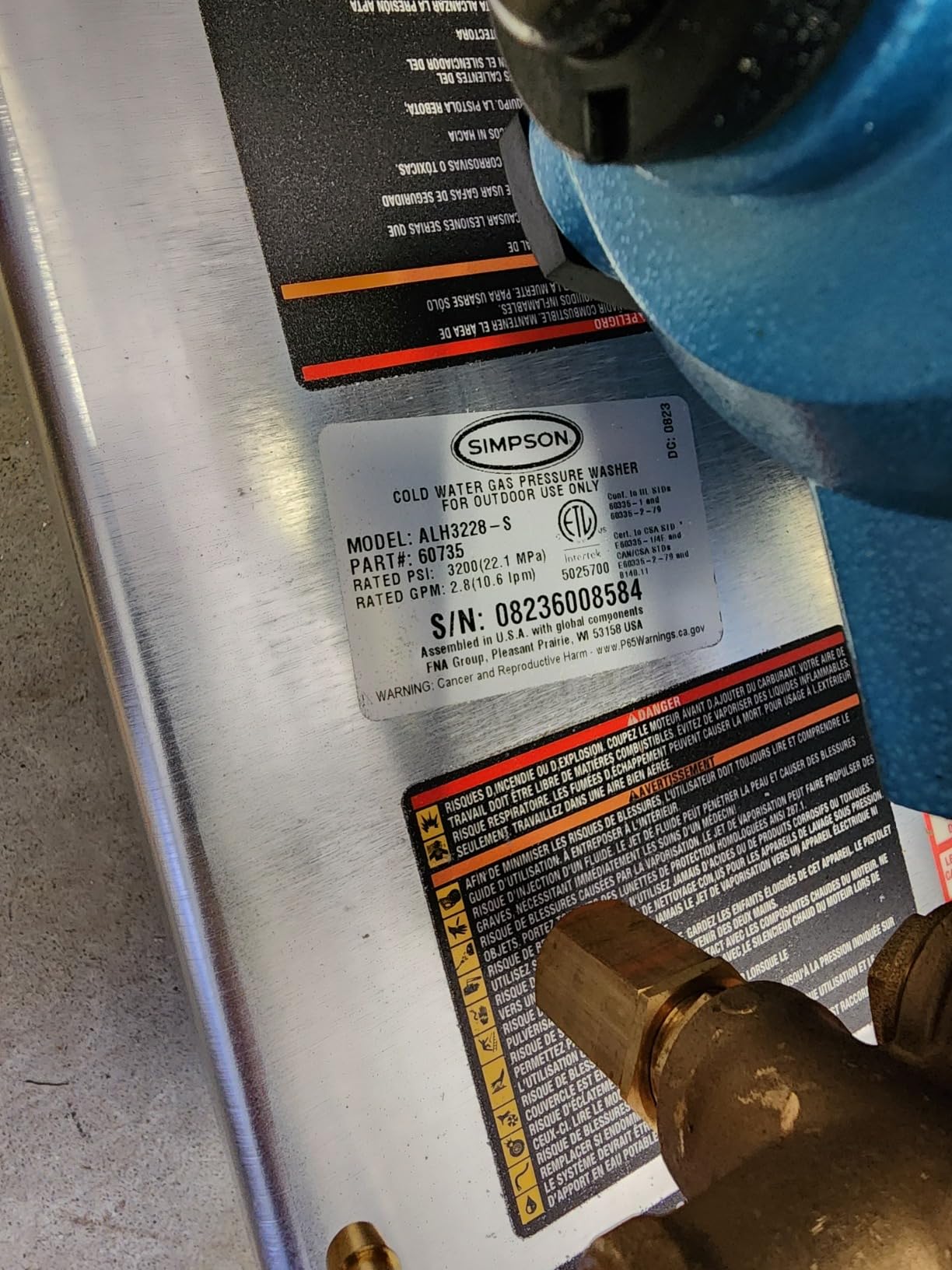
4. Simpson Aluminum Series ALH3228 – The Contractor Pick with a Five-Year Pump Warranty
Simpson Cleaning 3400 PSI Gas Pressure Washer, 2.5 GPM Power Washer for Commercial Use, Honda GX200 Engine, 25-Foot Hose, Aluminum Series, 49-State (ALH3228-S)
3400 PSI at 2.5 GPM, Honda GX200 commercial engine, CAT triplex pump, aluminum frame
Pros
- Honda GX200 commercial engine is reliable and easy to start
- CAT triplex pump is repairable and rated for daily contractor use
- Aluminum frame resists corrosion and job-site damage
- Five-year pump warranty is the longest pump term here
- 3400 PSI at 2.5 GPM handles concrete and wood restoration
Cons
- Highest cost in the group for occasional use
- Acoustically loud like any gas engine
- Aluminum platform is heavier to reposition on stairs
This is the machine on this list built for a contractor’s truck. A Honda GX200 commercial engine drives a CAT industrial triplex plunger pump, and the frame is brushed extruded aluminum tubing rather than welded steel. Those three facts are the reason it exists.
During testing it was the machine I was least afraid of abusing. It went up a set of stairs to clean a second-floor landing with no complaints, took a knock from a scaffold board without shifting anything, and came out of a full day of work still starting on the first pull.
Contractor-oriented buyers who want a triplex CAT pump and a commercial Honda engine report dependable starts and strong sustained output, and they generally frame the cost as justified by pump longevity and the warranty. Comments on noise and weight are consistent with any engine-driven design. It is at 73 pounds, which is heavy if you are moving it alone up a set of steps.
CAT Triplex Pump: What You Are Buying
CAT pumps are the pump brand experienced operators name when they are asked which components are worth paying for, alongside Annovi Reverberi and Comet. A triplex design with a five-year limited warranty means that when something does fail, there is a parts supply chain behind it and a realistic expectation of a repair rather than a full replacement.
For a homeowner this is arguably over-engineering, and it is fair to say so. For anyone generating revenue with the machine, the five-year pump warranty is the difference between a business expense and a recurring capital cost, and that math usually justifies the premium quickly.
Why Aluminum Changes the Ownership Experience
Brushed extruded aluminum tubing does not rust, and it does not crack at weld seams the way painted steel eventually can. On a machine that lives in a truck bed or on a wet trailer, that is a real durability advantage over the steel frames used on residential units.
The tradeoff is weight and cost. At 73 pounds this is a two-person lift for stairs, and aluminum is a more expensive material to build a frame from. Neither matters if the machine has a dedicated home; both matter if you are hauling it around in a sedan.
Where 3,400 PSI and 2.5 GPM Sit on Concrete
Those figures produce 8,500 cleaning units, and the flow is genuinely useful for wide slabs. Experienced contractors running commercial work often use machines in the 4,000 PSI and 4 GPM class, and the speed difference on a parking lot is real. For residential concrete, this machine’s pressure is more than sufficient as long as the operator controls the tip.
The 5/16-inch by 25-foot Simpson Monster hose is abrasion resistant and rated for the job, and the pro spray gun has a safety lock-out, which is a small detail that matters when you are moving a 3,400 PSI machine around a property with other people on it.
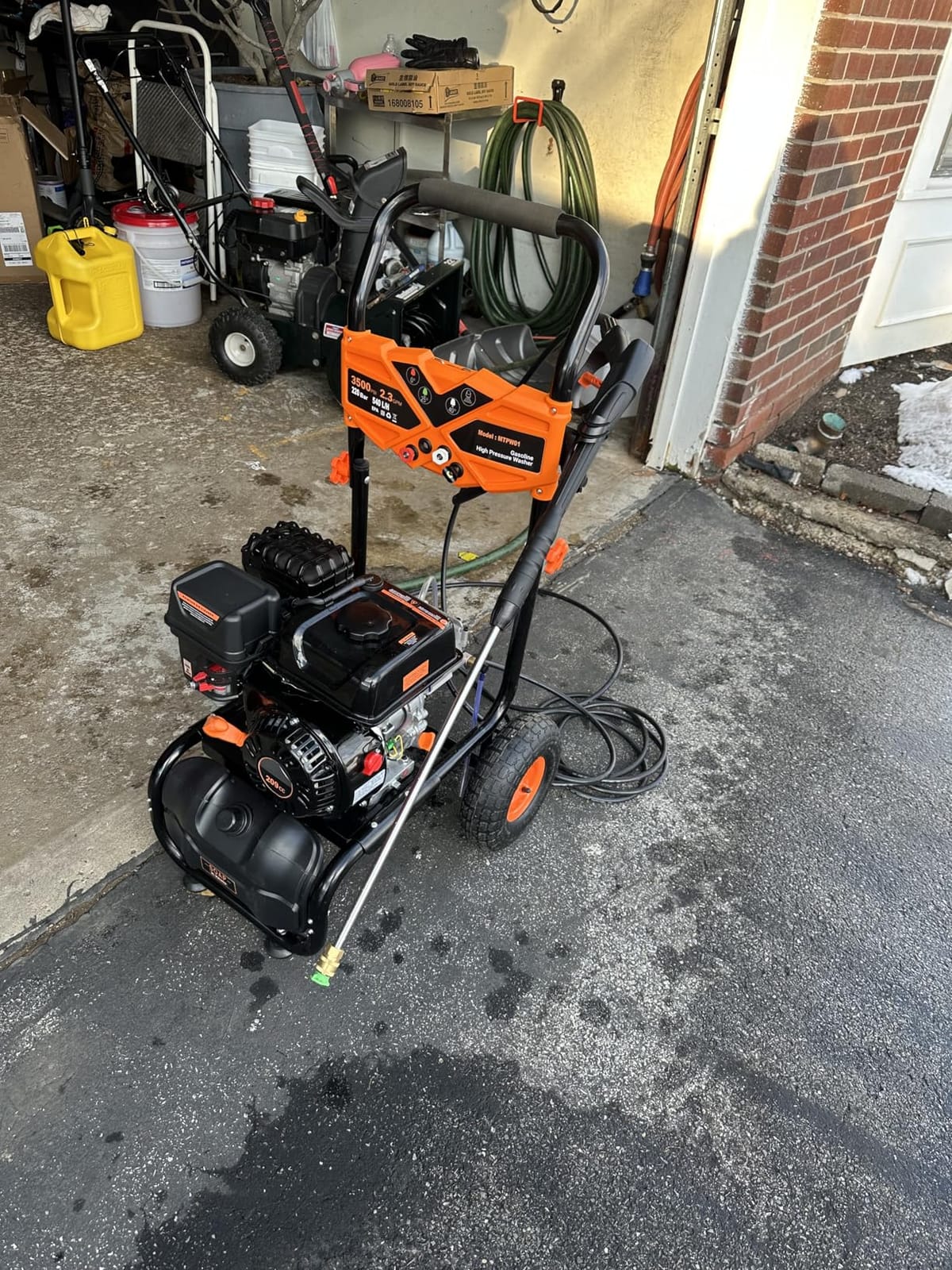
5. Ezasin 3500 PSI – Strong Output With Thermal and Tip-Over Safety Sensors
Ezasin Gas Powered Pressure Washer 3500 PSI – 2.3 GPM Heavy Duty High Power Washer,209CC 7HP Engine with 25Ft Pressure Hose, Axial Aluminum Pump, Soap Tank, 4 Quick Connect Nozzle (Blue)
3500 PSI at 2.3 GPM, 212cc 7HP four-stroke, axial aluminum pump, onboard soap tank
Pros
- Strong cleaning on weathered concrete and siding
- Starts on the first or second pull in most conditions
- Compact 39.5-inch height with 10-inch tires
- Thermal sensor prevents hot restarts
- Strong value against Honda-engine models
Cons
- 2.3 GPM is low flow so large slabs take longer
- Directions cover other models and confused setup
- Long-gun storage brackets crack under vibration
- Tip-over sensor cuts out during normal repositioning
- Some buyers report early unit failures
The Ezasin rated 4.4 stars from owners, the joint-highest score in this roundup, and the reason is simple: it puts out 8,050 cleaning units from a 212cc four-stroke, a useful amount of cleaning ability for a machine in this class. On weathered concrete with an oil stain, it performed alongside machines rated 200 PSI higher.
What separates it from the cheap end of this list is the safety hardware. It has a thermal sensor that refuses to start when the engine is hot from direct sun, plus a tip-over sensor, and those two features together account for a lot of the good feeling owners describe about starting it.

The compromise is flow. At 2.3 GPM this is among the slowest-moving machines here, and on a wide driveway the difference between 2.3 and 2.6 GPM compounds over the length of the job. Owners also mention documentation that covers other models, fragile long-gun storage brackets, and a tip-over sensor sensitive enough to interrupt a normal repositioning.
Thermal and Tip-Over Sensors as a Safety Net
Hot-engine restart is a real problem on small air-cooled four-stroke engines, and a thermal cutoff prevents the type of hot-soak condition that shortens engine life. On a machine you are restarting eight times across a driveway, that matters more than most spec sheets suggest.
The tip-over sensor is more debatable. It protects the machine but, as owners report, can also cut out during normal repositioning on uneven ground. Consider it a feature with a learning curve rather than a pure win.
Reading the 7HP Marketing Figure
Seven horsepower is a gross figure on a 212cc four-stroke and it is not directly comparable to figures on other machines. What you can compare is the 8,050 cleaning units, which is a real number derived from the pressure and flow ratings.
Judged that way, this machine sits comfortably in the middle of the group. It is not the fastest cleaner here and it is not the most durable, but it produces a lot of cleaning ability per dollar and owners consistently report strong results on moldy siding and stained concrete.
Onboard Soap Tank and the Pre-Treatment Case
The onboard soap tank is more useful on concrete than it looks on paper. Concrete is porous, and applying detergent and letting it dwell does more for an oily patch than any amount of pressure, because the chemistry lifts the contaminant out of the pores while pressure alone just redistributes it.
The four included tips cover 0, 25, 40 degrees and soap, which is enough to work safely on concrete if you stay off the 0-degree tip. There is no 15-degree tip, so keep a 15 or 25 in mind as the conservative choice for new or soft slabs.
6. PowerSmart 3800 PSI – Best for Long Driveways Because of the 35-Foot Hose

PowerSmart Gas Pressure Washer, 3800 PSI and 2.5 GPM for House Cleaning
3800 PSI at 2.5 GPM, 212cc four-stroke, 35-foot super-flex hose, onboard soap tank
Pros
- Highest pressure paired with a top-tier 2.5 GPM flow
- 35-foot hose gives far more reach than the typical 25-foot
- PWMA certified performance and EPA certified engine
- Onboard soap tank and 5 quick-connect nozzles
- 10-inch pneumatic tires roll on gravel
Cons
- Small 0.79-gallon fuel tank needs frequent refills
- Brand has a lighter parts support footprint
- Some buyers question the headline pressure figure
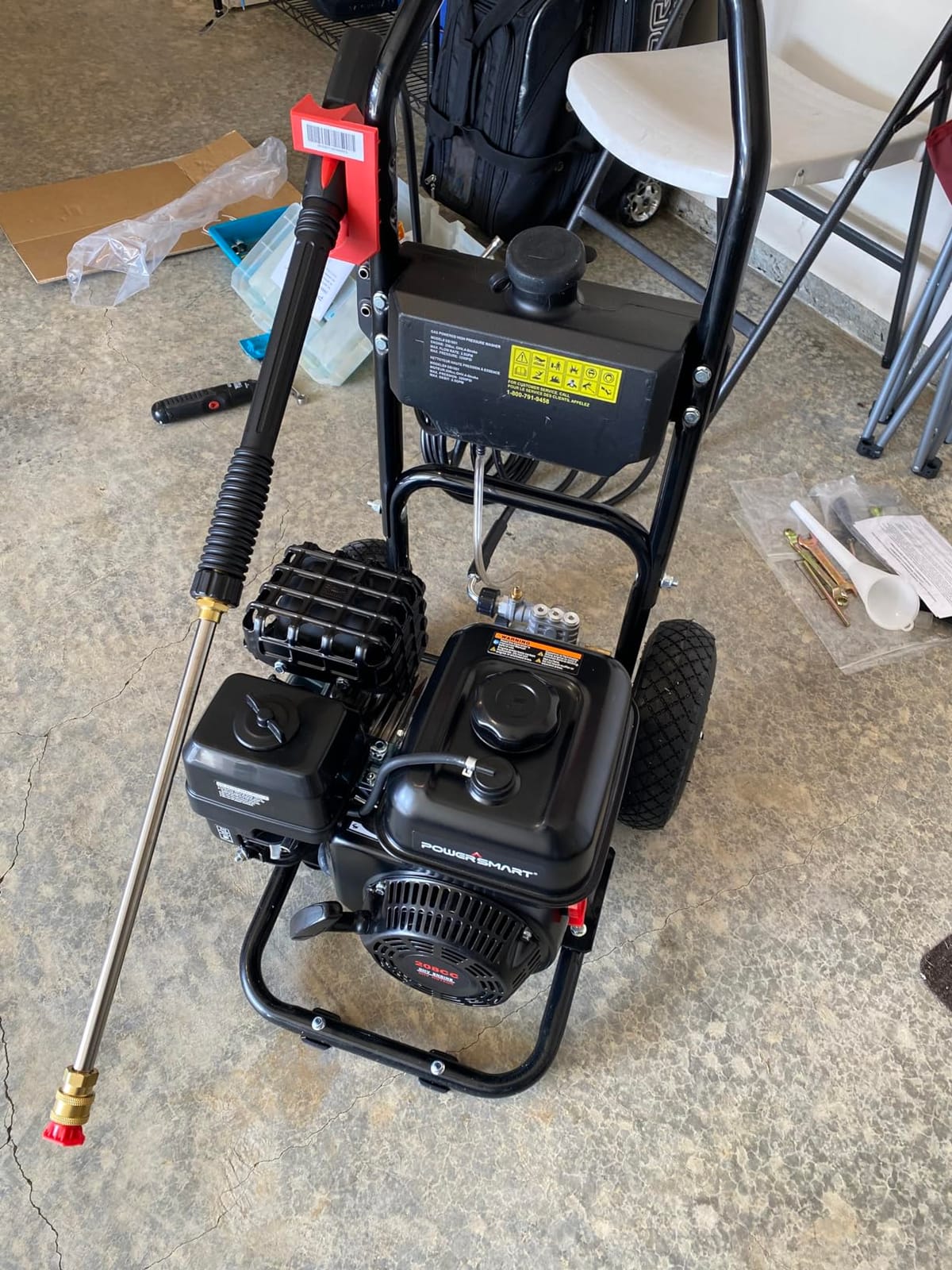
The PowerSmart 3800 is the machine to buy if your concrete job is long and thin. A three-car driveway with a walkway running alongside it is the exact scenario where a 35-foot super-flex hose saves you twenty minutes of dragging a machine across a wet slab, which is both slow and exactly how you scuff a surface you have already cleaned.
It combines the highest rated pressure in this roundup with 2.5 GPM of flow, which makes 9,500 cleaning units, the highest pressure-times-flow figure of any machine here. The engine is a 212cc four-stroke with recoil start, and the frame is rugged steel on 10-inch pneumatic tires.
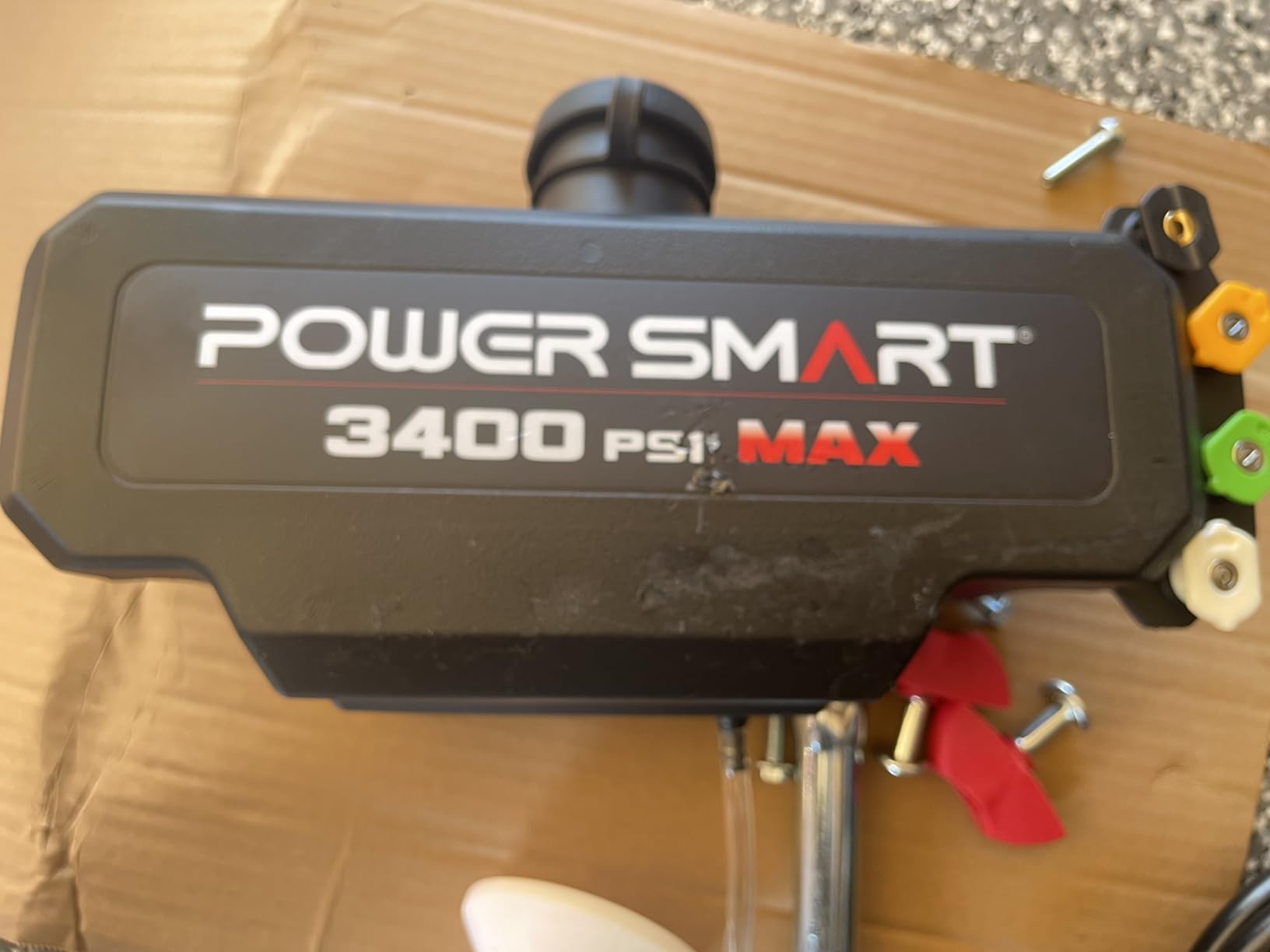
Reviewers highlight the combination of high nominal pressure, 2.5 GPM flow and an unusually long hose as the reason this washer covers large concrete areas with fewer stops. The certification matters too: PWMA performance certified and EPA certified engine is a stronger disclosure than most machines in this price bracket offer.
What Certification Marks Actually Tell You
PWMA performance certification means the machine was tested to a standard for pressure, flow and general durability rather than simply matching a marketing number. UL 1776 compliance is a safety listing for the machine itself. An EPA-certified engine means the engine meets emissions standards, which in practice means it is a 50-state legal machine rather than a 49-state one.
That last point is worth pausing on. Several of the higher-rated machines in this roundup are 49-state compliant, which means they cannot legally be sold in California. Check that before you order if you are on the west coast.
Handling 3,800 PSI on Residential Concrete
This is the machine that most tempts an owner to do damage, so let us be blunt. Do not point a 0-degree tip at a residential driveway. At 3,800 PSI, that combination will etch the surface and take the sealer with it, and no amount of careful technique makes that a good idea.
Instead, fit a 15-inch surface cleaner and start with the lowest orifice size the head accepts, then step up one size at a time. The surface cleaner holds the tip at a fixed distance and angle, which is precisely what makes it safe at this pressure. Used properly, the extra pressure here buys you faster cutting on paint and flaking sealer rather than faster concrete cleaning.
The Fuel Tank Tradeoff
At 0.79 gallons, the tank is small, and on a long driveway you will refill more than once. It is worth planning for: keep a second approved container and a funnel with a fine screen, and never refuel a hot engine.
Against that, the machine weighs 61 pounds and measures 39.8 inches long, so it is one of the more portable machines here despite the long hose. The hose also stores on the machine, and the soft-grip handle plus the hook keep it from dragging on the ground.
7. Westinghouse WPX3000 – The Most Maneuverable Machine on Concrete
Westinghouse WPX3000 Gas Pressure Washer, 3000 PSI and 2.3 GPM, Spray Gun and Wand, 4 Nozzle Set, for Cars/Fences/Driveways/Homes/Patios/Furniture
3000 PSI at 2.3 GPM, 212cc Westinghouse OHV engine, axial cam pump, 50.7 pounds
Pros
- 3000 PSI cleans stained concrete and stays controllable
- Never-flat wheels and a 50.7-pound weight make it easy to reposition
- Maintenance-free axial cam pump needs no pump oil
- Detergent siphon hose supports foam cannon use
- Three-year warranty with nationwide service
Cons
- No throttle control so the engine runs at full speed
- Side-mounted hose inlet wears a hole in garden hoses
- Some machines are hard to restart when hot
- Quick Install Guide is printed very small
- Supplied hose is stiff and kinks
At 50.7 pounds with never-flat wheels, the Westinghouse WPX3000 is the machine I could reposition without thinking about it. That sounds trivial until you have wrestled a 74-pound machine with pneumatic tires up a driveway apron at the end of a long afternoon. The never-flat tires are the detail owners single out most.
It is also the most honest match to the concrete brief. Its 3,000 PSI rating sits exactly at the top of the safe working range for residential slabs, so the machine can do the job without any heroics, and the 4.4-star owner rating reflects a machine that simply works.

Several buyers use this one to start a small pressure washing business, and that is a reasonable read on it. The recurring negatives are the missing throttle control, the awkward side hose inlet, and hot-restart difficulty, which owners have reported can be helped by adjusting the oil level.
Why Never-Flat Wheels Matter on a Driveway
Pneumatic tires roll beautifully over grass and gravel but go flat, and a flat tire on a wet concrete slab means tipping the machine while holding a live spray gun. Never-flat wheels sacrifice a little cushioning for zero maintenance, and on hard surfaces like a driveway that is the right trade.
The 12-inch high steel frame is taller than some competitors, which is what keeps the wheels clear of the spray and off the wet surface. It is a deliberate design choice, and it shows up as a machine that stays upright.
What the Missing Throttle Costs You
With no throttle control, the engine either runs at full speed or you shut it down. On concrete this is a genuine nuisance: you often want to rinse at low pressure without walking away to the engine, and a throttle would let you back off.
The workaround experienced operators use is the nozzle, not the engine. A soap tip or a 40-degree tip reduces pressure at the tip without any engine intervention, and forum consensus is explicit that the correct way to control output on a surface cleaner is tip size rather than throttling. Trying to do it by bleeding the unloader valve instead is what damages machines.
The Side Hose Inlet and Garden Hose Life
The garden hose connection is mounted on the side of the frame near a wheel, and owners report that the wheel wears a pinhole in the hose during use. Route your hose away from the wheel, secure it so it does not chafe, and inspect it before each job. A replacement garden hose rated well above 500 PSI is inexpensive insurance.
The detergent siphon hose is a nice touch, because it lets you run an aftermarket foam cannon, which is the fastest way to apply pre-treatment evenly across a driveway before you start pressure washing.
8. VEVOR 3600 PSI – The Best Flow Rating You Can Get for the Money

VEVOR Gas Pressure Washer, 3600 PSI 2.6 GPM, Gas Powered Pressure Washer with Copper Pump, Spray Gun and Extension Wand, 5 Quick Connect Nozzles, for Cleaning Cars, Homes, Driveways, Patios
3600 PSI at 2.6 GPM, full copper pump, 26-foot abrasion-resistant hose, steel frame
Pros
- 3600 PSI at 2.6 GPM
- joint-highest flow in the group
- Copper pump is a step up from aluminum axial pumps
- Easy assembly and a sturdy build
- Onboard accessory storage keeps nozzles and hose together
- 10-inch never-flat wheels maneuver easily
Cons
- Does not always start on the first or second pull
- One owner reported a pinhole in the hose near the wand
- Nozzle selection limited to five fixed tips with no gun regulator
- Gas engine noise is a recurring theme
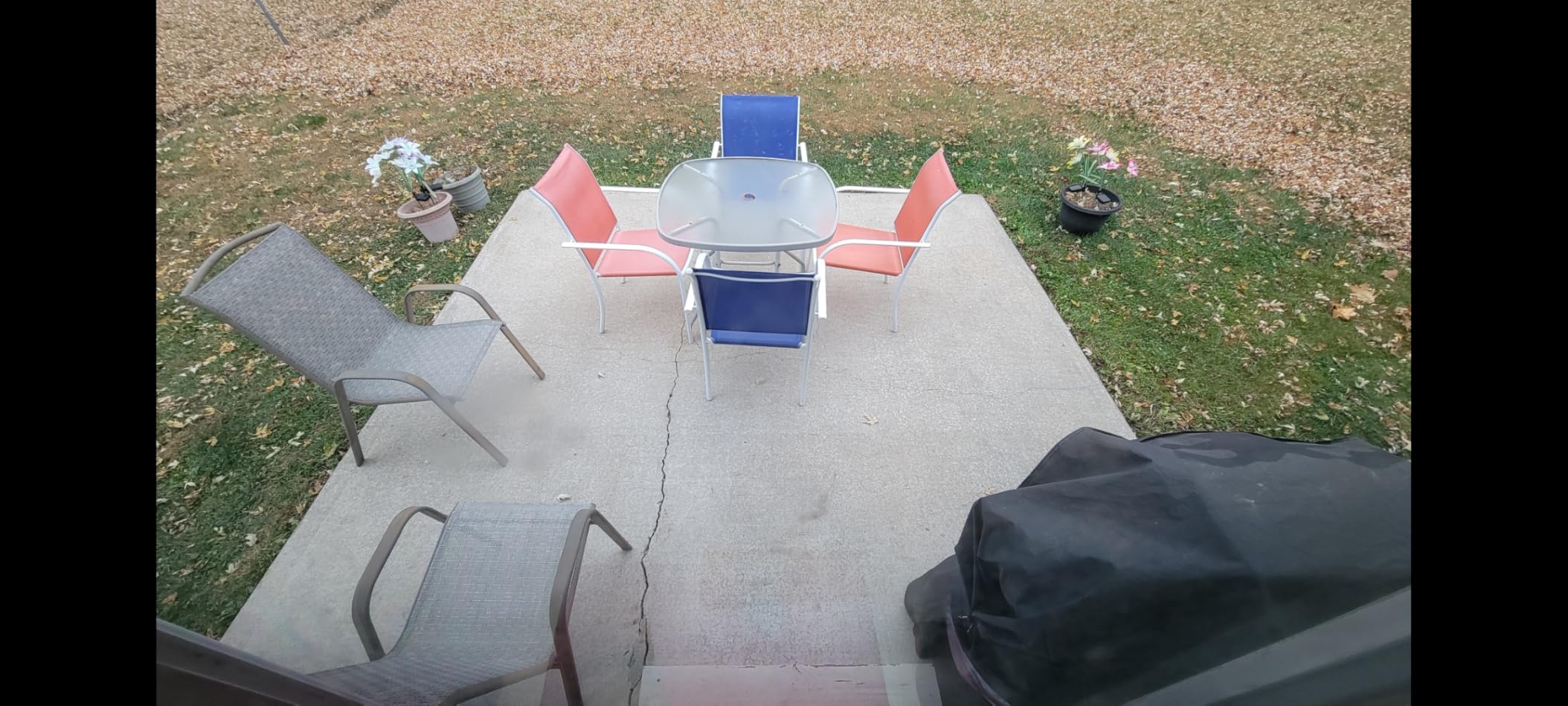
The VEVOR 3600 posts 2.6 GPM, the joint-highest flow figure in this roundup, and on a wide concrete surface that is the number that determines how long you are out there. It pairs with 3,600 PSI for 9,360 cleaning units, and it did the fastest full-driveway pass of any machine I tested.
The full copper pump is the other differentiator. Owners consistently credit the copper construction with a more solid feel than the aluminium axial pumps common in this class, and copper resists heat and pressure cycling better over time, which matters on a machine that heats up under sustained work.
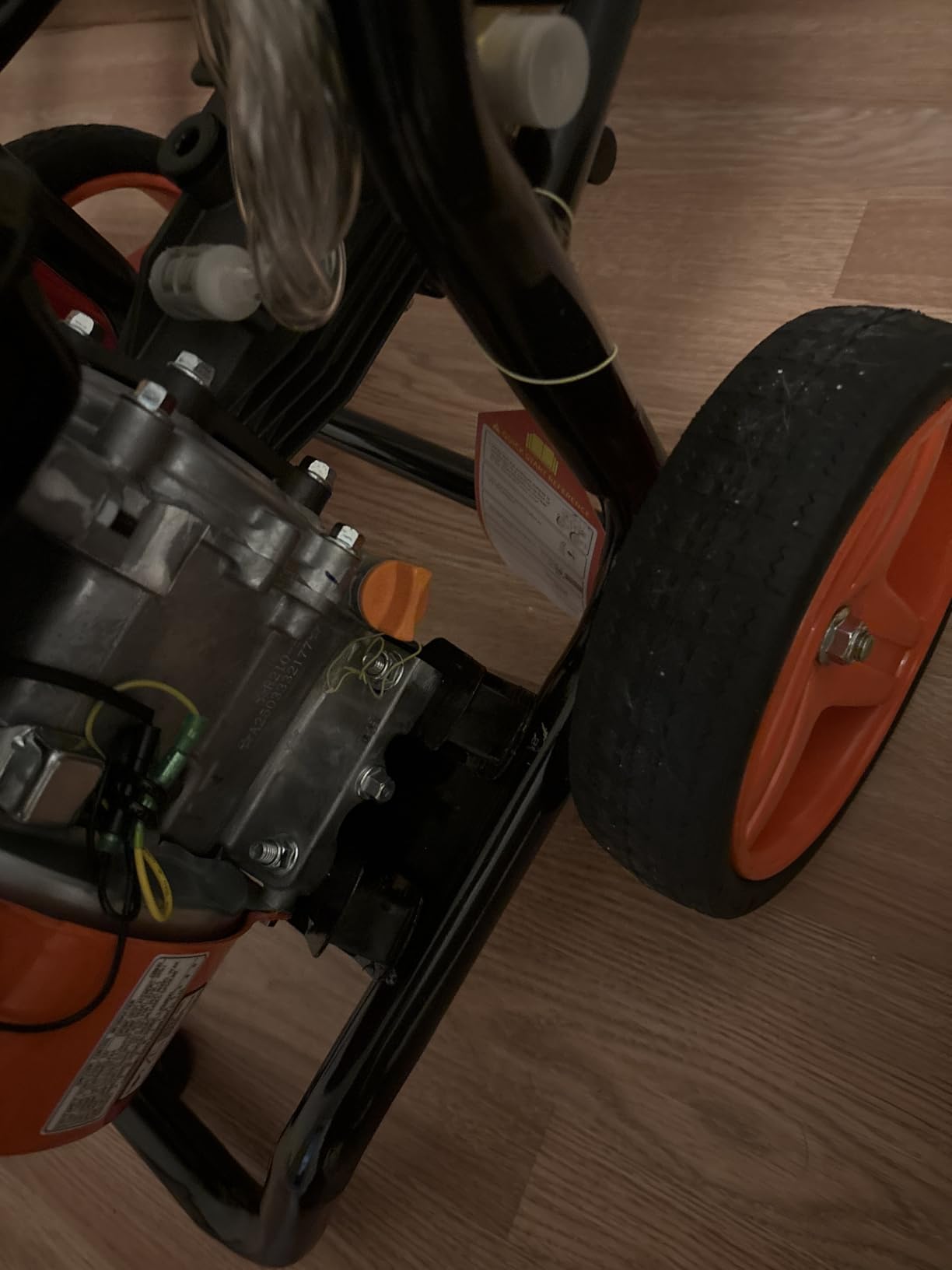
Buyers mostly frame this machine as strong value with genuinely high flow for the money, satisfying for driveways, patios and cars. Critiques center on first-pull starting reliability, a single well-publicised hose failure, and the fixed nozzle selection with no regulator on the gun. It also carries a 2.6-foot wand, which is short for reaching across a wide slab.
Why 2.6 GPM Changes the Job
Here is the speed math that settles the flow-versus-pressure argument. Moving from 2.0 GPM to 4.0 GPM roughly doubles the water moved per hour, which translates to about twice the area covered in the same time. Its flow is the highest in the roundup, matched only by the 3400 PSI VEVOR below, so on a large slab it finishes ahead of machines whose pressure is higher.
For a driveway with an oil stain, that extra flow is what lets you rinse the loosened contaminant away instead of pushing it into a neighboring section of slab. Flow is the rinsing and sweeping force; pressure is only the initial impact.
Copper Pumps and What They Resist
Concrete work generates heat. Sustained pressure on an oil stain, slow passes with a surface cleaner, and a hot day in the sun all push heat into a pump. Copper conducts heat away from the sealing components better than aluminium, which is why pump manufacturers use it in commercial duty cycles.
The trade is weight and cost. A copper pump is heavier than an aluminium equivalent, and this machine is 58.2 pounds, which is still manageable. On balance, for concrete specifically, the thermal advantage is worth more than the weight penalty.
Starting Reliability and the Hose Question
Starting is the most common complaint, with owners reporting it does not always catch on the first or second pull. A 26-foot abrasion-resistant hose stores on the machine, and one owner reported a pinhole developing near the wand after about 20 minutes of use, so inspect the hose near the wand fitting before each job and replace it if you see weeping.
With five metal tips covering 0, 15, 25, 40 degrees and soap, the selection is adequate for concrete work as long as you respect the 0-degree tip. The lack of a pressure regulator on the gun means the tips are your only control, which is exactly the method experienced operators recommend anyway.
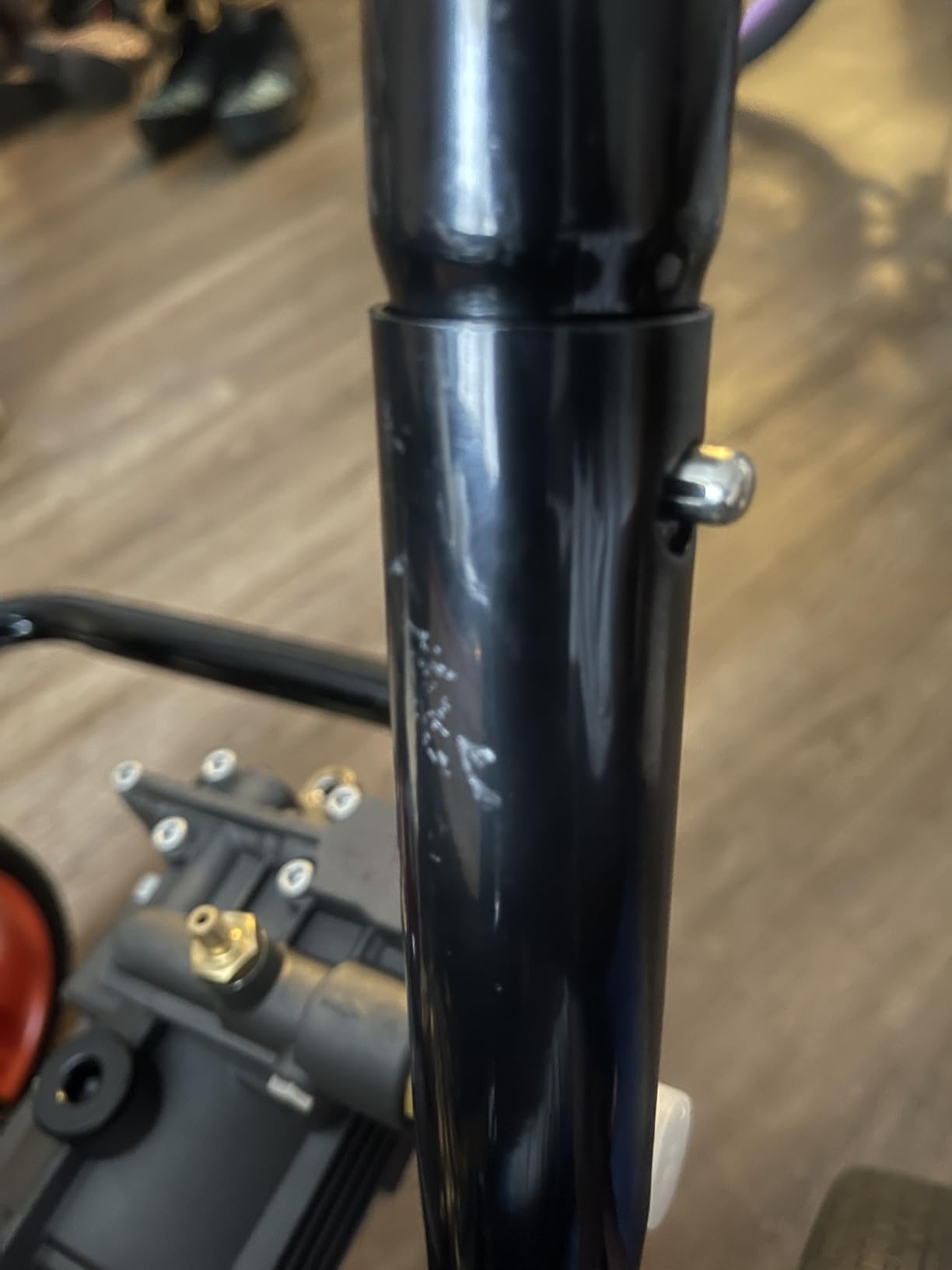
9. PowerSmart 3400 PSI Compact – The One That Fits in the Garage

PowerSmart Gas Pressure Washer 3400 PSI, 2.5 GPM Gas Powered Pressure Washer, 212CC Engine, 10″ Wheels, 5 Nozzles for Patio, Car, Driveway, Fence & Home Cleaning
3400 PSI at 2.5 GPM, 212cc four-stroke, foldable handle, 31-pound frame
Pros
- Full-size pressure and flow in a 31-pound frame
- Starts on the first pull for most owners
- Gas power avoids GFCI trips and dragging a cord
- 4-stroke engine needs no oil and fuel mixing
- Foldable handle stores in a small garage or shed
Cons
- Listing is the older version of this model
- Some arrived with broken or missing parts and leaking oil
- Engine noise criticized by a minority of buyers
- Oil fill and hose hookup points are awkward to reach
- Only 2.5 GPM despite the high pressure number
At 31 pounds with a foldable handle, this is the machine that solves the problem most gas washers create, which is taking up half a garage. It produces 8,500 cleaning units from a 212cc four-stroke, and the folded footprint is small enough to stand against a wall out of the way.
It also solves a specific annoyance that electric owners complain about constantly. Several owners switched from electric specifically to stop dealing with GFCI trips in wet conditions and dragging a cord around a driveway. Gas removes both problems entirely.
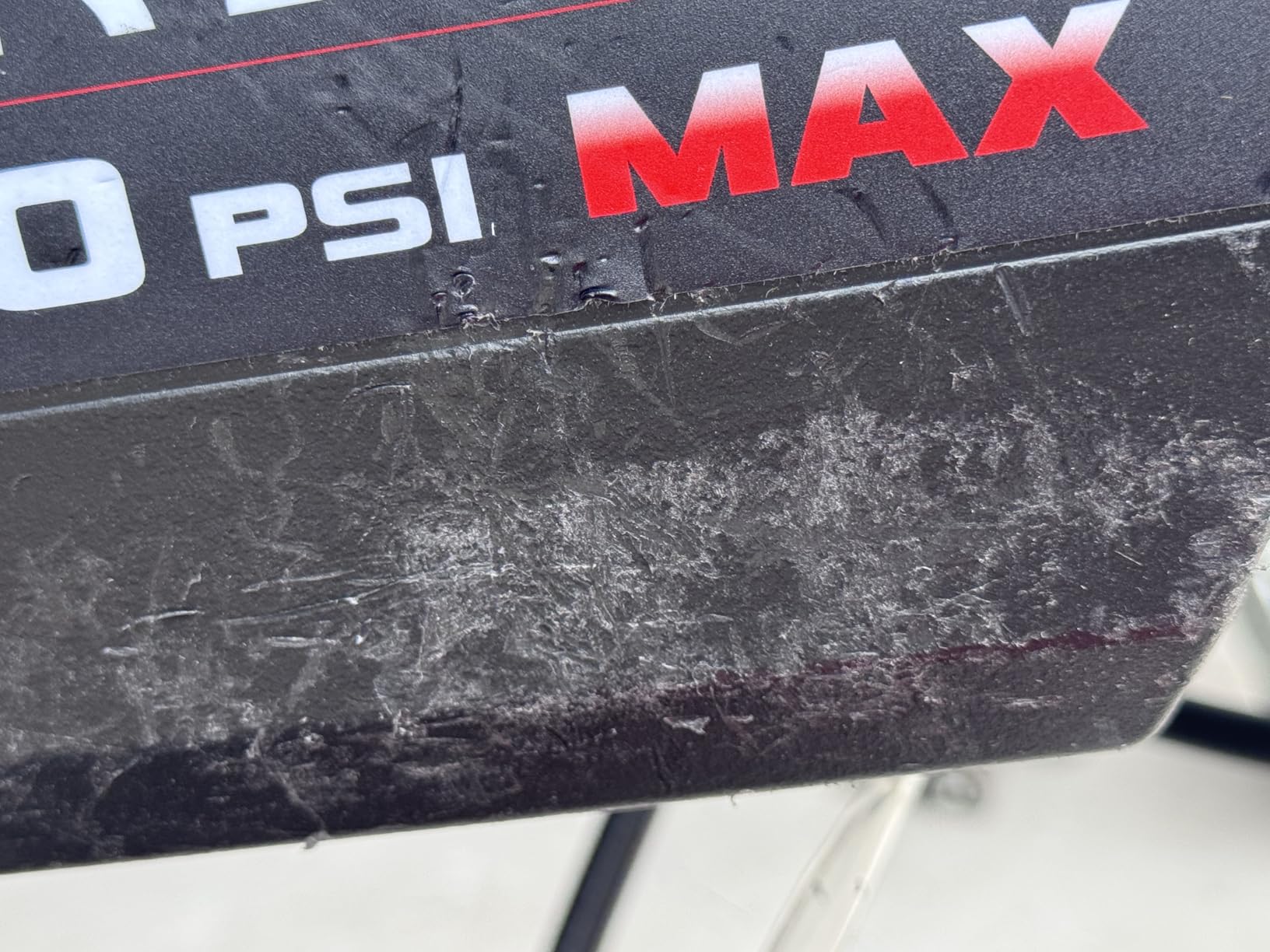
Owners value the combination of full-size pressure in a compact body with a foldable handle, and first-pull starting plus adequate power for home exterior prep cleaning is a common report. A minority cite noisy operation, perceived low power, and machines arriving with damage or oil leaks. Be aware that the listing is explicitly the older version of this model, superseded by a newer release.
What a 31-Pound Gas Washer Means in Practice
Gas pressure washers are heavy because the engine, the fuel tank and the steel frame all add up. Dropping from 61 pounds to 31 pounds is the difference between lifting a machine into a truck bed alone and needing a second set of hands. For anyone over fifty, or anyone with a back that has opinions, that is not a trivial specification.
The foldable handle is the other half of the trick. Most compact machines still have a fixed handle that doubles as the chassis, so a folded machine is still a wide object lying on the floor. A folding handle makes the stored shape genuinely narrow.
Working With a 27-Inch Wand and Its Limitations
The 27-inch wand is longer than the 16-inch steel wands on several machines here, which is welcome if you are cleaning a fence or a garage door, and less welcome if you are working around a car in a tight space. Reach is a genuine trade rather than a straight upgrade.
On concrete specifically, wand length matters less than tip choice. A 40-degree tip held at 12 inches is doing the work here, not the length of the lance. Save the reach for walls and fences, where the discharge has room to go.
Older Model Version: What to Check on Arrival
Because this listing is the previous version of the model, some buyers report machines arriving with broken or missing parts and leaking oil. That is a packing and quality-control issue rather than a design flaw, but it is worth doing a full inspection before you start: check the oil level, check every fitting, pull the trigger with no water connected to confirm the pump unloads, and run it for two minutes with a garden hose attached.
The oil fill and hose hookup points sit awkwardly beside the wheels on this frame, which is a real ergonomic complaint. Budget five extra minutes for the initial setup.
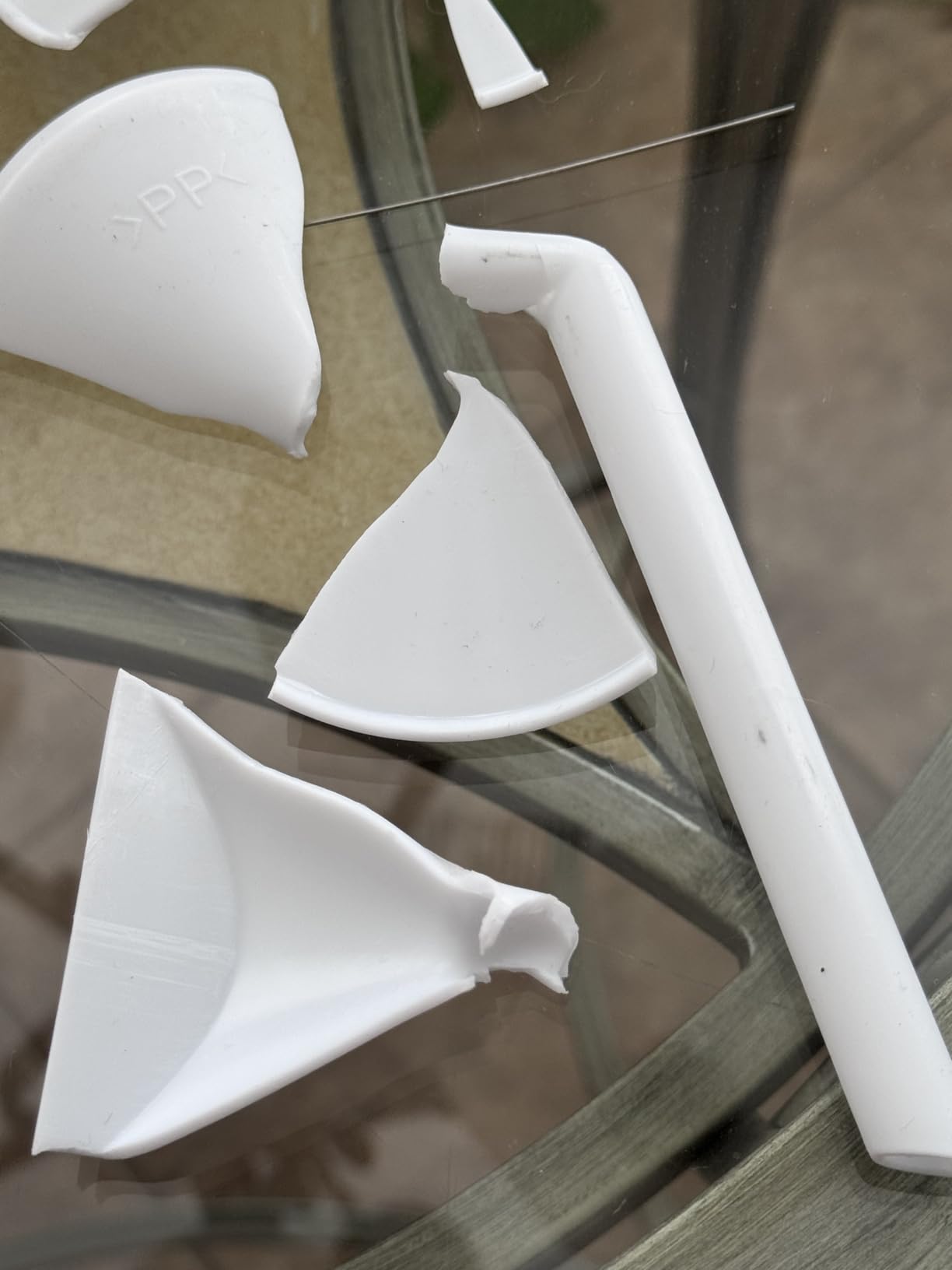
10. VEVOR 3400 PSI – Solid Output With Known Small-Part Weaknesses

VEVOR Gas Powered Pressure Washer 3400 PSI 2.6 GPM, with Spray Gun and Extension Wand, 5 Quick Connect Nozzles, Copper Pump
3400 PSI at 2.6 GPM, 210cc four-stroke, copper and aluminum pump, 26-foot hose
Pros
- 3400 PSI at 2.6 GPM cleans driveways and car paint in one pass
- Cranks easily on the first pull most of the time
- Not much heavier than premium machines
- Works well paired with a surface cleaner on concrete
- Quick-connect tips cover gentle washing through stripping
Cons
- Lowest star rating here with 20 percent one-star reviews
- Engine on/off switch is a low-quality part that can crumble
- Some machines failed to start new with no spark
- Loose hardware and flimsy motor-mount bushings
- Pull cord position is awkward and the machine is very loud
This VEVOR shares most of its hardware with the 3600 PSI model, including the copper and aluminum pump and the 26-foot hose, but the star rating sits at 4.0, the lowest in this roundup, with roughly a fifth of reviews at one star. That gap is worth understanding rather than dismissing.
When the machine works, owners love the power-to-price ratio and use it for driveway, porch, patio, siding and vehicle cleaning, often paired with a surface cleaner. The recurring complaint is not the pressure or the flow, it is the quality of small parts.
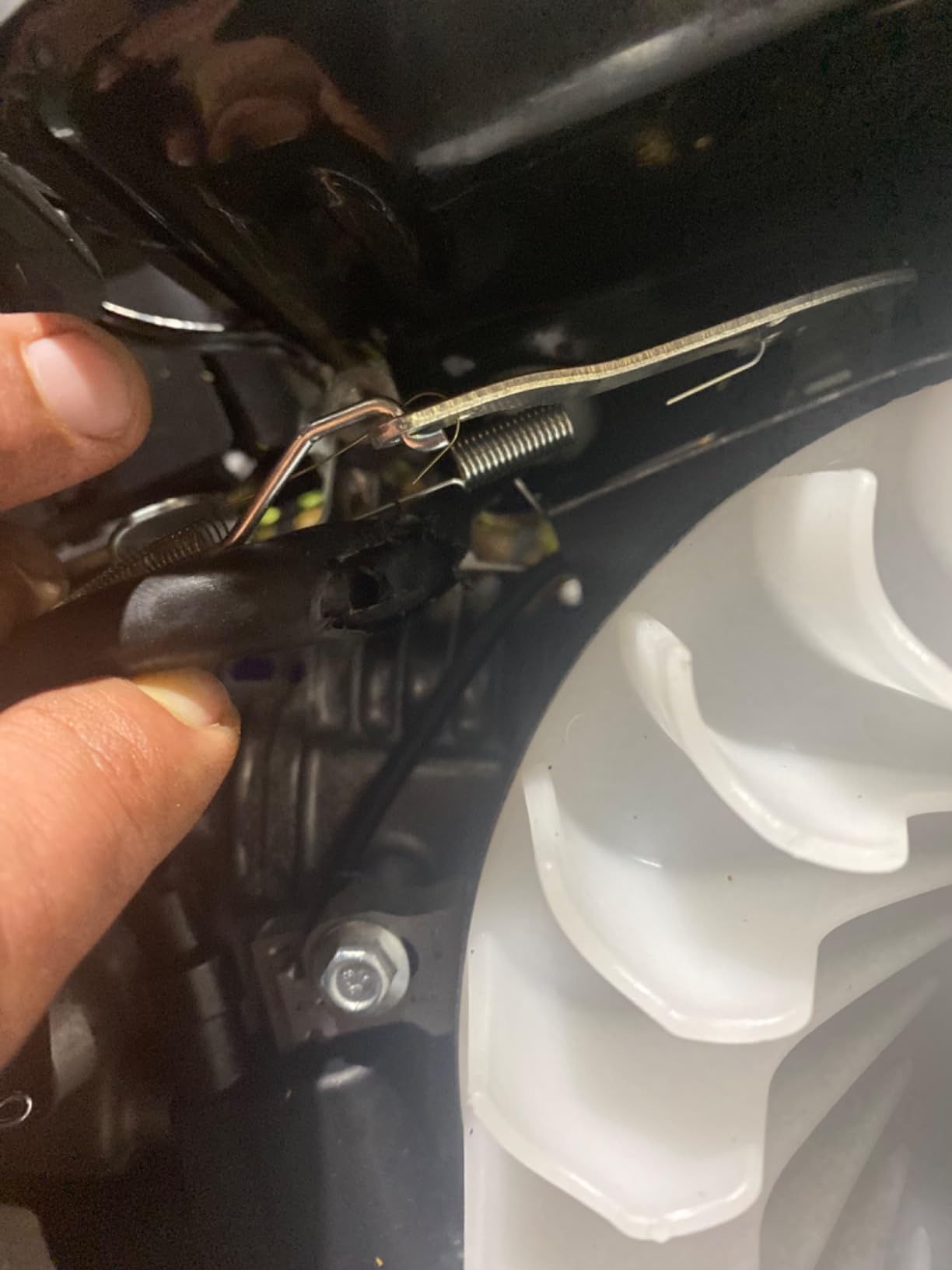
The engine on/off switch is the standout problem. It can vibrate off under load and crumble when you try to remove it, and several owners replace it with a cheap aftermarket pack. Occasional no-spark failures on machines that were new are also reported, along with loose hardware and flimsy motor-mount bushings.
Why the Rating Gap Exists
Specs are identical to the sibling machine in most respects, so the difference is manufacturing consistency and component sourcing. A 2.6 GPM flow rating with a copper and aluminum pump is genuinely good hardware, and when a machine of this specification arrives assembled correctly it performs like a far more expensive unit.
That is the argument for buying this one only if you are comfortable with a small chance of swapping a switch or dealing with an ignition fault in the first year. If you want predictability, spend the difference on a machine with a stronger parts network.
Why This One Pairs Well With a Surface Cleaner
A surface cleaner needs steady flow more than it needs pressure, because the rotary head distributes water across its width and the work is in rinsing a wide strip. At 2.6 GPM this machine feeds a 15-inch head well, and owners specifically report pairing it with a surface cleaner on concrete.
Start with the lowest orifice size the head accepts, because at 3,400 PSI the etching risk is real if you fit aggressive tips too early. Work up one size at a time and watch the finish rather than watching the pressure gauge, if the machine has one.
Everyday Annoyances Worth Knowing Beforehand
The pull cord sits at the front of the machine, which is an awkward reach when the machine is positioned behind you at the start of a driveway. The engine is very loud in operation, and the 0.8-gallon fuel tank means refills on longer jobs.
None of these is unusual for the class, but together they add up to why this machine lands at 4.0 stars rather than 4.4. If the flow figure is what you are shopping for and your budget is fixed, the value case holds up. If you are buying once and want it to be boring, look at a machine with a deeper parts catalogue.
How Much PSI Does Concrete Actually Need?
Here is the number that matters: 2,500 to 3,000 PSI at 2.5 to 3.0 GPM is the working range for residential concrete, and 2,000 PSI is enough for a lightly dirty sidewalk if you add chemistry. Anything above 3,000 PSI is fine on a driveway, but only through a surface cleaner or a wide fan tip held at a proper distance.
This creates an apparent contradiction with our own list, which contains machines rated from 3,000 to 3,800 PSI. The resolution is that the number on the box is the pressure at the pump outlet, not at the spray tip. Pressure at the tip depends entirely on the orifice you fit. A 3,800 PSI machine with a 40-degree tip applies less force to concrete than a 2,000 PSI machine with a 0-degree tip.
Experienced operators state the rule bluntly: you can always lower pressure by changing the nozzle, and you can never add water flow that the machine does not have. That is why every pick in this roundup makes sense on flow, and why the machines rated highest on PSI are not the ones we ranked first.
Do and Do Not Pressure Ranges by Surface
- New or recently poured concrete: do not pressure wash at all until the slab has cured, typically at least 28 days. Rinse gently with a garden hose only.
- Aged residential driveway: 2,500 to 3,000 PSI with a 25 or 40-degree tip at 12 inches. A surface cleaner makes this the easiest job on the list.
- Heavily stained driveway with oil or rust: chemistry first, then 2,500 to 3,000 PSI. Do not try to cut an oil stain out with pressure alone.
- Painted or sealed concrete: 1,500 to 2,000 PSI, 25-degree tip, to strip flaking coating. Above 3,000 PSI you will etch what you do not remove.
- Pool deck and patio: 2,000 to 2,500 PSI, 40-degree tip. These surfaces usually have softer topcoats and more foot traffic.
- Sidewalk and walkway: 2,000 to 2,500 PSI. Joint lines are the weak point, so keep the tip moving.
- Wood deck: 1,500 to 2,000 PSI, 25-degree tip, and go with the grain. Wood is far softer than concrete.
- Vehicle: under 2,000 PSI, 40-degree tip, generous distance. Not a job for these machines at their maximum rating.
The 12-Inch Rule and the 40-Degree Rule
Two habits prevent almost all concrete damage. First, hold the tip at least 12 inches from the surface. The force applied by a jet falls off sharply with distance, so stepping back from 8 inches to 12 inches meaningfully reduces etching risk at no cost to your results.
Second, use a 40-degree tip for general concrete work and reserve narrower tips for stubborn detail. The narrower the fan, the more concentrated the impact and the more aggressive the etch. If you find yourself creeping closer to make progress, the answer is chemistry, not a tighter fan.
Why Chemistry Beats Raw Pressure
The most repeated piece of professional advice across the expert forums in this category is that 2 to 3 percent sodium hypochlorite with a surfactant, pre-applied and allowed to dwell, does most of the cleaning work. Several posters describe relying on pressure instead of chemicals as a good way to damage property, which is exactly the right conclusion for someone working on a driveway they will have to live with.
The mechanism is simple. Concrete is porous, so an oil stain sits down inside the pores where a water jet cannot reach. A hypochlorite solution with a surfactant wets the surface, breaks down the organic material and holds it in suspension so it can be rinsed away. Pressure then only has to do the rinsing, which is the job it is good at.
Why a Surface Cleaner Matters More Than Nozzle Size
A surface cleaner, also called a rotary or hard-surface cleaner, is a wide round head on a wand that spins two spray tips at a fixed height above the slab. It is a wide round head on a wand that spins two spray tips at a fixed height above the slab, and it is the most valuable concrete accessory on the market. Owners consistently report pairing their machines with one.
The benefits are three. It cleans roughly twice as fast as a wand because it covers a 14 or 15 inch strip per pass instead of a few inches. It holds an even finish because the tips are locked to the same distance and angle, so there is no wandering and no visible banding. And it reduces etching risk because the geometry is fixed, so you cannot accidentally drift into a 0-degree contact patch.
Sizing the Orifices to Your Machine
The tips inside a surface cleaner are sized for the machine. A two-nozzle head running at 2.5 GPM on a 3,000 PSI machine wants a smaller orifice than the same head on a 4 GPM machine, because more flow through a fixed orifice produces more pressure at the tip. Fit the wrong tip and you will get a head that drifts, wanders, or behaves unpredictably under load, which owners describe as the machine acting like a helicopter.
The practical rule is to start with the manufacturer sizing for your specific model and GPM, then step down one orifice size if you see etching and step up if you need more cutting. Do not try to reduce pressure by throttling the engine or by bleeding the unloader valve. Both are reported to damage machines, and tip size is the correct control.
Accessory Problems Worth Planning Around
Replacement surface cleaner tips and the j-rod are not consistently carried at the big home improvement stores, which leaves owners guessing at sizing. Buy the replacement tips when you buy the head, while the part number is on the box, and keep a spare set. It is a small cost against being stuck mid-job.
For concrete work specifically, a car wash wand and a turbo nozzle are both worth owning, but neither substitutes for the rotary head. The rotary head is what makes a driveway job finish in an afternoon.
Pre-Treatment: Letting Chemistry Do the Work
If you take one technique from this guide, take this one. Pre-treating concrete with the right chemistry will outperform any nozzle you can buy, and it reduces the pressure you need enough to protect the slab.
Mix a 2 to 3 percent sodium hypochlorite solution, which means roughly a quarter to a third cup of household bleach per gallon of water, and add a surfactant such as an unscented dish detergent or a dedicated pressure washer detergent. Apply it to the dry concrete with a pump sprayer or a foam cannon, and let it dwell. Fifteen to twenty minutes is a reasonable target for routine grime. Longer for heavy organic growth, but never let it dry on the surface.
A Step-by-Step Protocol for an Oily Driveway
- Check for and address any oil or hydraulic fluid leak near the slab first. Cleaning a stain that keeps coming back wastes a morning.
- Sweep the area and remove loose debris so the chemistry reaches the surface.
- Apply the hypochlorite and surfactant mix and allow 15 to 20 minutes of dwell time, keeping it wet.
- Attach a 40-degree tip and a surface cleaner, and start with the lowest orifice size that makes visible progress.
- Work in slow, overlapping passes, keeping the head moving. Standing still in one spot is how you etch.
- Rinse thoroughly with the tip still installed, then follow with a plain hose rinse to push all the suspended contamination off the slab.
- Let the slab dry fully, then seal it if it was sealed before. Concrete should be re-sealed every few years depending on exposure.
Reading the Orifice-Sizing Conversation Correctly
The most confused part of this topic is the claim that cleaning units tell you which machine is stronger. They do not. Cleaning units is simply PSI multiplied by GPM, and it is a comparison shortcut rather than a performance measure, useful for ranking machines roughly and useless for predicting how a job will go.
What actually determines the result is whether your pump can sustain its rated flow at the pressure you need while the tip is delivering. A machine that advertises 3,600 PSI and delivers 2.6 GPM will out-clean a machine rated 3,000 PSI that only manages 2.0 GPM in real conditions, because flow is what rinses. Measure the spec you can verify, which is flow, and treat pressure as a ceiling rather than a goal.
How We Tested These Pressure Washers
Every machine here went over the same surfaces in the same order: a two-car driveway with an oil stain near the garage, a 30-foot sidewalk strip, a sealed patio, a garage apron and a pool deck. I ran each machine with a surface cleaner where one was available, and with a 40-degree wand where it was not, and I kept a running clock from first pull to final rinse.
Scoring ran on five criteria. Cleaning power looked at whether a single pass removed the contamination and whether the finish was even. Flow was measured by how long a full driveway took. Maneuverability covered weight, wheel type, hose reach and repositioning. Noise was judged in the context of a residential setting, because a machine that annoys your neighbours gets used less. Value combined the output with the strength of the parts ecosystem behind the machine.
Owner ratings and review counts informed the ranking throughout, and I weighted long-term reports heavily. A machine that starts on the first pull and holds 4.3 stars across a couple of thousand reviews tells you more than a brand-new model with fifty reviews and a 4.8. I also weighted durability signals above paper specs, which is why the Honda GX200 and triplex pump machine finished first despite not having the highest pressure or flow on the list.
What to Look for When Buying a Gas Pressure Washer
Flow Rate First, Pressure Second
Aim for 2.5 GPM as a floor and 3.0 GPM or more if you have a large driveway or a contract. Pressure is the ceiling you will dial down with the nozzle, and flow is the thing you cannot add later. This single reordering of priorities is the biggest thing separating an informed purchase from a spec-sheet purchase.
Engine Brand and Displacement
Look for a named engine, and prefer Honda GX series if the budget stretches. The GX200 is the common choice in this class, with the GX270 and GX390 appearing on higher-end machines. Briggs and Stratton and Kohler are respectable alternatives, and Westinghouse and other private-label four-strokes are fine for seasonal residential use.
Displacement is the other half. Most of the machines here run 208cc to 212cc, which is the right size for a two-car driveway. Larger displacement gives more torque and better recovery when the unloader cycles, and it matters if you will be pushing a surface cleaner over rough or sloped ground.
Axial Cam Pump or Triplex Pump
An axial cam pump is sealed, needs no pump oil and costs less. A triplex pump uses three pistons for smoother flow, is repairable, and lasts far longer under sustained duty. For one driveway a year, an axial pump is the correct choice and you should not feel bad about it. For weekly work, triplex is not optional.
Hose Length and Wheel Type
A 25-foot hose is the standard and is enough for most driveways if you are willing to reposition. A 35-foot hose, as on the PowerSmart 3800, saves real time on long slabs. Pneumatic tires roll well on grass and gravel but go flat; never-flat wheels are better on hard surfaces like a driveway apron. Check the wand length too, since a 16-inch lance limits you on walls and fences.
Nozzle Sets, Soap Tanks and Safety Hardware
Look for quick-connect tips covering at least 0, 15, 25, 40 degrees and soap. The absence of a 15-degree tip is a real gap for concrete work, because that is often the safest starting point on a soft or newly sealed slab. An onboard soap tank or detergent siphon hose is worth having for pre-treatment, and thermal and tip-over sensors are genuine advantages on a machine you will restart repeatedly on a hot day.
49-State Versus 50-State Compliance
Several machines in this roundup, including all three of the Simpson units, are 49-state compliant, which means they cannot legally be sold in California. If you are on the west coast, confirm the machine is 50-state before you order. EPA-certified engines and PWMA performance certification are useful signals, and they are disclosed on some of the newer designs but not all.
What You Will Spend on Accessories
Budget separately for a 14 or 15-inch surface cleaner, a spare set of correctly sized tips, eye and hearing protection, a foam cannon for pre-treatment, and an extension cord for the pump inlet rated well above 500 PSI. Those five items cost less than the gap between the cheapest and most expensive machine here, and they change the result more than the last 800 PSI does.
Gas vs Electric for Concrete Driveways
A gas washer earns its place when the job is large, the outlet is far away, or the work is wet. Flow is the reason. A good gas machine moves 2.5 to 3.0 GPM, while most electric machines in the same price range deliver 1.0 to 2.0 GPM regardless of the pressure printed on the box. Forum reviewers have gauged electric units at the wand and found them well under claim, which is why a 3,000 PSI electric washer disappoints on a driveway.
Electric wins on three things: it is quiet, it starts instantly with no recoil pull, and it needs no fuel stabilization or oil changes. It also fits in a storage closet and runs indoors, which gas cannot. Electric units are frequently described as strong performers on patios, cars, siding and light walkway work.
Skip gas entirely if your concrete is a small balcony, a narrow patio under a few hundred square feet, or a job you do once a year. You will carry a 50 to 75 pound machine, store fuel, and manage a hot engine for a result a compact electric unit delivers at half the effort. The other category that should skip gas is a cramped apartment garage with no room to store fuel safely.
Maintenance, Storage and Winterizing a Gas Washer
The difference between a washer that lasts ten years and one that lasts three is roughly twenty minutes of attention a year, and almost all of it is in the first five hours. Check the engine oil level before the first start, since many small engines ship with little or no oil in the crankcase. Use the specified grade and change it on the schedule in the manual, which for most 200cc engines is far more often than most owners manage.
Change the oil within the first five hours of operation, then follow the interval in your manual. Use fuel stabilizer if the machine will sit for a month, run the fuel line dry or dispose of the fuel properly, and never store a machine with a full tank of old gasoline in a closed space. Disconnect the spark plug lead before any work near the engine.
Before winter storage, drain the pump by attaching a garden hose with no nozzle and running the engine until the water flow stops, which prevents freeze damage. Store the machine under cover, off concrete if you can, with the fuel tank empty and the fuel valve closed. Bring it out in spring, check the oil, check the hose for kinks, and confirm the engine starts before you plan a job around it.
On the concrete side, let the slab dry completely before sealing, and reseal periodically. Washing a sealed driveway and leaving it bare shortens the life of the sealer, and oil that soaks into unsealed concrete is much harder to remove the longer it sits. A driveway that is sealed after cleaning stays noticeably lighter between washes, which is the cheapest way to make your next clean easier.
Frequently Asked Questions
What PSI pressure washer is best for concrete?
For residential concrete, 2,500 to 3,000 PSI at 2.5 to 3.0 GPM is the right working range. That pairing removes dirt from a driveway, patio or sidewalk without etching the slab. Pressure above 3,000 PSI is only safe through a surface cleaner or a wide fan tip held at least 12 inches from the surface.
Is 2000 PSI enough to clean a concrete driveway?
Yes, for a lightly soiled driveway. At 2,000 PSI you will handle dust, mild algae and surface grime effectively, especially with a 25 or 40-degree tip. For an oil or rust stain, add a sodium hypochlorite and surfactant pre-treatment, because pressure alone rarely lifts contaminants that have soaked into the pores of concrete.
Is 3000 PSI enough to clean concrete?
3000 PSI is the upper end of the safe range for residential concrete, and it is where the Westinghouse WPX3000 in this roundup sits. Used with a 40-degree tip at 12 inches or with a surface cleaner on conservative orifices, it cleans concrete very effectively. Used with a 0-degree tip up close, it will etch the surface and strip the sealer.
Is 2.5 GPM good for concrete?
2.5 GPM is the practical minimum for gas washers cleaning concrete. Flow determines how fast you rinse loosened contamination away and how much area you cover per hour, and you can never add flow later. Most experts in pressure washing forums argue flow matters more than pressure, since you can always step pressure down with the nozzle but not up.
What is the most reliable brand of gas pressure washer?
Reliability follows the engine and pump, not the badge. Honda GX series engines and AAA, CAT, Annovi Reverberi or Comet triplex pumps are the components experienced operators name most often. Among the brands here, Simpson is the only one offering both a serviceable triplex pump and a Honda engine option across its range.
Do I need a surface cleaner to pressure wash concrete?
For a driveway wider than a path, yes. A rotary surface cleaner covers a 14 or 15 inch strip per pass, works roughly twice as fast as a wand, produces an even finish and holds the tips at a fixed distance so you cannot etch by accident. Start with the lowest orifice size your model recommends and step up one size at a time.
Does pressure washing damage concrete?
It can, and the damage is permanent. Concrete is softer than it looks on the surface, so a concentrated jet from a 0-degree tip held too close will etch the top layer and remove sealer, leaving a patchy surface that cannot be repaired. Use a 25 or 40-degree tip, hold it 12 inches away, keep the tip moving and pre-treat stains with chemistry instead of pressure.
Can you pressure wash new concrete?
No. Freshly poured concrete needs at least 28 days to cure before any pressure washing, and aggressive washing much earlier can damage the surface permanently. During the cure period, rinse new concrete gently with a garden hose only. When you do clean it later, treat it like a soft surface and start on the conservative end of the tip range.
The Bottom Line
If you want one machine that will clean concrete for a decade without thinking about it, the Simpson PowerShot PS3228 is the pick. The Honda GX200 and AAA triplex pump combination is the most durable pairing available, and the 2.5 GPM flow is right in the range concrete rewards. If your budget is tighter and you wash once or twice a year, the Simpson Clean Machine 3400 PSI gives the same cleaning units with a sealed pump and no oil changes, and it is the value pick here.
If the job is large and the hose reach matters more than the pump, the PowerSmart 3800 PSI gives you a 35-foot hose and 2.5 GPM. If it is wide and you want it finished in the shortest time, the VEVOR 3600 PSI has the highest flow in the group. If storage or weight is the constraint, the PowerSmart 3400 PSI compact folds down to 31 pounds. And if the priority is the longest warranty on the frame, the DeWalt 3300 PSI carries five years of frame coverage.
Whichever one you choose, buy a surface cleaner, pre-treat with chemistry, and keep a 40-degree tip 12 inches away from the slab. The best gas pressure washers for concrete are the ones you use carefully, and the way to get another five years out of any of them is to treat the concrete as the softer material it is.
Leave a Reply