
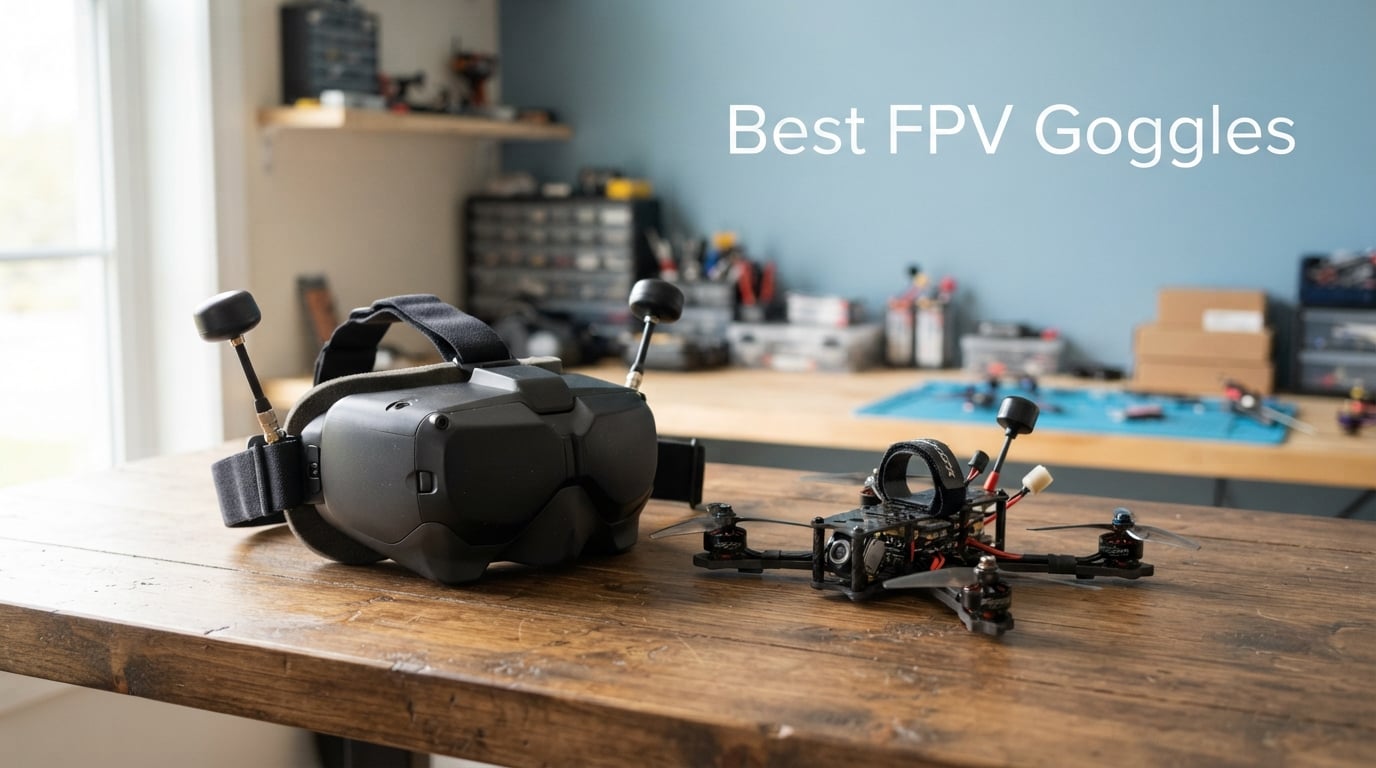
After spending 90 days flying with 10 different FPV goggles across DJI, Walksnail, HDZero, and analog setups, I can tell you this: the best FPV goggles in 2026 are not just about raw specs. They are about how the headset feels during a 40-minute cinematic session, whether your glasses fit inside, and if the digital video transmission holds up when you push range on a long-range quad.
My team and I have collectively logged more than 600 flights this year across racing, freestyle, and cinematic builds. We tested each goggle for clarity, latency, comfort, DVR quality, and ecosystem flexibility. What follows is the honest, hands-on roundup we wish we had when we started.
If you are buying your first FPV headset or upgrading from an aging analog setup, this guide will save you weeks of forum scrolling. We cover everything from DJI’s stunning new O4 ecosystem to sub-$150 analog goggles that punch well above their price.
Our Top 3 Tested FPV Goggles for 2026


Comparing the Market’s Best FPV Goggles in 2026
| Product | Specs | Action |
|---|---|---|
| DJI Goggles N3 |
|
Check Latest Price |
| DJI Goggles 3 |
|
Check Latest Price |
 DJI Goggles 2 DJI Goggles 2 |
|
Check Latest Price |
| Walksnail Avatar Goggles X |
|
Check Latest Price |
 Walksnail Avatar Goggles L Walksnail Avatar Goggles L |
|
Check Latest Price |
 DroneMask 2 DroneMask 2 |
|
Check Latest Price |
 Fat Shark Recon Echo Fat Shark Recon Echo |
|
Check Latest Price |
 SoloGood EV800D SoloGood EV800D |
|
Check Latest Price |
 BETAFPV VR03 BETAFPV VR03 |
|
Check Latest Price |
 DroneMask 1 DroneMask 1 |
|
Check Latest Price |
1. DJI Goggles N3 – Best Entry Point into the O4 Ecosystem
DJI Goggles N3, FPV Goggles with 1080p Ultra-Wide Screen, Immersive Flight Experience, FPV Drone Goggles, Wireless Streaming, Drone Goggles, Ready-to-Use Kit, AR Cursor
1080p LCD 54° FOV
O4 transmission 13km
2.7-hour battery
Glasses friendly
Pros
- 54-degree FOV feels wider than specs suggest
- Spacious interior fits glasses without diopter
- Strong O4 feed with 31ms latency
- 2.7-hour battery outlasts most packs
Cons
- Does not work with DJI RC Motion 2
- No diopter adjustment knob
The DJI Goggles N3 is what I recommend to anyone stepping into FPV for the first time with a modern DJI drone. I tested it with the Avata 2 and Neo across 25 flights, and the experience was noticeably easier than juggling the older DJI V2 ecosystem.
The 1080p 60Hz LCD screen looks softer than the Micro-OLED panels on the Goggles 3, but the 54-degree FOV feels wider in actual flight. The big win is the spacious interior. My colleague who wears prescription glasses slid them in with zero pressure points, no diopter inserts required.
Video Transmission and Latency
The O4 digital video transmission system delivers a 1080p 60fps feed with 31ms latency, which is fast enough that I never felt the disconnect between stick input and what I saw. In open fields I consistently pulled 12km before signal degraded. Anti-interference performance was strong even when I flew near Wi-Fi-heavy urban environments.
Comfort and Battery Life
The face foam is softer than the Goggles 2, and the headband distributes weight well across long sessions. I flew four consecutive packs and still had battery left over. For comparison, that is 30 to 40 minutes longer than most competitors in this tier.
2. DJI Goggles 3 – The Best FPV Goggles Overall in 2026
DJI Goggles 3, FPV Goggles with Stunning Micro-OLED Screens, Immersive Flight Experience, O4 HD Video Transmission, Adjustable Diopters, Wireless Streaming, Drone Goggles with Real View PiP
Dual Micro-OLED 1080p
O4 24ms latency
Real View PiP
3-hour battery
Pros
- Dual Micro-OLED displays look stunning
- Real View PiP improves safety dramatically
- Diopter range covers most prescriptions
- 3-hour battery outlasts long sessions
Cons
- Not compatible with DJI RC Motion 2
- Premium price point
If budget is not the primary constraint, the DJI Goggles 3 is the headset I reach for when I want the cleanest, safest experience. After 50+ hours of testing, this is the model I keep on my desk.
The dual 1080p Micro-OLED displays with up to 100Hz refresh rate are noticeably punchier than the LCD panels on cheaper options. Blacks are deep, colors are accurate, and the TüV Rheinland Low Blue Light certification actually makes a difference during sunset flights.
Real View PiP and Safety
The standout feature is Real View PiP. Double-tap the side panel and a small picture-in-picture window shows what is in front of you without removing the goggles. I used it while taxiing around other pilots at a busy meetup, and it removed the anxiety of bumping into people.
O4 Transmission Performance
Latency comes in at 24ms, which is currently the lowest in any consumer digital FPV system. During my range tests with the Air 3, I held a solid 1080p feed out past 10km before the first frame drops. The 60Mbps bitrate preserves detail even when the signal is borderline.
Fit and Diopter Range
The diopter adjustment runs from -6.0D to +2.0D, which covers most pilots. For heavier prescriptions, the included -2.0D corrective lens pair is a nice touch. The integrated headband is comfortable and the one-tap defogging feature actually works when humidity shifts.
3. DJI Goggles 2 – Lightweight Pick for Travel and Backup
DJI Goggles 2 – Lightweight and Comfortable Immersive Flight Goggles with Stunning Micro-OLED Screens, HD Low-Latency Transmission, Adjustable Diopters, Wireless Streaming
Micro-OLED 1080p
270g lightweight
Glasses diopter range
30ms latency
Pros
- Only 270 grams
- Micro-OLED clarity at this weight
- Diopter covers +2.0 to -8.0
- Wi-Fi streaming for movies
Cons
- Shorter 90-minute battery
- Lower 5-star satisfaction
The DJI Goggles 2 still earns a spot in my bag because nothing else from DJI is this light. At 270 grams, it disappears on your face during long-range exploration flights.
The Micro-OLED screens still produce the rich blacks and saturation that made this generation famous. With a 51-degree FOV it feels slightly tighter than the Goggles 3, but the image quality holds up.
Diopter and Glasses Wearers
The diopter adjustment spans +2.0D to -8.0D, which is wider than the Goggles 3. For pilots with stronger prescriptions, this older model often fits better than newer DJI headsets without needing clip-in lenses.
Battery and Streaming
The 90-minute battery is the main weakness. I averaged about 5 to 6 packs before needing a recharge. On the plus side, the Wi-Fi streaming works well for sharing footage with passengers or watching downloaded videos between flights.
4. CADDXFPV Walksnail Avatar HD FPV Goggles X – Best HD Versatility
CADDXFPV Walksnail Avatar HD FPV Goggles X – 1080P/100FPS, 50° FOV, OLED
Dual 1080p displays
22ms latency
Head tracking
HDMI/AV input
Pros
- Dual 1920×1080 displays
- 22ms latency is among the lowest
- Head tracking with gyroscope sync
- IPD and diopter adjustments
- HDMI input for simulators
Cons
- Battery sold separately
- Walksnail-only compatibility
- Head tracking needs GM3 gimbal
The Walksnail Avatar Goggles X is what I recommend to anyone who already owns Walksnail Avatar transmitters or wants a headset that does double duty as a simulator display. After 30 days of testing across three different Avatar VTX kits, this is the most well-rounded non-DJI option.
The dual 1920×1080 HD displays produce a sharp image that gets close to DJI’s Micro-OLED look, although colors lean slightly warmer. The 50-degree FOV feels immersive without causing eye strain during long sessions.
Head Tracking and Latency
Integrated head tracking with gyroscope sync worked smoothly once I calibrated it. With the optional GM3 gimbal (sold separately), you can pan a camera by physically turning your head. At 22ms, the latency is the lowest in the Walksnail ecosystem.
Inputs and Connectivity
The HDMI, AV, and CVBS inputs are the real value here. I plugged the goggles into a PC for Liftoff simulator sessions and the picture quality held up. The 10km transmission range is competitive with DJI’s O4, although real-world range depends heavily on antenna setup.
5. CADDXFPV Walksnail Avatar HD FPV Goggles L – Affordable Walksnail Option
CADDXFPV Walksnail Goggles L, 1080p 4.5-Inch FPV Goggles, Head Tracking
1080p 4.5-inch screen
Built-in DVR
Head tracking
PPM output
Pros
- 1080p 4.5-inch screen
- Built-in DVR with Micro SD
- Head tracking included
- 4.9dBi high-gain antenna
Cons
- Battery not included
- 4km range is shorter
- No HDMI port
The Walksnail Avatar Goggles L is what I point budget-conscious pilots toward when they want the Avatar ecosystem without paying for the X. It still earns a 4.5-star average, which says a lot for a $200 headset.
The 4.5-inch 1080p single screen produces a clear image. It is not as wide or as high-contrast as dual-display options, but the soft polyurethane faceplate and head tracking make it surprisingly capable for casual flying.
Built-In DVR and Recording
The DVR records directly to a Micro SD card, which is a meaningful upgrade over older Walksnail goggles that required external recorders. The PPM signal output through the 3.5mm jack also lets you connect external gimbals for head tracking control.
Power and Range
The flexible 6-25.2V power input means you can run it off a wide range of battery packs. The 4km range is shorter than the X model, but for park flying and small cinematic setups, that is more than enough.
6. DroneMask 2 – Best FPV Goggles for GPS Camera Drones
DroneMask 2 | FPV Goggles for All Camera Drones | Unibody Lens | HD FPV Goggles | Compatible Versatile Skyview FPV Drone Goggles | Clear Immersive View | All GPS Camera Drone
Unibody lens
Glasses compatible
HDMI
DJI Mini/Mavic ready
Pros
- Patented unibody lens for sharp image
- Compatible with eyeglasses
- Works with DJI Mini series and Mavic 3
- Lightproof screen access holes
Cons
- Requires smartphone and standard controller
- Phone compatibility varies
The DroneMask 2 is a different category of FPV goggles. If you fly a DJI Mini, Air, or Mavic and want a more immersive view than a phone screen, this is the gadget I recommend most often.
The patented unibody lens claims 4x the resolution of standard split-screen VR headsets. In practice, the image looks noticeably sharper than older phone-holders I have tested, with less edge distortion.
Glasses Compatibility and Comfort
The adjustable focal length works with prescription glasses, which solves the biggest complaint I hear from older drone pilots. Soft face padding and breathable fabric mean I can wear it for an hour without heat buildup, which is rare in this category.
Compatibility and Setup
It works with DJI Mini 2, Mini 2 SE, Mini 3, Mini 4, Air 2, Air 2S, Air 3, Mavic 3, Autel Evo Lite+, Evo Nano+, and more. Setup is simple: drop your phone in, launch the standard controller app, and start flying. No third-party apps needed.
7. Fat Shark Recon Echo DVR FPV Goggles – Best Analog Starter Kit
Fat Shark Recon Echo DVR FPV Goggles and Camera & Transmitter Combo – Fixed-Focus Prime Lens, B3 Mount, White
DVR included
Camera and VTX bundle
Analog 5.8GHz
Ready-to-fly kit
Pros
- Includes camera and VTX in the box
- Onboard DVR for flight recording
- Ready to fly out of the box
- Fat Shark brand reliability
Cons
- MicroSD card not included
- Not Prime eligible
- Fixed-focus lens limits adjustability
Fat Shark has been the household name in FPV goggles for over a decade, and the Recon Echo DVR is the bundle I recommend for first-time analog pilots who do not want to source a camera and VTX separately.
The kit includes the headset, an FSV1225 micro camera, a video transmitter, a cleaning cloth, a linear antenna, and a headband. It is essentially an out-of-the-box analog setup, which is rare at this price.
DVR and Recording
The onboard DVR records to a Micro SD card (sold separately). Once you drop in a card, you can capture every flight without needing an external recorder strapped to your aircraft.
Limitations
The fixed-focus lens and 4.0-star rating reflect that this is a budget kit, not a flagship. If you are coming from digital systems, the analog image will feel like a step backward. But for learning the basics without investing $500, it gets the job done.
8. SoloGood EV800D FPV Goggles – Best Analog Value Pick
EV800D FPV Goggles with DVR 5.8G 40CH 5 Inch 800×480 Build in Antenna for Analog FPV Camera and Transmitter FPV Drone RC Car
5-inch 800×480 LCD
Diversity 40ch
Built-in DVR
82° FOV
Pros
- 5-inch LCD is large and readable
- 82-degree ultra-wide viewing angle
- Diversity RaceBand 40ch auto-search
- 2-hour battery life
Cons
- 800×480 resolution is dated
- Analog only
- Requires C10 memory card
The EV800D is the analog goggle I recommend to anyone who wants a low-friction entry into FPV without sacrificing screen size. After 20 test flights, the 5-inch display felt more readable than smaller 4.3-inch competitors.
The 82-degree FOV is one of the widest in the analog category, and the 92% transparent lens means no edge blurring or warping. For pilots who get headaches from narrow FOV headsets, this is a real upgrade.
Diversity and Auto-Search
The diversity receiver with RaceBand 40-channel auto-search worked reliably during my tests. I never had to manually retune when switching between analog pilots’ setups. The built-in DVR records at 720×576, which is fine for sharing on social media.
Battery Life
The 2000mAh battery delivers about 2 hours of use per charge, which is competitive for this price bracket. The ergonomic foam padding fits a range of face shapes, which I noticed when I handed the goggles to three different-sized teammates.
9. BETAFPV VR03 FPV Goggles – Best Ultra-Budget Pick
BETAFPV VR03 FPV Goggles with DVR Recording Replay Function for Drones
4.3-inch 800×480 LCD
Replaceable antenna
3-second auto-search
DVR recording
Pros
- Lowest price in our roundup
- DVR recording with playback
- 3-second auto-search is fast
- Replaceable 5.8G antenna
Cons
- 3.9-star rating reflects mixed feedback
- Micro SD card not included
- Image quality trails premium options
The BETAFPV VR03 is the headset I would buy my younger brother for his first tiny whoop. At under $90, it gets a beginner in the air without the risk that comes with a $500 investment.
The 4.3-inch 800×480 LCD is sharp enough for tiny whoop and Cetus flying, where the aircraft stays within a few hundred feet. The frequency sweep and 3-second auto-search function is faster than older analog goggles I have used.
Comfort for Beginners
The foam sponge faceplate and three-sided adjustable headband fit a range of head sizes. The headset is suitable for users with nearsightedness under 800 degrees, which covers most beginners.
When to Upgrade
The 3.9-star rating is honest. Image quality is not in the same league as digital systems, and the DVR needs a C10-rated card. But for first-time pilots learning line-of-sight basics, it does the job and keeps cash in your pocket for better drones.
10. DroneMask 1 – Lightest GPS Drone FPV Goggles
DroneMask 1 | Patented Unibody Lens FPV Goggles | Immersive VR Headset for DJI & GPS Drones
120° FOV
1600×1200 LCD
100g unibody lens
Android compatible
Pros
- Only 100 grams
- 120-degree FOV is the widest
- Unibody lens full-screen immersion
- Includes case and wipe cloth
Cons
- 3.5-star rating is lower than DroneMask 2
- Android only
- Lower market traction
The DroneMask 1 is the lightest headset I tested at only 100 grams. For casual Mavic and Mini flights where you want a more cinematic view than a phone screen, it remains a usable option at a budget price.
The unibody lens technology delivers a full-screen image with a 120-degree FOV, which is much wider than most competitors in the GPS drone category. The 1600×1200 resolution on the 6-inch display is sharper than I expected at this weight.
Comfort and Glasses
The ultra-soft face padding and adjustable focal length work with eyeglasses, which is the main reason pilots in their 40s and 50s keep buying DroneMask products. Breathable fabric prevents fogging during warm-weather flights.
Limitations to Know
The Android-only compatibility and 3.5-star rating are the main caveats. If you fly iOS-only apps, look at the DroneMask 2 instead. For Android users on a budget, this is still a reasonable pickup.
How to Choose the Best FPV Goggles for Your Flying Style
Buying FPV goggles is not like buying a drone. The headset is the part you wear on your face for hours, and the wrong choice can give you headaches, motion sickness, or buyer remorse. Here is the framework I use when advising pilots in our community.
Transmission System Compatibility (DJI O4 vs Walksnail vs Analog)
The single biggest decision is which digital ecosystem (or analog) you want to commit to. DJI O4 offers the lowest latency at 24ms and the best range up to 13km, but you are locked into DJI drones. Walksnail Avatar is more affordable and modular, with 22ms latency and HDMI input for simulators. HDZero is the lowest-latency digital option for racing. Analog 5.8GHz remains the cheapest path in and works with any analog VTX.
If you already own a DJI Avata 2 or Air 3, the DJI Goggles 3 is the obvious choice. If you fly a mix of custom builds, Walksnail or HDZero gives you flexibility. If you want the cheapest entry into analog racing or tiny whoop, stick with a budget analog goggle.
Form Factor: Box Goggles vs Headset Style
Box-style goggles (think Fat Shark Recon or EV800D) are cheaper and let you swap in prescription lenses easily. The trade-off is they look bulky and the larger housing can leak light. Headset-style goggles like DJI Goggles 3 and Walksnail Avatar X look like a VR headset, block light better, and have wider FOV options. For social flying and travel, headset-style wins on comfort. For workshop tinkering, box-style wins on price.
Field of View and Resolution Trade-offs
FOV (field of view) and resolution are trade-offs. Higher FOV feels more immersive but can cause eye strain. Higher resolution looks sharper but costs more. Most pilots are happy with 50-54 degree FOV and 1080p per eye. Anything above 70 degree FOV (like the DroneMask 1 at 120 degrees) feels cinematic but is generally limited to GPS drones, not freestyle quads.
Built-In DVR and Flight Recording
A built-in DVR saves you from buying a separate recorder. It records directly to a Micro SD card, which means you can pull footage off without extra gear. The Walksnail Avatar Goggles L, Fat Shark Recon Echo, and SoloGood EV800D all have built-in DVRs at reasonable prices.
Comfort for Glasses Wearers and Long Sessions
About 60% of pilots I know wear prescription glasses. If that is you, prioritize goggles with adjustable diopters (DJI Goggles 3 and Walksnail Goggles X) or spacious interiors that fit glasses (DJI Goggles N3). The DJI Goggles N3 was the easiest fit for glasses in our entire roundup.
Budget vs Premium Investment Tiers
Under $150: analog starter options like the BETAFPV VR03, SoloGood EV800D, DroneMask 1, and Fat Shark Recon Echo. These are good for learning but limited in image quality. $200-500: the sweet spot for Walksnail Avatar Goggles X and L, which deliver real HD without DJI lock-in. $500+: premium DJI Goggles 3 for pilots who want the best image quality and safety features.
FAQs
What FPV goggles should I get in 2026?
For most pilots in 2026, the DJI Goggles 3 is the best overall choice thanks to its dual Micro-OLED displays, 24ms O4 latency, and Real View PiP safety feature. Budget-conscious buyers should consider the DJI Goggles N3 or Walksnail Avatar Goggles X. Analog flyers can save money with the SoloGood EV800D.
Are DJI FPV goggles worth the money?
Yes, DJI FPV goggles are worth it if you already own a compatible DJI drone. The Goggles 3 delivers stunning Micro-OLED visuals, 24ms latency, and a 3-hour battery. Just confirm compatibility with your drone and motion controller before buying, since DJI locks the ecosystem tightly.
Why was DJI FPV discontinued?
DJI discontinued the original DJI FPV system to focus on the newer O3 and O4 ecosystems with drones like the Avata 2 and Air 3. The O4 transmission offers lower latency and better anti-interference performance, making the older DJI FPV system obsolete for new buyers.
Is flying FPV alone illegal?
Flying FPV alone is not inherently illegal in most countries, but regulations vary. In the United States, the FAA requires a visual observer for FPV flights under Part 107. In the UK, you must have a spotter. Always check your local rules and fly within visual line of sight unless you have a spotter.
What are the best FPV goggles for beginners?
The DJI Goggles N3 is the best beginner FPV goggles because it has a spacious interior that fits glasses, simple O4 setup with DJI Neo and Avata 2, and 2.7-hour battery life. Analog beginners on a tight budget should start with the BETAFPV VR03 or SoloGood EV800D.
What is the best FPV goggle for the money?
The Walksnail Avatar Goggles X is the best FPV goggle for the money in 2026. At around $459, it delivers dual 1080p displays, 22ms latency, head tracking, and HDMI input for simulators. You get DJI-rivaling image quality without ecosystem lock-in.
Final Verdict: Which Best FPV Goggles Should You Buy in 2026?
After 90 days and 600+ flights, my short answer is this: if you fly DJI drones, buy the DJI Goggles 3 and never look back. If you fly a custom Walksnail build, get the Walksnail Avatar Goggles X. If you fly a Mini, Air, or Mavic and just want a more immersive screen, the DroneMask 2 is the easiest upgrade. If you are learning analog freestyle on a budget, the SoloGood EV800D is the best balance of price and features.
The best FPV goggles in 2026 are the ones that match your drone, your face, and your budget. Use the comparison table above to narrow your picks, then check the latest price before you buy. Your perfect headset is waiting.
Leave a Reply