
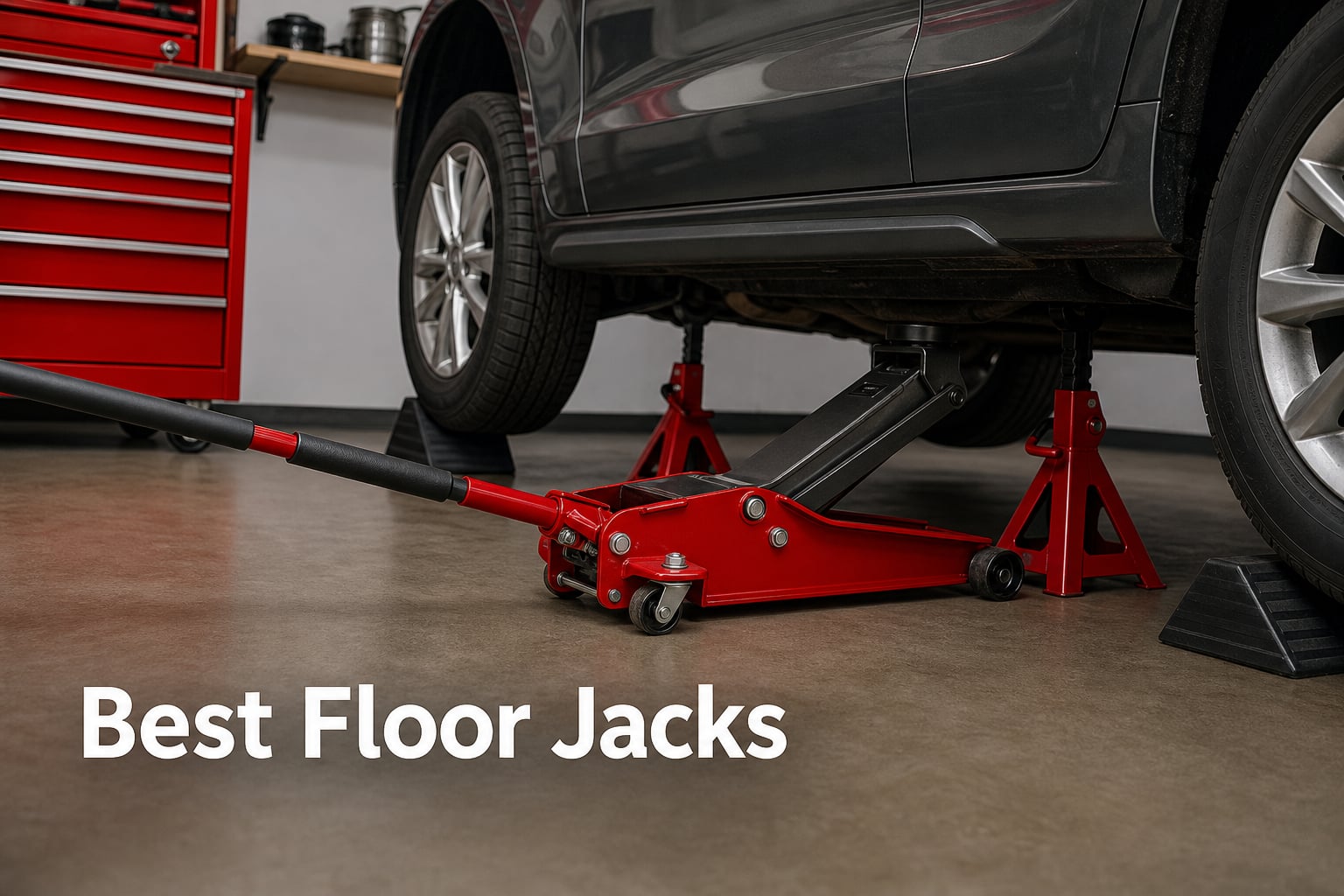
The best floor jack for most home garages is a 3-ton, low-profile hydraulic model with a wide lift range, controlled lowering, and a stated overload safeguard. For 2026, my strongest all-around match from this eight-jack group is the BIG RED 3 Ton Low Profile because its 3.13-to-20-inch range, seven-stroke dual-piston claim, steel build, and stated one-year warranty cover the jobs most owners actually do.
I approached these floor jack reviews as a spec-and-fitment comparison, not a claim that one jack suits every vehicle. I compared the stated capacity, minimum and maximum lift height, pump layout, construction, mobility hardware, certifications, warranty information, review volume, and reported limitations for every model listed here.
A hydraulic floor jack raises a vehicle by moving hydraulic fluid with the handle, which pushes its lifting piston and saddle upward. It is much more practical than a supplied scissor jack for a DIY oil change, tire rotation, or brake job, but it is never a substitute for rated jack stands on a solid, level surface.
That last point is non-negotiable: lift at the vehicle manufacturer’s approved jack point, place correctly rated stands under approved support points, and lower the vehicle onto the stands before working underneath. Community discussions repeatedly make the same point in plain language: never trust the jack alone.
The three strongest floor-jack choices answer most garage needs
Our short answer: choose BIG RED for the broadest home-garage lift range, SATA for the lowest stated clearance and enhanced stated safety testing, and AV Steel for a 3-ton steel model with a rotatable saddle and a larger review sample. Each has a different compromise, so vehicle clearance should make the final call.
- BIG RED 3 Ton Low Profile: 3-ton capacity, 3.13-to-20-inch range, and a dual-piston system stated to reach lift in seven strokes.
- SATA 3-Ton Heavy-Duty Steel: an ultra-low profile claim, dual-piston pump, slow-release system, and stated 1.5-times overload test.
- AV Steel Low Profile 3 Ton: 3-ton capacity, 3.125-to-19.875-inch range, a 360-degree rotatable saddle, and a one-year warranty.


The eight floor jacks below separate low-clearance and higher-clearance fitments
The comparison card is a fast way to narrow the field, but the minimum saddle height is the first figure I would verify against your car. A 3-ton rating is the recurring sweet spot here for versatility, while the 2-ton DNA MOTORING is a more limited choice for smaller cars and vertical lifting only.
| Product | Specs | Action |
|---|---|---|
 BIG RED 3 Ton Low Profile BIG RED 3 Ton Low Profile |
|
View Details |
| SATA 3-Ton Steel Jack |
|
View Details |
| AV Steel Low Profile 3 Ton |
|
View Details |
 Maxority 3-Ton Low Profile Maxority 3-Ton Low Profile |
|
View Details |
 LARBANKE 3 Ton Jack LARBANKE 3 Ton Jack |
|
View Details |
 Jack Boss 3 Ton Fast Lift Jack Boss 3 Ton Fast Lift |
|
View Details |
 DNA MOTORING 2 Ton DNA MOTORING 2 Ton |
|
View Details |
 VEVOR 3 Ton Racing Jack VEVOR 3 Ton Racing Jack |
|
View Details |
1. BIG RED 3 Ton Low Profile is the best overall jack for broad garage use
Big RED 3 Ton Low Profile Hydraulic Floor Jack, Dual Pump 6600lbs Heavy-Duty Steel, 3.125″-20″ Lift for Cars/Trucks/SUVs w/Overload Protection & 1-Yr Warranty
3 ton
3.13-20 inch lift
Dual pump
Pros
- Seven-stroke dual pump
- Steel construction
- 20 inch maximum height
- ASME certified
- One-year warranty
Cons
- 3.13 inch minimum height
- Small review sample
I put this BIG RED at the top because the documented numbers line up with what a general-purpose floor jack needs: 3-ton capacity, a low 3.13-inch minimum, and a full 20-inch maximum lift. That range can make one tool useful across many cars, crossovers, trucks, and SUVs, provided your vehicle’s approved lift point and clearance match the saddle.
The product data also says it uses a dual-piston hydraulic system that reaches lift in seven strokes. Fewer handle strokes matter most when you are raising a vehicle several times during wheel work, although the jack still needs to sit flat and roll freely before you begin pumping.
The 3.13-to-20-inch range gives this jack its broadest practical fit
A 3.13-inch starting height is low enough to be worth considering for many lower passenger vehicles, while 20 inches gives more working room than the shorter-travel models in this group. I would still measure the actual clearance at the intended central lift point, not the height of a bumper or rocker panel.
The listing identifies this as a universal-fit car jack, yet its 6,600-pound rating and 20-inch travel also make it a logical candidate to evaluate for trucks and SUVs. Capacity alone does not establish fit: the saddle has to safely reach the manufacturer-approved point without forcing a pad or extension into an unstable position.
The dual-piston pump and movable chassis focus on repeat garage work
BIG RED states that the dual quick pump gets to lifting height in seven strokes. Its two universal front casters and two swivel rear wheels are designed for 360-degree mobility, a useful detail when positioning a heavier steel service jack under a central jack point.
The detachable 52-inch handle is also called out for storage. On an uneven garage floor, I would clear loose gravel, seams, and debris first; forum users often point out that small wheels can hang up on floor imperfections, which can affect how a jack tracks as the vehicle rises.
The overload valve and stated certifications support a safety-first shortlist
The industrial-grade steel frame, overload valve, and ASME PALD-2014 plus CE/UKCA claims give this model a more complete stated safety profile than several basic alternatives. Those features are safeguards, not permission to lift beyond the rating or work beneath a vehicle supported only by hydraulics.
BIG RED includes a limited one-year manufacturer warranty in the listed details. Before the first use, I would inspect for shipping damage, confirm that the release valve responds smoothly with no load, and follow the manual’s bleeding and maintenance instructions if the lift feels spongy.
2. SATA 3-Ton Heavy-Duty Steel is the safest low-clearance-focused option on paper
SATA 3-Ton (6,600 lb) Heavy-Duty Steel Floor Jack Ultra-Low Profile Design (2-11/16” Height) with Dual-Piston Quick Lift Pump, Tested for 1.5X Overload for Ultimate Safety
3 ton
Ultra-low profile
Dual piston
Pros
- 1.5x overload testing
- Slow-release system
- Steel body
- Dual-piston pump
- Low clearance claim
Cons
- 70 pound weight
- Conflicting minimum-height details
The SATA stands out for its stated 1.5-times overload test to 4.5 tons, dual safety systems, and slow-release design. Those are the specifications I look for when controlled lowering and a conservative stated safety margin matter as much as lift speed.
It is also one of the heavier models at 70 pounds. That weight can help a steel jack feel planted in a fixed garage, but it makes carrying it around less appealing than a lighter trolley jack or an aluminum-and-steel design.
The listing’s minimum-height conflict requires a measurement before purchase
This product’s information is not consistent: its title says 2-11/16 inches, the product details list 2.13 inches, and a technical detail calls the lifting range 3-3/4 to 19-1/8 inches. I would not choose it for a very low car until the seller confirms the actual closed saddle height on the current unit.
That caution is especially important for lowered cars, where even half an inch changes whether the jack rolls under the center point. The claimed maximum of 19-1/8 inches is still a useful service height for routine tire, brake, and underbody access when the vehicle is properly supported by stands.
The dual-piston pump reduces stated effort during repeated lifts
SATA says its dual-piston rapid-lift pump reduces handle effort by 40 percent. I treat that as a manufacturer claim rather than an independently verified measurement, but the dual-piston layout is still relevant because it normally targets quicker lifting than a single-piston model.
The body is industrial-grade, thickened high-strength steel according to the listing. Steel is sensible for a jack that stays in one shop, yet it also explains the 70-pound listed weight and the extra effort involved in loading it into a vehicle for track-day or mobile use.
The slow-release system favors controlled descent over hurried lowering
A slow-release system is a welcome stated feature because abrupt lowering is a common concern with hydraulic floor jacks. It gives the operator more opportunity to settle the vehicle carefully onto jack stands, though you should always keep hands, feet, and tools clear of pinch zones.
The overload valve is paired with the 1.5-times test claim, but neither replaces a capacity check. Use the vehicle’s gross weight and the lifting configuration as a guide, then keep a generous margin rather than treating the rating as a target.
3. AV Steel Low Profile 3 Ton is the balanced steel choice with a rotatable saddle
AV Steel Low Profile Floor Jack 3 Ton (6600 lbs), Heavy Duty Hydraulic Jack for Car, Heavy-Duty Floor Jack with Dual Pistons Quick Lift Pump, Car Floor Jack with Lifting Range 3-1/8” to 19-7/8”
3 ton
3.125-19.875 inch lift
Rotatable saddle
Pros
- 360 degree saddle
- Dual-piston pump
- Overload protection
- ANSI ASME PASE
- One-year warranty
Cons
- Some one-star reviews
- No listed weight
The AV Steel is a straightforward 6,600-pound hydraulic floor jack with a 3-1/8-to-19-7/8-inch stated lifting range. It earns its place because that is close to the BIG RED’s useful range, yet it adds a 360-degree rotatable saddle and has 184 recorded reviews rather than a very small sample.
Its 4.7 rating is backed by 87 percent five-star reviews in the supplied analysis, but the same distribution includes 4 percent one-star reviews. That is not a reason to dismiss it, but it is a reason to inspect the specific unit closely and keep packaging until operation is confirmed.
The 3-1/8-inch start height serves many ordinary low-profile cars
The 3-1/8-inch closed height is only a fraction above the BIG RED figure and is much lower than the 5.1-inch class of basic trolley jacks. For a standard sedan, coupe, or crossover, this is the kind of clearance figure that belongs at the top of your checklist.
The 19-7/8-inch maximum is a useful near-20-inch ceiling for placing jack stands at the correct height. Never lift from a body seam or suspension component simply because it is easy to reach; use the points in the vehicle owner’s manual.
The rotatable saddle helps align the pad without twisting the chassis
AV Steel specifies a 360-degree rotatable saddle intended to help protect the vehicle while positioning. I like that feature for aligning the saddle with a designated support point, although a rotating saddle should be centered and fully seated before any load is applied.
The listing also states overload protection and ANSI/ASME PASE compliance. Read those as signs of a documented design target, then use the jack only on hard, level ground with the load centered over its saddle and the casters free to move as the suspension arc changes.
The dual piston and 12-month coverage make ownership easier to assess
The dual-piston quick-lift pump targets fewer strokes, and the alloy-steel construction aims at garage durability. Its stated 12-month warranty and 24/7 customer service add clearer support information than listings that only direct buyers to contact a seller.
Review feedback praises its low-profile layout and pumping efficiency, while the rating distribution shows it is not immune to defects. Before you put it under a vehicle, test the unloaded lift and descent, look for fluid leakage, and confirm the release control is predictable.
4. Maxority 3-Ton Low Profile is the review-rich rapid-pump option for routine service
Pros
- 510 recorded reviews
- Rapid pump
- High-strength steel
- Safety valve
- Low-profile design
Cons
- 90-day warranty
- Random color
The Maxority has the largest review count among the four newer 3-ton steel models near the top of this list, with 510 recorded reviews and a 4.6 rating. Its stated 19.9-inch maximum lift, rapid-pump design, high-strength steel, and built-in safety valve make it a reasonable routine-maintenance contender.
It also makes two limitations very clear: the finish is random, and the listed warranty is only 90 days. The color has no effect on lifting, but the shorter warranty is meaningful when you are comparing models intended for years of garage use.
The 19.9-inch maximum height is close to full-service-jack territory
A 19.9-inch maximum almost matches the top model’s 20-inch figure, so this is not a short-travel jack. The actual minimum height is described as low profile and extended reach in the provided data, but no exact closed height is supplied here; measure or confirm it if your vehicle sits low.
That missing detail should keep it below models with a specific 3.13- or 3.125-inch published start height for a lowered-car purchase. The right decision is based on verified clearance at the intended lift point, not a broad low-profile label.
The rapid pump and stable saddle suit repeated tire and brake work
Maxority calls out RAPID PUMP technology for lifting with fewer strokes. That can make tire rotations and brake jobs less tiring, but a fast pump does not change the safe sequence: raise, place stands, lower onto stands, then check stability before starting work.
The product also lists a stable lift saddle and a built-in safety valve. A stable saddle matters, but a rubber or metal pad cannot correct a bad jack point, a sloped driveway, or a vehicle that is allowed to roll because the wheels were not chocked.
The 90-day warranty is the central durability trade-off
The reported review distribution includes 84 percent five-star ratings and 5 percent one-star ratings. With any hydraulic tool, I would examine the cylinder and seals on arrival, keep a record of the warranty terms, and run a cautious no-load functional check before trusting it for regular work.
The short stated warranty does not automatically mean poor performance, but it gives you less written coverage than the one-year terms on BIG RED and AV Steel. If long-term support is your deciding factor, that difference matters more than cosmetic color choice.
5. LARBANKE 3 Ton is the better match for higher-clearance vehicles and simple home work
LARBANKE 3 Ton Hydraulic Floor Jack,Lift Range: 5.31”-18.11”,6600Lbs,Red
3 ton
5.31-18.11 inch lift
Carbon steel
Pros
- 3-ton capacity
- 360 degree casters
- Carbon-steel frame
- Wide reinforced base
- Multi-use design
Cons
- 5.31 inch minimum
- Single-piston pump
The LARBANKE offers 3-ton capacity in a carbon-steel jack with a 5.31-to-18.11-inch stated range. It is not the choice for a low-slung car, but that higher starting height is less of an issue on a vehicle with generous clearance and can be perfectly workable for basic home maintenance.
At 20.5 kilograms, roughly 45 pounds, it is lighter than the 70-pound SATA while still being a steel-bodied unit. Its large review sample of 162 and 4.6 rating offer some useful ownership context, although its one-piston layout is less focused on rapid lifting than the dual-piston models.
The 5.31-inch minimum height rules out many low cars
The 5.31-inch minimum is the key fact to understand before choosing this jack. It is around two inches taller than the low-profile leaders, so I would not buy it for a sports car, a lowered vehicle, or any car whose central lift point sits below that height.
For a pickup, SUV, or higher-riding vehicle with a compatible jack point, the same limitation may not matter. Even then, confirm the 18.11-inch maximum lift gives enough clearance to position your specific stands at a safe working height.
The reinforced base and caster layout focus on stable positioning
LARBANKE describes a wide base and reinforced frame for stability, along with 360-degree swivel casters and load-bearing rollers for movement. Those features can make it easier to position a jack in a home garage, especially if storage requires rolling it against a wall.
Mobility is useful only on a smooth, solid surface. Do not operate any floor jack on dirt, gravel, soft asphalt, or an incline, because the wheels and base need a stable plane as the load moves upward.
The single-piston pump is the honest convenience trade-off
This jack uses a single-piston system rather than the quick dual-piston arrangement found on several 3-ton rivals. It can still perform routine tire replacement and maintenance, but expect the pumping experience to be a less central selling point.
The reported ratings show 79 percent five-star and 14 percent four-star feedback. That profile suggests many users are satisfied, while the dimensional limitation remains easy to predict in advance: measure clearance before buying rather than trying to compensate later with an unsafe improvised block.
6. Jack Boss 3 Ton Fast Lift is the high-review steel alternative for regular vehicles
Jack Boss Floor Jack 3 Ton Capacity Fast Lift Service Jack Steel Heavy Duty Hydraulic Car Jack
3 ton
5.1-18.3 inch lift
Fast lift
Pros
- 1
- 010 recorded reviews
- Swivel casters
- ANSI ASME PASE
- Steel construction
- One-year warranty
Cons
- 5.1 inch minimum
- Durability concerns in reviews
The Jack Boss is another 3-ton service jack for owners whose vehicles clear a 5.1-inch starting height. It has a larger recorded review base than most of this group at 1,010 reviews, a stated fast-lift feature, 18.3-inch maximum height, and alloy-steel construction.
Its 4.5 rating and 6 percent one-star share require a balanced reading. The listing says it is built for years of service, yet the supplied review insights also note some reports of long-term durability issues, so inspection and early functional testing are sensible.
The 5.1-to-18.3-inch range favors normal-clearance cars and taller vehicles
This range is almost the same starting height as the LARBANKE but adds a small amount of maximum travel. That makes it a practical fit to consider for many standard-clearance cars, crossovers, and compatible SUVs, not for vehicles that require a genuinely low-profile floor jack.
Do not confuse 3-ton capacity with a blanket approval for every truck. Check the vehicle weight, suspension travel, approved support points, and whether 18.3 inches reaches the stand height your job requires.
The universal joint and swivel casters target precise placement
Jack Boss lists a rugged universal joint for precise load control, two steel front casters, and two 360-degree swivel casters with solid-rubber material. The chassis is also finished with corrosion-resistant red paint, which is useful if a jack lives in a humid garage.
Precise movement reduces the temptation to drag a loaded jack by its handle. Once the saddle contacts the vehicle, watch that the jack can roll in the direction the lift point moves; a floor jack that binds can push the load sideways.
The one-year warranty and stated standards improve the paperwork picture
The listing reports a limited one-year manufacturer warranty, CE certification, and ANSI/ASME PASE compliance. Written coverage and stated standards are positives, but they should be checked against the current seller documentation because warranty terms can change.
For prospective owners, the review spread is the main caution. Test lowering control without a vehicle first, check for leaks or damaged wheels, and stop using the jack immediately if it does not hold or lower predictably.
7. DNA MOTORING 2 Ton is the compact choice only for smaller-car vertical lifts
DNA Motoring TOOLS-00234 Low Profile Hydraulic Trolley Service/Floor Jack, 2 Ton (4000 lbs) Capacity, Lifting Range 5.1″-13″, Black
2 ton
5.1-13 inch lift
Steel trolley jack
Pros
- Compact 9.75 kg weight
- Safety release valve
- Large saddle
- Swivel casters
- 1
- 659 recorded reviews
Cons
- 13 inch maximum
- Not for trucks or large SUVs
The DNA MOTORING TOOLS-00234 is the outlier here: it is a 2-ton trolley jack with a 5.1-to-13-inch lift range and a listed weight of 9.75 kilograms. That compactness makes it easier to store and move, but the lower capacity and short maximum height give it a clearly narrower role.
Its product information explicitly says it is not recommended for pickups, trucks, or large SUVs and that it is for vertical lifting jobs only. That clear limitation is useful, and it is why I would reserve it for appropriately sized passenger cars rather than treating it as a universal garage tool.
The 2-ton capacity is for suitable cars, not a shortcut around vehicle weight
A 2-ton rating can be enough for many smaller cars when lifting one approved end or corner in the correct manner, but it leaves less flexibility than a 3-ton floor jack. Confirm the vehicle manual’s lifting instructions, account for the load distribution during the lift, and use stands with appropriate ratings.
The 4,000-pound stated capacity must not be used where side or downward force is involved. The listing specifically warns against that, which reinforces the need for a flat surface and a vertical, centered saddle contact.
The 13-inch maximum height limits underbody working room
At 13 inches maximum, this is far shorter than the 18-to-20-inch 3-ton jacks above. It may be adequate for a wheel change or a limited task on a compatible car, but it may not create the clearance needed to place taller stands or work comfortably underneath.
The 5.1-inch minimum also excludes many low vehicles. If your car has low central lift points, a compact jack that does not fit underneath is not made safer by driving onto improvised ramps or stacking wood beneath the saddle.
The safety release valve and large saddle are appropriate basics
DNA MOTORING lists a built-in overload release valve, a large saddle, heavy-duty steel construction, and swivel casters. These are meaningful basics for a compact car jack, yet the product should still be used for lifting only, never as the support holding the car during service.
The 1,659 recorded reviews make it the most reviewed item in this group, with a 4.4 rating and 74 percent five-star share. Its broad visibility does not alter the fitment rules: smaller vehicles and short, vertical-lift tasks are its lane.
8. VEVOR 3 Ton Racing Jack is the aluminum-and-steel option for lower cars and portability
VEVOR 3 Ton Low Profile Aluminum & Steel Racing Floor Jack
3 ton
3.55-19.69 inch lift
Aluminum steel
Pros
- Dual parallel pumps
- Low 3.55 inch start
- Rubber saddle
- Aluminum steel body
- ASME certified
Cons
- 63 pound weight
- Durability concerns in reviews
The VEVOR combines aluminum and steel in a 3-ton racing-style floor jack with a stated 3-6/11-inch minimum and 19-11/16-inch maximum lift. Its dual parallel pumps are said to reach full lift in seven strokes, and its rubber saddle plus foam handle bumper focus on protecting vehicle contact surfaces.
At 63 pounds, it is not ultralight, but it is lighter than the 70-pound SATA steel jack. The hybrid construction, side carrying armrests, and two-piece 45-inch handle make it the model I would examine first when occasional transport matters alongside low-profile fitment.
The 3.55-inch minimum height works for many low-clearance applications
A 3.55-inch starting height is not as low as the published figures on BIG RED or AV Steel, but it is far lower than the 5.1-inch basic-jack category. That can make a real difference for sport-oriented cars, provided you measure the actual central jack point and account for any aftermarket lowering.
The 19-11/16-inch maximum provides nearly 20 inches of travel for tire, suspension, and brake work. The replaceable, 360-degree rotatable saddle should be centered on the prescribed point; a rubber saddle protects surfaces but does not make an incorrect lifting point safe.
The dual parallel pumps and protective details target fast careful positioning
VEVOR states that its dual parallel pump system reaches full lift in seven strokes. It also lists two universal rear wheels, four total wheels, side armrests, a long two-piece handle, and a foam bumper, all of which are thoughtful details for moving and storing a service jack.
The jack has a built-in load system intended to prevent use beyond its capacity and claims CE, UKCA, and ASME PALD-2014 compliance. Those features complement, rather than replace, wheel chocks, stands, a clear work area, and a careful check that the vehicle is stable before anyone goes beneath it.
The 4.3 rating makes long-term durability the key trade-off
This model has 1,294 recorded reviews but a lower 4.3 rating than the steel leaders, with 9 percent one-star feedback in the provided distribution. The review insight specifically notes that some customers report lower durability with aluminum components, so this is not the one I would choose solely because it is a hybrid design.
Aluminum can reduce carry weight, while steel commonly favors a more planted workshop tool. For this VEVOR, the sensible trade is low-profile access and transport-friendly features against a more mixed durability signal than the top three models.
The right floor jack starts with clearance, capacity, and safe support
The best specification on paper is useless if the saddle cannot reach the approved lift point. Before choosing a hydraulic floor jack, measure the lowest usable clearance under your vehicle, check the owner’s manual for front, rear, and side lift points, and decide whether you need enough maximum height to place jack stands.
A 3-ton jack is the most flexible starting point for most home garages
A 3-ton floor jack does not mean the vehicle must weigh 3 tons. It gives a larger capacity margin than a 2-ton model for the common situation of lifting one end or one corner of a car, crossover, SUV, or compatible light truck, and it is the capacity professionals commonly favor for versatile service work.
Still, capacity is only one part of the decision. The vehicle’s gross weight, where the lift is applied, the jack-point design, and the stand rating all matter; use the manufacturer’s instructions for every component rather than guessing from body style alone.
The three-quarter rule means staying below 75 percent of the jack’s rating
The three-quarter rule is a conservative practice: do not plan to lift more than 75 percent of a floor jack’s rated capacity. On a 3-ton jack, that working target is 2.25 tons, or 4,500 pounds; on a 2-ton jack, it is 1.5 tons, or 3,000 pounds.
This is not a universal legal standard printed on every jack, and it does not override the manual. It is a practical safety margin that recognizes uneven loading, the difference between total vehicle weight and the load at one end, and the fact that ratings should not be treated as a daily operating target.
A low-profile jack needs a published closed height, not just a marketing label
For lowered cars, the minimum saddle height is often the deciding number. BIG RED lists 3.13 inches, AV Steel lists 3-1/8 inches, and VEVOR lists 3-6/11 inches, while LARBANKE, Jack Boss, and DNA MOTORING start around 5.1 inches or higher.
Check source data for conflicts as well. The SATA listing provides several different minimum-height figures, so verify the current physical dimension with the seller before ordering for a tight-clearance car.
A 19-to-20-inch maximum lift is more useful for stands than a short trolley range
Maximum lift affects both access and whether your stands can be placed at a sensible height. BIG RED reaches 20 inches, Maxority lists 19.9 inches, AV Steel lists 19-7/8 inches, and VEVOR lists 19-11/16 inches; these figures give more setup room than DNA MOTORING’s 13-inch maximum.
More height is not automatically better. Lift only high enough to position the stands at approved support points, then lower the vehicle gently onto them and test for stability before beginning an oil change, tire rotation, or brake job.
Steel favors a fixed garage while aluminum-and-steel favors moving the jack
Steel construction is common here because it supports a durable, stable service-jack frame. The SATA is listed at 70 pounds, which illustrates the portability cost; LARBANKE is listed at 20.5 kilograms, while the VEVOR aluminum-and-steel model is listed at 63 pounds.
Aluminum is not automatically better or worse. It can reduce carry weight, but the VEVOR’s supplied review data includes durability concerns, so choose on the whole design, its support documentation, and whether the jack will live in one garage or travel regularly.
A dual-piston pump saves strokes while release control protects the setup
BIG RED, SATA, AV Steel, and VEVOR all specify dual-piston or parallel-pump arrangements, while LARBANKE specifies a single piston. Rapid lift is convenient for repeated work, but it comes after stability, lift-point accuracy, and predictable lowering.
Test the release control without a vehicle before the first job. Community discussions often flag hard-to-control release valves, so a smooth, gradual descent is a condition of use, not a feature to ignore because the jack has a high capacity rating.
Jack stands, wheel chocks, and a hard level surface are mandatory safety gear
Use appropriately rated jack stands every time any part of your body will be under a vehicle. Chock the wheels remaining on the ground, set the parking brake where appropriate, keep bystanders clear, and never work on a slope, dirt, gravel, soft asphalt, or loose garage surface.
A floor jack is a lifting device, not a support device. If the saddle slips, the floor is uneven, the jack rolls poorly, or the vehicle does not settle solidly on the stands, lower it safely and start again rather than trying to correct a loaded setup.
The most common floor-jack questions have straightforward safety-led answers
What is the 3 4 rule for floor jacks?
u003cstrongu003eThe three-quarter rule means staying at or below 75 percent of a jack’s rated capacity.u003c/strongu003e For a 3-ton jack, that conservative target is 2.25 tons or 4,500 pounds. It is a practical safety margin, not a replacement for the vehicle and jack manuals, correct lift points, and rated jack stands.
What floor jack do mechanics use?
u003cstrongu003eMany mechanics choose a 3-ton steel floor jack with a broad lift range, rapid pump, and controlled release.u003c/strongu003e A 3-ton model offers flexible capacity for many passenger vehicles and compatible light trucks. Professional use still requires correctly rated stands, a level shop floor, and routine equipment inspection.
Who makes the best floor jack?
u003cstrongu003eNo single brand is best for every vehicle.u003c/strongu003e In this comparison, BIG RED has the broadest stated 3.13-to-20-inch range, SATA emphasizes stated overload testing and controlled lowering, and AV Steel combines a low profile with a rotatable saddle. Match the published clearance and lift range to your vehicle first.
Are aluminum floor jacks worth it?
u003cstrongu003eAluminum floor jacks are worth considering when moving the jack often matters.u003c/strongu003e They can reduce carry weight compared with all-steel models, but construction type alone does not predict durability. Compare the actual weight, stated lift range, certification claims, warranty information, and ownership feedback before choosing.
The best floor jack for you is the one that fits your vehicle and safety routine
For the Best Floor Jacks in 2026, I would start with BIG RED when you want the broadest documented 3-ton lift range, SATA when low-clearance measurement and controlled descent are central, and AV Steel when the rotatable saddle and a one-year warranty appeal. Choose LARBANKE or Jack Boss only when a roughly 5-inch starting height fits the vehicle, and keep DNA MOTORING to its stated smaller-car role.
Pick the model that reaches your approved lift point, use it below its rating with a conservative margin, and pair it with rated jack stands every single time. A careful setup is more valuable than any rapid-pump feature.
Leave a Reply