
The best espresso machines for latte art all share one trait: a steam wand with enough power and control to stretch and texture milk in a single pitcher instead of simply heating it. We put twelve machines through their steaming routines, and the Breville Barista Express took the top spot for most home baristas, with the Calphalon Temp iQ and the Breville Infuser as the strongest alternatives.
For this guide I ranked machines on one axis that most espresso roundups ignore: what the wand does to milk. I compared steam power, wand length, tip style, boiler architecture and how quickly each machine recovered after the first pitcher, then judged every unit on whether the milk left the jug with the wet, glossy surface that latte art actually sits on. Espresso quality still counted, but only after the milk question was settled.
That ordering matters because the two skills are independent. A machine can pull a beautiful shot and still produce dry, airy foam that will not hold a pattern, and a modest machine with a genuinely strong wand can pour clean art on an average shot. The pattern sharpens considerably once the shot improves, but it never appears from a weak wand alone.
Steaming has two phases, and the machine has to support both. In the stretch phase, steam expands cold milk into foam. In the texturing phase, the tip drops just under the surface to spin the milk and cut those bubbles into microfoam. A wand that cannot do both in one pitcher, because it lacks power, because the tip sits too deep, or because the boiler stalls after the first jug, is the number one reason beginners quit. We cover the pitcher and thermometer side of the setup in our guide to the best latte art tools.
If your priority is simply excellent coffee rather than poured patterns, our guide to the best espresso machines overall covers the wider field. This list is sorted by milk.
Our Top 3 Espresso Machines for Latte Art
Three machines stood apart on steam behaviour alone, and each serves a different kind of drinker. The Barista Express wins because it pairs a proper manual wand with a grinder in the same box, so nothing else is needed to start pouring. The Temp iQ is the value pick, with a long solid metal wand that most owners get good results from within a week. The Infuser is the one to buy when you already own a grinder and want the strongest dedicated steam output in this group.

Breville Barista Express
- Powerful manual steam wand
- Integrated conical burr grinder
- PID temperature regulation
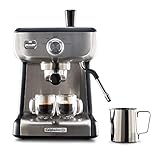
Calphalon Temp iQ
- Long solid metal steam wand
- Thermoblock heating with PID
- 58mm portafilter
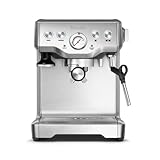
Breville Infuser
- 1650W high-pressure steam wand
- PID adjustable in 2 degree steps
- Pressure gauge and auto purge
Every Machine Compared Side by Side
Every machine below uses a manual steam wand that you control by hand, except the De’Longhi Dedica Arte and the MAttinata, which add automatic or preset milk programs. Read the wand column first, then the grinder column, since a machine without a grinder adds a second purchase to your setup. Our guide to entry-level machines on a tight budget covers the cheapest of these in more detail.
| Product | Specs | Action |
|---|---|---|
| Breville Barista Express |
|
Check Latest Price |
| Calphalon Temp iQ |
|
Check Latest Price |
| Breville Infuser |
|
Check Latest Price |
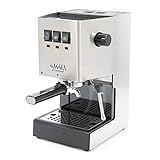 Gaggia E24 Classic Gaggia E24 Classic |
|
Check Latest Price |
 Gevi 20 Bar Gevi 20 Bar |
|
Check Latest Price |
 Chefman Crema Deluxe Chefman Crema Deluxe |
|
Check Latest Price |
 De’Longhi Dedica Arte De’Longhi Dedica Arte |
|
Check Latest Price |
 atatix 20 Bar atatix 20 Bar |
|
Check Latest Price |
 CHULUX Slim CHULUX Slim |
|
Check Latest Price |
 AMZCHEF Compact AMZCHEF Compact |
|
Check Latest Price |
 SHARDOR 20 Bar SHARDOR 20 Bar |
|
Check Latest Price |
 MAttinata 1632L MAttinata 1632L |
|
Check Latest Price |
1. Breville Barista Express – The Best All-Rounder With a Grinder Built In
Breville BES870XL Barista Express Espresso Machine, Brushed Stainless Steel
1600W element, manual steam wand, integrated conical burr grinder, PID control
Pros
- Powerful wand that reaches microfoam quickly
- Built-in burr grinder removes a second purchase
- PID and pressure gauge aid consistency
- Hot water dispenser for Americanos
Cons
- Plastic top and lower side panels
- Small 67oz water tank needs frequent refills
- Daily wand wiping and regular descaling required
This is the machine I hand to people who want one box that does everything. The Barista Express pulls a real shot, steams milk fast enough to work at a normal pace, and comes with a grinder, so there is no second purchase standing between you and your first attempt at a rosetta.
Owners consistently describe the wand as capable of smooth microfoam with a bit of practice, and that is the honest verdict here. It is a manual wand, which means the texture quality tracks your pitcher angle and tip depth rather than a program.
What surprised me most was how little the machine asks of a beginner. The pressure gauge and PID readout give you two concrete signals to learn from, so when a shot runs fast or a pitcher goes flat you have something to point at instead of guessing.
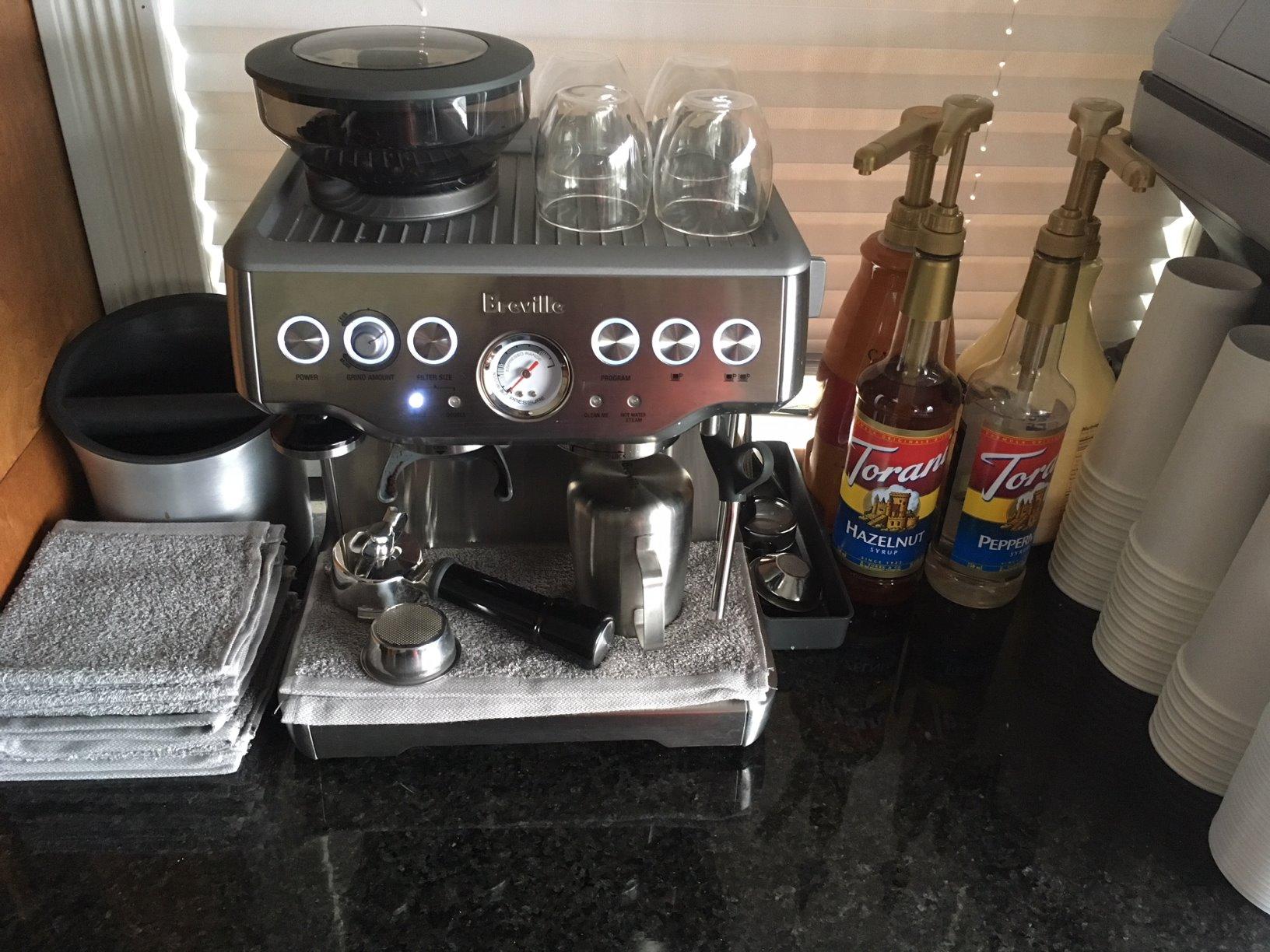
The grind dial is coarse enough to be forgiving of user error. That matters for latte art specifically, because a badly dosed shot gives you a thin, pale crema that a design will sink straight through, and the dose you get from the integrated grinder is easier to keep consistent than a scoop of pre-ground coffee.
Steam Power and Microfoam Quality
A 1600 watt element sits behind the wand, and in practice that is enough to bring a small pitcher of cold milk up to texturing temperature in a reasonable time without the wand going slack mid-pour. Reviewers who have used it long term report that the wand keeps pressure steady as long as the purge habit is maintained.
The tip is a conventional manual type, so you decide the air intake yourself. Lower the pitcher just enough to introduce air in the stretch phase, then drop the tip a few millimetres for the texture. Owners who make art regularly say the wet, glossy surface this produces is what allows a rosetta to sit on the surface rather than vanish into it.
Thermoblock Heating and Workflow
This is a thermoblock machine, so the heating element is inline with the water path rather than sitting in a large boiler. It heats quickly and recovers between shots, but brewing and steaming still happen sequentially, which is the normal compromise at this tier.
Because the machine is a single closed loop, the temperature you see on the PID display settles quickly and stays put. That stability is why the shot tastes consistent from one pull to the next, even on a busy morning when you are alternating between brewing and steaming.
Who Should Skip This Machine
Skip it if you want a metal-bodied appliance that ages gracefully, because the top and lower side panels are plastic. The 67oz water tank also runs small, so expect a refill every few drinks during a session.
It also asks for real discipline on maintenance. A wiped wand after every use, weekly cleaning of the group area, and descaling on schedule are the difference between steady steam pressure and a wand that sputters. Owners who skip those steps report solenoid noise and leaks appearing over the following months.
2. Calphalon Temp iQ – Best Value for a Long Solid Metal Steam Wand
Calphalon BVCLECMP1 Temp iQ Espresso Machine with Steam Wand, Stainless
1350W, thermoblock with PID, long solid metal steam wand, 58mm portafilter
Pros
- Long thick metal wand produces creamy foam
- 58mm portafilter gives even dispersion
- 2.0L reservoir with hinged lid
- Few controls so it is easy to learn
Cons
- No manual shot volume option
- Baskets sit tightly in the portafilter
- Included baskets are both dual wall
The Temp iQ is the machine I recommend when someone wants a proper manual wand without spending prosumer money. The steam wand is long, thick and solid metal, and owners who angle the pitcher correctly report creamy foam rather than the dry, separated foam that shorter wands tend to produce.
It is also a calm machine to learn on. There are two dials, two shot programs and a steam switch, so there is very little between you and a cup.
The 58mm portafilter is a genuine step up from the smaller baskets on cheaper models, and it disperses water evenly enough that extraction stays predictable even when your tamping is still improving.
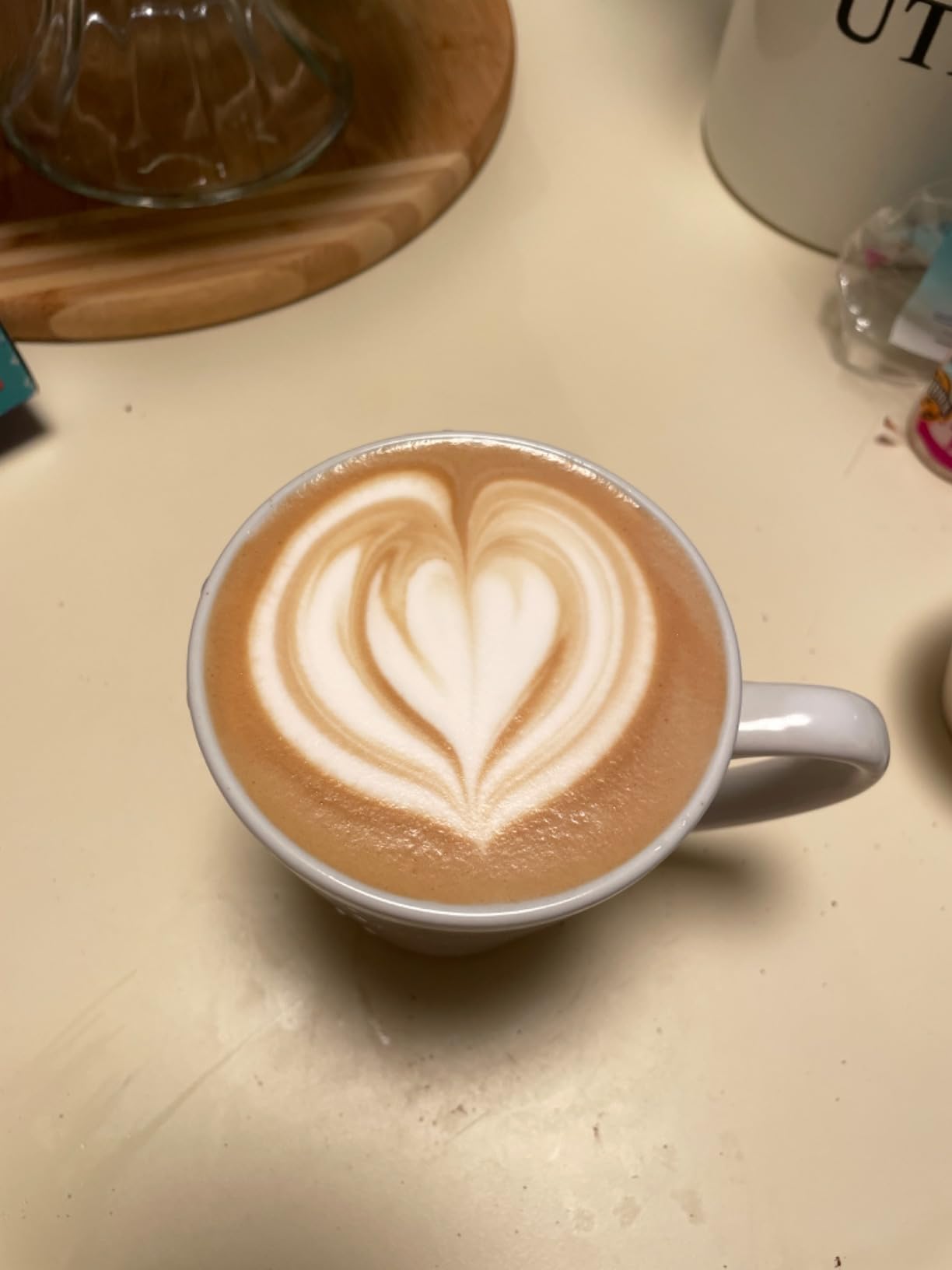
The 2.0L reservoir with a hinged lid is genuinely easy to fill at a sink, which removes one of the most annoying chores on smaller machines. It also means you are not refilling between every second drink when practising.
Why the Wand Length Matters
Longer wands give you more room to keep the tip near the surface during the texturing phase without your hand pinning the pitcher against the body. That extra millimetre of working space is the difference between a steady whirlpool and a pitcher that just sits there while the milk scalds.
Owners describe the foam as creamy and dense once the wand angle is right, which is exactly the starting point for both a heart and a rosetta. Because the wand is solid metal rather than a thin plated tube, it holds heat evenly through the length.
Thermoblock With PID and Shot Temperature
Temperature control runs through a thermoblock element with PID regulation, so brew temperature stays consistent shot after shot. For latte art that is a modest but real advantage, since a stable shot produces a stable crema colour and the design reads more clearly.
The tradeoff some buyers hit is crema character. Owners who make art report that the shot surface can be a little foamy, and a design poured into a very frothy crema loses contrast. A few months of tightening grind and tamping fixes most of this.
Who Should Skip This Machine
Skip it if you want to stop a shot by hand. There is no manual volume button, only single and double programs, and the included baskets are both dual wall, which limits how much control you have over the extraction itself.
Durability reports are mixed beyond a few years, with some owners documenting pump or lighting failures. Treat it as a capable first machine rather than a lifetime purchase, and keep a basic cleaning routine on the group head.
3. Breville Infuser – Strongest Dedicated Steam Output in the Group
Breville BES840XL Infuser Espresso Machine, Brushed Stainless Steel
1650W element, high-pressure manual wand, PID in 2F steps, pressure gauge
Pros
- High power element drives fine microfoam
- PID adjustable in small increments
- Pressure gauge teaches extraction
- Auto purge after steaming
Cons
- No built-in grinder so budget for one
- Single boiler means sequencing brew and steam
- Button layout carries a learning curve
The Infuser is what I would choose if a burr grinder already sits on my counter. It has no grinder, which most buyers see as a drawback, but it turns that budget into a better steam wand and finer temperature control, and those two things decide whether your art lands.
Reviewers who moved up from the Barista Express consistently name the stronger wand, the finer PID steps and the pressure gauge as the reasons for the switch. Owners making art report microfoam fine enough to pour detailed designs.
The auto purge after steaming is a small feature that matters more than it sounds. It clears residual water from the system, which helps the next shot land at the right temperature instead of arriving cool.
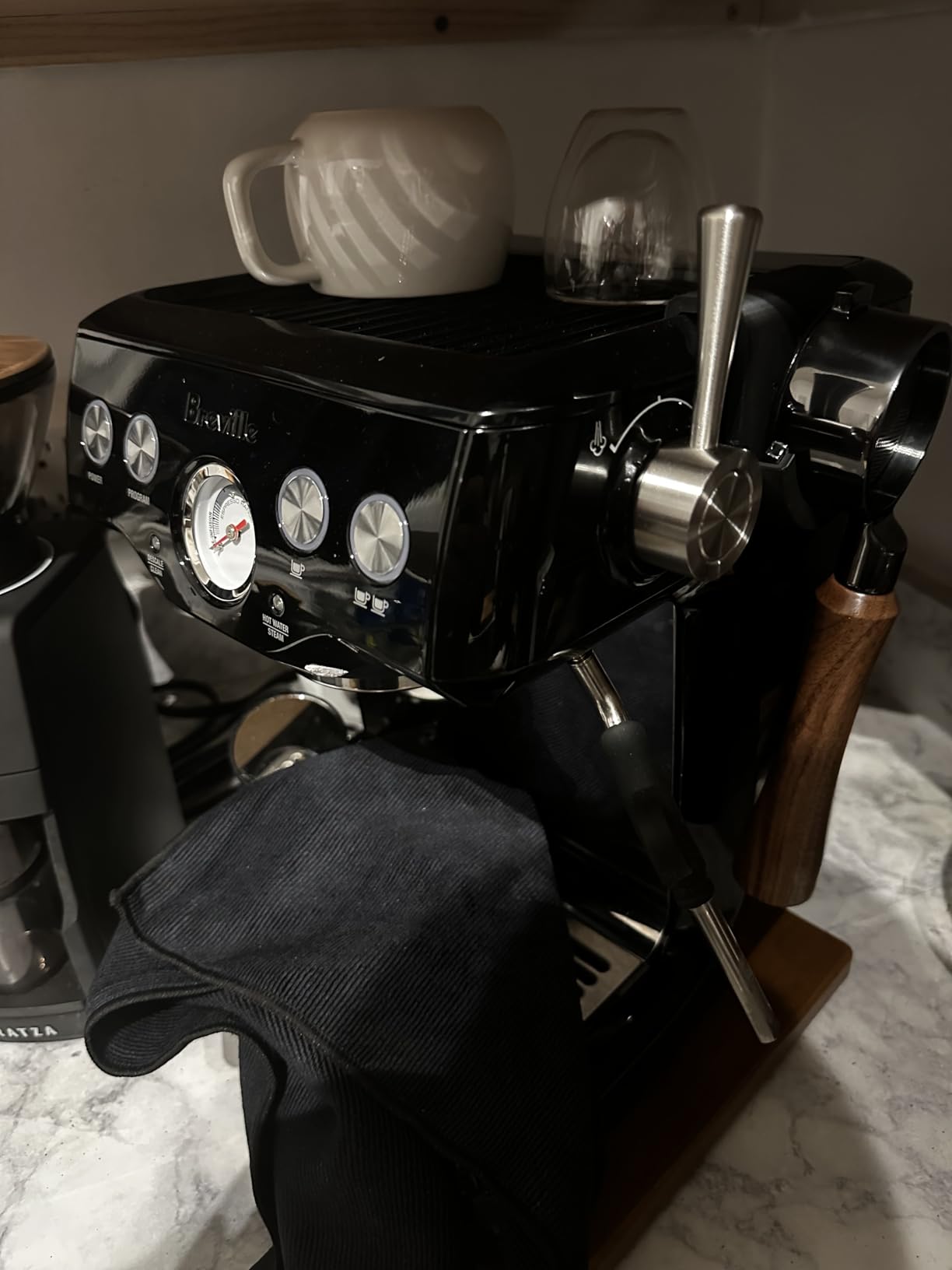
Volumetric shot control with a manual override means you can still stop a shot yourself once you know what you want. That matters for art, because a shot pulled to weight and stopped by hand gives you a consistent base to pour into.
Why Wattage Translates Into Better Foam Here
The 1650 watt element is the highest figure in this group, and it shows up in the milk rather than in a specification sheet. The wand holds pressure through a full pitcher, and owners report the foam comes up glossy rather than foamy, which is the surface pattern needs.
High element wattage also shortens heat-up time, so you are not waiting on a cold boiler while your milk is already out. For someone practising daily, that difference between a cold start and a warm one is the difference between steaming once and steaming three times in a session.
Single Boiler Limits on Workflow
There is one boiler, so you brew, then you steam, then you brew again. That is a small friction point, and it is the main reason to consider the Chefman further down this list if simultaneous brewing matters to you.
Because the controls are manual, the sequence stays predictable. The purge cycle after steaming resets the temperature, so the shot that follows your pitcher is the same as the one that came before it.
Who Should Skip This Machine
Skip it if you do not already own a grinder or are not prepared to add one. That second purchase is where most of the money goes, and the machine will not make better coffee for you until the grind is right.
The button layout also takes an adjustment period. If you prefer a minimal interface with two dials, the Calphalon earlier in this list is easier to live with day to day.
4. Gaggia E24 Classic – Best for Learning Manual Wand Control
Gaggia RI9380/46 E24 Espresso Machine, Brushed Stainless Steel
1200W, commercial 58mm portafilter, three-way solenoid, manual wand
Pros
- Commercial components in a serviceable home body
- Steel housing and brass group
- Large upgrade community for PID and OPV
- A small footprint for a full size machine
Cons
- Single boiler adds a wait between brew and steam
- Steam takes minutes to build full pressure
- 9-bar spring is weak out of the box
The Gaggia E24 is the machine I point people toward when they want to learn the craft rather than automate it. Everything a working barista would touch is exposed and serviceable, and the community around this machine is large enough that almost any problem has a documented fix.
Reviewers call it the best value in manual espresso machines, and the reason is the component list rather than any single feature. A commercial-style 58mm portafilter and a three-way solenoid valve are unusual finds in a home machine.
The steam wand is a straightforward manual type. It does not milk automatically and it will not do anything for you, which is exactly the point for someone who wants to learn where the steam goes.
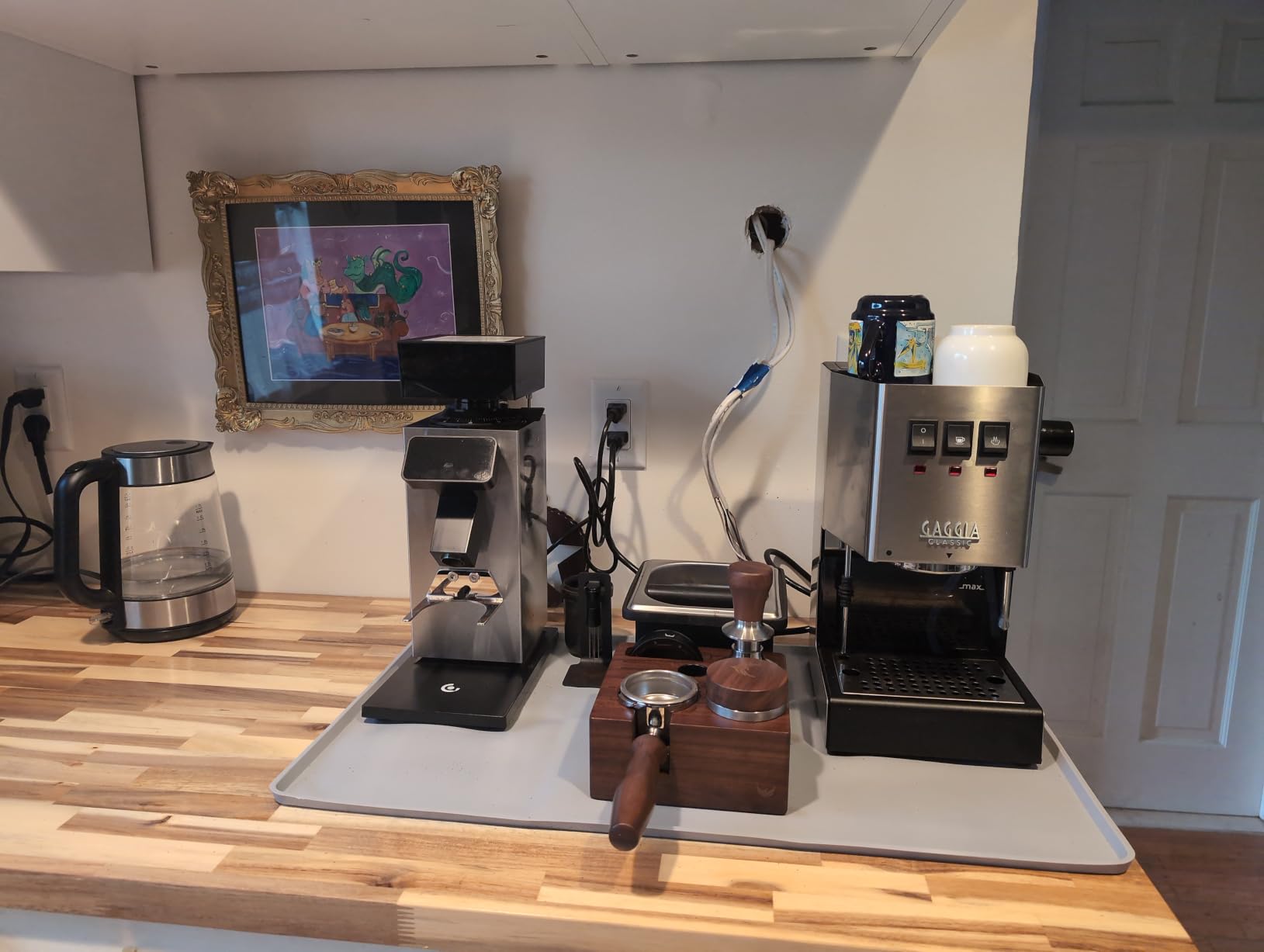
It is also small for a full-size machine, measuring under 10 inches wide, so it fits a counter where a thermoblock machine with a hopper would not. That is a real advantage in a compact kitchen.
Boiler Patience and Steam Recovery
This is the honest limitation. As a single boiler machine, it must transition between brew temperature and steam temperature, and the steam wand takes a couple of minutes to build full pressure from cold. Once it is up, owners report good foam with correct technique.
Practitioners on Home-Barista use 30 seconds for a 6oz pitcher as the threshold where a machine still feels responsive, with 37 seconds recorded for a 12oz pitcher on a compact dual boiler. The E24 will not hit those numbers from cold, so plan to pull your shot first and steam second.
Component Quality and Serviceability
Steel housing, a brass group and a portafilter you can disassemble on the counter make this a machine that can be repaired rather than replaced. That has real financial value over a decade of daily use.
The upgrade community is a genuine asset. PID kits, an OPV spring and other documented modifications are widely available, and the stock 9-bar spring is widely considered too weak, which is the single most common first change owners make.
Who Should Skip This Machine
Skip it if you want latte art on your first morning. The learning curve is steeper than anything else in this list, the boiler coating issue on some production runs produced a mixed response from manufacturer support, and you will need a separate burr grinder to get a good shot at all.
The wand also only pivots one way and drips from condensation when closed. Neither ruins the milk, but both annoy you daily.
5. Gevi 20 Bar – Best With a Built-In Grinder and a Wand That Keeps Up
Gevi 20 Bar Espresso Machine with Grinder & Steam Wand for Latte Cappuccino
20-bar pump, 30-setting burr grinder, NTC and PID control, 58mm portafilter
Pros
- Integrated burr grinder with 30 adjustments
- High pressure wand makes velvety microfoam
- PID and NTC control both brew and froth
- 58mm commercial style portafilter
Cons
- Tall 16.5 inch body takes vertical space
- Single boiler means sequencing brew and steam
- Basket changes still need managing by hand
The Gevi combines the two things a latte-art buyer cares about most in one housing: a real burr grinder and a high-pressure wand. Reviewers single out that pairing, because most machines at this level give you one or the other.
Owner sentiment on the milk is strongly positive. The wand produces what reviewers describe as velvety microfoam, and the temperature control covers frothing as well as brewing, which keeps the milk texture repeatable between drinks.
The dual-function wand also dispenses hot water for Americanos and for cleaning, so you are not juggling accessories while you learn.
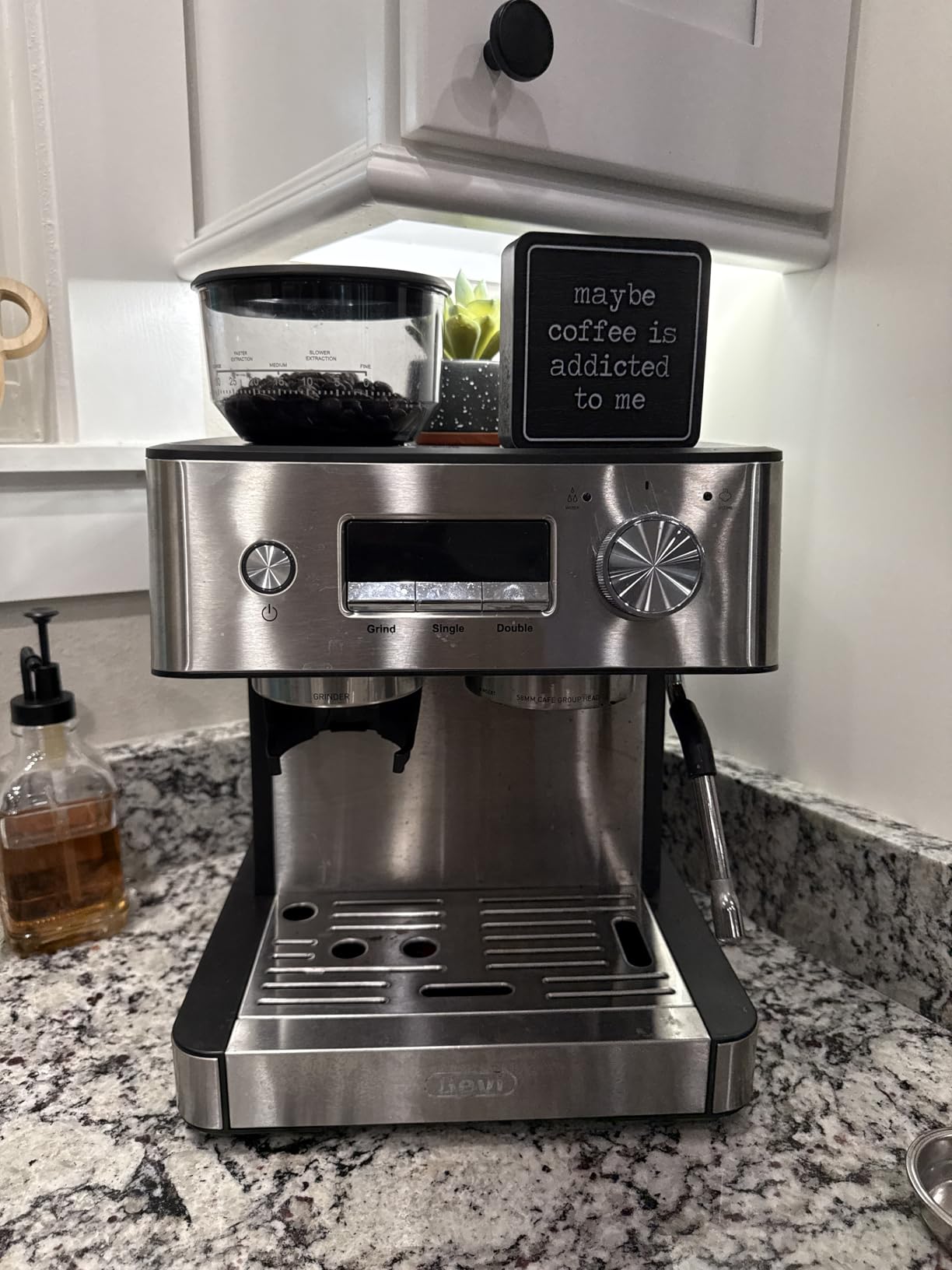
Grind duration and shot volume are both adjustable, which means you can compensate for the fact that a grinder dosing by time is less precise than one dosing by weight. It is a small adjustment once, and then it holds.
Wand Pressure and Microfoam
The steam wand here is rated for high pressure rather than for convenience, and the foam it produces is fine enough to hold a design. That is the practical difference between a machine that can be used for latte art and one that is marketed for it.
Because the temperature control covers frothing, the milk reaches texture at a repeatable point each time. Inconsistent milk temperature is one of the top causes of failed pours, and controlling it at the machine level removes a variable before your technique even enters the picture.
Footprint and Vertical Space
At 16.5 inches tall, this is one of the larger machines here, and the grinder housing above the group is the reason. If your counter has an upper cabinet close to the surface, check the clearance before you commit.
It is also a single boiler, so you sequence brewing and steaming. For a single drink that costs nothing. For two drinks back to back it means a short wait between the shot and the pitcher.
Who Should Skip This Machine
Skip it if counter height is tight or if you only drink one or two cups a day. You would be paying grinder and boiler size costs for a routine that does not need them.
The grind duration and button panel also take practice to master. If you want a machine you understand in ten minutes, the entry-level manual picks later in this list are simpler.
6. Chefman Crema Deluxe – Best for Brewing and Steaming at the Same Time
Chefman Crema Deluxe Espresso Machine with Double Boiler, Use Milk Frother and Brew Espresso Simultaneously, Professional Coffee Maker with Coffee Grinder and Steam Wand, 30 Grind Settings
Dual boiler, 30-setting conical burr grinder, 15-bar pump, 3L tank
Pros
- Dual boiler lets you pull a shot and steam together
- Included 30-setting burr grinder
- Wide 3L reservoir cuts down refills
- Solid stainless steel tamper included
Cons
- Notably loud during brewing and frothing
- Considerable plastic in the body
- Some units degraded within a few months
The Chefman is the only dual boiler in this group, and that single fact changes your workflow more than any other spec on this page. You can pull a shot and steam a pitcher at the same time, which is how a café works and how you practise pouring without waiting.
Reviewers regularly name that simultaneous capability as the deciding advantage. If you are making drinks for another person, or you are trying to learn timing and workflow rather than just a single design, that advantage is real.
The 30-setting conical burr grinder is a bonus in this housing, and the 3L reservoir means you can go a long session without walking to the sink.
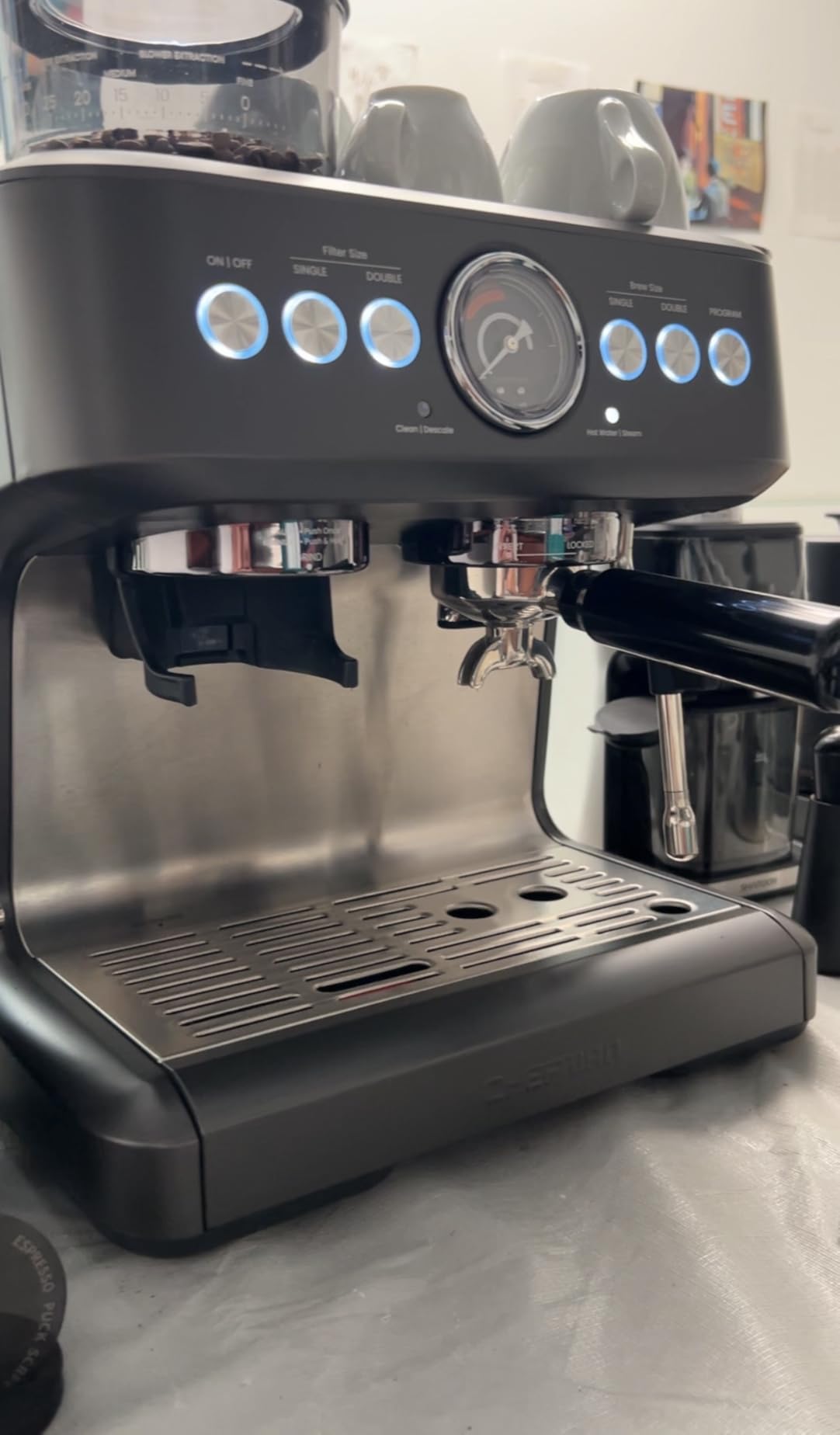
Foam quality from the manual wand is good. The weaker part of the milk story is the automatic attachment, which owners report can produce bubbly rather than silky foam. If latte art is the goal, use the wand and leave the auto attachment for cappuccinos.
What a Dual Boiler Changes for Milk
With separate brew and steam boilers, the steam boiler sits at pressure while the brew boiler holds temperature. There is no transition to wait for, so your milk gets the same wand performance on the tenth drink as on the first.
That is the practical answer to the recovery problem. Machines with a single boiler trade away consistency after the first pitcher, and this one does not have that trade-off.
Build Quality Concerns
Durability is the concern here. Several owners report electronics, seal or extraction problems within roughly two to five months of daily use, and the machine is difficult to service when something fails.
The body also uses a good amount of plastic for its size, and the machine runs noticeably loud during both extraction and frothing. If it lives in a small apartment, that noise is worth thinking about.
Who Should Skip This Machine
Skip it if reliability over years is your priority. The reported failure pattern is frequent enough that it dominates owner feedback, and the boiler architecture that makes it appealing does not offset that.
Working baristas also report the foam is coarser than a hand-poured wand can achieve on a commercial machine. If your goal is genuinely fine microfoam rather than fast workflow, a single strong manual wand is the better buy.
7. De’Longhi Dedica Arte – Best for Small Kitchens and Guided Starters
De’Longhi Dedica Arte Espresso Machine with My LatteArt Steam Wand (Milk Frother), 15-Bar Pump & 3-Level Temp Control – Compact Espresso Maker for Latte & Cappuccino – Italian Stainless Steel Design
15-bar pump, My LatteArt steam wand, three texture settings, 6 inch wide
Pros
- Only 6 inches wide for tight counters
- Three foam temperature and texture settings
- Removable double drip tray fits tall glasses
- Automatic Flow Stop removes shot guesswork
Cons
- Single boiler means waiting between brew and steam
- No built-in grinder
- Preset programs limit manual texture control
The Dedica Arte is bought for two reasons, and both are about milk and space. The body is 6 inches wide, and the steam wand is marketed specifically for cafe-style texture, with three temperature and texture settings to choose from.
Owner feedback is generally favourable once those three settings are understood. Pick the wrong one and the foam is wrong, pick the right one and you get a usable cappuccino without any technique at all.
The removable double drip tray is a thoughtful detail. It lets you use taller latte glasses that would otherwise hit the cup rest, which is a small thing that shows up every single morning.
The 35oz water tank is on the small side, and the machine is finished in stainless steel while still using plastic components internally. It looks more industrial than it behaves.
Preset Programs Versus Manual Control
This is the core trade-off. The wand is program-driven, so it removes the two decisions that produce good microfoam: when to introduce air and how deep to hold the tip. You choose a texture level and the machine handles the rest.
For a total beginner that is a feature rather than a limitation. For someone who already knows what glossy microfoam feels like, the lowest manual control among the manual wands here is frustrating, and ratings sit lowest among buyers who wanted more.
Boiler Workflow and Small Footprint
Single boiler means waiting between brewing and steaming. At 6 inches wide, the machine gives that space back, and for a small kitchen or an office coffee corner that trade is usually worth taking.
Practitioners on Home-Barista treat counter space as a real filtering criterion, not a detail. Plenty of capable machines are ruled out purely on footprint, so a narrow body is worth as much as a stronger boiler in a small space.
Who Should Skip This Machine
Skip it if you want to learn latte art properly. The presets cap your progress, and once you can already pour a heart the machine has little left to teach you.
There is also no built-in grinder, so a separate burr grinder is required for a good shot. Budget for that before choosing this over an all-in-one machine.
8. atatix 20 Bar – Best for Fast Preheat and Dense Glossy Microfoam
atatix Espresso Machine with Milk Frother, 20 Bar Pressure Espresso Maker
20-bar pump, 1350W, NTC control, preheats in about 30 seconds
Pros
- Wand delivers dry focused steam for glossy microfoam
- Preheats in about 30 seconds
- Manual extraction runs to 102 seconds
- Suction cup base stays stable while operating
Cons
- Instructions are thin for first time owners
- Double basket holds roughly 14g
- No built-in grinder
The atatix is the machine here that reaches steaming temperature fastest. NTC control locks onto the 90 to 96 degree range in about 30 seconds, which means you can start a drink the moment you decide to have one rather than planning around a warm-up cycle.
Owner feedback on the wand is the strongest part of the review base. Reviewers report dense, glossy microfoam, and several describe a short period of practice yielding thick, creamy milk that is genuinely pourable.
Manual extraction up to 102 seconds sits alongside automatic 28 and 42 second presets, so you can move from preset shots to full manual control as your technique improves.
The compact body and detachable water tank and drip tray make cleaning straightforward, which matters more than it sounds when you are steaming daily.
What the Steam Wand Does to Milk
Reviewers describe the steam as dry and focused, which is exactly the character that produces microfoam rather than volume. Dry steam has the energy to fold air into the milk and then break the bubbles down, and that is what a good texture needs.
Buyers consistently praise the wand for latte art, which is unusual at this level. The limitation is not power but guidance: there is no pressure gauge, so the only feedback you get on the shot is what you can see and taste.
Heating Speed as a Daily Advantage
A 30 second preheat changes the rhythm of practice. You are not batching your latte-art attempts around a warm-up, so you can steam, pour, taste, adjust and steam again inside a single session.
That loop is how most people actually learn. Machines that take several minutes to be useful get used once a day, and once a day is not enough to build a technique.
Who Should Skip This Machine
Skip it if documentation matters to you. The instructions are incomplete for first-time espresso machine owners, and a single boiler means sequencing brewing and steaming even with that fast warm-up.
There is no built-in grinder, and the double basket holds roughly 14g rather than a full 16g dose, so the shot profile takes some working out before the milk matters.
9. CHULUX Slim – Best for Narrow Counters With a Real Pressure Gauge
CHULUX Slim Espresso Machine with Milk Frother for Home Cappuccino, Creamy
5.5 inch wide, 20-bar pump, 1350W boiler, pre-infusion and gauge
Pros
- Only 5.5 inches wide for tight spaces
- Steam wand makes rich creamy microfoam
- Real-time pressure gauge and pre-infusion
- Food grade boiler
- tank
- pipes and wand
Cons
- Noisy with a vibrating cup holder
- Steam wand drips a little water
- First pass often pushes too little liquid
The CHULUX Slim solves a problem most buyers underestimate, which is width. At 5.5 inches it is the narrowest machine here, and on a counter beside a hob or in a small office corner that is the difference between owning a machine and never getting around to installing one.
Buyers like the quick preheat, around 30 seconds on a 1350W boiler, and the steam wand, which they report produces the right amount of hot, non-burnt foam for cappuccinos and lattes.
The real-time pressure gauge and pre-infusion are unusual at this level and genuinely useful. You can see what the pump is doing while you are pulling a shot, which is faster feedback than tasting and guessing.
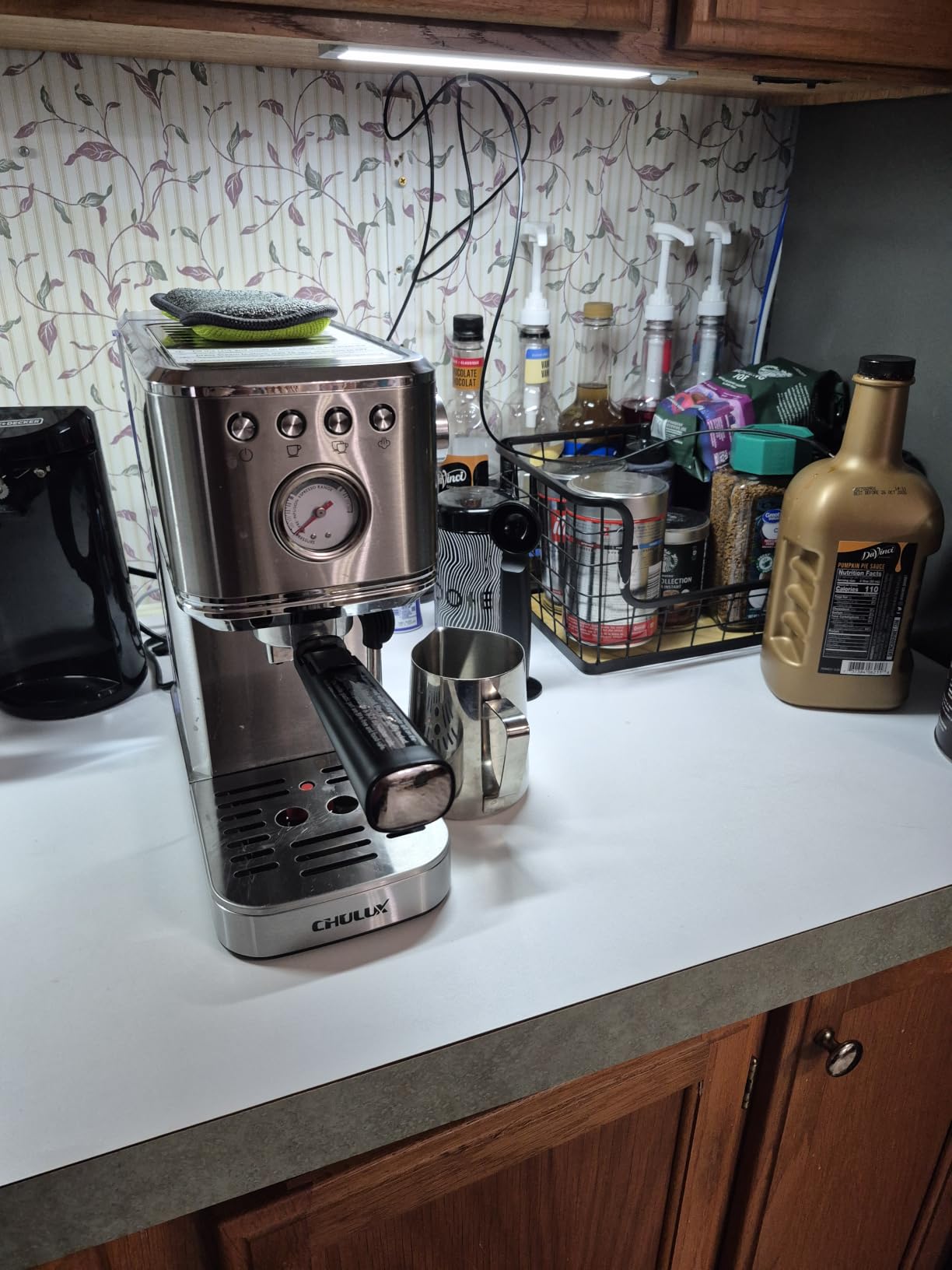
Food-safe materials are specified for the boiler, tank, brew head, silicone pipes, filter and steam wand, which matters for anyone who is sensitive to plastic components in a hot water path.
Microfoam and Steam Wand Behaviour
Owners describe the wand output as rich and creamy, with a texture closer to what you would want for a cappuccino than what a bare heating wand produces. That is a meaningful distinction in this price bracket.
The wand does drip a little water, so wipe and purge before you steam. That is normal behaviour for a wand at this level rather than a fault, and it costs five seconds.
Physical Build Issues Worth Knowing
The recurring complaints are physical rather than culinary. A vibrating cup holder and a rattling plastic tank lid make the machine louder than it needs to be, and some owners report the first pass pushing too little liquid so that a double needs two runs.
A minority of owners also document gradual loss of pump pressure and seam leaks over a few months. That is a minority report, but it is worth weighing if you plan to steam heavily every day.
Who Should Skip This Machine
Skip it if noise is a factor in your home. The vibration and rattles during operation are consistently mentioned, and they get worse on hollow cabinets.
There is also no built-in grinder, so you will be buying pre-ground coffee or adding a grinder separately. Combined with the single boiler, this is a machine for one drink at a time, not for a household that runs a queue.
10. AMZCHEF Compact – Best Rotating Wand and Tightest Temperature Control
AMZCHEF Compact Espresso Machine 20 Bar, Americano, Latte & Cappuccino
360 degree rotating stainless wand, 20-bar pump, PID within 2 degrees, 30 second preheat
Pros
- Rotating 360 degree wand produces fine dense froth
- Highest average rating in this group
- PID holds water within about 2 degrees
- 50oz tank cuts down refills
- Preheats in 30 seconds
Cons
- Body is primarily plastic
- No built-in grinder
- Single boiler means sequencing brew and steam
The AMZCHEF’s distinguishing feature is a frothing system that rotates a full 360 degrees. Reviewers consistently single out that system, and it is a real ergonomic advantage: the pitcher is not trapped at one awkward angle while you try to place the tip.
The froth it produces is described as fine and dense, which is the surface a rosetta needs. Being able to reposition the pitcher without contorting your wrist also makes it easier to hold a steady angle as you learn.
This machine holds the highest average rating among the twelve we looked at, though the review base is smaller than the established names above, so treat that number as encouraging rather than proven.
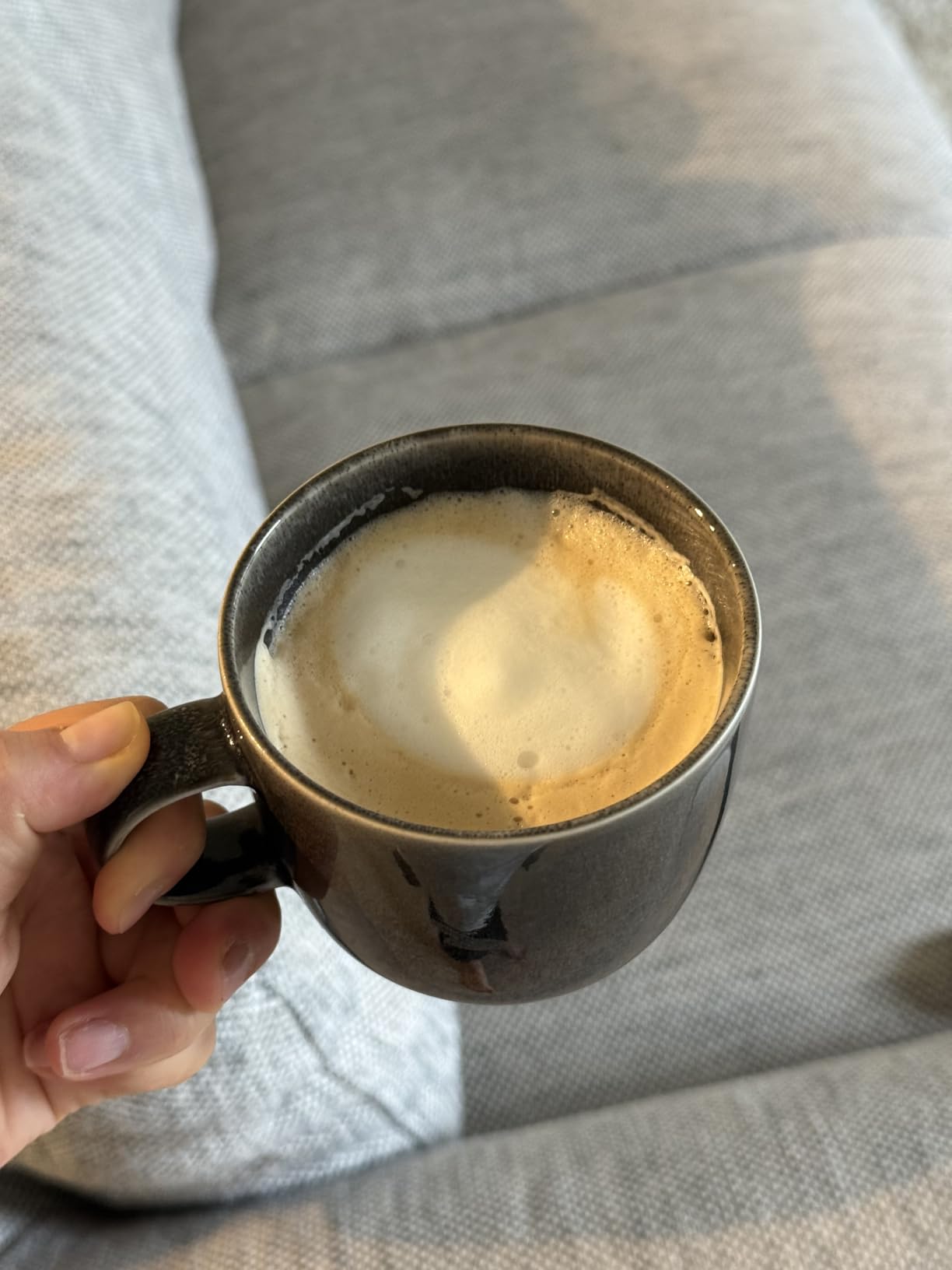
PID control holding water within about plus or minus two degrees is a tight tolerance. It is one reason the milk texture is repeatable, since milk texture is a temperature outcome before it is a technique outcome.
Why a Rotating Frothing Head Helps
Most entry wands pivot through a limited arc, which means the pitcher sits in a fixed position and you change your body to suit the machine. A 360 degree head lets the pitcher move and the wand follow.
That sounds minor until you consider what latte art asks of the texturing phase: hold the tip just under the surface, keep it there, and let the milk spin. A pitcher you can move freely makes that far easier to sustain for twenty seconds.
Temperature, Preheat and Tank
The 1350W system preheats in 30 seconds and warms cups for serving. The 50oz removable tank is among the larger capacities in this group, which means fewer sink trips while you practise.
One-touch buttons handle single, double or custom extraction times, so you can start on presets and move to manual timing once you know what you want.
Who Should Skip This Machine
Skip it if you want a metal-bodied machine that will be handed on in ten years, because the body is primarily plastic. The compact footprint also limits how large a cup or tank you can eventually fit.
There is no built-in grinder, so you need pre-ground coffee, which caps how good the espresso can be. Given that latte art reads through a thin crema, a fresh grind matters more here than on most drinks.
11. SHARDOR 20 Bar – Best for Simple Controls and a Two-Year Warranty
SHARDOR 20 Bar Espresso Machine for Home with LCD Display and Steam Wand
20-bar pump, 1350W thermoblock, 30 second heat-up, LCD display
Pros
- Adjustable wand makes smooth creamy foam
- 30 second thermoblock heat-up
- Clear LCD simplifies the brew cycle
- Cup warming tray included
- 2 year manufacturer warranty
Cons
- No built-in grinder so pre-ground coffee only
- Single boiler means sequencing brew and steam
- Small review base limits reliability evidence
The SHARDOR is the most approachable machine here for someone who does not want to read a manual. The LCD display shows the brew cycle as it happens, and the button controls are simple enough that the machine teaches itself.
Owners rate the adjustable steam wand well, reporting smooth, creamy foam suitable for lattes, cappuccinos and flat whites. The three drink types on that list are exactly the ones a beginner is trying to make.
The integrated cup warming tray is more useful than it appears. Warming the cup before the shot is one of the cheapest ways to make espresso and art taste better, and very few entry machines include one.
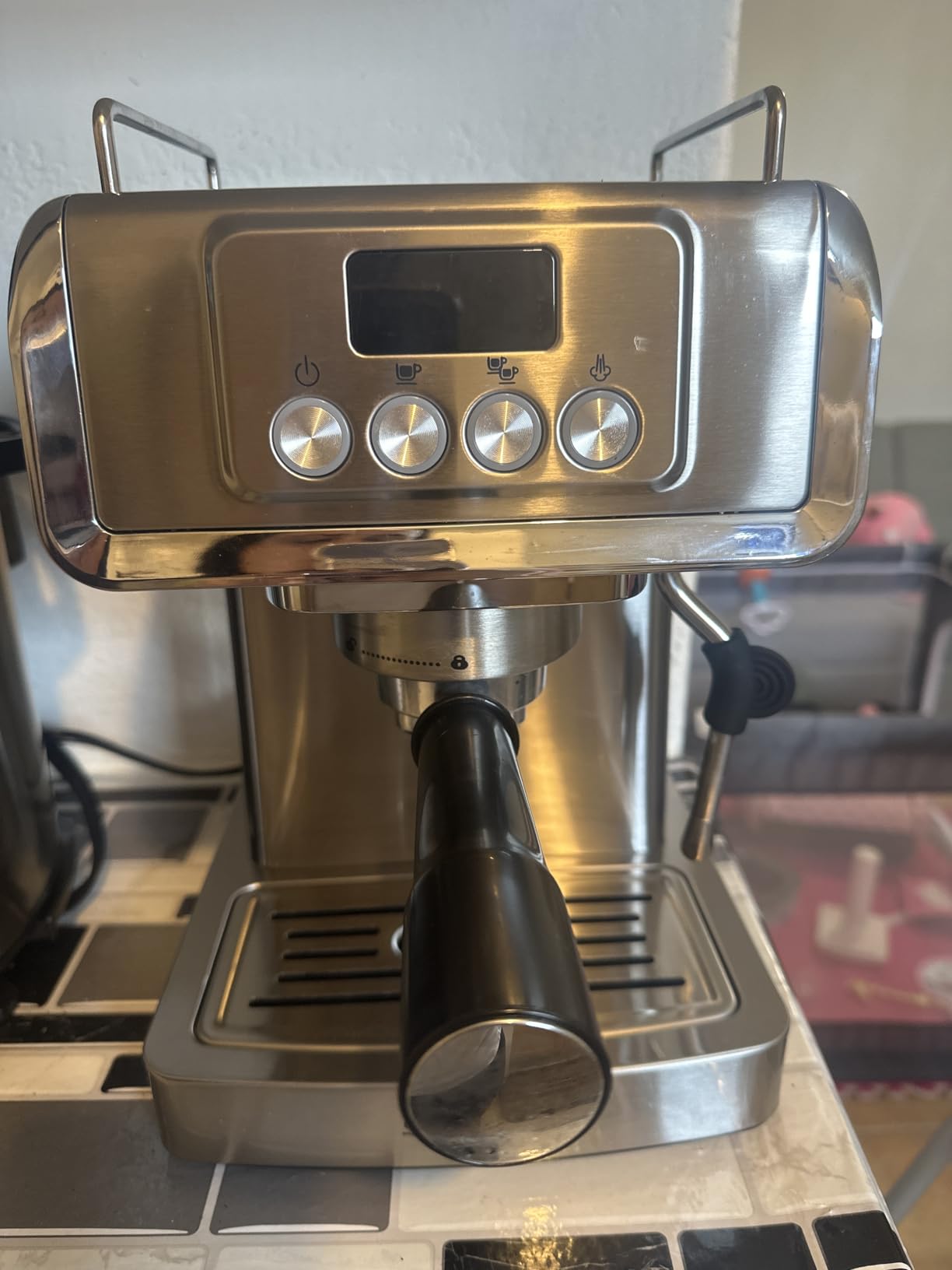
A 2 year manufacturer warranty is longer than most of this group offers, which matters when the review history is still short.
Steam Wand and Foam Consistency
The wand is adjustable and produces foam with the texture needed for a flat white as well as a cappuccino, which is a wider range than most entry machines claim. Owner feedback is consistent on that point.
What the wand cannot do is recover fast between pitchers, because this is a single boiler machine. If you are making one drink at a time, that never becomes a problem. If you are making two, plan a short pause.
Thermoblock Speed and Daily Use
The 1350W thermoblock reaches brewing temperature in about 30 seconds, so the machine is usable almost immediately. For a first espresso machine that removes the single biggest barrier to daily practice.
Because the wand and the brew boiler share the loop, the practical rule is simple: brew first, steam second, then let the thermoblock settle before the next shot.
Who Should Skip This Machine
Skip it if you want a built-in grinder. Pre-ground coffee is the only input, and stale grounds will flatten the crema that your design needs to sit on.
The review base is also small, which means there is limited long-term reliability evidence. That is a fair trade for a low cost and a two-year warranty, but not a fair trade for a daily commercial routine.
12. MAttinata 1632L – Best for Fully Automatic Milk Without Manual Technique
MAttinata 1632L Espresso Machine, Cappuccino Machine with Auto Milk Frother
20-bar pump, automatic milk frother, three foam settings, self-clean cycle
Pros
- Automatic frother removes technique from milk texturing
- Dense foam with a paint-like consistency
- Arrives assembled so you can brew immediately
- Detachable milk tank and self-cleaning steam cycle
Cons
- Frother must be cleaned immediately after every use
- Texture adjustment stops at three presets
- Some units lost heating power after a few months
The MAttinata is here for the buyer whose real question is whether the machine can froth milk on its own. The automatic frother does, with light, medium and thick settings, and owners report dense, cappuccino-grade foam that rivals a coffee shop version.
Users who want consistent foam without learning a manual wand are the group this machine serves best. It arrives assembled, so you rinse, fill and brew, and the detachable milk tank plus self-cleaning steam cycle keep the routine short.
The important caveat sits in the reviews rather than the marketing. The frother must be flushed straight after use, because milk residue hardens in the tubing and the result is a machine that smells permanently of milk.
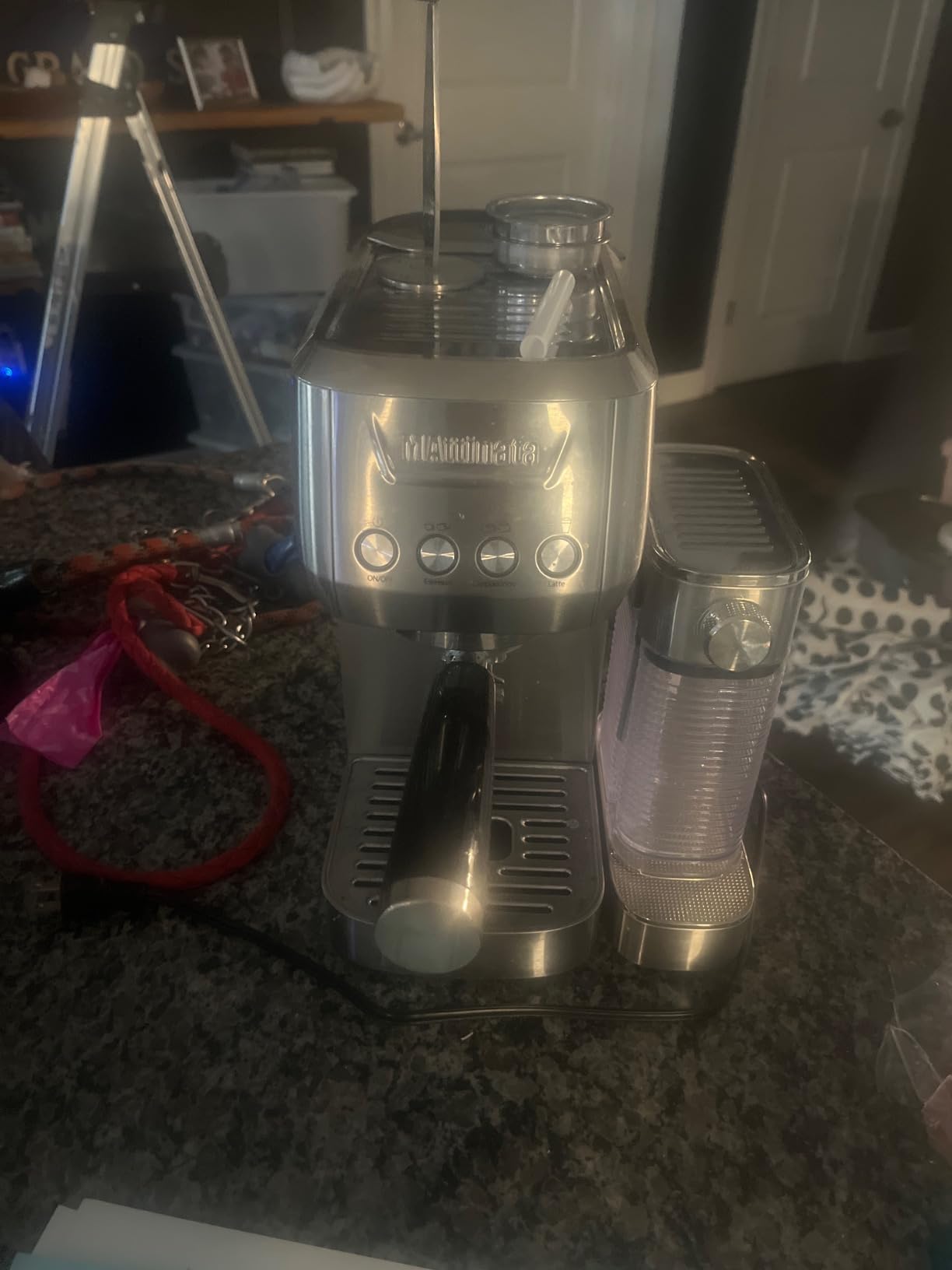
A descaling interval of every 2 to 4 weeks or roughly 500 uses is on the aggressive side, so budget time for maintenance rather than treating it as an occasional task.
What Automatic Frothing Removes and What It Keeps
Automatic frothing removes the stretching and texturing decisions entirely, which is the appeal. What you give up is control over the surface, and surface control is where latte art lives.
The three presets are a genuine limit. There is no adjustment between them, so the milk lands at one of three textures rather than at the one your cup and design need.
If you want to learn pouring, this machine will get you a drinkable foam but not the control to build on. If you want a consistent cappuccino every morning with no practice curve, that is exactly the right product.
Reliability Reports and Maintenance Discipline
Several owners documented the machine gradually losing heat and frothing power after two to four months and moved to a more expensive unit. That is the pattern to weigh before buying, because the machine’s appeal depends on frothing power.
The 20-bar Italian pump and pre-soak technology handle the espresso side well, and owners report rich crema, but the frother is the part that degrades first.
Who Should Skip This Machine
Skip it if you intend to learn latte art. The automatic frother caps you at a preset texture, and you will outgrow it in a few months.
Also skip it if you will not clean the frother immediately after every single use, or if you want a long service life. A machine that must be cleaned on a schedule you will not keep is the wrong purchase, however good the foam looks on day one.
De’Longhi vs Breville for Latte Art
De’Longhi and Breville split the SERP for this query, and for latte art they are opposites in approach. Breville gives you a full manual wand plus a grinder, and De’Longhi gives you a guided program in a body narrow enough for a small counter. The right answer depends on whether you want control or a head start.
Where Breville wins:
- Manual wand control, which is the only way to learn stretching and texturing separately.
- An integrated burr grinder on the Barista Express, so the shot quality that supports the art is handled in the same box.
- Higher element wattage on the Infuser at 1650W, which drives the strongest dedicated steam output in this group.
- Pressure gauge and PID readouts, so you get feedback while learning rather than only afterwards.
Where De’Longhi wins:
- Counter width. The Dedica Arte is 6 inches wide, so it fits counters that rule out the Breville machines entirely.
- Zero learning curve at the start, because the wand runs three preset foam programs instead of asking you to judge temperature and air intake.
- A removable double drip tray that accepts taller latte glasses without repositioning the machine.
- A lower total cost for a first attempt, since the machine arrives ready to run.
My read: buy Breville if you want to learn the craft and you have a separate grinder budget. Buy De’Longhi if your counter is small and you want a working cappuccino this week, accepting that you will want manual control later.
How to Choose an Espresso Machine for Latte Art
Judge an espresso machine for latte art on three things, in this order: steam wand power, boiler architecture and milk pitcher clearance. Everything else on the spec sheet matters less than those three, and almost every failed pour traces back to one of them.
1. A Powerful Steam Wand Beats a Clever One
Steam power is what separates glossy microfoam from dry foam. Wet, shiny milk with no visible bubbles is the surface a rosetta or tulip needs, and producing it takes energy that a low-wattage element simply does not have.
Tip type matters as much as power. A single-hole tip gives you a focused jet that spins hard and lets you control the air intake precisely, which is what most experienced baristas use. A multi-hole tip breaks the steam into a broader pattern that is more forgiving for beginners. A panarello sleeve sits between the two and is the most common compromise: it warms milk evenly, but it folds in air rather than stretching it, so you can produce cappuccino foam and struggle to produce microfoam.
For numbers, practitioners on Home-Barista treat 30 seconds for a 6oz pitcher as the point where a machine still feels responsive, with 37 seconds recorded for a 12oz pitcher on a compact dual boiler. Those are community benchmarks rather than lab measurements, but they give you a target. If a machine cannot steam a small pitcher in roughly half a minute from a hot boiler, it will not have the headroom for a full 12oz pitcher.
Check the stated wattage as a rough proxy. Everything from 1350W upward in this group steams acceptably; the machines rated near 1500W and above give you more headroom for a large pitcher.
2. Boiler Architecture Decides Your Workflow
The boiler determines whether you can brew and steam at the same time, and whether your steam pressure holds up for a second or third drink.
- Single boiler: One water chamber does both jobs, so you brew, wait, steam, then brew again. Steam pressure is fine once the transition completes. Most machines in this group use this design.
- Heat exchanger: The brew water passes through a steam boiler without mixing, so you never wait. Steam is plentiful and the temperature is stable, though the wand is very manual.
- Dual boiler: Separate brew and steam chambers mean simultaneous brewing and steaming with no warm-up penalty. It is the best workflow of any architecture for practice, and it is why the Chefman is on this list.
- Thermoblock: An inline element heats water on demand. Heat-up is fast and temperature is stable, but brewing and steaming are still sequential. The Calphalon and Breville machines here use this.
- Thermocoiler: A thermoblock paired with a small steam boiler, giving some recovery without the full dual boiler footprint or cost.
- Fully automatic with a carafe: Milk is drawn from a carafe through a fixed spout. You can produce a cappuccino, and you cannot pour art, because the pour is not yours. We deliberately left these out of this list.
For latte art specifically, dual boiler is the upgrade that pays off most, and single boiler is a perfectly workable compromise if you make one drink at a time.
3. Check Milk Pitcher Clearance Before You Buy
Clearance is the criterion almost nobody checks and everybody notices. If your largest pitcher will not fit under the wand at a comfortable angle, you cannot hold the tip just below the surface, and the texturing phase collapses.
Measure two things: the height from the drip tray to the underside of the wand tip, and the width available in front of the machine. Taller wands give you more vertical room, which is why the Calphalon Temp iQ and the Gaggia both feel easier to work with than very short compact wands.
Also check that the machine’s cup rest can be raised or removed if you drink from tall latte glasses. The De’Longhi Dedica Arte and the wider machines here accommodate this better than the smallest bodies.
Our guide to the best latte art milk pitchers covers the jug shapes that suit a rosetta versus a tulip, and the spout style that controls how fast you can start the pour.
4. Manual or Automatic Milk Texturing: Which Should You Buy?
Buy manual if you want to learn latte art. Automatic if you want a repeatable cappuccino with no learning curve. That is the whole decision, and it is a decision about how much of the process you want to own.
A manual wand asks you to judge three things: when to introduce air, how deep to hold the tip, and when the milk is finished. Get it right and you have full control over texture and can pour anything. Get it wrong and you get big bubbles, dry foam, or milk that tastes scalded.
An automatic wand or preset program takes those three decisions away. You choose a level and press a button. The foam is consistent, which is genuinely valuable if you are making the same drink every morning, but you have no way to adjust the result when a design is not landing.
The compromise many buyers land on is a manual wand machine, used with a basic recipe until the technique is automatic. Every manual machine in this list supports that path. Only the Dedica Arte and the MAttinata remove it, and they are the two to buy if you are certain you do not want it.
5. Countertop Footprint and Reservoir Versus Plumbed-In
Width is the constraint that eliminates the most good machines. The CHULUX is 5.5 inches wide and the Dedica Arte is 6 inches, while the Gevi is over 11 inches wide and 16.5 inches tall because of its grinder housing.
Measure the space above the machine as well as the width. A tall machine with an integrated grinder needs cabinet clearance, and finding that out after delivery is the most common regret in this category.
Water supply is the second constraint. All the machines here use a removable reservoir, which is the right choice for most homes because refilling takes seconds. A plumbed-in line removes refills entirely but needs a drain and a valve under the counter, and it is a job worth doing only if you make enough drinks per day to care.
Reservoir capacity ranges from 35oz on the Dedica Arte to 3L on the Chefman, and the larger tanks matter more for practice sessions than for daily use.
6. The Grinder Matters as Much as the Machine
Practitioner forum consensus, on Home-Barista and elsewhere, is that the grinder deserves a share of the budget equal to the machine. Latte art amplifies a good shot and exposes a bad one, because the design has to be poured through crema.
Grind size sets the extraction rate, and extraction rate sets crema thickness and colour. A shot pulled too fast gives you a pale, thin surface that a rosetta sinks straight through, and no steam wand on any machine in this list can fix that.
Three machines here include a burr grinder: the Barista Express, the Gevi and the Chefman, each with an integrated hopper that grinds into the portafilter. If you are buying the Infuser or the Gaggia instead, put the money you saved into a conical burr grinder, and the machine will outperform a comparable setup running on a cheap blade grinder.
Latte Art Technique: Stretch, Texture, Then Pour
A good machine gives you the headroom, but the pattern still comes from four things: milk temperature, pitcher size, the order of the two steaming phases, and where you start the pour. Get these right and a mid-range machine will pour better art than an expensive one used badly.
Target Milk Temperature: 55 to 65 Degrees Celsius
Target 55 to 65 degrees Celsius, which is 130 to 145 degrees Fahrenheit. Below that range, the milk has not fully integrated the air and you get large bubbles that will not hold a shape. Above it, proteins tighten and the milk tastes flat and sweet, and the foam goes slick against the crema instead of sitting on it.
Below roughly 50 degrees you are heating milk. Between 55 and 65 you are texturing. That narrow band is where all latte art lives, and it is why a wand with unstable temperature control is such a handicap.
Stretch First, Then Texture
Steaming has two phases and they happen in a fixed order.
- Stretch: Start with cold milk in the pitcher, tip just under the surface, and introduce a little air early. You want the volume to grow to roughly a third more than the starting milk.
- Lower the tip: Drop the tip a few millimetres so steam stops expanding air and starts spinning the milk. Keep the pitcher off the counter and let the wand draw a whirlpool.
- Texture to temperature: Keep the whirlpool going until you reach 55 to 65 degrees. The surface should turn glossy and wet, with no visible bubbles.
- Wipe and purge: Wipe the wand immediately with a damp cloth and purge it into the drip tray before the milk dries on the tip.
Getting air in early is the single most common tip repeated by working baristas, and the whirlpool is what makes the texture. Pour from height and the design will not settle. Let the wand make the vortex for you.
Pitcher Size and Pouring Height
Use less milk than the pitcher holds. A half-full pitcher gives you room to stretch without the milk climbing over the lip, and it gives you a taller column to roll, which improves the texture. Our pitcher guide covers which sizes suit which designs.
For the pour itself, start high. The community’s default beginner technique is the pin drop: begin at around 10 centimetres above the cup and pour slowly enough that the milk drops below the crema surface rather than landing on it and breaking the pattern.
Once the design is sitting in the crema, drop your pour height low and increase the flow to push the pattern back and forth. Raising the jug again and cutting through the design is the most common reason a rosetta turns into a blob.
Why Your Latte Art Comes Out Bubbly
Bubbles are the most common latte art failure, and the causes are worth checking in order before you blame the machine.
- Milk was too cold when you started. Cold milk needs more air and more time, so the air you add stays as large bubbles instead of being folded in.
- The tip sat too deep during the stretch. Deep in the milk, steam makes big bubbles. Shallow and near the surface makes fine foam.
- You introduced too little air, or too late. Milk with no expansion cannot be textured properly, so the foam is thin and the pattern sinks.
- The pitcher was too large for the milk. A tall narrow column spins better than a wide shallow one, so an oversized jug gives you uneven texture.
- You finished too hot. Past 65 degrees the surface stops taking structure and the design collapses into the cup.
- The wand is genuinely underpowered. If the milk takes over a minute to reach temperature and the wand feels slack, you have a hardware limit, and no technique change will fix it.
That last point is the one worth taking seriously. If the other five causes are not the answer, the machine is the problem, and the fix is more element wattage, a longer wand, or a dedicated steam boiler rather than a different recipe.
Frequently Asked Questions
What is the best machine to make latte art?
The Breville Barista Express is the best all-rounder for latte art because its powerful manual steam wand turns milk into glossy microfoam, and the built-in burr grinder means no second purchase stands between you and your first rosetta. The Calphalon Temp iQ is the value pick, with a long solid metal steam wand that beginners get good results from quickly.
What kind of steam wand do I need for latte art?
You need a manual steam wand with a single-hole or multi-hole tip and enough steam power to reach 55 to 65 degrees Celsius in about 30 seconds for a 6oz pitcher. Avoid weak panarello-style sleeves, which warm milk evenly but fold in air instead of stretching it, so you get cappuccino foam rather than pourable microfoam.
Can superautomatic machines make latte art?
No. Superautomatic machines draw milk from a carafe through a fixed spout, so the pour is not yours to control. They make a respectable cappuccino with consistent foam, but the pattern has to be poured by hand, and a separate manual machine is the only way to practise. That is why we left them out of this roundup entirely.
Why does my latte art come out bubbly?
Bubbles usually mean the milk was too cold at the start, the tip sat too deep during the stretch, or you added too little air too late. Start with a half-full pitcher, keep the tip shallow until the volume grows by about a third, then lower it a few millimetres and spin to 55 to 65 degrees Celsius. If the wand feels slack and the milk takes over a minute to heat, the machine lacks steam power.
What milk temperature is best for latte art?
Aim for 55 to 65 degrees Celsius, which is 130 to 145 degrees Fahrenheit. Below that range the milk has not integrated the air and you get large bubbles that will not hold a design. Above it the proteins tighten, the milk tastes flat and sweet, and the foam slides off the crema instead of sitting on top.
Which Espresso Machine Should You Buy for Latte Art in 2026?
If you want one machine that does everything and you are starting out, the Breville Barista Express is the pick: powerful manual wand, built-in grinder, PID control, and a footprint that still fits a normal counter. If you want the strongest steam output and already own a burr grinder, the Breville Infuser is the better machine for milk.
If your counter is narrow, the De’Longhi Dedica Arte at 6 inches wide or the CHULUX Slim at 5.5 inches wide will fit where the others will not, and the De’Longhi will hand you a usable cappuccino without any practice. If you want to learn the craft on a machine built from real parts, the Gaggia E24 is the honest choice, with a commercial portafilter and a serviceable body. If you want to brew and steam at the same time, the Chefman’s dual boiler is the only one here that does it, and you should weigh its reported durability issues first.
Whatever you choose, the wand is only half of it. Grinder, milk temperature and pour height decide whether the pattern lands, and all three are habits you can fix in a week. Pick the machine that suits your counter and your patience, then spend a month with it before you judge it.
Leave a Reply