
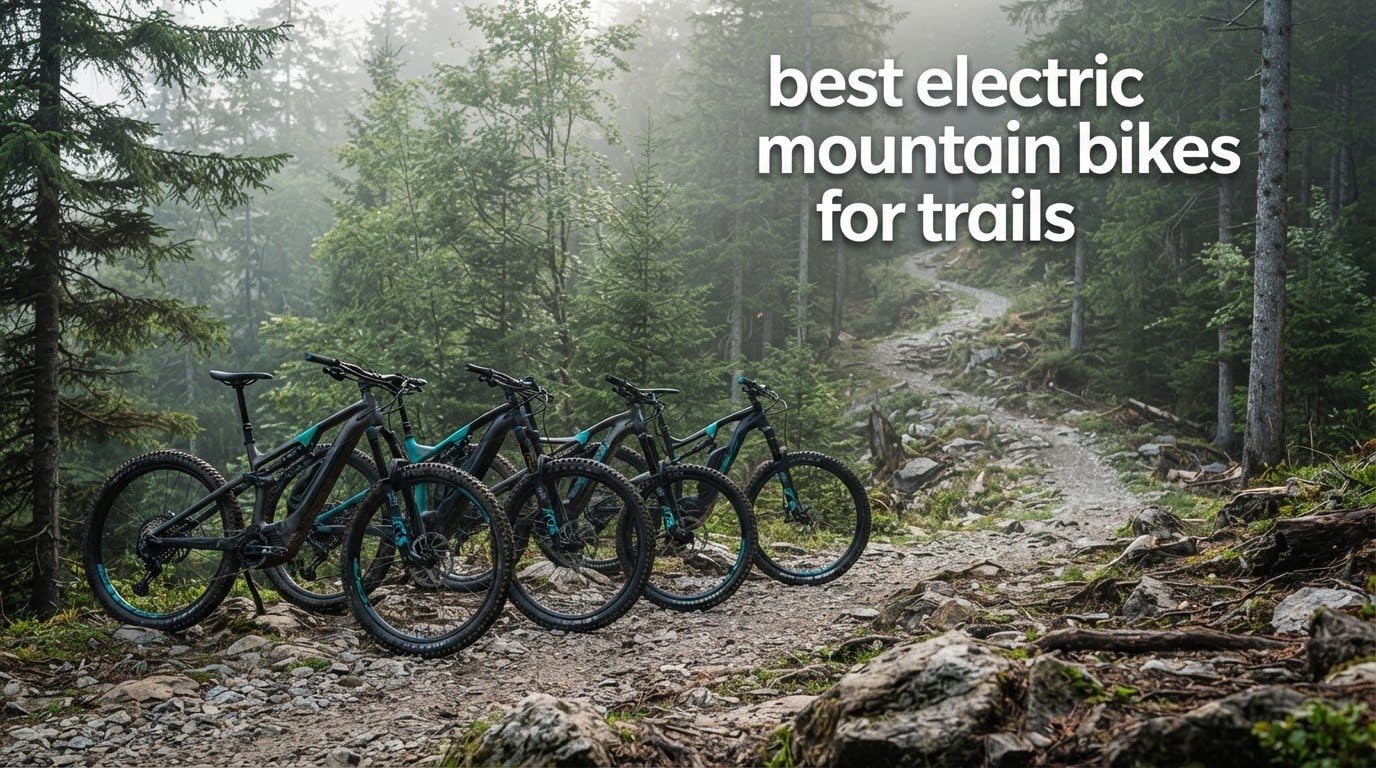
Choosing the best electric mountain bikes for trails is harder than it looks, because most bikes sold under that name are not built for singletrack at all. They carry mountain-bike styling, knobby tires and a suspension fork, then add a throttle, a low gearing count and a motor that was designed for a beach path. I compared ten of the most-reviewed e-MTBs in this category, reading the spec sheets, warranty terms and owner review patterns for each one so the trade-offs are visible before you commit.
The headline finding: every bike in this guide is a road-legal e-bike, but almost none of them are legal on your local trail network without reconfiguration. The difference between a bike that works on singletrack and one that only looks like it does comes down to torque, gearing, weight and how the manufacturer configures the assist modes. A 500W hub-drive bike with seven gears is a different tool from a 21-speed aluminum-framed model with a 499Wh battery, even when both print a trail-sounding name.
I also weighted what riders actually complain about. Forum threads on r/ebikes and r/CyclingMSP keep circling the same themes: weight, assist delay, and parts that are hard to source after the warranty ends. I used those as scoring criteria alongside the published numbers. If you want a broader baseline first, our guide to the best mountain bikes overall is a good place to understand the non-electric hardware these bikes are built on.
Are E-Bikes Legal on Mountain Bike Trails? The Short Answer
It depends entirely on the class of the bike and the land manager in charge. Class 1 e-bikes, which assist up to 20 mph with no throttle, are the only class most dedicated mountain bike trail networks permit. Class 2 bikes add a throttle up to 20 mph and are banned on most MTB trails. Class 3 bikes assist to 28 mph and are treated like a motorcycle in many jurisdictions.
Class 1, Class 2 and Class 3 explained
The three classes exist because trail managers needed a way to separate a pedal-assist bicycle from a motorized vehicle. Class 1 is pedal assist only, capped at 20 mph, and the pedal has to be turning for the motor to fire. Class 2 adds a hand throttle but stays capped at 20 mph. Class 3 allows assistance up to 28 mph, and some states require a license and registration for that class.
Trail networks generally allow Class 1 and nothing else. USFS pilot programs that open routes to e-bikes do so for Class 1 machines on designated routes only, and many dedicated MTB trail systems post signage at the trailhead that reads Class 1 only, with everything else turned away. State rules defer to the land manager, so two counties in the same state can post opposite rules.
Why trail managers say no
The concerns are consistent and worth understanding before you argue with a ranger. Motor noise on a quiet corridor, wildlife disturbance, extra erosion from heavier tires and riders, and a genuine skill mismatch when a heavier bike meets a technical descent. Some of these are reasonable, some are debatable, but they explain why the rules are written by class rather than by rider intent.
There is a second, less visible problem. Plenty of trails that are legally open to Class 1 are informally discouraged locally, and riders report being given a hard time at the trailhead even when they are within the rules. Knowing the posted class before you drive out saves a wasted day.
How to check before you drive to the trailhead
Look up the land manager for the specific trail, not just the state. Read the current rule page for the bike park, forest or recreation district, then confirm the class your bike is configured for. Several bikes in this guide ship with a display that can be set to Class 1, 2 or 3, and configuring it correctly before you leave home matters. Finally, call the trail office when the rule language is ambiguous.
Worth noting: helmets are required by many states for riders 15 and under, and most trail networks require one regardless of age. If you are new to e-bikes entirely, our budget electric bike guide covers the class differences in more detail.
Our Top 3 Trail-Ready Picks
The three bikes below cover the most common rider profiles. Every one has a full owner review record behind it, which matters more in this category than headline wattage.

ANCHEER 499Wh 21-Speed
- 499Wh removable battery
- 21-speed Shimano drivetrain
- Lockable front fork
- UL 2849 certified
Funhang EB-M1
- 1000W peak motor
- 5 assist levels
- UL 2271 and UL 2849 certified
- Removable lockable battery

Loeook EB-M1
- 4.4 star owner average
- Removable lockable battery
- UL certified battery and bike
- 300 lb capacity
Comparing All Ten Bikes Side by Side
Every bike below ships with a removable battery, a pedal-assist mode and a 12-month warranty of some kind. The differences that matter on a trail are torque, gear count, suspension and weight.
| Product | Specs | Action |
|---|---|---|
| ANCHEER 27.5 inch 499Wh Electric Mountain Bike |
|
Check Latest Price |
| Funhang EB-M1 26 inch 1000W Peak |
|
Check Latest Price |
| Loeook EB-M1 26 inch 1000W Peak |
|
Check Latest Price |
 TotGuard 27.5 inch 499Wh 21-Speed TotGuard 27.5 inch 499Wh 21-Speed |
|
Check Latest Price |
 Qlife Racer 26 inch 21-Speed Qlife Racer 26 inch 21-Speed |
|
Check Latest Price |
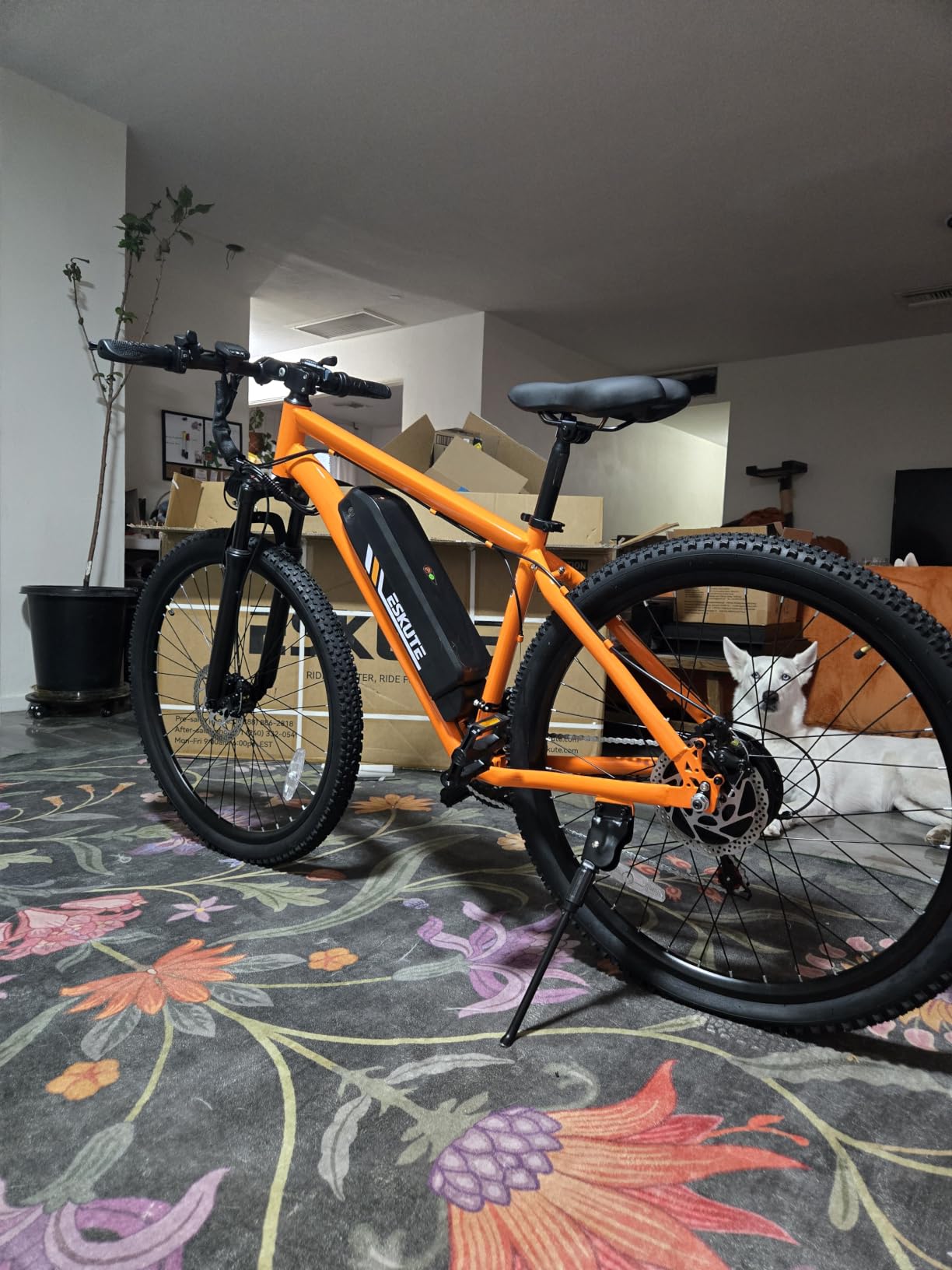
 ESKUTE M200 27.5 inch 1200W Peak ESKUTE M200 27.5 inch 1200W Peak |
|
Check Latest Price |
 ESKUTE M200F Full Suspension 998Wh ESKUTE M200F Full Suspension 998Wh |
|
Check Latest Price |
 E-Bycco E8 29 inch 2000W Peak E-Bycco E8 29 inch 2000W Peak |
|
Check Latest Price |
 Funhang EB-S1 26 inch Fat Tire Funhang EB-S1 26 inch Fat Tire |
|
Check Latest Price |
 PUJH PU1 29 inch 2000W Peak PUJH PU1 29 inch 2000W Peak |
|
Check Latest Price |
1. ANCHEER 27.5 inch 499Wh – Best All-Rounder With the Deepest Owner Record
ANCHEER Hummmer Electric Bike for Adults 27.5” Peak 750W Electric Mountain Bike/Ebike, 3 Hours Fast Charge, 55 Miles Electric Bicycle with 48v/499Wh Battery, LCD Display, 21 Speed Gears
499Wh removable battery
500W nominal 750W peak
27.5 inch wheels
52 pounds
Pros
- Aluminum frame holds up better than steel rivals
- 21-speed Shimano drivetrain
- Lockable fork tunes to terrain
- LCD shows error codes
- 1000 owner reviews on record
Cons
- Narrow factory saddle
- Costly replacement battery
- Five preset speed levels only
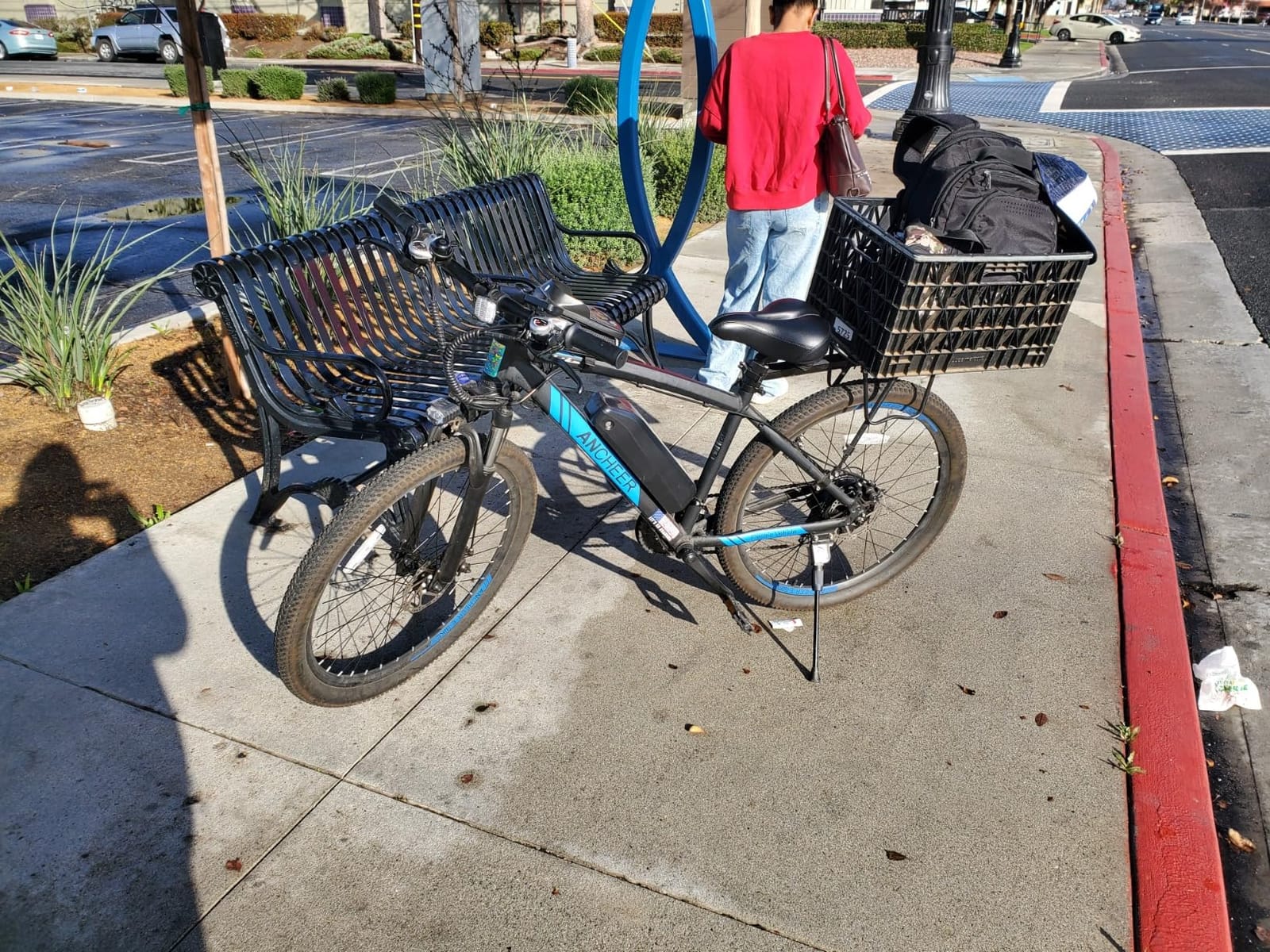
The ANCHEER is the pick I keep coming back to because its owner record is the deepest in the group. More than a thousand reviews means the failure modes are well documented, which is exactly what you want when a component is only warranted for a year. It ships as an aluminum frame with a 21-speed Shimano drivetrain and a 499Wh removable battery, and it weighs 52 pounds.
Twenty-one gears is the number that matters here. Nearly every rival at this tier runs seven, and on a climb where you are spinning out the motor against a steep grade, the extra range keeps your cadence in a usable band. Owners single out the Shimano shifting and braking as components that wear slowly, and the lockable suspension fork is genuinely useful when you switch from a gravel fire road to loose singletrack.
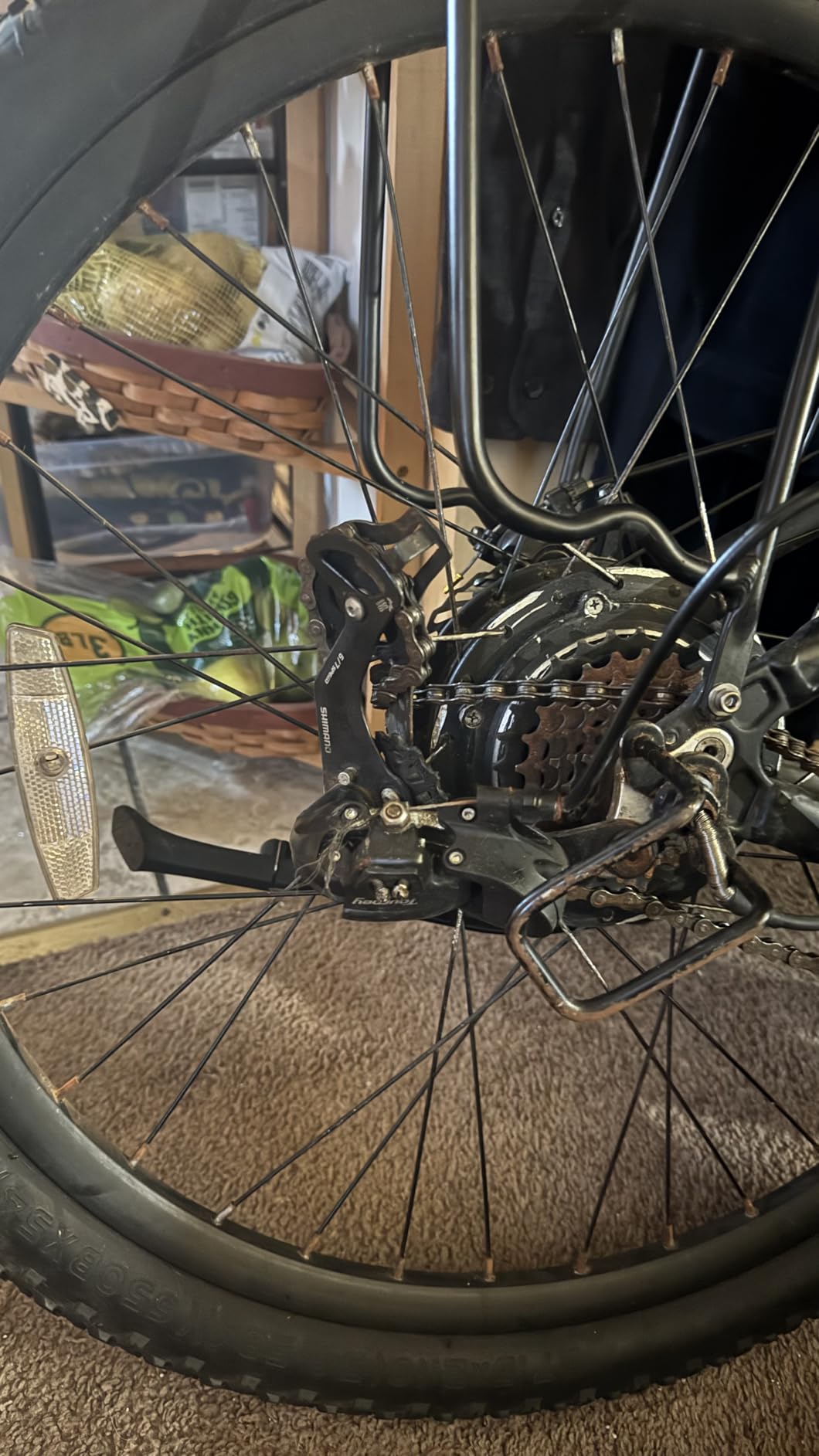
Assist behavior is where the compromises show. The speed controller uses five preset levels rather than continuous variation, so both throttle and pedal assist snap to a fixed speed instead of ramping. Owners also report the stock saddle is narrow, the charger runs very hot during long sessions, and the factory-fitted tires wear quickly on rough ground. All three are fixable with a saddle, a plug, and a tire change.
Battery capacity and charging reality
The 48V 499Wh pack is genuinely large for the money, and the manufacturer quotes a three-hour charge. The whole bike carries SGS UL 2849 certification, which covers the battery and the electrical system together, and the cell pack is also removable and lockable. One long-distance owner reports roughly 150 miles per charge, though that figure comes from mixed riding rather than repeated trail climbs.
Trail riding is harsher on a battery than pavement commuting because climbing draws sustained current. Expect your assist range to shrink noticeably if you spend the day in the highest assist level on loose ground. The 10.4Ah capacity is the main reason this bike outlasts the 374Wh packs in the group.
Why the 21-speed drivetrain earns its place
Owners consistently report strong climbing torque on steep dirt trails and desert grades, and I think the gearing explains why. A 7-speed drivetrain on a 500W motor leaves you spinning or bogging with nothing in between. Twenty-one ratios let you drop into a low gear, keep the motor in its efficient band, and pedal smoothly out of a technical section rather than stalling in the middle of it.
Who this bike suits
This is the one I recommend to someone whose local trail network allows Class 1 bikes and who wants a machine that works on a fire road, a doubletrack climb and a winding singletrack descent without changing anything. The maximum recommended rider weight is 265 pounds, so riders above that should look at the E-Bycco E8 or the ESKUTE M200.
The weaker fit is a rider chasing descents. With a 750W peak motor and a 20 mph class cap, this is a bike that helps you get to the good part and then gets out of the way. Riders who want to ride down fast should look at the ESKUTE M200 instead.
2. Funhang EB-M1 – Best Value for First Time Trail Riders
Funhang Electric Bike for Adults, 1000W Peak Ebike, 50Miles Electric Mountain Bike, 26″ Adult Electric Bicycle with 48V Removable Battery, Fenders,7 Speed, Front Suspension, UL 2849 Certified
1000W peak motor
374Wh removable battery
Five riding modes
7-speed drivetrain
Pros
- Good pedal-assist range
- UL 2271 and UL 2849 certified
- Removable lockable battery
- Booster mode helps with the heavy frame
- Assembly videos for first-timers
Cons
- Weak brake feel
- Non-adjustable handlebar stem
- Assist engages with a delay
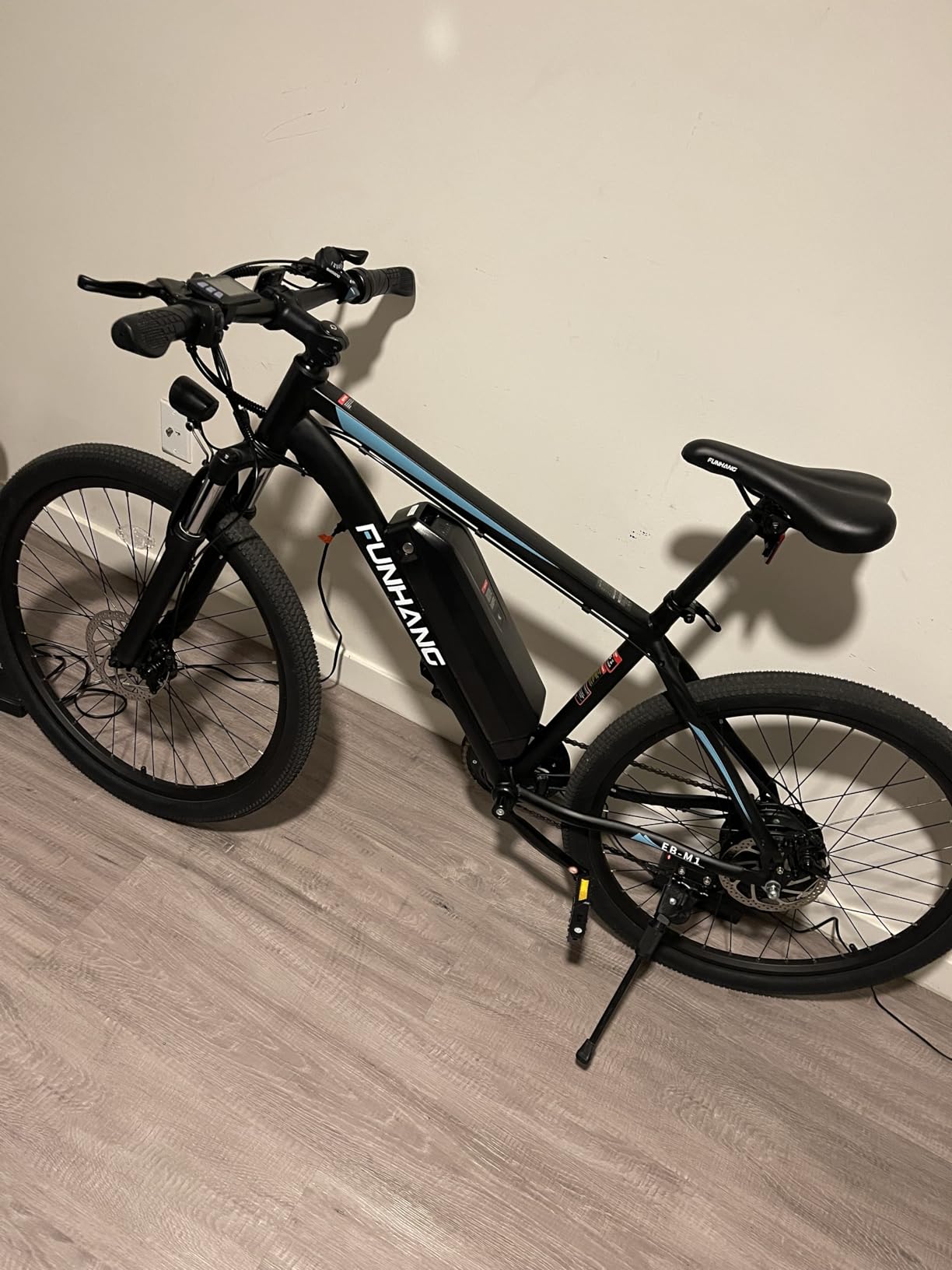
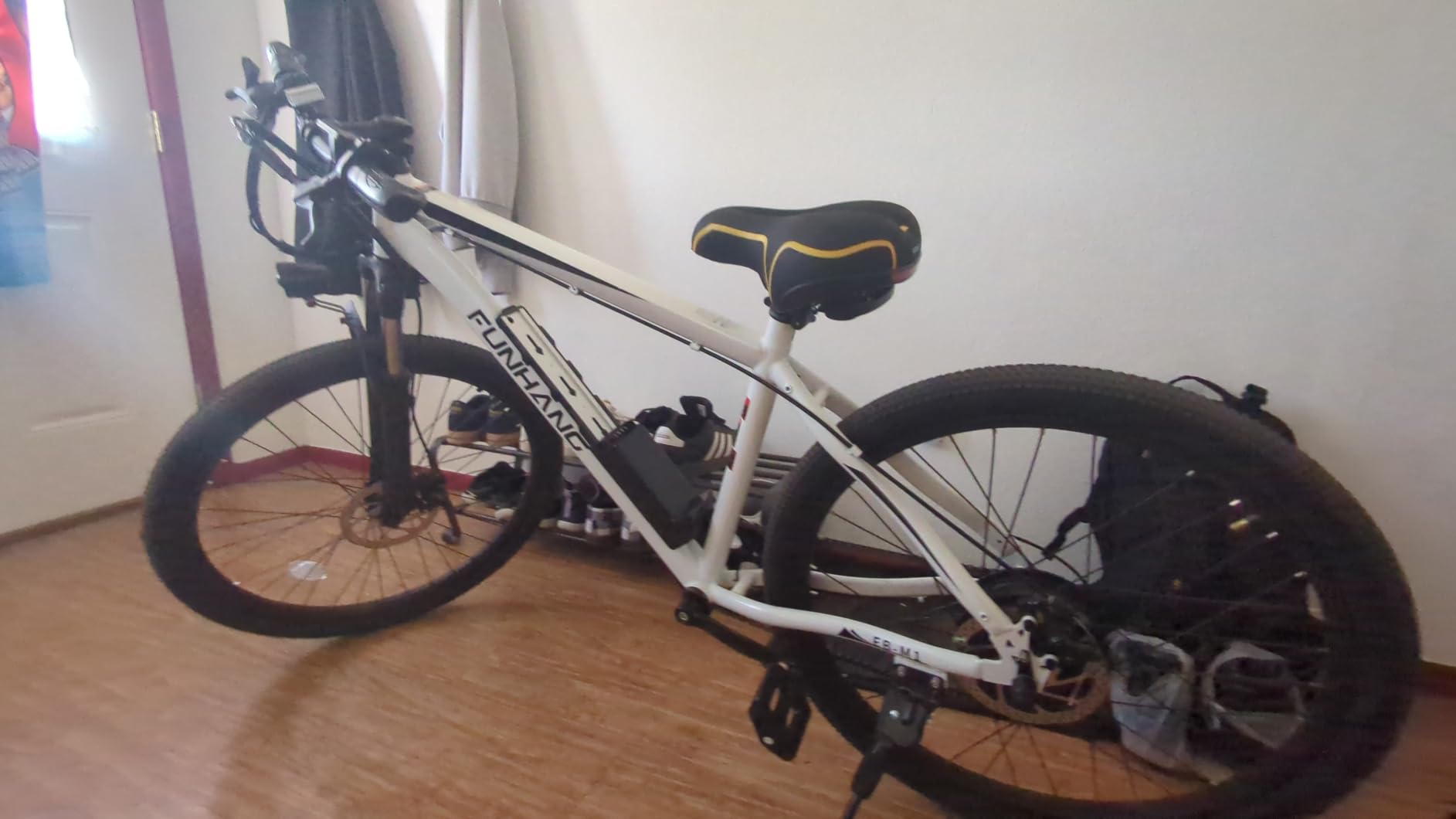
The Funhang EB-M1 is one of only two bikes in this group that carry both UL 2271 battery certification and whole-bike UL 2849 certification, and that safety paperwork is the main reason I rank it here. The motor is a 500W unit that peaks at 1000W, paired with a 48V 374Wh removable pack that charges in four to five hours.
Owners report finishing 20-mile rides in pedal assist with charge to spare, and the front shock absorbs potholes and country road chatter well enough to double as a commuter. The frame is carbon steel with smooth welds, and the booster mode helps push the bike up a steep driveway when the motor is not engaged.
Assist timing is the biggest complaint
Riders describe a five to eight second delay before pedal assist engages, and a throttle that feels weak at low assist settings. That delay is not dangerous, but it is distracting on technical ground where you expect the motor to respond immediately to a twist of the cranks. If you are buying a bike for flowing singletrack, test the assist response on a steep hill before you commit.
The second recurring theme is brake feel. Owners report long stopping distances relative to the top speed, which on loose ground is a real consideration. The factory grips and factory saddle are widely replaced by owners, and the handlebar stem is no longer height adjustable despite what some product imagery suggests.
Certification, weight and warranty
UL 2271 covers the battery cells and UL 2849 covers the entire electrical system, which is the combination riders on r/ebikes tend to look for first when buying a bike they will charge indoors overnight. The frame is heavy, with owners putting it above 50 pounds, and the manufacturer does not publish a weight figure. Minimum rider height is listed at 160 centimeters.
The warranty is a limited 12 months, with about 85 percent of the bike pre-assembled and extensive assembly and disassembly videos on the brand’s site. That last point is a genuine benefit for first-time owners who do not have a local shop that will work on the bike.
Who this bike suits
Pick the EB-M1 if your priority is safe, affordable entry into trail-flavoured riding on greenways, gravel roads and wide dirt tracks, and you want documented battery safety more than you want aggressive trail performance. The 7-speed drivetrain and the assist delay rule it out of tight switchback terrain.
For riders who want a real hardtail comparison on singletrack, our guide to the best hardtail mountain bikes shows what the non-electric equivalent handles.
3. Loeook EB-M1 – Most Versatile Building Trail Fitness
Loeook Electric Bike for Adults, 26″ Ebike with 1000W Peak Motor, 20MPH 50Miles Electric Mountain Bike with 48V Removable Battery, 7-Speed, Front Suspension, LCD Display, UL 2849 Certified
500W motor 1000W peak
374Wh removable battery
26 inch wheels
56.9 pounds
Pros
- 4.4 star owner average
- UL 2271 and UL 2849 certified
- 300 lb rider capacity
- Removable battery with two lock keys
- Lifetime technical support
Cons
- Heavy steel frame
- Only 7 gears
- Soft factory seat
The Loeook EB-M1 sits at a 4.4 star average, with about three quarters of its 189 reviews at five stars. A distribution that tight is unusual in this category, where most bikes cluster around 4.2 with a long tail of complaints, and it is the strongest trust signal the Loeook has going for it.
Underneath, the specification is a familiar budget layout: a 500W brushless motor peaking at 1000W, a 20 mph top speed, a 48V 374Wh IPX5 removable battery with two lock keys, and a 7-speed drivetrain. Where it improves on its direct competitors is the certification and the stated 300 pound maximum rider weight.
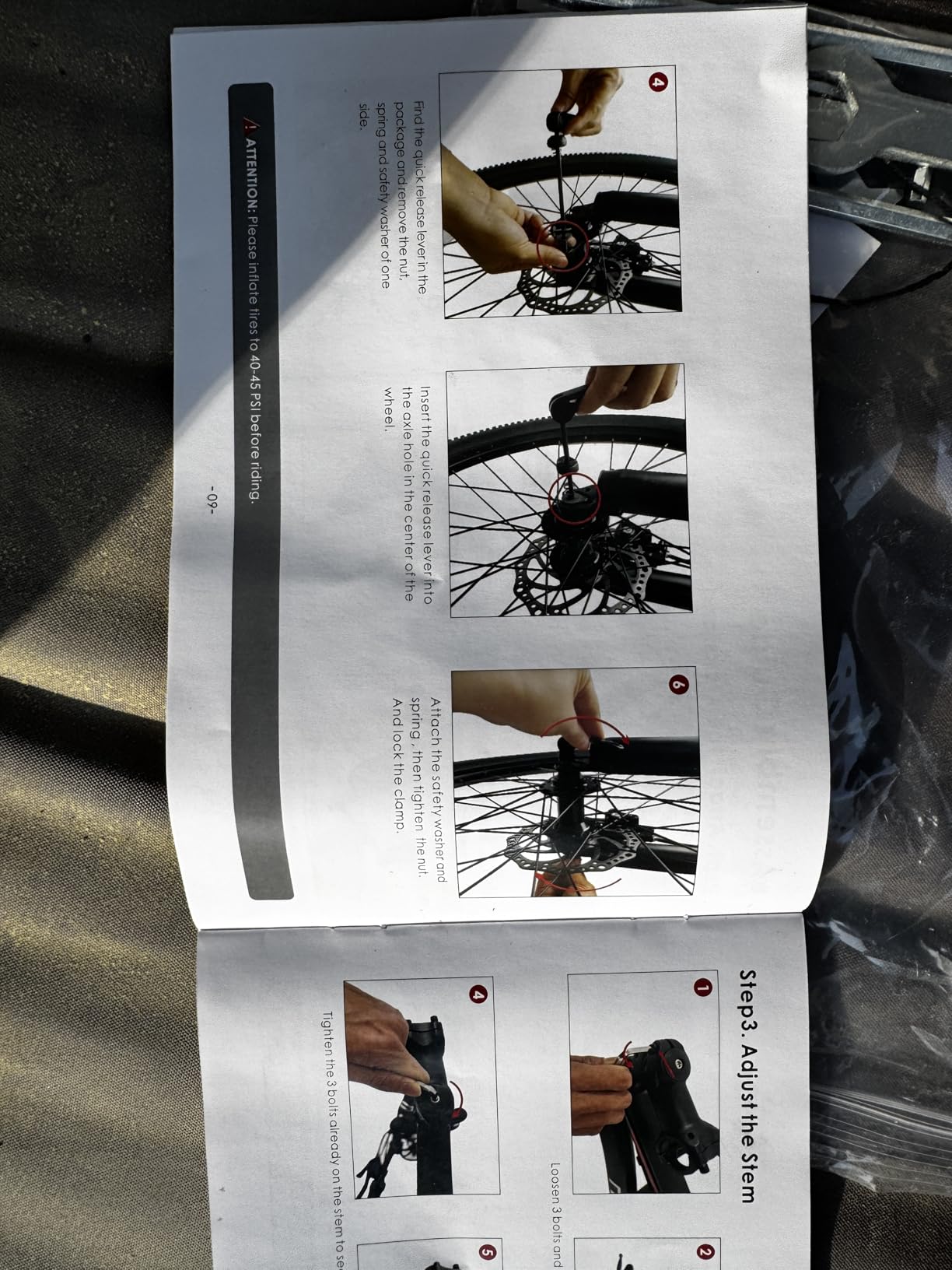
Range and assist modes on the trail
Published figures are 25 to 30 miles in pure electric mode and 40 to 50 miles in pedal assist. Treat those as pavement numbers. Real trail riding eats that budget much faster because climbs draw sustained current, and cold mornings make it worse still. For a two to three hour ride on mixed terrain, plan on a top-up charge halfway.
Five working modes cover throttle, five levels of pedal assist, pedaling with no power, cruise and a booster. The booster is useful on a steep push, and cruise control is a small quality-of-life feature on long fire road transfers.
Where the 300 pound rating matters
Many budget e-bikes cap out at 265 pounds, which excludes a meaningful slice of riders. The Loeook lists a 300 pound recommendation, and the front suspension plus fenders improve comfort on uneven ground. Frame material is high carbon steel, which is the main reason the bike weighs 56.9 pounds.
That weight is the honest drawback. Owners note the bike is hard to pedal unassisted, and getting it into a vehicle requires two hands. If lifting your bike over a log at a trail junction is part of your ride, a lighter model like the Qlife Racer is the better answer.
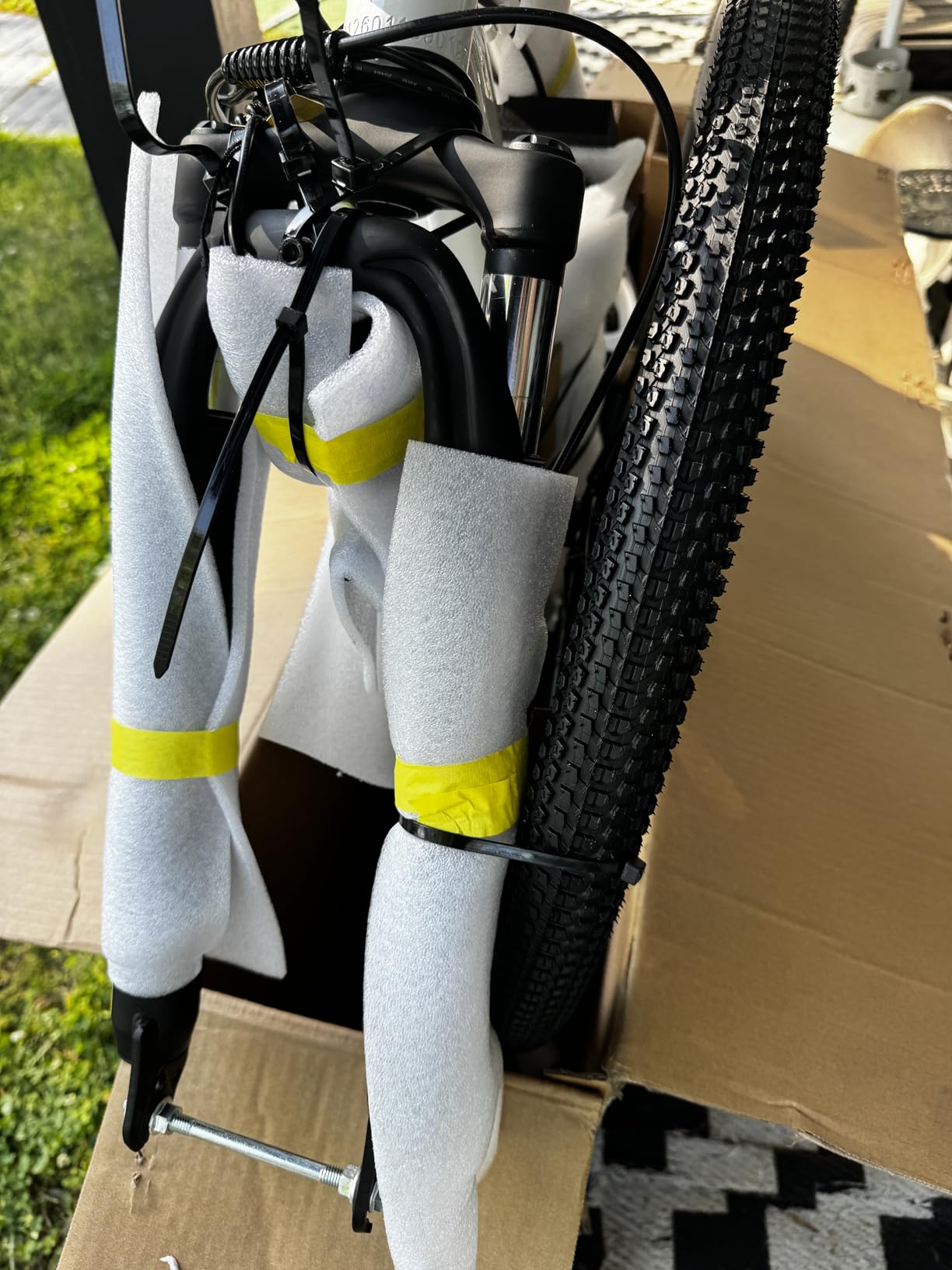
Who this bike suits
This is my recommendation for a beginner who wants to build trail fitness on packed dirt, gravel forest roads and the occasional easy singletrack, and who values owner satisfaction and safety certification over outright power. Riders above 250 pounds, or those who plan real technical terrain, should step up to the TotGuard or the E-Bycco E8.
4. TotGuard 27.5 inch 499Wh – Best with a Real Front Derailleur
TotGuard Electric Bike, 27.5″ Electric Bike for Adults 500W Motor Ebike Adult Electric Bicycles Electric Mountain Bike,48V 499WH Removable Battery,21S Gears,Lockable Suspension Fork
499Wh IP54 battery
Shimano Tourney 3 by 7 gears
19.8 mph top speed
Three assist levels
Pros
- Genuine front and rear derailleurs
- Aluminum frame with lockable fork
- Dual disc brakes and 499Wh pack
- Clear LCD with ride-time tracking
Cons
- Modest 500W motor and top speed
- Only three assist levels
- Upgraded battery not interchangeable
Where the Funhang and Loeook cut the drivetrain to seven speeds, the TotGuard keeps a full 21-speed setup with a Shimano Tourney three-speed front derailleur and a seven-speed rear. That is a real mechanical difference rather than a spec-sheet trick, and on loose climbs the extra ratios are what let you stay seated.
The rest of the package is a step up in materials too. The frame is aluminum alloy, brakes are dual disc, and the front suspension fork is lockable so you can firm it up for pavement and open it for rough ground. The 48V 499Wh IP54 battery takes roughly five hours to charge.
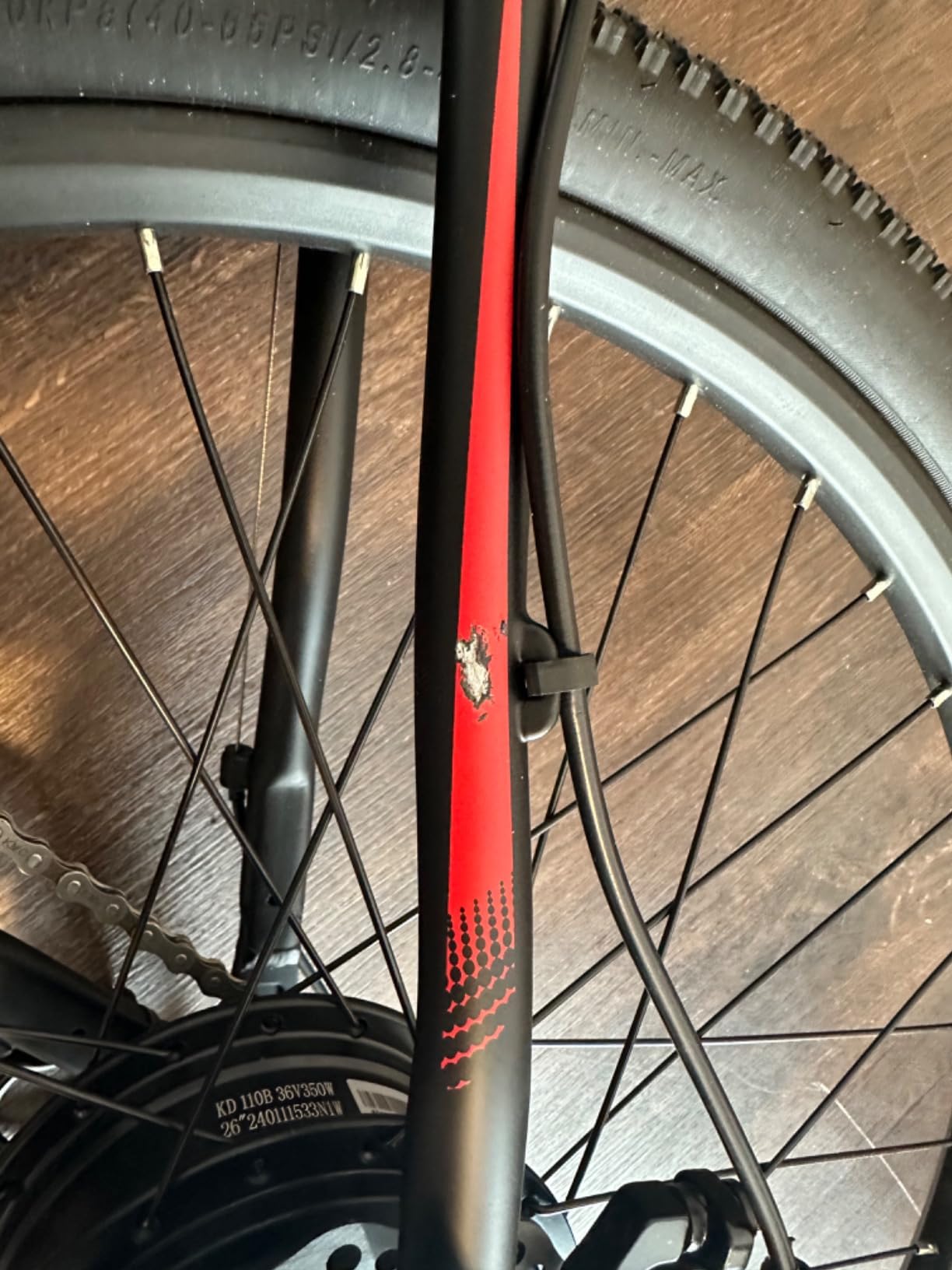
Battery and display behavior
The LCD shows battery level, three assist levels, mileage, voltage, speed and ride time, which is more instrumentation than most rivals in this tier provide. Three riding modes are listed: pure electric, pedal assist and normal bike. Note the difference between the three assist levels and the five levels offered by the Funhang and Loeook, because finer assist steps mean less jerky power delivery on a loose climb.
One practical warning: the upgraded battery is not interchangeable with the earlier battery base. If you plan to add a second pack later, buy the spare from the same seller at the same time.
Where the power ceiling shows
The 500W motor and 19.8 mph top speed are modest next to the 1000W and 1200W peak machines here. On a smooth, fast fire road that ceiling is obvious, and on a steep technical climb you will be working harder than on the ESKUTE models. The gearing makes up some of that gap because you can stay in a spinning gear, but it does not replace power.
Riders who ride long road transfers to the trailhead and want more speed with the same drivetrain logic should look at our roundup of the best electric dirt bikes for adults.
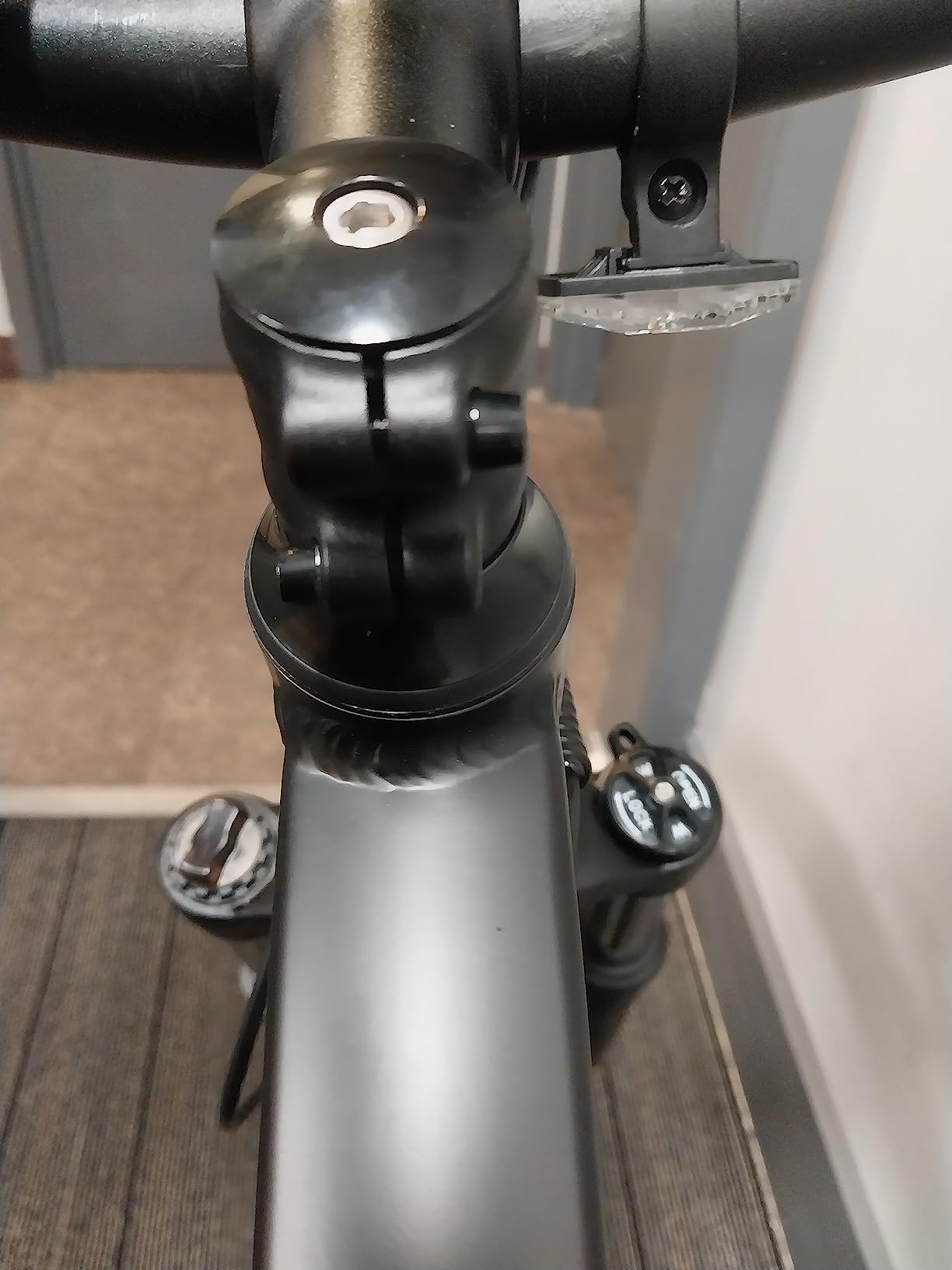
Who this bike suits
Choose the TotGuard if your terrain is steep, loose and short, and you would rather have nine more gears than a faster top speed. The 12-month warranty and lifetime technical support are standard for the category. Owners rate it broadly positive on build quality, with power output and assist granularity cited as the limiting factors.
5. Qlife Racer – Best for Riders Who Care About Frame Weight
Qlife Racer Electric Bike for Adults – 21-Speed Mountain Lightweight Ebike with Peak 1000W Brushless Motor, 375Wh Removable Battery, 26X2.1 Tire Step Over E-MTB, Up to 40 Miles Range,Black
48.1 pound claimed weight
Peak 1000W brushless motor
21-speed gearset
375Wh removable battery
Pros
- Lowest stated weight in the group
- 21-speed gearing
- Removable anti-theft battery
- About 15 minutes of assembly
Cons
- Brakes fade after several months
- Thin handlebar grips
- Some early units had tire and battery issues
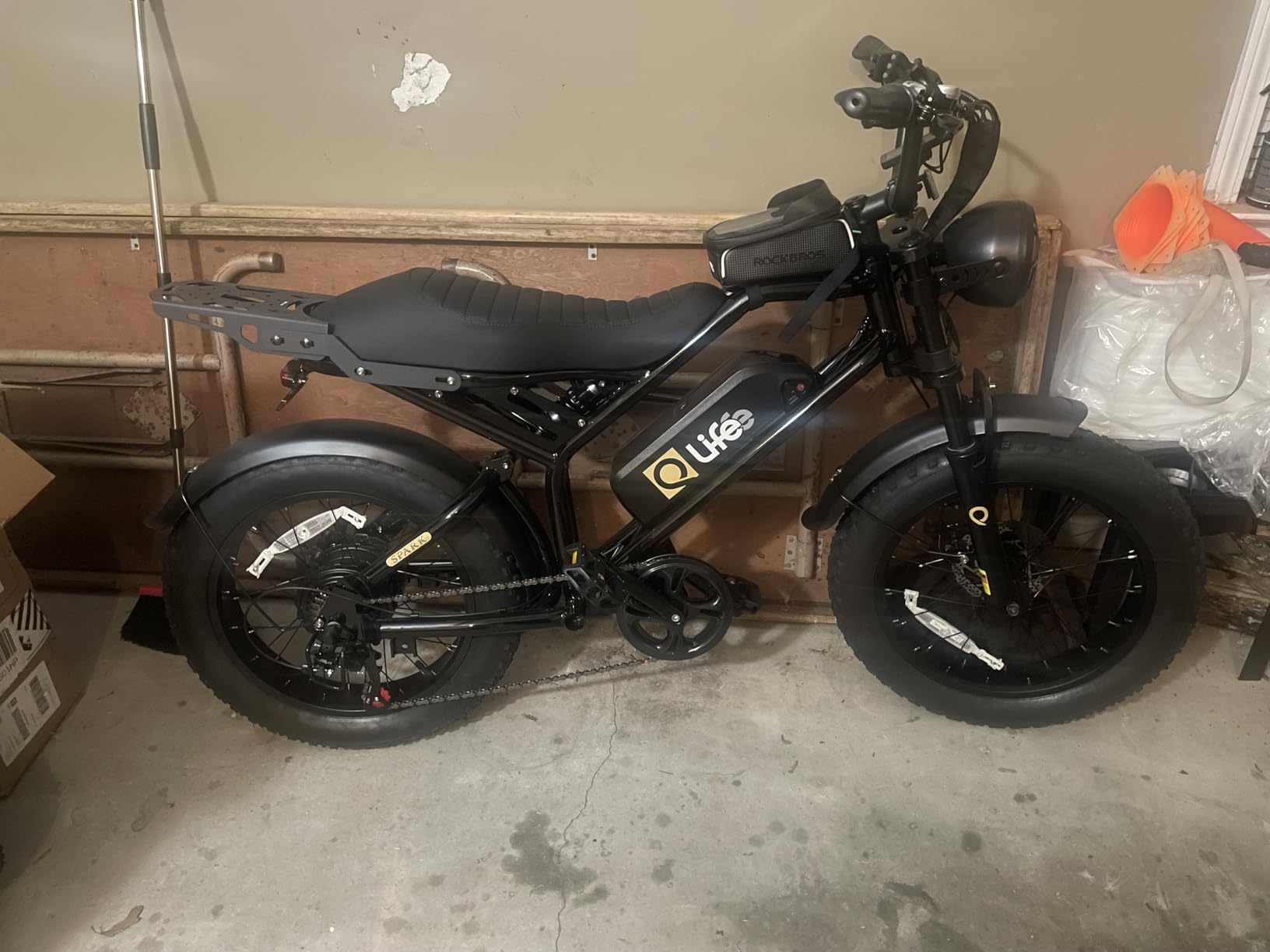
The Qlife Racer is the odd one out in this lineup because it pairs a 21-speed drivetrain with a claimed weight of 48.1 pounds. That is several pounds below the steel-framed rivals, and it is the reason this bike feels manageable when you have to walk it up a staircase or lift it into a rack.
Underneath, it is a 1000W peak brushless motor with a 48V 7.8Ah 375Wh removable, waterproof, key-locked battery that charges in about four hours. Published range is up to 25 miles on throttle or 40 miles in pedal assist, and four riding modes include a walking assist that is useful when you are pushing a heavy bike up a slope.
Rating distribution and long-term durability
With a 4.5 average and about 79 percent of reviews at five stars, the Qlife carries one of the strongest rating distributions in the group. Owners praise the acceleration, the seating and the suspension over rough ground, and several report completing the assembly in about 15 minutes.
The honest caution is the review base size. At 125 reviews it is thinner than the ANCHEER, Funhang and Loeook records, so long-term failure data is thinner too. A handful of early units reported tire punctures, chain derailment and unexplained battery cutouts, which is a normal early-production pattern but worth weighing against a thinner warranty history.
Brake fade and parts availability
The most common negative theme is brake feel degrading after several months of use, and replacement parts that are hard to source. On a bike with a 12-month after-sale service window, that is the risk to plan for: budget for brake pads and cables early rather than assuming a shop will stock them. The handlebar grips are also thin and commonly replaced.
Wheel size is 26 inches with 2.1 inch tires, and the drivetrain uses an electronic shifter rather than a trigger. Tires roll faster than the 4.0 inch fat options, which makes this the more sensible choice for mixed pavement and dirt riding.
Who this bike suits
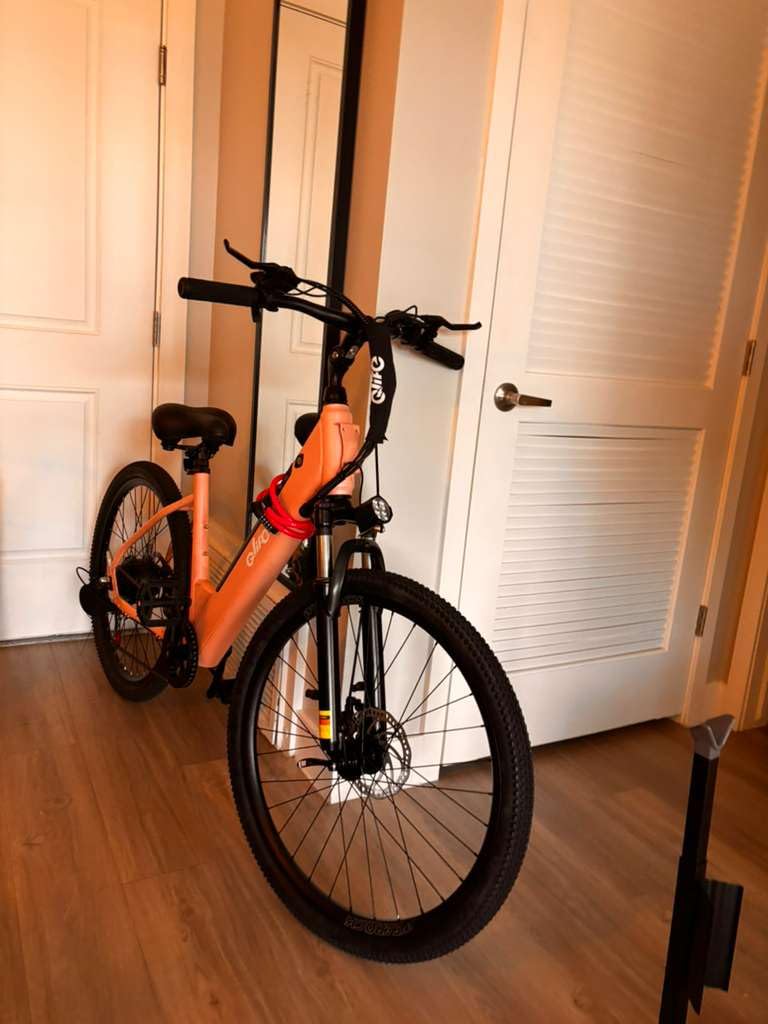
This is the bike for a rider who wants trail capability without the 70 pound handling problem. It suits a mix of paved trailhead approaches, gravel roads and packed dirt singletrack, and it is the easiest of the group to load into a car. Riders who want a full-suspension platform with that low weight should know that combination is not offered here.
6. ESKUTE M200 – Best for High-Speed Riding
M200 Electric Bike for Adults – 21-Speed Gear 27.5″ Mountain E-Bike, 1200W Peak Brushless Motor 28MPH, 48V 10.4Ah&13Ah Removable Battery, Up to 55-65 Miles Range, Step Over Commuter E-MTB, NFC Unlock
1200W peak to 28 mph
21-speed Shimano drivetrain
350 lb capacity
10.4Ah and 13Ah options
Pros
- Owners confirm the full 28 mph top speed
- Shimano drivetrain
- Strong in cold and wet conditions
- Support sent free replacement parts
Cons
- One owner had a brake lever break
- Entry-level hardware quality
- Front brake can rub out of the box
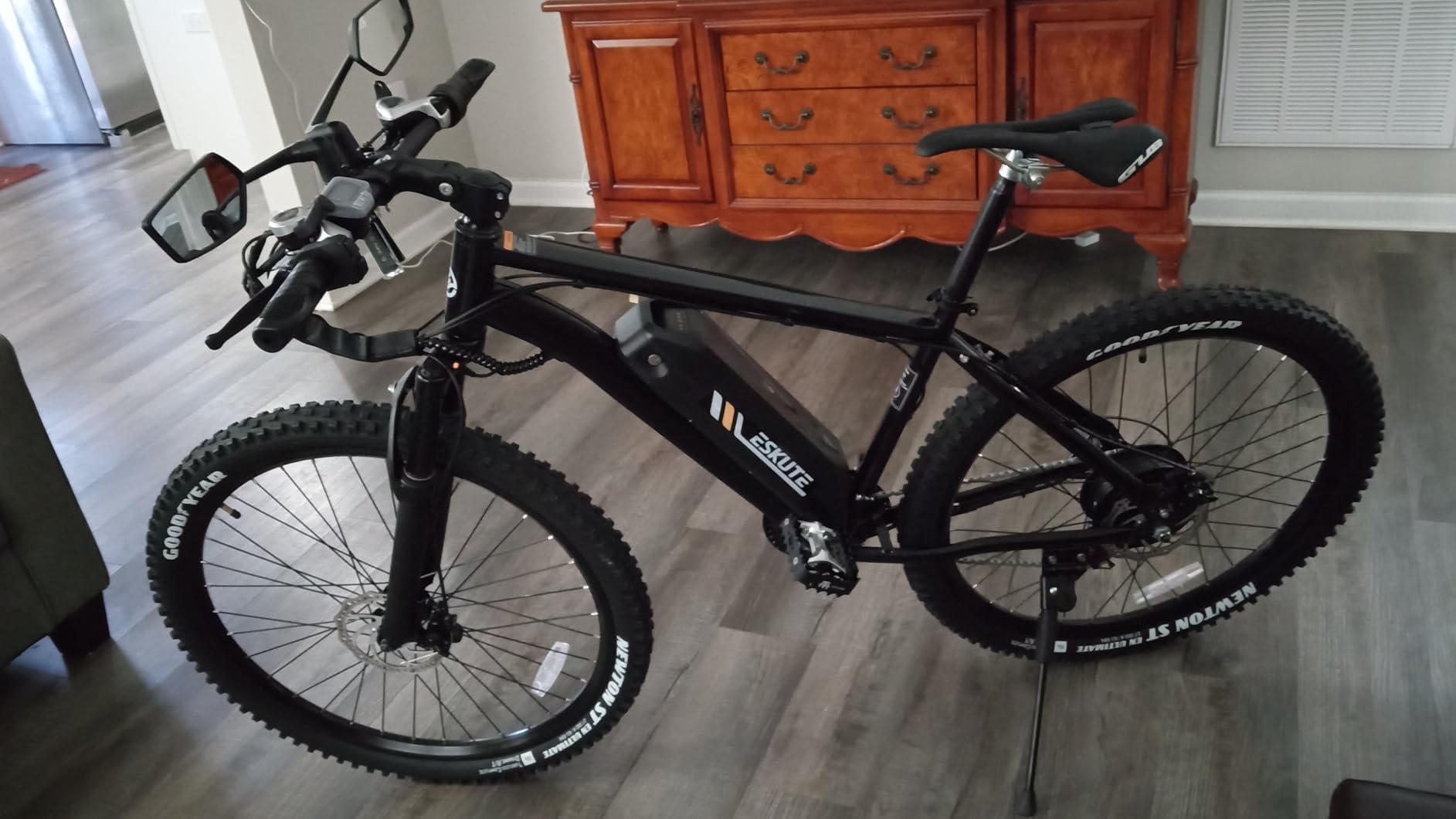
The ESKUTE M200 is the fastest of the 21-speed bikes in this group, and owners confirm the advertised 28 mph top speed rather than just claiming it. The motor peaks at 1200W, and the 27.5 inch wheels run 2.15 inch tires with dual front suspension and dual disc brakes. The only quicker machines here, the PUJH PU1 and the E-Bycco E8, run seven-speed drivetrains.
Two battery options are offered at 10.4Ah and 13Ah, giving roughly 55 miles in pedal assist or 40 miles on throttle from the smaller pack. The battery is TUV certified, waterproof, and secured with a lock and key. Maximum recommended rider weight is 350 pounds, the highest figure in the group, ahead of the 330 pound ratings on the E-Bycco, the PUJH and the Funhang EB-S1.
Wet weather and cold weather performance
One owner logged more than 100 miles in cold, rainy conditions without a fault, and another rated the tire tread pattern 9 out of 10 after several hundred miles. That kind of durability report is rare in this price bracket, where tires are often the first thing to fail. The tread depth and sidewall compound are doing real work on loose ground.
Support is also worth noting. Owners report ESKUTE sending free replacement parts for axle and assembly problems, which is a genuine advantage for a direct-to-consumer bike with a 12-month warranty and no local dealer relationship.
Hardware quality is the weak point
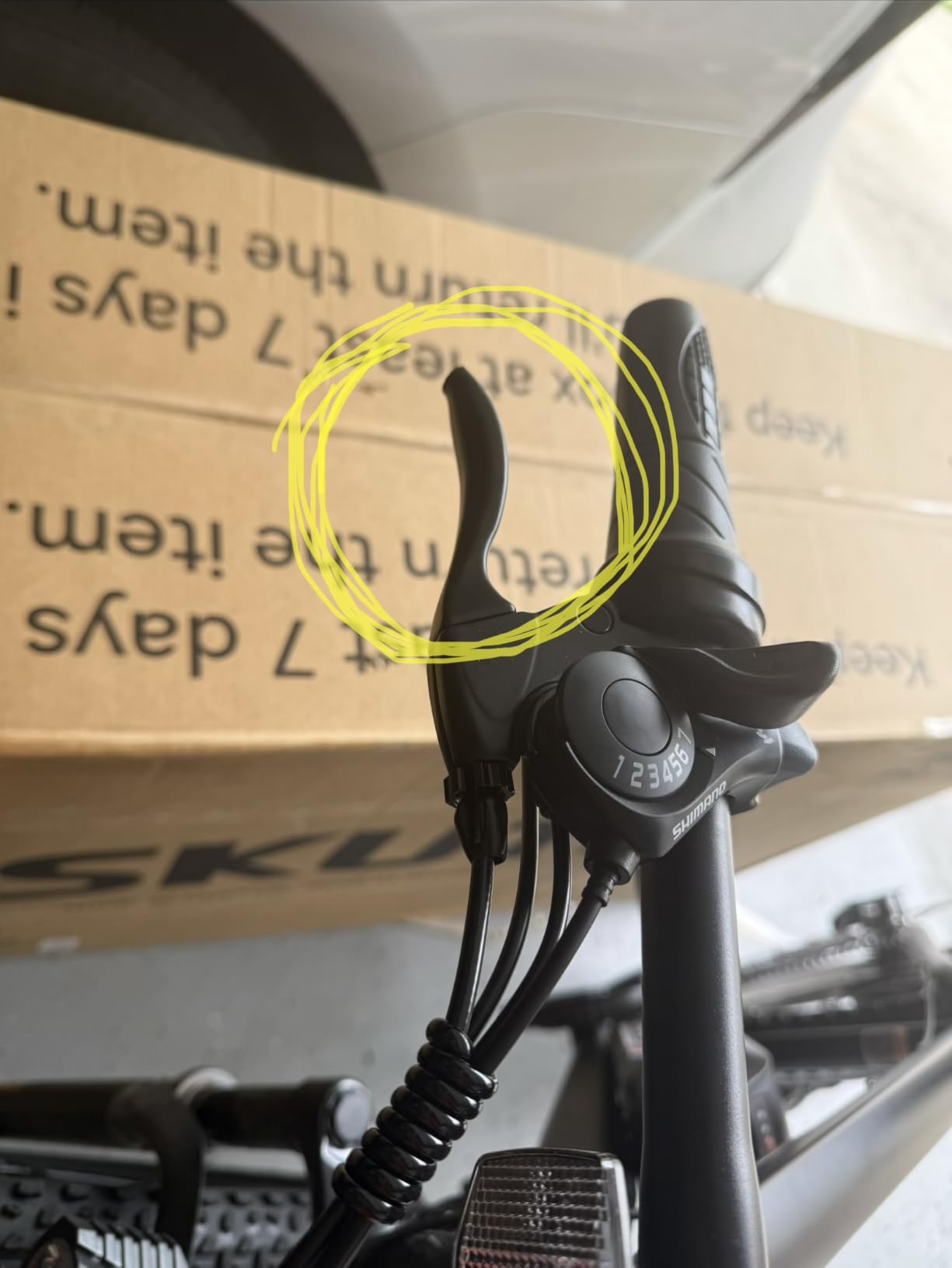
Reviewers repeatedly describe the hardware as lacking for the price. One owner had a brake lever break after a single gentle ride, others report a front brake that needs adjusting out of the box and can rub, and there are scattered reports of punctured factory tires and intermittent shifting. On a bike this fast, brake feel matters more than usual, so inspect the levers and pads on day one.
Assembly takes roughly 30 minutes for an experienced mechanic with a helper, since the bike arrives 90 percent pre-assembled with tools included. Frame geometry is described as awkward by some riders, so check the reach before a long test ride.
Who this bike suits
The M200 fits a rider who wants to cover ground fast on fire roads, open dirt and gravel, and who carries a higher weight than most bikes here support. It also suits anyone who wants the 21-speed mechanical range plus a genuine throttle for spur-of-the-moment trail access. It is not the pick for tight, technical singletrack where a 28 mph bike is more liability than asset.
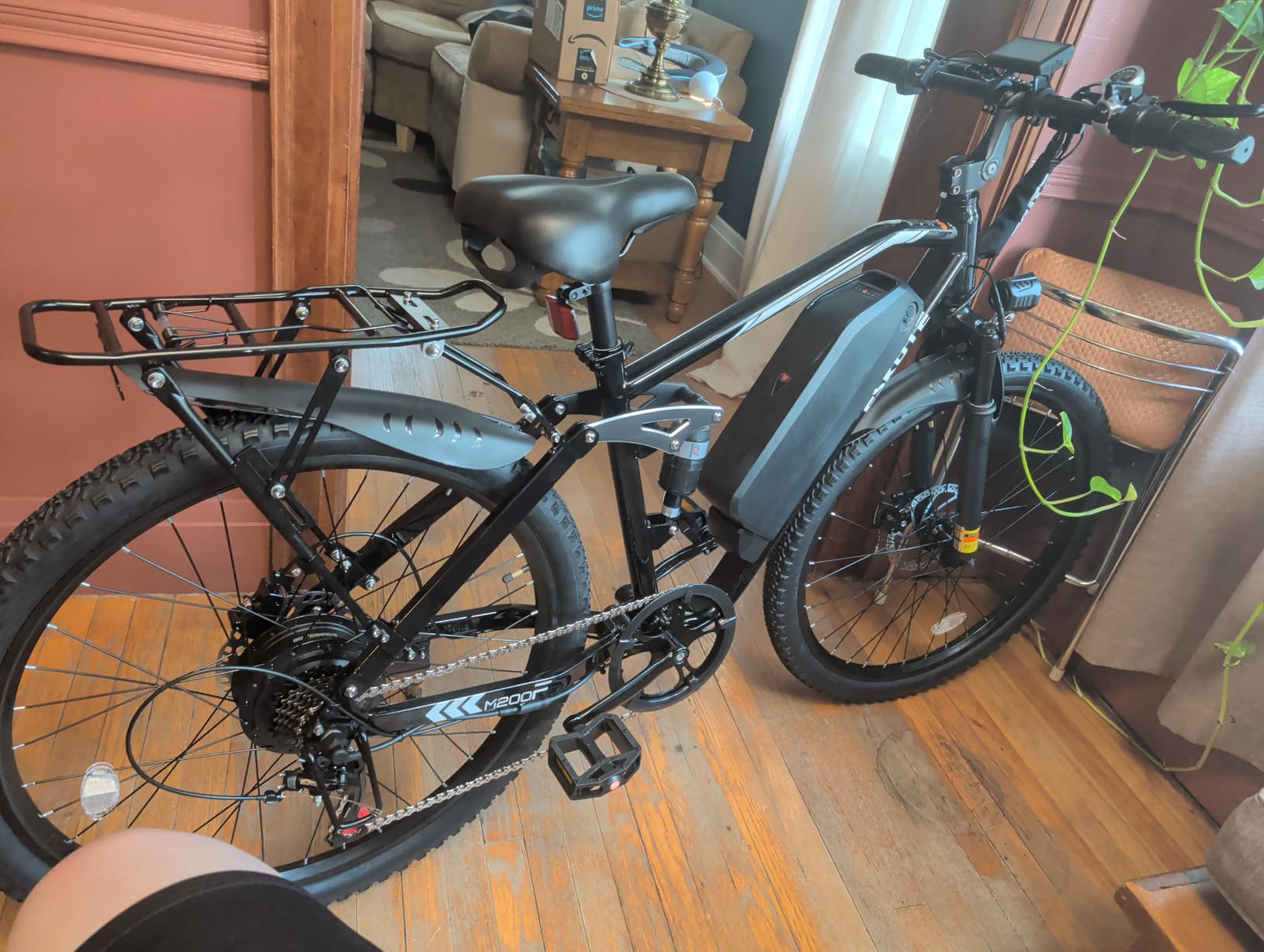
7. ESKUTE M200F – Best Full Suspension With the Largest Battery
ESKUTE M200F Electric Bike for Adults – 27.5 inch Tire Mountain E-Bike, 1500W Peak Brushless Motor 31+MPH, 48V 20.8Ah Removable Battery, Up to 80 Miles, Step Over Commuter E-MTB, Full Suspensions
998.4Wh removable battery
Front and rear suspension
1500W peak to 31+ mph
Bottom-mounted pack
Pros
- Near 1000Wh battery
- True dual suspension for the price
- Adjustable handlebars and saddle
- Bottom-mounted battery aids stability
Cons
- Only 7 speeds
- Heavy steel frame
- Newer model with a small review base
The M200F is the only bike in this guide with genuine full suspension and a near-1000Wh battery, which is a combination that normally costs considerably more. The 48V 20.8Ah pack works out to 998.4 watt-hours, and the manufacturer quotes up to 80 miles on pedal assist level one.
Suspension is fitted front and rear on 27.5 x 2.1 inch tires, so it absorbs bumps rather than deflecting them. The motor peaks at 1500W for a 31+ mph assisted top speed, and the handlebars and performance saddle are fully adjustable, which is unusual at this level and helps with fit for taller riders.
Battery placement and range planning
The pack sits in the bottom bracket area rather than on the rear rack, which lowers the center of gravity and improves stability in fast corners. It also means the bike steers more like a mountain bike and less like a loaded commuter. Plan the charge around the reality of a large pack on a standard charger.
Published range of 80 miles assumes pedal assist level one on favorable terrain. Real trail use with a heavier rider and frequent climbs will use that budget much faster, and the 31+ mph speed setting drains fastest of all. Central display shows speed, battery level and trip distance, with NFC card keyless start.
The 7-speed shortfall
Here is the real problem: 7 speeds on a bike with this much torque. A 1500W motor in a low gear can spin the rear wheel, and seven ratios give you very little room to match the motor to the terrain. Riders on climbs will be stuck between bogging down and spinning out. A 21-speed model like the TotGuard or the PUJH PU1 gives a much better match.
This is also a 2026 model with 78 reviews, the third thinnest record in the group, so long-term durability data is limited. The steel frame is heavy enough that carrying this bike is a two-person job despite the suspension benefits.
Who this bike suits
Pick the M200F if you ride rough, broken ground and want suspension to take the hits, and if long range matters more than gear range. Minimum rider height is listed at 5.1 feet, and the adjustable cockpit helps with fit. If you climb technical terrain regularly, weigh the 7-speed drivetrain carefully before buying.
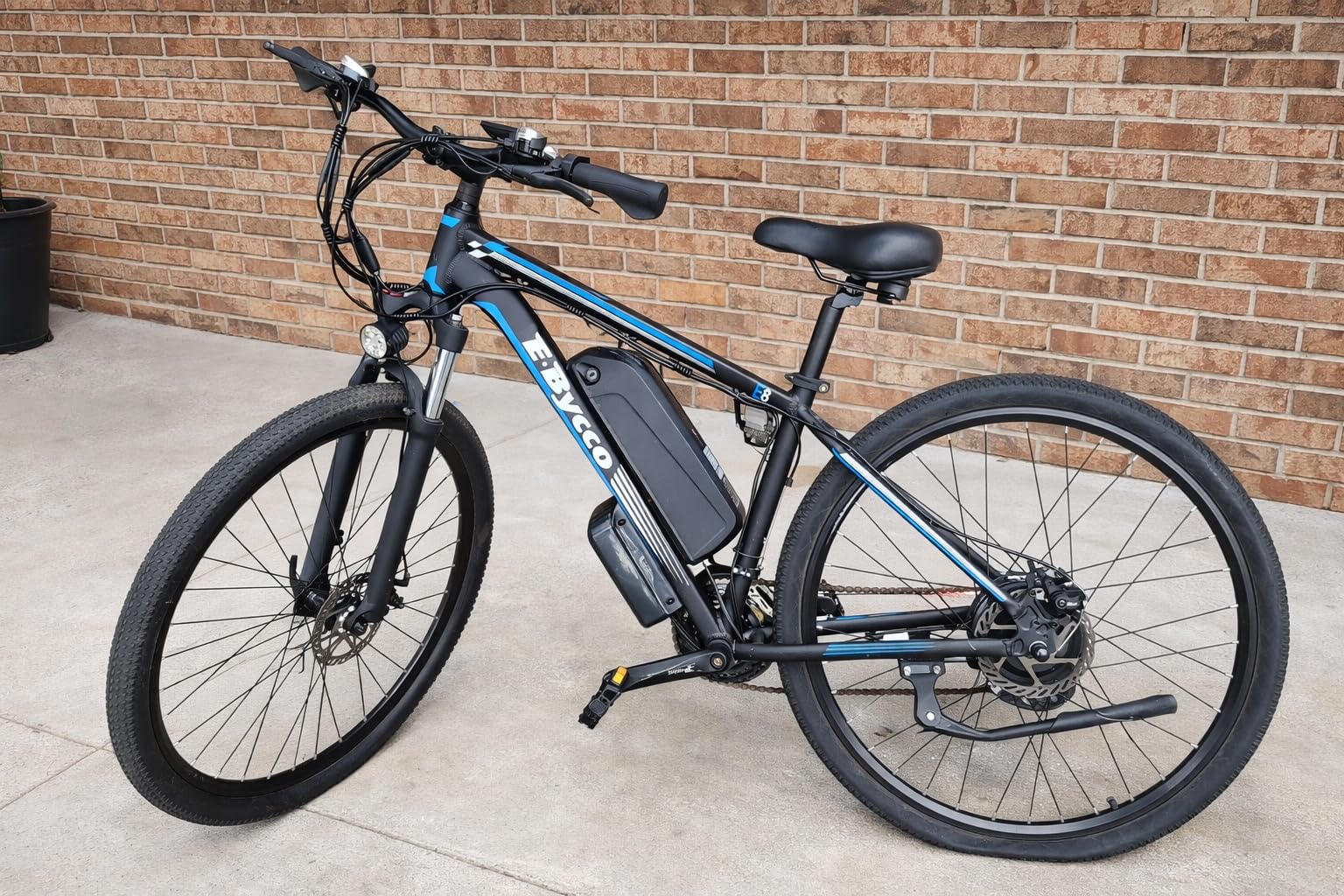
8. E-Bycco E8 – Best for Steep Climbs and Big Riders
E·Bycco 29Inch Peak 2000W Mountain Electric Bike for Adult, 48V 17.5AH Battery Ebikes, 36MPH & 70 Miles Long Range Fast Electric Bicycle, Pedal Assist Throttle Commute E-Bike, UL Listed(Silver)
2000W peak with 90 Nm torque
840Wh UL listed battery
29 inch wheels
68 pounds
Pros
- 90 Nm torque for steep grades
- 29 inch wheels roll over rough ground
- UL listed IP67 battery
- 330 lb load capacity
- Display configurable as Class 1
- 2 or 3
Cons
- Heavy at 68 pounds
- Only 7 speeds
- 7-8 hour charge time
- Smallest review base
The E8 has the highest torque figure in this group at 90 Nm, paired with 2000W peak power and a 29 inch wheel. Torque is the number that decides whether a climb is possible, because it is what lets the motor push you out of a technical pitch without the rider supplying most of the power.
The battery is a 48V 17.5Ah pack rated at 840 watt-hours, UL listed and rated IP67 for waterproofing, which is unusually well documented for a bike at this level. Published figures are 35 miles on electric only and up to 70 miles in pedal assist. The waterproof LCD can be configured as a Class 1, 2 or 3 e-bike, which is a useful feature when you ride in more than one jurisdiction.
Why 29 inch wheels help on rough ground
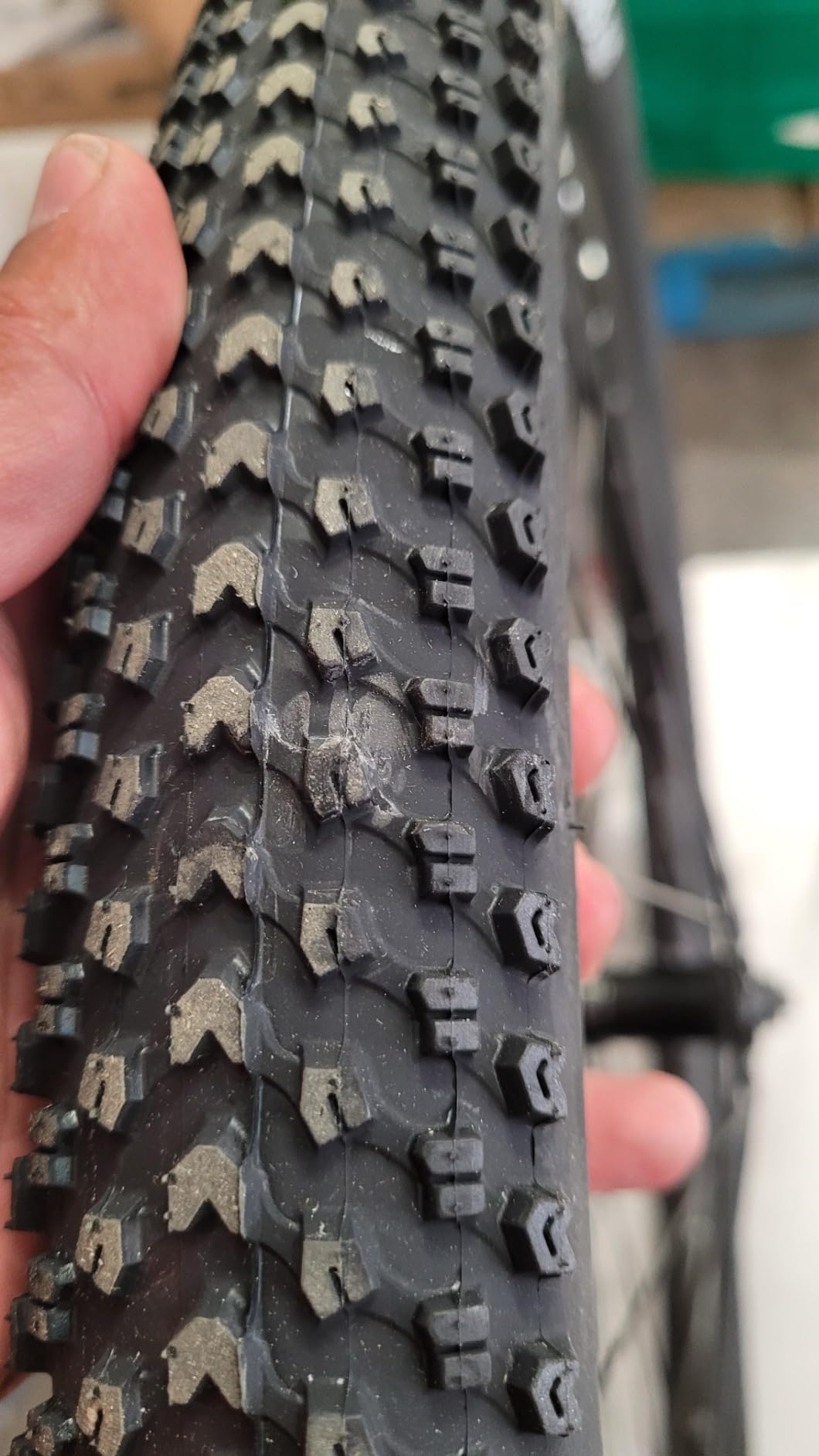
Larger wheels roll over roots, rocks and ruts rather than getting deflected by them, which is why 29 inch is the standard on modern trail bikes. The tradeoff is rollover feel: at low speed on tight switchbacks, larger wheels feel less precise than 26 inch or 27.5 inch wheels. On open, rough terrain the advantage is clear.
Tires are 2.1 inch on an aluminum frame with a lockable front fork, and the listed maximum load is 330 pounds. Five riding modes cover manual, five-level pedal assist, full throttle, cruise and walking assist, so you can configure it to whatever class your trail network accepts.
Weight and charging trade-offs
At 68 pounds this is one of the heaviest bikes here, and getting it into a vehicle or over a log is a genuine inconvenience. The 7-8 hour charge time is the longest in the group, so plan overnight charging rather than a midday top-up. The drivetrain is listed as 7 speeds despite the 21-speed wording in the product title, which limits climbing gear options.
The review base of 54 is the thinnest here, and about 8 percent of ratings sit at two and three stars. Treat the spec sheet as promising and the owner record as still forming. If torque is your priority and you can accept the weight, nothing else here matches the 90 Nm figure.
Who this bike suits
The E8 is built for a rider pushing a heavier bike up long, steep fire roads, and for larger riders who exceed the 265 pound limit on most rivals here. Riders under 200 pounds who ride technical terrain will find the weight awkward without the torque to justify it, and should consider the 48.1 pound Qlife Racer instead.
9. Funhang EB-S1 – Best Fat-Tire Choice for Mixed Surfaces
Funhang Electric Bike for Adults, 1000W Peak Ebike, 20MPH 60Miles Electric Mountain Bike, 26″ Fat Tire Electric Bicycle with 48V 13AH Battery, Front Suspension,7 Speed, Rear Rack, UL 2849 Certified
26 x 4.0 inch fat tires
66.6 Nm torque
60 lb rear cargo rack
70 pounds
Pros
- Fat tires grip loose sand and snow
- 79 percent of reviews at five stars
- Owners exceed the 20 mph spec
- Rack and lights with turn signals
- Fits riders 5 foot 3 to 6 foot 2
Cons
- 70 pounds is hard to move
- Low gear not low enough
- Banana saddle is replaced
- Thin assembly instructions
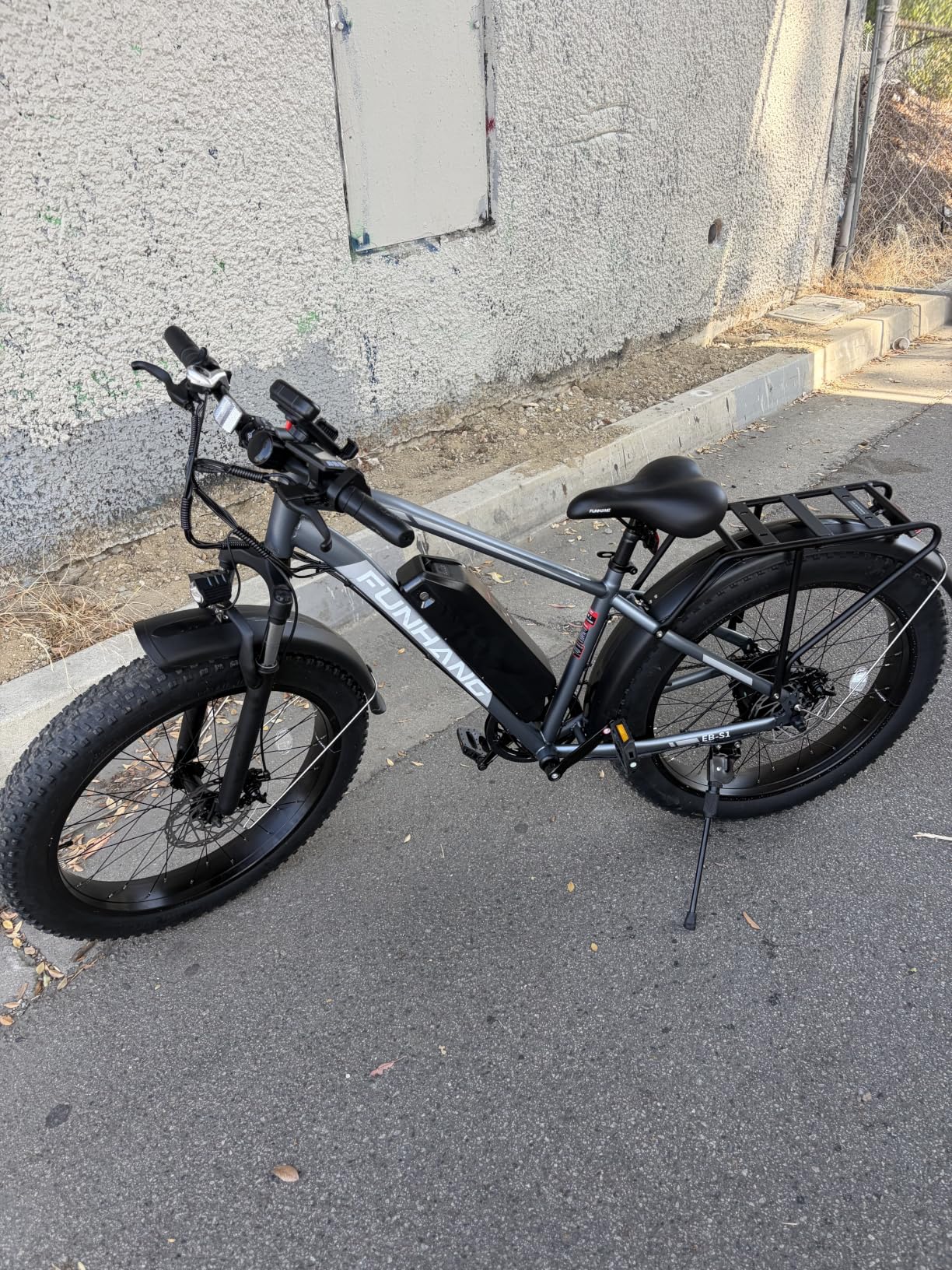
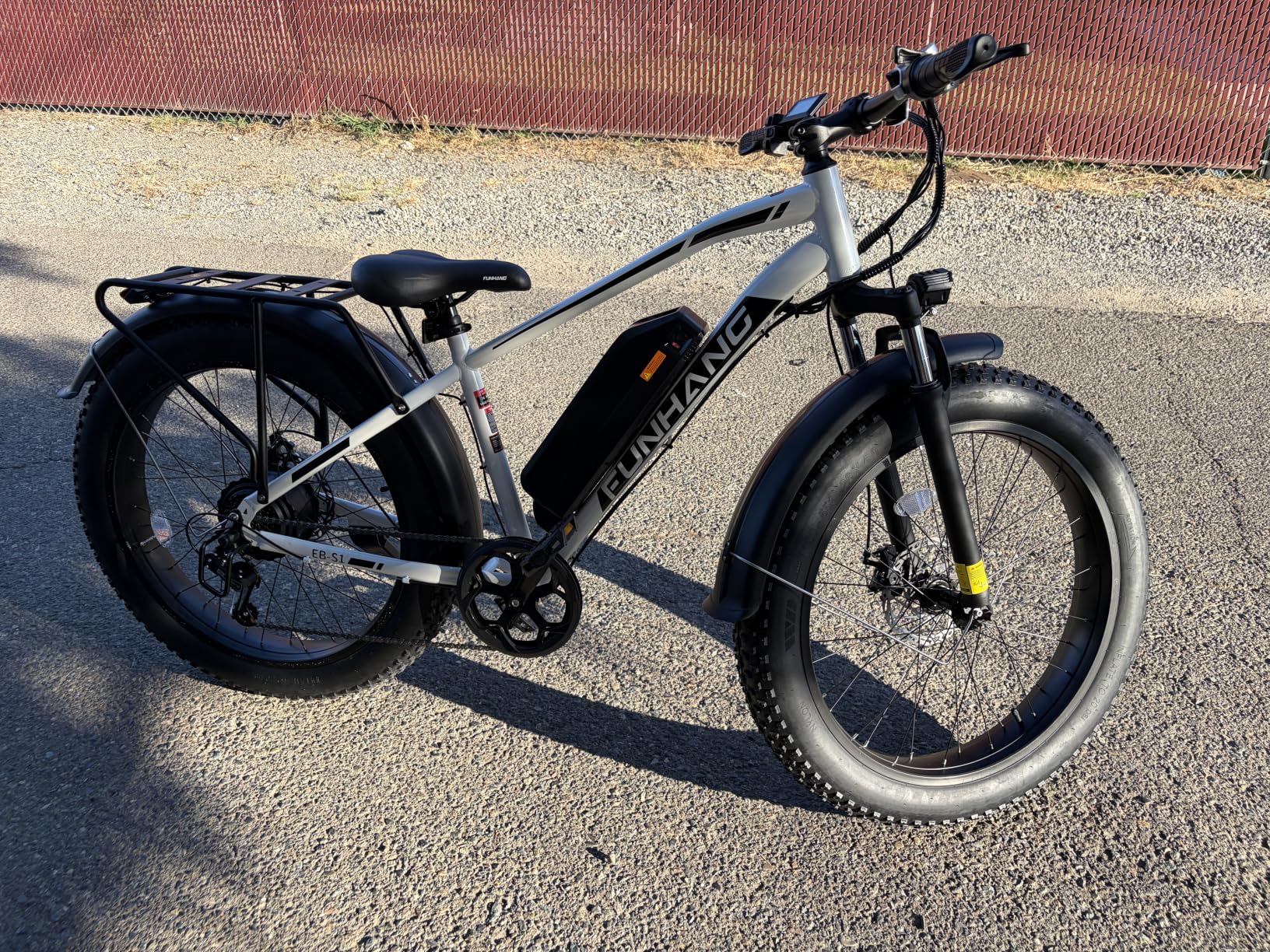
The EB-S1 is a fat-tire bike, and I want to be direct about that: 4.0 inch tires on a 26 inch wheel are not a trail setup. They float over sand, snow, gravel and grass, and they damp chatter on pavement, but they are vague and slow in tight singletrack. Buy it for the surfaces it is good at.
What it does well is real. The 500W motor produces 66.6 Nm of torque, and owners report reaching 25 mph in electric mode, above the 20 mph published spec. The 48V 13Ah IPX5 battery is removable and BMS protected, with 30 to 35 miles on electric and 55 to 60 in pedal assist. A six-and-a-half hour charge is the trade for that capacity.
Commuter equipment that carries over to the trail
The rear cargo rack is rated to 60 pounds and comes with a headlight, a taillight with turn signals and a horn. That equipment is genuinely useful for long rides to a distant trailhead. The rack also lets you carry a second battery, spare tubes and a repair kit, which matters more when the nearest shop is an hour away.
Sizing is unusually well reported, with owners between 5 foot 3 and 6 foot 2 riding at up to 330 pounds, including a confirmed fit at 6 foot 2 and 195 pounds. The bike is 85 percent pre-assembled with a 365-day warranty, and the pack carries SGS UL 2271 and TUV UL 2849 certification.
The weight and gearing problems
At 70 pounds this is the joint-heaviest bike here, and owners are blunt that it takes help to move and is difficult to pedal without assist. The low gear is also not low enough to give real exercise in assist mode one above 15 mph, which can feel strange on a climb where you want to contribute. The banana-style factory saddle is replaced by most owners, and the assembly instructions are thin.
At a 4.5 average with 79 percent of its 228 reviews at five stars, owner satisfaction is high despite the weight. If you can lift it and you ride varied surfaces, that is a fair trade.
Who this bike suits
This is the bike for mixed terrain: gravel roads, beach access, snow, grass and long backcountry approaches rather than technical trails. The confirmed sizing range makes it a safe choice for shorter and taller riders, and the 330 pound limit is among the most generous here. For genuine downhill trail riding, choose a narrower tire.
10. PUJH PU1 – Best for Tall Riders on Fast Open Trails
PUJH 2000W Ebike 48V 17.5Ah 29″ Electric Bike Max 80Mi for Off-Road Adults
2000W peak with 60 Nm
34+ mph top speed
6061 aluminum frame
70 pounds
Pros
- 6061 aluminum frame
- 29 inch stability on rough ground
- About 35 miles for a 200 lb rider
- Useful bundled accessories
- Stable on rocky singletrack
Cons
- Pedal sits within range of the front tire
- Poor hard-to-adjust brakes
- Confusing instructions
- Some performance below advertised
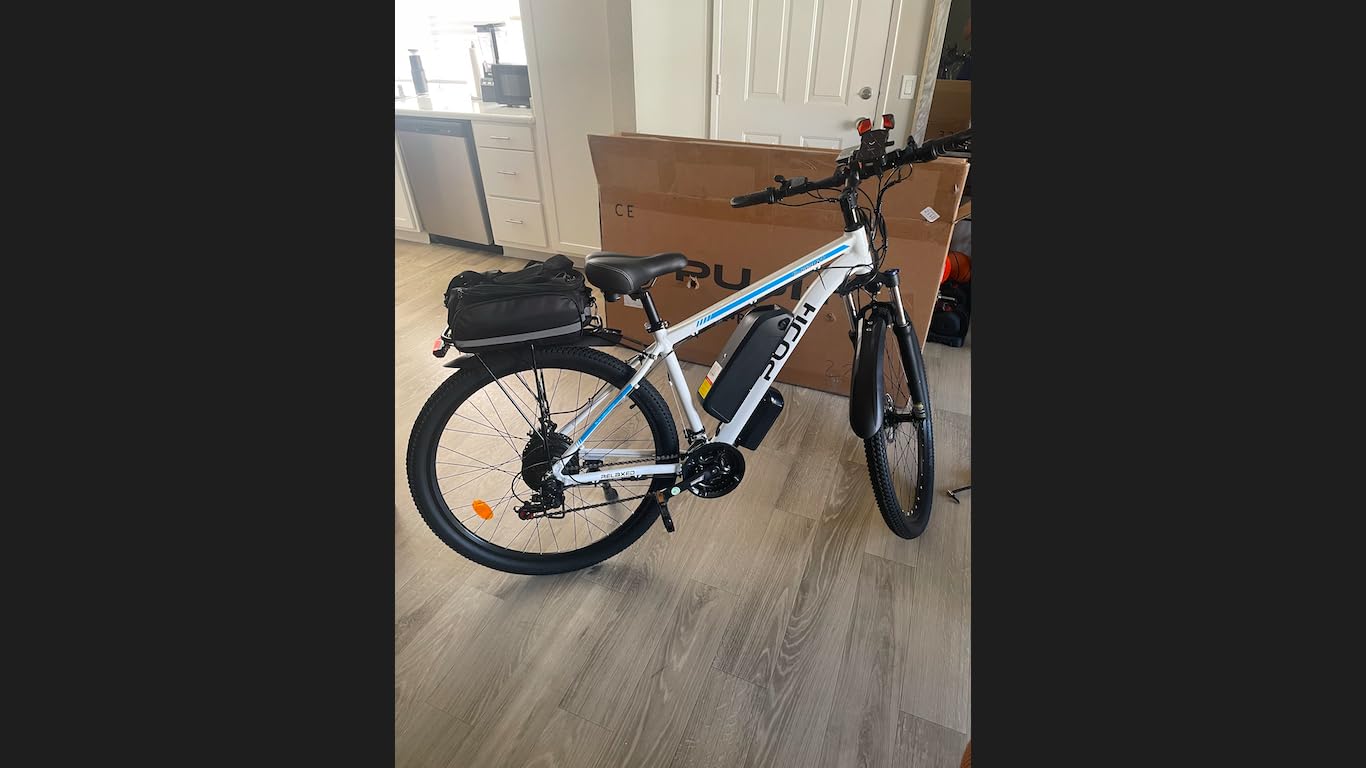
The PU1 is an X-Large frame with a 29 inch wheel and 2.1 inch tires, built for a taller rider. Minimum height is listed at 5.4 feet, and the maximum recommended load is 330 pounds. The 6061 aluminum frame is a genuine quality step over the high carbon steel used elsewhere in this group.
The motor peaks at 2000W with 60 Nm of torque for a top speed of 34 mph or better, and owners confirm roughly 34 mph with one reporting a 51 mph downhill run. A 21-speed gear kit is fitted, which is unusual at this power level, along with a twist throttle and disc brakes. The battery is a 48V 17.5Ah pack with a stated 30 to 80 mile range.
The pedal clearance problem
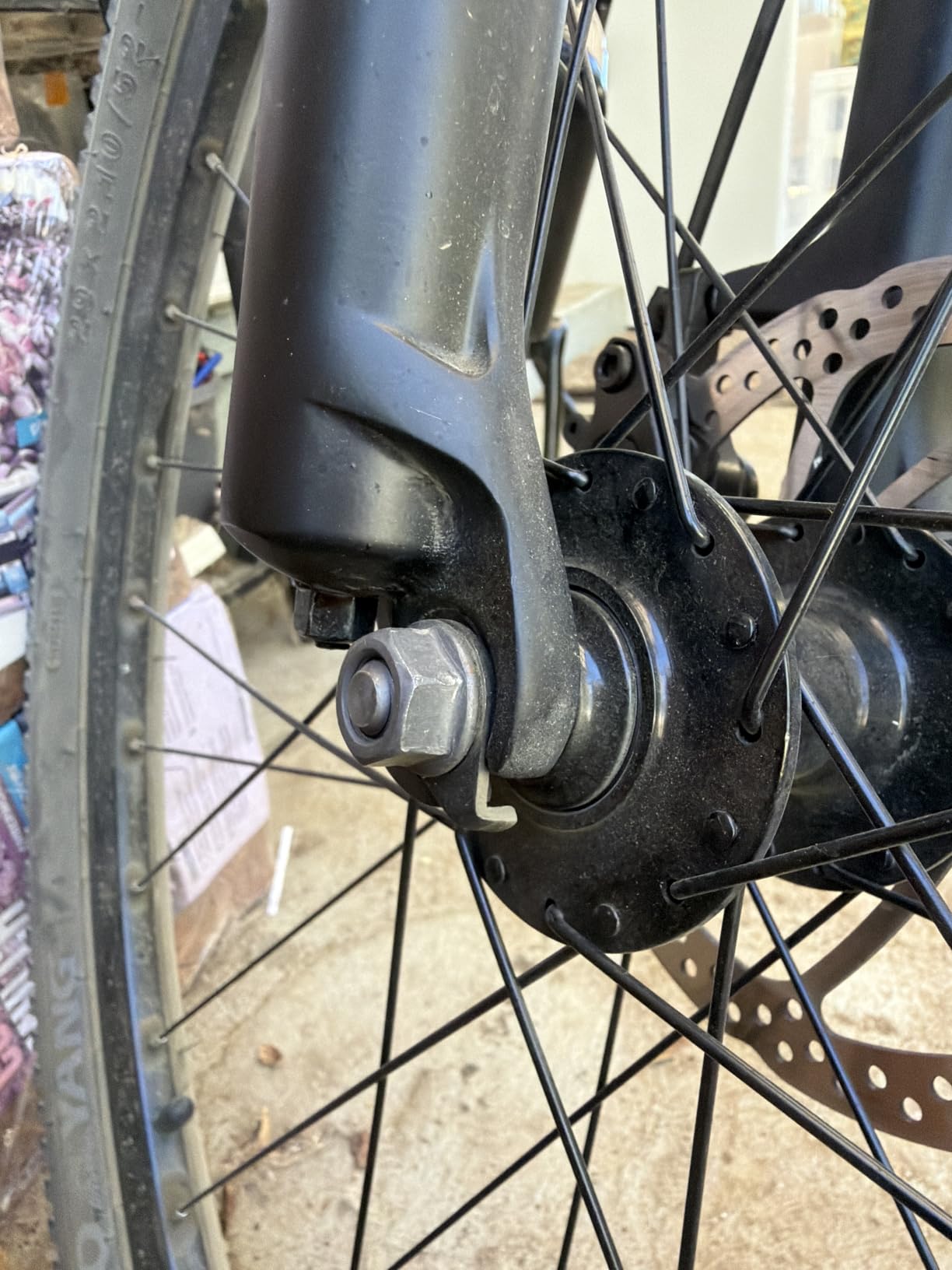
There is one safety issue worth flagging before anything else. The pedals sit within range of the front tire, so a sharp turn while pedaling can cause a fall. This is called out directly in owner reviews and it is a geometry problem, not a rider error. Riders who ride tight switchbacks should treat this as a dealbreaker and choose a bike with more pedal clearance.
Brakes are also described as poor and hard to adjust, and gearing feels low, requiring heavy pedaling to hold speed. Instructions are confusing and mislabelled, the included tools are low quality, and some owners report performance well below the advertised figures. Arrivals with cosmetic paint damage and warped fenders are mentioned too.
Where it earns its place
On the positive side, a 200-mile owner reports no major issues including in rain, and 29 inch wheels give noticeably better stability at speed than 26 inch e-bikes. A 200 pound rider riding hard on hilly terrain reports about 35 miles of range, which is a realistic number. The bundled kit includes a pump, spare tube, spare pads, a phone holder, a lock and tools.
At a 4.1 average, this carries the lowest owner rating in the group, and the review split between enthusiasts praising the power and critical reviews flagging the hardware is sharper than on the other nine bikes. The 21-speed drivetrain and 24/7 support with a one-year warranty on motor, battery and charger are real positives against the hardware complaints.
Who this bike suits
The PU1 fits a tall rider over 5 foot 10 who rides fast, open off-road terrain and wants an aluminum frame with 21 speeds and strong acceleration. Riders who ride tight, technical trails should avoid it because of the pedal clearance, and riders buying on a tight budget would be better served by our budget mountain bike picks paired with a separate assist system.
How to Choose a Trail-Ready Electric Mountain Bike
Every bike above is a legal e-bike. Making one of them a good trail bike comes down to five decisions, and the order you make them in matters more than the brand name.
Motor placement matters more than peak wattage
Peak wattage is the number brands print, and it is the least useful one on a trail. What actually decides how a bike climbs is torque in Nm and whether the motor is torque-sensing or cadence-sensing. Every bike in this guide is a hub or rear-drive style motor with a throttle and assist modes rather than a full-power mid-drive unit.
A mid-drive motor sits at the bottom bracket, multiplies through your gears, and uses a torque sensor to meter power based on how hard you push. That is the architecture behind the full-power trail e-MTBs that serious riders use, and none of the ten bikes here match it. If your priority is technical singletrack rather than gravel roads, plan for a mid-drive machine instead of expecting a budget hub bike to substitute for one.
Battery capacity and your climbing budget
Watt-hours are the honest capacity number, and packs here range from 374Wh to 998.4Wh. As a rough conversion, 100Wh of capacity adds about 1.5 pounds of weight, so a near-1000Wh pack is carrying roughly six pounds of battery above a 375Wh pack. A well-proportioned full-power trail e-MTB carries 400 to 700Wh and will typically deliver 4,000 to 5,000 feet of climbing on a charge.
Published range figures assume pedal assist on flat ground at a moderate level. On trail terrain with a heavy rider, repeated climbs and cold air, plan on roughly 15 to 25 percent less than the claim. A removable, lockable battery matters more than raw capacity, because charging indoors overnight is far safer than a pack sitting unattended in a vehicle.
Hardtail or full suspension for singletrack
A hardtail is lighter, cheaper to service and faster on smooth, flowing terrain. A full-suspension bike absorbs impacts and lets you carry more speed through rock gardens and roots. Of the bikes here, the ESKUTE M200F is the only one with rear suspension, and the value of that is real on rough ground.
Front suspension only, which is what most of these bikes have, smooths chatter but does nothing for the impact that travels through the frame on a drop. Riders who value low weight and long gear range generally prefer a hardtail; riders who value control at speed generally prefer full suspension.
Wheel size, tire width and clearance
29 inch wheels roll over rough ground and suit taller riders, 27.5 inch wheels feel more precise at low speed, and 26 inch wheels suit smaller frames. Tire width is a separate choice: 2.1 inch tires are a trail compromise, 4.0 inch tires are for sand, snow and pavement, and anything wider than 3 inch is not a trail tire.
Also check pedal clearance against the front tire on a step-over frame. One bike here has a documented clearance issue that turns a sharp turn into a fall risk, and that is the kind of geometry detail that a spec sheet never shows.
Brakes, drivetrain and frame material
Hydraulic disc brakes are effectively mandatory on any e-bike above 20 mph, because the added mass makes mechanical discs fade under repeated descents. Gearing should be 21 speeds if you ride steep terrain, and 7 speeds is a genuine limitation on anything with meaningful torque. Aluminum frames are lighter than the steel used on most bikes in this group, which shows up in the stated weights.
UL 2849 whole-bike certification and UL 2271 battery certification are the two safety marks worth paying attention to. In this group the Funhang EB-M1, the Loeook EB-M1 and the Funhang EB-S1 carry both, and the E-Bycco E8 carries a UL listed, IP67-rated pack.
Weight, warranty and the parts problem
Stated weights run from 48.1 pounds on the Qlife Racer to 70 pounds on the Funhang EB-S1 and the PUJH PU1. Every 10 pounds matters when you are lifting a bike into a vehicle, walking it up a technical climb or loading it onto a rack, and weight is the complaint riders raise most often in forum threads.
Warranty length in this category is uniformly 12 months, with the Funhang EB-S1 offering 365 days. Parts availability is the bigger risk: when a controller, display or proprietary battery fails after the warranty, the quote can exceed the cost of a new bike, so check whether your local shop will service the brand before you buy. Two of the bikes here state lifetime technical support alongside the 12-month warranty, which is worth asking about when you call the shop.
Frequently Asked Questions
Can I ride my e-bike on mountain bike trails?
You can ride your e-bike on mountain bike trails only if the trail allows your class. Most dedicated MTB trail networks permit u003cstrongu003eClass 1u003c/strongu003e e-bikes, which use pedal assist only and cut out at 20 mph. Class 2 bikes with a throttle and Class 3 bikes that assist to 28 mph are banned on most trail networks. Rules are set by the land manager, so check the specific trail rather than the state.
Why are e-bikes not allowed on trails?
Trail managers restrict e-bikes mainly for four reasons: u003cstrongu003emotor noiseu003c/strongu003e on quiet corridors, disturbance to wildlife, extra erosion from heavier tires and riders, and a skill mismatch when a heavier bike meets a technical descent. Class 1 bikes are the compromise because they are quiet, pedal-driven and capped at 20 mph, which is why land managers including USFS pilot programs allow them on designated routes only.
How much torque does an e-MTB need for steep climbs?
For a 20 to 30 mph trail bike, u003cstrongu003e85 to 111 Nmu003c/strongu003e of torque is the full-power benchmark, and 60 to 70 Nm covers moderate trail riding. Below 50 Nm, the motor assists rather than powers, and a throttle becomes necessary on steep pitches. Among the bikes reviewed here, the E-Bycco E8 leads with 90 Nm, followed by the Funhang EB-S1 at 66.6 Nm and the PUJH PU1 at 60 Nm.
How far can you ride an electric mountain bike on one charge?
On trail terrain you should plan on u003cstrongu003e15 to 25 percent lessu003c/strongu003e than the published range. A 375Wh pack typically delivers 25 to 40 miles in pedal assist on mixed ground, while a 998Wh pack such as the one in the ESKUTE M200F can cover far more. Steep climbs, a heavy rider and cold air all reduce the figure, so treat the manufacturer claim as a pavement maximum.
Is a mid-drive motor worth it on a mountain bike?
Yes, if you ride real singletrack. A u003cstrongu003emid-drive motoru003c/strongu003e at the bottom bracket multiplies through your gears and meters power with a torque sensor, so it delivers smooth, controllable assistance on technical ground. Hub-drive motors are cheaper and fine for gravel roads and commuting. None of the ten bikes reviewed here use a mid-drive, so riders chasing technical trails need to look at full-power eMTBs instead.
Which Electric Mountain Bike Should You Buy?
Start by picking the profile that matches your riding. If you want the most dependable all-rounder with the deepest owner record and the gearing range for real climbs, the ANCHEER 27.5 inch 499Wh is our editor’s choice and the pick I would buy first. If you want the cheapest credible entry with both UL 2271 and UL 2849 certification, take the Funhang EB-M1. If you are a beginner building trail fitness under 300 pounds, the Loeook EB-M1 is the one with the tightest five-star share in the group.
Match the hardware to the terrain next. Steep, loose, short climbs call for gear range, so the TotGuard with its 21-speed Shimano Tourney drivetrain or the PUJH PU1 with 21 speeds and a 6061 aluminum frame are the stronger choices, though the PU1 has a documented pedal clearance issue. Broken ground and rough descents call for suspension, which means the ESKUTE M200F and its near-1000Wh battery. Maximum torque sits with the E-Bycco E8 at 90 Nm, though its 68 pound frame makes it a deliberate trade. Mixed surfaces with sand, snow or pavement access point to the Funhang EB-S1 fat-tire bike, and if lifting weight is your biggest concern the Qlife Racer at a stated 48.1 pounds is the light option.
One last check before you buy anything. Confirm that your local trail network allows your class of e-bike, and consider whether a non-electric bike would serve you better. Riders on paved greenways and rail trails never face a legality question, and there is more to compare there in our guide to the best mountain bikes for mixed-surface riding.
Whichever one you pick, give it a shakedown ride on familiar ground before you take it to the good trail. Check the brakes, the pedal clearance and the assist response first, because those three things are the difference between a great day and a walk back to the car. This roundup of the best electric mountain bikes for trails is updated for 2026, and every figure above comes from the published specification sheet alongside owner review data, so you can weigh the claims against the experience.
Leave a Reply