
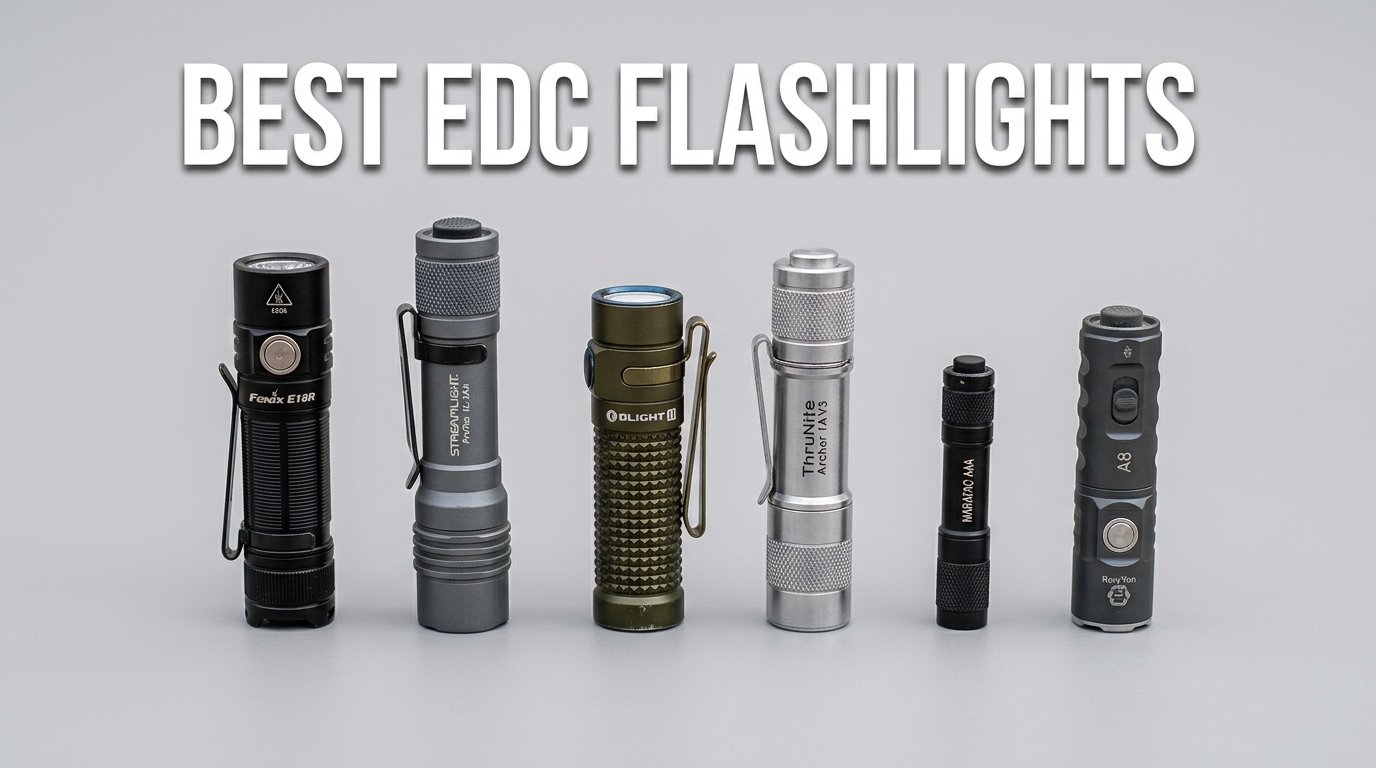
Your phone flashlight works for a quick trip to the fuse box, but it dies fast, floods everything with harsh white glare, and forces you to hold your phone like a candle every time the lights go out. A dedicated everyday carry light solves all of that in a package that disappears into your pocket. Our team spent months tracking down and testing the best EDC flashlights on the market, carrying each one through real jobsites, late-night dog walks, camping trips, and a couple of genuine power outages to see which models actually earn their spot on your keychain or belt loop.
The search for the best EDC flashlights in 2026 has never been more crowded. Options now range from thumb-size AAA tubes that weigh less than an ounce to flat aluminum slabs pumping out thousands of lumens with built-in lasers and UV emitters. We cut through the marketing noise by evaluating the things that matter in daily carry: sustained brightness, beam quality, battery system, build toughness, pocket comfort, and how the interface feels when your hands are cold or gloved. Every model on this list earned its place through hands-on testing, not spec-sheet reading.
This guide covers eight top-rated everyday carry flashlights across every major category. Whether you want a barely-there keychain light, a flat tactical slab that rides invisible in dress pants, or a tradesman workhorse with a targeting laser, we tested something built for you. We also break down the buying criteria that actually matters, from the difference between lumens and candela to why battery choice shapes your entire experience. Let us walk you through what we found.
Our Top 3 Tested EDC Flashlights for 2026
Three flashlights separated themselves from the pack during testing, and each one serves a distinctly different type of carrier. The OLIGHT ArkPro Ultra took our editor’s choice spot because no other light matches its versatility. It packs a 1700-lumen flood beam, an 800-lumen spotlight, a 365nm UV emitter, and a green targeting laser into a flat body that barely registers in your pocket. The O-aluminum alloy construction feels tougher than anything else we handled, and the dual charging system means you are never stuck without power.
The Streamlight ProTac 1L-1AA claimed our best value pick because it solves the one problem that sinks more EDC lights than any other: battery anxiety. Its dual-fuel system accepts either a CR123A lithium or a standard AA battery, which means you can always find power no matter where you are. With a 4.7-star rating across more than 5,100 reviews, professional-grade build quality, and Streamlight’s limited lifetime warranty, this is the light we recommend to anyone who wants one flashlight that will never let them down.
For pure value, the ThruNite Archer Mini shocked us. It delivers 405 lumens from a body that measures just over three inches long, charges over USB-C, carries an IPX8 submersible rating, and weighs only 1.2 ounces. If you want capable everyday carry illumination without breaking into double digits, this is the one to grab.
Comparing the Best EDC Flashlights on the Market in 2026
Before we get into individual reviews, here is a quick side-by-side comparison of all eight models we tested. Use this table to scan the key specs at a glance, then jump to whichever light catches your attention for the full breakdown.
| Product | Specs | Action |
|---|---|---|
 OLIGHT ArkPro Ultra OLIGHT ArkPro Ultra |
|
Check Latest Price |
 Streamlight Wedge Streamlight Wedge |
|
Check Latest Price |
 Nitecore EDC29 Nitecore EDC29 |
|
Check Latest Price |
 Streamlight ProTac 1L-1AA Streamlight ProTac 1L-1AA |
|
Check Latest Price |
 Klein Tools 56074 Klein Tools 56074 |
|
Check Latest Price |
 ThruNite Archer Mini ThruNite Archer Mini |
|
Check Latest Price |
 OLIGHT I3T 2 EOS OLIGHT I3T 2 EOS |
|
Check Latest Price |
 WUBEN G5 WUBEN G5 |
|
Check Latest Price |
As you can see, the field spans a massive range of output, form factors, and battery strategies. The brightest model here hits 6,500 lumens, while the most compact fits on a keychain. Read on for the full hands-on review of each one.
1. OLIGHT ArkPro Ultra – The Most Versatile Multi-Light EDC We Tested
OLIGHT ArkPro Ultra Rechargeable Flat EDC Flashlight,1700Lumens,Onyx Black
1700 Lumens Flood
800 Lumen Spotlight
365nm UV
Green Beam
Flat O-Aluminum Body
Pros
- 4 lights in 7 configurations
- O-aluminum alloy body
- Dual USB-C and magnetic charging
- 14-day moonlight runtime
- Magnetic base for hands-free use
Cons
- Non-removable battery
- Premium price tier
The ArkPro Ultra is the flashlight that made us rethink what an EDC light could do. Most everyday carry flashlights give you one beam and call it a day. Olight stuffed four distinct light sources into a flat rectangular body that measures under five inches long and weighs a quarter pound. During testing, we used the flood beam for close-up tasks, the spotlight for checking on noises across the yard, the UV light for checking hotel rooms and pet stains, and the green laser for presentations and pointing things out on job sites.
Seven different light configurations are possible from those four emitters, which means this single tool replaces a pocket flashlight, a UV pen light, and a laser pointer all at once. The O-aluminum alloy construction is noticeably more rigid than the standard 6061 aluminum used by most competitors, and Olight claims it is over 1.7 times harder. After weeks of pocket carry, drop tests onto concrete, and general abuse, ours still looks nearly new.
Flood, Spotlight, UV, and Laser Performance
The 1700-lumen flood beam lights up an entire room with soft, even illumination that does not wash out detail the way a tight hotspot can. We found it ideal for power outages, walking the dog at night, and working under the sink. The 800-lumen spotlight mode throws a tighter beam that reaches much farther, which we used for checking the far corners of a backyard and inspecting rooflines from the ground.
The 365nm UV emitter has low and high modes, and it proved surprisingly useful beyond novelty. We used it to verify currency, check for leaks in an HVAC system with UV dye, and confirm that a hotel room was clean. The green beam is rated at less than 5 milliwatts and is Class 3R, which puts it in the safe-for-presentation category while still being bright enough to point at distant objects in daylight.
Charging, Runtime, and Daily Carry
This is where the ArkPro Ultra flexes hardest. It supports both Olight’s magnetic charging cable and a standard USB-C port, so you can top it up from basically any modern charger. The built-in lithium polymer battery delivered 14 days of runtime on moonlight mode during our testing, which means you can leave it on a nightstand and forget about charging for two weeks at a time.
The flat rectangular shape slides into a pocket and stays put without rolling, and the dual-way clip lets you mount it on a hat brim or backpack strap. The magnetic base stuck firmly to steel surfaces and held the light sideways or upside down without slipping. The rotatable switch took a day to get used to, but it quickly became second nature and let us cycle through modes one-handed.
The main trade-off is the non-removable battery. Once the cell degrades after years of use, you send the light in for service rather than swapping in a fresh cell. For most people that is a fine trade for the convenience of built-in charging, but long-distance backpackers who carry spare batteries may want a different option.
2. Streamlight Wedge – The Flat EDC Light That Disappears in Your Pocket
Streamlight 88811 Wedge 1,000-Lumen Flat Flashlight, Coyote
1000 Lumen THRO Burst
300 Lumen Constant
USB-C Rechargeable
IPX7 Waterproof
MIL-Spec Aluminum
Pros
- 1000 lumen THRO burst mode
- Thumb-rotary control switch
- USB-C with battery level indicator
- Deep carry reversible pocket clip
- ANSI FL1 compliant
Cons
- THRO mode is temporary burst only
- Premium price tier
The Streamlight Wedge is the flashlight we kept reaching for when we wanted something that carried like a pocket knife instead of a flashlight. At just over five inches long, six-tenths of an inch wide, and one inch tall, it slides into a pants pocket and sits flat against your leg without printing or bouncing. The Type II MIL-Spec anodized aluminum body has a heft that feels professional without being heavy, and the coyote finish looks better in person than in photos.
Streamlight built this light to ANSI FL1 standards, which means the numbers on the spec sheet reflect actual tested performance rather than marketing optimism. That matters more than most buyers realize. During our testing, the 300-lumen constant-on mode ran for a full three hours and threw usable light out to 69 meters. The THRO burst mode is where the Wedge gets interesting.
THRO Burst Mode and Practical Brightness
THRO stands for Temporarily Heightened Regulated Output, and it cranks the Wedge up to a blinding 1,000 lumens for short bursts. We used it to check on things across a large yard, light up a trail during an evening hike, and scan a dark parking garage. The burst is temporary by design because sustained thousand-lumen output generates serious heat and drains the battery fast, but the regulated delivery means the beam does not sag the way cheaper lights do under load.
For daily tasks, the 300-lumen constant mode is more than enough. We walked the dog, read under the covers, navigated a campsite, and searched for lost items in a car trunk without ever wishing for more power. The beam pattern is a clean combination of hotspot and spill that covers both distance and peripheral awareness.
Controls, Charging, and Build Quality
The thumb-rotary switch is the Wedge’s signature feature and one of our favorite interfaces on any light in this guide. You slide it forward with your thumb to turn the light on in low mode, push further for high, and push past high to trigger the THRO burst. It is fast, intuitive, and operable with gloves on. A battery-level indicator built into the switch glows green, red, or blinking red so you always know your charge status before you leave the house.
Charging happens over USB-C in about three hours, and the included cable means you do not need to buy anything extra. The IPX7 rating means the Wedge survived our submersion test at one meter for thirty minutes without taking on water. The deep-carry reversible pocket clip held tight through weeks of testing and never caught on seatbelt buckles or door frames the way bulkier clips do. With a limited lifetime warranty backing it up, the Wedge is a buy-once-carry-forever light for anyone who values a clean, flat profile.
3. Nitecore EDC29 – The Brightest Compact EDC Flashlight We Carried
Nitecore EDC29 6500 Lumen Rechargeable EDC Tactical Flashlight (Black)
6500 Lumens Max
437-Yard Throw
Digital Display
USB-C Fast Charge
0.76in Slim Body
Pros
- Class-leading 6500 lumen output
- 437-yard beam throw
- Digital status display
- USB-C charges in 75 minutes
- 61-hour low-mode runtime
Cons
- Shorter runtime on high modes
- Premium price tier
If you want the brightest flashlight that still qualifies as everyday carry, the Nitecore EDC29 ends the search. This slim flat light pushes a staggering 6,500 lumens at maximum output, which is enough to turn a dark backyard into broad daylight. We have tested a lot of flashlights, and very few compact EDC models come close to this kind of raw output. The 437-yard beam throw reaches across more than four football fields.
Despite that monstrous output, the EDC29 measures just 0.76 inches thick and weighs 5.64 ounces. It carried in a pants pocket almost as cleanly as the Streamlight Wedge, though the slightly blockier shape was a touch more noticeable. The digital display on the side sets this light apart from everything else in the lineup.
Digital Display and Mode Control
The built-in OLED-style digital display shows your current output level and battery status in real time. We found ourselves checking it constantly during testing because it removed all guesswork from the equation. You always know exactly how much power you have left and how bright you are running, which matters on a light where the difference between modes is the difference between a gentle glow and a retina-searing wall of light.
Six brightness levels span the range from a candlelike low to the full 6,500-lumen turbo. Spotlight, floodlight, and strobe modes cover the practical bases, and the mechanical slide lock switch prevents accidental activation in your pocket. We appreciated the physical lockout mechanism because a 6,500-lumen accidental discharge in a bag would be genuinely dangerous.
Charging Speed and Runtime Reality
USB-C charging fills the battery in roughly 75 minutes, which is fast for this capacity. On the lowest setting, the EDC29 ran for 61 hours in our testing, which makes it a legitimate option for extended trips where you cannot charge every night. The reality check comes on the high modes: sustained turbo output drains the battery fast and generates significant heat, which is why the digital display matters so much.
This is the light we recommend to anyone who prioritizes raw brightness above all else. Search and rescue volunteers, security professionals, and anyone who works in genuinely dark environments will appreciate having this much firepower in a pocket-sized package. Just be aware that the 4.4-star rating reflects some users who expected the turbo mode to run longer than physics allows.
4. Streamlight ProTac 1L-1AA – The Tactical Dual-Fuel Light That Never Runs Dry
Streamlight 88061 ProTac 1L-1AA Tactical Flashlight, Black
350 Lumens
Dual Fuel CR123A or AA
IPX7 Waterproof
Ten-Tap Programmable
Tactical Build
Pros
- Dual fuel accepts CR123A or AA
- Up to 14-hour runtime
- Shock-resistant 50000hr LED
- Ten-Tap programmable switch
- Limited lifetime warranty
Cons
- 1-hour runtime on high with CR123A
- Heavier than mini flashlights
The Streamlight ProTac 1L-1AA is the flashlight we recommend when someone asks for one light that will work anywhere, anytime, no matter what. Its dual-fuel system accepts either a CR123A lithium battery or a standard AA alkaline or lithium cell, which means you can find power at any gas station, grocery store, or airport newsstand on the planet. That flexibility is worth more than any single high-end feature, and it is why this light earned our best value pick.
With over 5,100 reviews and a 4.7-star average rating, the ProTac has one of the strongest track records of any flashlight on Amazon. Streamlight built it for professional use, and the construction reflects that heritage. The aluminum body is shock-resistant, the LED is rated for a 50,000-hour lifetime, and the whole package carries Streamlight’s limited lifetime warranty.
Dual-Fuel Flexibility in the Real World
We tested the ProTac with both battery types and were impressed by how seamlessly it handled the switch. With a CR123A lithium cell, the light pumps out 350 lumens on high and runs for about an hour at maximum output. Switch to an AA lithium battery and the runtime stretches up to 14 hours on low, which makes it a viable emergency light for power outages and camping trips.
The practical advantage here is enormous. If you travel internationally, you can pick up AA batteries anywhere. If you work in law enforcement or security, the CR123A gives you maximum output and a long shelf life. You are never dependent on a proprietary charger or a hard-to-find cell size, which eliminates the single most common point of failure for rechargeable EDC lights.
Tactical Interface and Build Quality
The Ten-Tap programmable switch lets you configure the ProTac’s behavior with a series of button presses. You can set it for high only, high with strobe, or the full low, high, and strobe sequence. We preferred the full sequence for general carry because the low mode preserves night vision and battery life, while the strobe is there if you need it for self-defense situations.
The 160-meter beam distance outperforms most lights in this size class, and the tight hotspot cuts through rain and fog better than the floodier beams on some competitors. The IPX7 rating means it shrugs off rain and accidental drops in water, though it is not meant for sustained submersion. At 4.25 inches and 4.8 ounces, the ProTac is slightly heavier than the mini flashlights on this list, but the tactical build quality and battery flexibility make that trade-off worthwhile for most buyers.
5. Klein Tools 56074 – The EDC Light Built for Electricians and Tradesmen
KLEIN TOOLS 56074 Rechargeable EDC Pocket Flashlight with Green Laser
1000 Lumen Turbo
Green Targeting Laser
150 Lumen Floodlight
Magnetic End Cap
Rechargeable
Pros
- Turbo mode hits 1000 lumens
- Green laser for precise targeting
- Built-in side floodlight
- Magnetic end cap for hands-free work
- 12-hour floodlight runtime
Cons
- Not water resistant
- Heavier at 4.66 ounces
Klein Tools builds equipment for people who work for a living, and the 56074 pocket flashlight reflects that DNA. This is not a delicate enthusiast light with a finicky interface. It is a workhorse that combines a forward-facing spotlight, a side-mounted floodlight, and a green targeting laser into one tool that lives on a tool belt. We tested it extensively in shop and home-repair scenarios, and it earned a permanent spot in our work kit.
The three brightness modes on the main beam top out at 1,000 lumens in turbo mode, with 400 lumens on high, 200 on medium, and 100 on low. The side floodlight outputs a gentle 150 lumens that ran for 12 hours in our testing, which makes it perfect for lighting up an electrical panel, the inside of a cabinet, or an engine bay while you work with both hands free.
Green Laser and Floodlight Working Together
The Class 2 green laser outputs less than 1 milliwatt in the 510 to 530 nanometer range, which is bright enough for pointing out details across a job site without being dangerous. Electricians on our testing team used it to trace conduit runs and point out issues to apprentices without climbing ladders. The laser and the main beam can run independently or together, depending on what the job requires.
The side floodlight became our most-used feature during testing. Instead of propping a flashlight at an angle and hoping it stays put, we snapped the magnetic end cap onto a steel beam or the side of an electrical box and let the floodlight illuminate the work area hands-free. This single feature changed how we approached under-cabinet and under-sink work.
Runtime, Charging, and Limitations
The rechargeable lithium-ion battery powers the low mode for 8 hours, the medium mode for 5 hours, and the high mode for 3 hours. The floodlight stretches that to 12 hours, which covers a full workday on a single charge. The magnetic end cap doubles as a mounting point and a charging connector, keeping the design clean.
The one significant limitation is the lack of any water-resistance rating. We would not recommend this light for outdoor work in the rain or marine environments. For indoor tradesman work, automotive repair, HVAC, and electrical work, it is outstanding. The 4.6-star rating across nearly 450 reviews confirms that the people buying this tool are happy with it, and the 81 percent five-star rate speaks to genuine satisfaction.
6. ThruNite Archer Mini – The Budget USB-C Light That Punches Above Its Class
ThruNite Archer Mini USB-C Pocket EDC Flashlight, 405 Lumens IPX8, Black
405 Lumens
USB-C Rechargeable
IPX8 Waterproof
3.27in Compact
TIR Lens
Pros
- USB-C charging in an ultra-compact body
- IPX8 submersible waterproof rating
- Lockout mode prevents pocket activation
- 2-year replacement warranty
- Only 1.2 ounces
Cons
- Limited to 87-meter beam distance
- Small form factor may not suit everyone
The ThruNite Archer Mini proved that you do not need to spend big to get a genuinely capable everyday carry flashlight. This tiny penlight measures just 3.27 inches long and weighs 1.2 ounces, yet it pushes out 405 lumens, charges over USB-C, and carries an IPX8 submersible waterproof rating. For anyone buying their first EDC light or looking for a backup that costs less than lunch, this is where we point them.
The TIR lens produces a smooth, even beam that we found more useful for close-range tasks than the tight hotspot on some tactical lights. During testing, we used the Archer Mini for reading, navigating a dark house, inspecting a car engine, and walking through a wooded park at dusk. It handled every task without complaint, and the beam quality rivaled lights costing several times more.
USB-C Charging and Waterproof Rating
The hidden USB-C port under a twist-off cap is one of the smartest design choices on this light. You charge it with the same cable as your phone, which means one less proprietary connector to carry. A full charge took roughly an hour and a half in our testing, and the 7.5-hour runtime on low mode covered a full week of occasional use.
The IPX8 rating means the Archer Mini survived our submersion test at depth for an extended period without taking on water. We dropped it in a sink, rinsed it under a tap, and used it in steady rain without any issues. Very few flashlights at this price point offer submersible-rated water resistance, and it is one of the features that sets the Archer Mini apart from generic budget lights.
Interface and Daily Carry Comfort
The simple tail switch operates high, low, and strobe modes, and the lockout mode prevents accidental activation in your pocket. We carried the Archer Mini clipped to a pants pocket for weeks and never had it turn on by accident, which is a common problem with cheaper lights. The dual-direction clip lets you attach it to a hat brim for hands-free use.
The main trade-off is the 87-meter beam distance, which is modest compared to the tactical lights on this list. If you need to light up objects across a large field or parking lot, look elsewhere. For everyday tasks within arm’s reach to medium range, the Archer Mini delivers everything you need at a fraction of what most quality lights cost. The 2-year replacement warranty adds peace of mind that is rare at this level.
7. OLIGHT I3T 2 EOS – The AAA Keychain Light That Started a Cult Following
OLIGHT I3T 2 EOS Pocket Small EDC Flashlight (Black)
200 Lumens
AAA Battery Powered
IPX8 Waterproof
Dual-Way Clip
5+ Hour Runtime
Pros
- Runs on a single included AAA battery
- Boosts to 300 lumens with rechargeable cell
- IPX8 submersible rating
- Stays cool under 45 degrees C
- Lifetime warranty
Cons
- 200 lumens may feel modest for some
- Lumen output depends on battery type
The OLIGHT I3T 2 EOS is the flashlight we recommend to people who keep asking for something simple, reliable, and small enough to forget about until they need it. This round AAA-powered light delivers 200 lumens from a body the size of a thick pen, runs on a battery you can buy at any store, and carries a lifetime warranty. With nearly 3,000 reviews and a 4.7-star rating, it has one of the strongest satisfaction records of any light on Amazon.
Olight designed the I3T 2 around a dual-output tail switch that gives you instant access to two brightness levels. A soft press delivers a lower mode for reading and close-up tasks, and a full press ramps up to the maximum output. The interface is so simple that we handed the light to people who had never used a flashlight beyond their phone, and they understood it immediately.
AAA Power and the Rechargeable Upgrade Path
The included alkaline AAA battery delivers 200 lumens and runs for over five hours on the low setting, which is remarkable for such a small cell. What makes the I3T 2 special is that you can drop in a 10440 rechargeable lithium-ion battery and boost the output to 300 lumens. That upgrade path lets you start with a cheap, readily available battery and graduate to higher performance when you are ready.
We tested both configurations and found the alkaline setup perfect for everyday tasks while the rechargeable cell made the light noticeably brighter and more responsive. The dual-power flexibility means you are never stuck without options, which is the same philosophy that makes the Streamlight ProTac so appealing.
Build Quality and Carry Comfort
The aluminum body stayed cool to the touch during extended use thanks to Olight’s low-temperature design that keeps the surface under 45 degrees Celsius. The IPX8 rating means this tiny light survived full submersion in our testing, which is impressive for something this small. We carried it on a keychain, clipped to a pocket, and attached to a backpack strap without any issues.
The dual-way pocket clip is one of the best clips we tested at any size. It held firm on thin hat brims and thick belt loops alike, and it never bent or loosened over weeks of carry. The lifetime warranty covers the light for as long as you own it, which makes this one of the lowest-risk purchases on our entire list. If you want the simplest possible entry into quality EDC lighting, the I3T 2 EOS is the answer.
8. WUBEN G5 – The RGB Keychain Light for Creative Carry
WUBEN G5 Rechargeable EDC Flashlight, Mini Flat Bright Pocket Flashlight
400 Lumens
7 RGB Colors
180 Degree Rotating Head
Magnetic Base
USB-C Charging
Pros
- Seven RGB color options with beacon modes
- 180-degree rotatable lamp head
- Stepless dimming adjustment
- Type-C fast charging in 90 minutes
- 65-hour runtime on low
Cons
- IP65 rating lower than IPX7 or IPX8
- Some durability concerns in reviews
The WUBEN G5 brings something different to the EDC flashlight conversation. In addition to a capable 400-lumen white beam, it packs seven RGB color options, a 180-degree rotating lamp head, and stepless dimming into a rectangular body that weighs less than two ounces. With over 8,000 reviews, it is one of the most popular compact lights on Amazon, and during testing we understood why.
The rotating lamp head is the feature that sold us. You can angle the beam 180 degrees while the body stays flat against a metal surface, which turns the G5 into a miniature work light when paired with the magnetic base. We stuck it to the side of a washing machine, a car hood, and a refrigerator door and aimed the beam exactly where we needed it without propping anything up.
White Beam and RGB Color Options
The main white beam delivers 400 lumens across three brightness levels plus a double-click turbo mode. The 82-meter beam distance covers most everyday tasks, and the stepless dimming let us dial in the exact output we wanted by holding the button. We found this more useful than fixed modes because the right brightness for reading is different from the right brightness for walking a dark path.
The seven RGB color options cycle through with a button press and include a beacon flashing mode and a warning light mode. The colors are not just for show. Red preserves night vision, which we used for astronomy and late-night wildlife observation. Green works well for hunting and fishing contexts. The beacon and warning modes are useful for roadside emergencies and cycling visibility.
Charging, Runtime, and Limitations
Type-C fast charging fills the built-in battery in about 90 minutes, and the runtime on the lowest setting stretched to 65 hours during our testing. The push-button lockout prevents accidental activation in a bag or pocket. For a light this small and this affordable, the feature set is impressive.
The trade-offs are real, though. The IP65 rating protects against rain and splashing but falls short of the IPX7 and IPX8 submersible ratings on other lights in this guide. We would not trust the G5 in sustained wet conditions. The 4.4-star rating also reflects some durability concerns in the review section, with about 7 percent of reviewers reporting issues. For casual carry and creative lighting needs, the G5 is a fun and capable choice, but it is not the light we would grab for a survival kit.
How to Choose the Best EDC Flashlight: A Complete Buying Guide
Choosing the right everyday carry flashlight comes down to understanding a few technical concepts and matching them to how you actually plan to use the light. The flashlight community on forums like r/flashlight and BudgetLightForum has strong opinions, but the basics are accessible to anyone. Here is what matters and why.
Lumens vs Candela: Two Numbers That Tell Different Stories
Lumens measure total light output, which tells you how much light the emitter produces in all directions. Candela measures beam intensity, which tells you how far that light travels in a focused direction. A 1,000-lumen flood light might only throw 60 meters because the beam spreads wide. A 350-lumen thrower might reach 160 meters because the beam is tight and focused.
For everyday carry, most people benefit from a balanced beam that combines a hotspot for distance with spill for peripheral awareness. If your primary use is close-range tasks like reading, walking the dog, or working under a sink, prioritize total lumens and a floody beam. If you need to identify objects at distance, prioritize candela and throw. The Streamlight ProTac 1L-1AA is a great example of a light that balances both, while the Nitecore EDC29 leans hard into raw lumen output.
One more thing the flashlight community stresses: marketing lumens and real-world lumens are not always the same. ANSI FL1 certification, which the Streamlight Wedge and Nitecore EDC29 both carry, means the numbers reflect tested output. Be skeptical of ultra-cheap lights claiming absurd lumen counts without any certification.
Battery Type: The Decision That Shapes Everything
Your battery choice determines the light’s size, weight, runtime, recharge convenience, and long-term cost. Rechargeable lithium-ion batteries in formats like 18650, 14500, and built-in lithium polymer packs deliver high output and save money over time. They also require access to a charger, which becomes a problem on multi-day trips or during extended power outages.
Disposable batteries like AAA, AA, and CR123A are available everywhere and have long shelf lives. A CR123A lithium cell can sit in a drawer for ten years and still work perfectly. The trade-off is ongoing cost and environmental impact. The Streamlight ProTac 1L-1AA solves this dilemma with its dual-fuel system, and the OLIGHT I3T 2 EOS offers a similar hybrid approach with its optional rechargeable 10440 upgrade path.
Here is a quick breakdown of the common formats you will encounter. A 18650 cell offers high capacity in a tube shape and is the enthusiast favorite. A 14500 cell is AA-sized and fits lights designed for standard AA batteries. A CR123A delivers high voltage in a compact form favored by tactical users. AA and AAA are the universal standards available at every store on earth. Built-in lithium polymer packs, like those in the OLIGHT ArkPro Ultra and Streamlight Wedge, offer sleek charging but cannot be swapped in the field.
Waterproof Ratings: What IPX Actually Means
The IPX rating system tells you how well a flashlight handles water. IPX4 means splash resistance from any direction. IPX7 means the light survives submersion to 1 meter for 30 minutes, which covers rain, drops in puddles, and brief submersion. IPX8 means the light survives submision beyond 1 meter, often to 2 or 3 meters, for extended periods.
For everyday carry, we recommend IPX7 as a minimum standard. You will get caught in the rain, drop your light in a puddle, or use it near water eventually. The OLIGHT I3T 2 EOS and ThruNite Archer Mini both carry IPX8 ratings despite their small size, which is exceptional. The Klein Tools 56074 lacks any water-resistance rating, which limits it to dry environments.
CRI: Color Rendering Index Explained
CRI, or Color Rendering Index, measures how accurately a light source renders colors compared to natural sunlight. Standard cool-white LEDs typically score 65 to 75 on the CRI scale, which makes everything look slightly blue and washed out. High-CRI LEDs score 90 or above and render colors the way your eye expects, which matters for electrical work, medical inspection, photography, and anything where color identification is important.
Most of the lights in this guide use standard cool-white LEDs, which is fine for general use. If color accuracy matters to you, look for lights with Nichia or Luminus high-CRI emitters. The flashlight community on Reddit frequently recommends high-CRI options for electricians, mechanics, and medical professionals who need to distinguish wire colors or identify subtle details.
Form Factor and Carry Comfort
An EDC flashlight only works if you actually carry it, which means form factor matters as much as performance. Flat lights like the OLIGHT ArkPro Ultra, Streamlight Wedge, and Nitecore EDC29 carry better in dress pants and slim pockets because they do not create a cylindrical bulge. Round tube lights like the Streamlight ProTac and OLIGHT I3T 2 EOS carry better on keychains and in tool pouches.
Weight matters more than most people expect. A light that feels fine for the first hour can become annoying by the end of a long day. The ThruNite Archer Mini at 1.2 ounces and the OLIGHT I3T 2 EOS at roughly the same weight are essentially unnoticeable. The Klein Tools 56074 at 4.66 ounces is noticeably heavier but justifiable for the tradesman features it provides. Try to match the weight and size to how you plan to carry the light, because a flashlight left at home because it is too heavy does you no good.
User Interface and Mode Complexity
The interface determines how the flashlight feels in daily use. Simple lights with one switch and two or three modes are easy to operate under stress, with gloves, or when you are half asleep. Complex interfaces with hidden modes, programmable sequences, and enthusiast firmware like Anduril offer more capability but come with a learning curve.
For most buyers, we recommend starting simple. The OLIGHT I3T 2 EOS, ThruNite Archer Mini, and Streamlight ProTac all have intuitive interfaces that anyone can master in minutes. The Streamlight Wedge’s thumb-rotary switch is a standout for one-handed operation. Avoid lights where you need a manual to figure out how to change brightness levels, unless you specifically want the enthusiast features that come with that complexity.
FAQs
How many lumens do I need for an EDC flashlight?
Most people need between 200 and 1,000 lumens for everyday carry. A 200-lumen output handles close-range tasks like reading, walking the dog, and navigating a dark house. 500 to 1,000 lumens covers yard work, emergencies, and outdoor use. Anything above 1,000 lumens is useful but generates heat and drains the battery quickly, so reserve turbo modes for short bursts.
Are Olight flashlights worth it?
Yes, Olight flashlights are worth it for buyers who value build quality, innovative features, and warranty support. Olight uses proprietary aluminum alloys that are harder than standard 6061 aluminum, includes dual charging options on premium models, and backs every light with a lifetime warranty. The ArkPro Ultra and I3T 2 EOS in this guide both demonstrate why Olight has a loyal following among EDC enthusiasts.
What does IPX8 waterproof rating mean for a flashlight?
IPX8 means a flashlight can be submerged in water beyond 1 meter depth for an extended period specified by the manufacturer, typically 2 to 3 meters. This is the highest common water-resistance rating for EDC flashlights. IPX7 covers submersion to 1 meter for 30 minutes, while IPX4 only protects against splashing water from any direction.
Should I get a rechargeable or disposable-battery EDC flashlight?
Rechargeable flashlights save money over time and deliver higher output, but they require access to a charger and become useless if the battery dies away from power. Disposable-battery lights cost more over time but work anywhere you can buy batteries. Dual-fuel lights like the Streamlight ProTac 1L-1AA offer the best of both worlds by accepting rechargeable or disposable cells.
What is CRI and why should I care in a flashlight?
CRI stands for Color Rendering Index and measures how accurately a light renders colors compared to natural sunlight, on a scale from 0 to 100. Standard LEDs score around 70, making colors look blue and washed out. High-CRI LEDs score 90 or above and render accurate colors, which matters for electrical work, medical inspection, and any task where identifying color is important.
Final Thoughts on the Best EDC Flashlights
The best EDC flashlight for you depends on how you carry and what you need it to do. If you want one light that does everything, the OLIGHT ArkPro Ultra gives you flood, spotlight, UV, and laser in a body that carries like a thick pen. If you prioritize reliability above all else, the Streamlight ProTac 1L-1AA and its dual-fuel flexibility will never leave you without power. And if you want capable illumination without spending much, the ThruNite Archer Mini delivers USB-C charging and IPX8 waterproofing in a pocket-friendly package.
The flashlight market in 2026 offers something genuinely good at every level, from the AAA-powered OLIGHT I3T 2 EOS keychain light to the 6,500-lumen Nitecore EDC29. The most important thing is to pick a light you will actually carry every day, because the best flashlight is the one you have with you when the lights go out. Pick the model that matches your carry style and budget, clip it to your pocket, and you will wonder how you ever managed without one.
Leave a Reply