
Garage dust is the quiet problem almost every woodworker discovers too late. A table saw and a planer in a one-car space generate enough fine particulate to coat every horizontal surface in a week, and that dust stays suspended every time you open the door. The fix that experienced shop owners keep coming back to is a cyclone separator: it spins dirty air inside a cone, flings the heavy chips and shavings down into a bucket or drum, and sends only the fine dust onward to your filter or bag. That is why the best cyclone dust collectors for garages sit near the top of our list of dust collectors worth owning.
I have spent the last few years building and rebuilding collection setups in garages and basements, and I put ten of the most popular cyclone options through the same routine: fit them to the machines I actually had, run a planer and a drum sander through them, and watch how long it took before I was standing in a cloud of my own dust. What follows is what survived that, plus the honest parts where each one frustrated me.
Two questions come up constantly, so I will answer them here rather than bury them. Are cyclone dust collectors worth it? Yes, for any garage that runs more than one machine or a planer at all, because the drum fills with chips you can lift out instead of a bag you have to shake into a bin. What is the difference between a cyclone separator and a dust collector? The collector is the motor and filter; the cyclone is the pre-separation stage bolted onto its intake, and the cyclone is the part that keeps big debris away from the filter.
One expectation-setting note before we get into the list. No collector captures every particle, and the ones that claim 99.9% are describing what gets pulled out of the airstream before the filter, not what stays in the room. Fine drywall and concrete particulate is the hardest case, and most of these units are built for wood. Our full garage slat wall comparison covers the storage side of the same shop; this article stays on suction.
Our Top 3 Cyclone Dust Collectors for Garage Shops in 2026

Oneida Dust Deputy DIY
- Up to 99.9 percent capture before the filter
- Tapered 2 inch ports
- Wet or dry
- Works with any shop vac

Dustopper PRO
- Third-party tested efficiency
- Preinstalled pail gasket
- Two high-flow sweep elbows
- Low profile
Peachtree Cyclone Kit
- 4 inch inlet and outlet
- Fits any bucket or barrel
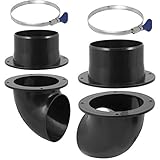
- Ports elbows and clamps included
All three top picks are separators rather than complete machines, which is the honest starting point for most garage shops. You already own a wet/dry vac or a small collector, and the cyclone is the layer that fixes what that machine is bad at.
Cyclone Dust Collectors Compared Side by Side in 2026
| Product | Specs | Action |
|---|---|---|
| Oneida Dust Deputy DIY |
|
Check Latest Price |
| Dustopper PRO |
|
Check Latest Price |
| Peachtree Cyclone Kit |
|
Check Latest Price |
 Festool CT CYCLONE Festool CT CYCLONE |
|
Check Latest Price |
 Oneida 2.5 Deluxe 5-Gallon Kit Oneida 2.5 Deluxe 5-Gallon Kit |
|
Check Latest Price |
 Oneida AXD002 Attachment Oneida AXD002 Attachment |
|
Check Latest Price |
 POWERTEC 70293V POWERTEC 70293V |
|
Check Latest Price |
 Mullet Cyclone Collector Mullet Cyclone Collector |
|
Check Latest Price |
 VEVOR Metal Tank Separator VEVOR Metal Tank Separator |
|
Check Latest Price |
 PEMEDOR Double Filtration PEMEDOR Double Filtration |
|
Check Latest Price |
1. Oneida Dust Deputy DIY – the separator almost every garage ends up with
Oneida Air Systems Dust Deputy DIY Anti-Static Retrofit Cyclone Separator for Wet/Dry Shop Vacuums (DD DIY)
Up to 99.9 percent capture
Tapered 2.0 inch ports
Wet or dry
15.5 x 9.3 x 7.4 inches
Pros
- Captures up to 99.9 percent of dust and debris before it reaches the vacuum filter
- Extends filter and bag lifespan
- Tapered 2.0 inch ports fit a range of hose sizes
- Works wet or dry with any wet/dry vacuum
- Made in the USA
Cons
- DIY kit is the separator only so you supply the container and hose
- Needs drilling or container adaptation to complete the build
Out of everything I ran, the Oneida Dust Deputy DIY is the one I recommend first to someone with a wet/dry vac and a table saw. It has been the default recommendation on woodworking forums for years, and the reason is simple: the separator itself costs less than a single replacement filter, and it converts bag emptying into bucket emptying.
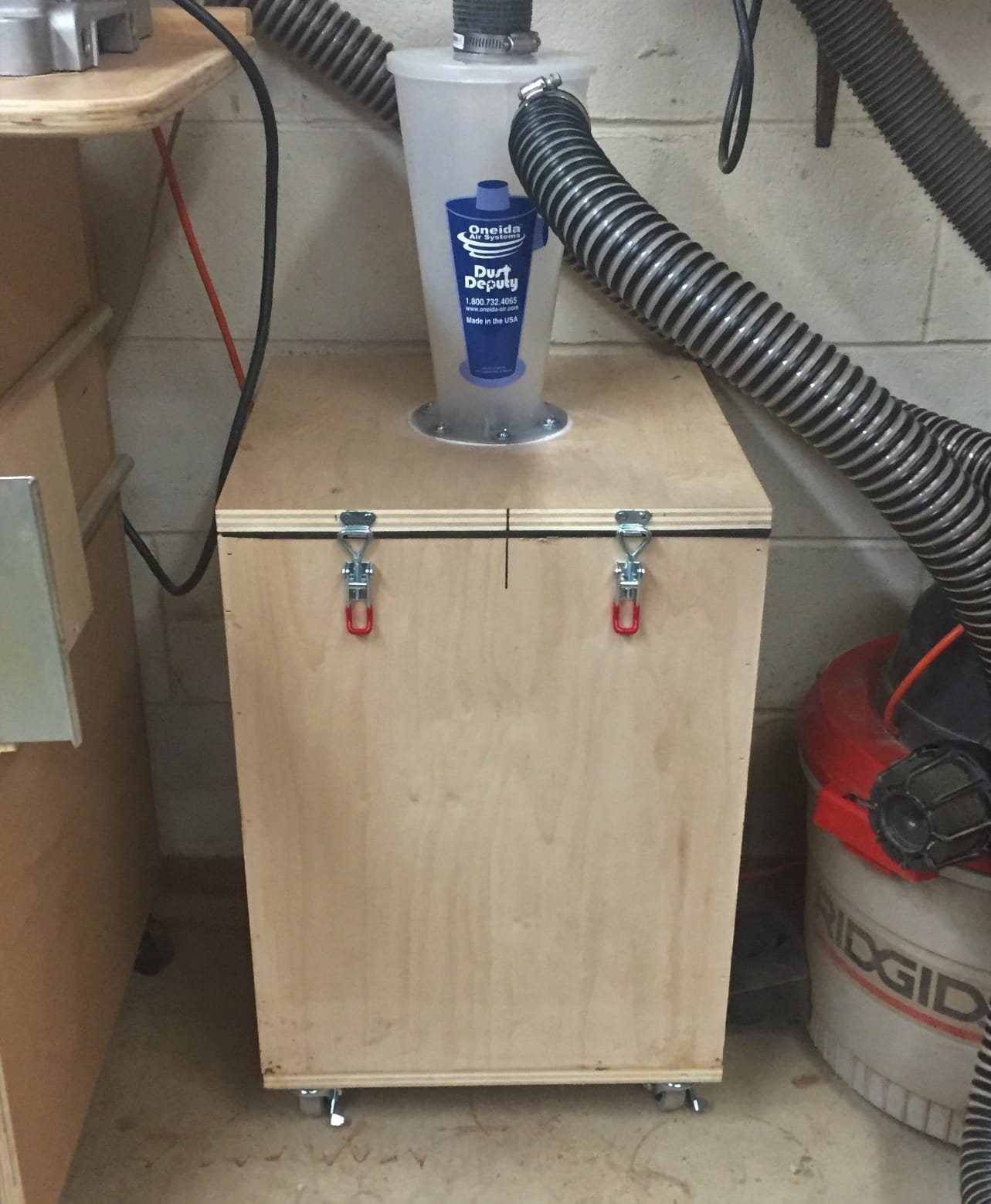
Mine went onto a 5-gallon pail with a 2 inch port drilled into the lid, which took about twenty minutes with a hole saw. Suction at the saw stayed strong, and the pail filled with chips while the vac filter on my machine stayed visibly clean. That is the entire promise of a cyclone, and this one delivers it at the most-tested level in the category with 4205 reviews at 4.6 stars.
How much debris actually gets pulled out of the airstream
The manufacturer states the separator captures up to 99.9 percent of dust and debris before it reaches the vacuum filter, and that is consistent with what I saw. Big shavings and coarse sawdust never made it past the cone, so they dropped straight into the container and never touched a filter surface.
The practical result is filter life. Instead of a bag filling in an afternoon, the filter surface stayed clear long enough that I emptied the shop vac on a normal schedule rather than a panic schedule. Owners consistently credit this with cutting replacement filter costs, and it is the single biggest reason people add one.
Port sizing and the DIY build
The tapered 2.0 inch ports are the design’s strongest feature and its main limitation. They mate to common shop vac hose with a clamp, but if your machine runs 2.5 inch or 4 inch hose you need reducers. The kit includes a gasket and mounting hardware, and you supply the container, so budget an afternoon the first time.
Center or edge mounting of the port inside the container both worked fine in my testing. Mount it off-center if your container is narrow, and leave room to get your hand in to knock the filter cake loose when you empty it.
Where it falls short
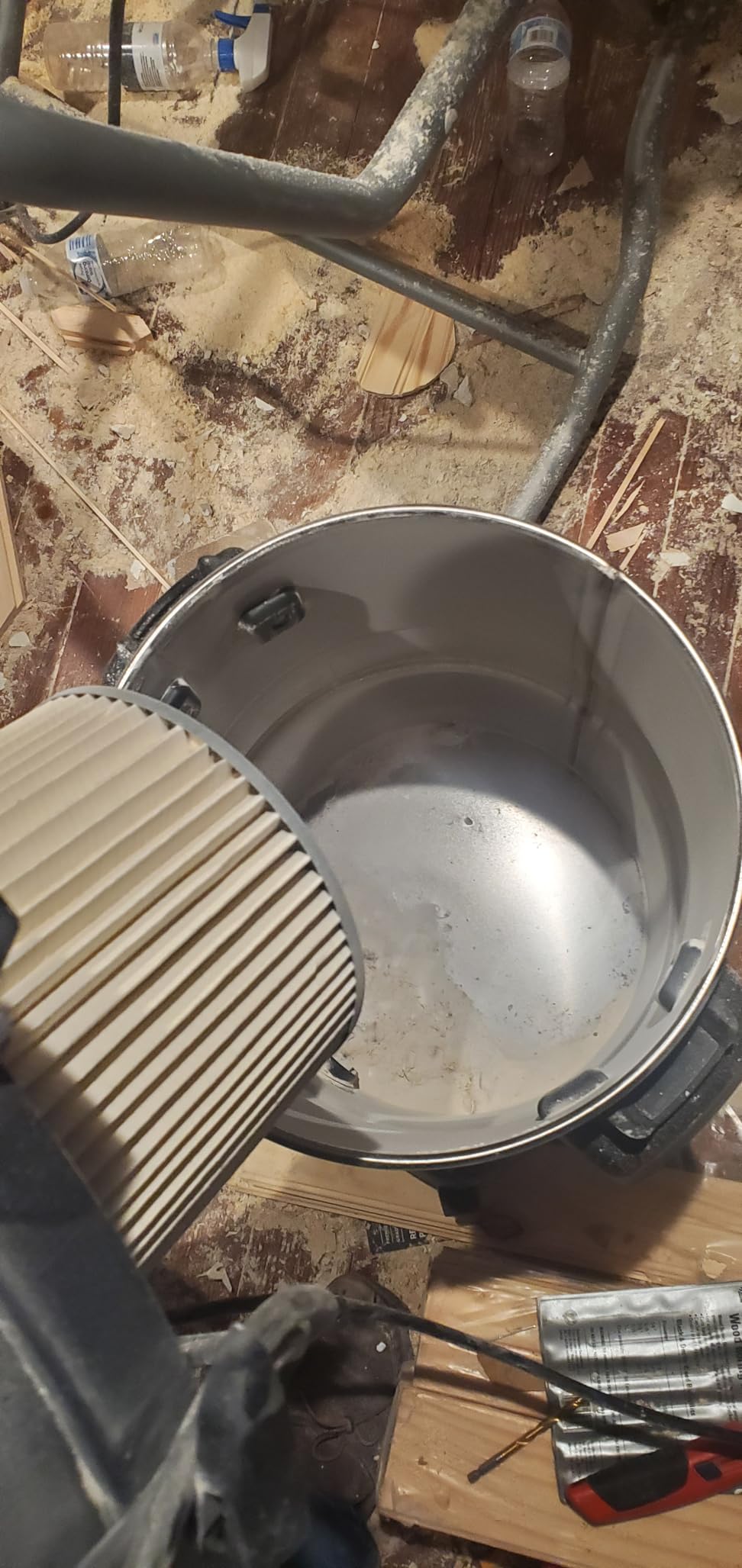
It is a separator and nothing more, which is a feature for a garage already equipped with a vacuum and a flaw for anyone expecting a turnkey system. The two most common complaints in reviews are the missing container and the drilling, and both are solvable on a Saturday.
It also shares a limitation with nearly every bucket-mounted design: suction drops as the container fills. Empty at about half full and you will keep the same performance you had on day one. If you want something with a bigger drum and less emptying, skip to the VEVOR metal tank or the Peachtree kit built on a barrel.
2. Dustopper PRO – third-party tested separation on a standard pail
Dustopper PRO Dust Collector – 99.9% Efficiency Cyclone Dust Separator
Third-party tested efficiency
Preinstalled EPDM gasket
Two sweep elbows
13 x 13 x 7 inches
Pros
- Independently tested for separation efficiency with sawdust and drywall powder
- Preinstalled hollow-core EPDM gasket seals a standard 5-gallon pail
- Patented high-flow sweep elbows reduce turbulence
- Works with a 2.5 HP shop vac and a 6-inch jointer
- Made in the USA
Cons
- Gasket can sit unevenly when detached from the bucket
- Static buildup that some owners ground with a wire
- 2.25 inch port diameter means adapters on some vacuums
The Dustopper PRO is the pick I recommend when you want the highest separation quality without building anything. The difference from the budget kits is that this one was tested by an outside environmental lab rather than rated by the manufacturer, and the design was optimized for separation instead of for raw airflow. Fewer eddy currents, better capture.
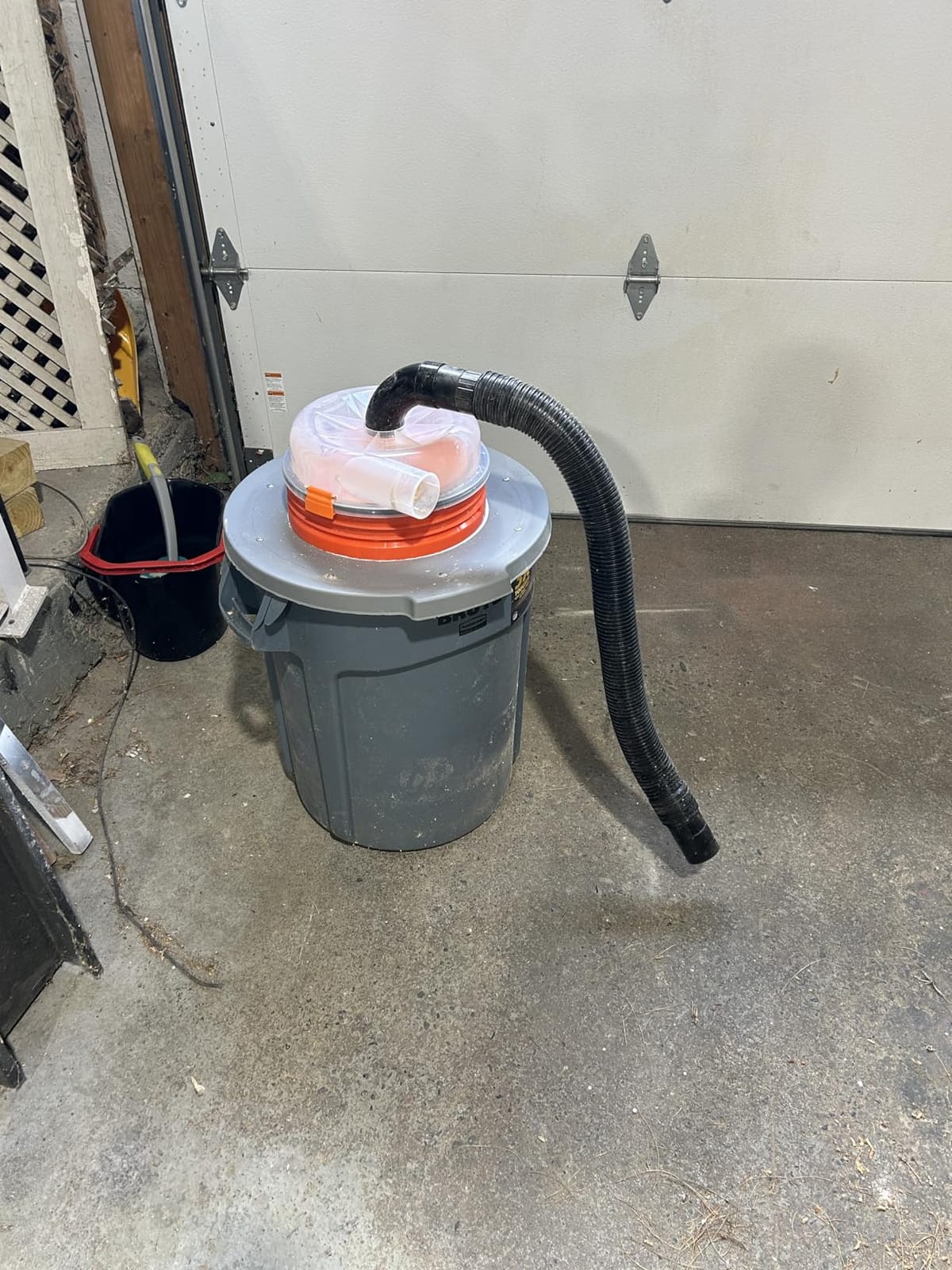
It is also the lowest profile option here at 7 inches tall, which matters in a low-ceiling garage or a rented space where wall mounting is off the table. The preinstalled gasket meant zero assembly for me: it dropped onto a pail, I clamped the hose, and it worked. That is genuinely the shortest path from unboxing to a cleaner shop.
Independent testing and the design choices behind it
The lab testing covered fine sawdust, coarse sawdust and drywall powder, which is a more honest test set than most manufacturers publish. Since drywall is the messiest dust in a residential garage, that third material is the one I care about most, and it is where the low-profile design earns its keep.
The two included sweep elbows also matter more than they sound. A straight 90 degree elbow at the cyclone outlet creates turbulence that roils air back into the cone, and these are shaped to keep the flow moving. Owners running big machines like a 6-inch jointer report it holds up where cheaper bucket kits lose suction.
Sealing to a standard pail
The hollow-core EPDM gasket is preinstalled and fits any standard 5-gallon pail, so there is nothing to glue or trim. In my install I used a plain flat-lid pail and the seal held through a full drum sander run.
The one recurring fit problem in reviews is the gasket sitting unevenly when the unit is detached from the bucket, which happens if you drag it by the cyclone body. Lift it off and set it back down square. The inside port measures 2.25 inches, so a few vacuums need an adapter.
Who should skip it
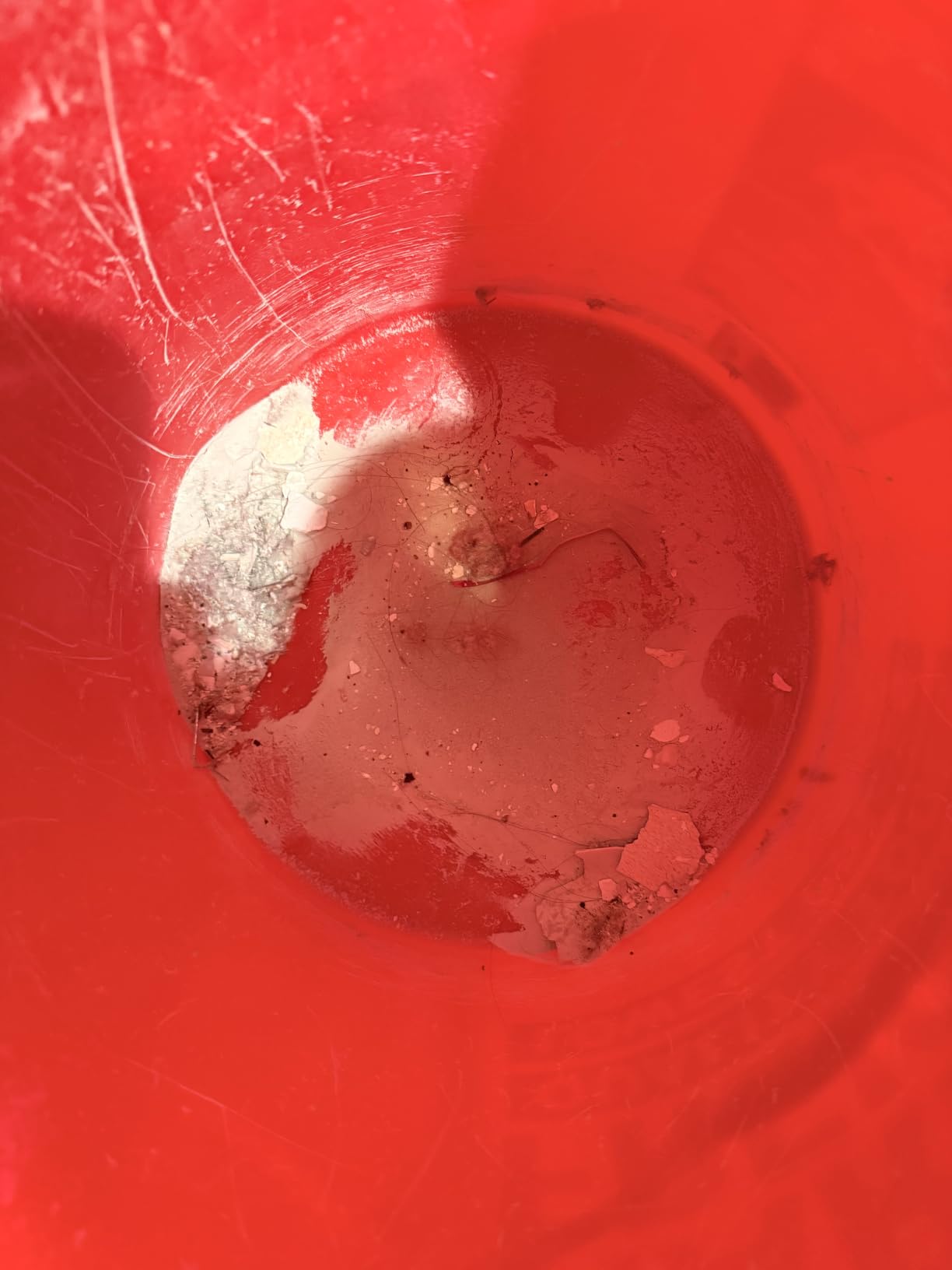
Static builds on the anti-static resin body in dry conditions, and some owners run a wire to ground the can, which is worth doing in a carpeted garage. If your shop is mostly concrete and you run wet pickup, this is not a problem you will hit.
This is also an attachment, not a system, so you need a container and a vacuum. For a complete kit with the bucket already on casters, the Oneida 2.5 Deluxe is the one I would buy instead, at the cost of a lower star rating.
3. Peachtree Woodworking Cyclone Kit – build it on whatever container you own
Cyclone Dust Separator Kit for 4
4 inch inlet and outlet
Fits any box, barrel or bucket
2 top ports, 2 elbow ports, clamps
Pros
- Rated 4.7 stars across 822 reviews
- Uses any container you already own
- Installs in about 15 minutes with the paper template
- Traps coarse chips and fine dust before they reach filters
- Complete hardware bundle in the box
Cons
- Suction drops noticeably once the container is about half full
- Hose and container are not included
- Sealed lids on some cans need trimming to fit
The Peachtree kit is the most flexible option in the roundup and one of the highest rated at 4.7 stars from 822 reviews. It does not care what you hang underneath it. I ran it on a 5-gallon pail in one shop and on a 30-gallon barrel in another, and separation held up in both because the cone geometry is unchanged.
The 4 inch port sizing is the real story. It is built to match a 4 inch duct run and to protect a collector impeller from chips, so it scales from a small shop vac rig up to a mid-size single-stage machine without new fittings. That flexibility is why I would build around it for anything involving a planer.
Why 4 inch ports change the calculus
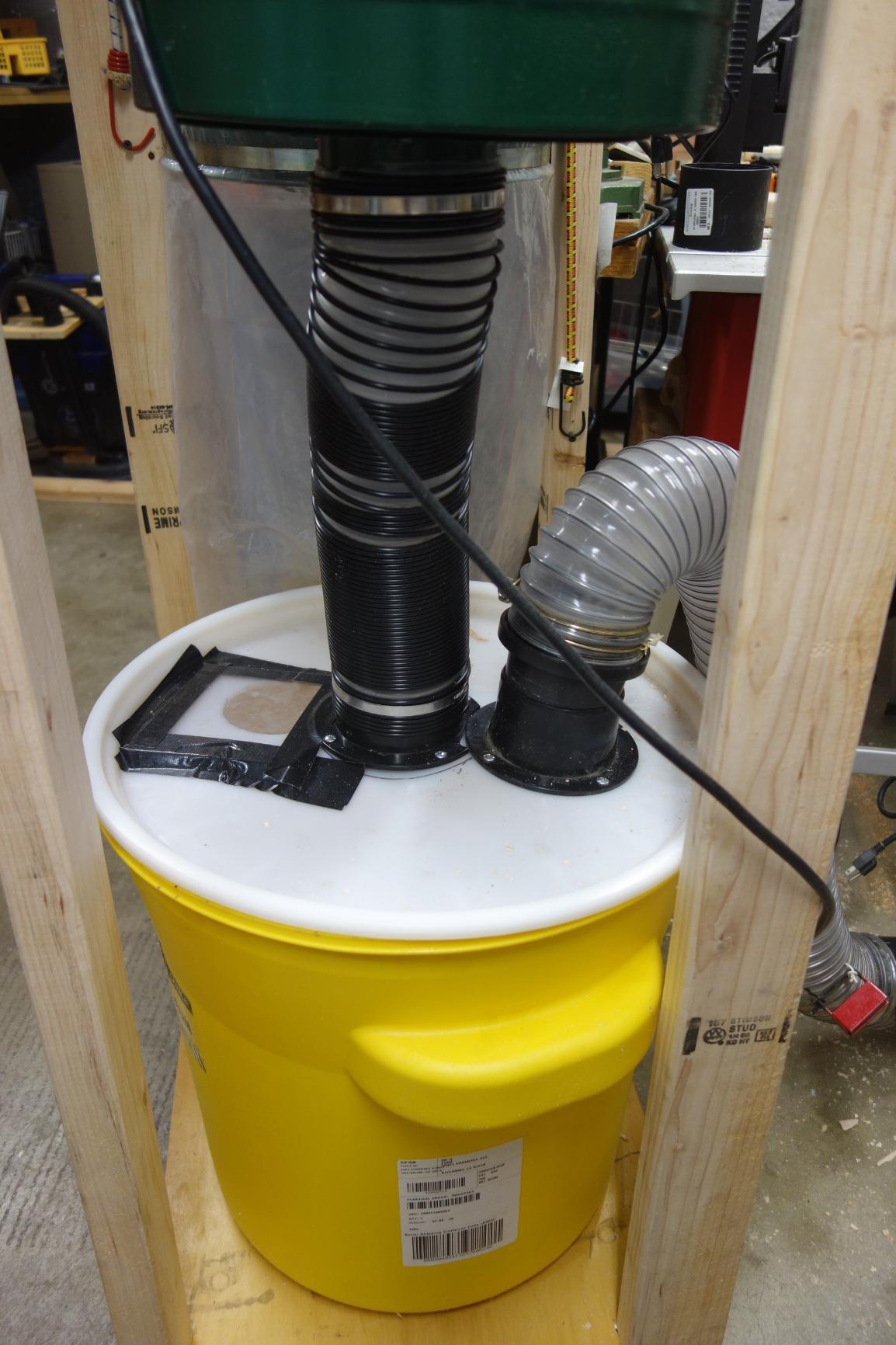
Almost every budget separator in this category ships with 2 inch ports, which caps how much air you can pull through and how many machines you can feed. At 4 inch you can tee off a main run, run proper ducting to a table saw and a planer, and still have headroom. Owners report multiple machines saving money on bags and filters as a direct result.
The kit includes two top-side 4 inch ports, two bottom-side 4 inch elbow ports, two turn-key hose clamps and a hardware pack. The clamps matter more than they sound, because the single most common build mistake is an unsealed connection that leaks dust and destroys your capture.
Installation on whatever you own
A paper template is included for marking the lid, so installation takes roughly 15 minutes with a hole saw. Owners report that center and edge port positions produced equal separation in their testing, which means you can mount for clearance rather than for flow.
A 30-gallon barrel or 55-gallon drum is the container I would choose. The larger the drum, the longer you go between emptyings, and with a 4 inch port you have the airflow to fill it. A 5-gallon pail works fine for a hobbyist with one machine.
The trade-off you are making
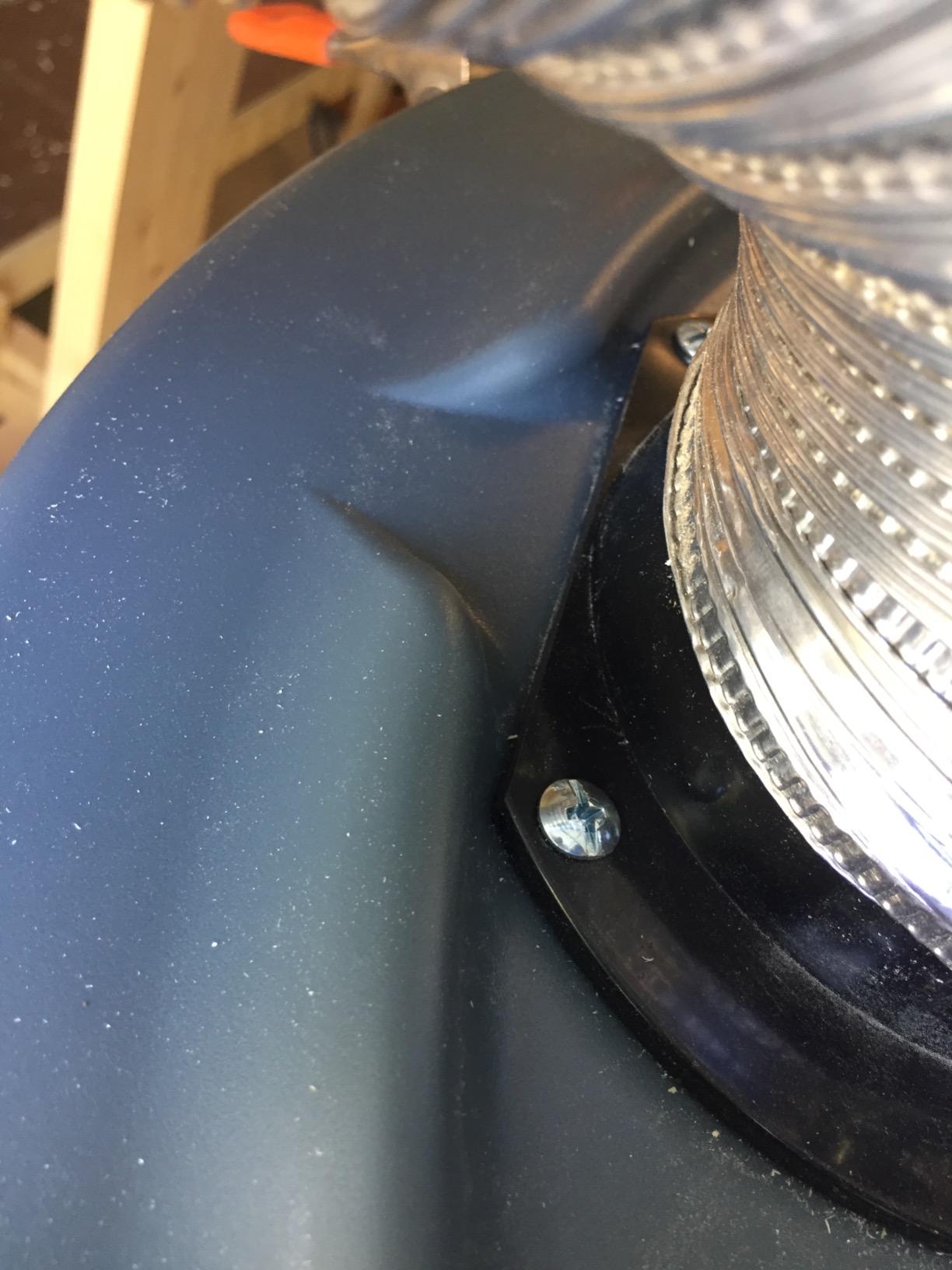
Suction drops noticeably once the container is about half full. That is physics in a straight-wall cone design, and it is why several owners in reviews consider it a fair bargain given what the kit costs. If you dislike the habit of checking the drum, plan a larger barrel and set a mental halfway mark.
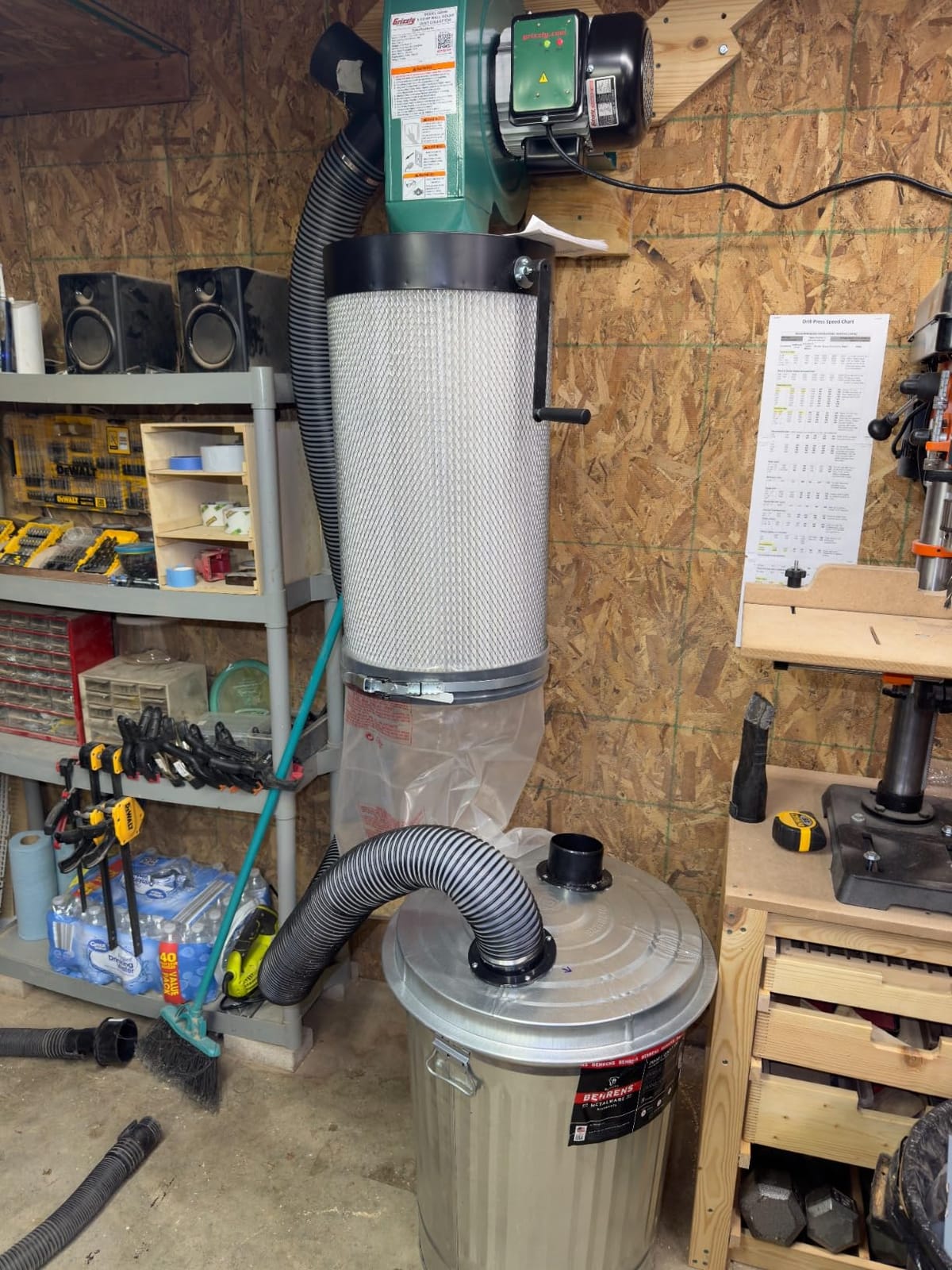
Planers deserve a specific warning. A planer can pressurize a sealed can, so a spring clamp on the lid is worth adding. Owners also note that molded lid features on some cans need a little trimming for a flat seal.
4. Festool CT CYCLONE – a flat separator for Systainer extractors
Festool 204083 CT CYCLONE Dust Separator CT-VA-20
Flat design fits inside Systainer
Compatible with CT 26, 36 and 48
Aluminum body
Pros
- Flat profile fits inside the Festool Systainer storage system
- Captures roughly 95 percent or more of sawdust
- Works across the CT 26
- 36 and 48 range including Autoclean
- OSHA Table 1 compliant when paired with a Festool HEPA extractor
Cons
- Most expensive separator in the roundup
- Friction-fit parts are easy to misalign and suction collapses when they are
- Some suction loss versus a straight hose connection
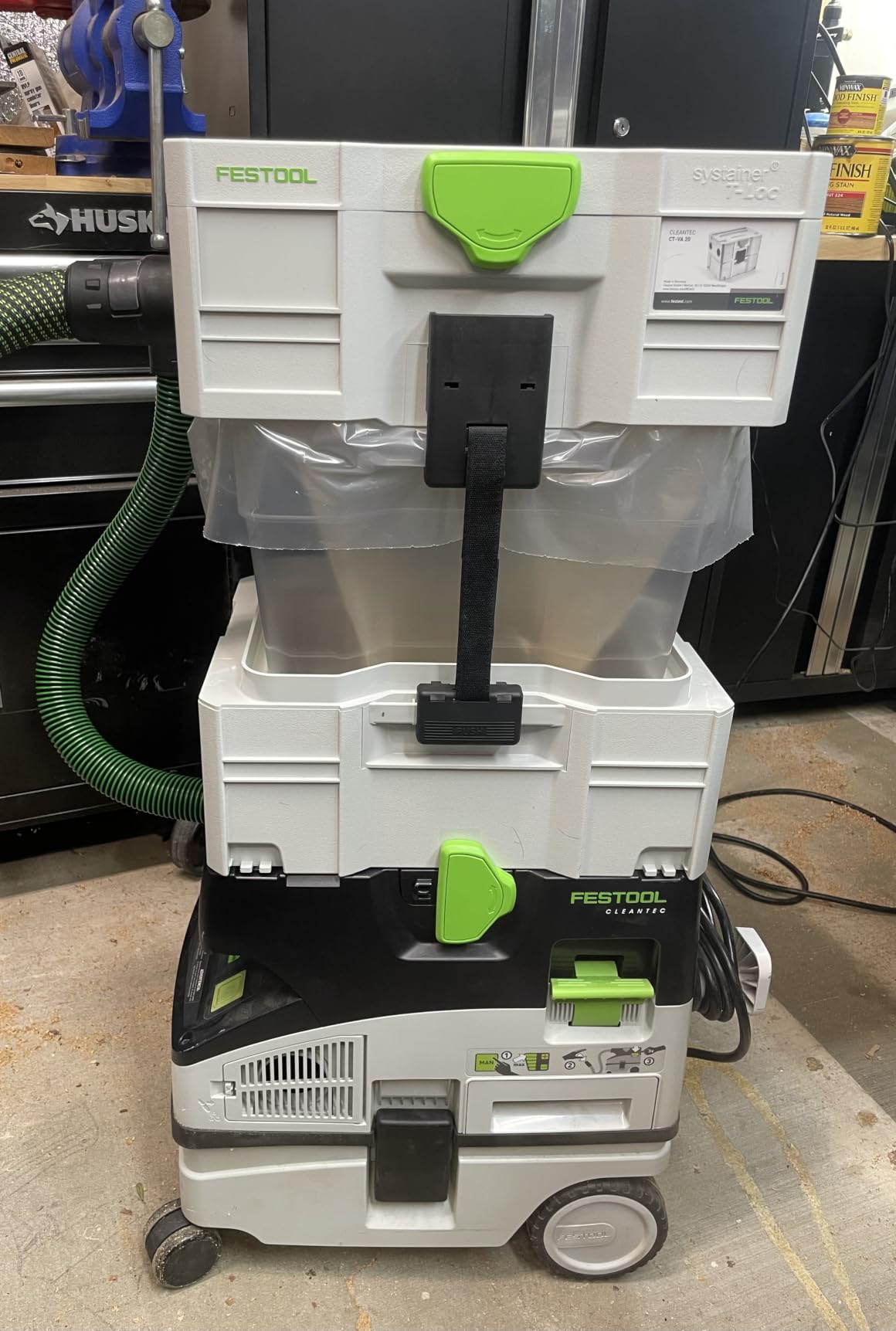
This one is only worth writing about if you are already in the Festool ecosystem. The CT CYCLONE is a flat aluminum separator that drops inside a Systainer, works with the CT 26, CT 36 and CT 48 extractors, and stays compatible with Autoclean models. If you do not own a CT extractor already, this is the wrong purchase at any budget.
If you do own one, the payoff is that large dust and debris are removed before they fill the extractor bag. Owners report bag changes dropping sharply, and a full bag is the most unpleasant maintenance task in any compact shop.
Flat geometry in a small shop footprint
The flat profile is the entire design thesis. Rather than a tall cone sitting on a can, it lays down inside the Systainer footprint and is held in place by the lid with friction fits. That means it stores with the machine instead of occupying a corner of the garage.
The tradeoff for that flatness is slightly reduced suction compared with a straight hose connection, which owners who are used to raw CT performance notice. The separation gain more than compensates if bag changes were the thing annoying you.
Silica compliance when it matters
When paired with a HEPA-certified CT dust extractor, the cyclone is OSHA Table 1 compliant for silica dust. That matters for drywall sanding and concrete work, which is where a lot of garage dust actually comes from and where the health risk is highest.
Silica compliance only applies to that specific pairing. A standard CT extractor without a HEPA cartridge does not earn the same rating, so verify the model before you plan drywall work around it.
Who should look elsewhere
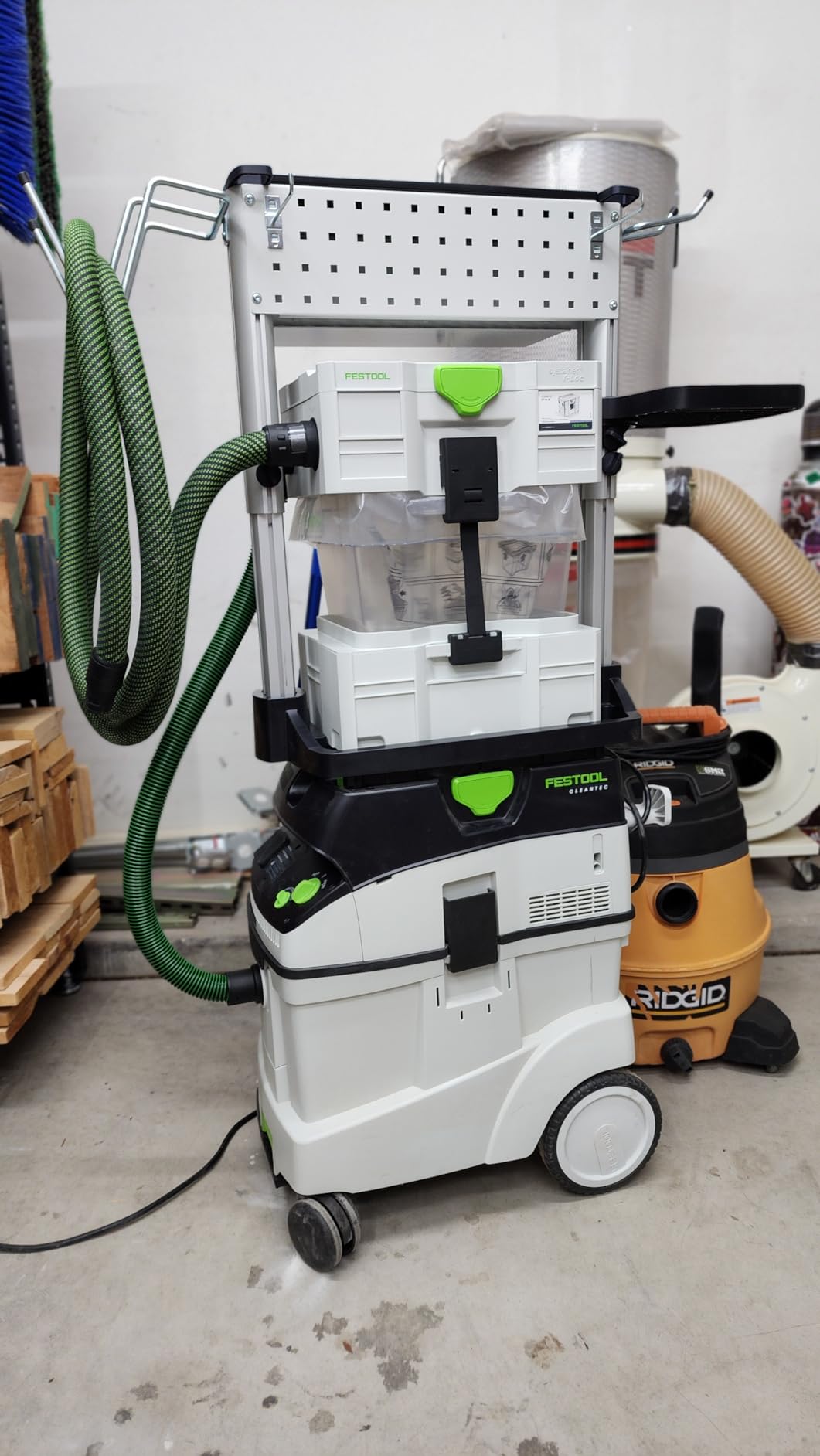
The cost is the reason most people pass. It is the most expensive separator here, and the value calculation only works if a CT extractor is already on your bench. For anyone starting from a shop vac, the Oneida Dust Deputy DIY does the same job for a fraction of the outlay.
Assembly is friction-fit and easy to misalign. Owners report a dramatic suction drop when the parts are not seated correctly, so take a minute to check alignment before every use rather than assuming it is fine.
5. Oneida 2.5 Deluxe 5-Gallon Kit – everything on four casters
Oneida Air Systems Dust Collector & Cyclone Separator Kit w/ Clear Bucket, 2.5 Deluxe 5-Gal – Portable Cyclone Machine for Wet and Dry Shop Vacuums
Up to 99 percent capture
Bucket, casters, hose and gasket
Translucent 5-gallon bucket
Pros
- Separator
- bucket
- casters
- hose
- tether kit and gasket in one box
- Translucent bucket shows fill level without opening the lid
- Cuts cleanup from over 30 minutes to about a minute
- Works with a 2.5 inch Rigid wet/dry vac
Cons
- Lowest rating here at 4.1 stars with 9 percent one-star reviews
- Tape-mounted casters have failed for some owners
- Bucket seal can leak if the unit is dragged off center
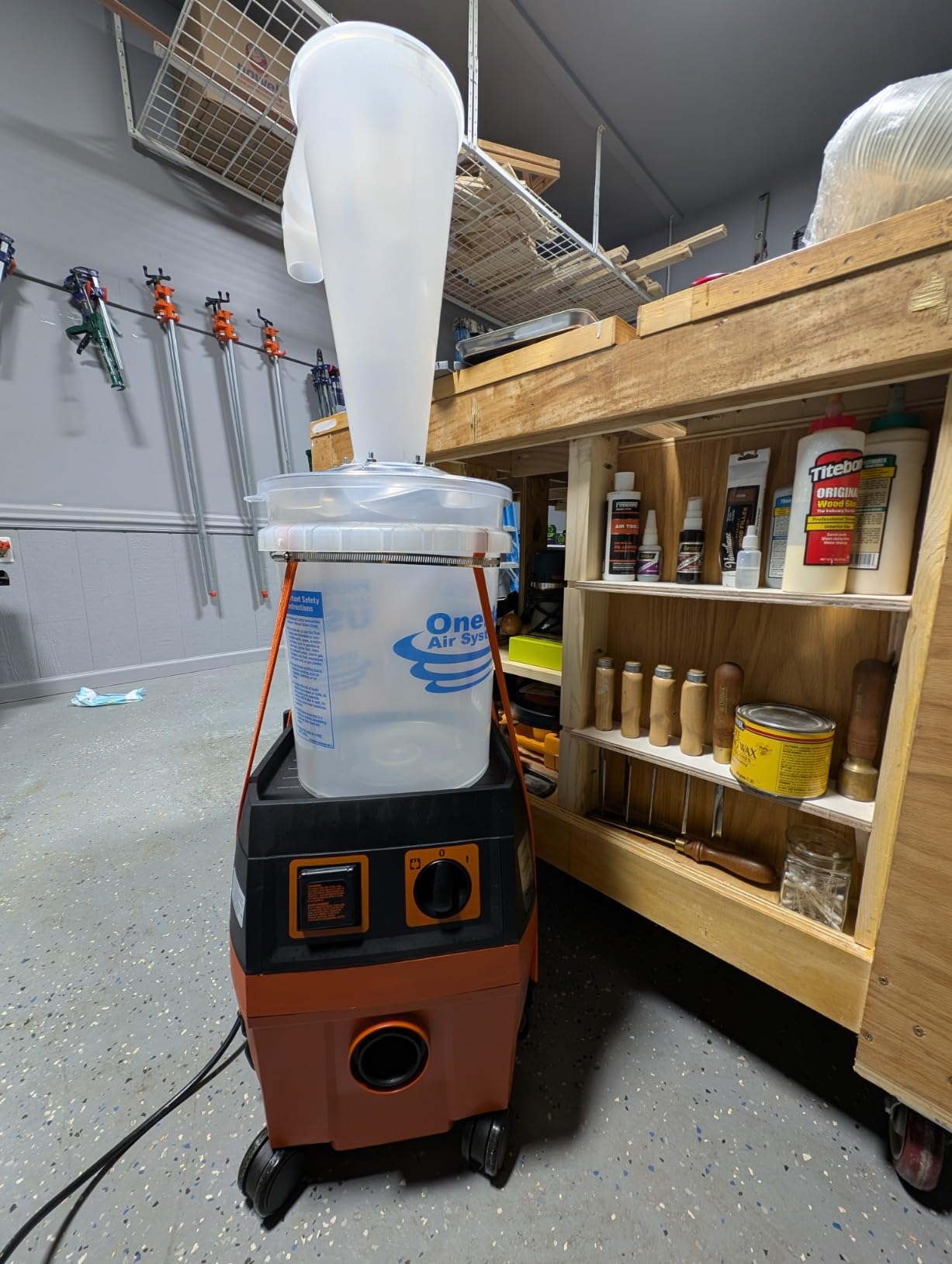
This is the one I recommend to anyone who wants a working cyclone tonight without a drill. The full parts list is in the box: the separator, a collapse-proof 5-gallon translucent bucket, a lid, four casters with mounts, a 4.5 foot hose with swivel cuffs, a vacuum tether kit and a pre-cut neoprene gasket. It rolls next to whatever machine you are working on.
Owners describe cutting cleanup from over 30 minutes to roughly a minute, and the translucent bucket is the detail I like most. You can see how full it is without lifting the lid, which means you empty it on your schedule rather than when suction complains. In my testing it handled drywall dust as well as wood dust, and the 2.5 inch fittings work with a standard Rigid wet/dry vac.
A turnkey build in a box
The value here is that nothing is missing. Most separators require you to source a container, a hose, clamps and a way to move it. This one has all of it, plus a tether kit that keeps the hose from kinking as you move between machines.
Separation is rated at up to 99 percent with neutral vane technology, a 20 percent improvement over a plain straight-vane inlet. The 2.5 inch hose fittings include a backwards-compatible 3 inch inside-diameter flange, so it reaches most wet/dry vacs on the market.
Where the low rating comes from
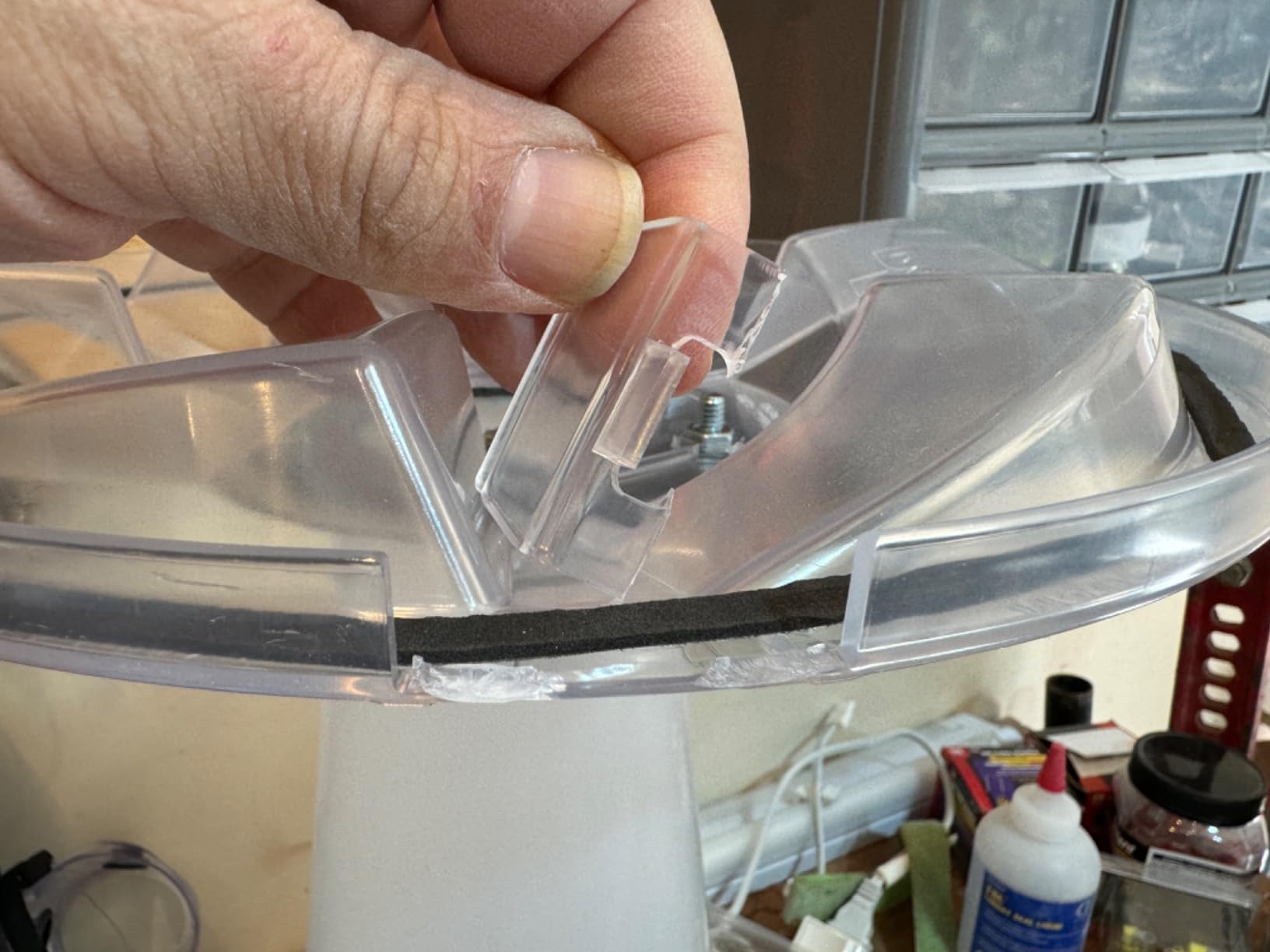
At 4.1 stars with 9 percent one-star reviews, this is the most divisive unit we tested, and the complaints cluster in the hardware rather than the dust performance. Tape-mounted casters have repeatedly failed for some owners, so check them periodically and pull the wheels off if the unit rocks.
The bucket-to-cyclone seal can leak dust if the unit is pulled or moved off center, and the included 4.5 foot hose is short enough that it will not let you stack the unit on top of the shop vac. No clamps ship with the kit, and the 90 degree adapters let the hose pull off. Add your own clamps.
Who it suits and who it does not
It suits a renter with a wet/dry vac who cannot drill into a wall, or anyone who wants one rolling unit that moves between a sander, a router and a saw. Forum builders consistently use a portable cyclone-and-bucket rig in exactly that way, including setups built around a Rubbermaid Brute can on casters.
Skip it if you are hard-piping to machines or running a planer that pressurizes the can, or if fragile hardware bothers you. Read the one-star reviews before deciding; the manufacturer has a good parts and warranty service record, but the casters and clamps are the weak points. For a rigid fixed install, the Peachtree kit is the sturdier path.
6. Oneida AXD002 Cyclone Attachment – upgrade a collector you already own
Oneida Air Systems Cyclone Attachment for Single Stage 0.5-3HP Dust Collector, 4/5 DIY – Portable Attachments and Accessories for Home and Woodworking Space Cleaning
Retrofits 1HP to 3HP collectors
4 or 5 inch inlet, 4 or 6 inch outlet
Neutral-vane inlet
7.7 pounds
Pros
- Upgrades a collector you already own instead of replacing it
- Integrated air ramp and neutral-vane inlet hold suction while separating
- 83 percent five-star ratings across 326 reviews
- Includes gasket
- two reducer adapters and lid hardware
- Light at 7.7 pounds and straightforward to install
Cons
- Useless without an existing 1HP to 3HP single-stage collector
- Requires cutting a 4 or 5 inch inlet and matching outlet
- Polypropylene body is less durable than a metal separator
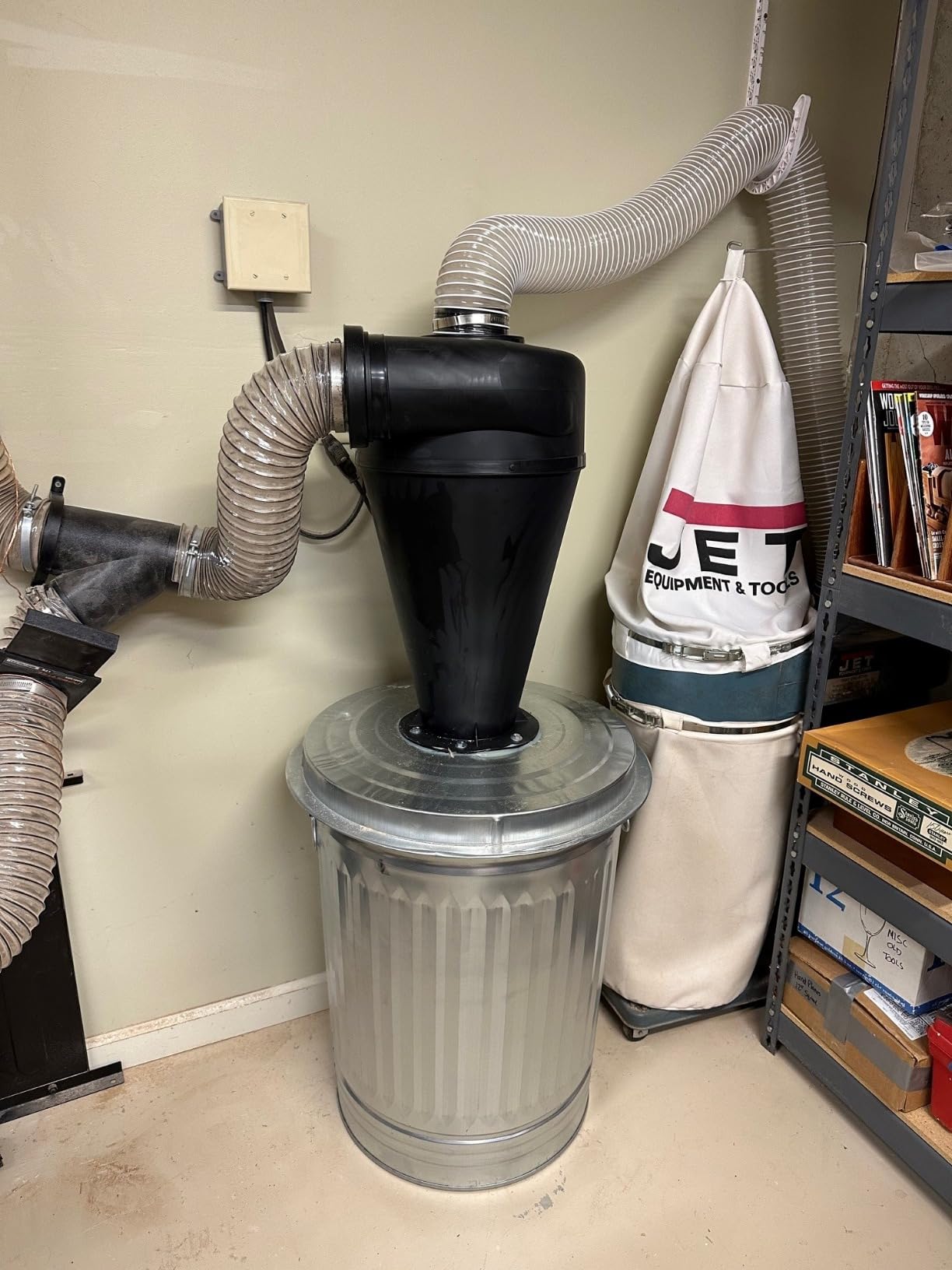
If you already own a small single-stage collector, this is the highest satisfaction ratio in the roundup at 4.7 stars with 83 percent five-star ratings. It retrofits 1HP through 3HP machines and captures over 99 percent of fine dust and large debris before they reach the collector, which is the single most valuable upgrade you can make to a budget machine.
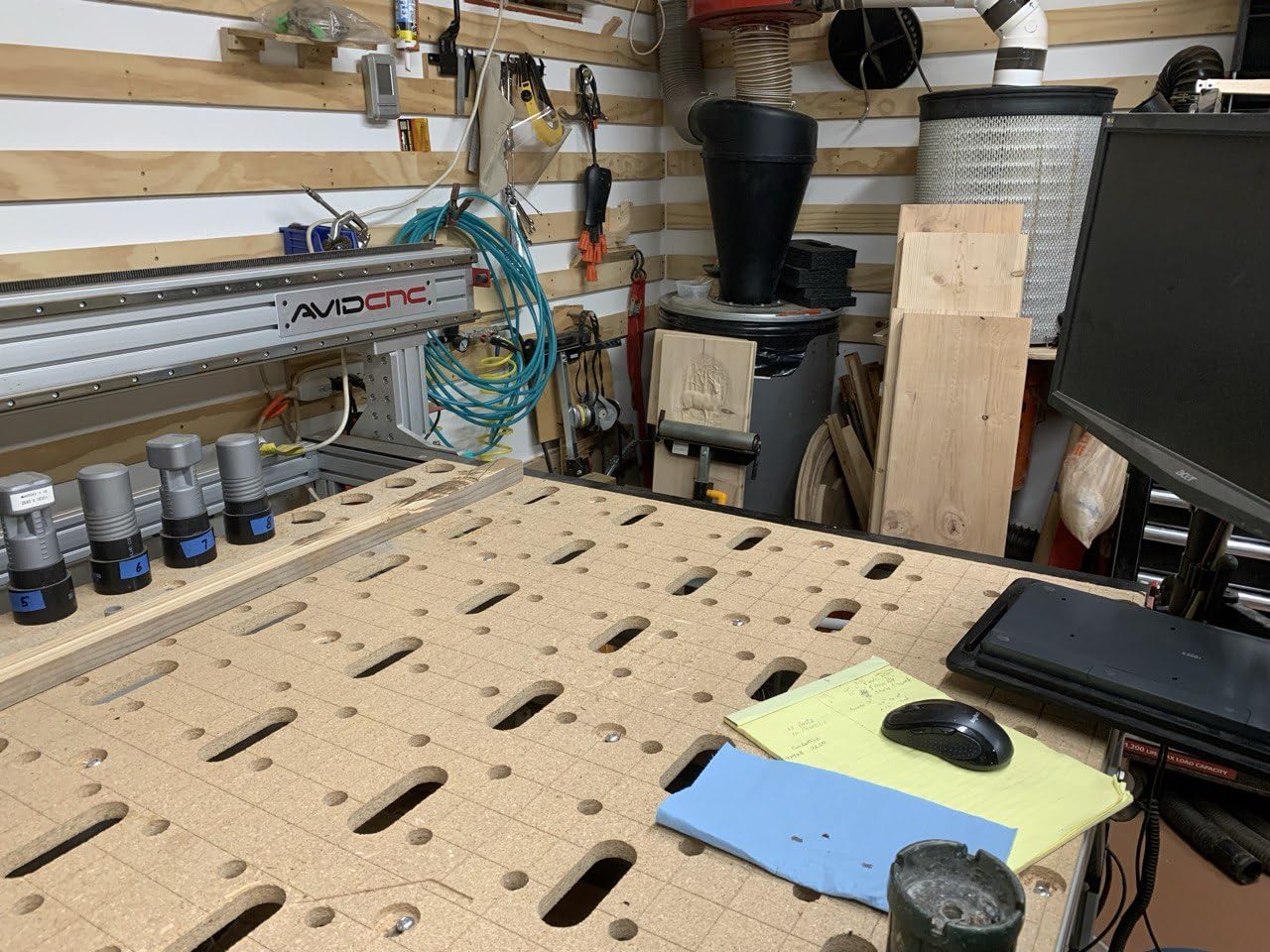
It is also the most economical path to cyclone performance. Instead of a second machine, you add a lid-mounted separator with an integrated air ramp, and chips and shavings stop reaching the impeller and the filter. Builders on the Garage Journal forum described the same logic when they paired a 2 HP collector with a Super Dust Deputy and a Brute can.
How the retrofit avoids a suction loss
Adding a cyclone normally costs airflow, because the airstream takes a detour through the cone. The integrated air ramp and neutral-vane inlet are designed specifically to recover that. Reviews and my own experience agree that suction stays strong while separation happens, which is the thing cheap DIY rigs never manage.
Port configurations are flexible: a 4 or 5 inch inlet with a 4 or 6 inch outlet covers most single-stage collectors, and the kit includes a gasket, two 4 inch reducer adapters and lid mounting hardware. That means you can likely keep your existing duct size.
Who this is genuinely for
It only makes sense with a 1HP to 3HP single-stage collector already on the floor, so if you are starting from a shop vac, go with a bucket separator instead. The weight of 7.7 pounds also means one person can lift it onto the lid, which matters in a basement shop with a low ceiling and a tight approach.
Installation requires cutting a 4 or 5 inch inlet hole and a matching outlet in the collector drum. That is a weekend job with a hole saw, and the included hardware covers the mounting, but it is not a no-tools install.
The one material caveat
The body is polypropylene, which is lighter and cheaper than metal but less durable in a busy shop. It will not break from a chip strike the way a thin ABS lid can, but it is not the choice if your shop takes impacts from wood or a dropping tool.
Everything about this unit is designed around the assumption that the big win is preventing chips from reaching a fan and a filter. If your collector is already handling that, keep it. If not, this is the highest-return single purchase in the category.
7. POWERTEC 70293V – the most complete two-stage parts bundle
POWERTEC 70293V Cyclone Dust Collector and Separator Kit w/Clear 6 Gallon Dust Bucket, Hoses, Reducers, Couplers and Hose Clamps
6 gallon clear bucket
Hose, reducers, couplers and clamps
Heat resistant
7.2 pounds
Pros
- Complete parts bundle with bucket
- hose
- reducers
- couplers and clamps
- Reducers and couplers fit most dust collection brands
- Clear 6 gallon bucket is larger than a typical 5 gallon
- Sized for planers
- drum sanders and jointers in a two-stage setup
- Heat resistant anti-clogging material
Cons
- Thinner review volume than the category leaders
- Clamps and couplers target common North American hose diameters
- Plastic body is lighter duty than a metal separator
The POWERTEC 70293V is the kit I would hand to someone standing a two-stage system up for a planer, a jointer and a drum sander at once. It comes with the whole parts list: the separator, a 6-gallon clear bucket, an expandable vacuum hose, reducers, couplers and hose clamps. Nothing to source, nothing to guess about fittings.
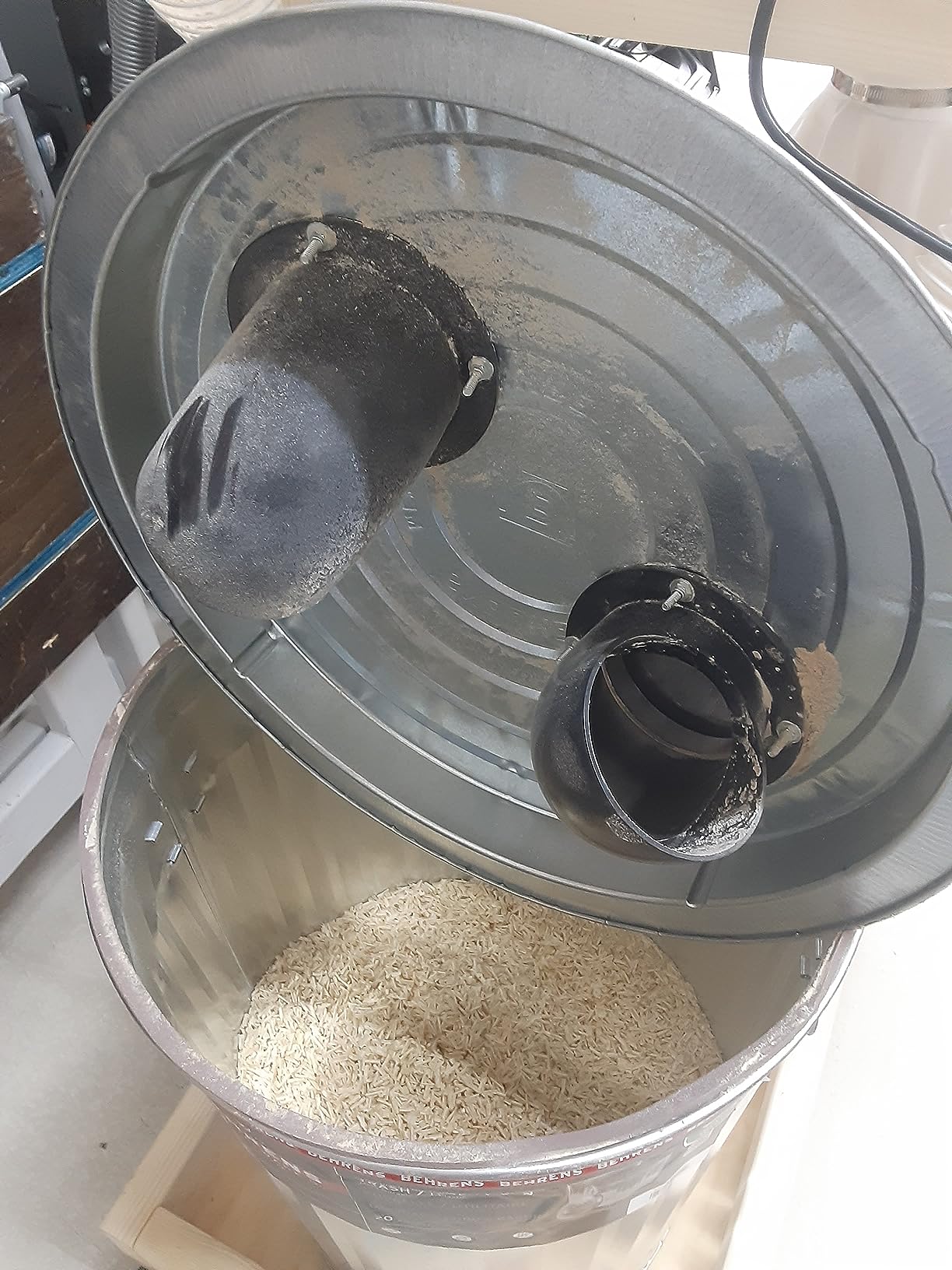
The 6-gallon bucket is larger than the 5-gallon standard, and it is clear, so you can see the fill line. Planers and jointers throw a lot of volume quickly, and the extra gallon plus the visibility means fewer surprises mid-session.
Built for the heavy chip producers
The stated use cases are planers, drum sanders and jointers, which tells you the design brief. Those machines generate long stringy shavings and heavy volume rather than only fine dust, so the separator needs a large mouth and a large container to keep airflow up between emptyings.
Heat resistant material matters more than it sounds. A drum sander exhausts warm air, and a thin plastic cone can warp or crack over repeated cycles. Reviewers who run drum sanders report the construction holds up without deforming.
Fittings that make a multi-machine setup possible
The reducers and couplers are the real content of this box. They are sized to work across most dust collection brands, so you can run a two-stage setup where the cyclone feeds several machines without buying a fitting for each one. That is the difference between a one-machine rig and a shop-wide system.
The tradeoff is that the fittings target common North American hose diameters. If your machines take a different gauge, you will be ordering adapters separately, which is a normal part of any build in this category.
Where it ranks against the field
At 4.6 stars from 299 reviews it sits solidly in the upper middle, though review volume is thinner than the Oneida and Dustopper products. The construction is plastic, so it is lighter duty than a metal-bodied separator if your shop is rough on equipment.
For a renter with a single planer, this is more hardware than you need and the Peachtree kit is a leaner answer. For a shop running three machines off one cyclone, the complete fitting set is exactly what you would otherwise spend a weekend sourcing.
8. Mullet Cyclone Dust Collector – the fastest spin in the roundup
Mullet Cyclone Dust Collector, High-Speed Separator for Shop Vac
Over 99 percent pre-separation
Parabolic one-piece body
Rigid PVC connection
72 dB
Pros
- Highest rating here at 4.8 stars with 89 percent five-star ratings
- Parabolic one-piece body spins air faster than straight-wall designs
- Rigid cut-to-fit PVC connection replaces bungee and tape rigs
- Adapters fit virtually all wet/dry shop vacs and dust extractors
- Keeps suction strong and the vac filter clean far longer
Cons
- Attachment only so you supply the collection container
- 72 dB is not silent in a small shop
- Attachment format will not work with a high-pressure dust collector
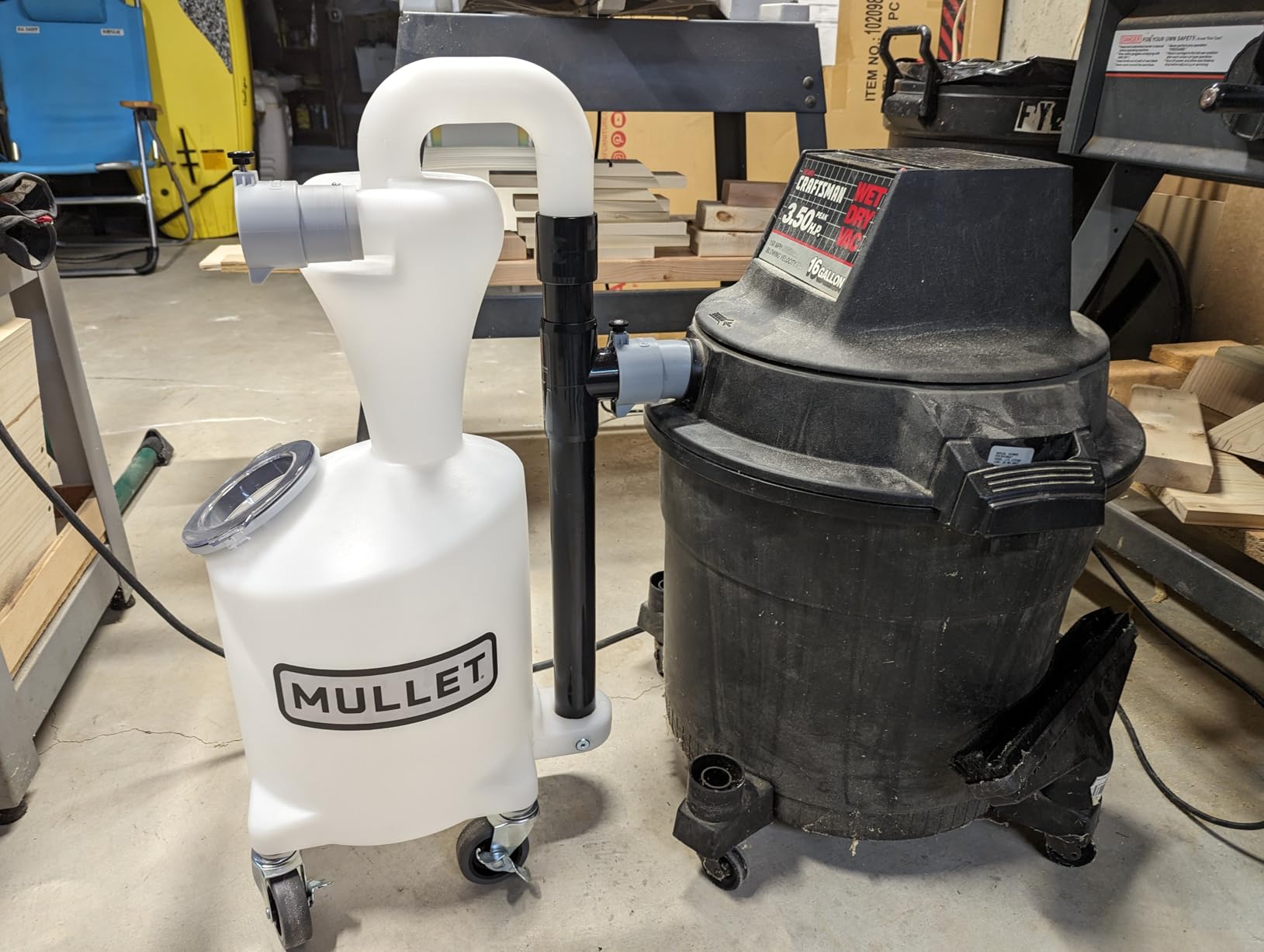
The Mullet is the highest rated product in this roundup at 4.8 stars from 288 reviews, with 89 percent of ratings at five stars. The design difference is geometry. Instead of a straight-walled cone, the body is parabolic and cast as a seamless one piece, which spins the airstream faster than a typical cyclone-and-bucket assembly and pre-separates over 99 percent of debris.
You feel that difference as suction. On machines where I noticed a performance gap with cheaper separators, the Mullet closed most of it. Owners also single out the rigid cut-to-fit PVC connection, which replaces the bungee cords and duct tape that hold most DIY bucket rigs together after a year of use.
Why shape matters more than size
Separation efficiency in a cyclone comes down to how fast air can swirl before it exits. A parabolic profile keeps the velocity high deeper into the cone, so heavier particles get flung to the wall with more force and land in the container instead of drifting upward with the airflow.
The seamless one-piece construction also removes the internal seam and fastener pockets that create turbulence in cheaper units. If you have ever wondered why two similarly rated separators capture differently, this is usually why.
Noise and what 72 dB means in a garage
The rated sound level is 72 dB, which is not silent. In a one-car garage with the door down and a machine running, that is comparable to a loud shop vac and it is the number that generates complaints in shared-wall or basement setups. Enclosing the vacuum, or running the setup at off-hours, is the practical mitigation.
It is worth weighing that against the 1.5 HP and 2 HP collectors people buy for the same room. A bigger machine at the same duct length is louder, not quieter, so the separator itself is rarely the loudest thing in the shop.
The format limits
This is an attachment, so you supply the collection container yourself, and it will not work with a high-pressure dust collector. Pair it with a shop vac or a dust extractor, which is what the included hose adapters are sized for. They cover virtually all wet/dry vacs and extractors.
It is the most expensive separator I tested, and reviews are candid about that being the reason some people pass. If you chase the last few points of separation and already own a vacuum, it is the one I would pick. If you are starting from nothing, the Oneida Dust Deputy DIY covers 95 percent of the benefit.
9. VEVOR Cyclone Separator with Metal Tank – steel where plastic cracks
VEVOR Cyclone Dust Separator with Metal Tank, 4″ Retrofit Cyclone Separator for Dust Collectors, ABS Material With 2″ Hole O.D. Connector & Hose for Wet/Dry Shop Vacuums, Fits 13.21 Gallon Tank
99.61 percent separation
Transparent body
13.21 gallon steel tank
19.49 x 17.91 in
Pros
- Steel tank resists the flexing that cracks plastic barrels
- Up to 99.61 percent separation rate
- Transparent body and tank sight window show fill level in real time
- Compact 13.21 gallon size is easy to dump
- Handles a 4HP high-pressure collector without failure
Cons
- Included 2.5 inch reducers do not fit properly and need replacing
- Only three casters supplied so the tank rocks
- Short dust ports need a clamp when moving the unit
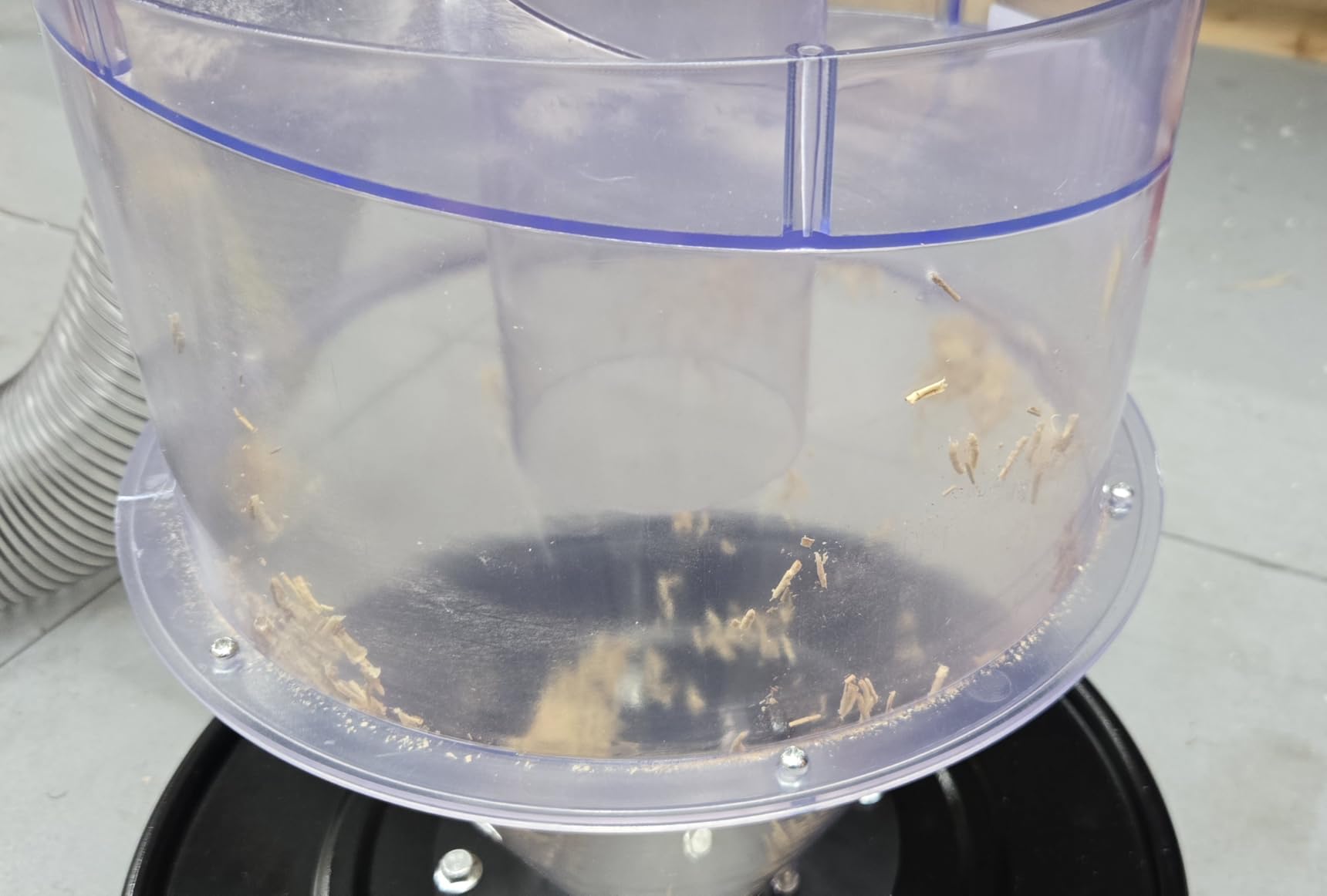
Every other kit in this roundup hangs off a plastic bucket or a plastic barrel, which is fine until a caster catches or something gets dropped on a lid. The VEVOR SKL400 uses a 13.21 gallon iron collection barrel on casters, and the ABS separator body is fully transparent so you can watch separation happen in real time instead of guessing.
The separation rate is rated at up to 99.61 percent, and owners running it against a 4HP high-pressure collector report it holding without failure. The tank also has a sight window, so you get fill-level visibility from two angles.
Port sizing and the fittings that need replacing
Inlet and outlet measure 3.81 inches, which mates to 4 inch commercial hose, and a 1.97 inch adapter is included for 2 inch household vacuum hoses. That range covers most garage machines with the right hose.
The most repeated complaint is about the included 2.5 inch reducers, which do not fit properly. Owners substitute third-party 4 inch to 2.5 inch reducers and move on, so budget for that if your vac takes 2.5 inch hose. Only three casters are supplied even though the tank is described as having four, so the unit rocks until you either add a wheel or remove them entirely.
Size, sound and who it suits
At 13.21 gallons, this is small for a production shop but genuinely convenient for hobby shops and for anyone who finds a full 35 gallon drum hard on their back. The compact footprint at under 20 inches in each direction also suits a basement with a low ceiling.
Be aware the metal can pings audibly when a high-pressure collector spins up, and the short dust ports mean hoses need a clamp whenever you move the unit between tools. The unit weighs 17.86 pounds, so it is a two-hand move.
Newer on the market than the rest
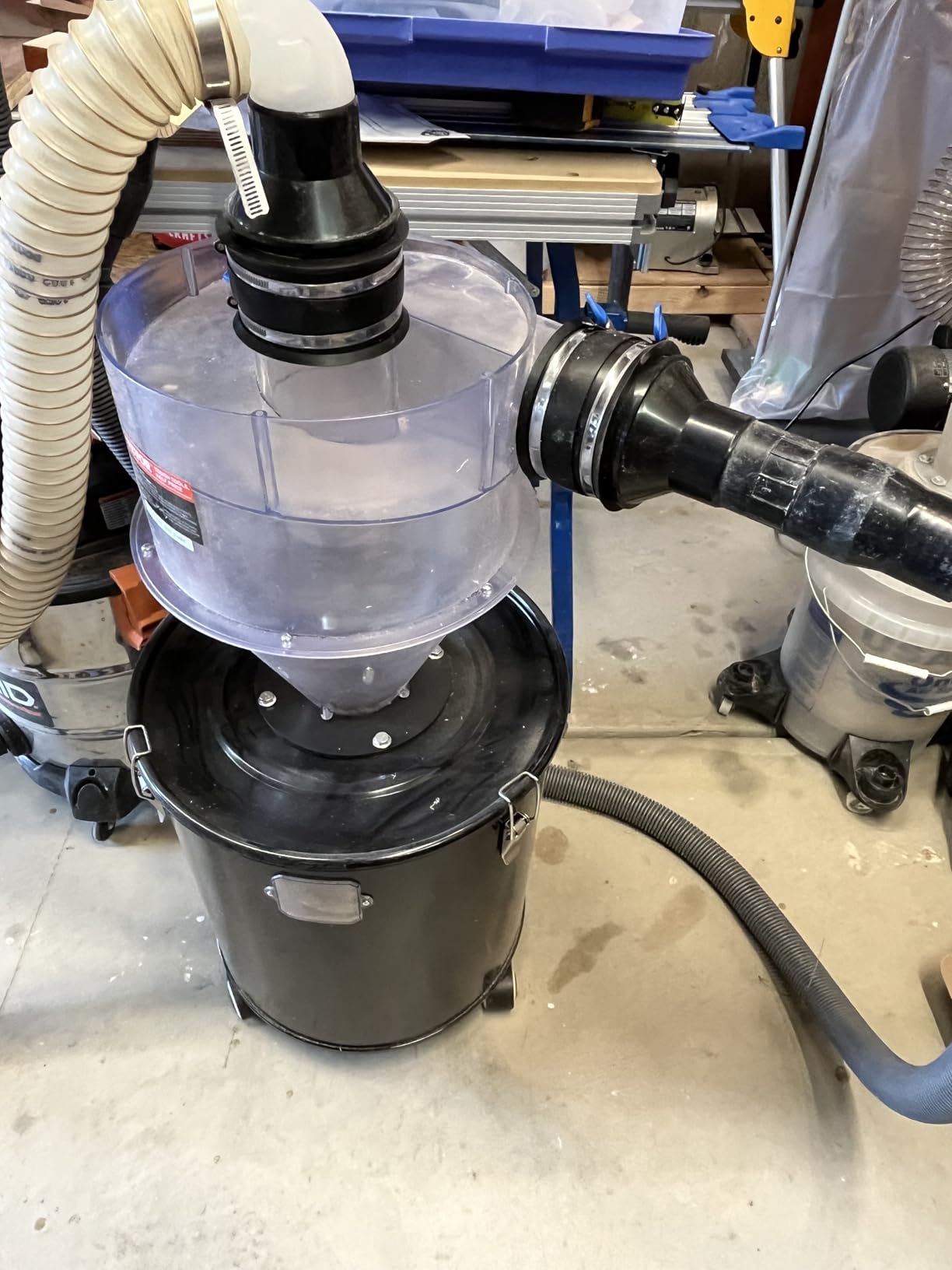
This is the newest product here, with only 141 reviews, the thinnest history among the well-known names. Buyers who wanted a metal alternative to plastic-bucket cyclones are broadly satisfied with separation, including under static pressure, where chips can stick to a plastic cone body.
For a garage that has already cracked a plastic bucket or two, the durability argument is real. Otherwise, weigh the fitting replacement against the Dustopper PRO, which is cheaper to get running and has far more field history behind it.
10. PEMEDOR Double Filtration Cyclone – a second stage on a small budget
Pemedor Double Filtration – Cyclone Dust Collector, OD2” DIY Turbocharged Woodworking Filter Industrial Separator Collector Canister Dust Control System
50mm / 2 inch turbocharged cyclone
99.99 percent claimed
Adapter flange
12 x 10 x 9 inches
Pros
- Entry-level second stage for a small budget
- No suction loss reported when operating with a 3HP vacuum
- Captures dust
- shavings
- chips and chunks before the filter
- Adapters cover most common hose connection sizes
- Clear cup doubles as a fill-level indicator
Cons
- Least-reviewed unit here with 77 ratings
- Top-heavy design so the attached bucket must be secured
- Main hose connector may need tape for a tight seal
The PEMEDOR PM02 is an entry-level way in this roundup to add a second separation layer, and the double filtration stage is the idea. Rather than one cone, it combines a 50mm turbocharged cyclone with a secondary filter, and the manufacturer claims 99.99 percent efficiency at capturing fine particles.
Owners commonly attach it to a 20-gallon can with a sealing lid and report no measurable suction loss even running a 3HP vacuum. The clear cup doubles as a fill-level indicator, so you are not opening the can to check. For saws, sanders and routers in a small shop, it does the job at the entry price point.
What double filtration actually does
A single-stage cyclone separates by centrifugal force alone, and the very finest particulate can stay suspended. Adding a second stage gives the remaining air another chance to shed particles, which matters for sanding dust and for anyone worried about what reaches their lungs rather than what lands in the can.
Claims like 99.99 percent are manufacturer figures rather than independently tested numbers, and the Dustopper PRO is the option here with published third-party testing. Take both with the same grain of salt when comparing them against a lab report.
Setup notes before you buy
The base port is 50mm, so every connection starts at 2 inches and additional connectors in other sizes are included. If your machines run 4 inch hose, you will be adapting down, and the fixed base port makes the routing less flexible than a 4 inch kit.
Two practical cautions. The design is top-heavy, so the container must be secured properly or it will tip. And the main hose connector may need tape to hold an airtight seal, which is worth doing before you start a machine rather than after dust starts leaking.
Who should skip it
With 77 reviews, this is the least proven unit in the roundup, and that thin history matters when you are putting it in front of a planer. If your shop needs to work every day, choose a separator with a deep review base.
It still earns a place for a specific situation: a hobbyist with a saw and a router who wants noticeably cleaner air for a small outlay, or a second stage in front of an existing setup. For a one-machine garage, that is exactly the use it fits.
How to Choose a Cyclone Dust Collector for a Garage
Cyclone separator, dust collector, shop vac or canister extractor
These four get confused constantly, so start here. A shop vac is a wet/dry vacuum with a hose and a filter. A dust collector is a higher static pressure machine, usually 1HP to 3HP on 120V or up to 5HP on 240V, with a drum, a filter and ports sized for ducting. A cyclone separator is not a vacuum at all; it is a passive cone you bolt to the intake of one of those machines, and it drops chips into a container before the air ever reaches the filter. A canister extractor is the compact European-style machine, powerful in a small footprint but limited by its small drum.
So the honest answer to which one you need: in a garage, the cyclone is the layer that makes the other three tolerable. Buy the vacuum or collector for airflow, then add the cyclone for separation.
Match the machine to the dust, not the other way around
Start with an honest list of what actually makes dust in your shop, because that list drives everything. A table saw and a router can be served by a shop vac with a bucket cyclone. A planer, jointer or thickness planer generates volume and needs real static pressure, which usually means a 1.5 HP or larger collector on 120V or a dedicated 240V circuit.
Beyond woodworking, count drywall, concrete and metal. Drywall sanding and concrete grinding produce respirable silica, and no wood-rated cartridge handles that safely on its own. If that is your use, a unit rated OSHA Table 1 compliant paired with a HEPA extractor is the requirement, not a nice-to-have.
120V versus 240V in a home garage
This is the decision that most guides skip, and it matters more than any feature list. A 120V circuit in a typical garage supports 15 amps, or 20 amps on a dedicated outlet, and a 1 HP to 1.5 HP collector fits inside that. Anything larger wants a dedicated 20A 120V branch circuit, and 2 HP and up generally means a 240V circuit.
The consequence is a real cost decision. If your garage panel does not have a spare 240V breaker slot and the panel is near capacity, running a new circuit means an electrician and a permit. Start by checking your panel. If you only have 120V available, choose a 1.5 HP collector or a shop-vac-plus-cyclone rig rather than planning around a machine you cannot power.
Ducting details that decide whether suction survives
Most lost performance in a garage collection system is a ducting problem, not a separator problem. Run 4 inch rigid duct for a table saw and a planer, keep runs as short as possible, and use blast gates or dampers at each machine so you are not pulling through a dead-end branch.
Radius matters as much as diameter. Sharp 90 degree elbows are the single biggest airflow killer in these systems, and the sweep elbows included with the Dustopper PRO exist for that reason. A short-radius bend in 4 inch duct can cost more airflow than a whole extra foot of straight pipe.
Filters, emptying and the real running cost
Plan for filters as a recurring line item, not an afterthought. A cyclone extends filter life, but the cartridge or bag still needs replacing on a schedule, and the exhaust side of the machine may want a filter too. Members building two-stage systems on the Garage Journal thread used high-efficiency cartridges in a plywood plenum with filter pans specifically to capture fine dust before it leaves the shop.
Emptying is the maintenance task a cyclone actually fixes. A drum of chips lifts out in one trip, while a full bag has to be carried, shaken and cleaned. If you are the kind of owner who puts off bag changes until suction suffers, that difference alone justifies the separator.
Noise, footprint and renting a space you cannot drill into
Noise gets ignored in guides and then becomes the reason a spouse objects. A separator adds little of its own, and the 72 dB rating on the Mullet is in the same range as a shop vac. Bigger collectors are louder, not quieter. A remote start or auto-on switch cuts the noise to only the seconds the machine is actually running, which is the single most effective fix.
Footprint is the harder limit. Measure your ceiling height and your floor space before buying, especially in a one-car garage or a low basement, where a full-size two-stage unit may simply not fit. If you rent and cannot drill, a rolling bucket-and-cyclone rig on casters with flexible hose is the standard answer, and it is why portable kits remain popular.
Is buying a used cyclone worth it, and what to check
Used is not a compromise in this category; it is a mainstream answer. Woodworkers report regularly seeing two-stage cyclone units and 5HP collectors listed on marketplace sites for a fraction of the equivalent new cost, and the common advice in those threads is simply to buy used and be done with it.
What to check before you commit: confirm the cyclone body is not cracked or deformed, especially around the inlet. Look for missing or damaged gaskets and lid hardware. Check that the blower wheel is intact and spins freely, and that the motor starts without noise. Verify the filter is present and not packed solid. Check the drum or barrel for cracks, and confirm the inlet diameter matches your existing ductwork. Finally, count the casters, because missing wheels are the most common reason a used unit ends up on the scrap pile.
Are cyclone dust collectors worth the money?
For most garage shops, yes. You get a drum of chips instead of a bag of fine dust, your filter lasts longer, your impeller stops chewing on debris, and the machine you already own performs noticeably better. The exceptions are a shop with one small tool and a good shop vac, or a renter who cannot move anything heavy.
Common disadvantages are real and worth stating plainly. It is one more component to seal and maintain. Suction drops as the container fills. Bucket rigs are top-heavy and can leak if the seal is disturbed. And none of these units will capture the very finest airborne particulate that a HEPA-rated extractor is designed for, particularly on concrete and drywall work.
Frequently Asked Questions
What is the best dust collection system for a garage?
The best dust collection system for a garage is a shop vac or 1.5HP dust collector with a cyclone separator on the intake. The separator drops chips and shavings into a bucket or drum before they reach the filter, which cuts filter clogging and makes emptying a fast task instead of a chore. Add a HEPA extractor if you sand drywall or grind concrete.
Are cyclone dust collectors worth it?
Yes. A cyclone separator captures heavy debris before it reaches your filter or bag, so the filter clogs far less often and the collection container fills with chips you can lift out. Most garage shops see the biggest improvement in cleanup time and filter replacement frequency rather than in raw suction.
What are the disadvantages of using a cyclone dust collector?
The main drawbacks are added weight, a seal that must be maintained, and a loss of suction as the collection container fills. Bucket-mounted units are top-heavy, cheap plastic lids can crack, and a poor seal leaks dust into the room. Cyclones also do not replace a HEPA extractor for respirable silica from drywall or concrete work.
What is the difference between a cyclone separator and a dust collector?
A dust collector is the machine: a motor, an impeller, a filter and a drum. A cyclone separator is a passive cone that bolts onto the collector intake and spins the incoming air so heavy debris falls out. The cyclone protects the filter and impeller; the collector provides the airflow. You need both for full performance.
What is the best cyclone dust collector for a small shop?
For a small shop or one-car garage, pick a compact bucket-top separator such as the Oneida Dust Deputy DIY or the Dustopper PRO. Both are low profile, fit on a standard 5-gallon pail, work with an ordinary shop vac, and leave enough floor space for a car. Avoid full-size two-stage units in low-ceiling spaces.
Is a shop vac good enough for dust collection?
A shop vac is enough for a table saw, router and random orbital sander, especially with good 2.5 inch hose and no tight bends. It is not enough for a planer, jointer or thickness planer, which need sustained static pressure. In that case use a 1.5HP or larger collector, and in either case a cyclone makes it work much harder.
The Verdict: Where to Start in 2026
If you want one answer, start with the Oneida Dust Deputy DIY if you already own a wet/dry vac and want the cheapest proven path to a clean shop. Pick the Dustopper PRO if you want the best separation and third-party test data with no build at all. Choose the Peachtree kit if you run a planer and want 4 inch ports and the freedom to use any barrel or can you already own.
Buy the Oneida 2.5 Deluxe when you cannot drill into anything and want one rolling turnkey unit. Add the Oneida AXD002 only if you own a 1HP to 3HP collector that is ready for an upgrade. Reach for the Mullet when you want maximum separation and already have a vacuum, and the VEVOR when plastic buckets keep cracking on you. The Festool CT CYCLONE is exclusively for owners of a CT extractor, and the POWERTEC bundle suits anyone wiring a planer, jointer and drum sander to one cyclone.
Whatever you choose, add an auto-on switch so the collector only runs while a machine is running, and pair the install with our home garage car lift guide if the same bay has to work as a parking spot. Check the ducting and the seal before you blame the cyclone, and those are the best cyclone dust collectors for garages on the shelf right now.
Leave a Reply