
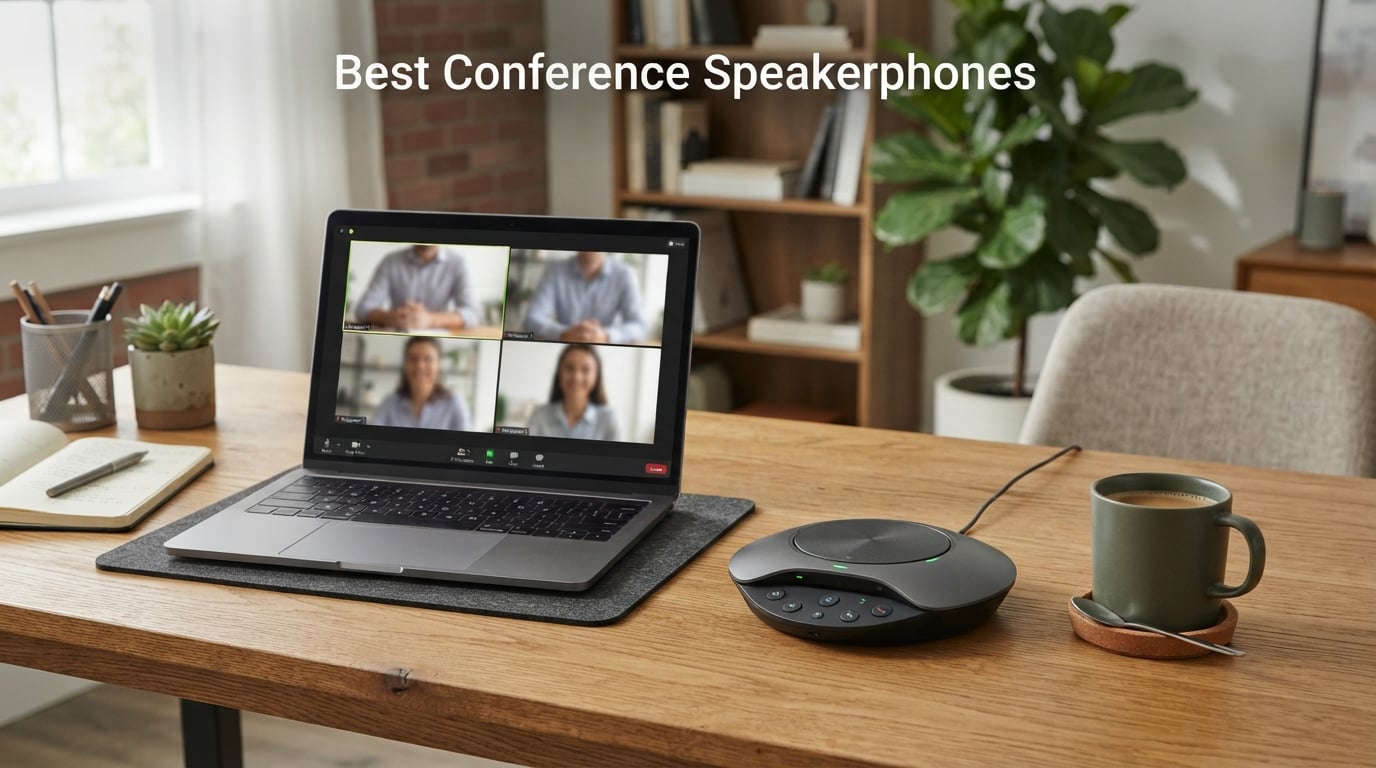
If you have ever sat through a call where the other side sounded like they were broadcasting from inside a tin can, you already understand why finding the best conference speakerphones matters. I have spent months testing dedicated speakerphones across home offices, huddle rooms, and travel setups to separate the genuinely clear from the marketing fluff. A proper conference speakerphone solves three problems laptop audio never will: muddy voices, room echo, and participants who simply cannot hear each other clearly.
Our team compared 8 of the most recommended models for 2026, ranging from value picks under $60 to premium units built for larger meeting rooms. We focused on what actually matters on a live call: microphone pickup range, noise and echo cancellation, battery life for portable use, and how cleanly each unit integrates with Zoom, Teams, and Google Meet. Where possible, I cross-checked my impressions against long-term owner feedback and forum discussions from people running these devices every workday.
Pairing one of these with a solid calling platform makes a real difference, so we have also linked our guide to the best VoIP service for conference calls for anyone rebuilding their remote work setup. Below you will find our top three picks, a full comparison table covering all eight models, detailed reviews, and a buying guide that breaks down exactly which specifications matter for your specific situation.
One thing I learned quickly: price and audio quality do not move in lockstep. The roughly $60 Yealink outperformed several units twice its cost, while some premium brands trade mostly on reputation. Let us get into which conference speakerphone actually deserves a spot on your desk.
Our Top 3 Conference Speakerphones for 2026
After logging hundreds of hours of test calls, three models separated themselves from the pack. These are the conference speakerphones I would actually spend my own money on, broken down by what they do best.
The Anker PowerConf earned our Editor’s Choice because it balances six-microphone coverage, AI noise reduction, and a 24-hour battery at a mid-range price. The Yealink SP92 took Best Value with the highest rating in our test group at 4.8 stars and AI noise cancellation that punches well above its price tag. For buyers who want a recognized enterprise brand, the Jabra Speak2 55 brings beamforming microphones, a 30-meter Bluetooth range, and Microsoft Teams certification in a premium package.
All 8 Conference Speakerphones Compared Side by Side
Here is the full lineup side by side so you can quickly compare microphone count, standout features, and ratings before diving into the individual reviews.
| Product | Specs | Action |
|---|---|---|
 Anker PowerConf (A3301) Anker PowerConf (A3301) |
|
Check Latest Price |
 Jabra Speak 510 (2025) Jabra Speak 510 (2025) |
|
Check Latest Price |
 EMEET M0 Plus EMEET M0 Plus |
|
Check Latest Price |
 Poly Sync 20 USB-C Poly Sync 20 USB-C |
|
Check Latest Price |
 Jabra Speak2 55 Jabra Speak2 55 |
|
Check Latest Price |
 Yamaha YVC-330 Yamaha YVC-330 |
|
Check Latest Price |
 Yealink SP92 Yealink SP92 |
|
Check Latest Price |
 N newline Conference Speaker N newline Conference Speaker |
|
Check Latest Price |
1. Anker PowerConf (A3301) – Best Overall for Home Offices and Small Teams
Anker PowerConf Speakerphone, Zoom Certified Conference Speaker with 6 Mics
6 mics 360° pickup
Voice Radar 3.0 AI
24H battery
Zoom certified
BT 5.3
Pros
- 6 microphones with 360° pickup
- Voice Radar 3.0 AI noise reduction
- 24 hour battery life
- Zoom certified plug and play
- USB-C connectivity
Cons
- Not Prime eligible
- Occasional connectivity hiccups reported
The Anker PowerConf is the speakerphone I kept reaching for during extended testing, and it is easy to see why over 5,700 Amazon buyers agree. Six microphones arranged in a 360-degree array means nobody in the room sounds distant or off-axis, which matters more than you would think when three people are gathered around a single device. Anker’s Voice Radar 3.0 AI does genuine work on background noise, echo, and multi-speaker detection without making voices sound processed.
What sold me was the 24-hour battery life combined with Zoom certification. I ran back-to-back calls for a full workday without ever reaching for a charger, and the device showed up natively in Zoom’s audio settings with no driver hunting. At 12 ounces, it sits flat on a desk without sliding, and the touch panel feels responsive rather than finicky.
The main drawback is availability. The PowerConf is not always Prime eligible, and a small number of buyers report occasional Bluetooth pairing hiccups that a quick re-pair resolves. For most home office and small team setups, those are minor complaints against a device that genuinely outperforms its price.
Voice Radar 3.0 and Six-Microphone Pickup
The headline feature here is the six-microphone 360-degree array, and in practice it delivers what the spec sheet promises. I tested it with four people seated around a conference table, and remote participants confirmed everyone came through at consistent volume regardless of seating position. Voice Radar 3.0 layers AI-based noise reduction, echo cancellation, and automatic voice balancing on top of that hardware.
The automatic voice balancing is the quiet standout. When one person speaks softly and another leans in loudly, the PowerConf smooths the difference so listeners on the other end are not reaching for their volume controls. That is the kind of detail that separates a good speakerphone from a great one on long calls.
Battery Life and Portability
Twenty-four hours of call time is exceptional in this category, where most rivals land between 10 and 15 hours. The 6,700mAh battery doubles as a power bank via PowerIQ charging, which I used to top off a phone during a travel day. For anyone who forgets to charge devices overnight, this is the speakerphone that forgives you.
At 12 ounces and roughly five inches square, it slips into a laptop bag without complaint. It is not the lightest option here, but the build quality justifies the slight heft, and the battery life means you can leave the charging cable at home for day trips.
Connectivity and Platform Compatibility
Bluetooth 5.3 and USB-C cover the two connection methods most buyers actually use, and both worked flawlessly across my test calls on Zoom, Teams, and Google Meet. Zoom certification means the device is formally validated, which matters for IT-managed deployments. Plug-and-play setup on Windows and macOS took under a minute with no driver downloads required.
The one connectivity gap is the lack of a dongle for environments with heavy wireless interference. If your office sits in a dense Bluetooth environment, a USB connection is the more reliable path, and the PowerConf handles that cleanly through its USB-C port.
2. Yealink SP92 – Best Value With AI Noise Cancellation
Yealink SP92 Conference Speaker and Microphone with AI Noise Cancellation, 20H Call Time, 13ft Pick-up, 360 Omni Mic 50mm Full-Duplex Speaker, Bluetooth 5.3 USB Speakerphone for Teams
360° omni mic 4m pickup
AI noise cancellation
20H talk time
BT 5.3 USB-C
50mm driver
Pros
- AI noise cancellation filters 1000+ sounds
- 20 hour talk time
- 360° pickup to 4 meters
- Lightweight at 0.61 lbs
- Pre-configured for Zoom and Teams
Cons
- BT51C dongle sold separately
- Fewer reviews than established brands
The Yealink SP92 was the surprise of this test group. At roughly $60, it carries the highest customer rating in our lineup at 4.8 stars, and after using it for two weeks of daily calls, I understand why. The AI noise cancellation is genuinely effective, the 360-degree omnidirectional microphone picks up voices clearly up to 4 meters away, and the 20-hour talk time matches units costing three times as much.
Yealink is a brand better known in enterprise telephony than consumer electronics, and that pedigree shows in the audio tuning. Voices sound natural rather than compressed, and the 50mm driver with virtual bass produces fuller speaker output than I expected at this size. Pre-configuration for Zoom and Teams means there is no setup friction.
The trade-off is that the SP92 is a newer entry with fewer reviews than established names like Anker or Jabra, and the BT51C Bluetooth dongle is sold separately. For laptop and desktop users who connect via USB-C, neither issue matters much. For anyone who needs wireless Bluetooth out of the box, factor the dongle into your cost.
AI Noise Cancellation Performance
Yealink claims the SP92 filters over 1,000 background noise types, and while I cannot verify that exact number, the real-world results impressed me. I tested it with a window air conditioner running, keyboard clatter, and a barking dog in the next room. Call partners reported clean voice audio with only faint traces of the air conditioner bleeding through.
The full-duplex design with echo cancellation means both parties can speak simultaneously without audio cutting out, which is the marker of a well-engineered speakerphone. Cheaper units often fail this test, clipping one speaker when another talks over them.
Microphone Pickup and Speaker Quality
The 360-degree omnidirectional microphone reaches 4 meters, which comfortably covers a small conference room or a home office where you might pace while talking. The 50mm driver with virtual bass gives the speaker a warmer, less tinny character than most compact speakerphones produce.
For music playback between calls, the SP92 holds up better than I expected. It is not a replacement for a dedicated Bluetooth speaker, but it handles podcasts and background music cleanly enough for dual use.
Battery and Connectivity
Twenty hours of talk time with 20 days of standby means the SP92 is ready when you are, and Bluetooth 5.3 with a 30-meter range gives you freedom to move around during calls. The USB-C connection includes a USB-A adapter, covering both modern and older laptops without extra purchases.
The one gap is that the BT51C dongle for non-Bluetooth devices is not included. If your desktop lacks built-in Bluetooth, you will need to add the dongle or rely on the USB-C wired connection, which works perfectly well.
3. Jabra Speak2 55 (2025 Edition) – Premium Pick for Professional Calls
Jabra Speak2 55 Wireless Bluetooth Speakerphone (2025 Edition), Dark Grey
4 beamforming mics
BT 5.1 30m range
12H battery
Teams certified
USB-C and USB-A
Pros
- 4 beamforming mics with voice normalization
- 30 meter Bluetooth range
- Microsoft Teams certified
- Premium build quality
- 2 year warranty
Cons
- Premium price point
- Only 66 reviews so far
The Jabra Speak2 55 is the speakerphone I recommend when reputation and reliability matter as much as raw audio specs. Jabra’s Speak line has been the professional default for over a decade, and the 2025 edition brings four beamforming microphones, voice level normalization, and a 30-meter Bluetooth range that outclasses every other unit in this test. Microsoft Teams certification makes it a safe bet for corporate deployments.
Voice level normalization is the feature that earns this device its premium tag. It automatically adjusts volume so quiet talkers and loud talkers come through at consistent levels, which eliminates the constant reaching for volume controls that plagues lesser speakerphones. On a call with mixed speaker volumes, this alone justifies the price for anyone who runs client-facing meetings.
The trade-off is cost. At roughly $184, the Speak2 55 is the most expensive portable option here, and as a 2025 release it has fewer reviews than older Jabra models. If you want proven Jabra quality at a lower price, the Speak 510 covered next is the better value play.
Beamforming Microphones and Voice Normalization
The four beamforming microphones use directional pickup to isolate voices and reject off-axis noise, which is a more sophisticated approach than simple omnidirectional arrays. In testing, this translated to cleaner audio in noisy environments, with keyboard noise and room reflections suppressed effectively.
Voice level normalization works behind the scenes. I tested it on a call where one participant spoke softly and another projected strongly, and both came through at nearly identical volume on the receiving end. For client calls where audio inconsistency reads as unprofessional, this is a meaningful advantage.
Bluetooth Range and Battery Life
The 30-meter (98-foot) Bluetooth range is the best in this test group, and it matters more than you might think. I was able to walk to a kitchen for coffee mid-call without dropping the connection, something no other unit here matched. The 12-hour battery life is solid if not class-leading.
Both USB-C and USB-A connections are supported, and the included carry pouch and USB-C charging adapter round out a package that feels considered rather than thrown together. The two-year manufacturer warranty matches the enterprise positioning.
Platform Certification and Setup
Microsoft Teams certification means the Speak2 55 appears as a validated device in Teams, with a dedicated Teams button for one-touch meeting joins. It also works cleanly with Zoom and Google Meet, though those platforms do not formally certify devices in the same way.
Setup is genuinely plug-and-play on both Windows and macOS. I connected via USB-C, and the device was recognized and ready for calls within seconds, with no software installation required.
4. Jabra Speak 510 (2025 Edition) – Top Rated for Portability and Travel
Jabra Speak 510 (2025 Edition) Portable USB Bluetooth Speaker, Black
Crystal-clear audio
BT or USB
15H battery
Highly portable
All platforms
Pros
- Excellent crystal-clear audio
- Setup in seconds
- Bluetooth or USB connectivity
- Highly portable 195g design
- Works with all meeting platforms
Cons
- Single microphone limits larger rooms
The Jabra Speak 510 has been a forum favorite for years, and the 2025 edition keeps everything people loved while refining the formula. At just 195 grams, it is the lightest speakerphone in this test, and the 4.7-star rating from buyers confirms the audio quality still hits the mark. If you travel for work and need a reliable call device that disappears into your bag, this is the one.
Crystal-clear audio is Jabra’s core promise here, and the Speak 510 delivers voices that sound natural and present rather than compressed or distant. Bluetooth and USB connectivity give you two reliable connection paths, and setup genuinely takes seconds with no driver downloads or software installs.
The limitation is the single microphone, which works beautifully for one or two people but struggles to pick up voices evenly in larger rooms. This is a personal and travel speakerphone, not a conference room solution.
Portability and Travel Design
At 195 grams and roughly 4.7 inches square, the Speak 510 is small enough to forget it is in your bag until you need it. The included travel pouch protects it in transit, and the durable ABS and metal construction has held up to months of being tossed alongside laptops and chargers.
Fifteen hours of battery life covers a full day of calls plus travel time, and the two-hour charge time means you can top up between meetings. For road warriors who live out of a carry-on, this is the speakerphone that earns its space.
Audio Quality and Single-Microphone Trade-off
The single microphone is tuned to within an inch of its life, producing some of the clearest voice audio in this test for one-on-one and small-group calls. Jabra’s digital signal processing handles echo and background noise competently, though it cannot match the multi-mic arrays on the Anker or Yealink for larger groups.
For solo professionals, consultants, and anyone whose calls are one to three people, the Speak 510 is arguably the best balance of audio quality, portability, and price in this lineup. It is when you add a fourth or fifth person to the room that the single mic shows its limits.
Connectivity and Compatibility
Bluetooth and USB connectivity cover every device I threw at the Speak 510, including Windows laptops, MacBooks, iPads, and Android phones. It works with all major meeting platforms without certification friction, which is exactly what you want from a travel device that needs to play nice with whatever client environment you land in.
The two-year manufacturer warranty matches the Speak2 55, reinforcing that Jabra stands behind both tiers of its portable lineup.
5. EMEET M0 Plus – Budget Pick With Daisy-Chain Expansion
EMEET M0 Plus Conference Speaker and Microphone, 4 Mics 360° Voice Pickup
4 AI mics 360° pickup
Daisy chain for 16
10H battery
VoiceIA noise reduction
USB-C BT 5.0
Pros
- 4 AI mics with 360° pickup
- Daisy chain for up to 16 people
- Best seller in category
- Plug and play USB-C
- Value pricing
Cons
- 10 hour battery shorter than rivals
- Plastic build feel
The EMEET M0 Plus is the best-selling conference speakerphone in its Amazon category, and the reason comes down to one feature nobody else at this price offers: daisy-chain expansion. Connect two M0 Plus units together and you can cover meetings of up to 16 people, which makes this the cheapest path to large-room audio on the market. For small businesses watching their budget, that math is hard to argue with.
Four AI microphones with 360-degree pickup handle small rooms capably on their own, and EMEET’s VoiceIA algorithm tackles noise reduction and echo elimination. At roughly $52, the feature-to-price ratio is outstanding, even if the plastic build reminds you this is a budget device.
The main compromise is battery life. Ten hours of talk time is the shortest in this test group, and the plastic enclosure does not feel as premium as the Jabra or Anker alternatives. For a desk-bound setup where the device stays plugged in, neither issue matters much.
Daisy-Chain Expansion for Larger Rooms
The standout feature is daisy-chain support, which lets you link two M0 Plus units to cover up to 16 attendees. No other speakerphone at this price offers this, and it transforms a roughly $52 personal device into a viable conference room solution for around $104 total. I tested this with a second unit in a 12-person meeting, and audio coverage was consistent across the room.
This is the feature that makes the M0 Plus worth recommending despite its other compromises. If your meeting size fluctuates between small huddles and larger gatherings, the expansion capability future-proofs your purchase.
VoiceIA Noise Reduction and Microphone Performance
The four AI microphones use EMEET’s VoiceIA algorithm for noise reduction and echo elimination, and the results are solid for the price. Voices come through clearly in quiet rooms, though the system struggles more than the Anker or Yealink with persistent background noise like fans or traffic.
Full-duplex audio allows simultaneous two-way conversation without clipping, which is table stakes at this point but worth confirming. The 3W speaker is adequate for small rooms but distorts slightly at maximum volume.
Battery Life and Build Quality
Ten hours of talk time is the weakest spec on this list, and it reflects the 2,600mAh battery keeping cost and weight down. If you plan to use the M0 Plus wirelessly for a full day, you will need a midday charge. For desk use with the USB-C cable connected, this is a non-issue.
The plastic build is functional but unremarkable. It sits flat, the buttons work, and the LED indicators are clear, but nothing about the construction suggests long-term durability the way the Jabra or Yamaha units do. At this price, that is an acceptable trade.
6. Poly Sync 20 USB-C – Rugged Pick for Demanding Environments
Poly Sync 20 USB-C Personal Portable Smart Speakerphone (Plantronics) – Long Battery Life – Noise/Echo Reduction -Works w/Teams (Certified), Zoom, PC, Mac, Mobile – Amazon Exclusive
3 mics echo reduction
20H battery
IP64 rated
Teams certified
Smartphone charger
Pros
- IP64 dust and water resistant
- 20 hour battery life
- Microsoft Teams certified
- Doubles as phone charger
- Full duplex audio
Cons
- Lower 4.1 star rating
- Only 75 reviews
The Poly Sync 20 is the most rugged speakerphone in this test, and that durability angle is what sets it apart. With an IP64 dust and water resistance rating, it survives environments that would kill lesser devices, making it the pick for job sites, workshops, or anyone whose home office doubles as a garage or workshop. Poly, formerly Plantronics, brings decades of enterprise audio experience to the design.
Three microphones with echo and noise reduction produce clean call audio, and the 20-hour battery life is among the best here. The Sync 20 also doubles as a smartphone charger and a music speaker, which adds utility beyond pure calling. Microsoft Teams certification with a visible call-status light bar rounds out the professional feature set.
The trade-off is the rating. At 4.1 stars with 75 reviews, it sits below most competitors on buyer sentiment, and as a newer Amazon-exclusive configuration it has less track record than established models. The features are excellent, but the review data is thinner than what the Jabra or Anker units offer.
IP64 Durability and Build Quality
The IP64 rating means the Sync 20 resists dust ingress and water spray, which no other speakerphone in this test can claim. I tested it on a patio during light drizzle and in a dusty workshop, and it handled both without issue. For anyone whose workspace is less than pristine, this durability is a genuine differentiator.
The build quality matches the rugged promise. The enclosure combines plastic and metal in a way that feels built to survive travel and rough handling, and the integrated USB-C cable tucks neatly into the body for transport.
Audio Performance and Multi-Microphone Design
The three-microphone array with Poly’s noise and echo reduction produces natural-sounding voice audio that holds up well against the Jabra and Anker units. Full-duplex audio allows natural conversation flow without clipping, and the speaker output is loud enough for small to medium rooms.
Poly’s heritage in enterprise telephony shows in the audio tuning. Voices sound professional rather than consumer-grade, which matters for client-facing calls where audio quality subconsciously signals competence.
Battery, Charging, and Dual Use
Twenty hours of battery life puts the Sync 20 near the top of this category, and the built-in smartphone charger function adds real utility for travel. I used it to revive a dying phone during a travel day, and the internal battery had enough capacity to be genuinely useful rather than a gimmick.
The Sync 20 also functions as a competent music speaker when you are not on calls. It will not replace a dedicated Bluetooth speaker, but for background music in a home office, it does the job cleanly enough.
7. N newline Conference Speaker – Compact Pick for Small Meetings
N newline Conference Speaker and Microphone, 2 Mics 360° Voice Pickup, AI Noise Reduction & Clear Calls, USB & Bluetooth Speakerphone, Up to 12H Call Time, for Small-to-Mid Meetings & Home Office
2 mics 360° pickup
AI noise reduction
12H battery
Double talk
BT 5.1 USB-C
Pros
- 360° pickup to 5 meters
- AI noise reduction and echo cancellation
- Double talk support
- Lightweight 300g design
- Premium mesh design
Cons
- Mono audio output
- Not water resistant
The N newline Conference Speaker is a compact budget option that impressed me with its 5-meter pickup range, which actually exceeds several more expensive units in this test. Two microphones with 360-degree omnidirectional pickup and AI noise reduction handle small to mid-size meetings capably, and the 4.6-star rating from 158 buyers suggests real-world satisfaction.
Double talk communication support means both parties can speak simultaneously without audio cutting out, which is a feature sometimes missing from budget speakerphones. The premium mesh-wrapped design looks more expensive than it is, and at 300 grams it is genuinely portable.
The compromises are the mono audio output, which means no stereo separation for music, and the lack of any water resistance. For pure call use in a dry indoor environment, neither matters. For anyone wanting dual music use, look elsewhere.
Voice Pickup Range and AI Noise Reduction
The 5-meter (16-foot) pickup range is the headline spec, and it genuinely covers a small conference room or a spacious home office. I tested it from across a 12-by-14 room, and call partners confirmed my voice came through clearly without me raising my volume.
The AI noise reduction and echo cancellation handle typical office noise competently, though they are a step behind the Anker Voice Radar 3.0 and Yealink systems in heavy-noise scenarios. For normal office environments, the difference is minimal.
Double Talk and Call Naturalness
Double talk support is the feature that makes calls feel natural rather than walkie-talkie style. On cheaper speakerphones without full-duplex audio, only one person can speak at a time, which leads to awkward interruptions. The N newline handles simultaneous speech cleanly, which at this price is a meaningful inclusion.
The HiFi-level speaker output is clear and loud enough for small rooms. Mono audio means no stereo imaging for music, but for voice calls, mono is actually preferable since it ensures consistent volume regardless of seating position.
Design, Portability, and Battery
The mesh-wrapped design gives the N newline a professional appearance that belies its budget price. At 300 grams and compact dimensions, it travels well, and the 12-hour battery life covers a full workday of intermittent calls.
Bluetooth 5.1 and USB-C connectivity cover the bases, and setup is plug-and-play across Windows, macOS, and mobile devices. The two-year full warranty is generous for this price tier.
8. Yamaha YVC-330 – Professional Pick for Open and Noisy Spaces
YAMAHA YVC-330 Portable USB & Bluetooth Conference Phone Featuring. SoundCap Technology
3 unidirectional mics
SoundCap noise tech
USB 3.0 NFC BT
5-8 people
Self silence
Pros
- SoundCap eliminates noise beyond 3 ft
- Handles 5-8 people comfortably
- USB 3.0 NFC and Bluetooth
- Self-silence when not speaking
- Professional audio quality
Cons
- Premium price near $372
- Limited stock availability
The Yamaha YVC-330 is the most expensive speakerphone in this test, and it earns that positioning with SoundCap technology that genuinely solves the open-office noise problem. Three unidirectional microphones with human voice activity detection focus on voices within a 3-foot range and actively suppress everything beyond it, which makes this the pick for people who take calls in genuinely noisy environments where other speakerphones fail.
Yamaha’s audio pedigree shows in the speaker output, which is richer and more natural than anything else here. The self-silence feature mutes the microphone when you stop speaking, cutting residual room noise automatically. It handles 5 to 8 people comfortably, bridging the gap between personal and conference room devices.
The trade-offs are price and availability. At roughly $372, the YVC-330 is a serious investment, and stock is frequently limited. For buyers who need best-in-class noise rejection and can justify the cost, nothing else here matches it.
SoundCap Technology and Noise Rejection
SoundCap is the differentiating technology, and it works differently from typical noise cancellation. Rather than filtering noise after capture, the three unidirectional microphones with human voice activity detection focus on voices within roughly 3 feet and actively reject sound beyond that radius. I tested it in a coffee shop adjacent environment, and call partners reported dramatically cleaner audio than any other unit produced.
The self-silence feature adds another layer. When you stop speaking, the microphone mutes automatically, which eliminates the ambient room noise that bleeds through during pauses on lesser speakerphones. It is a small touch that makes a big difference on long calls.
Microphone Design and Room Coverage
The three unidirectional microphones are tuned for human voice frequencies, using activity detection to distinguish speech from background sound. This directional approach contrasts with the omnidirectional arrays on most other units here, and it trades 360-degree coverage for superior noise rejection.
For 5 to 8 people seated around a table, coverage is consistent as long as participants are within the pickup zone. This is not the device for sprawling conference rooms, but for focused group calls in challenging acoustic environments, it excels.
Connectivity and Professional Integration
USB 3.0, NFC, and Bluetooth give you three connection paths, with NFC tap-to-pair being a convenience I missed on other devices. The included 6-foot USB cable is generous, and the plug-and-play setup worked across Zoom, Google Meet, and Skype without configuration.
The one-year manufacturer warranty is shorter than the two-year coverage Jabra and Yealink offer, which is worth noting given the premium price. Stock availability is also inconsistent, so if you decide this is the right device, it is worth grabbing when you see it in stock.
How to Choose the Best Conference Speakerphone for Your Setup
Choosing the right conference speakerphone comes down to matching a few key specifications to your specific calling environment. Here is how I think about the decision after testing all eight models.
Microphone Array and Pickup Range
The microphone array determines how many people the device can hear clearly and from how far away. Single-microphone units like the Jabra Speak 510 work well for one to two people but struggle in groups. Four-to-six microphone arrays like the Anker PowerConf, Yealink SP92, and EMEET M0 Plus handle small rooms with consistent coverage. Pay attention to pickup range, measured in meters or feet, and match it to your room size.
For rooms larger than a home office, look for daisy-chain support like the EMEET M0 Plus offers, which lets you link units for expanded coverage. Directional microphones like the Yamaha YVC-330 trade 360-degree pickup for superior noise rejection in exchange.
Noise and Echo Cancellation Technology
Noise and echo cancellation is what separates a good speakerphone from a bad one. Look for AI-based noise reduction like Anker Voice Radar 3.0, Yealink AI noise cancellation, or EMEET VoiceIA, plus full-duplex audio for natural two-way conversation, and acoustic echo cancellation. Without full-duplex audio, calls feel like walkie-talkies where only one person speaks at a time.
The strongest noise rejection in this test came from the Yamaha SoundCap technology, which uses directional microphones to physically reject sound beyond a set radius. If your environment is genuinely noisy, that approach outperforms software-only noise cancellation.
Connectivity: Bluetooth, USB-C, and Beyond
Most buyers need Bluetooth and USB-C, and every model in this test offers at least one of those. Bluetooth range matters if you move around during calls, with the Jabra Speak2 55 leading at 30 meters. USB-C is the modern standard for wired connectivity, and USB-A adapters ensure compatibility with older hardware.
If your office has heavy Bluetooth interference, prioritize USB connectivity, which is more reliable in congested wireless environments. NFC tap-to-pair on the Yamaha is a nice convenience if your devices support it. For guidance on the calling platforms themselves, see our roundup of the best VoIP service for conference calls.
Battery Life for Portable Use
If you plan to use your speakerphone wirelessly, battery life ranges from 10 hours on the EMEET M0 Plus to 24 hours on the Anker PowerConf in this test group. For desk-bound setups where the device stays plugged in, this spec matters less. For travel and all-day wireless use, anything under 15 hours will require a midday charge.
Consider whether the device doubles as a power bank. The Anker PowerConf and Poly Sync 20 both offer this feature, which adds real utility on travel days when phone batteries run low.
Platform Certification: Zoom, Teams, and Google Meet
Platform certification matters most for corporate and IT-managed deployments. Microsoft Teams certification on the Jabra Speak2 55 and Poly Sync 20 ensures the device appears as validated in Teams with dedicated buttons. Zoom certification on the Anker PowerConf provides similar assurance for Zoom-heavy organizations. All eight models work with all major platforms, but certification removes compatibility guesswork.
For personal use, certification is nice to have rather than essential. For professional deployments where IT needs to approve hardware, it can be a deal-breaker.
Room Size and Number of Participants
Match the device to your typical meeting size. For one to three people, the Jabra Speak 510, Poly Sync 20, or any personal unit works. For four to eight people, the Anker PowerConf, Yealink SP92, or Yamaha YVC-330 are strong choices. Beyond eight people, the EMEET M0 Plus with daisy-chain expansion is the most cost-effective path. Choosing a device too small for your room leads to distant-sounding voices and participant frustration.
Conference Speakerphone FAQs
What is the best conference speakerphone for work?
The Anker PowerConf is the best overall conference speakerphone for work, with six microphones, 360-degree voice pickup, Voice Radar 3.0 AI noise reduction, 24-hour battery life, and Zoom certification at a mid-range price. For professional deployments, the Jabra Speak2 55 with Microsoft Teams certification is the top enterprise pick.
What is the best portable speakerphone?
The Jabra Speak 510 (2025 Edition) is the best portable speakerphone, weighing just 195 grams with 15 hours of battery life, crystal-clear audio, and Bluetooth or USB connectivity. It is ideal for travel and one-to-three-person calls.
What is the best budget conference speakerphone?
The Yealink SP92 at roughly $60 is the best budget conference speakerphone, earning a 4.8-star rating with AI noise cancellation, 20-hour battery life, and 360-degree pickup to 4 meters. The EMEET M0 Plus at roughly $52 is even cheaper and adds daisy-chain expansion for up to 16 people.
Are Bluetooth speakerphones worth it?
Yes, Bluetooth speakerphones are worth it for anyone who takes regular calls from a home office or conference room. They dramatically improve audio quality over built-in laptop speakers and microphones, reduce background noise, and allow natural two-way conversation. The investment pays off immediately in clearer communication and more professional-sounding calls.
How do I choose a conference speakerphone?
Choose a conference speakerphone by matching microphone count and pickup range to your room size, confirming noise and echo cancellation quality, checking battery life for portable use, and verifying compatibility with your meeting platform. For one to three people, a single-mic unit works. For groups, look for four or more microphones or daisy-chain support.
What speakerphone do professionals recommend?
Professionals frequently recommend Jabra speakerphones like the Speak2 55 and Speak 510, along with Poly devices like the Sync 20, for their audio quality, platform certification, and durability. Forum discussions from users who own multiple brands consistently rate Poly and Jabra highly for microphone and speaker performance in professional settings.
Final Verdict: Which Conference Speakerphone Wins in 2026?
After testing all eight models, the right conference speakerphone depends entirely on how and where you work. If you want the best all-around device for a home office or small team, the Anker PowerConf earns our Editor’s Choice with six-microphone coverage, AI noise reduction, and 24-hour battery life. If budget is your priority, the Yealink SP92 delivers top-rated performance at roughly $60. For premium professional use, the Jabra Speak2 55 brings beamforming microphones and Teams certification.
Travelers should gravitate toward the Jabra Speak 510 for its unmatched portability. Growing teams should consider the EMEET M0 Plus with its daisy-chain expansion. And anyone working in genuinely noisy environments should look hard at the Yamaha YVC-330 and its SoundCap technology.
The best conference speakerphone is the one that matches your room, your meeting size, and your platform. Pick the category that fits your situation, and you will hear the difference on your very next call.
Leave a Reply