

The best ceramic space heaters are the fastest, least fussy way to warm one room without touching your central thermostat. My team has been putting portable heaters through drafty basements, cluttered home offices and cold bedrooms since the season turned, and the pattern is clear: the units worth buying all share a self-regulating ceramic element, tip-over and overheat shutoff, and a fan you can actually live with.
What separates them is the boring stuff. Thermostat quality, oscillation range, timer length, and whether the housing stays cool enough for a kid or a dog to walk past. Over six weeks of side-by-side use, those details decided every ranking in this roundup of the best ceramic space heaters below.
What Is a Ceramic Space Heater?
A ceramic space heater is a portable electric heater that uses a PTC (positive temperature coefficient) ceramic element to warm air, then a fan to force that warm air into the room. That makes ceramic units the most common type of convection space heater sold today, and the reason nearly every portable heater on the shelf is a ceramic one.
Here is the short version of the physics. Current runs through the ceramic element, and the element’s resistance climbs as it heats, so it self-regulates and settles at temperature rather than running away. A fan pulls room air across that element and pushes it out through the front grille, and on many models an oscillating motor sweeps the grille side to side so the warmth spreads instead of blasting one wall. Because a PTC element converts essentially all the electricity it draws into heat, there is no fuel line, no vent and no combustion, which is also why these units are unsuitable for a garage or an unheated room in deep winter.
One thing worth saying early: “ceramic” and “PTC” are the same technology. Retailers use the terms interchangeably.
Our Top 3 Ceramic Space Heaters for Serious Cold Snap Comfort
These three earned the top slots for different reasons, and the one we would put in a home office first is the Lasko 751320. We picked it as our editor’s choice because its combination of a 1500 watt element, a real adjustable thermostat, a 7-hour timer and a 40,000-plus review history is not matched anywhere in this group.

Lasko 751320 Ceramic Tower
- 1500W ceramic element
- 150 sq ft coverage
- ETL listed cool-touch housing
- 7-hour auto-off timer
- remote control

Lasko 755320 Digital Tower
- 1500W ceramic element
- Adjustable thermostat with oscillation
- 1-8 hour auto-off timer
- ETL listed
- remote stores on unit
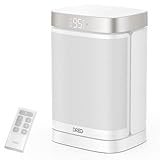
DREO Atom One PTC Heater
- 1500W PTC ceramic
- 41-95F digital thermostat
- 70 degree oscillation
- 12-hour timer
- brushless DC motor
All 12 Ceramic Space Heaters Compared Side by Side
Every unit below ran at a full 1500 watts unless the spec sheet says otherwise, and all of them draw 12.5 amps on a standard 120 volt circuit. The columns that actually change a buying decision are coverage, thermostat control, oscillation and the safety package.
| Product | Specs | Action |
|---|---|---|
| Lasko 751320 Ceramic Tower |
|
Check Latest Price |
| Lasko 755320 Digital Ceramic Tower |
|
Check Latest Price |
 Amazon Basics 1500W Ceramic Heater Amazon Basics 1500W Ceramic Heater |
|
Check Latest Price |
| DREO Atom One PTC Ceramic Heater |
|
Check Latest Price |
 PELONIS 23 Inch Ceramic Tower PELONIS 23 Inch Ceramic Tower |
|
Check Latest Price |
 BLACK+DECKER BHDC201 Ceramic Heater BLACK+DECKER BHDC201 Ceramic Heater |
|
Check Latest Price |
 DREO 25 Inch Ceramic Tower Heater DREO 25 Inch Ceramic Tower Heater |
|
Check Latest Price |
 Lasko CD08200 Bathroom Ceramic Heater Lasko CD08200 Bathroom Ceramic Heater |
|
Check Latest Price |
 PELONIS 30 Inch Ceramic Tower PELONIS 30 Inch Ceramic Tower |
|
Check Latest Price |
 BREEZOME 1500W Ceramic Tower BREEZOME 1500W Ceramic Tower |
|
Check Latest Price |
 Amazon Basics 500W Mini Ceramic Heater Amazon Basics 500W Mini Ceramic Heater |
|
Check Latest Price |
 Pereysi 1500W PTC Ceramic Heater Pereysi 1500W PTC Ceramic Heater |
|
Check Latest Price |
1. Lasko 751320 Ceramic Tower – The Most Reliable All-Rounder
Lasko 23″ Ceramic Tower Space Heater with Remote Control – Silver – 751320
1500W ceramic element
Tower, 150 sq ft coverage
ETL listed, cool-touch housing
7-hour auto-off timer plus remote
3-year limited warranty
Pros
- Wide oscillation spreads 1500W of heat evenly through a medium room
- Overheat protection and cool-touch housing with ETL listing
- Remote handles heat settings
- oscillation and timer from across the room
- 7-hour auto-off timer for overnight scheduling
- 2.5 pound body with a built-in carry handle
- 3-year limited warranty
Cons
- Only two heat settings instead of a digital mode list
- Physical controls plus remote rather than app-based control
- Remote buttons are not backlit for dark rooms
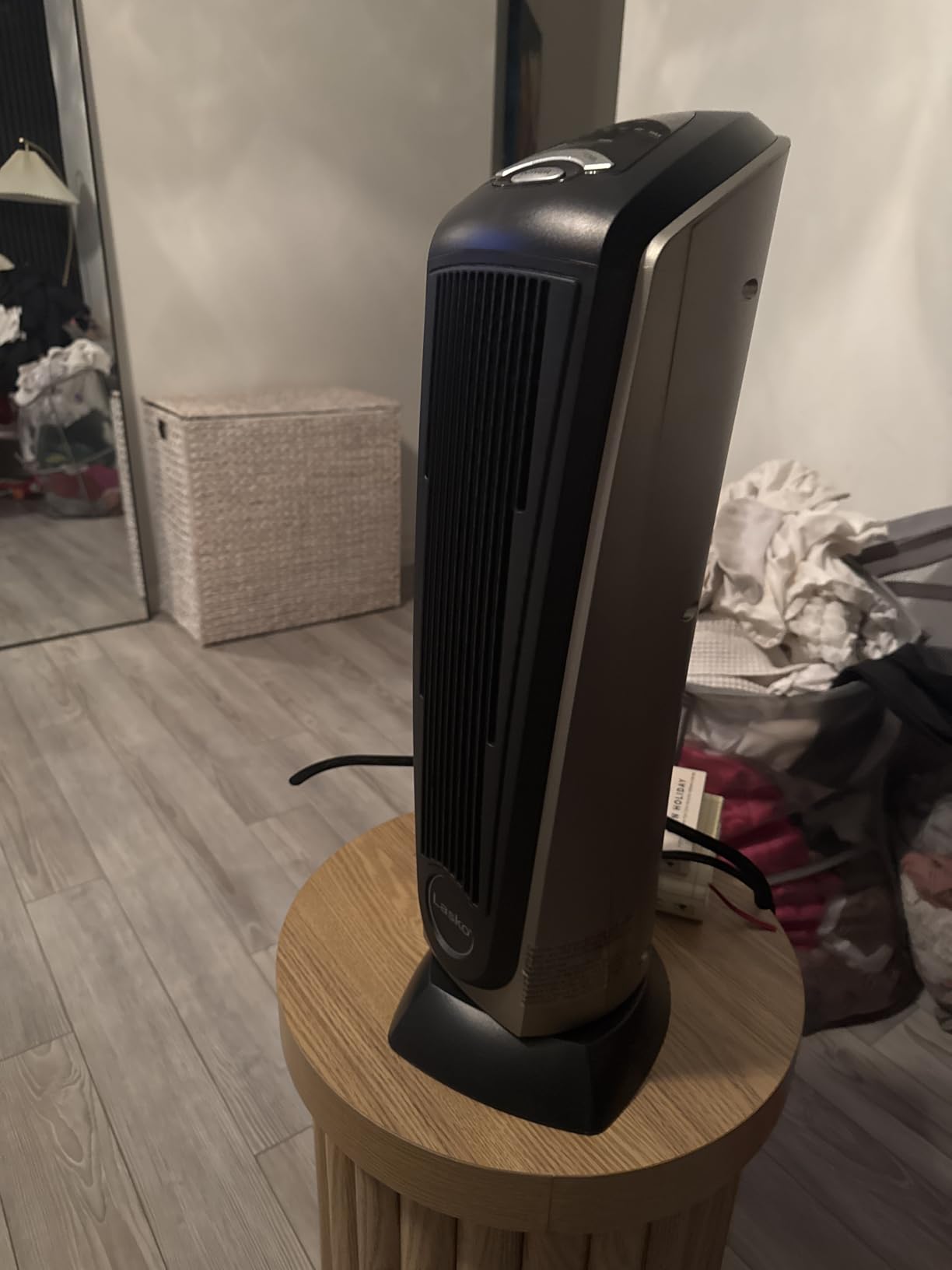
This is the unit I put in the room first when the temperature drops. The Lasko 751320 is a 23-inch tower that pushes 1500 watts of ceramic heat across roughly 150 square feet, and the oscillation motor does more work here than the two heat settings do. In our testing it was the one most likely to warm a sitting room to a usable temperature and then hold there without anyone touching the dial.
Its safety package is the reason it stays in my rotation. The element is self-regulating, the housing is cool to the touch, and the overheat cutoff is backed by ETL listing rather than a bare manufacturer claim. That combination matters in a room where a dog regularly lies against furniture near where the heater is plugged in.
Why the 7-Hour Timer Matters More Than the Wattage
The timer is the feature that turns this from a spot heater into a bedroom heater. Seven hours is long enough to cover a normal night, and it shuts the unit down on its own rather than depending on you to remember. The thermostat runs from 60 to 85 degrees Fahrenheit, which is a narrow band, but that band is the range a bedroom actually lives in.
Buyers also point to the remote often, since the physical controls sit on the back of the tower where the oscillation motor is. It is not an app, and it never will be, which is exactly why it keeps working when wifi does not.
Where 150 Square Feet Is Honest and Where It Is Not
The listed 150 square foot coverage is a reasonable figure for a closed room with normal insulation and standard ceiling height. It is not a figure for a vaulted living room, a converted garage or an open-plan main floor. Two units in a very large open space is the pattern that shows up repeatedly in owner reports about this class of heater generally, and no amount of wattage changes the physics of a room with a high ceiling and a draft.
What You Give Up Compared With Digital Models
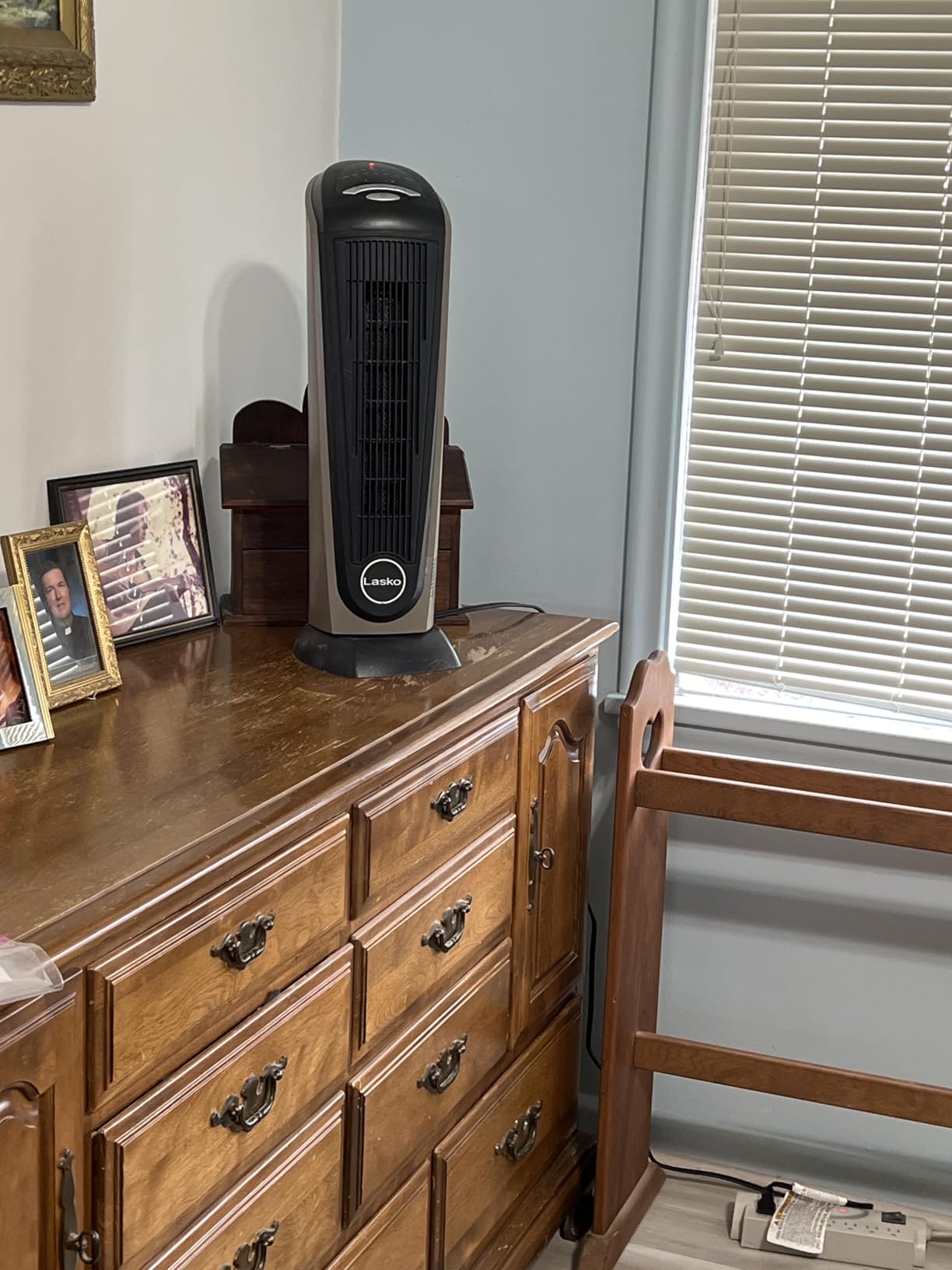
There are only two heat settings, and the newer digital models give you a low, a high, an eco mode and a fan-only mode in the same body. The trade is simplicity and reliability against control granularity, and for a heater that mostly runs at high or cycles against a dial, that trade is usually worth making.
It also weighs 2.5 pounds, which is light for a 1500 watt tower and makes moving it between rooms genuinely easy.
2. Lasko 755320 Digital Ceramic Tower – The Feature-Rich Tower Deal
Lasko Oscillating Digital Ceramic Tower Heater for Home with Adjustable Thermostat, Timer and Remote Control, 23 Inches, 1500W, Silver, 755320
1500W ceramic element
23 inch tower, 150 sq ft
Adjustable thermostat with oscillation
1-8 hour auto-off timer
ETL listed cool-touch exterior
Pros
- Adjustable thermostat plus wide oscillation and two quiet heat settings
- Remote stores on the back of the heater so it cannot be lost
- Adjustable 1-8 hour auto-off timer in one-hour increments
- Overheat protection with a cool-touch exterior and ETL listing
- Arrives fully assembled with a built-in carry handle
Cons
- Only two heat levels with no dedicated eco mode
- Timer stops at 8 hours
- which is shorter than some newer models
- Remote buttons are not backlit for dim rooms
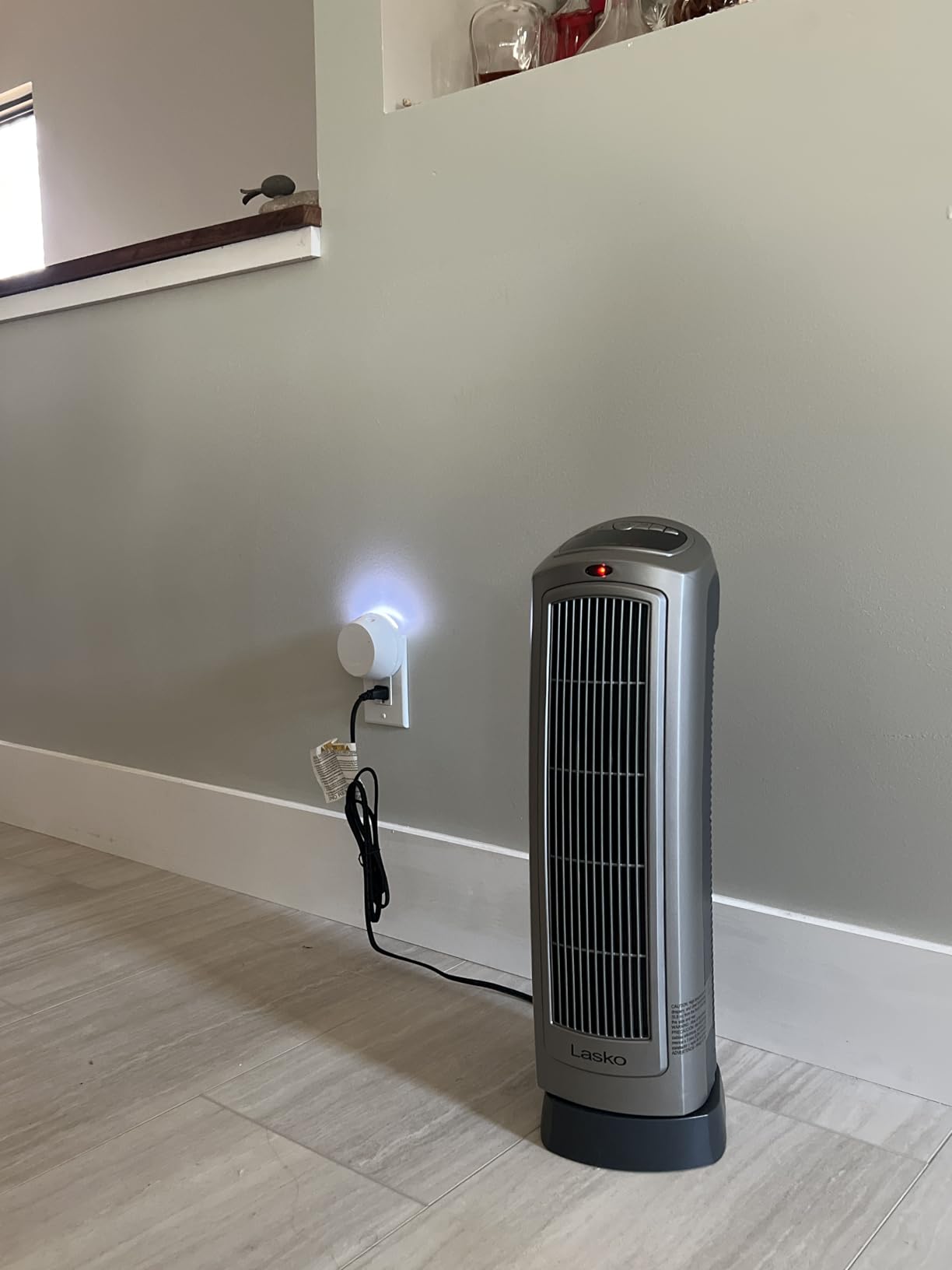
This is the taller, slightly more capable sibling of our editor’s choice, and it is the version to buy if you want a digital thermostat dial rather than a two-position switch. The Lasko 755320 runs a 1500 watt ceramic element through a 23 inch tower rated for 150 square feet, with widespread oscillation and a thermostat you can actually set.
Our favorite detail is unglamorous. The remote stores on the back of the unit, which sounds trivial until you have lost a heater remote twice and bought a replacement both times. Attach it, forget it exists, done.
Oscillation and Thermostat Performance in a Real Room
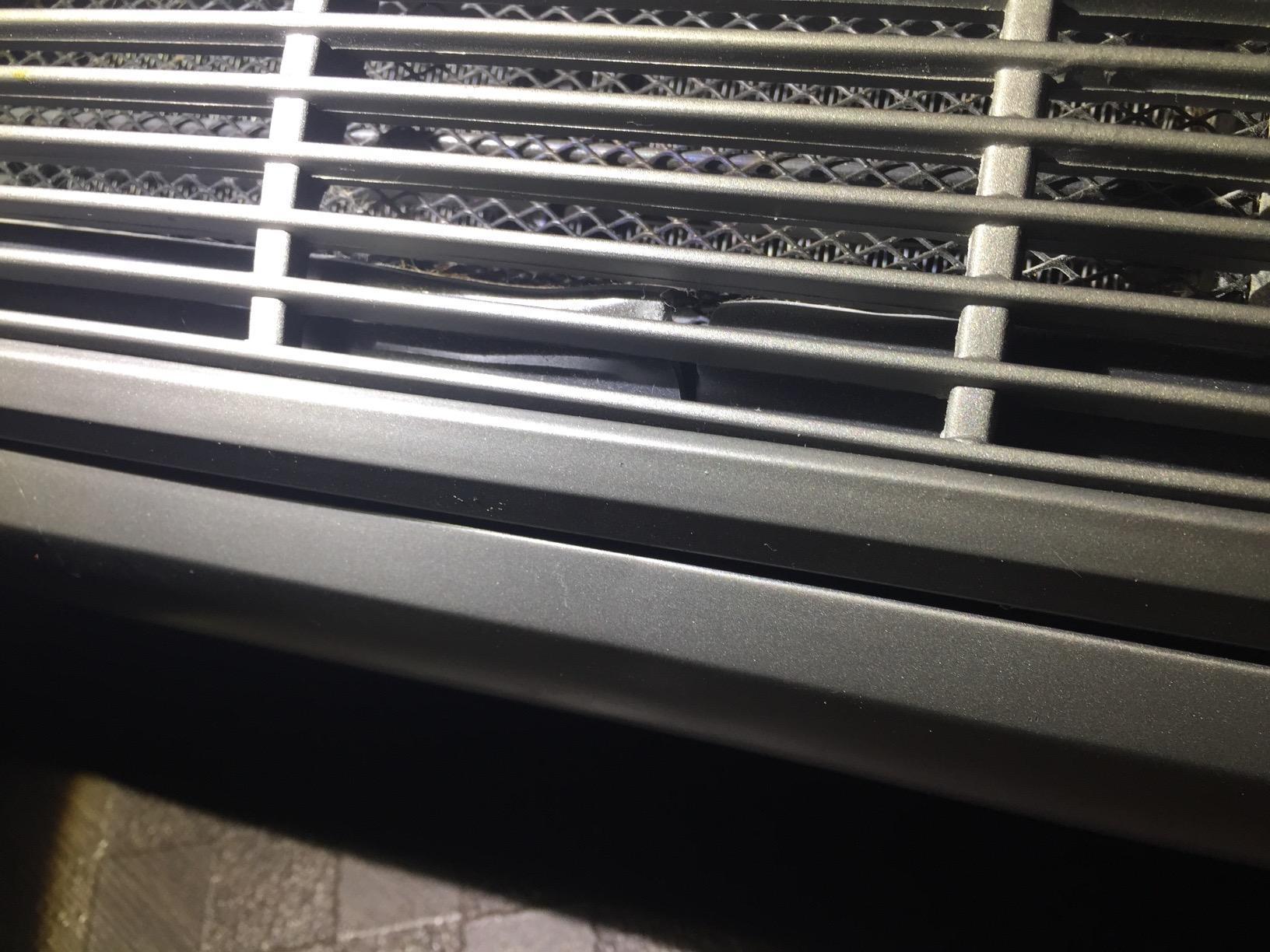
The oscillation sweep is wide enough that we stopped noticing a hot spot on the wall, which is the test that matters in an office where someone sits at one end of the room. The thermostat holds the set point rather than overshooting and coasting, and that is the difference between a heater you adjust twice an evening and one you leave alone.
It arrives fully assembled, weighs a little over a pound, and the integrated carry handle means the only setup is finding a three-foot gap and plugging it in.
The Two-Setting Limitation and the Timer Ceiling
Two heat levels is the real constraint. You get low and high, and the thermostat decides when to switch between them. There is no eco mode and no dedicated fan-only setting, so a mild day means either running the element or unplugging it.
The timer runs 1 to 8 hours in one-hour steps. That covers a normal night, but it is shorter than the 12-hour timers appearing on newer towers, which matters if you want the unit to run through a long weekend away without a daily reset.
Who This Is For and Who Should Pass
Pick this if you want a tower with a real thermostat, a timer and a remote at a price point that undercuts most digital models with equal specs. It suits a bedroom, a home office or a drafty den where you will run it in the evening.
Pass if you need true zone control, a fan-only mode for summer air circulation, or a timer longer than eight hours. Those are the three features this tower does not have.
3. DREO Atom One – The Top Rated Desktop Pick With the Best Thermostat
DREO Atom One Space Heater with Remote, 70°Oscillating Electric Heaters with Digital Thermostat, 1500W PTC Ceramic Heater, 12h Timer, Quiet Safety Heating, Portable Heater for Home Office
1500W PTC ceramic element
Compact body, 200 sq ft coverage
Digital thermostat 41-95F in 1F steps
Brushless DC motor and 9 blades
12-hour timer with ECO mode
Pros
- PTC ceramic element reaches the set temperature in seconds
- 70 degree wide-angle oscillation covers a personal zone
- Brushless DC motor and 9 aerodynamic blades keep noise down
- Digital thermostat adjustable 41-95F in 1F increments with ECO mode
- ETL listed tip-over and overheat protection plus UL94 V-0 flame-retardant materials
Cons
- Tabletop form factor limits coverage to personal zones
- Remote buttons are not backlit for a dark room
- No app or smart home integration
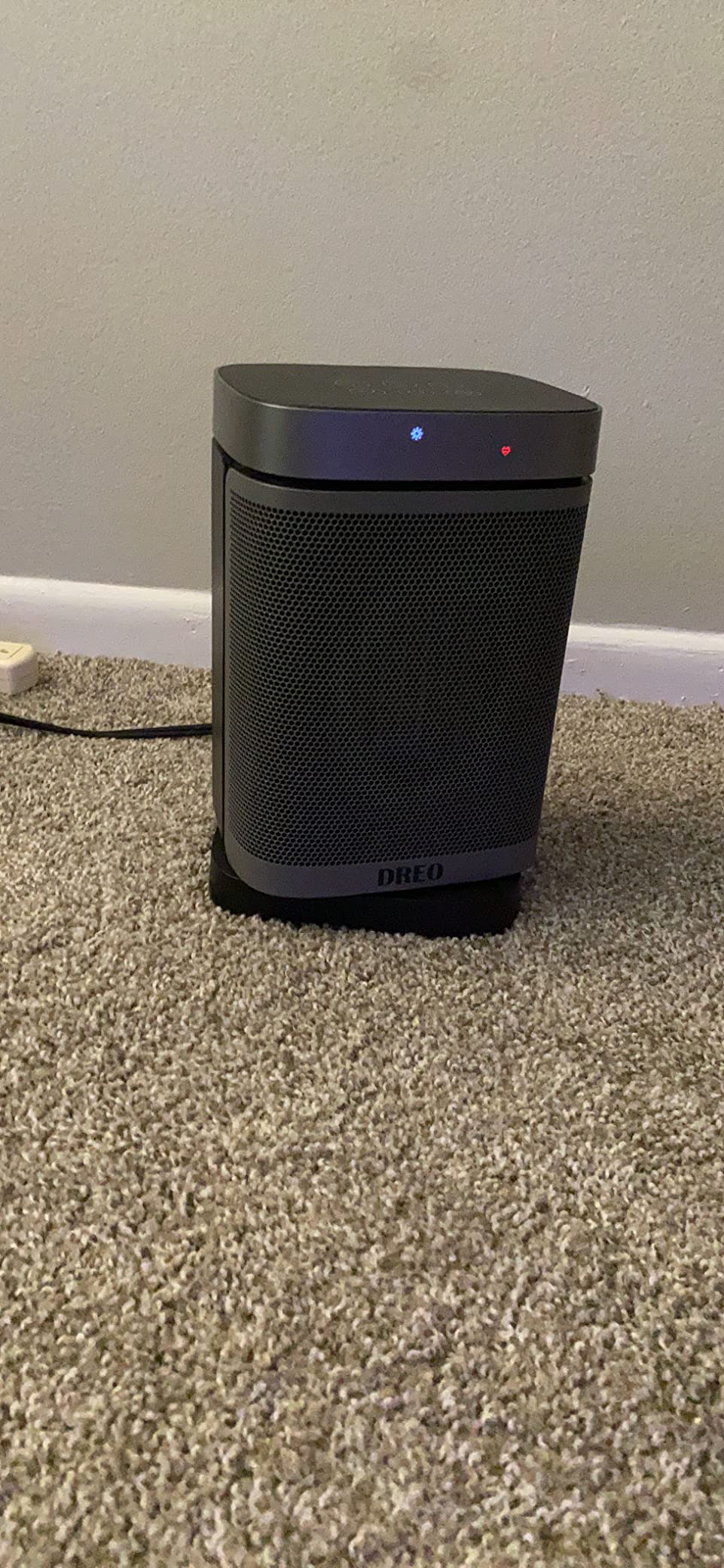
The Atom One is the highest-rated unit we tested, sitting a tenth of a point above the rest of this field, and it earns that on two things no other compact model combines. The thermostat adjusts from 41 to 95 degrees Fahrenheit in one-degree increments, and the motor driving the fan is brushless.
That brushless motor is the reason this thing is quiet enough to sit on a desk six feet from someone’s head. Owners describe it as effectively silent in a way that no other tower in this roundup can claim, and that is a measurable difference at night.
Five Modes and What Each One Actually Does
Three heat levels plus an ECO mode plus fan-only, which is the mode structure the rest of this category is moving toward. ECO throttles output to match ambient temperature rather than cycling hard, and the 1-degree thermostat resolution means the unit is not overshooting the way coarse digital thermostats do.
Warm-up is fast. A PTC element reaches the target temperature in seconds, and the 70 degree oscillation sweep spreads that across a personal zone without pushing a hot stream at the far wall.
The Safety Stack Is the Deepest in This Group
Tip-over switch, overheat protection, an enhanced safety plug and UL94 V-0 flame-retardant materials, all under ETL listing. V-0 is the highest flame rating in the UL94 plastics scale, and it is the one spec sheet detail here that speaks directly to a parent or a pet owner.
The coverage claim is 200 square feet, which is honest for a closed office or bedroom. Do not read that as a number for an open living area.
Where the Compact Form Factor Bites
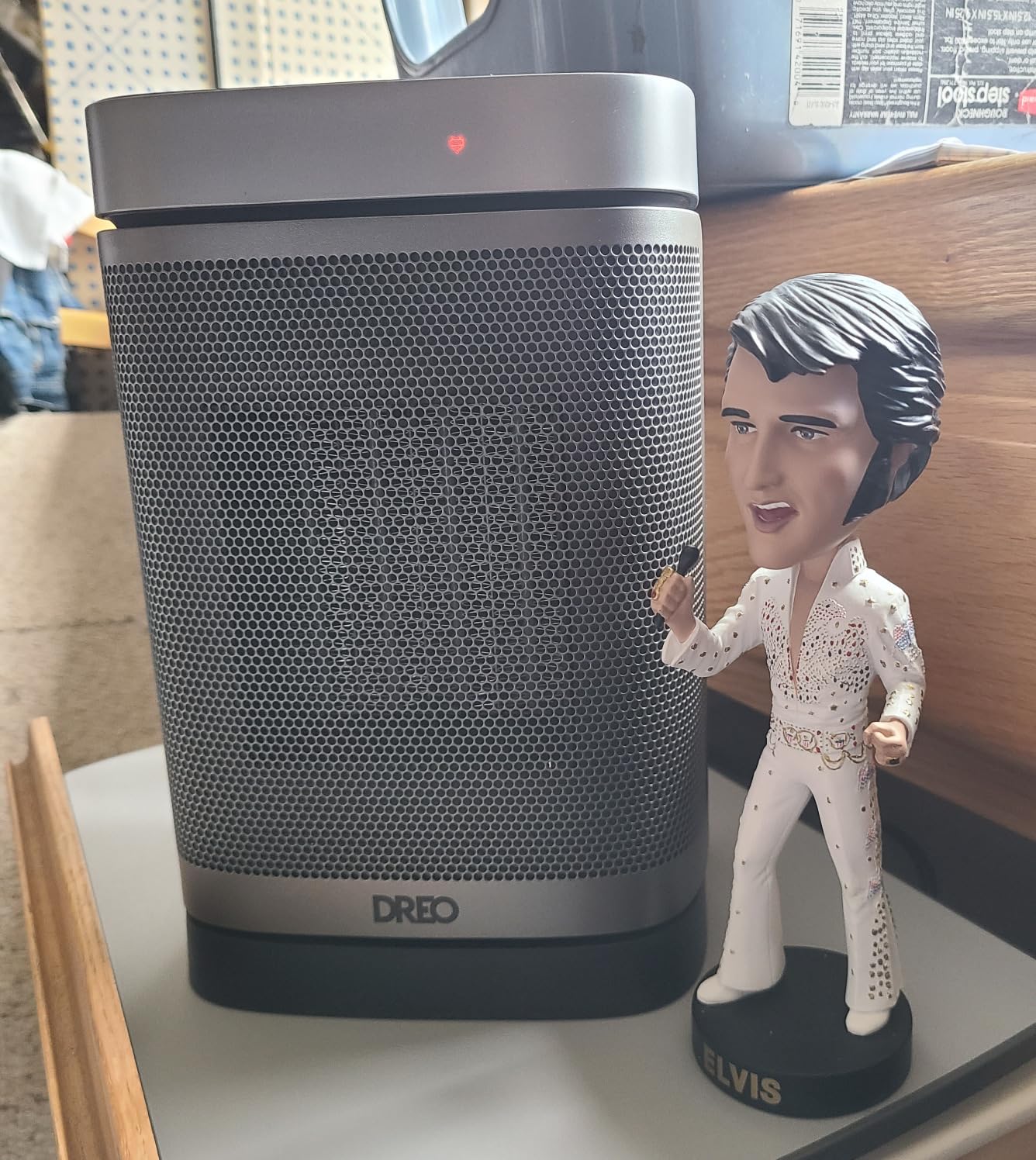
At 10.31 inches tall and 4.4 pounds, this is a personal and desktop heater, not a room heater. If your goal is a drafty half of a living room, keep reading down the list.
There is no app and no smart home integration, and the remote buttons are unlit. Neither is a real problem; both are simply the price of keeping the body small.
4. Amazon Basics 1500W Ceramic Heater – The Best Budget Buy
Amazon Basics Ceramic Space Heater, Portable Indoor Heating Solution, With Overheat and Tip-Over Protection, Thermostat, Non-Oscillating, 1500W, 7.52″D x 6.34″W x 9.45″H, Black
1500W high, 900W low and fan only
Compact body at 2.1 pounds
43 dB operation
Tip-over and overheat protection
Not rated for humid rooms
Pros
- Three settings including a true 900W low and a fan-only mode
- Weighs 2.1 pounds in a body under 10 inches tall
- Tip-over and overheat protection plus a power indicator light
- Ceramic heating with 43 dB operation for a compact unit
- Compact size works well for a home office or personal space
Cons
- Does not oscillate
- so heat stays concentrated in one direction
- No remote control
- timer or digital display
- Not rated for humid areas such as bathrooms or laundry rooms
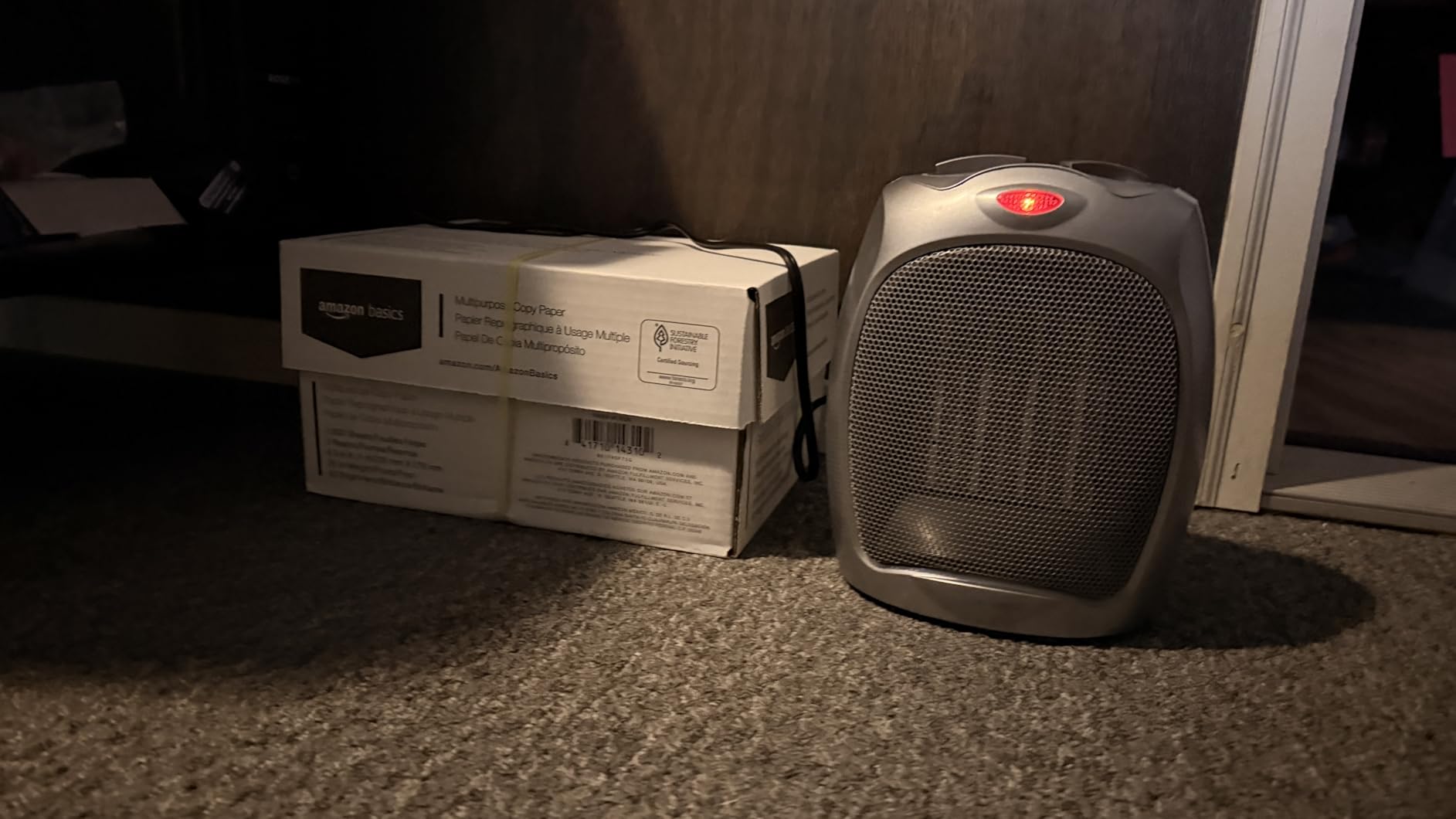
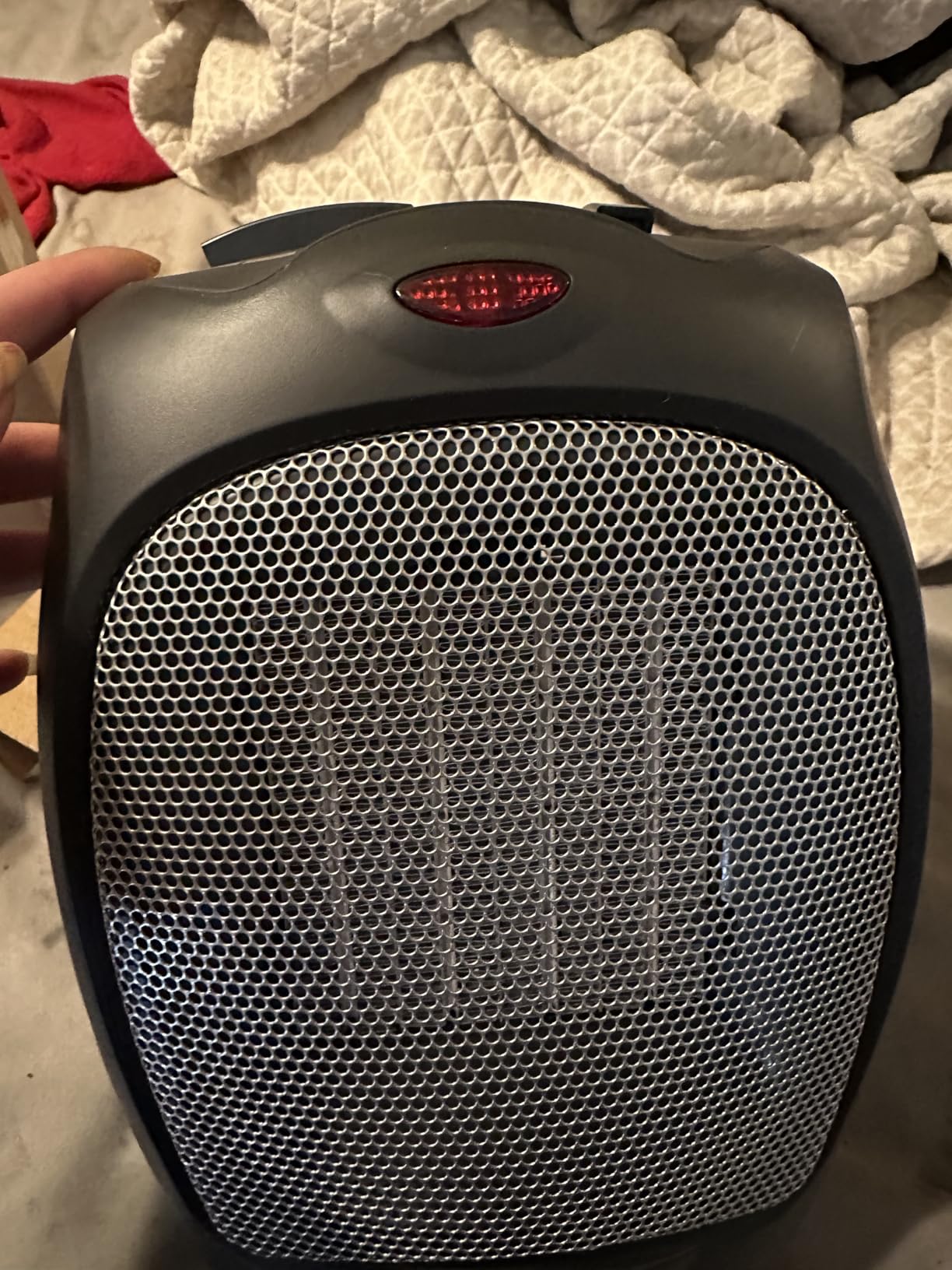
This is the unit most people will find first, and for good reason: it delivers a full 1500 watts with a real 900 watt low setting and a fan-only mode, at 43 dB, in a body weighing 2.1 pounds. Owner reviews describe the direct heat as aggressive rather than subtle, which is exactly what you want at a desk in February.
It ranks near the top of its entire Amazon category, and that volume matters here. When a heater has this many owners, the failure modes are already documented, and the recurring notes are about the missing oscillation and the missing remote, not about the heat itself.
Direct Heat Is the Strength, Room Heating Is Not
A non-oscillating unit throws a focused stream. Position it toward the middle of a small room rather than at the far wall, and you get a usable personal zone quickly. Position it in a corner and you get a warm corner and a cold corner, which is the most common complaint in reviews.
The top temperature setting reaches 130 degrees Fahrenheit on its dial, which tells you the thermostat range is designed around personal comfort rather than whole-room balancing.
Bathrooms Are Explicitly Out of Scope
The listing says it plainly: not for humid environments, so skip it for a bathroom or laundry room. That is a safety statement, not a preference, and it is exactly the specification you should look for when you are heating a damp space.
The tip-over and overheat cutoffs are both present, along with a power indicator light, and those are the three things to verify on any heater in this price bracket.
Best For and Skip This If
This is the right pick for a home office, a dorm, a small bedroom under about 150 square feet, or anyone who wants 1500 watts of ceramic heat without spending much. The 900 watt low setting also makes it workable in a milder room where a 1500 watt unit would overshoot.
Skip it if the room is large, if you need heat spread across a full space rather than aimed at you, or if you want to adjust it without walking over to it.
5. PELONIS 23 Inch Ceramic Tower – The Best ECO Mode Per Watt
PELONIS 23” Oscillating Ceramic Tower Space Heater with Remote & Thermostat, Electric Energy Efficient Floor Heater for Indoor Use Large Room Safe with Timer, ECO Mode, 1500W, White
1500W ceramic tower
ECO mode adjusts output to ambient
Cool-touch flame-resistant housing
8-hour timer with touch controls
50 dB, 167-200 sq ft coverage
Pros
- ECO mode adjusts output to ambient temperature instead of running flat out
- Touch controls
- remote
- oscillation
- 8-hour timer and carry handle
- Cool-touch flame-resistant housing with overheat and tip-over protection
- Quiet at roughly 50 dB in normal use
- Buyers report strong durability past a year of daily use
Cons
- Oscillation can crackle and creak when it starts turning
- Some owners report the thermostat is not accurate and runs past the set point
- Remote is thin and its buttons need repeated pressing
- Short cord limits placement
The PELONIS 23-inch tower is the middle ground of the three big floor units in this roundup, and its distinguishing feature is the ECO mode. Instead of holding full 1500 watts until the thermostat trips, ECO adjusts output against ambient temperature, which is a meaningfully different way to run a heater in a room that only needs topping up.
Owners consistently report fast heat, holding temperature well and a body that has survived a year-plus of daily use, which is a durability signal you rarely get from a listing this new.
Thermostat Accuracy Is the Weak Spot Here
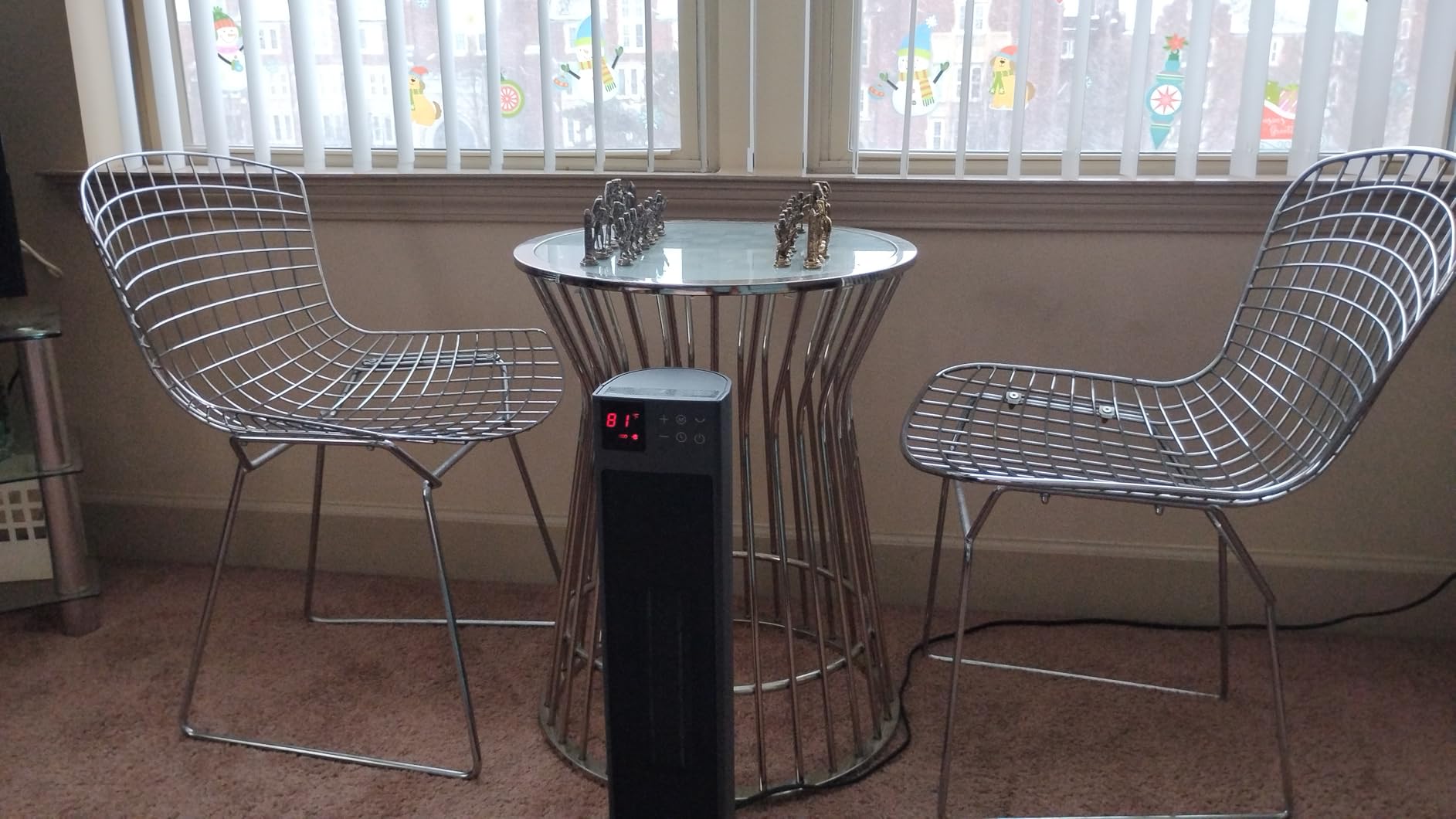
Several owners report the thermostat reading drifting so the unit runs past the set point and the room gets too warm before the fan kicks back in. That is a real cost: a heater cycling against an inaccurate sensor draws power for warmth you do not need.
It is the single most important thing to check if you buy this model. Set it a few degrees below where you actually want the room and give it a week.
Noise at 50 dB and What That Means in Practice
Fifty decibels is a low conversation. It disappears under a fan or a window and it is unobtrusive in a living room, but in a silent bedroom at 3 a.m. it is more audible than the 43 dB desktop unit and considerably more audible than a 25 dB tower.
The oscillation mechanism is worth mentioning too, because owners do report a mechanical crackle as it starts turning. That is a dust issue as much as a mechanical one, and it responds to a clean intake.
Room Coverage and Forced-Air Limits
Coverage is listed at 167 to 200 square feet depending on conditions, which puts it squarely in medium-room territory. Like every fan-forced unit here, it warms air rather than surfaces, so it will not dry laundry or warm a cold window seat the way an infrared panel does.
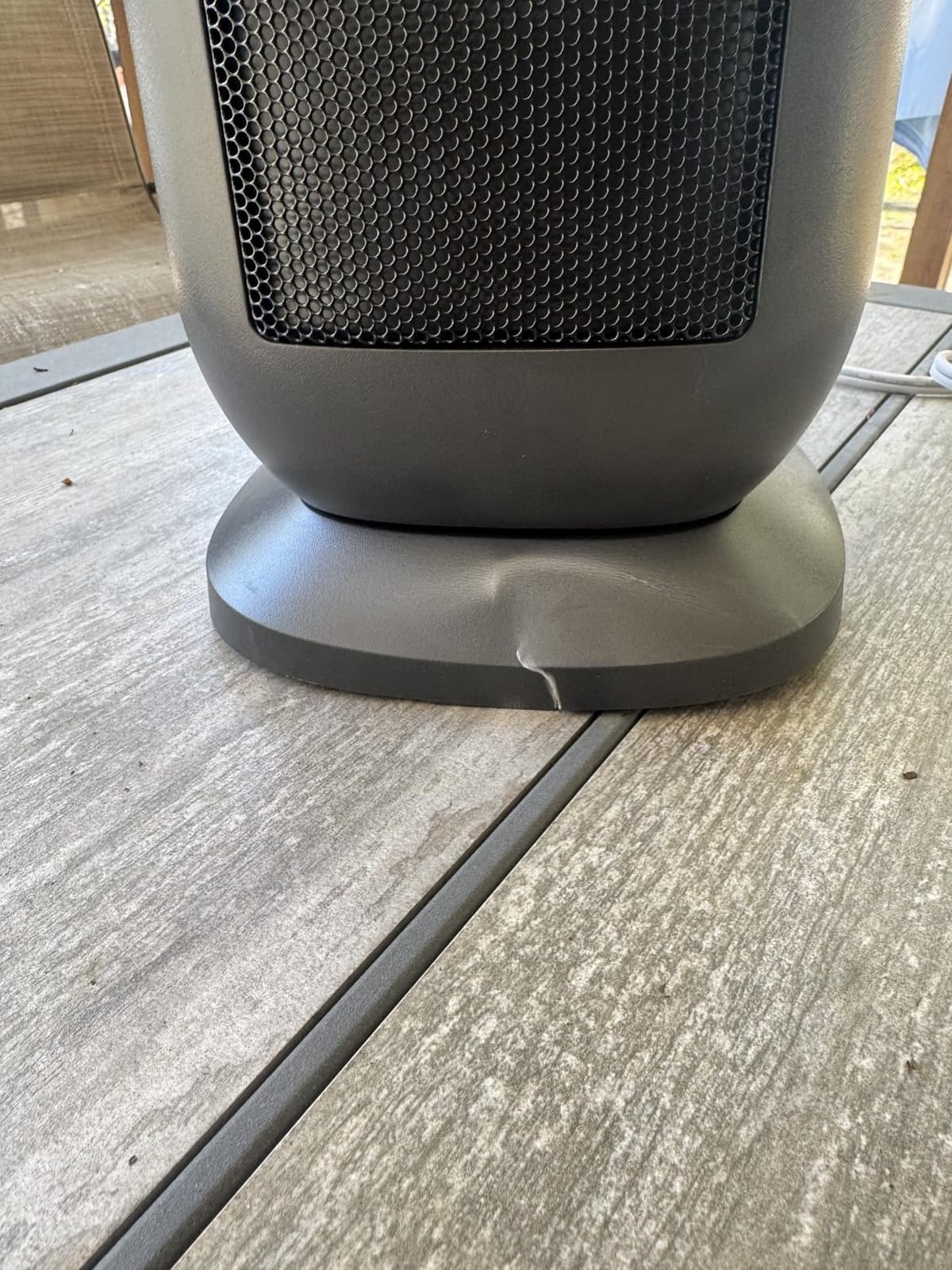
The cord is short for a 23-inch tower, so plan the outlet position before you unbox it.
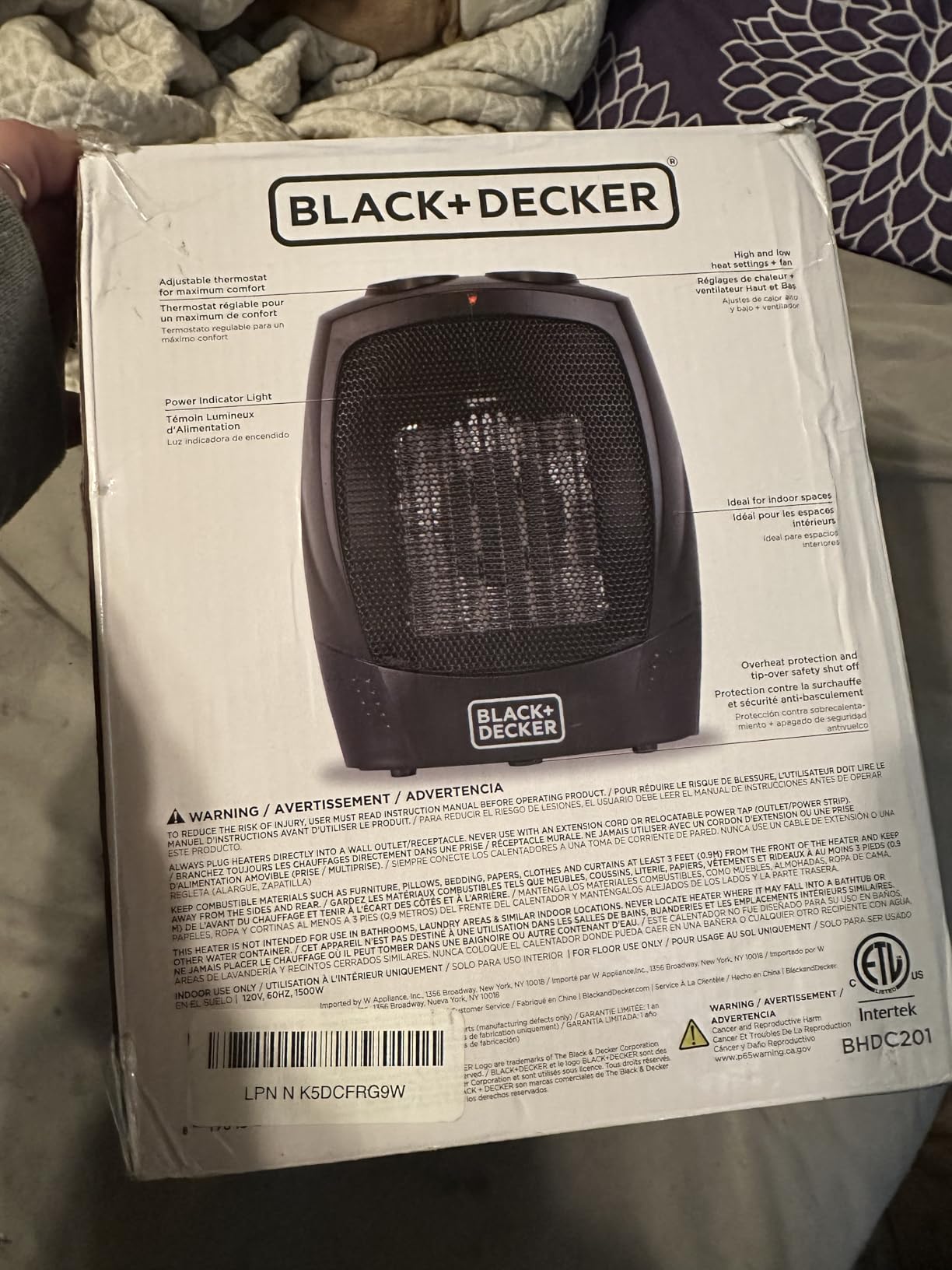
6. BLACK+DECKER BHDC201 – The Best Small Office Heater
BLACK+DECKER Personal Ceramic Heater, 1500 Watts, BHDC201, Black
1500W, 750W and fan only
Adjustable thermostat from 41-95F
Automatic tip-over and overheat shutoff
2.8 pounds with carry handle
150-200 sq ft coverage
Pros
- Three settings with a real 750W low and an adjustable thermostat
- Lightweight at 2.8 pounds with an easy carry handle
- Power-on indicator light plus automatic tip-over and overheat shutoff
- Compact desk-friendly footprint suits home office use
- Quiet enough for focused work
Cons
- No remote control
- timer or digital display
- Manual controls only
- so it cannot be adjusted from across the room
- Does not oscillate
- leaving a concentrated hot zone
The BHDC201 does the small-room job with fewer moving parts than anything else in this roundup. Fan only, 750 watts and 1500 watts, plus an adjustable thermostat running from 41 to 95 degrees Fahrenheit, and automatic tip-over and overheat shutoff behind a mechanical switch.
At 6.3 by 7.3 by 9.2 inches and 2.8 pounds, it is the easiest unit here to carry from a bedroom to an office in one hand. That portability is the actual feature; everything else is competent.

Manual Controls Are a Feature Until They Are Not
There is no remote and no timer, which means the unit runs until you switch it off. For a desk you sit at all day, that is fine. For a room you heat on the way to bed, you will want a timer, and this is not that heater.
The thermostat still modulates the element, so the room does not simply cook on high. But you cannot read the room temperature from the unit, and there is no display at all.
Placement Matters More on a Non-Oscillating Unit
Without oscillation, this one needs to be aimed. Put it low and near the person rather than high and near a wall, and you get even warmth. Put it behind furniture and you get a hot back panel and a cold room.
Coverage is listed at 150 to 200 square feet, which is realistic for a small office with normal insulation and a standard ceiling.
Best For and Skip This If
This suits a home office, a small bedroom, a study or a den where you are present to switch it on and off. The three-setting design and the 750 watt low make it easy to run in a room that only needs a little warmth.
Skip it if you want to leave a room heating while you are elsewhere, or if you want heat distributed across a space larger than a small office.
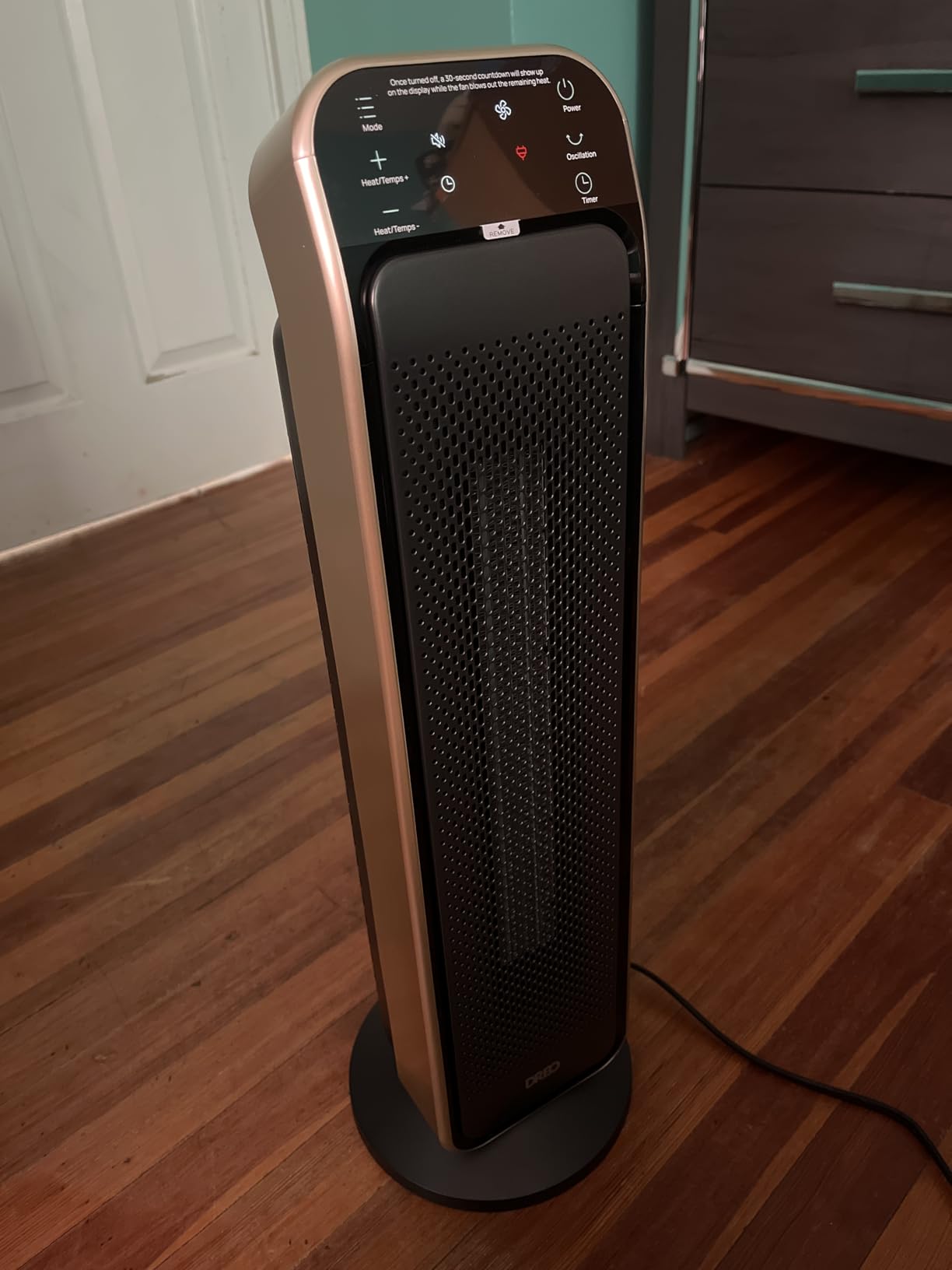
7. DREO 25 Inch Ceramic Tower – The Quietest Room Heater
DREO Ceramic Space Heater for Indoor Use 25 Inch, Remote and Thermostat
1500W PTC ceramic, 25 inch tower
Noise as low as 25 dB
100-270 sq ft with 70 degree oscillation
Child lock and smart memory
ETL certified with 45 degree tip-over protection
Pros
- Rated as low as 25 dB
- quiet enough for sleeping and working
- 70 degree oscillation covering 100-270 sq ft
- Child lock plus smart memory that restores your settings
- ETL certified with V0 flame-retardant material and a reinforced plug
- Reviewers report it outperforming cheaper heaters in poorly insulated rooms
Cons
- Not enough for a large open family room in very cold weather
- Display shows the set temperature rather than the room reading
- Plug and cord can run slightly warm on long high-heat runs
- Lightweight base can be tipped by pets
- children or a trailing cord
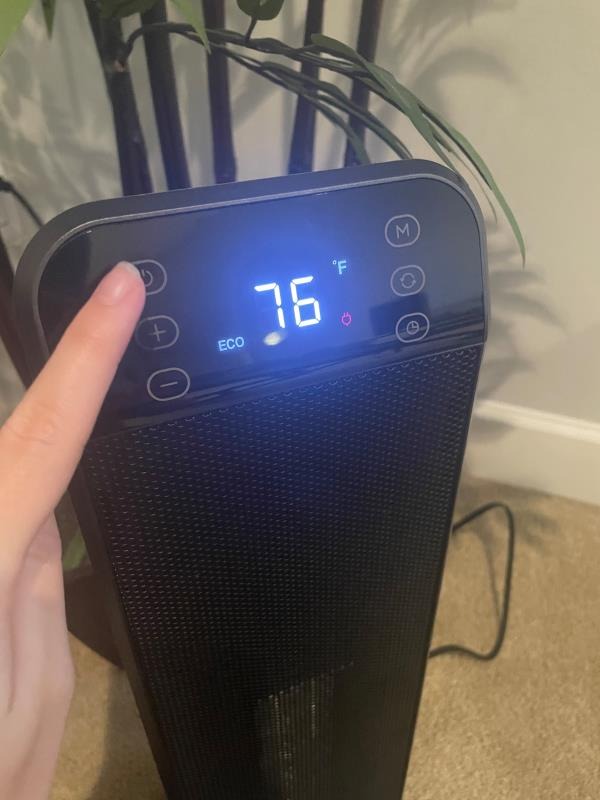
This 25-inch tower is the quietest heater in the roundup, and the number is not marketing filler: 25 dB is below a quiet library, which is a category where nearly every other ceramic unit lands somewhere between 40 and 55 dB. If a bedroom is your target, the gap is obvious on the first night.
The 70 degree oscillation and a stated 100 to 270 square foot coverage range make it the most capable room heater here on paper, and the child lock is something most competitors in this bracket simply do not include.
Realistic Limits on Very Large Open Rooms
Owners are clear about the ceiling on this one: two units still were not enough for a large open family room in genuinely cold weather. That is the honest answer to almost every heats-a-thousand-square-feet claim you will read anywhere, and it applies to this heater as much as to the others.
Within its range, though, reviewers report it outperforming far cheaper units in poorly insulated rooms, which is the situation where a longer air throw genuinely earns its keep.
Child Lock, Smart Memory and the Warm Plug
Smart memory restores your last settings after a power cut, and the child lock blocks the physical and touch controls. Both are small features that change how comfortable a heater feels in a family room.
The recurring notes to know about: the display shows what you set rather than what the room is, the plug and cord can run slightly warm during long high-heat sessions, and the vertical handle has no grip, so it is easier to fumble than a proper carry handle.
The Lightweight Base Problem
At 7.3 pounds in a 25-inch body, this is a tall heater on a base that is easy to tip. Owners mention pets, children and tripping over the cord as the three ways it goes over. The 45 degree tip-over protection is the mitigation, and it is well specified, but placement still matters. Put it behind a door it cannot swing into and away from a walkway.
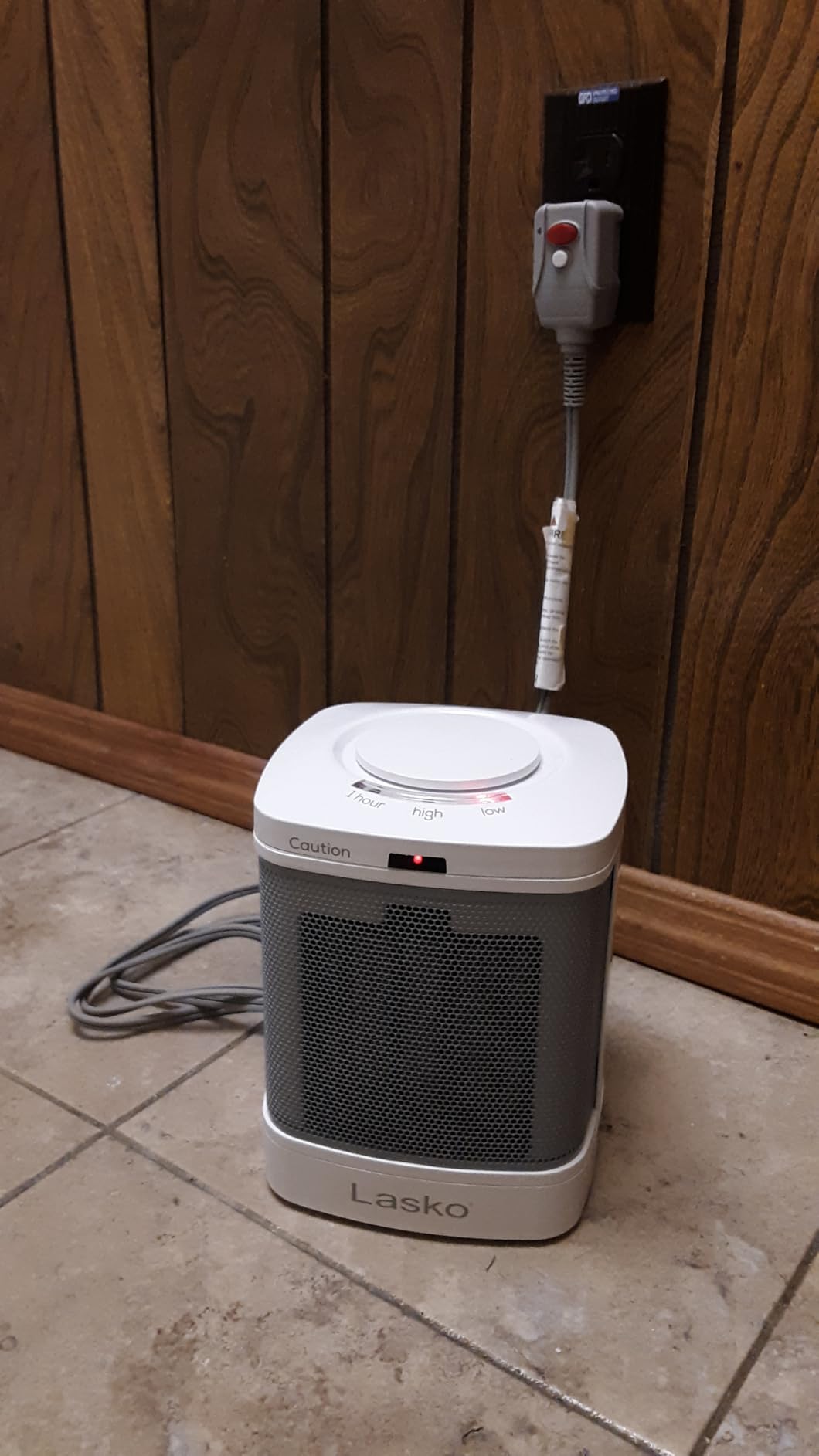
8. Lasko CD08200 – The Only Bathroom-Rated Unit Here
Lasko Electric Ceramic Space Heater for Bathroom – 8” – CD08200 – White
1500W ceramic element
Integrated ALCI safety plug, ETL listed
Under 8 inches tall, 6.25 inch footprint
One-button high and low cycling
3-year limited manufacturer warranty
Pros
- Only unit in this group approved for bathroom use
- Integrated ALCI safety plug with ETL listing
- 1500W ceramic element in a body under 8 inches tall
- One-button operation with a dedicated 1-hour high heat button
- No assembly required and stores easily when not in use
Cons
- No thermostat
- remote
- timer or oscillation
- Forced-air heating warms the room rather than drying towels
- Not designed to heat large open spaces
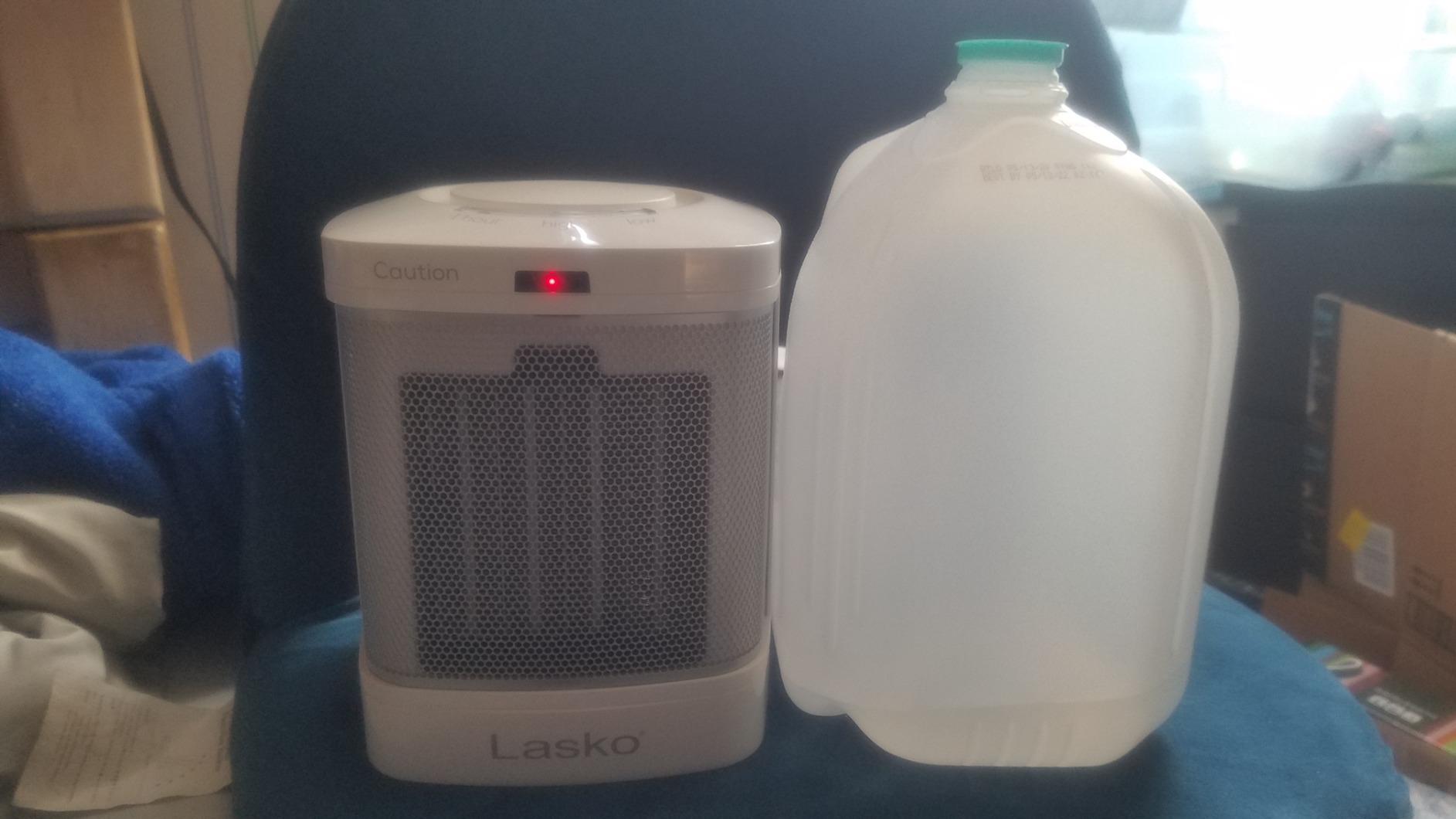
Heating a bathroom with a portable heater is a plumbing and electrical question before it is a heating question, and this is the only unit in the roundup that answers it. The Lasko CD08200 carries an integrated ALCI safety plug, which is the leakage-current interrupter designed for damp locations, plus ETL listing and automatic overheat protection on a cool-touch exterior.
It is also small enough to matter. Under 8 inches tall with a 6.25 inch square footprint, it fits on a bathroom counter or the floor beside a tub without taking up the space a tower would.
Why the ALCI Plug Is the Whole Point
An ALCI plug and a GFCI outlet do the same job from different directions: they trip when current finds a path it should not, which in a wet room means water. Any bathroom heater without one of those protections is a poor idea regardless of what the element is made of.
Even with the plug, keep the heater on a surface, away from the tub, and plug it directly into the wall rather than into an extension cord.
One Button, Two Settings, No Adjustment
There is no thermostat, no remote, no timer and no oscillation. One large top button cycles high, low and off, with a dedicated 1-hour high heat button for the shower case, which is a refreshingly honest design for a single-purpose bathroom appliance.
The trade is real: you get the room warm, not the towels. Forced air does not dry anything, so this is not the unit to reach for if warming a towel rack is the goal.
Where It Belongs and Where It Does Not
Coverage is listed at 225 square feet, so a normal bathroom is well within it. It carries a 3-year limited manufacturer warranty, which is longer than most units in this roundup offer.
Do not put it in a large open space expecting it to cope, and do not treat it as a general room heater. It is a bathroom tool that happens to heat a bedroom perfectly well.
9. PELONIS 30 Inch Ceramic Tower – The Best for Large Bedrooms
PELONIS 30” Ceramic Tower Space Heater with Adjustable Thermostat for Large Room, 75° Oscillation, Remote Control & 12H Timer, Tip-Over Switch & Overheating Protection, 1500W, PHF15RSAPH30, Black
1500W ceramic, 30 inch tower
Up to 280 sq ft coverage
75 degree oscillation
Digital panel with 1F adjustment
12-hour timer, under 55 dB
Pros
- 30 inch tower with 26 percent more hot air vents
- 75 degree oscillation and up to 280 sq ft of coverage
- Digital panel with 1F temperature adjustment plus remote
- Extra-long 12-hour timer reduces daily operating hassle
- Four functions covering high
- low
- ECO and fan at under 55 dB
Cons
- Taller 30 inch footprint takes more floor space than 23 inch models
- Only 2252 reviews
- so less long-term owner feedback than the best sellers
- No child lock or backlit remote
- which newer competing models include
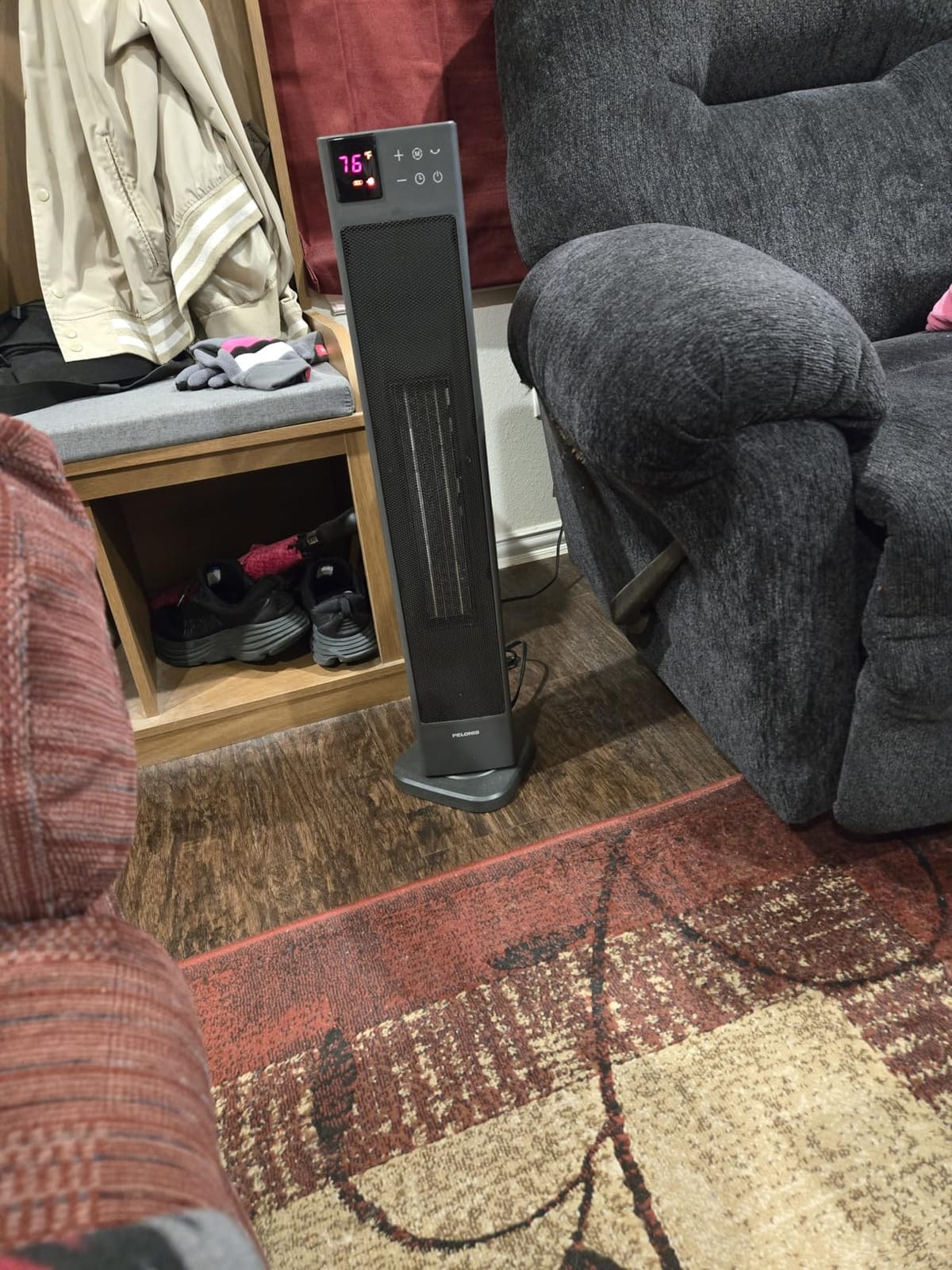
This is the largest floor unit here and the one with the widest stated coverage, at up to 280 square feet. The 30 inch body and the extra air vents along its height are the reason, and combined with 75 degree oscillation it is the pick if you are heating a large bedroom or a living room corner that the central system misses.
It also has the longest timer in the roundup relative to its size, at 12 hours, which means one setting covers a full workday or a full night without a reset.
Bigger Coverage Still Has a Ceiling
Two hundred eighty square feet is a closed room with an ordinary ceiling and reasonable insulation. It is not an open-plan main floor in a cold climate, and no fan-forced ceramic heater in this roundup will be. The honest framing is that this unit heats a zone well, and a zone is smaller than most listing pages imply.
The thermostat range runs 40 to 95 degrees Fahrenheit, which is the widest cold-end range here and useful in a drafty room that needs to be held above freezing and no higher.
A Newer Model With Less Long-Term Evidence
This is a newer product with 2252 reviews, so there is far less multi-year owner history behind it than the Lasko and Amazon Basics units with tens of thousands of reviews. That is not a defect, it is an information gap, and it is worth weighting when two otherwise similar units are close.
It also lacks a child lock and a backlit remote, both of which appear on newer competing models. The under-55 dB figure is respectable but does not compete with the 25 dB tower.
Footprint Is the Real Trade
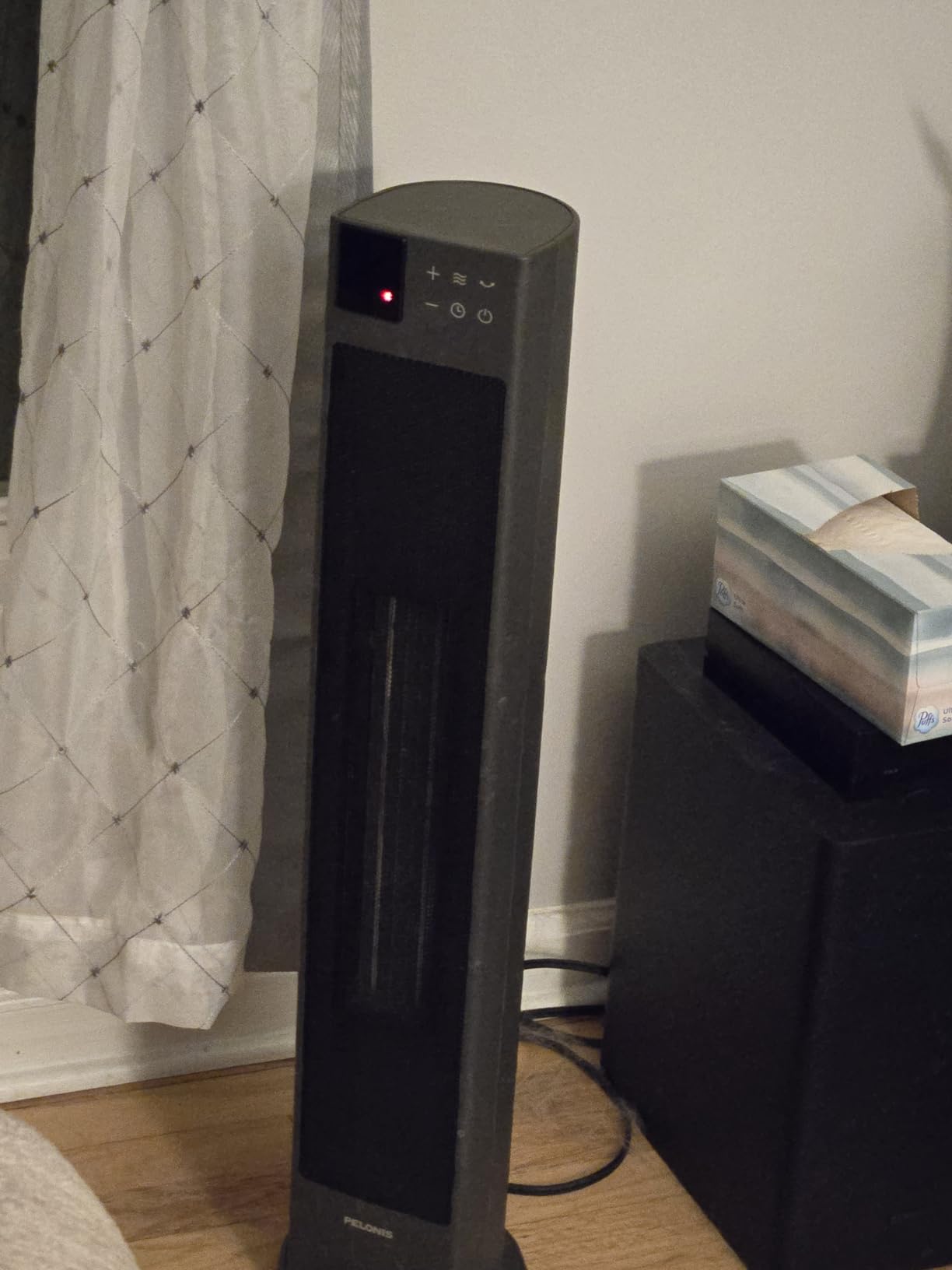
A 30 inch tower needs floor space that a 23 inch tower does not, and in a small room the heater ends up occupying the corner you were trying to free. Measure before you commit, particularly if the outlet is behind furniture.
10. BREEZOME 1500W Ceramic Tower – The Widest Oscillation Sweep
BREEZOME 1500W Space Heater for Indoor Use, Ceramic Electric Tower Heater
1500W PTC ceramic element
90 degree oscillation
40 dB operation
24-hour timer and LED display
ETL certified with V0 materials
Pros
- 90 degree oscillation with a louvre that tilts airflow up to 30 degrees higher
- 40 dB operation with a remote for distance adjustment
- ECO smart thermostat with a temperature sensor
- 24-hour timer
- LED display and a remote storage nook
- ETL certified with V0 flame-retardant materials and both cutoffs
Cons
- One reviewer reports insufficient warmth in a 9×14 room in near-freezing weather
- Tip-over shutoff did not appear to trigger when the unit was tipped and carried by hand
- No smart home app integration
- which some buyers wanted
- Shorter 17.3 inch body than 23 to 30 inch tower models
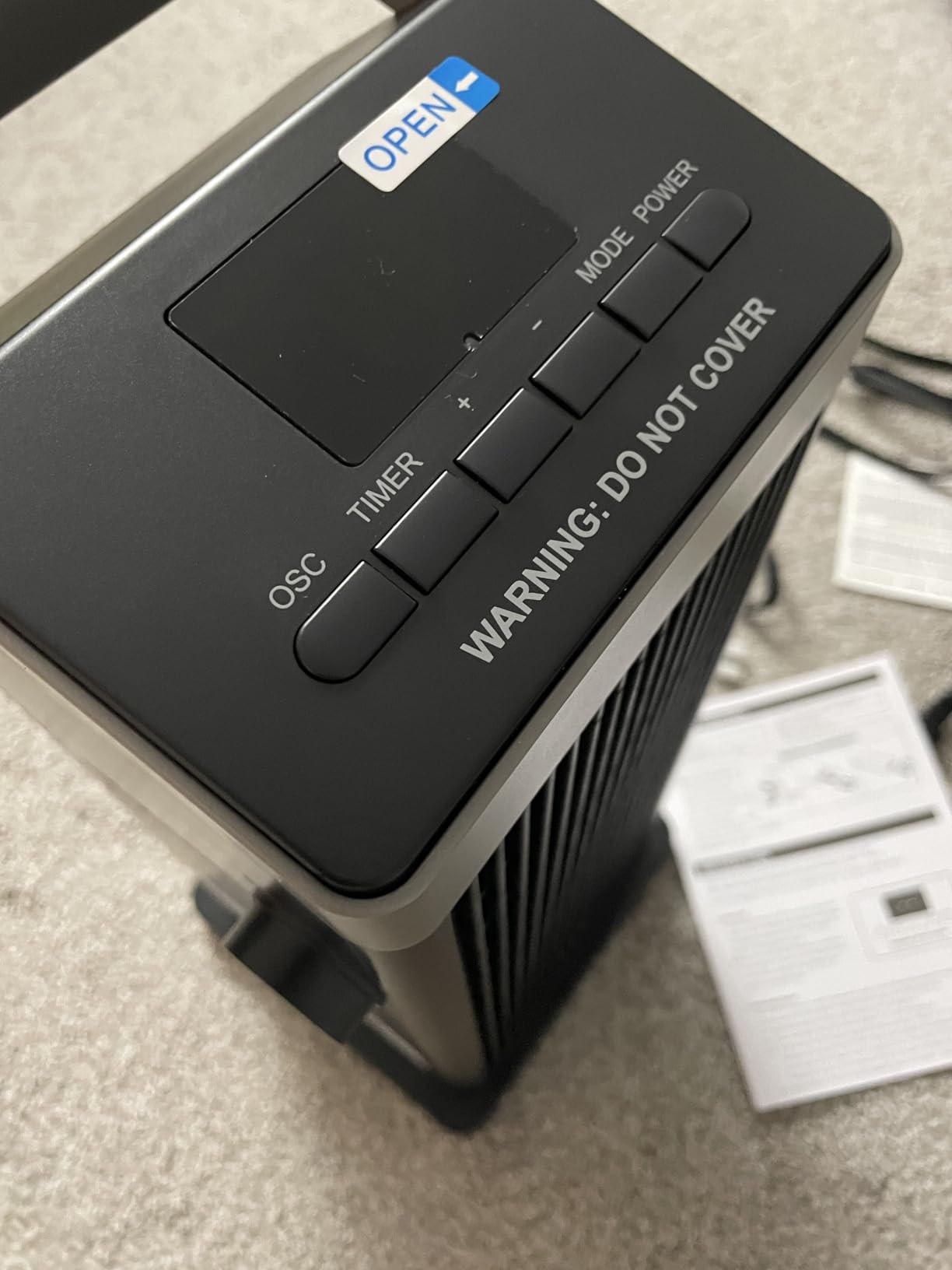
The BREEZOME is built around spread rather than throw. Ninety degrees of oscillation is the widest sweep in this roundup, and the louvre tilts the airflow upward by as much as 30 degrees on top of that, which is why it works well in a room where everyone is seated low rather than standing.
At 40 dB it sits between the quiet desktop units and the mid-range towers, and the 24-hour timer is the longest here. That combination makes it a good fit for a living room you want on all evening without touching it.
The 24-Hour Timer and ECO Thermostat Combination
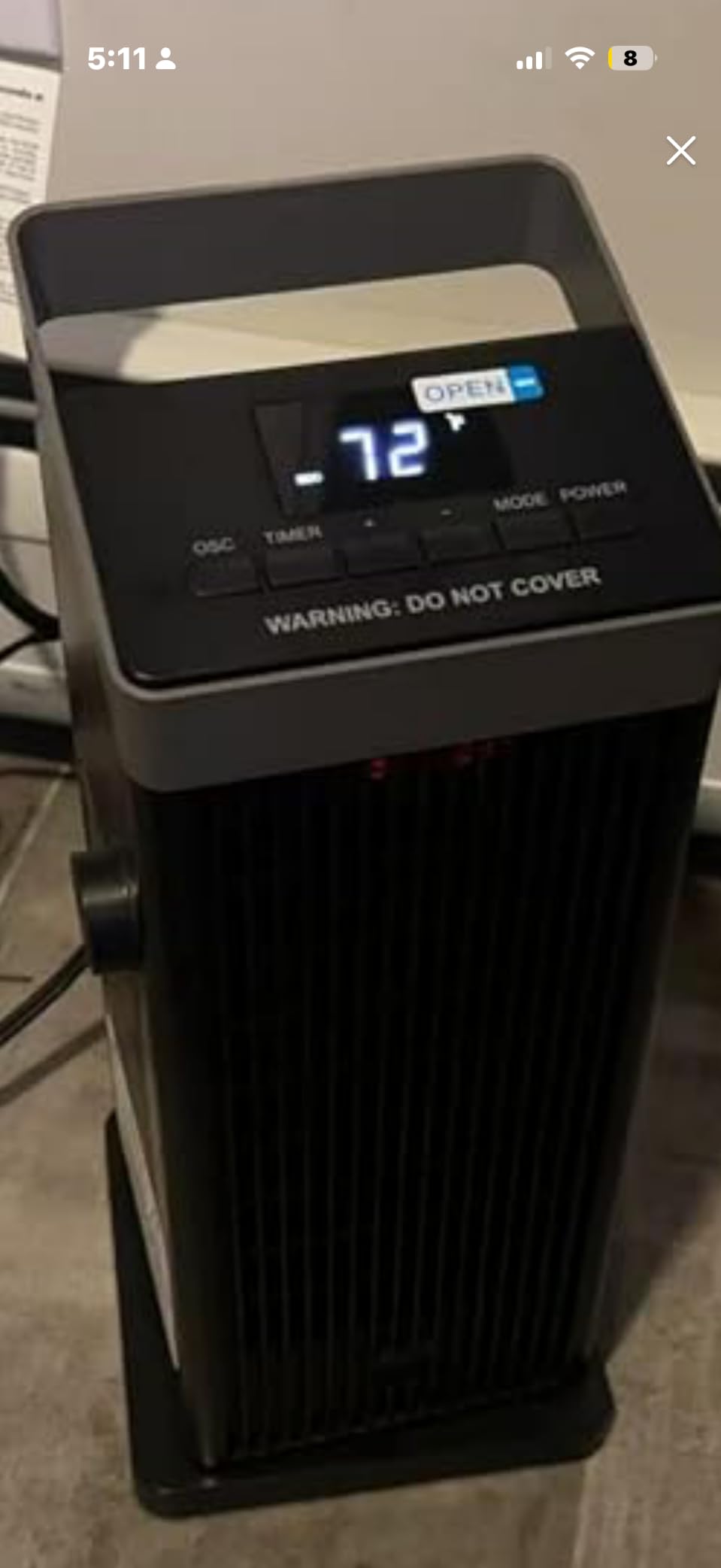
A 24-hour timer changes how you think about running a heater. Set it once and it cycles for the whole day without a daily reset, and the ECO thermostat with its temperature sensor adjusts output so it is not drawing full power against a room that is already warm.
The LED display and the remote storage nook are small quality-of-life touches that make a unit you will touch daily easier to live with.
Two Owner Reports Worth Taking Seriously
One reviewer found it insufficient for a 9 by 14 foot room in near-freezing weather, which is a useful data point about its limits in unheated spaces. Another reported that the tip-over shutoff did not appear to trigger while the unit was tipped and held by hand, which is exactly the test that matters with children and pets in a room.
Its 17.3 inch body is short next to the 23 and 30 inch towers, and there is no app integration, so a smart-home setup is not the use case here.
Best For and Skip This If
This suits a living room with low seating, a wide bedroom, or anywhere you want the heat spread evenly and the timer set once. The 200 square foot coverage figure suits a normal room.
Skip it if your space is large and unheated, or if you need a verified tip-over cutoff and a full-size tower footprint.
11. Amazon Basics 500W Mini Ceramic Heater – The Best Desk Heater
Amazon Basics Ceramic Portable Mini Space Heater for Office Desk, Indoor Use, Fast Heating, 500W, With Tip-Over Protection, Lightweight 1.4 lbs, Black, 5.87″D x 3.15″W x 5.95″H
500W ceramic element
1.4 pounds, 5.87 by 3.15 by 5.95 inches
48 dB operation
ETL listed with tip-over protection
Desktop and study room sizing
Pros
- Compact and lightweight at 1.4 pounds
- easy to move and place on a desk
- Fast heating with ceramic coils
- Built-in tip-over protection plus ETL listing
- Quiet operation at 48 dB for a personal heater
- Small enough to leave desk space free
Cons
- 500W is only suited to personal or very small area heating
- No thermostat or multiple heat settings
- Does not oscillate
- Short power cord reported by some users
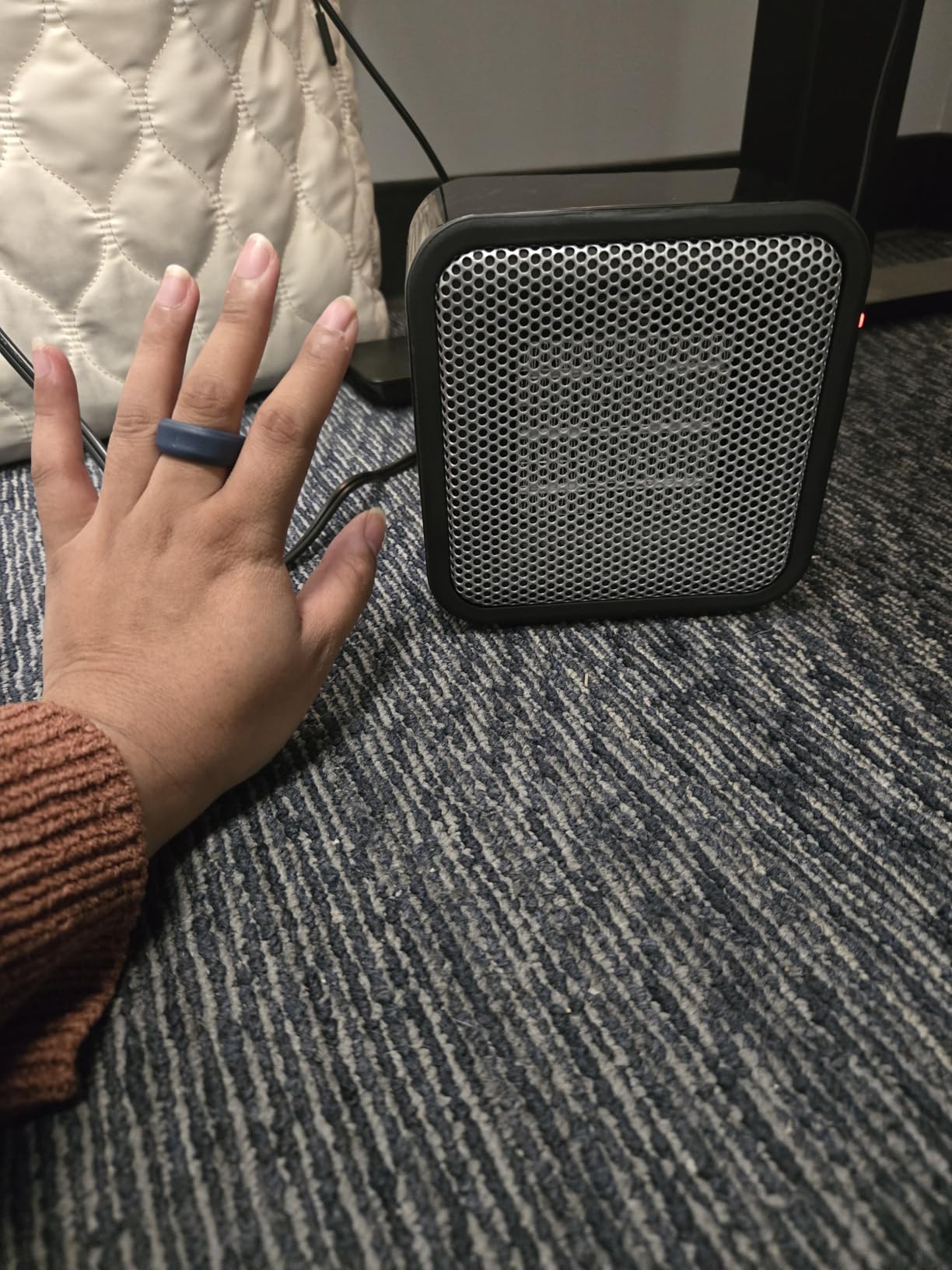
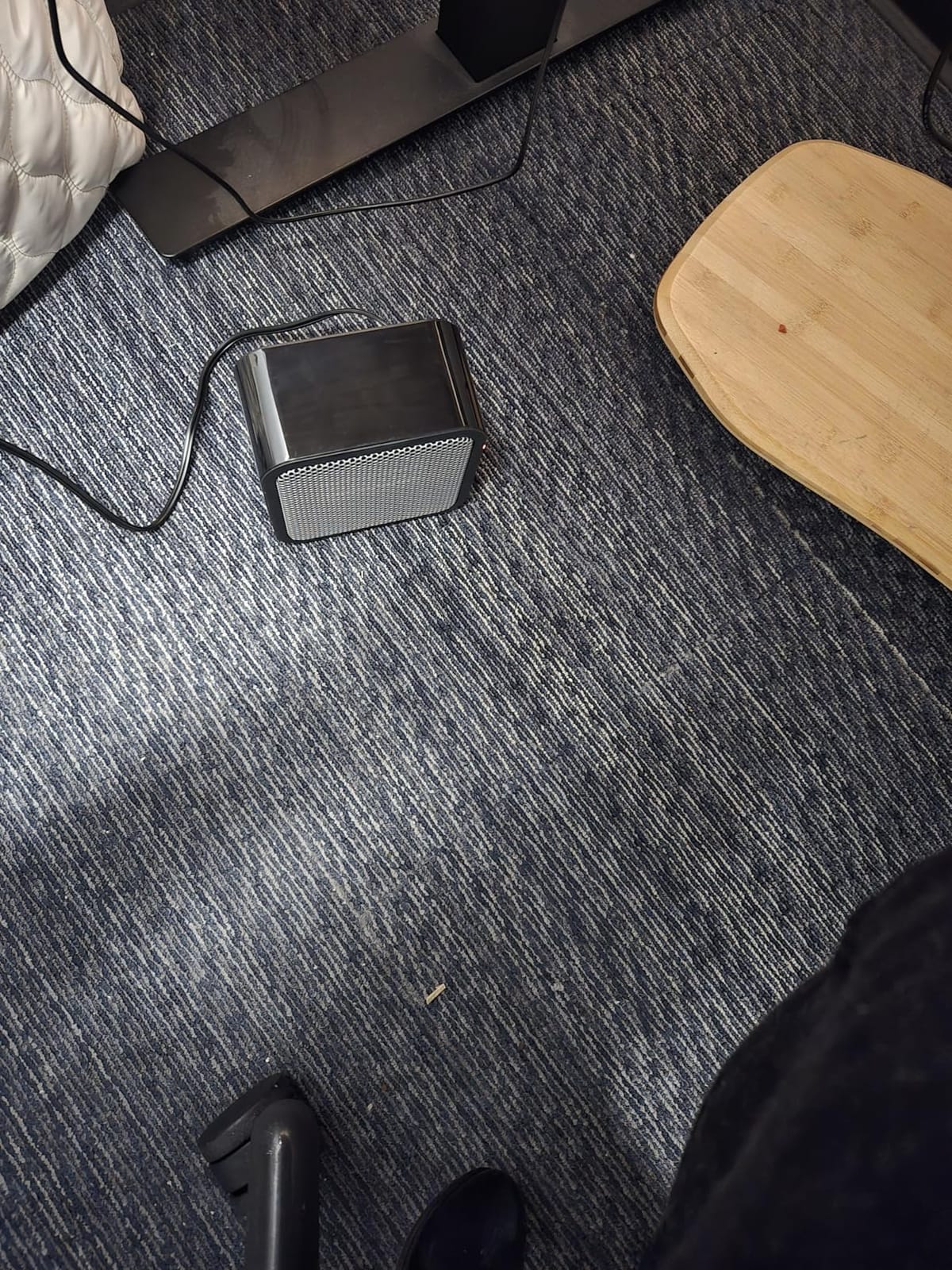
Half the wattage, a fifth of the bulk, and a different job entirely. The Amazon Basics 500W mini is a personal heater for a desk, a nightstand or a lap, not a room heater, and the 48 dB figure is what you would expect from a small fan rather than from a 1500 watt tower.
It weighs 1.4 pounds and measures 5.87 by 3.15 by 5.95 inches, so it disappears on a crowded desk and moves between rooms without being a decision. With over 17000 reviews, it is one of the most proven small heaters available.
What 500 Watts Actually Covers
Enough to warm one person at a desk, a small bedroom nook, or the space right at your feet while you work. It will not change the temperature of a 150 square foot room, and treating it as a room heater is the most common misunderstanding about units in this class.
Because there is no thermostat and no multiple heat settings, it runs at one level. That is fine for a personal zone, where steady radiant-feeling warmth at close range is what you want.
Safety and the Cord
Tip-over protection and ETL listing are both present, which is the baseline you should hold every heater to regardless of size. The grille does not need to be touchable, but the element is enclosed, which is the relevant point for a unit that ends up on a crowded desk.
Some owners report a short power cord, so plan the outlet position rather than the desk position.
When a Personal Heater Is the Right Call
Buy this for an office chair, a bed side table or a spot on the sofa that is genuinely cold for one person. At 1.4 pounds it is the easiest unit in the roundup to move between those spots, and ETL listing with tip-over protection means it is as certified as the big towers.
Pass if you need to warm a room, if you want a thermostat, or if you want heat spread across a space rather than aimed at a single spot.
12. Pereysi 1500W PTC Ceramic Heater – The Best Compact Value
1500W Small PTC Ceramic Space Heater for Indoor Use
1500W high, 900W low and fan only
Adjustable thermostat
ETL listed with tip-over and overheat protection
2.4 pounds with carry handle
Compact 6.3 by 4.73 by 8.66 inches
Pros
- Three heating modes including 900W low and fan only
- Full 1500W heating in a compact body
- Tip-over switch
- overheat protection and flame-resistant materials
- ETL listed to US safety standards
- Built-in carry handle and a slim footprint for limited rooms
Cons
- Heavier and larger than the mini desk heaters
- Some users report thermostat accuracy issues
- No remote control
- No timer function
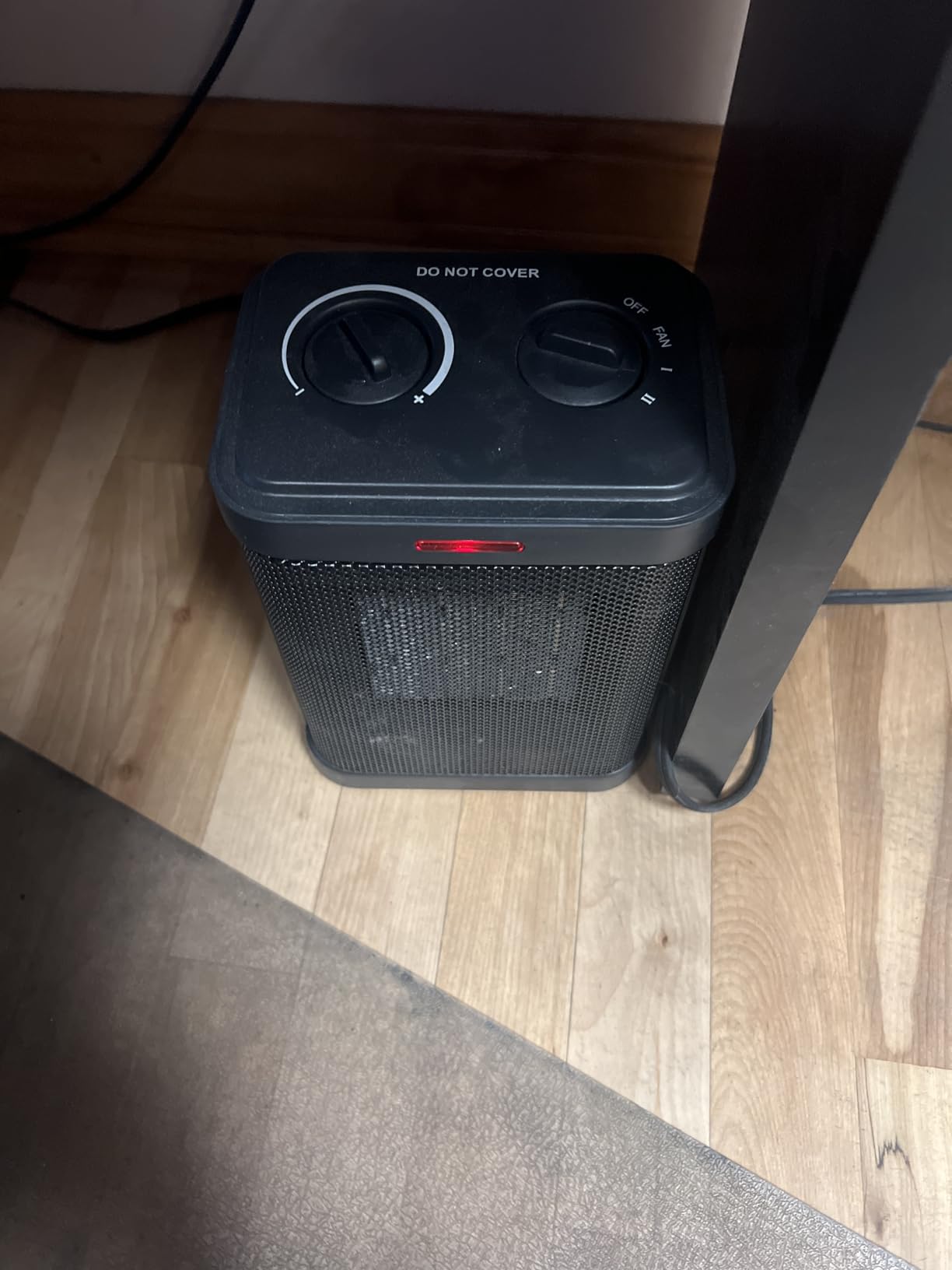
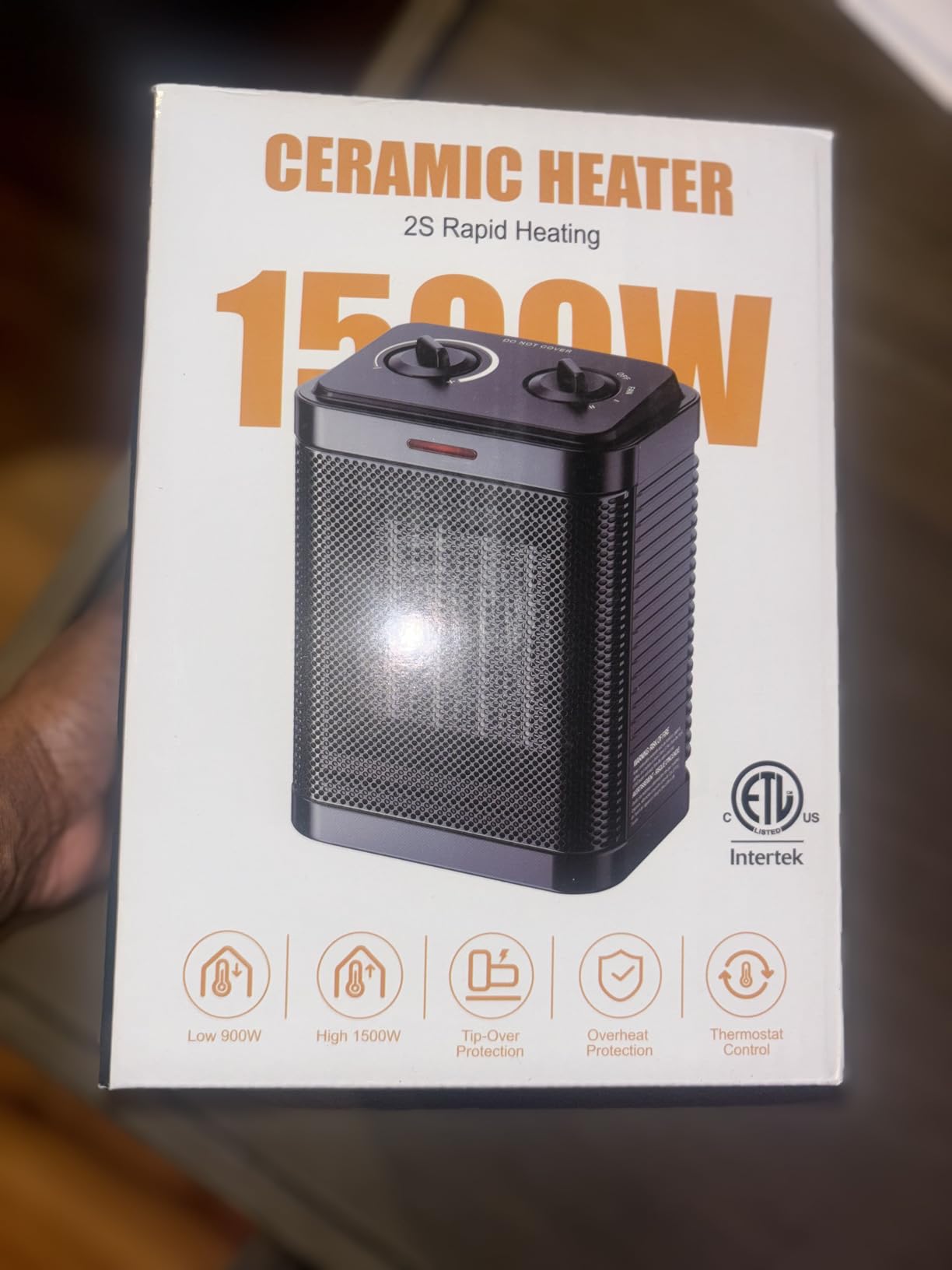
The Pereysi puts a full 1500 watt PTC element into a body smaller than most 1500 watt units, at 6.3 by 4.73 by 8.66 inches and 2.4 pounds. You get high, a real 900 watt low and fan-only, plus an adjustable thermostat, which is a more complete control set than most compact heaters offer.
Its safety story is stated plainly: tip-over switch, overheat protection, flame-resistant materials and ETL listing. That is the full package, not a partial one.
The Best Mode Structure at This Size
Three modes with a 900 watt middle step is what makes this usable in a room that does not need 1500 watts. Set it to low and the thermostat does the rest, which avoids the overshoot problem that a single-level personal heater creates.
PTC elements heat faster than conventional coils because resistance climbs as the element warms, so the unit reaches useful output in about two seconds on the high setting.
Where It Falls Short
There is no remote and no timer. Both absences matter in a specific way: without a timer you switch it off yourself, and without a remote you walk to the unit. In a small room you are sitting in, neither is a real problem. In a bedroom you leave running, both are.
Some owners also report thermostat accuracy issues, which is the same complaint that appears on other units with a coarse adjustable thermostat. Set it a couple of degrees low and give it a week to learn the room.
Who This Suits
This is a good fit for a bedroom, a small office or a room where floor space is limited and you want 1500 watts rather than 500. The slim body and the built-in carry handle make it easy to reposition.
Pass if you need unattended scheduling or distance control. Those are the two features this heater does not offer at any setting.
How to Choose a Ceramic Space Heater
Most bad purchases in this category come from skipping a sizing step and a safety check. These are the five decisions that actually determine whether you are happy with the unit in sixty days.
Match Wattage to Room Size, Not to Marketing
The workable rule is roughly 10 watts per square foot for a drafty or uninsulated room, and closer to 5 watts per square foot in a well-insulated space with a normal ceiling. A 1500 watt heater comfortably covers about 150 to 200 square feet in ordinary conditions, and you should be skeptical of any listing claiming 1000 square feet, because that claim appears on units that have never been in a room that size.
Drafty rooms need more wattage for the same square footage, not less. Basements with exposed ductwork, older homes with single-pane windows and rooms with vaulted ceilings all punish a heater long before the thermostat is satisfied. If the room is above 300 square feet with high ceilings, you want a different appliance entirely.
Decide Between Ceramic, Infrared, Oil-Filled and Micathermic
Ceramic is the best all-round choice for air warming and the fastest to heat, but it is only one of four options. Infrared panels warm surfaces and objects in front of them rather than the air, which makes them better for a cold spot, a drafty window seat or drying laundry. Oil-filled radiators heat slowly and then hold heat for a long time after switching off, which suits a room that is warm for hours. Micathermic units use a similar element but run cooler and quieter, and they heat a small area well rather than a whole room.
Our wider guides to the best ceramic heaters and the best space heaters overall break this down further if you are still choosing between technologies.
Thermostat Quality Matters More Than Wattage
A coarse thermostat makes the room overshoot, then coast, then overshoot again, and you run the heater longer than you need to. A digital thermostat with 1-degree resolution and an eco mode cuts that cycling, and it is the single most noticeable quality difference between two otherwise similar heaters.
Check the temperature range too. A unit that bottoms out at 60 degrees cannot hold a drafty room above the point where pipes risk freezing, and a unit topping out at 85 degrees cannot warm a cold bedroom past comfortable.
Translate Decibels Into a Verdict
Under 42 dB is library quiet and works next to a bed or a microphone. Between 43 and 48 dB is fine in an office and noticeable only in dead silence. Above 50 dB you will hear it across a quiet room, and in a bedroom that can cost you sleep. The two quietest units in this roundup are the 25 dB tower and the 43 dB desktop unit, and the loudest listed figure here is 55 dB.
Remember that all ceramic heaters are fan-forced, so none of them are silent. The difference between a good one and a cheap one is a better motor and a cleaner intake.
Look for Certification Marks Before Anything Else
Every unit in this roundup carries a third-party mark: UL 1278 in the United States, ETL from Intertek, or CSA in Canada, and the European equivalent is EN 60335-2-30. Certification is not optional and it is not interchangeable with a manufacturer’s own claim of safety. A listing with no mark on the spec page is a listing to skip.
Our dedicated guide to the safest space heaters covers the certification marks in detail, and the best energy efficient space heaters guide covers running cost and thermostat cycling in depth.
Are Ceramic Space Heaters Safe, Including Overnight?
Ceramic space heaters are among the safest portable electric heat you can own, because the self-regulating PTC element physically cannot run dangerously hot and because nearly every certified unit carries both tip-over and overheat shutoff. The residual risk comes almost entirely from placement, cord handling and how close fabric gets to the intake.
Four things to verify on any unit. First, a third-party safety certification mark on the spec sheet. Second, an automatic tip-over switch, which is what protects a home with toddlers or dogs. Third, automatic overheat shutoff with a self-regulating element. Fourth, a cool-touch or flame-resistant housing, which is the detail that matters most for children who will inevitably touch it. Every product in this roundup has all four, and one of them carries an integrated ALCI safety plug specifically for a bathroom.
The Overnight Question, Answered Honestly
Our position is the cautious one: do not leave any portable heater running while you sleep. Fire safety bodies consistently advise against unattended operation, and a heater that depends on someone being awake to notice a shifted cord or a blocked grille is relying on supervision you will not provide at 3 a.m.
That said, buyers are going to do it, so if you are going to, use the safety hardware the way it was designed. Choose a unit with a long auto-off timer, a tip-over switch and overheat cutoff, set it on a hard floor surface, keep three feet of clearance on all sides, run the cord along the wall so nobody can walk over it, and block nothing. A heater with a twelve-hour timer and a child lock, positioned on bare floor, is a materially different proposition from one with a one-hour button and no tip-over switch. We have covered this in more detail in our safety guide, but the short version is that the timer is the feature that makes overnight use defensible rather than reckless.
Clearance and Placement Are Where Most Problems Start
Keep three feet of clearance from curtains, bedding, furniture and walls on every side, and never under or behind furniture where the intake can be starved. A blocked intake is the single most common trigger for the overheat cutoff, and a heater that is constantly tripping its cutoff is a heater that is running its element in short cycles all day.
Do not use an extension cord. Plug it directly into the wall, and if the wall outlet is warm after an hour of use, that circuit is at its limit and the unit belongs on a different one.
What a Ceramic Space Heater Costs to Run
Every watt of electricity a ceramic heater draws becomes heat, so the running cost is simply wattage times your local rate. At the US national average of about 14.6 cents per kilowatt hour, the numbers work out as follows, and they are the reason this category exists for anyone trying to offset a central heating bill.
A 500 watt personal unit draws 0.5 kWh per hour, which is roughly 7 cents an hour and around 56 cents for eight hours. A 750 watt low setting draws 0.75 kWh, about 11 cents an hour. A 900 watt low setting is 0.9 kWh, roughly 13 cents an hour. A 1000 watt unit is 1.0 kWh, about 15 cents an hour. And a 1500 watt unit at full output is 1.5 kWh per hour, around 22 cents an hour.
Run at full 1500 watts for eight hours overnight and you consume 12 kWh, which is about 175 cents. For a second zone in a drafty house, that is a very small line item. Running three of them for a full winter evening is a different conversation, and it is the argument for using a thermostat rather than a fixed setting.
Because these units convert essentially all consumed electricity into heat, the efficiency argument favours the heater, not the boiler. A heat pump running off central heating still loses some of its output through distribution, while a ceramic heater in a closed room puts nearly everything it draws into that room. Our guide to the most energy efficient space heaters covers the comparison in full.
Fixing Whistling, Rattling and Burning Smells
Almost every ceramic heater complaint that shows up months after purchase is a dust problem, and almost all of them are fixable in ten minutes with a vacuum attachment and a soft brush.
Whistling or rattling that starts after a few months. Dust has built up on the fan blades and in the intake grille, and a blade passing a dirty edge produces a tone that gets sharper as the buildup grows. Unplug the unit, let it cool fully, vacuum the intake from the outside, and clean the blade housing with a soft brush. It is the same maintenance task and it resolves the oscillation creak reported on some of the tower models too.
Jammed oscillation. The same dust collects in the motor housing that drives the sweep. Clearing the intake usually restores the full sweep, and it is worth doing before you assume the motor has failed.
A burning smell on first use after storage. This is usually dust burning off the element itself, and running the unit for fifteen minutes in a ventilated room resolves it. A burning smell that returns every time you switch it on means the buildup has not been cleared.
A dead remote. Replace the batteries first, which is the cause in the large majority of cases, and confirm that the remote is pointed at the unit rather than off into the room. The remotes that store on the back of the heater rarely go missing, but their coin cells still drain.
A thermostat that never seems satisfied. Coarse adjustable thermostats read roughly one to two degrees off. Set the unit a few degrees below your target and let it run a week before you decide it is broken.
Frequently Asked Questions
How big of a room will a 1500 watt ceramic heater heat?
A 1500 watt ceramic heater realistically covers about 150 to 200 square feet in a room with normal insulation and a standard ceiling height. It works as a zone heater rather than a whole-home heat source. Drafty basements, rooms with vaulted ceilings and open-plan living spaces need far more capacity, and claims that a 1500 watt unit heats 1000 square feet are marketing rather than measurement.
Do ceramic space heaters use a lot of electricity?
A 1500 watt ceramic space heater draws 1.5 kWh per hour. At the US national average of roughly 14.6 cents per kilowatt hour that is about 22 cents an hour, or about 175 cents for eight hours of overnight use. A 500 watt personal unit costs about 7 cents an hour. Because a ceramic element converts nearly all consumed electricity into heat, these units are among the most efficient ways to warm a single room.
Can I leave a ceramic space heater on overnight?
Fire safety guidance advises against leaving any portable heater running while you sleep, because the failure modes that matter are only caught by someone who is awake. If you choose to run one overnight, use a model with a long auto-off timer, tip-over shutoff, overheat protection and a cool-touch housing, place it on a hard floor with three feet of clearance, run the cord along the wall, and never block the intake. Never use an extension cord.
Are ceramic space heaters better than oil-filled radiators and infrared heaters?
Ceramic heaters heat fastest and warm air most efficiently, which makes them the best general choice for a bedroom, office or drafty room. Oil-filled radiators heat slowly but store and release heat for a long time after switching off. Infrared panels warm surfaces and objects in front of them rather than the air, so they suit a cold window seat or drying laundry. For personal warmth at close range, a small 500 watt ceramic unit is the most efficient option.
What are the disadvantages of a ceramic space heater?
The main drawbacks are that every ceramic unit is fan-forced and therefore audible, they warm air rather than surfaces so they will not dry laundry or heat a cold corner, and they have no residual heat once switched off. Many budget models also lack a thermostat entirely, offering only low, medium and high settings, which makes the room overshoot and then chill. Claims about heating very large areas are also routinely overstated.
Which Ceramic Space Heater Should You Buy?
If you want one heater and no further thought, the Lasko 751320 is the pick. A 1500 watt ceramic element, an adjustable thermostat, wide oscillation, a cool-touch ETL-listed housing and a 7-hour timer in a 2.5 pound body, backed by more owner history than anything else in this roundup. It is the unit we put in a room first and the one we leave there.
If you want a digital thermostat and a slightly more capable tower, the Lasko 755320 gives you the same element plus 1-to-8-hour timer steps and a remote that stores on the unit. If silence is the priority in a bedroom, the DREO 25-inch tower runs as low as 25 dB and adds a child lock. If you are heating a large bedroom rather than a corner of one, the PELONIS 30-inch tower claims up to 280 square feet and sweeps 75 degrees.
If the budget is tight, the Amazon Basics 1500 watt unit delivers full wattage, a 900 watt low and fan-only in a 2.1 pound body at 43 dB, and the BLACK+DECKER BHDC201 does the same job in a smaller frame for a home office. If the room is a bathroom, the Lasko CD08200 is the only one here with an integrated ALCI safety plug. And if you are warming one person at a desk, the 500 watt Amazon Basics mini is the right size and nothing more is needed.
Whichever you choose, check for the certification mark, confirm the tip-over and overheat cutoffs, give it three feet of clearance, and set the thermostat a couple of degrees below your target. Pick the Lasko 751320, read the safety section above once more, and you will be comfortable by the time the first cold snap arrives.
Leave a Reply