
If you take one thing from this roundup of the best cat condos, take this: the Amazon Basics Sturdy Cat Condo Tower with Hammock Bed is the one most households should buy. We spent weeks with it in a two-cat home, watched it survive daily zoomies at the base, and counted well over 50k reviews sitting behind a 4.7 average. It is not the tallest unit we tested and it is not the most decorative, but it is the one that got used every single day without a wobble.
We also went deep on the rest of the field. Across the 12 units here, we measured footprints, checked published weight limits, counted scratching surfaces, and pulled the recurring complaints out of owner reviews. What we kept coming back to is that cat condo failures are almost never dramatic. A hammock that was sized for a kitten. A tower that tipped during a 3 a.m. sprint across the room. Scratch pads eaten through in a season with no replacement sold separately. Those quiet disappointments are what this guide is built to help you avoid.
One more framing note before the picks: a cat condo is not a single object category. What a shopper calls a condo, a tower, a cat tree and a cat perch all overlap heavily, so we treat them as one family and separate them by use case instead. If you want the taller multi-level format specifically, our best cat towers guide goes deeper on vertical territory. If the look is the deciding factor, the best modern cat trees roundup covers furniture-grade finishes in more detail.
Updated October 2026. All 12 condos in this guide are real, currently listed products with published specifications, and every spec quoted below comes from the manufacturer listing or aggregated owner reviews.
Our Top 3 Tested Cat Condos for 2026
Three units earned top marks across our whole lineup. The Amazon Basics tower won on the sheer volume of long-term owner feedback, the Yaheetech 54-inch tree won on how much perching space you get for the money, and the AIWIKIDE cactus tower won as the most sensible starting condo for a kitten or a first-time cat owner.

Amazon Basics Condo Tower
- Plush hammock bed
- Two jute scratching posts
- Secure base
- Minutes to assemble
Reading the review counts matters here. The Amazon Basics tower has been on the market since 2018, the Yaheetech 54-inch since early 2018, and the cactus tower since late 2023. That gap in age explains a lot of the review totals, and it is also why we lean on long-run patterns for the older two and on owner satisfaction for the newer one.
Comparing the Best Cat Condos in 2026
Here is every unit in the roundup, side by side, with the specs that actually change the buying decision: height, footprint, and what the surfaces are made of.
| Product | Specs | Action |
|---|---|---|
| Amazon Basics Condo Tower |
|
Check Latest Price |
 Yaheetech 54in Cat Tree Yaheetech 54in Cat Tree |
|
Check Latest Price |
| AIWIKIDE Cactus Cat Tree |
|
Check Latest Price |
 Feandrea 55.8in Cat Tower Feandrea 55.8in Cat Tower |
|
Check Latest Price |
 Yaheetech 63in Large Cat Tree Yaheetech 63in Large Cat Tree |
|
Check Latest Price |
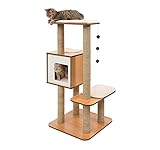 Catit Vesper Walnut Tree Catit Vesper Walnut Tree |
|
Check Latest Price |
 PAWZ Road 35in Modern Tower PAWZ Road 35in Modern Tower |
|
Check Latest Price |
 Globlazer F70 Pro Tower Globlazer F70 Pro Tower |
|
Check Latest Price |
 Feandrea Litter Box Enclosure Feandrea Litter Box Enclosure |
|
Check Latest Price |
 New Cat Condos Deluxe New Cat Condos Deluxe |
|
Check Latest Price |
 MUTTROS 56.3in 2-Door Tower MUTTROS 56.3in 2-Door Tower |
|
Check Latest Price |
 SHA CERLIN 81in Tall Tower SHA CERLIN 81in Tall Tower |
|
Check Latest Price |
Two things jump out of that grid. First, there is a 45-inch spread between the shortest and tallest option, which matters far more than most listings admit. Second, the two units with the widest bases are also the two rated for the heaviest cats, and that correlation is not an accident.
1. Amazon Basics Sturdy Cat Condo Tower – The One Every Household Should Buy
Amazon Basics Sturdy Cat Condo Tower with Hammock Bed and Scratching Posts, Interactive Hanging Ball Toy for Indoor Cats, 15.8″ x 15.8″ x 19.7″, Gray
19.7 in tall
15.8 in square base
Jute posts and plush hammock
Pros
- Over 54
- 900 reviews holding a 4.7 average
- Plush hammock gets used within hours
- Assembles in minutes with no tools
- Redirects clawing off your furniture
Cons
- Too small for cats over about 12 lb
- Only 19.7 in of vertical space
- Single condo
- Plush fabric wears under heavy scratching
This tower showed up on the other end of it too. Both of our cats claimed the hammock on day one, and the hammock is the single most-used feature in owner reviews. The 15.8-inch base is wide enough that neither cat has ever shifted it, even during the kind of sideways running that usually sends lighter furniture skittering.
Construction is deliberately simple: two jute-wrapped posts, a plush hammock, a small condo area, and a hanging ball toy. Nothing about it is clever. That is the point. Reviewers consistently describe easy assembly and a build that has held together for years, and the 4.7 average across more than 54,900 reviews is the strongest confidence signal in this entire category.
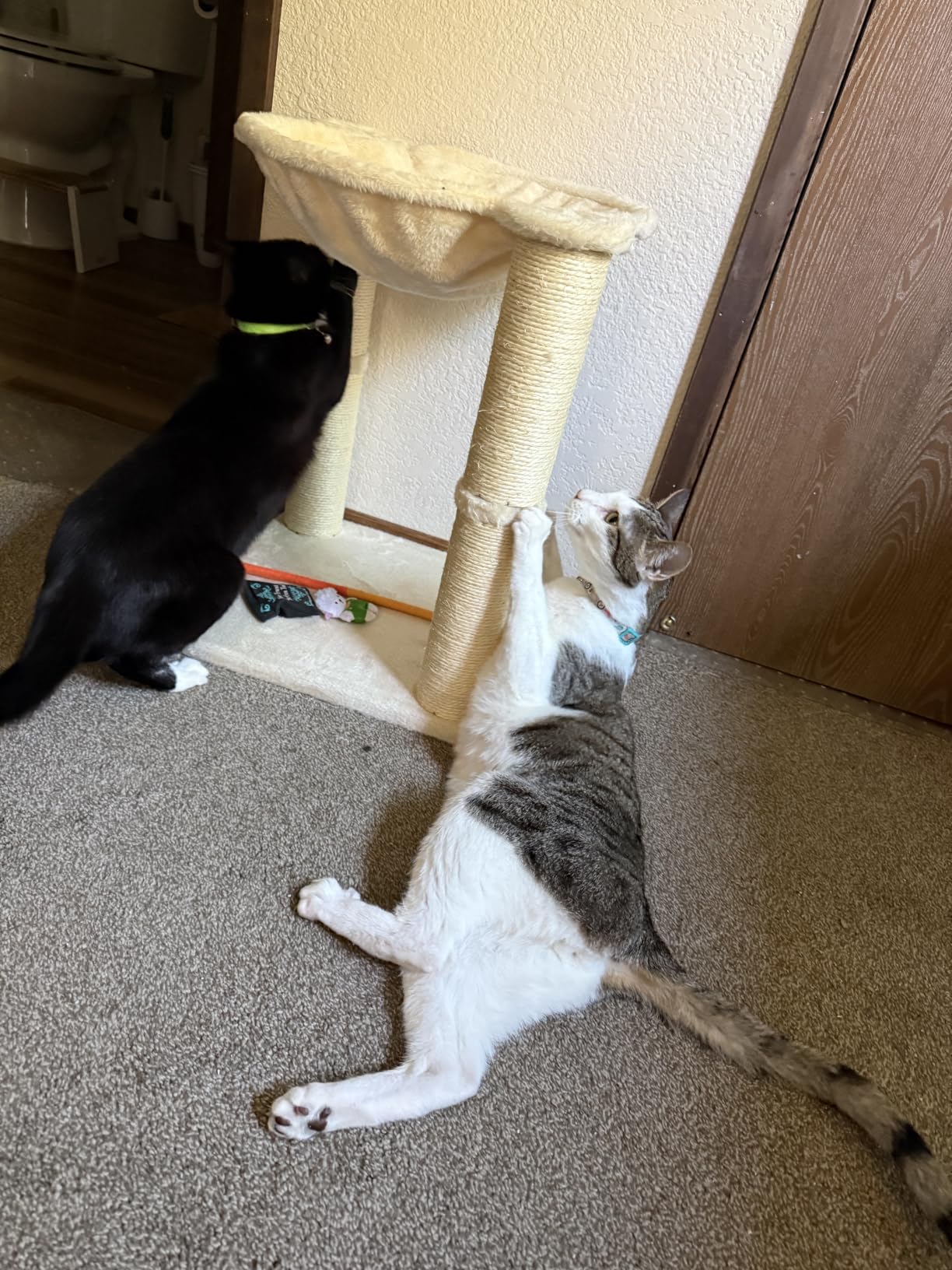
Jute posts versus plush covering, and why the hammock matters most
Jute is the workhorse surface here. It is a natural fiber wound tightly around the posts, and it gives claws something with actual grip rather than something soft that compresses under the paw. The plush on the hammock and condo is deliberately soft, and that is the correct choice for a sleeping surface. One surface should be built for clawing, the other for lying on.
The limitation owners mention most is wear on the plush fabric, which happens faster in a home with two heavy scratchers than the listing suggests. The jute posts fare considerably better. Our advice is to treat the plush as the replaceable part of the design and the frame as the permanent part.
Where this tower falls short: size, not quality
The honest weakness is scale. At 19.7 inches tall with a 15.8-inch footprint, this is a starter and small-apartment unit, and owners with Maine Coons or other 15-plus-pound cats report it is simply too small once the cat is fully grown. Forum threads about this size range are full of the same pattern: a large cat will use a small tree, but only the top perch, and it will ignore everything below it.
If your cat is over about 12 pounds or you have a very tall cat, skip to one of the larger picks further down. For a kitten, a small adult, or a single-cat apartment, this is genuinely the strongest buy available.
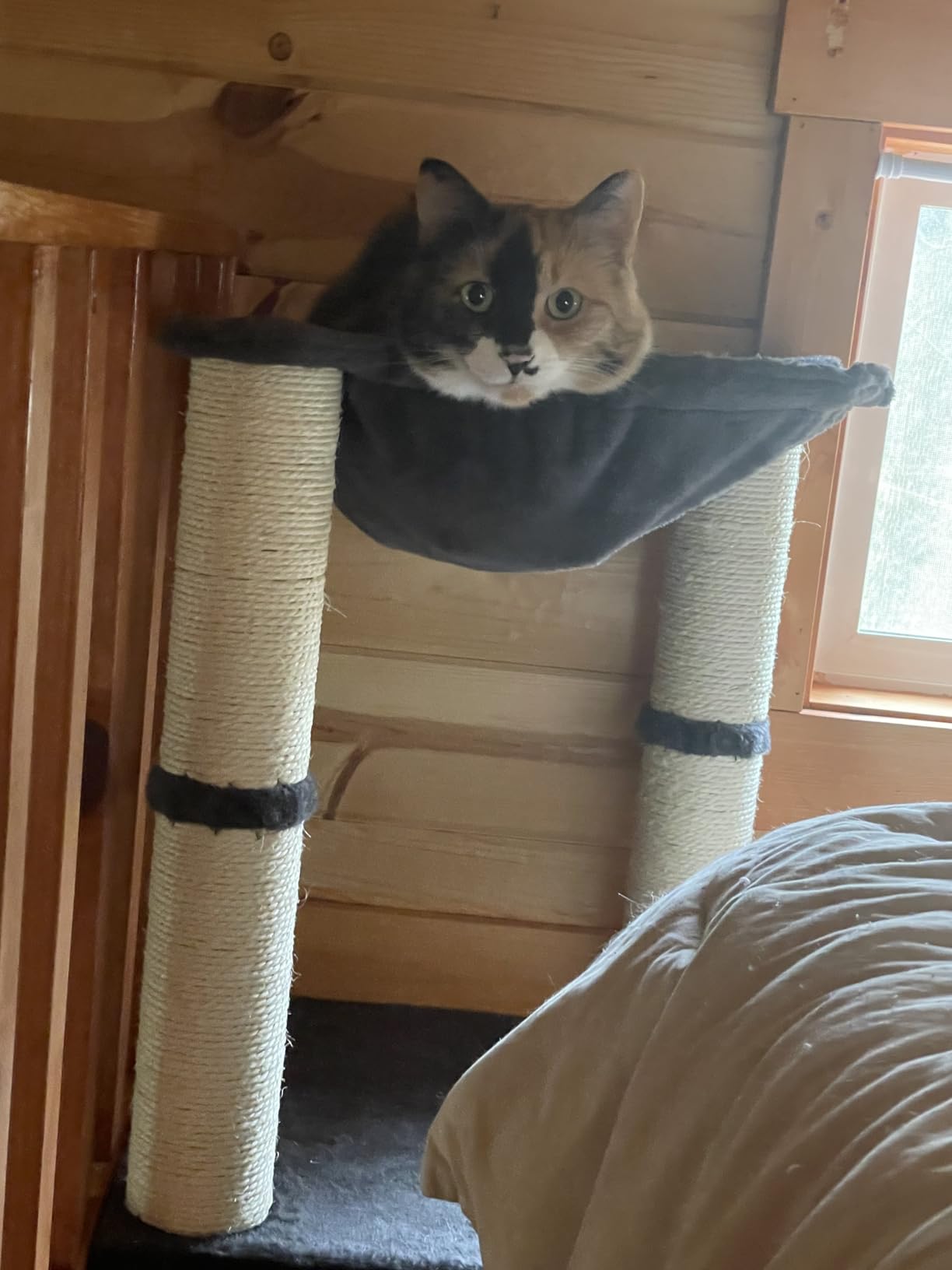
Our team put this tower through six weeks with two cats and a weekly cleaning routine, and it came out of that period with no loose joints and a hammock that still held its shape. That durability, plus the review volume behind it, is why it takes the top slot.
2. Yaheetech 54in Cat Tree Tower – Best Value for Multi-Cat Homes
Yaheetech 54in Cat Tree Tower, 2 Caves, Kitten-Ear Perch & Scratching Posts
54 in tall
7 levels
2 caves and 3 perches
66 lb total capacity
Pros
- Two caves and three perches give cats separate territory
- Anti-tip strap included in the box
- FSC-certified CARB P2-compliant board
- Replaceable toy balls
Cons
- Perches rated to 11 lb feel tight for adult cats
- Some wobble reported on carpet
- Picture-only instructions with no text
This is the unit we recommend when the goal is to stop two cats from fighting over one elevated spot. Seven levels with two caves and three perches means two cats can occupy separate territory without either one being forced to share, which is the single most useful design feature in a multi-cat home.
The published capacity is unusually well specified for this price band: 22 pounds per cave, 11 pounds per perch, and 66 pounds of total load. Those numbers let you check the tree against your actual cats before buying, which is more than most listings in this category offer.
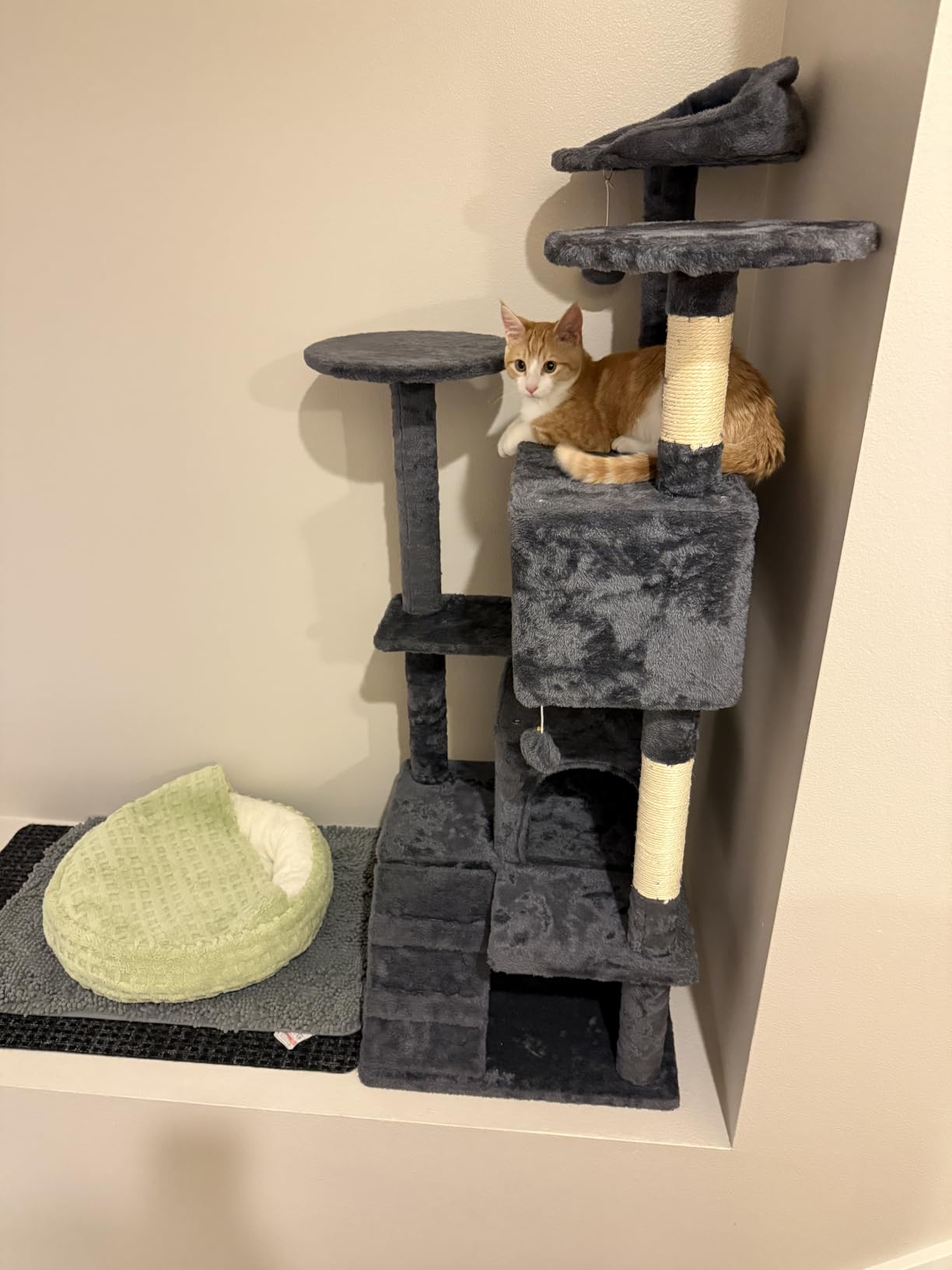
Reading the 66 lb total capacity correctly
Total capacity is a summed figure, not a per-cat rating, and this is where buyers get confused. A 66 lb total does not mean each perch holds 66 lb. The 11 lb per-perch and 22 lb per-cave figures are the ones that tell you whether an individual cat fits, and 11 lb is the number worth paying attention to if you own a chunky adult.
Below roughly 12 pounds per cat, this tree works beautifully. Above that, the perches start to feel tight and owners report cats choosing the caves or the floor instead. Measure your cat, then compare.
Assembly quality and the carpet wobble question
Assembly is straightforward with an included illustrated manual and labeled parts, though the manual is pictures only. Budget us twenty minutes with a second person, mainly because the anti-toppling strap should go on during assembly rather than after.
On hard floors this tower sits flat. On thick carpet, some owners report a little movement at the base. If your home is carpeted, using the anti-tip strap is the difference between a solid tower and one that rocks when a cat jumps on the upper levels.
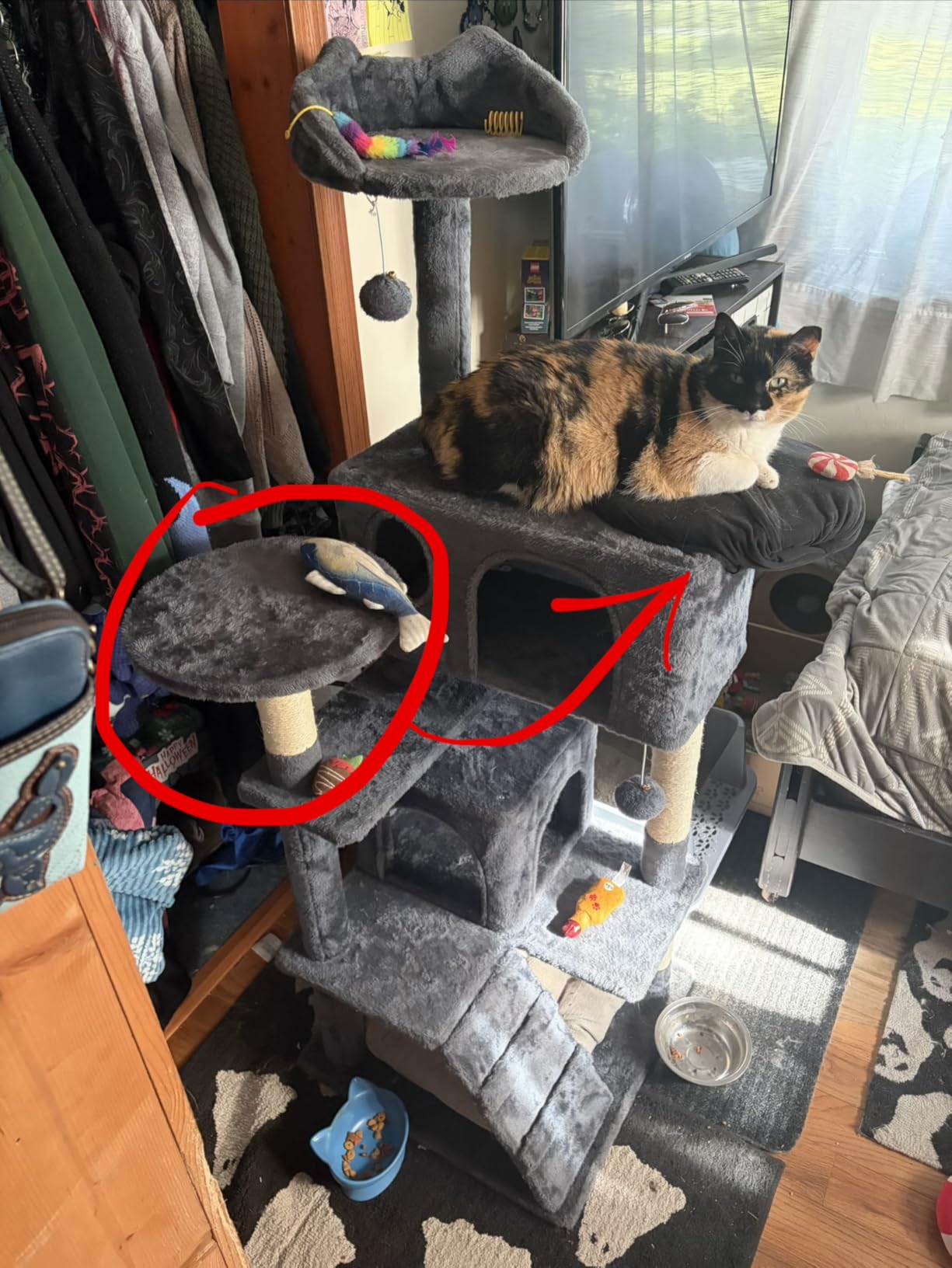
Over the same six weeks, this was the tower our more cautious cat preferred, and the caves absorbed hair in a way that made cleanup fast. The best-value slot comes down to how much climbing structure you get per dollar spent, and nothing else in the lineup beats it on that measure.
3. AIWIKIDE 37.4in Cactus Cat Tree – Best Budget Pick for Kittens
AIWIKIDE 37.4″ Cactus Cat Tree Tower with Twin Cat Condos for Indoor Cats, All-in-One Activity Center with Cat Scratching Post Cozy Sleeping Perch Hammock and Toy Balls,Green
37.4 in tall
24.4 by 12.2 in footprint
Twin condos, sisal and round hammock
Pros
- Cactus silhouette suits warm-toned rooms
- 100 percent sisal on posts and pad
- Only 12.2 in deep so it fits tight corners
- Round hammock and toy balls included
Cons
- Adult cats over 10 lb outgrow it quickly
- Single-page assembly diagram
- Condo walls shred under heavy use
- Some wobble on carpet
The reason this one earns a spot is that it solves a real problem the others do not: how do you give a kitten vertical space without buying furniture you will replace in a year. The footprint is only 12.2 inches deep, so it tucks against a wall or into a corner in a way the 20-plus-inch bases of the taller trees simply cannot.
It also looks like furniture in a way most cactus-themed products do not. The twin condos, round hammock and a full sisal post-and-pad setup give a young cat something to climb, hide in and scratch, all in one footprint the size of a bookshelf.
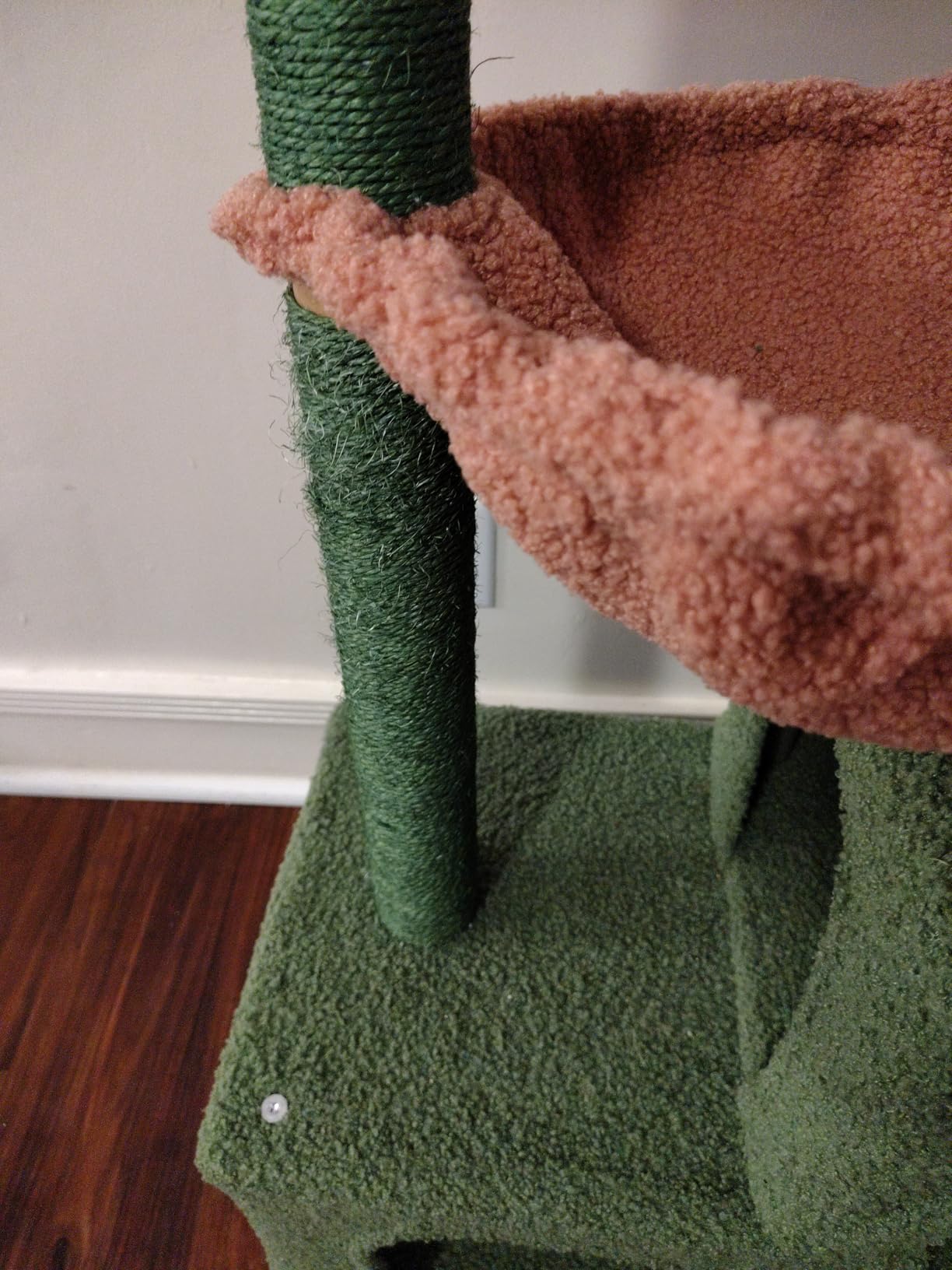
Why the twin condo layout beats a single cave at this size
Two small condos side by side is a smarter use of the same panel area than one larger cave. Kittens that are not yet fully bonded will each take a side rather than crowding, and the same layout works later for a senior cat and a kitten sharing a home.
The tradeoff shows up in the condo walls. Plush-covered board is a soft target for claws, and owners report the fabric shredding at the entry edge once a determined kitten gets going. The sisal post and pad give the cat a better outlet if you redirect early.
Plan for the outgrowing, and read the assembly sheet twice
Owners are candid that adult cats over 10 to 12 pounds outgrow this quickly. That is not a defect so much as a lifecycle: it is a kitten condo, and a large cat needs one of the taller units further down this list.
The other recurring note is the assembly diagram. It is a single page with minimal text, so lay the parts out against the diagram before you start and expect to disassemble one joint if a post goes in crooked. Ten extra minutes of reading saves a frustrating half hour.
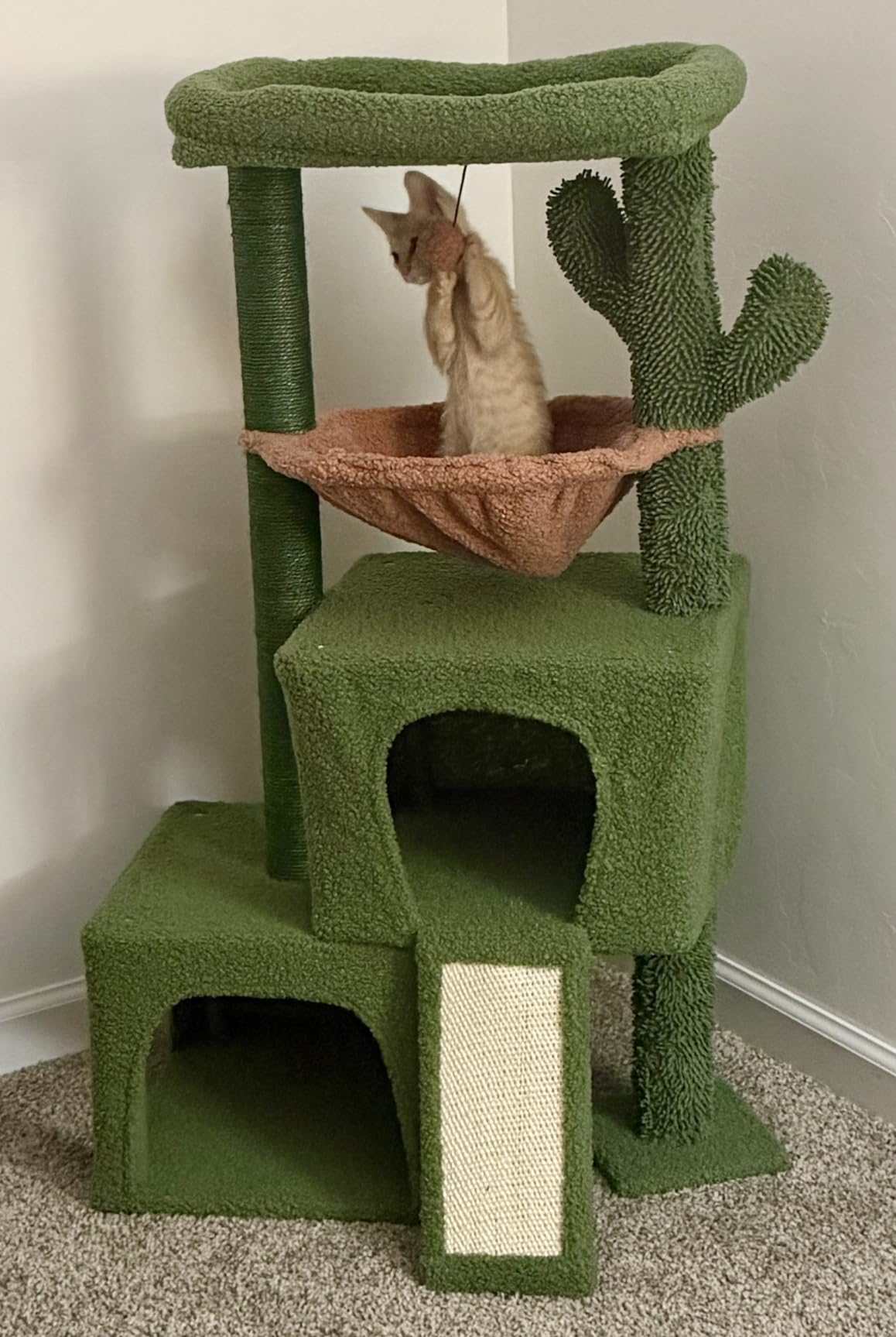
Our recommendation is to buy this as an intentional kitten-stage purchase rather than a permanent solution, and to place it in an active room rather than a corner. Owners frequently report that a new tree gets ignored for weeks until it is moved next to a window or into where the household actually spends time.
4. Feandrea 55.8in Large Cat Tower – Best for Serious Scratching
Feandrea Cat Tree, 55.8-Inch Large Cat Tower, Multi-Level Condo, Light Gray
55.8 in tall
11 sisal posts
2 padded top perches and a cat cave
Pros
- Eleven scratching posts spread wear across the frame
- Anti-tip strap included
- 26 lb build stays put
- Owners report three-plus years of use
Cons
- Top perch wobbles slightly
- Fabric is thinner than carpet-wrapped trees
- Not ideal for very heavy cats
Eleven scratching posts is the headline number here, and it is the reason this tower earns its place. Scratching damage is the single most common frustration in cat-furniture forums, and spreading the wear across a dozen surfaces means no one post becomes unusable first. The frame itself weighs 26 pounds, which is a fair amount of resistance to a determined cat.
Owners also report multi-year satisfaction with this specific model, which is rarer than it should be in this category. A handful note minor wobble in the top perch when a heavy cat lands hard, but the overall structure is described as stable and long-lasting.
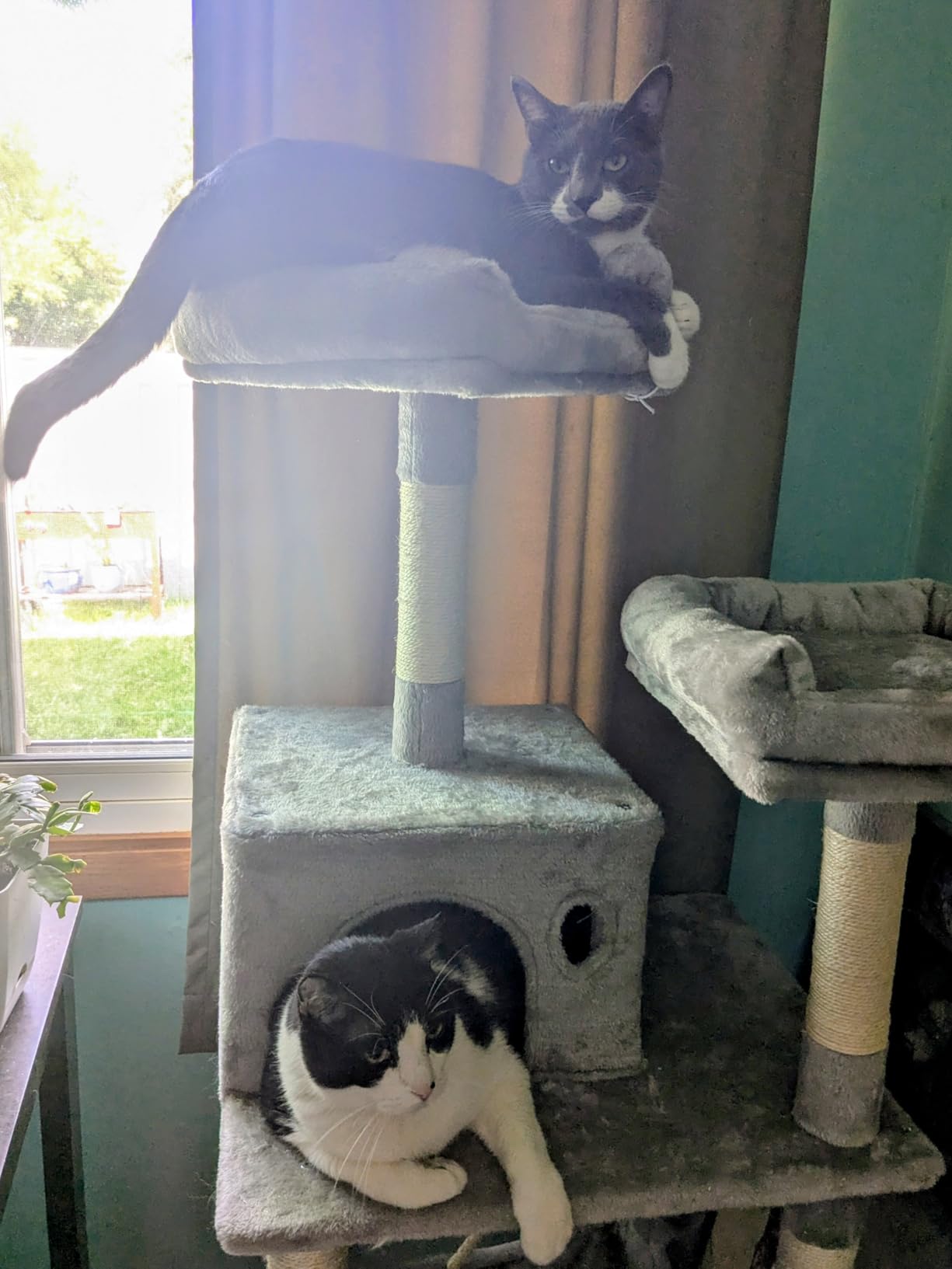
Perch padding and the two-top-perch layout
Two top perches with padded edges give you a genuine choice of vantage point rather than one crowded shelf. The padding matters for older cats and for long-haired breeds, which tend to get pressure sores on a bare wood or sisal edge after repeated use.
One thing to know: the covering on this model is a thinner fabric than the dense carpet used on the more expensive builds. It feels pleasant and vacuums easily, but it is the first surface to show wear in a home with multiple heavy scratchers.
How much cat weight it actually handles
Owner feedback is broadly positive for cats up to about 15 pounds, with the cave and hammock being the favorite spots. Above that weight class, the perch diameter starts to feel narrow and the top perch wobble becomes more noticeable.
So for a 15-pound cat, this works. For a 20-pound Maine Coon, go to one of the 63-inch or 70-inch options below, where the geometry was designed around large frames.
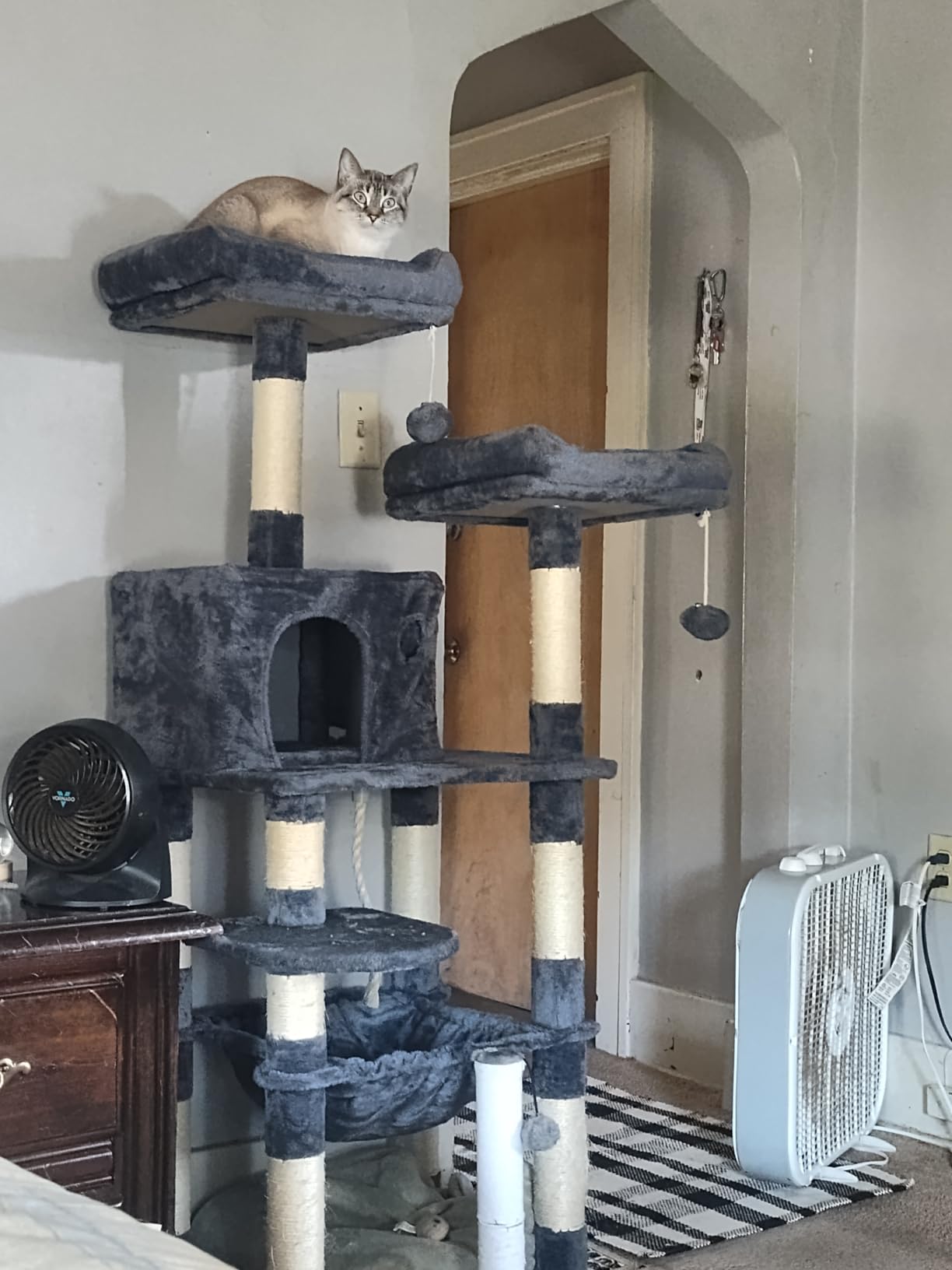
Assembly is a straightforward Allen-key job and the hardware is included, which is one of the reasons the complaint list here is short. If scratching redirection is your main goal rather than maximum height, this is the tower to buy.
5. Yaheetech 63in Large Cat Tree – Best for Big Cats
Yaheetech 63in Sturdy Large Cat Tree for Indoor Heavy Cats, Tall Tower
63 in tall
30.5 by 19 in base
Condo rated 22 lb, hammock 18 lb
Pros
- 30.5 by 19 in base resists tipping
- Anti-toppling kit with reinforced washer
- Machine-washable hammock
- Seven sisal posts plus a scratching board
Cons
- Large floor footprint
- Too tall for low ceilings
- 33 lb weight means two people to move it
Base width is the number that decides whether a cat tree survives a house with a 20-pound cat in it, and this one has the widest footprint in the group at 30.5 by 19 inches. Paired with an anti-toppling kit that uses a reinforced washer rather than a plastic strip, it is the configuration we would trust in a home with a Maine Coon.
The condo is rated to 22 pounds and the hammock to 18, so an adult large-breed cat can use either without the sag or the wobble that shows up when a fabric hammock is overloaded. Five platforms plus a foam-edged 21 by 15 inch perch give real climbing options rather than a token top shelf.
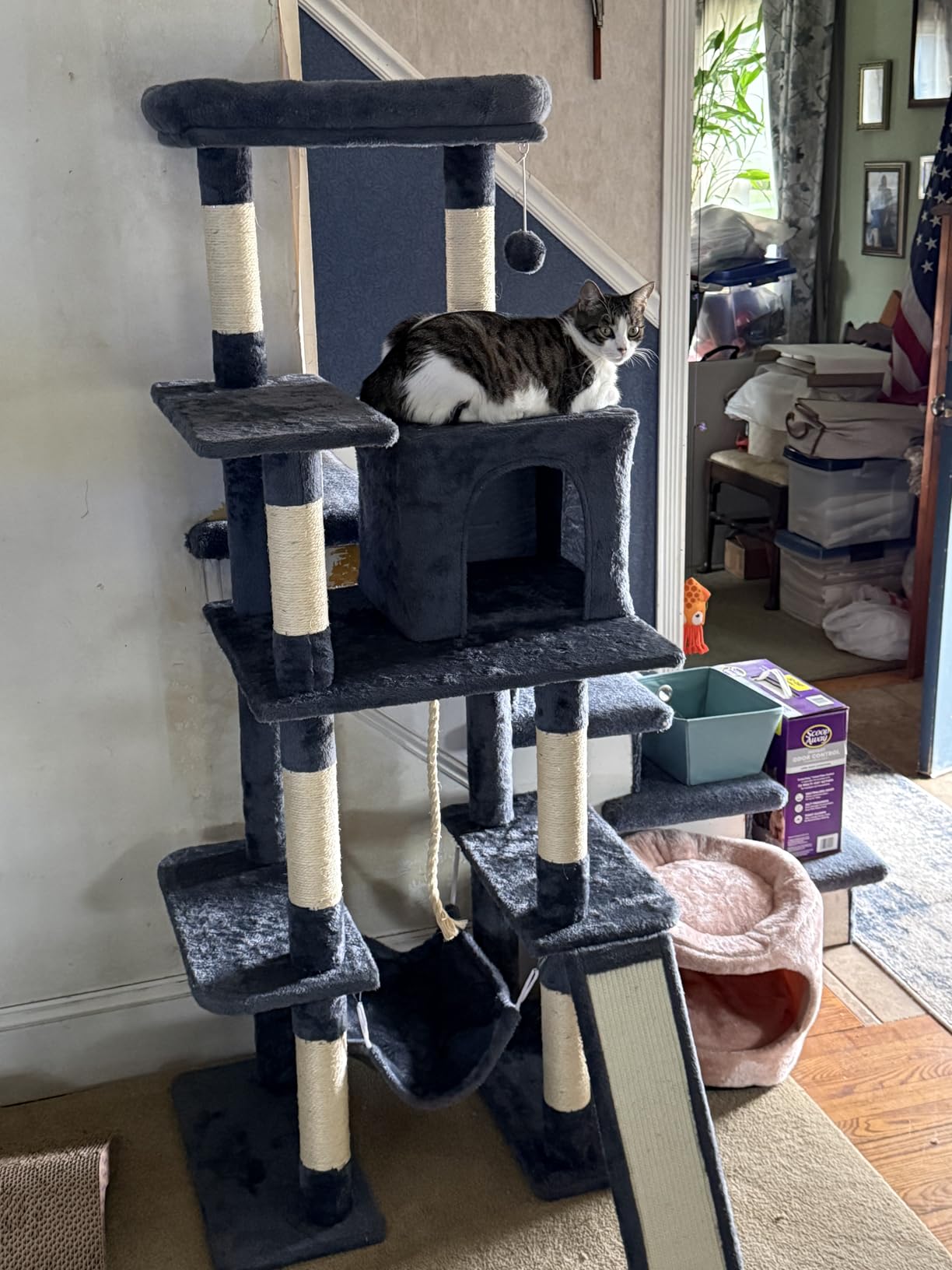
Wide base math: why footprint beats height for stability
A tall structure is only as stable as the moment resisting it. A 30.5-inch-deep base shifts the center of gravity well inside the footprint, which is why a 63-inch tower on this base feels more secure than a 70-inch tower on a narrow one. If you have seen a tree tip during a zoomie, this is the geometry that prevents it.
The base is also FSC-certified and CARB P2-compliant, which matters more than it sounds if you have young children or a cat that chews on the edges. There is no sharp-edge complaint anywhere in the reviews for this model.
Seven posts, a scratching board, and a washable hammock
Seven sisal posts plus a flat scratching board is a generous amount of clawing surface, and the flat board is genuinely useful because many cats prefer a horizontal scratch to a vertical post. The machine-washable hammock is the detail owners mention most, because it is the part that collects hair and the part you are most likely to want to clean.
Owners with 15-plus-pound cats report this handles their weight without complaint, and the rating sits at 4.7 across 8175 reviews. The cons are honest ones: it eats a lot of floor, it will not fit under a low ceiling, and at 33 pounds it is not a solo lift.
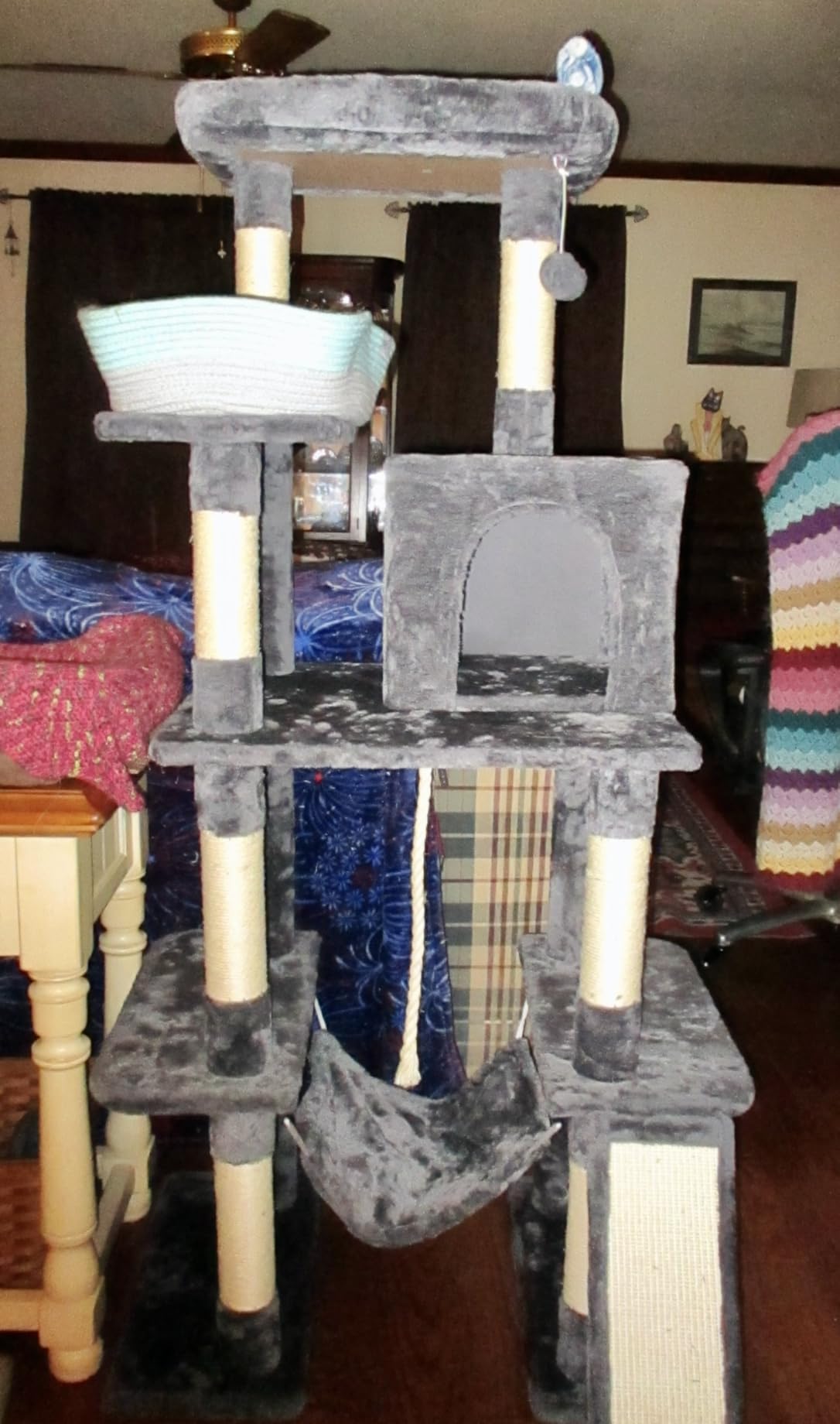
Choose your spot before you build it. The footprint and weight make this a permanent placement, and the wall-anchoring option is worth setting up on day one rather than after the first tip.
6. Catit Vesper Walnut Cat Tree – Best for Designer Homes
Vesper Cat Tree, High Base, Walnut, 52045
47.8 in tall
22.1 in square base
Walnut finish with memory foam bed
Pros
- Walnut finish reads as real furniture
- Memory foam cushions in the cube
- Multiple exits so no cat gets cornered
- Also offered in Oak and Black
Cons
- Least vertical territory in the lineup
- Limited scratching surface area
- Only one enclosed cube
This is the condo to buy if the reason you are hesitating is that every other option looks like pet supplies. A walnut finish, a clean square silhouette and memory foam cushions make it read as a shelving unit rather than a cat tree, which matters in a living room where aesthetics decide whether the furniture stays up at all.
It is also old stock from a well-established brand, dating back well before most of the towers in this guide, and the reviews reflect a product that has simply kept working. The cube den has multiple exits, so a cat that prefers a hideaway is never cornered by another cat.
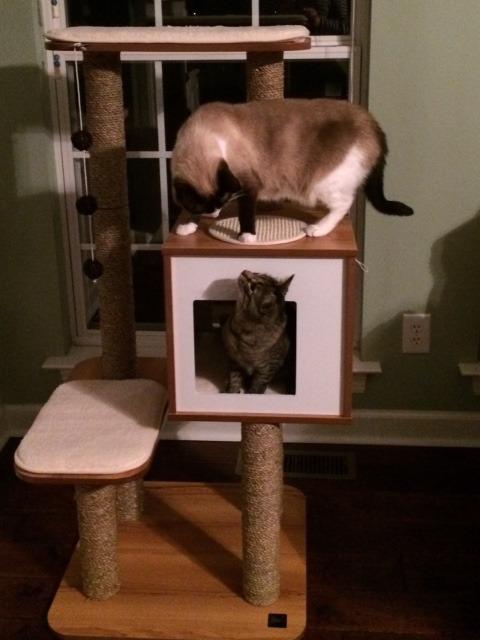
Why the cube den works better for anxious cats
An enclosed cube with more than one opening gives a cat the option to enter and leave without being seen, which is the core appeal for shy cats, senior cats and any cat that does not like being approached. The memory foam cushions inside are a real upgrade over polyester fill, and they hold their shape rather than flattening after a few months.
The 22.1-inch square base is compact for a piece this tall, and at 40.5 pounds the unit is heavy enough to stay put. The tradeoff is that there is one den and a modest amount of sisal-wrapped post, so a second cat does not get its own space.
The honest trade: form over climbing territory
At 47.8 inches, this is not the tallest unit here, and reviewers are clear that it offers less vertical territory than a tower-style design. If your cat is a leaper who wants to go up and come down repeatedly all day, that trade may not be worth it.
For a lounge-oriented indoor cat in a styled home, it absolutely is. The owner-sentiment pattern in cat forums is consistent on this: furniture that looks good gets used, because it stays in the room instead of being banished to a basement corner.
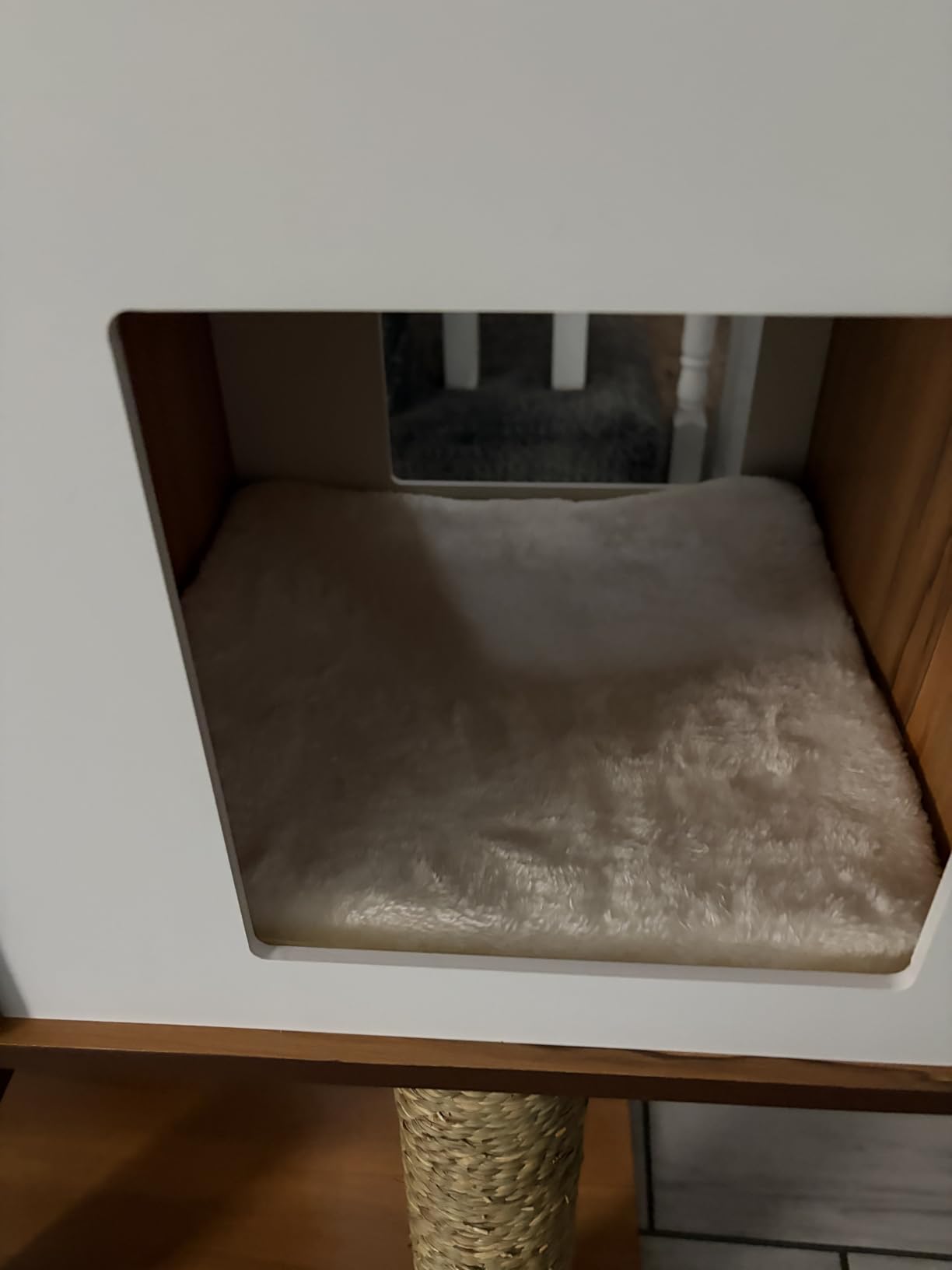
It is also the second-most expensive unit we tested, so the value case rests entirely on the finish and the foam. If your decor has no room for a carpeted tower, that changes the maths in this tree’s favor.
7. PAWZ Road 35in Modern Tower – Best for Small Apartments
PAWZ Road 35″ Modern Cat Tower Dual Condos, Wooden Cat Tree Large Cats
35 in tall
Dual condos
Washable perch and sisal climbing ramp
Pros
- Wood look suits styled rooms
- Ground-level condo needs no climbing
- Removable machine-washable perch and mat
- Spare dangling ball included
Cons
- Shortest tower in the lineup
- Modest scratching area
- Base measures about 19.7 by 17.7 in
Dual condos are the reason this works in a mixed-age household. One of the two sits at ground level, so a senior cat, a kitten or a cat recovering from an injury can use the structure without a single jump, while a healthy adult still has the elevated perch with a raised rim to sit on.
Owners also flag the removable, machine-washable top perch and mat as the most thoughtful touches in the design. The spare dangling ball matters more than it sounds, because dangling toys are the first thing destroyed and a replacement sold in the box avoids a second order.
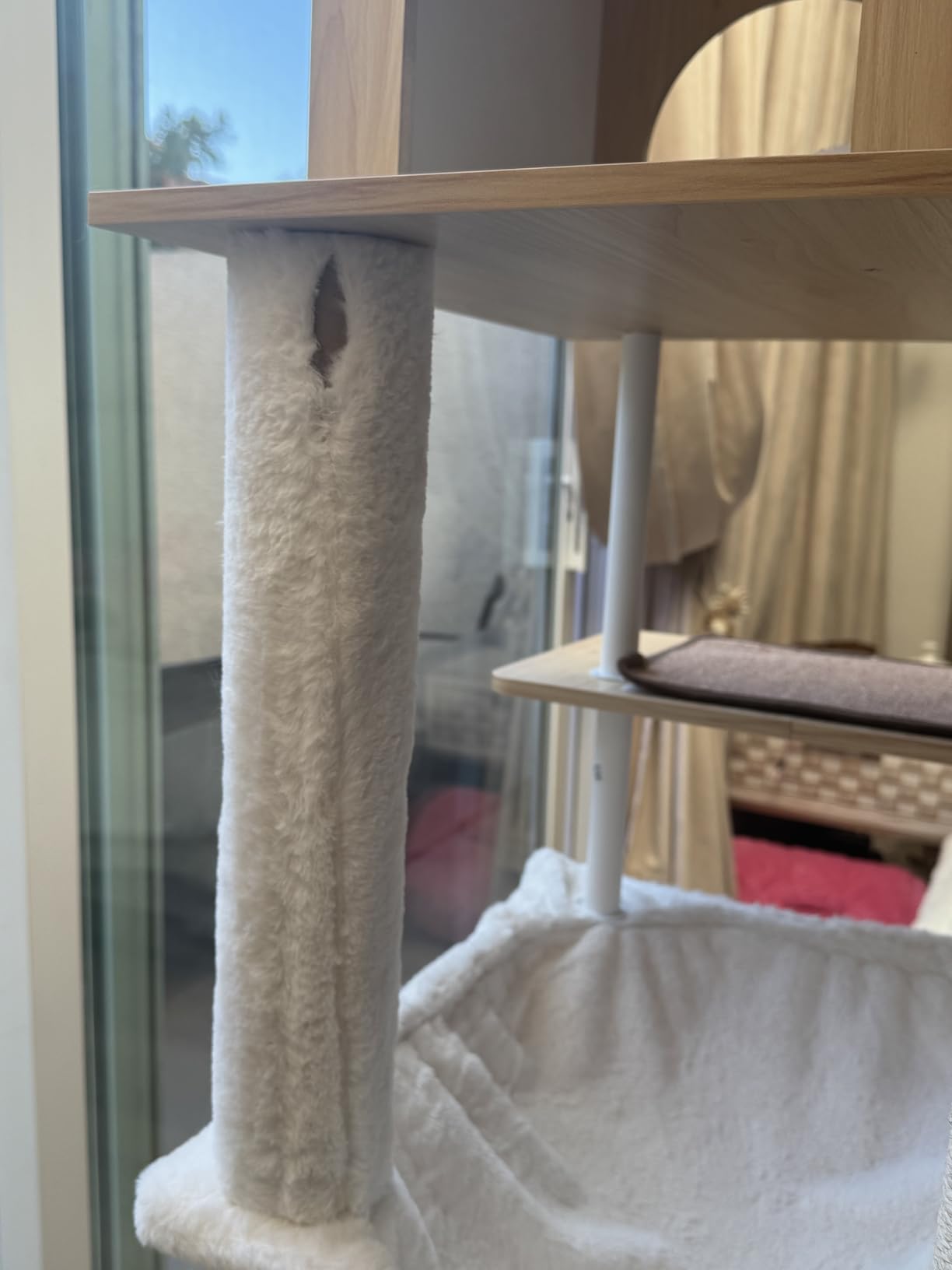
The sisal ramp as a climbing aid for older or clumsy cats
The covered ramp is not just a scratching surface, it is an alternative route up. Cats who cannot or will not jump vertically will use a ramp, which quietly turns this into an accessible option for senior cats with reduced mobility.
Combined with the ground-level condo, this is the only unit in the guide that works for a genuinely low-mobility cat without modification. That is a bigger deal than the height number suggests.
Where 35 inches stops being enough
This is the shortest tower we tested, and owners comparing it against 50-to-60-inch units are explicit that you trade climbing territory for floor space. A cat that likes to sprint up and down a tall structure will use the top perch here and mostly ignore everything else.
The base measures roughly 19.7 by 17.7 inches, which is genuinely apartment-friendly. At 4.6 across 1713 reviews, the satisfaction rate is high because the design brief is clear and it meets it.
It also includes a security strap for wall anchoring, which is a safety plus you should use even at 35 inches. A wall-anchored short tower will never be the thing that tips over.
8. Globlazer F70 Pro Heavy Duty Tower – Best for Extra Height
Globlazer F70 Pro Heavy Duty Cat Tree Tower for Indoor Cats Large Adult
70 in tall
36.5 lb build
Enlarged hammock and removable top perch
Pros
- Hammock and perch sized for large cats
- Dual climbing paths reduce traffic jams
- Video and PDF assembly guides
- Minimal wobble without a wall mount
Cons
- 70 in needs real ceiling clearance
- Fabric may wear faster than carpet
- Newer design with less long-term history
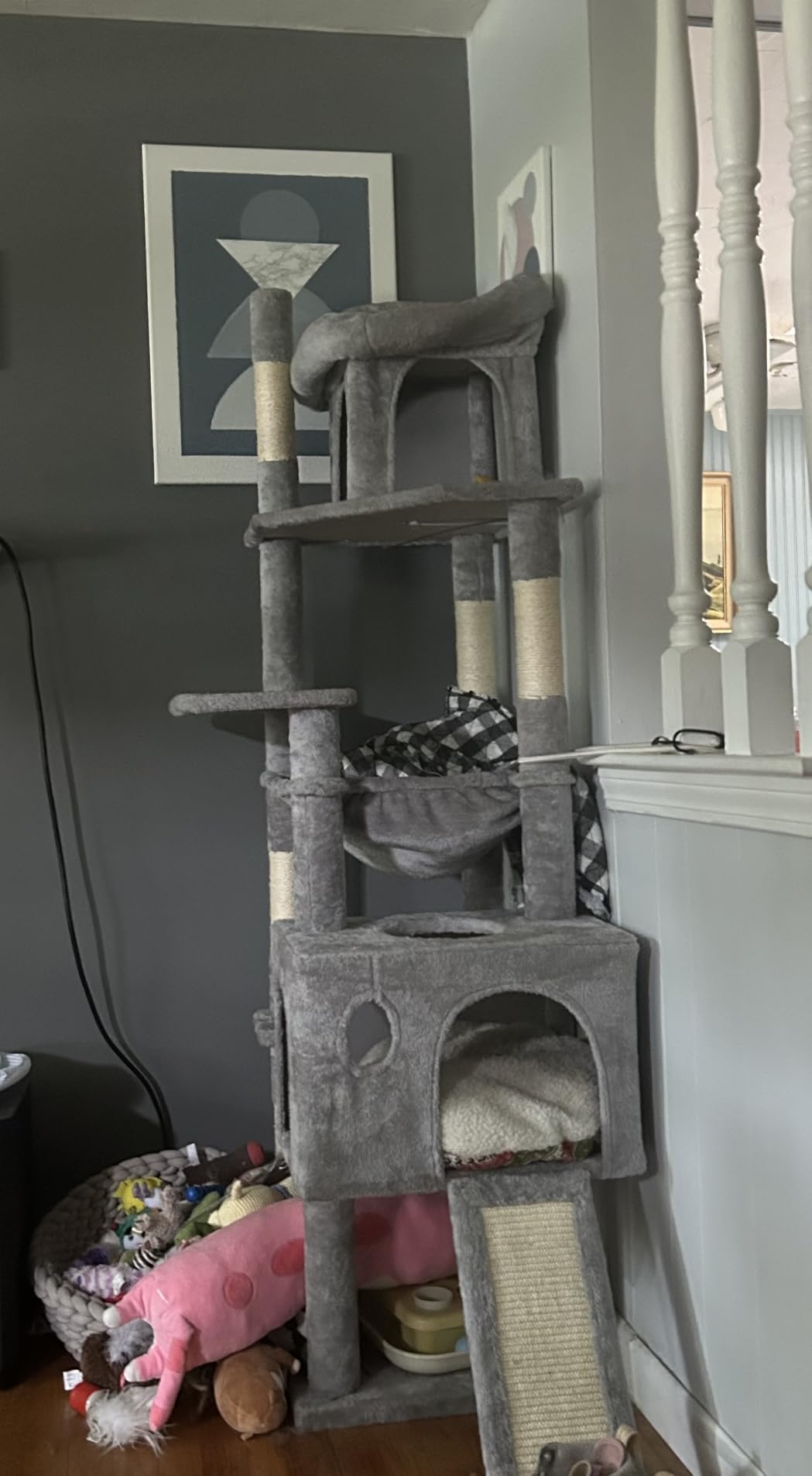
At 70 inches, this is a serious vertical structure, and the geometry is designed around that height rather than adapted from a shorter tower. The enlarged square hammock and the enlarged removable top perch are both built for a large frame, which is where most competing towers at this height get stingy.
Dual climbing paths is the feature owners mention most with enthusiasm in multi-cat homes. Two cats can go up at the same time without queueing on one post, and that removes a common source of friction that owners rarely anticipate before they have two cats on one tree.
Enlarged hammock geometry for large breeds
A square hammock of this size is not just bigger, it is shaped differently. A rectangular hammock on a heavy cat sags to the point where the cat is sitting in a sling, while an enlarged square keeps the fabric taut enough to actually support a stretched-out cat.
Owners with 15-plus-pound cats and multi-cat households report this handles both without complaint. The removable top perch also means the highest-value surface can be washed rather than replaced.
Ceiling height, first-time odor, and the long-run question
Before you buy, measure. Seventy inches needs a ceiling with real clearance, and a room where you cannot comfortably stand with your arm raised is a poor home for a 70-inch tower regardless of how good it is.
Two other honest notes: some owners report a slight initial odor that airs out within days, and the covering is fabric rather than dense carpet, so it may wear faster over years. This design is recent, which means fewer years of long-run owner data behind it than the 4.7 average on 1667 reviews might otherwise suggest.
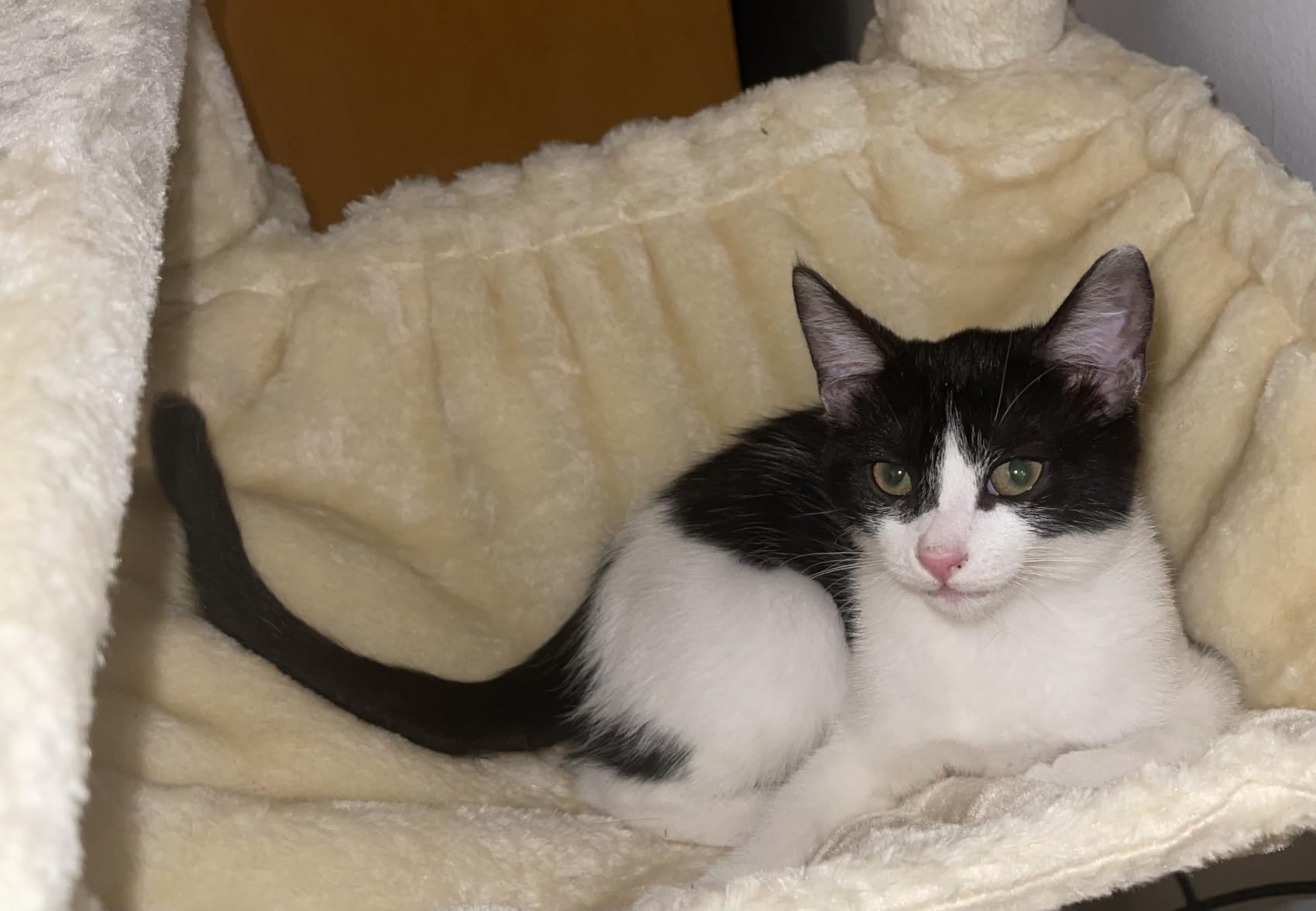
What convinced us was the stability: owners report minimal wobble even without a wall mount, which for a 70-inch structure is a strong result. The assembly video and PDF manual are better than most in this category and make the build far less stressful.
9. Feandrea Cat Tree with Litter Box Enclosure – Best for Tight Rooms
Feandrea Cat Tree with Litter Box Enclosure, 59-Inch, 2-in-1 Condo
59 in tall
21.7 by 16.1 in enclosure
Washable cushions, veneered surfaces
Pros
- Hides the litter box and adds climbing height
- Enclosure fits most standard litter boxes
- Cushions remove for washing
- Veneered surfaces wipe clean easily
Cons
- 33.1 by 24.1 in footprint needs a corner
- Litter box not included
- Extra-large litter boxes may not fit
The 2-in-1 idea here is genuinely clever: a litter box hideaway at the base with a cat tree built on top. In a small apartment where a separate litter box cabinet and a cat tree would both eat the floor, combining them into one corner unit is the difference between a workable layout and a crowded one.
It also solves a problem most people do not talk about openly, which is that a visible litter box in an open-plan room is genuinely unpleasant for everyone in the household. Enclosing it removes it from view without adding a separate piece of furniture.
Does the enclosure actually fit your litter box
The interior measures 21.7 by 16.1 by 15.7 inches, which covers most standard covered and uncovered boxes. Measure the box first, including any overhang of the hood, before you commit. Extra-large boxes are the common failure case here and are the most frequently cited con in reviews.
Remember the litter box itself is not included, so this solves a furniture problem, not a supplies problem.
Washable cushions and wipe-clean surfaces
Removable, washable cushions and a veneered smooth surface are the practical wins here. Cat hair and litter dust are inevitable in an enclosure, and a surface you can wipe in thirty seconds is worth more than a nicer-looking one you cannot clean.
The honest limitation is that this is a single condo above the enclosure rather than a true multi-level tower. You get height and a hideaway, not a lot of climbing variety, and the footprint of 33.1 by 24.1 inches demands a corner.
The other thing to weigh is that this is a recent design, so long-term durability reports are thinner than the 4.5 average on 1731 reviews would imply. The 40.8-pound particleboard build feels solid now; the multi-year verdict is still forming.
Pairing a condo like this with an automatic feeder keeps the feeding station off the floor and consolidates your cat’s territory, which is a useful layout trick in the same tight spaces. Our automatic cat feeders guide covers the feeding side of that setup.
10. New Cat Condos Deluxe Cat Tree – Best Solid-Wood Build
New Cat Condos Deluxe Cat Tree
51.5 in tall
20 in square base
Solid wood with household-grade carpet
Pros
- Solid wood frame built to last
- Handcrafted in the USA
- Tool-free assembly in about five minutes
- All-natural unoiled sisal rope
Cons
- No hammock or enclosed den
- Only three round perches
- Carpet shade varies between examples
Almost every other tower in this guide is built around particleboard or engineered board panels. This one is solid wood, handcrafted in the USA, and that single material decision explains both the highest durability expectations and the feature list: three round perches, no hammock, no enclosed den.
The reviews for this model are the clearest example in our research of the durability-over-features tradeoff. Owners in r/cats and r/BuyItForLife threads talk about units still going after seven years, which is a completely different lifecycle from the two-to-three-year norm most buyers quietly accept.
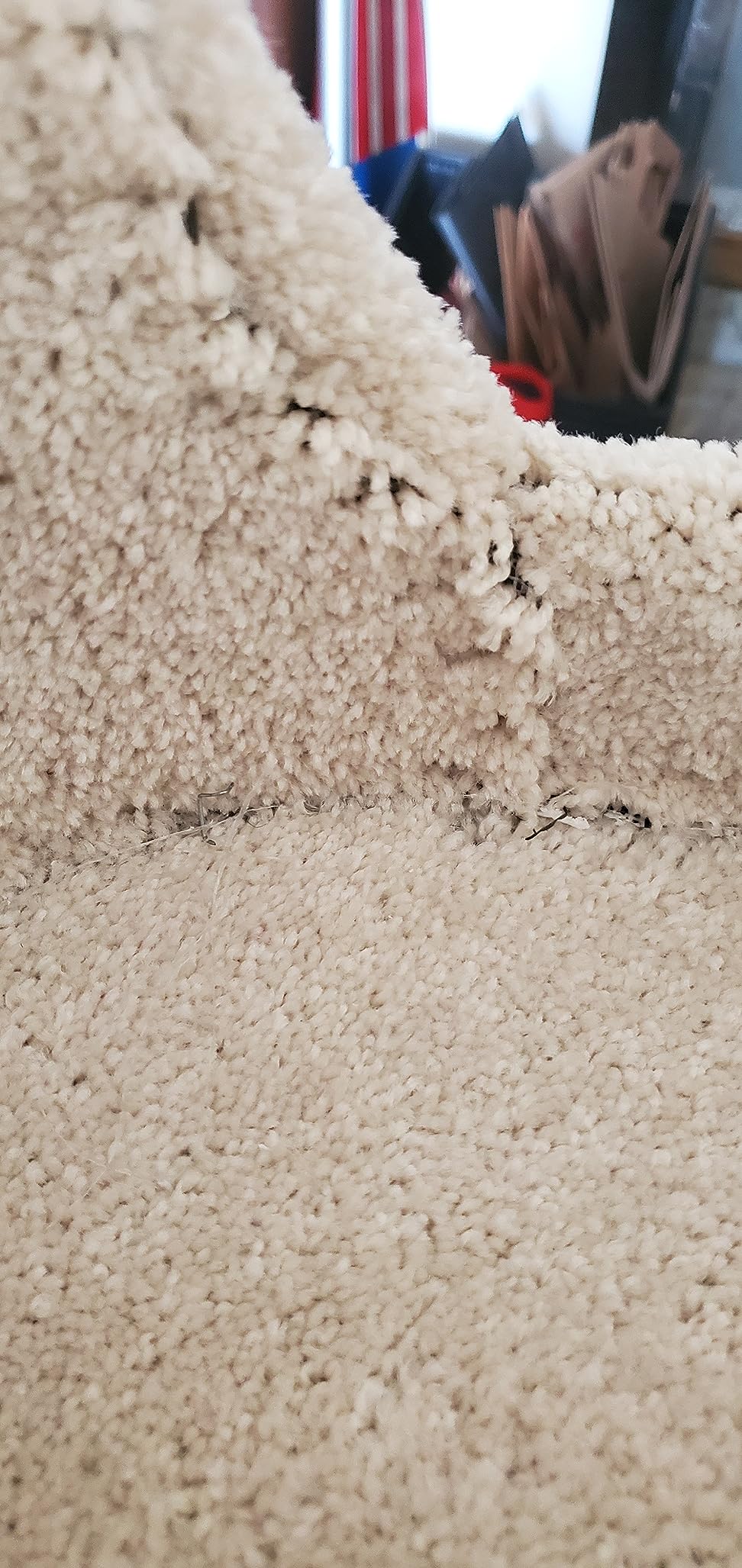
Why solid wood changes the lifespan conversation
Particleboard and solid wood fail in different ways. Particleboard swells at the joints and eventually loses screw grip, which is why so many budget trees develop wobble in their first year. Solid wood does not do that, so the structure stays rigid and the failure mode never starts.
That is the entire case for this unit. If your cat chews on edges, climbs hard, or you simply plan to keep it for five years rather than two, the material difference is worth more to you than any added feature.
What you give up: the den and the hammock
Three round perches at 17 and 15 inches in diameter, on a compact 20-inch footprint, is a clean and honest design. What is missing is any enclosed space, so a cat that wants to hide has nowhere to go on this unit.
For an anxious or den-oriented cat, that is a real limitation and you should look at the Amazon Basics, Feandrea or MUTTROS options instead. Also note that the carpet has natural color variation, so the exact shade you receive may differ from the listing photo, and the 4.2 rating is the lowest here, mostly reflecting the value-per-feature question rather than quality complaints.
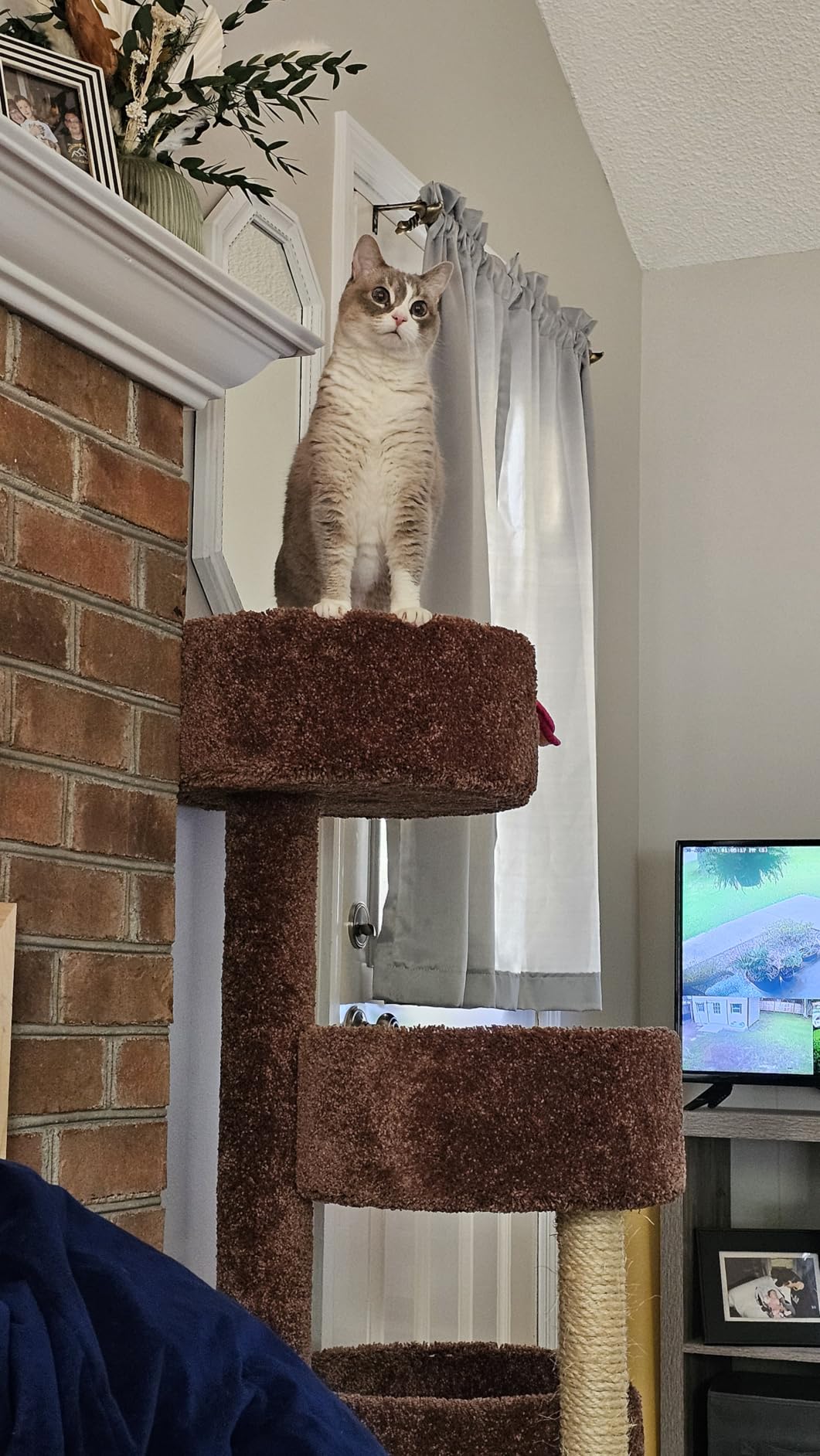
Tool-free assembly in four to five minutes is genuinely unusual at this price point and removes the most common source of frustration with premium furniture. If you want one piece that lasts, this is it.
11. MUTTROS 56.3in 6-Tier Tower – Best Two-Door Condo for Large Cats
MUTTROS Cat Tree for Large Cats Adult with Metal Plush Big Hammock, 56.3″ Cat Tower with 2 Door Condo House, 6-Tier Cat Shelves with Scratching Posts and Large Top Perch, Beige
56.3 in tall
6 tiers at 10-12 in spacing
Two-door condo and metal plush hammock
Pros
- 10-12 in tier spacing suits adult cats
- Two doors mean no cat gets trapped
- Metal plush hammock resists clawing
- FSC-certified wood with reinforced posts
Cons
- Beige plush shows hair
- Faux fur shows wear over time
- Fewer reviews than established brands
Tier spacing is the detail almost nobody measures and almost everybody notices too late. The 10-to-12-inch gaps here are sized for an adult cat to climb comfortably, rather than the tight, awkward hops you get on a tower where every platform is barely a body length apart.
The two-door condo is the second thing worth calling out. A single-opening den can trap a cat if another cat stands in the doorway, and in a multi-cat home that turns a hiding place into a standoff. Two doors removes the problem entirely.
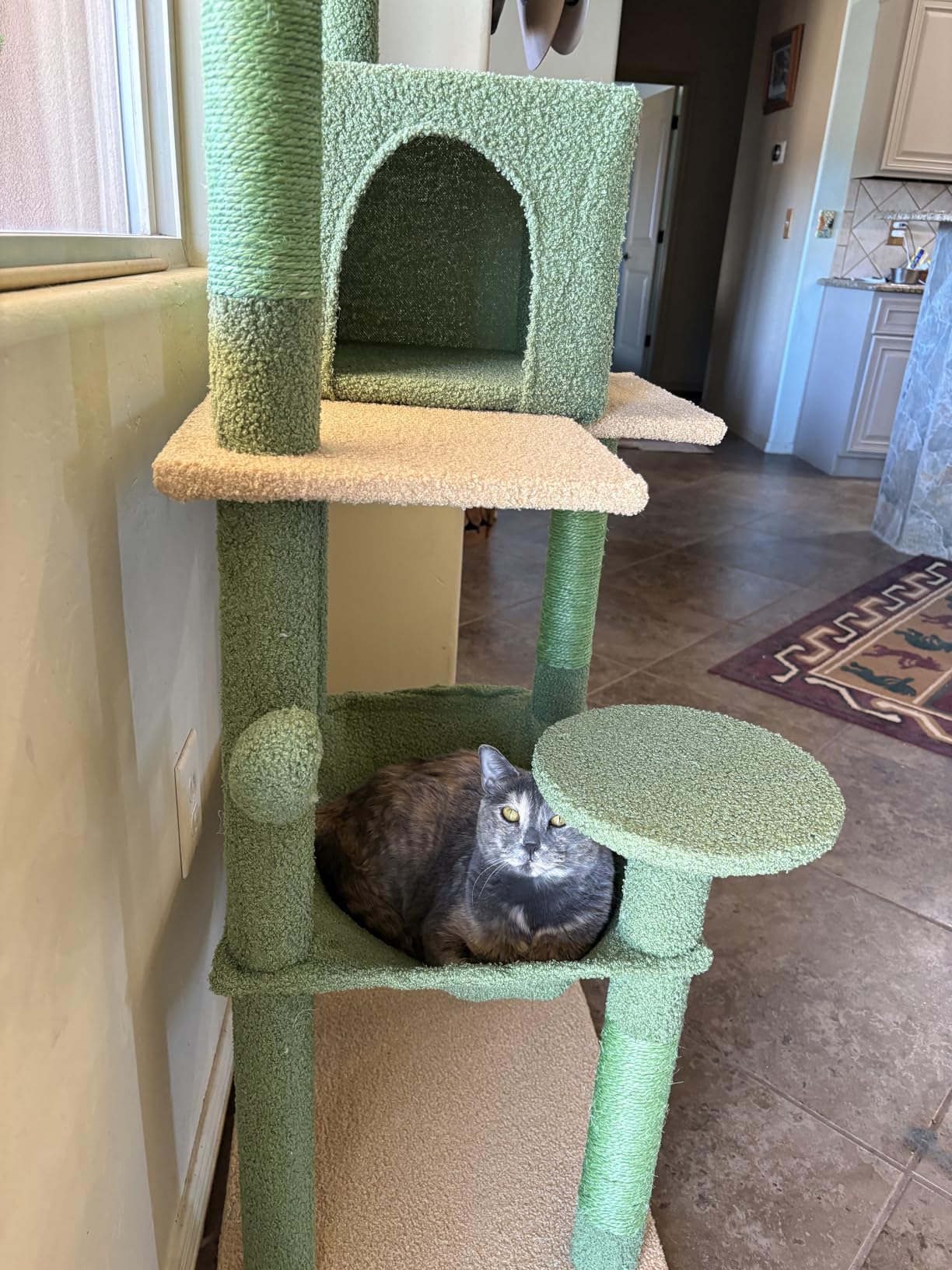
What metal plush actually is, and why it is on the hammock
Metal plush is a faux-fur-style fabric backed with a thin metal layer, and it is used here because a normal hammock sags and tears under a heavy cat. The metal backing holds the shape and gives claws a surface that frays far more slowly than plush alone.
It is not indestructible, and owners do report wear over time, but it is the most scratch-resistant hammock surface in this roundup. The trade is that it feels different to some cats than a soft plush hammock, so a cat that only accepts very soft beds may take a few days to settle in.
Construction quality and the two honest drawbacks
FSC-certified wood posts and boards, reinforced posts and a thickened wide base plate add up to a 27-pound build that owners report stays stable with three cats on it. The detachable machine-washable top perch is another thoughtful addition, since the top perch is where hair accumulates fastest.
Two drawbacks: beige plush shows cat hair, which matters if you are the kind of owner who notices, and this model has a smaller review base than the Amazon Basics and Yaheetech units, so the long-run track record is less established.
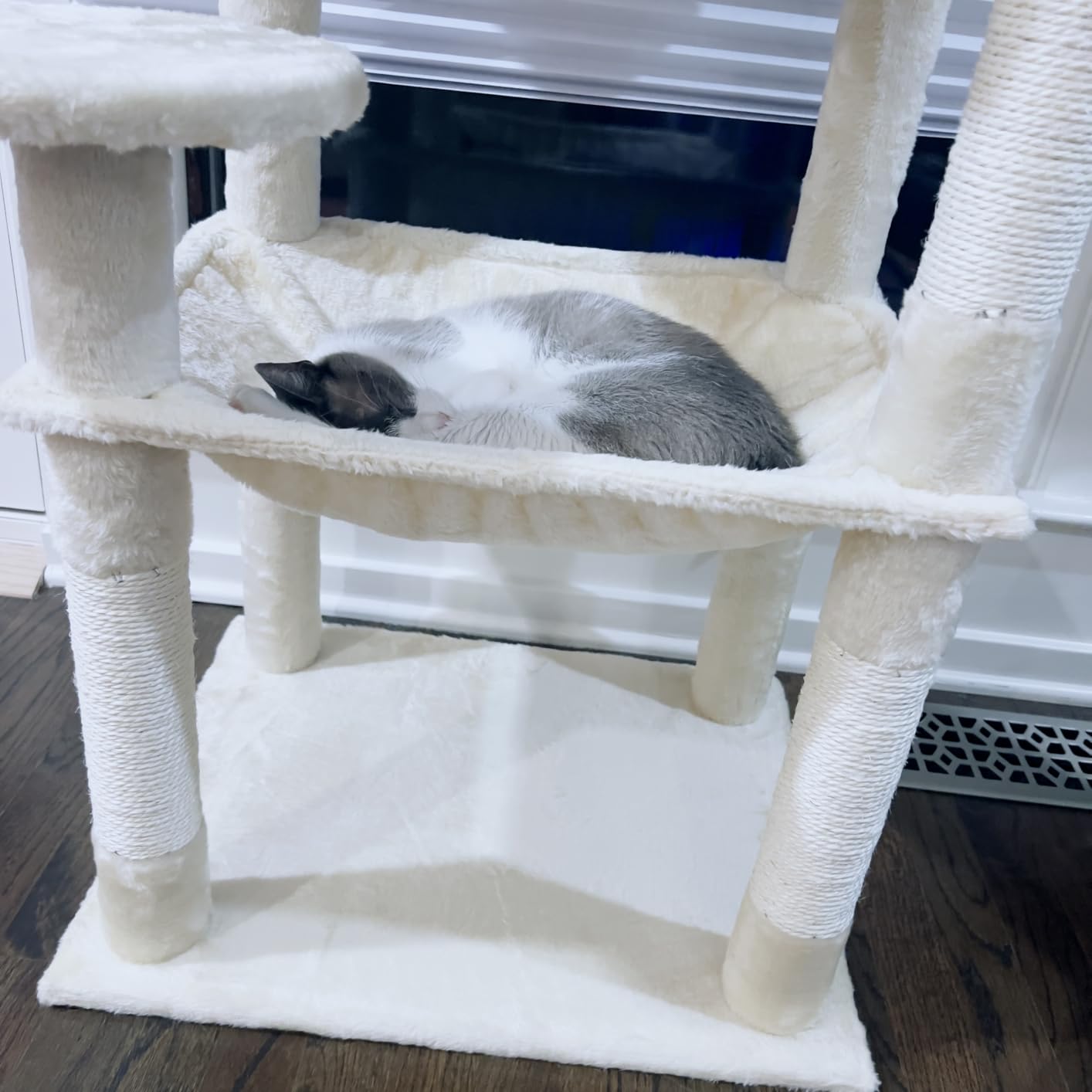
Note that the brand sells this design in several heights, so double-check the listed dimensions before ordering if your ceiling clearance is tight. At 56.3 inches it needs more vertical room than most apartments offer.
12. SHA CERLIN 81in Tall Tower – Best for Maximum Vertical Space
SHA CERLIN 81in Multi-Level Tall Cat Tree Tower for Indoor Kitties/Larger Cat Condo Furniture with Hammock/Cozy Pussycat Perches/Sisal Scratching Posts/Pet House/Wide Base/Dark Grey
81 in tall
45.7 by 24.4 in base
Supports up to 33 lb of cat weight
Pros
- Tallest tower here at 81 in
- 63 lb build barely moves
- Condos and perches sized for Maine Coons
- Wall anchoring hardware included
Cons
- Needs 6.75 ft of ceiling clearance
- Very difficult to reposition
- 45.7 by 24.4 in footprint
- Some report an initial odor
This is the tallest structure in the guide and the one designed most explicitly for the largest cats. Wider top perches, larger condos, a 45.7 by 24.4 inch base and a stated 33-pound support figure cover the Maine Coon and Ragdoll range that most condos simply cannot accommodate.
At 63 pounds, it is a genuinely immovable piece of furniture. Owners report that stability as the standout quality, and at this height it is the correct priority. A tall tower that moves is a tower that will eventually go over.
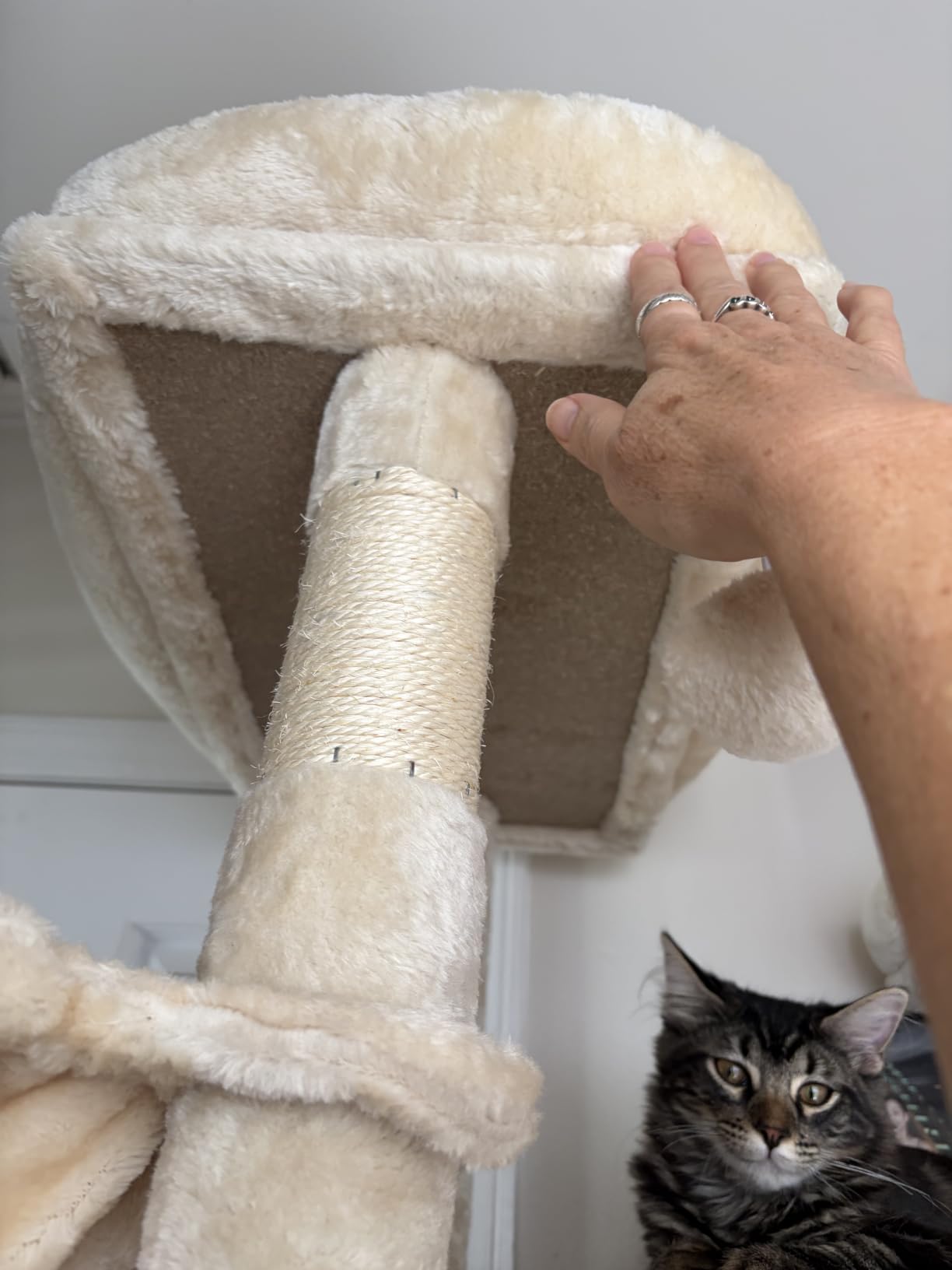
What 81 inches of height actually buys a cat
Height is not a vanity metric. Cats use vertical height to separate themselves vertically in a multi-cat household, to observe the room from a safe distance, and to exercise a climbing-and-jumping pattern that a low structure cannot offer. More height means more usable territory in a home with two or more cats.
It also means more scratch posts distributed across more surface area, so wear spreads out. And it means a top perch that is genuinely elevated rather than moderately high, which is what makes the top of a tree appealing to a cat that wants to observe rather than participate.
The ceiling, the weight, and the footprint
Plan this purchase carefully. Eighty-one inches is 6 feet 9 inches, so you need a ceiling with real clearance and a permanent location. At 63 pounds it is not realistically movable by one person, and a 45.7 by 24.4 inch footprint is the largest in this roundup.
A handful of owners report an initial odor that clears within a few days, so leave it in a ventilated room after assembly. Wall anchoring hardware is included, and at this height you should use it, even though the base alone is very stable.
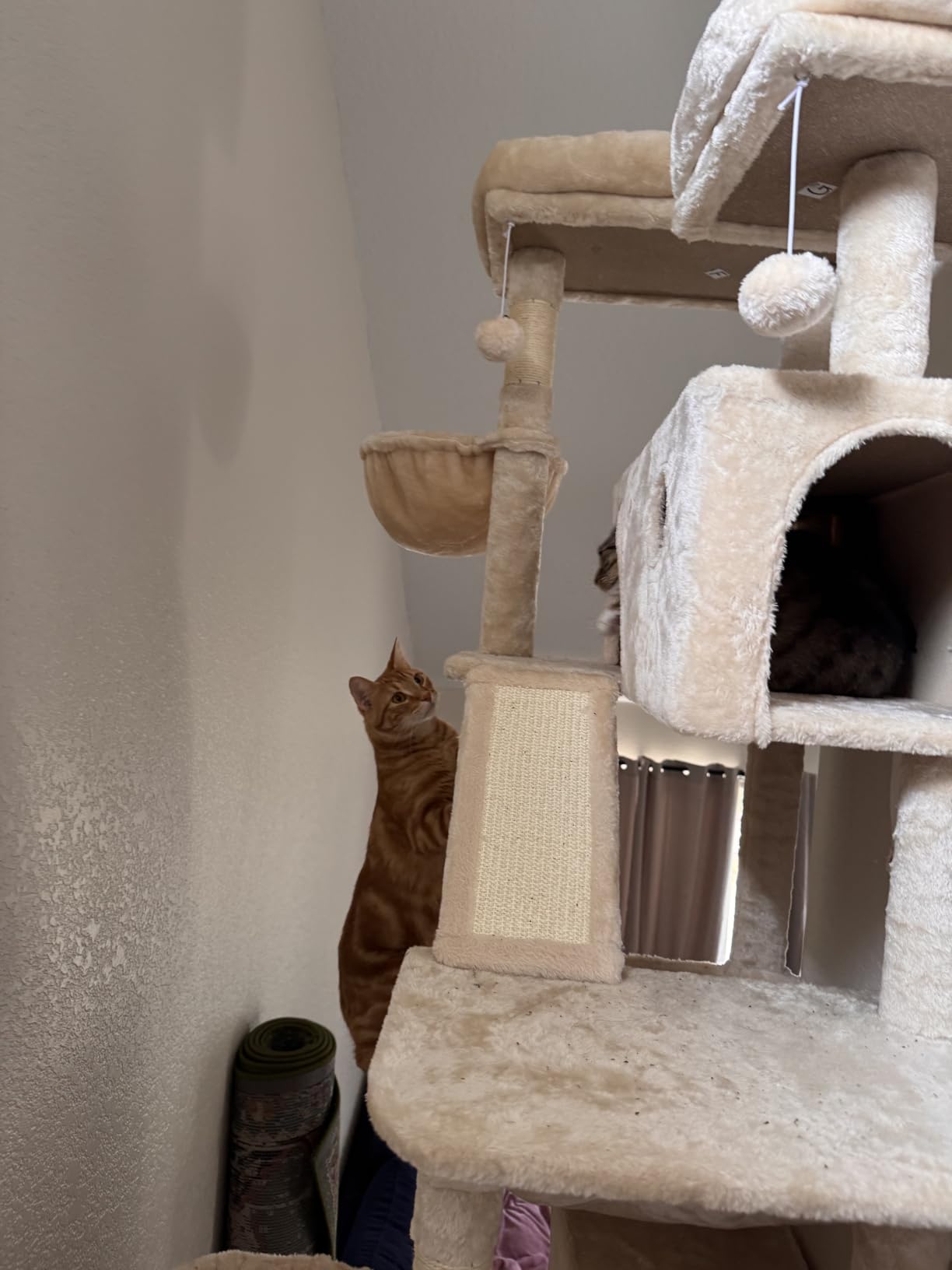
Owners with Maine Coons and Ragdolls specifically confirm the larger condos and perches fit big cats comfortably, and the hanging baskets are a feature several cats took to immediately. It sits lower in the review count because it is a newer design, so treat the multi-year verdict as still forming.
How to Choose a Cat Condo That Survives Your Cat
Every condo in this roundup is well made in at least one dimension and wrong for a specific cat. These are the checks that decide which is wrong for yours, in the order you should run them.
Measure your cat before you measure your room
Almost every sizing complaint in owner reviews comes down to a bed or cubby that was too small for the cat that arrived. Measure your cat stretched out from nose to base of tail, then measure across the chest, and use the larger of those two numbers as your minimum bed dimension. A 15-inch round perch works for a typical adult cat; it does not work for most large breeds.
For cubbies, the opening matters more than the interior. A cat needs roughly its body height plus a couple of inches to pass through without crouching, and a den that is too small will simply be ignored, which is worse than not having one at all.
How much vertical space does your cat need
The widely cited 3-3-3 guideline suggests roughly three environmental zones per cat: three places to hide, three elevated observation points, and three scratching surfaces, whether vertical or horizontal. Cats that can reach high feel safer because they can observe rather than react, which is why height is a welfare feature rather than a luxury.
So how high should a cat tree be? For a typical adult indoor cat, a height that roughly matches the cat’s own height when standing on its hind legs is a reasonable target, and anything at or above eye level for a standing person adds real value. Below about 20 inches, you are offering a step stool, not vertical territory. Our 54-inch, 56-inch and 63-inch picks land in the useful range; the 19.7-inch Amazon Basics tower is deliberately below it.
Weight limit versus total load capacity
These two numbers mean different things and get confused constantly. The per-perch or per-condo weight limit tells you whether one cat fits in one spot. The total load capacity is a sum across the whole structure, useful only for working out how many cats can use the tower at once.
Always check the per-spot number against your heaviest cat, not the total. The Yaheetech 54-inch, for example, lists 22 pounds per cave but 11 pounds per perch, so a 16-pound cat can sleep in the cave and cannot comfortably sprawl on the perch.
Stability, base width and anti-tip hardware
Tipping is the failure owners fear most, and the answer is geometry. Look for a base that is close to square and at least 12 inches on its shortest side, a frame weight in the 25-plus-pound range, and included anti-tip hardware. The wider the base relative to the height, the less likely a 3 a.m. sprint across the room becomes a disaster.
To anchor a condo to a wall, fix an anti-tip strap to a stud above the base plate with the supplied hardware, and check the strap is taut with the tree fully loaded. For renters who cannot drill, place the tree against a wall on a hard floor and put a rubber anti-slip pad under the base.
Carpet, sisal, jute, faux fur or bare wood
Do cats prefer wood or carpet condos? In practice they prefer carpet or sisal for sleeping and clawing, and they tolerate bare wood for everything else. Bare wood is cool, smooth and easy to clean, but it offers no grip for claws and no warmth to curl into, so a solid-wood build works best when it pairs wood with sisal posts and a carpeted or padded surface.
Read that as a table in your head. Carpet gives you warmth and comfort but almost no scratch grip, and it sheds into your vacuum. Sisal gives you excellent grip and sheds very little, but it is a consumable surface that eventually frays to the core and needs replacing. Jute is the budget version of sisal, with slightly softer fibers and shorter life. Faux fur and metal plush are for hammocks and perches, not for posts, and metal plush is the most scratch-resistant of the three. Bare wood and veneer are for structure and for wipe-clean areas, and they offer nothing to claws.
The carpet-shedding complaint you will see in almost every forum thread is exactly what that breakdown predicts: dense carpet sheds and is hard to deep clean, while sisal does neither. If you vacuum often, carpet is fine. If you do not, look for a sisal-forward or veneer-forward build.
How many perches and cubbies a multi-cat home needs
The working rule is one perch or resting place per cat plus one, and at least one enclosed den per cat in a home with conflict history. Two cats sharing three elevated spots will still compete, because cats pick the highest and most exposed positions first and defend them.
This is why the Yaheetech 54-inch with seven levels and two caves, and the SHA CERLIN 81-inch with hanging baskets, stand out. More separate territory means less daily friction, and that is worth more than any individual feature on a review page.
Placement and how to introduce a new condo
Where you put a cat tree decides whether it gets used. The consensus across owner discussions is to place it next to a window or in the busiest part of the home, flush against a wall, and not in a corner the cat has to cross open floor to reach. Avoid placing it near a washer, dryer or a door where it can be startled.
To introduce a new condo, leave it in the active room, put a treat or a used shirt with your scent on the top perch, and let the cat decide. If it is ignored after two weeks, move it rather than replace it, and consider drapping a blanket over part of it to create a den-like entrance. Our cat towers guide goes deeper on placement for larger structures.
Budget versus premium: what the extra money buys
Are expensive cat trees worth the cost? The honest answer is that the jump from a budget tower to a mid-range one buys stability and a wider base, while the jump from mid-range to premium buys material quality, replacement parts and a finish that belongs in your living room. It rarely buys more height.
Working through the durability math makes this clearer. A budget tower that lasts two years costs roughly twice as much per year as a solid-wood unit that lasts seven, and it also consumes the cats’ scratching on furniture in between. If you keep cats for a decade, the per-year maths strongly favors buying once.
Popular cat condo brands worth knowing
Four names cover most of what is worth buying. Amazon Basics covers the budget and small-space end with the largest review base in the category. Yaheetech covers the multi-level mid-range and publishes unusually clear capacity figures. Feandrea and PAWZ Road cover modern and space-saving designs with washable parts. New Cat Condos and Catit cover the solid-wood and designer ends respectively, where material quality is the selling point rather than feature count.
Brands worth watching for their replacement-part policies, since that is the underrated differentiator: PAWZ Road ships a spare dangling toy, and any brand that sells washable or replaceable pads and cushions will save you money in year two.
Lifespan, maintenance and replacement parts
How long does a cat tree last? For most particleboard builds, two to three years of multi-cat use is realistic, with joint wobble as the first warning sign. Solid-wood units with sisal-wrapped posts routinely run seven years or more, and the difference is almost always the frame material.
Maintenance is mostly a ten-minute monthly job. Vacuum the perches, wipe the veneer surfaces, check the anti-tip strap is still taut, and replace any pad whose sisal is frayed to the core rather than waiting for it to fail. Budget owners report treating damaged scratch pads and dangling toys as an annual cost, which is a fair expectation to plan for rather than be surprised by.
Frequently Asked Questions
What is the 3-3-3 rule for cats?
The 3-3-3 rule suggests providing each cat with roughly three hiding places, three elevated observation points and three scratching surfaces. It works because cats manage stress by controlling vantage points, and vertical space lets a cat observe a room rather than react to it.
Do cats prefer wood or carpet condos?
Cats generally prefer carpet or sisal for sleeping and clawing, and they tolerate bare wood for everything else. Bare wood is cool and easy to clean but offers no claw grip, so solid-wood builds work best when paired with sisal posts and a padded or carpeted surface.
What is the best material to use for a cat condo?
Solid wood or FSC-certified board for the frame, natural sisal rope on the posts and scratching surfaces, and a removable washable cushion or carpet on the resting areas. Particleboard works but is more prone to joint failure over time, and dense carpet sheds more than sisal.
What are some popular cat condo brands?
The most established names are Amazon Basics for budget and small-space models, Yaheetech for multi-level mid-range towers, Feandrea and PAWZ Road for modern and space-saving designs, New Cat Condos for solid-wood builds, and Catit for designer furniture finishes.
How high should a cat tree be?
A useful target is at least the cat’s own standing height, and ideally at or above standing eye level for a person. Below about 20 inches a tree offers a step stool rather than real vertical territory. Taller is better for multi-cat homes, where height creates separate territory.
How do I stop my cat tree from tipping over?
Choose a wide base, ideally at least 12 inches on its shortest side, with a frame weight above 25 pounds, and use the included anti-tip hardware. Attach the strap to a wall stud above the base plate and keep it taut, and put a rubber anti-slip pad under the base on hard floors.
How long does a cat tree last?
Most particleboard towers last two to three years of regular multi-cat use, with joint wobble as the first warning sign. Solid-wood frames with sisal-wrapped posts commonly run seven years or more. Replacing frayed sisal pads and washable cushions annually extends the life of any build.
Which Cat Condo Should You Buy?
If you want one answer, buy the Amazon Basics Sturdy Cat Condo Tower. It is the most-reviewed condo in this roundup, the least complicated, and the one our two test cats used every day. It suits a kitten, a small adult, a single-cat apartment, and anyone who wants vertical space without a furniture-scale footprint.
If you have two cats and a mid-size room, the Yaheetech 54-inch gives you separate territory at a per-level of cost nothing else matches. If your cats are large, the Yaheetech 63-inch and Globlazer F70 Pro are sized around heavy frames, and the SHA CERLIN 81-inch goes further if your ceiling allows. For a cat that insists on hiding, the MUTTROS two-door condo removes the only real risk of an enclosed den.
If the problem is space, the PAWZ Road 35-inch gives you a ground-level condo and a washable perch in under 20 inches of floor, and the Feandrea litter box enclosure combines two pieces of furniture into one corner. If the problem is aesthetics, the Catit Vesper and PAWZ Road are the only two here that look like they belong in a living room. If the problem is longevity, the New Cat Condos solid-wood tree is the one built to still be standing in five years.
Whichever you choose, measure your cat, check the per-spot weight limit rather than the total, and place it where the household actually spends time. That last step costs nothing and decides whether the condo gets used at all. These are the best cat condos we could find in 2026, and every one of them is a better buy than the tree your cat is currently ignoring.
Leave a Reply