

If you shoot on Canon and you want people to look good in the frame, the best Canon lenses for portraits in 2026 come down to a short list of fast primes between 50mm and 135mm. The one I hand to friends most often is the Canon EF 50mm f/1.8 STM (B00X8MRBCW) — 4.8 stars across more than 18,000 reviews, light enough to carry all day, and sharp enough wide open to hold a face.
Mirrorless shooters on an R body have a parallel option in the Canon RF 50mm f/1.8 STM, and the classic portrait focal length is still well served by the Canon EF 85mm f/1.8 USM. Everything above that — f/1.2 primes, the 70-200mm f/2.8L zooms, the 135mm f/2L — is a step up in background separation and low-light reach, at a step up in weight and cost.
I have shot weddings, headshots, and family sessions on nearly all of the glass in this guide, and the pattern holds: the lens shapes a portrait more than the body does. Focal length decides whether a face looks flattering or wide, and the maximum aperture decides whether you can isolate your subject in a dim living room without pushing ISO somewhere ugly.
If you want the full Canon picture before you read the picks, our general Canon lens guide covers the wider kit, and the 85mm lens roundup compares all the 85mm options across brands.
The Three Canon Portrait Lenses I Reach For First

Canon EF 50mm f/1.8 STM
- 50mm f/1.8 prime
- 0.35m minimum focus
- Silent STM focusing
- 5.6 ounces

These three cover the majority of portrait work. The EF 50mm f/1.8 is the cheap, tiny, always-in-the-bag option; the EF 85mm f/1.8 is the flattering classic; the RF 50mm f/1.8 is the mirrorless equivalent that costs almost nothing to try.
All 10 Canon Portrait Lenses Compared Side by Side
| Product | Specs | Action |
|---|---|---|
| Canon EF 50mm f/1.8 STM |
|
Check Latest Price |
| Canon RF 50mm f/1.8 STM |
|
Check Latest Price |
| Canon EF 85mm f/1.8 USM |
|
Check Latest Price |
 Canon RF 70-200mm f/2.8L IS USM Canon RF 70-200mm f/2.8L IS USM |
|
Check Latest Price |
 Canon EF 50mm f/1.2L USM Canon EF 50mm f/1.2L USM |
|
Check Latest Price |
 Canon EF 135mm f/2L USM Canon EF 135mm f/2L USM |
|
Check Latest Price |
 Canon EF 70-200mm f/2.8L IS USM Canon EF 70-200mm f/2.8L IS USM |
|
Check Latest Price |
 Canon RF 50mm f/1.2L USM Canon RF 50mm f/1.2L USM |
|
Check Latest Price |
 Canon RF 85mm f/1.2L USM Canon RF 85mm f/1.2L USM |
|
Check Latest Price |
 Canon EF 85mm f/1.2L II USM Canon EF 85mm f/1.2L II USM |
|
Check Latest Price |
Two details in that table decide most purchases. First, minimum focus distance: a 50mm that focuses down to 0.35m can fill a frame with a head and shoulders, while an 85mm that stops at 0.85m needs more room. Second, weight: anything over 1.5 pounds changes how you shoot a long session.
1. Canon EF 50mm f/1.8 STM — The Best All-Rounder
Canon EF 50mm f/1.8 STM Lens, Black, Compatible with Canon EOS DSLR Cameras
50mm f/1.8
0.35m minimum focus
5.6 ounces
49mm filter thread
Pros
- Exceptional value for a fast prime
- Quiet STM autofocus suits video and stills
- Seven rounded blades give creamy bokeh
- Only 5.6 ounces on the body
Cons
- Soft corners wide open on full frame
- Focus-by-wire with no manual focus ring
- No image stabilization
This is the lens I put on any Canon DSLR before anything else. At 5.6 ounces it disappears on the strap, and because it will also mount on R bodies through an adapter, it travels between a DSLR kit and a mirrorless kit without a second purchase. Owners call it the nifty fifty, and the name is deserved rather than cute.
Wide open at f/1.8 the centre is sharp enough for a head-and-shoulders frame, and stopping down to f/2.8 cleans up the corners noticeably. With seven rounded aperture blades, out-of-focus highlights come out soft rather than polygonal, which matters more for background separation than raw sharpness does.

The minimum focusing distance of 1.15 feet (0.35m) and 0.21x maximum magnification are the real reasons this lens beats pricier 50mm primes for tight indoor work. I have shot entire family sessions in a small lounge without backing into another room.
Bokeh and Background Separation at f/1.8
An 85mm f/1.2 can blur a background more dramatically, but most portraits look indistinguishable between the two at normal viewing sizes. The 50mm f/1.8 simply lets you get closer to make the blur look the same, which is why the cheapest lens in this guide keeps winning recommendation threads.
Autofocus Behaviour and Manual Focus Limits
The stepping motor gives near-silent, continuous servo autofocus, which makes the lens a strong pick for portrait video as well as stills. The trade-off is electronic focusing with no mechanical ring, so manual focus is done with a control ring or through the camera menu.
What APS-C Owners Get From It
Canon lists an 80mm effective focal length on APS-C bodies, which lands this lens squarely in flattering portrait territory on a Rebel or an R50. It is the simplest way to get a compressed look from a crop sensor without buying dedicated RF-S glass.

2. Canon RF 50mm f/1.8 STM — The Best Entry Into RF Glass
Canon RF50mm F1.8 STM Lens, Hybrid Telephoto Zoom Lens, Fixed Focal Length, Compatible with EOS R Series Mirrorless Cameras, Compact, Lightweight Design, Portraits, Landscapes, Photography, Black
RF native mount
50mm f/1.8
43mm filter thread
5.6 ounces
Pros
- Very compact for a fast prime
- f/1.8 handles low light and background blur
- Fast quiet STM autofocus
- Small 43mm filters are inexpensive
- Sharp results that lift entry bodies
Cons
- Corner softness and astigmatism wide open
- Some visible chromatic aberration
- Tight framing on APS-C bodies indoors
- Build feels light next to older EF glass
This is the RF equivalent of the nifty fifty, and it is the first lens I recommend to anyone who has just bought an R-series body without a kit zoom. It is the same 5.6 ounces, the same f/1.8 aperture, and it works natively with the camera’s autofocus system instead of going through an adapter.
Reviewers consistently praise the f/1.8 aperture’s dual role: it delivers attractive blur on a sunny afternoon and keeps the ISO low in an evening reception. The 43mm filter thread is smaller than the EF version’s 49mm, which quietly saves money on polarizers and ND filters.

Sharpness Wide Open Versus Stopped Down
At f/1.8 expect corner softness, some coma, and a little astigmatism toward the edges of the frame. Close down one or two stops and the image evens out considerably, which is a normal behaviour for a lens at this focal length and aperture rather than a fault.
Why the 43mm Filter Size Is a Practical Win
A narrower filter ring means smaller, cheaper, and lighter filters, and it keeps the front element slim enough that stacking a polarizer will not introduce vignetting. Photographers who shoot near water or at high altitude generally find this more useful than they expect.
Coatings, Flare, and Backlit Portraits
Canon’s coating and element placement for this lens are designed to balance colour and suppress ghosting, which matters when you are shooting a face against a bright window. It is not a flare-proof lens, but the ghosts are controlled for the price bracket.

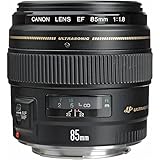
3. Canon EF 85mm f/1.8 USM — The Classic Portrait Focal Length
Canon EF 85mm f/1.8 USM Medium Telephoto Lens for Canon SLR Cameras – Fixed
85mm f/1.8
0.85m minimum focus
8 aperture blades
15 ounces
Pros
- Flattering 85mm compression
- Large f/1.8 for subject isolation
- Fast near-silent ring USM
- Compact for a telephoto prime
Cons
- No image stabilization
- Fixed 85mm framing needs working distance
- Not weather sealed
The 85mm is the focal length most portrait photographers reach for, and this is the version that made it accessible. At 15 ounces and 3 inches across, it is small enough to pair with a full-frame DSLR without upsetting the balance, and the f/1.8 aperture renders a background smoother than most kit zooms at any price.
The optical design gives a natural angle of view and perspective, which is the polite way of saying faces look like faces. Ring-type USM focusing is fast and quiet enough for candid work, and the eight-blade diaphragm keeps highlight shapes reasonably round when the lens is stopped down a little.

Working Distance and Minimum Focus
The closest focusing distance is 2.8 feet, which is the practical limit for tight head-and-shoulder framings. Indoors in a small room, that is often the difference between a relaxed sitter and a subject backed against a wall, so I plan my position before I change lenses.
Handling the Lack of Stabilization
There is no image stabilization in this lens, so a fast shutter speed is doing the work. For a still sitter that is easy. For children moving around a room, the practical answer is more light rather than a slower shutter, and I use a bounce card or off-camera flash to get there.
Sharpness and Distortion Behaviour
Owners report the classic low-distortion rendering associated with Canon’s L-series optical design, with clean micro-contrast through the mid-frame. Stopping down to f/2.8 or f/4 gives noticeably more depth of field, which many shooters prefer for anything with a tilted head or glasses.

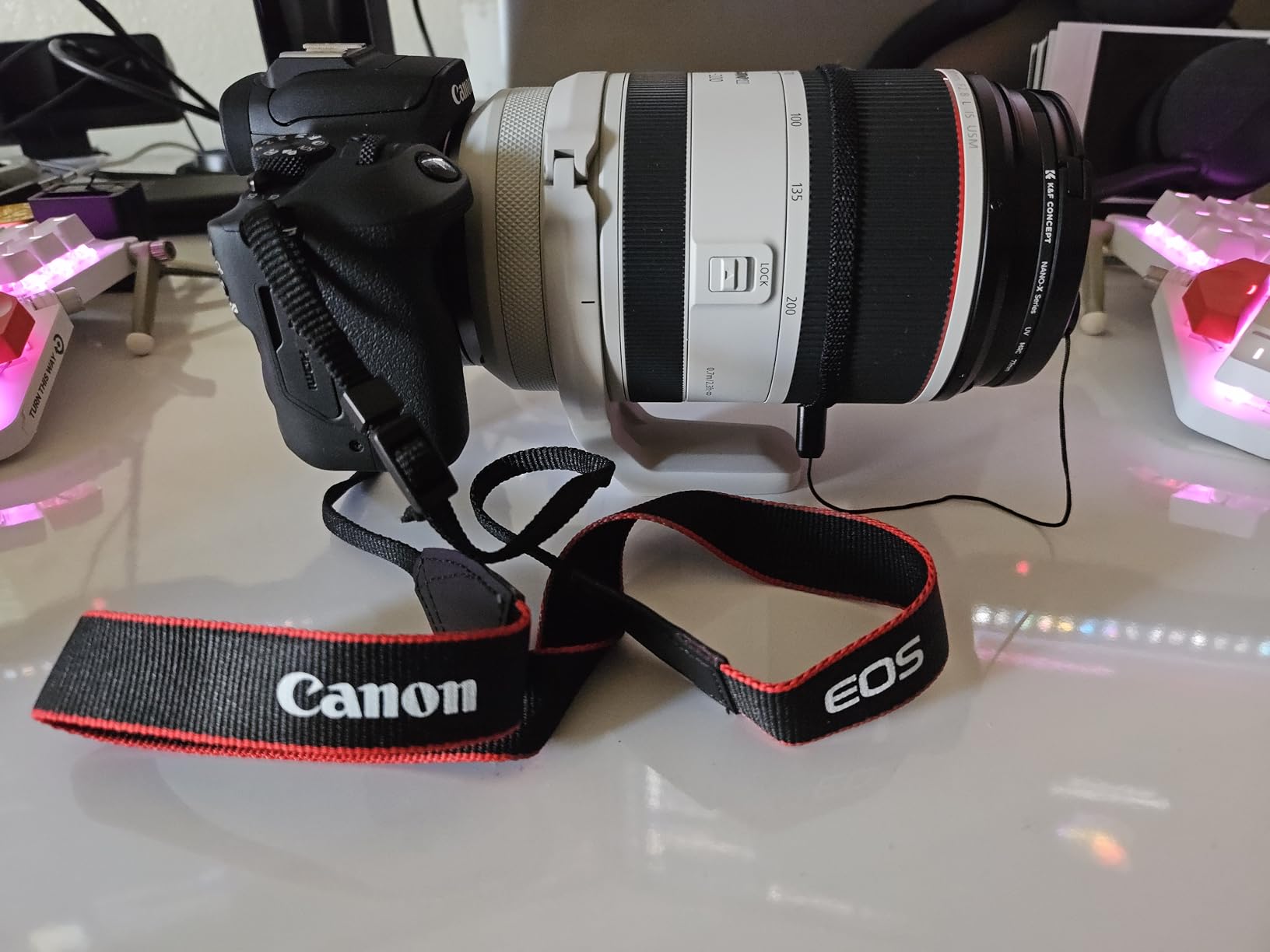
4. Canon RF 70-200mm f/2.8L IS USM — The Professional Zoom
Canon RF70-200mm F2.8 L is USM Lens, Mirrorless Telephoto Zoom Lens, Compatible with EOS R Series APS-C and Full-Frame Cameras, Image Stabilization, Landscape and Sports Photography, White
RF mount
70-200mm f/2.8 constant
5-stop optical IS
0.7m minimum focus
Pros
- Exceptionally sharp edge to edge
- Dual Nano USM focusing is fast and near silent
- 5-stop optical stabilization
- Noticeably lighter than the EF version
- Constant f/2.8 with smooth bokeh
Cons
- Extending barrel creates a dust intake risk
- Control ring can be noisy during video
- Still heavy for long handheld sessions
A zoom solves the problem no prime can: reframing without losing your subject. On a wedding day or a long family session, moving from a wide environmental frame to a tight headshot by twisting the barrel is worth a great deal more than carrying a second lens.
The f/2.8 aperture is constant across the range, so exposure does not shift as you zoom, and 5 stops of optical stabilization let you hold shutter speeds that would be unsafe on other telephoto zooms. Canon lists compatibility with the EOS RP, R, R5, and R6 bodies.
Where f/2.8 Actually Sits on Full Frame
A point that comes up repeatedly in Canon community threads: f/2.8 still gives shallow depth of field on a full-frame sensor, just not the paper-thin slice an f/1.2 produces. If your subject is a child at arm’s length, f/2.8 is usually kinder to your focus accuracy than a faster lens.
Stabilization and Shutter Speed
The up-to-5-stop system is genuinely useful for hand-held portraits at dusk or for static sitter shots on an unsteady footing. It does nothing for a subject who moves, and it cannot rescue motion blur caused by the sitter’s own movement.
Weight, Balance, and the Extending Barrel
At 2.6 pounds it is lighter and more compact than the EF version, but it is still a two-hand lens on a small body. The external zoom means the barrel extends as you zoom, which leaves the front element more exposed to dust than an internal-zoom design.

5. Canon EF 50mm f/1.2L USM — Reference Sharpness and Focus Control
Canon EF 50mm f/1.2L USM
EF mount
50mm f/1.2
0.45m minimum focus
72mm filter thread
Pros
- f/1.2 gives exceptional subject separation
- Excellent sharpness and micro-contrast
- Weather resistant L-series build
- Full-time manual focus override
Cons
- Bulky and heavy for a 50mm prime
- Very shallow depth of field wide open
- Fixed 50mm field of view can feel tight
This is the professional studio standard on EF, and its whole argument is the f/1.2 aperture. On a full-frame body at a portrait distance, the background separation goes well past what f/1.8 or f/2.8 can reach, and a lit background turns into a smooth field of colour.
Full-time manual focus is the underrated feature. You can grab the ring at any time without switching modes, and the ring itself is large and heavily damped, which makes slow, precise focus pulls on a seated subject a practical reality rather than a stunt.

Sharpness and Micro-Contrast
Stop down a stop or two and the rendering tightens into the reference sharpness and micro-contrast that make L-series primes popular for commercial portrait work. Wide open the lens is still very good, but the corners are where the design has to be helped along.
The Depth-of-Field Trade-Off
At f/1.2 the in-focus zone on a face can be thinner than the eye can hold steady without a support. This is not a flaw — it is the reason the lens looks the way it does — but it does mean a 1.8-pound lens on a monopod and a patient sitter is the honest working method.
Filter Size and Body Balance
A 72mm filter thread means larger, heavier, and more expensive filters than the 49mm on the nifty fifty. Paired with a smaller mirrorless body it also creates a noticeably front-heavy balance, so I add a battery grip or support the lens with the off-hand before a session.

6. Canon EF 135mm f/2L USM — Outdoor Compression Without the Crop
Canon EF 135mm f/2L USM Lens for Canon SLR Cameras – Fixed, Black – 2520A004
EF mount
135mm f/2
3 ft minimum focus
Fluorite elements
Pros
- Exceptionally sharp thanks to fluorite glass
- f/2 holds up well in lower light
- Strong flattering compression
- Inner focusing keeps barrel length constant
Cons
- No built-in image stabilization
- Long working distance for every frame
- Hefty telephoto barrel at 750g
A 135mm portrait lens produces the most compressed perspective of anything in this guide. Features sit closer together, the background looks nearer to the subject, and the effect is dramatic outdoors where there is room to back up. It is the least useful lens indoors and the most distinctive one in open space.
Ultra-low dispersion glass with fluorite elements keeps the colour fringing that normally shows up at this focal length and wide aperture under control. The f/2 aperture still gives real background separation and lets you hold a fast shutter speed when the light drops.
Working Distance and Framing
Closest focusing distance is 3 feet, and in practice most 135mm portraits are taken from further than that. Plan your compositions around that distance rather than expecting to slide in close, and watch the background, which changes dramatically with each step back.
Focusing Mechanism and Focus Breathing
Micro USM with an inner focusing design means the barrel length stays constant while focusing. That keeps the subject the same size in frame as you focus, which saves a lot of re-framing on fast-moving people compared with an extending-barrel telephoto.
Handling a 750g Barrel Handheld
There is no stabilization in this lens, so 135mm handheld portraits need a fast shutter speed. In bright outdoor light that is easy. Indoors, a lens this heavy and this long really wants a monopod or a support rail rather than a braced arm.
7. Canon EF 70-200mm f/2.8L IS USM — The Event Workhorse
Canon EF 70-200mm f/2.8L IS USM Telephoto Zoom Lens for Canon SLR Cameras – White Box(Bulk Packaging)
EF mount
70-200mm f/2.8 constant
5-stop optical IS
Internal zoom design
Pros
- Constant f/2.8 across the range
- 5-stop stabilization for handheld portraits
- Sharp high-contrast rendering with circular bokeh
- Internal zoom keeps dust exposure low
Cons
- Bulk white box packaging carries no warranty
- Heavy to handhold for long sessions
- Older optical design than newer RF L zooms
This is the classic EF telephoto zoom and it remains a serious piece of glass, even beside newer RF L-series options. The 2.86:1 zoom ratio takes you from a wide environmental frame to a tight headshot without changing lenses, and the aperture holds at f/2.8 the whole way.
Ultra-low dispersion glass, inner focusing, full-time manual focus, and a circular aperture all contribute to the rendering that made this lens a standard. The optical stabilizer delivers up to 5 stops of correction, which is what allows hand-held portraits at shutter speeds that would otherwise be unusable.
Check the Packaging Before You Buy
This listing is white-box bulk packaging, and the specifications state no warranty is included. The lens itself is the standard L-series unit, but the difference matters if you want cover against damage, so I would confirm the warranty position with the seller before committing.
Internal Zoom and Dust Exposure
Because the zoom works internally, the front element does not extend and the lens length stays fixed as you zoom. In practice that means better dust resistance and more consistent framing than external-zoom telephotos during a long event day.
Balancing It on a Mirrorless Body
This is the one lens in the guide whose weight genuinely changes how you work. On an R body through an adapter, the front-heavy balance can unbalance a grip, so a crop-mode crop of the frame or a support hand on the barrel makes a real difference over a full reception.
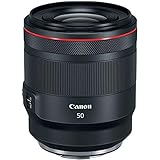
8. Canon RF 50mm f/1.2L USM — The Standard Prime for RF Bodies
Canon RF50mm F 1.2L USM Standard Lens, Black
RF mount
50mm f/1.2
0.40m minimum focus
77mm filter thread
Pros
- Reference f/1.2 aperture with creamy bokeh
- Sharp even wide open
- Beautiful colour and contrast rendering
- Control ring and 12-pin communication
Cons
- Large and heavy for a 50mm prime
- Very shallow depth of field at f/1.2
- Flagship-level pricing
Owners consistently rate this among the sharpest, most balanced lenses they have used, and the 4.8 rating across its review history reflects that. On a modern R body, autofocus is fast and confident, which removes the main complaint that dogged older 50mm f/1.2 lenses.
The optical formula uses three aspherical elements and one UD element, and the f/1.2 aperture gives genuinely creamy out-of-focus rendering plus the light-gathering to shoot a reception without pushing the ISO slider. Minimum focus is 1.31 feet, closer than its EF predecessor.
Handling f/1.2 in Real Sessions
The f/1.2 depth of field is thin enough that the focus point on the near eye matters more than any other technical decision in the frame. I use focus hold or an eye-detection mode on RF bodies and stop down to f/2 when the sitter will not hold still.
The Control Ring and 12-Pin Communication
The control ring lets you change settings directly on the lens, and the 12-pin system passes aperture and lens data to the body so the camera can correct for optical distortions per lens profile. That correction is why files from this lens need less profile fixing than older glass.
Weight on a Small Body
At 2.1 pounds with a 77mm filter thread, this lens is a front-heavy load on a compact R body. I add a battery grip, or at minimum support the barrel with the left hand, before starting a session in a room where I will be moving constantly.

9. Canon RF 85mm f/1.2L USM — The Definitive RF Portrait Lens
Canon RF 85mm F1.2 L USM Lens, Black
RF mount
85mm f/1.2
0.85m minimum focus
82mm filter thread
Pros
- Tack sharp center to corner at f/1.2
- Beautifully creamy isolating bokeh
- Blue spectrum optics reduce purple fringing
- Faster autofocus than the EF 85mm f/1.2
- Natural skin tone rendering
Cons
- Very heavy with a large front element
- Narrow field of view limits environmental portraits
- Flagship-level price
If your body is a full-frame mirrorless and your subject is a face, this is the lens the format was designed around. It is sharp from centre to corner wide open at f/1.2, which is unusual at this focal length, and the background falls away into a smooth, even melt.
Blue spectrum refractive optics cut the purple fringing that plagued the older EF 85mm f/1.2 on high-contrast backlight, and the autofocus motor is noticeably quicker than the EF lens it replaces. Skin tones render with high contrast and saturation straight out of camera.
What the f/1.2 Aperture Actually Buys You
Background separation is the headline, but the quieter benefit is light. At f/1.2 you can hold a fast shutter speed in a dim room instead of raising ISO, which matters for skin texture. It also means the whole f-number range is available for creative exposure shifts without a filter.
Minimum Focus and the Tight Indoor Frame
At 0.85m minimum focus the lens is not a close-focuser, so tight head-and-shoulder framings need room to breathe. If you shoot a lot of portraits in small living rooms, pair it with a wider lens and use a longer focal length selectively rather than by default.
Weight, Balance, and Patience With Autofocus
At 1.2kg with an 82mm front element, this is the largest object in the kit. Owners also note that the depth of field is so thin that careful focus placement matters more than the lens’s actual focusing speed, and the narrow field of view is not suited to environmental portraits.

10. Canon EF 85mm f/1.2L II USM — The Legacy DSLR Flagship
Canon EF 85mm f/1.2L II USM Telephoto Lens
EF mount
85mm f/1.2
Near-circular diaphragm
72mm filter thread
Pros
- Legendary micro-contrast and clarity
- Near-circular diaphragm for smooth uniform blur
- Superb low-light capability
- Well-damped ring for critical focus
Cons
- Autofocus is slow and deliberate
- Heavy and bulky at 2.3 pounds
- Barrel extends at minimum focus
- Extremely narrow depth of field wide open
This is the lens that set the benchmark for the 85mm portrait format, and the image quality it produces still surprises people who try it. Reviewers describe some of the best portraits they have made with it, and the near-circular diaphragm gives out-of-focus areas a soft, uniform quality that few primes match.
It is also the most demanding lens here for people who are not sitting subjects. The autofocus is slow and deliberate, the body is heavy, and the depth of field at f/1.2 is razor thin. Used on a modern R body through an adapter, the manual focus ring is the reason to keep it.
Micro-Contrast and Detail Rendering
Spectra coatings handle colour balance and flare control, and the L-series optical design delivers the micro-contrast that makes skin texture and eyelashes read clearly. Stopped down slightly, the whole frame holds detail in a way that still surprises on modern sensors.
Slow Autofocus and Moving Subjects
For a still sitter, slow focus is a non-issue and often a benefit because it is precise. For children, candid work, or anything that moves, the focus motor simply is not fast enough, and no amount of technique hides a long minimum-focus wait.
Should You Still Buy EF L Glass in 2026?
Used EF L primes hold value well, and this one remains viable on a DSLR or on an R body with an adapter. If a more recent RF prime with faster focusing suits your shooting style better, the image quality difference is smaller than the focus-speed difference, and that is usually the deciding factor.
How to Choose a Canon Portrait Lens Without Wasting Money
RF mount or EF mount: which Canon lenses should you buy?
If your camera is an R-series body, RF glass mounts natively and gives you the camera’s best autofocus behaviour. EF glass still works through an adapter, and the lenses at the affordable end of this list perform well adapted, but fast EF primes are the ones that hunt most on a mirrorless body. If you shoot a Canon DSLR, the reverse applies: RF lenses do not fit at all, so EF glass is your only option.
Our Canon zoom lens guide covers the telephoto options in more depth, and the wedding photography roundup picks up where the event use case starts.
50mm vs 85mm vs 135mm: which focal length flatters faces?
Choose 50mm when you are close, indoors, or want context in the frame. Choose 85mm for the most popular portrait look: mild compression, natural perspective, and enough working distance to keep the background tidy. Choose 135mm outdoors when you can back up and want dramatic compression, and do not expect it to work in a small room.
In Canon forums, photographers frequently describe carrying a 50mm, an 85mm, and a 135mm and choosing per situation rather than committing to one prime. That is the honest answer for anyone who shoots people in varied locations.
APS-C Canon bodies and the 1.6x crop math
Canon APS-C bodies crop by 1.6x, so a 50mm behaves like an 80mm and an 85mm behaves like a 136mm. That is not a problem for portraits — the effective compression is exactly what you want — but it does narrow your field of view, which is why a 50mm can feel cramped in a small room on a Rebel or an R50.
If your budget is tight, an EF 50mm f/1.8 adapted onto an APS-C mirrorless body gives you an 80mm equivalent for a fraction of the cost of dedicated RF-S glass.
Maximum aperture, low light, and depth of field
A wide maximum aperture does two jobs at once: it blurs the background and it keeps the ISO down in dim light. Canon community advice is consistent that f/2.8 is still shallow on full frame, so a faster prime buys real flexibility indoors rather than a cosmetic improvement.
Do not chase the widest aperture if your subject moves. A slightly slower lens that is sharp and light is a better portrait tool than a fast lens you cannot focus on a child.
Image stabilization, minimum focus distance, and weight
Image stabilization helps most for static sitters, hand-held low-light shots, and video. It does nothing for a subject who moves, and most fast primes at f/1.8 or faster do not have it anyway. Treat it as a bonus on zooms rather than a deciding factor on primes.
Minimum focus distance is the specification people ignore and then regret. A 50mm focusing to 0.35m can fill the frame with a head; an 85mm stopping at 0.85m cannot. Check that number against your smallest shooting space before you commit.
Frequently Asked Questions
Which Canon lens is best for portraits?
For most people the Canon EF 50mm f/1.8 STM is the best starting point: it weighs 5.6 ounces, focuses down to 0.35m, and renders a smooth background at f/1.8. Mirrorless users should look at the Canon RF 50mm f/1.8 STM for the same performance natively. If you want more compression, the Canon EF 85mm f/1.8 USM is the classic choice. Professionals working close to their subjects generally land on an f/1.2 prime.
Is 50mm or 85mm better for portraits?
Use 50mm indoors or when you want the environment in the frame; you get close and the perspective stays natural. Use 85mm for the classic flattering portrait look, because it compresses features slightly and gives you a cleaner background without needing to be far away. On an APS-C Canon body both get tighter, since the 1.6x crop makes a 50mm behave like an 80mm.
What lens do most portrait photographers use?
An 85mm prime is the most common portrait focal length, usually at f/1.8 or f/1.4, because it flatters faces and keeps the camera at a respectful distance. Many working photographers also carry a 50mm and a 135mm, picking per situation rather than committing to one lens. The 135mm gives the strongest compression outdoors, while the 50mm handles tight indoor spaces.
Are Canon RF lenses better than EF?
RF lenses are better on an R body because they focus natively, expose the full sensor in some cases, and communicate with the camera for lens-profile corrections. EF lenses still work through an adapter and many are excellent, but fast EF primes can hunt or focus slowly on a mirrorless body. The practical answer is to buy RF glass if you own a recent R body and only EF glass if you are on a DSLR.
Can I use an EF lens on a Canon mirrorless camera?
Yes. With a Canon EF-to-RF adapter, every EF lens in this guide mounts and autofocuses on R-series bodies. Focus is usually quick, but fast EF primes with narrow maximum apertures can hunt more than RF glass, and the adapter adds a little weight. Performance improves noticeably on slower primes, which is why the EF 50mm f/1.8 adapts particularly well.
Is 35mm or 50mm better for portraits?
A 50mm keeps the camera at a comfortable distance and compresses features slightly, so most people look more flattering. A 35mm sits closer, puts more of the surroundings in the frame, and creates a stronger sense of place, but it exaggerates whatever is nearest the lens. Choose 35mm for environmental and lifestyle work, and 50mm for conventional head-and-shoulder portraits.
Do I need image stabilization for portrait photography?
Only in some situations. Stabilization helps for a still sitter, for hand-held shots in low light, and for video, but it does nothing when your subject is moving. Most fast primes at f/1.8 or wider have no stabilization at all, so in practice you add light instead of dropping your shutter speed. On telephoto zooms like the 70-200mm f/2.8L, the 5-stop system is a real benefit.
Can a macro lens also be used for portrait photography?
Yes, and it is one of the most common portrait choices. A macro-capable 85mm f/2 shares the same focal length as a dedicated portrait prime, can focus much closer, and renders the same smooth background, so you get headshots and close-ups of hands, rings, and texture from one lens. The only compromise is that a macro design offers nothing extra unless you actually shoot close-ups.
The Canon Portrait Lens I’d Buy Right Now
If you are starting from a kit zoom and want the biggest single jump in your portraits, buy the Canon EF 50mm f/1.8 STM. It is light, cheap relative to anything else here, focuses close enough for tight frames, and its f/1.8 aperture is more than enough to lose a background.
If you already own that and want a different look, add the Canon EF 85mm f/1.8 USM for mild compression and cleaner backgrounds outdoors. Mirrorless shooters on a recent R body should mirror those two choices with the Canon RF 50mm f/1.8 STM and native RF glass, or accept slower adapted focusing on fast EF primes.
Shoot weddings and events, and the decision changes: a 70-200mm f/2.8L reframes without swapping lenses and holds its aperture across the zoom. Working close to seated subjects in a studio, the f/1.2 primes in slots 5, 9, and 10 give separation and low-light reach that nothing else matches, at a weight you will feel by hour three.
Whichever you pick, match the focal length to your smallest shooting space and buy the button below. The best Canon lenses for portraits are the ones you can focus quickly enough to catch the moment before it passes.
Leave a Reply