
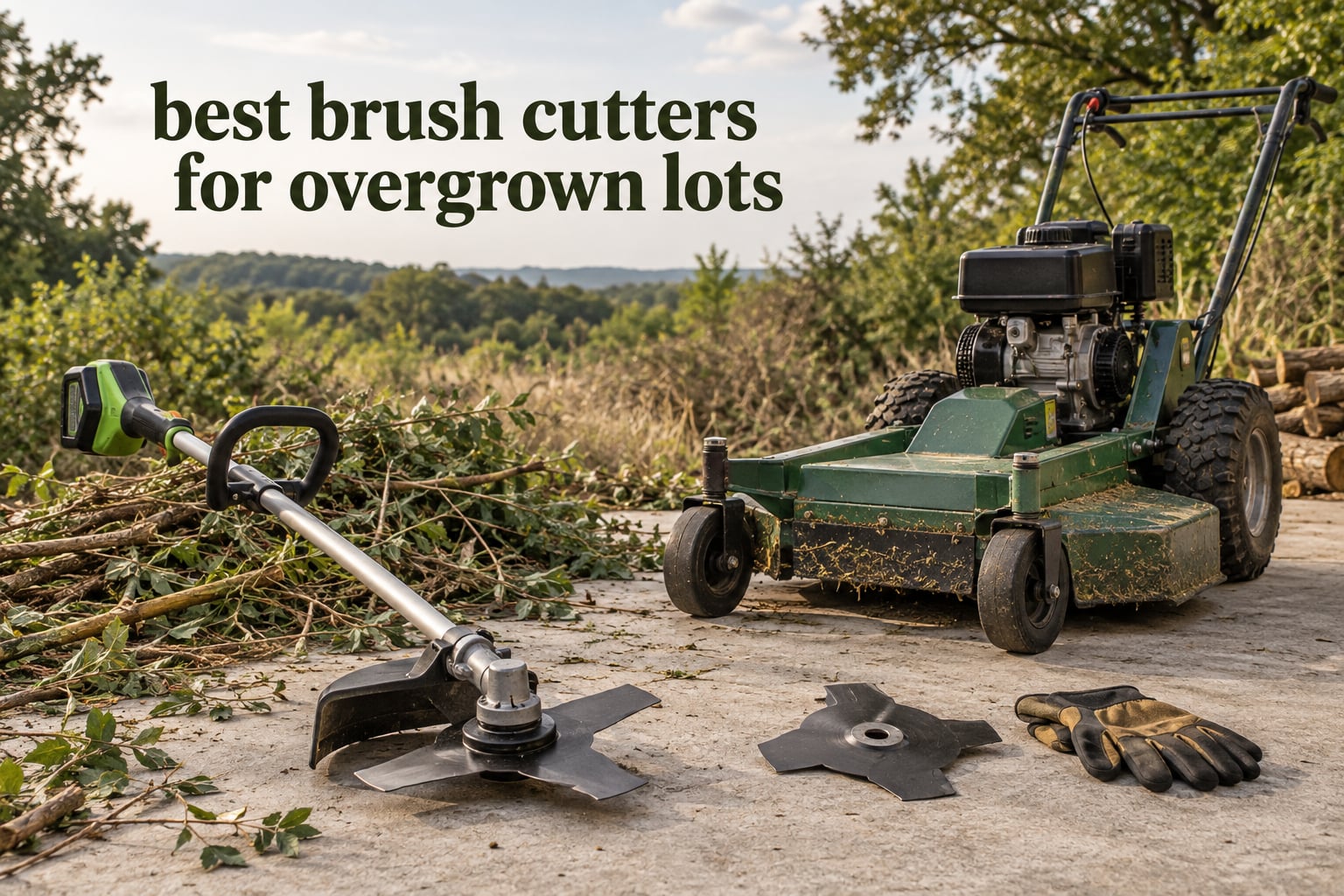
Short answer: the best brush cutters for overgrown lots are a cordless brush cutter attachment with a three-tooth steel blade for light woody growth, a walk-behind brush hog for wide acreage, and a straight-shaft gas machine for thick saplings. Pick the format that matches how much ground you have and how thick the stems get, because a lawn mower stalls within minutes on land that has been left alone for a season or two.
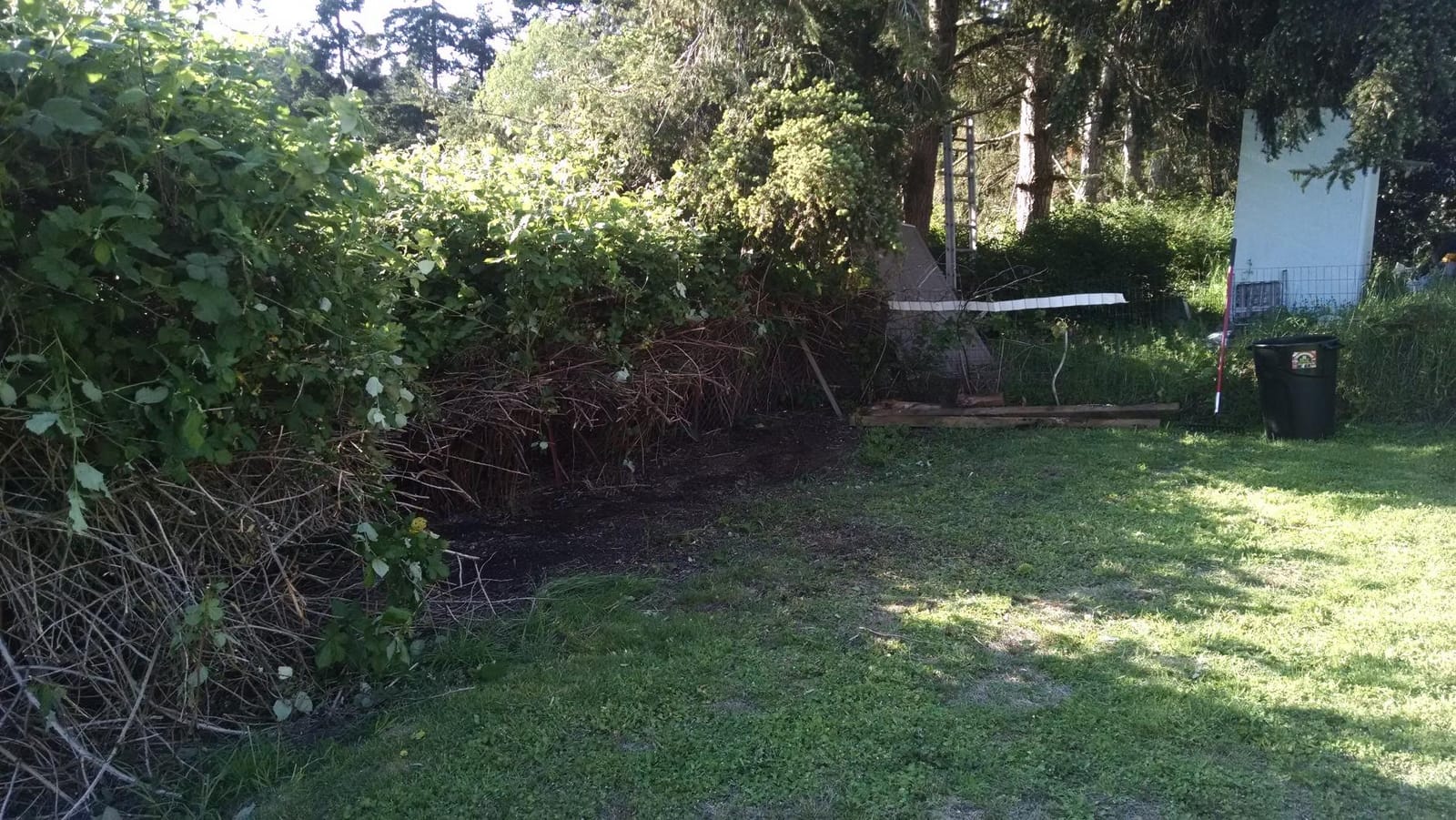
I spend a lot of time on neglected properties, and the pattern repeats every time. A lot that looked fine in spring is knee-high grass, blackberry canes, sapling-sized volunteer trees and a fence line you cannot see over by August. The machine that solves it is not the one with the biggest spec sheet. It is the one that starts easily, keeps cutting when the stems thicken, and does not leave you holding a vibrating handle at the end of the afternoon.
Our team compared 12 brush cutters, walk-behind brush hogs, cordless kits and attachment heads to put this guide together. We weighed them on cutting ability, ergonomics, durability, power-to-weight ratio and the awkward reality of owning a tool you may only use twice a year. Every spec below comes from the manufacturer listing or the verified owner reviews, and the verdict in each section tells you plainly who should buy it.
If you also work with cutting tools indoors or on smaller projects, our picks for the best rotary cutters and best mat cutters cover different jobs entirely. This guide stays outside.
Our Top 3 Brush Cutters for Clearing Neglected Land in 2026
Three machines stood out once we finished comparing cutting ability against the effort involved. The first handles the widest range of terrain without fatigue, the second unlocks the most value if you already own a power head, and the third covers the most ground per hour on a big lot.

EGO Power+ BCA1220 Brush…
- 12-inch 3-tooth steel blade
- 6000 rpm
- Carbon fiber shaft
- 2.2 pounds

TrimmerPlus BC720 Brushcutter
- Reversible 4-tip steel blade
- J-bar and shoulder strap
- Fits most attachment power heads
- 6.4 pounds

BILT HARD 170cc Walk Behind
- 22-inch cutting width
- 170cc 4-cycle OHV engine
- One-piece steel deck
- 54.1 pounds
Comparing 12 Brush Cutters for Overgrown Lots in 2026
All 12 machines below appear in the same order as the individual reviews that follow. The spec columns are the ones that decide whether a tool survives a neglected lot: cutting width, power source, weight and the type of head it carries.
| Product | Specs | Action |
|---|---|---|
| EGO Power+ BCA1220 Brush Cutter Attachment |
|
Check Latest Price |
| TrimmerPlus BC720 Brushcutter with J-Handle |
|
Check Latest Price |
 SENIX 160cc Walk Behind Brush Cutter SENIX 160cc Walk Behind Brush Cutter |
|
Check Latest Price |
 WeGofly 13 Inch 4-in-1 Cordless Kit WeGofly 13 Inch 4-in-1 Cordless Kit |
|
Check Latest Price |
| BILT HARD 170cc Walk Behind Brush Hog Mower |
|
Check Latest Price |
 YARDMAX YL2250 170cc Walk Behind Mower YARDMAX YL2250 170cc Walk Behind Mower |
|
Check Latest Price |
 Wild Badger Power 40V 4-in-1 Multi-Tool Wild Badger Power 40V 4-in-1 Multi-Tool |
|
Check Latest Price |
 LINASHI 52cc Gas Weed Eater and Brush Cutter LINASHI 52cc Gas Weed Eater and Brush Cutter |
|
Check Latest Price |
 COPLAR 8 Inch Brushcutter Attachment COPLAR 8 Inch Brushcutter Attachment |
|
Check Latest Price |
 VOL2GO Cordless Stringless Brush Cutter VOL2GO Cordless Stringless Brush Cutter |
|
Check Latest Price |
 RYOBI RXBC01 Expand-It Brush Cutter RYOBI RXBC01 Expand-It Brush Cutter |
|
Check Latest Price |
 WORX Driveshare 10 Inch Brush Cutter Attachment WORX Driveshare 10 Inch Brush Cutter Attachment |
|
Check Latest Price |
1. EGO Power+ BCA1220 – the Lightest Path to Cutting 1 Inch Saplings
EGO Power+ BCA1220 12” Brush Cutter Attachment 56-Volt Lithium-ion Multi Head System, Black
12-inch 3-tooth steel blade
6000 rpm max speed
2.2 lb carbon fiber shaft
Clears saplings to 1 inch
Pros
- Clears brush and saplings up to 1 inch thick
- Carbon fiber shaft backed by a lifetime warranty
- Only 2.2 pounds so full days of cutting stay manageable
- Quiet and clean compared with gas equipment
Cons
- Needs a separate EGO PH1420 power head and battery
- Heavier in the hand than a string trimmer once fitted
- Less punch than a gas machine on the toughest woody stems
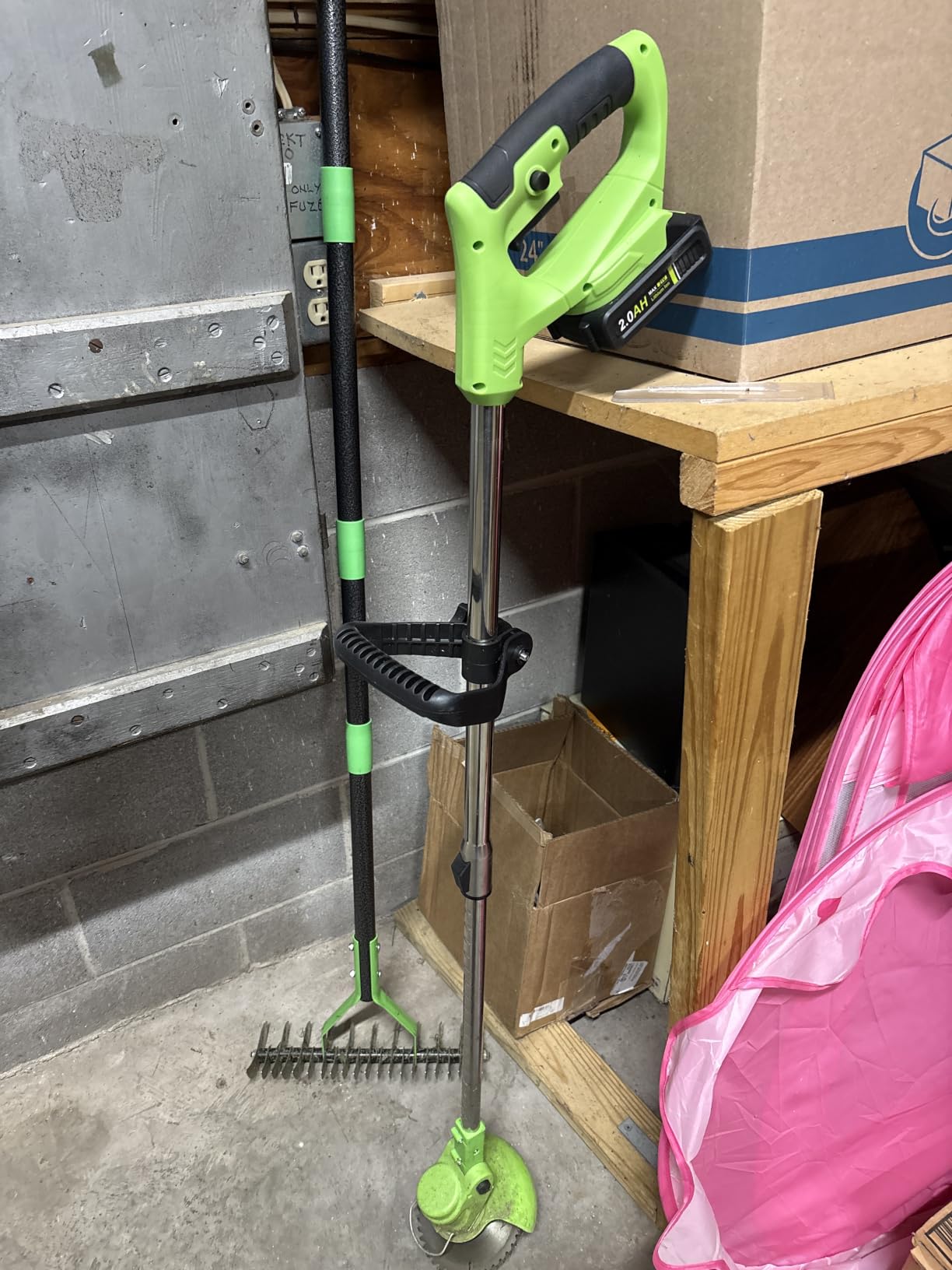
This is the head I reach for first when a lot is overgrown but not yet wooded. At 2.2 pounds it is the lightest cutting head in this entire group, and that weight is the whole story on a property where you will be swinging a machine for two or three hours at a stretch.
The blade is a three-tooth steel design spinning to 6000 rpm across a 12-inch cutting width. Owners consistently report it chewing through overgrown brush, thick stalky vegetation and saplings up to an inch thick, and several mention using it on driveway debris that a trimmer head would have refused.
The tradeoff is straightforward. It is an attachment, not a complete machine. You need an EGO POWER+ PH1420 power head and a battery, neither of which comes in the box.
Reviewers also flag a subtler issue: once the head is mounted, the assembly feels heavier than a bare string trimmer, and people working with a smaller battery notice the demand for down-force. That is worth factoring in if your lot is a full day of cutting rather than a Saturday morning.
Blade and cutting performance on light woody growth
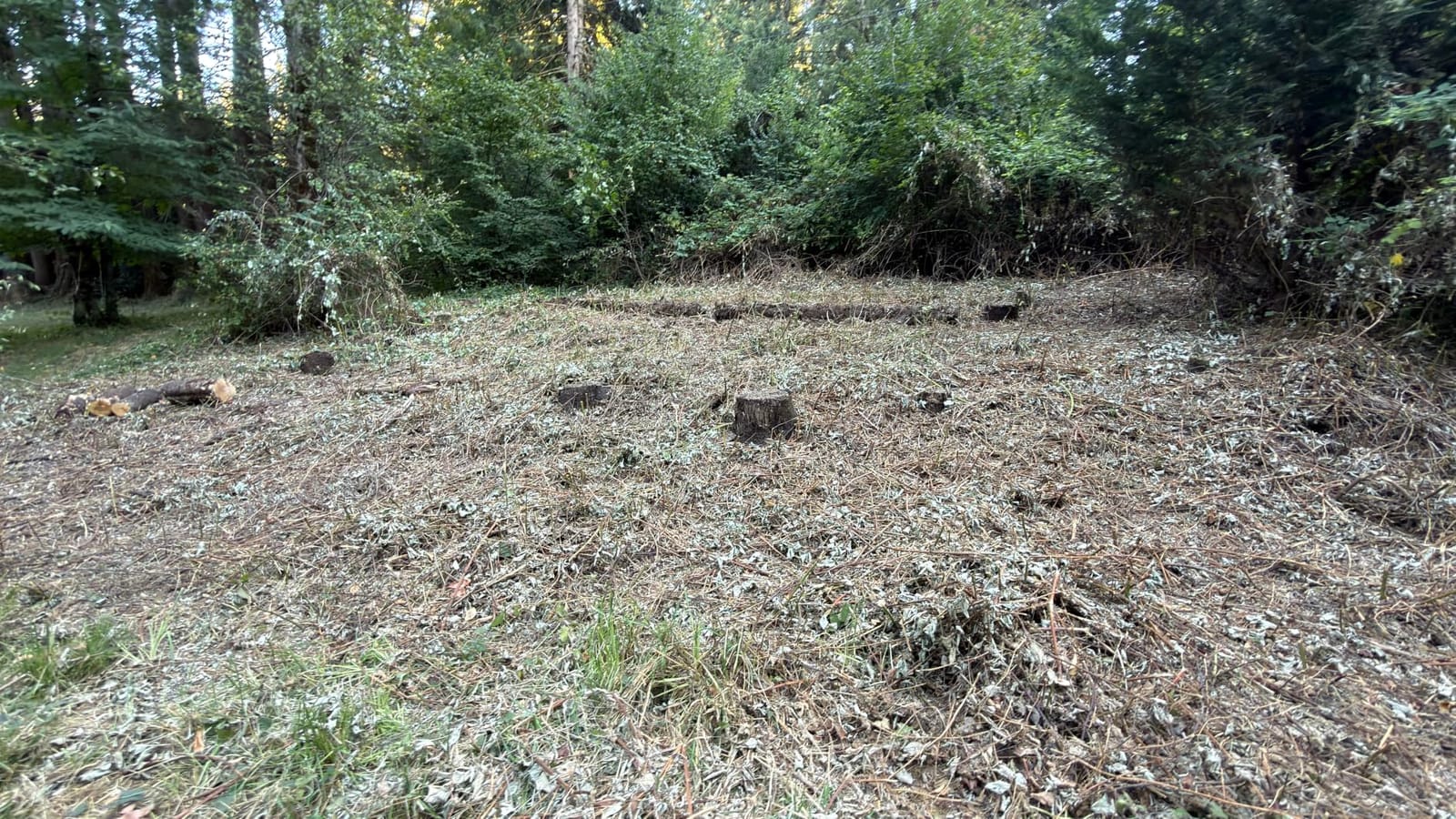
A three-tooth steel blade handles the material that defines an overgrown lot in its first and second year: brambles, heavy stalks, volunteer seedlings and vines up to an inch. It will not take down a two-inch sapling, and it is not meant to. It is the stage-one tool, and pairing it with a heavier machine later is a reasonable plan.
Carbon fiber shaft and build quality
The carbon fiber shaft is backed by a lifetime warranty, and the housing carries an IPX4 weather-resistance rating, which matters on a lot where dew and drizzle are constants. Reviews describe the build as solid and the attachment swaps onto other EGO multi-head tools without fuss.
Battery platform and runtime expectations
Performance scales with the battery pack you pair it with. A smaller pack means shorter sessions between charges, which is the complaint that appears most often in the reviews. A high-capacity pack turns this into a full-morning tool. If you already run EGO equipment, the platform math is easy. If you do not, this is a bigger purchase than the price of the head suggests.
Who should buy it, and who should not
Buy it if you own an EGO POWER+ system, work on a lot with brush up to an inch, and care a great deal about how the tool feels after three hours. Skip it if you need to fell small trees, or if you are starting from zero and a gas machine would serve you better for years of seasonal use.
2. TrimmerPlus BC720 – the Cross-Brand Attachment for Mixed Tool Collections
TrimmerPlus BC720 Brushcutter with J-Handle for Attachment Capable String Trimmers, Polesaws, and Powerheads, 8, Fatigue
Reversible 4-tip steel blade
J-bar and shoulder strap included
1.65-inch coupler tube
6.4 pounds
Pros
- Fits power heads from most major brands
- Reversible steel blade handles heavy brush
- J-bar and strap improve control on long jobs
- Two-year parts and labor warranty
Cons
- Requires a separate attachment-capable power head
- Compatibility depends on matching the square drive shaft
- 6.4 pounds adds weight to a light trimmer shaft
If your garage already holds a string trimmer with a coupler, this is the cheapest meaningful upgrade path into real brush cutting. The BC720 is a straight-shaft head with a reversible four-tip steel blade and a cutoff guard, and it is the attachment most often recommended to people who own a mixed-brand tool collection.
The fit list is long: Troy-Bilt, Remington, Craftsman, Yard Machines, Yardman, Snapper, Bolens, Murray, Ryobi, Greenworks, Kobalt and most other major brands. The connection is a 1.65-inch inner coupler tube with a 1/5 inch square female drive shaft.
Buyers single out the included J-bar and shoulder strap as a real comfort gain on longer sessions. The straight shaft design also lets you trim under shrubs and low branches, which a loop-handle brush cutter cannot do as easily.
J-bar and shoulder strap control
Most budget attachments ship with a bare loop handle. This one includes a J-bar and a shoulder strap, which spreads the load across both hands and a shoulder and gives you much better control when the blade snags. On a lot full of vines, that difference is the difference between a clean pass and a machine pulled sideways.
Cross-brand compatibility, with one caveat
Before you buy, measure the coupler tube diameter and check the shape of the drive shaft. The BC720 wants a 1.65-inch tube and a 1/5 inch square female connector, and a mismatch means the head simply will not mount. Take two minutes with a tape measure before ordering.
Where the reversible blade earns its place
Flipping the blade to its other side gives you a fresh edge when one side dulls, which matters on rocky or rooty ground. The four tips also cut in more directions per pass than a three-tooth design, and reviewers report solid performance on brush and low branches.
Best use case
This is the pick for someone who already owns a compatible power head and wants brush capability without buying a second engine. It is not the choice for thick saplings, and the 6.4-pound head does add noticeable weight to a light trimmer shaft, so pair it with a power head that already has some heft.
3. SENIX STMG-L 160cc – Walk-Behind Comfort on Long Fence Lines
SENIX High Wheel Gas Walk Behind Brush Cutter and String Trimmer, 22-Inch Swatch with .155-Inch Line, 160 cc 4-Cycle Engine, Steel Deck, 14″ Rubber Wheels, Adjustable Height (STMG-L)
22-inch swath with 0.155-inch line
160cc 4-cycle engine
5-position deck height
48.5 pounds
Pros
- Walk-behind format saves arms and back
- 22-inch swath cuts briers and tall weeds fast
- 4-cycle engine starts easily and runs quietly
- Five height positions and 14-inch rubber wheels
- Three-year limited warranty
Cons
- Some reports of drive belt and spinner head failures
- Engine can bog in the densest tangled growth
- Fuel and oil maintenance instead of battery convenience
- Bulky at 48.5 pounds in tight areas
The case for a walk-behind machine is simple: it moves the cutting head at walking pace instead of swinging it. On a long perimeter, that is the difference between a productive afternoon and a day spent nursing a sore shoulder. The STMG-L is the quietest-running walk-behind here, because a 4-cycle engine does not need a fuel-oil mixture.
The 22-inch swath with 0.155-inch line is the widest combination in this group, and thicker line resists snapping when it meets a stem. The steel deck adjusts through five positions from 1.57 inches to 3 inches, and 14-inch rubber wheels roll over uneven ground.
The catch is durability. Across reviews there is a cluster of reports about drive belts stretching and the spinner head stopping soon after assembly, and the 3.8 rating reflects that. The engine itself earns consistent praise for easy starting, low vibration and low exhaust smell.
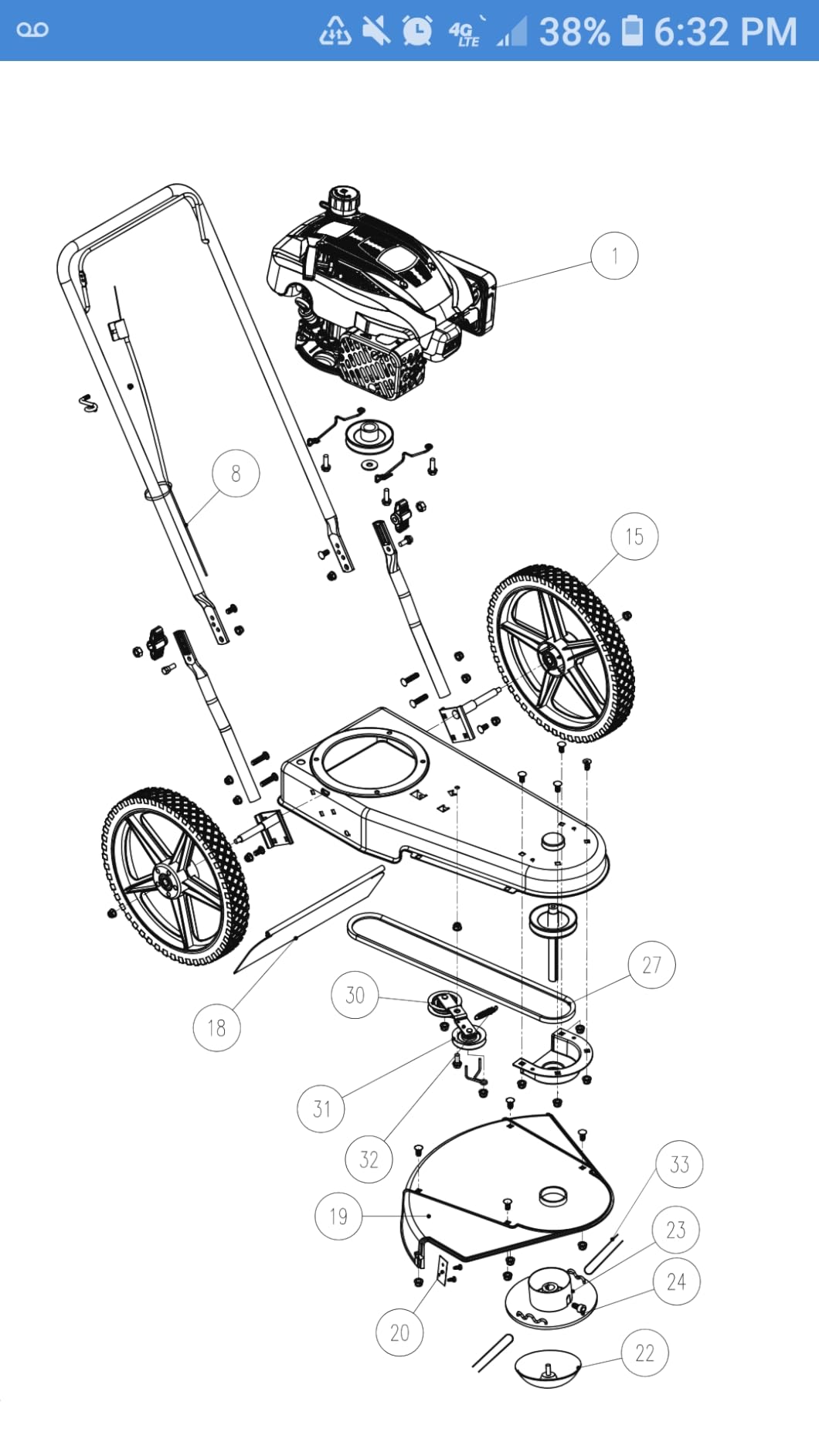
If you buy it, check the belt and head before the first long session, and keep expectations calibrated. It handles briers, tall weeds and coarse grass beautifully. It is not the machine for tangled vine thickets.
Why a walk-behind format wins on acreage
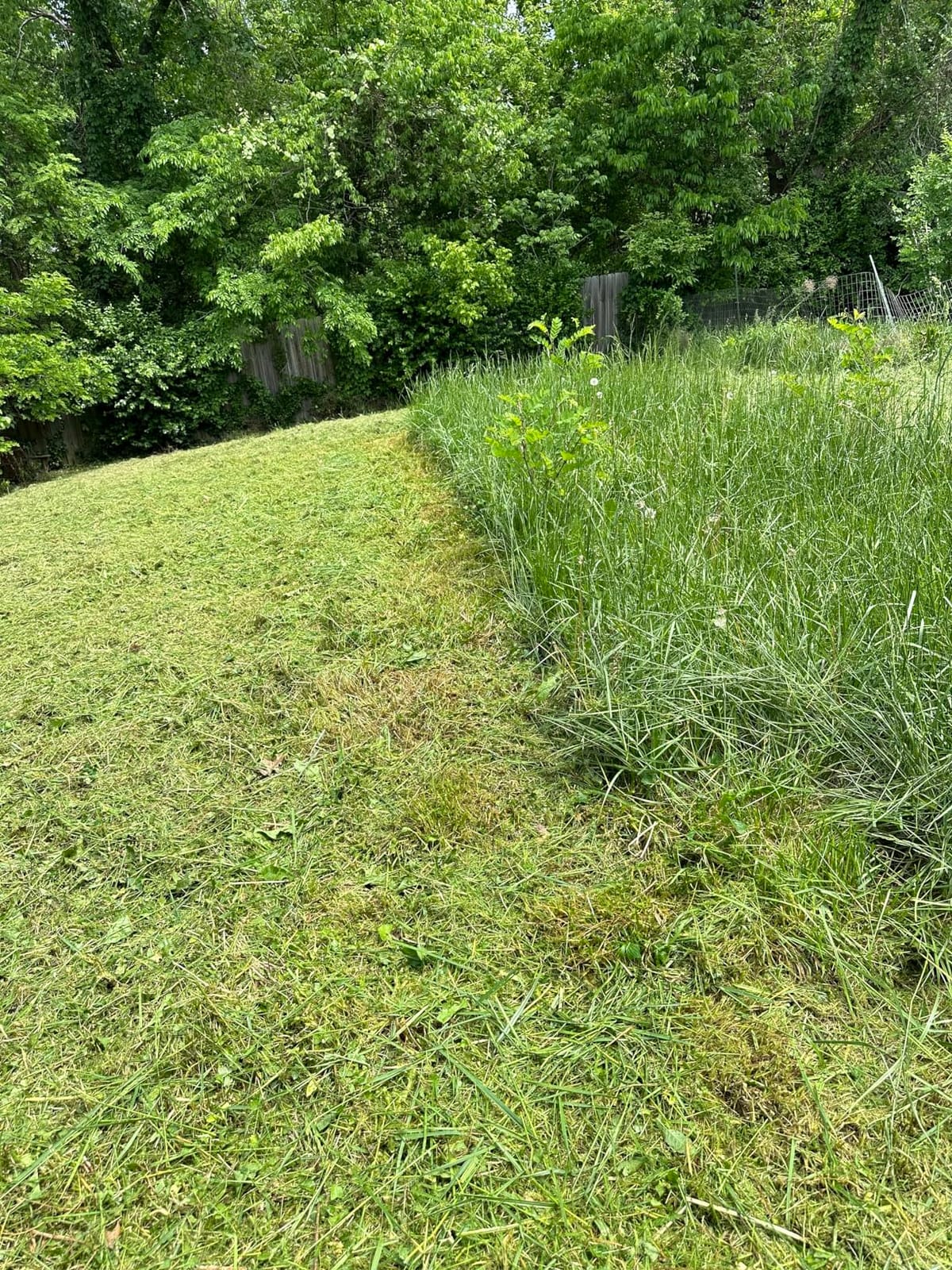
Every sweep of a walk-behind deck covers 22 inches of cut for free. A handheld machine covers the width of its head, roughly 10 to 12 inches, and everything else costs you arm movement. Over an acre of tall weeds and briers, that arithmetic is decisive.
4-cycle engine versus 2-cycle convenience
A 4-cycle engine runs on straight gasoline from the tank, which means no mixing, no fuel line fouling from bad ratio and no oil residue in the carburetor over winter storage. The trade-off is more total weight than a comparable 2-cycle, though this engine is still advertised as low vibration.
Drive train and durability concerns
Owners with acreage love the format and the engine, and the complaints cluster in one place: the drive train. Belts stretching, the bump knob cracking and the head stopping are the recurring notes, and one-star reviews concentrate on exactly those points. Treat the machine as a two-season tool rather than a ten-year investment unless you are comfortable with repairs.
Terrain handling and storage
The 14-inch rubber wheels and the five-position deck handle uneven lots and rolling ground well, and the fold-down handle makes it storeable in a small shed. At 48.5 pounds, it stays awkward between trees and along tight fence corners, which is where a handheld head still earns its place.
4. WeGofly 13 Inch 4-in-1 – Four Cordless Tools in One Package
WeGofly 13″ Electric Weed Wacker, 4 in 1 Cordless String Trimmer/Lawn Edger/Lawn Mower/Brush Cutter with Steel Gears, 2×21V 6.0Ah Batteries & Charger, 5.2 LBS Lightweight Grass Trimmer for Yard Garden
13-inch cutting width
15000 rpm brushless motor
Two 21V 6.0Ah batteries and charger
5.2 pounds
Pros
- Covers trimming edging mowing and brush cutting in one tool
- Two 6.0Ah batteries reduce charging downtime
- 5.2-pound body with telescopic pole
- Battery interface shared with many 21V tools
- Blades lines bag and tools all included
Cons
- A minority of reports of the housing separating
- Bump feed line does not stay seated well
- Only a small amount of spare line included
The value case here is the package, not the brush cutting specifically. You get a 13-inch trimmer head, an edger, a mini mower head and a brush cutter head, plus two 21V 6.0Ah batteries and a charger. For a lot that is mostly tall grass and coarse weeds, that is genuinely more tool for the money than any single-purpose machine.
At 5.2 pounds with a telescopic pole and adjustable cutting head, it is light enough for older users and small-framed operators. The 15000 rpm brushless motor and steel gear set are a meaningful step up from the brushed motors in cheap cordless tools.
The 21V slide interface is worth noting. Batteries from many other 21V tools often work in this machine, which extends the useful life of whatever packs you already own.
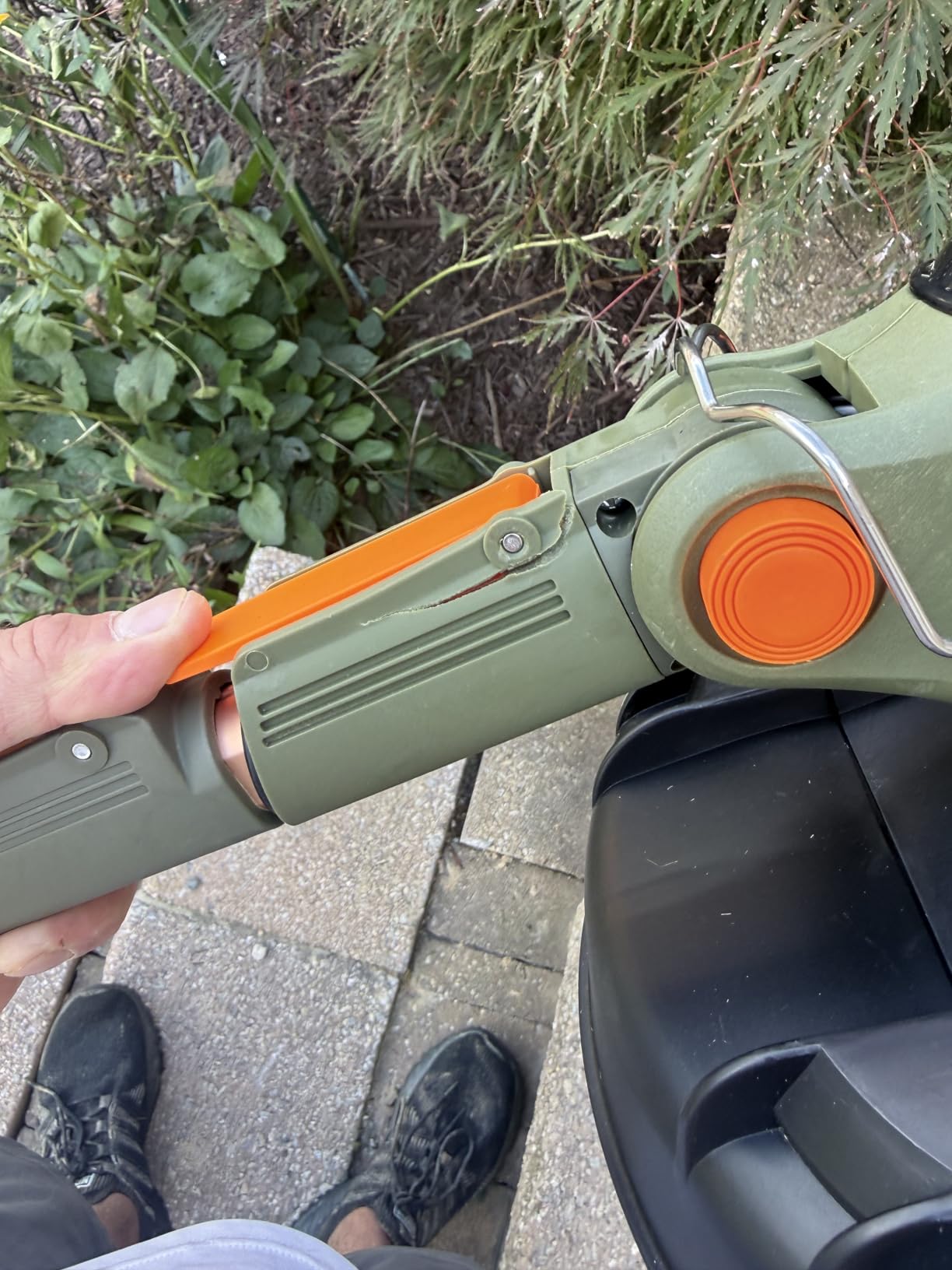
The negatives are narrow but real: the bump feed head does not hold its line well, and a small number of owners report the housing separating during use. Neither is a dealbreaker for grass and light weeds, but both would matter on heavy woody work.
Battery capacity as the deciding spec
Two 6.0Ah packs is the reason to pick this kit over a single-battery competitor. On a lot where you are already walking far distances, stopping to charge once instead of three times is the difference between finishing the job and rescheduling it.
What the 4-in-1 head actually handles
The brush cutter head deals with light brush and dense weeds. The mower head handles meadow-type grass on small patches rather than true acreage. Owners consistently praise the included replacement blades, trimmer lines and storage bag, which removes most of the accessory shopping that normally follows a cordless purchase.
Durability signals to weigh
At 4.1 stars across 538 reviews, the machine sits in the middle of this group. The brushless motor and steel gears are rated to resist burnout, but the housing complaints are a reminder that budget cordless tools have a shorter tolerance for abuse than a gas engine does.
Best for smaller users and mixed jobs
This is the pick if the lot is under roughly half an acre of weeds, if weight matters, or if you want a trimming and edging setup that happens to handle brush. It is not the answer for saplings, brambles thick enough to wrap the spindle, or acreage measured in more than a weekend.
5. BILT HARD 170cc – Push Power for Wide Overgrown Acreage
BILT HARD Walk Behind String Trimmer, 170cc 4-Cycle Gas Brush Hog Mower, 22 Inch Cutting Diameter, Push Weed Eater with 14 Inch Flat Free Wheels, Brush Cutter for Farm, Lawn, Yard
22-inch cutting diameter
170cc 4-cycle OHV engine
One-piece steel deck
54.1 pounds with 14-inch wheels
Pros
- Reaches fence lines and tight spots a mower cannot
- 170cc 4-cycle OHV handles heavy mowing and tall grass
- One-piece steel deck reduces vibration
- 14-inch never-flat wheels roll over rough ground
- 22-inch width clears overgrown grass and light brush
Cons
- Gasoline means fuel oil and pull-starting
- Heaviest walk-behind in this group at 54.1 pounds
- Returns on gasoline-related products go through the manufacturer
This is the machine for a lot measured in acres rather than square feet. A 170cc 4-cycle OHV engine is the largest engine in this roundup, and it drives a 22-inch swath of heavy-duty nylon line through a one-piece steel deck built for stability and low vibration.
Owners point to reach as the deciding factor. A walk-behind gets into fence lines, around obstacles and along ditches that a standard mower simply cannot enter, and that is where neglected lots hide their worst growth.
Feedback centers on bulk and the gas routine rather than cutting performance. Straightforward starting and a rugged deck come up repeatedly in the positive notes.
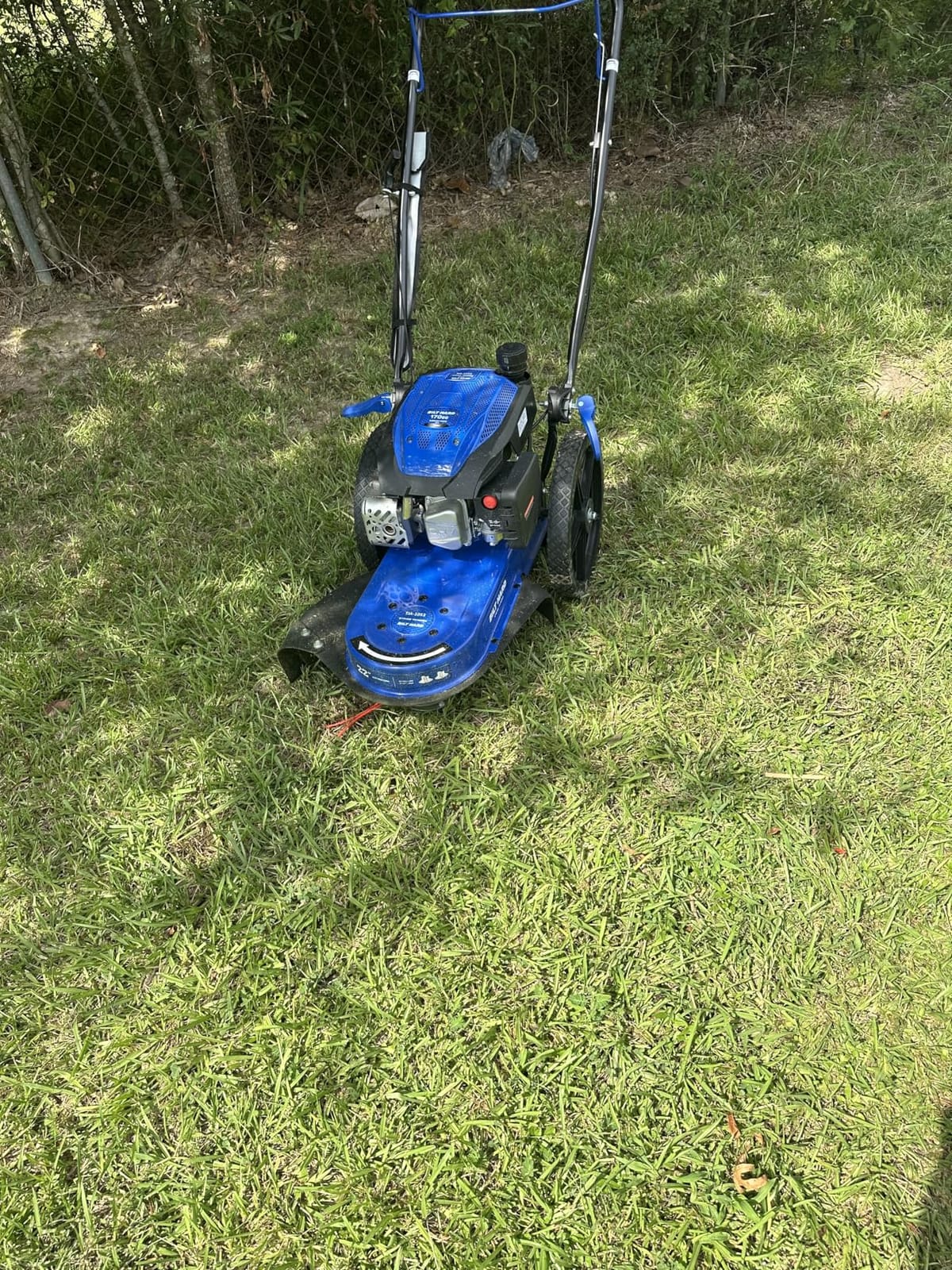
Be realistic about the weight. At 54.1 pounds, this is a machine you push across rough ground, not carry up a slope. Plan your route so the hardest terrain gets done when you are fresh.
Engine size and what it means for brush
At 170cc with overhead valves, this engine has the headroom to keep pulling when the deck meets a heavy stand of grass. Owners describe ample power for heavy mowing and tall grass, with clean running once it is started. It cuts overgrown tall grass and light brush at a 22-inch width, which covers most of what a neglected lot throws at you in year one.
Deck construction and vibration
The one-piece steel deck is a meaningful upgrade from stamped steel. It adds rigidity, which cuts the chatter that makes long sessions tiring. Combined with the 14-inch never-flat wheels, the machine tracks over ruts and uneven ground without the constant correction a small-wheeled trimmer demands.
Where it fits and where it does not
It suits wide open ground, long fence runs and ditches on a lot where the vegetation is grass and light brush rather than saplings. It does not suit small yards, tight wooded areas or anything steeper than a gentle slope, where 54 pounds of momentum becomes a liability.
Ownership realities
Gas means fuel, oil changes and a pull start every time. One practical note worth knowing before you buy: returns on gasoline-related products are handled by the manufacturer rather than the retailer, so a problem means a direct service call rather than a simple exchange.

6. YARDMAX YL2250 – Offset Head for Barns, Fences and Tight Edges
YARDMAX YL2250 22 in. 170cc Gas Walk Behind String Trimmer Mower, Orange
22-inch cutting width
170cc gas engine
Offset head position
Five tool-free height positions
61.7 pounds
Pros
- Offset head trims tight against fences and barns
- 22-inch swath and 170cc engine cover large areas fast
- Tool-free height adjustment across five positions
- 14-inch ball-bearing wheels roll over any terrain
- On-board string storage with cord caddy
Cons
- Heaviest machine here at 61.7 pounds
- Gasoline engine means fuel oil changes and pull-starting
- Lower review volume than most in this category
The offset head is the reason to choose this over any other walk-behind. Instead of a head centered under the deck, it sits to one side, so you can run the cutting edge directly against a fence, a barn wall or a foundation without leaning the machine over and gouging the grass beside it.
Underneath that, it is a 170cc gas machine with a 22-inch swath, tool-free height adjustment across five positions from 1.5 to 3.5 inches, and 14-inch ball-bearing wheels that owners say travel easily across uneven terrain.
Satisfied buyers name the offset head as the standout feature almost without exception, along with easy height changes and smooth-rolling wheels. The main caveat is weight.
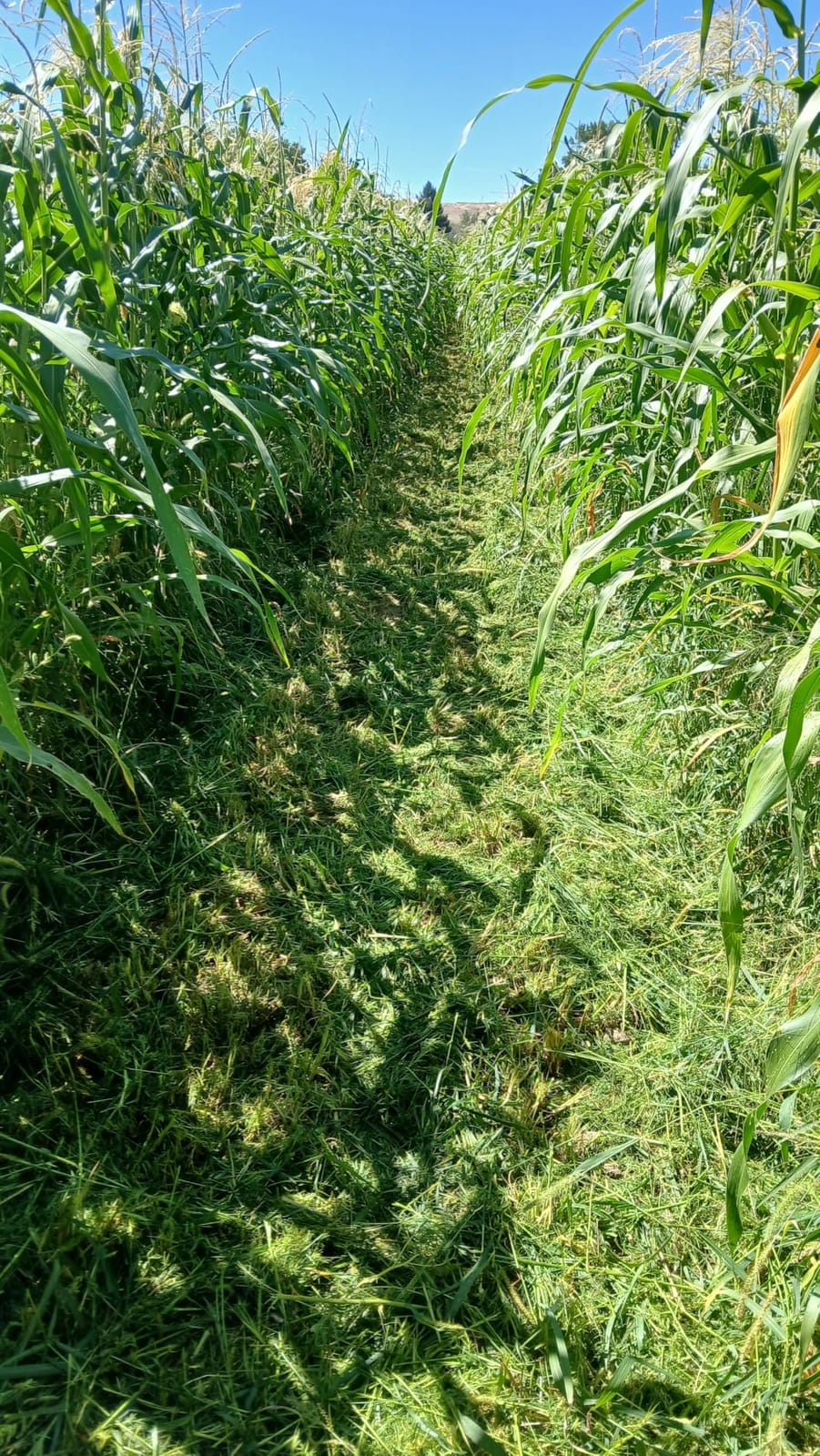
At 61.7 pounds this is the heaviest machine in the roundup. It is a walk-behind, not a carry machine, and the ergonomics suffer on slopes or broken ground where you need to lift and pivot.
What the offset head actually solves
On a neglected lot, the perimeter is the worst part. Fence lines accumulate years of accumulated growth, and a centered head leaves an uncut strip you have to come back and finish by hand. An offset head makes a single pass do the whole job, which on a 300-foot property line is a meaningful reduction in total labor.
Height adjustment and terrain
Five cutting heights from 1.5 to 3.5 inches, changed without tools, let you move from meadow grass to light brush without stopping. The ball-bearing wheels hold rolling speed over ruts, which matters because a walk-behind that drags stops making forward progress and you end up pushing it.
Convenience details that get overlooked
The on-board string storage with an included cord caddy is a small touch that pays off on a long day. You are not walking back to the shed every time the line breaks, and the caddy keeps the spare line from tangling in the process.
Who should buy it
Buy it if your lot is flat or gently rolling and defined by fence lines, barns and outbuildings. Look elsewhere if the ground is steep, wooded or small enough that a handheld machine is faster than anything you push.
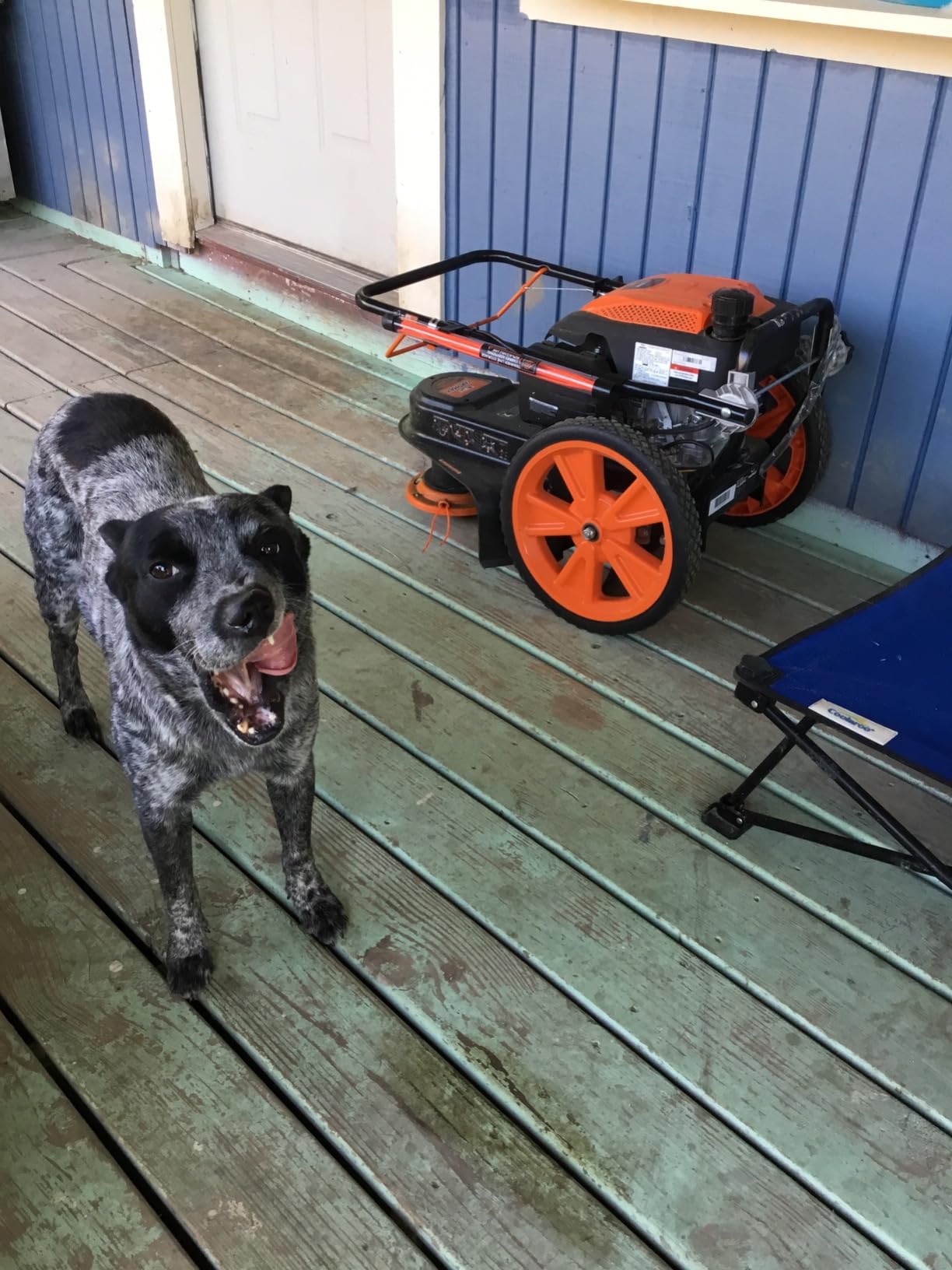
7. Wild Badger Power 40V – One Battery, Four Heads
Wild Badger Power 40V Brushless Weed Wacker, String Trimmer/Edger, Hedge Trimmer and Brush Cutter Blade, Pole Saw, Attachment Capable 4-in-1 Multi-Tool Kit with 1 * 40V 4Ah Battery and 1*Charger
Four heads in one kit
40V 4Ah brushless power unit
Quick-release attachment changes
18 pounds
Pros
- Covers trimming edging hedge shaping pole sawing and brush cutting
- About an hour of runtime per charge
- Quick attachment swaps without tools
- No gas oil or pull-starting
- Hedge trimmer and pole saw perform well for light work
Cons
- Assembly instructions are vague
- One 4Ah battery limits runtime with no rotation
- Pole saw struggles beyond about 2 inches
- Chain oil for the pole saw not supplied
This kit bundles four heads onto a single 40V 4Ah power unit: a 15-inch string trimmer and edger head, an 8-inch pole saw, a 16-inch hedge trimmer and a 10-inch brush cutter running 0.095-inch line. For someone clearing a lot and then dealing with the hedge row and the low branches at the property line, that is an unusually complete package.
Owners like the cordless convenience, quick assembly and battery life, and report roughly an hour of runtime per charge. Attachments swap in seconds, which means one battery in the tool and one on the charger if you own a second pack.
Review volume is thin at 33 ratings, so weigh the pattern of complaints more heavily than the average score. Vibration, vague documentation and less cutting punch than the marketing implies come up repeatedly.
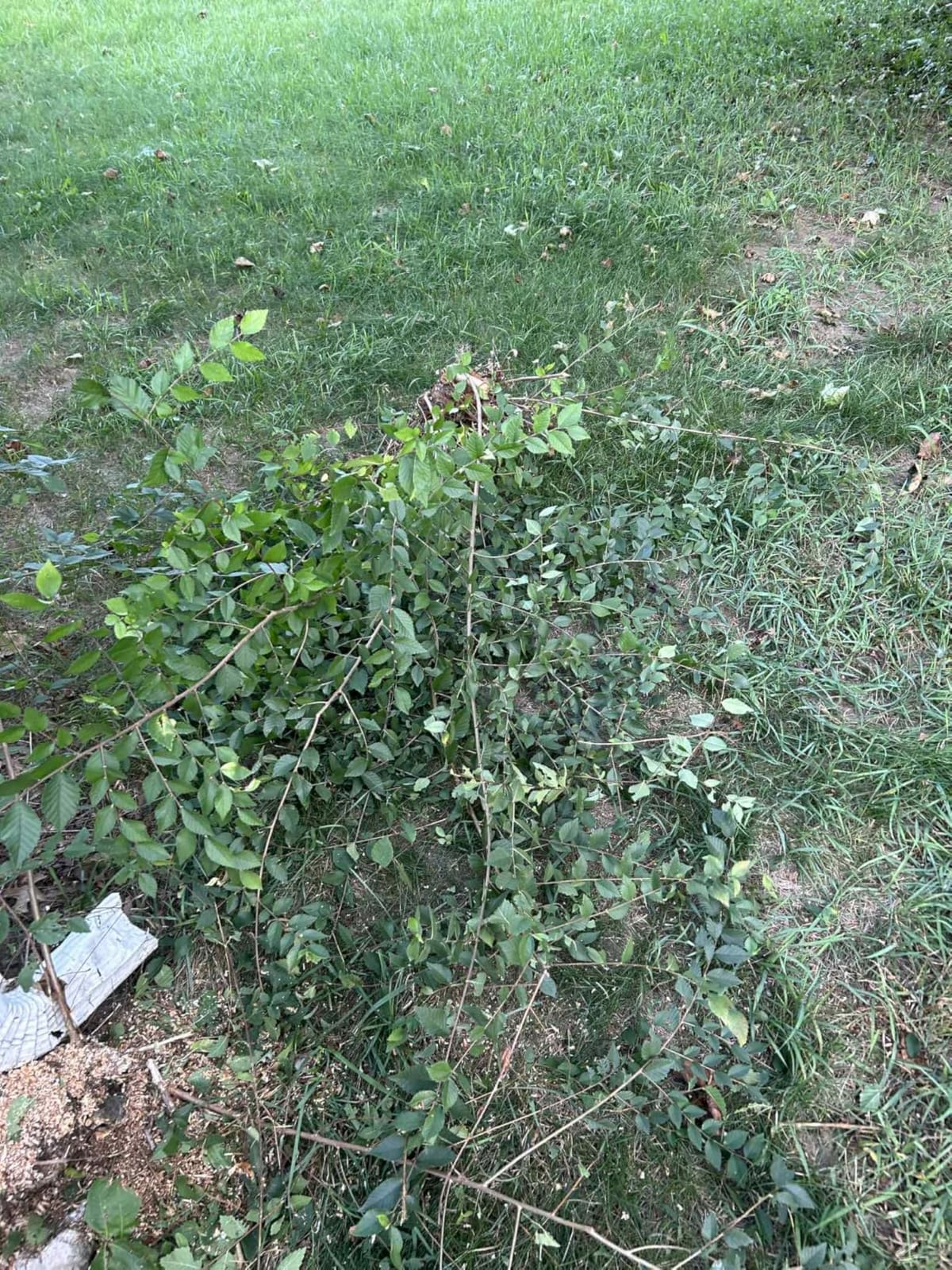
At 18 pounds for the full package, this is not a light tool. The included shoulder strap is not optional at that weight over a full session.
Where the 10-inch brush head fits
The 10-inch brush cutter head with 0.095-inch line handles light brush and overgrown grass, which is stage one of a lot clearing. It is not built for woody stems, and reviewers specifically flag the brush cutter and hedge trimmer heads as less powerful than the product description implies.
Multi-tool value versus dedicated machines
The value case is substitution. Four heads cover four jobs that would otherwise mean four separate purchases or two more machines. The risk is that each head is a compromise, and on a lot where one head does most of the work, the compromises show up exactly where you feel them most.
Runtime and battery limitations
A single 4Ah battery with no second pack means the kit stops when the battery stops. On a long clearing day that is a hard stop at roughly an hour, and the answer is a second battery rather than a different machine. Chain oil for the pole saw is not supplied, which is one more small thing to add to the box.
Best fit
It suits a homeowner with mixed small-property chores who values cordless convenience and owns a single voltage platform. It is a poor fit for a big acreage job or for anyone who needs serious brush capacity in one head.
8. LINASHI 52cc – an Entry Gas Machine with Honest Limits
52cc Gas Weed Eater, Gas Powered Weed Wacker, Brush Cutter & String Trimmer
52cc 2-stroke engine
8500 rpm
2.2KW rated output
Side-mounted engine with U-handle
Pros
- Genuine 52cc two-stroke engine with real cutting power
- Switches between string head and 3-tooth metal blade
- U-handle and shoulder strap improve balance
- Gloves funnel oil can tools and safety glasses included
Cons
- String head line repeatedly feeds out and the spool has broken
- Assembly instructions largely illegible
- Primer bulb will not stay primed causing hard starting
- Heavier and more awkward than expected
I include this one because the failure patterns are worth knowing before you buy, not because it is a recommendation. At 3.3 stars across 49 ratings it is the lowest-rated machine in this group, and the complaints are specific enough to predict them.
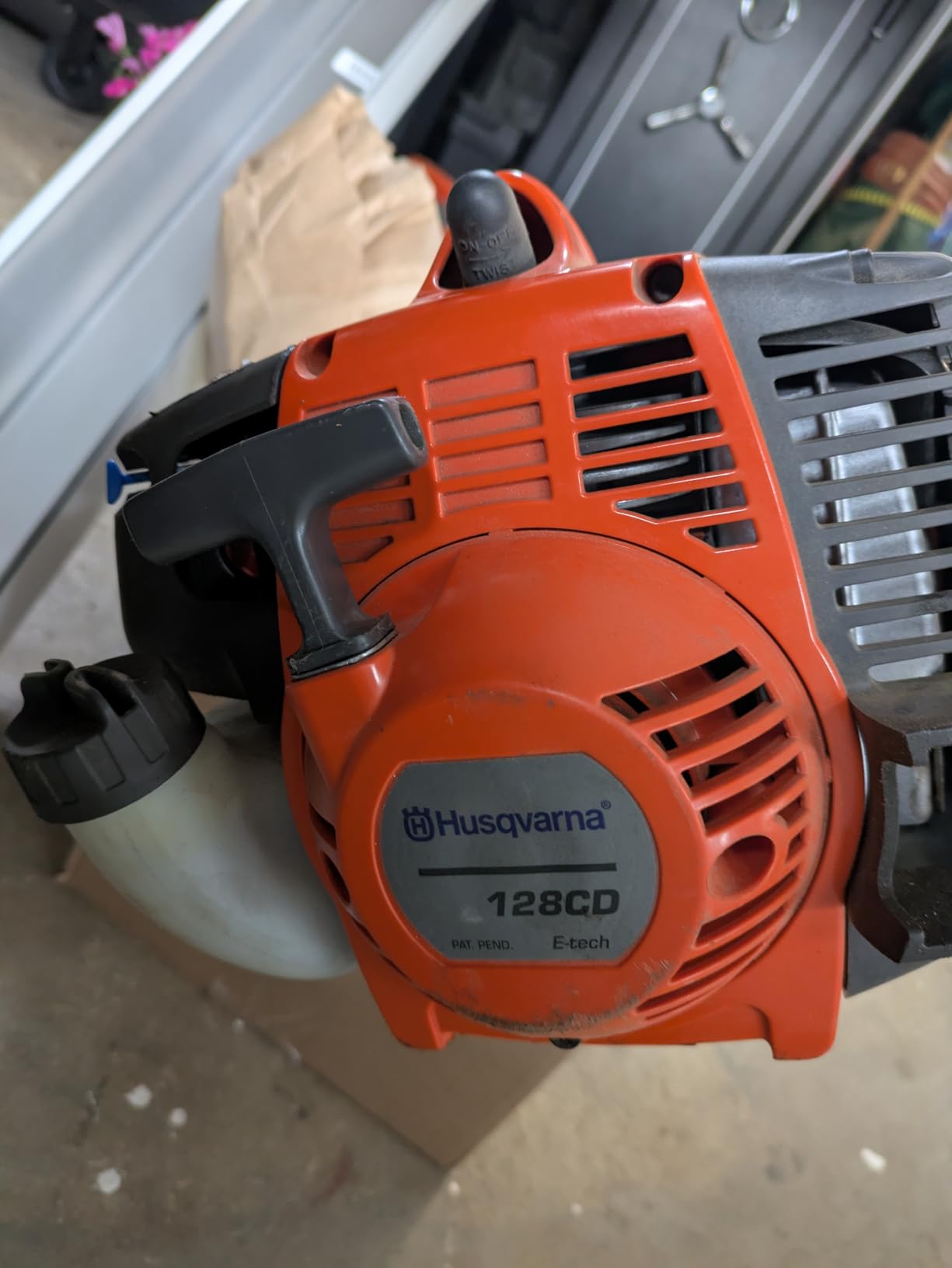
The good news is real. A 52cc two-stroke engine rated at 2.2KW and up to 8500 rpm has enough displacement to handle thick grass, weeds and light brush, and it switches between a string head and a three-tooth metal blade. A minority of buyers find the engine powerful and well made.
The bad news clusters on three things: the string head, the assembly documentation and starting. Owners report the line repeatedly feeding out with a spool that has broken in use, instructions with tiny illegible diagrams, and a primer bulb that will not stay primed.
The kit itself is generously packed, with the engine, control rod, extension rod, trimmer head, blade, gloves, funnel, oil can, installation kit and safety glasses. Side-mounted engine placement with a U-handle and shoulder strap is a sensible design for balance.
Reading the complaint pattern
Across retailer review aggregations for this category, the most common owner complaints are bogs when giving throttle, carburetor issues, difficult starting, a bump feature that does not work and difficult line loading. This machine appears in that pattern on all but the carburetor point. If you buy a budget 2-cycle, expect to spend time on the primer and the fuel line before the first cut of the season.
Weight and balance
Owners report it being heavier than expected even with the harness, and awkward to adjust in both height and handle angle. A 52cc engine with a side mount and a shoulder strap is a real load over a full afternoon, and the ergonomics here are not its strength.
When this category of machine makes sense
A gas machine earns its place when you clear land multiple times a year, need no battery platform and want no runtime ceiling. The 52cc size is the right starting point for a lot with weeds and light brush. The execution of this particular machine is the problem, not the concept.
Our recommendation
If a gas machine is what you need, choose a model with a stronger service record and a dealer network. If you are starting out and clearing land once, a battery machine or a rental will serve you better than owning this.

9. COPLAR 8 Inch – the Low-Cost Blade Head for an Existing Power Head
COPLAR 8 Inch Brushcutter Attachment
8-inch 3-tooth TRI-ARC steel blade
Accepts 1-inch aluminum tube
Square drive coupler
32.68 inches long
Pros
- Low-cost way to add brush cutting to an existing power head
- Three-tooth steel TRI-ARC blade handles grass and light brush
- Fits a very wide range of major-brand power heads
- Simple shaft-and-tube connection
Cons
- Requires a compatible attachment-capable power head
- 8-inch cutting width is narrow for large lots
- Square drive coupler must match 0.200 to 0.205 inch
- Manufacturer does not publish spare part numbers
This is the sensible low-cost answer for one specific situation: you already own an attachment-capable trimmer, and you want to try brush cutting before committing to a dedicated machine. Buyers treat it exactly that way, as a budget add-on for trimmers they already have.
The head carries a three-tooth steel TRI-ARC blade across an 8-inch cutting width. The connection is a 1-inch aluminum diameter tube with a 0.205 inch female square drive shaft, and the fit list covers Ryobi, Greenworks, Remington, Craftsman, Yard Machines, Troy-Bilt, Yardman, Snapper, Bolens, Murray and Kobalt.
The 8-inch width is the limiting spec. It is narrower than most dedicated brush cutter heads, so covering a lot means more passes, and more passes means more arm fatigue over a long day.
Confirming compatibility before you order
Two numbers decide whether this fits: the tube diameter your power head accepts and the shape and size of the drive coupler. This head wants a 1-inch aluminum tube and a square female connector at 0.205 inch. Check the spec sheet of your own power head rather than trusting the brand name on the listing, because two machines from the same brand can differ.
What an 8-inch TRI-ARC blade can do
A three-tooth TRI-ARC blade handles grass and light brush cleanly, which covers the majority of a first-year lot. It is not the tool for woody stems, and the narrow width means you are covering the ground one foot at a time rather than one foot plus change.
The parts availability problem
One limitation deserves attention from anyone planning to own this long: the manufacturer does not publish spare part numbers. If the head takes an impact from a rock or a root, plan on replacing the whole attachment rather than a single component.
Best use
A trial head, a secondary tool, or a solution for a small overgrown corner of a yard. It is a sensible first purchase in this category and a poor long-term investment if the lot clearing becomes a regular task.
10. VOL2GO Cordless Stringless – the Lightest Tool for Light Overgrowth
Cordless Weed Wacker Eater Brush Cutter Weed Trimmer with Blade Stringless
21V motor
6-inch cutting width
Stringless metal blades
Two rechargeable batteries included
3.5 pounds
Pros
- Only 3.5 pounds so smaller and older users can operate it
- No nylon line to break or rethread on rocks and roots
- Two rechargeable batteries hold charge well
- Multiple blade types for tight areas and tougher growth
- Quiet enough for a suburban neighborhood
Cons
- 6-inch cutting width is narrow for large overgrown lots
- Suited to light brush rather than thick woody growth
- Debris guard could be better designed
- Small battery capacity versus higher-end kits
The stringless design is the idea worth borrowing from this machine. Instead of a nylon bump head, it runs metal blades, which means no line breaking on rocks, no rethreading mid-pile and no bump head jamming when the vegetation is thick. For someone tired of line problems, that is a genuine change of day.
At 3.5 pounds it is the lightest complete machine in this roundup, and owners repeatedly mention clearing surprisingly large areas on a single charge. The kit includes saw blades, straight blades, two rechargeable lithium batteries, a charger, safety goggles, work gloves and a reinforced debris guard.
The 21V motor handles thick grass, stubborn weeds and overgrown areas, and the tool switches between trimming, edging and brush cutting. It is also the quietest option here if you have close neighbors.
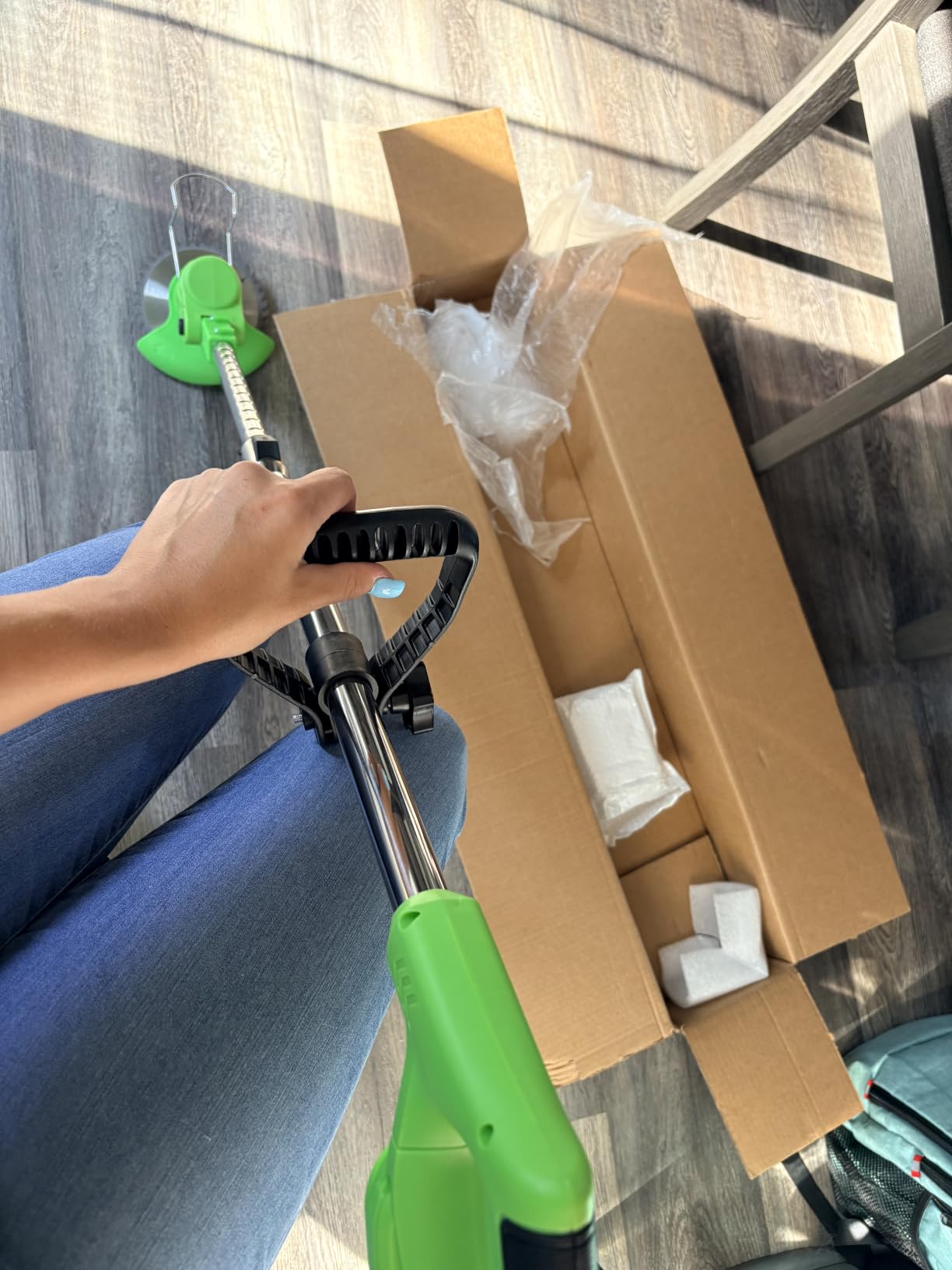
The 6-inch cutting width is the whole limitation. That is a garden-bed and path width, not a lot width, and owners are clear that it suits light overgrowth rather than thick woody material.
Why stringless blades help on rough ground
Line heads are the weak point on a neglected lot. Roots, rocks and dry stalks snap line, and a snapped line is the most common reason a clearing job stops. Fixed metal blades keep cutting through those conditions, which is why this design keeps appearing in the positive reviews.
Weight and control
At 3.5 pounds, this is light enough for older adults, smaller-framed operators and anyone with shoulder or back issues. For a half-acre of weeds and light brush on a suburban lot, a machine this light lets you work longer without fatigue than a heavier gas unit of equivalent output.
Real limits to plan around
The narrow width means more passes, the battery capacity is small compared with higher-end cordless kits, and owners note the debris guard is not well designed. None of those are dealbreakers for the intended job, and all of them matter if you try to push this into acreage work.
Best fit
Paths, garden edges, a driveway verge, a small overgrown corner, or any job where noise and weight matter more than throughput. It is the tool most likely to be used by every member of a household.
11. RYOBI RXBC01 – SmartTool Blade for Corded Expand-It Owners
RYOBI RXBC01 Expand-It Brush Cutter Attachment with SmartTool Capability, Grey
20 cm tri-arc blade
8100 rpm
SmartTool technology
Lightweight design
Pros
- Tri-arc 20 cm blade handles light brush and grass
- Lightweight design reduces fatigue on short jobs
- SmartTool technology optimizes output with corded power heads
- Clean addition to an existing RYOBI Expand-It collection
Cons
- Only works with RYOBI Expand-It corded power heads
- 8-inch cutting width is small for large overgrown areas
- 8100 rpm is adequate rather than class-leading
- Several listing specs for weight and dimensions appear inconsistent
If you already run RYOBI Expand-It corded tools, this is the head that fits the platform and nothing else will. The 20 cm tri-arc blade spins at 8100 rpm, and the SmartTool technology is designed to optimize performance when paired with a compatible corded power head.
Owners use it to extend an existing collection and report it working as intended for the size of job the head suits. The lightweight design shows up as a real benefit on short sessions.
Platform lock-in is the defining trade-off. It will not fit a non-RYOBI power head, and the power head is not included, so this only makes sense inside an established RYOBI corded system.
Where the tri-arc blade fits
A tri-arc blade at 20 cm handles grass and light brush, which is the same class of work as the other 8-inch attachment heads in this roundup. At 8100 rpm it has plenty of speed for green growth and thin stems. Woody brush is beyond what this head is designed to take.
SmartTool and the corded advantage
Corded power heads deliver unlimited runtime, which matters more on a large lot than most buyers expect. The tradeoff is a cord to manage across the property, and the SmartTool handshake that lets the head read the power head’s output is what keeps performance consistent rather than surprising you mid-cut.
A caution on published specs
Several listings for this item show inconsistent weight and dimension data, with a listed item weight of 2.5 kg alongside product copy that states 1.4 kg. Treat the manufacturer listing as the reliable figure and ignore marketplace dimension fields, which are clearly generated incorrectly here.
Best fit
A RYOBI Expand-It owner with corded power heads who wants light brush capability on a small property. Anyone without that platform should skip it and look at a universal attachment instead.
12. WORX Driveshare 10 Inch – Steel Blade that Fits Most Split-Shaft Trimmers
WORX Driveshare 10″ Brush Cutter Attachment, WA0221
10-inch heavy-duty steel blade
6700 rpm
Fits most split-shaft trimmers
4 pounds
Pros
- Steel blade slices through green brush to an inch and small saplings
- Cuts close to the ground without leaving stubs
- All-metal construction feels solid and durable
- Fits a wide range of third-party split-shaft trimmers including Ryobi
- Wrench hex key shoulder strap and safety handle included
Cons
- WORX assembly instructions are widely criticized
- Adapter pin does not always line up on non-WORX trimmers
- 10-inch width is modest for large lots
- Bundled with a trimmer rather than sold as a bare power head
The WORX head has the most useful owner reviews in this group, with 500 ratings describing real work on real overgrowth. The recurring theme is cutting performance: owners report brambles, ground ivy and saplings over an inch, and several call it a labor saver on neglected ground.
The design is a heavy-duty steel blade at a 10-inch cutting width running to 6700 rpm. All-metal construction is described as solid and durable, and the blade cuts close to the ground without leaving the stubs a line head tends to leave behind.
The friction points are documentation and fit. WORX assembly instructions are widely criticized, and on third-party split-shaft trimmers the adapter pin does not always seat, which requires a workaround.
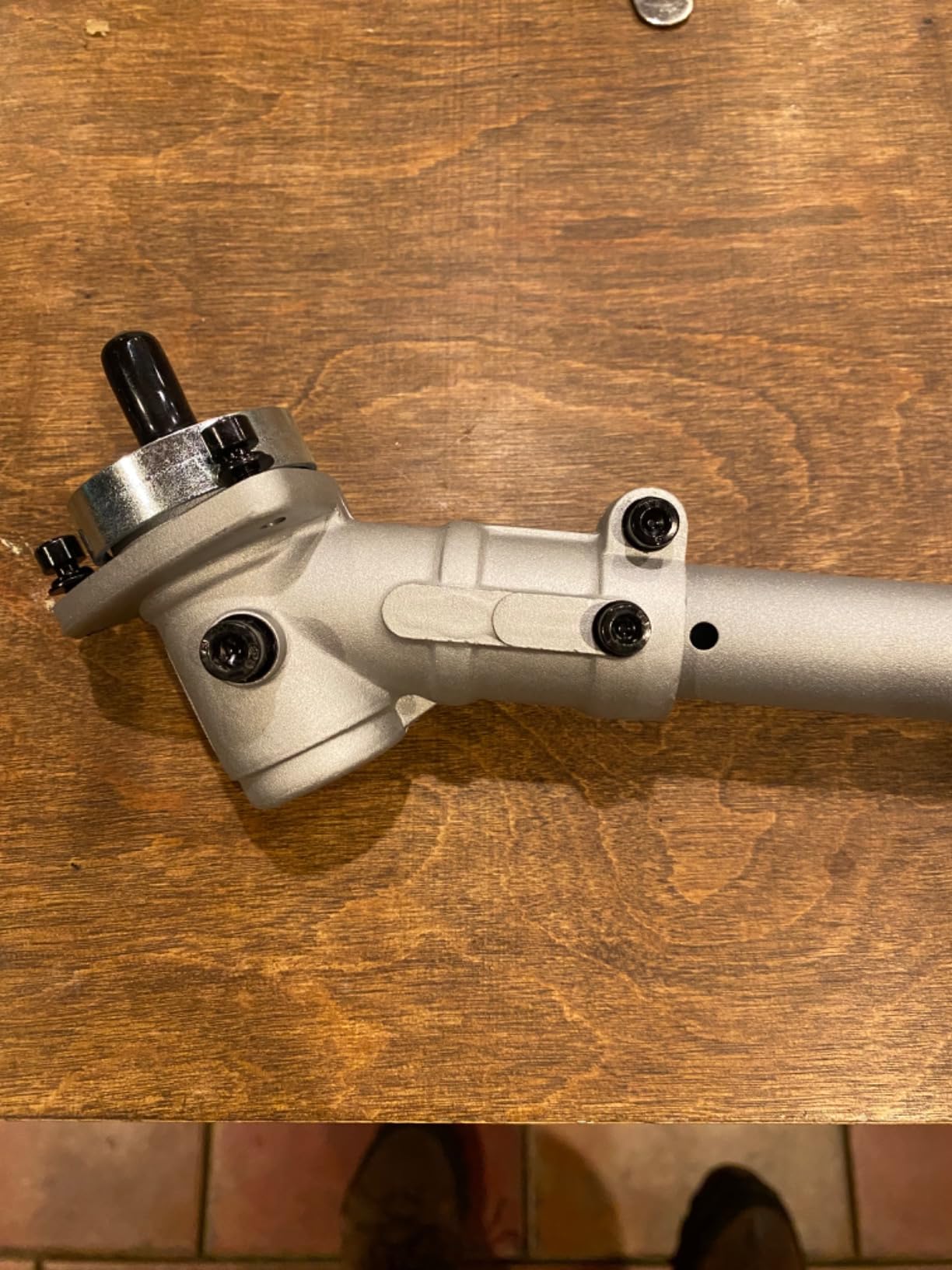
One purchasing nuance: this attachment is sold as part of a trimmer bundle rather than as a bare power head, so if you already own the WORX Nitro Driveshare you may be buying a duplicate. Verify what is in the box before ordering.
Cutting performance on real overgrowth
This is where the head separates itself. A steel blade at this width handles green brush up to an inch thick and small saplings, and it runs low enough to mow down ground cover and ground ivy rather than hovering above it. That is the vegetation that grows across the floor of a neglected lot, and it is the part most people underestimate.
Universal fit and the adapter pin
The head fits most split-shaft design trimmers from other brands, which covers a much larger share of the second-hand and existing tool market than a platform-locked head does. The catch is the locating pin. On non-WORX machines it does not always align on the first attempt, so allow a few minutes and expect a minor adjustment.
What comes in the box
The accessory list is unusually complete for an attachment: brush cutter attachment, wrench, hex key, shoulder strap and safety handle. Having the wrench and hex key included removes the most common assembly frustration, even if the printed directions are weak.
Best fit
Owners of split-shaft trimmers who want a durable steel head for light-to-medium brush on a small or medium lot. At 4 pounds it stays light, and the 10-inch width is a sensible compromise between coverage and handling in weeds.
How We Evaluated 12 Brush Cutters for Lot Clearing
We scored every machine on five axes that matter when the vegetation is not cooperative, and we weighted them the way the job demands rather than the way a spec sheet reads.
Cutting ability under load
A machine is not powerful if it bogs the moment the stems thicken. We looked at engine displacement or motor speed, cutting width, head type and the maximum diameter owners report actually cutting, then cross-checked that against the complaint pattern in the reviews.
Weight distribution and fatigue
Clearing a lot is a repetitive overhead and outward swing. We weighed machine weight, whether it is carried or pushed, the presence of a harness, J-bar or bicycle-style handlebars, and how owners describe the tool after two hours rather than after five minutes.
Durability and serviceability
We looked at warranty length, whether the air filter, spark plug and carburetor are user-serviceable, whether the manufacturer publishes spare part numbers, and the frequency of failure reports on drive belts, gear housings and bump knobs. A tool you cannot repair is a tool you replace.
Real owner patterns
Ratings tell you what happened once. Review volume and complaint clustering tell you what happens repeatedly. We weighted patterns like hard starting, carburetor issues, bogs on throttle, line loading problems and line breaking across a large sample more heavily than any single average score.
Value and platform fit
Finally we factored in what you already own. An attachment that fits your existing power head can be worth more than a stronger complete machine, and on a lot you clear twice a year that difference is real. We never factored cost of ownership into the scores themselves, so you can apply your own budget logic to the same data. If your property work runs beyond vegetation, our guide to the best pipe cutters covers the fixed-utility side of a rural lot.
Which Brush Cutter Type Fits Your Overgrown Lot
The right format depends on three variables: how much ground you have, how thick the stems get, and how often you will do the work. Here is how the categories divide.
Handheld brush cutter versus walk-behind brush hog
A handheld brush cutter is faster to set up, easier in the woods and better between obstacles, and it is the only sane option on uneven or sloped ground. A walk-behind brush hog moves more cut per minute over open ground and saves your arms entirely, at the cost of maneuverability and bulk. Forum users clearing creek edges and fence rows consistently favor the handheld format, and the reason is simple: a 55-pound machine does not fit between two trees.
Gas, battery or corded
Gas gives unlimited runtime and no battery platform, at the cost of fuel mixing on a 2-cycle, pull starting and a maintenance schedule. Battery gives instant starts, low noise and near-zero maintenance, with runtime capped by your pack. Corded gives unlimited runtime with a cord to manage. For a lot you clear once or twice a year, gas or battery both work. For a lot you cut every month, gas usually wins on total hours spent.
Matching the head to the vegetation
Match the head to what is actually growing, because this is where most failed attempts happen. Grass and weeds under half an inch take a heavy line head, and nothing more. Vines and light bramble from half an inch to an inch take a three-tooth or tri-arc steel blade. Woody brush from one to two inches needs a four-tooth steel blade and real engine torque. Anything thicker than two inches is past a handheld brush cutter and into chainsaw or walk-behind territory.
Attachment, dedicated machine, or conversion kit
Buy an attachment if you already own a compatible power head, since that is the cheapest path to brush capability. Buy a dedicated machine if you clear regularly, if you need a wider cutting head, or if you want a warranty behind the whole system. Consider a multi-tool kit if your property has varied small jobs rather than one big one, since the compromises in a multi-tool head show up exactly where you work hardest.
What people with the same problem actually report
Owners in the field forums repeatedly name weight and balance as the deciding factor over raw power, and they single out lighter two-stroke machines as preferable for working acres of weeds. The other recurring theme is tangling: a machine gets wrapped up in tall grass and vines very fast, and the fix is technique rather than a bigger engine.
How to Clear an Overgrown Lot, Step by Step
Order of operations matters more than machine choice. Clearing a lot wrong means doing the same ground three times.
Scout the property on foot first
Walk the whole property before you start cutting. Identify where the thickest growth is, locate rocks, buried wire, irrigation lines, fence posts and drop-offs, and note the vegetation types. This is the step everyone skips, and it is the one that prevents a blade from finding a buried fence line.
Cut the grass down first
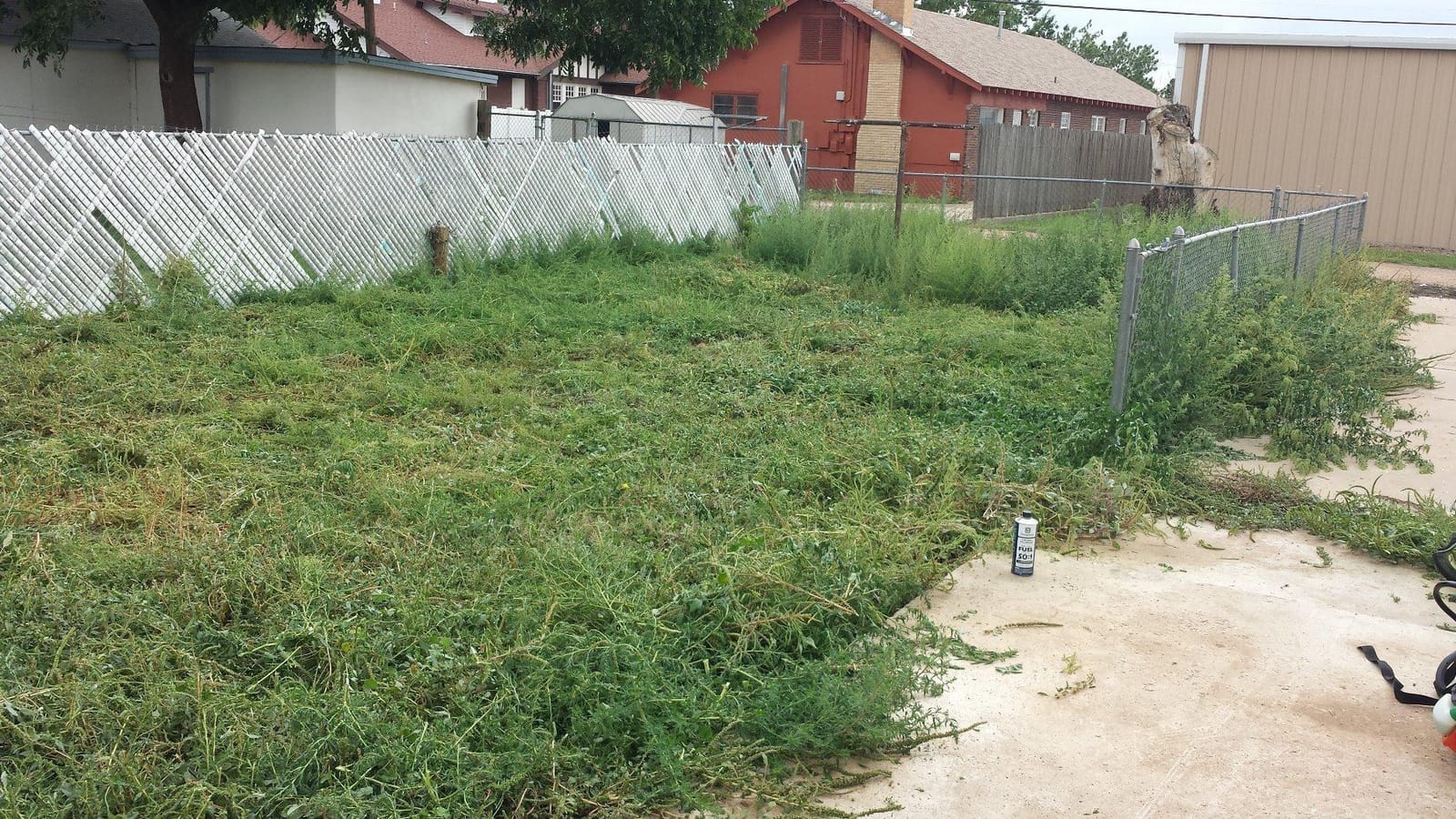
Tall grass is the biggest cause of tangling. Take the whole lot down to a manageable height with a line head or a mower before you introduce any blade. Cut away from yourself and from the machine so debris falls behind you rather than wrapping around the spindle or gear head, which is the entanglement problem owners describe most often.
Work up to the brush
With the grass down, switch to a steel blade and work in a slow, controlled sweep, taking maybe 60 to 70 percent of your weight onto the machine rather than pushing with your back. Clear the perimeter first, fence lines and ditches first, then work inward. Cut from the outside of a thicket toward the middle rather than standing inside it.
Handle saplings last, and separately
Saplings over two inches are a different job with different equipment. Do not force a brush cutter blade into them, because a jammed blade on a live stem is how kickback injuries and thrown blades happen. Use a saw or a heavier machine for anything that thick, and come back to the fine brush afterward.
Clean up as you go
Chip, mulch or pile cut material rather than leaving it underfoot, because cut debris hides rocks and roots and will wreck a line head on the next pass. Leaving brush piles to decay in place is fine for soil, but keep them away from anything you intend to mow next season.
Safety Gear and Techniques That Prevent Kickback Injuries
Kickback is the mechanism behind most serious brush cutter injuries, and it is entirely preventable. The blade snags, the machine rebounds, and the spinning blade comes back toward your leg. Four things prevent it.
Wear the right protection
At minimum: safety glasses or a face shield, hearing protection, cut-resistant chaps or long trousers with no slits, steel-toe boots with good grip, and gloves. A debris guard on the machine matters as much as any of it, since a thrown rock travels as far as a thrown blade.
Never let the blade touch solid material
Keep the cutting tip clear of rocks, roots, bottle caps, wire, irrigation lines and buried utility markers. A blade that touches solid ground immediately dulls, which forces you to push harder, which is precisely the combination that produces kickback.
Watch the blade tip angle
The tip of a brush cutter blade travels faster than the middle. Cutting with the lower two-thirds of the blade and keeping the tip pointed away from anything hard is the standard technique. Never let the tip dig into soil, because that is the classic bind-and-rebound scenario.
Manage people, slopes and fatigue
Clear bystanders and pets from the work area before you start, and never work with another person within blade reach. On slopes, work across the fall line rather than straight up or down, and do not operate a heavy walk-behind on a grade steeper than your footing allows. Most accidents on this kind of work happen in the last hour of a long session, so stop when your arms stop answering.
Frequently Asked Questions
What is the best tool for cutting through thick brush?
A brush cutter with a steel blade is the right tool for thick brush. A three-tooth or tri-arc steel blade at 10 to 12 inches handles growth up to about an inch, and a four-tooth blade with a 35cc-or-larger engine takes on 1 to 2 inch woody brush. Past 2 inches, use a chainsaw or a walk-behind brush mower instead of forcing a handheld machine.
Which brush cutter is best for heavy duty work?
For heavy duty work on a large overgrown lot, a walk-behind brush hog with a 170cc 4-cycle engine and a 22-inch cutting width covers the most ground with the least arm fatigue. For heavy woody brush specifically, a gas handheld brush cutter with a four-tooth steel blade gives the control you need in tight spaces where a walk-behind cannot follow.
What is the best tool for cutting overgrown grass?
For overgrown grass alone, a heavy line head with 0.080 to 0.095 inch line is the fastest option, and a walk-behind brush mower with a 22-inch swath beats any handheld for acreage. Switch to a steel blade only when stems exceed half an inch, since a blade in tall grass causes the tangling that owners complain about most.
What is the best brush cutter for steep hills?
A light handheld brush cutter is the only safe answer on steep hills. Walk-behind machines at 48 to 62 pounds become dangerous on a grade, and most mishaps happen during a pivot or a lift. Choose a machine under 8 pounds with a loop handle or J-bar, work across the slope rather than up and down it, and stop before fatigue sets in.
Do brush cutters need much maintenance?
Gas brush cutters need regular attention: clean the air filter, check the spark plug, drain old fuel before winter storage and run the fuel line dry. Battery and cordless models need far less, mostly a clean air intake and a dry storage location. Regardless of type, check the gear head grease and the blade bolt torque before each season.
What are the most common problems with brush cutters?
The most common problems reported by owners are hard starting, bogs when giving throttle, carburetor issues, dull or poor-quality blades, and difficulty loading line onto bump-feed heads. Tangles in tall grass and vines are the biggest operational problem. Each has a fix: fresh fuel mixture and a clean filter for starting, a properly sharpened blade for cutting, and cutting grass down first for tangles.
The Verdict: Which Brush Cutter Should You Buy
Match the machine to the job rather than to the biggest number. If you own an EGO POWER+ system and the growth tops out around an inch, the BCA1220 is the pick we keep coming back to, because at 2.2 pounds it is the least fatiguing way to cut a full day of brush.
If you already own an attachment-capable power head and want the most capability for the least commitment, the TrimmerPlus BC720 is the better value, with a reversible four-tip blade, a J-bar and a strap in the box. If you have a Ryobi or a third-party split-shaft trimmer instead, the WORX Driveshare head is the one that fits the widest range of machines.
For flat open acreage and long fence lines, a walk-behind is the right call, and the YARDMAX offset head wins on perimeter work while the BILT HARD 170cc has the most engine power. Skip the LINASHI 52cc unless you are set on a budget gas machine, because its starting and string head complaints are consistent enough to predict.
Whatever you choose, walk the lot first, cut the grass down before you pick up a blade, and clear the perimeter before the middle. That order of operations will do more for you than any single feature on the spec sheet. Re-read this guide in 2026 when your next neglected property comes up, because the machine that suits one lot rarely suits the next.
While you plan the work, our guides to the best brush pens for hand lettering and the best pizza cutters cover the lighter end of the cutting spectrum.
Leave a Reply