
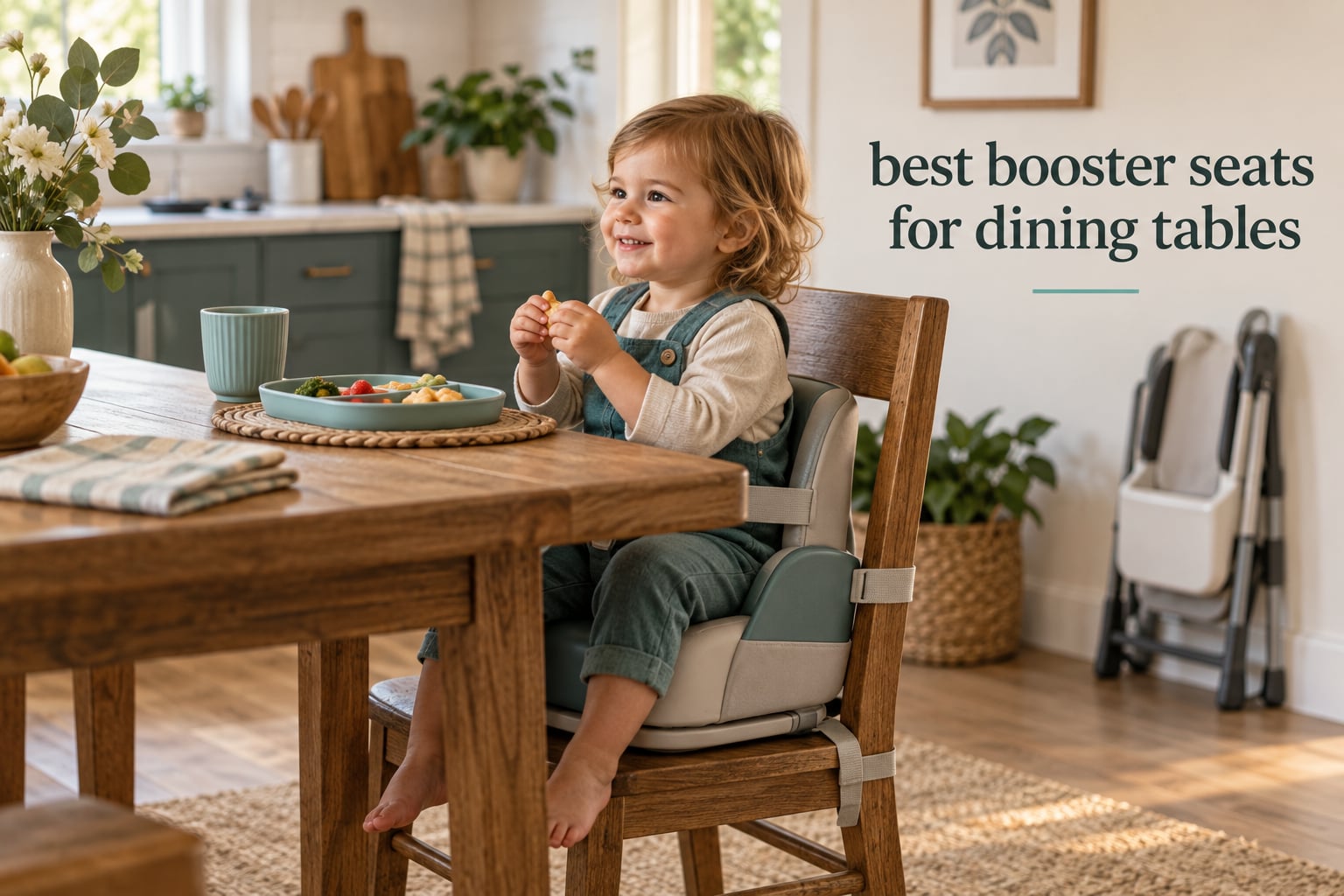
A dining table booster seat is a raised, strapped seat that sits on top of a standard dining chair to lift a toddler to table height, so they can eat and join family meals without a full-size high chair. It works by adding a few inches of seat height, wrapping adjustable straps around the chair back, and holding the child with a 3-point harness. Our team spent the last two months testing the best booster seats for dining tables with children aged 18 months to four years, plus one very tall kitchen island. This guide was updated for 2026.
The search terms parents actually use are annoyingly specific: will it fit my chair, can I still push the chair in, does it wipe clean, and will it survive a toddler who climbs in and out twenty times a day. We weighed all ten seats in this roundup on stability, restraint system, weight capacity, seat height added, chair fit, cleaning and portability. If you are also choosing the table itself, our guides to the best extending dining tables and the best space saving dining tables cover the adult side of the setup.
One thing that surprised us: the differences between these products are smaller than the marketing suggests, and the deciding factor is almost always chair fit and cleanability rather than raw features. For parents on forums, the most commonly recommended brand is Ingenuity, and the OXO Tot Nest is the usual second mention. Our findings broadly match what families report, with a few places where the spec sheets and the reviews disagree.
Our Top 3 Picks After Weeks of Family Dinner Testing
These are the three we kept in rotation at our own dinner table. The Ingenuity Baby Base earned the top slot on the strength of its rating and its sheer volume of long-term owner feedback. The SmartClean Toddler Booster is the cleaner, lighter alternative, and the Nuby Easy Go is the one that travels.

Ingenuity Baby Base 2-in-1
- Converts from baby booster to toddler seat
- Self-storing dishwasher-safe tray
- Adjustable chair straps
- Supports up to 33 lbs

Ingenuity SmartClean Booster
- Removable foam insert for deep cleaning
- 3-point harness
- Machine-washable straps
- Supports up to 33 lbs

Nuby Easy Go Booster
- Collapses for travel storage
- Water- and stain-resistant cover
- Holds up to 35 lbs
- Removable foam padding
Every Booster Seat in This Roundup Compared Side by Side
No competitor in this category publishes a true specification table, so here is ours. Ten seats, ten sets of facts, all taken from the manufacturer data and the owner reviews. The weight capacity column is the one most parents filter on, and the restraint column is the one that decides safety.
| Product | Specs | Action |
|---|---|---|
| Ingenuity Baby Base 2-in-1 Booster |
|
Check Latest Price |
| Ingenuity SmartClean Toddler Booster |
|
Check Latest Price |
| Nuby Easy Go Booster Seat |
|
Check Latest Price |
 Ingenuity Deluxe Comfort Booster Ingenuity Deluxe Comfort Booster |
|
Check Latest Price |
 OXO Tot Perch Booster OXO Tot Perch Booster |
|
Check Latest Price |
 OXO Tot Nest Booster OXO Tot Nest Booster |
|
Check Latest Price |
 SMZCTYI Booster Cushion SMZCTYI Booster Cushion |
|
Check Latest Price |
 Chicco Bento 3-in-1 Chicco Bento 3-in-1 |
|
Check Latest Price |
 Eiury Booster Cushion Eiury Booster Cushion |
|
Check Latest Price |
 Dreambaby Dining Booster Dreambaby Dining Booster |
|
Check Latest Price |
1. Ingenuity Baby Base 2-in-1 – The One That Outlasts the High Chair Era
Ingenuity Baby Base 2-in-1 Booster Feeding and Floor Seat with Self-Storing Tray – Slate
Supports up to 33 lbs
Self-storing tray
17.25 x 15.25 x 11.75 in
2-in-1 foam insert
Pros
- Converts from baby booster to floor seat
- Self-storing tray keeps footprint small
- Sturdy and well padded
- Easy to assemble and carry
Cons
- Snap-together crevices are hard to clean
- Foam insert can lift away from the shell
- Buckle can be stiff to fasten
This is the seat we have the longest history with, and the reason is unglamorous: it does more jobs than anything else here. We used it as a floor feeding seat for a six-month-old, pulled the foam insert out when she outgrew that, and then it became the table booster we still use. Two and a half years in one seat is exactly what parents mean when they say a booster beats a high chair on value.
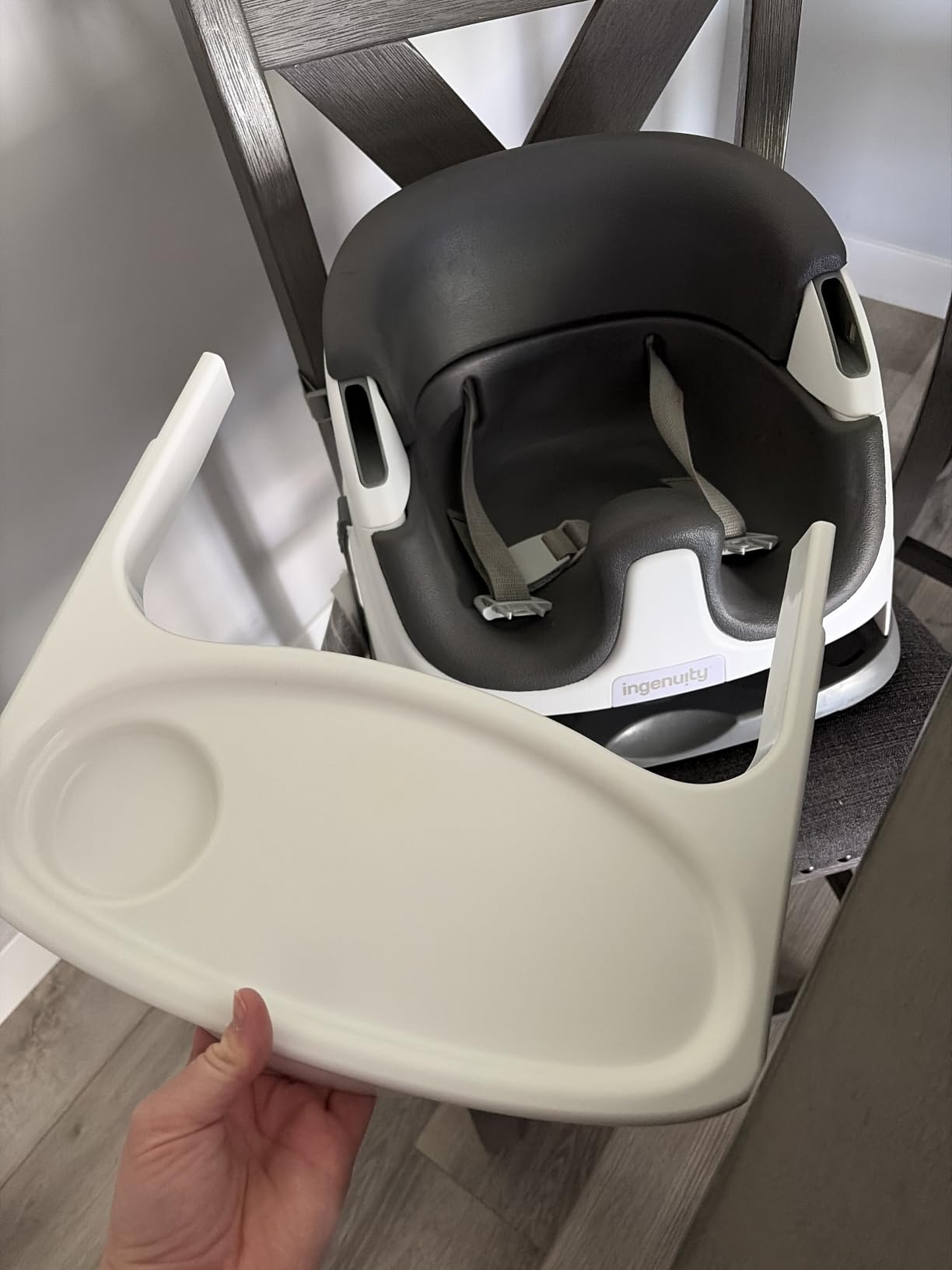
The self-storing tray is the quiet hero. It clicks under the seat and disappears, so the whole thing stores in the footprint of a dining chair rather than eating floor space in a small kitchen. The tray is dishwasher safe and the base wipes down with a damp cloth and mild soap.
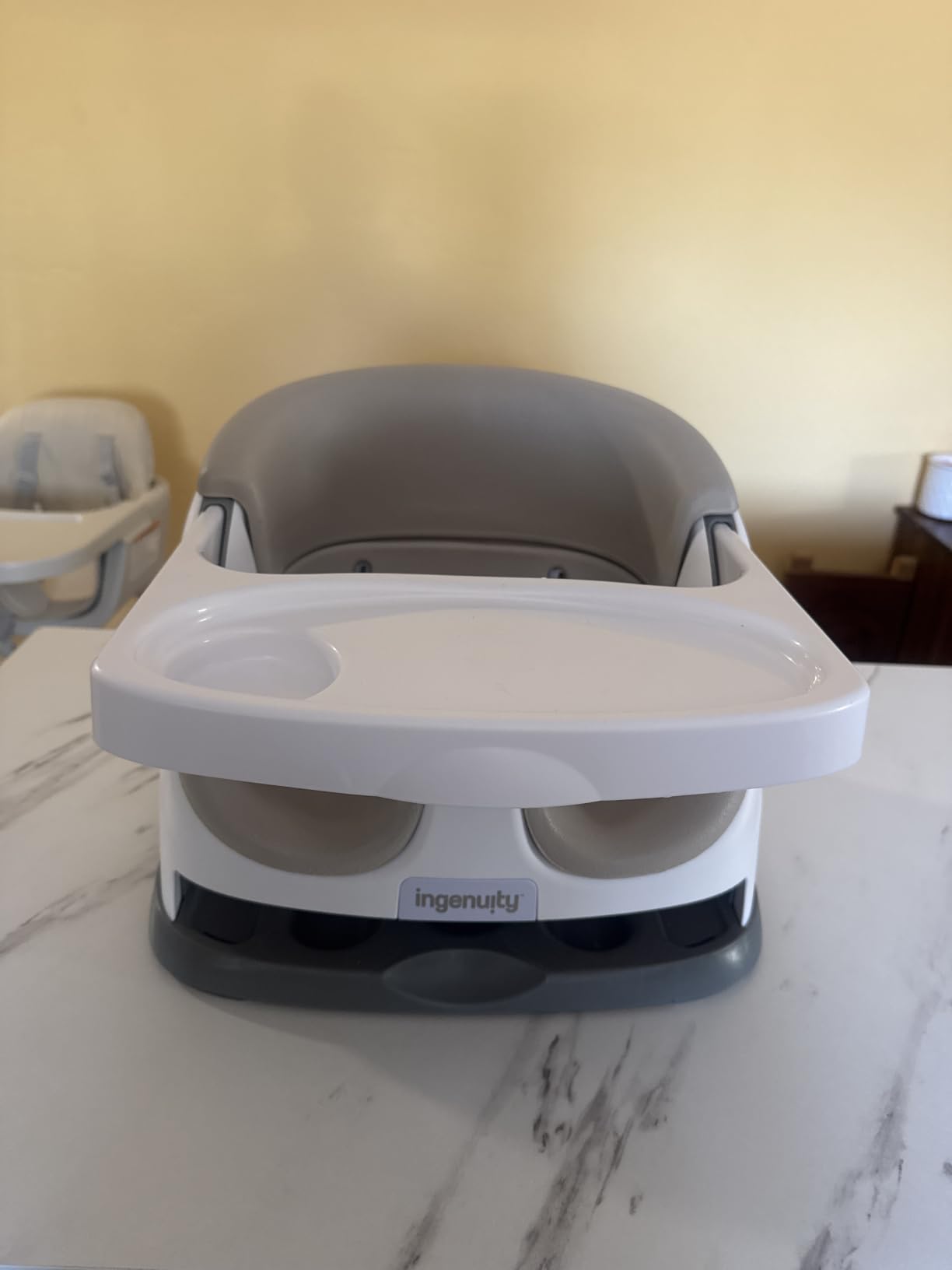
With more than twenty thousand ratings behind it, the pattern in the reviews is remarkably consistent. Owners praise sturdiness, portability and the multi-use design, and roughly 84 percent of ratings are five stars. It is also the highest-reviewed product we tested, by a wide margin.
Two modes from one shell, and the age it actually covers
Removing the foam insert converts it from a baby booster into a toddler seat, and the manufacturer states support up to 33 lbs. The assembled footprint is 17.25 by 15.25 by 11.75 inches, which is compact enough for most dining chairs without feeling cramped.
Strap and clearance behaviour on a real dining chair
The straps measure 22 inches around the bottom and 36 inches around the back, and the manufacturer recommends placing the bottom strap about five inches up each side of the base. That guidance matters more than it sounds, because pulling the strap tight at the very bottom lets the seat creep forward and the child slide off the front edge.
One flaw we confirmed: the snap-together assembly leaves crevices that a damp cloth does not fully reach, and the foam insert can lift away from the plastic shell and trap food underneath. If your toddler is a heavy snacker, check under the pad monthly.
Who should skip it
If your child is a determined climber who treats every chair as a jungle gym, note that the seat back is not removable once installed and the upper section is hard to detach. Parents also report the buckle can be stiff, which matters when you are buckling a squirming toddler one-handed at dinner.
2. Ingenuity SmartClean Toddler Booster – The Wipe-Clean Daily Driver
Ingenuity SmartClean Toddler Booster Seat for Kitchen Chair – Lightweight for on-the-go, Easy-Clean, 3-Point Harness Strap – Booster Seat for Dining Table, Slate
Supports up to 33 lbs
15.5 x 12 x 8.25 in
3-point harness
Removable foam insert
Pros
- Compact footprint
- Easy to wipe down
- Fits a wide range of chair shapes
- Supports upright sitting
Cons
- Foam insert can slip out of place
- Straps may not fully tighten
- Harness buckles can be fiddly
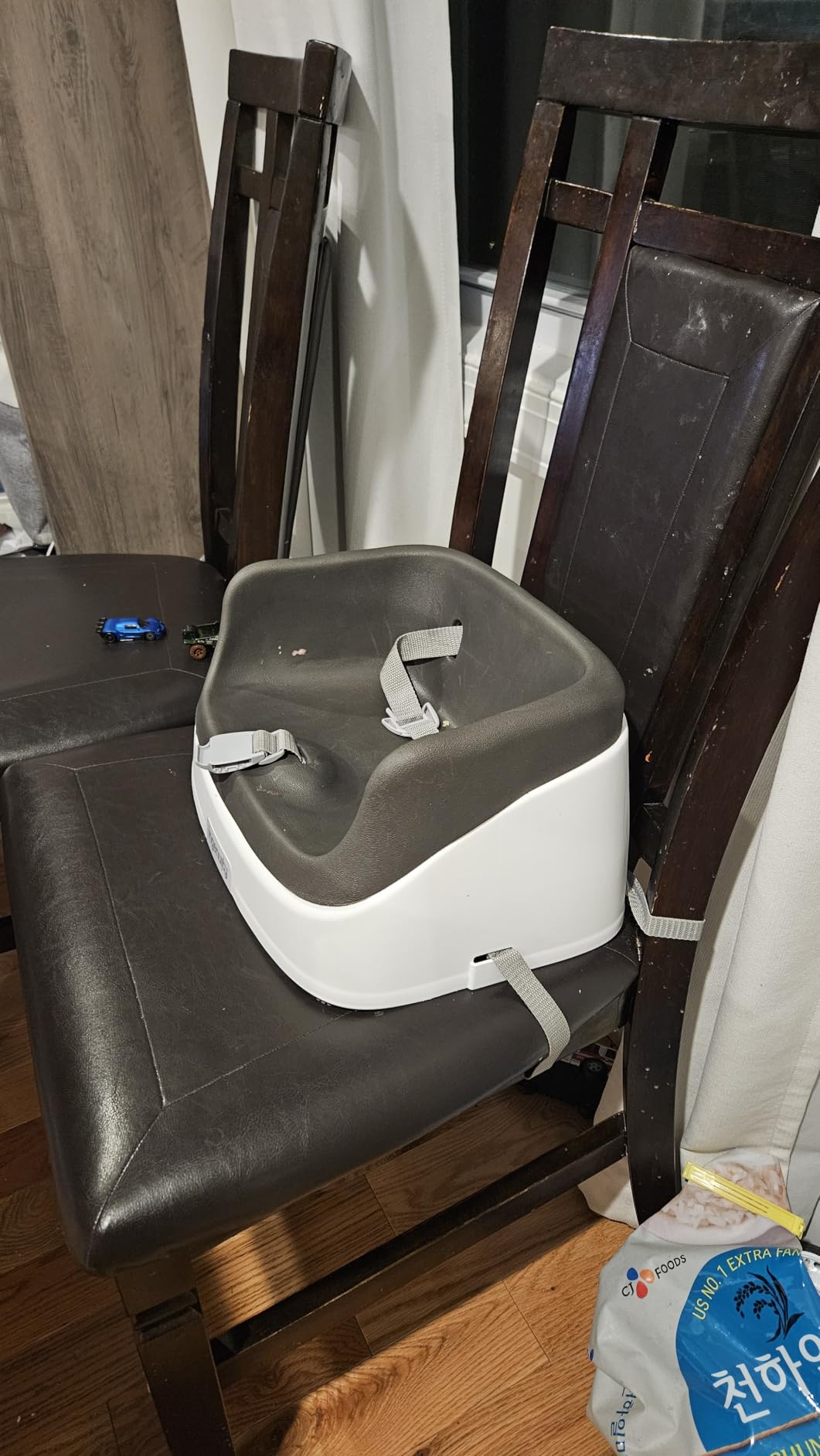
Where the Baby Base is the long-haul investment, this is the seat we reach for every night. It is smaller, lighter and built around cleaning, which is the correct priority for a family that eats three meals a day at the table. Reviewers consistently single out the small footprint as the reason it beats a full high chair in a compact kitchen.
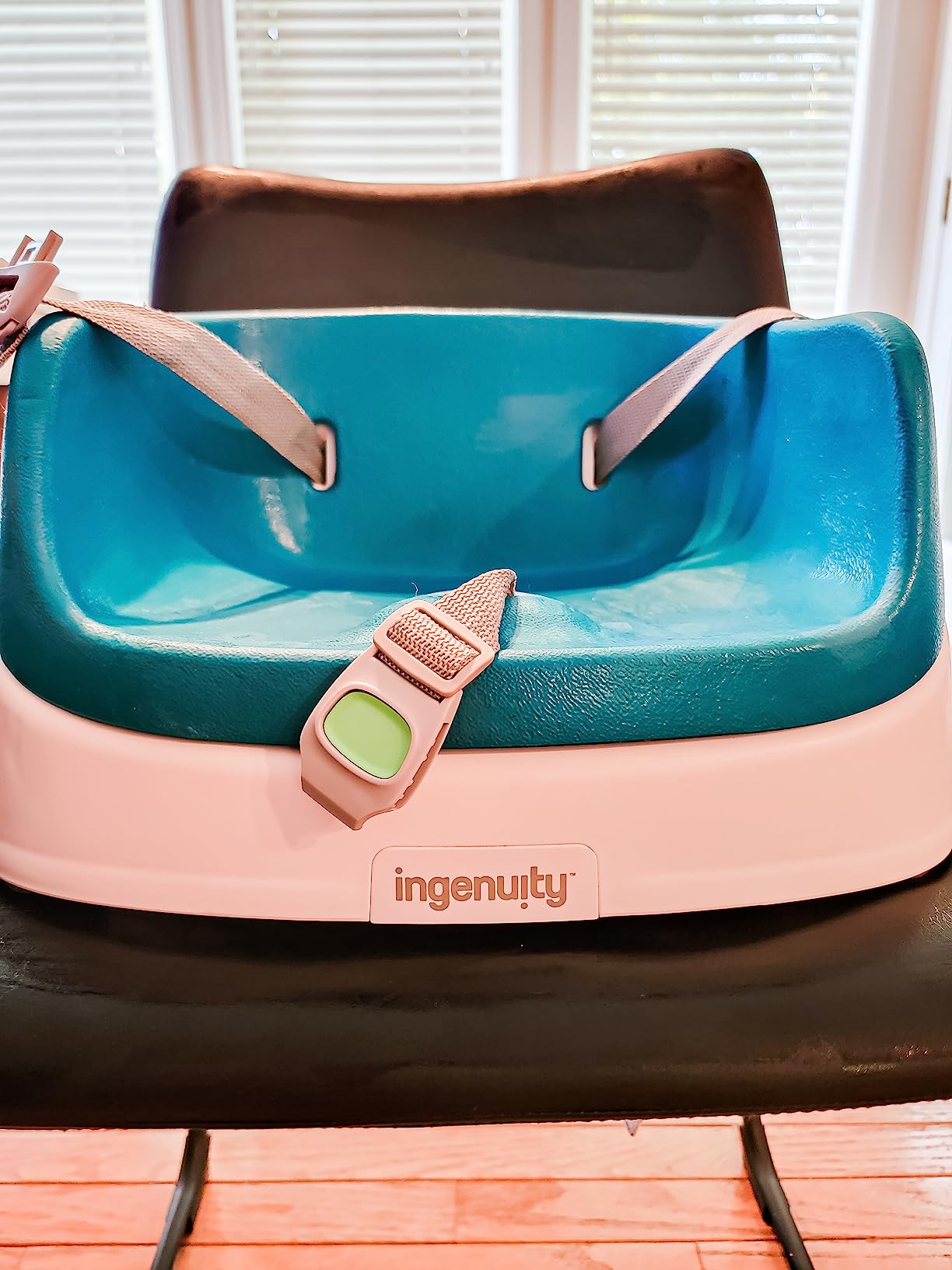
The 3-point safety harness is removable, so you can take it off as the child grows and keep using the seat as a plain booster. That single design decision extends the useful life of the seat considerably.
Cleaning the parts that actually get dirty
The foam insert lifts out for a deeper clean, and the straps are machine washable on a cold gentle cycle with no bleach. That is a better cleaning story than any of the fixed-cushion models here. The seat dimensions are 15.5 by 12 by 8.25 inches, so it fits a narrower chair than a full-seat booster will.
How the straps behave on awkward chair backs
Straps measure 26 inches around the bottom and 33 inches around the back. They work on standard ladder-back, upholstered and pedestal-base chairs, which covers most dining sets. The recurring complaint in reviews is that the straps do not always tighten fully around a chair back, so check the fit every few weeks as your child grows.
With over ten thousand ratings at a 4.7 average and about 83 percent five stars, this is a well-proven seat. The criticisms are consistent too: the foam pad can shift out of its fitted spot and trap food, and the harness buckles can be fiddly enough to distract your child mid-meal.
Who should skip it
If your child is on the taller side, the smaller 15.5 by 12 inch footprint gives you less room to grow into than the Baby Base. Parents on parent forums also report that a toddler who eats only from a tray may simply outgrow this one first.
3. Nuby Easy Go Booster – Built to Fold Into a Suitcase
Nuby Easy Go Booster Seat
Holds up to 35 lbs
3-point harness
Folds flat
Removable foam padding
Pros
- Folds flat for travel
- Among the easiest to wipe clean
- Small footprint fits most chairs
- Removable foam padding
Cons
- Cover is not machine washable
- Foam compresses with regular use
- Straps loosen over time
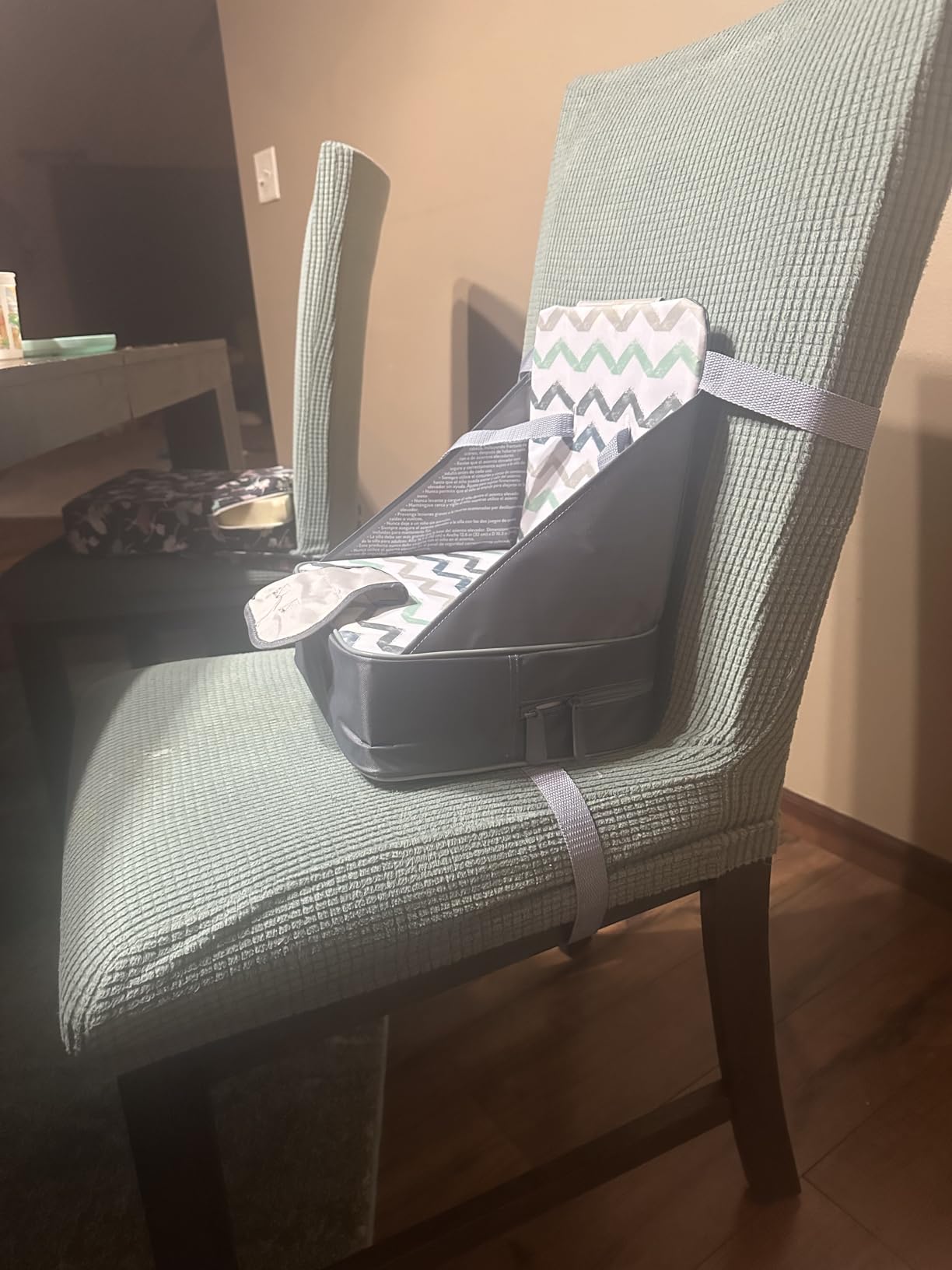
Every other seat we tested is a product for one house. This one is a product for two houses, a restaurant and a campsite. It collapses and folds with an easy-access storage pocket, and the whole point of the design is that it can live in a car boot or a carry-on rather than leaning against a wall at home.
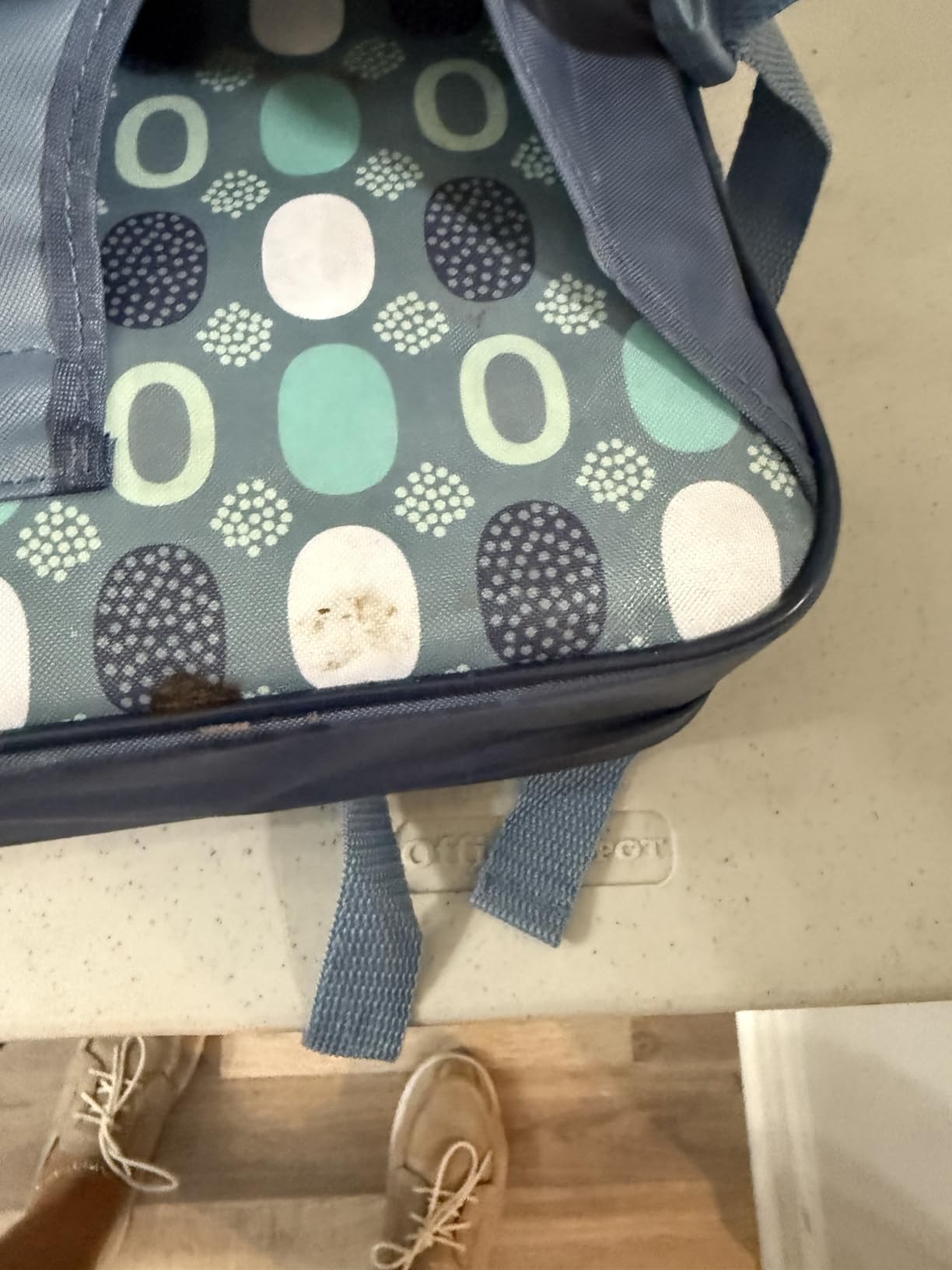
The surface is water- and stain-resistant coated polyester, and reviewers call it one of the easiest boosters in the category to wipe down. We agree. A wet cloth and a wipe was the entire cleanup after a toddler ate an entire plate of pasta off the tray.
Capacity and the 3-point harness
It holds up to 35 lbs, which is 2 lbs more than either Ingenuity in this roundup, and it uses a 3-point harness with adjustable straps. Removable foam padding lets you adjust the feel of the seat for different chair styles, which is genuinely useful when the same booster moves between a soft armchair at your parents’ house and a hard wooden chair at a restaurant.
Where durability costs you
The 4.4 average is the second lowest in this roundup and the reasons are clear from the reviews. The cover is difficult or impossible to remove for machine washing, the internal foam compresses with regular use so a child starts sliding to one side, the chair straps loosen over time, and the harness strap is short on one side and can dig in. Several owners also note it runs small for larger toddlers despite the 35 lb figure.
Our advice: treat it as the travel and restaurant seat rather than the one that lives at your table full time, where the fixed foam and non-washable cover get the least favourable reviews.
Who should skip it
If your child is tall for their age and you want them level with a higher table, the compressible foam is a poor long-term foundation. Fixed-shape foam seats in this roundup hold their height better once they have expanded.
4. Ingenuity Deluxe Comfort Booster – Folds Flat and Adjusts Height
Ingenuity Deluxe Comfort Booster Seat for Kitchen Chair, Compact Fold, Portable, Lightweight, Toddler Booster Seat for Dining Table, from 6 Months to 3 Years – Grey
6 months to 3 years
3-point harness
Adjustable height positions
Folds compactly
Pros
- Folds flat for storage and travel
- Narrow profile suits older toddlers
- Every removable piece wipes clean
- Full-featured folding design
Cons
- Straps can slip and fail to lock
- Buckle is stiff and tightens poorly
- Tray is difficult to slide on and off
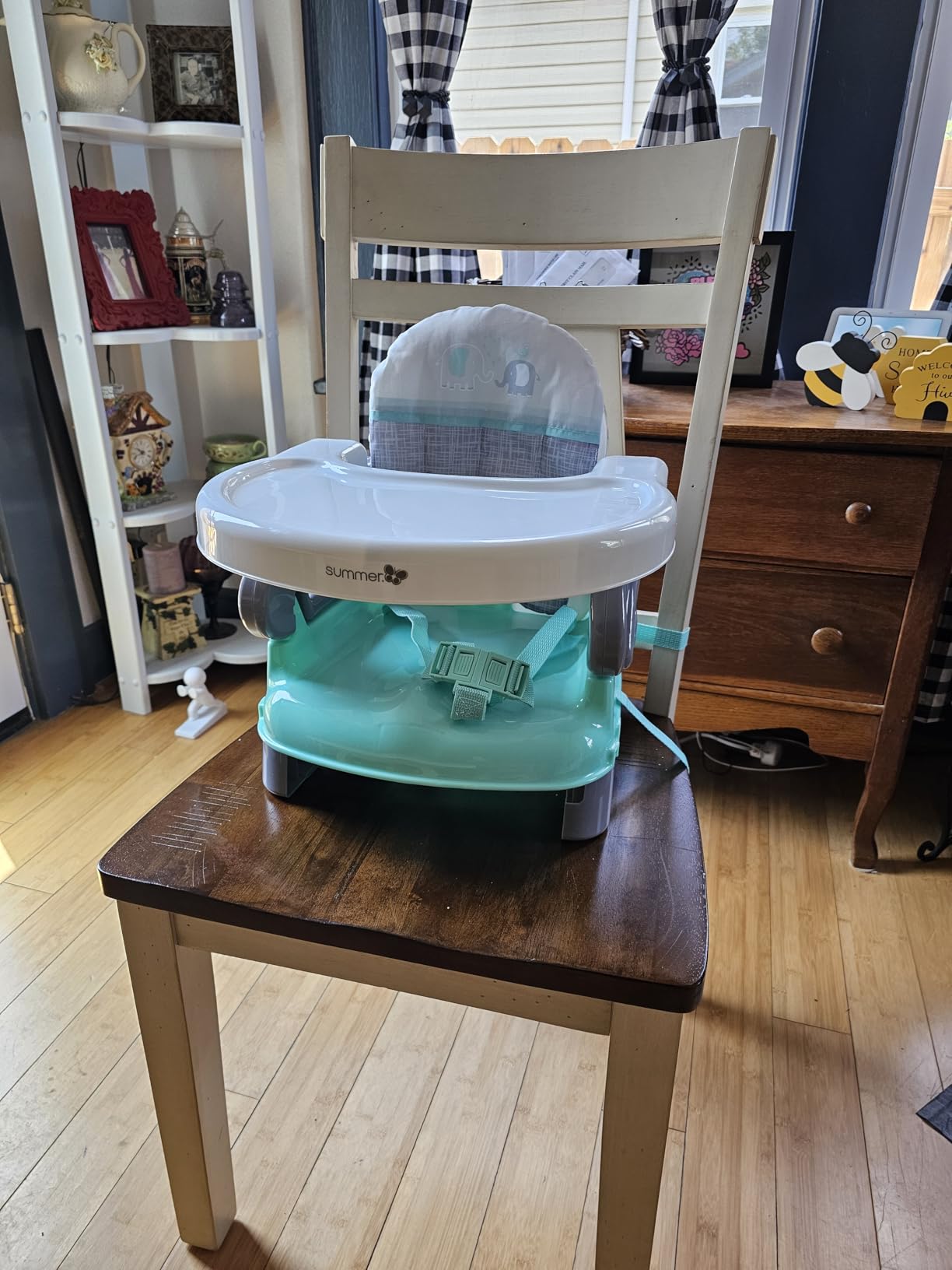
This is the Ingenuity for parents who need a seat that disappears into a cupboard. It folds compactly for storage and travel, and the cushioned seat pad and adjustable tray both lift out and wipe clean. The straps are removable and machine washable, which is a nice touch at this level.
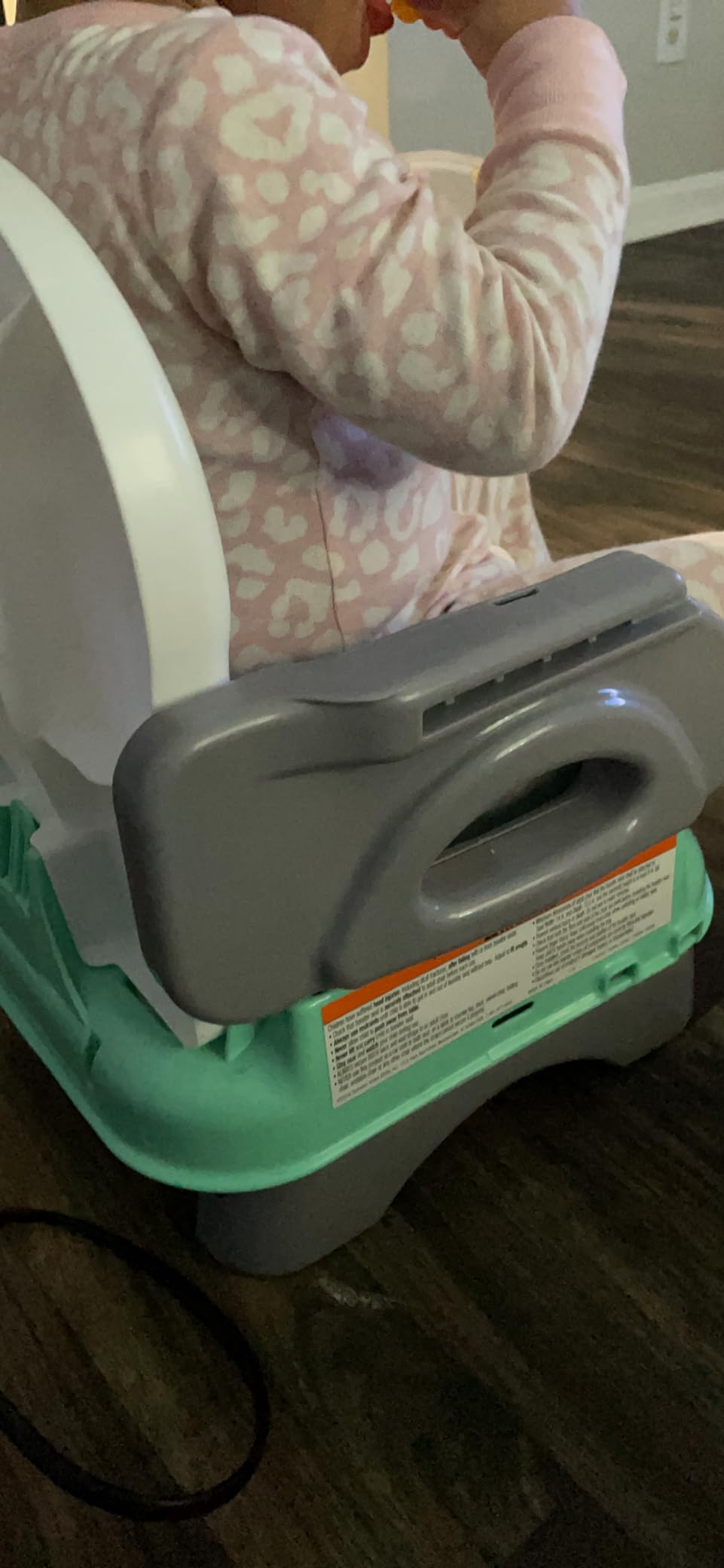
What sets it apart in the range is the adjustable height positions, which let the seat grow with the child from six months to three years. That range is the widest of any full seat here, and it means one booster can span the whole high-chair-exit phase.
The height adjustment in practice
Moving between height positions is a two-handed job and takes a few seconds, which is fine once a week and mildly annoying nightly. Owners like that the narrow profile still fits a child up to three years old, which is where most fixed-height boosters start to look cramped.
The strap and buckle problem is the honest weakness
This is the lowest-rated seat in our roundup at 4.3, with 6 percent of ratings at one star, and the reason is consistent. Chair straps can slip and fail to lock, letting the seat slide off the chair, and the harness buckle is stiff to open and does not tighten well. Some buyers replaced the straps entirely. The tray is also difficult to slide on and off, which slows down the start and end of every meal.
Other reported drawbacks: the seat pad is thin and some owners add an extra pad, the straight non-adjustable backrest pushes children forward, and it is not ideal for babies under about nine months despite the stated range.
Who should skip it
If your child is a wriggler, the strap-locking complaints are the deciding factor. A seat that can slide on the chair is not a seat you want when someone is climbing in and out unsupervised.
5. OXO Tot Perch Booster – Folds With One Button
OXO Tot Perch Toddler Booster Seat for Kitchen Chair with Straps, Gray
Up to 70 lbs
12 x 13.5 x 5 in
3-point harness
One-button fold
Pros
- One-button fold for storage and travel
- Straps store under the cushion
- Non-skid feet add stability
- Cushion lifts out to clean
Cons
- Perch style gives less side support
- Harness and straps need adjusting as the child grows
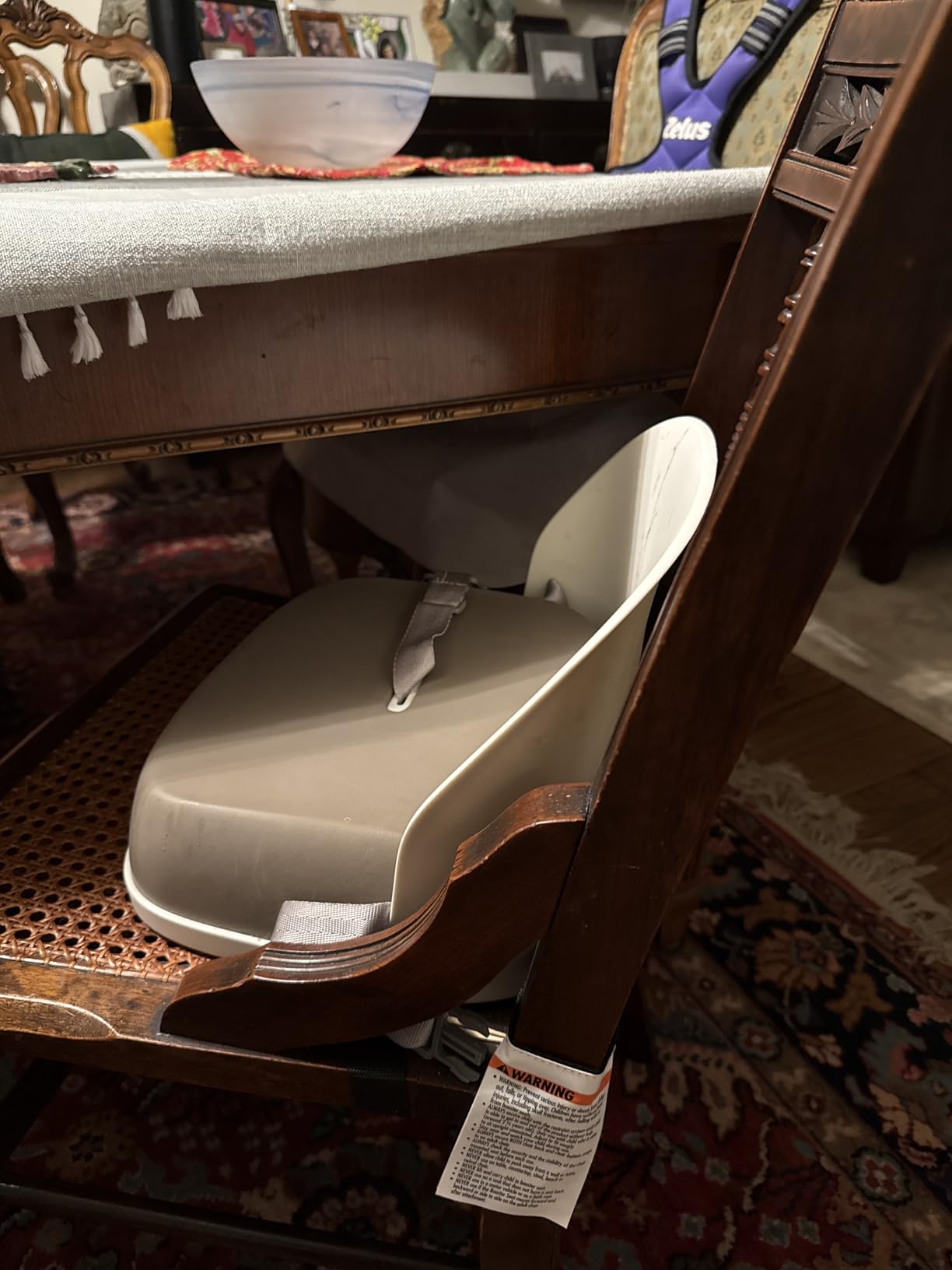
The Perch is a perch rather than a full seat. Your child sits on it with their legs down through the open front, and the contoured base supports them while a 3-point harness holds them in place. It is the smallest footprint in this roundup at 12 by 13.5 by 5 inches, and it is designed for 15 months and up.
The one-button fold is the detail that wins over parents. Push the button and it collapses flat for a cupboard or a car boot, and the straps tuck away underneath the cushion so you do not lose them. That combination of fold and self-storage is the best we found.
A weight limit that outlasts the category
It is rated up to 70 lbs, and the straps are removable at three years and up, which means this is one of the few boosters here that can plausibly carry a child from toddler to early school age. It is also BPA, phthalate and PVC free, a detail worth checking if you are buying for a nursery or a second-hand hand-me-down chain.
Stability and cleaning
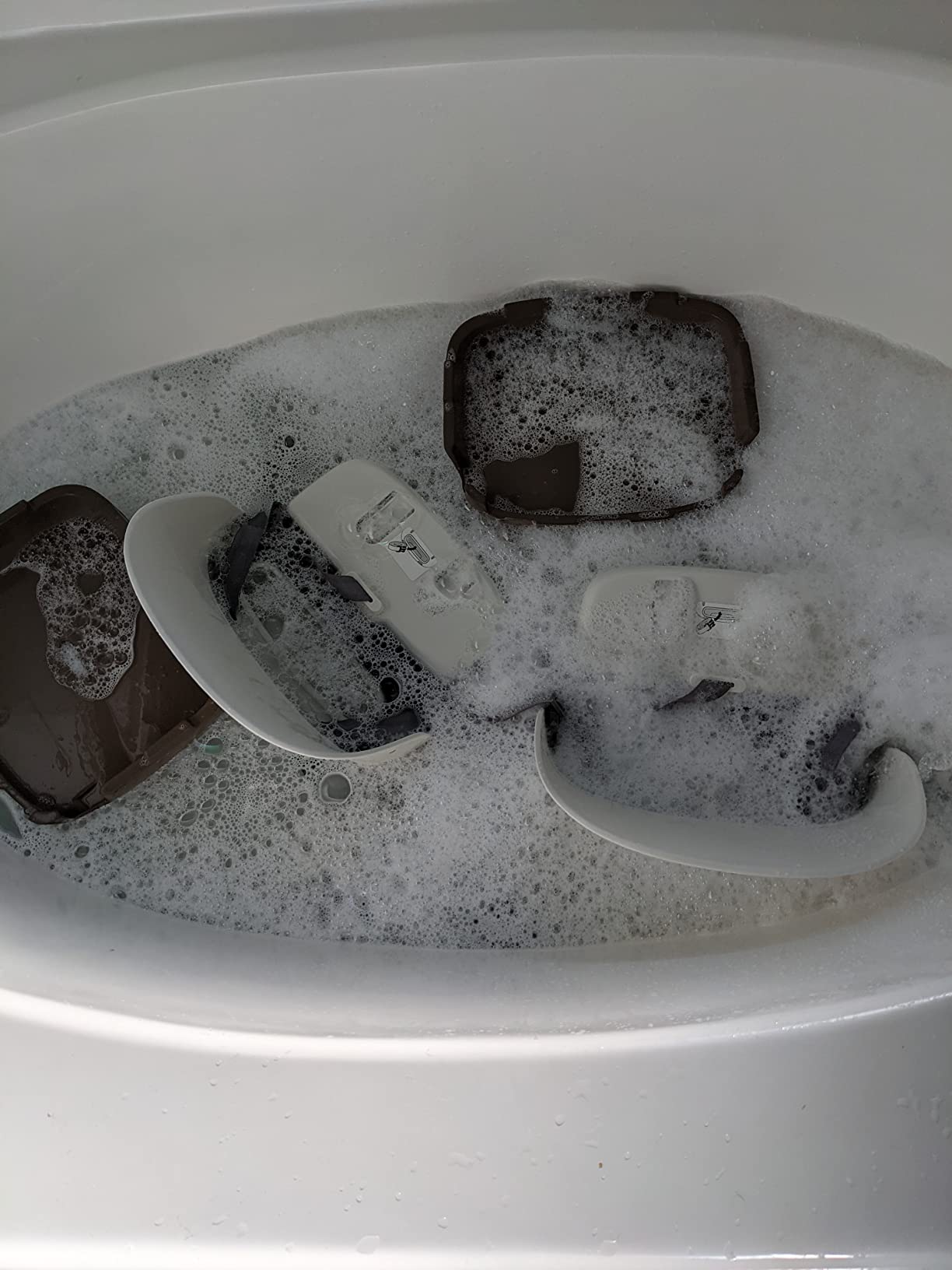
Non-skid feet keep the booster in place on any seat style, and the cushion lifts out and wipes clean. Reviews highlight 78 percent five-star ratings, with the fold and the tucked-away strap storage as the two features buyers most often name. The harness and straps need periodic adjustment as the child grows, which is normal rather than a fault.
The trade-off with any perch design is side support. Parents report that it offers less side support than a full seat with a back, so a child who slumps sideways at the table will slump here more than in a full seat.
Who should skip it
If your child needs lateral support to sit upright, or eats with a lot of arm contact and needs a wide base, the open-front perch is the wrong shape. Look at the full-seat designs instead.
6. OXO Tot Nest Booster – The Most Supportive Seat at the Table
OXO Tot Nest Toddler Booster Seat for Kitchen with Removable Cushion, Gray
High back and sides
Adjustable chair straps
Non-slip feet
Side-release buckles
Pros
- Most supportive seating in this group
- Adjustable straps fit many chair styles
- Feet protect chair surfaces
- Buckles keep children secured
Cons
- Bulkier and heavier than folding boosters
- Higher cost than cushion-style seats
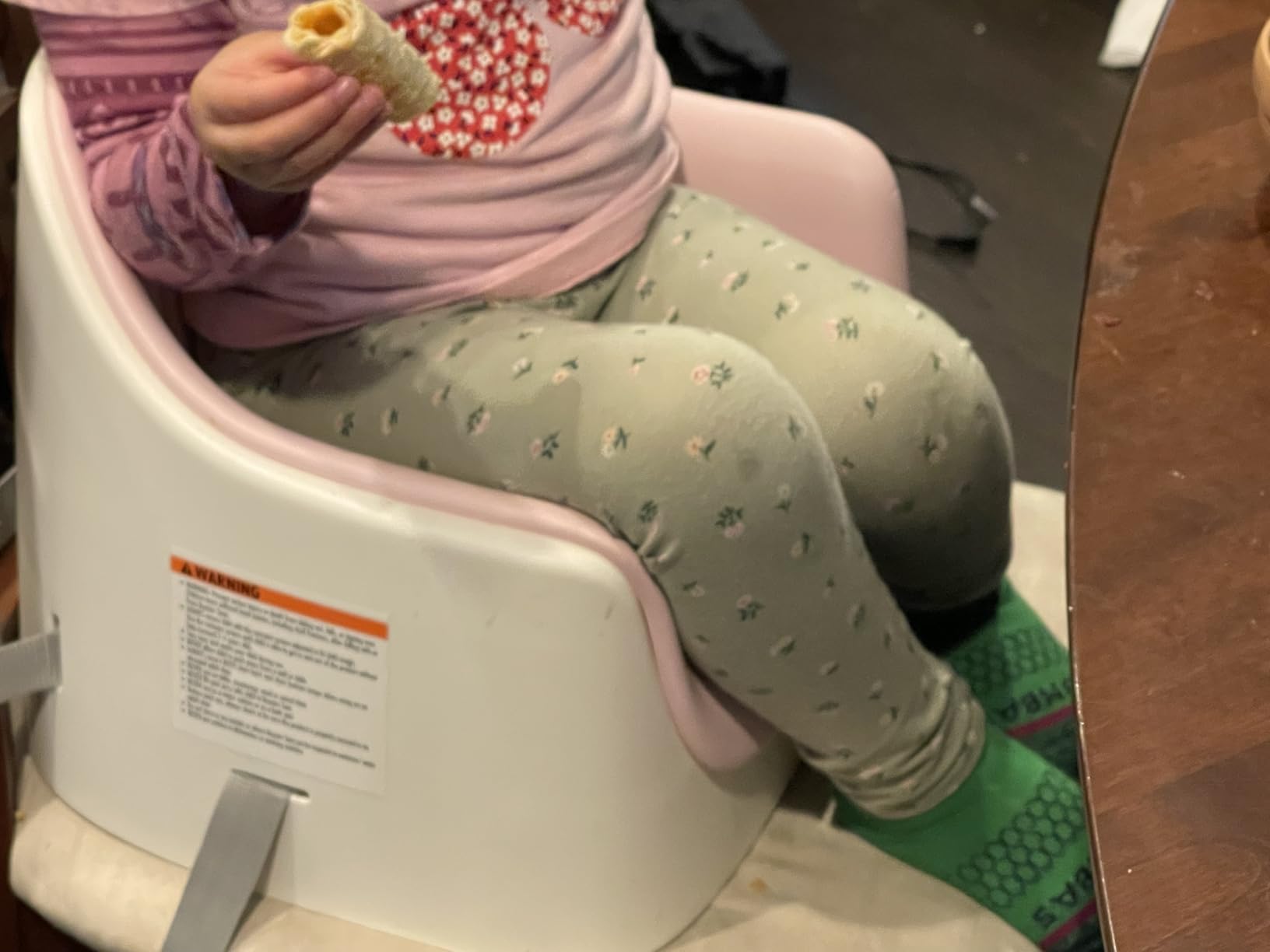
The Nest is the opposite design philosophy from the Perch. Instead of a perch, it is a full seat with a high back and wraparound sides that genuinely cradle the child, and that is why it earns the highest rating in our roundup at 4.8. About 90 percent of its ratings are five stars, and there is very little one or two star feedback at all.
Two side-release buckles hold the child in, which reviewers describe as secure and difficult to escape from. That matters for the specific concern parents raise on forums about active toddlers climbing in and out.
Straps, feet and chair protection
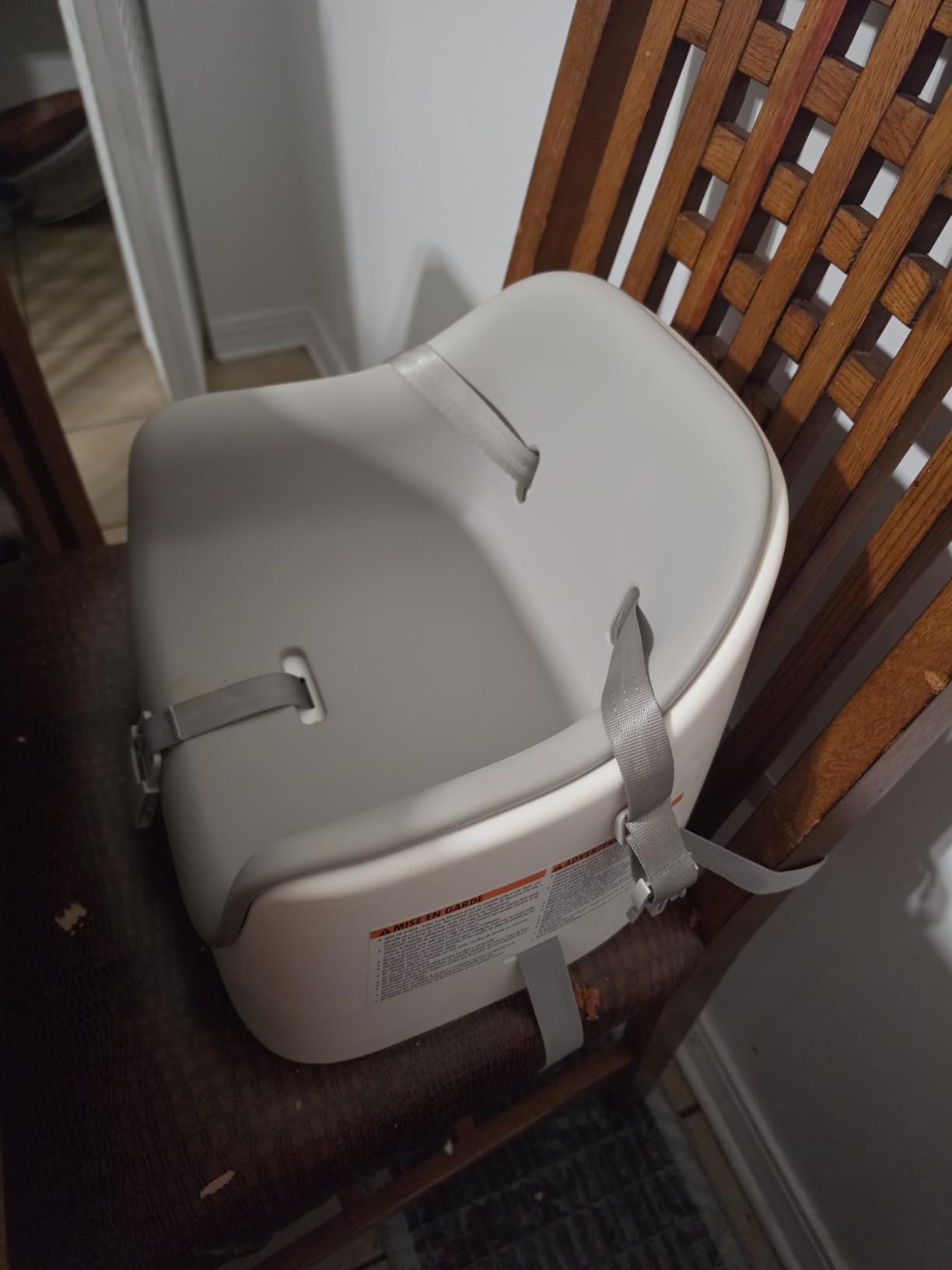
Adjustable back and bottom chair straps fit a wide range of chair styles and sizes, which is the fix for the problem parents describe with unusual backs and cantilever designs. Non-slip feet keep the seat stable and, usefully, protect the chair surface from scratches, so you are not trading a scuffed dining chair for a stable mealtime.
Why it is bulkier, and when that is fine
The two documented drawbacks are bulk and weight compared with folding portable boosters, and a higher cost than cushion-style seats. In a dining room with a proper adult chair to sit on, that bulk is not a real problem. In a small apartment kitchen where the chair has to be pushed in daily, it is. The cushion is removable, which helps a little with the storage question.
If your child is the type who slumps, twists or leans during a meal, the sides on this seat do more work than anything else in this roundup. That is the single strongest reason to choose it over a cheaper cushion.
Who should skip it
If your dining chair is a small folding kids chair or a bar stool with no back, a full seat with a high back will not sit securely. Match the booster to the chair, not the other way round.
7. SMZCTYI Booster Cushion – The Comfy Foam Middle Ground
SMZCTYI Toddler Booster Seat for Dining Table, Removable Chair Cushion
14.2 x 12.6 x 3.5 in
PU over high-density foam
Two safety belts
Anti-slip base
Pros
- Thick foam that stays supportive
- Wipes clean easily
- Straps securely to most chairs
- Discreet style tucks away
Cons
- Seat is narrow for standard chairs
- Bulkier foam is harder to store
- Foam needs up to 48 hours to expand
Not every family needs a shell. A foam cushion that straps to the chair is the lightest, quietest, least visually disruptive option, and this is the one we would pick for a child who hates anything moulded around them. It rates 4.7 across more than two thousand reviews.
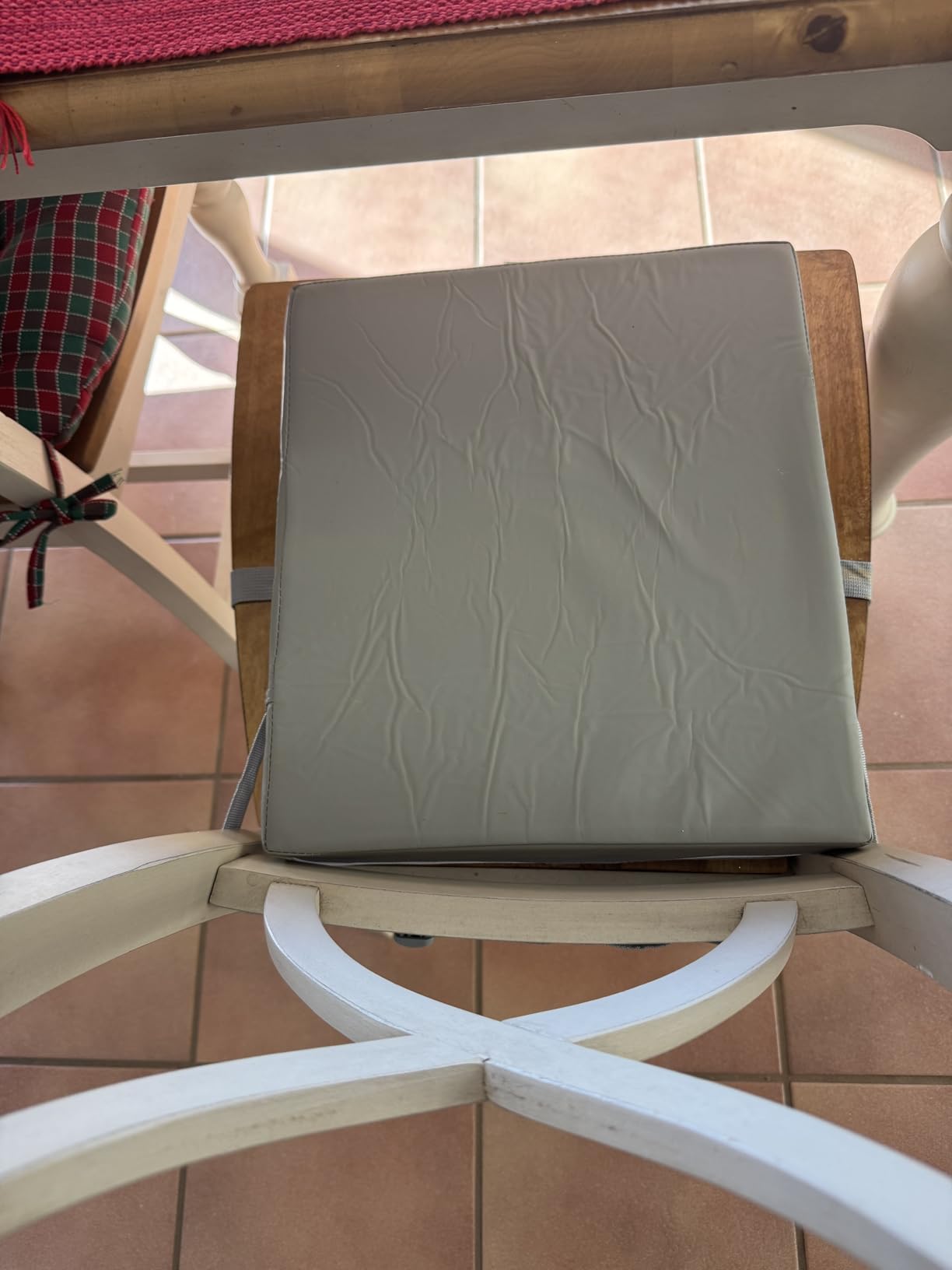
Because there is no hard shell, the child sits on top of the chair rather than in a separate seat, and the two safety belts fix to the back and bottom of the chair. The anti-slip silicone base keeps the cushion from sliding forward as the child reaches for things.
Cleaning the cover properly
The zippered design separates the waterproof PU surface from the inner sponge, so a spill on the top never reaches the foam. The surface wipes clean with a wet towel, which is a genuine advantage in a house where mealtimes are messy. The high-density sponge is what owners single out as staying supportive rather than flattening.
One thing to plan for: expansion time
Compressed packaging means the foam needs 24 to 48 hours to regain full height. Set it up on a Sunday and it will be ready for the week. We mention it because a cushion that looks disappointingly flat on day one generates a bad first impression and an unfair review.
Owners rate the 4.7 for delivering table height with a comfortable wipe-clean surface that grips the chair securely. The requests for improvement are consistent: a wider seat, and easier storage when not in use. The dimensions are 14.2 by 12.6 by 3.5 inches, which is narrower than most standard dining chair seats.
Who should skip it
A soft cushion offers no side containment, so it is the wrong choice for a very young toddler or a child who needs a tray. If the chair is wide, the narrow footprint also means more of the seat overhangs the edge.
8. Chicco Bento 3-in-1 – The Longest Usable Life in One Seat
Chicco Bento Booster 3-in-1 Portable Booster Seat for Babies & Toddlers
6 months to 3 years
Up to 50 lbs
Two height positions
Folds with tray attached
Pros
- Three modes in one seat
- Folds in one motion
- Built-in carry handle
- Wipeable seat and dishwasher-safe tray
Cons
- Smaller review base than established models
The Bento is built around a simple idea: instead of buying two products, buy one seat that changes mode three times. Remove the harness and tray and it is a floor feeding seat. Flip it and it is a toddler floor chair. Strap it to a dining chair and it is a table booster for children from six months up to 50 lbs.
That 50 lb weight capacity is the highest in this roundup by 15 lbs, and it is the main reason the seat stays useful for so long. The two height positions add a little more growing room on top of that.
Folding with the tray still attached
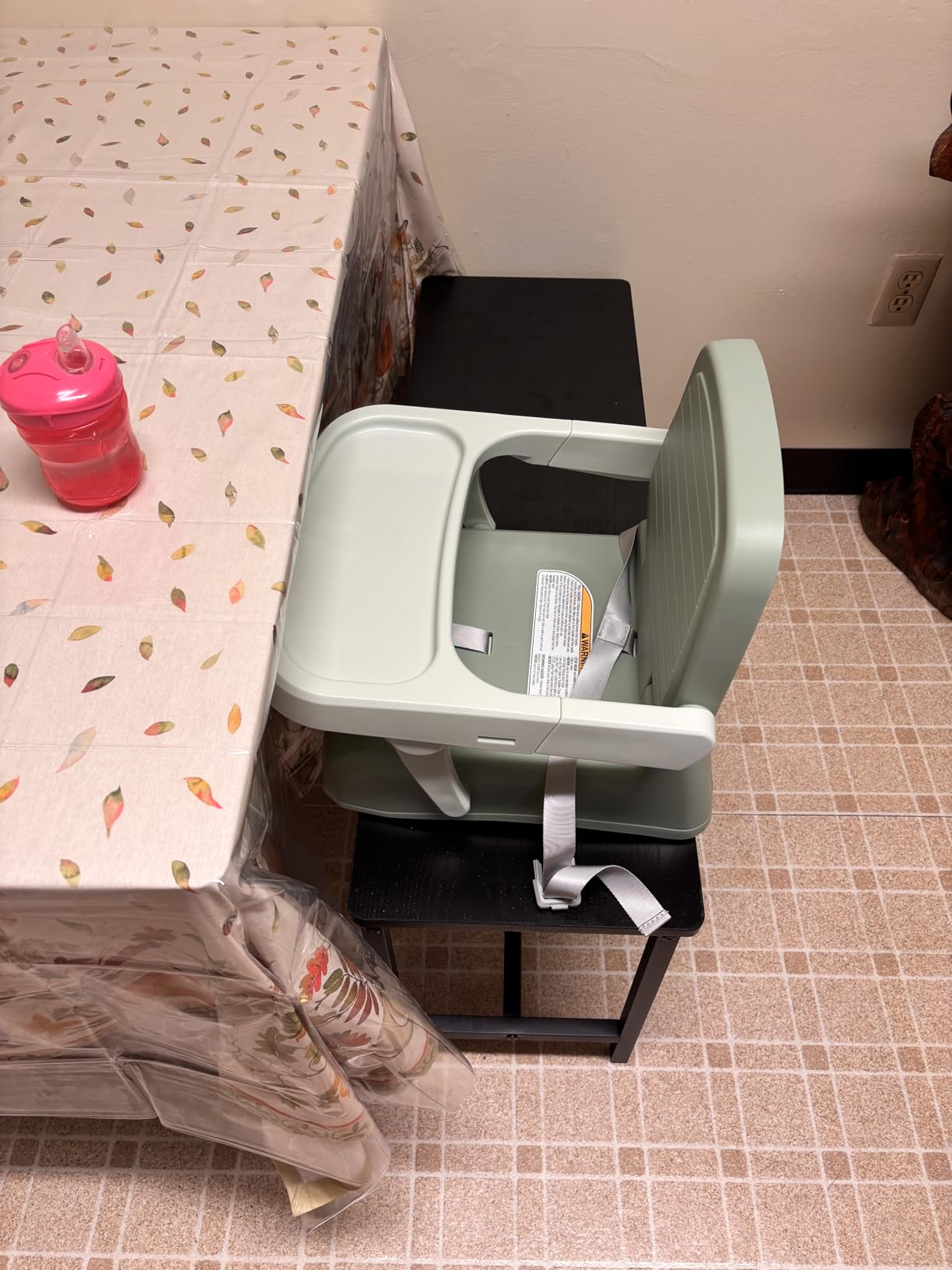
It folds compactly in one motion with the tray attached, which sounds minor until you try to fold a booster that requires removing three separate parts. The built-in carry handle means you can grab it with one hand, which is the difference between using it at a restaurant and leaving it in the car.
Cleaning and honest caveats
The seat wipes clean and the removable tray is dishwasher safe, so the two surfaces that actually get hit with food are both easy to deal with. The main drawback is not a design flaw but a data one: with roughly 1,100 reviews, it has a far smaller review base than the long-running Ingenuity and OXO models, so there is less long-term evidence behind it.
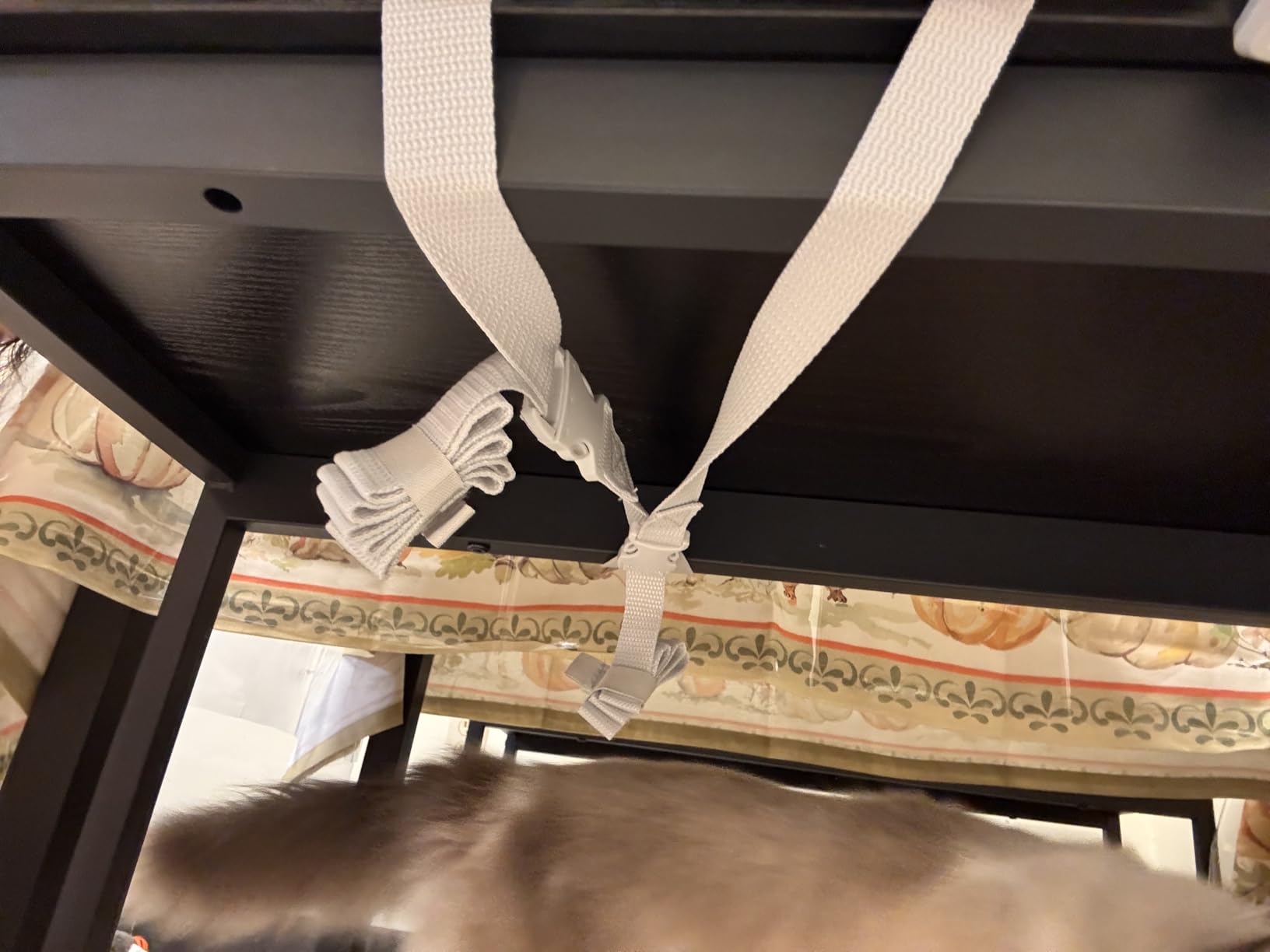
Reviewers do rate it at 4.7 with about 83 percent five stars, and they consistently credit the genuine three-in-one versatility and the generous capacity rather than treating the extra modes as marketing.
Who should skip it
If you want a single-purpose seat at one fixed chair and nothing else, the three modes are wasted capability. It also carries the second-highest cost of the full seats here, which is harder to justify if it will live in one spot.
9. Eiury Booster Cushion – Light, Firm Foam for Everyday Table Height
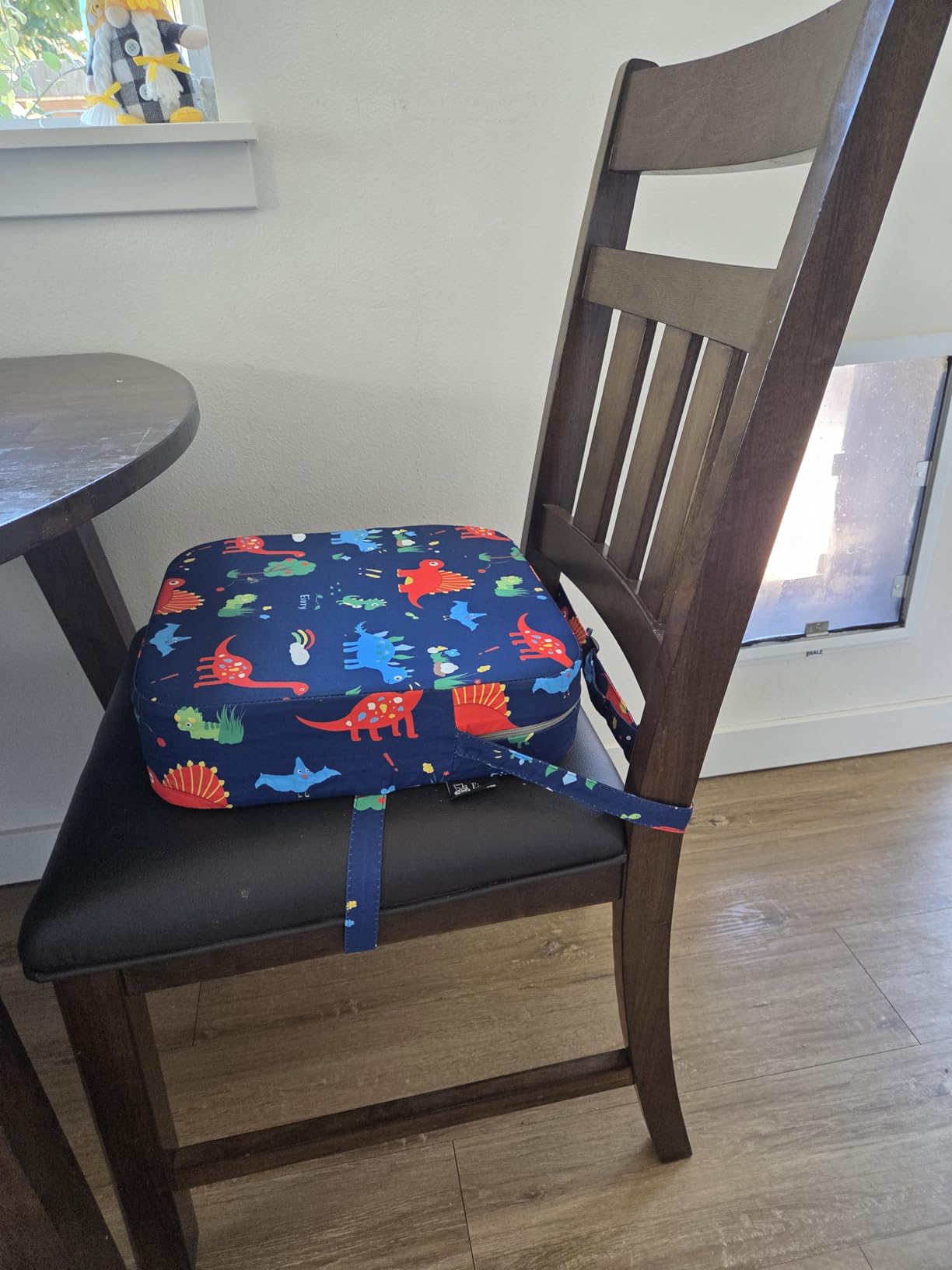
Eiury Toddler Booster Seat for Dining Table, Portable Kids Booster Seat with Safety Buckles Portable Increasing Booster Cushion with Non-Slip Bottom (Blue Dinosaur)
3.5 inch high-density foam
Two safety belts
Anti-slip base
Washable cover
Pros
- Firm foam that resists compression
- Secures tightly to many chair styles
- Removable washable cover
- Very light to carry
Cons
- Adds only about 2.5 inches of height
- Foam needs about 24 hours to expand
This ties for the highest rating in the roundup at 4.8, with 87 percent five-star ratings, and it is the simplest answer in the list. If you want your child at table height this week and you do not want a plastic shell in your dining room, this is the cushion to buy.
Owners particularly like that the foam is firm enough not to compress under adult weight. That is a real complaint about softer cushions, and it means the seat keeps its height for years instead of months. The playful cartoon patterns also do more work than they sound like they would, because toddlers are more willing to climb onto something they chose.
Height added, and the tall table problem
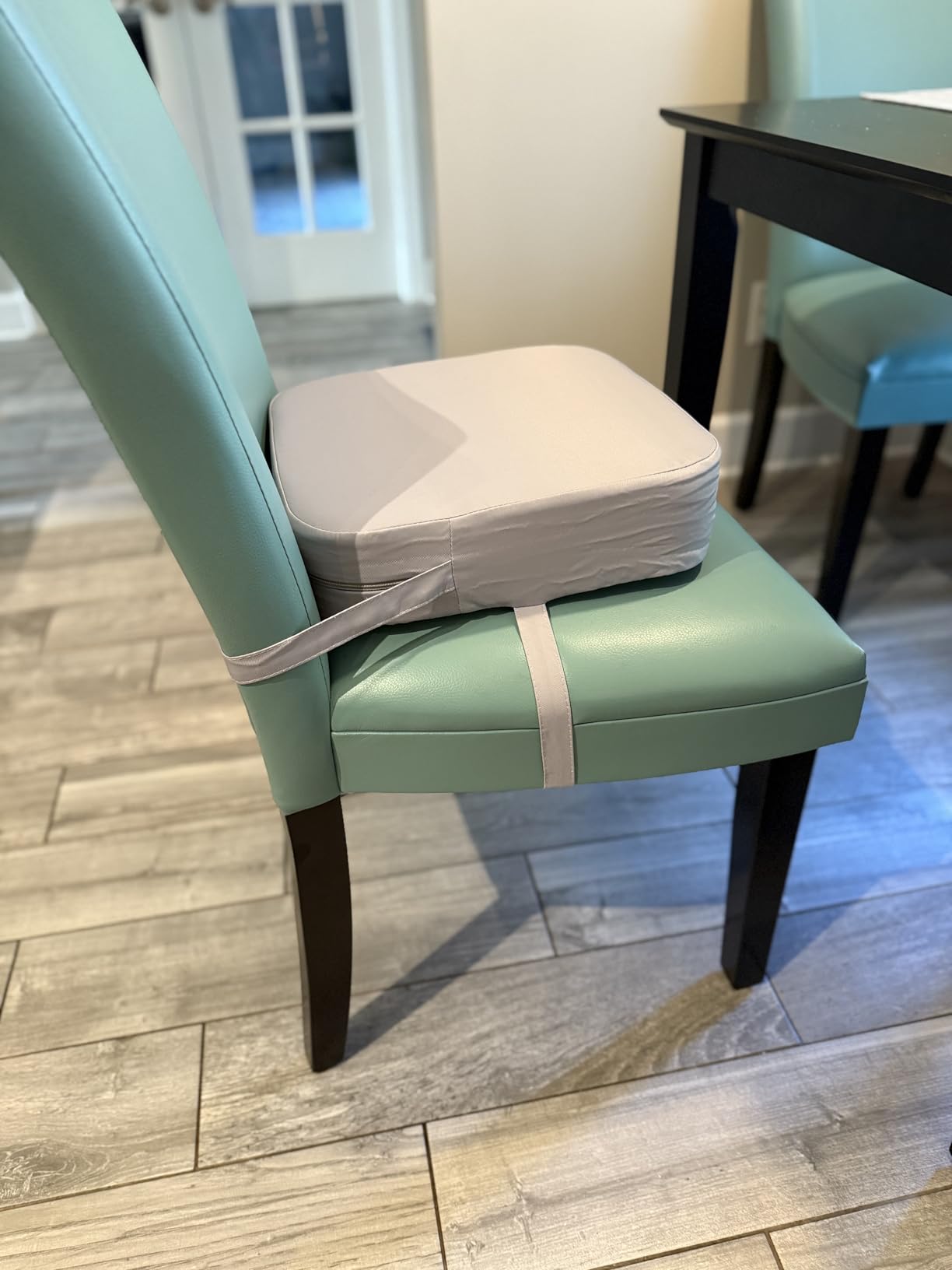
With 3.5 inch high-density foam, reviews put the effective height gain at roughly 2.5 inches once the child is sitting on it. That is enough for a standard dining table with a short toddler, and it is the main caveat owners raise: on a taller table or a kitchen island, 2.5 inches may not close the gap. Measure the gap from the chair surface to the underside of the table before you commit.
Cleaning and portability
The cloth cover is removable and machine washable, and the foam inside should not be machine washed. The whole seat is light enough to carry like a backpack, which is why it shows up in camping, picnic and restaurant recommendations. Foam takes about 24 hours to expand fully after unpacking, so give it a day before judging it.
The two adjustable safety belts secure tightly to a wide variety of chair styles, and anti-slip particles on the base keep it planted on upholstered or wooden seats.
Who should skip it
If you have a bar-height table, a tall island, or a child at the tall end of their age group, the modest height increase is the wrong tool. You need a full seat with a taller back instead.
10. Dreambaby Dining Booster – Built for Tall Tables and Built-In Storage
Dreambaby Dining Booster Seat – Portable High Chair for Dining Table
6 months to 3 years
Up to 33 lbs
Tall back
3-point harness
Pros
- Taller back pulls up to the table
- Built-in storage compartment
- Folds with carry strap
- 3-point harness to 33 lbs
Cons
- Flexible side panels can tip when leaning
- Light colors show dirt quickly
- Not for unsupervised use
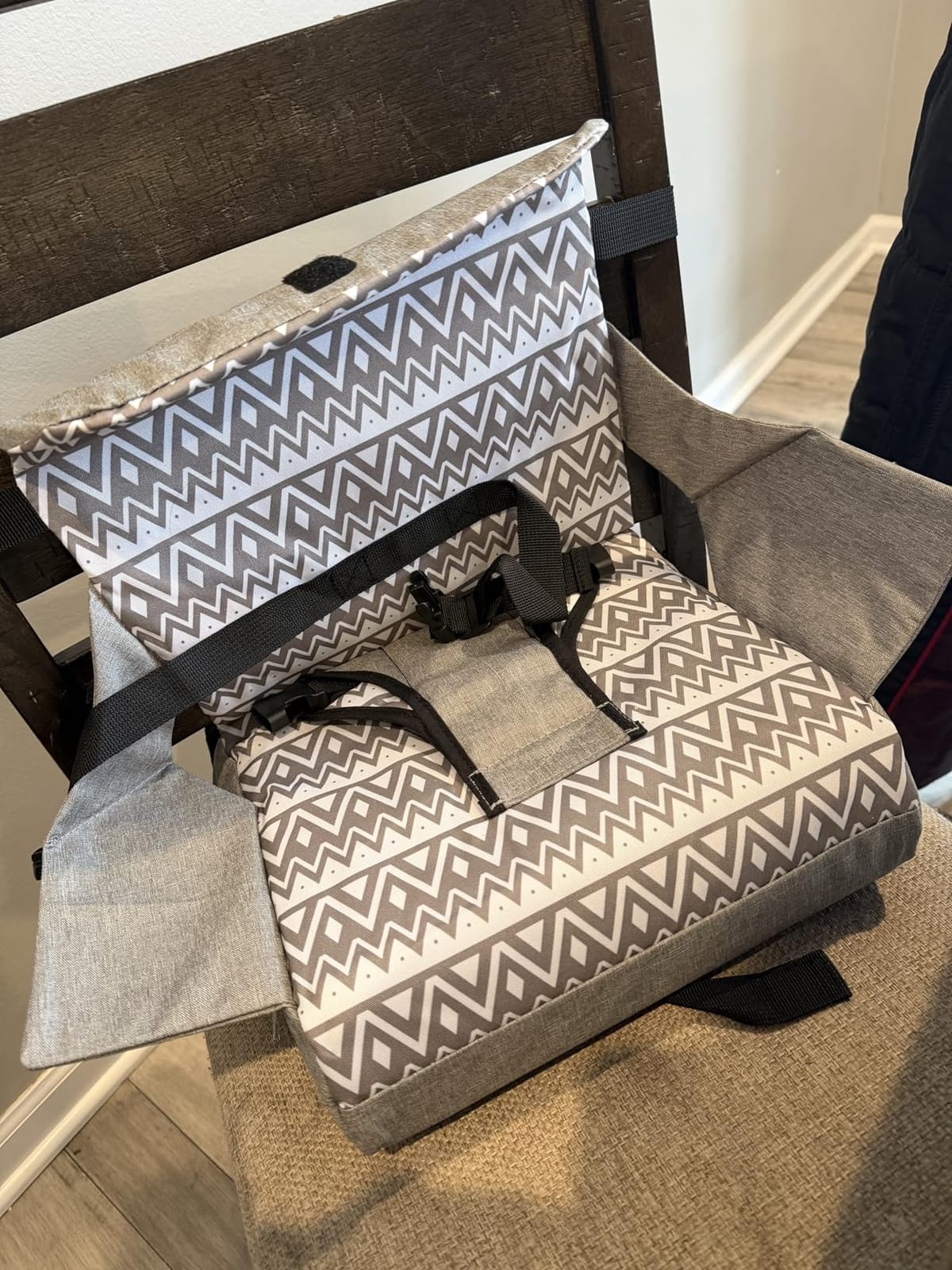
If your table is tall, this is the seat to look at first. The tall back pulls right up to the table without restricting the arms, and owners on parent forums ask specifically for a booster that is taller than the rest. The most-praised feature in reviews is exactly that: children can sit closer to the tabletop instead of eating several inches back from it.
It is rated from six months sitting upright to three years, holds up to 33 lbs, and uses a 3-point harness with adjustable straps. It is tested to meet EN standards, and it is explicitly not for use in motor vehicles.
The storage compartment is genuinely useful
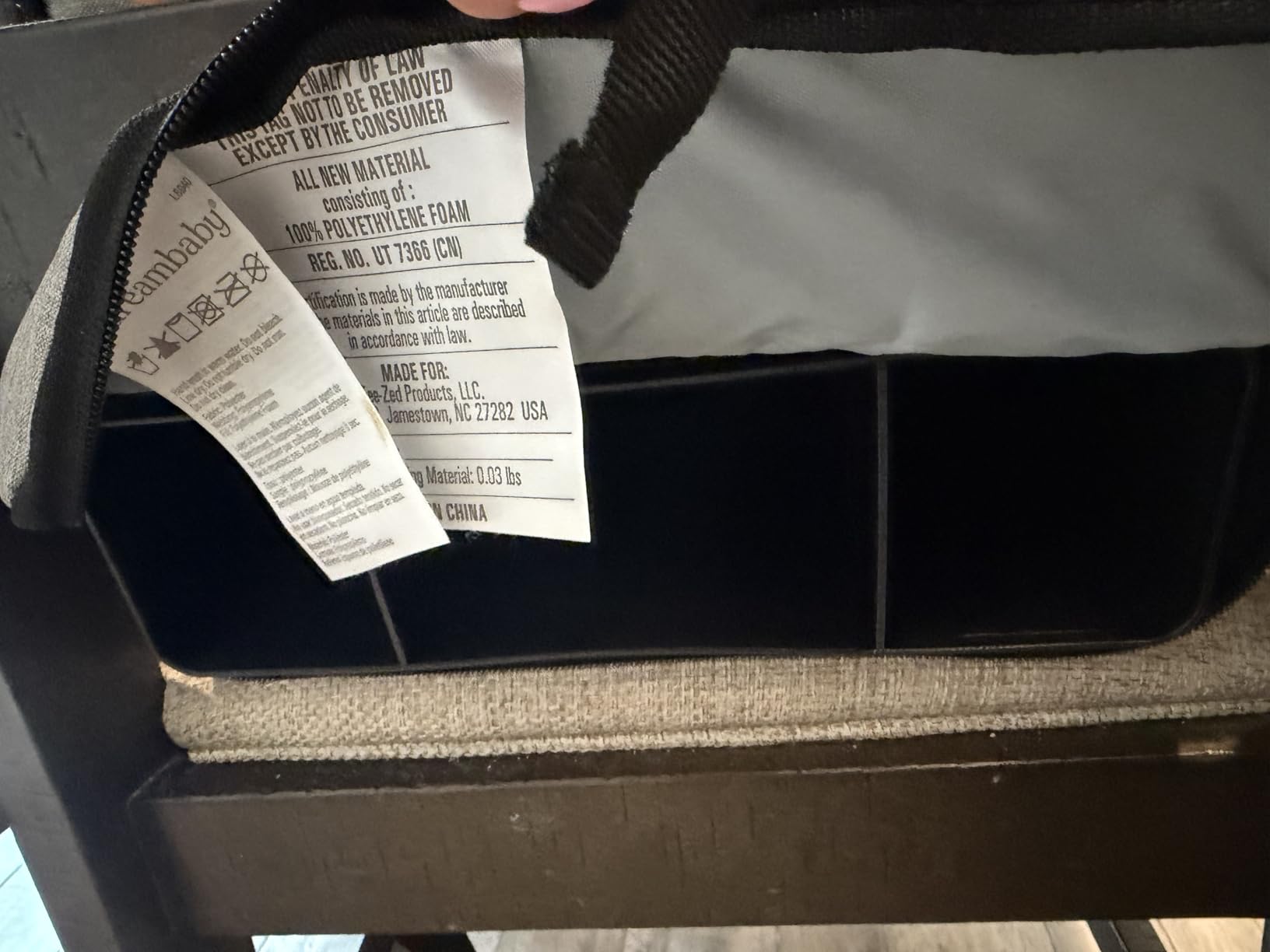
There is a built-in divided storage compartment inside the seat for snacks, bibs, bottles and wipes. In practice this means the things a toddler needs mid-meal travel in the seat with them rather than in a separate bag on the floor. It is a small idea that changes how a booster feels at dinner.
Folding, carrying and the tipping caveat
The seat folds compactly and includes a shoulder carry strap, which covers the grandparents-house and restaurant use cases well. The recurring caution in reviews is that the side panels are flexible and can allow a leaning child to tip sideways, and light colors show dirt quickly. It is also not recommended for unsupervised use, which is a sensible caution for a top-heavy tall-back seat.
At a 4.4 average with 73 percent five stars, it scores lower than the shell-based boosters mostly because of that flexibility. For a tall table, though, that is an acceptable trade.
Who should skip it
If your child leans hard to one side during meals or eats without close supervision, a rigid full seat with non-slip feet and a high wraparound back is a safer match than a flexible-panel design.
How to Choose a Booster Seat That Actually Fits Your Table
Most disappointing booster seats are not bad products. They are good products bought for the wrong chair, the wrong table height or the wrong child. Here is the process we use, and it takes about five minutes with a tape measure.
The three measurements to take before you buy
1. Seat width. Measure the usable width of the chair seat between armrests. A booster wider than the chair will overhang or tip, which is the single most common complaint we saw. A full seat generally needs more width than a perch or a cushion.
2. Seat depth. Measure front to back. The child needs enough depth that their back is supported and their thighs are not hanging off the front edge, because a child perched on the front lip is a child who slides.
3. Back clearance. Measure the height of the chair back and the gap behind the seat. Straps need somewhere to wrap, and a low-back or cantilevered chair gives the top strap nothing to grab, which is why strap tension is the top complaint on unusual chairs.
Chair clearance: will the boosted chair still slide under the table?
Measure the distance from the front of the chair to the table edge with the child seated, then compare it to how far the chair needs to move in. A moulded plastic booster with a raised centre guard can physically stop the chair sliding under the table, and parents on forums describe this exact frustration: a booster that technically raises the child but leaves them sitting out in the open.
The fix is to test it before you commit. Sit your child in the seat on the actual chair and push the chair in. If the front of the booster catches the table edge, the seat is wrong for your table even if it is well made.
Foot support and why dangling feet shorten mealtimes
An occupational therapist raised this in a parent forum and it has stuck with us: booster seats give a toddler no foot support, and dangling feet make a child feel less secure, so they lose interest sooner and come down from the table earlier. Several parents in the same thread reported the same fix, putting a footstool or a phone book under their child’s feet and seeing them sit longer.
That is why full seats with a contoured base, or cushioned boosters with more height, tend to produce longer meals than thin perch designs. If your child is the type who fidgets and asks to be taken down after four minutes, foot support is worth more to you than any tray feature.
Tall tables, bar-height counters and standing-height setups
Bar-height tables are the most common unmet need in this category. Almost nothing on the market is engineered for a 42 inch counter, so the honest answer is that a standard booster plus a very tall child may not get you there. Start by measuring the gap from the chair surface to the underside of the table, then subtract the height the booster adds. Cushions add roughly 2.5 to 3.5 inches, full seats add more, and tall-back designs get closest to the tabletop.
If you are shopping for a tall setup, prioritise back height and full-seat support over portability. A chair that cannot be pushed in at a bar counter is a lesser problem than a child eating with their feet four inches off the floor at a normal table.
The five-point safety check to run on any seat
1. Restraint system. A real 3-point harness or properly tensioned chair straps, not just a foam cushion. CPSC guidance for booster-type products centres on stability, an effective restraint system, no entrapment gaps, smooth edges, and limits on lead and phthalates in the materials.
2. Stability under climbing. Sit in the seat yourself. If it slides when an adult shifts weight, it will slide more when a toddler throws themselves in.
3. No entrapment gaps. Run a hand through every gap and joint. Anything a small finger can enter and get stuck in is a problem.
4. Foot and non-slip surfaces. Check that the feet grip the chair surface and do not mark it.
5. Stated capacity. Check the printed weight limit against what your child will weigh in a year, not today. Thirty-three lbs is the common figure, and the 50 lb and 70 lb seats give you far more headroom.
Cleaning, spills and how long the cushion really lasts
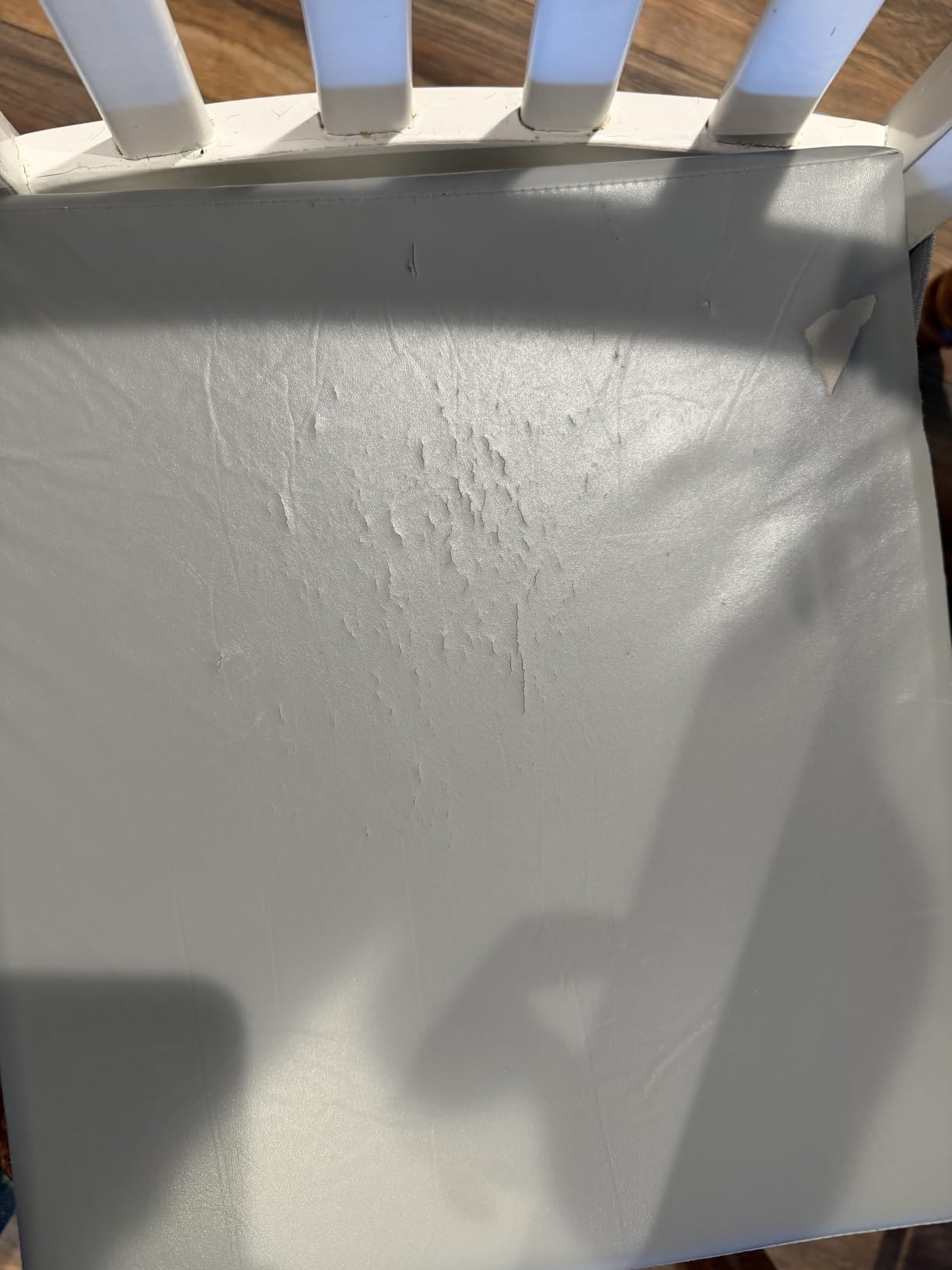
Daily spills decide which seats survive. Wipe-clean coated surfaces and removable machine-washable covers are worth more than any premium feature, because a fixed PU cushion will crack and stain long before a moulded plastic shell gives up. The recurring complaint across this whole roundup is the same: food getting into the seam between a removable insert and the base, or a foam pad lifting away from the shell and trapping spills underneath.
For lifespan, plan on two to four years of daily use before the foam or the cover gives up, and expect to replace a cushion long before a plastic shell. If you buy a second-hand seat, inspect the straps and the buckle first, because those are the parts that wear out silently, and check that it has no recalls or missing documentation.
Knowing when to move past a booster seat
A booster is a bridge, not a destination. The usual sign it is time to move on is that your child can sit with feet flat on the floor of the chair and their elbows at table height without any help, usually around four to five years. At that point a chair booster, a taller chair or a dedicated toddler chair serves better, and a perch-style booster that runs to a 70 lb limit can comfortably bridge the gap in the meantime.
Frequently Asked Questions
What is the best booster seat for a dining table?
The best booster seat for a dining table is one that straps securely to your specific chair, adds enough height to reach the tabletop, and wipes clean. The Ingenuity Baby Base 2-in-1 leads our testing for versatility, while the Ingenuity SmartClean wins for daily cleanup and the OXO Tot Nest wins for side support.
What is the best toddler booster seat for a dining table bench?
For a bench, avoid full seats with wraparound backs and choose a low-profile cushion or a perch design with a single strap. Cushions sit flat, wrap the bench more securely and let a second child sit alongside. The key is restraint: a bench has no back for straps to wrap around, so check the strap length before you buy.
At what age can a child sit at the table in a booster seat?
Most children are ready between 18 months and 3 years, once they can sit upright on their own without support. The seats in this roundup range from 6 months to 3 years, and weight matters more than age. Most are rated to 33 lbs, while the Chicco Bento reaches 50 lbs and the OXO Tot Perch reaches 70 lbs.
Are booster seats safe for tables?
Yes, when used as intended. Check that the seat straps tightly to the chair, that the child cannot create an entrapment gap, and that a 3-point harness or firm straps are fitted. Sit in the seat yourself first to test stability, and never leave a toddler in a booster unsupervised, particularly one with a tall back.
What is the best toddler chair for eating at the dinner table?
For children under 3, a strapped booster on an adult chair is usually better than a standalone chair because the adult chair raises them naturally. Past 3, when their feet reach the floor and elbows clear the table, a standalone toddler chair or a chair booster works and costs less. The switch point is posture, not age alone.
Which Booster Seat Is Right for Your Family
If you want one seat that covers the whole high chair exit and then some, the Ingenuity Baby Base 2-in-1 is our top pick: the best rating in the roundup, the most owner history, and two modes in one shell.
If your priority is surviving three meals a day without scrubbing foam, choose the Ingenuity SmartClean Toddler Booster and take the removable insert and washable straps as a gift to your future self. If dinner happens at grandparents’ house, a restaurant or a campsite half the time, the Nuby Easy Go folds into a bag and wipes clean in seconds.
If your child slumps, twists or leans at the table, the OXO Tot Nest is the only seat here with a high back and sides that genuinely contain them. If your table is a bar-height counter or a tall island, the Dreambaby Dining Booster is the only pick built with a tall back that pulls up to the tabletop.
For fold-flat storage in a small apartment, the OXO Tot Perch wins on its one-button fold and tucked-away strap storage, and its 70 lb rating outlasts the category. For the widest age and weight span in a single purchase, the Chicco Bento 3-in-1 covers 6 months to 50 lbs across three modes.
If you only buy one: the Ingenuity Baby Base 2-in-1, after you confirm the chair still pushes under your table. That last check matters more than any feature on this list, and it takes thirty seconds with your child sitting in the seat. Before you go, our picks and testing method for the best booster seats for dining tables will be updated again in 2026.
Leave a Reply