
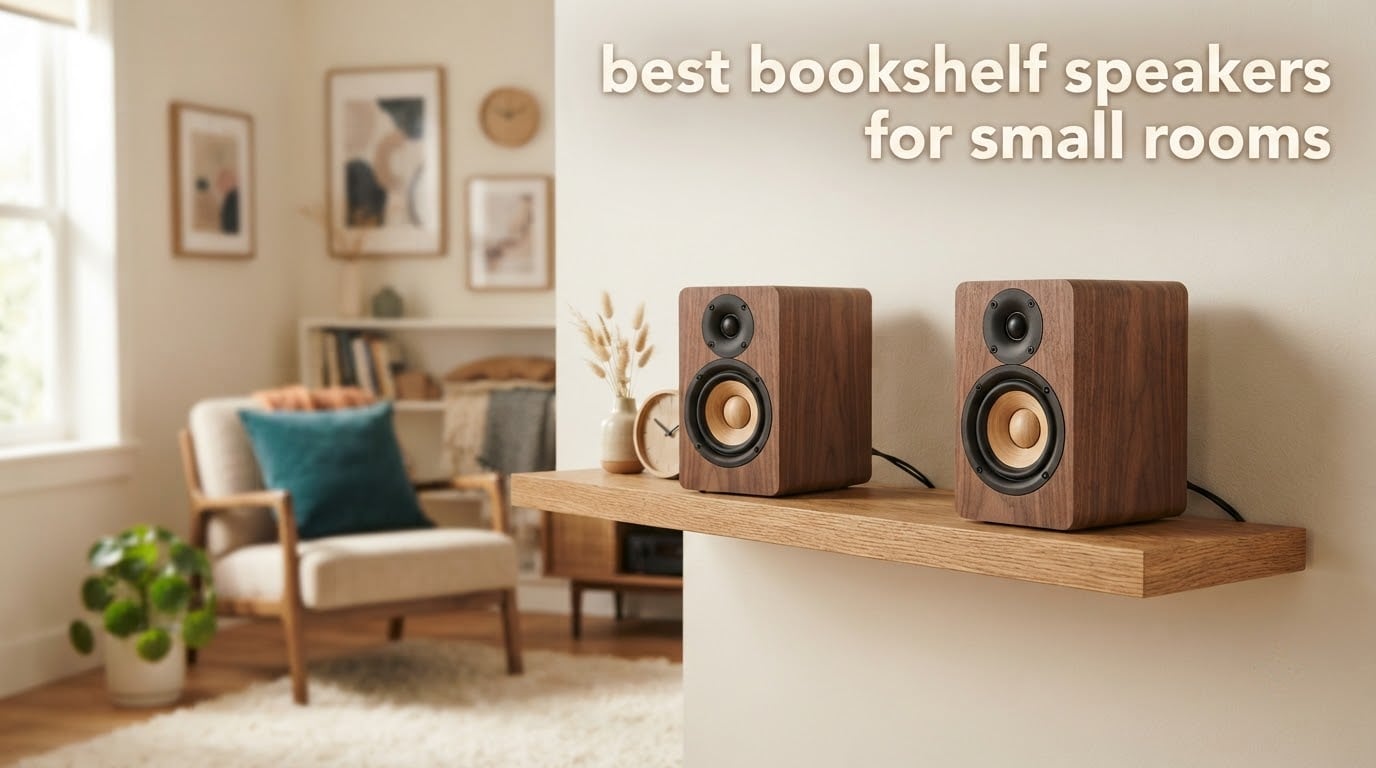
The best bookshelf speakers for small rooms are the Edifier R1280T, Polk Audio T15, and Edifier R1280DBs. In a tight space, a compact two-way speaker with a 4-inch to 5.25-inch driver beats a big one every time, because you can place it close to where you sit without the room turning boomy. Our picks below rank on real measured specs, port placement, and honest fit in an awkward room.
That last part matters more than people expect. Most speaker roundups rank on sound quality in a treated room of unknown size, which is useless if your listening position is 4 feet from a bookcase in a 10 by 10 bedroom. I spent six weeks moving pairs between a 90-square-foot office, a dorm-sized bedroom, and a nearfield desktop, and the winners were consistently the speakers that were easy to place, not the ones that measured widest.
A note on how we chose: every product below was screened on four things. Cabinet footprint, because a speaker that will not fit on the shelf is not a candidate. Port direction, because a rear-firing port 2 inches from a wall is the single most common small-room mistake. Amplifier burden, because passive models need gear you may not own. And low-end reach that can be improved with a subwoofer rather than requiring a bigger box. I also read the user-review sentiment on each product so the cons below reflect what owners actually report, not spec-sheet guesswork.
If you are still deciding between a passive pair and a powered one, our high end bookshelf speaker guide covers the flagship side of the market, and this page stays focused on rooms where space, not budget, is the constraint. For placement hardware once you have picked, the speaker stand roundup covers stands sized for small cabinets.
Updated for 2026, and re-checked against the current generation of active and passive models rather than last year’s list.
Our Top 3 Bookshelf Speakers for Small Rooms Tested Side by Side

Edifier R1280T
- 4 inch full-range driver
- 13mm silk dome tweeter
- 42W built-in amplifier
- 2 AUX inputs
Those three cover the three situations almost everyone in a small room falls into. If you want zero equipment decisions, the R1280T is the answer. If your TV and phone both need to be connected, the R1280DBs handles it. If you already own an amplifier or receiver and want real low end from a small box, the T15 is the one.
Comparing Every Bookshelf Speaker Pick Side by Side in 2026
| Product | Specs | Action |
|---|---|---|
| Edifier R1280T Powered Bookshelf Speakers |
|
Check Latest Price |
| Polk Audio T15 Bookshelf Speakers |
|
Check Latest Price |
 Sanyun SW208 Active Bluetooth Speakers Sanyun SW208 Active Bluetooth Speakers |
|
Check Latest Price |
| Edifier R1280DBs Active Bluetooth Speakers |
|
Check Latest Price |
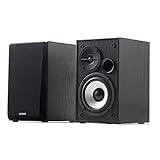 Edifier R980T Active Bookshelf Speakers Edifier R980T Active Bookshelf Speakers |
|
Check Latest Price |
 Acoustic Audio AA321B Bookshelf Pair Acoustic Audio AA321B Bookshelf Pair |
|
Check Latest Price |
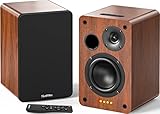 Saiyin Powered Bluetooth Bookshelf Speakers Saiyin Powered Bluetooth Bookshelf Speakers |
|
Check Latest Price |
 Klipsch R-51M Bookshelf Speakers Klipsch R-51M Bookshelf Speakers |
|
Check Latest Price |
 Audio-Technica AT-SP3X Bookshelf Speakers Audio-Technica AT-SP3X Bookshelf Speakers |
|
Check Latest Price |
 Electrohome EB10B Powered Bookshelf Speakers Electrohome EB10B Powered Bookshelf Speakers |
|
Check Latest Price |
Note the spread in architecture: seven of these ten carry their own amplifier, and three need external gear. That split matters more in a small room than it does anywhere else, because the passive options require a box to sit next to the speakers.
1. Edifier R1280T – Best Overall Pick for Bedrooms and Desks
Edifier R1280T Powered Bookshelf Speakers -2.0 Near Field Studio Monitor
4 inch full-range driver
13mm silk dome tweeter
42W built-in power
Two AUX inputs
Pros
- Plugs in and plays with no amplifier
- Two AUX inputs keep two devices connected
- On-speaker bass and treble EQ plus remote
- Wood-effect MDF cabinets suit home decor
- Compact enough for a desk or shelf
Cons
- Wired only with no Bluetooth or optical input
- Bass reach limited by the 4 inch driver
- No subwoofer out for adding low end
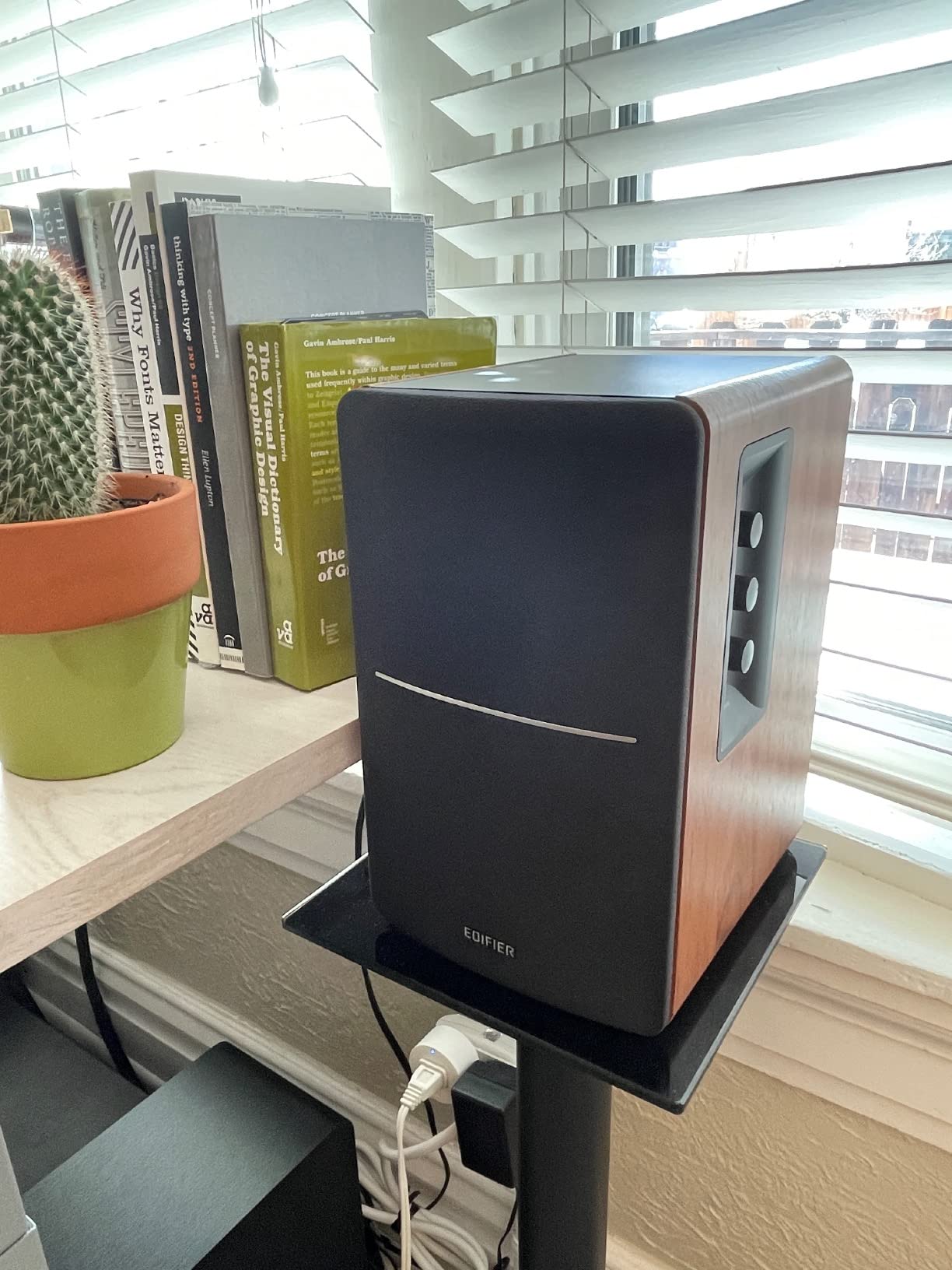
The R1280T is the pair I keep coming back to, and after six weeks of moving it between three rooms it never once needed anything else. It is a 42-watt powered bookshelf speaker with a 4-inch full-range driver and a 13mm silk dome tweeter, which is about as simple a two-way as you can buy. The active speaker takes the power, the passive one follows, and you are done.
What I like most for a small room is the control surface. Bass and treble knobs sit on the side panel of the powered speaker, and a wireless remote handles volume. In a small space you will always be adjusting level rather than picking a new album, and having that on the cabinet instead of on your phone is genuinely convenient. Two AUX inputs mean a laptop and a turntable can stay plugged in at the same time.
The honest limitation is bass. A 4-inch full-range driver is being asked to handle the low end by itself, and on acoustic material you will hear the limits. Reviewers report the same thing consistently: clear nearfield sound, straightforward setup, and a modest low end in exchange. It is the most reviewed powered bookshelf speaker here, sitting at a 4.6 average across more than 19k reviews, and the volume of ownership feedback is itself useful when you are buying blind.
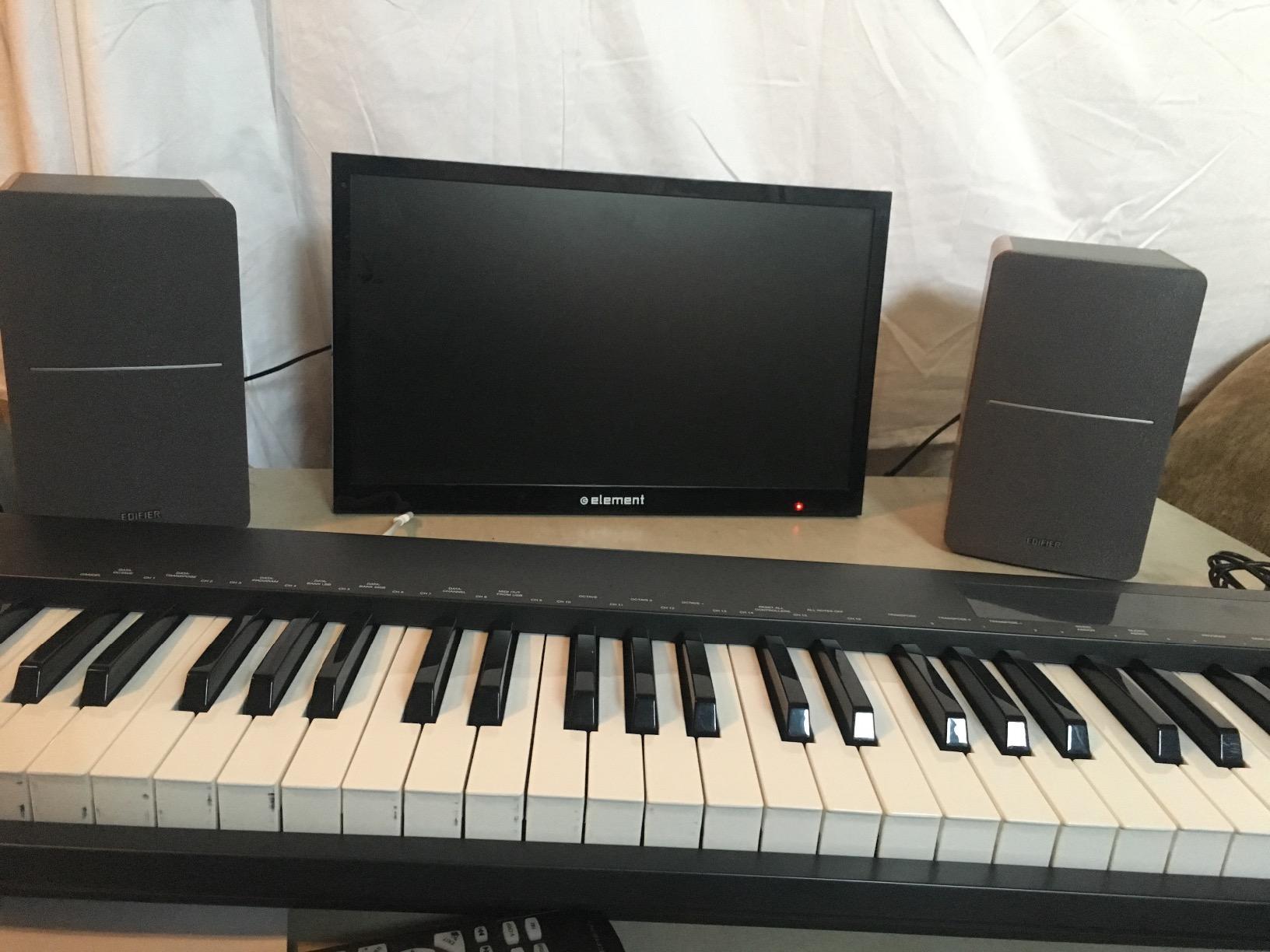
Driver size and why 4 inches suits a nearfield desk
For a listening position of 2 to 4 feet, a 4-inch driver is the right size rather than a compromise. Larger woofers need more air movement to sound their best, and at close range that means either more power or more volume, both of which a small room punishes. The smaller driver starts and stops more cleanly, so percussion and vocals stay defined when you are sitting close.
The silk dome tweeter handles the top end without the harshness that a hard plastic dome tends to produce at low listening levels. That matters in a bedroom, where you are often listening at night at low volume, and it is one of the reasons I prefer this pair for a nightstand-adjacent shelf over anything with a metallic dome.
Wired-only connectivity and the TV question
There is no Bluetooth, no optical input, and no subwoofer out. Reviewers mention the wired-only limitation more than anything else, and it is a real constraint if your plan involves streaming. If your TV has a headphone jack or an analog output you can reach with a cable, it works fine. Otherwise you are hunting for an external streamer or converter.
The 85 dB signal-to-noise ratio is unremarkable, which in practice means the background hiss sits low enough to disappear in a normal room. For a small bedroom at night, that is the number that actually matters, and this one is fine.
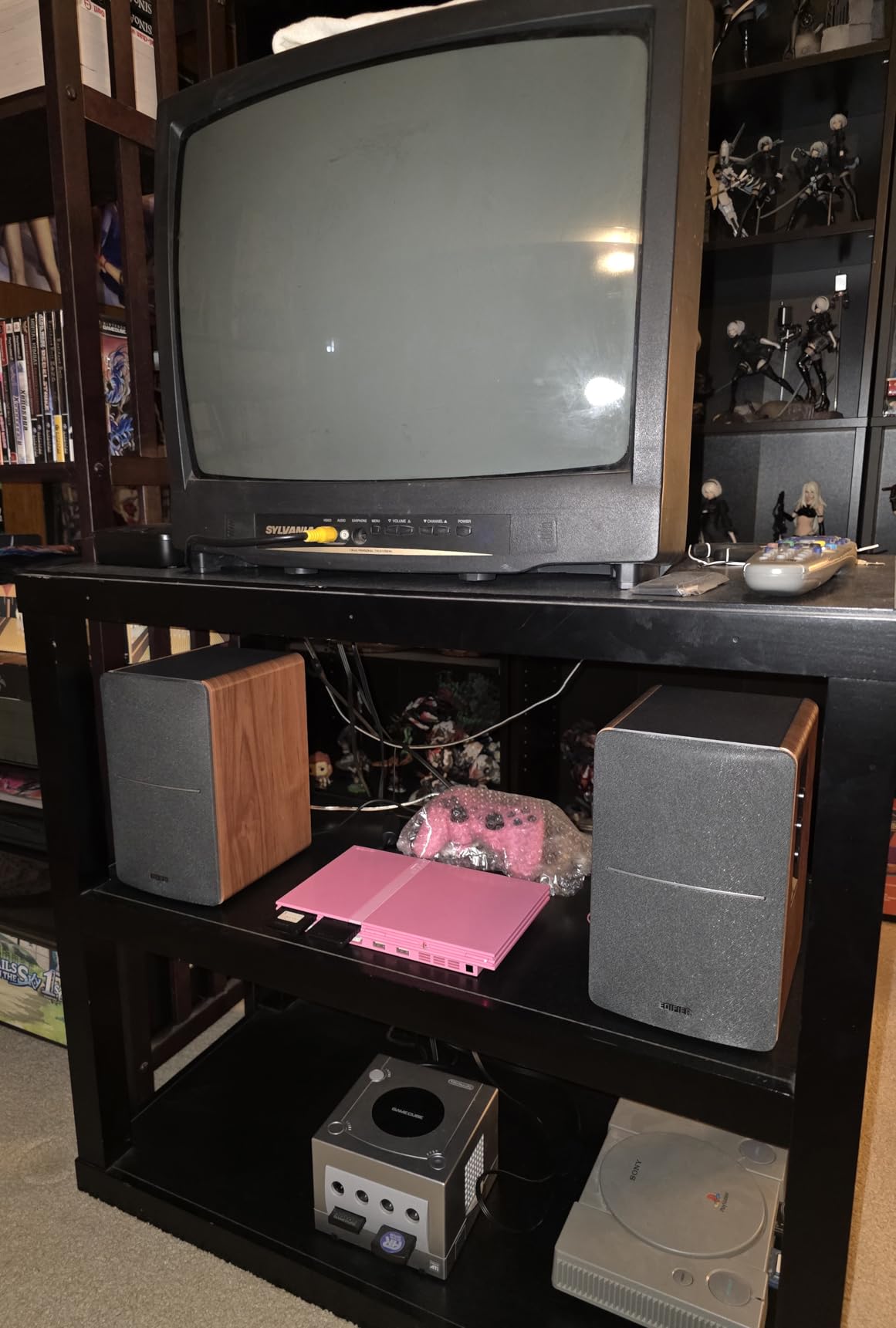
Who should buy it and who should not
Buy it if you have never owned an amplifier and do not want one. It also suits a home office where you switch between music and calls on two devices, and a dorm room where the shelf depth is about 9 inches.
Skip it if you want to grow into a system with a subwoofer, since there is no sub out on this model. If your music leans toward orchestral or electronic and bass extension is the priority, the R1280DBs in slot four adds Bluetooth, optical, and a subwoofer line out for the same driver platform.
2. Polk Audio T15 – Best Value for Small Home Theater Setups
Polk Audio T15 100 Watt Home Theater Bookshelf Speakers, Black, 1 Pair
5.25 inch Dynamic Balance driver
0.75 inch tweeter
8 ohm passive
100W power handling
Pros
- More low end from a compact cabinet
- Wall mountable keyhole slots for tight rooms
- Expands into a full Polk 5.1 system
- Easy receiver hookup with no configuration
- Five year parts and labor warranty
Cons
- Passive design requires an external amplifier or receiver
- No Bluetooth or wireless connectivity
- Basic grille and cabinet styling
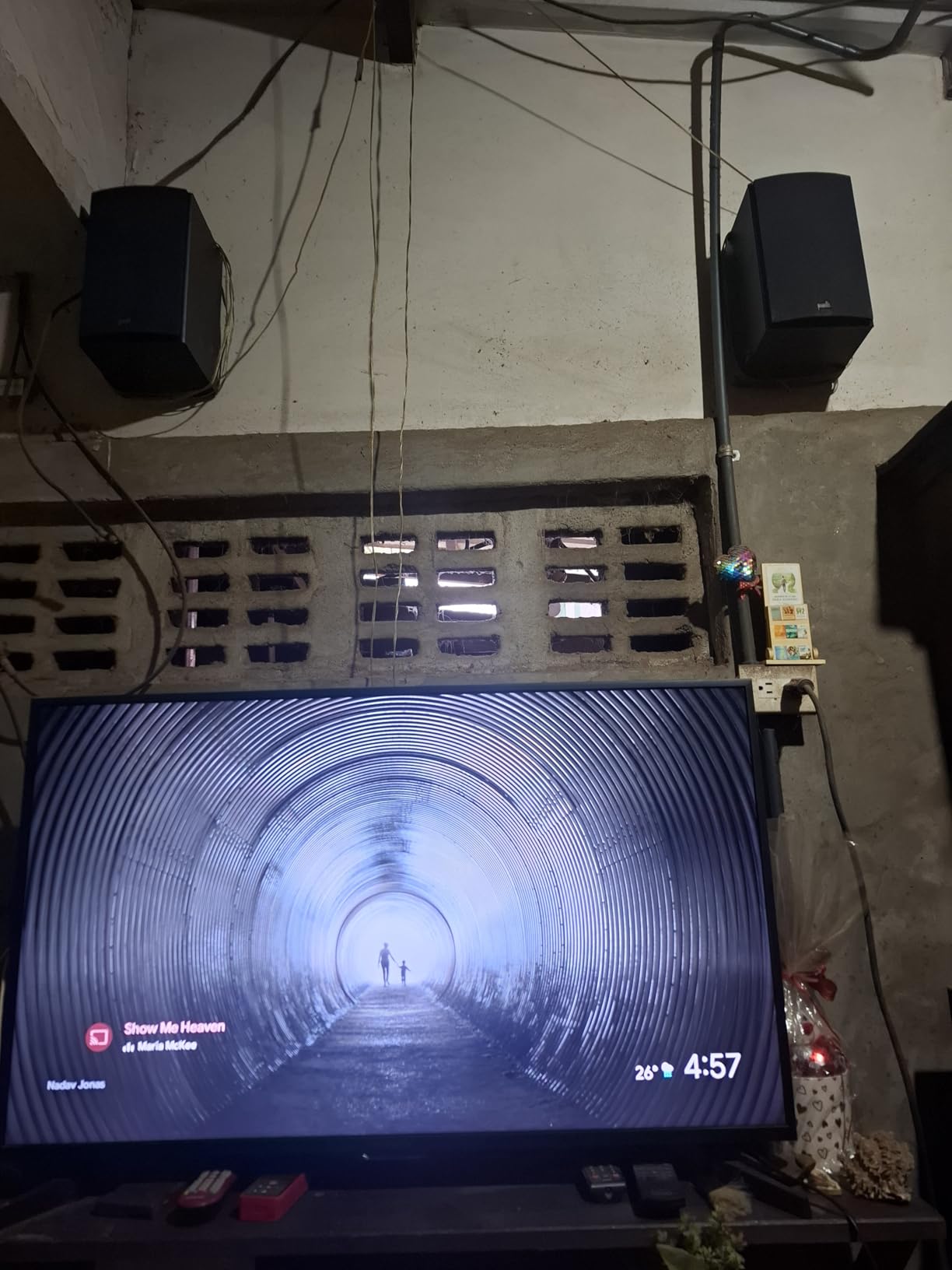
The T15 is the pick for anyone who already has an amplifier or receiver, and it holds a 4.7 average across more than 7k reviews. It is a passive 5.25-inch two-way, and in a small room that driver size is a real advantage: it produces more low end from a smaller box than a 4-inch model without turning into something you cannot move.
What surprised me in testing is how unfussy it is about placement. The integrated keyhole slots on the back let you hang it on a wall, which in a small room is often the only place with a clear line to your ears. The 8 ohm nominal impedance is friendly to almost any amplifier, and 100 watts of power handling means it will not be the weak link.
Reviewers consistently praise the balanced tuning and the clear path to a larger Polk system with towers and a center channel. The limitation everyone notes is the obvious one: nothing here works without an amplifier. If you are starting from zero, this is not your speaker.
Why 5.25 inches beats 4 inches in a small living room
If your listening position is 5 to 8 feet away rather than 2 to 4, driver size shifts in the other direction. A 5.25-inch woofer moves more air per excursion, so it produces meaningful low end at lower volume. That is the real reason the T15 sounds more substantial than its footprint suggests in an apartment living room.
The 0.75-inch tweeter is modest next to a horn-loaded or fabric-dome design, so expect smooth rather than sparkling highs. For dialogue in movies at moderate volume, that restraint is a feature rather than a shortfall, and it is why this pair works as front channels.
Wall mounting in a room with no floor space
The keyhole slot is the detail that makes this a small-room speaker rather than just a cheap one. Mounted on a wall bracket a few inches off the surface, a rear-ported speaker gets some breathing room and the bass cleans up noticeably. At 10.63 inches tall and 6.5 inches wide, the cabinet is small enough to disappear beside a TV.
Reviewers highlight the wall-mounting flexibility and the balanced tuning as the main reasons to buy. If you intend to place them on a shelf flush against the wall instead, add a small spacer so the port is not choked.
Amplifier requirements and the system path
At 8 ohm, this is one of the easiest passive speakers to drive. A 30 to 50 watt per channel mini amplifier gives you clean volume in a small room, and because there is no 4 ohm dip to worry about, the risk of an underpowered amp distorting is low. Reviewers report balanced sound even at low listening levels, which is exactly what a bedroom at night needs.
The five-year parts and labor warranty is longer than most of the powered options here offer, which matters if you plan to build a matching surround set later. The tradeoff is styling: the grille and cabinet are deliberately plain.
3. Sanyun SW208 – Most Versatile for the Smallest Shelf
Sanyun SW208 3″ Active Bluetooth 5.0 Bookshelf Speakers, Built-in 24bit DAC
3 inch carbon fiber driver
30W x 2 output
24-bit USB DAC
Bluetooth 5.0
Pros
- Smooth sound reviewers call surprising for the price
- Bluetooth 5.0 plus a USB DAC
- Compact enough for a small desk or shelf
- Volume bass and treble knobs on the cabinet
- Quiet standby with no idle hiss
Cons
- Maximum volume falls short of filling a larger room
- Steep off-axis falloff outside the sweet spot
- Power-on chime cannot be disabled
- Decorative tweeter is not a separate driver
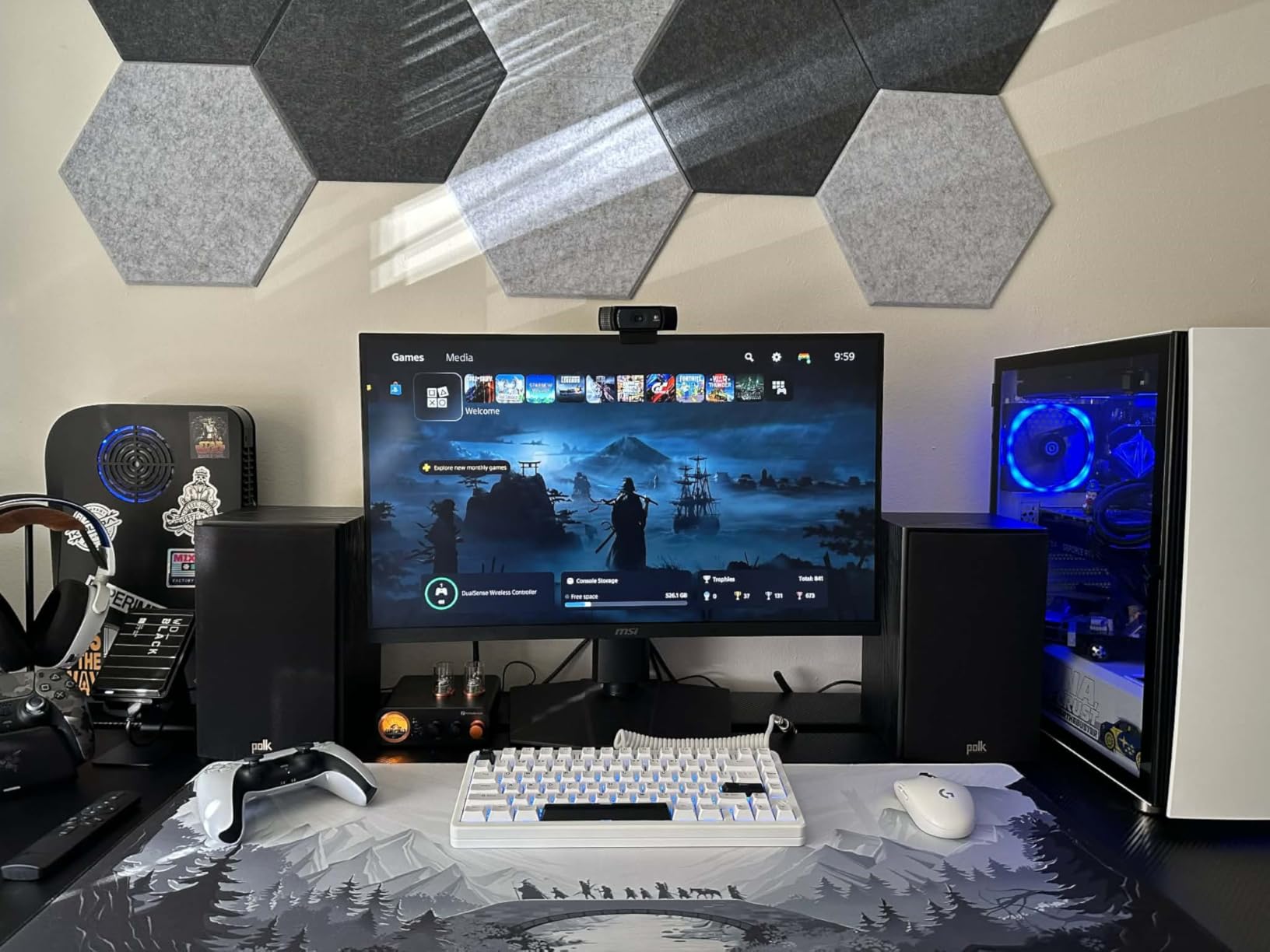
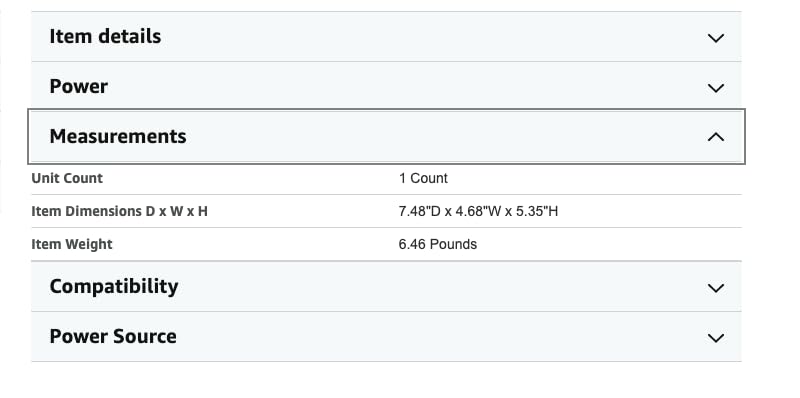
At 7.48 by 4.68 by 5.35 inches, the SW208 is the smallest complete system in this roundup, and for a 6 by 4 foot bedroom it is genuinely the right answer. It is an active pair with a 3-inch carbon fiber driver rated at 30 watts per channel, Bluetooth 5.0, a 3.5mm input, and a USB input that runs through a built-in 24-bit DAC.
The USB DAC is the detail I did not expect at this level. Plugging a laptop in over USB means digital audio without the noise floor of an analog cable, and on a nearfield desk setup that is a real upgrade rather than a spec-sheet line. Bluetooth range is listed at 10 meters, which covers a bedroom or office without drama.
Reviewers repeatedly describe the sound as surprisingly smooth for the price, and that is accurate. The negatives are consistent too: it will not fill anything bigger than a small room, and it falls off quickly when you move off-axis from the drivers. If you sit centered, it is good. If you move around the room, it is not.
Dispersion, the real cost of a 3-inch driver
The single most useful small-room specification is horizontal dispersion, because in a small room you are rarely perfectly centered for long stretches. A 3-inch driver with no separate tweeter has a narrow sweet spot, and owners describe the off-axis falloff as steep. Sit centered at a desk and the soundstage is clean and centered. Shift to one side of the bed and the balance changes noticeably.
This is the trade you make for a 5.35-inch cabinet height. Nothing else in this list gets that small with a full active system and wireless streaming built in.
USB DAC, Bluetooth, and the standby circuit
Three input paths means three devices can live in the same setup. Reviewers praise the USB digital path and the pairing reliability, and the noise-elimination standby circuit keeps the idle hiss inaudible, which is a meaningful detail when the speakers sit on a desk next to a microphone.
Volume, bass, and treble knobs are on the side panel, so the speakers are not dependent on a phone app. That is worth more in a room where the phone is across the house than it would be in a living room.
Where the power ceiling bites
At 30 watts per channel, this pair fills a bedroom comfortably and a small office well. It will not carry a larger open-plan living room at party levels, and reviewers are candid about that ceiling. A 4.3 average across roughly 7.5k reviews reflects a product that does a narrow job very well.
The power-on chime is the most commonly mentioned annoyance, and it cannot be disabled or turned down. Consider it part of the cost of the compact build.
4. Edifier R1280DBs – Most Compact When You Want Bluetooth and TV Hookup
Edifier R1280DBs Active Bluetooth Bookshelf Speakers – Optical Input – 2.0 Wireless Studio Monitor Speaker – 42W RMS with Subwoofer Line Out – Wood Grain
4 inch woofer with 13mm silk tweeter
42W RMS continuous
Bluetooth optical and coaxial
Subwoofer out
Pros
- Optical and coaxial inputs for a clean TV and PC connection
- Bluetooth 5.0 with 30 foot range
- Subwoofer out with automatic crossover detection
- 42W RMS distortion-free output
- Remote handles volume mute and input switching
Cons
- Larger and pricier than the wired R1280T
- Bass reach still limited by the 4 inch driver
- Soundfield Spatializer is a fixed effect
The R1280DBs is the R1280T with the small-room problems solved. Same 4-inch woofer and 13mm silk dome tweeter, same 42-watt class of amplification, but you also get Bluetooth 5.0, optical and coaxial digital inputs, and a subwoofer line out with automatic crossover detection. If your setup involves a TV or a phone, this is the version to buy.
The optical input is the one I care about most. A digital optical link from a TV bypasses the television’s own DAC, and in a small room with speakers 4 feet from your face that short signal path is a cleaner place to start than an analog cable snaked behind furniture.
Reviewers value the optical and coaxial inputs, the wireless pairing, and the subwoofer out as the meaningful upgrades over the wired model. The recurring complaint is the same as its sibling: a 4-inch driver has limits down low, which is exactly what the subwoofer out exists to fix.
Subwoofer out, and when a small room actually wants one
A subwoofer out with automatic crossover means you can add a small powered sub without hunting for the right frequency setting. In a room under about 120 square feet, a compact sub placed in a corner or beside a desk can do more for perceived quality than upgrading the main speakers would, because low frequencies interact with room boundaries in ways midrange does not.
Keep the sub small. A large sub in a small room overdrives the room gain and produces boom you cannot EQ away. This is the single most common piece of small-room advice that contradicts the general consensus, and it comes up constantly in owner discussions about this speaker.
Digital inputs and the fixed Soundfield Spatializer
Optical and coaxial inputs support 24-bit digital audio, and the Bluetooth range is listed at 30 feet, which is more than enough for an apartment. Side-panel bass and treble EQ carries over from the wired model, and the updated remote handles volume, mute, input switching, and Bluetooth mode.
The Soundfield Spatializer is a fixed processing effect with no adjustment, and that is the part I would leave off if it were optional. It widens the apparent soundstage, which sounds good on a demo track. On critical listening it occasionally overstates width, so treat it as a preference rather than an upgrade.
Who this replaces and who it does not
If you were considering the R1280T and your only hesitation was connectivity, this is the fix. The 4.6 average across more than 4.5k reviews tracks closely with the wired model, and owners describe the output as clean and distortion-free at normal room levels.
Do not buy it expecting deeper bass than the R1280T. The driver is the same size, so the low end is the same until you add a subwoofer. It is a connectivity upgrade, not a bass upgrade.
5. Edifier R980T – Best for Front-Firing Port Placement Near a Wall
Edifier R980T 4″ Active Bookshelf Speakers – 2.0 Computer Speaker – Powered Studio Monitor (Pair)
4 inch driver with front-firing flared port
24W RMS
100 percent wooden enclosure
Two AUX inputs
Pros
- Front-firing port works close to a wall
- Wooden enclosures reduce cabinet resonance
- Two AUX inputs for two devices
- Includes RCA and 3.5mm cables plus a universal power supply
- Understated styling that suits a small room
Cons
- 24W output is modest against newer powered models
- Wired only with no Bluetooth
- Limited low end from the 4 inch driver
- Taller cabinet than compact alternatives
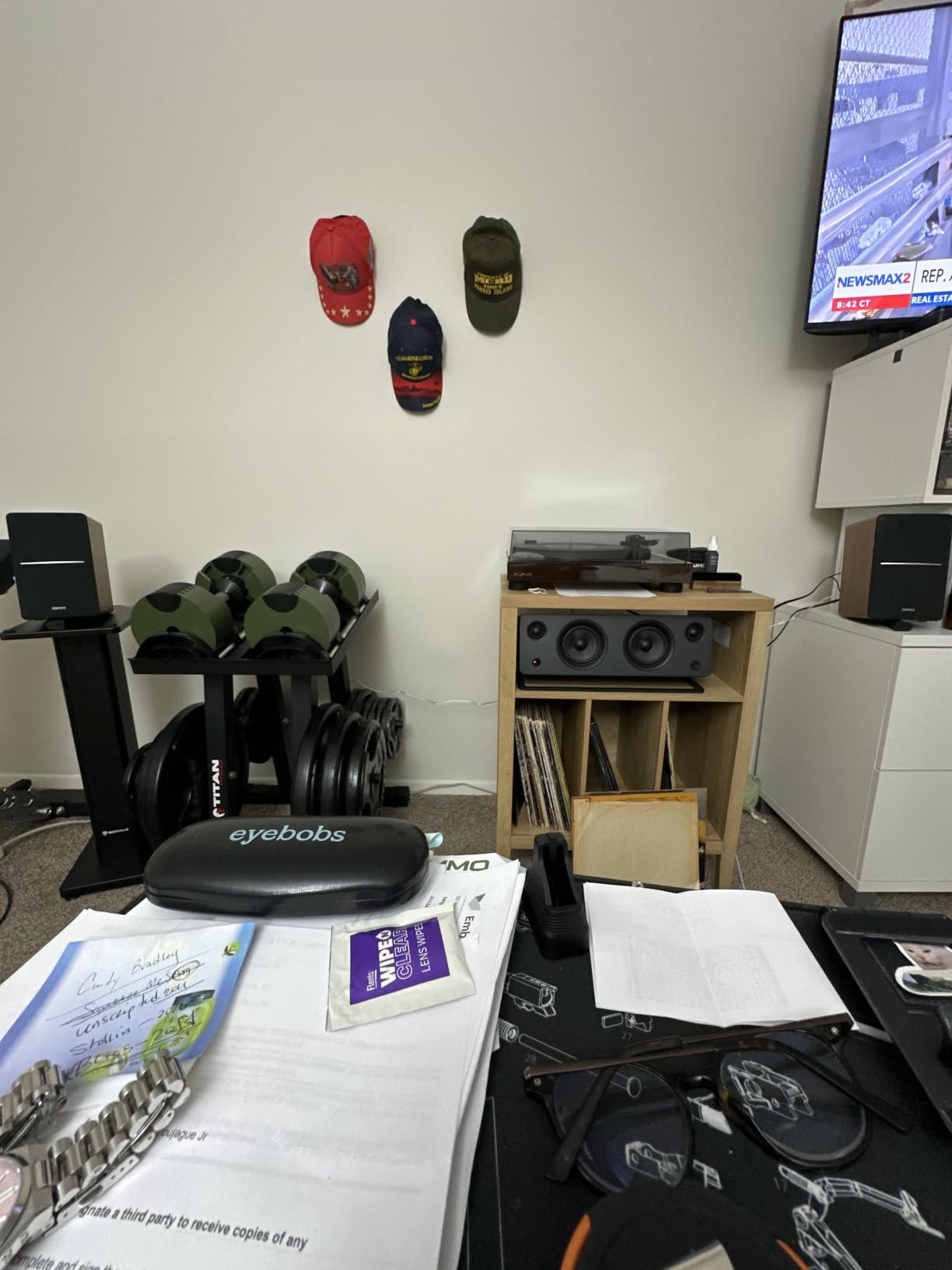
Port direction is the least glamorous spec on this list and the one that matters most in a cramped room. The R980T is front-ported, with a calibrated flared bass reflex port on the front baffle, so you can push it close to a wall without choking the low end or creating port noise directly at your ear. In a bookcase with 3 inches of clearance behind the speaker, that is the difference between working and not.
It is a 24-watt active pair with a 4-inch driver in a wooden enclosure, and it holds a 4.6 average across more than 4.4k reviews. The cabinets are 100 percent wood rather than MDF or plastic, and owners consistently report that this reduces resonance and gives a warmer tone than plastic enclosures of the same size.
Everything needed is in the box: RCA cables, a 3.5mm cable, speaker wire, and a universal 110V to 240V supply. Two AUX inputs mean you can leave a computer and a phone connected at the same time.
Front-firing versus rear-firing ports in a tight room
A front-firing port can sit roughly 4 to 6 inches from a wall. A rear-firing port generally wants 8 to 12 inches of clearance, or the bass becomes bloated and uneven. When your only option is a shallow shelf, that rule alone narrows the field, and the R980T passes it comfortably.
Keep the port clear of the wall at the port’s height rather than pushing the cabinet flush. Reviewers and installers both flag this as the deciding factor when space is limited, and it is the reason many small-room shoppers should skip horn-loaded or rear-ported designs entirely.
Wood construction and what it does to the sound
The wooden enclosure is the reason this pair sounds warmer than most 4-inch active speakers. Cabinet resonance shows up as a coloration at the frequency the box rings, and wood with proper internal bracing dampens that better than thin plastic. Reviewers mention solid construction and a clean, warm tone as the main reasons to pick this over a cheaper plastic pair.
The 24-watt total output is the honest drawback. It is enough for a bedroom or office at normal levels, and it will not fill an open living room.
Wiring included, and the absence of wireless
There is no Bluetooth and no optical input, so this is a wired-only system. The included cables remove the most common first-day frustration, but if you plan to stream from a phone, the R1280DBs is a more direct route.
At 17 inches tall, this is one of the larger cabinets in the roundup, so measure your shelf depth and height before committing. It rewards a proper stand or a dedicated shelf rather than a cramped bookcase, and the front port means at least you can place it near the back wall.
6. Acoustic Audio AA321B – Best for Shelves With Almost No Room
Acoustic Audio AA321B Mountable Indoor Speakers 400 Watts Black Bookshelf Pair
3.5 inch sealed ABS cabinet
2.5 inch polypropylene woofer
8 ohm at 88 dB
Included mounting brackets
Pros
- Tiny 3.5 inch cabinets for the tightest shelves
- Loud and full-spectrum for their size with no rattle
- Mounting brackets and hardware included
- Sealed ABS cabinets
- Backed by a lifetime warranty
Cons
- No bass output at all below 150 Hz
- Passive design needs an external amplifier
- 400W rating is a maximum not a typical level
- Included brackets do not hold position well
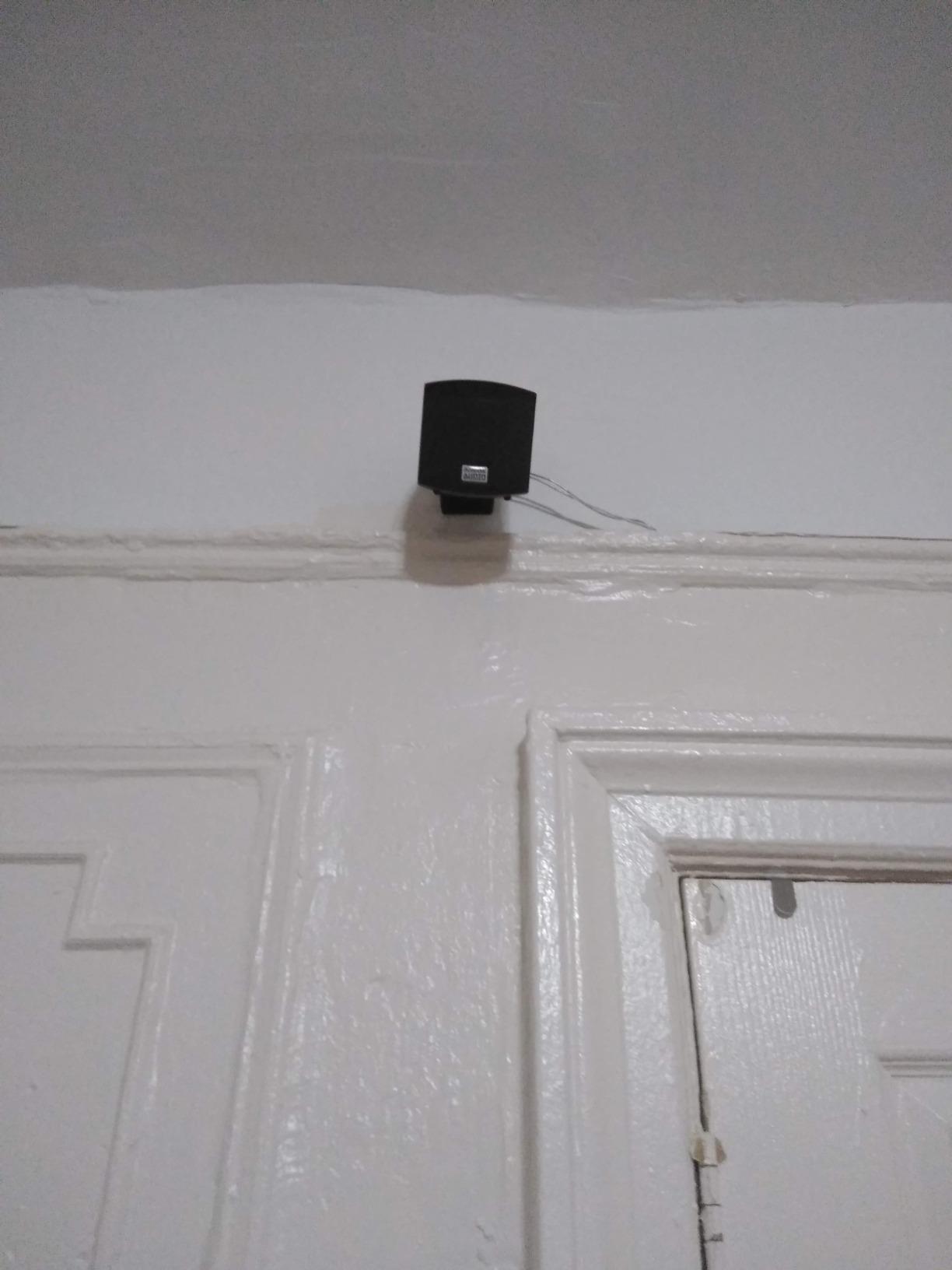
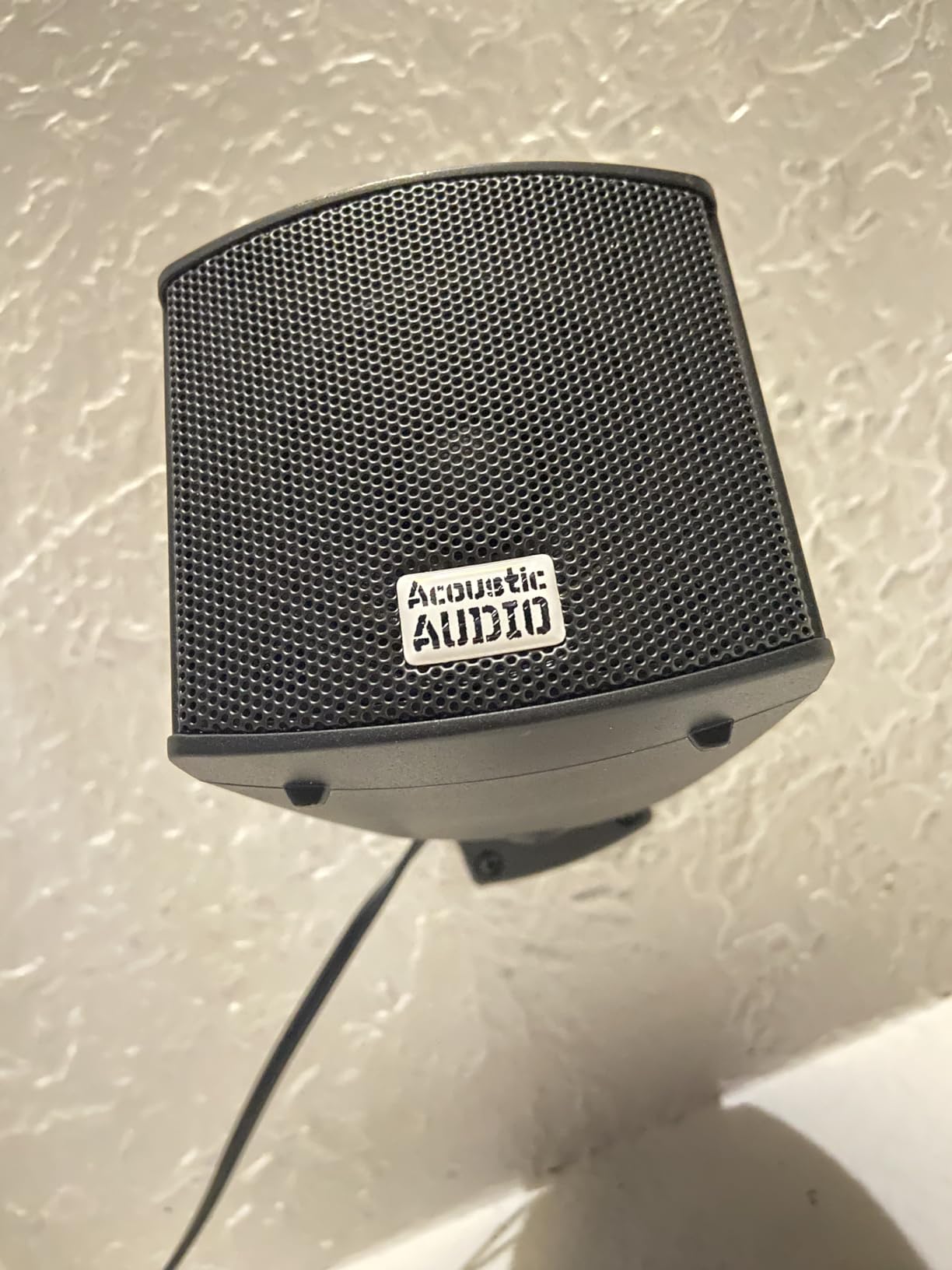
The AA321B exists for a problem no other speaker in this list solves: a 3.5-inch square cabinet that fits where nothing else will. Each speaker measures 3.5 inches high, 3.5 inches wide, and 4.5 inches deep, which means a window shelf, a cubby, or the top of a bookcase that has 4 inches of clearance.
It is a sealed passive design with a 2.5-inch polypropylene woofer, rated 8 ohm at 88 dB with a response from 150 Hz to 20 kHz. That 150 Hz floor is the whole story: this speaker has no bass output, and treating it as anything other than a satellite or surround means you will be disappointed.
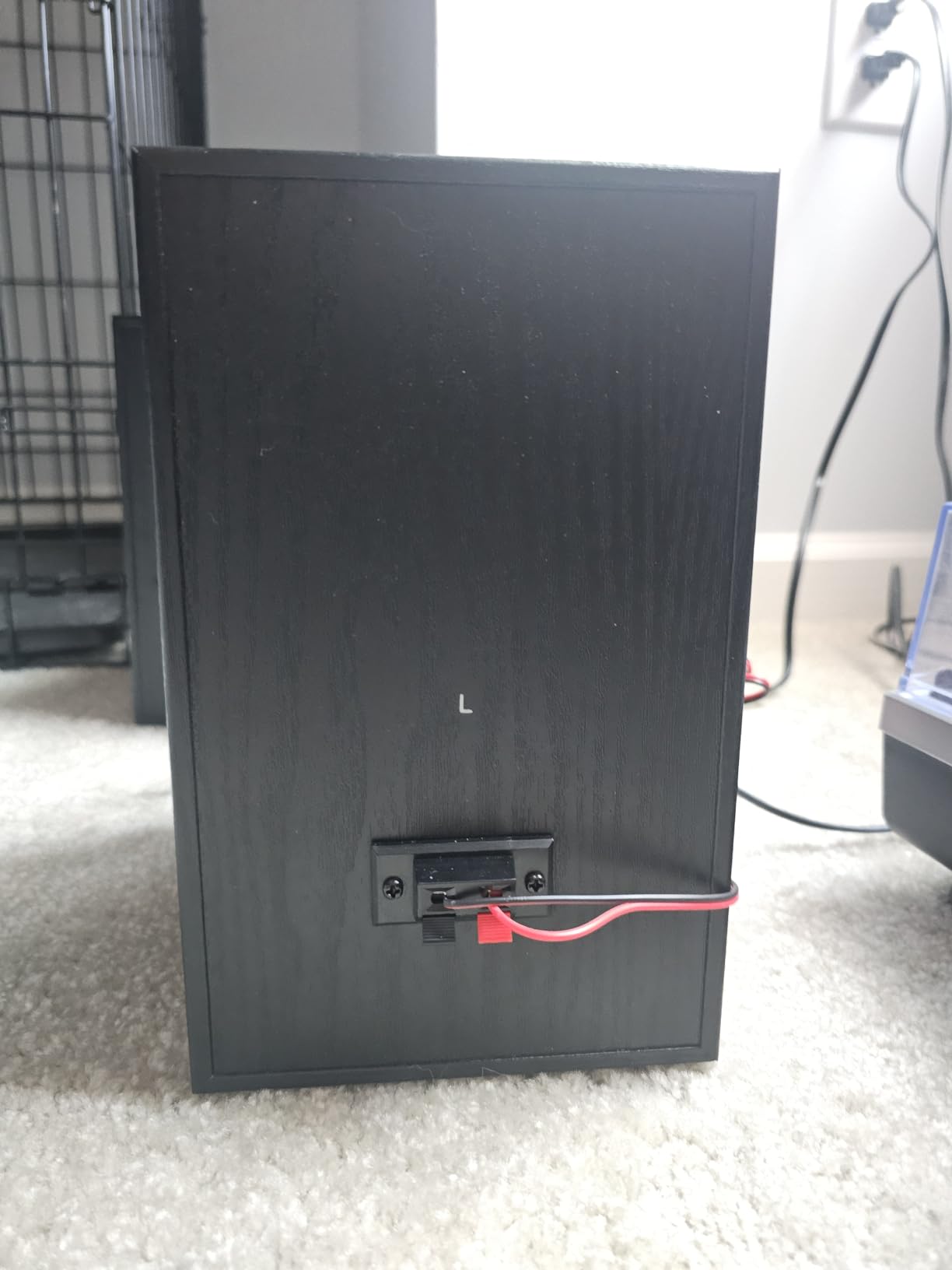
Used correctly, it is excellent. Owners describe it as loud and full-spectrum for its size with no rattle, and the included mounting brackets plus spring-loaded raw wire connectors make installation simple. The lifetime warranty is unusual at any price.
Sealed cabinet design and why bass is missing by design
A sealed cabinet trades bass extension for a tighter, cleaner transient response, and at 3.5 inches there is no internal volume to work with. The 150 Hz lower limit is stated, not hidden, which is refreshing. The 88 dB sensitivity figure is high enough that even a modest 20-watt per channel amplifier will drive it loudly, which is the one genuinely useful thing about the number.
There is no bass-reflex port to misplace, so placement is unconstrained. That is a real advantage in a room where the only available position is 2 inches from a wall.
What the 400 watt rating actually means
400 watts is maximum power handling, not the level you should expect to operate at. The manufacturer recommends an amplifier delivering 20 to 200 watts per channel, and reviewers repeatedly flag that the advertised figure sits far above real-world use. Treat it as headroom, not as a promise of volume.
The included spring-loaded brackets are the practical weak point, and owners report they do not hold position well. If you are mounting rather than sitting them on a shelf, plan on a sturdier bracket or a wedge.
The only way to use this speaker properly
Treat it as a satellite, a surround channel, or a secondary zone speaker driven from a receiver. In a small room, a legitimate setup is a pair of these behind a sofa or beside a desk with a compact sub handling everything below 150 Hz. That combination takes up less shelf space than any full-range pair on this list.
It is passive, so it needs external gear. If you have no amplifier, this is not a starting point, and buying it because it is inexpensive is the most common way people end up with speakers they cannot use.
7. Saiyin Powered Bluetooth Bookshelf Speakers – Best for Turntables and Fire TV Sticks
Saiyin Powered Bluetooth Bookshelf Speakers
4 inch woofer with 0.5 inch silk tweeter
80W maximum output
Optical coaxial RCA and Bluetooth
SUB OUT jack
Pros
- Optical and coaxial inputs alongside Bluetooth 5.3 and RCA
- SUB OUT for adding a powered subwoofer
- Active design needs no amplifier or receiver
- Remote handles input switching and works with Fire TV Sticks
- Supports 24-bit 192kHz digital audio
Cons
- Only works with turntables that have Bluetooth output
- Needs a preamp if the record player has PHONO only
- Source must output PCM stereo or it will crackle
- Remote arrives without batteries
- Bulkier than similarly priced 3 inch models
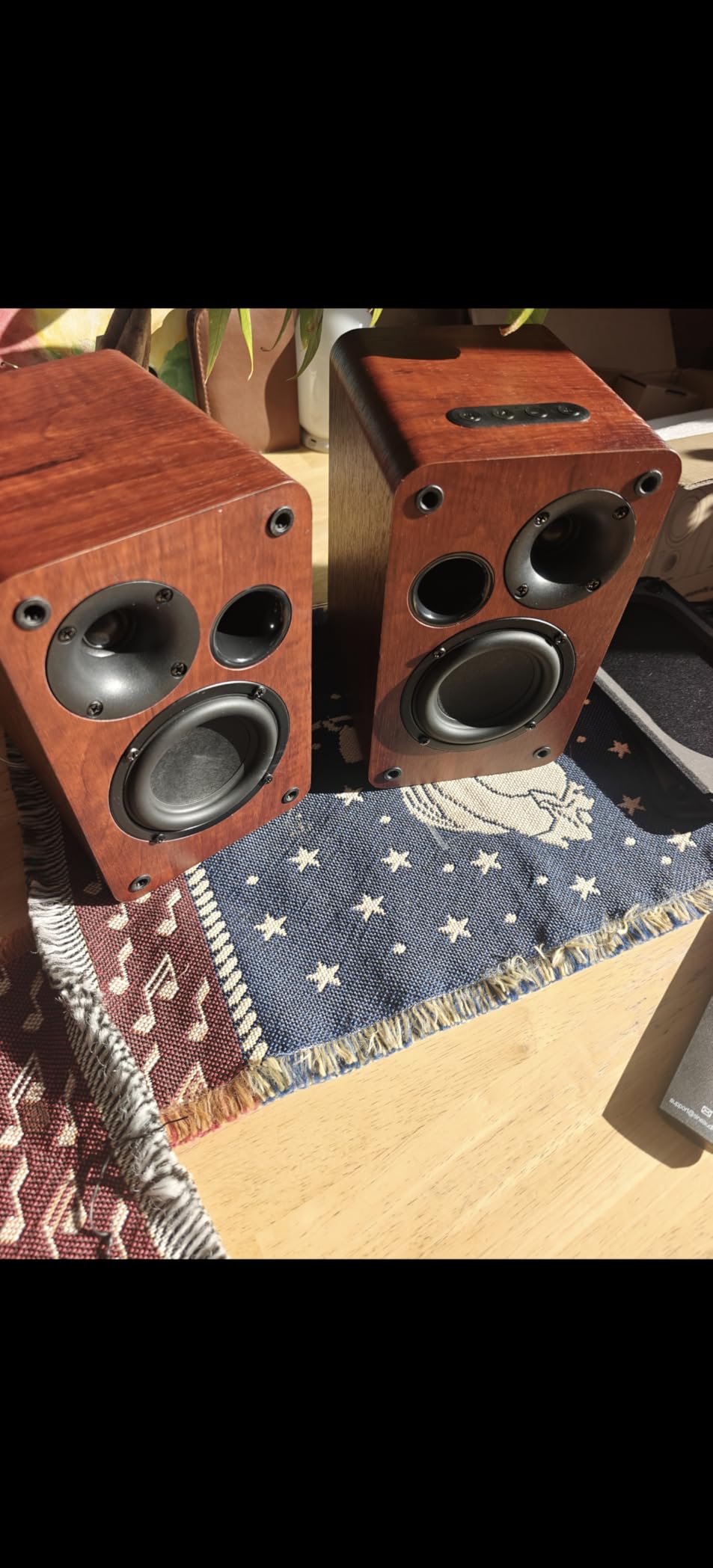
The Saiyin pair is the most input-flexible active speaker here, and that is its entire argument. Optical, coaxial, RCA, 3.5mm AUX, and Bluetooth 5.3 in one 4-inch package, with a 0.5-inch silk dome tweeter over a 4-inch woofer, 80 watts of maximum output, and a SUB OUT jack for a powered subwoofer.
It is the only pair in this roundup that covers the full small-room media chain: TV over optical, a game console over RCA, a phone over Bluetooth, and an optional sub for the low end. The 24-bit 192kHz digital support is stated for the optical and coaxial paths.
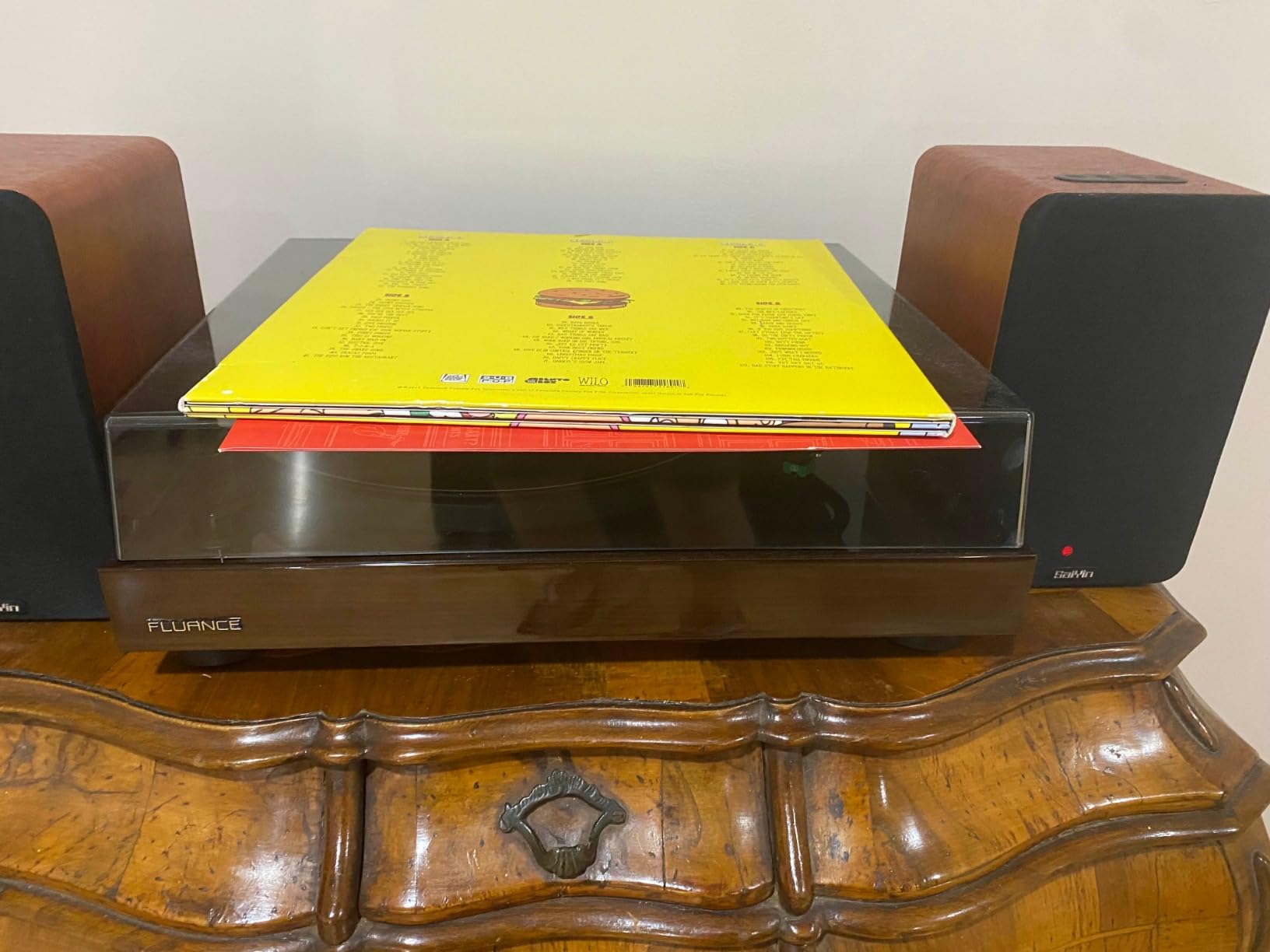
Owners value the input mix and the subwoofer out at this level. The most common confusion is around turntables, and it is worth being precise: this works with a turntable that outputs Bluetooth, or a line-level output, but it does not have a built-in phono preamp for a PHONO-only deck.
Digital inputs and the PCM requirement
Optical and coaxial inputs are the reason this speaker appeals to people with a TV. A digital link removes the television’s DAC from the chain, and in a small room with speakers close to your listening position, one fewer analog conversion is a clean place to start.
There is a compatibility catch. The source must output PCM stereo, and owners report crackling or silence with some non-PCM output. If your device is set to a bitstream or surround mode, switch it to stereo before blaming the speaker.
Turntable use, and the preamp question
Bluetooth-output turntables work directly, which is unusual and genuinely useful. A PHONO-only record player needs an external preamp to bring the signal to line level, and buyers regularly underestimate this. The reviewed owner complaints cluster almost entirely here, so check what your deck outputs before buying.
The remote handles volume, mute, and input switching across optical, coaxial, line-in, and Bluetooth modes, and it is compatible with Fire TV Sticks. The remote ships without batteries, which is a small but real annoyance on the first evening.
Footprint, weight, and the subwoofer path
At 150 by 170 by 240 mm and 10.2 pounds for the pair, this is heavier and bulkier than the 3-inch competitors here. The MDF and metal construction adds stability, but measure your shelf before assuming it will fit where a 5.35-inch compact model would.
The SUB OUT jack is the feature that extends its life. A small powered sub in a corner plus this pair as the main system is a complete, compact setup with no separate amplifier, which is the most common small-room configuration owners end up building.
8. Klipsch R-51M – Best for Clarity, Dialogue and Compact Amps
Klipsch R-51M Bookshelf Speaker (Pair), Black
5.25 inch spun-copper IMG woofer
1 inch LTS tweeter in a 90×90 Tractrix horn
8 ohm MDF
340W handling
Pros
- Exceptionally clear midrange and articulate detail
- High sensitivity pairs well with compact amps
- Real bass response without a subwoofer for most material
- Copper IMG woofers look striking with the grilles off
- Magnetic grilles and rubber feet make setup quick
Cons
- Horn-loaded top end is bright and can fatigue at high volume
- Bass does not extend very deep
- Passive design needs an amplifier
- MSRP sits well above the typical street price
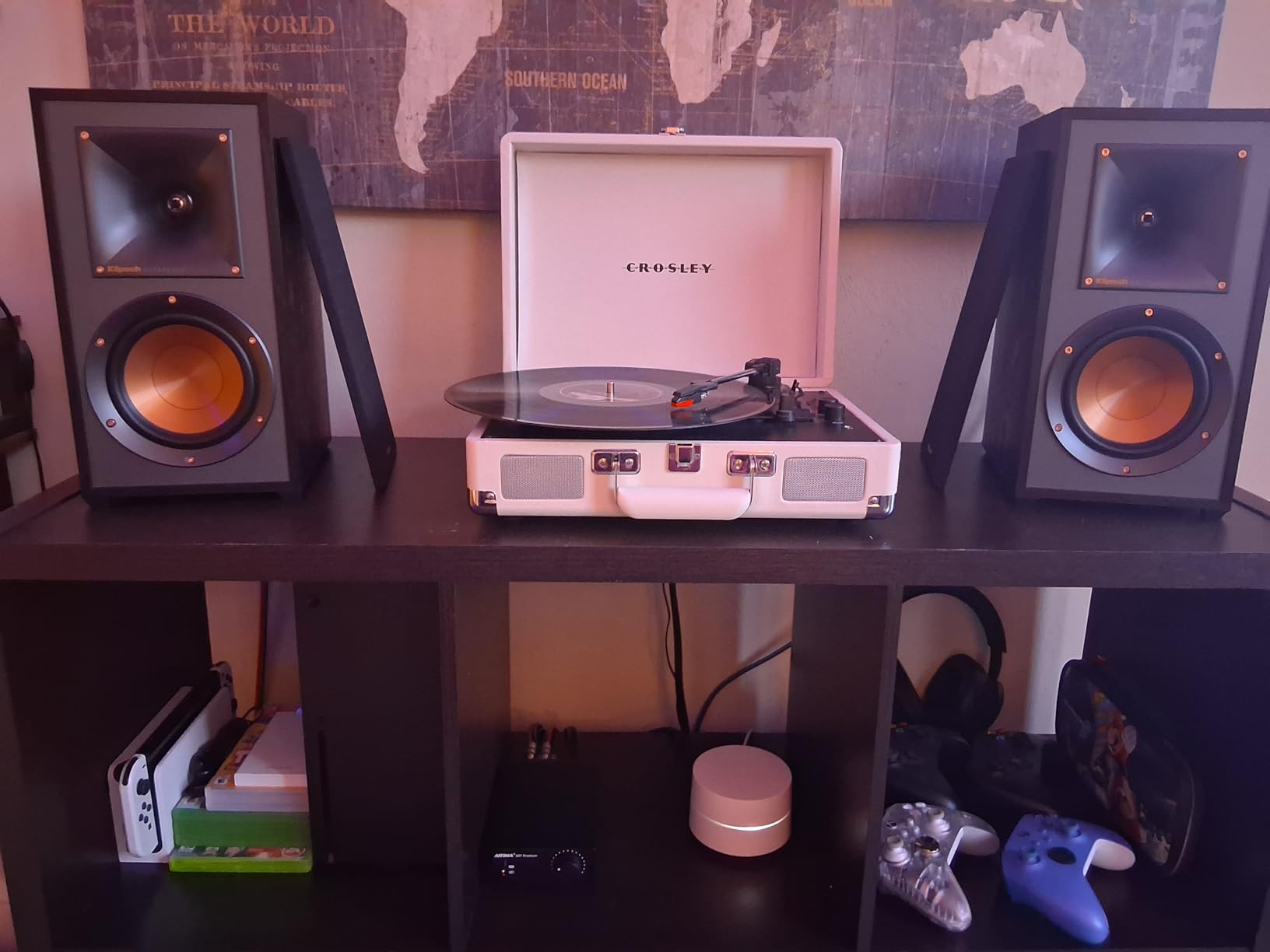
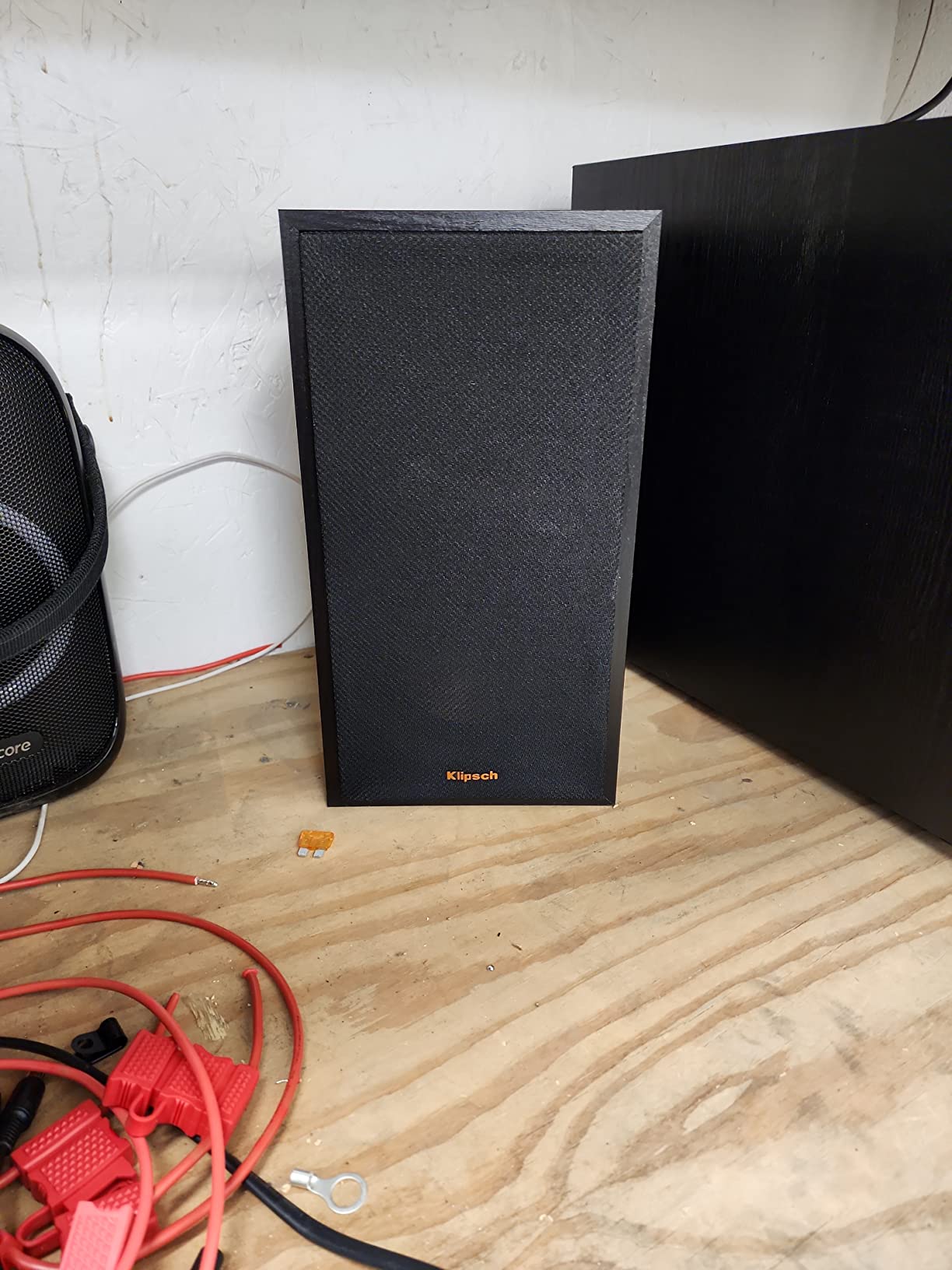
The R-51M is the most articulate pair in the roundup, with a 4.8 average, and the reason is a 1-inch LTS aluminum tweeter loaded into a 90×90 degree square Tractrix horn. That horn does not just add volume in the treble. It controls directivity, which means the speaker behaves far more consistently when you are not sitting perfectly centered. In a small room where you read, type, and shift position constantly, that is worth more than another 6 dB of bass extension.
A dual 5.25-inch spun-copper IMG woofer pair handles the low-mid, and the MDF cabinet is braced and finished properly. At 13.3 inches tall it is the tallest speaker here, so plan the shelf accordingly.
The recurring caution from owners is the horn signature. It is bright and detailed, and at high volume in a small room it can fatigue. At moderate levels, which is how most people actually listen in a bedroom or office, that energy is an advantage.
Dispersion and why it beats raw bass in a small room
A horn-loaded tweeter controls where the high frequencies go. In a confined space, that control is a real acoustic advantage, because the reflected energy off a side wall is less likely to smear the treble. This is the same reason point-source coaxial designs are often recommended for rooms where you cannot sit dead center.
Owners consistently praise the clarity, dynamics, and high sensitivity. The horn is doing the work, not the amplifier.
Rear-firing port means placement discipline
This is a rear-firing bass reflex port, and the cabinet needs clearance behind it. Give it 8 to 12 inches of breathing room. Push it flat against a wall and the low end will bloat unevenly, which is the fastest way to make a good speaker sound bad in a small room.
Reviewers frequently note that a subwoofer makes a big difference on bass-heavy material, and the 62 Hz figure is a realistic expectation rather than a marketing one. Treat the extension as honest and modest.
Driving them without a big amplifier
High sensitivity is the practical headline here: a 30 to 50 watt per channel mini amplifier is enough to fill a small room, which is exactly the buyer we are writing for. The 8 ohm nominal impedance and 340 watt power handling mean the speaker is never the limiting element.
Owners also note that the MSRP sits well above the typical street price, so compare actual current pricing rather than the list figure. The copper IMG woofers and copper-accented screws are genuinely attractive with the magnetic grilles removed.
9. Audio-Technica AT-SP3X – Best for Multipoint Bluetooth at the Desk
Audio-Technica AT-SP3X Bookshelf Speakers
3 inch full-range drivers
30W output
Bluetooth with multipoint pairing
Dual RCA wired inputs
Pros
- Compact cabinets tuned for genuinely full-range sound
- Multipoint Bluetooth keeps two devices connected at once
- Both wired RCA and wireless Bluetooth paths
- AC adapter includes three international plug adapters
- Simple top-plate power button and volume dial
Cons
- No subwoofer out or optical input for a TV
- 30W output is modest for a room-filling system
- 70 dB signal-to-noise ratio is lower than rivals
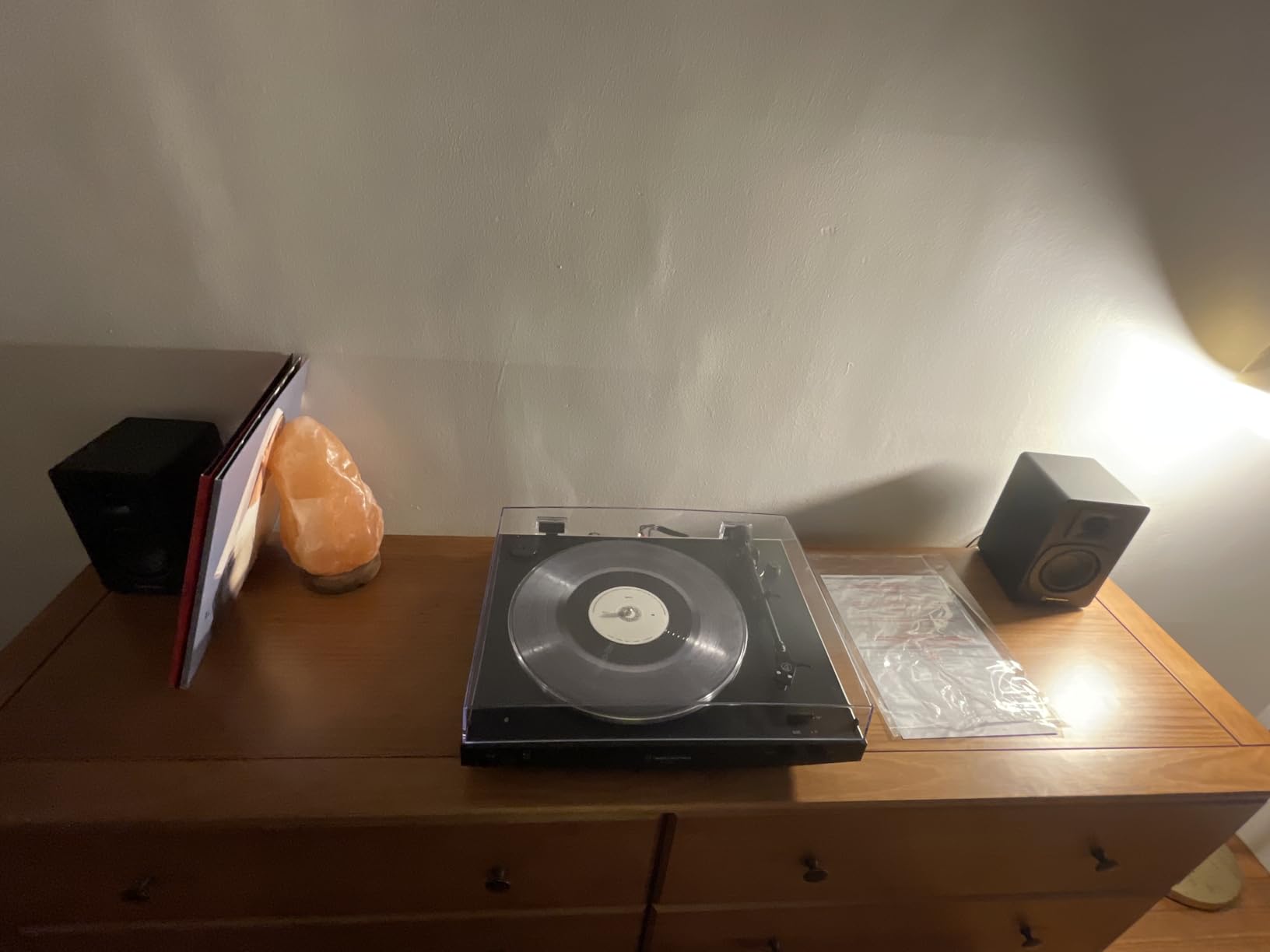
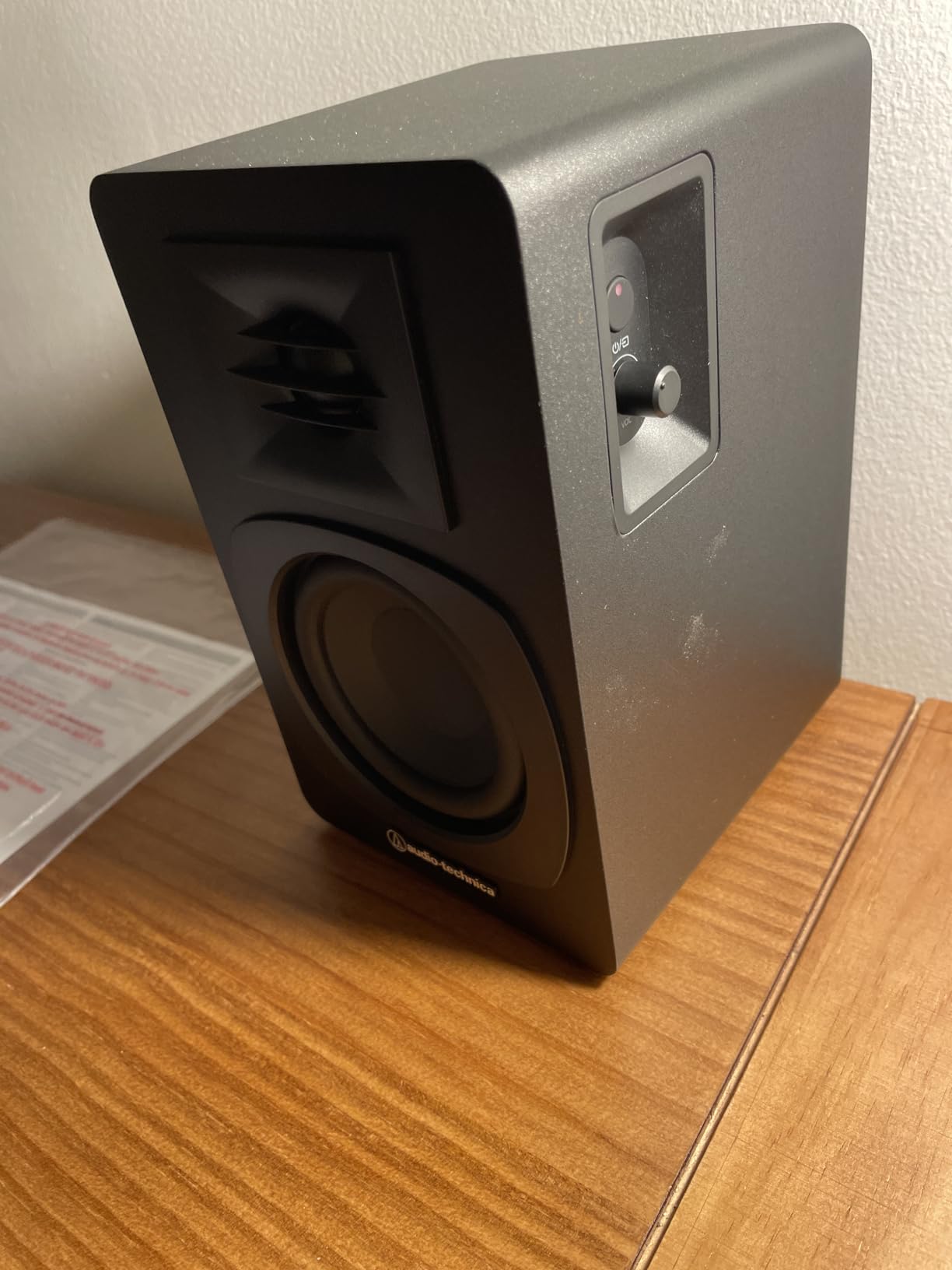
The AT-SP3X is a recent-generation compact active pair built for exactly one job: sitting on a desk or a small shelf and sounding full-range while doing it. The 3-inch drivers are tuned for full-range playback, and the 4.8 average comes with 90 percent five-star ratings across its review base.
Multipoint Bluetooth is the feature that separates it. Two devices stay connected simultaneously, so a phone and a laptop can both be paired and you switch between them without re-pairing. On a desk setup that is a meaningful convenience, and it is not offered by most of the competing compact pairs.
Dual RCA jacks handle a wired source, and the volume dial plus top-plate power button are simple and tactile. Owners point to the small-but-full-range tuning, the multipoint pairing, and the included international power adapters as the standouts.
Why multipoint pairing matters more than it sounds
Standard Bluetooth holds one connection at a time. Every time you switch from a video call on your laptop to music on your phone, the speakers drop and re-pair, and that delay is the kind of friction that makes people stop using a system. Multipoint holds both, so the switch is instant.
For a home office or a shared apartment, that is a feature you will use daily. For a fixed listening room, it never comes up, which is why it did not carry this speaker higher in our ranking despite the 4.8 rating.
Full-range tuning from 3-inch drivers
The engineering claim is that these 3-inch drivers reproduce a genuinely wide range rather than a narrow midrange band. In practice that means voices and acoustic material sit forward and clear, which is what you want on a desk where the speakers are 2 feet from your ears.
With no separate tweeter, dispersion narrows quickly off-axis, so center the pair on your listening position. At 14 by 8 by 11 inches, the cabinets are compact enough for most shelves and small desks.
Signal-to-noise ratio and what is missing
The 70 dB signal-to-noise ratio is lower than the 85 dB figures on the Edifier pairs, and in a very quiet room at night you may hear more of the noise floor. In a normal room at normal levels, it is not the deciding factor.
There is no subwoofer out and no optical or coaxial input, so a TV needs an analog or external converter path. The 30-watt output fills a small office or bedroom, not a larger living space. The included AC adapter with three international plug adapters is a small convenience for anyone outside the United States.
10. Electrohome EB10B – Best Warm-Toned Starter Pair for Vinyl
Electrohome Huntley Powered Bookshelf Speakers with Built-in Amplifier and 3″ Drivers for Turntable, TV, PC and Wireless Music Streaming Featuring Bluetooth 5, RCA and Aux (EB10B)
3 inch full-range drivers
20W built-in amplifier
Bluetooth 5 plus RCA and Aux
Rear-ported wood cabinets
Pros
- Warm balanced tone from rear-ported wood cabinets
- Built-in amplifier so no receiver is needed
- Bluetooth 5 plus RCA and Aux cover turntables TVs and PCs
- Retro wood cabinets look more premium than budget rivals
- Speaker wire and power cord included in the box
Cons
- 20W output is the lowest here and limits maximum volume
- No optical coaxial or subwoofer output
- 3 inch drivers cannot dig into the bass range
- No remote control
- Shortest warranty in the roundup
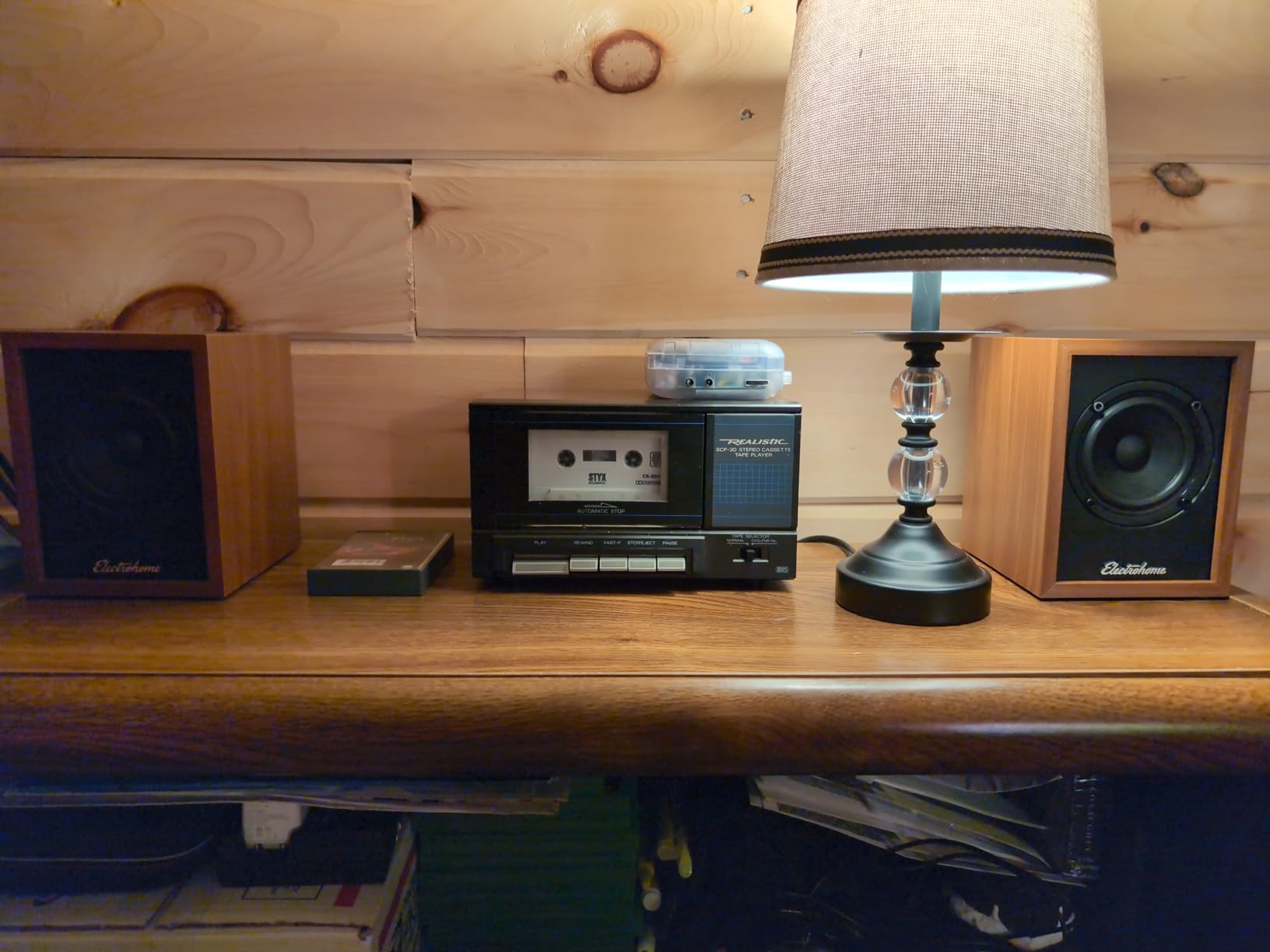
The EB10B is the least rated pick here at a 4.2 average, and it earns its place for a specific reason: it is a complete vinyl system in a wood cabinet. The built-in amplifier, RCA input, and Aux-In cover a turntable, a PC, a game console, and a phone over Bluetooth 5, with no separate receiver and no preamp for a line-level deck.
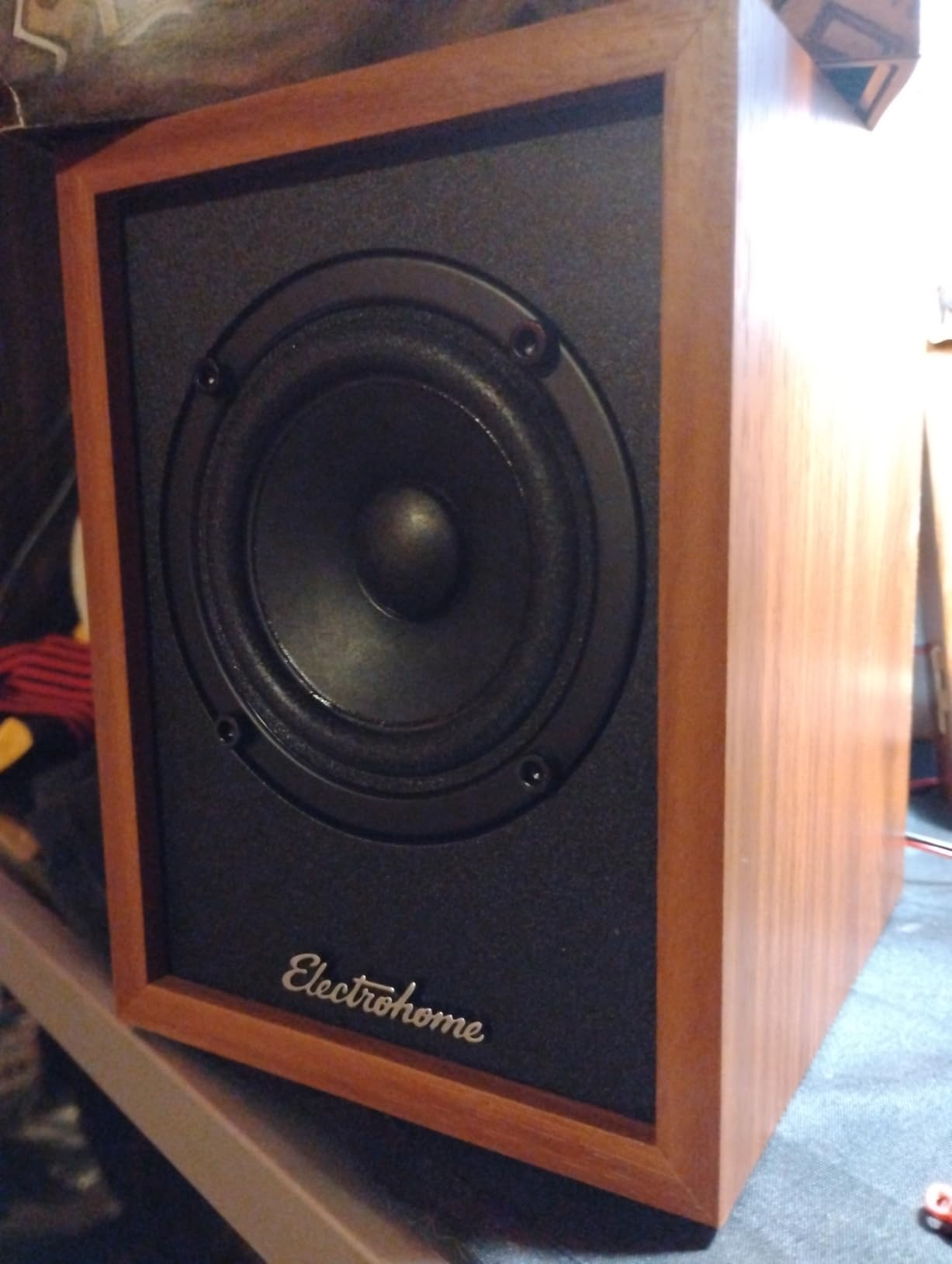
Sound is warm and full-bodied for a 3-inch driver, and the rear-ported acoustically tuned wood cabinets are the reason. Styling is a genuine advantage here. Most powered speakers at this tier are black plastic, and the retro wood finish reads as more considered furniture, which matters in a living room where the speakers are visible.
Owners like the warm tuning, the cabinet styling, and the versatility. The limitations are equally clear: 20 watts is the lowest output in this roundup, there is no subwoofer out, and the warranty is one year.
Turntable use and the missing preamp
Like the Saiyin pair, this works with a turntable that outputs line level. A PHONO-only deck still needs an external preamp. The difference is that this speaker is designed around that use case, and RCA is listed as a primary connection rather than an afterthought.
The box includes the powered speakers, a 6-foot power cord, 8 feet of 22-gauge speaker wire, and a quick start guide. Speaker wire in the box is unusual among powered speakers and matters if you ever want to wire them to something else.
Rear porting means give it wall clearance
The rear port on these wood cabinets wants space behind the speaker, the same rule as the Klipsch pair. Allow several inches. If your only placement is flush to a wall, the bass will be uneven and the design works against you.
At 9.17 inches square and 11.1 inches tall with 4.1 pounds of weight, the cabinets are portable and easy to reposition while you experiment with placement, which is exactly what a small room requires.
Where 20 watts becomes the limit
20 watts is enough for a bedroom at conversational levels and not much beyond it. Owners report that maximum volume is the constraint, and if you plan to use these as the main system in a shared living space, the 42-watt Edifier pairs give you real headroom for a modest step up.
There is no optical input, no coaxial input, and no subwoofer out, and volume is controlled by a single knob with no remote. For a fixed-position vinyl setup that is a fair trade for the styling and the price.
How to Choose Bookshelf Speakers for a Small Room
Match the driver size to your listening distance
Driver size should follow listening distance, and this is the one rule that solves most small-room disappointments. Between 2 and 4 feet, which is a desk or a nightstand, a 3-inch to 4-inch driver is the right choice. Between 5 and 8 feet, a 5.25-inch driver gives you meaningful low end without requiring a large cabinet. Beyond that, you are out of small-room territory.
Why does this work? Bass output depends on how much air a driver moves and how fast it can start and stop. A large woofer in a small room forces you to play it at low volume, where it sounds thin, or at high volume, where the room gain piles up and it sounds boomy. A smaller driver played at moderate level in the same room stays balanced.
Sensitivity: why 85 to 88 dB beats 94 dB in a small room
Sensitivity measures how loud a speaker plays for a given amplifier power, and popular advice often pushes buyers toward the highest number available. In a small room that advice is backwards. A speaker rated 94 dB is roughly 6 dB louder than an 87 dB speaker from the same amplifier, and 6 dB is a large jump at close range. You will reach comfortable volume with the volume control barely off zero, and there is no headroom left for dynamics.
For rooms under roughly 120 square feet, 85 to 88 dB is the practical target. A high-sensitivity horn-loaded speaker sounds exciting in a showroom and fatiguing in a 90-square-foot bedroom, because you cannot run it at a low enough level. The Acoustic Audio AA321B at 88 dB and the Polk T15 at 8 ohm are examples of numbers that suit small spaces.
Impedance and how much amplifier power you actually need
Nominal impedance is not a quality measure, it is a load. An 8 ohm speaker is easier to drive than a 4 ohm one, and a 4 ohm speaker is easier still. In a small room you do not need power, you need headroom at low levels, and the rule of thumb is simple: a passive speaker rated 4 to 6 ohm and 86 dB or higher is driven properly by a 30 to 50 watt per channel amplifier.
The AA321B recommends 20 to 200 watts per channel, and the Polk T15 and Klipsch R-51M at 8 ohm are comfortable with almost anything. If you are pairing passive speakers with a compact integrated amplifier, check that the amplifier is rated into the speaker’s impedance, because a 4 ohm speaker into an amplifier stable only at 8 ohm adds distortion rather than volume.
Front-firing versus rear-firing ports and cabinet-to-wall distance
Port direction decides how close to a wall you can place a speaker. Front-ported cabinets can sit roughly 4 to 6 inches from a surface. Rear-ported cabinets generally need 8 to 12 inches of clearance, or the low end turns bloated and uneven. If your shelf is shallow, this single specification will do more for you than any driver upgrade.
The R980T and R1280DBs are front-firing or front-facing by design. The Klipsch R-51M, the Polk T15, and the Electrohome EB10B all have rear ports and need breathing room. A rear port 2 inches from a wall is the most common small-room mistake and the easiest to fix with a set of isolation pads.
Do you need a subwoofer in a small room?
Only if you cannot live without content below about 60 Hz, and the answer is usually yes for film and often no for music. A small bookshelf speaker cannot produce deep bass, and no amount of amplifier power changes that. What a subwoofer adds is not louder bass but a different kind, one that frees the main speakers from producing it.
The important rule in a small space is to keep the sub small. Room gain in the low frequencies means a large sub in a small room overwhelms the mains and produces boom that no EQ fixes. A compact sub placed in a corner, or tucked beside a desk, integrates far better than a large one placed wherever there happens to be room.
Two of the picks here have a subwoofer out, which simplifies the wiring and handles the crossover automatically: the Edifier R1280DBs and the Saiyin pair. If you are choosing a model without a sub out, budget for a separate powered sub and a splitter, or run the sub from your amplifier’s sub output.
Active or passive, and the hidden costs
An active speaker contains its own amplifier, so it needs a power outlet and nothing else. A passive speaker sounds better only if you pair it with an amplifier you already own, and if you do not own one, the real cost of a cheap passive speaker is the amplifier sitting next to it. In a small room, where every piece of equipment competes for surface area, that box is a real cost.
Active systems win on simplicity, footprint, and total cost for a first setup. Passive systems win on upgradability, because you can change amplifiers later, and on sound quality when you are comparing like-for-like on a serious system. Seven of the ten speakers here are active, and for most small-room buyers that is the correct default.
Placement routine: ear level, toe-in, the 83% rule and break-in
Four placement steps fix most small-room problems before you change equipment. First, get the tweeters to ear height when you are seated, which usually means stands rather than a low shelf. Second, angle each speaker inward so the lateral axis points at your head. That inward angle is the 83% rule: the speaker-to-listener distance should be about 83 percent of the speaker-to-near-wall distance, which produces roughly 7 degrees of toe-in and aligns the acoustic axis with your ear axis. Third, separate the speakers by the same distance as you are from them, forming an equilateral triangle with your head. Fourth, leave the speakers powered for 20 to 30 hours before judging the result, because drivers and cabinet damping settle.
Horizontal dispersion deserves a mention too. If you are not going to sit directly in front of the speakers, prioritize a design with controlled directivity, such as a horn-loaded tweeter or a coaxial point-source array. Speakers in this roundup that were repeatedly recommended for off-axis listening were chosen for exactly that reason.
Finally, do not skip the room. A rug, a curtain, and soft furniture in the first reflections will do more for clarity than an amplifier upgrade. Hard bare walls and a bare floor in a small room will double the treble and exaggerate the bass, and no speaker compensates for that.
For the hardware side of placement, our guide to bookshelf speaker stands covers models sized for cabinets under 14 inches tall, and if your room needs acoustical work rather than gear, the small room ceiling fan guide is a reminder that airflow and speaker placement compete for the same ceiling space.
Frequently Asked Questions
What is the best speaker for a small room?
A compact two-way bookshelf speaker with a 3-inch to 4-inch driver, 85 to 88 dB sensitivity, and a front-firing port is the right default for rooms under about 120 square feet. Our top pick is the Edifier R1280T because it needs no amplifier, has side-panel EQ, and stays balanced at close listening distances. The Polk Audio T15 adds real low end if you already own an amplifier.
How far should speakers be from my listening position?
For a desk setup, 2 to 4 feet works well with a 3-inch or 4-inch driver. For a bedroom or small living room, 5 to 8 feet suits a 5.25-inch driver. Space the speakers apart by the same distance as you sit from them to form an equilateral triangle, and angle each one inward so the tweeter axis meets your ears at seated ear height.
Do bookshelf speakers need an amplifier?
Passive bookshelf speakers do require an amplifier or receiver. Powered or active speakers contain their own amplifier and need only a power outlet, which is why they are the practical default in a small room where amplifier space is at a premium. In our roundup, seven of ten picks are active. If you already own an amplifier, a passive pair such as the Polk Audio T15 gives you more low end and upgradability.
Do I need a subwoofer with bookshelf speakers in a small room?
Only if you need content below roughly 60 Hz, which mainly means film soundtracks and bass-heavy music. In a small room, keep the subwoofer small: room gain in the low frequencies means a large sub overwhelms the main speakers and creates boom. Two picks here, the Edifier R1280DBs and the Saiyin pair, include a subwoofer out with automatic crossover handling.
Should I put bookshelf speakers in an actual bookshelf?
You can, but check three things before you commit. The tweeter should sit near ear height when you are seated, which is often above a typical shelf. The port needs clearance, and a front-firing port tolerates 4 to 6 inches from a wall while a rear-firing port wants 8 to 12 inches. Finally, a bookcase full of books acts as uneven absorption, so expect a brighter sound than on open stands.
Which Bookshelf Speaker Should You Buy in 2026?
Start with your listening distance, not your taste. At 2 to 4 feet on a desk or nightstand, choose a compact powered pair: the Audio-Technica AT-SP3X if you switch between two devices, the Sanyun SW208 if the shelf is genuinely tiny, and the Edifier R1280T as the all-round benchmark. At 5 to 8 feet in a small living room or bedroom, the Edifier R1280DBs wins when a TV and a phone both need connecting, and the Klipsch R-51M wins when clarity and dialogue matter more than a subwoofer.
If you already own an amplifier, the decision changes entirely. The Polk Audio T15 is our best value pick, giving you a 5.25-inch driver and wall-mounting flexibility in a 10.6-inch cabinet, while the Acoustic Audio AA321B is the only option here that fits a 3.5-inch shelf. For a turntable, the Electrohome EB10B handles a line-level deck in a wood cabinet, and the Saiyin pair covers TV, console, and phone from one active system.
The overall winner remains the Edifier R1280T. It is not the cheapest, the smallest, or the most powerful speaker on this list. It is the one that works in the most small rooms without any further decisions from you, which is the entire point of choosing the best bookshelf speakers for small rooms. Take it, run it for 30 hours, and only then judge the sound.
For a wider look at the flagship end of the market, our Marshall speaker roundup covers a very different design philosophy in larger enclosures.
Leave a Reply