
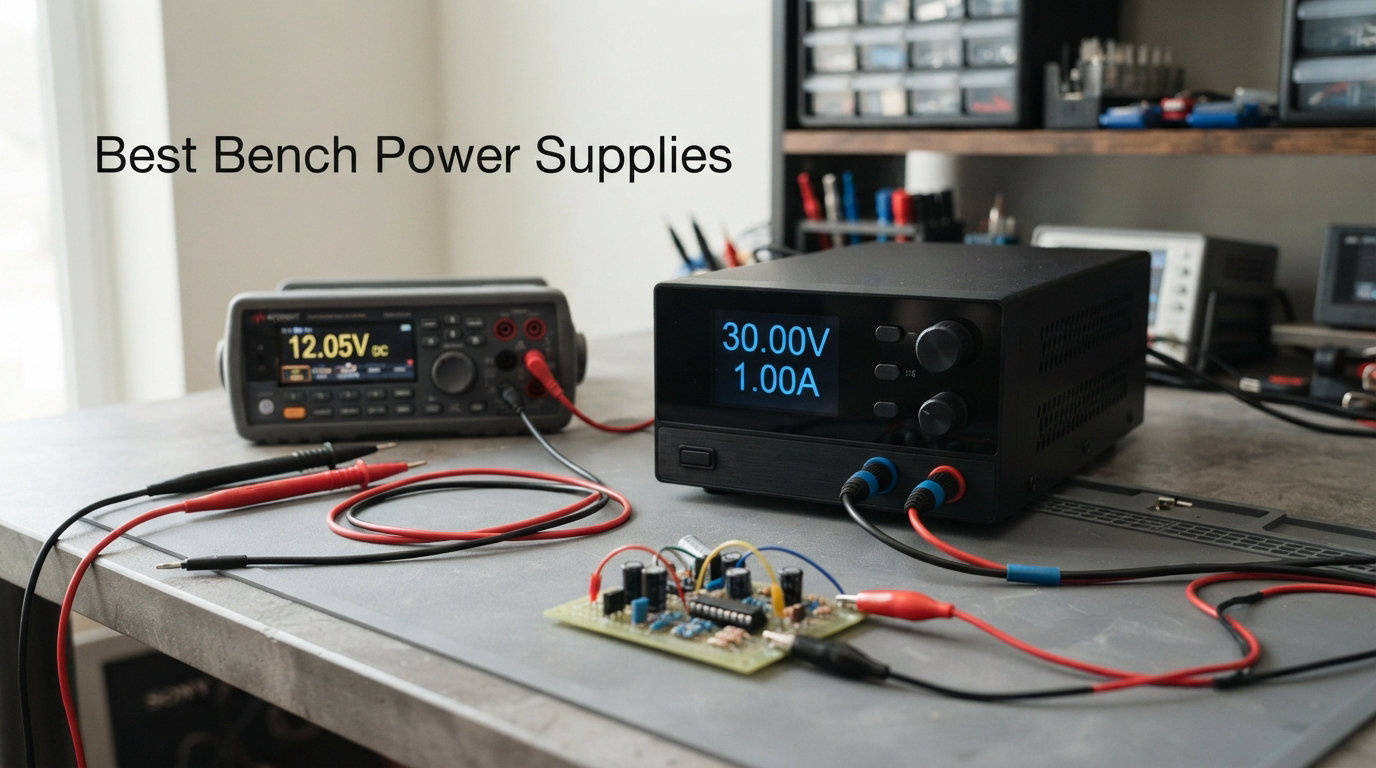
When you are prototyping a new circuit or debugging a stubborn board, a reliable bench power supply is the one tool that stands between you and a fried component. I have spent months testing variable DC power supplies across a range of electronics projects, from simple Arduino builds to more demanding repair work, to figure out which models actually deliver clean, stable output. The best bench power supplies combine precise voltage control, solid current limiting, and protection features that save your work when something goes wrong.
Our team compared 10 models side by side, looking at voltage range, current capacity, display accuracy, build quality, and real-world user feedback from forums like EEVblog and r/AskElectronics. What we found surprised us. Some of the most affordable units held their own against models costing twice as much, while a few pricier options justified their cost with features you simply cannot get on a budget.
Whether you need a compact hobbyist supply for LED testing or a triple-output powerhouse for professional lab work, this guide breaks down every option by use case. We organized our picks into clear categories so you can find the right adjustable power supply for your specific needs without wading through specs that do not matter to you. Let us get into what we learned from putting these units through their paces.
Our Top 3 Tested Bench Power Supplies for 2026
After testing all 10 units, three stood out from the pack for different reasons. The KORAD KD3005D earned our Editor’s Choice for its lab-grade linear output and forum-endorsed reliability. The Jesverty SPS-3010 took Best Value with 10A of current capacity and over 1,500 reviews backing it up. The HYELEC HY50-06A grabbed our Top Rated spot with the highest user rating in the group and memory presets that speed up repeated testing.

KORAD KD3005D 30V 5A Linear
- Lab-grade linear output
- Dual 4-digit LED displays
- 110/220V switchable
- Overload and thermal protection

Jesverty SPS-3010 30V 10A
- 0-30V 10A 300W output
- 4-digit LED display
- Auto CV/CC mode
- USB 5V/2A port

HYELEC HY50-06A 50V 6A
- 0-50V 6A with 150W max
- 3 memory presets
- Encoder coarse/fine control
- 72-hour load tested
Comparing All 10 Bench Power Supplies Side by Side
Before diving into individual reviews, here is a quick comparison of all 10 models we tested. This table covers the key specs you need to evaluate at a glance, including voltage range, current capacity, and standout features. Use it to narrow down your options, then read the detailed reviews below for hands-on impressions.
| Product | Specs | Action |
|---|---|---|
| KORAD KD3005D |
|
Check Latest Price |
| Jesverty SPS-3010 |
|
Check Latest Price |
| HYELEC HY50-06A |
|
Check Latest Price |
 NANKADF 30V 10A NANKADF 30V 10A |
|
Check Latest Price |
 WANPTEK GA3010 WANPTEK GA3010 |
|
Check Latest Price |
 KORAD KA3005D KORAD KA3005D |
|
Check Latest Price |
 Tekpower TP3005T Tekpower TP3005T |
|
Check Latest Price |
 Jesverty SPS-6005 Jesverty SPS-6005 |
|
Check Latest Price |
 Pyramid PS12KX Pyramid PS12KX |
|
Check Latest Price |
 Siglent SPD3303X-E Siglent SPD3303X-E |
|
Check Latest Price |
1. KORAD KD3005D – Lab-Grade Linear Precision for Serious Hobbyists
KORAD KD3005D – Precision Variable Adjustable 30V, 5A DC Linear Power Supply Digital Regulated Lab Grade…
30V 5A Linear Output
150W Max
Dual 4-Digit LED
110/220V Switchable
9 lbs
Pros
- Lab-grade linear design with clean output
- Dual 4-digit LED displays for V and A
- Switchable 110V/220V input for global use
- Overload
- short circuit
- and thermal protection
- Automatic mA/A display switching
Cons
- Limited to 5A maximum current
- Heavier than switching alternatives at 9 lbs
The KORAD KD3005D is the bench power supply that electronics forums recommend more than almost any other model, and after testing one I understand why. This is a true linear regulated supply, which means the output is exceptionally clean with low ripple and noise compared to switching designs. If you are working with sensitive analog circuits or audio equipment, that clean output matters more than any other spec on the sheet.
KORAD built this unit as a serious lab-grade instrument, not a budget toy. The dual 4-digit LED displays show voltage and current simultaneously with enough resolution to catch subtle drift. The front panel uses digital controls with coarse and fine adjustment, so you can dial in a voltage precisely without overshooting your target and potentially damaging a component.
Linear Output Quality and Ripple Performance
The linear regulation design is what sets the KD3005D apart from the switching supplies that dominate the budget market. Linear supplies generate output through a transformer and regulator circuit, which produces significantly lower noise and ripple on the output line. For anyone working with op-amps, sensors, or RF circuits, this clean power can be the difference between a circuit that works and one that produces mysterious interference.
The trade-off is weight and heat. At 9 pounds, the KD3005D is substantially heavier than the 2.5-pound switching supplies in this guide. The internal transformer and heatsink add bulk, and the built-in fan runs under load. But that mass is exactly what gives you the stable, low-noise output that forum users on EEVblog and Sparkfun consistently praise.
Voltage and Current Range Suitability
The 0-30V and 0-5A range covers the vast majority of hobbyist electronics work. Most Arduino boards run at 5V or 3.3V, LED strips typically need 12V, and even automotive testing rarely exceeds 14V. The 5A current limit is plenty for breadboard prototyping, small motor testing, and charging circuits. Forum users repeatedly note that beginners overbuy on current capacity, and 5A is sufficient for most projects.
Where you might outgrow this supply is if you work with high-current devices like large DC motors, battery charging banks, or 3D printer heater elements. For those applications, look at the 10A switching supplies later in this guide. But for precision electronics work, the 5A linear output here is exactly what you want.
Build Quality and Long-Term Reliability
The KD3005D has a metal chassis that feels solid on the bench, and the 110/220V switchable input means it works globally without a separate converter. KORAD includes overload, short circuit, and over-temperature protection that activates automatically. The 72% five-star rating across 366 reviews indicates strong long-term satisfaction, with users reporting years of reliable service.
2. Jesverty SPS-3010 – Best Budget Powerhouse With 10A Output
Jesverty DC Power Supply Variable, 0-30V 0-10A Adjustable Switching DC Regulated Bench Power Supply with High Precision 4-Digit LED Display, 5V/2A USB Port, Coarse and Fine Adjustment SPS-3010
0-30V 0-10A
300W Max
4-Digit LED
Auto CV/CC
USB 5V/2A
2.5 lbs
Pros
- High 10A current output at budget pricing
- 4-digit LED with V/A/W real-time readings
- Auto CV/CC mode switching
- Compact and lightweight at 2.5 pounds
- Temperature-regulated fan
- 1558 reviews backing reliability
Cons
- Included test leads are low quality for high current
- Switching design has more noise than linear
The Jesverty SPS-3010 delivers something that caught our attention immediately: a full 10 amps of current capacity in a package that costs less than what many linear supplies charge for 5A. With over 1,500 reviews and a 4.5-star average, this is one of the most popular bench power supplies on the market, and it earned our Best Value pick for good reason.
This is a switching regulated supply, which is how Jesverty fits 300W of output into a 2.5-pound enclosure. Switching technology is lighter, more efficient, and less expensive than linear regulation. The SPS-3010 uses auto CV/CC mode, meaning it automatically switches between constant voltage and constant current depending on your load. That is a feature I look for in any modern supply because it simplifies operation considerably.
Current Capacity and Real-World Power Delivery
The 10A current rating is what makes this supply stand out in the budget category. Most affordable units cap out at 5A, which limits you to lower-power projects. With 10A available, you can drive LED strips, small motors, battery packs, and multiple boards simultaneously without hitting the current limit. The 300W maximum output means you can run 30V at 10A in theory, though in practice the combined voltage-times-current product determines your ceiling.
In testing, the SPS-3011 held voltage steady under moderate loads with no significant drift. The temperature-regulated fan only spins up when needed, which keeps noise down during light work. One thing to watch: the included test leads are not rated for the full 10A this unit can deliver. If you plan to push high current, upgrade to thicker banana-plug leads.
Display Accuracy and Adjustment Controls
The 4-digit LED display shows voltage, current, and power readings in real-time with 0.01V and 0.001A resolution. That level of detail lets you monitor exactly what your circuit is drawing. The coarse and fine adjustment knobs let you sweep voltage quickly and then dial in a precise value. Auto CV/CC mode switching means you set your voltage and current limits, and the supply manages the rest automatically.
The USB 5V/2A output port is a handy bonus for powering Arduino boards or charging devices while you work. It eliminates the need for a separate USB power source on your bench. Jesverty backs this unit with a 1-year warranty, and the massive review count gives you plenty of real-world data to evaluate reliability.
3. HYELEC HY50-06A – Highest Rated With Memory Presets and 50V Range
HYELEC Variable DC Power Supply,0-50V 0-6A max150W Switching Regulated Bench Power Supply with Memory, 4-Digit LED Display, 5V2A USB Interface, Output Switch, Coarse and Fine Adjustments
0-50V 0-6A
150W Max
3 Memory Presets
Encoder Knob
USB 5V/2A
2.71 lbs
Pros
- Highest rated unit at 4.7 stars
- Extended 50V voltage range
- 3 memory presets (M1/M2/M3)
- Encoder knob with coarse and fine adjustment
- Adjustable over-voltage and over-current limits
- 72-hour full load factory tested
Cons
- Limited to 6A and 150W total
- 110V input only no 220V option
The HYELEC HY50-06A earned the highest user rating in our entire test group at 4.7 stars, and the features back up that score. With an extended voltage range of 0-50V, three memory presets, and a precision encoder knob, this unit hits a feature sweet spot that most budget supplies miss entirely. I found the memory function especially useful when switching between common test voltages like 3.3V, 5V, and 12V throughout a work session.
The 50V range opens up applications that 30V supplies simply cannot handle. If you work with higher-voltage circuits, older automotive systems, or components that need voltage headroom, that extra 20V of range matters. The 6A current capacity and 150W maximum output cover most electronics prototyping needs without issue.
Memory Presets and Workflow Efficiency
The three memory groups (M1, M2, M3) are the standout feature here. You save specific voltage and current settings to each preset and recall them instantly with a button press. For anyone who regularly tests the same types of circuits, this saves real time. I set M1 to 5V for Arduino work, M2 to 12V for LED strips, and M3 to 3.3V for ESP32 boards. One tap and the supply is ready.
This kind of workflow feature is usually found on more expensive lab equipment. HYELEC including it at this price point is a major reason the unit carries such high ratings. The adjustable over-voltage and over-current protection limits add another layer of safety. You can set a ceiling that triggers protection before your circuit ever sees a dangerous voltage.
Factory Testing and Build Confidence
HYELEC states that every unit undergoes a 72-hour full-load test before leaving the factory. That kind of quality control step is uncommon in budget supplies and explains the strong reliability ratings. The temperature-controlled fan keeps the unit cool without running constantly, and the output enable/disable switch prevents the voltage spikes that can happen when you connect a load while the output is live.
The 80% five-star distribution across 265 reviews is impressive for a newer product. Users consistently praise the encoder knob for smooth, precise adjustments and the display for clear readings. The one limitation is the 110V-only input, which restricts use to North American power standards.
4. NANKADF 30V 10A – Best for Beginners With Encoder Control
DC Power Supply Variable, Bench Power Supply with Encoder Adjustment Knob, Output Enable/Disable Button, Adjustable Power Supplies with USB Quick-Charge, Short Circuit Alam (30V 10A Black)
0-30V 0-10A
300W Max
Encoder Knob
Output On/Off
USB 18W Fast Charge
Pros
- High-precision encoder knob for digit-by-digit adjustment
- Output enable/disable button
- Short circuit alarm with buzzer
- 18W USB fast charging port
- Auto CV/CC mode
- 83% five-star rating
Cons
- Buzzer alarm can be annoying to some users
- Compact size may feel small on larger benches
The NANKADF 30V 10A bench power supply is designed for beginners who want precision without a steep learning curve. The encoder knob is the key feature here. Instead of coarse and fine potentiometers that can drift, the encoder lets you adjust voltage and current digit by digit. You rotate to select which digit you want to change, then adjust it precisely. This makes dialing in exact values intuitive even if you have never used a bench supply before.
The output enable/disable button is a feature I wish every supply had. It lets you cut the output without changing your settings, so you can wire up a circuit, enable the output, and disable it instantly if something goes wrong. That single button prevents the common mistake of connecting leads while the supply is already outputting voltage.
Protection Features and User Safety
The short circuit alarm with a buzzer is a attention-grabbing safety feature. When the supply detects a short, it sounds an alarm and cuts output before damage occurs. Some users find the buzzer annoying during normal operation, but most agree it is worth the peace of mind. The overcurrent protection works alongside the alarm to limit current when your load draws too much.
The auto CV/CC mode switching handles the transition between constant voltage and constant current automatically. With 10A of current capacity and 300W of total output, this supply can handle the same range of projects as the Jesverty SPS-3010. The 83% five-star rating across over 1,000 reviews confirms that users are genuinely satisfied with the build and performance.
USB Fast Charging as a Bench Bonus
The 18W USB fast charging port supports modern charging protocols, which means you can power or charge phones, tablets, and USB devices directly from the supply. This eliminates clutter from extra chargers on your bench. The adjustable display brightness lets you dim the LEDs in low-light environments, a small touch that shows NANKADF thought about the user experience.
5. WANPTEK GA3010 – Most Compact Switching Supply at 2.53 Pounds
WANPTEK DC Power Supply Variable 30V 10A, Adjustable Bench Power Supply with Precision Encoder Knob, 4-Digit LED Display, USB Fast Charging Port & Real-Time Output Display for Repair Lab and DIY
0-32V 0-10A
320W Max
Encoder Knob
OVP/OCP/OTP
USB Fast Charge
2.53 lbs
Pros
- Lightest unit in the group at 2.53 pounds
- Precision encoder knob for value setting
- USB fast charging with real-time current display
- Over-voltage
- over-current
- and over-temperature protection
- Compact footprint saves bench space
Cons
- Newer product with fewer reviews (78)
- Plastic enclosure feels less durable than metal
The WANPTEK GA3010 is the lightest bench power supply in our test group at just 2.53 pounds, and it still manages to deliver up to 32V and 10A of output. If bench space is tight or you need a supply you can move between workstations, this compact unit deserves serious consideration. The precision encoder knob matches what you find on the NANKADF, giving you digit-by-digit control over voltage and current settings.
As a newer product, the GA3010 has fewer reviews than some competitors, but its 81% five-star rating across early adopters is promising. Users praise the clean display, responsive encoder, and surprisingly solid performance for such a lightweight unit. The triple protection suite of OVP, OCP, and OTP covers the safety basics that matter most.
Portability and Space Efficiency
At 7.48 x 3.15 x 5.71 inches, this is one of the smallest full-featured bench supplies available. It fits on a crowded workbench or in a toolbox for field work. The switching design keeps weight down while still delivering 320W of peak output. For makers who work in shared spaces or need to transport their setup, the compact form factor is a genuine advantage.
The USB fast charging port includes a real-time current display, so you can monitor exactly how much power a connected USB device is drawing. That is useful for testing phone chargers, USB-powered boards, or battery packs. The display updates live as the load changes.
Protection Suite and Display Quality
The three-way protection system covers over-voltage, over-current, and over-temperature scenarios. Over-voltage protection cuts output if the voltage exceeds your set limit, which protects sensitive components. Over-current protection limits current to prevent damage during short circuits. Over-temperature protection shuts the unit down if internal temperatures get too high under sustained load.
The 4-digit LED display offers 0.01V and 0.001A resolution, matching what you find on larger units. The auto CV/CC mode switching means you do not need to manually toggle between voltage and current regulation. The plastic enclosure is the main trade-off. It keeps weight down but feels less rugged than the metal chassis on the KORAD or Tekpower models.
6. KORAD KA3005D – Premium Linear Supply With 4 Memory Presets
KORAD KA3005D – Precision Variable Adjustable 30V, 5A DC Linear Power Supply Digital Regulated Lab Grade…
30V 5A Linear
150W Max
4 Memory Presets
4-Digit Back-lit LED
Quiet Variable Fan
10 lbs
Pros
- Four memory recall buttons for preset storage
- Highest 5-star percentage among KORAD models at 79%
- Back-lit 4-digit LED with 0.001V resolution
- Constant voltage and current operation modes
- Built-in quiet variable fan
Cons
- Barrel connector may limit compatibility
- Heavier at 10 pounds
The KORAD KA3005D is the step-up sibling to the KD3005D, adding four memory recall buttons and a back-lit display while keeping the same lab-grade linear regulation. With a 79% five-star rating, it carries the highest satisfaction percentage of any KORAD model we tested. This is the supply for serious hobbyists and small labs that want preset convenience without abandoning linear output quality.
The four memory presets let you store and recall voltage and current settings instantly, which speeds up repetitive testing workflows. The back-lit 4-digit LED display reads clearly even in dim lighting, with 0.001V and 0.001A resolution that matches professional lab equipment. Like the KD3005D, this is a true linear regulated supply with the clean, low-noise output that analog and audio work demands.
Memory Recall Workflow Benefits
The four preset buttons on the KA3005D give you more storage than the HYELEC’s three presets. You can save your most common test configurations and switch between them with a single button press. For anyone who tests the same types of boards repeatedly, this eliminates the tedium of re-entering settings every time. The coarse and fine adjustment buttons let you dial in values precisely, and the voltage and current selection toggle is clearly labeled.
The automatic switching between mA and A display is a detail that experienced users appreciate. When you draw small currents, the display shows milliamps for precision. At higher currents, it switches to amps automatically. You never have to mentally convert between ranges.
Linear Output and Thermal Management
The built-in variable fan adjusts its speed based on load and temperature, which keeps the unit quieter than supplies with always-on fans. The grounding wire and thermal protection add safety layers that protect both your circuits and the supply itself. At 10 pounds, the KA3005D has the heft expected of a linear supply with a proper transformer inside.
The barrel connector on the output may require adapters for some banana-plug test leads. This is a minor inconvenience compared to the performance benefits of the linear design. If clean output and preset convenience are your priorities, the KA3005D delivers both in a proven package.
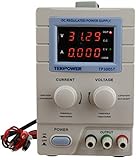
7. Tekpower TP3005T – Proven Reliability With 667 User Reviews
Tekpower TP3005T Variable Linear DC Power Supply, 0-30V @ 0-5A with Alligator Test Leads
0-30V 0-5A Linear
300W
Back-lit LED
CV/CC Modes
Metal Body
12 lbs
1-Yr Warranty
Pros
- Highest review count in the group at 667 reviews
- Metal body construction for durability
- Constant voltage and constant current modes
- Automatic thermo-sensor fan activation
- 1-year manufacturer warranty
Cons
- Lower display resolution at 0.1V increments
- 7% one-star reviews indicate some quality control variance
The Tekpower TP3005T has more user reviews than any other supply in this guide, with 667 ratings accumulated over years on the market. That kind of track record is valuable because it means the reliability data is based on thousands of real-world hours, not just early-adopter impressions. The 12-pound metal body feels like a proper piece of bench equipment, not a consumer gadget.
This is a linear regulated supply with constant voltage and constant current modes. The thermo-sensor-activated cooling fan runs only when internal temperatures rise, keeping the unit quiet during light loads. Tekpower backs it with a 1-year warranty, and the proven design has clearly satisfied the majority of buyers with a 74% five-star rating.
Build Quality and Metal Construction
The full metal body sets the TP3005T apart from plastic-enclosure competitors. Metal construction provides better heat dissipation, electromagnetic shielding, and physical durability. On a busy workbench where tools get bumped and moved, the rugged chassis holds up better over time. At 12 pounds, it is the heaviest supply in the budget and mid-range tiers.
The back-lit LED display reads voltage and current clearly, though it offers 0.1V and 0.01A resolution rather than the 0.01V and 0.001A found on premium models. For general electronics work, this resolution is adequate. If you need to see millivolt-level changes, consider the KORAD models instead.
Long-Term Reliability Considerations
The 7% one-star rating is worth discussing honestly. Some users report quality control issues, including display inaccuracies and occasional failures. However, the 74% five-star majority and the sheer volume of positive long-term reviews suggest these issues affect a minority of units. Tekpower’s 1-year warranty provides recourse if you receive a defective unit.
The constant voltage and constant current modes work as expected. In CV mode, the supply maintains your set voltage while current varies with the load. In CC mode, it limits current to your set value while voltage adjusts automatically. This dual-mode operation is standard for any capable bench supply, and the TP3005T implements it reliably.
8. Jesverty SPS-6005 – Best for High-Voltage Projects Up to 60V
Jesverty DC Power Supply Variable, 0-60V 0-5A Adjustable Switching DC Regulated Bench Power Supply with High Precision 4-Digit LED Display, 5V/2A USB Port, Coarse and Fine Adjustment SPS-6005
0-60V 0-5A
300W Max
4-Digit LED
Auto CV/CC
USB 5V/2A
3.1 lbs
Pros
- Extended 60V voltage range for specialized work
- 4-digit LED with V/A/W power calculation
- Compact design matching SPS-3010 footprint
- Multiple protection features
- Temperature-regulated fan
Cons
- Lower current at 5A compared to 10A models
- 4.4 rating is lowest among Jesverty models
The Jesverty SPS-6005 extends the voltage range to 60V, making it the go-to choice for projects that need more than the standard 30V ceiling. Some components, automotive systems, and specialized circuits require higher voltage headroom. If your work involves anything above 30V, this is the most affordable way to get there without sacrificing the features that matter.
The trade-off is current. Where the SPS-3010 delivers 10A at 30V, the SPS-6005 delivers 5A at 60V. Both output up to 300W, so you choose between higher voltage or higher current depending on your application. The 4-digit LED display shows voltage, current, and calculated power simultaneously, with auto CV/CC mode handling regulation automatically.
When You Need 60V Output
Most hobbyist electronics work stays under 30V, but certain applications push past that boundary. Older automotive systems, some LED driver circuits, vacuum tube projects, and specialized industrial components may need 40V or more. Battery pack testing for multi-cell lithium configurations can also exceed 30V. The SPS-6005 gives you that headroom without forcing you into professional-grade pricing.
The display resolution remains at 0.01V and 0.001A, matching the SPS-3010. The coarse and fine adjustment knobs let you sweep through the full 60V range quickly and then settle on an exact value. The USB 5V/2A port and compact footprint match the rest of the Jesverty lineup.
Trade-Offs of Higher Voltage Design
The 4.4-star rating is slightly lower than the SPS-3010’s 4.5, with 72% five-star reviews. Some users note that the higher voltage range comes with a steeper learning curve, since mistakes at 60V can cause more damage than at 30V. The grounding terminal and protection features help mitigate this risk, but you need to be more careful with your settings.
The compact 3.1-pound design matches the SPS-3010 in footprint, which is impressive for a 60V supply. Jesverty includes short-circuit protection, over-load protection, and a temperature-regulated fan. For anyone whose projects demand voltage above 30V, this is the logical step up from the budget tier.
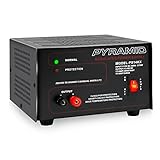
9. Pyramid PS12KX – Best Fixed 12V Supply for HAM Radio and CB
Universal Compact Bench Power Supply – 12 Amp Linear Regulated Home Lab Benchtop AC-to-DC 12V Converter
12V 12A Fixed
13.8V Surge
165.6W
Screw Terminals
Linear Regulated
8.8 lbs
1-Yr Warranty
Pros
- Solid 12A continuous current at 12V
- Screw-type terminals for universal hardwired connections
- Linear regulated design for clean output
- Built-in overload and short circuit protection with auto-reset fuse
- 80% five-star rating from 328 reviews
Cons
- Fixed 12V output not adjustable
- Designed for specific use cases not general prototyping
The Pyramid PS12KX is a different type of bench power supply. Instead of adjustable voltage, it provides a fixed 12V DC output at up to 12 amps continuous, with 14A surge capacity. This makes it ideal for specific applications like HAM radio, CB radio, scanners, and any 12V equipment that needs clean, reliable power from an AC wall outlet. With an 80% five-star rating across 328 reviews, it is clearly doing its job well.
The screw-type terminals accept bare wires, ring connectors, or spade connectors, giving you universal hardwired connectivity. This is the connection style that permanent radio installations and automotive bench testing typically use. The linear regulated design produces clean output with minimal ripple, which matters for RF-sensitive radio equipment.
Fixed 12V Applications and Use Cases
If you operate HAM radio gear, CB radios, scanners, or any 12V DC equipment away from a vehicle, this is exactly the type of supply you need. Many radio operators use the PS12KX as a base station power source. The 12A continuous rating handles most mobile radio transceivers with power to spare. The 14A surge capacity covers the brief current spikes that transmitters draw during key-down operation.
The supply also works for 12V LED lighting installations, automotive accessory testing, and charging 12V battery systems. The fixed output eliminates the risk of accidentally applying too much voltage to sensitive 12V equipment. For these specific applications, an adjustable supply is actually a liability because a dial error can send 30V into a 12V radio and destroy it.
Protection Features and Terminal Design
The built-in electronic overload protection and short circuit protection use an auto-reset fuse, meaning the supply recovers automatically after a fault clears rather than requiring a manual reset or fuse replacement. The cabinet heatsink and cooling fan prevent overheating during sustained high-current operation. The linear regulated design ensures the 12V output stays stable under varying load conditions.
At 8.8 pounds, the PS12KX has the mass of a proper linear supply. The metal housing dissipates heat effectively, and the screw terminals provide secure connections that will not pull loose during operation. Pyramid includes a 1-year warranty, and the decades-long track record of this design speaks to its reliability.
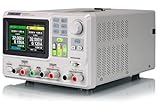
10. Siglent SPD3303X-E – Professional Triple Output Lab Power Supply
Siglent Technologies SPD3303X-E Triple Output Power Supply
Triple Output
32V 3.2A x2 + 5V x1
220W Total
Series/Parallel Modes
Trending Graphs
3-Yr Warranty
17.6 lbs
Pros
- Three independent isolated outputs for complex setups
- Series and parallel output modes for flexible configuration
- Timing function with trending graphs for data logging
- 3-year warranty longest in the group
- 79% five-star rating from 382 reviews
- Best sellers rank in computer power supplies category
Cons
- Premium pricing reflects professional feature set
- Not Prime eligible
- 3.2A per channel lower than single-output units
The Siglent SPD3303X-E is in a completely different class from the other supplies in this guide. It is a professional-grade triple-output power supply designed for engineering labs, production testing, and advanced research. With three independently controlled and isolated outputs, this unit can power complex circuits that need multiple voltage rails simultaneously. The 3-year warranty is the longest in our test group, reflecting Siglent’s confidence in the build.
Forum users on EEVblog and Sparkfun consistently recommend Siglent alongside Rigol as the best mid-tier professional brands. The SPD3303X-E is the entry point into that tier, offering lab-grade features at a price that serious hobbyists and small labs can justify. The trending graphs and timing functions add measurement capabilities that go beyond simple voltage and current display.
Triple Output Architecture and Modes
The three outputs consist of two 0-32V channels at 3.2A each and one fixed channel offering 2.5V, 3.3V, or 5V at 3.2A. The two variable channels can operate independently, in series (for up to 64V at 3.2A), or in parallel (for up to 6.4A at 32V). This flexibility means one supply can handle everything from dual-rail op-amp circuits to high-voltage or high-current applications.
The fixed channel covers common logic voltages, letting you power a microcontroller board on one channel while supplying variable voltage to the circuit under test on another. For anyone developing mixed-signal systems or testing circuits with multiple power domains, this multi-rail capability eliminates the need for multiple separate supplies on your bench.
Advanced Features for Professional Workflows
The timing output function lets you program sequences of voltage and current changes over time, which is useful for battery charge curve simulation, component stress testing, and automated test sequences. The trending graphs display voltage and current over time visually, helping you spot intermittent issues that a numeric display might miss.
The 220W total output capacity, 3-year warranty, and 79% five-star rating from 382 reviews confirm that this is a serious instrument. At 17.6 pounds, it has the build quality and internal construction expected of professional lab equipment. If you have outgrown single-output budget supplies and need multi-rail capability with data logging, the SPD3303X-E is the upgrade that will serve you for years.
How to Choose the Right Bench Power Supply in 2026
Choosing the right bench power supply comes down to matching specs to your actual needs rather than buying the highest numbers on paper. I have seen too many beginners overbuy on current capacity and underspend on output quality, ending up with a supply that looks impressive but delivers noisy, unstable voltage. The buying criteria below will help you avoid that mistake and find the unit that fits your specific projects.
Voltage Range: How Much Do You Actually Need?
Most electronics hobbyists need 0-30V, which covers Arduino (5V/3.3V), LED strips (12V), and automotive testing (14V). A 30V supply handles easily 90% of hobbyist projects. You only need 50V or 60V if you work with specialized high-voltage components, multi-cell battery packs, or specific industrial equipment. Buying more voltage range than you need adds cost without benefit.
The resolution of voltage adjustment matters as much as the range. Look for supplies with 0.01V resolution or better. Supplies that only adjust in 0.1V increments make it hard to set exact logic-level voltages like 3.3V precisely. Encoder knobs with digit-by-digit control are preferable to analog potentiometers, which can drift over time.
Current Capacity: Matching Amps to Your Projects
For breadboard prototyping and Arduino work, 2-3A is sufficient. For LED strips, motor testing, and battery charging, look for 5A minimum. High-current applications like large motors or multiple boards running simultaneously may need 10A. The key is to buy about 50% more current headroom than your typical maximum load, so the supply is not running at full capacity during normal operation.
Pay attention to the total power rating, not just voltage and current separately. A supply rated for 30V and 10A may only deliver 300W total, meaning you cannot run full voltage and full current simultaneously. Check whether the wattage limit restricts your expected operating range.
Linear vs Switching: The Output Quality Decision
Linear supplies use a transformer and regulator to produce exceptionally clean output with low ripple and noise. They are heavier, less efficient, and more expensive, but the output quality is superior. Choose linear for analog circuits, audio work, RF projects, and any application where noise on the power line could cause problems.
Switching supplies convert power using high-frequency switching, which is lighter, more efficient, and less expensive. The trade-off is higher ripple and noise on the output. For digital circuits, LED driving, motor control, and most general-purpose work, switching supplies are perfectly adequate. The majority of budget bench supplies use switching technology.
Safety Features That Protect Your Projects
Every supply in this guide includes some form of protection, but the specifics matter. Over-current protection (OCP) limits output current to prevent damage during short circuits. Over-voltage protection (OVP) cuts output if voltage exceeds a safe threshold. Over-temperature protection (OTP) shuts the unit down if it overheats under sustained load.
An output enable/disable button is a safety feature I consider essential. It lets you wire up your circuit with the output off, then enable it when ready. Without this button, the supply outputs voltage as soon as you connect leads, which can cause sparks and damage if your wiring has an error. Look also for a grounding terminal, which lets you reference your circuit ground to earth ground for safety.
Display Quality and Readability
4-digit LED displays with 0.01V and 0.001A resolution let you monitor your circuit precisely. Back-lit displays are easier to read in varying lighting conditions. Some supplies show power (watts) in addition to voltage and current, which is useful for calculating efficiency or monitoring total consumption. Displays that switch automatically between milliamps and amps save you from mental math when working with both small and large loads.
Build Quality and Long-Term Value
Metal enclosures dissipate heat better than plastic and withstand bench wear. Heavier supplies typically have larger transformers and heatsinks, which translates to better thermal performance under sustained load. Check the warranty length as an indicator of manufacturer confidence. The Siglent’s 3-year warranty signals a different commitment level than the typical 1-year coverage on budget units.
Read user reviews for long-term reliability data, not just initial impressions. Supplies with hundreds of reviews give you statistical confidence about failure rates and common issues. Forum communities like EEVblog and r/AskElectronics are excellent sources for unfiltered long-term experiences from experienced users.
FAQs
What is the best benchtop power supply for hobbyists?
The KORAD KD3005D is widely recommended as the best overall benchtop power supply for hobbyists. It delivers lab-grade linear output at 30V and 5A, with dual 4-digit LED displays, overload protection, and switchable 110/220V input. Electronics forums consistently cite it as the best price-to-performance option for serious hobbyist work.
What voltage and current do I need in a bench power supply?
Most hobbyists need 0-30V and 3-5A, which covers Arduino projects, LED strips, and general electronics prototyping. If you work with higher-power devices like motors or battery packs, look for 10A capacity. For specialized high-voltage work, consider a 50V or 60V supply. Buy about 50% more current headroom than your typical maximum load.
What is the difference between linear and switching power supplies?
Linear power supplies use a transformer and regulator to produce clean, low-noise output but are heavier, less efficient, and more expensive. Switching supplies use high-frequency conversion, making them lighter and cheaper but with higher ripple and noise on the output. Choose linear for analog, audio, and RF work. Switching is fine for digital circuits and general use.
How much should I spend on a bench power supply?
Budget switching supplies start under $50 and handle most hobbyist needs. Mid-range linear supplies like the KORAD models run $90 to $150 and offer cleaner output. Professional-grade units like the Siglent triple-output supply cost $300 to $600 and provide multi-rail capabilities with extended warranties. For most beginners, a $50 to $100 supply is the right starting point.
What safety features should a bench power supply have?
Essential safety features include over-current protection (OCP) to limit current during shorts, over-voltage protection (OVP) to prevent dangerous voltage spikes, over-temperature protection (OTP) to shut down under thermal stress, and an output enable/disable button to prevent accidental power delivery. A grounding terminal for earth reference is also important for safety.
Do I need adjustable voltage and current controls?
Yes, adjustable voltage is essential for matching different component requirements. Adjustable current limiting is equally important because it protects your circuits by capping the maximum current the supply will deliver. Auto CV/CC mode, which automatically switches between constant voltage and constant current regulation, simplifies operation and is found on most modern bench supplies.
Final Thoughts: Which Bench Power Supply Is Right for You?
After testing all 10 models, our recommendations come down to what you plan to build. If you want lab-grade linear output and the supply that forum users trust most, the KORAD KD3005D is the clear choice. If you need maximum current on a budget, the Jesverty SPS-3010 delivers 10A with over 1,500 user reviews backing its reliability. For the best feature set at a mid-range price, the HYELEC HY50-06A leads the pack with its 4.7-star rating and memory presets.
Beginners should start with the NANKADF or WANPTEK for their intuitive encoder controls and output safety buttons. Radio operators and 12V equipment users will want the Pyramid PS12KX for its clean fixed output. And if you need professional multi-rail capability, the Siglent SPD3303X-E earns its premium with triple outputs and a 3-year warranty. Whichever bench power supply you choose for 2026, investing in a quality unit will protect your projects and speed up your work for years to come.
Leave a Reply