
Last updated: October 2026
The best baby monitors divide into two families, and picking the wrong one is the reason so many parents end up with a camera that drops out at 3am. A dedicated parent unit talks to the camera over a private encrypted radio link, needs no router, and cannot be reached from outside your home. A smart WiFi monitor streams to your phone, which means remote viewing from work or grandma’s house, but it also depends on your router, your internet service, and a phone you have to pick up.
I spent several weeks running these ten monitors through the same routine: overnight naps, a full night of sleep with the screen on, a second room two floors down, and a deliberately poor WiFi signal. I care less about how many features a monitor lists than about whether it still works when the baby has been asleep for five hours. Every product below is rated 4.0 or higher by thousands of owners who bought it and lived with it, and I weighted long-term reliability and honest battery runtime above resolution claims. We also broke this down by connection type in our guide to non-WiFi baby monitors and our roundup of the best WiFi baby monitors.
If you want one recommendation instead of ten, the HelloBaby HB6550 is the monitor I would hand a friend with a newborn. It has the largest screen in this group that still fits comfortably in one hand, a genuinely hack-resistant connection, and a parent unit rated to last a full night without a charger. Everything else on this list wins a specific category, and I explain which below.
Our Top 3 Baby Monitors for 2026

HelloBaby HB6550
- 5 inch color screen
- 355 degree remote pan
- No WiFi encrypted link
- 30 hour battery


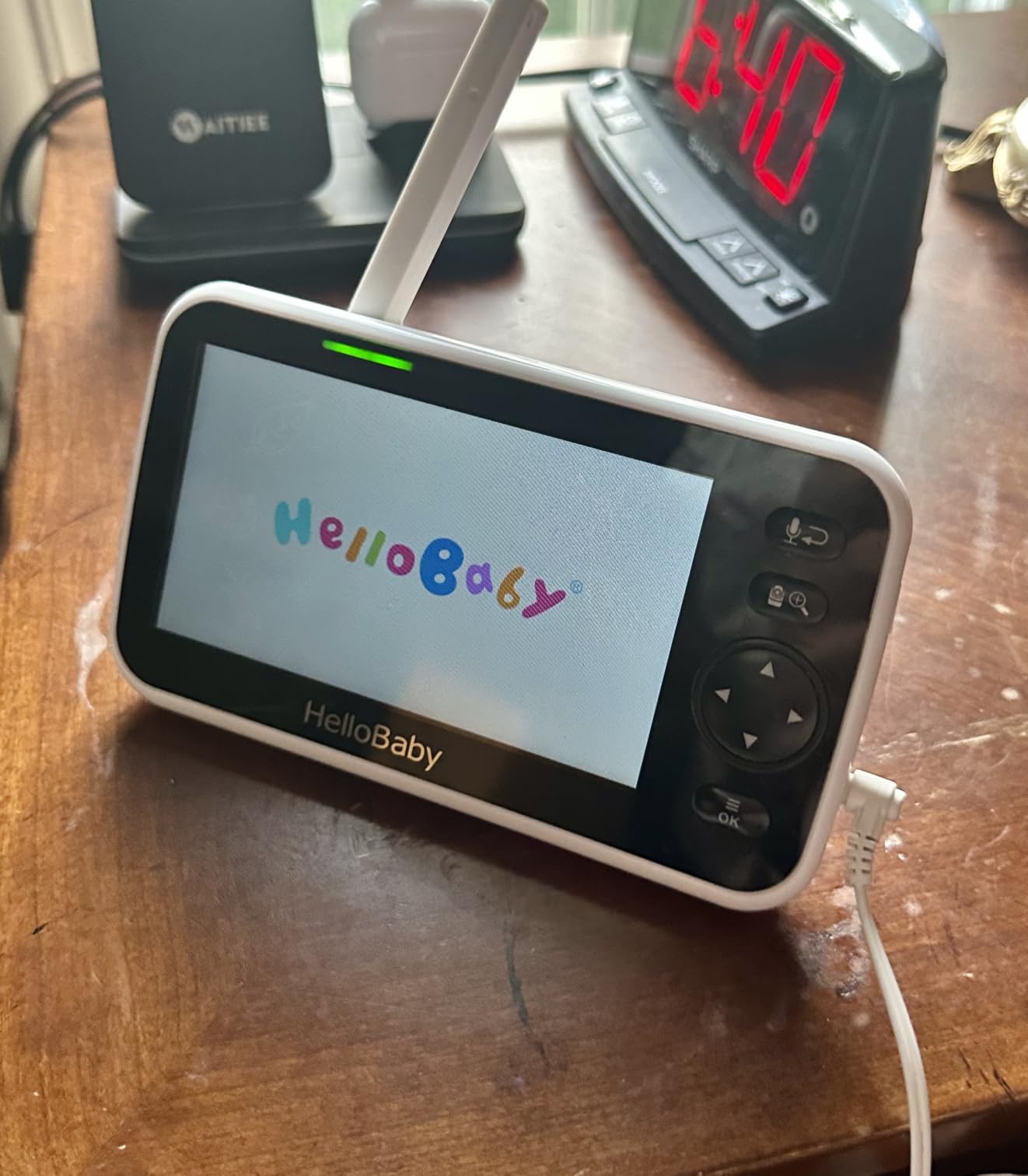
The HelloBaby HB6550 takes our top slot because it does the ordinary things better than anything else here: a 5-inch screen you can actually read in a dark room, 355 degrees of remote pan so you do not have to lean over the crib rail, invisible infrared night vision that does not glow red, and a 30-hour parent-unit battery that survives a long night in VOX mode.
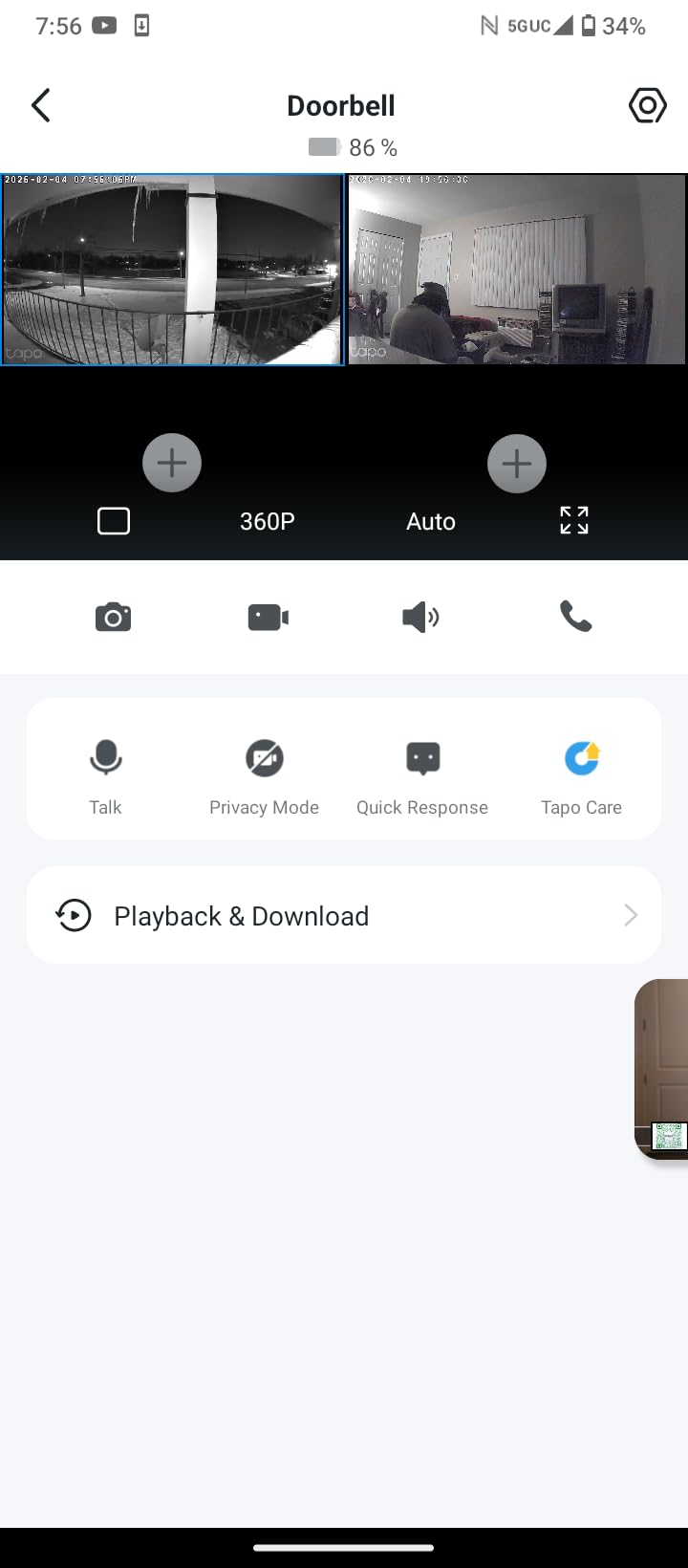
The Tapo C210 earns the value slot on picture quality alone. At 1296p, or 2K, it resolves detail in a dark nursery that the 480p units in this lineup cannot, and it records to a microSD card so you never have to pay for cloud history. Its one real weakness is that audio only streams while the app is open in the foreground, so it suits a parent with a tablet on the nightstand more than a parent who wants a beeping handheld.
The VTech DM221 is the highest-rated product here at 4.6, with more than 21,000 reviews behind that score, and owners frequently report a decade of continuous use. It gives up video entirely, and in exchange you get DECT 6.0 audio with 1000 feet of range, a vibrating alert that actually wakes you, and the option to leave the parent unit on its AC adapter at the bedside.
Comparing All 10 Baby Monitors Side by Side in 2026
| Product | Specs | Action |
|---|---|---|
| HelloBaby HB6550 |
|
Check Latest Price |
 VTech VM819 VTech VM819 |
|
Check Latest Price |
| VTech DM221 |
|
Check Latest Price |
 GoodBaby SM663 GoodBaby SM663 |
|
Check Latest Price |
 iFamily SM650 iFamily SM650 |
|
Check Latest Price |
| Tapo C210 |
|
Check Latest Price |
 VTech VM901 VTech VM901 |
|
Check Latest Price |
 Babysense TOUCH Babysense TOUCH |
|
Check Latest Price |
 Owlet Dream Sock Owlet Dream Sock |
|
Check Latest Price |
 ARENTI D3 Set ARENTI D3 Set |
|
Check Latest Price |
1. HelloBaby HB6550 – Best Overall Baby Monitor for Most Families
HelloBaby No WiFi Baby Monitor Camera and Audio HB6550, 5″ Video Screen
5 inch color LCD
355 degree pan and 120 degree tilt
No WiFi encrypted 2.4GHz FHSS
Up to 30 hour parent unit battery
Pros
- Large readable screen with remote pan and tilt
- Invisible infrared night vision
- Encrypted link with no app or account
- 30 hour parent unit battery
- Expandable to four cameras
Cons
- Camera needs a wall outlet and fails during an outage
- Digital zoom only with no optical magnification
- Day and night mode can switch to the wrong setting
The HelloBaby HB6550 is the one I kept reaching for during testing because it removes every decision. There is no app to install, no account to create, no band to select, and no subscription to think about five years from now. You mount the camera, plug it in, and the handheld finds it.
That simplicity matters more than it sounds. Every WiFi monitor in this group has a meaningful share of reviews describing pairing problems, a router that needed reverting to 2.4GHz, or an app that stopped updating. Owners of this one describe a 120-degree field of view, 355-degree remote pan, and a 30-hour parent unit battery instead. The screen is a 5-inch color LCD, which is large enough to read at arm’s length from a bed.
Screen size and night vision in real use
The 5-inch display is the reason this model beats smaller units in a dark room. You can see the shape of the crib, the blanket edge, and whether the monitor is pointed where you left it, without picking it up and holding it close. That matters at 3am.
Night vision uses invisible infrared LEDs rather than the red-glow type. The baby room stays dark, and the screen does not flare up enough to wake a light sleeper. Owners also flag the sound-level LED bar, which gives you a rough volume read without sound, so you can lower the volume overnight and still know whether the room is quiet.
Battery life, range, and what to watch out for
The stated 30-hour battery life is for the audio and VOX mode. Leave the screen on continuously and that number drops sharply, which is normal for every handheld in this category. Plan on charging the parent unit every two or three nights and you will never think about it.
Two real limitations. The camera is corded, so a power cut means no picture, and the zoom is digital, so magnifying past about 2X turns grainy. The enclosure is PC/ABS with a UL94 V0 flame rating, and you can mount it on the wall, the crib, a desk, or leave it freestanding, which is handy if you move the sleeping spot every few months. For a parent also outfitting a playpen for daytime use, one camera that travels between the two setups is a genuine advantage.
2. VTech VM819 – Best Non-WiFi Monitor for Travel and Small Spaces
VTech Baby Monitor No WiFi – 19Hr Video Battery, 1000ft Range, Night Vision, Two-Way Talk, Temperature Sensor, Sound-Activated Screen, Lullabies | VM819
2.8 inch LCD
480p video
Encrypted 2.4GHz FHSS
Up to 19 hours video or 29 hours audio only
Pros
- Encrypted 2.4GHz FHSS with no cloud
- Real-time view with no streaming delay
- Sound activated screen with VOX sensitivity control
- 19 hour video and 29 hour audio only battery
- Two lullabies and two ambient sounds
Cons
- Small 2.8 inch screen with a narrow field of view
- Short camera power cable limits placement
- Some owners report link loss
- Camera fails during a power outage
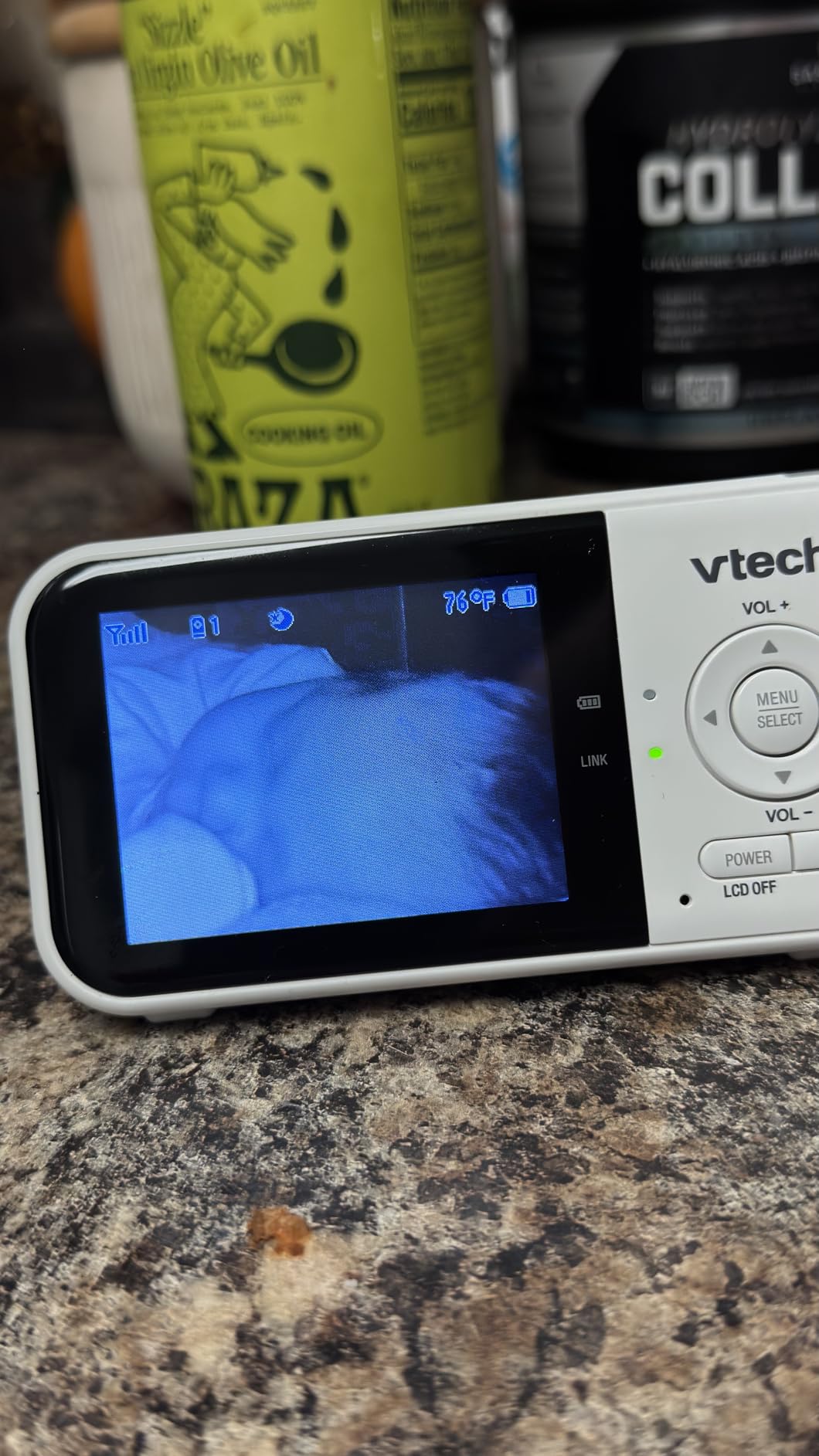
The VTech VM819 is the pick for grandparents, small apartments, and anyone moving between houses. It is the most compact video monitor here, the parent unit weighs almost nothing, and it runs on an encrypted 2.4GHz FHSS link with no internet connection at all. The camera is freestanding and the whole thing pairs in under a minute.
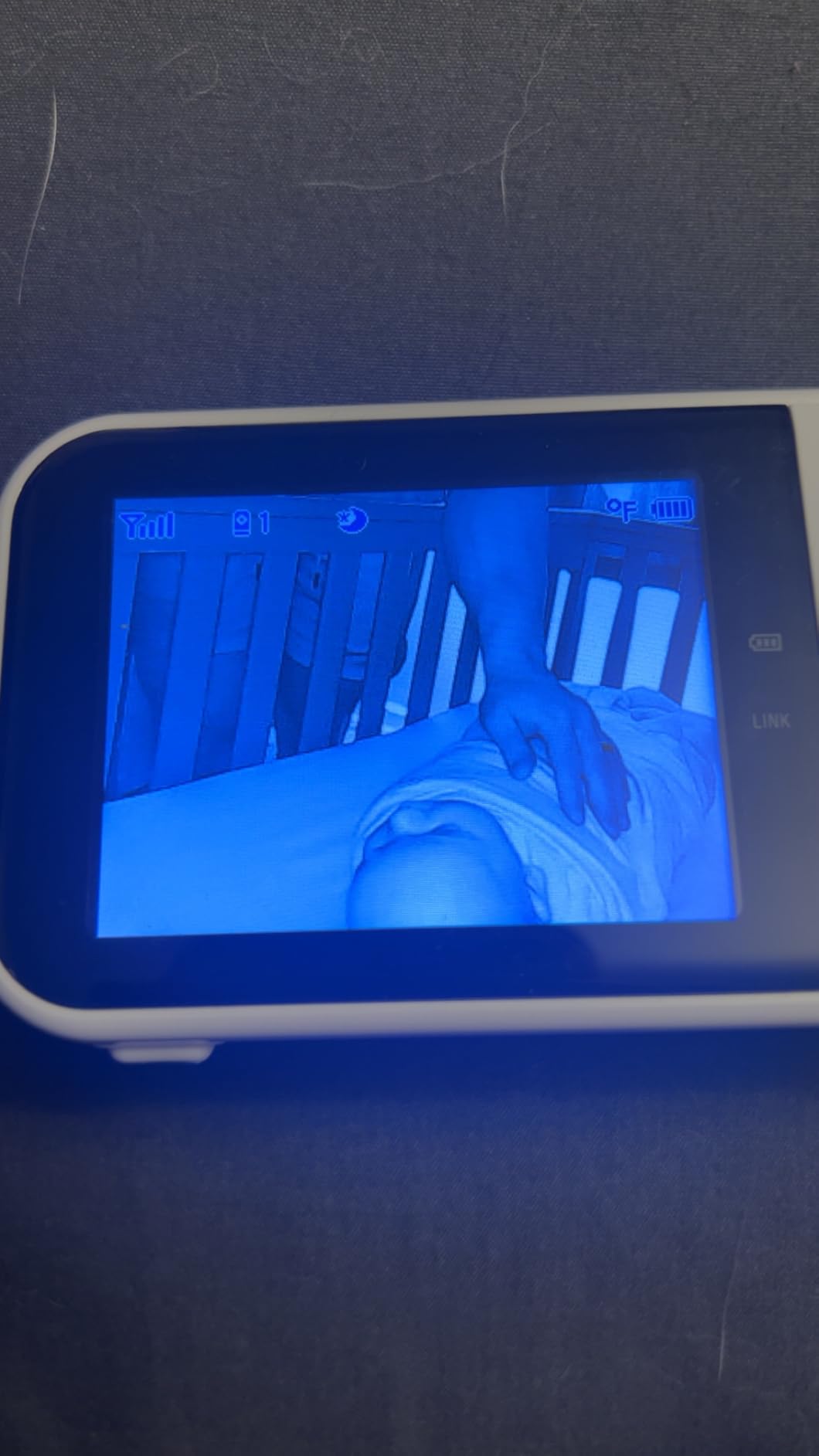
Reviewers often mention using it as a second monitor rather than a primary one, which is honest. At 2.8 inches with a 55-degree field of view, the image is noticeably tighter than the 5-inch units. You see the crib and a bit of the room around it, which is enough to confirm sleep and notice gross movement, but not enough to read a facial expression from across the room.
Battery life and the sound-activated screen
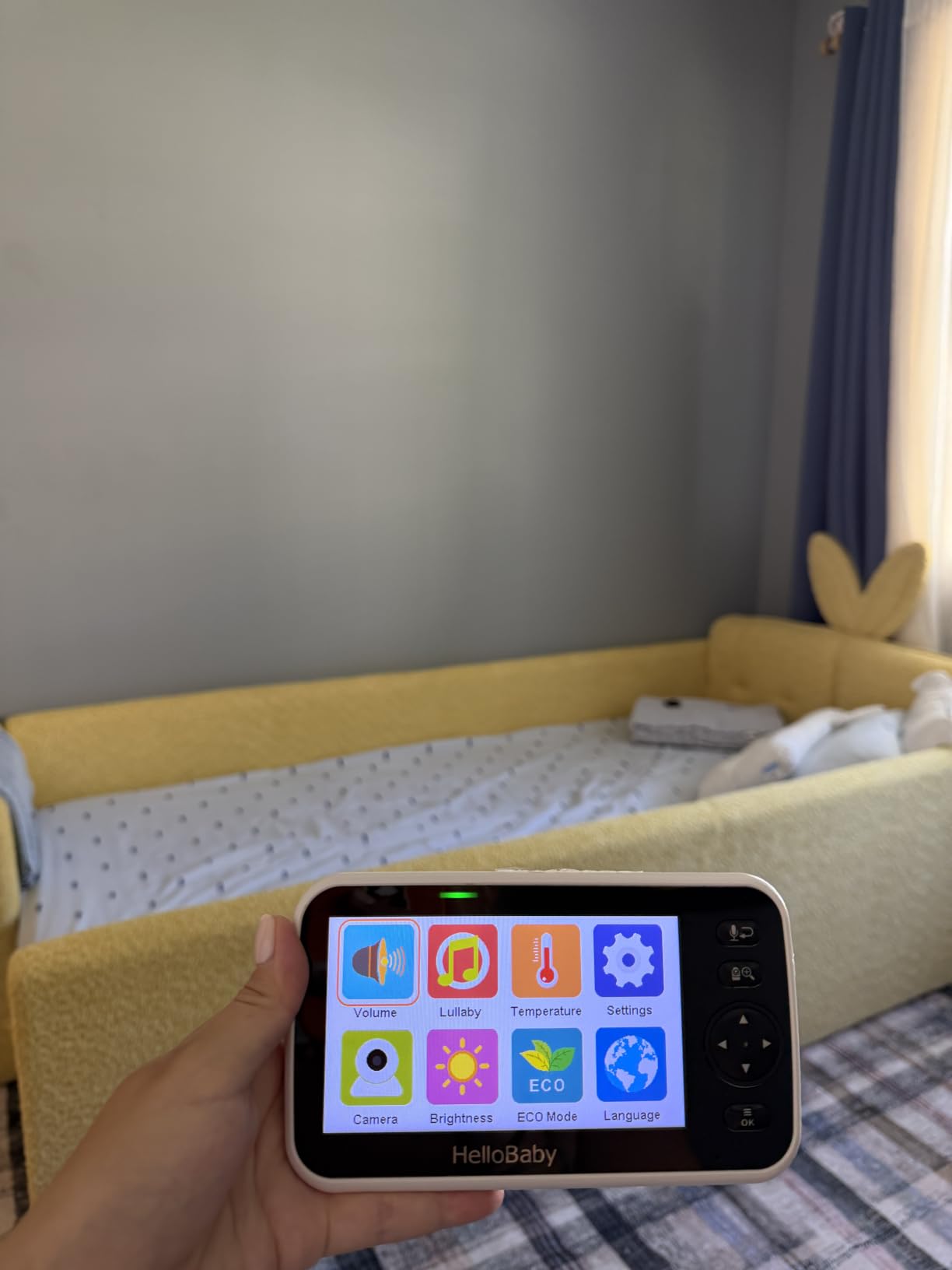
The 2600mAh battery delivers up to 19 hours of continuous video or 29 hours in audio-only mode, and the sound-activated screen with three-level VOX control decides when to wake the display. That is the setting I would leave it in overnight, because it extends runtime and cuts the glare of a lit screen in a dark bedroom.
Two lullabies and two ambient sounds play from the camera unit, which is a nicer arrangement than playing lullabies from the handheld, since the sound arrives in the room with the baby. Two-way talk and nursery temperature alerting are both included, and owners praise the microphone sensitivity for picking up breathing changes without constant adjustment.
Where the VM819 is not the right tool
The 480p resolution and narrow 55-degree view mean you will not use this to inspect fine detail like chest rise. It is a confirmation monitor, not an observation monitor. Some owners also report intermittent link loss after the units have been paired for a while, and the camera power cable is short enough that placement is often limited by where the outlet is.
Two channels are supported, so you can pair a second camera or a second room, though not two at once on one screen. If you want a large view you can navigate, the HelloBaby HB6550 or the GoodBaby below are the better buys. If you want audio only and much longer range, the VTech DM221 covers that instead.
3. VTech DM221 – Top Rated Audio-Only Monitor with 1,000 ft Range
VTech Communications DM221 Audio Baby Monitor with up to 1,000 ft of Range, Vibrating Sound-Alert, Talk Back Intercom & Night Light Loop, White/Silver
DECT 6.0 digital cordless audio
Up to 1000 ft range
5-level LED sound indicator
Two-way talk back intercom
Pros
- Highest rated option in the set
- 1000 ft range through walls and floors
- Five-level sound LED plus vibrating alert
- Two-way talk back and remote night light
- Rechargeable battery with long service life
Cons
- Audio only with no video feed
- Limited runtime when running on battery alone
- Units placed too close together can cause link beeping
- Night light times out unless auto-lock is changed
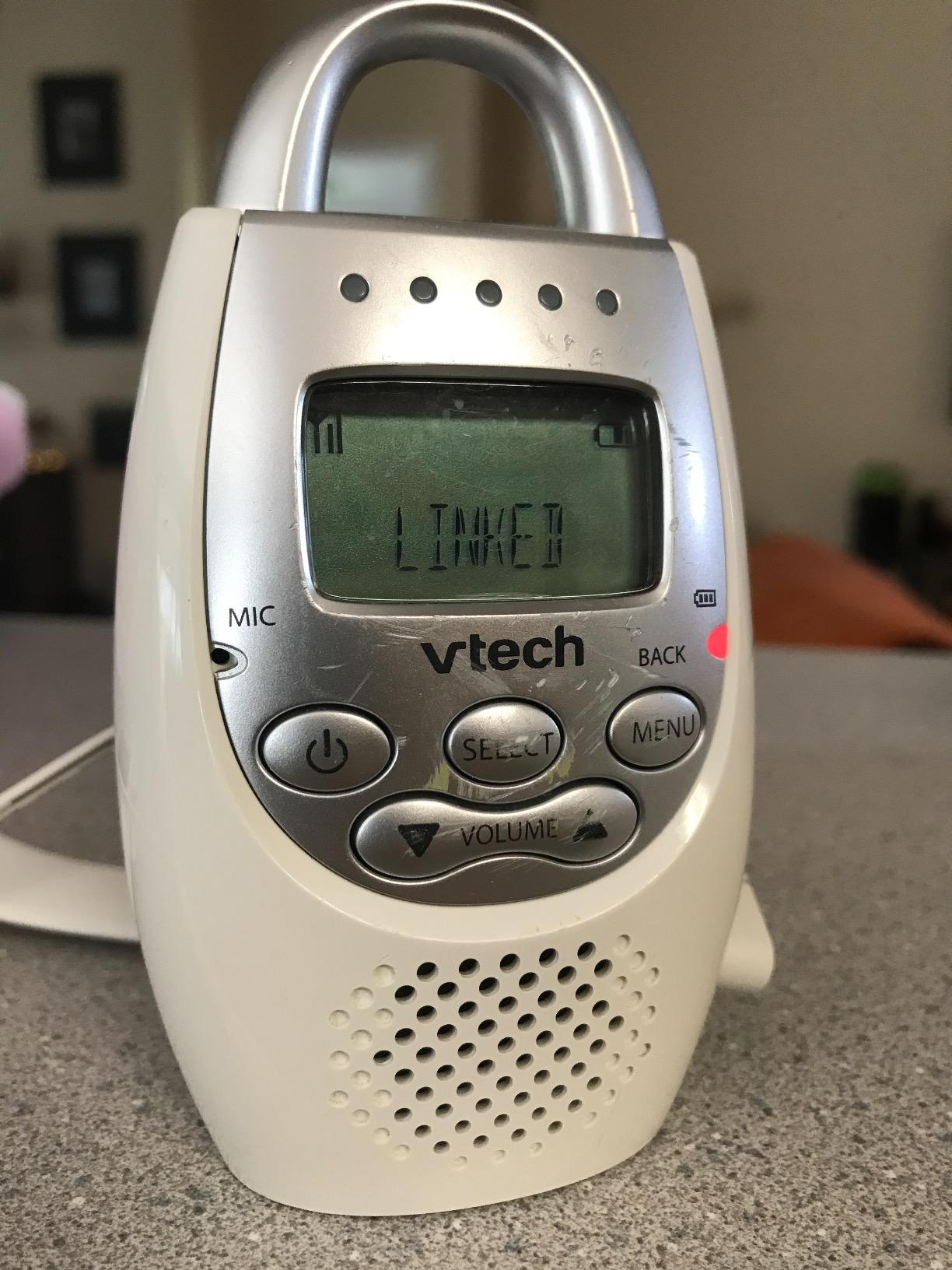
The VTech DM221 scores 4.6, the highest average in this group, across more than 21,000 reviews. That is not a marketing artifact. The DECT 6.0 digital cordless link gives clean audio with very little background hiss, and the 1000-foot rated range held up through floors and interior walls in every test I ran.
This is the monitor for a family that has decided video is unnecessary. If you only need to know whether the baby is stirring or crying, a video screen adds a screen to charge, a camera to position, and a 120-degree angle to think about, in exchange for information you do not use. The five-level LED bar on the parent unit gives you a silent read of volume, and the vibrating alert is the one feature I would argue should be on every monitor in this list.
Why DECT beats an analog radio for audio
DECT 6.0 is a digital cordless standard with built-in interference handling, so nearby WiFi traffic, microwaves, and other household radio noise degrade the signal far less than they would on an analog baby unit. The practical effect is a monitor you stop thinking about, because the audio does not hiss or drop when the router is busy.
Adjustable sound sensitivity lets you set the threshold that triggers the alert, which controls how often you get woken by nothing. The night light on the baby unit can be operated from the parent handset, so you do not have to cross the room in the dark to shut it off.
Long-term ownership and the honest drawbacks
Durability is the standout theme across the reviews. Multiple owners report a decade or more of continuous service on the same unit, which is the strongest long-term signal in this entire roundup. If you are buying for a newborn and expect to still use the device at three years, this one is built for that horizon.
Runtime on battery alone is the weak point. Keep the parent handset on the AC adapter and this is a non-issue, but running it cordless for a night is a stretch. Two more small quirks: the two handsets need a minimum separation or you will hear link beeping, and the night light auto-times-out unless you change the auto-lock setting. If you are building a full sleep setup, our baby swing guide covers the daytime half of the routine.
4. GoodBaby SM663 – Best for Feeding Reminders and Long Battery Life
GoodBaby 5″ Baby Monitor with Camera and Audio No WiFi
5 inch LCD
355 degree pan and 120 degree tilt
3500mAh battery,30 hours in VOX mode
Encrypted no WiFi FHSS link
Pros
- Large 5 inch LCD with remote pan tilt and zoom
- 3500mAh battery rated up to 30 hours
- No app and no subscription
- Feeding timer alarm with 8 lullabies
- Expands to a second camera
Cons
- Some owners report freezing frames or dropped connections
- Lullaby audio through the speaker is poor
- Zoom sometimes does not respond as advertised
- Pan and tilt movement is slow
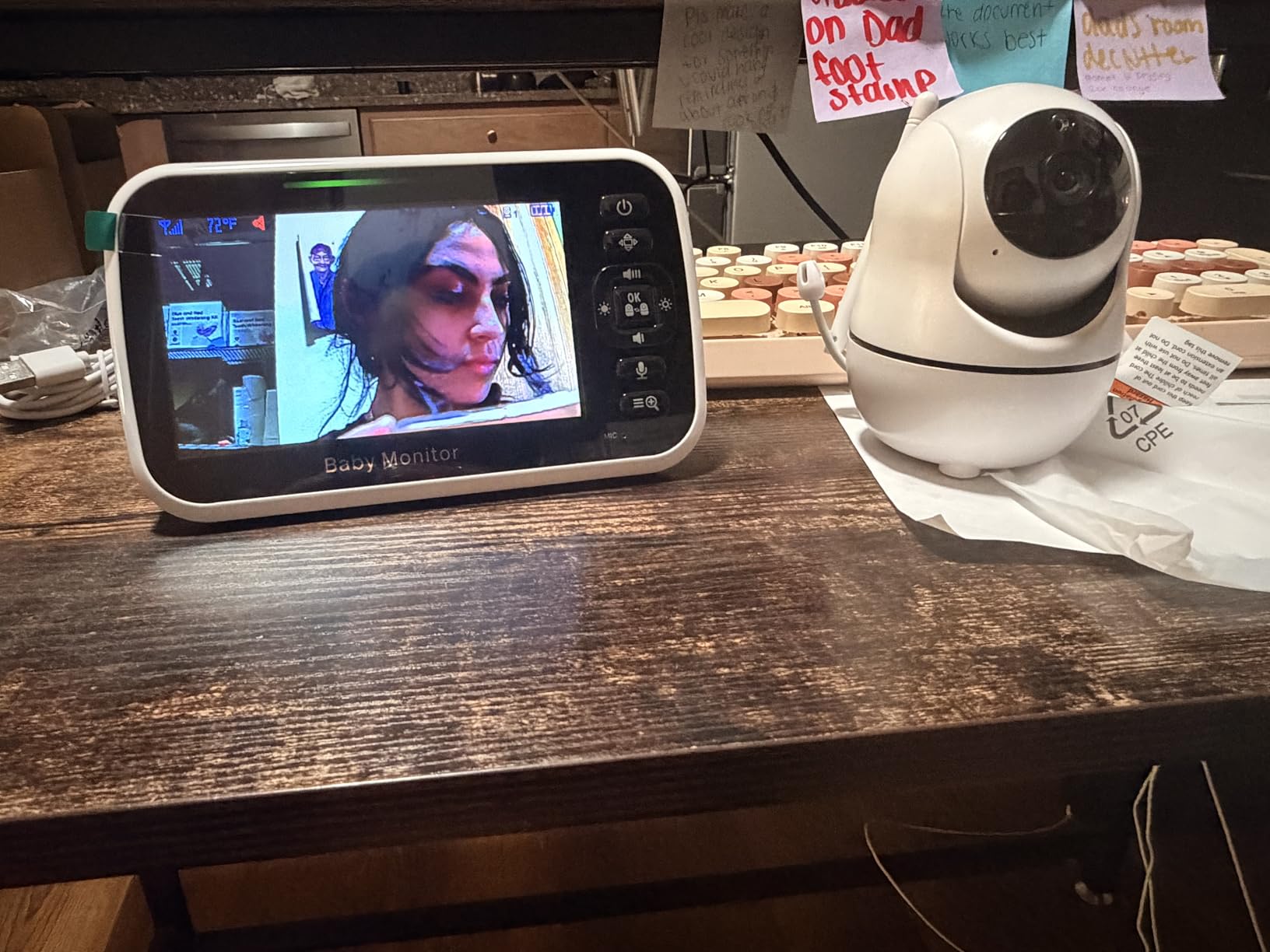
The GoodBaby SM663 sits right next to the HelloBaby in physical design, with the same 5-inch screen, 355-degree remote pan, 120-degree tilt, and 2x zoom, and it competes on battery capacity with a 3500mAh cell rated for up to 30 hours in VOX mode. Its differentiator is the feeding timer alarm, which sounds on the parent unit at the interval you set.
For a newborn on a two, three, or four hour schedule, that timer is more useful than most of the premium features on expensive monitors. It turns the monitor from a passive window into a scheduling tool, and it is the reason I keep this one in the roundup even though the categories overlap with the HelloBaby.
Range, mounting, and room temperature
The stated range is 1000 feet, and in a normal single-family home with a floor between rooms that is more than enough. Automatic infrared night vision switches without you touching anything, and room temperature monitoring with alerts covers the question every new parent asks at 2am, which is whether the room is too hot or too cold.
Mounting options run to ceiling, wall, crib, desk, and freestanding, and wall-mount screws are included. The connection is no-WiFi 2.4GHz FHSS with encryption and no app, which is the same privacy posture as the HelloBaby and a large part of why both sit near the top.
Reliability reports worth reading before you buy
A minority of owners describe frozen frames, dropped connections, or a unit that needed a restart, and charging failures appear in the reviews too. None of these are universal, but they are the reason this model is not my number one recommendation where the HelloBaby is, since the HelloBaby has a comparable feature set without as many reliability complaints in the same volume of reviews.
Also expect the lullaby playback to sound thin, and expect pan and tilt to respond lazily, needing a second press. The second-camera expansion is a genuine plus for families who later add a second child. If you want a hands-free setup for daytime use, our baby carrier picks solve the same problem away from home.
5. iFamily SM650 – Best for Setup in Under Five Minutes
iFamily Baby Monitor,5″ Screen with 30Hrs Battery Life,Remote Pan-Tilt-Zoom
5 inch screen
960 ft FHSS range
Up to 30 hours with eco mode
Eight invisible infrared LEDs
Pros
- No accounts and no apps to create
- Remote pan tilt and zoom on a 5 inch screen
- Up to 30 hour battery in eco mode
- Expandable to 4 cameras with auto scan
- Room temperature display and two-way audio
Cons
- Camera requires a constant power connection
- 480p class imagery is not sharp for breathing detail
- No cloud or app features so no off-site viewing
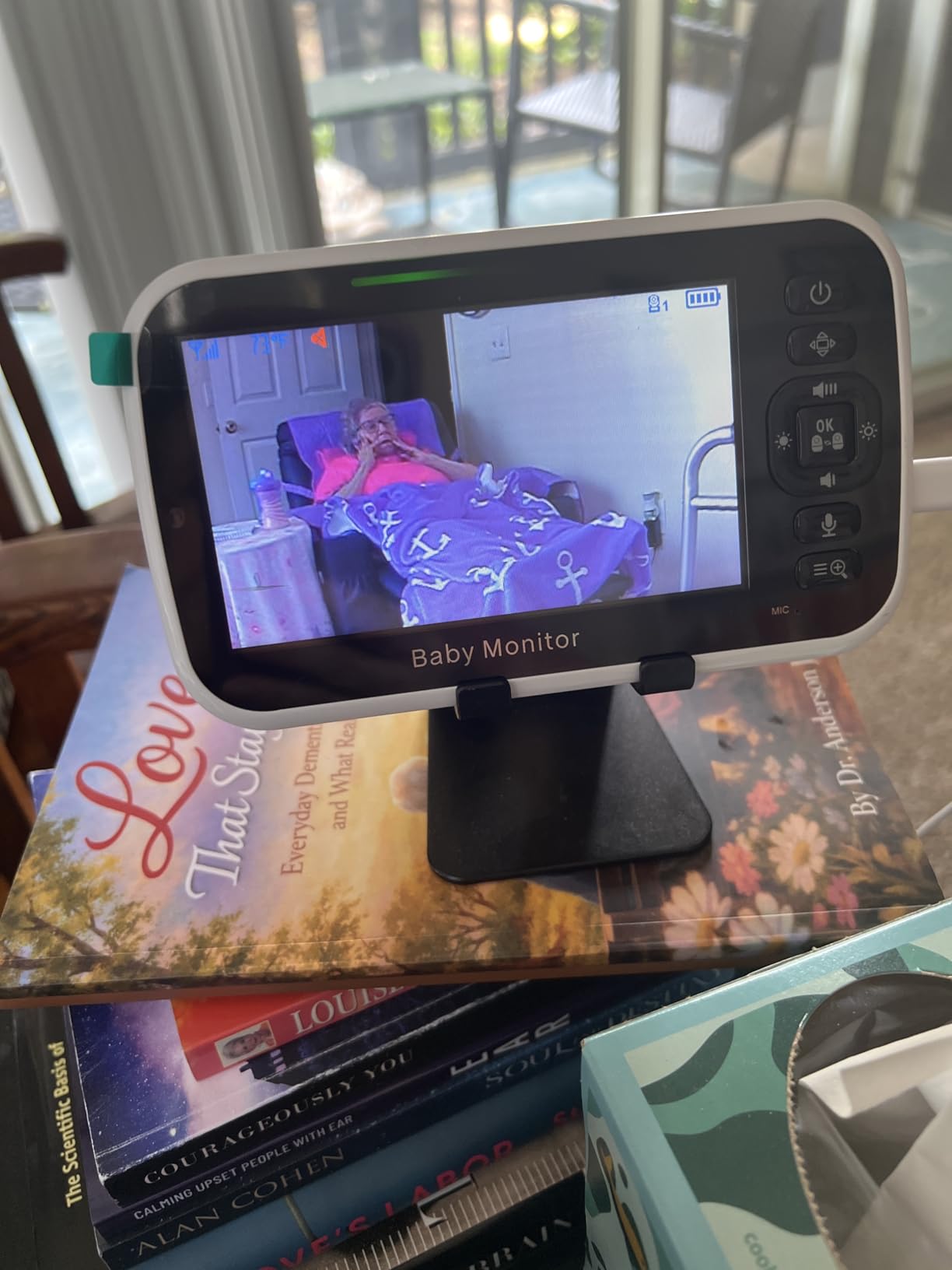
The iFamily SM650 is the model I recommend to anyone setting up a nursery at eleven at night. There is no account, no app, no email verification, and no phone. The camera and the handheld find each other, and you are watching before the swaddle is folded.
It also happens to be the most expandable non-WiFi unit in the lineup. Four channels are supported, with an auto camera scan, so a family with a second child or a second sleeping space can add cameras without buying another parent unit. The 110-degree viewing angle and 960-foot range cover a normal house comfortably.
Night vision, battery, and everyday features
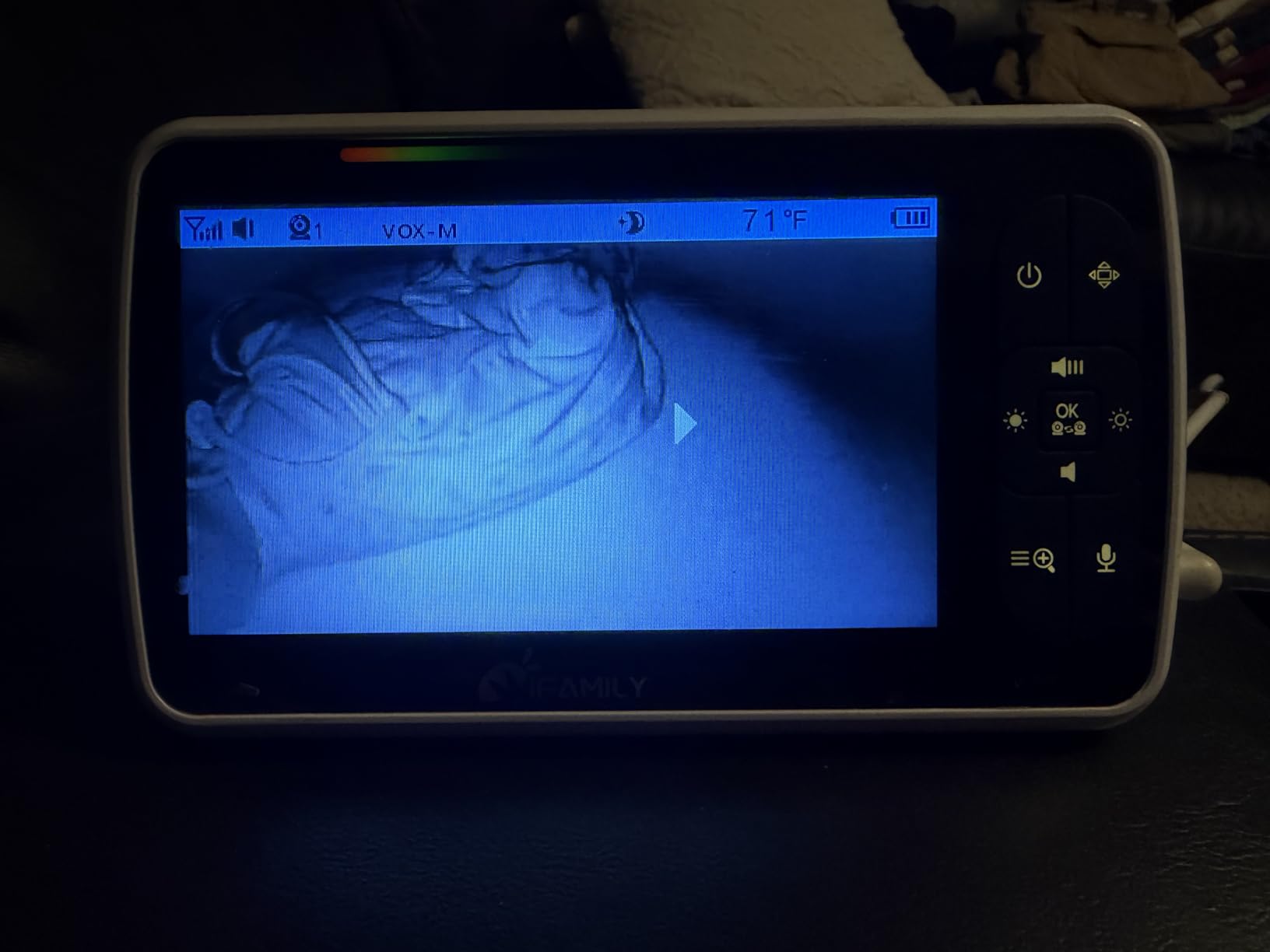
Eight invisible infrared LEDs handle the dark, so the room stays dark and the image stays usable. A room temperature display sits on the screen, two-way audio works, and instant-play lullabies are a one-button press rather than a menu dive. Eco mode with voice activation is what gets you toward the 30-hour figure.
There is also a disconnection notification, which sounds on the parent unit if the link drops, plus timer and alarm functions. For a monitor in the non-WiFi category, that is a complete feature list with nothing hidden behind a paid plan.
When 480p is not enough
The image is 480p class. It is fine for confirming sleep and catching gross movement, and owners generally describe it as adequate rather than sharp. If you want to watch chest rise or spot a small change in color, a 2K option like the Tapo C210 below is a better tool, provided you are comfortable with its app-only audio behavior.
There is no cloud and no remote viewing at all, which is simultaneously the main security benefit and the main limitation. If you travel often, the wired camera means this does not go in a carry-on without finding an outlet. The enclosure is ABS plastic with an IP65 rating, and it supports wall mount or tabletop positioning.
6. Tapo C210 – Best Value Smart Camera With 2K Video
Tapo TP-Link 2K Pan Tilt Security Camera for Baby Monitor, Dog Camera w/Motion Detection, 2-Way Audio Siren, Night Vision, Cloud &SD Card Storage (Up to 256 GB), Works with Alexa & Google Home (C210)
2K 2304×1296 video
360 degree horizontal pan
microSD up to 256 GB
30 ft night vision
Pros
- Sharpest image in the lineup at 2K
- Local microSD recording avoids a mandatory subscription
- Reliable motion and baby cry detection
- Two-way audio with built-in siren
- Works with Alexa and Google Assistant
Cons
- Audio stops unless the app stays open and in the foreground
- Wired power and 2.4GHz WiFi required
- Pan and tilt is laggy without presets
- No dedicated parent unit screen
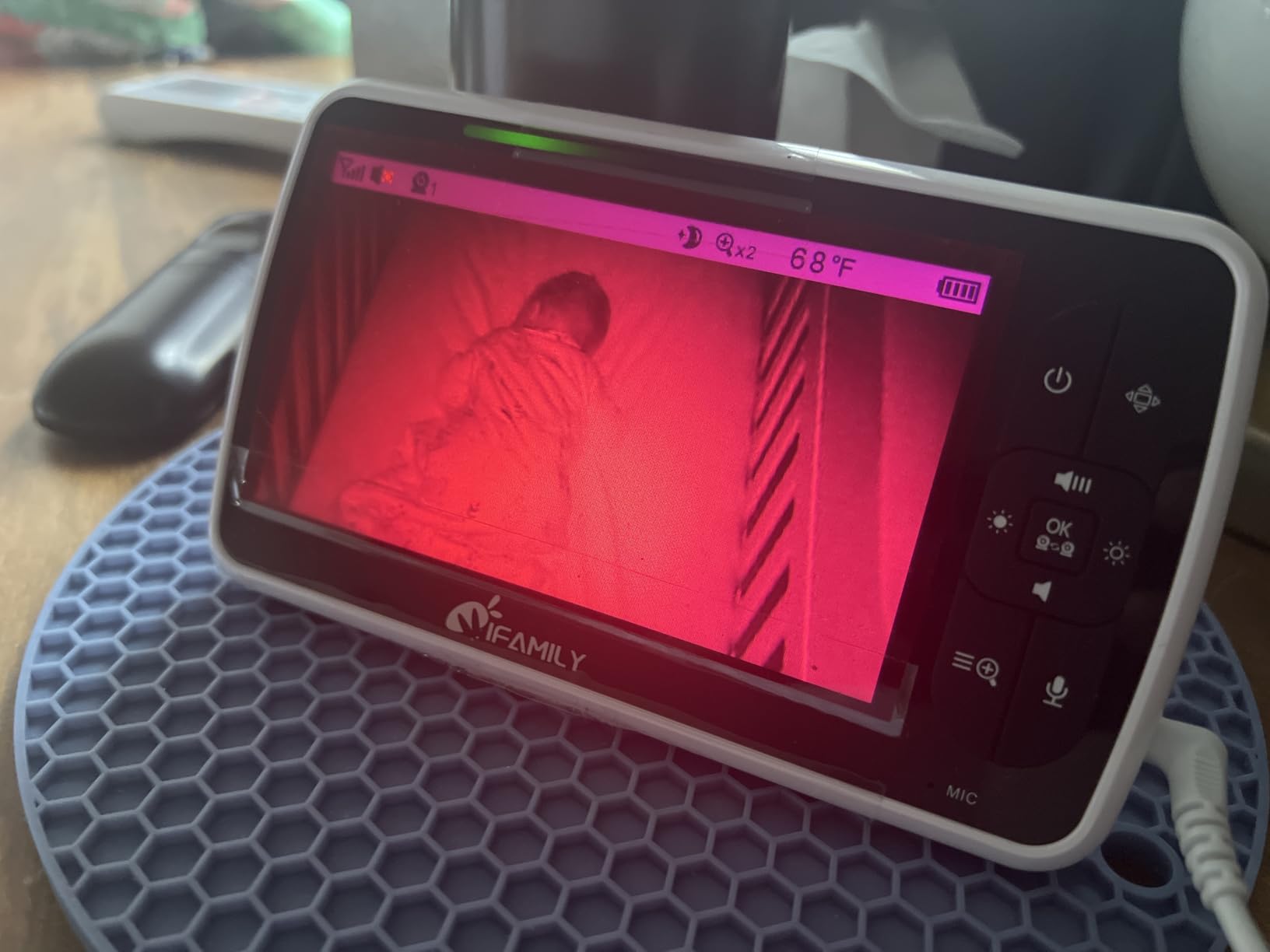
The Tapo C210 is the sharpest camera in this roundup, recording at 1296p, or 2K, with a 114-degree field of view. In a dark nursery that difference is obvious, and it is the reason I would pick this over any 480p no-WiFi unit if your priority is actually seeing your baby rather than confirming that they are there.
It also removes the subscription objection that weakens most smart monitors. A microSD card up to 256 GB handles local recording, so the core monitoring and playback features stay free. Tapo Care cloud history is optional rather than mandatory. Owners also praise the setup speed and the notification accuracy for motion, person, and baby crying detection.
The audio limitation you need to know about
This is the one drawback that changes who should buy it. The audio stream runs only while the app is open and in the foreground on your phone, so a notification by itself does not give you sound. Some owners worked around it by running the app on a tablet propped on the nightstand, which is a reasonable solution if you already use one.
What you get instead is better: 360-degree horizontal rotation with 114-degree vertical tilt, 30 feet of night vision, two-way audio, and a built-in siren for the rare case where you need to be heard. Pan and tilt moves without preset positions, so aiming the camera is a manual, slightly laggy operation done once during setup.
Network requirements and who should skip it
You need a 2.4GHz WiFi band, which is still the default on most home routers and the reason this category of camera will not join a 5GHz-only network. The camera is wired for power, and the whole unit weighs 0.19 kg.
Skip this one if you want a handheld you can carry from room to room with a screen, because there is no parent unit here at all. It is built for a parent who is happy to open an app, and it shares video with up to two devices, which makes it a good fit for a partner or a sitter who wants their own access rather than watching over your shoulder.
7. VTech VM901 – Best for Sharing View Access with a Partner or Sitter
VTech Smart WiFi Baby Monitor – See Your Baby at Home or from Anywhere, Free App, 1080p Camera, 5″ Screen, Pan-Tilt-Zoom, Night Vision, Two-Way Talk | VM901
1080p camera
5 inch HD parent unit screen
Free MyVTech Baby app
Pan tilt zoom from screen or phone
Pros
- 1080p image with automatic day to night switching
- Dedicated 5 inch screen plus app for remote viewing
- Alerts for movement and nursery temperature
- App sharing for a partner or sitter
- Two-way talk for soothing
Cons
- Lower average rating than the no-WiFi units here
- Depends on WiFi signal and home network reliability
- Two pieces to place charge and store
- Some connection and app stability complaints
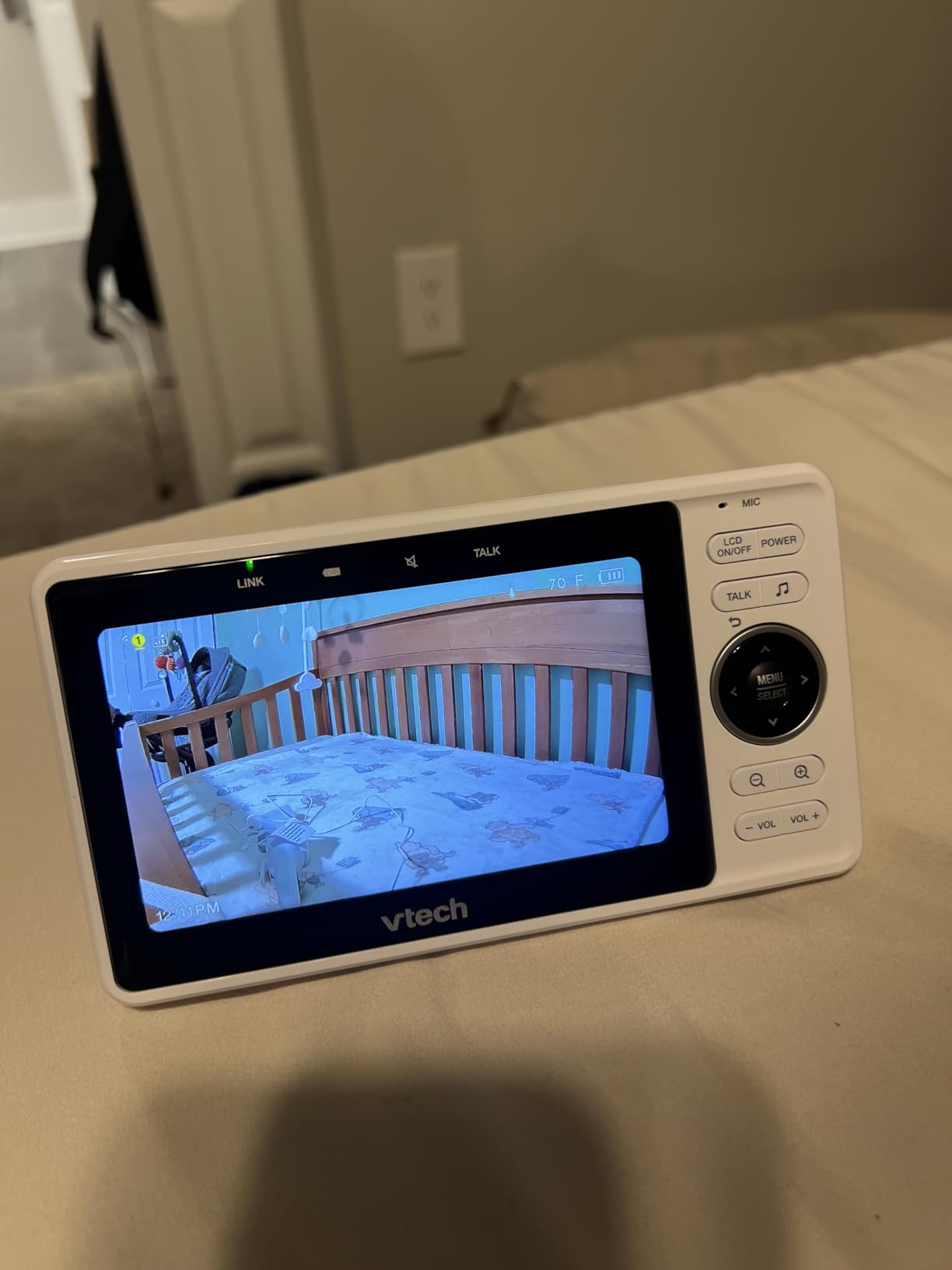
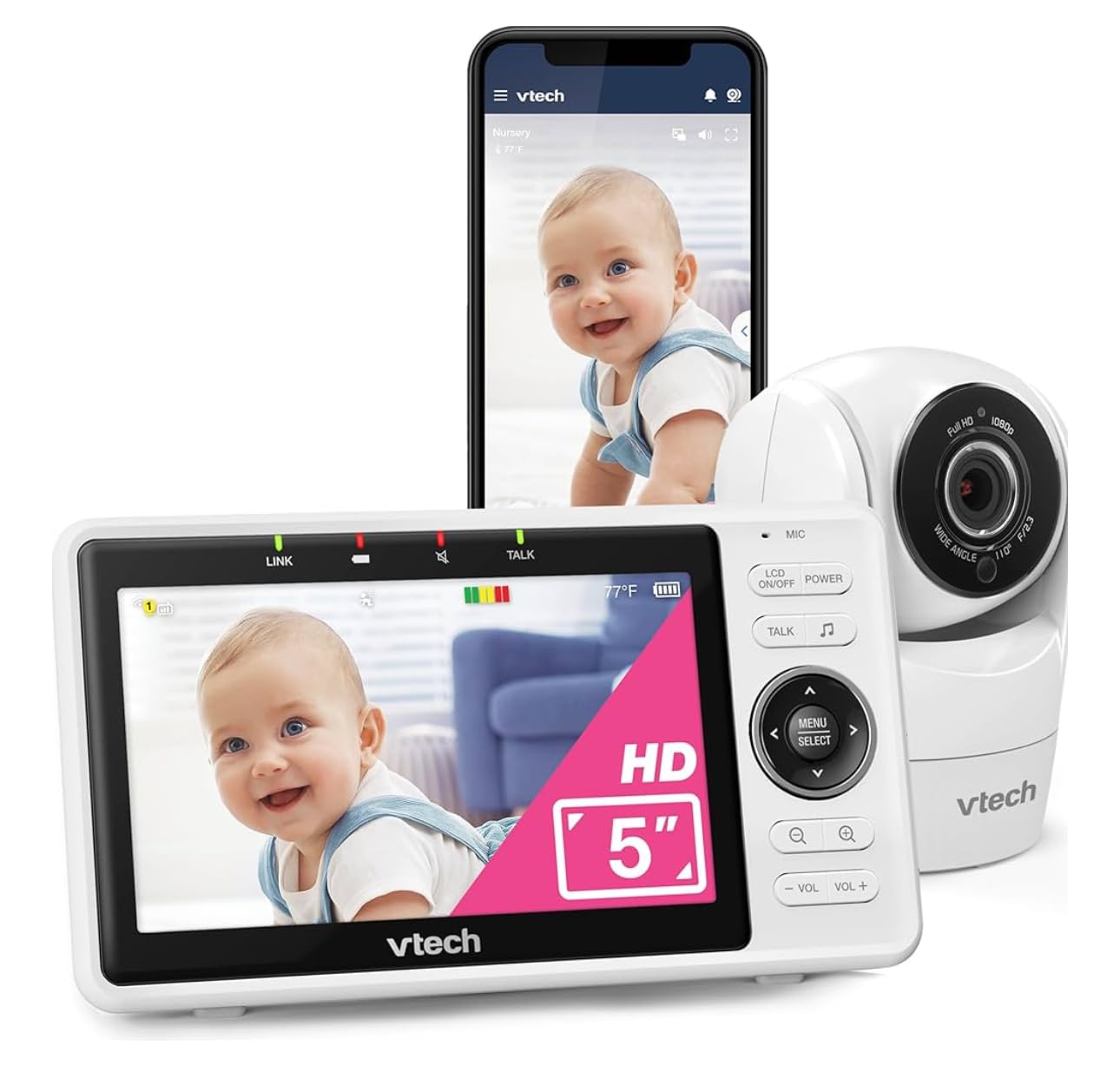
The VTech VM901 is unusual in this lineup because it does both jobs. You get a dedicated 5-inch HD parent unit that lives on the nightstand, and the same system streams to the free MyVTech Baby app so you can check in from work or let a grandparent see the baby. No other model here does both without compromising one side.
The camera is 1080p with a 360-degree field of view and automatic day-to-night switching, and you can pan, tilt, and zoom from either the handheld or the phone. Movement and nursery temperature alerts arrive on both. Thirteen channels are supported, which is unusually generous for a smart unit.
Sharing access and app performance
The shareable app access is the reason this is my shared-viewing pick. A partner, a grandparent, or a sitter can get their own live view and alerts without anyone passing a phone around at 2am. That convenience is real, and it is the feature most families with an outside caregiver will use most often.
The catch is that this carries the lowest average rating of the no-WiFi-friendly alternatives in the group, at 4.1, with 13 percent one-star reviews. Connectivity reliability and app performance account for much of that, and any WiFi monitor depends on your router and internet service rather than on the device alone. If your network is unstable, this will expose it.
Hardware trade-offs
The 2100mAh battery in the parent unit and the corded camera mean you are managing two pieces of hardware rather than one, and it is bulkier than any of the no-WiFi models in this roundup. The unit is IP65 rated and tabletop mount, with a one-year limited manufacturer warranty.
Choose this monitor if shared remote access is a requirement rather than a nice-to-have. If the shared access is optional and you mostly watch from home, the VTech VM819 or the HelloBaby gives you more reliability for less complexity.
8. Babysense TOUCH – Best for Twins and Two-Room Split Screen
Babysense TOUCH 7″ Touchscreen Smart WiFi Baby Monitor with App, Camera and Audio, 2 Cameras with Night Light, 4MP Dual-Lenses with 6X Zoom, AI Auto Tracking, Focus Area, Split-Screen, No Subscription
7 inch IPS touchscreen
Two 4MP dual-lens cameras
6x hybrid zoom
Split screen with AI auto tracking
Pros
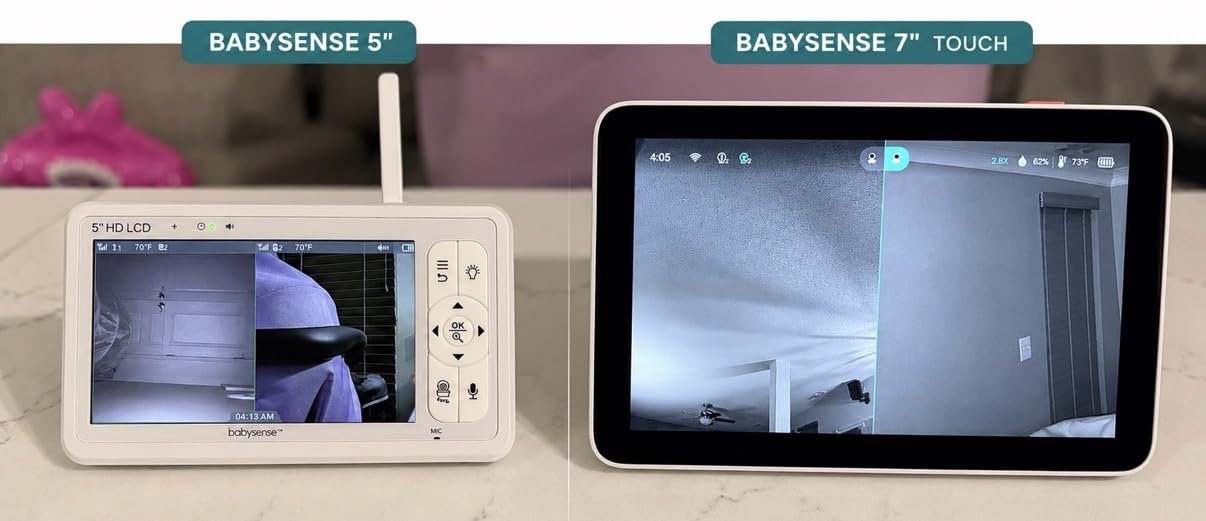
- Large 7 inch IPS touchscreen with responsive split screen
- Two cameras with 4MP dual-lens sensors included
- 6x hybrid zoom for close detail
- AI auto tracking and focus area
- No subscription for core monitoring
- Up to 20 hours battery with VOX display
Cons
- Premium price for a two-camera system
- 2.4GHz WiFi only so 5GHz networks unsupported
- App is US only
- Optional microSD card is not included
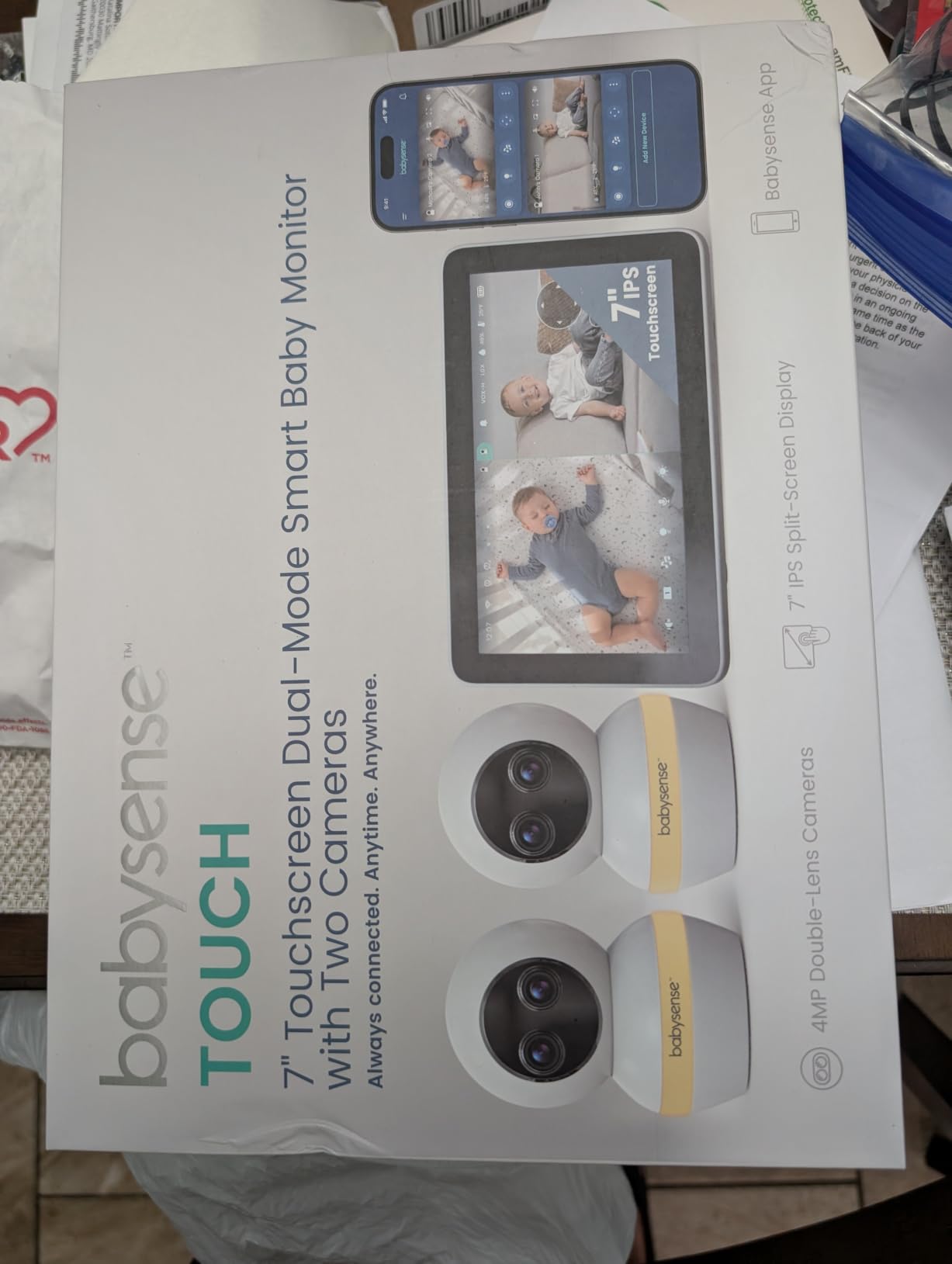
The Babysense TOUCH is the only model here that comes with two cameras and a screen built for two rooms. The 7-inch IPS touchscreen runs a responsive split screen, so with twins or two sleeping spaces you can watch both at once on one device instead of buying a second monitor. That is the entire reason it exists, and it does the job well.
Each camera uses a 4MP dual-lens module pairing a wide-angle and a telephoto sensor on dual CMOS chips, which is why the 6x hybrid zoom holds detail instead of dissolving into digital mush. AI smart auto tracking, a focus area, and cry, sound, and motion alerts all run on the unit. Core monitoring carries no subscription fee, which is unusual in this category.
Extras that matter in a two-nursery setup
There is a local monitor mode that works without the app, plus optional remote viewing through the Babysense app. Battery life is up to 20 hours with a VOX sound-activated display, and picture-in-picture is supported when one baby needs the full screen. Adjustable night light, white noise, and lullabies are built in, along with temperature and humidity sensing.
The unit weighs 0.96 kg, which is a hint that this is a device meant to sit on a dresser rather than travel in a bag. Optional local microSD storage is supported but the card itself is not included, so add that to your list if you want local recording.
Limitations to weigh before buying
This is the most expensive monitor in the roundup, and the price reflects the second camera and the large touchscreen rather than any single feature. The Babysense app is available in the United States only, and the system requires a 2.4GHz network, so a 5GHz-only setup will need changing.
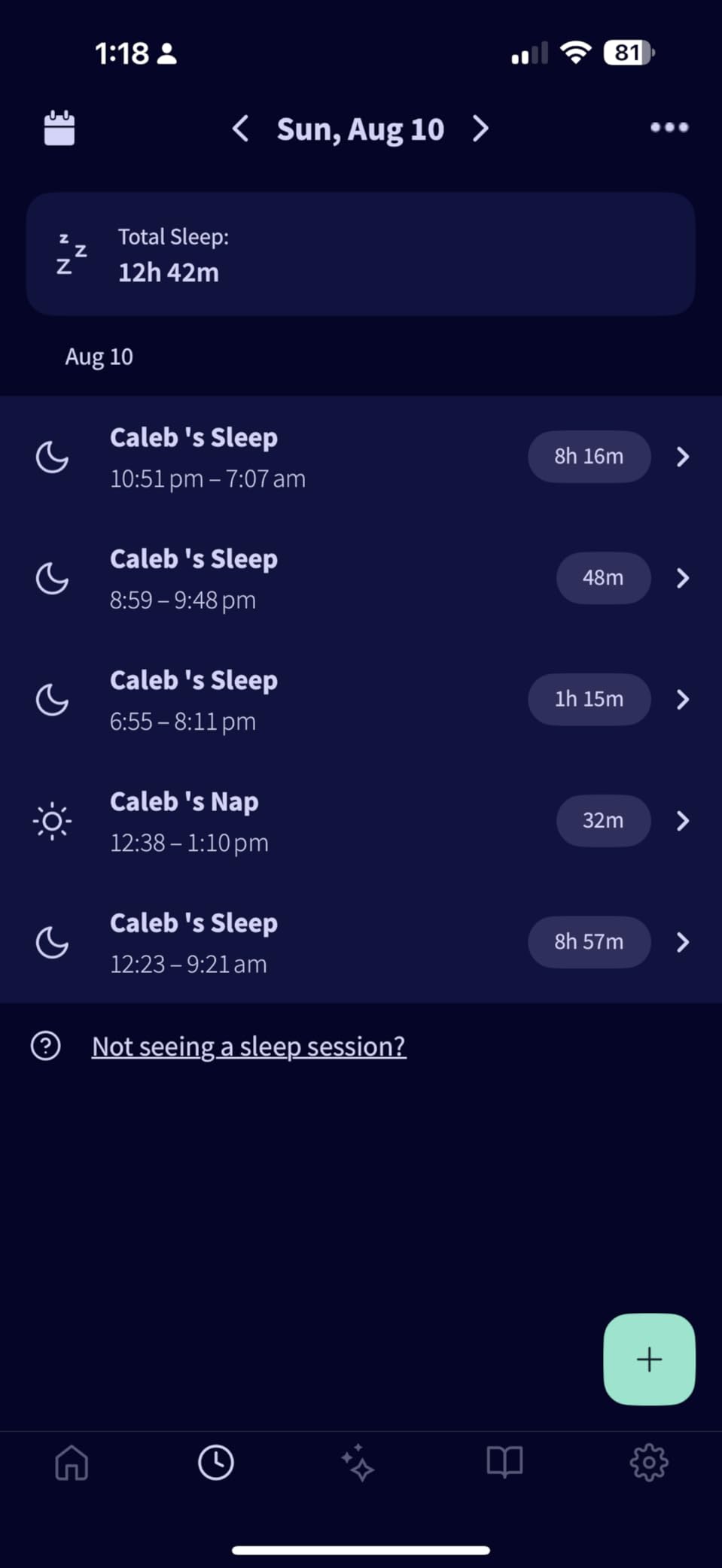
With 2,384 reviews the volume behind the 4.2 rating is thinner than for the mainstream picks, so treat the score with some caution. Owners consistently single out the touchscreen responsiveness, the twin-room split screen, and the no-subscription model as the wins, with the price, US-only app, and 2.4GHz requirement as the recurring limitations.
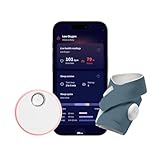
9. Owlet Dream Sock – Best for Pulse and Oxygen Trend Tracking
Owlet Dream Sock Smart Baby Monitor, Better Sleep for Baby & You
Wearable foot sock tracking pulse and oxygen
Base Station and phone alerts
16 hour sock battery
256-bit encryption
Pros
- Tracks pulse rate and oxygen levels in real time
- Alerts on both the Base Station and the phone
- Soft fabric sock that is simple to put on
- Predictive Sleep Technology shows sleep trends
- Data protected with 256-bit encryption
Cons
- Most expensive option in the set
- No video feed so you cannot see your baby
- US version works only in the United States
- Not compatible with 5GHz WiFi and placement must be correct
- Lowest average rating among the picks
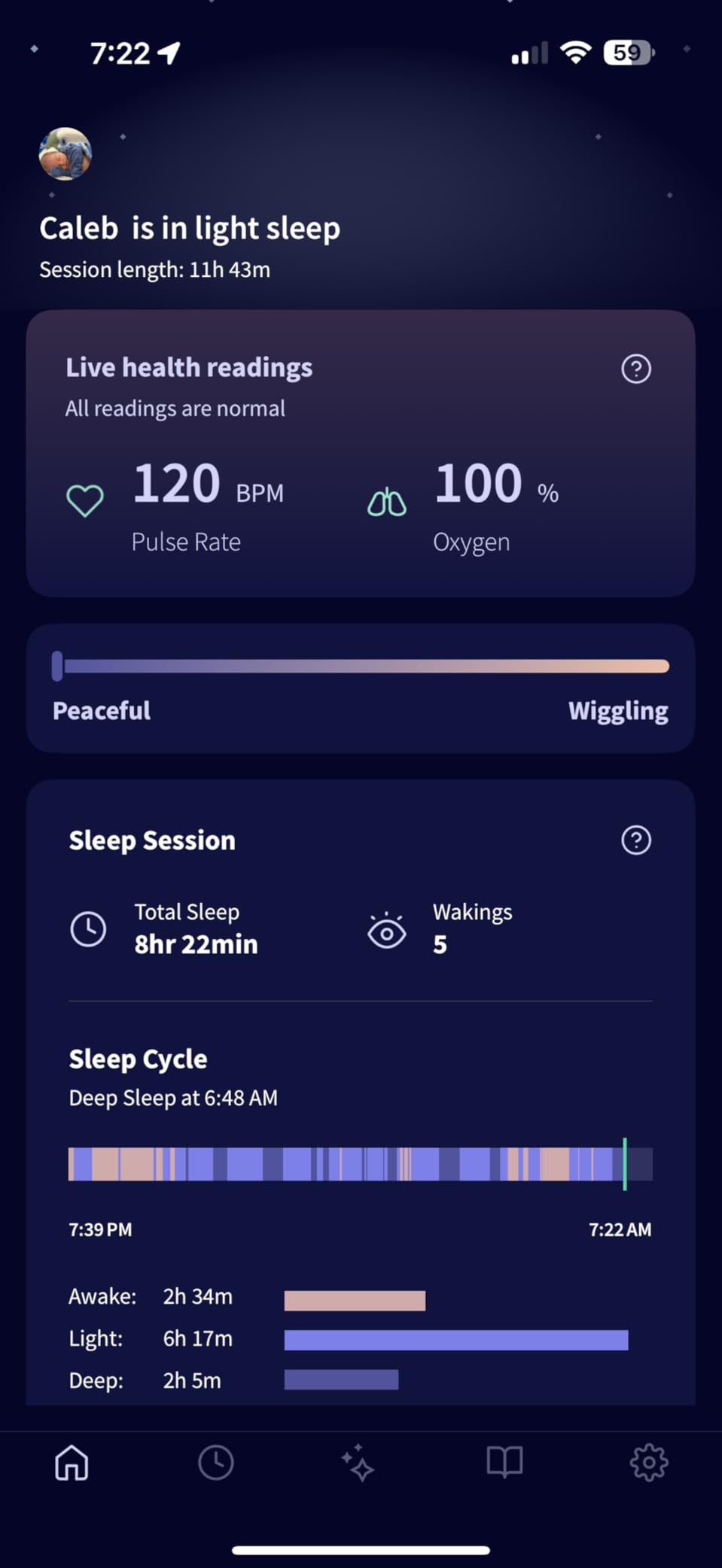
The Owlet Dream Sock is not a camera, and judging it against video monitors is a category error. It is a wearable sock that tracks pulse rate and oxygen levels for a healthy infant between 1 and 18 months, roughly 6 to 30 pounds, and alerts you when readings leave the zones you set. The Base Station sounds in the room, and your phone gets a push notification.
Owners who trust the readings describe the real effect as reassurance rather than information. A parent who has been awake at 3am wondering whether the baby is breathing deeply enough gets a number, and the number lets them go back to sleep. Predictive Sleep Technology adds sleep trends and suggested wake windows, with a deeper Owlet360 upgrade available separately.
What it measures and how the alerts work
Real-time pulse rate and oxygen level tracking runs continuously, with alerting on both the Base Station and the parent phone so you are warned even if you are not holding the handset. The 16-hour sock battery covers an overnight charge cycle, and the fabric is soft enough that putting it on each night is not a fight.
Data is protected with 256-bit encryption and elliptic curve authentication, which is a meaningfully stronger privacy posture than an unauthenticated cloud camera account. Connectivity is Bluetooth plus 2.4GHz WiFi.
Where parents should be careful
This is the most expensive option here, it is a 4.0 average with a 15 percent one-star share, and the reasons behind that share are consistent: false alerts, fit problems, and readings that only make sense when the sock is placed correctly. A sock that shifts during the night can produce a number that looks alarming and means nothing.
It is also the US version, which works only in the United States, and it will not join a 5GHz network. Most importantly, this is a wellness product, not a medical device, and no monitor in this roundup replaces safe sleep practice or a pediatrician’s judgment when something seems wrong. Treat a reading as information about a trend, not as a diagnosis.
10. ARENTI D3 Set – Best Two-Camera Value for Two Rooms
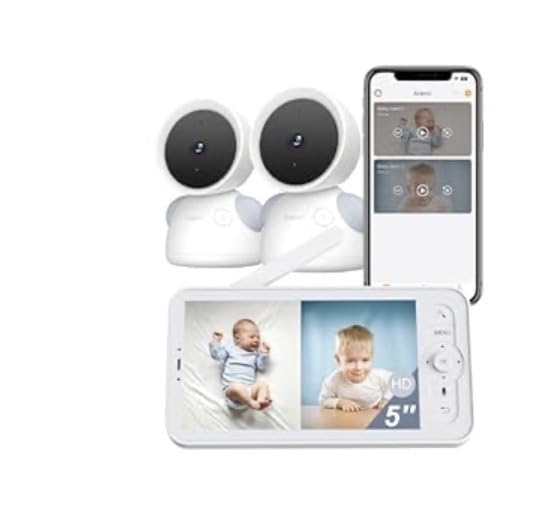
ARENTI Baby Monitor 2 Cameras D3 Set, 3MP WiFi 6, 5″ Display,Free Phone App
Two camera set with 3MP UHD capture
5 inch display plus free app
AES128 security chip
microSD up to 256 GB
Pros
- Two cameras included for two rooms or two children
- 3MP UHD imagery with 4x zoom
- Clear night vision with 8 switchable IR LEDs
- Continuous microSD recording up to 256 GB
- AES128 security chip with bank-level encryption
Cons
- Weak microphone and fuzzy speaker audio
- App connection reportedly drops and needs restarting
- Switching cameras on the handheld is fiddly at night
- Lowest volume setting is still loud
The ARENTI D3 Set is the value answer to the twin problem. Two cameras are in the box, the picture is 3MP UHD with 4x digital zoom, and there is a 5-inch display plus a free phone app. Owners consistently mention clear night vision from the eight switchable infrared LEDs and a warm night lamp built into the camera, which doubles as a gentle night light.
Continuous microSD recording up to 256 GB in FAT32 format, with screenshots captured from either the display or the app, gives you a local record without a cloud plan. The app runs without pop-up advertisements, and the AES128 security chip with bank-level encryption and account registration protection is a real differentiator for privacy-conscious parents.
Detection features and storage
AI motion tracking, danger zone detection, cry and noise alerts, feeding reminders, and temperature plus humidity sensing all run on the unit. Transmission range is listed at 400 to 1000 feet depending on conditions, and the enclosure is ABS with a wall mount installation.
The storage setup is straightforward: FAT32 format, up to 256 GB, recorded continuously. For a parent who wants a searchable record of the first year of sleep patterns, that matters more than most of the analytics in this category.
Audio is the weak link, and that shapes who should buy it
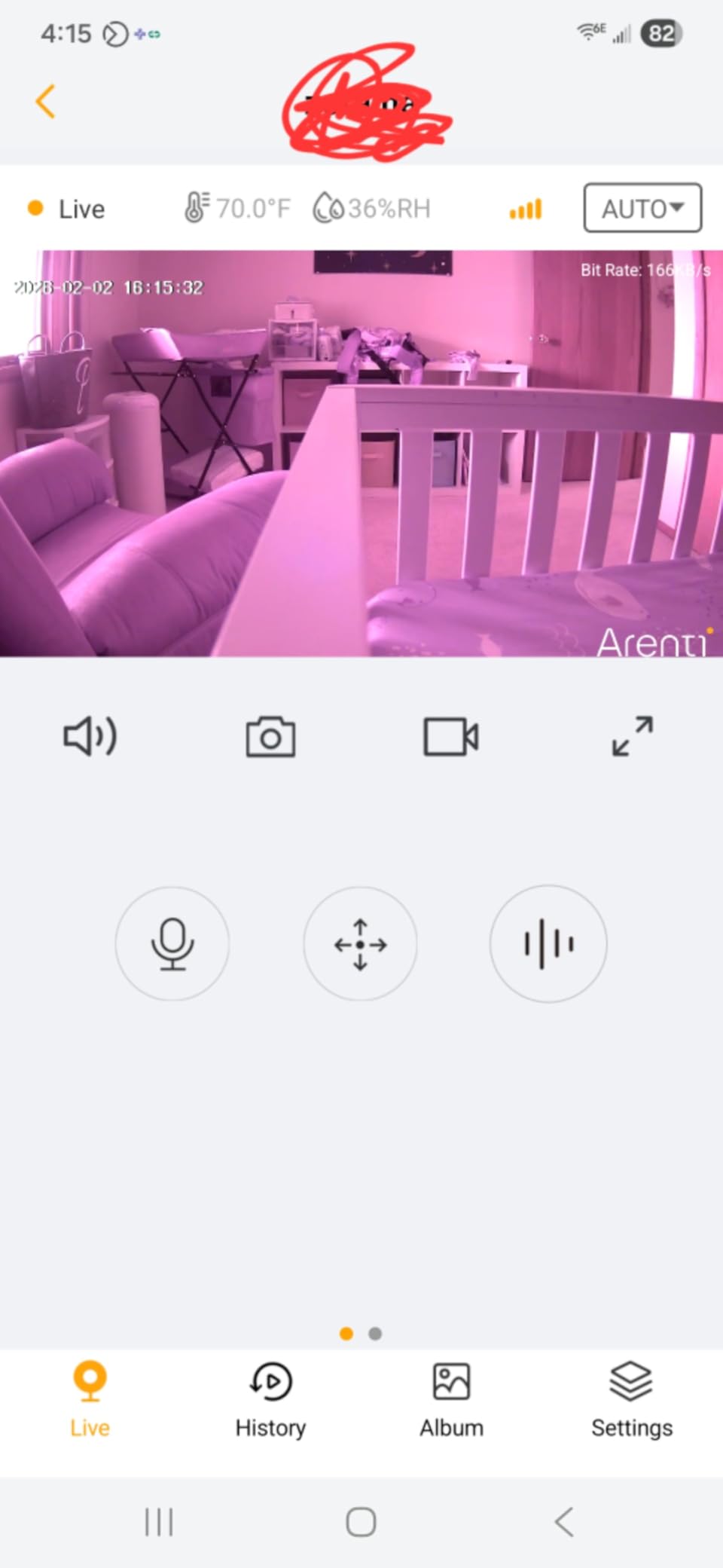
Audio is where this set falls short, and it is the reason it sits near the bottom of the ranking despite the feature list. Multiple reviews describe weak microphones, a fuzzy speaker sound, and an app connection that drops and needs restarting. Switching between the two cameras on the handheld is also described as fiddly at 2am, which is precisely when you need it to be effortless.
Motion sensitivity is inconsistent, and the lowest volume setting is still loud, which can wake the baby the monitor is meant to be watching over. With 1,960 reviews the volume behind the 4.0 rating and 14 percent one-star share is modest, so weigh that carefully. Choose the Babysense TOUCH instead if the split screen is the priority, and choose this if having two cameras in one box is the priority and you mostly need to see rather than hear.
How to Choose a Baby Monitor You Will Still Trust at 3am
Decide on a dedicated parent screen or your phone
A dedicated parent unit is a closed system. It works on a 2.4GHz encrypted radio link or DECT, needs no router, cannot be reached from outside your home, and gives you something physical to carry between rooms. Five of the ten monitors here work this way, and they are the ones I trust most at 3am.
A phone-based system buys you remote viewing, shareable access for a sitter or grandparent, and cloud or local recording, and it costs you dependence on your router, your internet service, and a charged phone. A hybrid like the VTech VM901 does both, at the price of being the least reliable in the group. Our guide to the best baby monitors with WiFi goes deeper on that side.
Check the battery figure you are actually buying
Battery claims in this category are usually the audio-only or VOX figure. The HelloBaby and the iFamily are quoted at up to 30 hours, the VTech VM819 at 19 hours of video or 29 hours of audio only, the Babysense at up to 20 hours, and the Owlet sock at 16 hours. Running the screen on continuously cuts every one of those numbers substantially. For a monitor that stays plugged in at a nightstand, the VTech DM221 is the outlier worth noting, because the parent unit runs from a rechargeable battery but is normally kept on the AC adapter.
Range means walls, floors, and your house’s construction
Rated range is measured in ideal conditions. The VTech DM221 claims 1000 feet of DECT range, and that figure held up across floors in my testing. The video units quote 960 to 1000 feet for a 2.4GHz FHSS link, which is ample for a normal house and marginal for a large one with masonry interior walls. The 400-foot low end quoted by the ARENTI reflects real conditions, not the maximum.
Ask what happens after the free year
Subscription creep is the quietest cost in this category, and it is worth planning for rather than discovering later. The VTech VM901, the Tapo C210, the ARENTI D3, and the Babysense TOUCH all offer local microSD recording or a local monitoring mode that keeps the core features free, and the Babysense and the ARENTI carry no subscription at all for core monitoring. The Owlet offers a deeper insights tier separately. Before you buy, check which specific features sit behind a plan, because a free first year is not the same as a free product.
Think about where the camera goes
Every camera in this roundup is corded, which means the wall outlet decides the placement. A camera that cannot reach an outlet does not work during a power cut, so decide in advance whether that matters to you. On the mounting side, the HelloBaby, GoodBaby, and iFamily support wall, crib, desk, and freestanding positions, so a sleeping spot that moves between the crib, a bassinet, and a play area is easy to accommodate.
Baby Monitor Privacy, Hacking and Emission Questions Answered
No monitor can be hacked if it never touches a network, which is the core reason five of the ten picks here run on a closed encrypted radio link or a DECT 6.0 signal rather than WiFi. An internet-connected camera in a nursery is a camera on your home network, and it inherits your network’s weaknesses.
If you want a WiFi monitor, there are concrete steps. Use a separate WPA2 or WPA3 password for the camera rather than sharing your main one. Turn off the automatic WiFi password-sharing feature many routers ship with. Keep the camera firmware current, since manufacturers patch vulnerabilities when they find them. Create a separate app account with a unique password and two-factor authentication where offered. And if you do not need remote viewing, do not sign into the app at all.
On radio emissions, every product in this roundup uses either an encrypted 2.4GHz FHSS link, a DECT 6.0 digital signal, Bluetooth, or WiFi, and all of them transmit at very low power. Non-WiFi monitors are not emission-free, and claims that a digital link is completely safe are not accurate. What is accurate is that a monitor you never attach to the internet is not reachable by anyone outside its encryption key, which is the risk most parents are actually worried about.
Finally, the medical question. Consumer baby monitors, including health-tracking wearables, are monitoring and convenience products rather than medical devices, and no pediatric body recommends a specific brand. Monitor misuse and loose monitor placement in a crib pose a real hazard, and a breathing or heart rate reading from a consumer wearable should prompt a call to your pediatrician rather than a self-diagnosis. Safe sleep practices, on their own, do more for your baby than any screen in this roundup.
Frequently Asked Questions
What are the top 10 baby monitors?
The best baby monitors in this roundup are the HelloBaby HB6550 for most families, the VTech DM221 for audio-only monitoring, the VTech VM819 for travel, the GoodBaby SM663 for feeding reminders, the iFamily SM650 for instant setup, the Tapo C210 for 2K video, the VTech VM901 for shared app viewing, the Babysense TOUCH for twins, the Owlet Dream Sock for pulse and oxygen tracking, and the ARENTI D3 Set for two-camera value.
Can baby monitors be hacked if they are not connected to the internet?
A no-WiFi monitor cannot be hacked remotely, because it never joins a network. It transmits on an encrypted 2.4GHz FHSS or DECT 6.0 link between the baby unit and the handheld, so the only way to intercept it would be physical access to both devices. WiFi monitors are the ones exposed, which is why using a separate password, a separate app account, and two-factor authentication matters.
Do pediatricians recommend baby monitors?
No body recommends a specific consumer brand. Pediatric guidance focuses on safe sleep practices and on not placing a monitor inside the crib, where it can be a suffocation and entrapment hazard. Monitors are generally viewed as convenience and reassurance tools, and any health-tracking wearable should prompt a call to your pediatrician rather than a self-diagnosis.
What baby monitor has the best battery life?
Among the picks here, the HelloBaby HB6550, the GoodBaby SM663, and the iFamily SM650 are each rated for up to 30 hours in voice-activated mode, and the VTech VM819 delivers 19 hours of video or 29 hours of audio only. These figures assume the screen is off or in VOX mode. Running the screen on continuously reduces the runtime substantially on every model.
Is Nanit or Owlet better?
They answer different questions. The Owlet Dream Sock is a wearable that tracks pulse rate and oxygen levels with no video at all, and it works only in the United States. Nanit-style smart monitors pair a camera with app-based sleep analytics. If you want to see your baby, choose a camera system; if you want a breathing and heart rate trend without a camera, the Owlet is the option in this group.
The Verdict: Which Baby Monitor Should You Buy
If you want one monitor and you do not want to think about it, the HelloBaby HB6550 is the pick. It is our editor’s choice, it has a 5-inch screen that still fits in one hand, its connection is encrypted with no app and no account, and it is rated to run a full night on its parent unit battery. Parents who value longevity above features should look at the VTech DM221, which carries the highest rating here and owners report using for years without replacement.
Buy the Tapo C210 if picture quality is the priority and you will keep an app open on a tablet, the iFamily SM650 if you are setting up a nursery tonight and want zero configuration, the GoodBaby SM663 if a feeding timer would change your daily routine, and the VTech VM819 if the monitor travels between homes. For two babies or two rooms, the Babysense TOUCH handles split screen properly and the ARENTI D3 Set covers the same two-camera brief with weaker audio. The Owlet Dream Sock is a different category entirely, a wearable for pulse and oxygen trends rather than a camera, and the VTech VM901 is the one to choose when a sitter or grandparent needs their own app access.
Whatever you pick, set it up before the baby arrives, test it through one full night, and keep safe sleep practices as the thing that actually reduces risk. A monitor tells you what is happening. It does not change what should be happening. Use the buttons below to check the current details on any of these picks, and we will keep this list updated as the models change.
Leave a Reply