
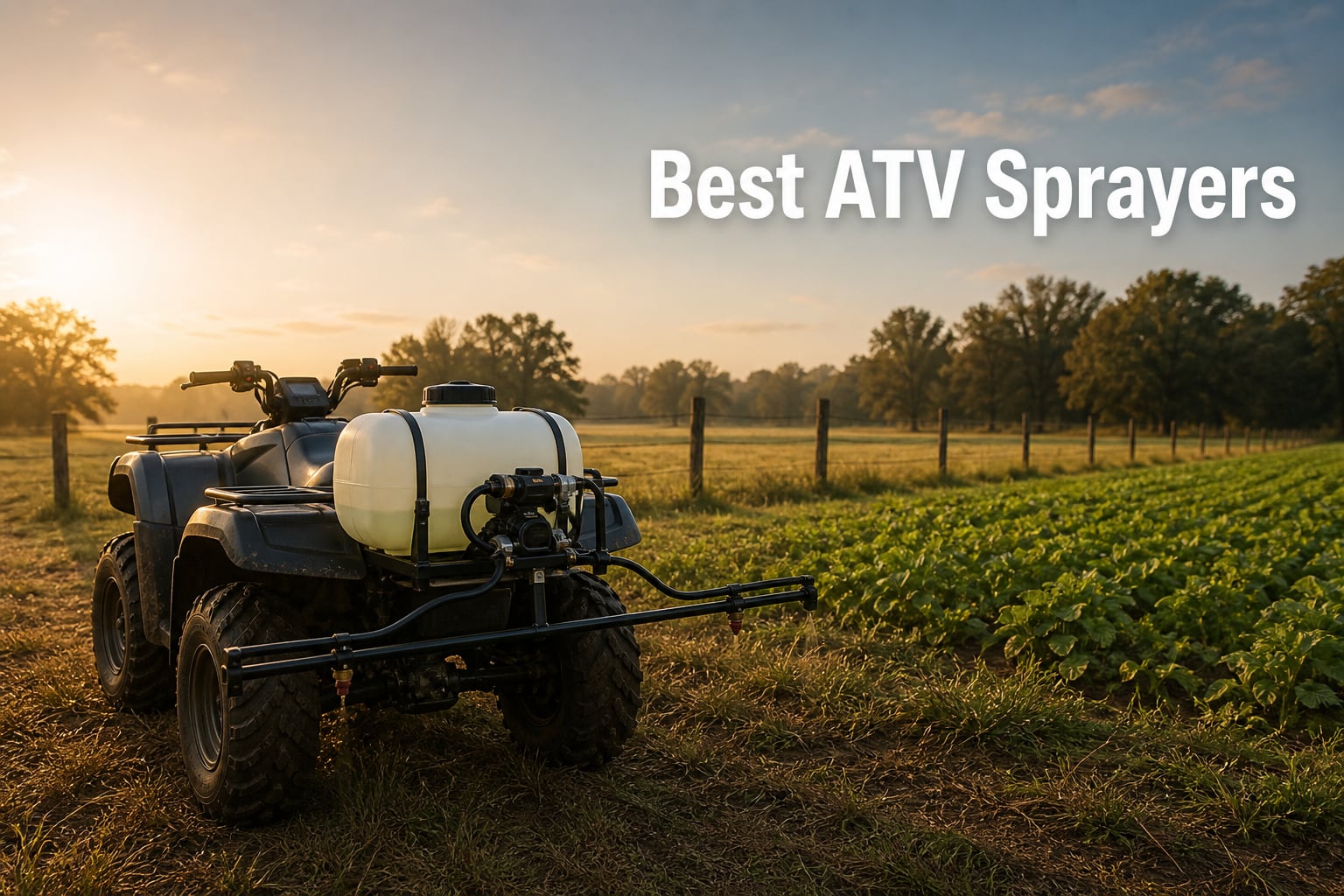
The Best ATV Sprayers make a hard choice simple: choose a boom when even field coverage matters, and choose a spot-spray setup when you need to work around trees, gates, fence lines, and brush. We compared the eight analyzed models by their stated tank size, pump output, hose reach, included boom equipment, filtration, mounting hardware, and review record rather than treating every 12-volt sprayer as interchangeable.
An ATV sprayer uses a 12-volt pump to move liquid from a tank through a hose and nozzle. That basic setup can handle targeted weed work, but a broadcast boom changes it into a more consistent tool for food plots and open ground.
Our strongest larger-acreage choice is the Chapin 40-gallon unit because it combines a 2.5 GPM diaphragm pump, a two-nozzle boom, and triple filtration. For a more manageable mounted spot sprayer, the 15-gallon Chapin 97154 brings a 1.0 GPM pump, a 15-foot hose, and two filters; the 8-gallon Chapin is the lighter fit for smaller jobs.
Before selecting any ATV or UTV sprayer, check your vehicle rack or cargo area, the filled tank load, and the herbicide or fertilizer label. The right gallons-per-acre setting and clean nozzles matter as much as a larger tank.
The three strongest choices cover acreage, dependable spot work, and compact spraying
The top three serve different property sizes, so the badge is not a promise that one rig fits every ATV. The Chapin 40-gallon model is the field-oriented pick, while the two smaller Chapin options make more sense when weight, storage, and targeted coverage lead the decision.


The eight ATV sprayers differ most in capacity, flow rate, and coverage method
Use this overview to narrow the field, then read the full sections for mounting and maintenance trade-offs. A listed flow rate describes pump capacity, while a boom, spot gun, or adjustable nozzle determines how that output reaches vegetation.
| Product | Specs | Action |
|---|---|---|
| Chapin 15-Gallon ATV/UTV Tank Sprayer |
|
View on Amazon |
| Chapin 8-Gallon ATV Spot Sprayer |
|
View on Amazon |
| Chapin 40-Gallon 2-Nozzle Boom Sprayer |
|
View on Amazon |
| Chapin 25-Gallon Mounted Spot Sprayer |
|
View on Amazon |
 Workhorse ATV2503 3-Nozzle Boom Sprayer Workhorse ATV2503 3-Nozzle Boom Sprayer |
|
View on Amazon |
 Grass Guardian 25-Gallon Broadcast Sprayer Grass Guardian 25-Gallon Broadcast Sprayer |
|
View on Amazon |
 Chapin 97214 Deluxe Boom Sprayer Chapin 97214 Deluxe Boom Sprayer |
|
View on Amazon |
 VEVOR 15.9-Gallon Adjustable Boom Sprayer VEVOR 15.9-Gallon Adjustable Boom Sprayer |
|
View on Amazon |
1. The Chapin 40-Gallon Boom Sprayer is the best fit here for larger open areas
CHAPIN 98444 40-Gallon ATV/UTV Sprayer, 2-Nozzle Boom & 2.5 GPM Pump
40 gal tank
2.5 GPM pump
2-nozzle boom
Pros
- 40-gallon capacity
- 2.5 GPM output
- Triple filtration
- Boom included
Cons
- Large footprint
- Only 50 reviews
The Chapin 98444 is the most field-focused option in this group because it pairs a 40-gallon tank with a two-nozzle boom and a stated 2.5 GPM diaphragm pump. We would shortlist it for pasture edges, food plots, and acreage where fewer refill stops outweigh the need for a compact rack-mounted load.
Its 4.2 rating comes from 50 reviews, so the review base is smaller than Chapin’s 15-gallon and 8-gallon models. Still, the equipment list is unusually complete: a 20-inch poly wand, 15-foot reinforced hose, locking S-clips, ratchet straps, a large opening, and a two-inch drain are all listed.
The 40-gallon tank is better for acreage but demands a vehicle-load check
Forty gallons of liquid add substantial load before the tank and hardware are counted, so this is not a casual fit for every ATV rack. Forum discussions repeatedly flag full-tank weight distribution as a safety concern; confirm the vehicle’s rack and cargo guidance before filling the tank.
The translucent chemical-resistant tank and six-inch opening make it easier to see remaining liquid and pour in a measured mix. A larger capacity does not change the application label, though—it only extends the distance possible between refills at your chosen gallons-per-acre rate.
The 2.5 GPM diaphragm pump supports a boom and handheld work
At 2.5 GPM, this pump has more stated flow than the 1.0 and 1.1 GPM models in this list. That reserve is useful when feeding a two-nozzle boom, while the 20-inch wand and reinforced hose keep targeted work available for missed patches or fence corners.
The listed maximum pressure is 60 PSI. Pressure alone does not set application volume: nozzle type, travel speed, and boom height also control the result, so calibrate with water before introducing chemical.
The triple filtration is the practical advantage for users worried about clogs
Chapin lists a filter-cap basket, in-tank filter, and serviceable shut-off filter. That three-stage approach directly addresses a recurring owner concern: debris in lines or nozzles can interrupt a pass and create uneven coverage.
Clean the tank and filters after each labeled application, especially before switching products. The diaphragm pump is also listed as able to run dry with no shafts or seals to replace, but cleaning and a quick inspection remain sensible habits.
2. The Chapin 15-Gallon Tank Sprayer is the balanced choice for regular spot spraying
CHAPIN 97154 15-Gallon ATV/UTV Sprayer with 12V Pump & 15-Ft Hose
15 gal tank
1.0 GPM pump
15-foot hose
Pros
- 4.4 rating
- Double filtration
- EZ mount
- Wide tank opening
Cons
- No boom included
- Needs 12V power
The Chapin 97154 earns the strongest rating in this roundup at 4.4 from 793 reviews, and its configuration stays focused on practical targeted spraying. Its 15-gallon chemical-resistant poly tank sits between the tiny spot-spray units and the much heavier 25- or 40-gallon options.
We like the plain logic of this build for fence lines, individual weeds, and irregular ground: a 1.0 GPM 12-volt diaphragm pump, 18-inch wand, 15-foot reinforced hose, and EZ mount system. It is not a substitute for an included broadcast boom when a uniform field pass is the job.
The 15-gallon capacity makes refills and ATV handling easier to balance
The stated empty weight is 17 pounds, and the 15-gallon tank has a six-inch opening. That opening can make measured filling and rinsing less awkward, while the tank is considerably smaller than a 40-gallon rig for riders working from a rear rack.
Capacity should follow the label rate, not a guess about acres. For example, a 15-gallon fill lasts one acre only when the labeled and calibrated application rate is 15 gallons per acre.
The double filters are a meaningful defense against nozzle downtime
Chapin specifies both an in-tank filter and a shut-off filter. This is useful because clogging and line maintenance are repeated pain points in user discussions, particularly when spray material or fill water carries debris.
Filter protection is not permission to skip rinsing. Strain water when possible, inspect the filters before a long day, and never try to clear a nozzle by blowing through it with your mouth.
The EZ mount and 15-foot hose favor mobile spot treatment
The EZ mount is listed for ATV, UTV, and tractor attachment, and the hose length gives useful reach without constantly repositioning the vehicle. The 60 PSI maximum and adjustable wand nozzle make it suitable for a controlled stream or a broader spray pattern.
Review data shows 72% five-star and 13% four-star ratings. That is encouraging for this simple spot-sprayer format, but make a clean 12-volt connection and route the wiring away from heat, moving suspension parts, and sharp edges.
3. The Chapin 8-Gallon Spot Sprayer is the lighter answer for small properties and touch-ups
CHAPIN 97084 8-Gallon ATV/UTV Sprayer with 12V Pump & 15-Ft Hose
8 gal tank
1.0 GPM pump
20-inch wand
Pros
- 9-pound empty weight
- Chemical-resistant seals
- 20-inch wand
- 4.3 rating
Cons
- Frequent refills
- 10-foot hose
The Chapin 97084 is a compact ATV spot sprayer, not a field boom rig. Its 8-gallon tank and stated nine-pound empty weight are why we would pick it for isolated weeds, garden-adjacent work, and riders who need to protect a smaller ATV from a bulky load.
It has a 4.3 rating from 294 reviews, including a reported 75% five-star share. The 12-volt 1.0 GPM diaphragm pump, 20-inch wand, adjustable poly nozzle, and chemical-resistant seals give it the essential equipment for herbicide, fertilizer, or pest-control applications that the label permits.
The eight-gallon format makes sense when stability is more important than runtime
A smaller tank needs more refills on a large property, but it also reduces the amount of liquid carried at one time. That trade-off can be smart for a narrow rack, an ATV with limited cargo capacity, or a job consisting of repeated short spot treatments.
The tank is still a chemical container, so secure it with appropriate mounting and keep the vehicle level during filling. A 23.75-inch stated width also deserves a measuring-tape check against the planned mounting surface.
The chemical-resistant seals support varied labeled applications
Chapin specifically lists chemical-resistant seals and gaskets, along with a chemical-resistant poly tank. That construction is relevant when the same sprayer may alternate between compatible fertilizers, pesticides, and weed-control products.
Do not assume products are interchangeable merely because a tank is chemical resistant. Read each product label, follow its mixing directions, and rinse according to the label before changing chemicals to avoid unintended carryover.
The 20-inch wand and adjustable nozzle keep the work targeted
The 10-foot hose is shorter than the 15- and 20-foot options in this guide, but the longer 20-inch wand helps reach under shrubs and toward low vegetation. This combination favors close, deliberate application rather than covering an entire food plot at a consistent swath.
A 60 PSI maximum does not mean every job needs maximum pressure. Use only the nozzle setting and pressure needed to meet the label’s droplet and coverage guidance, especially when wind could carry fine spray off target.
4. The Workhorse ATV2503 is the boom choice for users who want three nozzles and 2.2 GPM
Workhorse ATV Spot Sprayer with 25 Gallon Polyethylene Tank, 3 Nozzle Boom, 15ft. Hose, 18 inch Spray Wand, 60 PSI, 12 Volt Pump – 2.2 GPM ATV2503
25 gal tank
2.2 GPM pump
3-nozzle boom
Pros
- Three-nozzle boom
- 2.2 GPM output
- 0-60 PSI adjustment
- Corrosion-resistant tank
Cons
- Listed hand-powered
- Limited review base
The Workhorse ATV2503 brings a 25-gallon polyethylene tank, a three-nozzle boom with flood tips, and a stated 2.2 GPM pump. That arrangement is designed around broad coverage rather than the narrow spot-spray work that defines the Chapin 15-gallon model.
The product data describes an 18-inch spray wand or hand gun, a 15-foot hose, 0-60 PSI adjustment, and chemical- and corrosion-resistant construction. Its 4.2 rating is drawn from 48 reviews, so we would weigh the listed specifications alongside the smaller review sample.
The three-nozzle boom is the reason to choose this Workhorse model
Three flood-tip nozzles can distribute spray across a wider working area than a single handheld nozzle. A boom is generally the better tool for precision field coverage because the nozzles maintain a repeatable position and spacing when the rig is mounted level.
Spray pattern consistency still depends on cleaning tips, holding a consistent speed, and keeping the boom at its intended height. Avoid treating a boom’s presence as a shortcut around calibration.
The 2.2 GPM pump supplies more flow than basic spot rigs
The stated 2.2 GPM output sits close to the 2.5 GPM Chapin boom models and well above the 1.0 GPM spot sprayers here. More available flow is helpful for a multi-nozzle boom, though actual output at the nozzles changes with pressure, plumbing, and the selected tips.
The product listing identifies the power source as hand powered while also naming a 12-volt pump in the title. Confirm the current package details and operating instructions before ordering so the vehicle power connection matches your plan.
The 25-gallon polyethylene tank balances capacity with rack planning
A 25-gallon tank is a common middle ground for people managing a moderate food plot or several pasture sections. It can carry enough mix for a meaningful pass without the same volume as the 40-gallon Chapin, yet it remains a substantial load when full.
The listed 140-inch hand-gun coverage span is useful for reaching beyond the vehicle, but it is not a measured boom swath. Use the boom for repeatable broadcast coverage and the hand gun for selective work.
5. The Grass Guardian Broadcast Sprayer gives a clearly stated 7-foot swath for small fields
Grass Guardian 25 Gallon ATV & UTV Broadcast Boom Sprayer – 1.1GPM, 7′ Swath
25 gal tank
1.1 GPM pump
7-foot swath
Pros
- Defined 7-foot swath
- 20-foot spot reach
- Raised tank marks
- Mounting straps included
Cons
- 22 reviews
- 14% one-star share
The Grass Guardian is one of the clearer choices for a buyer who wants both a stated broadcast pattern and a dedicated spot gun. It combines a 25-gallon translucent tank, 1.1 GPM 12-volt Everflo diaphragm pump, 7-foot broadcast swath, and adjustable gun with a stated 20-foot horizontal reach.
We would view it as a small-field ATV broadcast sprayer where knowing the claimed swath matters for planning overlap. Its 4.1 rating comes from 22 reviews, and the reported distribution includes 14% one-star reviews, which calls for a careful inspection and a conservative first setup.
The stated 7-foot broadcast swath makes pass planning more concrete
A stated seven-foot swath lets you begin planning lane spacing, although the correct overlap depends on nozzle pattern, boom height, and wind. In an open plot, a boom with a known pattern is easier to calibrate than a boomless nozzle whose edge can shift with terrain and air movement.
Use water first and capture output from the broadcast nozzles for a timed test. Then measure a short course, record travel time at your normal speed, and adjust speed or pressure until the output agrees with the application label.
The spot gun offers stream-to-mist flexibility beyond the broadcast boom
The adjustable gun moves from stream to mist and has 15 feet of rubber hose, while the listing states a 20-foot horizontal spot-spray reach. That makes it useful for corners, individual weed clusters, and a few missed areas after a broadcast pass.
Longer reach does not remove drift risk. A fine mist can move well beyond the target in wind, so use the most controlled pattern appropriate for the label and do not spray when conditions could carry material to desirable plants or water.
The mounting hardware and power harness simplify a basic ATV installation
Two ratchet straps and a 12-volt alligator-clamp wire harness with a power switch are included according to the listing. Raised volume marks on the translucent tank can help when filling to a calculated amount rather than making an unmeasured batch.
The base unit is listed at 34 pounds before liquid. Place it as low and centered as the vehicle allows, tighten the straps again after a short drive, and make the electrical connection only after the controls are off.
6. The Chapin 97214 pairs a 2.5 GPM pump with a 7-foot boom for higher-output 25-gallon work
CHAPIN 97214 25-Gallon ATV/UTV Sprayer with 2-Nozzle Boom & 12V Pump
25 gal tank
2.5 GPM pump
7-foot boom
Pros
- 2.5 GPM output
- Three-stage filtration
- EZ mount
- Quick-connect pump
Cons
- 3.9 rating
- 18% one-star share
The Chapin 97214 offers an appealing specification mix for buyers who want a 25-gallon tank without stepping to the 40-gallon model. It includes a 2.5 GPM 12-volt diaphragm pump, a two-nozzle boom with a seven-foot spray pattern, EZ MOUNT hardware, and three-stage filtration.
Those specifications make it a serious ATV spray rig for routine acreage work, but its 3.9 rating across 172 reviews needs equal attention. The reported distribution contains 18% one-star reviews, so do not overlook setup checks, component inspection, and access to support when deciding.
The 2.5 GPM pump gives the boom more flow headroom
The listed quick-connect pump matches the flow rating of Chapin’s 40-gallon boom model. For a two-nozzle broadcast setup, that added capacity can be helpful compared with the 1.0 GPM spot sprayers, particularly when the goal is a stable pattern at the selected operating setting.
Higher GPM is not automatically a better application rate. The goal is to supply the chosen nozzle and reach the label’s gallons-per-acre target at a safe, consistent speed—not simply to run the pump at its highest setting.
The three-stage filtration is built for recurring mixed-work use
Chapin specifies a filter basket, in-tank filter, and shut-off filter. This layered layout is one of the best real-world features on the spec sheet because nozzle clogs can cause stripes, missed vegetation, and time lost dismantling plumbing in the field.
Clean each filter at the interval the manual calls for, rinse the tank after use, and inspect the boom tips for equal output. If one nozzle makes a visibly different pattern during a water test, clean it rather than raising pressure across the whole boom.
The 25-gallon size and EZ MOUNT suit versatile vehicle use
The tank is described as rust-resistant translucent poly with a six-inch opening, and the system is listed for standard ATVs, UTVs, and lawn tractors. That broad compatibility does not replace a physical fit check: compare the tank base, strap path, and wiring length with your own machine.
The included 19-inch wand and 15-foot reinforced PVC hose keep spot work available. This model is best viewed as a boom-first sprayer with a wand for detail work rather than a compact spot sprayer that happens to have high pump output.
7. The Chapin 25-Gallon Mounted Spot Sprayer suits users who want capacity without a supplied boom
Chapin 97254 25-Gallon Mounted ATV/UTV Spot Sprayer
25 gal tank
1.0 GPM pump
16-foot hose
Pros
- 25-gallon capacity
- EZ mount
- Chemical-resistant seals
- Wide-mouth opening
Cons
- No boom included
- 4.1 rating
The Chapin 97254 takes a simpler route: a 25-gallon tank, a 1.0 GPM pump rated up to 60 PSI, and an EZ mount system, without an included broadcast boom. It is the choice for someone who primarily needs more spot-spray runtime or prefers to decide on a separate boom arrangement later.
Its 4.1 rating comes from 48 reviews, with a reported 15% one-star share. We would treat that as a prompt to inspect fittings, confirm the pump operation with water, and keep the one-year limited warranty details available rather than assuming a trouble-free setup.
The 25-gallon tank lengthens spot-spray sessions but adds full-load concerns
For long fence lines and scattered brush control, a 25-gallon tank can reduce interruptions compared with the 8- and 15-gallon Chapin models. The six-inch wide-mouth opening with a filter cap is also a practical detail for filling and cleaning.
Yet a larger tank does not make a spot wand faster at treating a wide field. If the job requires uniform coverage across rows or open ground, choose an included boom model or add compatible equipment only after checking the sprayer documentation.
The 1.0 GPM and 60 PSI specification favors controlled wand work
The 1.0 GPM diaphragm pump is the same stated flow as the Chapin 15-gallon and 8-gallon spot units. It is a sensible output for an adjustable wand nozzle and targeted applications, not the high-flow approach of the 2.2 and 2.5 GPM boom-oriented models.
The listed hose length is 192 inches, or 16 feet. That extra foot over a 15-foot hose may help when working beside a parked ATV, but it is not a reason to operate beyond a stable, safe position.
The chemical-resistant seals and filter cap support careful product changes
Chapin lists chemical-resistant seals and gaskets for standard fertilizers, weed killers, and pesticides. Follow the exact label for each material and use a dedicated measuring container; do not mix chemicals in the tank unless the label permits it.
After spraying, flush the wand, hose, and pump with the label-directed rinse process. Keeping the filter cap clean and avoiding debris at fill time are small steps that address the reliability and clogging worries commonly raised by sprayer owners.
8. The VEVOR 15.9-Gallon Sprayer offers adjustable pressure, boom reach, and a long hose
VEVOR ATV Spot Sprayer, 15.9 Gal/60L ATV/UTV Broadcast Sprayer with A Nozzle Boom, 12 V Pump Sprayer with Water Tank, 1.9 GPM Flow Rate, Adjustable 0-72 PSI, 20FT Hose, for Garden, Farm
15.9 gal tank
1.9 GPM pump
20-foot hose
Pros
- 0-72 PSI adjustment
- 20-foot hose
- Pressure gauge
- Brass nozzle
Cons
- 3.5 rating
- 22% one-star share
The VEVOR model combines a 15.9-gallon tank, 1.9 GPM 12-volt pump, 20-foot hose, telescopic boom, pressure gauge, and regulator valve. On paper, it provides more adjustment and stated reach than the compact Chapin spot sprayers while retaining a tank size closer to the 15-gallon category.
Its 3.5 rating from 72 reviews is the lowest in this roundup, and the reported distribution includes 22% one-star reviews. That does not erase useful specifications, but it changes our recommendation: choose it only if the adjustable boom, gauge, and long hose match a specific need and you are ready to inspect the system carefully.
The 0-72 PSI working range and gauge support deliberate adjustment
The listing states a 0-72 PSI working range, a maximum of 116 PSI, and a built-in gauge with regulator. A gauge can help repeat a known setting after calibration, which is preferable to changing pressure by feel from one outing to the next.
Do not choose a pressure setting from the largest number on the dial. Use the nozzle’s guidance and the application label, then verify actual delivery by catching output for a measured time with clean water.
The 20-foot hose and adjustable boom expand reach around obstacles
The 20-foot hose is the longest listed in this group, and the product claims 21 feet of horizontal and 18 feet of vertical reach. The telescopic boom and brass nozzle can be useful where a fixed short wand limits access.
Reach has a trade-off: long hoses can snag and a high or distant spray can drift. Keep the hose away from tires and exhaust, avoid spraying into wind, and use the closest controlled position that reaches the intended plant.
The rating record means the setup deserves extra scrutiny
VEVOR lists ratchet straps, a quick-coupling line, control switch, pressure gauge, regulator, and adjustable boom among the components. More pieces create more setup flexibility, but they also give a new owner more fittings and functions to check before the first chemical fill.
Start with a water-only test: inspect for leaks, confirm the pressure adjustment responds, check the pattern, and verify that the straps hold the tank stable. This procedure is a good idea for every sprayer, and it is especially useful when review feedback shows mixed reliability experiences.
The right ATV sprayer starts with the label rate, property shape, and vehicle capacity
A larger tank, a faster pump, or an impressive spray-reach claim is only useful when it matches your application plan. These checks will help turn the product specifications above into a safer, more even treatment routine.
The tank-size decision starts with the labeled gallons-per-acre rate
There is no universal acreage number for an 8-, 15-, 25-, or 40-gallon tank. The calculation is direct: acres per tank = tank gallons divided by your calibrated gallons per acre.
- If the label and your calibration call for 5 gallons per acre, a 25-gallon tank covers about 5 acres.
- If the application calls for 10 gallons per acre, that same 25-gallon tank covers about 2.5 acres.
- If the application calls for 15 gallons per acre, a 40-gallon tank covers about 2.7 acres.
That is why “How many acres will 25 gallons spray?” has more than one answer. Start with the product label and nozzle requirements, then calculate capacity; never stretch a mix farther by changing concentration outside the label.
A boom is better for even field coverage while boomless equipment favors obstacles
Choose a boom sprayer for open food plots, lawns, and pasture sections where an even band matters. Multiple nozzles held at a repeatable height make overlap, coverage, and calibration easier to manage.
Choose a spot or boomless setup for fence lines, brush, trees, gates, and rough ground. It is easier to direct the spray around obstacles, but forum users warn that boomless patterns can be uneven for field work and become harder to control in wind.
A hybrid rig—such as the Chapin 40-gallon, Workhorse, Grass Guardian, Chapin 97214, or VEVOR—offers both a boom and a wand or gun. It can cover a plot and handle small missed areas, provided the boom is calibrated separately from the spot nozzle.
The pump output and nozzle choice decide what GPM means in practice
GPM means gallons per minute: it is the pump’s stated liquid-moving capacity, not an acreage claim. A 1.0 GPM system suits many spot-spray jobs, while the 2.2 and 2.5 GPM rigs in this list are better positioned to supply multiple boom nozzles.
PSI is pressure, and pressure changes droplet pattern and output. Raising PSI to chase distance can create fine droplets that drift, so follow the nozzle and chemical label instructions instead of treating high pressure as a general upgrade.
For a 12-volt sprayer, begin with a sound vehicle battery and clean connections. Run the wiring where it cannot rub, pinch, or touch hot parts, and switch the system off before connecting clamps or servicing filters.
An ATV fit depends on full-tank load, tank footprint, and stable mounting
Measure the vehicle before choosing a unit. Compare the tank width and base with the rack or cargo bed, confirm the straps have a secure path, and check that the hose and wiring can reach without interfering with steering, suspension, tires, exhaust, or the rider.
ATV and UTV compatibility printed on a listing is a starting point, not a fit guarantee. The Chapin models list EZ mounting for ATV, UTV, and tractor use, while the Grass Guardian supplies ratchet straps; in every case, the tank should sit low, centered, and firmly restrained.
Do a water-only shake-down run before the first application. Stop after a short distance, recheck strap tension and leaks, and confirm that the vehicle still handles predictably with the liquid moving in the tank.
Calibration and clean filtration produce more even coverage than guesswork
Calibration starts with water. Fill the tank with water, set the pressure you plan to use, run each nozzle into a marked container for the same timed interval, and compare the amounts; uneven nozzles should be cleaned or replaced before you spray a field.
Next, mark a measured course and drive it at your normal working speed while spraying water. Use the water consumed, course area, and tank markings to calculate gallons per acre, then adjust speed, pressure, or tips until the result matches the application label.
Filters deserve the same attention. The Chapin 15-gallon has double filtration, while the Chapin 40-gallon and 97214 list three filtration stages; regardless of model, keep debris out during filling, inspect filters, and flush the full system after the label-directed process.
The answers below resolve the most common ATV sprayer buying questions
Who makes the best ATV sprayer?
Chapin is the strongest overall brand in this comparison because it appears in five analyzed models spanning 8 to 40 gallons, with mounting options, filtration features, and the largest review record here. The best individual model still depends on whether you need a compact spot rig or a boom-equipped acreage sprayer.
What is the best sprayer on the market?
The Chapin 40-Gallon 2-Nozzle Boom Sprayer is our best overall pick from these eight for larger open areas. Its 40-gallon tank, 2.5 GPM diaphragm pump, included two-nozzle boom, and triple filtration suit repeated field coverage, but its full load requires a vehicle-capacity check.
Which is better, a boom or a boomless sprayer?
A boom is better for consistent coverage across open ground, while boomless or spot spraying is better around obstacles. A boom holds multiple nozzles at a repeatable height for calibration; a directed nozzle is more flexible for fence lines and brush but can be less even in wind.
How many acres will 25 gallons spray?
A 25-gallon tank covers acres based on your calibrated gallons-per-acre rate. Divide 25 by the label rate: at 5 gallons per acre it covers 5 acres, at 10 gallons per acre it covers 2.5 acres, and at 15 gallons per acre it covers about 1.7 acres.
Can a UTV sprayer be used on an ATV?
Some ATV/UTV sprayers can fit either vehicle, but fit depends on the actual rack, cargo area, straps, wiring, and full-tank load. Measure the mounting surface and check vehicle guidance before filling; a tank that fits physically may still be too heavy or unstable for a particular ATV.
The best final choice depends on whether you cover fields, fence lines, or small patches
For broad acreage work, the Chapin 40-Gallon 2-Nozzle Boom Sprayer is our first choice because the tank, 2.5 GPM pump, boom, and filtration align. For steady targeted work with a strong review record, choose the Chapin 15-Gallon Tank Sprayer; for compact touch-ups, the Chapin 8-Gallon Spot Sprayer makes carrying less liquid easier.
The best ATV sprayers in 2026 are not simply the biggest tanks. Match your model to the label rate, property shape, ATV capacity, and need for a boom, then run a water-only calibration before the first application.
Leave a Reply