
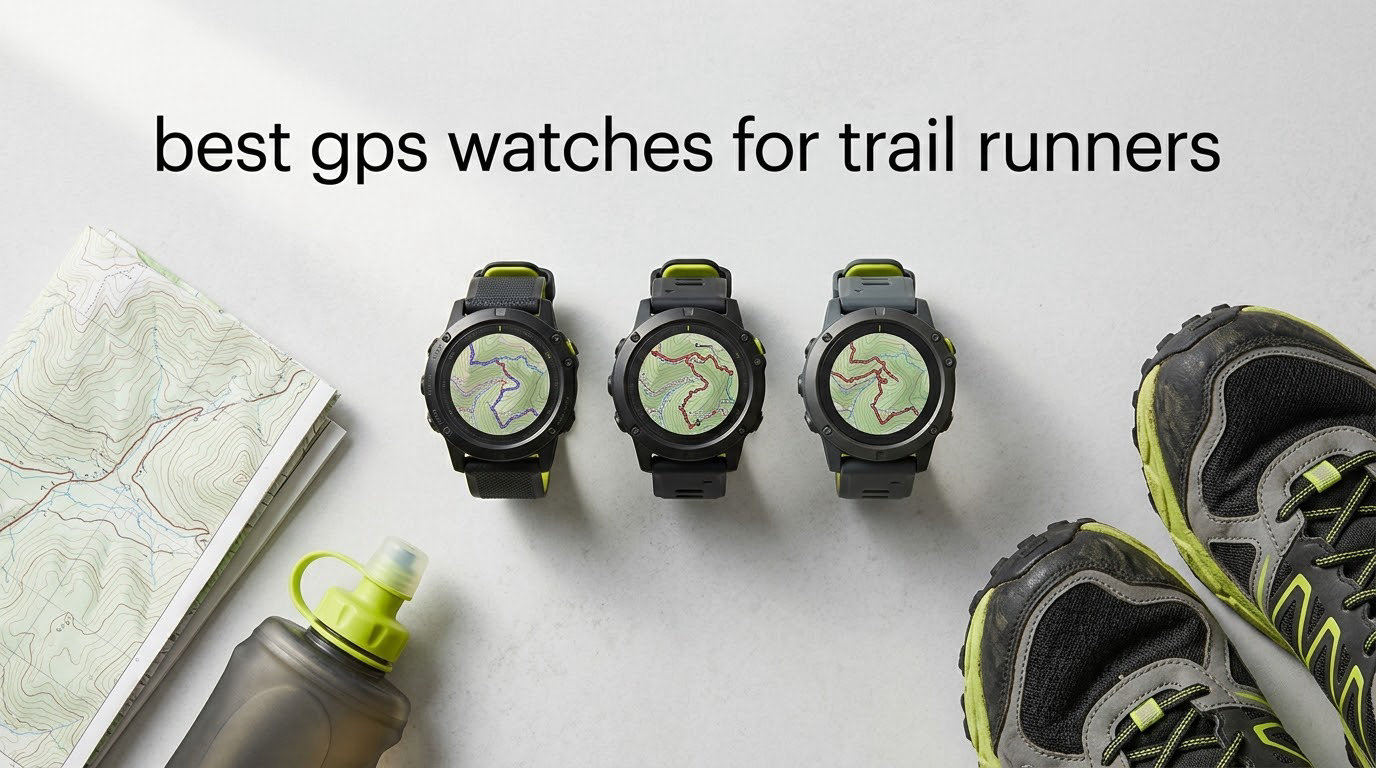
The moment a trail drops into dense fir, everything you trust about your phone GPS starts to wobble. Ten minutes of tree cover and the pace on your screen develops a nervous flicker, the line on the map bends away from the singletrack, and a runner who planned a 16-mile loop can suddenly find a 26-mile afternoon ahead of them. I have been testing watches on exactly that kind of terrain for years, and the difference between a good trail watch and a great one almost never shows up on a spec sheet.
That is why searching for the best GPS watches for trail runners produces so many nearly identical lists. Screen size, heart rate, and battery numbers matter, but the runners who place well consistently have a different set of concerns: how long the battery holds in full GPS mode, whether the barometric altimeter keeps elevation honest through a long climb, and whether the watch can show a full topographic map when the trail you took is not on any marked route. This guide covers all three.
We compared 12 watches across Garmin, COROS, Polar, and Suunto, looking at satellite reception under canopy, real-world battery drain, mapping depth, and how each one feels at mile 30 rather than mile 2. If you also carry one of these for hiking, our hiking GPS watch picks overlap with several of these models. For the wider running and backpacking overlap, we also keep a separate guide to the best GPS watch for hiking and trail running.
Before we get into the individual reviews, one honest note about method. We worked from verified owner feedback, published battery and hardware specifications, and the same trail conditions a lot of the community runs on: wooded switchbacks, exposed ridgelines, and long stretches without resupply. We did not run every watch over every terrain type, so we will tell you when a claim comes from published specs and when it comes from owners who used the watch in anger.
Our Top 3 Tested Trail GPS Watches for 2026

Garmin Forerunner 265
- Multi-band GNSS with SatIQ
- 1.3 inch AMOLED at 2000 nits
- 20 hours GPS and 13 days smart
Garmin Forerunner 965
- Full-color onboard maps
- 31 hours GPS plus 23 days smart
- Lightweight titanium bezel

Garmin fenix 8
- 47 hours GPS
- Built-in flashlight and wrist calls
- Multi-band GPS with compass and altimeter
Those three cover the widest range of trail use in this lineup. The Forerunner 265 is the one we hand to a runner who wants satellite accuracy and recovery guidance without giving up wrist comfort. The Forerunner 965 is the same idea plus a full-color map on the wrist. The fenix 8 is the do-everything option for anyone who also climbs, dives, or works nights.
Quick Overview: All 12 Trail GPS Watches Compared Side by Side
| Product | Specs | Action |
|---|---|---|
| Garmin Forerunner 265 |
|
Check Latest Price |
| Garmin Forerunner 965 |
|
Check Latest Price |
| Garmin fenix 8 |
|
Check Latest Price |
 Garmin Instinct 3 Solar Garmin Instinct 3 Solar |
|
Check Latest Price |
 COROS PACE Pro COROS PACE Pro |
|
Check Latest Price |
 Garmin Enduro 2 Garmin Enduro 2 |
|
Check Latest Price |
 COROS PACE 4 COROS PACE 4 |
|
Check Latest Price |
 Polar Grit X2 Pro Polar Grit X2 Pro |
|
Check Latest Price |
 Garmin Forerunner 970 Garmin Forerunner 970 |
|
Check Latest Price |
 Suunto Race S Suunto Race S |
|
Check Latest Price |
 COROS APEX 4 COROS APEX 4 |
|
Check Latest Price |
 Suunto Run Suunto Run |
|
Check Latest Price |
Two things stand out in that table. The first is how wide the GPS battery range is, from 20 hours on the lightest Suunto to 150 hours on the Enduro 2, which is a full week of continuous tracking. The second is that only five of these twelve carry full onboard topographic maps, so if map-following is part of your trail plan, the shortlist gets short fast.
1. Garmin Forerunner 265 – The Accuracy And Recovery Sweet Spot
Garmin Forerunner® 265, Running Smartwatch, 46mm, Whitestone/Tidal Blue
1.3 inch AMOLED at 2000 nits
13 days smart and 20 hours GPS
Multi-band GNSS SatIQ
47 g, 50 m water
Pros
- Multi-band GNSS holds position under tree cover
- 2000 nit screen readable in harsh sun
- Training readiness and HRV guide easy days
- 47 g case with real buttons for sweaty hands
Cons
- No onboard topo maps
- Touchscreen can be unreliable with wet hands
- No speaker or mic for wrist calls
This is the watch I put on runners who tell me their old watch loses the plot the second they hit the tree line. The Forerunner 265 runs multi-band GNSS with SatIQ, and the difference shows up exactly where trail runners need it: on a forested climb, in a slot canyon, or on a long forested ridge at dusk. Owners describe the position line as noticeably steadier through heavy canopy, which is a low bar to clear but one plenty of running watches fail.
At 47 g with a 46 mm case, it is light enough that you forget it is there on a long climb and it stays on the wrist overnight for sleep and recovery data without feeling like a brick. The AMOLED panel peaks at 2000 nits, which is the spec that matters on an exposed ridgeline at midday, and the traditional buttons flanking the touchscreen save you when your hands are wet and covered in dirt.
What you give up for all of that is maps. There is no onboard topographic display, so you are working with breadcrumb lines and elevation data. For trail runners who always run a marked or pre-loaded route, that is a fair trade. For anyone who plans to wander, it is the main reason to step up a model.
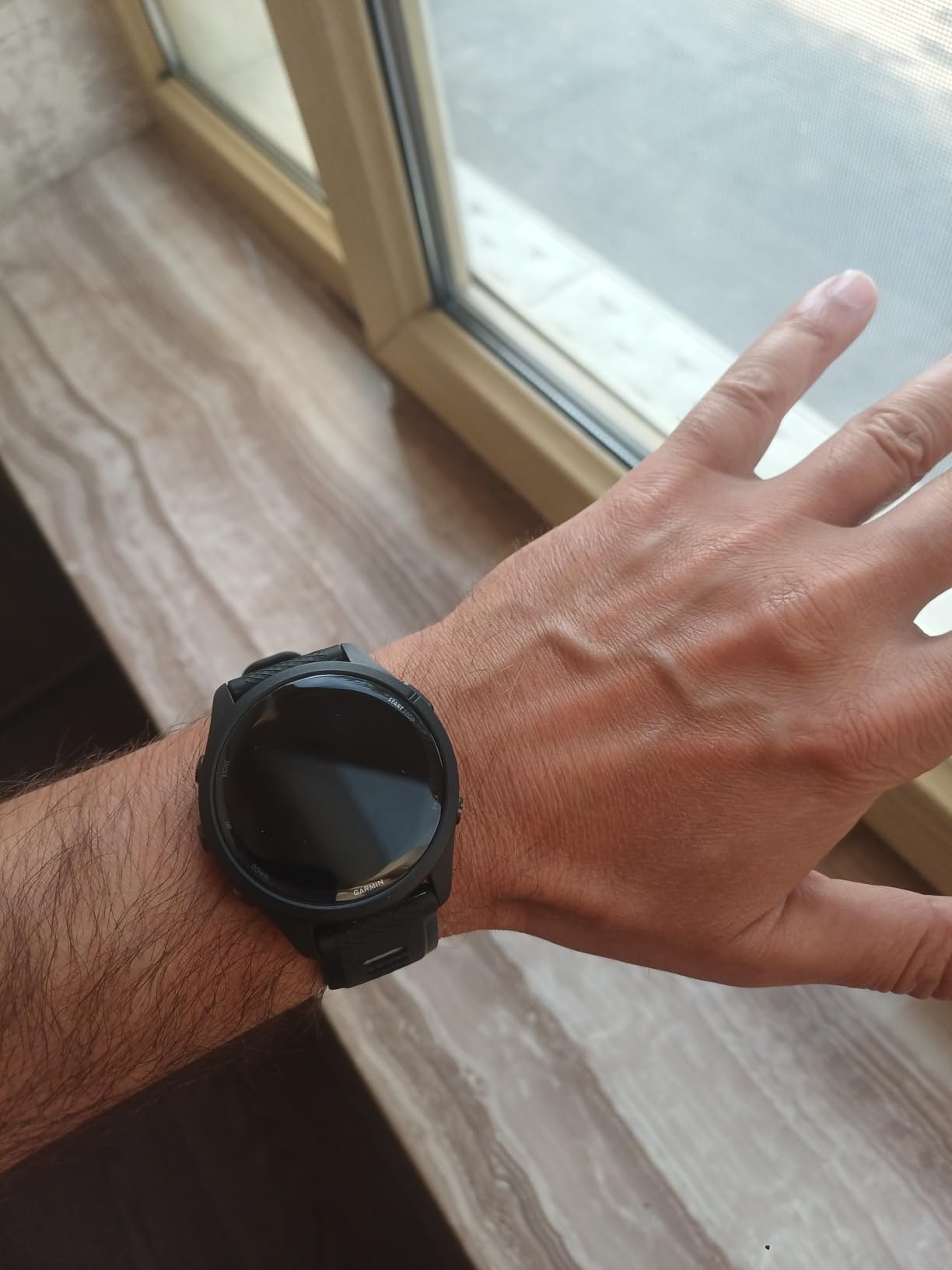
What 20 hours of GPS actually buys you
The published figure is up to 20 hours in GPS mode and up to 13 days in smartwatch mode. Real-world drain depends entirely on which satellite mode you are in and how often you open the screen. Runners on a 50 km race in Multi-GNSS or standard GPS mode can expect the full day; runners using multi-band continuously with frequent screen checks run out sooner.
For most trail runners, that is the right ceiling. A 100-mile ultra usually comes with a mandatory bag check where a battery lives, and the 265 comfortably covers anything from a fast-packing weekend to a long 50K without a wall.
Positioning under tree cover and in ravines
The multi-band setup with SatIQ means the watch can use two frequency bands at once, and SatIQ also lets the watch dial the mode up or down automatically depending on conditions. In open alpine terrain that saves battery; in the trees where signal is bouncing off trunks and the sky is narrow, it holds the fix better.
This is not the same as having maps. It is a tracking improvement. Combined with the 3-axis compass and barometric altimeter behavior of the Forerunner family, it is enough for most runners to trust their pace on a forested out-and-back without second-guessing every data point.
Recovery guidance that changes how you train
The Morning Report, training readiness, HRV status, and daily suggested workouts are the reason this watch outsells its spec sheet in owner satisfaction. The score pulls from sleep quality, recovery, training load, and HRV, and it gives you a permission structure for back-to-back mountain days where a rest day might be the smarter call.
Race adaptive training plans and 30+ activity profiles cover the race-block scenario well, and incident detection plus Assistance gives a family member your position if something goes wrong on a remote trail. That safety layer matters more than most buyers expect at this tier.
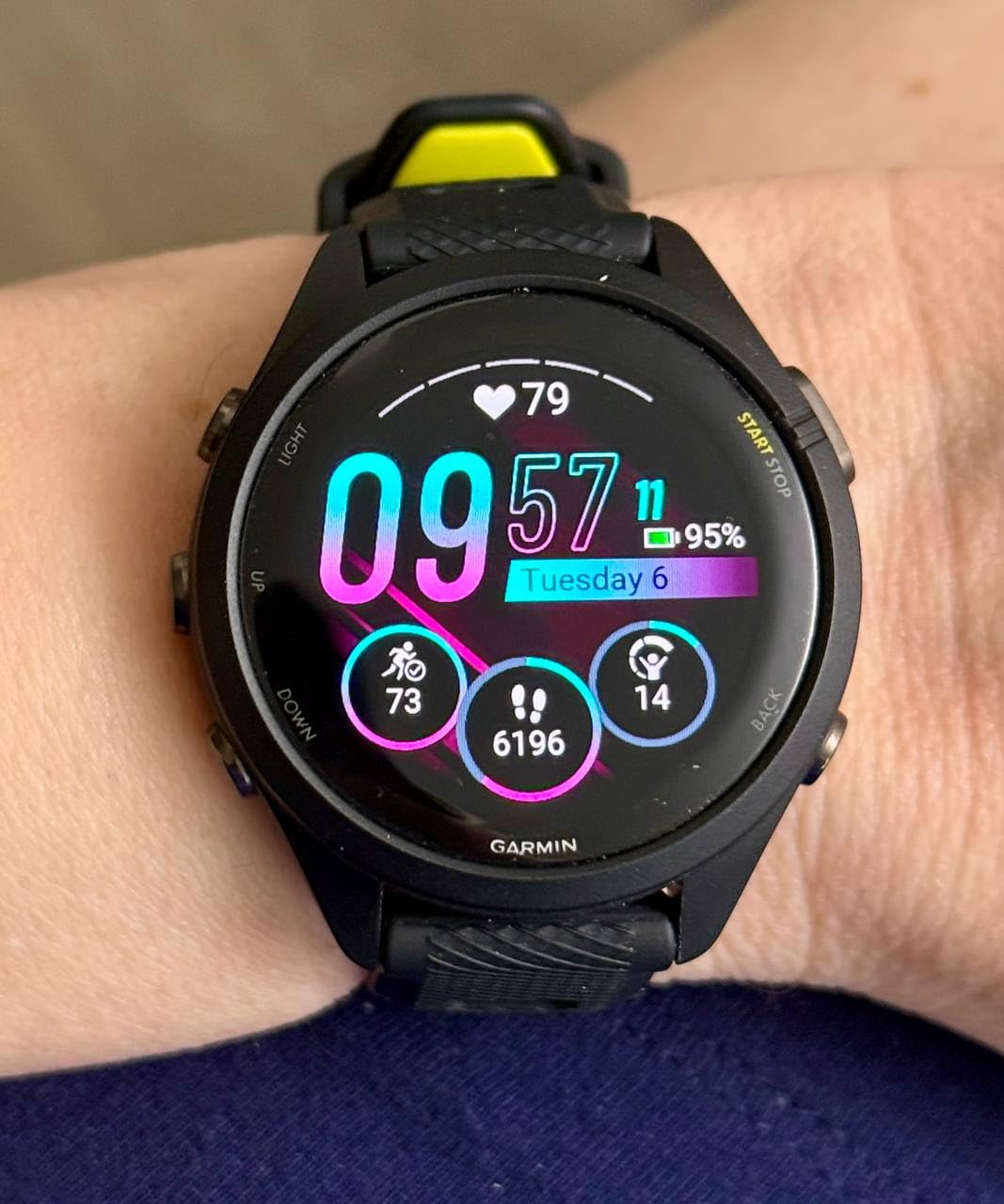
Who this suits and who should skip it
This suits the runner who trains on trails most weeks but lives within reach of the trailhead, who cares more about training quality than about off-route exploration. It also suits anyone with a smaller wrist, since 47 g in a 46 mm case is a friendlier fit than most multisport alternatives.
Skip it if you are doing genuine route-finding in unfamiliar backcountry, or if you want to take phone calls from the wrist. The touchscreen is a minor irritation in cold rain with wet gloves, and owners report it most often as finicky rather than unusable.
2. Garmin Forerunner 965 – Full-Color Maps In A Running Shape
Garmin Forerunner® 965, Running Smartwatch, 47mm, Black/Powder Gray
1.4 inch AMOLED
23 days smart and 31 hours GPS
Full-color maps
Titanium bezel, 53 g
Pros
- Onboard full-color topo maps with turn-by-turn
- 31 hours GPS covers long ultra days
- 23 day smart battery between charges
- Bright AMOLED readable in direct sun
Cons
- No LTE so no wrist calls or replies
- 47 mm case is large on small wrists
- Wrist HR drifts with sweat or tattoos
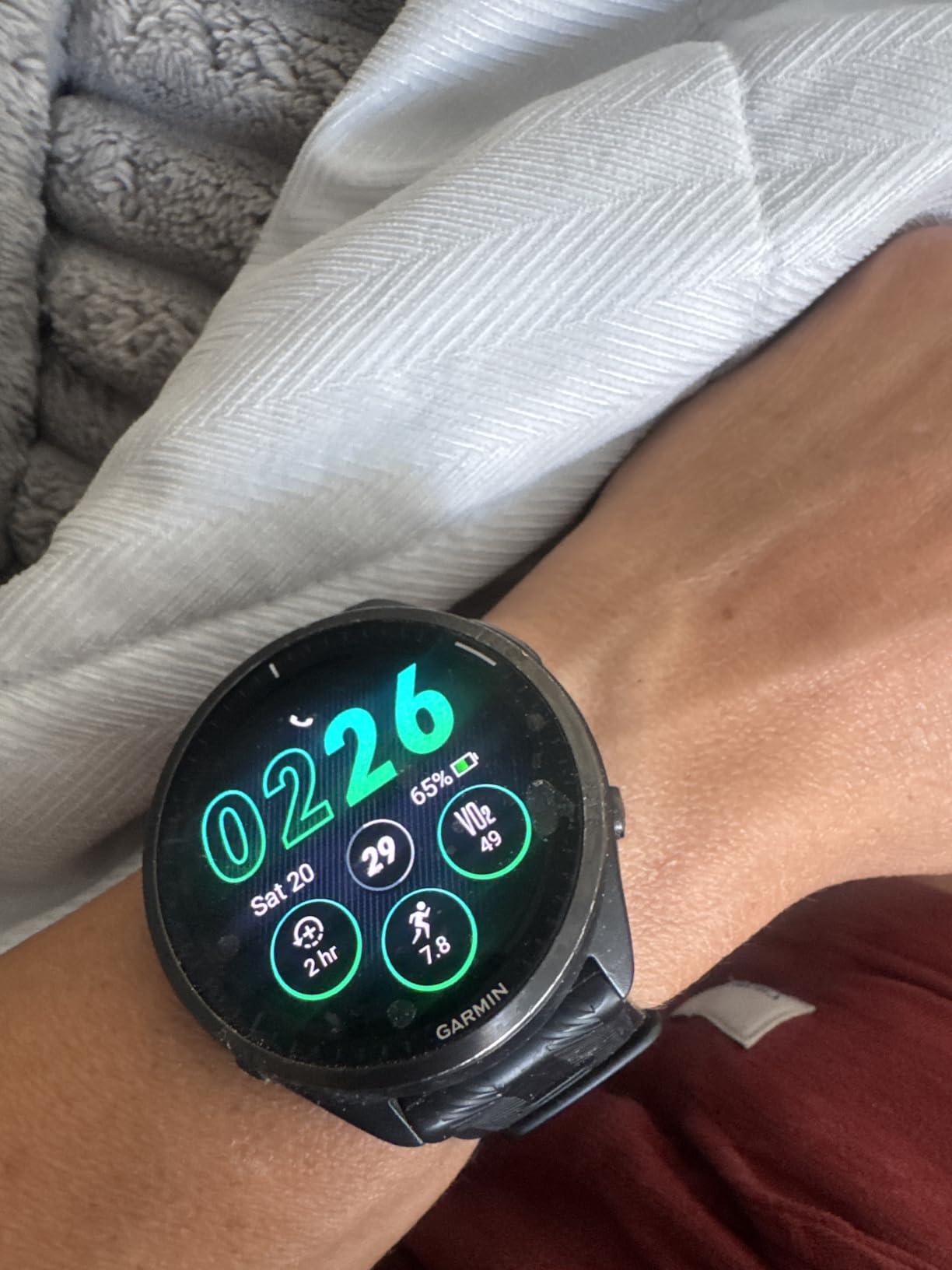
The Forerunner 965 is the model most trail runners end up on, and the reason is simple. It is the first watch in Garmin’s running line that puts full-color maps and turn-by-turn directions on your wrist, and it does it in a 53 g titanium-bezel body that still disappears under a sleeve. Owners consistently describe the maps as the feature that finally let them run trails they had only run on paper before.
It is also the endurance answer for road-to-trail athletes. Up to 31 hours in GPS mode and 23 days in smartwatch mode means a 100-mile day is a battery question you stop worrying about, and multisport auto-transition profiles cover the days you train on the bike and then run a mountain trail at sunset.
It shares the Forerunner 265 multi-band GNSS platform, so the tree-cover behavior is the same strong performer. What changes is the size of the case, the price of the hardware, and the depth of the Garmin Connect ecosystem available to you once you sync.
Maps that actually work at running speed
Full-color built-in maps with turn-by-turn directions are the headline, and the practical question is whether they are readable at 5 minutes per kilometer. On a 1.4 inch AMOLED at 454 by 454 with button control, the answer is yes for junction-level decisions, which is exactly the decision a trail runner makes constantly. Where it is less useful is fine-scale route tracing, where a larger screen or a paper map still wins.
Wrist-based running dynamics and running power are the other trail-relevant additions. Ground contact time and stride length tell you something meaningful about how you are handling a technical descent, and running power is the metric most runners now use to compare effort across hilly and flat days.
Battery life when maps and multi-band are on
The 31-hour GPS figure is the number to plan against for ultras. Because the display is AMOLED, expect a real trade when you run in all-day brightness mode or keep maps visible, and remember that music playback and continuous multi-band both draw heavily from the same cell.
For training blocks, 23 days in smartwatch mode means you charge roughly twice a month. That is the practical advantage over almost every competitor here, and it is why the 965 stays on the wrist for sleep and HRV tracking instead of sitting on a charger between runs.
Fit, wrist size, and who should move up
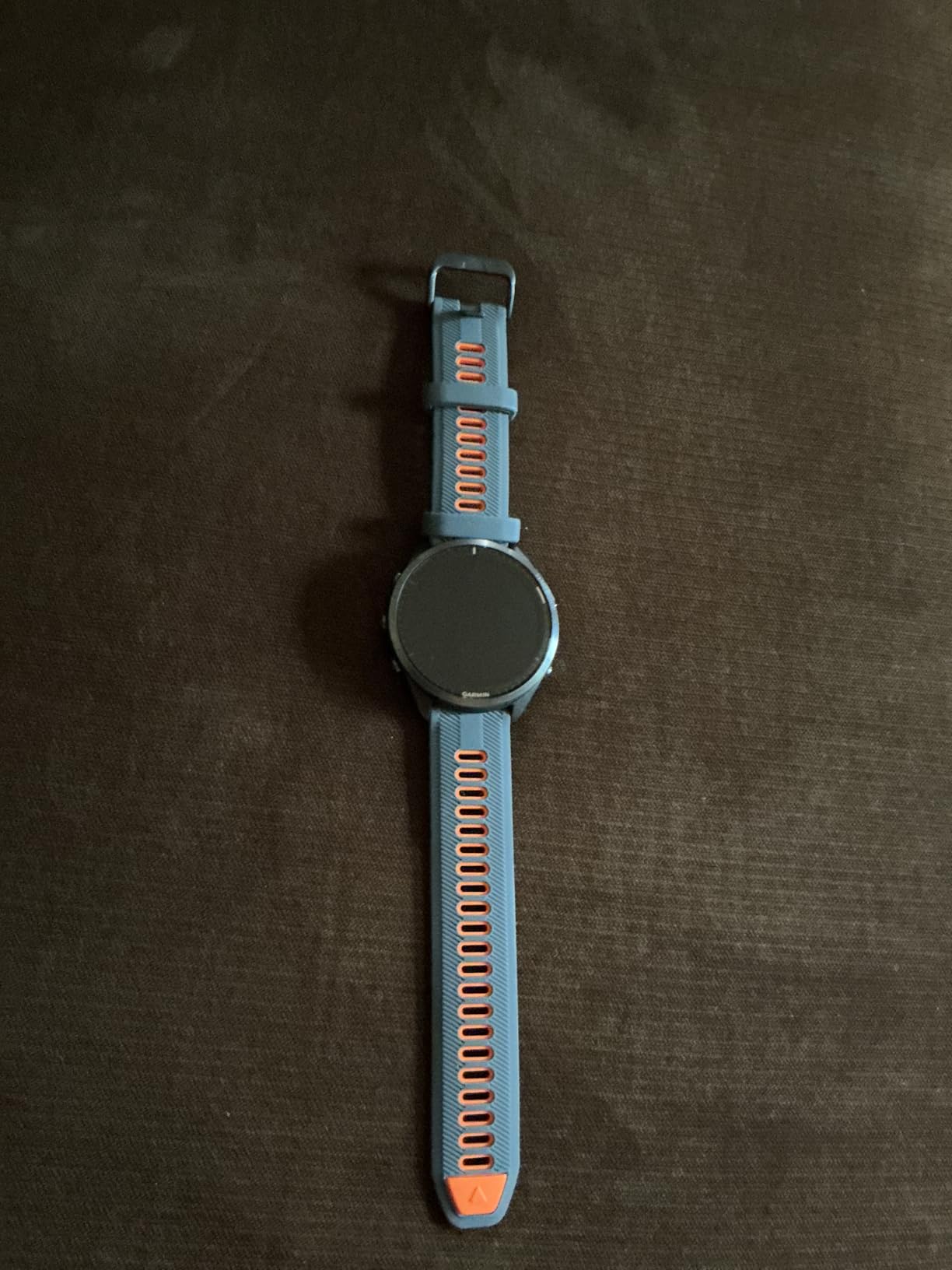
At 47 mm and 53 g this is a full-size running watch. Owners with larger wrists rate the comfort highly, and the titanium bezel keeps the weight down compared with steel. Owners with small wrists report the case digging in, and if that is you, look at the 46 mm Forerunner 265 or the 42 mm COROS APEX 4 instead.
There is also a real learning curve in Garmin Connect. Budget an evening with it before your first long run, because configuring activity profiles, data fields, and map regions is where the value lives, and it is much easier to do at a kitchen table than on a trailhead in the rain.
Who this suits and who should skip it
Suit it to you if you run unfamiliar routes, race 50K or longer, want wrist-based running power, and like having your training data in one app that most of the running world reads. It is the most complete single watch in this roundup for trail use.
Skip it if you need LTE for calls and notifications from the wrist, or if you want music storage. The learning curve is real, and the 47 mm case is the single most common reason owners hand it back. The hiking-oriented picks cover the lighter case sizes if fit is your deciding factor.
3. Garmin fenix 8 – The Watch That Works When You Are Not Running
Garmin fēnix® 8, 47mm, Black
1.4 inch AMOLED, 1000 nits
47 hours GPS, 16 days smart
100 m water
80 g steel case
Pros
- Speaker and mic take calls from the wrist
- Built-in LED flashlight with safety modes
- 47 hours GPS and a 16 day smart battery
- Dynamic round-trip routing for trails
Cons
- 80 g is heavy for sleep wear
- Some owners report software freezes
- Large case even in the 47 mm size
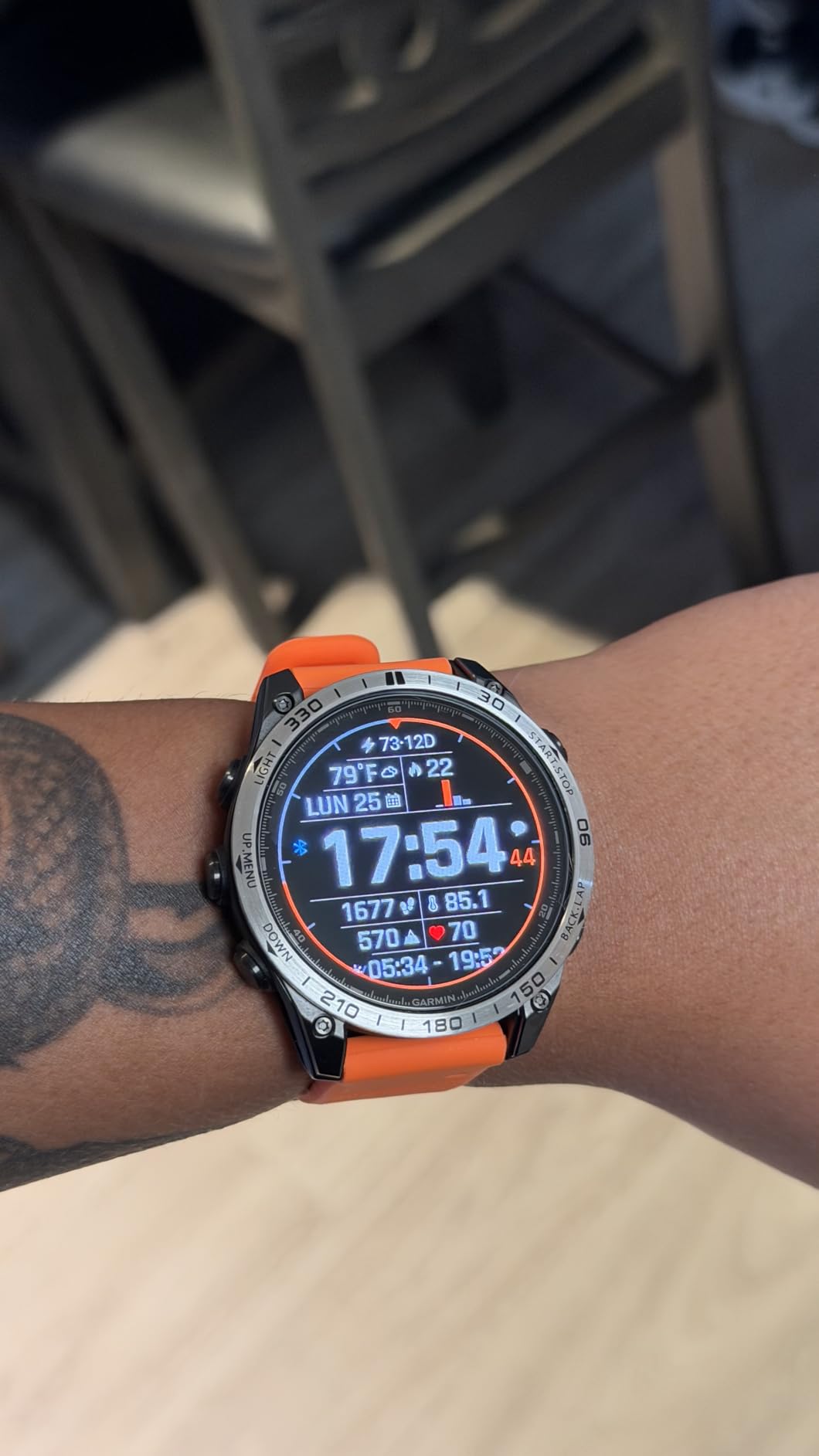
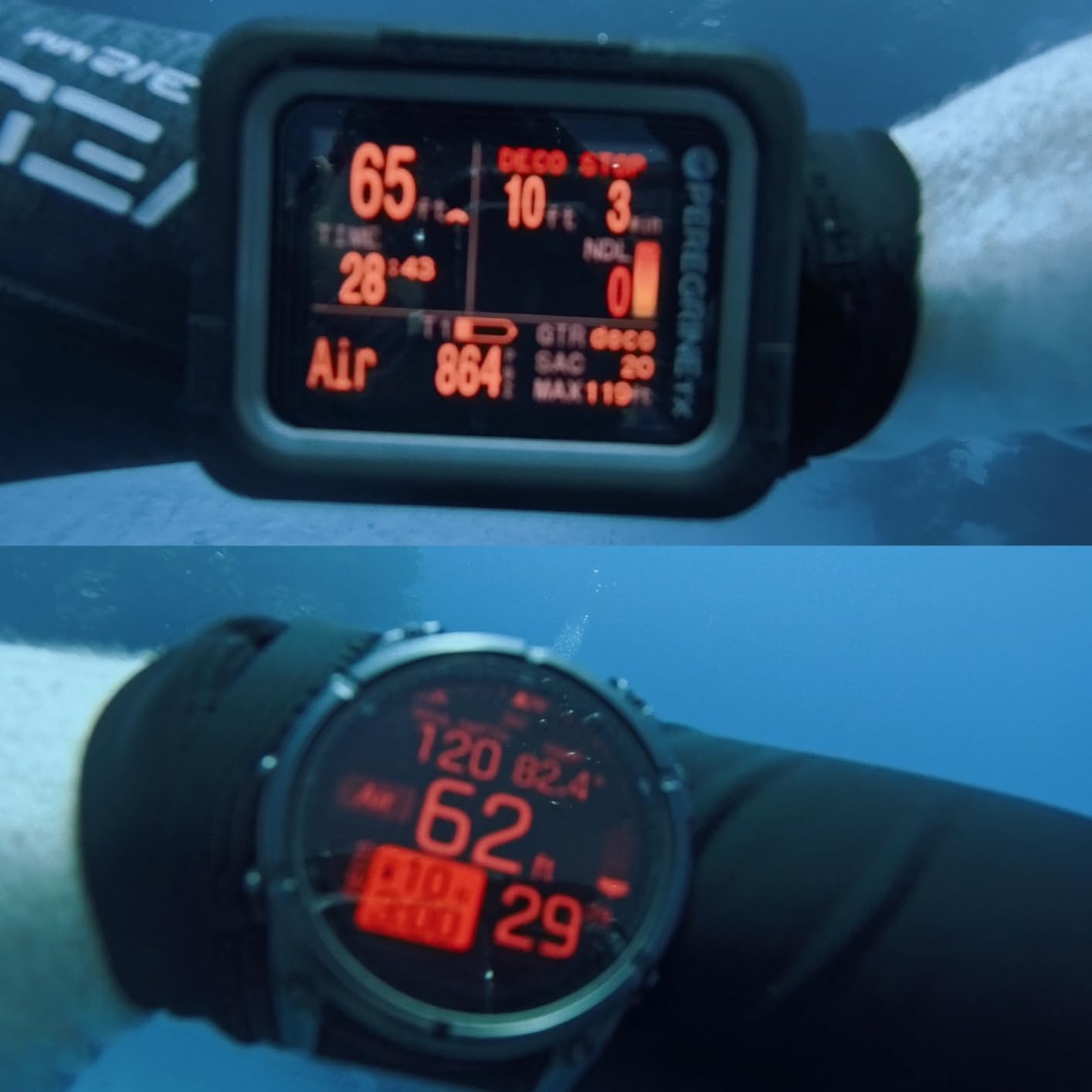
The fenix 8 is the watch in this list that runners carry on multi-sport days. Off-grid voice commands, a built-in LED flashlight, a 40-meter dive rating with leakproof metal buttons, and a speaker and microphone for wrist calls turn it from a running computer into an outdoor instrument. Trail runners who also ski, climb, or work night shifts tend to end up here permanently.
Multi-band GPS with SatIQ sits alongside a 3-axis compass, gyroscope, and barometric altimeter, so the orientation data on a steep sidehill is as good as the position data. Dynamic round-trip routing is the navigation feature owners praise most, because it plots a direct line back to a point you chose rather than snapping to a pre-drawn path.
It is also the most frustrating watch here to wear all day. At 80 g in a stainless steel case, it is the heaviest thing on this list, and owners consistently mention that it is bulky for overnight wear, which in turn means less sleep data and less recovery insight.
47 hours of GPS and what that means for a race
Forty-seven hours in GPS mode is enough for essentially any single-day ultra, and 16 days in smartwatch mode means the watch is a constant training tool rather than something you charge before a long run. That combination is why the fenix 8 is popular with runners who do multi-day races and still want a training tool on the wrist between attempts.
The brightness figure of 1000 nits is lower than the Forerunner models above, which is the cost of the steel build and dive-rated hardware. On shaded forested trails that does not matter. On a bright exposed ridge at midday, the Forerunner AMOLEDs are the better read.
Flashlight, wrist calls, and the safety case
The built-in flashlight is the feature owners mention most often in normal use, not just on expeditions. Starting a long trail run before dawn or finishing after dark, a wrist flashlight that holds charge for hours is genuinely useful, and having it means one less thing in your vest.
Wrist calls through the speaker and microphone are the other daily-use win. You still need your phone nearby, but you can take a call without digging out a phone mid-run, which matters on technical terrain where handling a phone is a distraction at best.
Where the 80 g weight hurts
Weight is the one number that will decide this for you. On long climbs, an 80 g watch is noticeable under a cuff, and for sleep tracking it is the difference between data and no data. If your primary sport is running and you sleep in your kit, the Forerunner 265 and 965 are the more coherent choices.
Some owners also report occasional software freezes, which is a real annoyance on a watch you may be relying on for navigation. Multi-year durability reports are stronger than launch reviews for this model, which is the pattern buyers describe as normal for the fenix line.
Who this suits and who should skip it
Suit it to you if your trail days include climbing, skiing, diving, or night work, and if you value a flashlight and wrist calls more than a light case. It is also the pick for runners who are done replacing watches every 18 months, because the feature ceiling here is high.
Skip it if you run ultras where every gram matters, or if your budget is better spent on the 965 with its maps. This is the heaviest build in the list purely because of weight and materials, not features.
4. Garmin Instinct 3 Solar – The One You Can Forget About Charging
Garmin Instinct® 3 Solar, Rugged GPS Smartwatch, 45mm, Black
0.9 inch monochrome MIP
28 days battery plus solar
MIL-STD-810, 10 ATM
52 g, 45 mm case
Pros
- Solar lens extends battery in open daylight
- MIL-STD-810 thermal and shock rating
- Metal-reinforced bezel survives rock and root
- Built-in flashlight and Garmin Pay
Cons
- Small monochrome screen is far less vivid than AMOLED
- No mapping beyond breadcrumb lines
- Solar gain assumes several hours of direct sun
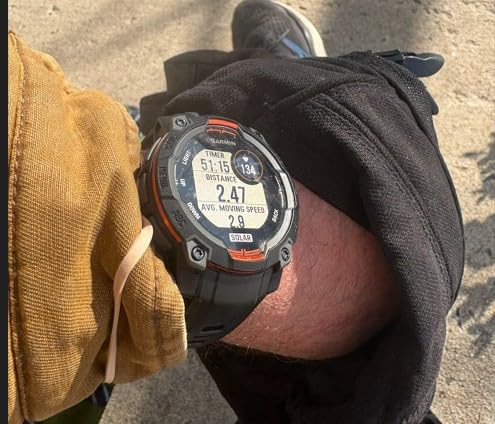
There is a specific kind of runner who buys this watch. They run rocky trails, they drop their gear, and they would rather not think about a charging cable at mile 40. For them the Instinct 3 Solar is arguably the most rational purchase in this roundup, and the 28-day battery with a solar charging lens is the reason.
The 45 mm fiber-reinforced polymer case with a metal-reinforced bezel is built for impact rather than elegance, and it carries MIL-STD-810 thermal and shock resistance alongside a 10 ATM water rating. Owners rate the durability extremely highly, and the multi-band GPS with SatIQ means the tracking is competitive with watches that cost considerably more.
The 3-axis compass, barometric altimeter, built-in flashlight with strobe modes, and Garmin Pay cover the practical trail day. What it does not do is show you a map, and the low-resolution monochrome display is the compromise that makes everything else possible.
Solar charging, honestly assessed
The solar lens sits over a 0.9 inch transflective memory-in-pixel display that is visible in direct sunlight without a backlight. That is why the screen stays readable on a bright ridge and why the battery spec is measured in weeks rather than days.
Solar gain depends on exposure. Owners report meaningful gains on open, sunny days and little to none under dense forest canopy or when the watch is under a sleeve. The honest way to read it is that the watch is already ultra-low-power and solar simply extends an already excellent baseline rather than replacing the charger.
What the MIP display costs you
At 176 by 176, the screen is a fraction of the resolution of the AMOLED models here. Data fields are legible, and the monochrome presentation is easier to read in harsh sun, but it cannot show the color maps or rich graphics that make the Forerunner 965 and COROS APEX 4 pleasant to use.
Navigation is breadcrumb only, so this is a follow-your-line watch rather than a plan-a-route watch. For a runner who always runs a known loop or who plans in advance with a phone, that is fine. For spontaneous backcountry days, it is a limit.
Built for abuse, awkward for sleep
The hybrid touch and button controls take practice, and running in gloves is where the learning curve shows up. The metal-reinforced bezel, however, is exactly what protects the case from the rock strike that ends a lighter watch.
Buyers who want indestructible, long-lasting trail hardware rate it very highly. The most common reservation in reviews is the same one the spec sheet implies, which is the display rather than the build.

Who this suits and who should skip it
Suit it to you if your trails are rocky, your runs are long, and you would rather not manage a charging routine. At 52 g in a 45 mm case it is also one of the more wearable options for smaller wrists among the rugged builds.
Skip it if route-finding is part of the experience or if a dim, small screen will frustrate you. There are better navigation watches here for that, including the models with topo maps and a larger panel.
5. COROS PACE Pro – The Mapping Upgrade Without The Premium Sticker
COROS PACE Pro GPS Sport Watch, 1.3-inch AMOLED Touchscreen – Blue
1.3 inch always-on AMOLED
38 hours GPS, 31 dual-frequency
32 GB maps
49 g, USB-C
Pros
- Topographic route planner with turn-by-turn guidance
- 38 hours GPS exceeds similarly priced rivals
- USB-C with a keychain adapter is easy to carry
- Fast processor and gesture backlight
Cons
- Smaller app ecosystem and fewer sport profiles
- Touchscreen-only control is awkward with gloves
- No speaker or microphone
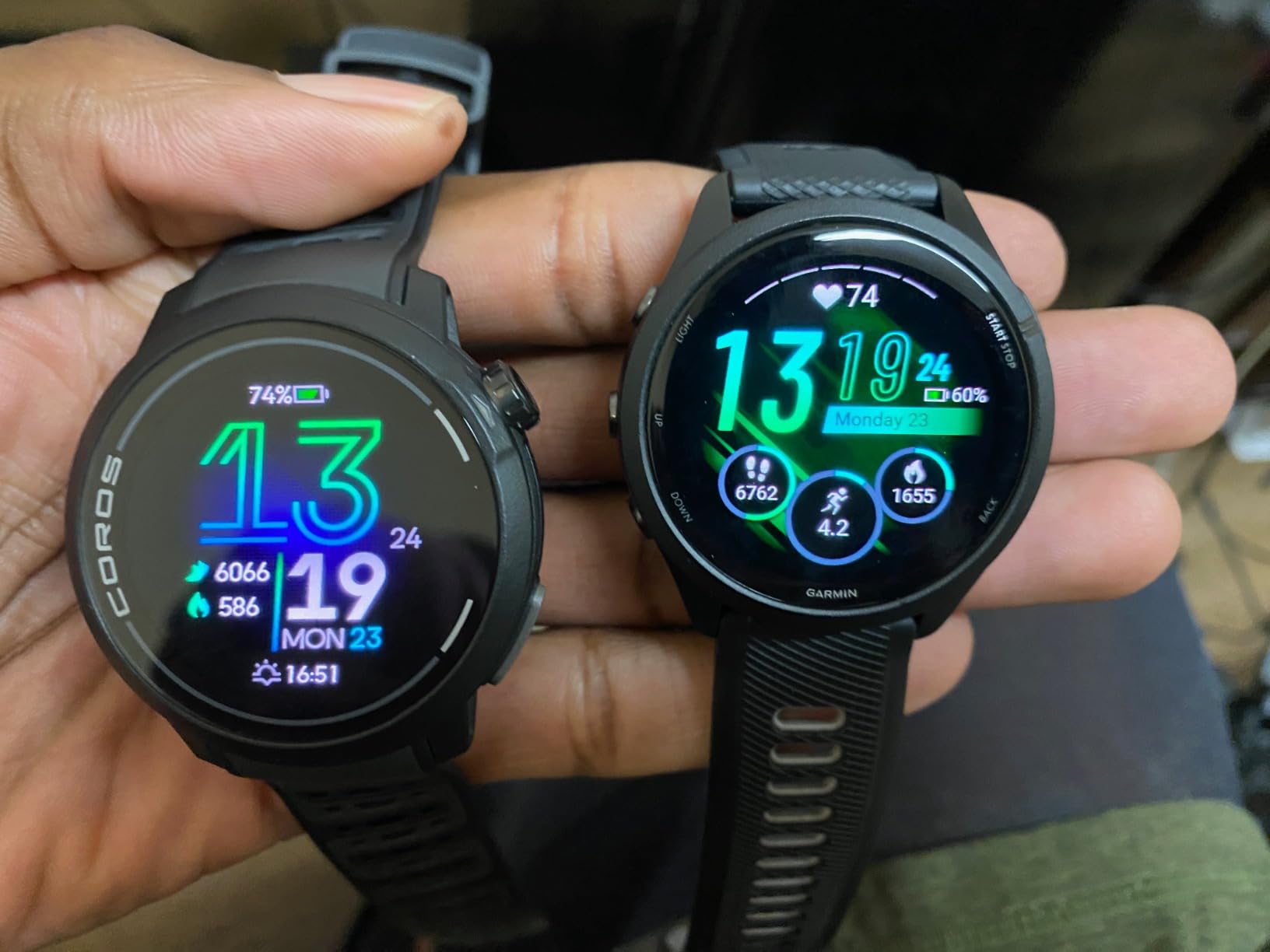
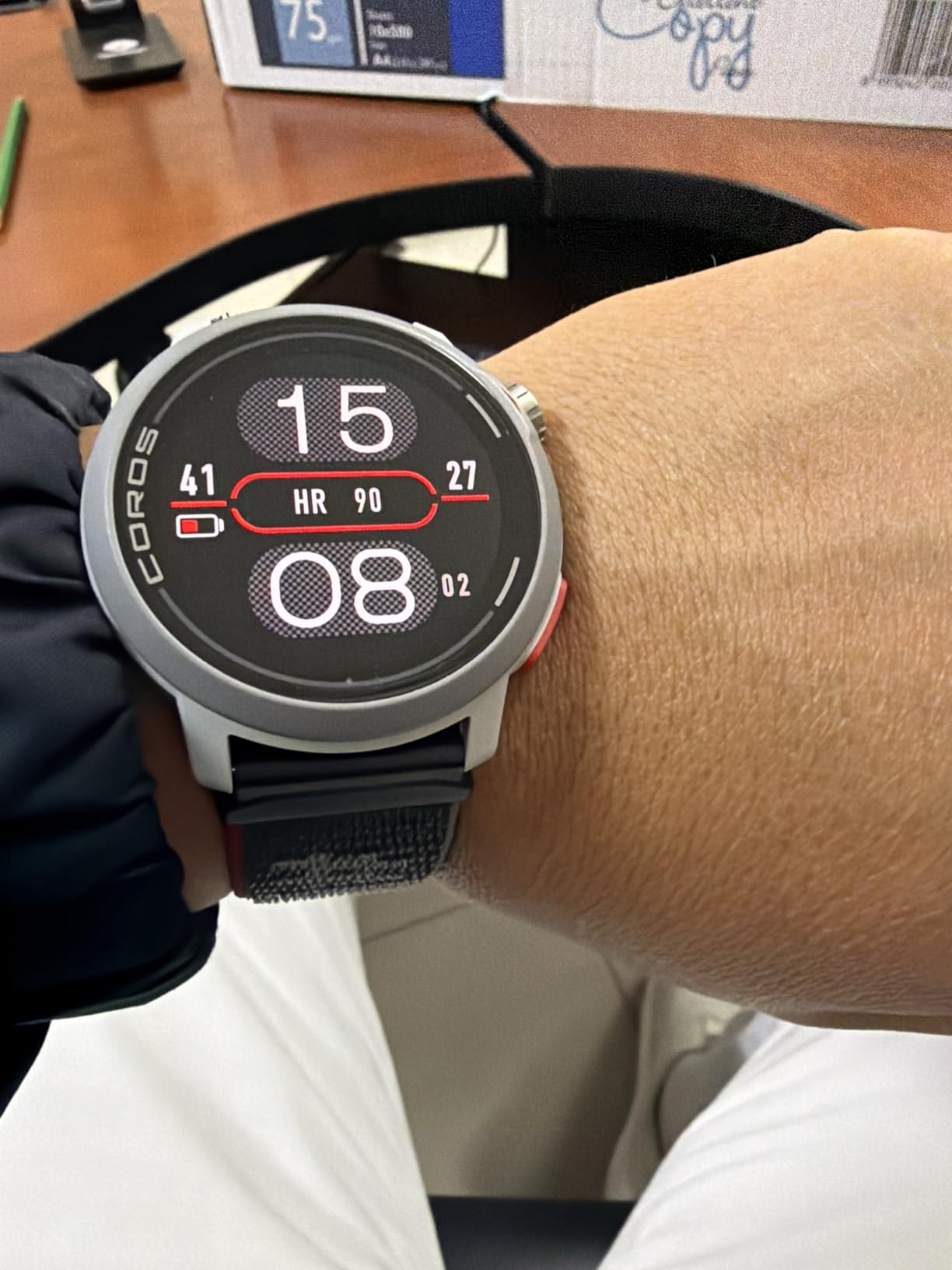
COROS put maps and a 38-hour GPS battery into a watch that sits in the middle of the market, and that combination is why this one keeps showing up in trail roundups. The navigation route planner with topographical and landscape mapping, turn-by-turn guidance, and 32 GB of storage gives it more navigation capability than several watches costing far more.
Positioning is competitive thanks to an all-new satellite chipset and dual-frequency reception, with 31 hours of battery when you run dual-frequency and 38 hours on standard outdoor GPS. On a forested climb that accuracy is the feature that matters, and reviewers rate it highly for the money.
The 1.3 inch always-on AMOLED at 1500 nits, with more than double the previous generation’s processor performance, makes scrolling through data fields feel quick even in wet conditions. The USB-C port with the included keychain adapter is a small thing that matters when your wall charger is four miles back at the car.
Battery numbers you can plan a race around
Thirty-eight hours of outdoor GPS, or 31 hours with dual-frequency, is enough for a 100-mile race on standard GPS. Twenty days in normal mode and six days with the always-on display means daily training wear is straightforward.
These are the numbers the brand publishes, and the community consensus is that COROS delivers closer to them than most competitors, which is a big part of why owners move up from cheaper models. If battery anxiety is your main reason for hesitating, this watch largely removes it.
Topo maps and how the route planner behaves
The navigation route planner supports topographical and landscape maps with turn-by-turn guidance, which puts this watch in a small group at this price point. For trail runners who plan routes on a phone and want them on the wrist, that is the feature set that matters most.
The display is 1.3 inches, and community feedback is consistent on the trade-off: mapping on a smaller screen is workable for junction decisions but not a replacement for a paper map at high speed. The gesture-activated backlight helps when you need to check the screen without stopping.
Where the COROS ecosystem shows its age
The app ecosystem is smaller than Garmin Connect, with fewer sport profiles and fewer third-party integrations. If your training data currently lives in a Garmin or Suunto account, moving here means starting a history over, and that friction is the main reason long-time owners stay put.
There is also no speaker or microphone, so no wrist calls. Training status, custom workouts, activity summaries, and sleep analysis are all handled well in the COROS app, and the 22 mm band fits 130 to 220 mm wrists, which is a genuinely wide range.
Who this suits and who should skip it
Suit it to you if you want real navigation and long battery without moving up to a titanium flagship, and if you are starting fresh rather than migrating a decade of training data. It is one of the strongest value picks in this roundup.
Skip it if you are deeply invested in another brand’s ecosystem, if you run in gloves regularly and need physical buttons, or if you want music stored on the watch. The 49 g weight and 22 mm band make it a comfortable all-day option.
6. Garmin Enduro 2 – For The Race Where You Carry Your Battery
Garmin Enduro™ 2 – Ultraperformance Watch
1.4 inch Power Sapphire lens
46 days smart, 150 hours GPS
AutoSelect SatIQ
70 g titanium
Pros
- 150 hours of GPS battery covers multi-day ultras
- NextFork and grade-adjusted pace are trail-specific tools
- Nylon UltraFit band stays secure on long runs
- AutoSelect balances accuracy and battery
Cons
- Low-resolution 240 by 240 MIP display
- Less training depth than the Forerunner line
- Older generation hardware
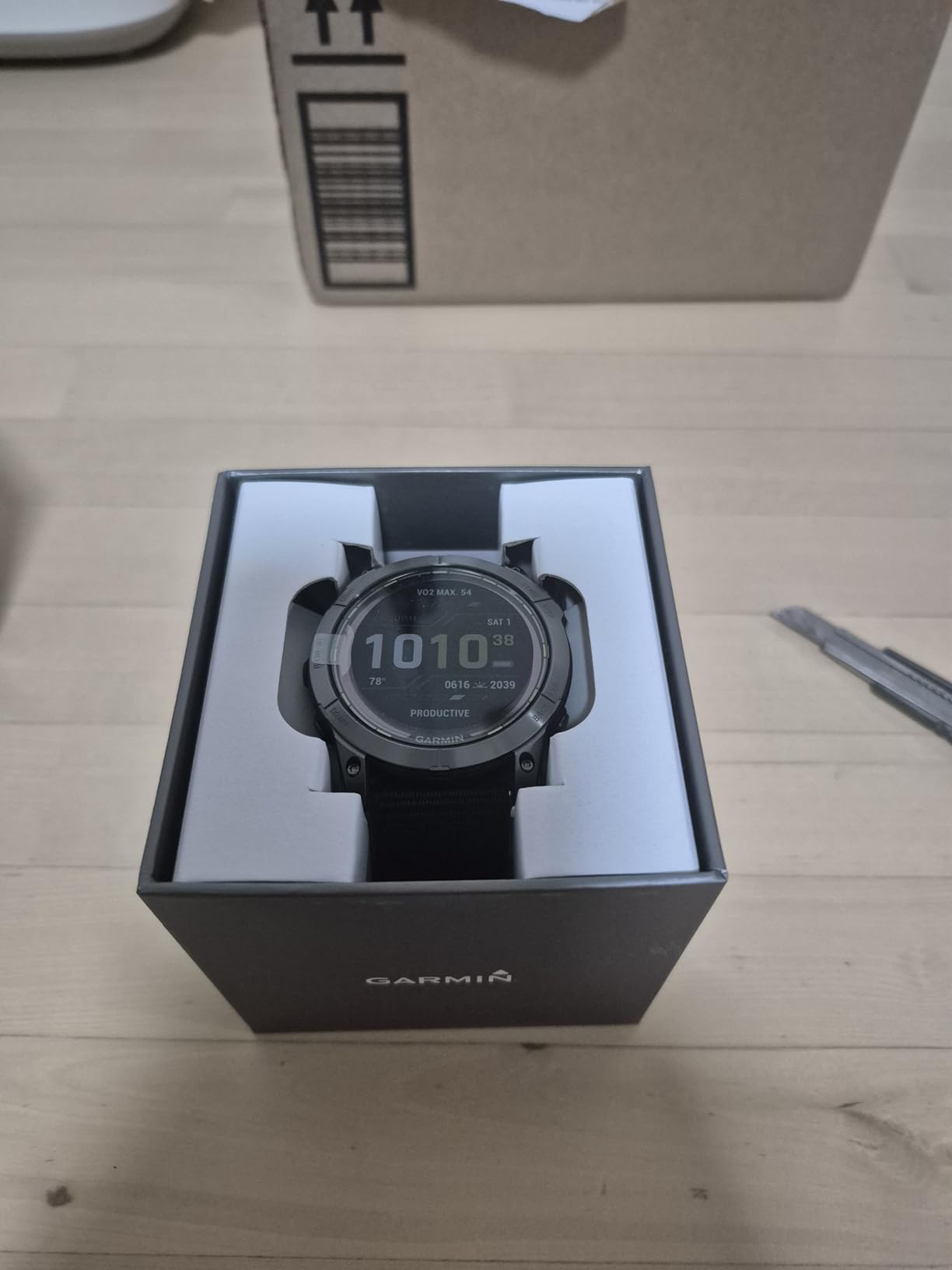
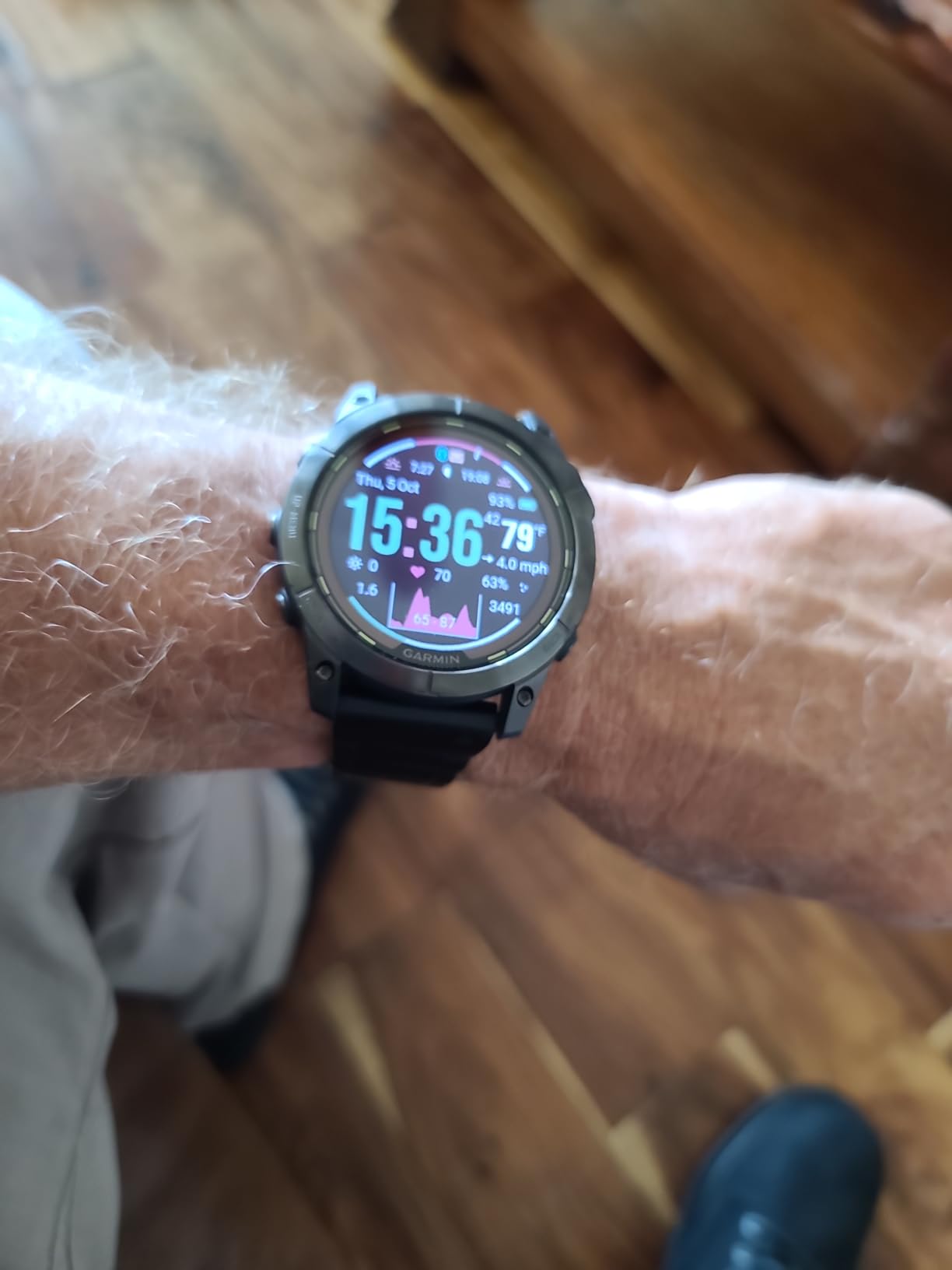
No other watch in this roundup solves the multi-day problem the way the Enduro 2 does. Up to 150 hours in GPS mode means you can run a stage race, a two-day mountain ultra, or a week of unsupported travel without planning around a charger, and up to 46 days in smartwatch mode sits on the same solar-powered logic.
The trail-specific tooling is unusually good. NextFork shows distance to the next trail intersection, grade-adjusted pace accounts for what you are climbing, and the automatic rest timer keeps your segment data clean at aid stations. Preloaded TopoActive and ski maps cover the navigation need without extra downloads.
It is a narrower watch than the rest, though. The 240 by 240 MIP display is the least vivid here, the training analytics are shallower than the Forerunner line, and there are no wrist calls. It is an endurance specialist, not a generalist.
Grade-adjusted pace and NextFork explained
Grade-adjusted pace normalizes effort to terrain, so a slow climb reads differently than the same speed on flat trail. For anyone training for mountain ultras, that is a more useful number than raw pace, and it is one of the reasons owners of this watch stay loyal.
NextFork is a navigation aid rather than a map. It tells you how far it is to the next junction on your route, which is the exact question you ask yourself constantly on an unfamiliar trail and the one a basic breadcrumb line cannot answer.
How AutoSelect manages the tradeoff
AutoSelect uses SatIQ to pick the GPS mode dynamically, moving between accuracy settings based on conditions and remaining battery. On an exposed ridge you get better accuracy; deep in a valley you save power. In practice this is the feature that makes the 150-hour figure believable rather than theoretical.
The superbright LED flashlight with a cadence-matched strobe and a red safety light mode is another trail-only touch, and the Power Sapphire lens keeps it readable in bright sun while harvesting energy.
Where the Enduro 2 shows its age
The display is the big one. A 240 by 240 memory-in-pixel screen is a step back from anything with AMOLED, and while it is bright and readable in sun, the training dashboards and map layers look plain next to newer rivals.
At 70 g with a titanium case it is not light, and the nylon UltraFit band is more secure than most on long efforts but less refined for daily wear. Owners upgrading from a Forerunner feel the loss of training depth and smart features most.
Who this suits and who should skip it
Suit it to you if you race or train in the mountains, if multi-day events are part of your year, and if battery anxiety has ended your long runs early before. The grade-adjusted pace and solar endurance math are the reason to own this watch.
Skip it if you want rich training analytics, wrist calls, or a modern display. If you run one long day a week, the 965 gives you maps and better training tools for far less money.
7. COROS PACE 4 – 32 Grams And Forty-One Hours Of GPS
COROS PACE 4 Ultralight Sport GPS Watch (Black Nylon, Standard)
1.2 inch AMOLED, 600 x 680
41 hours GPS, 19 days
32 g with nylon band
Digital crown and buttons
Pros
- Lightest watch here at 32 g with the band
- 41 hours of continuous GPS tracking
- Digital crown and buttons work at intensity
- Voice control and voice pins are useful on trail
Cons
- Only 4 GB storage limits maps and media
- Breadcrumb navigation rather than topo maps
- 1.2 inch display is on the small side
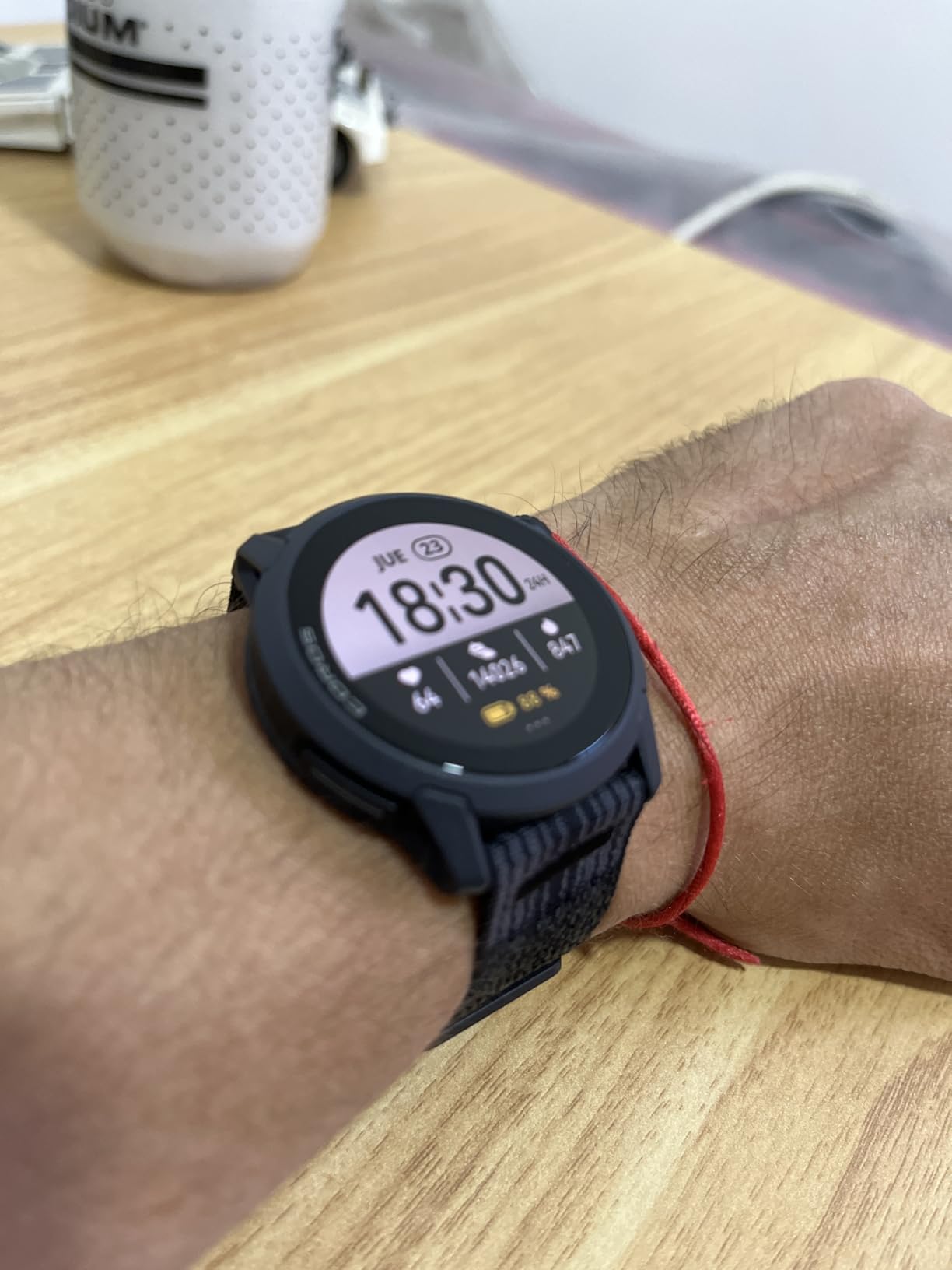
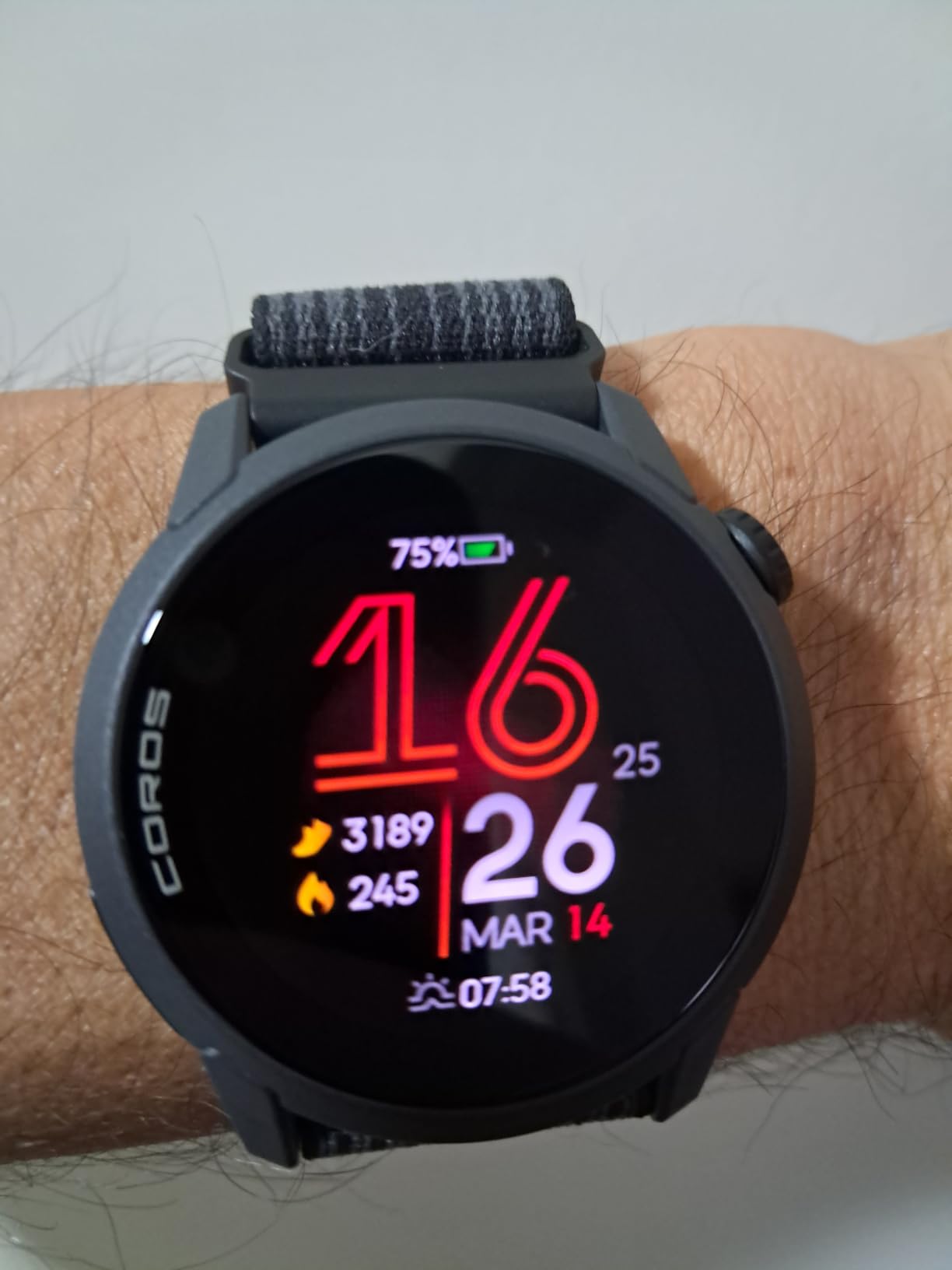
Weight is the first thing you notice on the COROS PACE 4. Thirty-two grams with the nylon band and 11.8 mm thick makes it the lightest watch in this roundup by a clear margin, and for runners who hate gear on their wrist, that alone is a reason to try it.
The second thing you notice is 41 hours of continuous GPS. That is longer than several watches costing far more, and it puts a full day plus a buffer on the clock for a long race or a big mountain day.
This is where we have to be clear about a limitation. Storage is 4 GB, navigation is breadcrumb, and the display is 1.2 inches. This is a fast, light watch that follows a line you have already planned, not a watch for reading terrain on the fly.
Why weight matters more than usual on trails
On a long climb, wrist weight is one of the few things that never stops being noticeable, because your arms keep swinging. At 32 g in a nylon band, the PACE 4 reads as barely there, and reviewers describe the fit as comfortable enough to sleep in.
Nylon also outperforms silicone for long efforts, since it wicks, dries, and does not chafe, and it is a better match to a watch this light than a molded band would be.
Battery and the control layout
Forty-one hours of continuous GPS and up to 19 days of daily use is outstanding in this weight class. The 1.2 inch AMOLED screen has a much higher resolution than the previous generation and auto-adjusts brightness, so it stays visible in sun and stays readable before dawn.
Control is a mix of a tactile digital crown, two buttons, and a touchscreen. That matters on trail, where a touchscreen-only watch is miserable in cold rain with gloves. A configurable Action Button gives one-tap access to the thing you need most mid-effort.
What the 4 GB limit means
Four gigabytes is enough for the watch’s breadcrumb navigation and health data, and not enough for large offline map regions or music libraries. If you plan routes from a phone app and want turn-by-turn, this is the wrong watch.
Recovery time, sleep stages, HRV, and menstrual cycle tracking are all present, which covers the health side of trail training well. Voice recording for training notes is a small feature that trail runners appreciate, since you can log a route condition without stopping.
Who this suits and who should skip it
Suit it to you if you run known routes, you are sensitive to wrist weight, and you want long battery in a small case. The 42 mm-diameter, 11.8 mm profile also makes it a strong option for smaller wrists.
Skip it if you navigate new terrain on the watch, if you want music stored locally, or if you need sport profiles the COROS app does not offer. Everything this watch does, it does quickly.
8. Polar Grit X2 Pro – The Analytics Watch Built For Big Terrain
Polar Grit X2 Pro Premium GPS Smart Sports Watch – Ultimate Outdoor Adventure Watch with Rugged Design, Advanced Navigation, Sports Tracking, and Heart Rate Technology for Peak Performance, Stone Gray
1.39 inch AMOLED, 1050 nits
Sapphire glass, MIL-STD-810H
Dual-frequency GPS with topo maps
79 g
Pros
- Dual-frequency GPS with downloadable topo maps
- Vertical speed and running power metrics
- MIL-STD-810H build with sapphire crystal
- Explore and Power-Save modes for multi-day use
Cons
- Wrist heart rate reported as inaccurate by multiple buyers
- App and interface feel dated
- Some owners report unresponsive touchscreens
- Heaviest option alongside the fenix 8
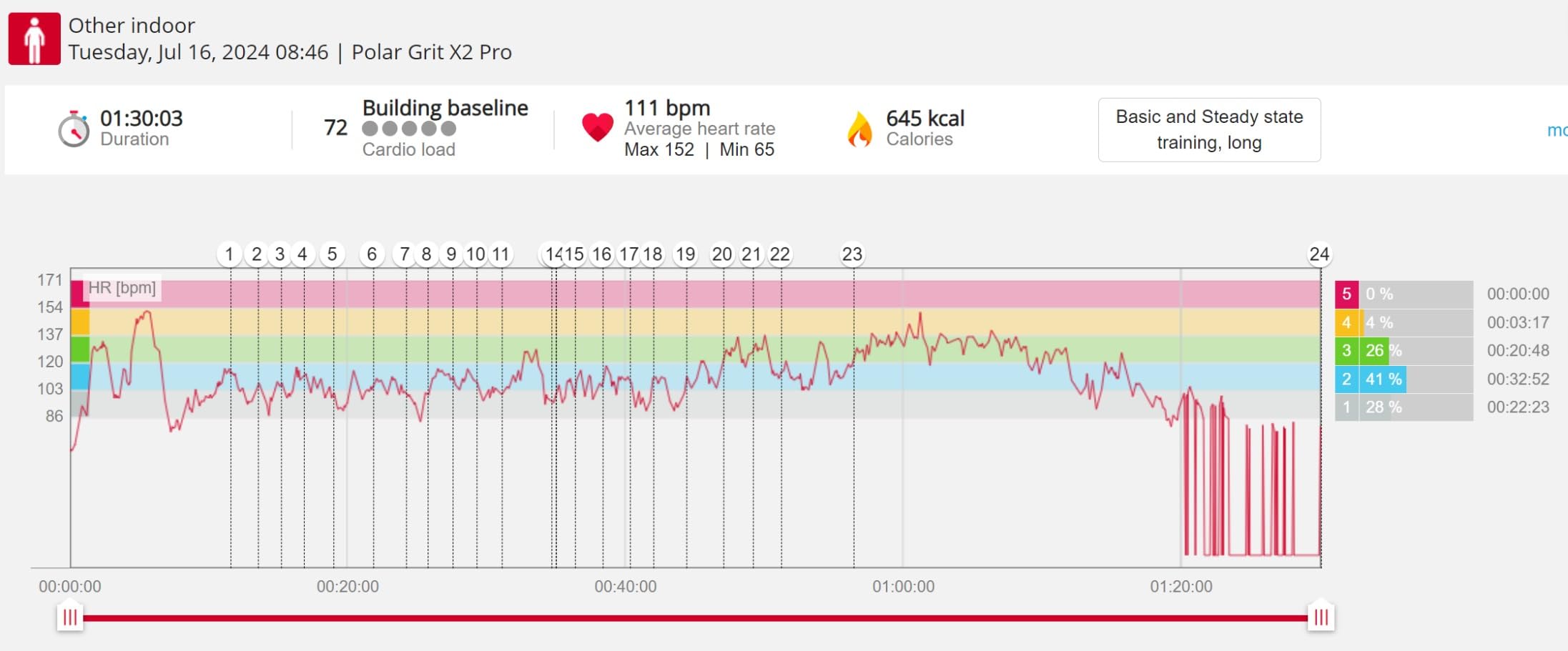
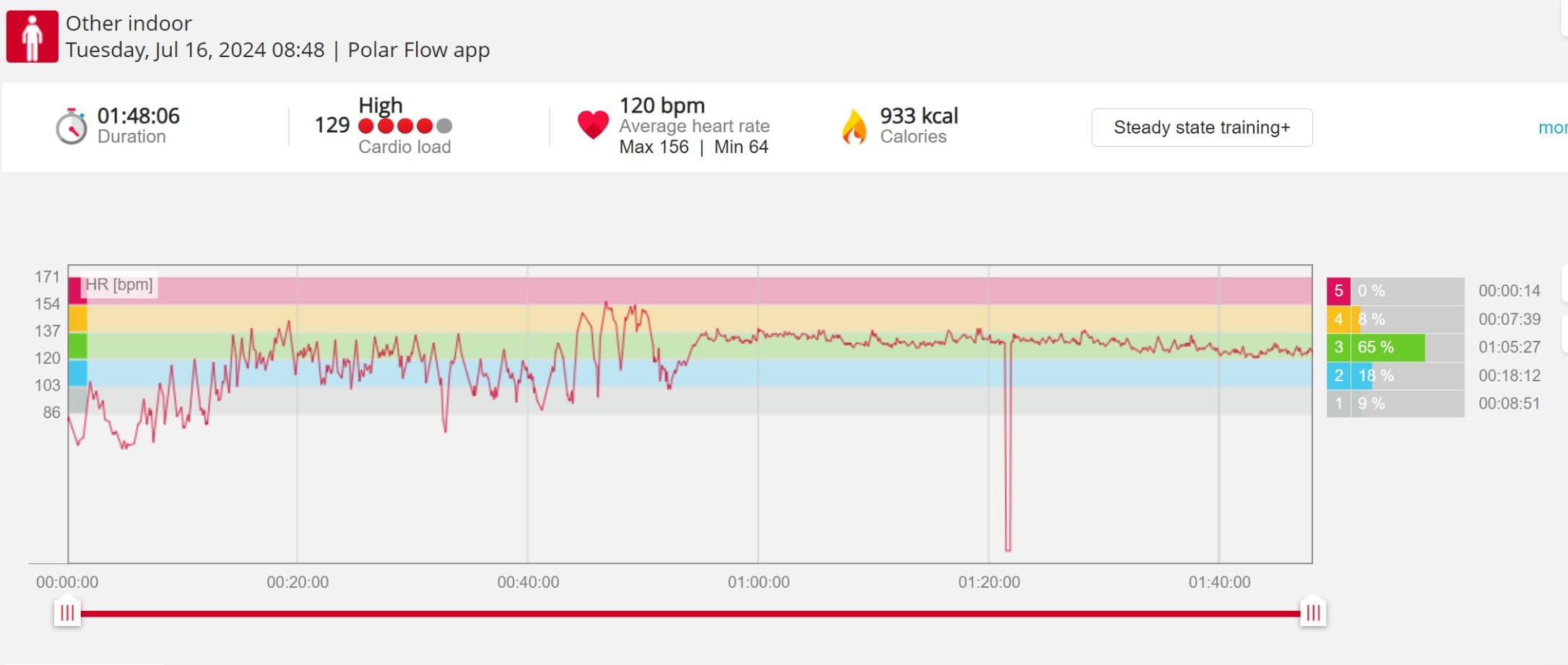
Polar has always been strongest where the training data is, and the Grit X2 Pro is the clearest expression of that. Vertical speed, running power, training load, and recovery measurement give you a genuinely different read on effort than the Garmin approach, and for runners training for steep mountain courses that data is worth a look.
The hardware is equally serious. Sapphire crystal glass, a stainless-steel bezel, MIL-STD-810H military-grade durability, and 100 m water resistance put it in the same category as the fenix 8 for physical abuse, and the 1.39 inch AMOLED at 1050 nits gives the best daylight visibility of the Polar lineup.
Dual-frequency GPS with downloadable topographic maps and turn-by-turn routing is a real navigation setup. It is also the most expensive watch here, and the 4.3 average rating tells you why: heart rate accuracy and dated software are the recurring complaints.
Why vertical speed changes training decisions
Running power and vertical speed let you compare effort on a steep climb against the same effort on a fire road. Most runners in this roundup get pace and heart rate; Polar adds the load variables, and for mountain training that is a different way to program a week.
The training load and recovery measurement feed a framework that experienced runners find genuinely useful. The catch, repeated across reviews, is that wrist heart rate readings are reported as inaccurate by multiple buyers, and if heart rate is central to how you train, that is a serious problem.
Build quality and the sapphire question
Sapphire crystal and a stainless-steel bezel are the most scratch-resistant combination in this roundup, and owners who run rocky terrain rate the durability extremely highly. At 79 g it is heavy, so expect the same bulk complaint you would have with the fenix 8.
The 1.39 inch AMOLED screen with extra visibility is noticeably better than earlier Polar models in daylight, which matters on exposed ridgelines where you need to read data at a glance without stopping.
Battery in Explore and Power-Save modes
Extended battery life in Power-Save and Explore modes makes the Grit X2 Pro usable for multi-day trips, and that is where the training data keeps recording while you are not running. In normal daily use, the average battery life figure is around four days, which is the honest number to plan around.
It is a two-mode watch. If you want week-long battery, you accept a limited feature set. If you want the analytics, you charge it every few days, which is a different habit from the Forerunner models.
Who this suits and who should skip it
Suit it to you if you train by load and recovery data, if your running is genuinely mountainous, and if you want the hardest glass in the roundup. Polar’s training ecosystem rewards the kind of runner who reads charts.
Skip it if heart rate accuracy is non-negotiable, if you want a modern app experience, or if you are starting out. Paying the most here for fewer ecosystem features is a hard sell unless the specific metrics are what you are after.
9. Garmin Forerunner 970 – Titanium, Sapphire And Running Economy
Garmin Forerunner® 970, 47mm, Carbon Gray DLC Titanium, Black/Whitestone
1.4 inch AMOLED, sapphire lens
15 days smart, 26 hours GPS
Titanium bezel, full-color maps
Built-in flashlight and wrist calls
Pros
- Brightest AMOLED in the range with sapphire lens
- Running economy and step speed loss metrics
- Full-color maps with dynamic round-trip routing
- Speaker and mic for wrist calls
Cons
- Steep learning curve and dense menus
- Only 26 hours of GPS battery
- Some metrics need the separately sold HRM 600
The Forerunner 970 is the running-first answer to the fenix 8, and the difference is in the training data. Running economy and step speed loss tell you how efficiently you are running and how much vertical motion you are absorbing, which is exactly the kind of feedback a trail runner gains from climbing volume.
Running tolerance and Garmin Coach training plans add a coaching layer, and the training readiness score behaves the same way it does on the 265 and 965, pulling from sleep, recovery, training load, and HRV. Training readiness is the feature trail runners use most to decide whether a hard day is actually hard.
The physical build is a step above the rest of the Forerunner line: a lightweight titanium bezel and sapphire lens, plus a built-in LED flashlight and a speaker and microphone for wrist calls. It is the most premium running watch here, and the specs that come with that include a 26-hour GPS battery that is the shortest among the map-capable Garmin models.
Running economy and what it actually tells you
Running economy is essentially how much oxygen you use per unit of output. Measured well, it shows whether a change in pace is coming from fitness or from fatigue, which is a genuinely useful distinction when you are 40 miles into a race and trying to decide whether to push.
Step speed loss gives a vertical picture, and it is the closest thing here to Polar’s vertical speed. One caveat appears repeatedly in reviews: some of these efficiency metrics require the separately sold HRM 600, so budget for that accessory if you want the full picture.
Maps, routing, and the flashlight
Full-color built-in maps, multi-band GPS, and dynamic round-trip routing make the 970 a genuinely capable trail navigator, on par with the 965. The dynamic routing feature plots straight back to a chosen point, which is what you want when a spur trail goes wrong at dusk.
The built-in LED flashlight covers early starts and late finishes, and the speaker and microphone handle wrist calls and voice assistant responses. Between the two, this is the most complete everyday watch for a runner who does not need the dive rating or the steel bezel of the fenix.
The learning curve is the price of depth
Owners upgrading from older Forerunners or from a generic smartwatch describe it as a major step up in battery, maps, and metrics, tempered by a demanding initial setup. Menu density is the consistent theme, and the workaround is the same as with the 965: set everything up at home, not at the trailhead.
In mixed use, owners report roughly 10 to 15 days between charges, which is excellent. In GPS mode the 26 hours covers a long race day but not a multi-day effort, so if you race 100 miles, the Enduro 2 or the fenix 8 remains the better tool.
Who this suits and who should skip it
Suit it to you if you are a data-driven runner, you want the newest training metrics, and you want maps and a flashlight in one running-shaped watch. The ECG app and health monitoring round out a serious health package.
Skip it if you are price-sensitive, if you dislike dense menus, or if you need more than a single long day of GPS battery. The 965 gives you the maps and readiness data at a lower tier if you can live without the economy metrics.
10. Suunto Race S – Maps And Storm Alerts In A Thin Case
SUUNTO Race S GPS Sports Watch, 1.32” AMOLED 95+ Sports Modes, All Black
1.32 inch AMOLED at 466 dpi
30 hours performance, 13 days daily
60 g, 11.4 mm thin
Dual-band L1 and L5 GNSS, 32 GB maps
Pros
- Dual-band GNSS across five satellite systems
- Global offline maps with 2 km zoom-out
- 30 hours in performance mode suits long ultras
- 95+ sport modes and full training metrics
Cons
- Firmware updates reset activity settings
- VO2 max readings reported as implausibly static
- No offline music storage
- Heart rate strap connectivity reported as difficult
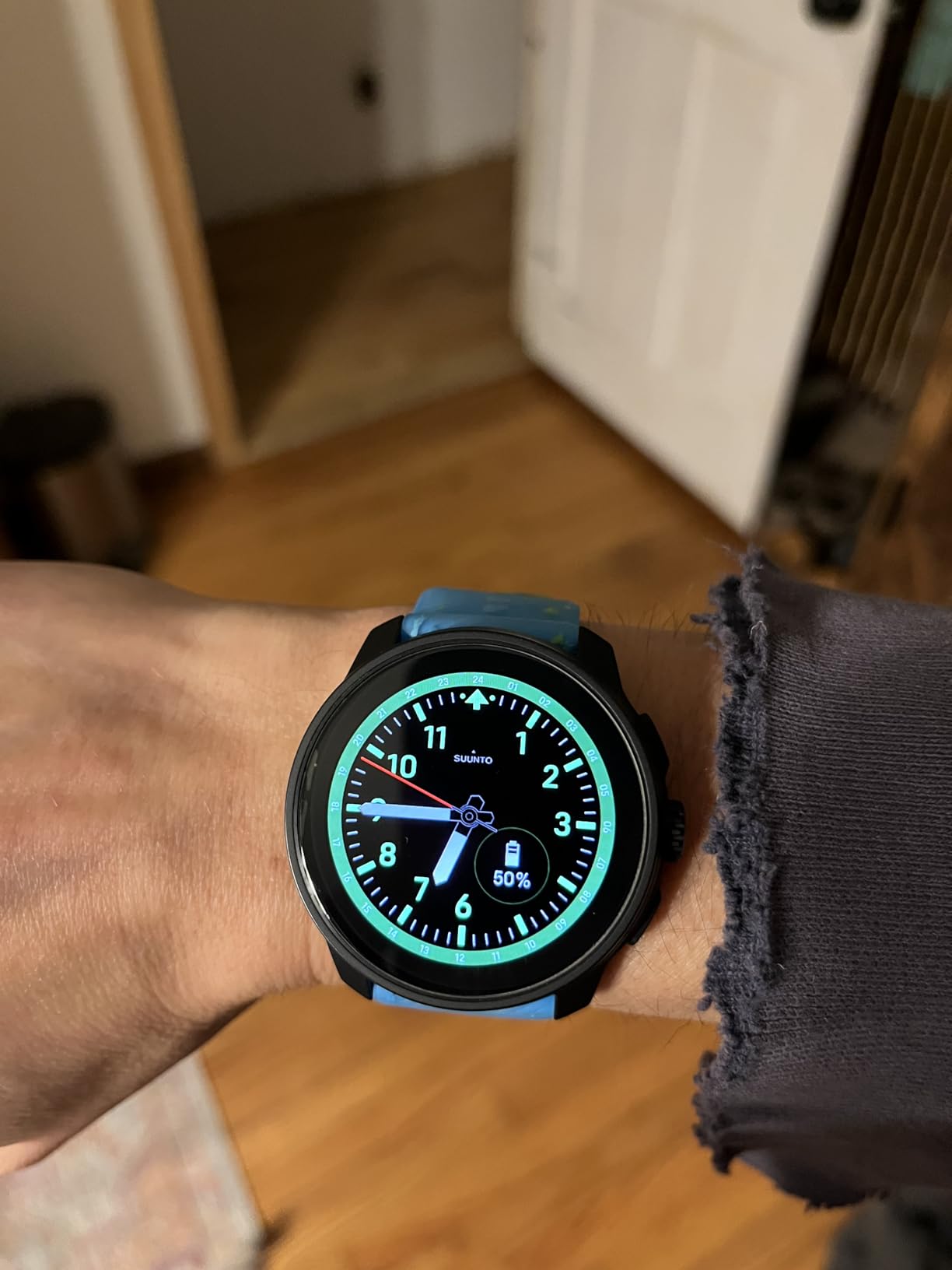
At 11.4 mm thin and 60 g, the Suunto Race S is a different shape of trail watch from the chunky multisport options. The 1.32 inch AMOLED at 466 dpi is one of the sharper screens in this roundup, and the digital crown makes scrolling maps with one hand genuinely pleasant.
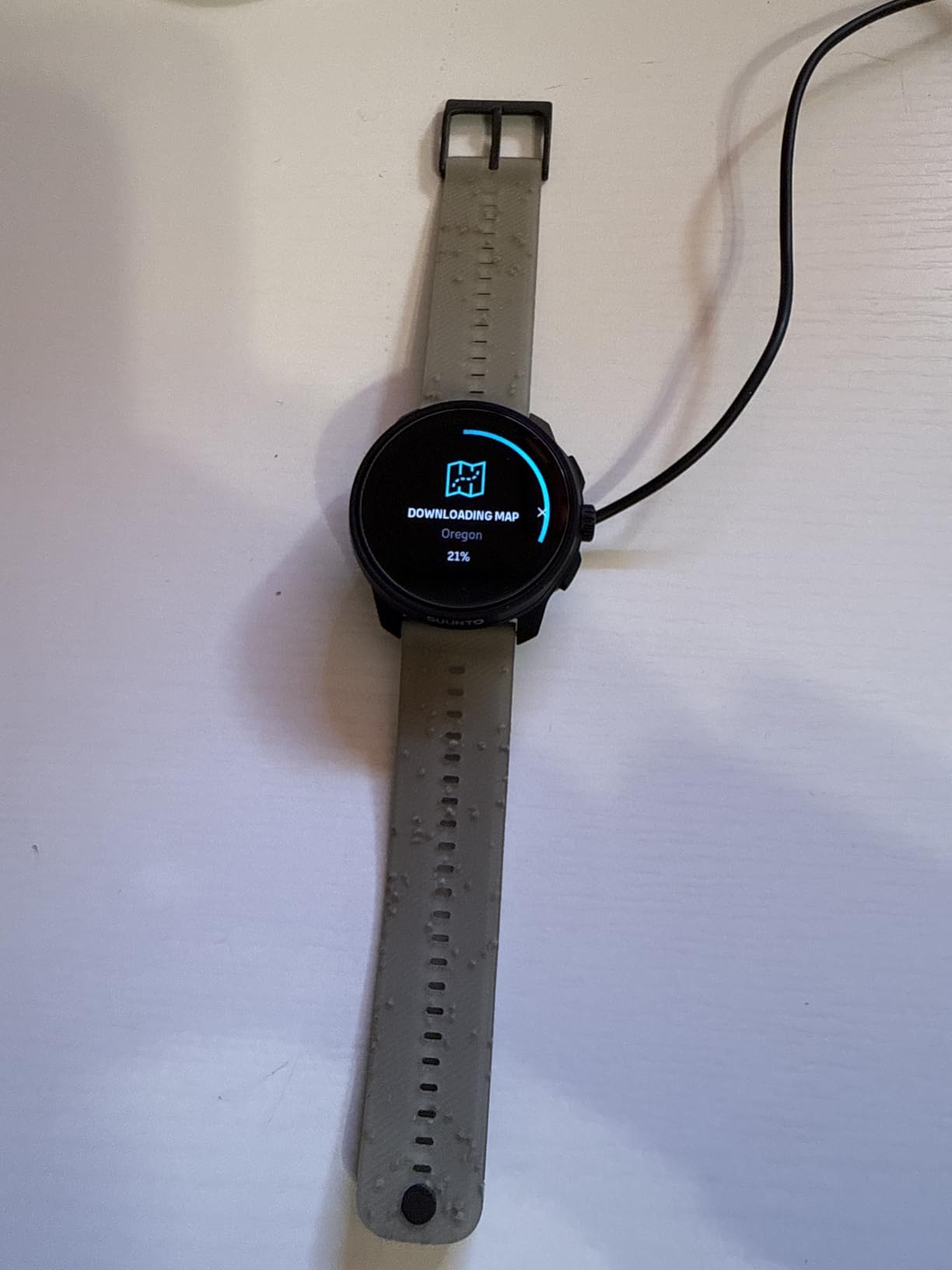
Underneath the display is a serious positioning stack. Dual-band L1 and L5 GNSS across GPS, GLONASS, Galileo, QZSS, and BeiDou is among the most capable satellite configurations here, and global offline maps with 2 km zoom-out, points of interest, bearing, and find-back navigation are the trail-relevant features most runners ask for.
The 4.4 rating is not a GPS problem. It is a software problem, and it comes down to firmware updates resetting activity settings, VO2 max readings that owners report as implausibly static, and storage used for maps instead of music. Get that expectation set and the watch performs very well.
Why dual-band matters in the backcountry
Using two frequency bands simultaneously reduces the error that comes from signals bouncing off rock walls and tree trunks. On a canyon run or a steep forested sidehill, that is the difference between a believable distance and a number that is a few hundred meters wrong by the end of the day.
Reviews consistently praise tracking accuracy in cities and in complex backcountry terrain, which is the harder test. If your routes involve navigation rather than laps, this is one of the more capable configurations at this tier.
Storm alert, find-back, and other trail-specific tools
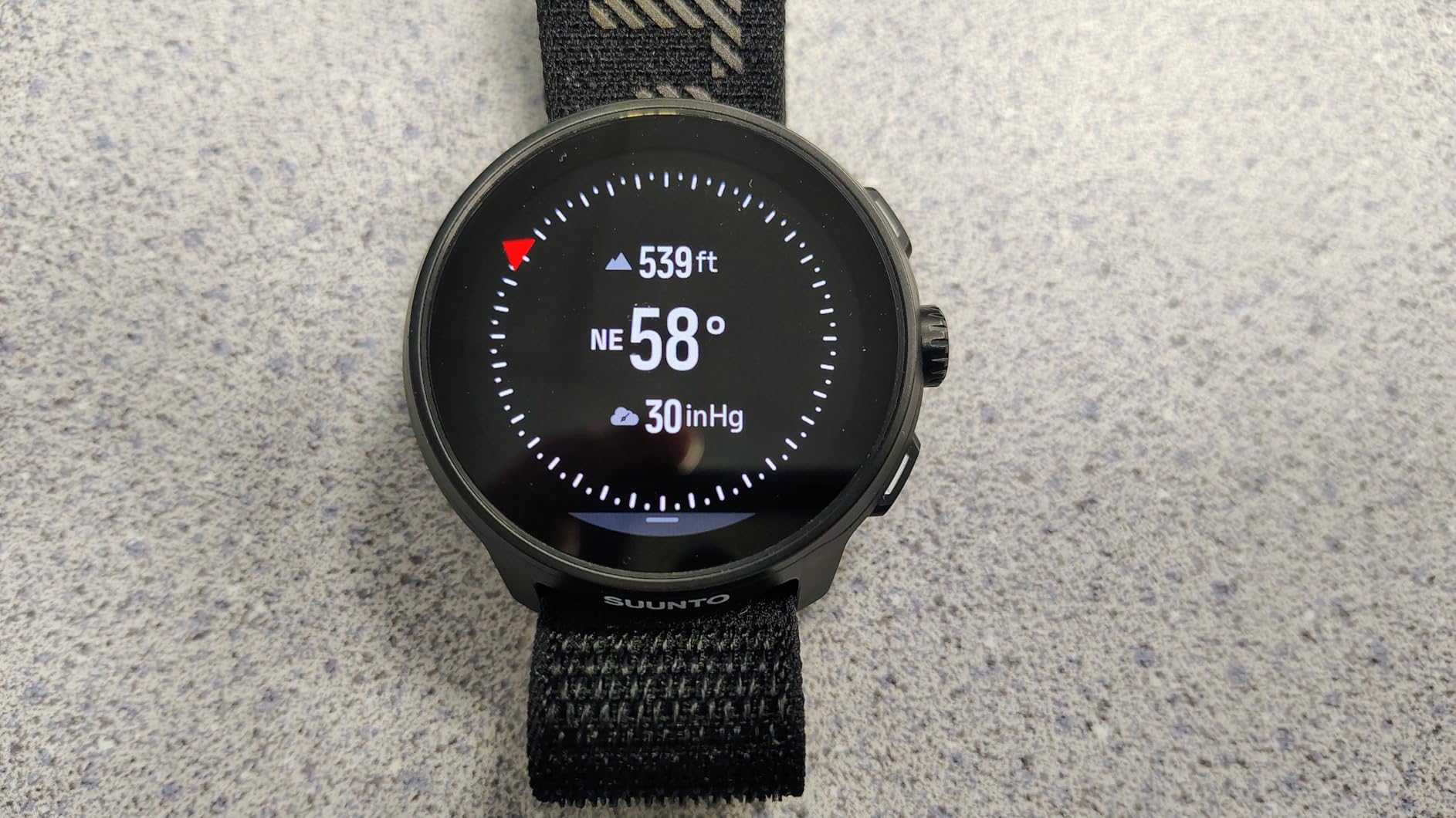
Weather forecasts, storm alert, sunrise and sunset alarms, altimeter, and compass are all built in, and the storm alert in particular is one of those features that a mountain runner will use and a road runner never touches. Find-back is the practical version of breadcrumb navigation: it points you toward where you started.
Offline maps with 2 km zoom-out mean you can see the shape of the terrain around you at a distance rather than only your immediate position, which is the difference between a useful map and a frustrating one when you are deciding whether to commit to a ridge.
Battery and the charging routine
Thirty hours in performance mode is the best GPS accuracy setting, and 13 days in daily use is a solid two-week-between-charges figure. Full recharge takes an hour, so a top-up during a long race window is realistic.
Twenty-four-hour wellbeing tracking plus menstrual cycle tracking in the Suunto app round out the health features, and 95+ sport modes cover everything from trail running to mountaineering. The SuuntoPlus app connects with 300+ partner services, which is a real integration strength.
Who this suits and who should skip it
Suit it to you if you want full maps and serious GNSS in a thin, light case, and if you are comfortable being the person in your running group who maintains their own settings. The crown, the storm alerts, and the find-back function all serve trail work directly.
Skip it if you want to store music on the watch, if firmware resets would drive you mad, or if you rely on external heart rate straps. Buyers defending Suunto tend to be exactly the people who are navigating unfamiliar ground.
11. COROS APEX 4 – Alpine Navigation In A 42 mm Case
COROS APEX 4 (42mm) GPS Watch,1.2″ MIP, 34 Days Battery Life – Black
1.2 inch always-on MIP display
41 hours all-systems GPS
42 mm titanium case, 56 g
Sapphire glass, dual-frequency GPS
Pros
- Dual-frequency GPS with vertical algorithms for steep terrain
- Topographic
- hydro and street maps with trail names
- 41 hours of all-systems GPS
- Lightweight titanium with sapphire at 56 g
Cons
- MIP display is dimmer than AMOLED alternatives
- Smallest review base of the mapped options
- 42 mm case is small for larger wrists
- Newer platform with shorter track record
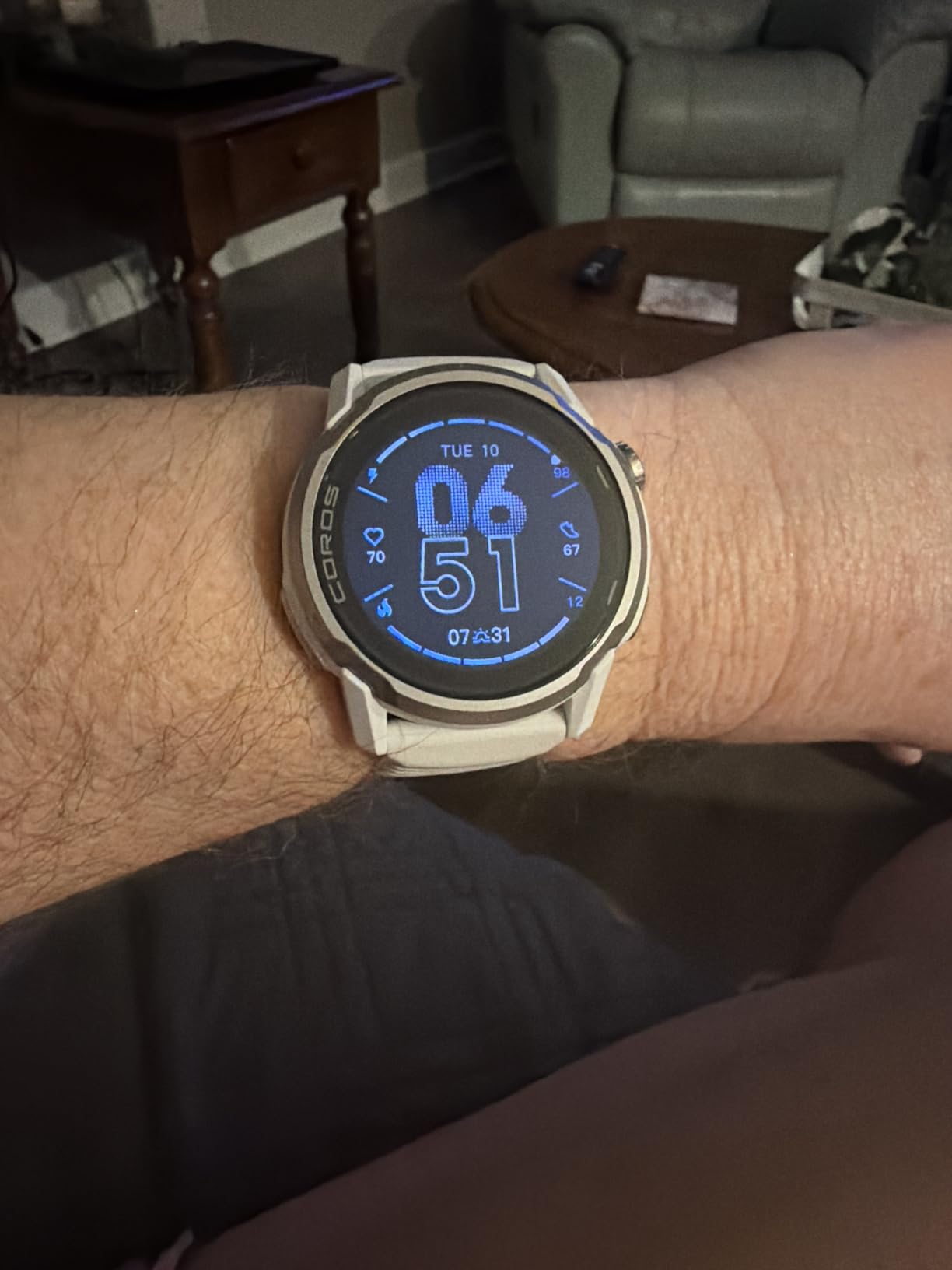
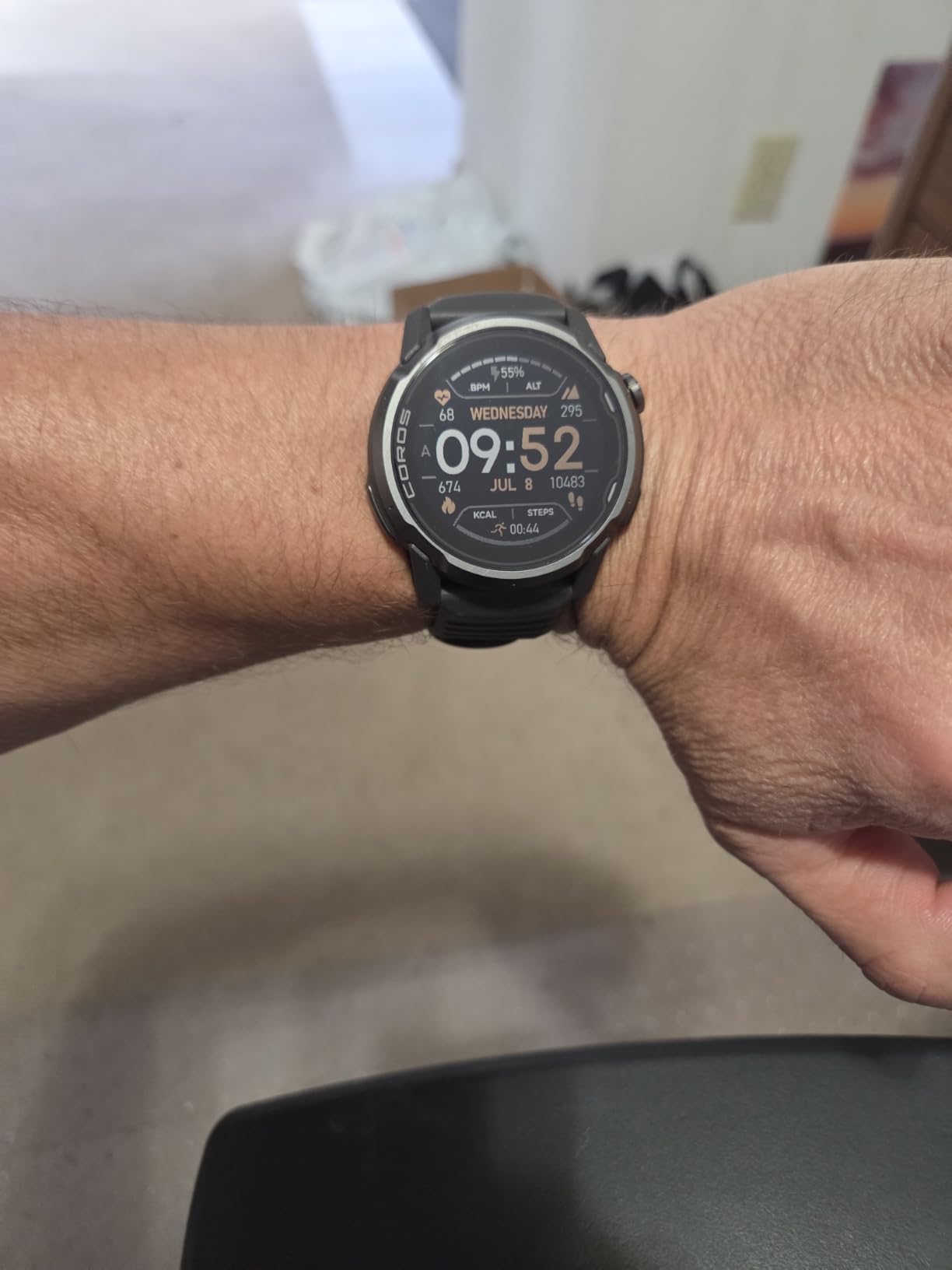
The APEX 4 is the watch to look at if a 47 mm case has always been the reason you passed on a serious trail watch. At 42 mm and 56 g with a titanium case and sapphire glass, it is the smallest and most refined build here, and it does not feel like a compromise on the trail.
Its specialty is alpine. All-systems GPS plus dual-frequency reception with vertical algorithms is built for dense forest, couloirs, and steep alpine terrain, which is the honest way to describe the kind of ground where a breadcrumb line and a wrist altimeter disagree with the map.
Mapping is the best in this roundup by some distance. Topographic, landscape, hydro, and satellite layers render 30 times faster, with two map layers, 15 m zoom, and trail and street names, plus turn-by-turn navigation. The 4.3 rating is a function of a smaller review base and a dimmer screen, not a navigation complaint.
Vertical algorithms and why they matter
Elevation error is the quiet problem in trail running GPS. A watch that reports 200 meters of gain when the real number is 400 will make your training data and your race pacing slightly wrong for the whole year, and vertical algorithms are the attempt to fix that.
On long climbs, owners rate the vertical tracking as one of the more accurate of the mapped watches here. Combine it with the topographic layers and the 2 km-scale context of the map, and this becomes the most reassuring combination for committing to an unfamiliar route.
Why the MIP screen is not just about battery
The 1.2 inch always-on memory-in-pixel display with sapphire glass is dimmer than an AMOLED panel, and that is the most common reservation in reviews. In bright sun it remains readable, and always-on is what delivers the 41-hour figure.
There is a real argument for this display beyond battery. A reflective screen does not burn power to be visible, it does not wash out at an angle the way some bright panels do, and it takes scratches to sapphire rather than to plastic. If you mostly read numbers and maps rather than notifications, the trade works.
Voice Pins and hands-free calls
A microphone and speaker mean you can record Voice Pins, which owners describe as useful for logging beta notes mid-climb, and you can take hands-free calls on the trail. That is a feature most running watches here skip entirely.
Activity modes and training tools for trail running, ski touring, and alpine climbing are all built in, which makes this the most genuinely multi-sport watch in the roundup for anyone whose trail work happens above the treeline.
Who this suits and who should skip it
Suit it to you if you run smaller wrists, if your trails are steep and technical, and if you want the best map detail in this roundup in a case that will sit comfortably on a narrow wrist. The 56 g weight also keeps it light on long climbs.
Skip it if you want a bright AMOLED panel, if you need a proven software platform with a long track record, or if you have larger wrists and want screen real estate. Reviewers like the hardware and the navigation, and the caution is mostly about the platform being new.
12. Suunto Run – The Lightweight Watch With Offline Music
SUUNTO Run GPS Sport Running Watch, Lightweight 1.32″ AMOLED Black Textile
1.32 inch AMOLED at 466 x 466
12 days daily, 20 hours GPS
36 g with textile strap, 11.5 mm thick
4 GB storage, dual-frequency GPS
Pros
- Very light at 36 g with a textile velcro strap
- Offline music playback at an entry price
- Accurate dual-frequency GPS with breadcrumb navigation
- Good display brightness and a mix of controls
Cons
- Wrist heart rate reported as inaccurate during workouts
- Overly sensitive crown and touchscreen
- Limited planning features in the app
- No contactless payment
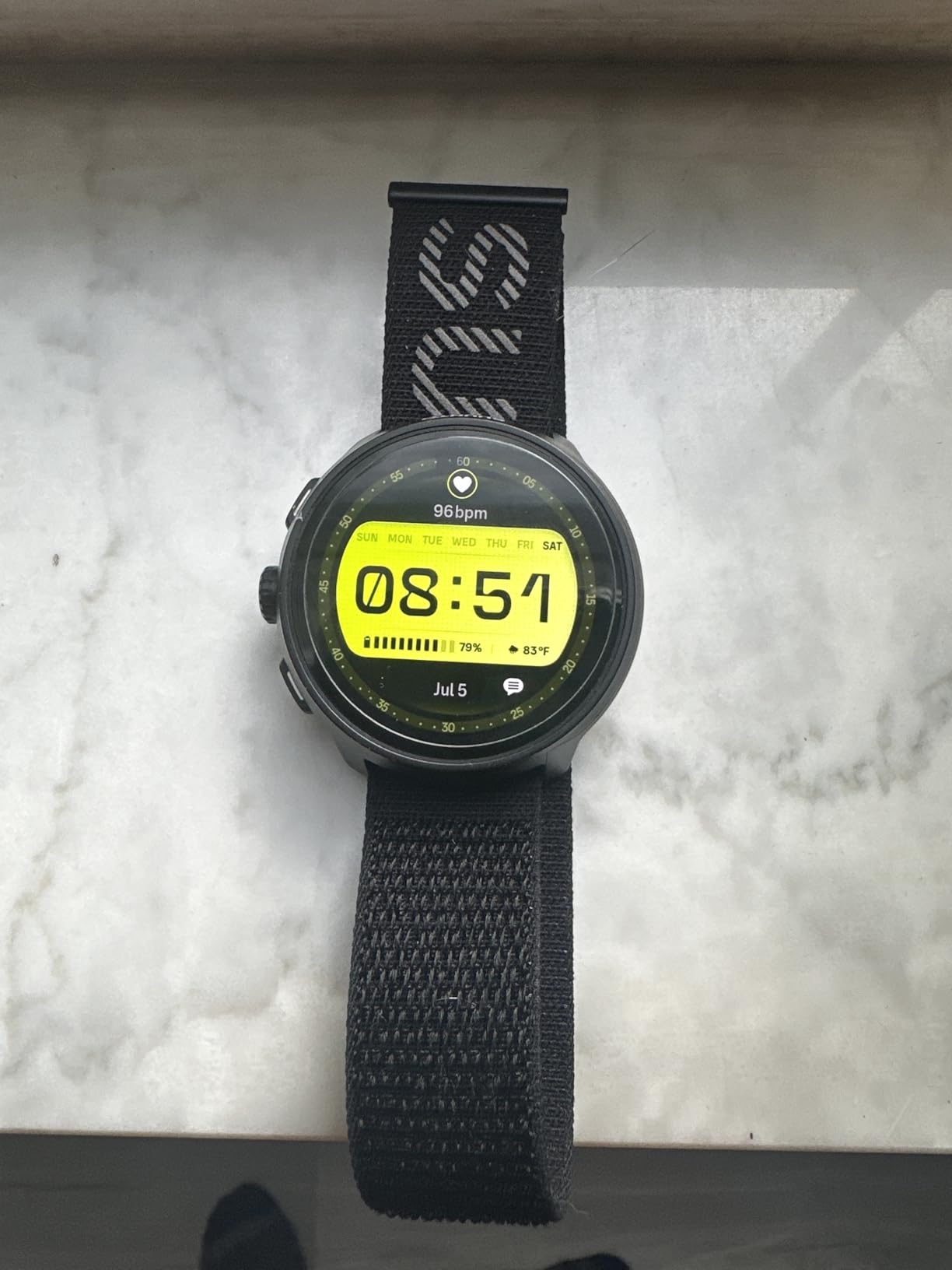
At 36 g with a textile velcro strap, the Suunto Run is the second-lightest watch here and the one that makes a strong case on value. Twenty hours of high-precision GPS and 12 days of daily battery are respectable figures, and dual-frequency GPS with breadcrumb trail navigation covers planned routes well.
Offline music playback is the feature that separates it from the other lightweight options, and if you run without your phone it is a genuinely useful addition at this tier. A 1.32 inch AMOLED at 466 by 466 with a crown and customizable widgets is a good screen for the money.
It is also the lowest-rated watch here at 4.1, and the reason is consistent across reviews: wrist heart rate accuracy. There are also complaints about overly sensitive controls triggering menus mid-stride and a limited planning app. Know that going in and it is a serviceable budget watch rather than a disappointment.
Where 20 hours of GPS actually gets you
Twenty hours of high-precision GPS and 12 days in daily activity and sleep tracking is enough for a marathon, a long 50K, or a week of daily running. It is not enough for a 100-mile race without a wall, so ultrarunners should look at the Enduro 2 or the fenix 8.
Because the watch is light, many owners report keeping it on overnight for sleep and stress tracking, which is where the daily battery figure matters more than the headline GPS number.
The control sensitivity problem
Owners repeatedly report that the crown and touchscreen are overly sensitive, with menus triggering during normal wrist movement. On a technical trail where you are using your arms for balance, that is more than a small annoyance, and it is the most fixable complaint here with a little setup time.
On the positive side, the display brightness is good for early starts, and training load, post-exercise heart rate, and Training Stress Score give you a usable daily training structure without going deep.
What the software does not do
The app cannot create weekly or monthly training schedules, which is a real limitation for anyone running a structured plan. Sleep, stress, and workload metrics are considered unreliable by owners, so treat the health data as directional rather than diagnostic.
There is no contactless payment, and swim distance and lap tracking are reported as unreliable, which matters if you use the watch for more than running. Multiple sport modes are covered, including hiking, cycling, yoga, tennis, and boxing.
Who this suits and who should skip it
Suit it to you if you want the lightest setup with offline music, you run a marathon rather than an ultra, and your training is not heavily structured. The textile strap and 36 g weight are the reason to keep it on.
Skip it if heart rate data drives your training, if you need a structured plan built in the app, or if you race beyond a single day. The cheaper COROS options in this roundup cover the same ground with better tracking and stronger software.
How to Choose a GPS Watch for Trail Running
Most buying guides for this category start with screen size, and screen size is almost never the deciding factor. These six questions are the ones that actually change which watch you should buy.
How much GPS battery do you really need?
Work backwards from your longest planned effort. A marathon or a 50K needs roughly 8 to 10 hours of tracking, a 100K can need 20 to 24, and a multi-day race means you are charging in a drop bag or carrying a battery. Anything above 20 hours covers all but stage races, and the list above ranges from 20 hours to 150.
Then check the mode. Published figures usually assume a specific GPS setting, and turning on dual-frequency, keeping maps visible on an AMOLED, or streaming music can cut usable life substantially. The Enduro 2 uses SatIQ to manage this automatically, which is worth something to anyone running unsupported.
Does dual-frequency GPS matter on your trails?
Dual-frequency, sometimes called multiband, uses two satellite frequency bands at once to reduce the error caused by signal bouncing off rock, trees, and canyon walls. Community feedback is consistent that the improvement is noticeable in forests and canyons, and irrelevant on an open fire road.
If your running happens in the mountains, pay for it. Ten watches in this roundup have it, and the ones that do not, like the COROS PACE 4, compensate with battery and weight instead.
Breadcrumb navigation or full topographic maps?
Breadcrumb shows the line you have already travelled, which works for repeating a known route or running with a planned track. Full topographic maps let you read the terrain around you and make decisions without a phone, which is what you need for unfamiliar backcountry.
In this roundup the models with full onboard maps are the Forerunner 965, the Forerunner 970, the fenix 8, the COROS PACE Pro, the COROS APEX 4, and the Suunto Race S. The COROS APEX 4 has the deepest mapping, with topographic, hydro, street, and satellite layers plus trail names.
Fit, wrist size, and band choice
Case diameter matters more than weight for comfort, and it is the most common reason a good watch gets returned. Below about 16 cm wrist circumference, look at the COROS APEX 4 at 42 mm and the COROS PACE Pro at 49 g, or the Forerunner 265 at 46 mm. The 47 mm Forerunner 965 and fenix 8 and the 45 mm Instinct 3 are noticeably larger watches.
Few guides cover this, so to be explicit: a watch that digs into your wrist bone on the trail strap will bother you every run. Try the case on your actual wrist with the band you intend to use, and if it overhangs, move down a size rather than trusting that it will loosen into place.
On bands, nylon or textile beats silicone for long efforts because it wicks, dries faster, and chafes less. The Enduro 2, COROS PACE 4, and Suunto Run all ship or pair naturally with that approach, and a woven strap costs almost nothing to change.
What switching brands actually costs you
This is the most underrated decision factor. Garmin Connect holds years of training history, race predictions, and body battery data, and moving to COROS or Suunto means starting that history over. The migration guide question comes up constantly in owner forums for good reason.
The honest advice is that switching is fine if your training is simple and you mostly care about the run in front of you. It is genuinely painful if you have a decade of load data and race history you care about. The COROS app has fewer sport profiles and third-party integrations than Garmin, and Polar’s software feels dated next to both.
Safety features and the accessories that matter
Incident detection and Assistance on the Garmin models send your position to a contact if you stop moving, which matters on remote trails. The fenix 8 and Forerunner 970 add a speaker and mic for wrist calls, and the fenix 8 and Instinct 3 include a built-in flashlight that saves you carrying one.
Two accessories change the experience more than most buyers expect. A chest strap fixes the wrist heart rate problem that owners complain about on the heavier watches during technical terrain, and a small USB-C power bank solves the charging gap without a proprietary cable.
If your training recovery is the limiting factor rather than your watch, our compression boots guide for runners covers the other half of that equation. And if you want the wider outdoor picture, our boat GPS picks cover the marine end of the navigation world.
Frequently Asked Questions
What is the best watch for distance runners?
The u003cstrongu003eGarmin Forerunner 265u003c/strongu003e is our pick for most distance runners, with multi-band GNSS, a 2000 nit AMOLED screen and 20 hours of GPS battery. For races beyond a single day, the u003cstrongu003eGarmin Enduro 2u003c/strongu003e adds 150 hours of battery and trail-specific tools like NextFork and grade-adjusted pace.
What is the best Garmin for trail running?
It depends on navigation needs. The u003cstrongu003eForerunner 265u003c/strongu003e is the best balance of accuracy, recovery data and 47 g weight. The u003cstrongu003eForerunner 965u003c/strongu003e adds full-color onboard maps and 31 hours of GPS. The u003cstrongu003efenix 8u003c/strongu003e is the do-everything pick at 47 hours of GPS with a flashlight and wrist calls.
Is the Garmin Forerunner 965 suitable for hiking?
Yes. With full-color built-in maps, turn-by-turn directions, 31 hours of GPS battery and a 50 meter water rating, it handles day hiking and fast hiking well. For multi-day trips, a solar model like the u003cstrongu003eInstinct 3 Solaru003c/strongu003e or the u003cstrongu003eEnduro 2u003c/strongu003e removes the charging question entirely.
How much GPS battery do I need for an ultramarathon?
A 100 mile race usually needs 20 to 30 hours of continuous tracking, and a 100K can need close to 20. Watches with 20 hours or more cover a single-day ultra, while multi-day events call for a solar watch such as the Enduro 2 with up to 150 hours of GPS battery.
Do ultrarunners need maps on a watch?
Most ultrarunners do, for self-sufficiency. Full topographic maps let you read terrain, water sources and escape routes without a phone, and find-back navigation helps when a course marker is missed. The watches with the deepest mapping in this roundup are the u003cstrongu003eCOROS APEX 4u003c/strongu003e, the u003cstrongu003eCOROS PACE Prou003c/strongu003e, and the u003cstrongu003eSuunto Race Su003c/strongu003e.
The Verdict: Which Trail GPS Watch Should You Buy in 2026
If you want the single best balance of satellite accuracy, recovery data, and a watch you will happily wear all day, the Garmin Forerunner 265 is the one. If you plan unfamiliar routes and want a map on your wrist, move up to the Forerunner 965, which is also the best value in this roundup. If you need multi-day battery, take the Enduro 2 for its 150 hours of GPS and trail-specific navigation tools.
For alpine terrain and smaller wrists, the COROS APEX 4 combines the deepest mapping with a 42 mm titanium case. For rock and root, the Instinct 3 Solar is the watch you stop thinking about. And for the lightest setup with offline music, the Suunto Run and COROS PACE 4 do more per gram than anything else here.
Whichever you pick, set it up at home over a free evening, download your maps, and run it once on a familiar route before you trust it on a mountain you do not know. That one habit prevents more bad days than any spec on this list. Pick your runner from the table above and get moving.
Leave a Reply