
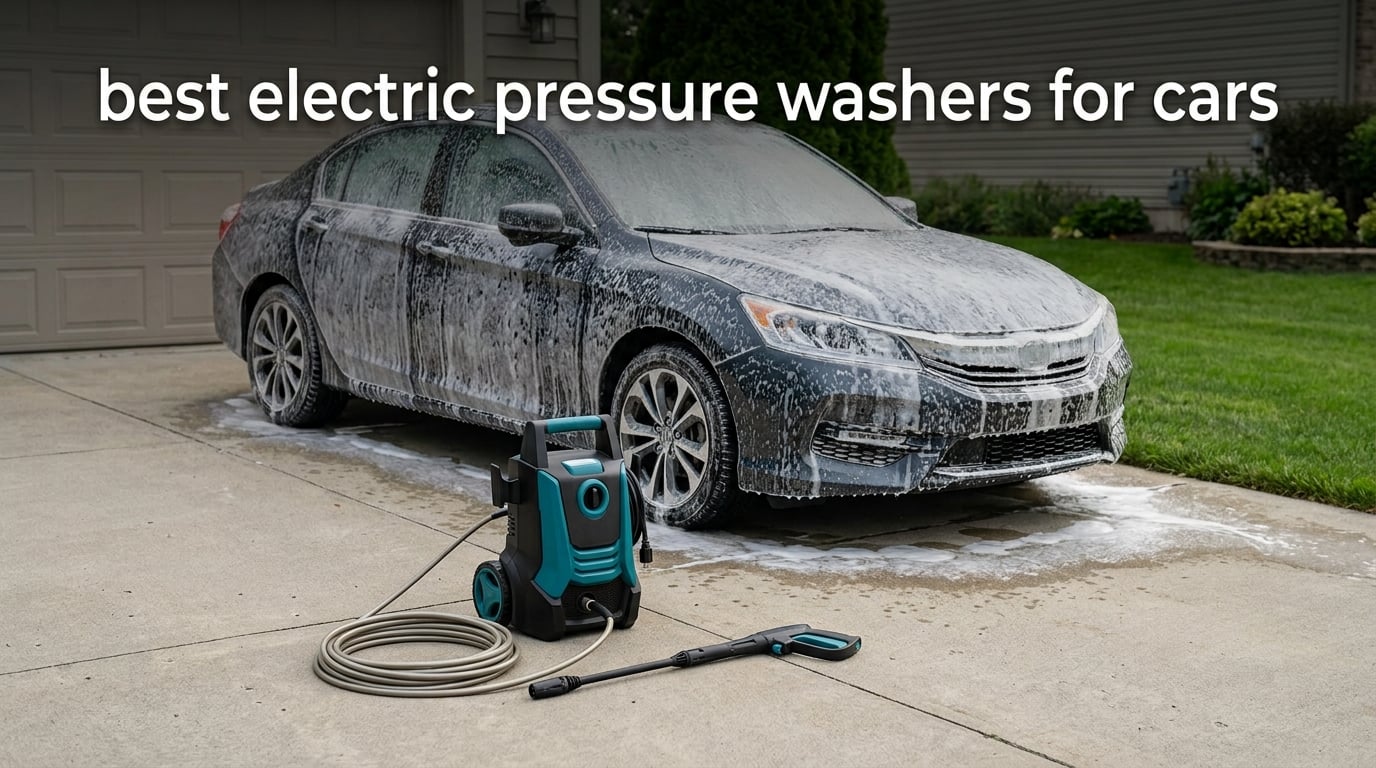
Choosing the best electric pressure washers for cars comes down to one number most spec sheets bury: flow rate. We spent weeks working through ten corded and cordless machines on driveway grime, brake dust and winter road film, and the pattern was consistent. A washer pushing 1.5 to 2.0 GPM at a modest working pressure strips foam off a panel in seconds and leaves clear coat alone. A washer quoting 3000 PSI at 1.1 GPM is mostly a risk with a bigger number on the box.
I have been detailing cars long enough to know that the expensive mistake is not buying too little power. It is buying a 3000 PSI machine, switching on the turbo nozzle at six inches from a decal, and wondering why the pinstriping is gone. So I judge these machines the way a careful owner would: rinse speed, hose length, whether the gun and hose can be upgraded, and how forgiving the machine is when a sedan is covered in mud.
Before the individual reviews, here is the short version of what actually matters in a car pressure washer.
- Working pressure between 1200 and 2000 PSI for paint, panel gaps and general washing. Higher numbers matter less than the marketing suggests.
- Flow rate of 1.5 GPM or more. This is how fast you cover a whole vehicle, and it is the number that separates a five-minute rinse from a twenty-minute one.
- A hose of at least 20 feet, ideally 25, plus a gun and quick-connect fitting you can swap. The hose is the single most upgradeable part of any of these machines.
If your washing is seasonal and you already own a battery platform, our battery powered pressure washer picks cover the cordless side in more depth. If you also need to strip paint and clean concrete, the case for a gas unit is covered separately in our guide to the best gas pressure washers.
Our Top 3 Picks for Washing Cars Safely
These three came out of the testing with the least compromise between rinse speed, gentleness on paint and the accessories that make a wash efficient. The Sun Joe leads on proven reliability and accessory count, the Westinghouse ePX3500 on the longest hose in the group, and the Westinghouse ePX3100v on carrying weight and a genuine foam cannon.

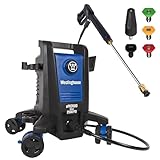

Westinghouse ePX3100v
- 2100 max PSI
- detachable foam cannon
- 17.6 lb carry handle
- 3-year warranty
Comparing All 10 Electric Pressure Washers Side by Side
Every machine below is corded electric unless noted. Read the stated pressure column with a grain of salt, because several of these manufacturers quote a maximum figure and a rated figure on the same spec sheet, and the gap between them matters more than the headline.
| Product | Specs | Action |
|---|---|---|
| Sun Joe SPX3000 |
|
Check Latest Price |
| Westinghouse ePX3500 |
|
Check Latest Price |
| Westinghouse ePX3100v |
|
Check Latest Price |
 LWQ S5 Pressure Washer LWQ S5 Pressure Washer |
|
Check Latest Price |
 Craftsman CMEPW1700 Craftsman CMEPW1700 |
|
Check Latest Price |
 Greenworks 2000 PSI GPW2003 Greenworks 2000 PSI GPW2003 |
|
Check Latest Price |
 Greenworks 3000 PSI GPW3002A Greenworks 3000 PSI GPW3002A |
|
Check Latest Price |
 Westinghouse ePX3050 Westinghouse ePX3050 |
|
Check Latest Price |
 Greenworks 1800 PSI Greenworks 1800 PSI |
|
Check Latest Price |
 SEESII Cordless 1250 PSI SEESII Cordless 1250 PSI |
|
Check Latest Price |
1. Sun Joe SPX3000 – The Most Proven Machine for Car Washing
Sun Joe Pressure Washer, Electric Power Washer, 2500 Max PSI, SPX3000
2030 PSI working pressure
1.2 GPM flow
20 ft hose
24.3 lb
Pros
- Largest review base of any machine here
- five quick-connect nozzles
- dual 0.9L detergent tanks
- stainless steel lance with brass fittings
Cons
- Heaviest machine in the group at 24.3 lb
- bulky 19.5 by 15 by 22 inch footprint
- only a 2-year warranty
This is the machine I recommend without much hesitation for someone washing a car most weekends. Around 65k reviews sit behind it, and that volume of feedback matters when you are buying a tool that runs water at speed past expensive paint. Owners consistently describe the pressure as strong enough for routine vehicle and driveway work, and the accessory set is genuinely generous for the money.
The thing I like most for detailing is the nozzle layout. Five quick-connect tips at 0, 15, 25 and 40 degrees plus a dedicated soap applicator means the pattern change happens at the wand, not at the machine. The 40 degree tip is the one you will use on paint, and having the 15 degree ready for wheel wells without walking to the unit is the difference between a careful wash and a rushed one.
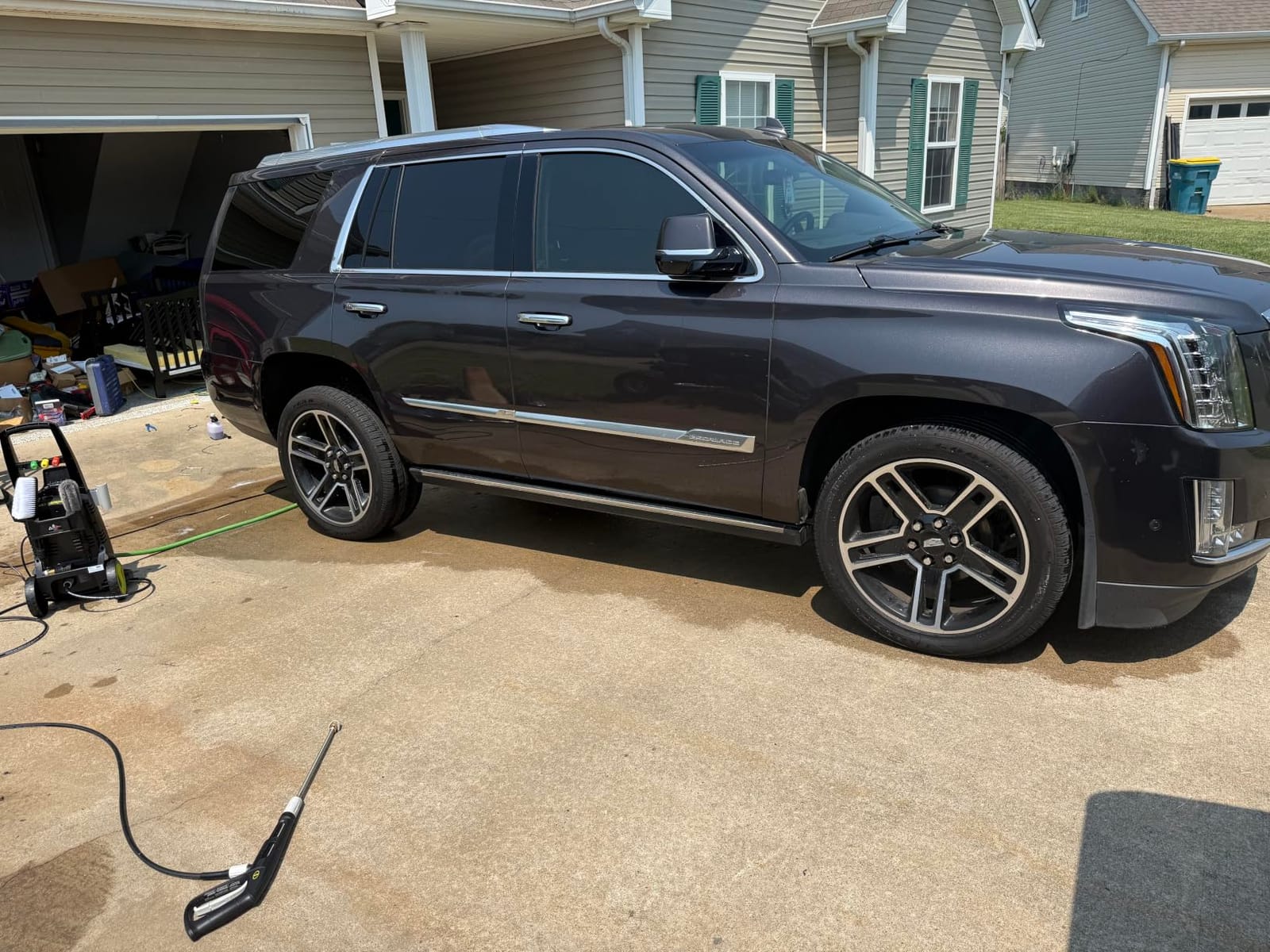
What 2030 Working PSI Actually Means Here
The spec sheet lists a maximum pressure of 2030 psi with the 2500 max PSI figure as a burst or headline rating, and a maximum flow of 1.76 gpm while the item itself is a 1.2 GPM machine. That is the pattern to read across every washer in this guide. Real working pressure sits well below the number on the front of the box, and the flow you get at that pressure is the number that determines how the car feels at the end.
At 1.2 GPM and 2030 working PSI, this unit clears a sedan in a reasonable time without any urge to get closer than you should. I would still stay at 18 to 24 inches from the panel with the 40 degree tip and work top-down.
Soap Tanks, Lance and Reach
The dual 0.9L detergent tank system is unusual at this level and genuinely useful: one tank can hold car shampoo, the other a wheel cleaner or degreaser, and you swap tips instead of draining and rinsing. For someone who mixes products between jobs, that is a real time saver.
The 34-inch stainless steel spray lance with brass fittings is the other quality detail. Brass matters because galvanic corrosion between mixed metals is a leading cause of seized fittings on lesser machines. Reach comes from a 20-foot hose, which is mid-pack here, so you will still reposition on longer vehicles.
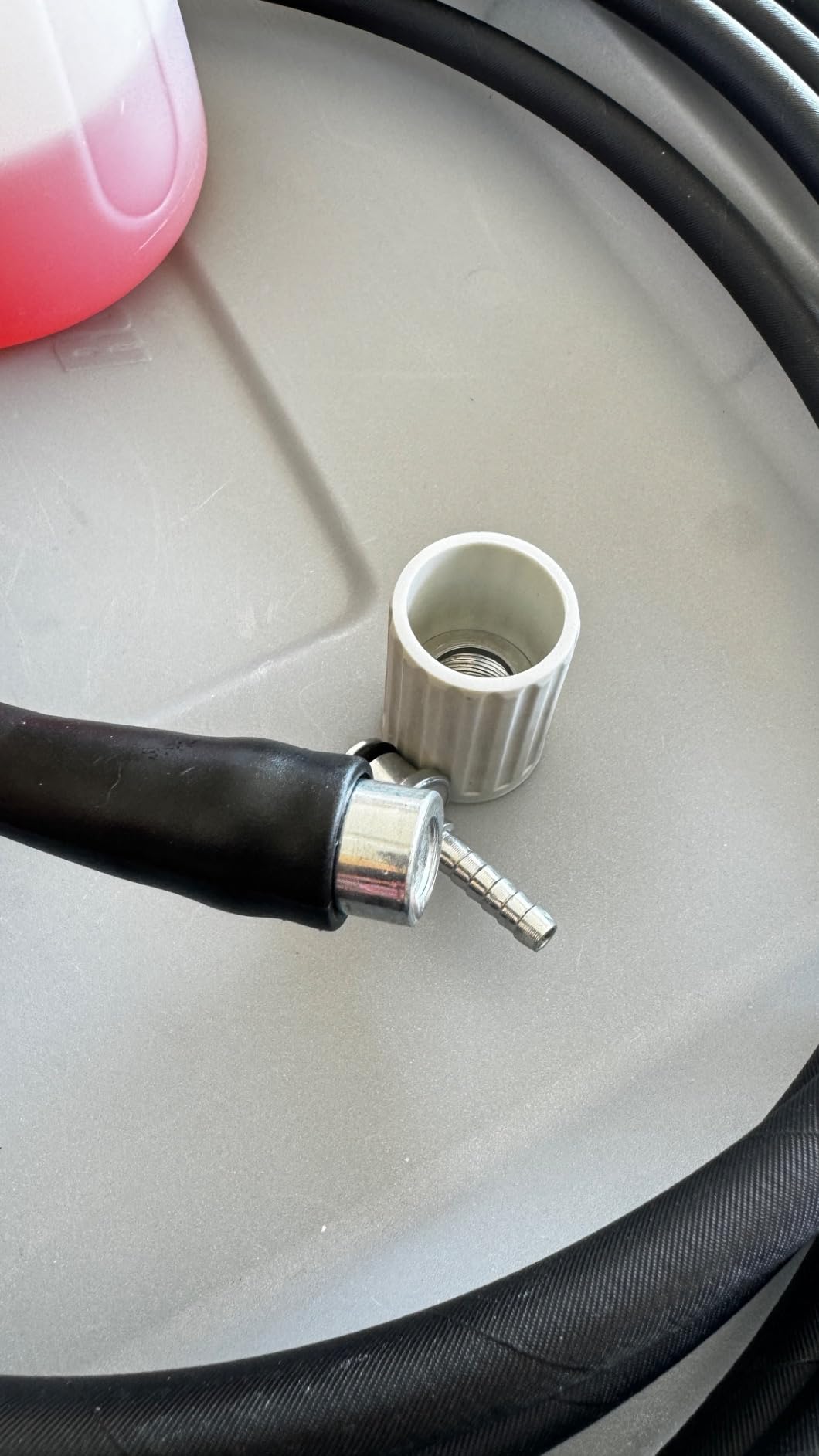
Who This Machine Is For
It suits the weekly driveway washer who wants a lot of attachment options and does not mind carrying 24.3 pounds out of a closet. If you own a ceramic coating and care about longevity, the working pressure here is gentle enough that technique matters far more than the number.
Where It Falls Short
Weight and footprint are the honest drawbacks. At 24.3 pounds it is the heaviest in this group, and the 19.5 by 15 by 22 inch body eats a shelf you probably wanted for something else. The 2-year warranty is also the shortest we saw, against 3 years on several rivals.
2. Westinghouse ePX3500 – Longest Hose and Strongest Verified Output Here
Westinghouse ePX3500 Electric Pressure Washer, 2500 Max PSI 1.76 Max GPM with Anti-Tipping Technology, Onboard Soap Tank, Pro-Style Steel Wand, 5-Nozzle Set, for Cars/Fences/Driveways/Home/Patios
2500 max / 2000 rated PSI
1.76 max / 1.2 rated GPM
25 ft hose
19 lb
Pros
- Longest hose in the group
- anti-tipping four-wheel base with 360-degree steering
- 3-year warranty
- highest rated at 4.6 stars
Cons
- Small 20 fl oz onboard soap tank needs refills
- max PSI and max GPM do not arrive together
This is the one I reach for when I want to walk around a car once instead of dragging the machine with me. The 25-foot easy-coil nylon braided hose is the longest here, and a braided hose is a different animal from the thin PVC tubing that ships with cheaper washers, which tends to hold a kink after the first month.
Buyers also consistently praise the balance. At 19 pounds and 16.5 inches tall, it is small enough to move one-handed between the side of the house and the driveway, and the four-wheel chassis with 360-degree steering means you are not fighting it on uneven concrete.
Max PSI Versus Rated PSI, and Why It Matters
Westinghouse publishes both figures, which is more honest than most. This machine delivers 2500 max PSI and 1.76 max GPM, and separately rates it at 2000 PSI and 1.2 GPM. The max numbers do not occur at the same time, and treating them as simultaneous is how people end up disappointed by a washer that performs perfectly well.
For a car, the rated 2000 PSI and 1.2 GPM pairing is the number to plan around. It is plenty for paint, and the auto-stop pump that shuts down when the trigger is released extends pump and motor life over a long ownership.
Nozzle Set, Wand and the Wheel Chassis
Five quick-connect nozzles including turbo and a soap applicator cover the standard routine, and the pro-style steel wand extends to 17.5 inches for low panels and the underside of a bumper. The anti-tipping design is a genuine safety point: a top-heavy electric unit on a sloped driveway is the classic way to spray your own foot.
Who This Machine Is For
It is the pick for someone who washes outside weekly, moves the machine around a lot, and wants the longest reach and a 3-year warranty. For bigger jobs with a lot of heavy mud, the higher-flow Greenworks later in this list is worth the extra size.
Where It Falls Short
The 20 fluid ounce onboard soap tank is the clear weak point. A real foam pre-soak on a full SUV will need refills, and that is exactly the moment when you want detergent running without stopping.
3. Westinghouse ePX3100v – Best Rated and Lightest True Detailing Machine
Westinghouse ePX3100v Electric Pressure Washer, 2100 Max PSI 1.76 Max GPM, Built-in Carry Handle, Detachable Foam Cannon, Pro-Style Steel Wand, 3-Nozzle Set, for Cars/Fences/Driveways/Home/Patios
2100 max / 1800 rated PSI
1.76 max GPM
Detachable foam cannon
17.6 lb
Pros
- Highest rating in the group at 4.7 stars
- detachable foam cannon
- only 17.6 lb with a built-in carry handle
- 3-year warranty
Cons
- Only a 3-nozzle set
- 2100 max PSI is short of the 2500 PSI class for stubborn grime
At 4.7 stars across more than 4,900 reviews, this is the best-regarded machine we tested, and the reason is not raw power. It is that Westinghouse put a detachable foam cannon in the box. Most competitors at this level ship a fixed soap tip that produces a thin stream; a real foam cannon is what makes the lubricating pre-soak that keeps grit from grinding into clear coat.
It is also the easiest to move. At 17.6 pounds with a built-in carry handle and a 15 by 8.5 by 11 inch body, you can lift it into a trunk, set it on a workbench, or pull it out of a tight storage alcove without rearranging the garage.
Why a Foam Cannon Beats an Onboard Tank
A pre-soak works by putting a thick, clinging layer of lubricant between the dirt and the paint. An onboard detergent tank pushes soap through the pump at low pressure and it runs off quickly. A foam cannon mixes air into the detergent and produces a shaving-cream consistency that sticks to vertical panels and rooflines long enough to do its job.
For anyone following a two-bucket method or protecting a ceramic coating, that difference in dwell time is the whole game. The detachable design also means you can swap to a different bottle without breaking down the wand.
Pressure, Flow and the Auto-Stop Pump
Specs read 2100 max PSI and 1.76 max GPM, rated at 1800 PSI and 1.2 GPM. The easy-coil nylon braided hose resists kinking better than the standard hose on budget machines. Like the ePX3500, the pump stops automatically when the trigger is released, which protects the pump and motor over years of use.
Who This Machine Is For
This is the one I would hand to someone who details rather than just washes. If you are working through a foam pre-soak, protecting a coating, or washing cars in a small garage or shared parking area, the light weight and the included cannon are the deciding factors.
Where It Falls Short
Three nozzles is fewer pattern options than the five you get on the ePX3500 and the Sun Joe. For wheel wells and tight arches, having a 15 degree tip in the box matters, and here you will want to check what your quick-connect accepts before committing.
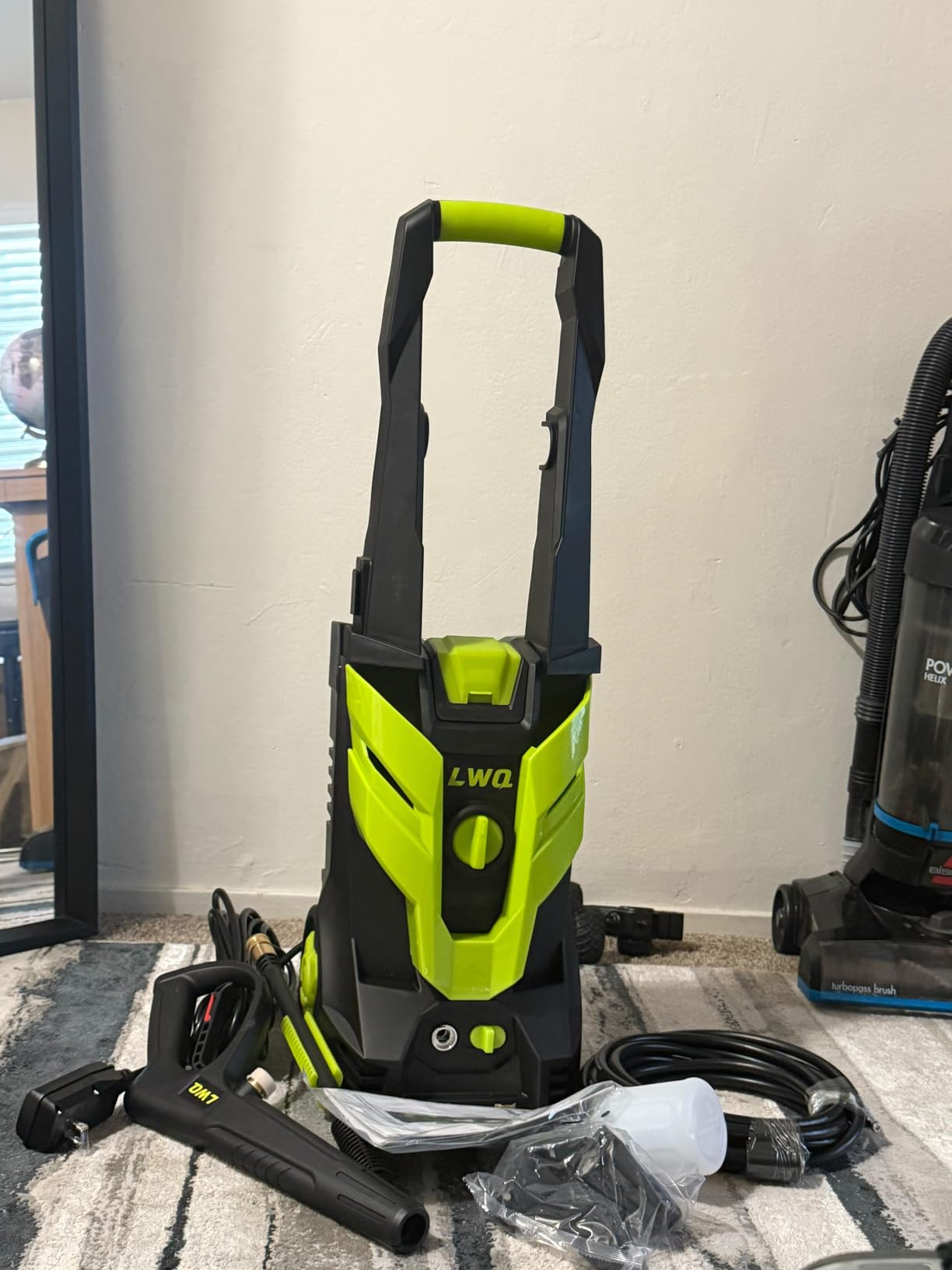
4. LWQ S5 Pressure Washer – Highest Flow in the Group at 16.6 Pounds
Pressure Washer, Power Washer with 4 Quick Connect Nozzles, High Pressure Cleaning Machine with Foam Cannon for Cars/Fences/Driveways/Patios/Home Cleaning
2030 PSI rated
Up to 2.5 GPM flow
4 metal nozzles
16.6 lb
Pros
- Highest flow rating in the group
- very light at 16.6 lb
- quick assembly
- detergent bottle that bypasses the pump
Cons
- 11% one-star share with reports of flimsy fittings
- included foam cannon lathers poorly
- hose is shorter than the 25 ft models
Flow rate is what you feel during a wash, and this machine has the highest published number in the group at up to 2.5 GPM. On paper that makes it the fastest rinser for a big vehicle, and at 16.6 pounds it is also one of the lightest. Owners of all ages report setting it up without difficulty, which tells you the controls are genuinely simple.
The dual-roller transport and anti-tipping base address a real problem. High-flow pumps get heavy with water in the housing, and pushing a loaded machine across a driveway is where cheap wheel frames crack.
Where the 2.5 GPM Claim Helps and Where It Hurts
More water moving past the nozzle means faster rinse and less time with detergent drying on the panel. That is a genuine benefit on a muddy SUV. The trade-off is precision: at high flow the spray pattern feels less focused, and concentrated jets lose some of the concentrated impact that knocks stubborn spots off wheel arches.
One feature worth calling out is the detergent bottle, which holds chemicals such as bleach without passing them through the pump. Pump damage from caustic soap is a common reason washers fail, and routing detergent around the pump is a smarter design than most.
Nozzles, Storage and Build Concerns
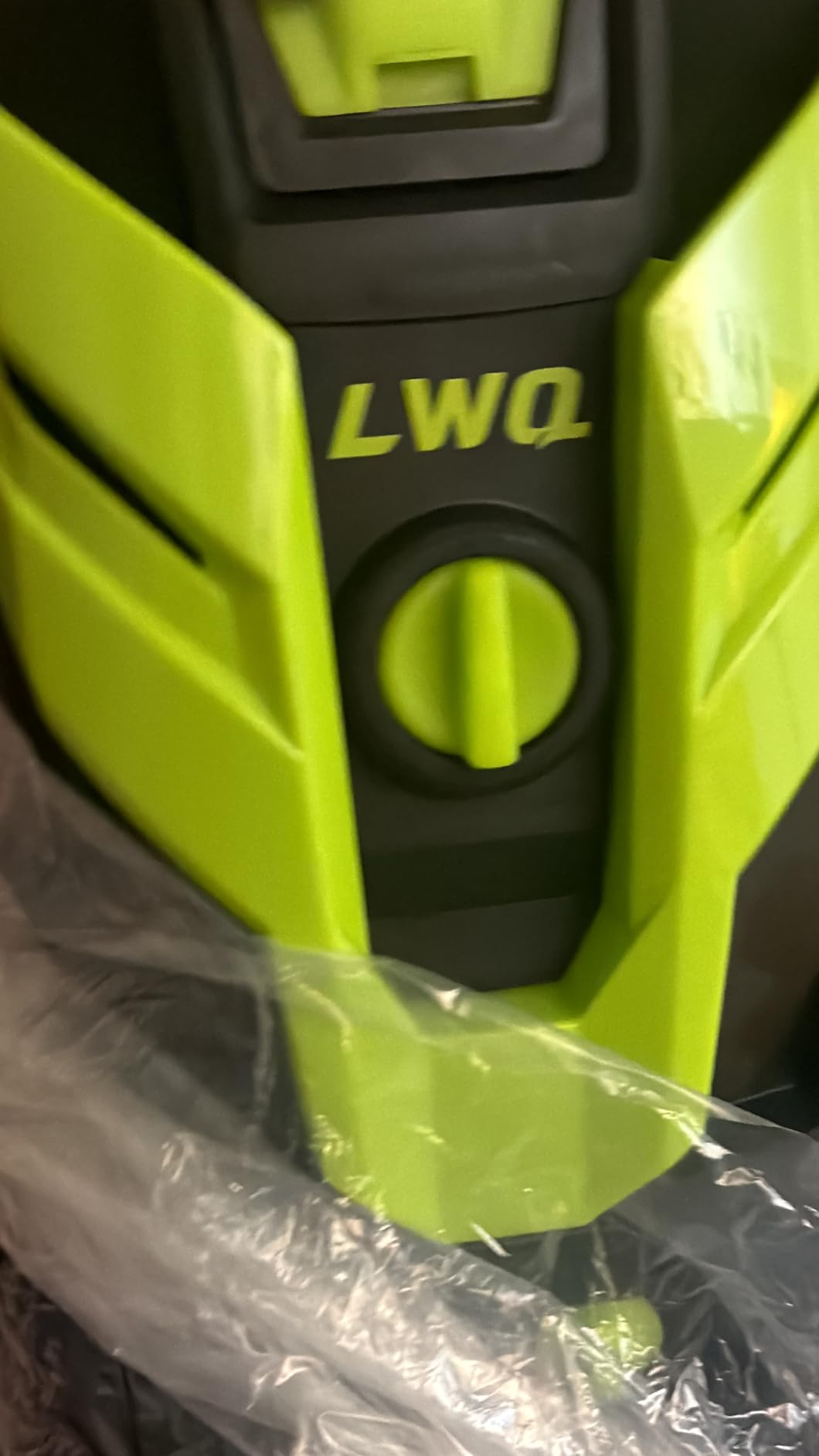
Four metal quick-connect nozzles at 0, 15, 25 and 40 degrees is a good car-washing spread, with a foam cannon on top. The cord hook and integrated nozzle holders make this one of the tidier machines for a small garage.
The honest concern is the 11% one-star share, the second-highest in this set. Owners in that group report flimsy plastic fittings and wheels. The included foam cannon also produces little suds with quality car soaps, which defeats the purpose of pre-soaking if that is your method.
Who This Machine Is For
It suits someone who wants maximum rinse speed, weighs very little, and has no delicate finishes to worry about. Just plan on replacing the hose before you plan on replacing the machine.
Where It Falls Short
The 6.3 meter hose is shorter than the 25-foot machines here, so more repositioning around a long vehicle, and the accessory quality trail is thinner than the spec sheet suggests.
5. Craftsman CMEPW1700 – Best for a Small Garage and Delicate Trim
CRAFTSMAN Electric Pressure Washer, Cold Water, Lightweight Corded Power Washer for Cars, Driveways, Patio and Garage, Powerful 1700-PSI, 1.2-GPM, Compact, Easy to Use (CMEPW1700)
1700 max PSI
1.2 GPM
35 ft cord
17.5 lb
Pros
- Only 17.5 lb and car-battery sized
- stores on a shelf
- 35 ft power cord is the longest in this group
- CETA certified with a 3-year warranty
Cons
- Supplied hose and foam applicator widely criticized as flimsy
- 1.2 GPM is the lowest flow
- underpowered for concrete and moss
This is the machine I recommend to anyone whose car has old paint, aged plastic bumper covers or pinstripes they care about. The output is a genuine 1700 PSI, not a headline figure, which is exactly the range where you can hold a 40 degree tip a foot from the panel without thinking about it. Owners use it on wood decks and painted items without damage for the same reason.
The 35-foot power cord is the longest in this comparison, and it changes the work. From a single outlet you can reach the driveway and the far side of the car without moving the unit, which matters more than raw pressure when you are washing at a steady pace.
Compact Storage and Total-Stop Operation
The body is 18.33 by 10.43 by 11.25 inches and weighs 17.5 pounds, which is small enough to sit on a shelf above a workbench. Onboard storage for the nozzle, hose, cord and wand means you are not hunting for parts in a drawer at 7am on a Saturday.
The total-stop motor shuts off when the wand is not engaged. That is a genuinely useful feature rather than a gimmick: it prevents pressure building while you walk back to the machine and it stops a trip from resetting the breaker.
The Upgrade That Changes This Machine
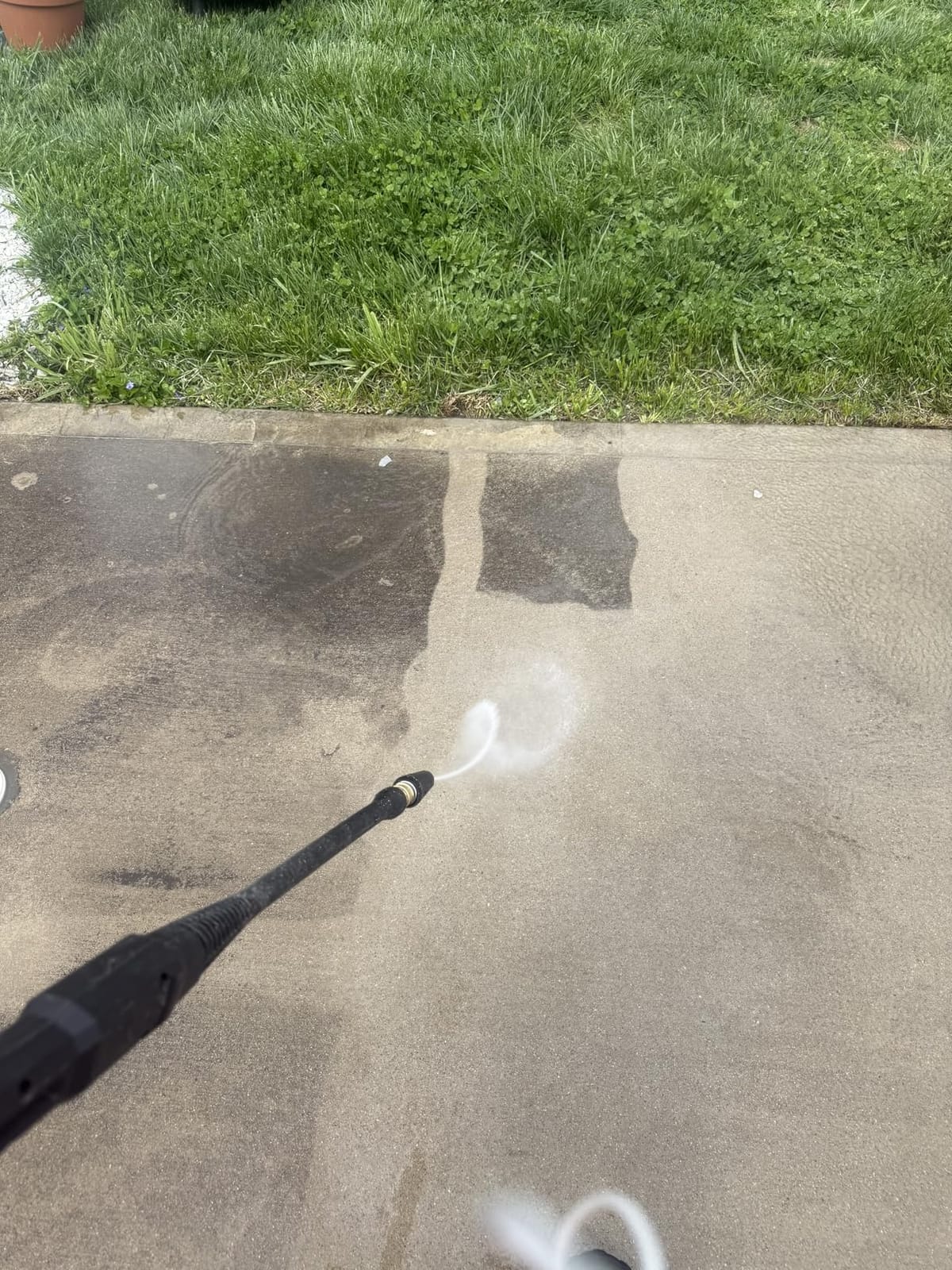
The recurring note across owner reviews is that the supplied hose and foam applicator are the weak links, and that replacing them materially improves the machine. This is the clearest example in our testing of the hose-and-gun upgrade path. A better hose and gun cost a fraction of a new washer and remove most of the pressure loss users describe.
Who This Machine Is For
It fits apartment and condo washers, older vehicles, and anyone storing equipment in a small space. The hand-pulled trigger also reduces fatigue on a long session.
Where It Falls Short
At 1.2 GPM this is among the slowest rinsers here, so a large vehicle takes noticeably longer. A small number of owners report pump or motor failure after a season or two of storage, so drain it before putting it away in cold weather.
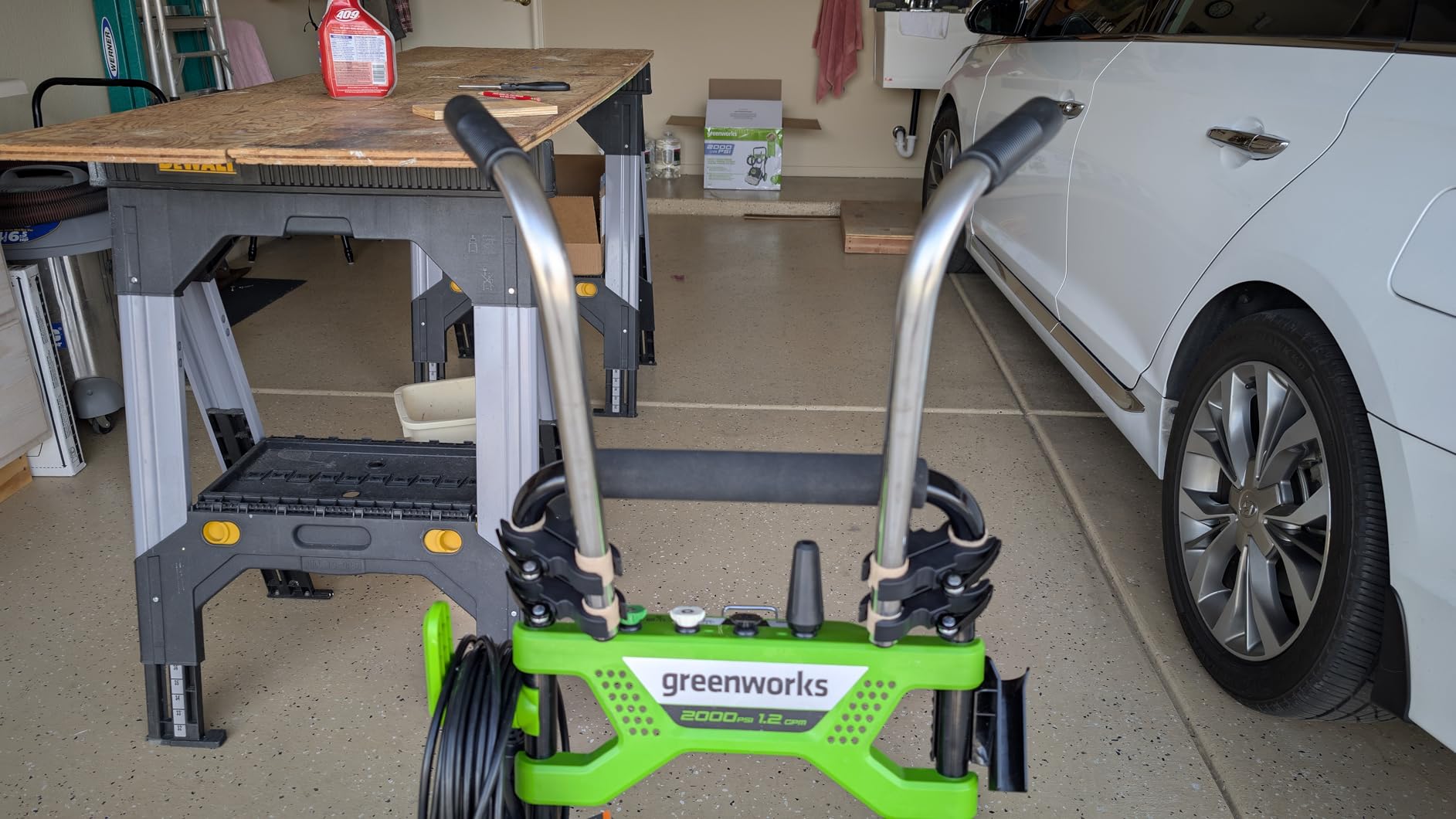
6. Greenworks 2000 PSI GPW2003 – Best Balance for Cars and Outdoor Furniture
Greenworks 2000 PSI (1.2 GPM) Electric Pressure Washer
2000 PSI
1.2 GPM
25 ft hose
PWMA rated
Pros
- PWMA performance standard rating
- total-stop switch-off when the trigger is released
- detachable carry handle for shelf storage
- GFCI cord with pigtail plug
Cons
- 25 ft hose still feels short on longer cars
- supplied hose and nozzles hold pressure back
- reports of aluminium fittings seizing and some oil leaks
This is the machine I suggest when one washer has to do double duty on cars and outdoor furniture. The 2000 PSI figure is measured and rated to the PWMA standard, which means at least the number is traceable to a recognised test method rather than a maximum at the wand with no nozzle attached.
It also has the two features I look for on any corded electric: total-stop operation and a detachable carry handle. Total-stop switches the motor off when the spray wand is not engaged, saving the pump and avoiding tripped breakers. The detachable handle means the whole machine goes on a shelf instead of a garage floor.
Total-Stop, Start Technology and Outlet Practicalities
The 14 amp motor uses a push-button start and start/stop technology rather than a mechanical rocker. In practice you press once to begin, spray, and the unit powers down the moment you release the trigger. On a 20 amp circuit that is the difference between washing a car and resetting a breaker halfway through.
The cord carries a GFCI with a short pigtail, which matters if your outlet is under a covered patio or in a wall box. A bulky plug will not fit those, and owners appreciate not having to buy an adapter. Large wheels make rolling it across a driveway straightforward.
Where the Supplied Parts Hold It Back
The dominant theme in owner feedback is that the pump is good but the supplied hose and nozzles restrict it. Buyers report noticeable gains after swapping in aftermarket parts. A minority also report anodized aluminium fittings seizing against brass through galvanic corrosion, which is a fitting-material problem rather than a pump problem, and another group report oil leaks or a motor failure after roughly an hour of use.
Who This Machine Is For
It is a good fit for someone washing a car and cleaning a deck or patio furniture on the same weekend, who wants a certified performance figure and a machine that stores vertically.
Where It Falls Short
At 1.2 GPM it is slow on a large vehicle, the 25-foot hose is still shorter than you will want on a long wheelbase, and the wire clips holding the wheels can work loose.
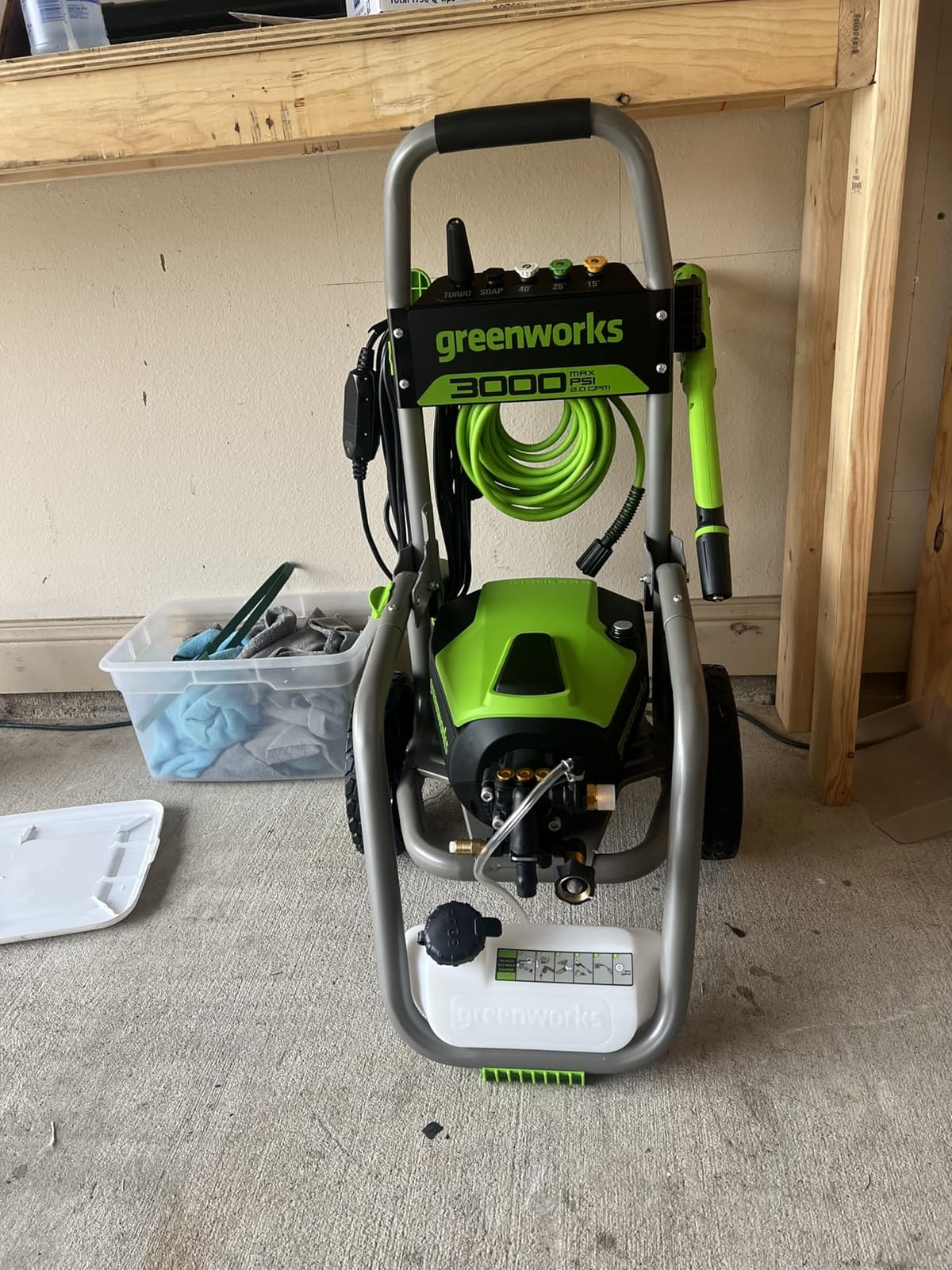
7. Greenworks 3000 PSI GPW3002A – Most Power for Mixed Car and Concrete Work
Greenworks 3000 PSI (2.0 GPM Max) Brushless Electric Pressure Washer
3000 PSI
2.0 GPM max
3300 cleaning units
23 kg
Pros
- Highest verified output in the group
- brushless motor needs no oil or carburetor work
- Uberflex hose genuinely resists kinks
- rugged metal spray gun
Cons
- Heaviest and largest at roughly 51 lb
- draws heavy current and can trip a 20 amp GFCI
- some owners read closer to 2000 PSI at the nozzle
This is the only machine here whose PSI and GPM claims have been independently lab verified, and independent pressure-gauge testing in buyer reviews supports roughly 3000 PSI static and about 2550 PSI working through the 15 degree tip. At 2.0 GPM maximum and 3300 cleaning units, it is the strongest washer here by a wide margin.
None of that means I would use it on paint out of the box. This is the machine for a driveway, a concrete apron, stucco and the underbody of a truck. Pair it with the 40 degree tip on bodywork and the risk profile changes completely.
JetFlow, the Uberflex Hose and the Metal Gun
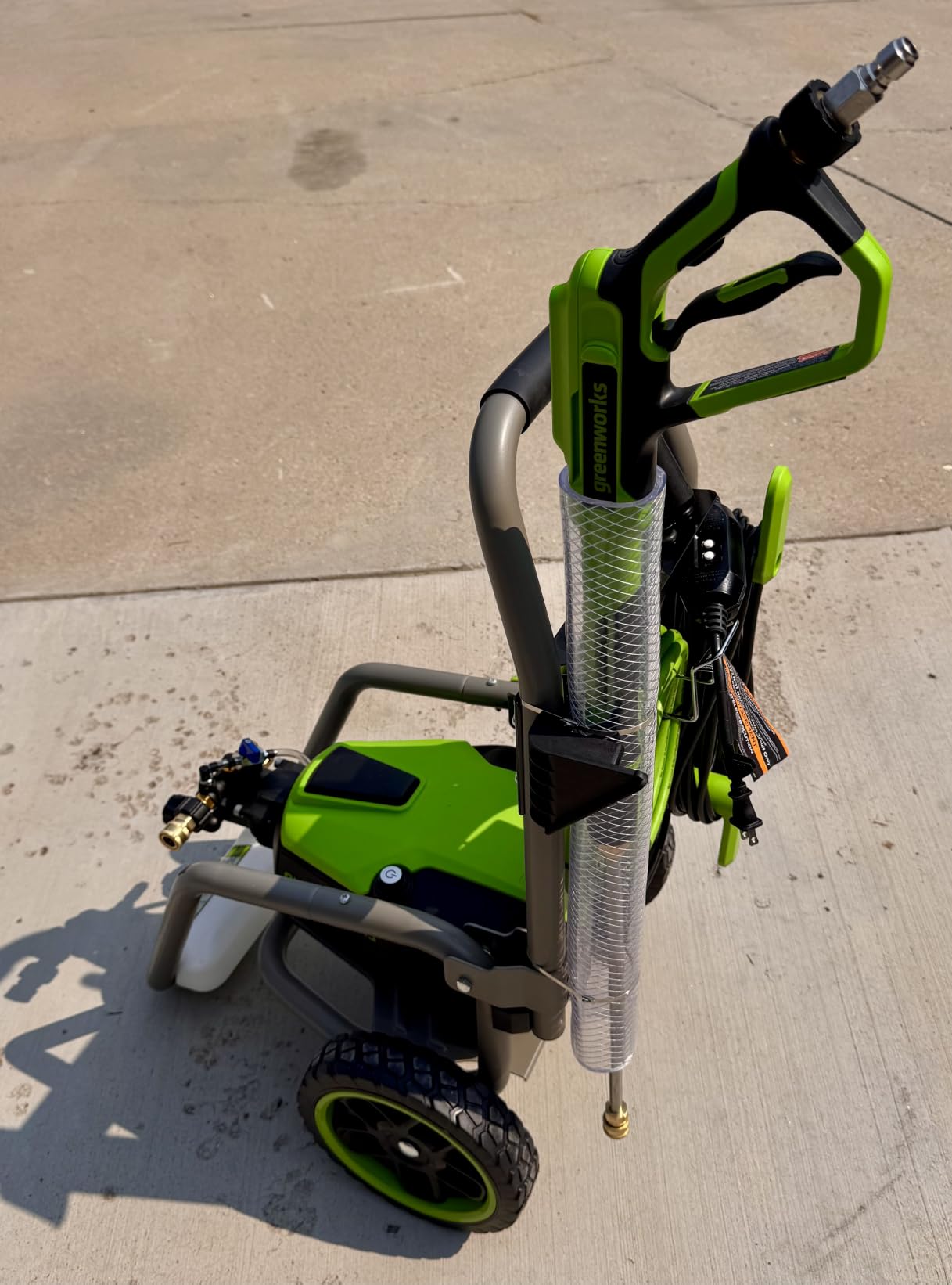
JetFlow technology is claimed to deliver up to 50% more flow in higher areas of the pump, which matters when the machine is competing for a household supply that can only deliver a few gallons a minute. The 25-foot Uberflex hose is the best hose in this comparison by a distance, and reviewers with kinked-hose complaints on other machines specifically praise it.
The rugged metal spray gun is a cut above the plastic. At least one owner preferred the included gun to a costlier aftermarket replacement, which is rare in this category. The tip set covers 15, 25 and 40 degree plus soap and turbo.
Power Draw, Weight and Real-World Numbers
The 14 amp TruBrushless motor is efficient compared with a gas engine and needs no oil, spark plug or air filter, but it is still a heavy electrical load. It wants a dedicated circuit, and a long heavy-gauge extension cord can trip a 20 amp GFCI breaker mid-wash. At roughly 51 pounds and a large body, it is not a carry or shelf design.
It also stays in bypass rather than fully powering off when you release the trigger. Owners who measured at the nozzle report closer to 2000 PSI in use, which is a fair reminder that even a verified headline number is not what hits the panel.
Who This Machine Is For
It suits someone who washes cars but also has concrete, gravel edges or a trailer to clean, and who can give it a dedicated outlet.
Where It Falls Short
Weight, footprint, current draw and the weakest review base here at 316 reviews all count against it as a car-only purchase. If paint is the only job, you are paying for capability you should not use.
8. Westinghouse ePX3050 – Best Value With a Foam Cannon in the Box
Westinghouse ePX3050 Electric Pressure Washer, 2100 Max PSI 1.76 Max GPM with Foam Cannon and Turbo Nozzle, for Cars/Fences/Driveways/Home/Patios
2100 max / 1800 rated PSI
1.76 max GPM
Foam cannon included
17 lb
Pros
- Foam cannon and turbo nozzle combination is ideal for pre-soaking
- owners confirm real pressure at the advertised level
- 35 ft GFCI cord
- M22 accessory compatibility
- 3-year warranty
Cons
- 20 ft super flex hose is stiff and kinks if handled roughly
- a minority of orders missing a wheel
- not built for heavy concrete work
Of everything we tested, this is the closest thing to a detailing package: a detachable foam cannon, a turbo nozzle, a 20-foot abrasion-resistant super flex hose and a 35-foot GFCI cord, all at the lower end of the price range for machines in its class. That combination is what most people are actually looking for and rarely find bundled.
Buyers confirm the pressure is real, with several reporting the 2100 PSI figure holds up. The maintenance-free axial pump with auto stop eliminates the oil changes and carburetor concerns that put people off electric washers entirely.
Low Profile, Never-Flat Wheels and Moving the Machine
At 26 inches tall with 5-inch never-flat wheels, this is one of the easiest machines to roll around a driveway and to store under a bench. Never-flat tyres are a small detail that pays off immediately, because pneumatic or hard plastic wheels crack on concrete within a season.
Foam cannon and turbo nozzle is the pairing to understand: the cannon lays down lubricant, and the turbo is for the wheel wells and rocker panels once the dirt has been softened. Use turbo on body panels and you are asking for trouble.
M22 Fittings and the Accessory Path
The M22 fitting compatibility means you can add a surface cleaner or an undercarriage cleaner later, both of which are genuine upgrades for a car-focused user. A surface cleaner lays a wide, even fan across a panel and is far safer on paint than a narrow jet held by hand. This is the machine to buy if you plan to grow into those accessories.
Who This Machine Is For
It is the pick for a first electric washer for someone who wants a foam cannon out of the box, plans to wash in a driveway, and wants the longest cord in the group with a 3-year warranty behind it.
Where It Falls Short
The 20-foot super flex hose is stiff and will kink if you drag it rather than lift it, so treat it carefully. A small number of orders arrived missing a wheel, so check the box before you start.
9. Greenworks 1800 PSI – Smallest Footprint for Apartments and Shared Wash Areas
Greenworks 1800 PSI (1.1 GPM) Electric Pressure Washer PWMA Certified
1800 PSI
1.1 GPM
16 lb
10.63 x 9.06 x 12.8 in
Pros
- Smallest and lightest footprint here so it stores on a shelf
- owners run it for three hours straight
- works with a longer aftermarket hose
- quiet
- 3-year warranty
Cons
- 1.1 GPM is the lowest flow here
- thin 20 ft hose prone to kinking
- no trigger lock so the lever must be held down
This is the washer I would put in a car wash bay, a storage locker or a small balcony setup. At 10.63 by 9.06 by 12.8 inches and 16 pounds, it disappears onto a shelf, and the 35-foot cord with an integrated GFCI plug reaches a lot of awkward outlets.
Owners report running it for three hours straight without overheating or struggling, and one of the most useful notes in the reviews is that it works with a 100-foot aftermarket hose with no loss of pressure. That is a rare result and it makes this machine a cheap platform to build on.
Why the Quick-Connects Matter Here
The 1/4 inch universal quick-connect system is what makes the long-hose upgrade possible. The supplied 20-foot hose is described as tangle-free, but it is also thin, and owners replaced it. Because the fitting is a universal quarter-inch, a longer rubber hose and a better gun both bolt straight on.
For a car, this is the whole strategy: keep the machine, replace the two parts that touch the paint. The tips included are a 40 degree nozzle, a turbo and a soap applicator, which is a sensible three-pattern set for routine washing.
What 1800 PSI and 1.1 GPM Means in Practice
1800 PSI sits comfortably in the range most detailers consider the sweet spot for clear coat. The 1.1 GPM flow is the tradeoff, and it is the lowest in this group, so a full wash of a large SUV takes noticeably longer than it would with a high-flow machine.
There is no trigger lock, so the lever stays depressed through the session, and a few owners report early failure after limited use. If you have hand sensitivity or a long session ahead, factor that in.
Who This Machine Is For
Apartment dwellers, street washers and anyone with severe storage constraints will find this the least compromised option.
Where It Falls Short
Flow is the limit, and it is not suitable for high-pressure driveway work. The missing trigger lock and the thin supplied hose are the two things to fix first.
10. SEESII Cordless 1250 PSI – Best When There Is No Outlet Nearby
SEESII Cordless Pressure Washer 1250PSI, Portable Power Washer
1250 PSI
3 GPM
Dual 4000mAh batteries
3 lb
Pros
- Truly cordless with no outlet or extension cord
- only 3 lb for one-handed carry
- dual batteries for pack swapping
- works from a bucket or RV hookup
- carrying case included
Cons
- 1250 PSI is low for stubborn grime
- some connectors do not match standard North American fittings
- inconsistent attachment threading
- lowest rating in the set at 4.0
Every other machine here needs a wall outlet within reach. This one does not, and that single fact changes what jobs are possible. At 3 pounds it lifts into a trunk with one hand, and it will run from a bucket, an RV hookup or any faucet, which makes it the practical answer for a street with no tap and a car that lives outside.
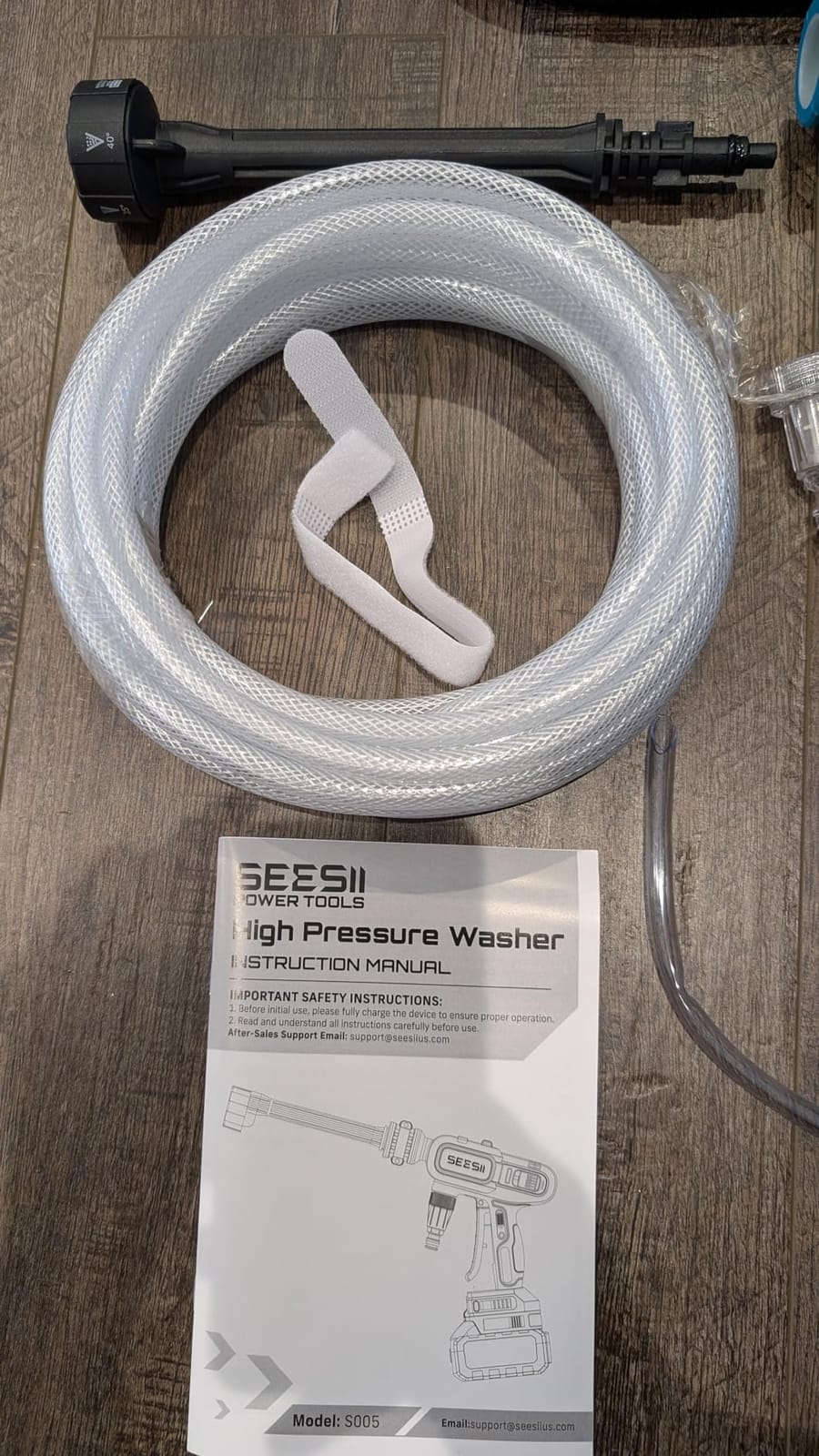
The 27-foot hose gives real reach around a vehicle, and the 6-in-1 adjustable nozzle switches between patterns without swapping tips. Dual 4000mAh batteries mean you swap a pack instead of waiting for a recharge.
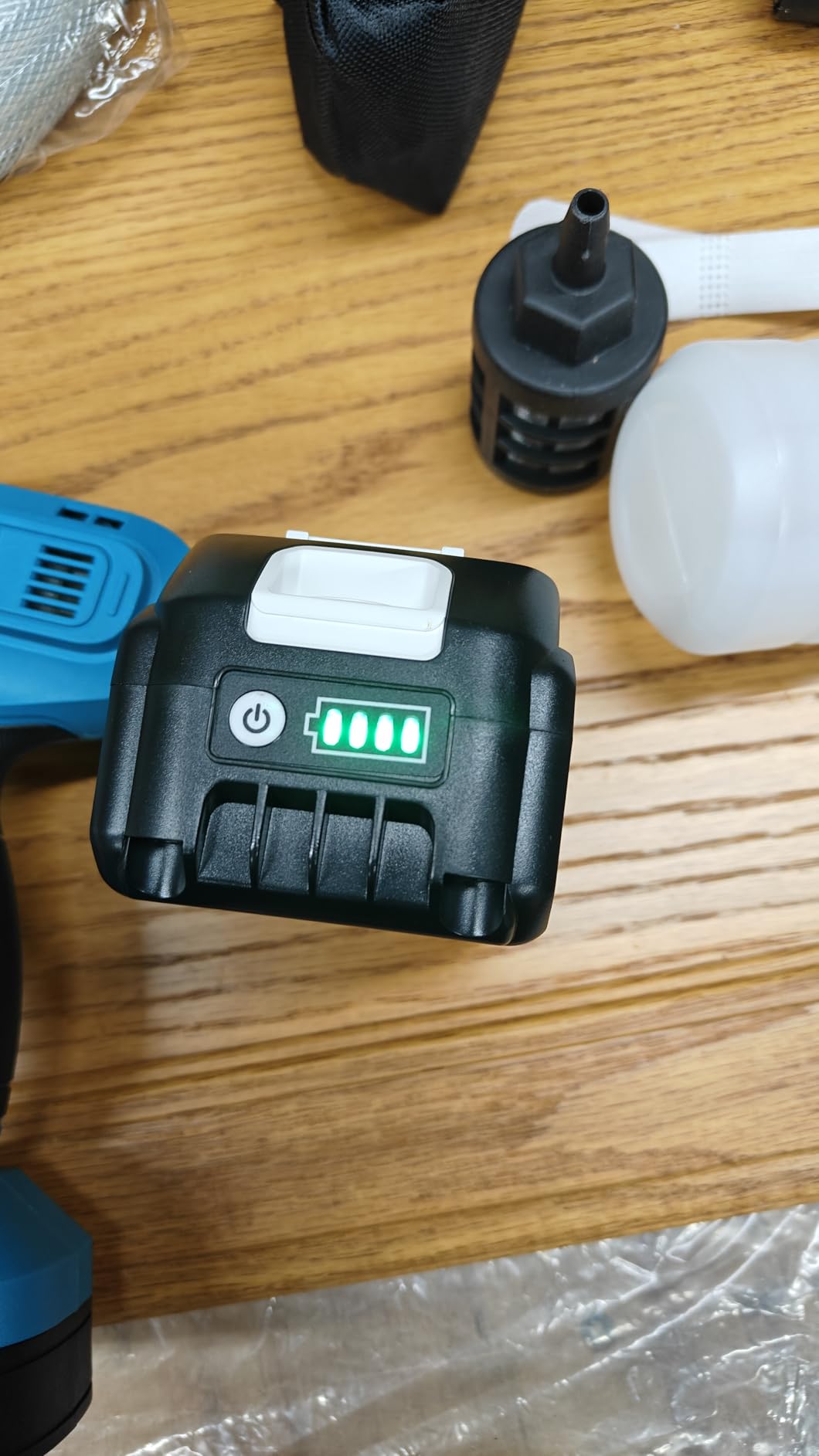
1250 PSI With 3 GPM: A Different Kind of Machine
Read the two numbers together. At 1250 PSI there is no chance of stripping paint, and at 3 GPM there is more water moving than most corded units in this guide. This is a rinser by design, not a dirt remover, and for a dusty car or a light rinse between washes that is exactly the right trade.
The 300W high-speed brushless motor spins to 20,000 RPM to get there, and the batteries are rated for up to 60 minutes of cordless runtime. Brushless means no brushes to wear, which matters on a tool that gets carried around rather than parked in a garage.
Fitting Compatibility Is the Real Catch
Some connectors do not match standard North American hose fittings, so plan on an adapter if you want to attach a foam cannon or a longer hose. Attachment threading is also inconsistent, with reports of leaking at the hose hookup, and the manual does not clearly describe everything in the box. Check the fitting standard before you buy accessories. If you plan to add a foam cannon or a longer hose, a detachable quick-connect makes it a two-minute job rather than a return.
Who This Machine Is For
Apartment and condo residents, people washing on the street with a water butt, and anyone who needs a second tool for a quick rinse between full washes.
Where It Falls Short
It carries the lowest rating in this group at 4.0 stars, with 14% of reviews calling it closer to a garden hose. For stuck-on grime you will need a corded machine, and the fitting question is real.
How to Choose a Car Pressure Washer Without Overspending on PSI
Every washer here will clean a car. The differences that matter are how fast it rinses, how gentle it is on the finish you own, and how much of the included junk you have to replace. Here is how to think through those decisions before you buy.
PSI Bands and What Each Number Is Safe On
Manufacturers measure maximum pressure at the wand with no nozzle attached, which is why a box can claim 2500 or 3000 PSI and the machine still behaves like a 1800 PSI unit at the tip. Look for a rated figure when one is published, and treat anything labelled max as a burst rating.
For a typical clear-coated car, 1200 to 2000 working PSI is the band to shop in. That covers rinsing, road film and wheel wells. Above roughly 2500 PSI you gain nothing on automotive paint and only gain risk, particularly on matte wrap, black plastic trim, pinstripes, decals, aged single-stage paint and rubber seals around windows.
GPM Is the Number That Actually Moves Water
Cleaning power is roughly pressure multiplied by flow, but for a car you feel flow far more than you feel pressure. Above 1.5 GPM you cover a whole sedan in minutes rather than a quarter of an hour, which is the difference between washing weekly and washing twice a year.
There is a ceiling here that most spec sheets ignore. A household supply typically cannot deliver 2.5 GPM continuously, and when the pump asks for more than the tap can give it will cavitate, which shows up as sputtering and lost pressure. This is the forum complaint about certain K-series machines, and it is a supply problem rather than a fault. A machine rated at 1.8 to 2.0 GPM is the safe target for a typical suburban tap.
Nozzles, Spray Angles and the Tip to Keep Off Paint
Spray angle is a safety control as much as a cleaning control. A wider fan spreads the same pressure over a larger area, so a 40 degree tip is your default on paint. A 15 degree concentrates the stream for wheel wells and rocker panels, and a 0 degree is for a very small targeted spot at close range. Keep the turbo nozzle off body panels entirely; it is a driveway tool.
A good car wash runs top-down with the 40 degree at 18 to 24 inches, pre-soaked with foam, with wheel wells and brakes done last so the grit you lift there does not get splashed across clean paint. Getting closer does not clean better, it just increases the risk of etching a clear coat.
Foam Cannon Versus Onboard Soap Tank
The onboard tank exists so you do not have to buy anything, and it works for a quick once-over. For anyone following a pre-soak method or protecting a coating, a detachable foam cannon is worth the small extra cost because the foam clings and gives you dwell time.
Check the fitting standard before you buy. A machine with a quarter-inch quick-connect or M22 compatibility accepts a wide range of aftermarket foam cannons; a proprietary fitting can cost you the upgrade entirely. Thick car soap also clogs soap tips, which is another reason detailing owners move to a wand-mounted cannon.
Hose, Gun and Quick-Connect: the Highest-Value Upgrade
Across our testing, the most common owner complaint on budget machines is the hose. The included PVC holds a memory, kinks near the fitting, and drags the machine toward the car instead of letting you move. A flexible or braided hose in the 25 to 50 foot range removes that problem entirely.
A replacement spray gun is the second upgrade worth making. Cheap guns have restrictive internal passages that cost you real pressure at the nozzle, so a better gun paired with a better hose often outperforms a more expensive machine with the parts it came with. If your washer uses a standard quick-connect, both swaps take minutes. If you only replace one part, replace the hose.
Corded, Cordless and Gas: Which Fits Your Driveway
Corded electric covers almost every home case: quiet, no fuel mixing, no pull cord, and no engine maintenance. The two things to plan for are the outlet, particularly on high-current machines, and the length of the cord reaching the work.
Cordless suits apartments, street washing and travel, where no outlet exists. Pressure is lower, so treat them as rinsers. Gas units are for concrete, decks, timber and volume work, and we cover them separately in our guide to the best gas pressure washers, along with battery platforms in our battery powered pressure washer roundup.
Frequently Asked Questions
What PSI power washer is best for cars?
For a typical clear-coated car, 1200 to 2000 working PSI is the ideal range, paired with 1.5 GPM or more flow. Most machines in this roundup quote a higher max figure measured at the wand, so look for a rated number where one is published. Staying at or below 2000 PSI with a 40 degree nozzle at 18 to 24 inches removes essentially all risk to paint, trim and decals.
Is 2500 PSI too much for a car?
It is more than a car needs, not a machine that will damage your car. 2500 PSI at a safe distance with a wide 40 degree fan will not etch clear coat, but it leaves no margin for a distracted moment with a narrow tip up close. If you also clean concrete, stucco or trailers, 2500 PSI has a purpose. If the car is the only job, 1800 to 2000 working PSI is the sensible ceiling.
Is 3000 PSI too much for a car wash?
Yes, for paint it is unnecessary risk, and the only reason to buy one is that you also clean hard surfaces. The Greenworks GPW3002A in this roundup genuinely delivers around 3000 PSI static and about 2550 PSI working, so it is not a marketing number. On bodywork, fit the 40 degree tip, stay 18 to 24 inches back, and reserve the turbo nozzle for concrete and wheel wells.
Are electric pressure washers good for washing cars?
They are the right tool for most people. Electric units deliver a controlled, moderate pressure that rinses soap and road film off paint safely, run quietly, start instantly and need no fuel mixing or oil changes. The limitation is sustained heavy-duty work on concrete and timber, where a gas unit has more torque. For routine car washing, an electric machine is quieter, cheaper to run and easier to store.
What pressure washer do most car detailers use?
Detailers generally reach for corded electric in the 1800 to 2100 PSI range with 1.8 to 2.0 GPM, and they prioritise flow and hose length over headline pressure. The Ryobi 1.8 GPM automotive high-flow style of machine comes up constantly in detailing communities for that reason. For a serious rinse, the most common professional choice is a wall-mounted or cart-mounted unit fed by a hose long enough to walk all the way around the vehicle.
Can I connect my foam cannon to the pressure washer hose?
Usually, yes, as long as the fitting standard matches. Quarter-inch quick-connect systems, which the Greenworks 1800 PSI uses, and M22 fittings, which the Westinghouse ePX3050 uses, both accept a wide range of aftermarket foam cannons. Machines with proprietary fittings may need an adapter. A detachable foam cannon in the box, as on the Westinghouse ePX3100v and ePX3050, saves you from having to check at all.
Which Electric Pressure Washer Should You Buy?
If you wash most weekends and want the widest set of nozzles and the best-proven machine in this guide, start with the Sun Joe SPX3000, our editor’s choice for car washing in 2026. It carries the largest review base we found, the 2030 PSI working pressure is genuinely car-safe, and the dual detergent tanks are useful when you switch products mid-job.
If you move the machine around a lot and want the longest reach, the Westinghouse ePX3500 is the better tool, with a 25-foot braided hose and an anti-tipping chassis that will not fight you on a sloped driveway. If you pre-soak before you rinse, the Westinghouse ePX3100v is the one to buy, because a detachable foam cannon in the box is the single most useful thing for protecting a coating.
For very high flow on a large vehicle, the LWQ S5 rinses fastest but carries a wider spread of owner complaints. If storage is tight, the Craftsman CMEPW1700 and the Greenworks 1800 PSI are the two smallest bodies here, and the SEESII cordless is the answer when there is no outlet at all. If concrete is part of the job, the Greenworks 3000 PSI is the only machine in this roundup verified to deliver its headline number.
Whichever you pick, budget for a hose and a gun before anything else. Replacing those two parts does more for how a washer feels than upgrading the machine itself, and it is the upgrade that keeps a cheap washer on your driveway for years. Use the links above to check current pricing for each pick, and see you in the driveway.
Leave a Reply