
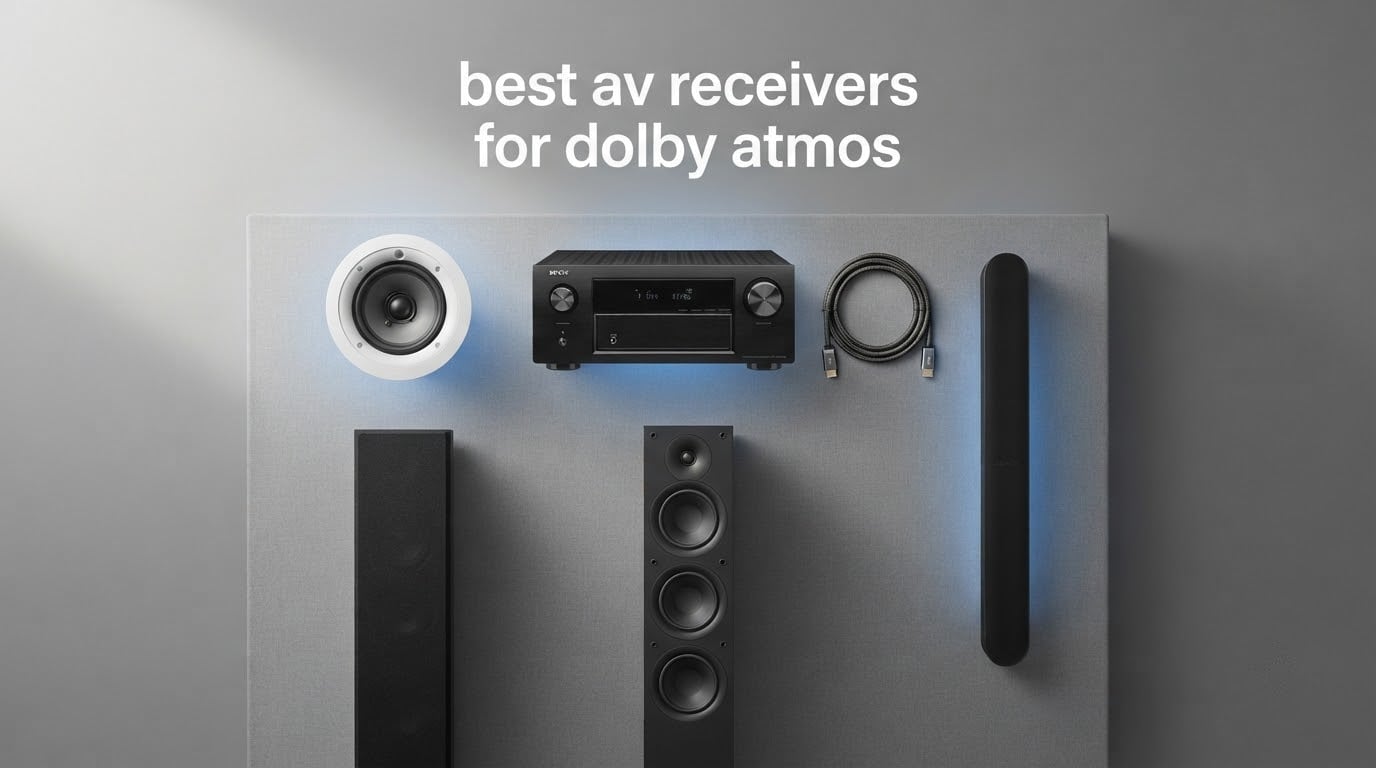
True Dolby Atmos needs height speakers, and the practical floor is a 7.2-channel receiver with Dolby Atmos decoding plus two overhead channels. We compared nine current models on verified specifications and owner feedback, and these are the best AV receivers for Dolby Atmos in 2026, from a five-channel entry unit to a nine-channel processing flagship.
The reason people get this purchase wrong is rarely the receiver. It is channel count, wattage inflation, and how many full-bandwidth HDMI inputs sit on the back panel. Almost every Atmos-capable receiver in this group decodes the same object-based tracks, so the differences that actually change your experience are the amplifier’s clean power, the room correction suite, and gaming support.
Every pick below was chosen on verified specifications: channel configuration, rated watts per channel, HDMI input counts, calibration software, and warranty length, then cross-checked against what owners report after living with the unit. If your room cannot take overhead speakers, read our Dolby Atmos soundbar roundup first. If you want a channel-count-specific shortlist, we also cover 7.2 channel receivers and 9.2 channel receivers separately.
One more thing before we start. Spending flagship money on a nine-channel receiver that only drives 5.1.2 speakers is the most common expensive mistake in this category, and buyers repeatedly ask whether Atmos is worth the money at all. The short answer is that overhead effects are obvious in a properly placed layout, and a soundbar will not give you them.
Our Top 3 Dolby Atmos AV Receivers for 2026

Denon AVR-S760H
- 75 W per channel
- 3 dedicated 8K HDMI inputs
- Atmos and DTS Virtual:X
- HEOS multi-room
Denon AVR-X1700H
- 80 W per channel
- Audyssey room correction
- two subwoofer pre-outs
- phono input

Onkyo TX-NR7100
- Dirac Live calibration
- 9.2 channels
- 6 HDMI 2.1 in and 2 out
- works with Sonos
We picked the Denon AVR-S760H as the top choice because it combines the most reviewed platform in this group with a three-year warranty and dedicated 8K inputs at a price point most people can reach. The AVR-X1700H takes the top-rated slot at 4.4 stars thanks to stronger Audyssey calibration, and the Onkyo TX-NR7100 is the pick when you want Dirac Live correction and nine channels of processing under one roof.
All Nine Dolby Atmos AV Receivers Compared at a Glance
| Product | Specs | Action |
|---|---|---|
| Denon AVR-S760H 7.2 |
|
Check Latest Price |
 Denon AVR-S570BT 5.2 Denon AVR-S570BT 5.2 |
|
Check Latest Price |
 Onkyo TX-NR6100 7.2 Onkyo TX-NR6100 7.2 |
|
Check Latest Price |
| Denon AVR-X1700H 7.2 |
|
Check Latest Price |
| Onkyo TX-NR7100 9.2 |
|
Check Latest Price |
 Sony STR-AN1000 7.2 Sony STR-AN1000 7.2 |
|
Check Latest Price |
 Pioneer VSX-935 7.2 Pioneer VSX-935 7.2 |
|
Check Latest Price |
 Yamaha RX-A2A 7.2 Yamaha RX-A2A 7.2 |
|
Check Latest Price |
 Yamaha RX-A6A 9.2 Yamaha RX-A6A 9.2 |
|
Check Latest Price |
Two things stand out in that grid. First, the number of full-bandwidth HDMI 2.1 inputs varies far more than the channel counts do, and it is the spec most buyers never check. Second, the gap between 70 and 165 watts per channel is the difference between filling a flat and filling a dedicated theater room, and it tells you how much headroom you have at midnight with the family asleep.
1. Denon AVR-S760H – The Most Proven All-Rounder for Atmos
Denon AVR-S760H 7.2 Ch AVR – 75 W/Ch (2021 Model), Advanced 8K Upscaling
7.2 channels
75 W per channel
3 dedicated 8K HDMI inputs
3 year limited warranty
Pros
- Largest review base in this group at 1190 ratings
- Dolby Atmos Height Virtualization and DTS Virtual:X
- VRR and Quick Frame Transport for consoles
- HEOS multi-room streaming with Wi-Fi and AirPlay
Cons
- Only 75 W per channel leaves little headroom in large rooms
- No pre-out for an external amplifier or processor
- On-screen setup wizard looks dated
- Authorized dealer requirement for warranty service
This is the receiver I recommend to people who will not read a manual. The AVR-S760H decodes Dolby Atmos, Dolby Atmos Height Virtualization, DTS:X and DTS Virtual:X, and it carries 1190 ratings averaging 4.3 stars, which makes it the most thoroughly exercised platform in our group.
It handles a 7.2 layout, so you can run five beds, two surrounds and two subwoofers today, then add overhead speakers later with Dolby Atmos Height Virtualization filling the gap in the meantime. The three-year limited warranty is the longest of any receiver here apart from the Denon AVR-X1700H.
Three Dedicated 8K Inputs and the Full Gaming Feature Set
Three of the seven HDMI ports are dedicated 8K inputs supporting 8K at 60Hz and 4K at 120Hz, with 8K upscaling on every input. Variable Refresh Rate, Quick Frame Transport and Auto Low Latency Mode are all present, which is what you want for a PS5 or Xbox Series X.
That third dedicated input matters more than it sounds. A receiver with one 8K input forces you to swap cables every time you switch between a console and a streaming box in a 4K120 mode.
Why 75 Watts per Channel Is the Limiting Factor
Seventy-five watts per channel is adequate for mid-size rooms, as owners consistently note, but it is the reason this is not our pick for a large dedicated theater. Driving all seven channels into 4-ohm floorstanders at reference level is where you will hear the amplifier working hardest.
Pair it with efficient bookshelf speakers in a living room, and it never strains. Pair it with demanding towers in a large room, and spend your money on speakers and a subwoofer first.
HEOS Multi-Room and Voice Control
HEOS multi-room streaming works over Wi-Fi, AirPlay and Bluetooth without needing a command center, and Alexa voice control handles volume, track changes and input switching hands-free. For a family setup where the receiver lives in a cabinet, that hands-free control is genuinely useful.
Where It Falls Short
There is no pre-out, so you cannot add an external power amplifier later when you outgrow it. That single omission is the main reason to stretch up to the AVR-X1700H if you already own demanding speakers.
2. Denon AVR-S570BT – A 5.2 Receiver That Skips Atmos Entirely
Denon AVR-S570BT 5.2 Channel AV Receiver – 8K Ultra HD Audio & Video
5.2 channels
70 W per channel
4 HDMI 2.1 8K inputs
Bluetooth only
Pros
- Four HDMI 2.1 8K inputs with eARC up to 40 Gbps
- Supports HDR Dolby Vision HDR10+ VRR and QFT
- Runs cool and sounds clean for the money
- On-screen HD Setup Assistant walks through balancing
Cons
- 5.2 only with no height channels and no Dolby Atmos Height Virtualization
- No Wi-Fi or Ethernet so Bluetooth is the only streaming option
- Only four HDMI inputs
- Inputs cannot be renamed and there is no phono stage
We include this one with a warning, not a recommendation for an Atmos buyer. The AVR-S570BT is a genuinely good budget 5.2 receiver with modern HDMI, but Dolby Atmos is exactly what it does not do.
There are no height channels, no Atmos decoding and no height virtualization, so any Atmos track plays as a 5.1 downmix. That is fine for a secondary room. It is the wrong tool for the job this article is about.
Four Full-Bandwidth HDMI 2.1 Inputs at an Entry Price
Getting four HDMI 2.1 8K inputs plus one output with eARC at 40 Gbps on a five-channel receiver is genuinely impressive. It covers Dolby Vision, HDR10+, HLG, VRR and Quick Frame Transport, so a modern console is fully served.
What it cannot do is feed those signals into an Atmos soundstage, because there is no processor behind the HDMI section.
Bluetooth-Only Streaming Is the Real Compromise
There is no Wi-Fi or Ethernet, so AirPlay, Spotify Connect and multi-room streaming are all absent. Owners who expected a networked receiver report that as the feature they miss most, alongside inputs that cannot be renamed.
Volume control through the TV remote is also slow, and HDMI-CEC behaviour is unreliable once more than one source is connected. Both are recurring complaints in the reviews.
Two Year Warranty and a Two Year Ceiling
Warranty coverage is two years, and the amplification ceiling is 70 watts per channel. With only five channels to drive, that is enough for a flat or a small living room with efficient bookshelf speakers.
If your plan involves a projector, a couch, and real Atmos, look at the Denon AVR-S760H instead. If you just need clean 5.1 for a bedroom, this does the job.
3. Onkyo TX-NR6100 – THX Select Certification and Real Power
Onkyo TX-NR6100 7.2 Channel THX Certified Network AV Receiver – Black
7.2 channels
100 W per channel
THX Select certified
8 HDMI ports
Pros
- THX Select certified with 5.2.2 channel Dolby Atmos and DTS:X
- Three HDMI 2.1 40 Gbps inputs for 8K
- Discrete Zone 2 audio and video
- eight HDMI ports give generous switching flexibility
Cons
- No composite video input so very old consoles cannot be connected
- Included remote is not programmable for other components
- Some owners report intermittent HDMI handshake or menu issues
- Runs warm and needs ventilation clearance
The Onkyo TX-NR6100 is the pick if THX Select certification means something to you, and it is the only THX-certified receiver in this group. It decodes 5.2.2 channel Dolby Atmos and DTS:X through seven internal amplification channels, with a discrete second zone for audio and video.
Its 4.1 average across 994 ratings is the lowest of the nine models here, and about 11% of reviews are one-star. The complaints cluster around HDMI reliability and the non-programmable remote rather than sound quality.
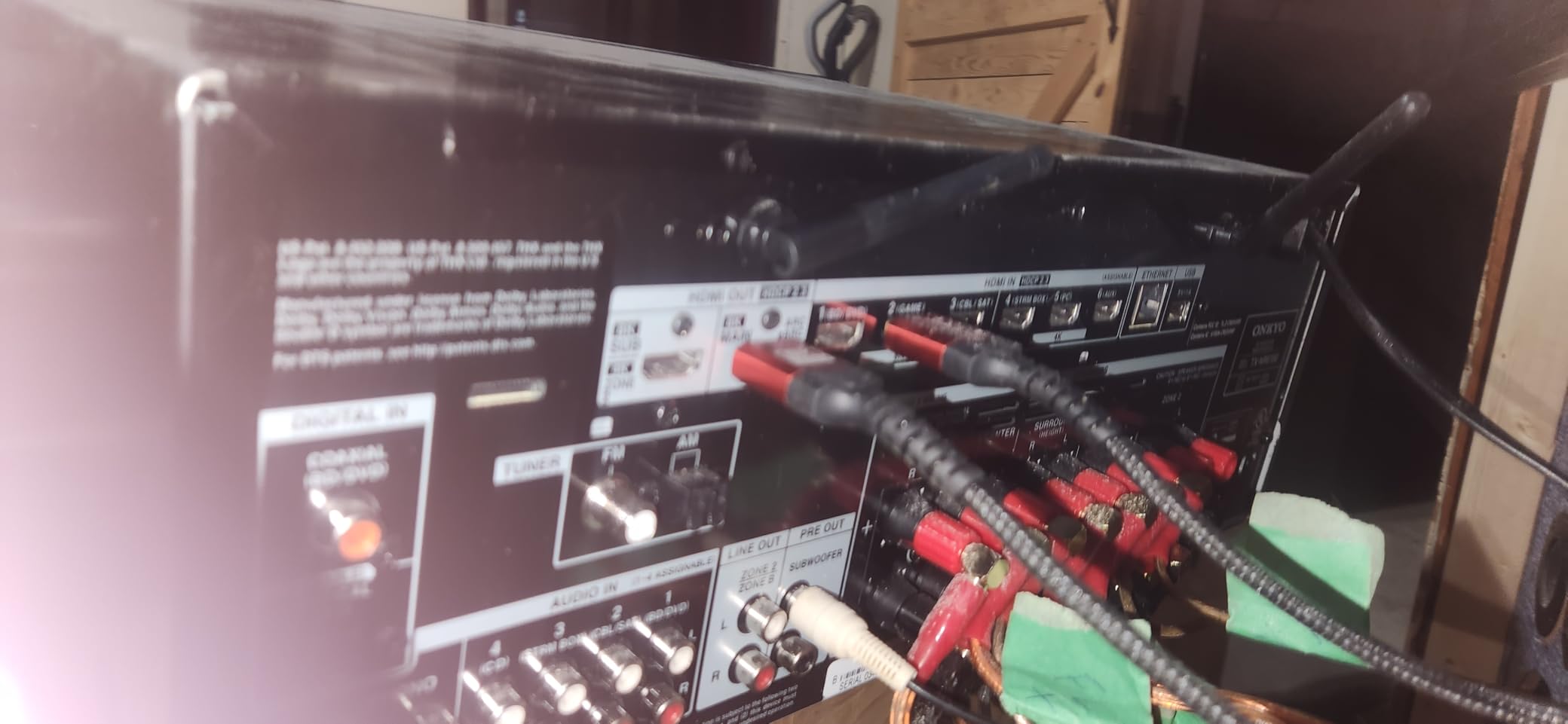
THX Select Certification and 5.2.2 Channel Processing
THX Select is a meaningful certification because it verifies both the electronics and the room setup at the level most people actually watch movies. Combined with 210 W/ch dynamic amplification listed in the technical data, it gives this receiver more raw power than the entry Denon models.
Home theater forum regulars repeatedly single out Onkyo and Integra receivers for strong power delivery, and this is the model in the group where that reputation is most visible.
Three HDMI 2.1 Inputs at 40 Gbps
Three HDMI 2.1 inputs carry 8K, and the total port count is eight including outputs. That is a good balance for a PS5 plus a streaming box plus a disc player, though it is fewer 8K inputs than the Denon AVR-S760H offers.
Zone 2 output is discrete rather than matrixed, so a second room gets real audio and video without sacrificing the main theater picture quality.
AccuEQ Calibration Without Dirac Live
AccuEQ auto calibration handles distance and crossover settings for each speaker, and owners report it does its job adequately. It is not Dirac Live, which the step-up Onkyo TX-NR7100 includes out of the box and which does a visibly better job in an untreated room.
That difference in correction quality is the main reason to choose the TX-NR7100 over this one if your room has soft furnishings and parallel walls.
What Owners Flag as Problems
There is no composite video input, so a very old console cannot be connected at all. The included remote controls only Onkyo components, it runs warm enough to need airflow clearance, and some owners report intermittent HDMI handshake or menu display problems.
None of that is disqualifying, but if you are patient with finicky HDMI handshakes, a Denon will be calmer.
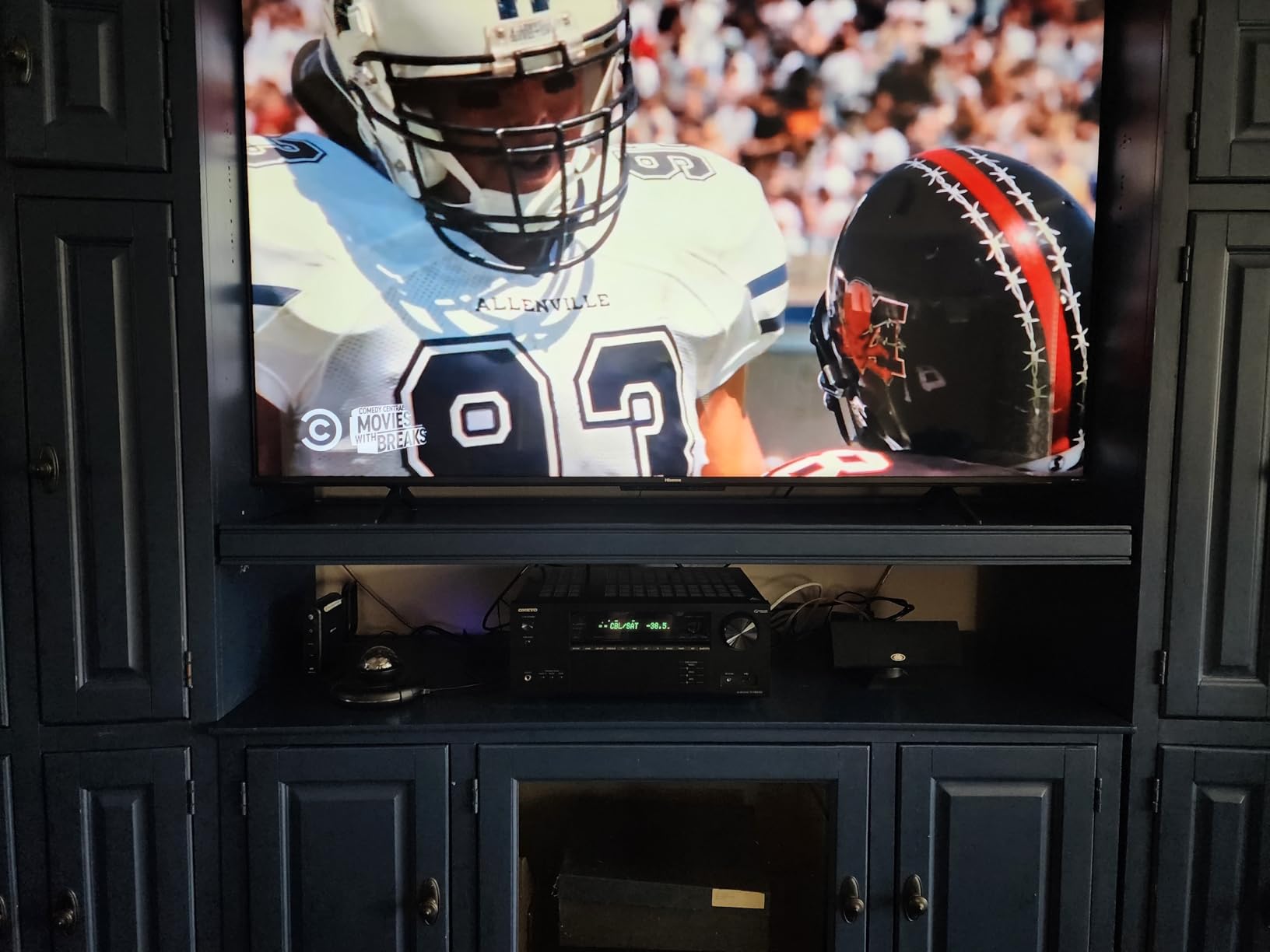
4. Denon AVR-X1700H – The Top-Rated Choice With Audyssey Tuning
Denon AVR-X1700H 7.2 Channel AV Receiver – 80W/Channel, Built-in HEOS
7.2 channels
80 W per channel
Audyssey room correction
6 HDMI ports
Pros
- Highest average rating in the group at 4.4 stars
- Audyssey auto calibration is widely praised above YPAO
- Three dedicated 8K inputs with upscaling on all six ports
- Two subwoofer pre-outs plus a phono input
Cons
- On-screen menus and setup wizard look dated
- Two separate apps needed for control and music streaming
- Occasional HDMI-CEC and eARC handshake issues
- Short calibration microphone cable for larger rooms
At 4.4 stars across 703 ratings with roughly 74% five-star reviews, the AVR-X1700H has the highest average rating in this group. It is also the one we would call the best all-rounder, because it fixes the two things the AVR-S760H leaves out: a longer feature set on the back panel and a far better calibration mic.
The practical difference is Audyssey. Owners consistently describe it as more capable than competing YPAO implementations on the same speakers, which matters enormously in a carpeted room with soft furnishings.
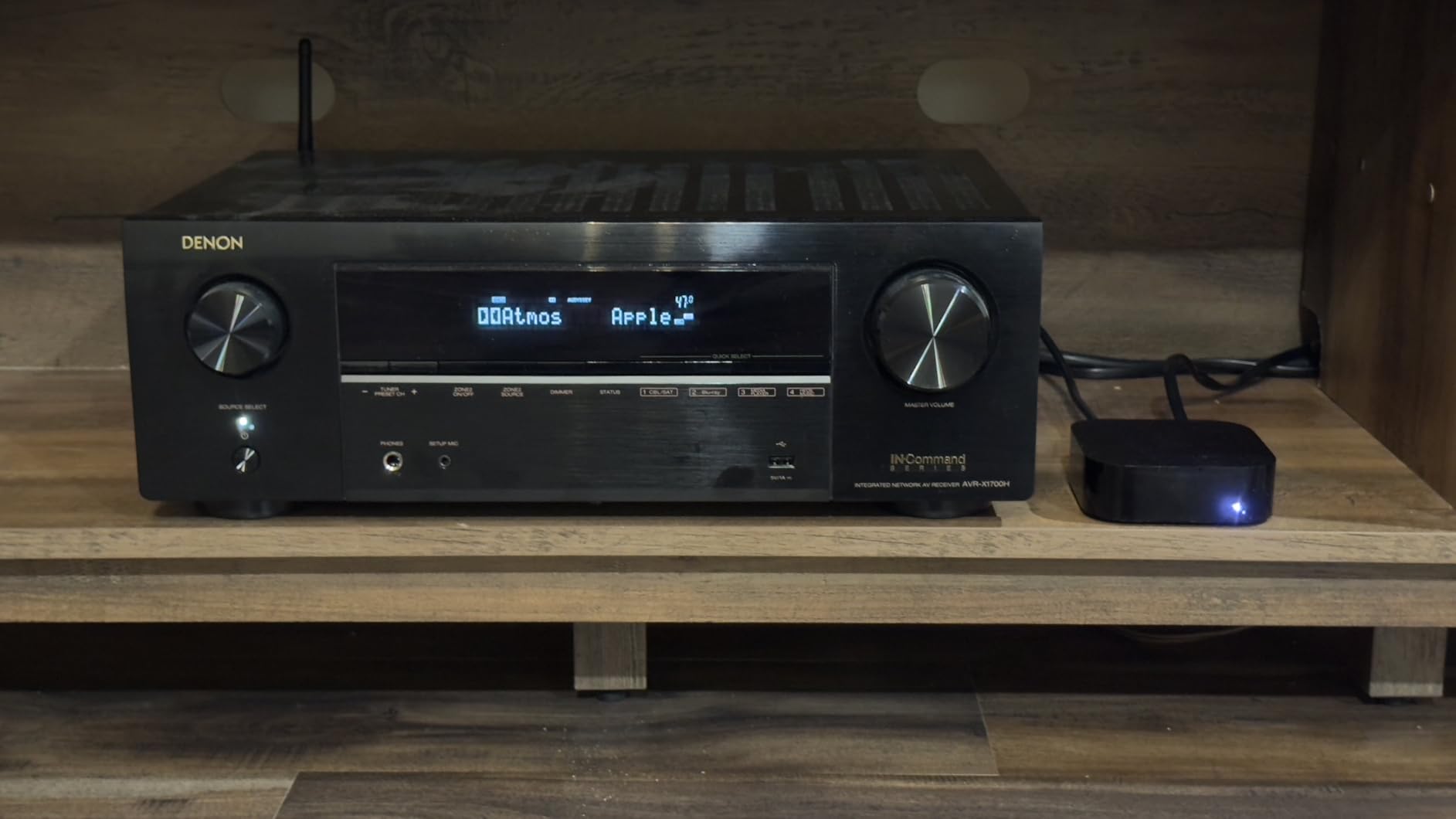
Audyssey Correction Changes the Sound More Than Wattage Does
Audyssey auto calibration measures each speaker’s level, distance and delay and corrects the interaction between your speakers and the room. Owners describe that correction as doing more for clarity and dialogue intelligibility than a jump from 75 to 100 watts per channel.
It is the single highest-impact feature on this receiver, and it is why we rate the X1700H above the S760H despite the lower review count.
Two Subwoofer Pre-Outs and a Phono Input
Two independent subwoofer pre-outs let you run a pair of subs with separate calibration, which is a real advantage in a large room where one sub cannot cover the seating area. A phono input is included for turntables, alongside two digital, two analog and one coaxial input.
The single phono stage means moving coil and moving magnet cartridges cannot both be connected at once, which only matters if you have two turntables.
HDMI 2.1 Coverage and 4:4:4 Chroma
Three dedicated 8K inputs plus one output handle 8K at 60Hz and 4K at 120Hz, with 8K upscaling on all six inputs. All ports support 4:4:4 pure color subsampling, HDR10, HDR10+, Dolby Vision and HLG.
On the software side, this is where the X1700H’s reputation takes a hit. The on-screen menus and setup wizard are repeatedly described as looking dated, and it takes two separate apps for control and for music streaming.
Who Should Buy This One
Buy the AVR-X1700H if your room is medium-sized, your speakers are moderately demanding, and you want the best correction in the group without moving to a nine-channel platform. If you already own a powerful external amplifier, note that there is no pre-out for it.
If you want the widest HDMI switching and the most proven platform instead, the AVR-S760H is our Editor’s Choice and is covered first in this guide.
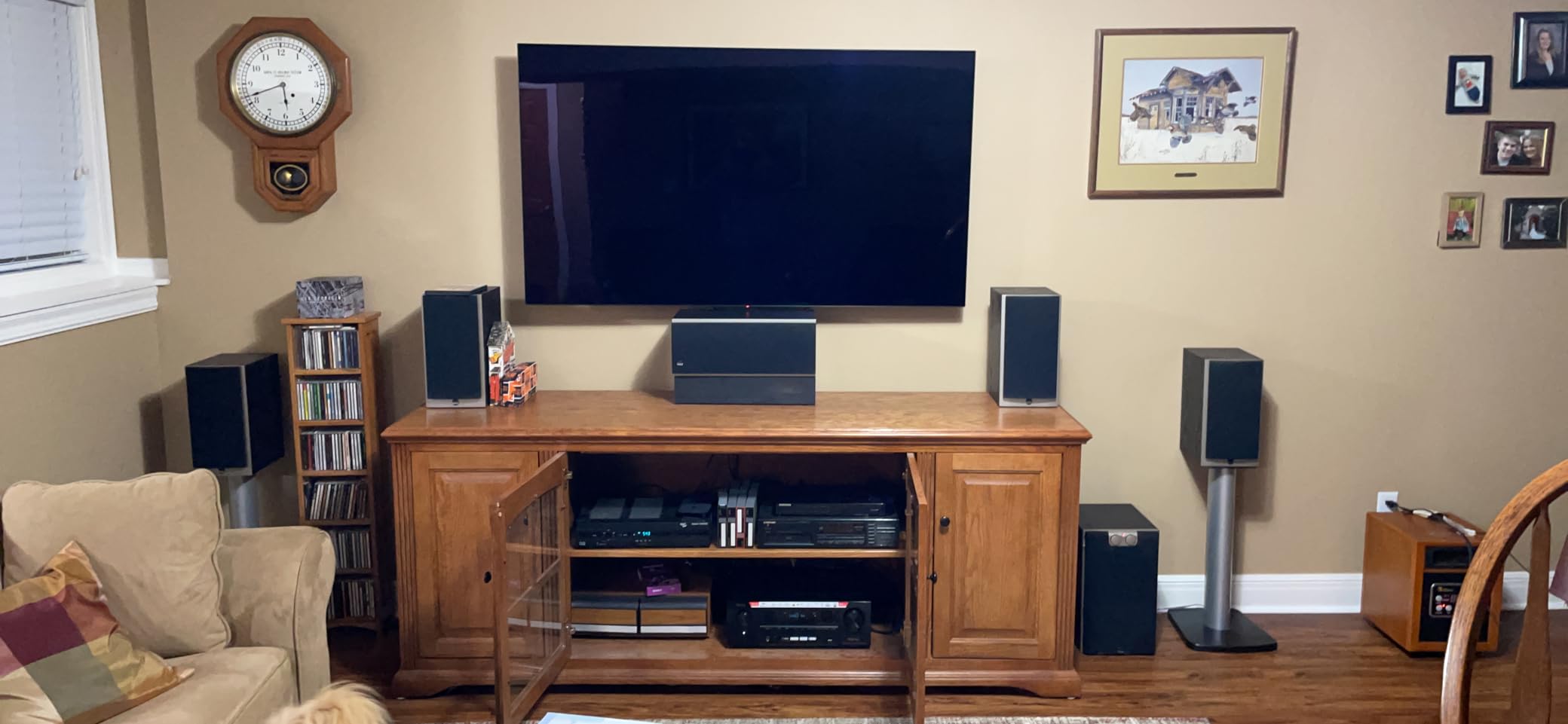
5. Onkyo TX-NR7100 – Nine Channels With Dirac Live Correction
TX-NR7100 9.2-Channel THX Certified AV Receiver
9.2 channels
100 W per channel
Dirac Live out of the box
8 HDMI ports
Pros
- Dirac Live room correction included at no extra cost
- Six HDMI 2.1 inputs and two HDMI 2.1 outputs at 8K and 4K120
- Dolby Atmos Height Virtualizer for virtual height from a 5.1 layout
- Works with Sonos plus AirPlay 2 and Chromecast built in
Cons
- No preamp outputs so it cannot drive external amplifiers
- Audio briefly drops out when new content starts
- Dirac Live phone calibration can fail to complete
- Runs warm and the faceplate feels cheap
The TX-NR7100 is the most interesting receiver in this group for two reasons. It processes nine channels, and it includes Dirac Live room correction in the box rather than as a paid upgrade or a step-up to a different brand.
Owners describe Dirac Live as transformative in untreated rooms, and that claim holds up. The correction measures your room and produces a corrected target curve you can compare before and after, which makes the improvement obvious even to someone who has never calibrated anything.
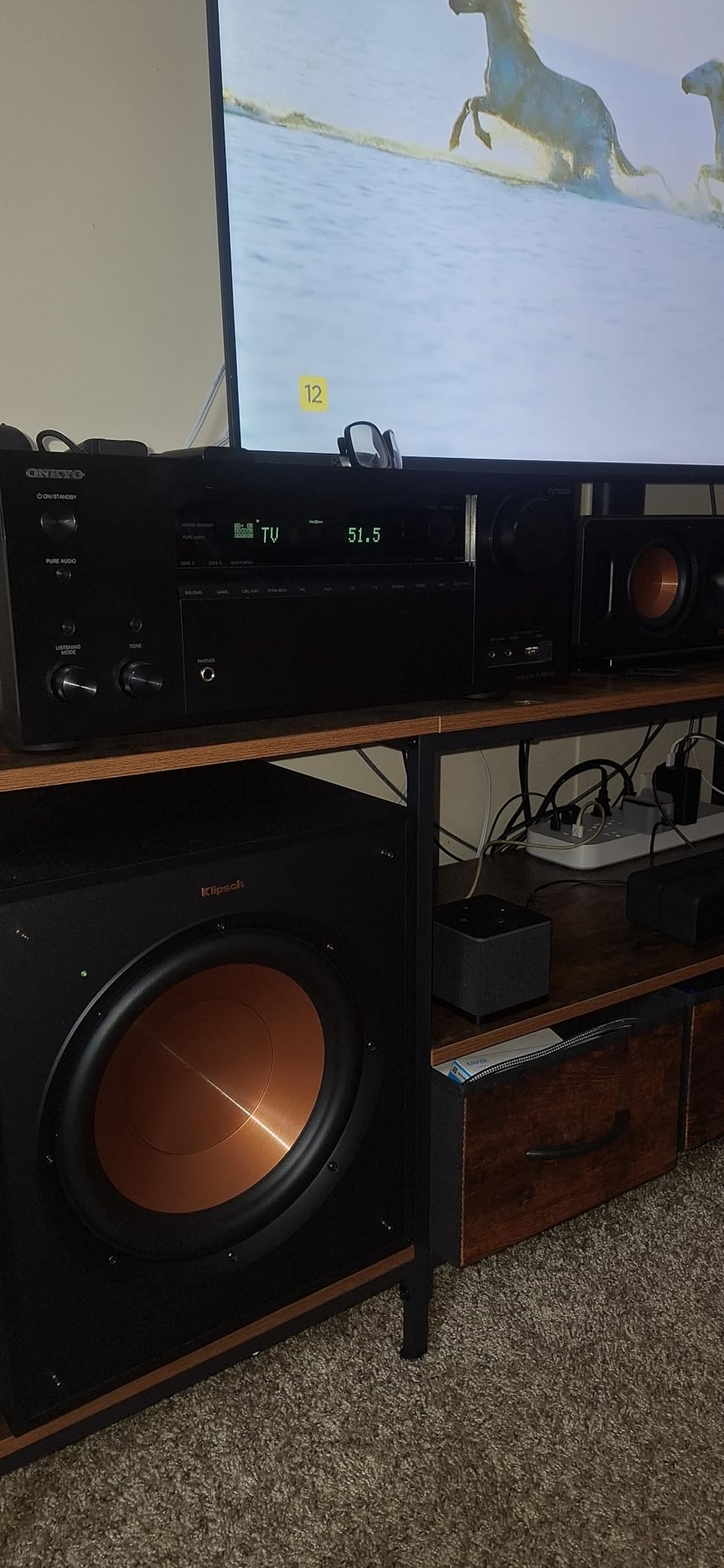
What Nine Channels Actually Buys You
At 9.2, you can run a full bed layer plus side and rear surround pairs with two subwoofers, or add front height channels to a 7.1 setup. For a dedicated theater room with a wide seating area, that extra surround coverage is the difference between effects passing beside you and effects passing over your head.
It is also why we would not recommend this receiver for a 5.1.2 system. Nine channels of processing driving only five speakers and two heights leaves money on the table that is better spent on speakers and a subwoofer, which is the exact over-buying mistake that dominates forum threads.
Six HDMI 2.1 Inputs and Two Outputs
Six HDMI 2.1 inputs and two HDMI 2.1 outputs supporting 8K at 60Hz and 4K at 120Hz give this more HDMI switching than any other model here. VRR, ALLM and Quick Frame Transport are all supported, and discrete Zone 2 HDMI switching allows a second TV to carry a separate 8K source.
For a house with a theater room and a playroom, that second 8K output is a genuine feature that nothing else in this roundup matches.
Dirac Live Included Versus Paid Upgrades
You can calibrate with the included wired microphone and a smartphone, or with a PC or MacOS application and a third-party USB microphone for a more accurate reading. Owners report that the smartphone route sometimes fails to complete, in which case a meter and manual level adjustment is the fallback.
Compare that with the Denon AVR-X1700H, where Audyssey is included but simpler, and the Onkyo TX-NR6100, where AccuEQ is included but basic. Dirac is the deepest correction here and it costs nothing extra.
Known Quirks Worth Knowing Before You Buy
There are no preamp outputs, so this cannot act as a processor for external power amplifiers. Audio briefly drops out for about a second whenever new content starts, which owners find irritating with streaming services, and a persistent initial setup prompt can require a factory reset to clear.
The remote is not backlit and the mute button sits where it is easily pressed by accident. The chassis runs warm and needs airflow clearance, so plan your cabinet ventilation before it arrives.
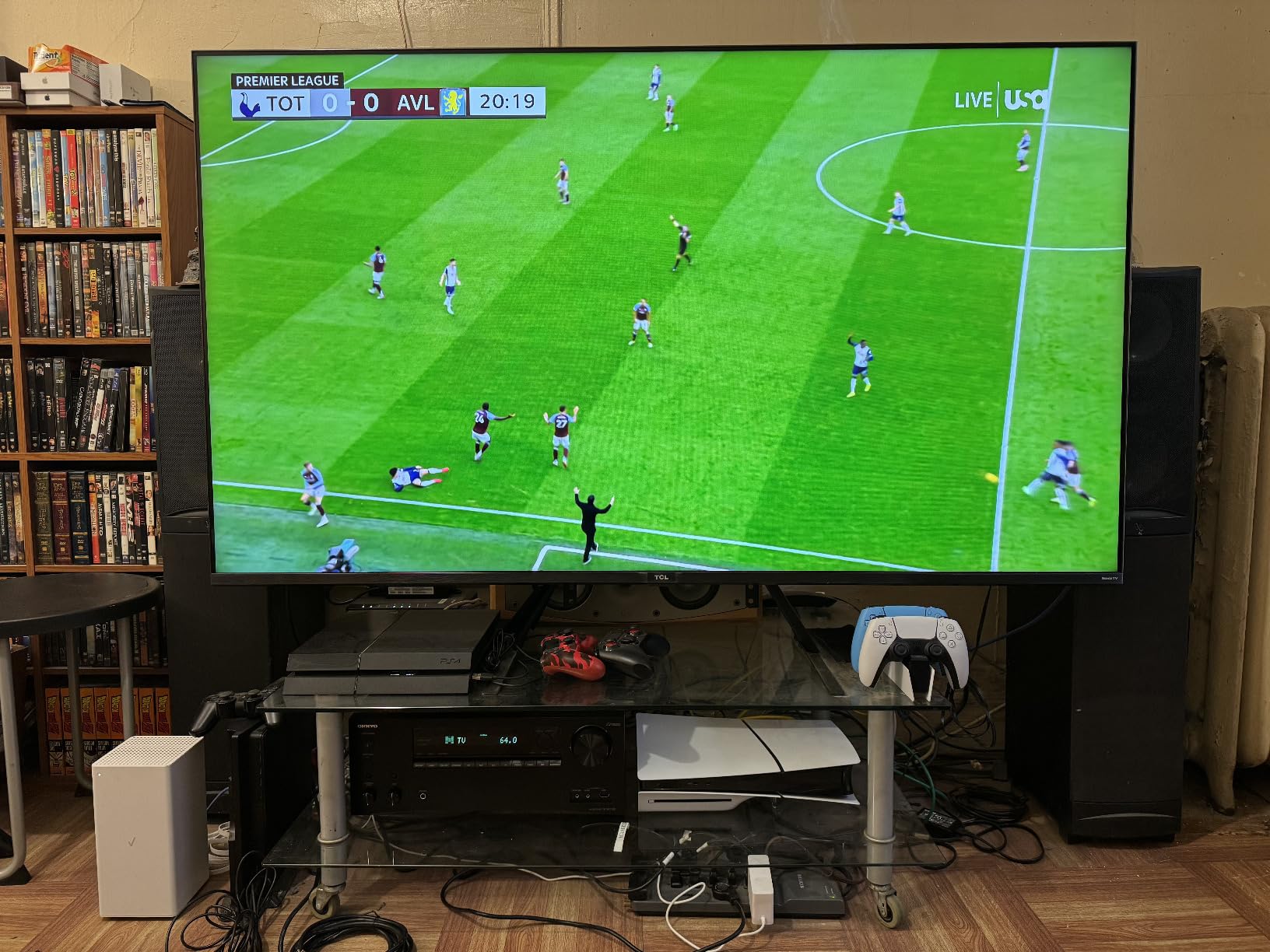
6. Sony STR-AN1000 – The Highest Rated Power and the Best Gaming Features
Sony STR-AN1000 7.2ch Home Theater 8K A/V Bluetooth Receiver
7.2 channels
165 W per channel
HDMI 2.1 6-in and 2-out
1 year warranty
Pros
- Strong 165 W per channel that drives larger speaker sets cleanly
- HDMI 2.1 with 6 inputs and 2 outputs and reliable eARC
- 360 Spatial Sound Mapping with H.S.C. S-Center sync for Bravia TVs
- Zone 2 and Zone 3 for multi-room audio and video
Cons
- No phono input for turntables
- Dolby Vision pass-through from an Apple TV 4K reported as unreliable
- Boot time is roughly two minutes with occasional input bugs
- Front panel display is very small and hard to read
With 165 watts per channel, the STR-AN1000 has the highest rated power of any receiver in this roundup. Reviewers repeatedly say it beats their previous Denon or Onkyo receivers on sound, and several specifically single out the 360 Spatial Sound Mapping field as the reason.
For a large room with inefficient floorstanders, that power headroom is the differentiator. Nothing else here drives a demanding seven-speaker layout at 8K and 4K120 HDMI bandwidth with this much reserve.
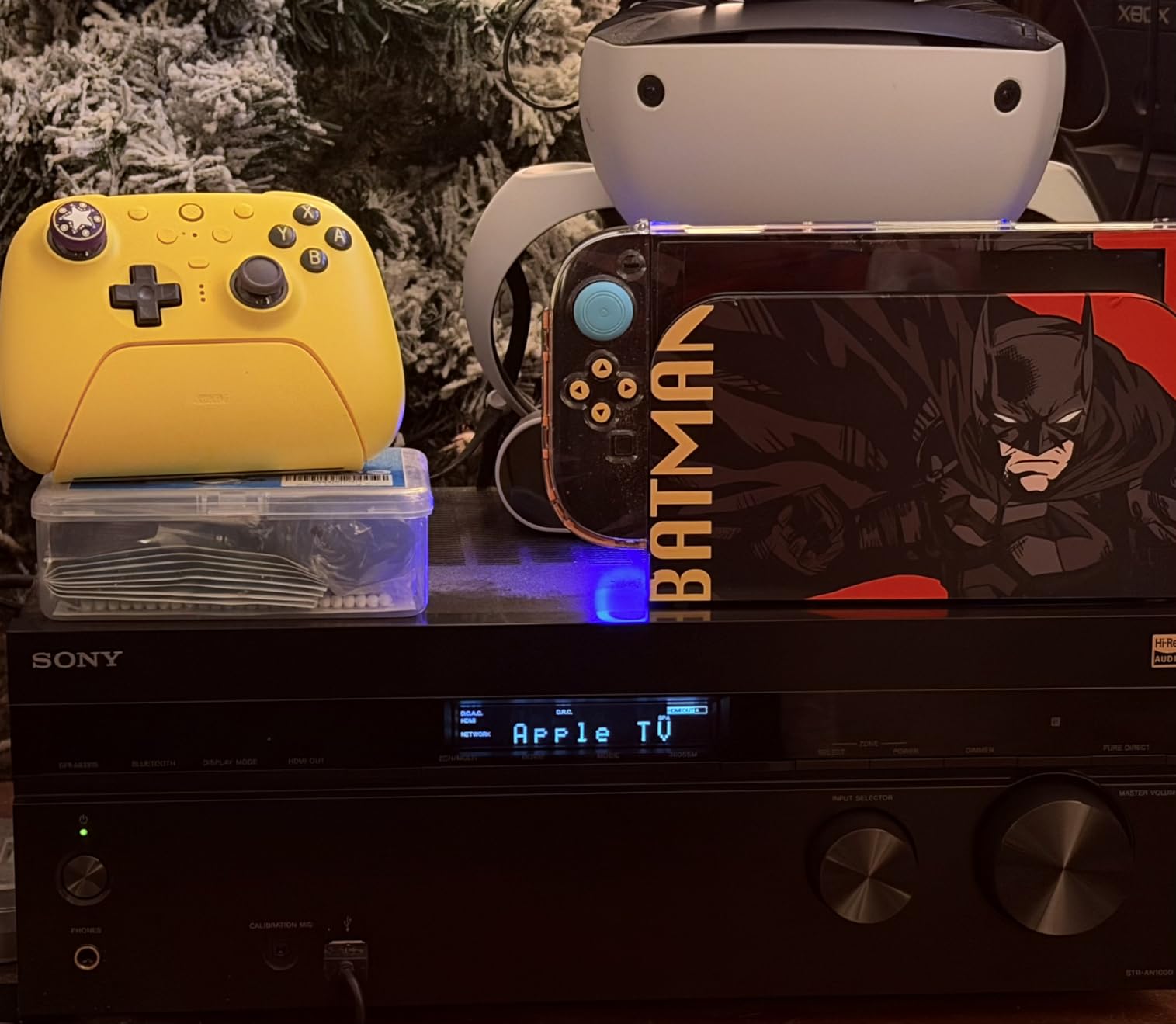
165 Watts per Channel and Why It Matters in Big Rooms
The rated figure is 165 W at 6 ohms with one channel driven, and it still delivers meaningfully more than the 75 to 100 watt entries. In a large room with low-sensitivity towers, headroom is what keeps dialogue clean at reference level instead of straining.
There is one caveat to check before pairing it with speakers: the surround setup interface only offers large speaker options for the rear surrounds, which can force you into the wrong distance and level settings for smaller rear speakers.
360 Spatial Sound Mapping and Bravia S-Center Sync
Sony’s 360 Spatial Sound Mapping analyzes how sound reflects off your ceiling and walls to simulate a taller, wider soundstage. H.S.C. S-Center sync adds a vertical dimension on a compatible Bravia television using its center speaker as a channel.
Digital Cinema Auto Calibration IX provides a graphical setup flow and calibrates both subwoofers, which is a genuinely useful feature when you run a pair.
Gaming and HDR Format Support
HDMI 2.1 with 6 inputs and 2 outputs supports 8K and 4K at 120Hz, and it supports Dolby Vision, HDR10, HLG and IMAX Enhanced. Built-in Chromecast, Spotify Connect, Apple AirPlay, Bluetooth and Works with Sonos cover streaming.
The reported weakness is video handling rather than gaming bandwidth: Dolby Vision pass-through from an Apple TV 4K is described as unreliable by some owners. Check that before committing if that is your streaming device.
The One-Year Warranty and the Two-Minute Boot
The one-year warranty is the shortest of any receiver in this group, and the case is reported to feel thin with some units failing after a month. Startup takes roughly two minutes, with occasional input-recognition and no-audio bugs that owners find tedious.
If the sound quality and power are what you are buying, this is the strongest option here. If you want a long warranty and painless setup, the Denon AVR-S760H is the safer pick.
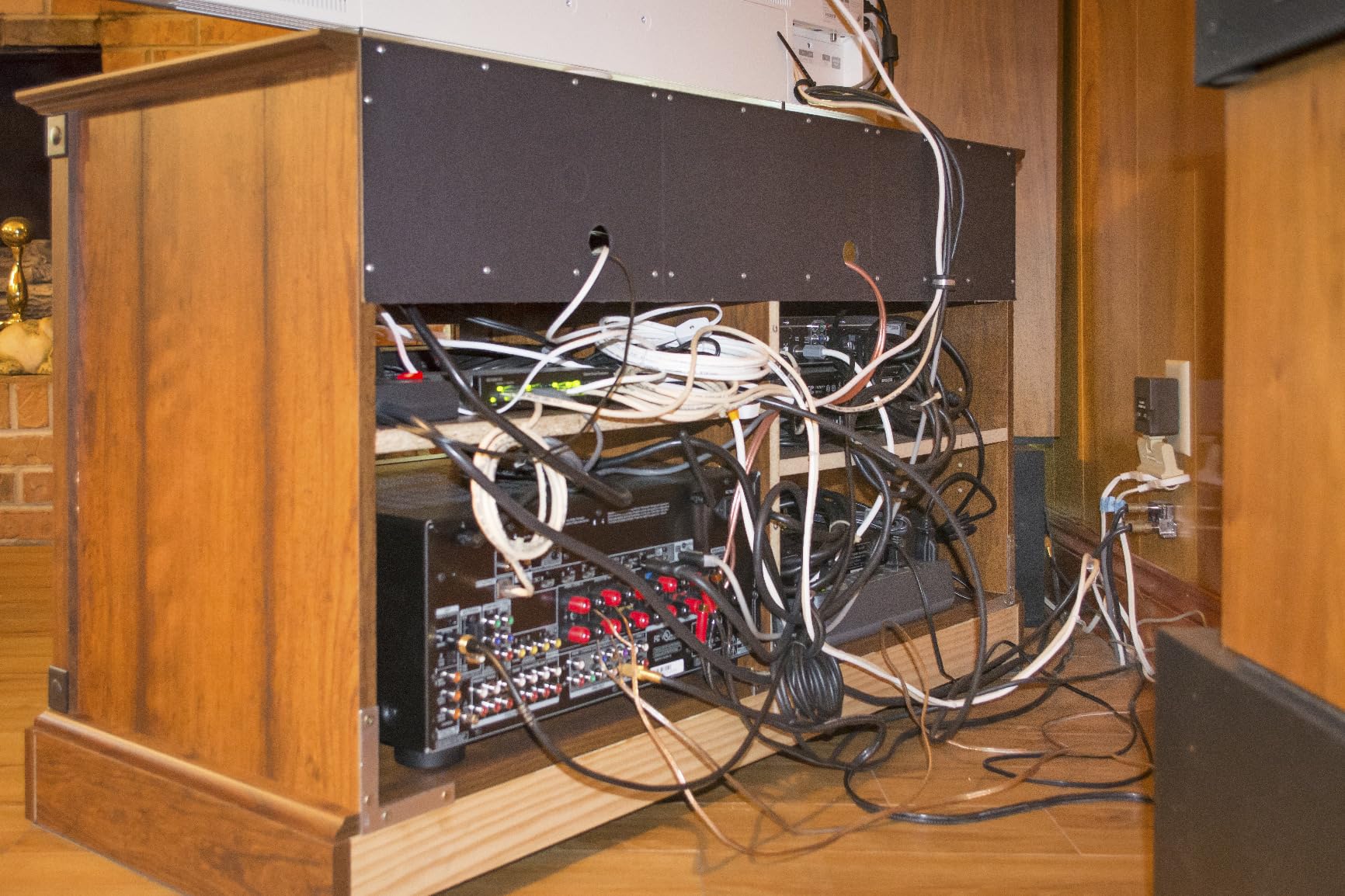
7. Pioneer VSX-935 – Crisp Sound and a Ceiling-Speaker Culture
Pioneer VSX-935 7.2 Channel Surround Sound Network Receiver Dolby Atmos (2021)
7.2 channels
80 W per channel
HDMI 2.1 with 8K
MCACC room correction
Pros
- Crisp detailed sound with strong dialog intelligibility
- Room correction with phase adjustment is a real step up
- Many owners run ceiling speakers for a true Atmos bed
- Dual zone speaker output and an included RF remote
Cons
- Firmware updates are USB only and frequently fail with error codes
- Does not pass TrueHD Atmos from TV apps over eARC
- Interface and menu design feel like 1990s software
- Auto setup results need manual level and distance adjustment
The VSX-935 is the sleeper in this group. Owners report crisp, detailed sound with strong dialog intelligibility, and a large share of them are running in-ceiling speakers to build a genuine Atmos bed rather than relying on upfiring modules.
That is the most reliable route to convincing overhead effects, and it is why this receiver appeals to installers. The tradeoff is user experience, which is the weakest part of this roundup.
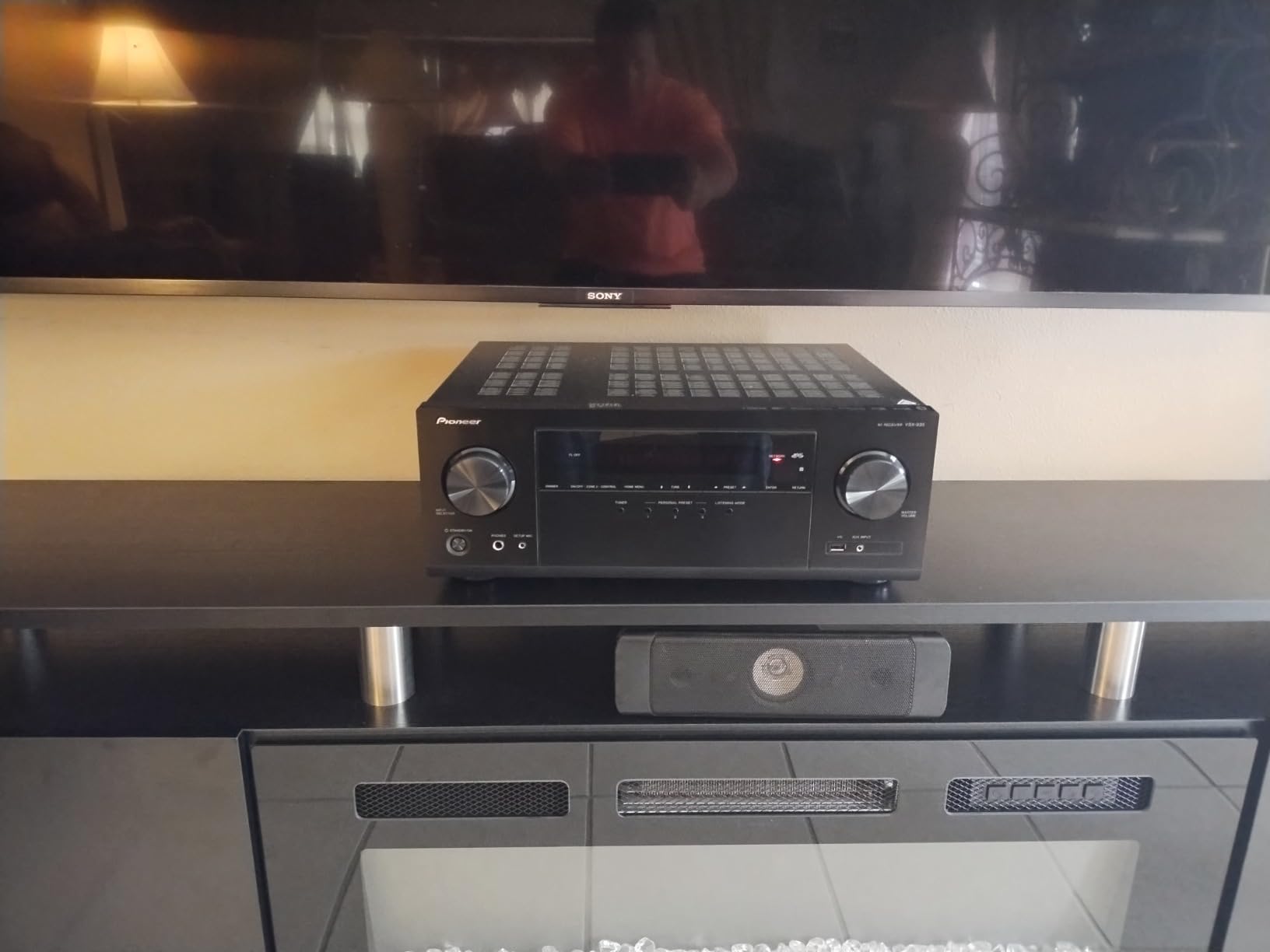
MCACC Phase Adjustment Is the Feature to Know
Room correction here includes phase adjustment, which lets the receiver align in-phase drivers that are physically wired out of polarity. That is a genuine upgrade over the correction in older Pioneer models and over the basic setups on cheaper rivals.
Just expect to finish the job manually. Owners report that auto setup results need volume, distance and level adjustments afterward to sound right, and if you are comfortable with a sound meter, that is fine.
HDMI 2.1 With 8K Across Eight Ports
The HDMI section is HDMI 2.1 with 8K support and a total of eight ports, plus enhanced gaming features. Dolby Atmos is supported alongside Dolby Atmos Height Virtualization, which creates virtual height from a traditional 5.1 layout when you have not installed overhead speakers yet.
There is a catch worth planning around: it does not pass TrueHD Atmos from TV apps over eARC. If you stream Atmos content from your television’s own apps, you will lose the lossless track.
Firmware Updates Are the Real Weakness
Firmware updates are USB only, not network based, and owners report they frequently fail with error codes. The interface and menu design are described as feeling like software from the 1990s, and two-way Bluetooth is buried in menus with no dedicated button.
Speaker terminal placement is also awkward to reach, so allow extra cable length when planning a rack.
Warranty and Value
Coverage is one year, which is short. Against that, the sound quality per watt is strong and the room correction is more capable than the price would suggest.
For a first home theater built around in-ceiling speakers, this is a defensible choice. For an easier setup experience, the Denon AVR-X1700H is the better buy even though it costs more.
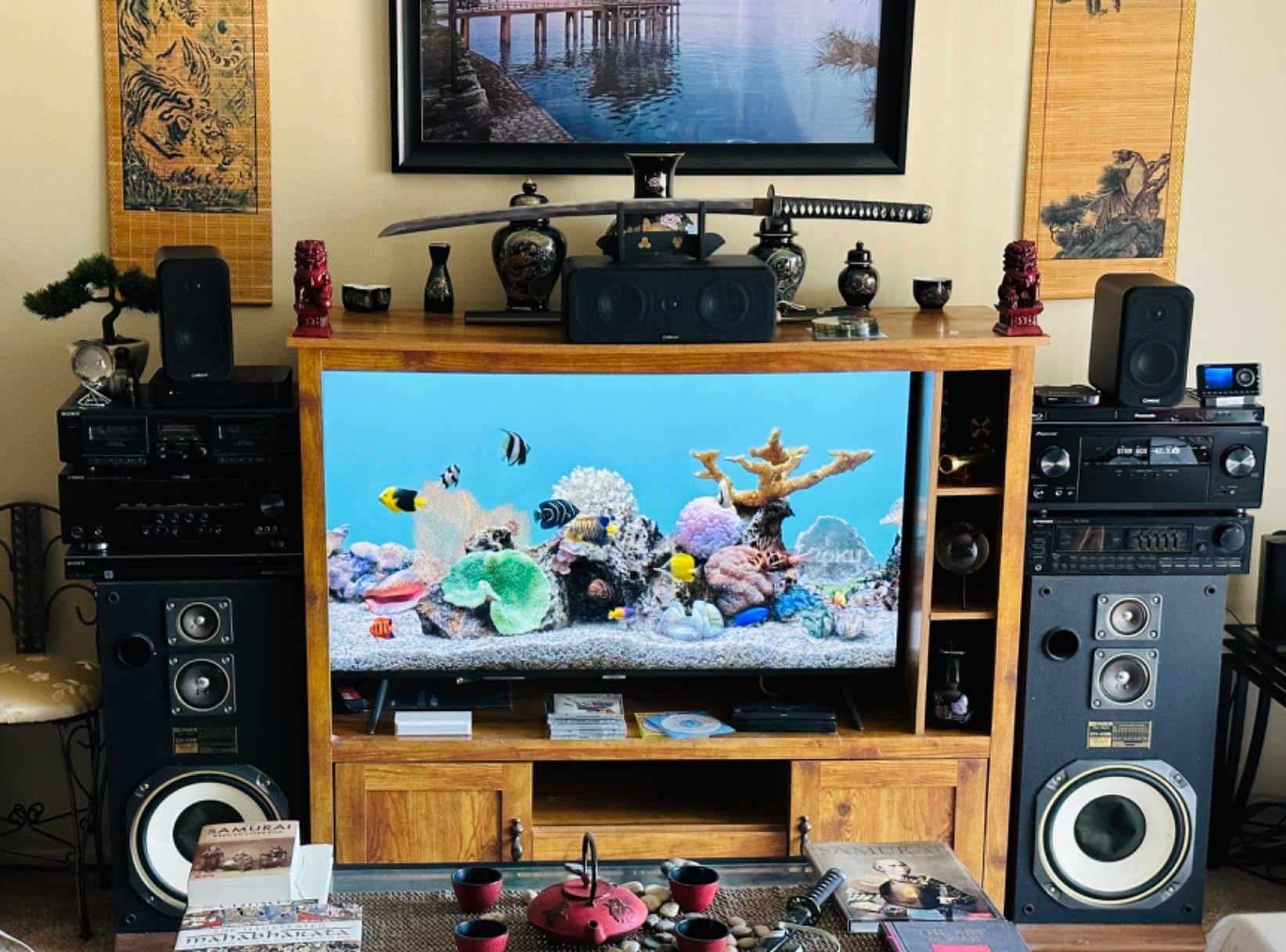
8. Yamaha RX-A2A – AVENTAGE Build and the Best Streaming Suite
Yamaha RX-A2A AVENTAGE 7.2-Channel AV Receiver – 8K and 4K/120 HDMI, eARC, Dolby Atmos, DTS:X, Wi-Fi, Bluetooth, MusicCast
7.2 channels
100 W per channel
YPAO R.S.C. with Surround:AI
2 year warranty
Pros
- AVENTAGE build quality at a mid-level price
- Supports Dolby Atmos DTS:X and Auro-3D decoding
- YPAO R.S.C. multipoint calibration with Surround:AI real-time optimization
- AirPlay 2 Spotify Connect MusicCast Amazon Music HD TIDAL Qobuz and Roon Tested
Cons
- Only one HDMI output so Zone 2 uses analog or a matrix
- Just 3 of 7 HDMI inputs are 8K and 4K120 capable
- 100 W per channel is modest for demanding large-room systems
- Setup and firmware process is less intuitive than Denon or Onkyo
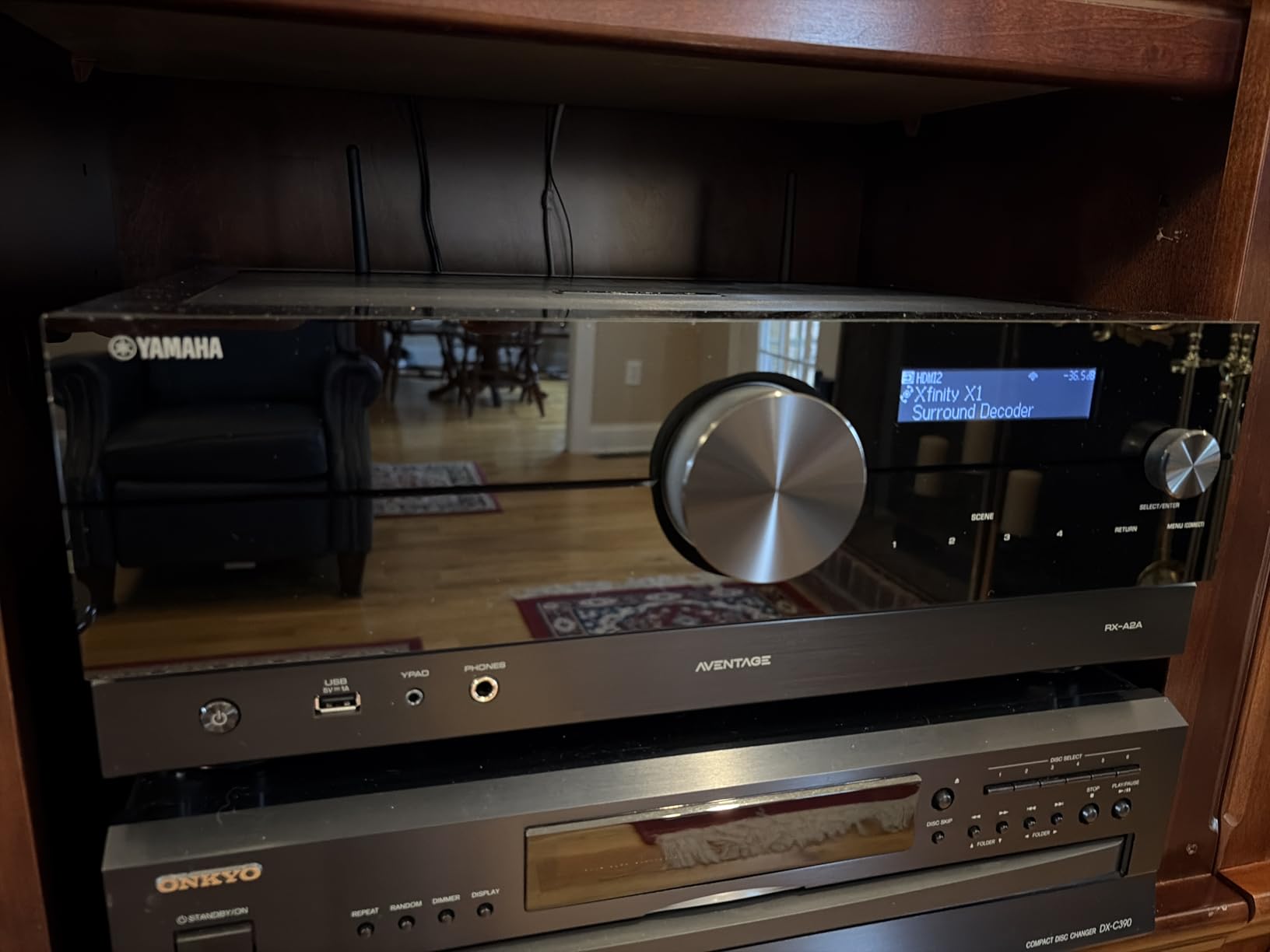
The RX-A2A is the one to buy if your system does double duty with music, and if you listen on services other people skip. It is Roon Tested, it supports Qobuz, TIDAL, Amazon Music HD, Spotify and Apple Music over AirPlay 2, and it adds Auro-3D on top of Dolby Atmos and DTS:X.
Yamaha’s AVENTAGE line also uses a heavier chassis than the Denon and Onkyo entries, and that mass is a real part of why the soundstage feels stable.
YPAO R.S.C. With Surround:AI Works in Real Time
YPAO R.S.C. takes multipoint measurements across several seating positions and builds a correction curve from them, which matters in a wide sofa where the listeners at each end hear a different room. Surround:AI then analyzes the content in real time and adjusts the tonal balance for dialogue and effects.
Whether that beats Audyssey is genuinely debated, and owners who switch from a Denon report a warmer, more refined presentation with smoother top end.
HDMI 2.1 Is There, But Only on Three Inputs
There are seven HDMI inputs and one output with HDCP 2.3 and eARC. All inputs support 4K at 60Hz, and only three support 8K60B and 4K120AB. ALLM and VRR are present for next-generation consoles.
Check your source count carefully. A PS5, an Xbox Series X and a 4K120-capable PC would consume all three high-bandwidth inputs, leaving nothing for a 4K120 Apple TV.
100 Watts per Channel and the Single Output Problem
One hundred watts per channel is modest for a large room with demanding speakers, and forum discussion about Yamaha receivers and low-impedance floorstanders comes up often. If you plan to run a big theater, budget for efficient speakers or an external amplifier later.
The single HDMI output means Zone 2 is served by analog audio or an HDMI matrix rather than a second 8K output. For a two-room house that is a limitation; for a single theater it never comes up.
Who This Suits Best
Choose the RX-A2A if music is half of what you play, if you are Roon or Qobuz committed, or if you want a measurement microphone and base included with a two-year manufacturer warranty.
For a dedicated theater with more than three 4K120 sources, the Yamaha RX-A6A solves the HDMI problem but adds channels you may not use.
9. Yamaha RX-A6A – Full 11.2 Channel Processing and Four Zones
Yamaha RX-A6A AVENTAGE 9.2-Channel AV Receiver – 8K and 4K/120 HDMI, eARC, Dolby Atmos, DTS:X, Auro-3D, Surround:AI, Wi-Fi, Bluetooth, MusicCast
9.2 channels with 11.2 processing
150 W per channel
7 in and 3 out HDMI
four zones
Pros
- Nine channels of amplification with 11.2 channel processing
- All seven HDMI inputs and all three outputs support 8K60 and 4K120 at 40 Gbps
- YPAO R.S.C. with 3D multipoint measurement and low frequency mode
- Four zones plus balanced XLR inputs and Roon Tested
Cons
- Smallest review base in the group at 145 ratings
- Balanced XLR and four zones add cost without benefit in most living rooms
- Large and heavy chassis needs a deep ventilated cabinet
The RX-A6A has the most extensive specification sheet in this roundup and the least universal relevance. It amplifies nine channels while processing 11.2, runs four separate zones, and accepts balanced XLR input, which is the only balanced connection in the group.
Its 145 ratings give it the smallest review base here, and the AVENTAGE specification sheet rather than owner experience is what stands out. Roughly 67% of reviews are five-star.
Eleven Point Two Channels of Processing Behind Nine Amplifiers
The gap between processing and amplification matters more than the channel count suggests. Eleven-point-two processing means you can set up a 7.1.4 or 9.1.4 bed and add channels later through an external amplifier, which no other receiver in this roundup offers.
The Onkyo TX-NR7100 is the receiver to buy if you are certain you will grow into a 7.1.4 theater and want the processing headroom in place from day one.
Every HDMI Port Handles 8K60 and 4K120
Seven HDMI inputs and three HDMI outputs, all supporting 8K60 and 4K120 at 40 Gbps, eliminate the input-squeezing problem entirely. Every source you own can run at full bandwidth, and the Zone 2 and Zone 3 outputs carry separate 4K or 8K signals rather than a matrixed downgrade.
For a house with multiple theaters or a main room plus a playroom, no other receiver here is close.
YPAO R.S.C. With 3D Measurement
YPAO R.S.C. with 3D uses multipoint measurement, precision EQ and a low frequency mode, and it works alongside Surround:AI real-time optimization. The 3D measurement component specifically helps when height speakers sit close to a ceiling or in an irregularly shaped room.
For a standard rectangular living room, the difference between this and YPAO on the RX-A2A is small. In a complicated room with four height speakers, it is not.
Where the Extra Cost Goes
The honest answer is that most of the premium buys capability that a single theater room will not use. Balanced XLR inputs and four zones are wasted budget in a living room with one screen and one speaker layout.
The chassis is also large and heavy enough to need a deep, well-ventilated cabinet, so measure your shelf before ordering. If you only need nine channels and can live with one output, the Onkyo TX-NR7100 delivers similar channel count with better room correction at a much lower outlay.
How to Choose a Dolby Atmos AV Receiver in 2026
The nine receivers above span a narrow price band, and the differences between them are real but modest. The bigger mistakes shoppers make are about channel count, power numbers and HDMI bandwidth, so here is how to avoid them.
How Many Channels Do You Actually Need for Dolby Atmos?
Most Atmos content on streaming services and disc is mixed for a 5.1.2 bed, which is five speakers, one subwoofer and two heights. A 7.2-channel receiver is therefore the practical minimum for real overhead sound, because the two extra channels become the surrounds once you upgrade from 5.1.
Match the layout to the room rather than the spec sheet. A flat or a small living room is well served by 5.1.2 or a 7.2 receiver. A dedicated theater with a wide seating area benefits from 7.1.4. A 9.2 receiver only makes sense if you are running two subwoofers with full side and rear surround pairs, or if you want processing headroom for later.
Speakers for a single listening position cost roughly double what a matching pair costs, and forum consensus consistently says to buy one excellent pair of height speakers rather than four mediocre ones. Spend the rest on a real subwoofer.
HDMI 2.1 Inputs: How Many Do You Need?
Count the sources that will actually run at 4K at 120Hz, then add one spare. A PS5, an Xbox Series X and a 4K120 gaming PC is three high-bandwidth sources, and a 7.2 receiver with three dedicated full-bandwidth inputs covers that with room to spare.
Fewer full-bandwidth inputs means swapping cables whenever you change source. The Denon AVR-S760H and AVR-X1700H give you three dedicated 8K inputs each, the Yamaha RX-A6A makes every input full-bandwidth, and the Onkyo TX-NR7100 gives six in and two out.
Do not count eARC as an input. It is a return path for your television’s audio, and it works on all of these receivers.
Watts Into 8 Ohms Is the Only Power Number That Matters
Quoted wattage at 6 ohms and 4 ohms with only one or two channels driven is inflated marketing. The number that predicts real performance is watts per channel into 8 ohms with all channels driven, and most manufacturers do not print it.
Use the per-channel rating on the spec sheet as a relative guide instead. Anything at or above 100 watts per channel handles a medium room with reasonably efficient bookshelf or tower speakers. Below that, stay in a flat or a small living room, or choose efficient speakers.
Speaker sensitivity in dB matters as much as the receiver. A 90 dB sensitive pair is far easier to drive than an 84 dB pair, and the gap is bigger than most of the wattage differences in this roundup.
Room Correction: Audyssey, AccuEQ, MCACC, YPAO and Dirac Live
Room correction is the feature that most changes what you hear, and it is the one most people evaluate last. It measures your room and speakers, then corrects for reflections, level, delay and distance so the mix arrives at your ears as the director intended.
What you actually feel differs by suite. Audyssey on the Denon AVR-X1700H is widely praised and widely reported to outperform the YPAO it is often compared against. Dirac Live on the Onkyo TX-NR7100 goes deeper, gives you a before-and-after measurement, and is included at no extra cost. YPAO R.S.C. with Surround:AI on the Yamaha models is the smoothest and most refined, and MCACC phase adjustment on the Pioneer VSX-935 handles miswired drivers.
AccuEQ on the Onkyo TX-NR6100 handles distances and crossovers competently but does not attempt deep tonal correction. Whichever suite you get, run it before you touch crossovers manually, and set the mic at ear height in the main seat.
Upfiring, In-Ceiling and Atmos Module Height Speakers
In-ceiling or in-wall speakers fired downward are the best real height channels. They place sound exactly where the Dolby Atmos object renderer expects it, and they disappear visually, which is why most of the VSX-935 owners in our data run them.
Upfiring modules bounce sound off the ceiling and work acceptably in a flat where drilling is not an option, but they depend heavily on ceiling height and surface material. On a low or heavily carpeted ceiling the overhead effect largely disappears, and forum users consistently treat them as a compromise.
While you are waiting, every receiver in this roundup except the Denon AVR-S570BT offers Dolby Atmos Height Virtualization, which fakes height from a 5.1 layout. It is a reasonable stopgap and a poor substitute.
What to Buy First When Funds Are Limited
If your budget only stretches to one purchase, buy the subwoofer and the front three speakers before you upgrade the receiver. A good subwoofer fixes the single most common complaint in home theater, and a matched front three does more for Atmos than a more expensive processor.
On a used or existing system, a receiver with Dolby Atmos Height Virtualization and three dedicated 8K inputs, such as the Denon AVR-S760H, adds the most capability for the least disruption. You can revisit our main AV receiver roundup later if your layout grows.
How We Picked
We selected these nine models on verified specifications rather than brand reputation: channel configuration, rated watts per channel, HDMI 2.1 input and output counts, included room correction, warranty length, and whether the receiver decodes Dolby Atmos out of the box. We then read the owner reviews to confirm that the stated specifications match lived experience, and excluded models whose review volume or rating did not support the claims.
Every receiver here is Atmos-capable except the AVR-S570BT, which we include with a clear warning because it is frequently bought by mistake. We may earn a commission when you buy through the links on this page, and that never changes which model we rank first.
Frequently Asked Questions
Which AV receivers are compatible with Dolby Atmos?
Any receiver that decodes Dolby Atmos is compatible, which today means almost every model released in the last several years. In this roundup, eight of our nine picks decode Atmos natively, including the Denon AVR-S760H, the Denon AVR-X1700H, the Onkyo TX-NR6100, the Onkyo TX-NR7100, the Sony STR-AN1000, the Pioneer VSX-935, and both Yamaha AVENTAGE receivers. Compatibility also means enough amplifier channels to drive real height speakers, so a 5.2 model is not enough.
What audio receivers have Dolby Atmos?
Receivers with a 7.2 channel configuration or higher typically include Dolby Atmos decoding, and the ones in our list pair it with DTS:X and often Dolby Atmos Height Virtualization for layouts without height speakers. The Denon AVR-X1700H, the Denon AVR-S760H, the Onkyo TX-NR6100 and TX-NR7100, the Sony STR-AN1000, the Pioneer VSX-935 and the Yamaha RX-A2A and RX-A6A all decode object-based Atmos. Only the budget Denon AVR-S570BT in this group does not.
Can you add Dolby Atmos to a receiver?
You can add height speakers to any receiver that has spare amplifier channels and Atmos decoding, and that is why we recommend starting with a 7.2 receiver rather than a 5.1 unit. r/hometheater users advise exactly this, buying a 7.2 receiver first and adding Atmos later. If your receiver is already 5.1, you can use Dolby Atmos Height Virtualization on a compatible model, or add an Atmos-capable receiver and reuse your existing speakers.
What is the cheapest receiver with Dolby Atmos?
Among the models we reviewed, the lowest-cost genuine Atmos option is the Denon AVR-S760H, a 7.2 channel receiver with Dolby Atmos, Dolby Atmos Height Virtualization, DTS:X, three dedicated 8K HDMI inputs and a three-year warranty. The Pioneer VSX-935 and Onkyo TX-NR6100 also deliver real Atmos decoding below that tier. Avoid five-channel models like the Denon AVR-S570BT, which have no height channels and no Atmos at all.
How many channels do I need for Dolby Atmos?
A 5.1.2 layout is the format most Atmos content is mixed for, so five speakers, one subwoofer and two heights is the real minimum. A 7.2-channel receiver is the practical floor because the two spare amplifier channels become surrounds later. Use 7.1.4 in a dedicated theater with a wide seating area, and reserve 9.2 for two subwoofers with full side and rear surround pairs.
Do I need a 9.2 channel receiver for a 5.1.2 system?
No, and buying one is the most common expensive mistake in this category. If you only run five beds, two heights and a subwoofer, a 7.2 receiver such as the Denon AVR-S760H or the Yamaha RX-A2A gives you identical Atmos rendering for less money. The extra budget buys better speakers, a proper subwoofer, or the option of adding surrounds later. Choose 9.2 when you have the speakers to drive.
Is Dolby Atmos worth it?
Yes, when you have genuine overhead speakers rather than a 5.1 downmix. The r/audiophile skepticism is fair, because a receiver playing an Atmos track through five speakers sounds much like 5.1 with a wider front stage. Add in-ceiling or in-wall height speakers and the difference is obvious in films, streaming series and games. If drilling is not possible, upfiring modules help, though forum users treat them as a compromise.
How many HDMI 2.1 inputs do I need?
Count the sources that will run at 4K 120Hz, then add one spare. A PS5, an Xbox Series X and a 4K120 gaming PC already uses three. In this roundup the Denon AVR-S760H and AVR-X1700H give three dedicated 8K inputs, the Onkyo TX-NR7100 gives six inputs and two outputs, and the Yamaha RX-A6A makes all seven inputs full-bandwidth. One high-bandwidth input means swapping cables every time you switch.
Which Dolby Atmos AV Receiver Should You Buy?
Start with your room and your speakers, not the channel count on the box. Most people searching for the best AV receiver for Dolby Atmos are choosing between three very different needs, and the right answer is different for each.
If you want the safest overall buy and the most proven platform, the Denon AVR-S760H is our Editor’s Choice. Seven channels, three dedicated 8K inputs, full Atmos and DTS:X decoding, and a three-year warranty, with the largest review base in this group backing it up.
If room correction is what you care about most, the Denon AVR-X1700H has the highest rating here at 4.4 stars, two independent subwoofer outputs and a phono input. For an untreated living room, that Audyssey correction is worth more than extra watts.
If you want maximum power for a big theater or low-sensitivity towers, the Sony STR-AN1000 delivers 165 watts per channel with 360 Spatial Sound Mapping, and it pairs with a Bravia television’s center speaker. Just check your Apple TV Dolby Vision behavior and note the one-year warranty.
If you want nine channels and the best correction technology, the Onkyo TX-NR7100 includes Dirac Live at no extra cost and gives you six HDMI 2.1 inputs and two outputs. For all-in processing headroom and four zones, the Yamaha RX-A6A processes 11.2 channels and makes every HDMI port full-bandwidth.
For music-heavy listening and the widest streaming support, the Yamaha RX-A2A adds Roon Tested, Qobuz, Auro-3D and AVENTAGE build quality. If you are building a first theater around in-ceiling speakers, the Pioneer VSX-935 gives you phase-correcting MCACC at a modest outlay.
And if you are on a strict budget, pick the Onkyo TX-NR6100 for THX Select certification and real power, and skip the five-channel Denon AVR-S570BT entirely, because a receiver without height channels is not a Dolby Atmos receiver no matter what the box says.
Whichever you choose in 2026, measure your room, run the room correction before touching any settings, and set the crossover at 80Hz. That last habit does more for your Atmos soundstage than any upgrade above.
Before you buy, it is worth checking current pricing on the latest soundbar deals as a sanity check, and reading our broader AV receiver buying guide if you want to compare these against models outside the Atmos-first shortlist.
Leave a Reply