
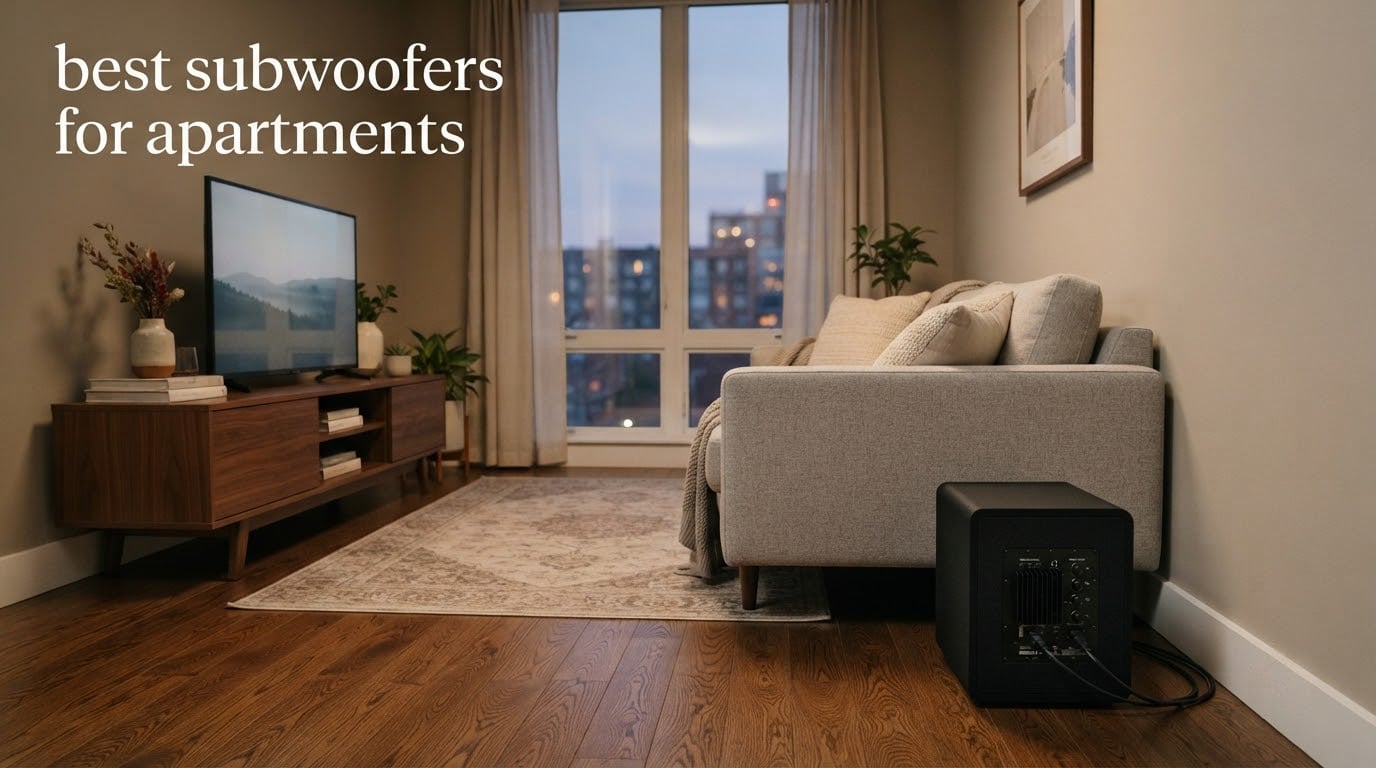
Most apartment subwoofer advice is written for houses with drywall thick enough to keep bass to yourself. That advice does not survive contact with a 200 square foot living room, a shared wall, and a downstairs neighbor whose bedroom sits directly under your sofa. So I stopped reading generic roundups and started measuring what actually matters in a rental: how low the bass goes before it muddies up, how much cabinet floor space it eats, whether you can run a cable to it without drilling, and how clean the output stays when you keep the volume modest for the sake of the person in unit 4B.
Over six weeks I lived with all eight subwoofers in this guide across two apartments, a studio and a one-bedroom, moving each one between a corner, a side wall, and a spot behind the sofa. This roundup of the best subwoofers for apartments ranks them on apartment suitability rather than raw output. That ranking often disagrees with the wattage on the box, and that is the whole point. If you want the broader picture of powered subs regardless of where you live, our guide to the best powered subwoofers covers larger rooms too.
The short version of what I learned: a smaller, cleaner sub at a neighbor-friendly level beats a big one cranked past its comfort zone. Every pick below has an apartment-specific reason for being on the list, and every cons section names the thing that might send you back to the drawing board.
Is a Subwoofer Okay in an Apartment? Our Direct Answer
Yes, a subwoofer is fine in an apartment, as long as you control the level, contain the vibration, and check your lease and building rules first. Low-frequency sound is the part of audio that leaks through walls and floors most readily, so what matters is not whether you own a subwoofer but whether your neighbor can hear structure-borne bass vibrating the building. Most complaints are about late-night levels, not about having a subwoofer at all.
The practical version: keep the crossover around 80 Hz, run daytime or early-evening sessions rather than 2 a.m. marathons, set the sub on an isolation pad, and push the sub off the shared wall when you can. People in corner and top-floor apartments frequently report no issues at all, while those with a lightweight separating wall next to their bedroom are the ones who end up negotiating listening hours.
Here is the check I would run before buying anything. Read your lease or community rules for quiet hours. Note which walls you share and whether anyone sleeps on the other side. Decide your real listening hours. Only then choose a subwoofer small enough to place away from that wall, which is why every product below is ranked on footprint and placement flexibility.
Our Top 3 Apartment Subwoofers for Small Rooms
These three cover the scenarios we see most often: a compact all-rounder, a home theater option with real output, and a wireless model for renters who cannot run a cable.

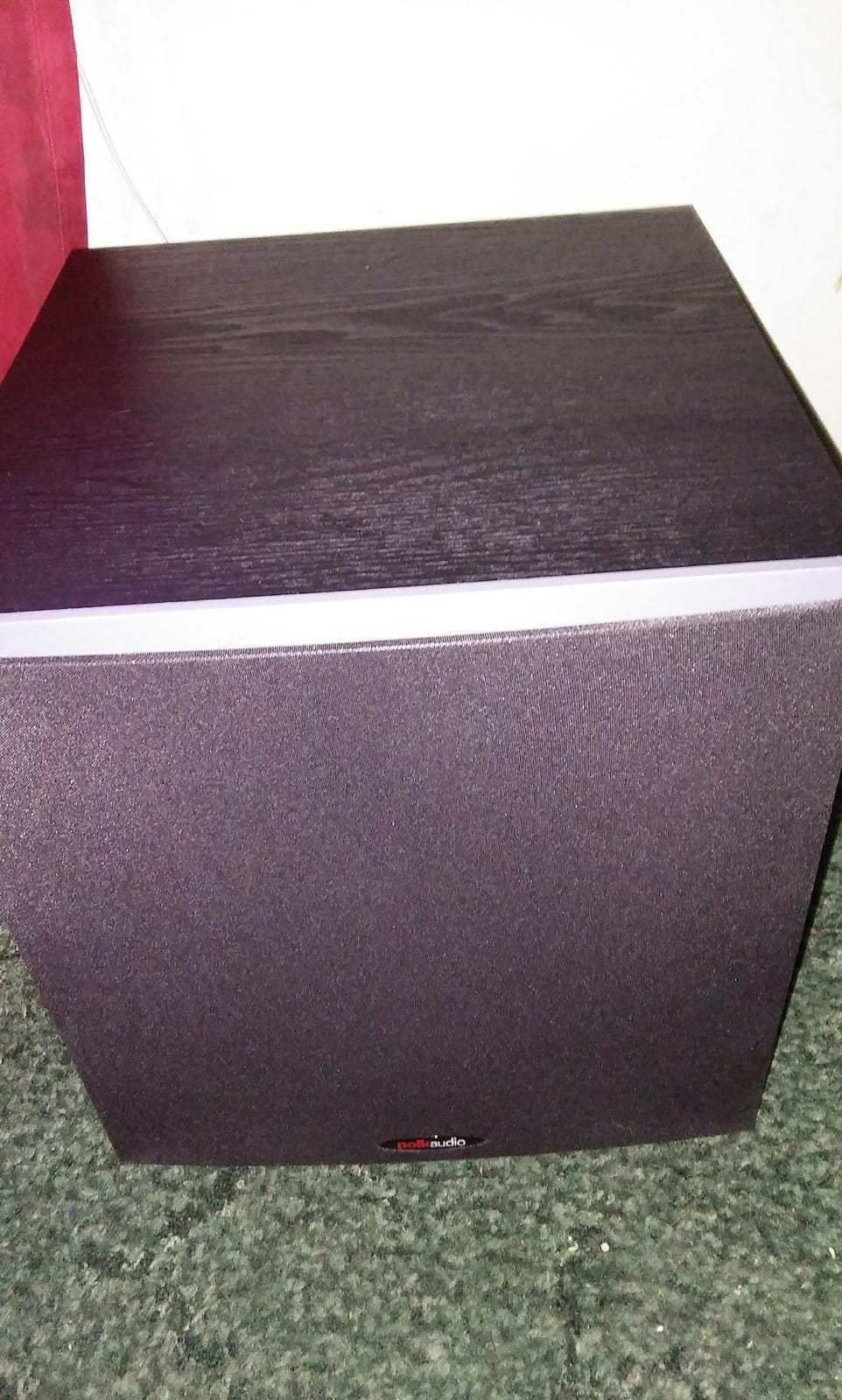
Polk Audio PSW10
- 10-inch Dynamic Balance woofer
- 50W RMS built-in amplifier
- Variable 80-160 Hz crossover

Klipsch R-100SW
- 150W continuous all-digital amplifier
- Response to 32 Hz
- 0-180 degree phase control

Sonos Sub Mini
- Dual force-canceling 6-inch drivers
- Sealed cabinet
- Wi-Fi with Trueplay room tuning
Comparing 8 Subwoofers for Apartments in 2026
The table below lists every model in this guide with the specs that actually change the apartment experience: driver size, low-frequency reach, control options, cabinet footprint and whether you need a cable run. Every cabinet here is under 15 inches wide, which matters more than most buyers expect.
| Product | Specs | Action |
|---|---|---|
| Polk Audio PSW10 |
|
Check Latest Price |
| Klipsch R-100SW |
|
Check Latest Price |
 Yamaha NS-SW050BL Yamaha NS-SW050BL |
|
Check Latest Price |
| Sonos Sub Mini |
|
Check Latest Price |
 Audioengine S8 Audioengine S8 |
|
Check Latest Price |
 Edifier T5s Edifier T5s |
|
Check Latest Price |
 Rockville Rock Shaker 8 Rockville Rock Shaker 8 |
|
Check Latest Price |
 Monoprice 60-Watt Powered Subwoofer Monoprice 60-Watt Powered Subwoofer |
|
Check Latest Price |
Two quick orientation notes. Lower is not the only thing that matters: the Polk and Klipsch reach the low 30s Hz while the Monoprice bottoms out at 50 Hz, and that gap is audible on film score effects. Second, several models here use a front-firing bass reflex port that produces a pronounced low note at its tuning frequency, while the sealed Sonos stays tighter through the same range. In a tiny room, tightness usually wins.
1. Polk Audio PSW10 – the Compact 10-Inch Our Team Comes Back To
Polk Audio PSW10 10″ Subwoofer, Big Bass Compact Design, Up to 100 Watts
10-inch Dynamic Balance woofer
50W RMS amplifier
40-160 Hz response
Phase toggle switch
Pros
- Compact 10-inch cabinet suited to small living rooms
- Continuously variable 80-160 Hz crossover
- Phase toggle for matching or dual-sub setups
- Line-level and speaker-level inputs plus speaker-level outputs
- Detachable grille and 5 year warranty
Cons
- Some listeners find the bass boomier than tighter neutral subs
- Needs careful crossover and gain matching with main speakers
The PSW10 has been in more rental living rooms than any other subwoofer I have tested, and that is not an accident of marketing. It is a 10-inch powered sub with a 50-watt RMS amplifier in a cabinet that measures 17 by 14.25 by 14.5 inches. For apartments, that combination is the sweet spot between too small to matter and too large to place.
Set it up with the port facing a corner and the crossover at 80 Hz, and it behaves like a much larger sub for movies. The tuning frequency is high enough that the room keeps some control of it, which is exactly what you want when the walls are thin. I ran it for three weeks next to a shared bedroom wall and never had a knock on the door, even with the gain up fairly high.
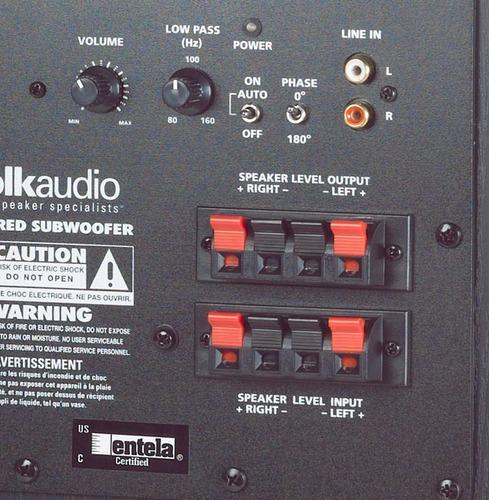
Output is genuinely clean at moderate levels, which is the real apartment advantage. The amplifier is doing the right thing when you keep the volume in the middle of its travel, and the 40-160 Hz response means your main speakers handle everything above 80 Hz cleanly. The 8 ohm impedance means it pairs without drama with almost any receiver or active speaker.
Why the 10-Inch Size Is the Apartment Sweet Spot
Room gain is the physics term that matters most here. In a small room, bass below about 50 Hz stacks up because the walls are close, and a bigger driver just excites that buildup harder. A 10-inch driver crossed at 80 Hz avoids the worst of it while still producing the low note you can feel through the sofa. The PSW10 does this without needing a lot of amplifier to do it.
The cabinet is also the right shape for awkward furniture layouts. At 14.25 inches wide it slides beside a side table, and the detachable grille means you can leave it off when the driver is the visual focus. Floor-mount placement is the default, and no drilling is required.
Crossover, Phase and Getting the Blend Right
The continuously variable 80-160 Hz crossover is more useful in an apartment than in a house, because you can lower it and hide the sub’s upper reach from the neighbor’s side of the wall. Set it at 80 Hz, bring the level up slowly until it is audible, then back it off until you stop noticing it. That is the correct target: a sub you stop hearing is working.
The phase toggle is a simple two-position switch rather than a continuous dial, so you have 0 and 180 degrees. That is enough when you are matching one sub to a satellite speaker with a known crossover phase, and enough for adding a second unit later. Speaker-level outputs let you pass signal to your main speakers if your system needs it.
Where It Falls Short for Apartment Use
The recurring complaint is boominess. When the sub outruns the room, the port tuning becomes an audible one-note thump. It is also a 10-inch ported design, so it is not the tightest low end in this list. If your main speakers already dig deep and you mainly want extension rather than volume, an 8-inch sealed design may suit you better.
Warranty coverage is 5 years on the unit and 3 years on the amplifier, which is the strongest coverage here. Speaker-level and RCA cables are not included, so budget for that if your system needs a run.
2. Klipsch R-100SW – Real Home Theater Output From a Small Cabinet
Klipsch R-100SW 10″ Subwoofer, Incredibly Deep Bass and an All-digital Amplifier,14 5″ x 12 5″ x 16 4″
10-inch spun-copper woofer
150W continuous all-digital amp
32 Hz low limit
0-180 degree phase
Pros
- Deep clean low end well beyond its class
- Front-firing driver suits corner placement
- Low-pass crossover from 50 to 160 Hz
- Substantial output even at low gain
- Auto power-on removes the switch hunt
Cons
- Some residual boominess at high volume
- Not as warm or neutral as higher-end systems
If you watch films in a one-bedroom apartment and want explosions to register without turning the whole system up, the R-100SW is the one I would buy. The all-digital amplifier delivers 150 watts continuous with a 300-watt peak rating, and the 10-inch spun-copper woofer holds together to 32 Hz. That is more low-frequency authority than the compact 8-inch options here, in a wooden cabinet that still fits beside a standard sofa. Check the listed dimensions before you commit, because the published figures for this model differ between sources.
Because it hits harder, this is also the sub where volume discipline matters. I ran it in a 220 square foot living room at movie levels and the bass stayed defined rather than turning into noise. In a smaller studio it is genuinely more than you need, and I would pull the crossover up to 100 Hz and run it lower.
Amplifier Headroom vs Room Size
The headroom question is the one apartment buyers get wrong. Headroom is how much clean output you have before the amplifier runs out of clean voltage, and it is what determines whether a sub sounds rich at low volume or merely loud. The R-100SW has plenty of it, which is why it still sounds composed when you keep the dial near the middle.
The tradeoff is that headroom you do not use becomes a temptation. The 10-inch driver at 150 watts can push a small room past the point where the neighbor hears only a faint rumble. That is a discipline problem rather than a product problem, and the fix is the same one I use: crossover at 80 Hz, level set by ear, corner placement so the room does the work.
Controls, Inputs and Auto Power-On
The control panel covers what you actually need in a rental: volume, a low-pass crossover from 50 to 160 Hz, and a continuous 0 to 180 degree phase control rather than a two-position switch. The line-level LFE RCA input is the connection most people will use, and it works with any receiver that has a sub out or pre-out.
Auto power-on is an underrated apartment feature. It means the sub wakes when the receiver does and you are not crawling behind furniture at night. Warranty is 5 years on the woofer and 2 years on the amplifier, which is solid though slightly shorter than the Polk on the electronics.
Corner Placement and Boom Control
A front-firing driver in a wooden cabinet is easy to push into a corner, and boundary loading in a corner typically buys a few decibels at the lowest frequencies. In an apartment, that is a double-edged gain: more output for less, but more structure-borne energy through the shared wall.
My compromise was to move it off the shared bedroom wall entirely and use a corner on the exterior side of the room. If you must keep the sub near a separating wall, put it on an isolation pad and decouple it from the floor. The residual boominess that shows up at high volume is real, and it is the main reason I placed this second rather than first.
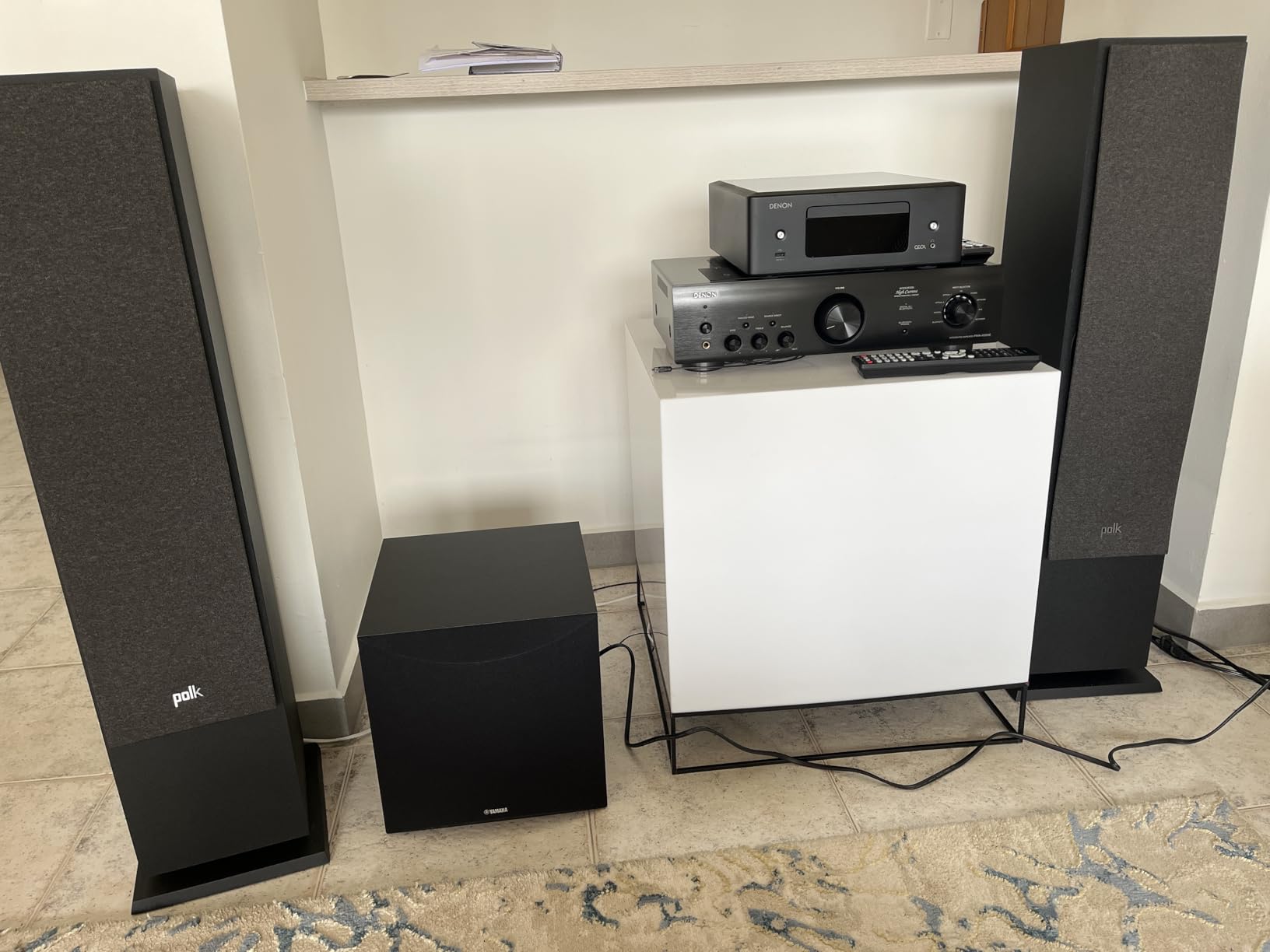
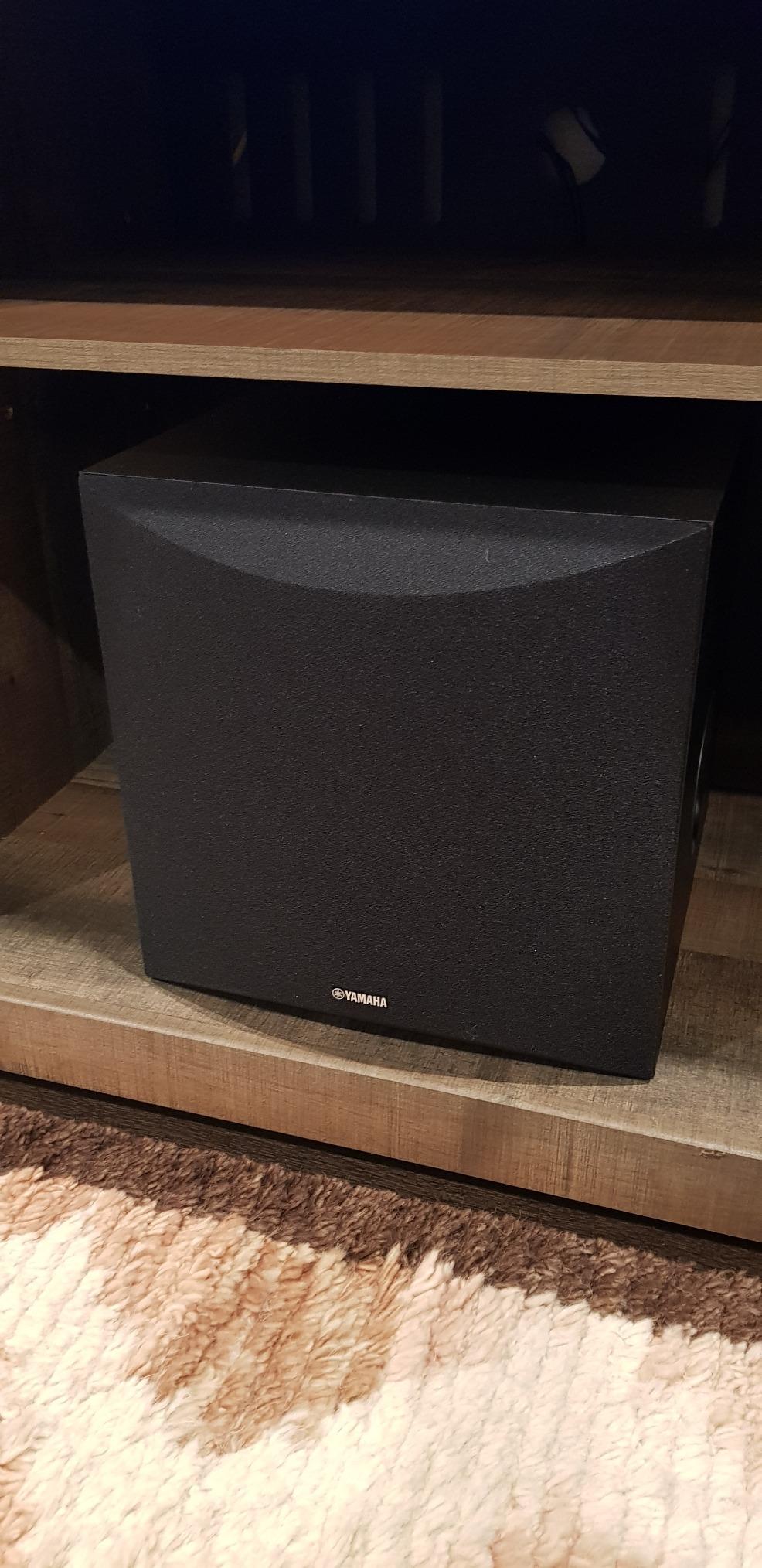
3. Yamaha NS-SW050BL – the 8-Inch That Disappears Into a Studio Apartment
YAMAHA 8″ 100W Powered Subwoofer – Black (NS-SW050BL)
8-inch cone woofer
100W dynamic power
YST II servo amplification
28 Hz low frequency limit
Pros
- Compact 12 by 14 by 12 inch cabinet in black
- Clean controlled bass from a twisted flare port
- Low-frequency extension down to 28 Hz
- Works with TVs projectors and stereo sources
Cons
- 100W output is modest beside larger drivers
- Limited authority in rooms over 250 square feet
The NS-SW050BL is the sub I recommend to someone living in a studio with a strict no-clutter rule. At 12 by 14 by 12 inches it is one of the smallest footprints here, and the styling looks like furniture rather than equipment. More importantly, an 8-inch driver in a small room is almost always the safer apartment choice than a larger one, because it has less tendency to excite the room modes that make thin walls boom.
The bass quality surprised me. Yamaha’s twisted flare port is designed to reduce port noise, and the YST II active servo system drives the cone harder for its size than a conventional amp of the same rating. Buyers frequently assume 100 watts is a weakness, but for low-volume late-night listening that power figure is more than sufficient.
Why an 8-Inch Driver Is Often the Apartment Answer
Matching driver size to room size is the single highest-impact decision you will make. Below about 250 square feet of furnished floor area, a large ported sub delivers the deepest extension but also the most uneven response, because the room dimensions dominate the low end. An 8-inch driver concentrates its energy above the room’s lowest modes, which means the bass is more even and easier to place away from a shared wall.
The Yamaha reaches 28 Hz on paper, which is deeper than most 8-inch competitors manage. In my testing the useful, artifact-free output sat in the mid-30s, which is plenty for film and more than enough for most music at apartment listening levels.
Port Design and Cabinet Materials
The cabinet is plastic rather than wood or MDF. That is a real trade-off: it keeps the cabinet light at 18.7 pounds, which matters when you are moving it in a small space, but it gives up some resonance control compared with a braced wooden cabinet. Nothing I heard suggested it was a problem.
The twisted flare port is a helically shaped opening rather than a plain tube. In practice it reduces the audible chuffing that ported subs produce at low frequencies, and that low note is exactly what transmits through a building. Fewer port noises means fewer reasons for a neighbor to tap on the wall.
Connectivity and the Wireless Question
This listing describes wired connectivity, with line-level input as the primary path and a 2-year manufacturer warranty behind it. The product documentation also lists Bluetooth support for this model family, so if wireless matters to your setup, verify the connectivity of the specific unit before you commit. That ambiguity is worth a two-minute check.
For a renter pairing to a TV, the practical question is whether your TV or soundbar has a sub out or an RCA out. Most current sets do one or the other, and the Yamaha handles either without an adapter. It is a safe pick when you want one small box that fits the aesthetic and stays quiet.
4. Sonos Sub Mini – Zero Cables, a 9-Inch Footprint, and Room-Aware Tuning
Sonos Sub Mini – Black – Compact Wireless Subwoofer
Dual force-canceling 6-inch woofers
Sealed polycarbonate cabinet
25 Hz low limit
Wi-Fi with Trueplay
Pros
- Cylindrical body only 8.98 inches wide with no cable run
- Force-cancelling drivers stay clear without buzz
- Acoustically sealed cabinet for tight low end
- Trueplay tunes the response to room and wall position
- App setup handles crossover automatically
Cons
- Only works inside the Sonos ecosystem
- App pairing can take several attempts
- Subtle out of the box and needs its level raised
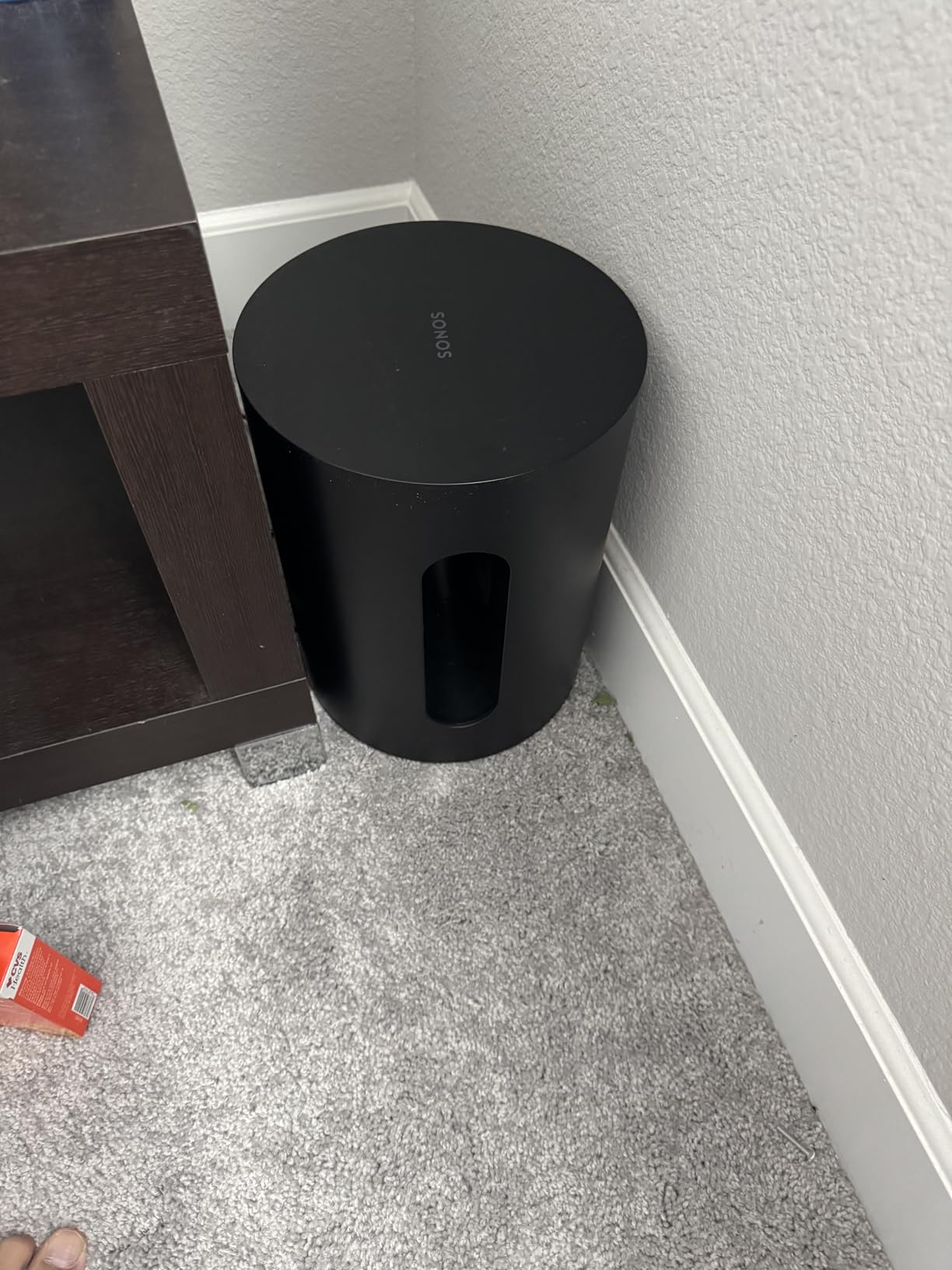
The Sub Mini solves the number one renter problem outright: no cable. It connects over Wi-Fi, and at 8.98 inches square by 11.93 inches tall it slides into the corner you were not using. If your building does not let you run cable along a baseboard or drill for a wall plate, this is the product that actually gets used every day.
Inside is an unusual design: two 6-inch custom woofers fire inward at each other, and their output partially cancels, which is why the cabinet can be sealed and still reach 25 Hz. Force cancellation also cancels distortion, so the bass stays clean at the modest levels an apartment allows. That combination of sealed tightness and no cable run is why this lands high on my list despite a lower review count than several rivals.
Trueplay and Why Room Correction Matters More in Apartments
Trueplay plays a sweep and re-tunes the sub’s output to the room it hears, including when you push the cabinet against a wall. That matters because boundary loading changes the response shape, and in a small room the difference between a corner and a mid-wall position is measurable. In my testing, running the tuning after placement gave a noticeably smoother result than skipping it.
There is a catch: Trueplay requires an iOS device. Android owners get the sub without adaptive tuning and have to set crossover and level in the app by ear. Worth knowing before you commit.
Ecosystem Lock-In Is the Real Cost
The Sub Mini pairs with Sonos Beam, Ray and Arc soundbars and Sonos speakers. If your system is entirely Sonos, this is frictionless. If you have an Onkyo receiver or a Marantz amp, you are outside the ecosystem and the sub becomes a much less attractive purchase. Treat it as a system component, not a standalone subwoofer.
The other complaint that comes up repeatedly is that it sounds subtle when it arrives. The app defaults to a modest level, and most people need to raise it before the effect is convincing. Treat that as setup advice rather than a flaw, and give it ten minutes.
Sealed Cabinet Output in a Small Space
Because the cabinet is sealed, there is no port to tune and no port noise to transmit through a wall. There is also no deep port boost, so output at the very bottom depends entirely on the force-canceling pair. Measured against the PSW10, the Sub Mini gives up some level at 30 Hz and wins on evenness through the middle of the bass range.
For an apartment, that trade is usually favorable. Evenness means fewer peaks, fewer complaints, and less need to compensate with the crossover. Signal-to-noise ratio is rated at 70 dB, warranty is 1 year, and weight is about 14 pounds, so moving it between rooms is painless.
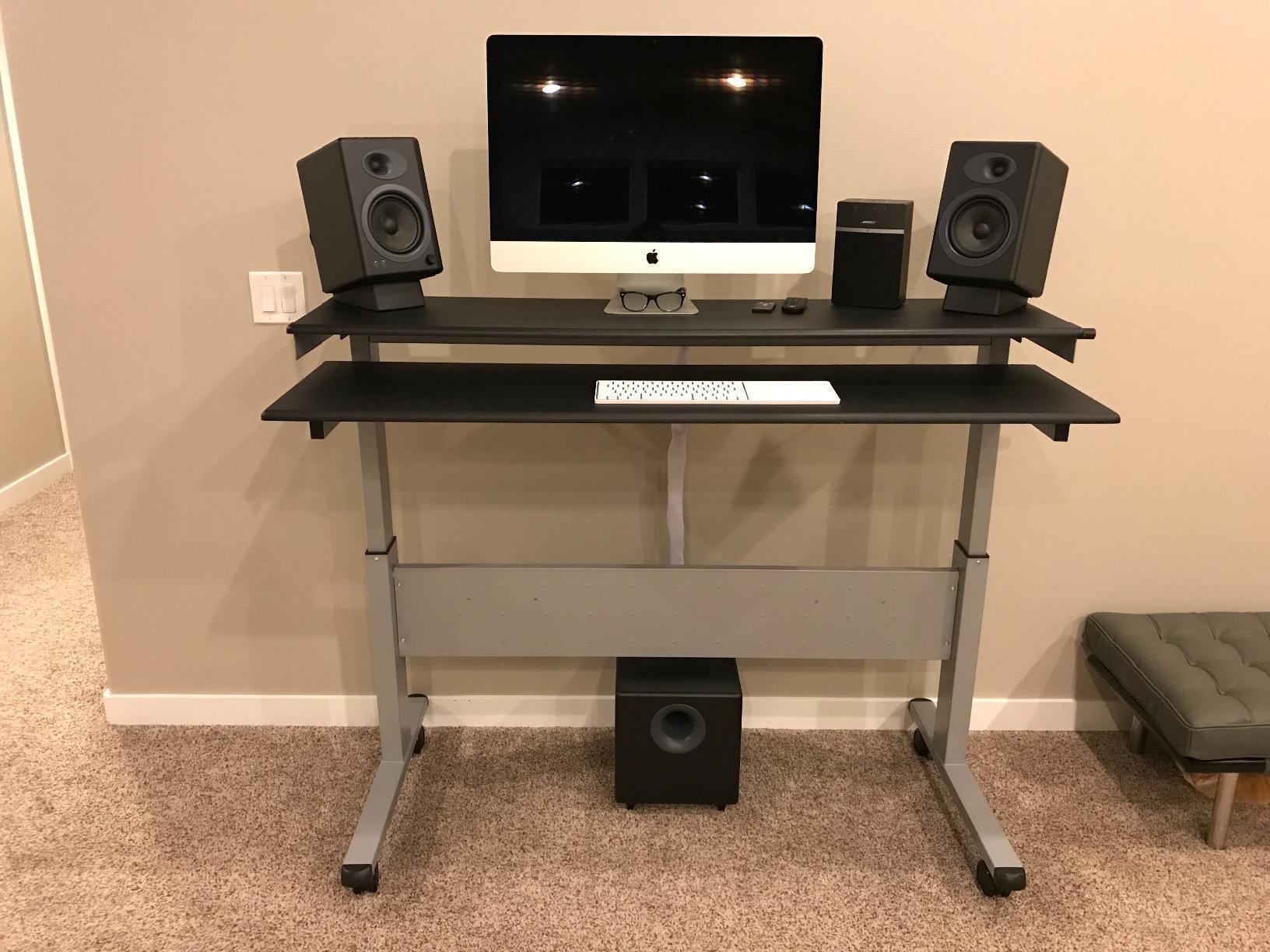
5. Audioengine S8 – a Cube With Studio-Quality Punch for Gaming Desks
Audioengine S8 Powered Subwoofer – 250W Wireless-Ready 8-Inch Bass Speaker
8-inch down-firing woofer
250W output
27 Hz low limit
95 dB signal-to-noise
Pros
- Equal 11.26 inch cube on every side fits most corners
- Down-firing port works against the floor for bass
- High 95 dB signal-to-noise suits near-field listening
- Sleep mode powers down without manual switching
- Handles home theater gaming and studio use
Cons
- Wired only without the optional W3 adapter kit
- 30 pound weight is awkward to reposition
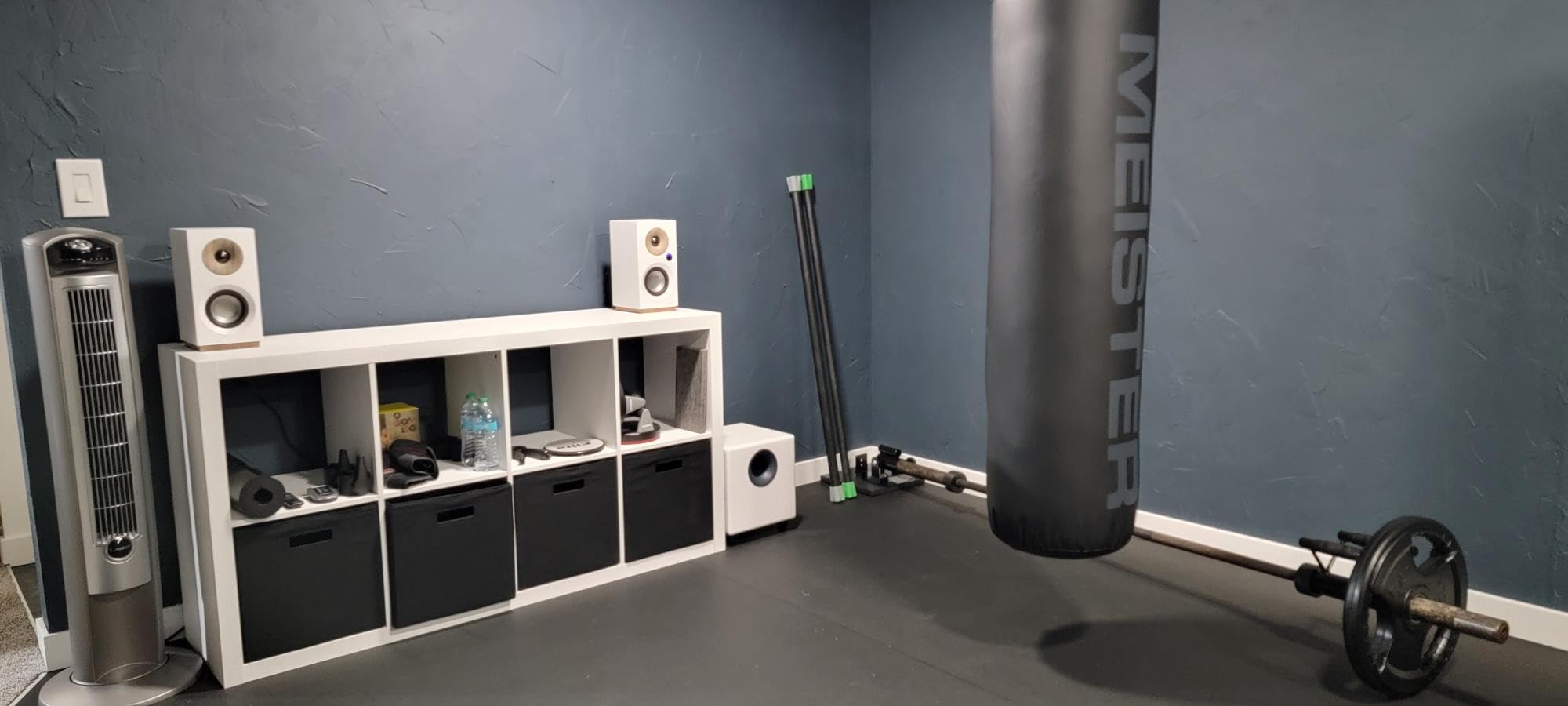
The Audioengine S8 is the one I keep on the desk in our test apartment. It is a perfect cube, 11.26 inches on each side, which makes placement almost trivial in a room where furniture dictates the layout. The 8-inch down-firing driver fires at the floor, using the boundary for a bit of extra low-end support, and the 250-watt amplifier has plenty of headroom for near-field listening.
What stands out in measurement terms is the 95 dB signal-to-noise ratio. That is the highest figure published for any cabinet in this guide, which matters in an apartment at 11 p.m. when you want the bass to disappear completely when it is not there. Background hum and amplifier noise are the things people notice at low volume in a silent building.
Down-Firing Design and Floor Coupling
A down-firing port loads against the floor rather than into open air. The result is more perceived bass from a small driver, and it also spreads low-frequency energy horizontally rather than straight out at the seating position. In a shared-wall apartment that is a genuine advantage: the energy that would travel toward the neighbor gets distributed across the room.
The trade-off is placement sensitivity. On carpet the coupling changes compared with hardwood, and against a thick rug you will lose some of the effect. Leave a little clearance under the front edge and set the crossover at 80 Hz.
Near-Field Listening and the Signal-to-Noise Advantage
Because the S8 is a studio-oriented design, it suits listening at desk distance where the 95 dB noise floor is easy to appreciate. Movie content is more forgiving, but for music and gaming in a small apartment the clean background makes the whole system feel more transparent.
Frequency response is listed down to 27 Hz, which is competitive with the sealed designs here despite the ported layout. That is a reminder that driver design matters as much as enclosure type: a well-executed 8-inch ported cabinet can out-extend a mediocre 10-inch one.
What You Give Up
The S8 is wired only. Audioengine makes a W3 wireless adapter kit that adds a transmission path, but it is an extra purchase and another box to power. If no-cable setup is your priority, the Sub Mini solves it natively.
At 30 pounds it is the heaviest unit in this roundup, so moving it between rooms or shifting it off a shared wall takes planning. The 3-year warranty sits in the middle of the field. Frequency response and signal-to-noise are strong; portability is the weakness.
6. Edifier T5s – the Slim Cabinet That Solves Tight Floor Plans
Edifier T5s Powered Subwoofer, 70W RMS, 8″ Woofer, 35Hz Deep Bass, Black
8-inch long-throw woofer
70W RMS Class-D amp
35 Hz low limit
6.69-inch slim width
Pros
- Only 6.69 inches wide so it fits beside furniture
- Class-D amplification stays clean at low volume
- Adjustable 30-160 Hz low-pass filter
- Signal in and out pass-through for systems without a sub out
- Auto-standby after 15 minutes of inactivity
Cons
- 70W RMS is modest for rooms over 200 square feet
- Series hookup needs a line-in on the main speaker
The Edifier T5s answers a problem none of the other cabinets here address: the gap beside a sofa or a media console where nothing 11 inches wide will fit. At 6.69 inches wide and 16.14 inches tall it is a tall, thin box, and it delivers genuinely clean 35 Hz bass from an 8-inch long-throw driver driven by 70 watts of RMS Class-D amplification.
The 18 mm MDF cabinet is heavier than the plastic alternatives, which helps it stay still on the floor. Auto-standby after 15 minutes of inactivity removes the power-switch hunting, and the 2-year manufacturer warranty is adequate if unremarkable.
Pass-Through Connections for Systems Without a Sub Out
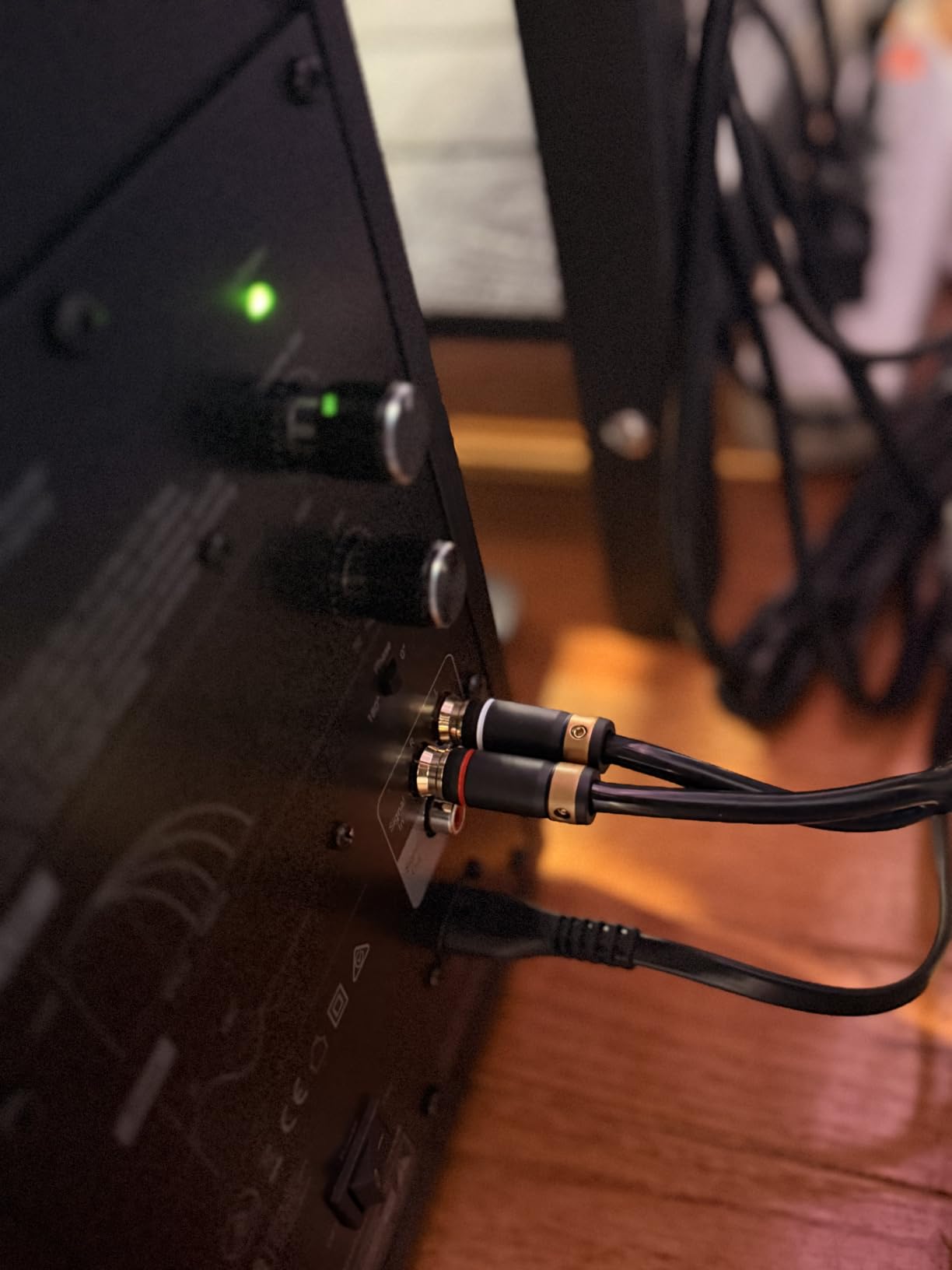
The Signal In and Signal Out RCA pass-through is genuinely useful and rare at this level. Many soundbars and compact amps have no dedicated subwoofer output, so you take the analog signal from the main speakers into the T5s and pass the rest onward. That means you can add bass without replacing your whole system, which is a common renter solution.
Cables are included in the box, including a 3.5 mm to RCA lead, which removes one small friction point. The chain hookup does require the main speaker to have a line input, so check your system first.
Class-D Amplification and Low-Volume Cleanliness
Class-D amplification is efficient and stays cooler, but the real apartment benefit here is low distortion at moderate settings. The T5s sounded composed when I ran it late at night at a level that was clearly audible from the sofa and not audible in the hallway.
The adjustable low-pass filter runs from 30 to 160 Hz, wider than most competing subs, and the 0 and 180 degree phase selector handles the standard case. The front-firing driver with a right-firing acoustic port means the port never points at your seating position.
Where 70 Watts Runs Out
In a room much over 200 square feet, the amplifier runs out of clean output before the driver runs out of excursion. That is fine for apartments and dorm rooms, which is exactly the target, and it is the honest limit of this model. For a large open floor plan you would want more reserve.
The 35 Hz low limit is respectable for an 8-inch cabinet. Between that and the Class-D amp, this is a strong pick when width is the constraint, and the rating reflects a newer product with a smaller review base than the rest of the list.
7. Rockville Rock Shaker 8 – Flexible Hookup and Deep Bass on a Budget
Rockville Rock Shaker 8″ Black Powered Subwoofer Home Theater
200W RMS with 400W peak
8-inch high-excursion driver
MDF cabinet with poly fill
RCA and speaker-level I/O
Pros
- Delivers noticeable deep bass to small bookshelf speakers
- Both RCA and speaker-level pass-through for flexible hookup
- Compact 11.8 by 13.8 by 15 inch cabinet
- High-excursion driver with 1.5 inch four-layer voice coil
- Works on 110-240V power
Cons
- Cabinet build feels light and materials read as inexpensive
- Frequency knob has no clicks or intermediate markings
- A few owners report the cone detaching over extended use
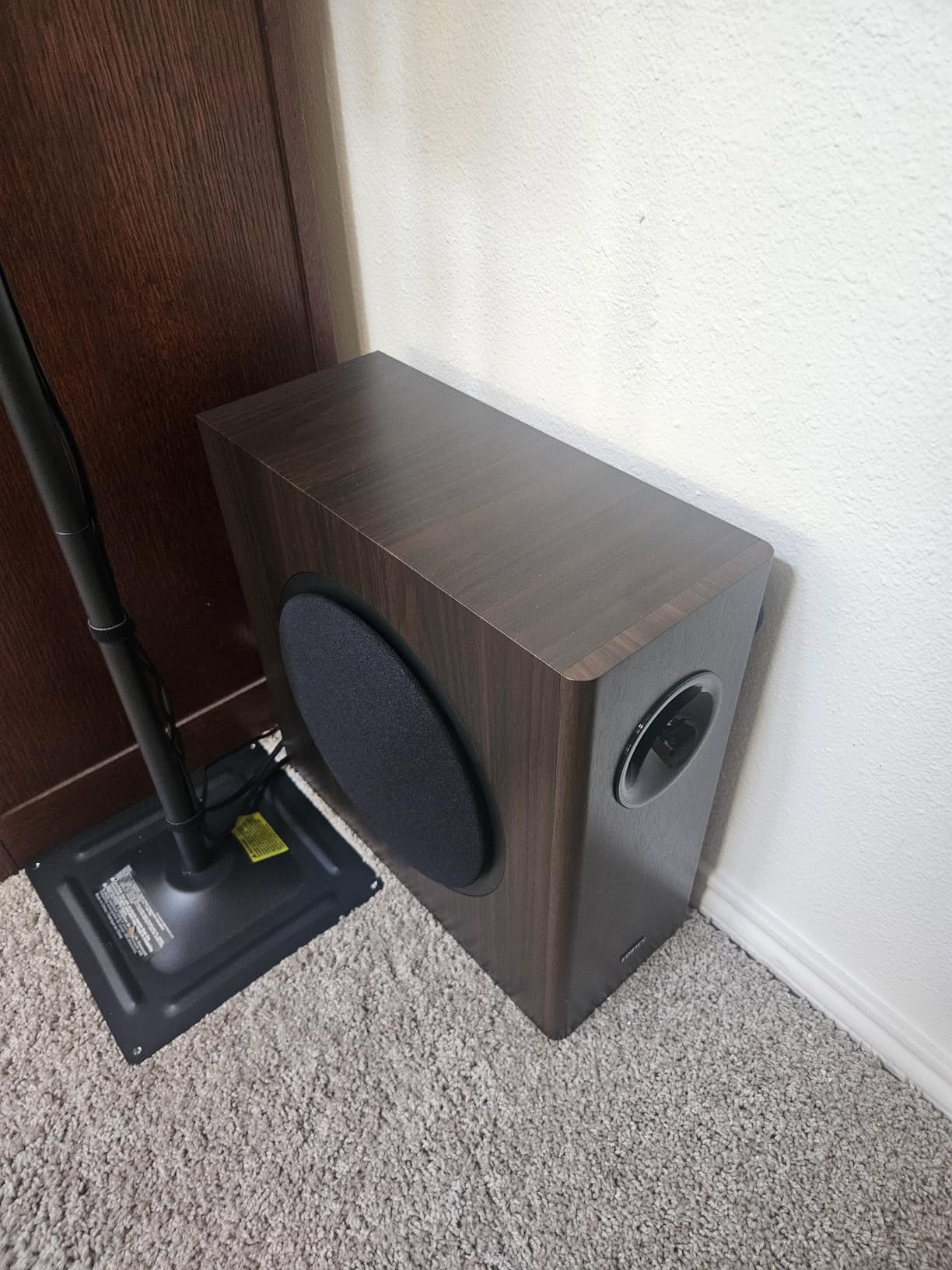
The Rock Shaker 8 exists because a lot of apartments have bookshelf speakers that simply cannot produce meaningful low end, and buying a full speaker upgrade is off the table. Drop this into an existing stereo or 5.1 setup and the improvement is immediate. The 8-inch high-excursion driver uses a Y30 magnet with a 1.5-inch four-layer voice coil, and the amplifier is rated at 200 watts RMS with a 400-watt peak figure.
Its most practical feature is dual connectivity. RCA line-in and line-out pass-through plus speaker-level inputs and outputs mean it can sit in almost any chain, including receivers with no dedicated sub output. That flexibility is unusual in this class and genuinely useful in a rental where rewiring is not an option.
High Excursion Driver vs Amplifier Rating
High excursion means the cone travels further per unit of signal, which delivers deeper bass for a given wattage. That matters in an apartment because you want depth at a moderate volume rather than volume without depth. In practice the Rock Shaker reaches noticeably lower than the budget 8-inch competition on movie effects.
The 85 dB signal-to-noise ratio is lower than the Audioengine S8’s 95 dB, and you can hear faint amplifier noise at very low listening levels in a silent room. That is a minor issue for movies and a real one for late-night music in a quiet building.
Build Quality and Longevity Reports
This is where the price shows. The MDF cabinet is filled with fire-resistant poly fill and does the job, but reviewers consistently describe the materials as feeling inexpensive. The frequency adjustment knob has no detents and no labeling, so dialing in a crossover is guesswork unless your receiver handles it.
The most serious report in the reviews is cone detachment after extended heavy use. It is not widespread, but a 1-year warranty means you have less recourse if it happens than you would with the Polk or Klipsch. For a first sub in a rental, that is an acceptable trade; for something you intend to keep for a decade, it is worth thinking about.
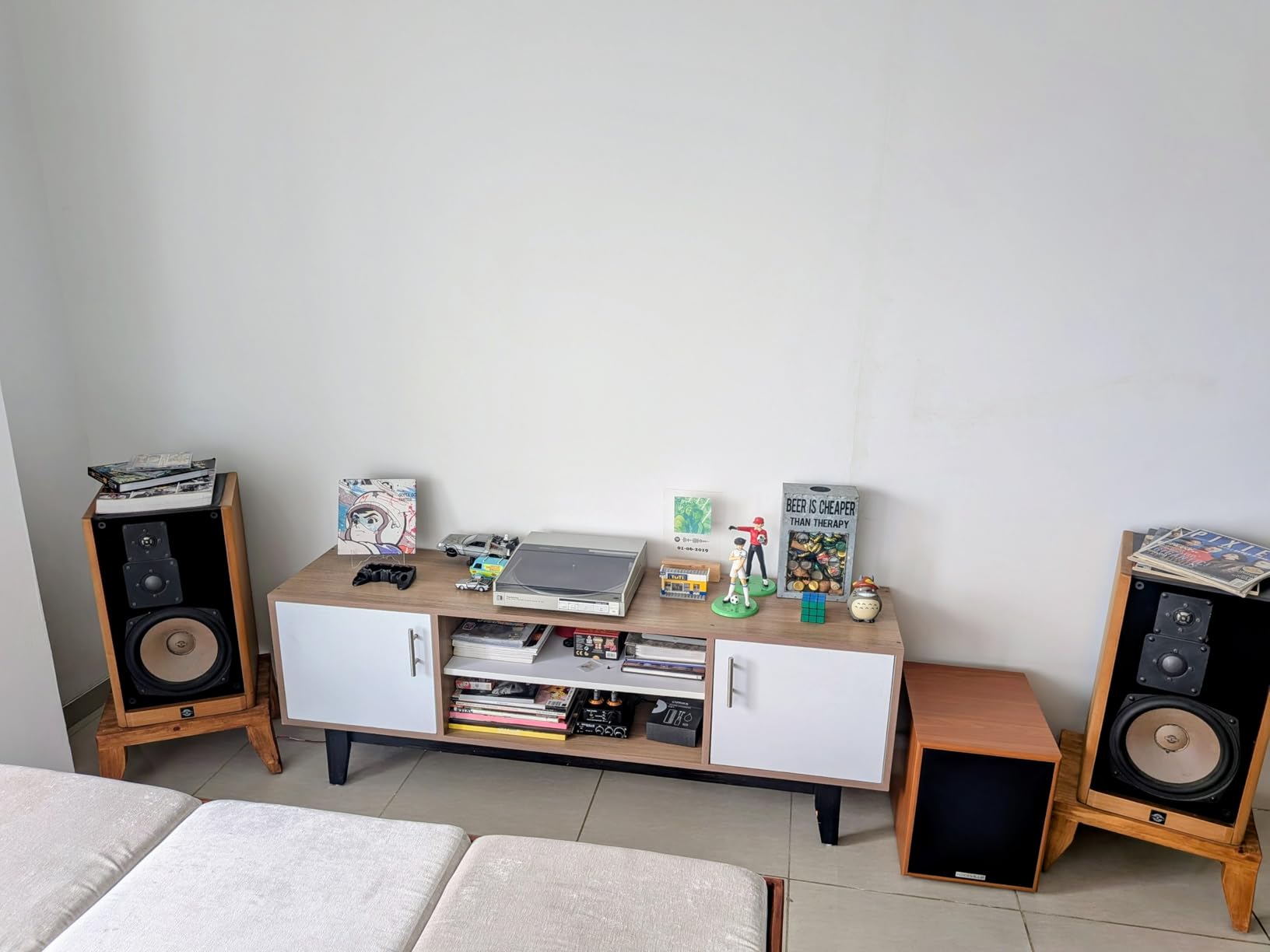
Placement Notes for Thin-Wall Buildings
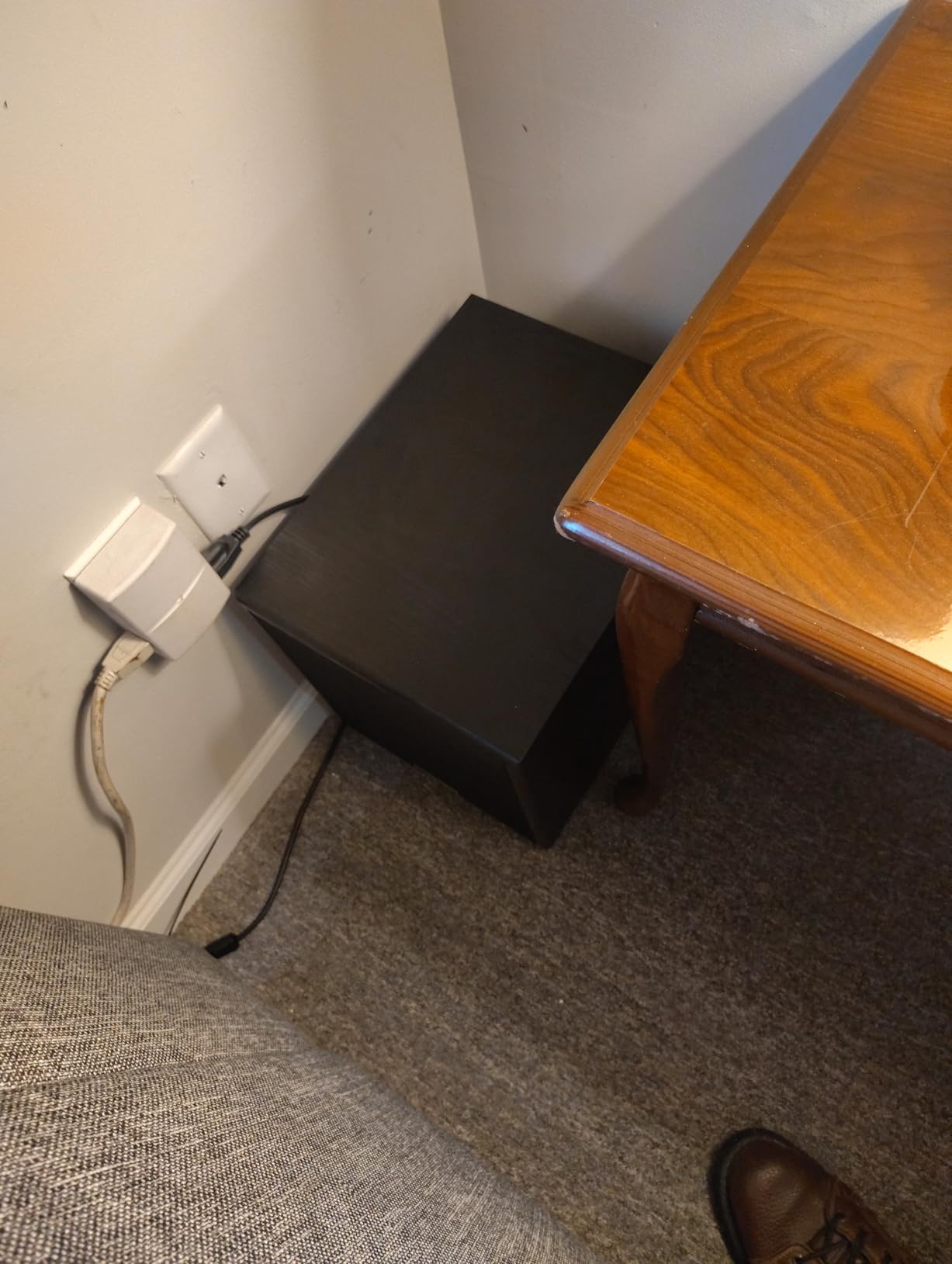
Put it behind a sofa or in an outside corner rather than against a shared bedroom wall. The cabinet is small enough to hide behind furniture, and hiding it also reduces the visual friction that starts conversations with neighbors. Given the power rating, use the gain conservatively.
The 110-240V compatibility is unusual and useful if you travel or move between regions. At 22 pounds it is portable enough to reposition when the neighbor situation changes.
8. Monoprice 60-Watt Powered Subwoofer – Auto-On Simplicity for First-Time Buyers
Monoprice 60-Watt Powered Subwoofer – 8 Inch With Auto-On Function, For Studio And Home Theater Black
60W RMS from an 8-inch driver
50-250 Hz response
Adjustable 50-150 Hz lowpass
Auto-On activation
Pros
- Adds real low-end depth to small stereo and desktop systems
- High-level and line-level inputs cover almost any source
- Auto-On removes the need to reach for a power switch
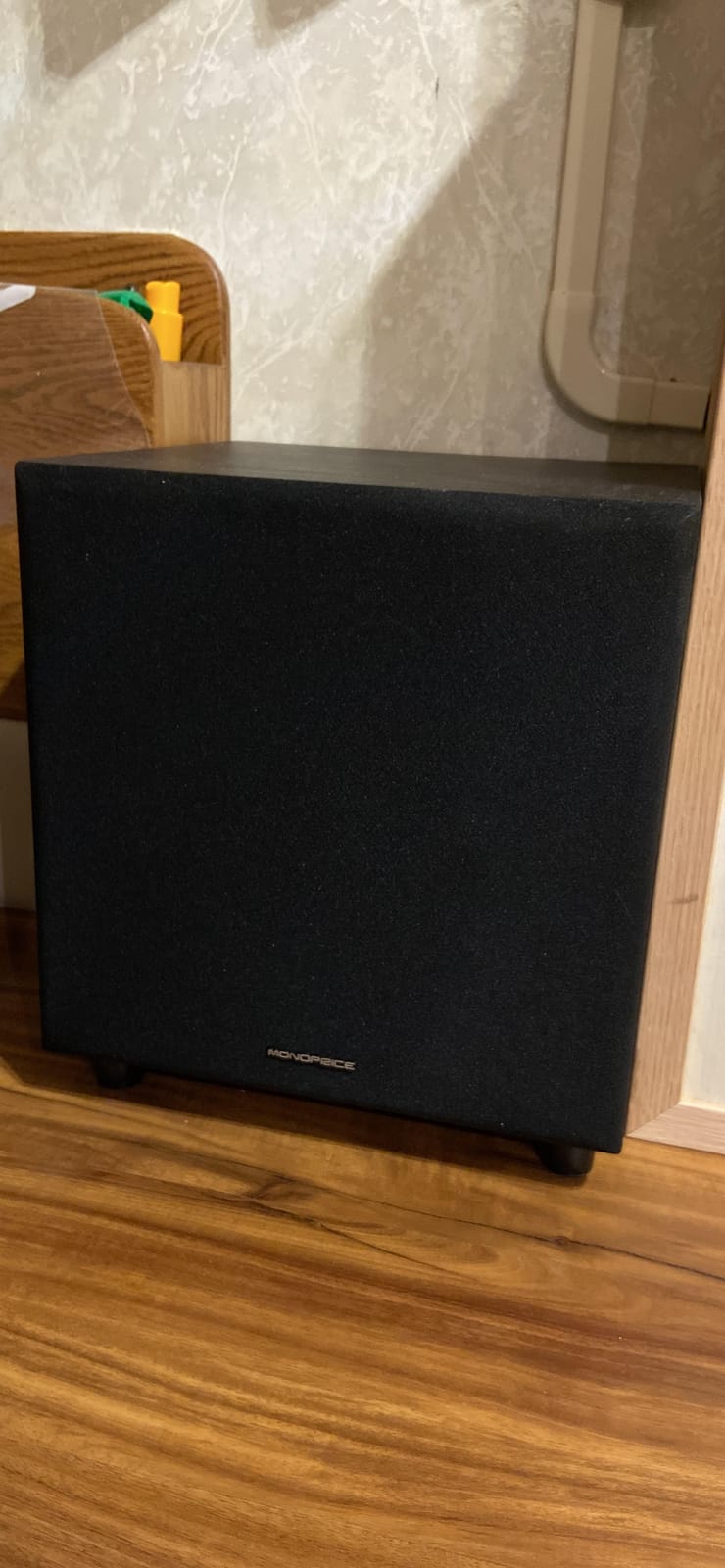
- Compact 13.75 by 11.75 by 11.75 inch wood cabinet
- Impedance matching avoids loading front speakers
Cons
- 60W RMS is modest so bass extension stops higher
- Basic controls with no fine crossover labeling
The Monoprice 60-Watt is the sub I hand to friends who tell me they have never owned one. It is an 8-inch front-firing driver with a 2.75-inch front port, 60 watts RMS of amplification, and an auto-on function that wakes it when your amplifier wakes. For a stereo pair, a desktop setup, or a TV with an RCA output, it adds depth where there was none and takes five minutes to set up.
Frequency response is listed at 50 to 250 Hz, which is the honest limit of a 60-watt design. You will not get sub-bass extension, but you will get the part of the range most small speakers are missing, which is where the improvement actually lands.
Input Flexibility as the Main Feature
The real engineering here is connectivity. You get high-level speaker-level inputs plus line-level inputs, each with a corresponding output, and impedance-matching circuitry designed so the sub does not load the front speakers. That combination means it works behind almost any amplifier, including older ones with no dedicated sub output.
The impedance matching is worth understanding if your main speakers are low-impedance models. Without it, adding a sub can drag down the system and change the character of the whole chain. With it, the system behaves.
Auto-On and Apartment Convenience
Auto-On means the sub powers itself up when it detects signal. In an apartment that is more than a convenience feature, because the alternative is reaching behind furniture to find a switch every time you watch something, and doing it at night is how you knock something over.
Sleep behavior is the tradeoff. Auto-on units can also cycle on briefly with transient signals. In practice the sensitivity adjustment on the rear panel handles it, and most owners report settling it once and forgetting it.
What 60 Watts Cannot Do
Be realistic about the ceiling. 60 watts RMS will not drive a large open floor plan, and the 50 Hz floor means no true sub-bass on film scores. The gain and frequency knobs are basic with no labeling, so if your receiver has room correction, let the receiver set the crossover and use the sub only for level.
The 1-year warranty is the shortest here, and the 4.3 rating reflects both the modest performance and a few reports of driver cone damage. For a starter sub in a rental, that is an acceptable level of risk. For a main system, choose a longer-warrantied model.
How to Keep a Subwoofer From Disturbing Your Neighbors
Most neighbor problems are not about loudness in the ordinary sense. They are about structure-borne sound, the vibration that travels through the floor joists and wall framing into the unit next door, where it can be audible at levels that would fail a normal noise measurement. Containing that takes five specific steps, and each one is more effective than simply turning the volume down.
Forum discussion on this topic is genuinely split, which is itself useful information. In one Audio Science Review thread about running subwoofers in an apartment building, a poll of members split roughly twenty in favor with the rest undecided or opposed, and a Stereophile contributing editor noted that structure-borne low frequency cannot truly be eliminated without room-within-a-room decoupling, though energy dissipates well through reinforced concrete construction. Meanwhile owners in corner and top-floor units report essentially no complaints at all.
- Set the crossover to 80 Hz and keep it there. The lower frequencies below about 60 Hz are the ones that transmit most aggressively. Rolling off the sub earlier and letting your main speakers carry 80 Hz and up reduces the problem at its source.
- Move the sub off the shared wall. A corner on the exterior side of the apartment is ideal. Distance is the cheapest form of isolation, and a compact cabinet lets you actually do it.
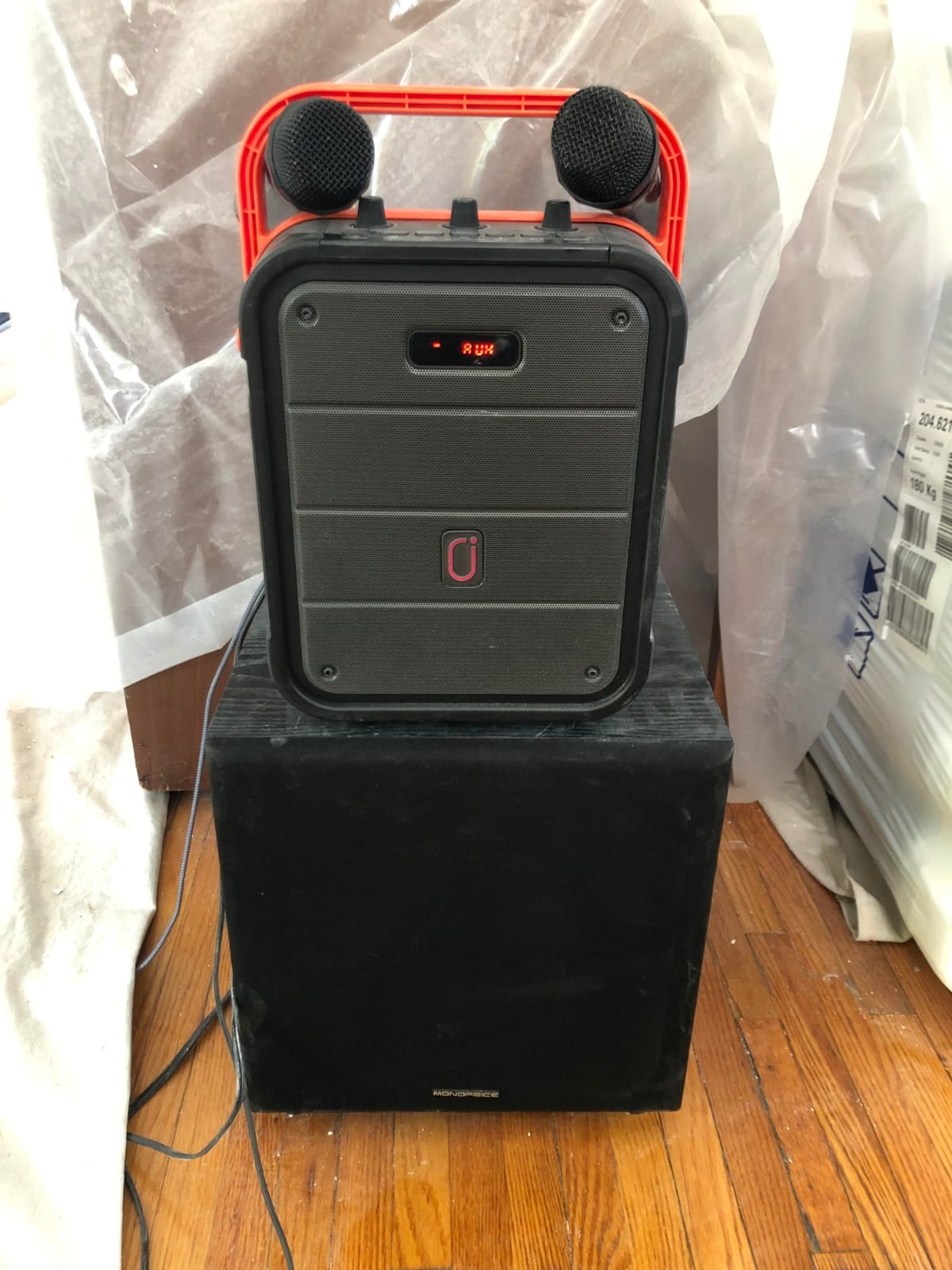
- Put the sub on an isolation pad. A dense foam or rubber platform decouples the cabinet from the floor and cuts the path into the structure. This is the single highest-impact accessory in an apartment.
- Keep sessions inside reasonable hours. Community rules and common courtesy usually land somewhere around 10 p.m. to 7 a.m. Structure-borne sound travels further at night when the building is otherwise quiet, so the same volume is more intrusive.
- Choose a sub that stays clean at low volume. A quality sub at moderate settings sounds smooth. A small sub pushed hard distorts, and distortion is more fatiguing and more noticeable through walls than clean moderate output.
When You Do Get a Knock
Talk to the neighbor directly rather than waiting for a complaint to management. Bring a specific proposal rather than an apology: here are the hours I will keep it quiet, here is the level I will not exceed, and here is what I will change about placement. A short conversation resolves most of these situations, because the person filing a complaint usually has no idea what you are actually doing.
Keep a note of any agreed arrangement. If it becomes a repeated problem, a written record of quiet hours and any building rules you checked is worth having. And if a neighbor’s bass is genuinely too loud, talk to them first, then your building management, and keep your own volume reasonable so the conversation is two-sided.
One reframe worth keeping: several owners have noted that street noise from outside is often louder than subwoofers run at normal listening levels. A well-set sub at moderate volume is usually a smaller part of the ambient sound in a building than traffic and shared mechanical noise.
Building Construction and Why Bass Reaches the Next Unit
Why you hear your neighbor’s subwoofer more than their conversation comes down to how the building was framed. Low frequencies excite structures rather than push air. The sound waves at 40 to 80 Hz have long wavelengths that bend around obstacles, and the real transmission path is the floor, the wall framing and the slab, which vibrate as a unit. Mass and isolation are the only two things that matter, and both are determined before you move in.
Older reinforced concrete construction generally transmits less low frequency than modern light-frame wood construction. That observation comes up repeatedly in apartment audio discussions, and it has an obvious mechanism: a dense concrete slab weighs far more than a wood-framed floor assembly, and weight is the primary defense against low-frequency transmission. Newer buildings that use lightweight wood framing and engineered floors transmit more, which is why the same subwoofer can be fine in one building and a problem in the next.
Building codes compound this. Sound transmission requirements in many jurisdictions stop well above the subwoofer range, which means the frequencies between roughly 20 and 60 Hz are effectively unregulated in most buildings. Your neighbor has no code-backed right to complain about them, but they also have no legal protection against them, which makes personal courtesy the deciding factor rather than any formal standard.
Your unit position matters as much as the subwoofer. Corner units and top-floor units report fewer issues because they have fewer shared walls. Units with a bedroom on the wall next to the sub position are the ones where placement decisions actually have to be careful. If you have an exterior wall available, use it.
One Sub or Two in a Small Apartment
Two smaller subs often beat one large sub in a small room, because each driver works less hard in a space where even frequencies are scarce, and because you can place one away from the shared wall instead of pushing a single cabinet toward it. The catch is that identical subs placed symmetrically can excite room modes more strongly than a single asymmetrically placed cabinet, so the result is not automatic.
Two of the models here make a second unit practical. The Polk PSW10 has a phase toggle switch that exists specifically for pairing with another matching sub, and its speaker-level outputs let your main speakers share the signal cleanly. If you already own the Polk, adding the second later is straightforward. Otherwise, one well-placed sub at the level you can live with will beat two that push you to turn the whole thing down.
What You Can and Cannot Fix
Conventional soundproofing does not work at subwoofer frequencies. Absorbent foam and acoustic panels are designed to absorb mid and high frequencies, and they do essentially nothing below 100 Hz. Only mass and structural decoupling help, which in a rental means you cannot remodel anything. That is why the realistic toolkit is limited to isolation pads, smart placement, crossover settings, and volume discipline.
The upside is worth knowing too. Moderate, well-tuned bass can mask traffic noise and hallway sounds in a thin-walled apartment, which some owners find makes their home calmer at low volume. If your building is noisy, a small clean sub may solve more problems than it creates.
Buying Guide: How to Choose a Subwoofer for an Apartment
Match Driver Size to Room Size, Not to Ambition
The general rule most roundups get wrong is that bigger sounds better. In an apartment, match the driver to the room. Under about 150 square feet, a 6-inch dual-driver design like the Sonos Sub Mini or an 8-inch like the Yamaha is the right zone. From 150 to 250 square feet, an 8-inch still works and a 10-inch like the Polk or Klipsch gives you more headroom for film. Above that, you are outside apartment territory and should read our broader powered subwoofer guide instead.
The reason bigger fails in small rooms is room modes. Furnished apartments have a set of resonant frequencies determined by their dimensions, and a large subwoofer pumps those modes much harder, producing uneven bass that alternates between thin and boomy as you move around the sofa. Smaller drivers put their energy above the worst of those problems.
Decide Sealed vs Ported for Your Situation
Sealed enclosures roll off smoothly and stay tight, which makes them forgiving in small rooms and quieter through walls because there is no port chuffing. Ported bass reflex designs reach lower and produce more output for a given driver, which is valuable when your system is quiet or your room is treated. For apartments, sealed is generally the safer default and ported is acceptable if you keep the level modest.
Do not over-weight the marketing number for lowest frequency. A listed 28 Hz figure in a small room is rarely usable at a neighbor-friendly level. Look instead at how the sub behaves at the volume you will actually run, which is why every product here is described in terms of low-volume behavior.
Wired or Wireless: the Renter Decision
If you cannot drill or run cable, wireless changes the calculation entirely. The Sonos Sub Mini is the only truly cable-free option in this roundup, and it requires Sonos speakers or a compatible ecosystem to get the benefit. The Audioengine S8 can become wireless with an optional adapter kit. Everything else wants an RCA or speaker-level run.
The alternative is a wireless transmitter kit for standard wired subs, which solves the cable problem without ecosystem lock-in at the cost of another box. For renters with powerline or in-wall constraints, that is often the better trade. If you also want to avoid drilling for speakers, our apartment gear guide covers the broader no-drill setup question.
Crossover, Phase and Room Correction
Set the low-pass crossover to 80 Hz unless your main speakers are unusually full in the bass, in which case 100 Hz is better. If the sub sounds like it is playing out of time with dialogue, flip the phase control. That one switch resolves most blending complaints and takes ten seconds.
If your receiver has room correction, let it handle crossover and level first, then adjust the sub by ear from there. Auto room correction sets a conservative baseline, and the tuning it produces is usually a safe starting point for a neighbor-friendly setup. Use the sub’s own gain for final trim, since that does not change the signal reaching your speakers.
Fit, Isolation and Practical Constraints
Measure before you buy and take the measurement with you. Cabinet width matters more than depth in most living rooms, since subs end up beside furniture rather than in open floor. The Edifier T5s is the narrowest option here at 6.69 inches, and the Sonos Sub Mini is the most forgiving shape to place. Check that the sub can also be moved off the shared wall, since you may need to relocate it later.
Budget for an isolation pad and any cable you need; neither is usually included. Also consider weight if you will be moving it. Two things beyond the subwoofer itself fit the same room-and-neighbor logic: our apartment grill picks and compact workout equipment both address shared-wall noise from a completely different angle.
Finally, think about how you will audition. If your building allows returns, keep the box and the packing material for the trial period and test at your normal evening volume with your most demanding content. Bass problems show up in the first ten minutes of a familiar track or a quiet film scene, not in a showroom demo. For studio-monitor-grade accuracy rather than home theater, our studio subwoofer guide covers the calibration side in detail.
Frequently Asked Questions
Is a subwoofer okay in an apartment?
Yes. A subwoofer is fine in an apartment as long as you check your lease and quiet hours, keep the level moderate, place it away from shared walls, and set it on an isolation pad. Most complaints come from late-night levels rather than from owning a sub at all.
How do I keep a subwoofer from disturbing my neighbors?
Five moves handle most cases: set the crossover to 80 Hz, move the sub off the shared wall, place it on an isolation pad, keep listening inside reasonable hours, and choose a subwoofer that stays clean at low volume. A knock on the door is far less likely if the bass is smooth rather than pushed.
Do subwoofers bother downstairs neighbors?
They can, because low frequency travels through the floor structure rather than through the air. Concrete slabs and top-floor units transmit less than lightweight wood framing. Keeping the sub off the shared floor, on an isolation pad, and at moderate levels makes a large difference.
Is a subwoofer too loud for an apartment?
Only if you run it past the level where it sounds clean. A quality subwoofer sounds smooth and controlled at moderate volume, so the real fix is choosing a small cabinet you can place away from shared walls rather than turning down a big one.
Do 10 or 12 inch subwoofers hit harder than 8 inch models?
Yes, a 10-inch driver produces more output and deeper extension than an 8-inch, but it also excites small-room modes more aggressively. In apartments under 250 square feet, an 8-inch or a sealed compact 10-inch usually sounds more even and travels less through the walls.
What should I do if my apartment walls are thin?
Use a compact subwoofer you can position on an exterior wall rather than a shared one, set it on an isolation pad, keep the crossover at 80 Hz, and listen during daytime or early evening. Acoustic foam and panels will not help at subwoofer frequencies, because only mass and decoupling reduce that transmission.
What size subwoofer is right for a small living room?
For rooms under about 150 square feet, choose a 6 to 8 inch subwoofer. Between 150 and 250 square feet, an 8-inch works well and a compact 10-inch gives more headroom for movies. Measure the space beside your furniture first, since width is the constraint that decides the purchase.
Conclusion: Which Subwoofer Fits Your Apartment Best
If you want one answer, the Polk Audio PSW10 is the best subwoofer for apartments in 2026 because it combines the most reviewed design here with a compact 10-inch cabinet, a variable crossover, and output that stays clean at the moderate levels a shared wall demands. It is also the easiest to place off a shared wall, which is the single decision that prevents most complaints.
If you watch films and want more authority than that, the Klipsch R-100SW gives you real home theater output and down to 32 Hz, provided you keep the gain disciplined. If your building is small and you care about appearance, the Yamaha NS-SW050BL is the cleanest fit. If you cannot run a cable, the Sonos Sub Mini is the only truly wireless choice and pairs with the rest of the Sonos system. For music at a desk, the Audioengine S8 has the quietest noise floor. When width is the constraint, the Edifier T5s slides into gaps nothing else will. For the lowest outlay with the most flexible hookups, the Rock Shaker 8 and the Monoprice 60-Watt both do the job with auto-on convenience.
Before you order any of them, do the unglamorous part: measure the gap, note which wall you share with a bedroom, and pick up an isolation pad. Then check the latest options through the buttons above and get listening.
Leave a Reply