
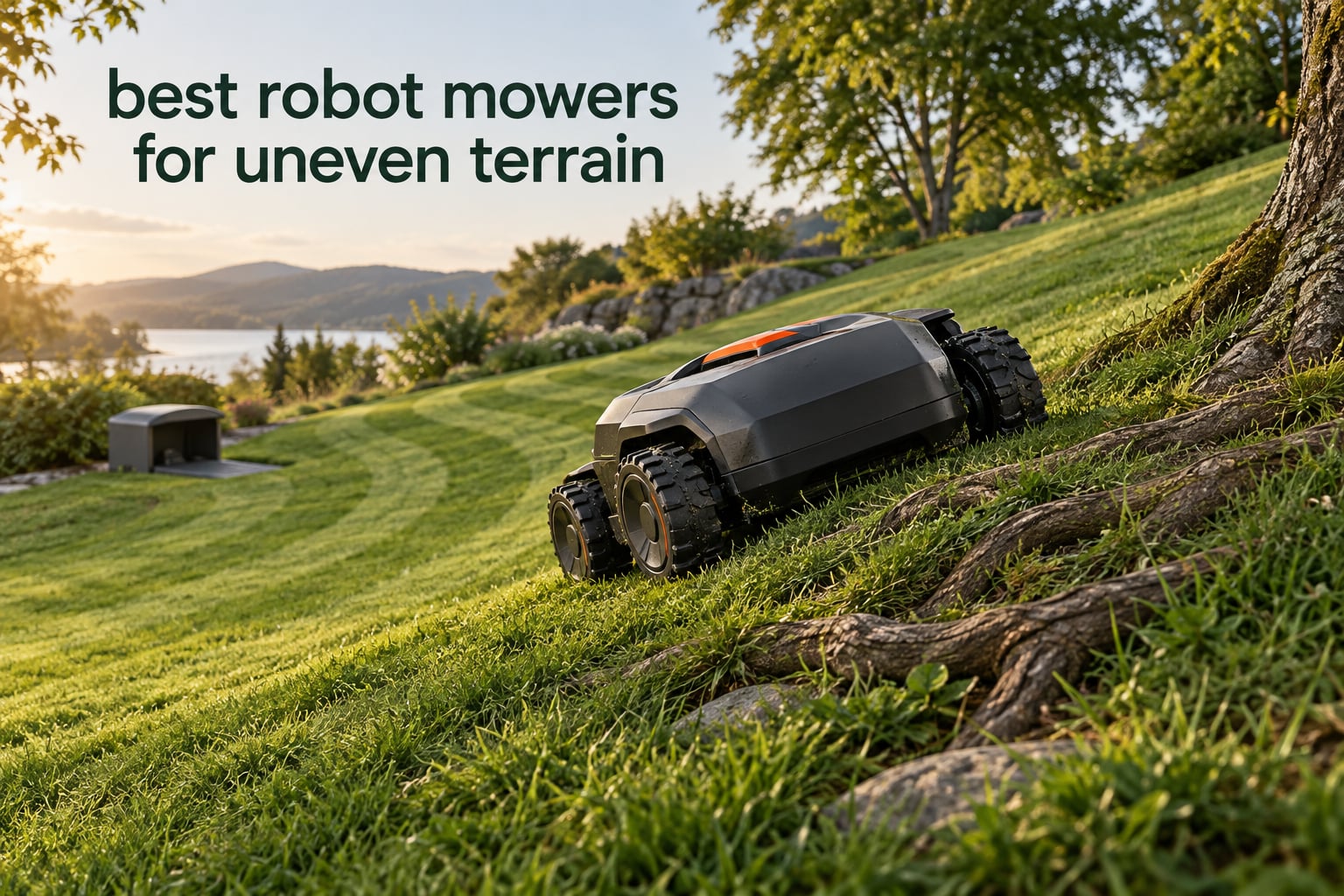
Yes, robot mowers can handle uneven ground, but only the right ones. A standard two-wheel-drive unit on a lumpy, rooty, sloping lawn high-centers on divots, loses traction mid-hill and needs a manual rescue, which defeats the whole point. The best robot mowers for uneven terrain combine all-wheel or four-wheel drive, a rated climbing slope well above your steepest grade, and a deck that floats with the ground. We compared ten wire-free AWD and 4WD machines on slope rating, drivetrain, obstacle climbing height, navigation stack and cut consistency.
First, what actually counts as uneven terrain. Four categories cover almost every rough lawn we have looked at:
- Rolling or sloped ground where the grade changes enough to move a mower sideways under its own weight.
- Tree roots and exposed stumps that lift the chassis and twist the cutting deck out of level.
- Divots, ruts and soft dips where the wheels drop away and the deck scalps or misses the grass.
- Gravel, stones and broken ground that challenge wheel grip and the anti-theft lift detection at the same time.
And these are the six ways robot mowers fail on that ground, straight from owner reports on r/roboticLawnmowers and r/automower threads about rough acreage and tree roots:
- High-centering on a divot, where the chassis rides up and the mower stalls with an error code.
- Loss of traction on inclines, with a two-wheel-drive machine spinning its wheels or sliding down the slope.
- Bouncing across rough patches, leaving unmown stripes in the dips and shadow bands around bumps.
- Inconsistent cut height, because a fixed deck follows the chassis rather than the turf.
- Skipped or circled obstacles, where a root or a rock becomes a boundary the mower keeps avoiding.
- Part damage and manual recovery, which quietly turns a time-saving machine into a chore.
One owner on a three-acre property described the pattern plainly: the wheeled mower performed well on flat, smooth sections and stalled repeatedly on divots, exposed roots and slopes in the rougher areas. Another spent months laying wire, levelling bumps and removing stones, only for the mower to fail to complete a single perimeter lap. That is the failure mode we designed this roundup to avoid.
If your lawn is only mildly uneven, a mid-range AWD machine with 45% slope capability will cover it comfortably. If you have genuine working acreage with tree roots, wet soft ground and a steady grade, you should be sizing for 60% to 80% climbing and a suspension or obstacle figure you can measure. If you are still deciding between a robot and a traditional cut, our guides to the best Toro mowers and the best EGO mowers are worth a look for flat-ground comparison.
Our Top 3 Robot Mowers for Uneven Terrain

Mammotion LUBA mini 2 AWD 1500H
- 80% slope climbing
- Adaptive suspension to 45mm
- 360 degree LiDAR plus dual-camera vision


Comparing 10 Wire-Free Robot Mowers Built for Rough Ground
Slope is quoted two ways and both are used below. Percent is the rise over the run, measured straight up and horizontal. Degrees is the same slope expressed as an angle. Roughly speaking, 25% is about 14 degrees, 45% is 24 degrees, 60% is 31 degrees and 80% is 39 degrees, so a machine rated in degrees looks meaningfully stronger than the same number in percent.
| Product | Specs | Action |
|---|---|---|
| Mammotion LUBA mini 2 AWD 1500H |
|
Check Latest Price |
 Mammotion LUBA 2 AWD 3000HX Mammotion LUBA 2 AWD 3000HX |
|
Check Latest Price |
| DREAME A3 AWD |
|
Check Latest Price |
| Mammotion LUBA 3 AWD 3000 |
|
Check Latest Price |
 Segway Navimow i206 AWD Segway Navimow i206 AWD |
|
Check Latest Price |
 Segway Navimow i215 LiDAR Segway Navimow i215 LiDAR |
|
Check Latest Price |
 Sunseeker X5 AWD Sunseeker X5 AWD |
|
Check Latest Price |
 WORX Landroid 4WD WR342 WORX Landroid 4WD WR342 |
|
Check Latest Price |
 MOVA LiDAX Ultra 3000 AWD MOVA LiDAX Ultra 3000 AWD |
|
Check Latest Price |
 Husqvarna 410iQ Husqvarna 410iQ |
|
Check Latest Price |
Two numbers deserve attention here. The WORX WR342 claims 84%, the steepest rating in the group, while both Segway Navimow units and the Husqvarna sit at 45%. If your steepest measured grade is 35%, only the 60% and 80% machines genuinely have headroom.
1. Mammotion LUBA mini 2 AWD 1500H – The Machine Owners Say Finally Replaced the Push Mower
(2026 NEW) Mammotion LUBA mini 2 AWD 1500H Robot Lawn Mower with Garage, for 0.37 Acres, 360° LiDAR+Dual-Camera AI Vision, 80% Slope, DropMow, 20 Multi-Zone Management
AWD 80% slopes
45mm adaptive suspension
360 deg LiDAR plus cameras
7.9 in cut
Pros
- Four-wheel drive and suspension handle holey root-filled lawns
- Very quiet operation
- RTK boundary repeatable within an inch
- Firmware updates improve behaviour
- Responsive support
Cons
- Hard 0.37 acre mapping ceiling
- Narrow blade means long mow times
- Boundary edits in software are awkward
This is the model that showed up again and again in owner discussions about rough ground, from users with Florida and Bermuda grass on sloped, holey properties. The two independently controlled 88W motors deliver the same 80% climbing figure as the larger LUBA machines, which is unusual in something sized for just 0.37 acre.
The adaptive suspension is the part that matters on a pitted lawn, stepping over curbs, roots and thresholds up to 45mm without the deck dropping into the hole behind it. Owners describe a very slow mowing pace that trades speed for a consistent cut, and the 360 degree LiDAR combined with dual-camera vision means it keeps working where satellite signal is weak.
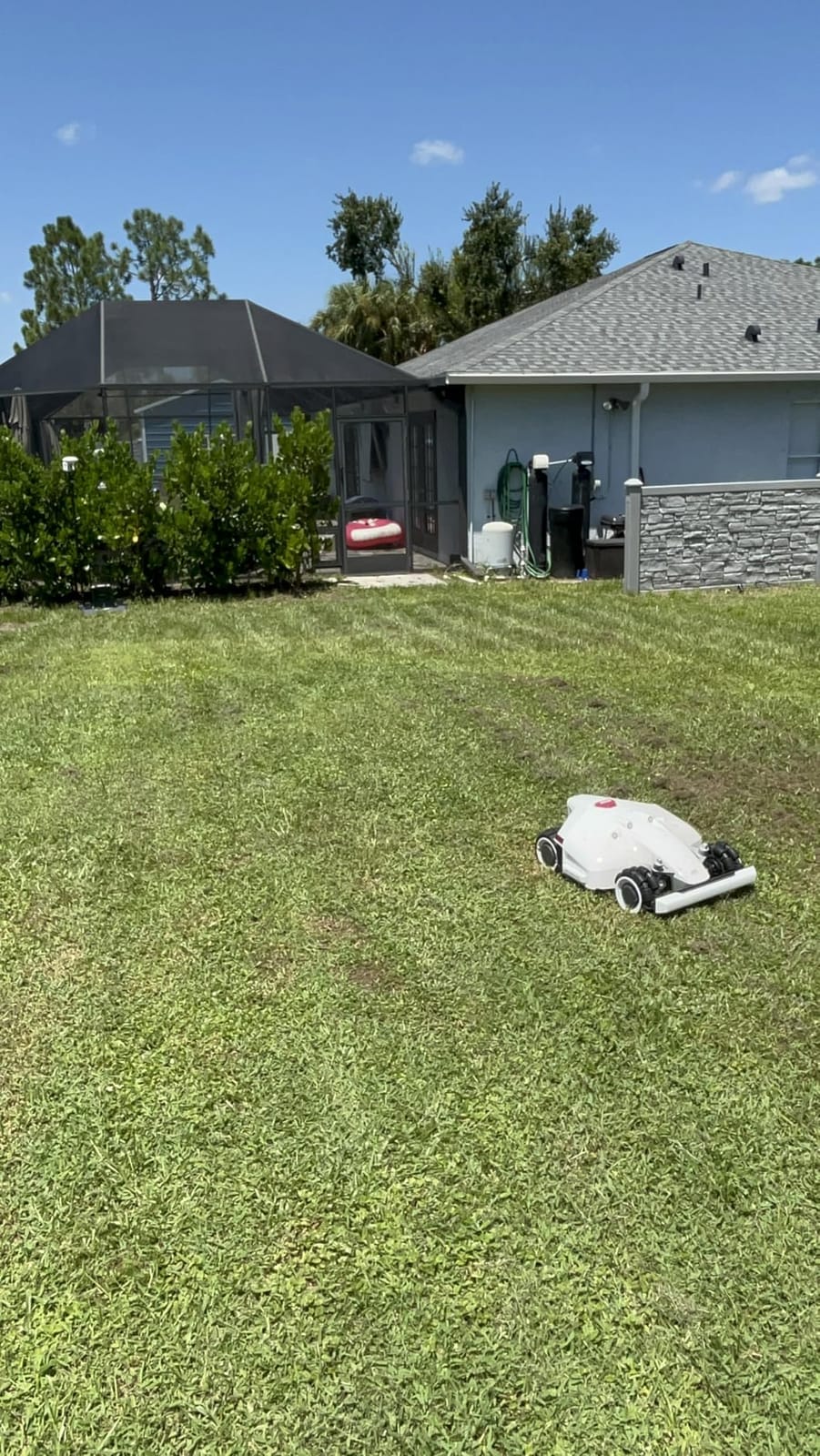
It is not perfect. The 0.37 acre mapping cap is hard and cannot be extended, and a 5.5 inch effective blade width turns a quarter acre into a half-day job. Reviewers also note that boundary edits in the app are awkward, so the initial mapping pass needs to be accurate rather than approximate.
Recharging from flat ground can take two to three hours, and tall grass or sticks will dull the razor-style blades quickly enough that owners trim first or route around them. Still, this is the one in the group most owners describe as the machine that finally let them put the push mower away.
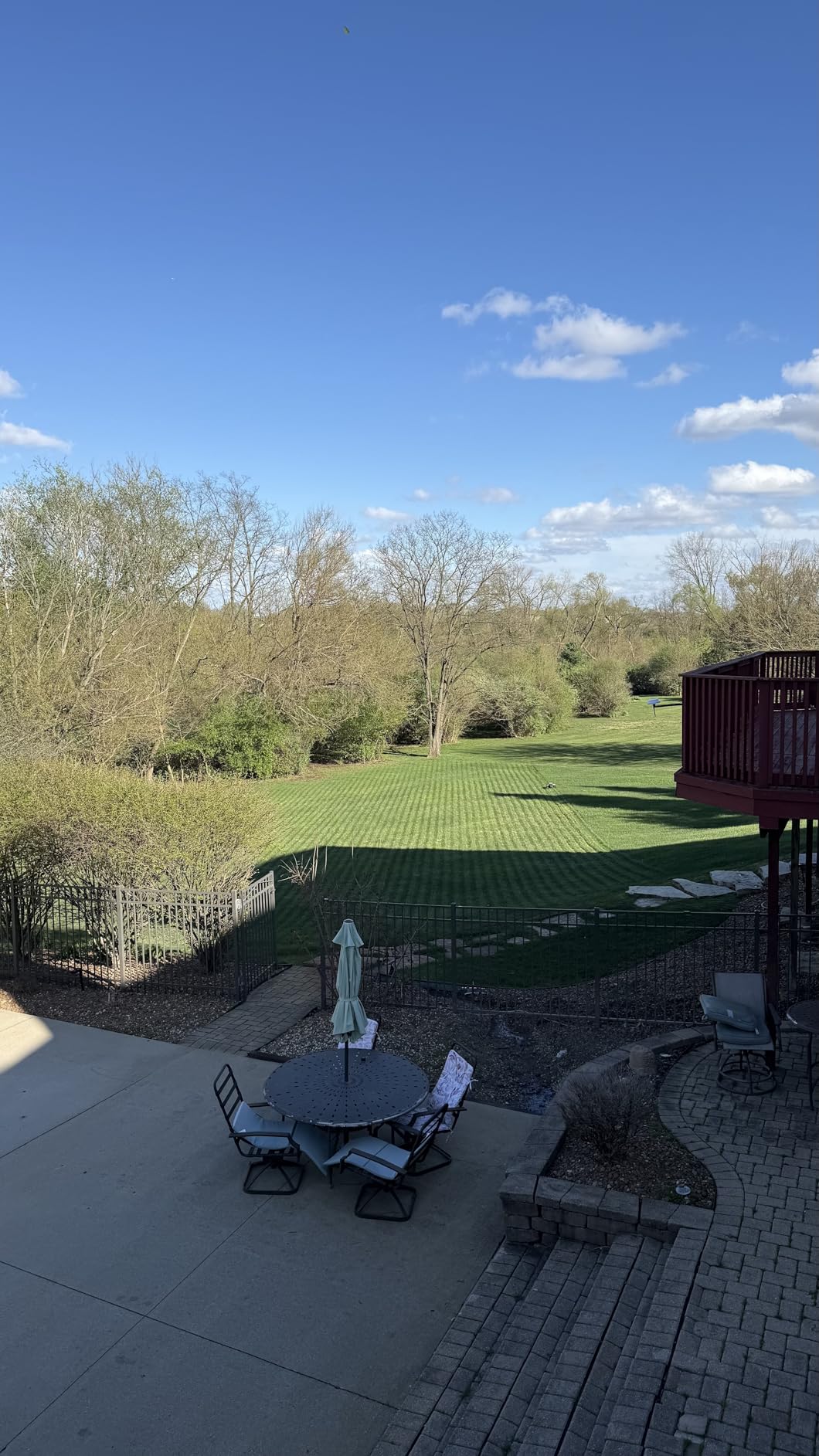
Why the four-wheel drive matters more than the slope number
An 80% climbing rating tells you what the machine can do on a clean incline. It says nothing about what happens when the incline has a root crossing it at an angle. The combination of independent drive motors and suspension travel is what keeps all four wheels loaded through a bump, and that is the difference between a mower that keeps cutting and one that stops for a rescue.
Cutting quality on uneven ground
The dedicated edge disc is a real advantage on a lawn with ragged borders, and the automatic 2.2 to 4.0 inch height adjustment keeps the cut consistent as the deck rides over a divot. Several owners with high-cut-height grass types set the machine higher and report an even finish. Edging is not fully replaced, though, and a string trimmer is still part of the routine.
What to watch in the first month
Get the mapping right on day one because editing later is painful. A few owners in yards hemmed in by neighbouring houses reported GPS signal problems that resolved after firmware updates and a support contact, which is worth knowing before you blame the hardware.
2. Mammotion LUBA 2 AWD 3000HX – Built for Larger Hills and Long Overnight Runs
Mammotion LUBA 2 AWD 3000HX Robot Lawn Mower with 4G, All-Wheel-Drive for 80% Slope, Perimeter Wire Free for 0.75 Acre, UltraSense AI Vision & RTK Auto-Mapping, 2.2″-4.0″ Adjustable Cutting Height
AWD 80% slopes
15.7 inch dual-blade disc
UltraSense vision with RTK
Up to 30 zones
Pros
- Handles steep bumpy property without getting stuck
- Very quiet overnight operation
- Precise boundary following and clean striping
- Resumes automatically after charging
- 200+ object recognition
Cons
- Setup and initial mapping take real time
- RTK station sold separately and best mounted high
- Can stall on 1 to 2 inch driveway ramps
Where the mini 2 is a small machine for a small awkward lawn, this is the version for a bigger uneven property. The 165W four-wheel drive motor and a 15.7 inch dual-blade disc cover 0.75 acre far faster, and the same 80% climbing capability applies. Owners on hilly ground report noticeably clean stripes running overnight without waking the neighbours.
The UltraSense AI vision paired with RTK navigation is the reason it can mow under tree cover, which is where signal alone would fail. With 200+ object recognition and up to 30 mowing areas including no-go zones, it handles a complex layout without re-walking the boundary.
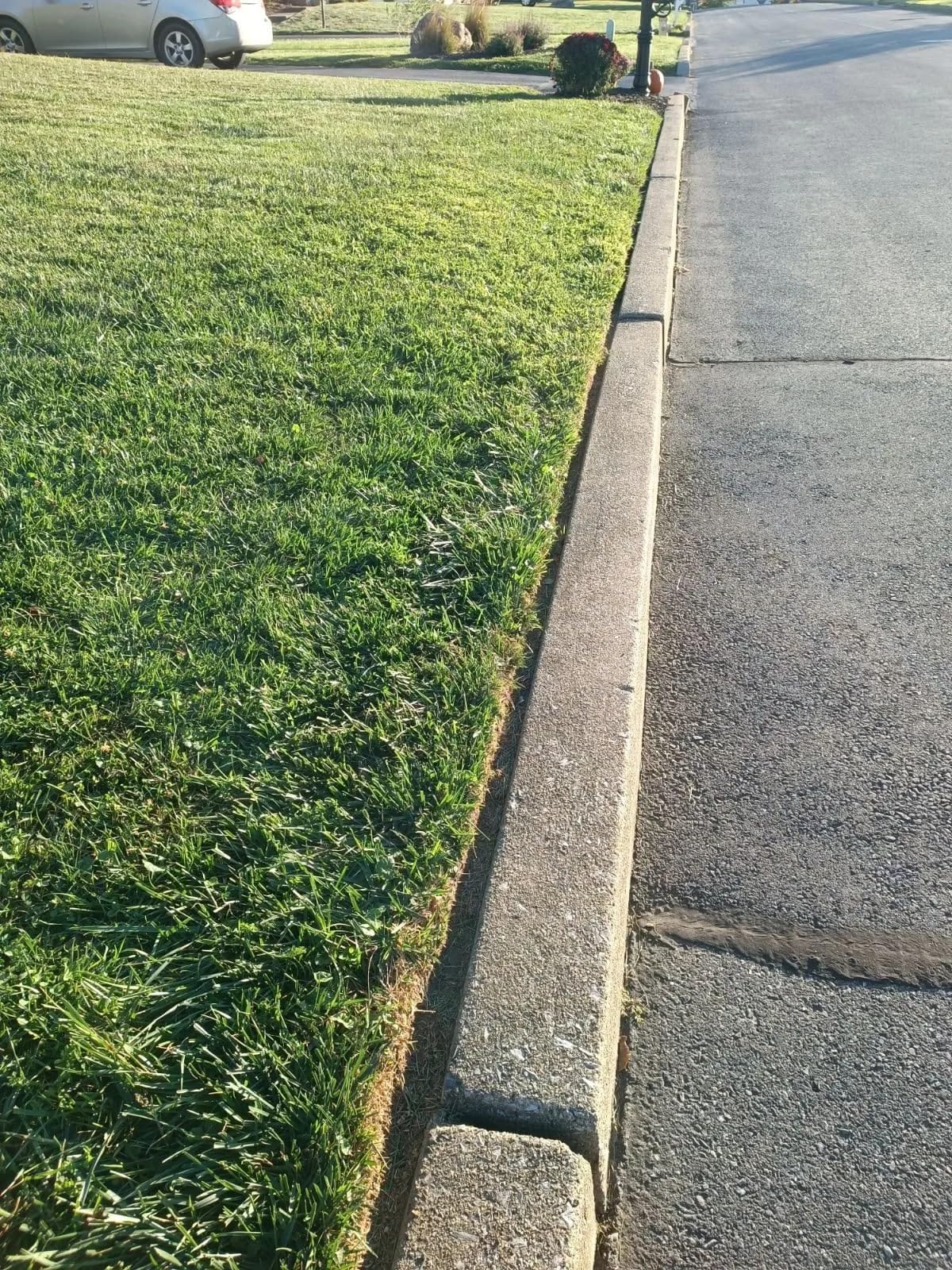
The honest complaints cluster around setup effort and turf damage on turns. Mapping and RTK station placement demand real patience, the station is a separate purchase and works best mounted high, and the default turn algorithm can tear grass on wide arcs that were not actually tight. A minority of owners also report reliability or repair-service issues on units inside two seasons.
One more caveat worth planning for: it can stall on driveway ramps of only one to two inches, and it neither mulches nor collects leaves, so edging still needs a separate tool.
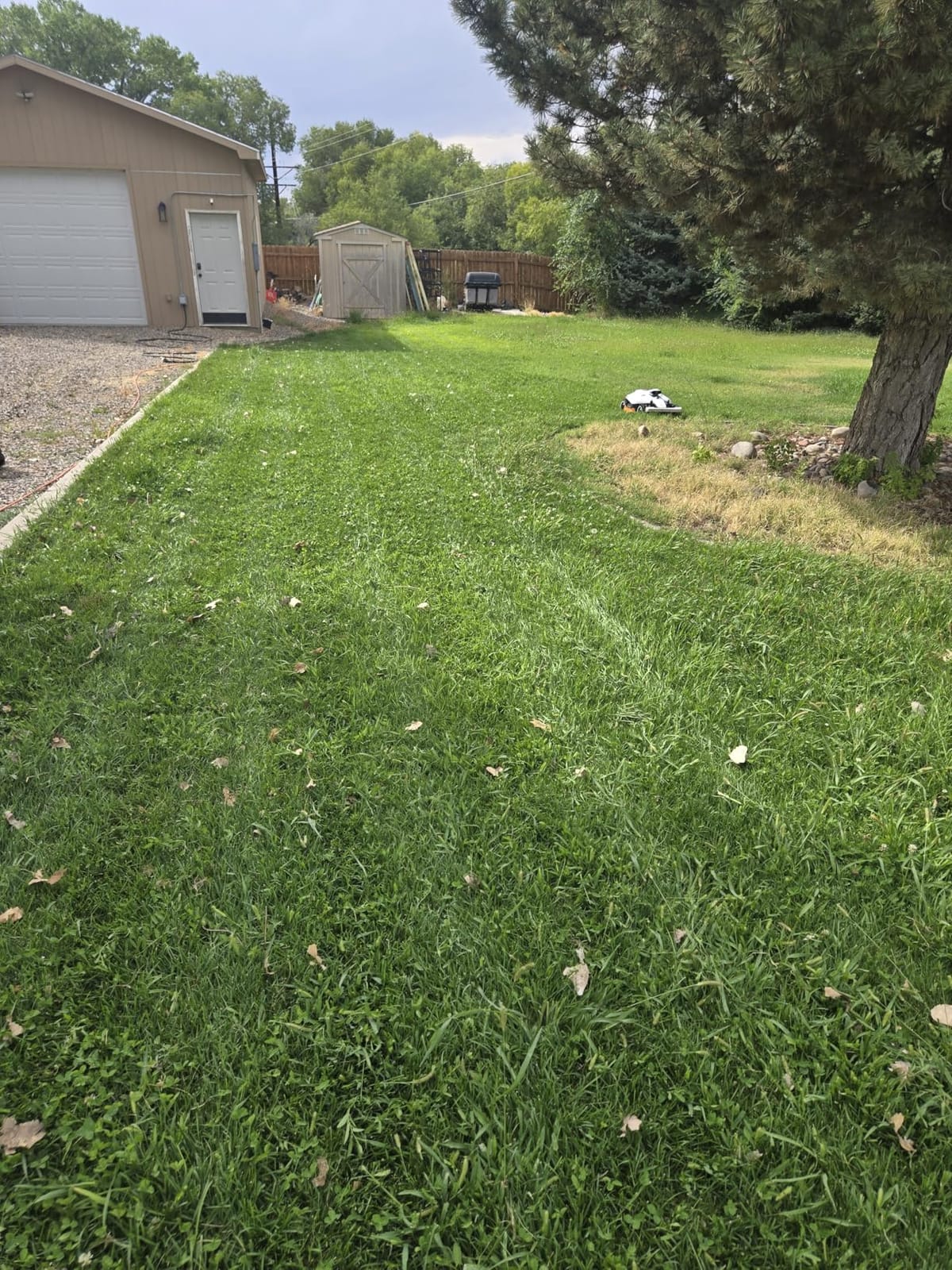
Coverage area versus obstacle climbing
With a 15.7 inch cutting width, this machine moves through an uneven lawn in far fewer passes than a 7.9 inch deck, and the difference is dramatic on a property where every pass is a chance to snag a root. The trade is the narrower 2.2 to 4.0 inch height range compared with the Husqvarna, which matters if you cut very tall grass varieties.
RTK placement as a terrain problem
Station height directly affects how accurately the mower holds a boundary across a slope, because a low station sees the lawn at an angle. If your boundary runs along a hillside, mount the station where it has a clear view rather than at the easiest point near the dock.
Who should pass on it
If your lawn has a lot of short ramp transitions between grass and hard surfaces, this model is not the safest pick. For a large property with long smooth hills and room to manoeuvre, it is one of the strongest options here.
3. DREAME A3 AWD – Highest Rated, and the Least Proven Over Time
DREAME A3 AWD Robot Lawn Mower, A3 Robotic Mower, Quick Release Blade Kit
AWD 80% inclines
2.17 in obstacle clearance
LiDAR plus binocular vision
300+ objects
Pros
- AWD traction rated for 80% slopes
- Wire-free LiDAR and vision mapping in minutes
- Holds position under tree cover and tall walls
- Avoids 300+ common objects
- Compact on complex multi-zone lawns
Cons
- Listing specs describe the blade kit variant rather than the full mower
- Mow areas still need manual edge tidying
- Very new listing with limited owner history
The DREAME A3 carries the highest average rating in this group at 4.7 across 201 reviews, and the specification story is a terrain-first one. AWD hub motors rated for 80% inclines, or 38.7 degrees, plus 2.17 inch obstacle clearance, which is the second-highest climb figure in the lineup.
Navigation is 360 degree LiDAR fused with binocular AI vision, with no boundary wire and no RTK station to install. The listing claims laser-accurate positioning under heavy tree cover or next to tall walls, and 300+ object recognition covering pets, toys and hoses.
There is a transparency issue we should flag rather than gloss over. The specification fields returned for this ASIN describe the replacement blade kit, model MBKA10, a 12-piece set at 0.11 kg, rather than the complete mower, so mower-level dimensions and weight were not available from the product data. That is a listing structure quirk, not a defect in the machine, but it is a reminder that owner history here is short.
Obstacle clearance as the differentiator
The 2.17 inch figure is the number to focus on for rooty lawns. An exposed root that lifts the deck by an inch is a nuisance; one that lifts it by two inches stops a machine with a low-slung chassis. Compare that against the 45mm, or 1.8 inch, suspension figures on the Mammotion machines and the difference is small but real.
Navigation without an RTK station
Removing the RTK station removes an entire class of setup failure. There is no antenna to site, no alignment ritual, and nothing to re-map if a post gets knocked over. The tradeoff is that LiDAR and vision mapping is generally less precise at the boundary than a fixed RTK base with a clear line of sky.
Where the evidence is thin
With a very new listing, most of what we can verify is manufacturer positioning rather than multi-season owner data. If long-term reliability matters more to you than headline slope numbers, the machines with a few seasons of feedback are the safer bet.
4. Mammotion LUBA 3 AWD 3000 – The Most Capable Terrain Machine in This Lineup
Mammotion LUBA 3 AWD 3000 Robot Lawn Mower, Perimeter Wire Free for 0.75 Acre, 360° LiDAR+NetRTK+AI Vision, All-Wheel-Drive for 80% Slopes, 30 Multi-Zone Management, Cutting Height 1.0″-2.7″
80% slopes
50mm suspension
Tri-fusion LiDAR NetRTK vision
165W motors,12Ah
Pros
- Four independent motors for 80% slopes
- Adaptive suspension clears 50mm thresholds
- Omni wheel pivoting keeps turf clean
- Long run time and fast coverage
- Robust where satellite signal is weak
Cons
- Setup and station placement take more effort than advertised
- Battery runtime shared across large hilly areas
- Some app refinements arrive after purchase
This is the third-generation LUBA and the most mechanically serious machine here. Four independent motors give it 80% climbing at 38.6 degrees, the adaptive suspension travel is the highest in the group at 50mm, and the LiDAR plus NetRTK plus dual-camera vision stack switches sensors automatically depending on conditions.
Two 165W high-torque motors driving six-blade discs, with a lithium battery rated up to 12Ah, translate into up to 175 minutes per charge and up to 500 square metres per hour of coverage. On a big uneven property that pace matters, because every pass over rough ground is a chance to snag something.
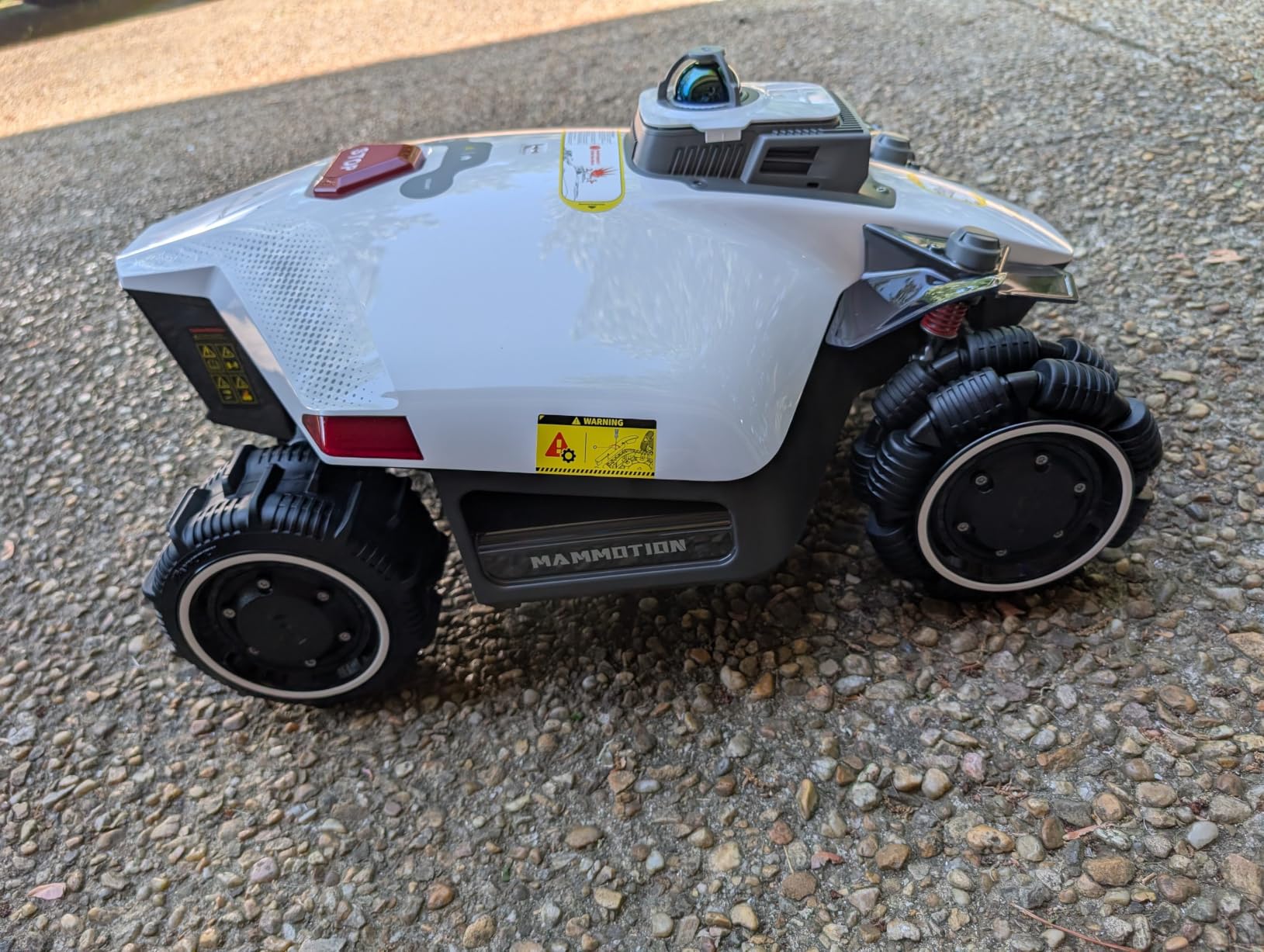
Owner sentiment is solid but a shade softer than on the earlier LUBA models, and the reasons are consistent. Initial mapping and station placement take more effort than the marketing implies, and if the station or RTK base is moved later you are re-mapping the property. Some firmware and app refinements are still arriving after purchase.
On a large hilly lawn, the shared battery runtime can be the deciding factor. It means a mid-cycle recharge on the biggest properties rather than one continuous run.
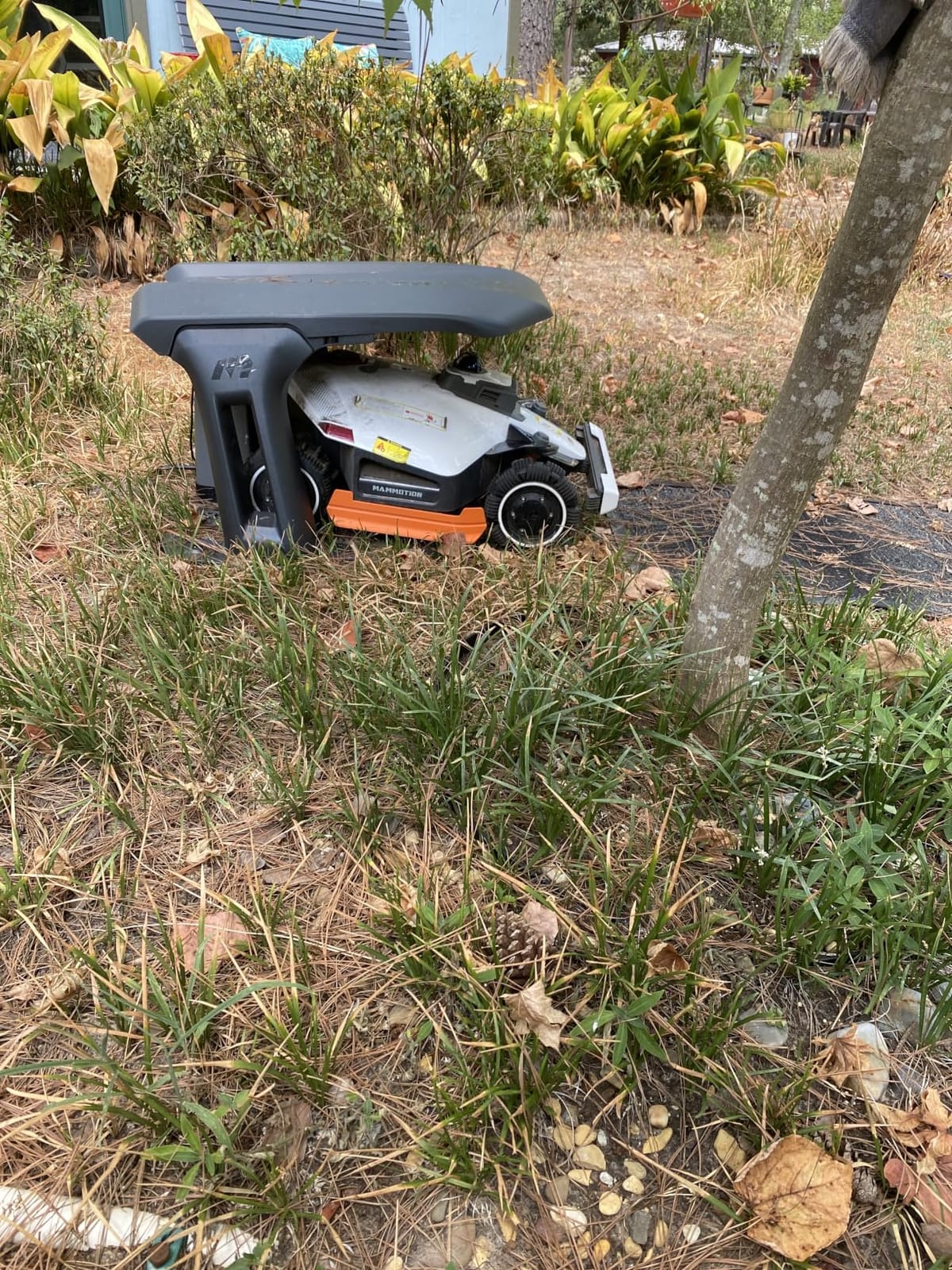
Why 50mm suspension travel changes the cut
A deck that can drop half an inch and recover before the wheels cross the same obstacle produces a far more even stripe across a rutted lawn than a fixed-deck machine. The number is not glamorous, but it is the single mechanical specification that most directly reduces the light-and-dark banding owners complain about.
Sensor switching on a tree-covered yard
Tri-fusion is the right architecture for a lawn with a mix of open sun and heavy canopy. LiDAR carries it through shade where the satellite signal drops, NetRTK gives centimetre accuracy in the open, and the cameras handle the transitions between the two. No single technology in this roundup covers all three conditions as cleanly.
Running cost over a season
With six-blade discs and a 12Ah battery, expect to budget for replacement blades and a spare battery within a few seasons of heavy use. That running cost is the part most spec sheets skip and the part owners on forums talk about most.
5. Segway Navimow i206 AWD – Compact AWD Traction With a Turf-Safe Steering Geometry
Segway Navimow i206 AWD Robot Lawn Mower, New i105N, 0.15 Acre, 45% Slopes
AWD 45% slopes
Zero-turn steering
EFLS Network RTK plus vision
7.1 in deck
Pros
- Stability control handles sloped uneven ground
- Very quiet in a neighbourhood setting
- Zero-turn steering avoids tearing turf
- Adjusts angle to keep the cut even
- Support rated highly with free parts
Cons
- Auto-mapping can fail on complex yards
- Maps corrupted by lifting or wheel slip on an incline
- Leaves an unmowed strip against fences
The i206 is the smallest coverage area here at 0.15 acre, but it introduces one idea the larger machines do not: zero-turn steering. Because the mower pivots rather than scrabbling through a turn, it does not drag itself sideways across a slope and tear the turf, which is a real advantage on an incline.
All-wheel drive with automotive-grade stability control handles slopes up to 45%, and the deck adjusts between 2 and 3.6 inches with adaptive torque delivery for thick grass or inclines. The 2.5Ah battery covers up to 1,350 square feet per charge with auto-resume charging across up to 20 zones.
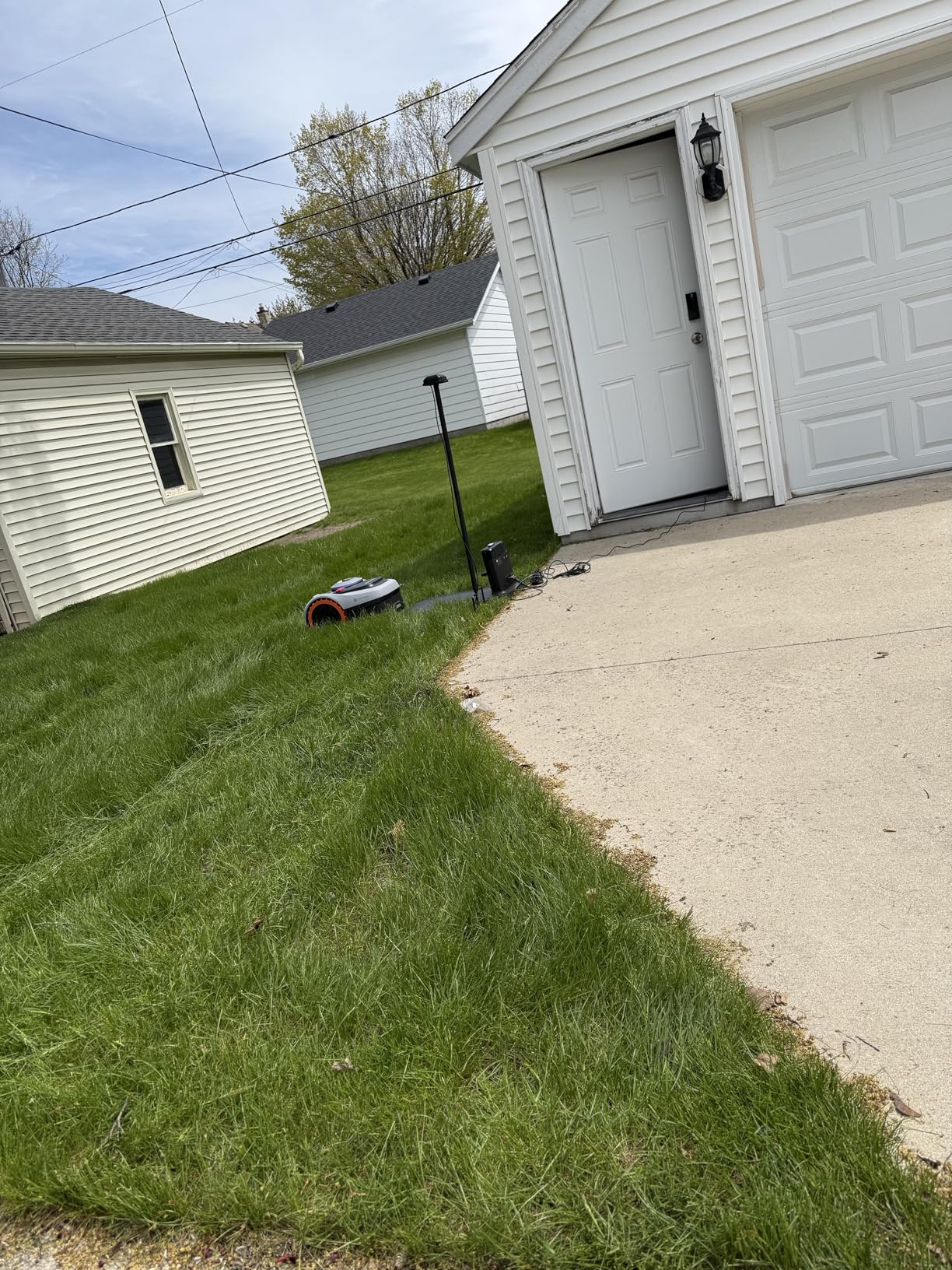
The dominant negative theme is software fragility rather than mechanics. Several reviews describe maps being lost after the mower is lifted or after a wheel slips on an incline, forcing a full remap, and one describes the machine wandering into mulch beds outside the mapped area. Auto-mapping can also fail on complex yards and leave you walking the boundary by hand.
Two smaller issues: tall isolated grass clumps get circled for several passes instead of cut, and an unmowed strip is left between the machine and fences in places. Support is repeatedly singled out as a strength, including free replacement antennas.
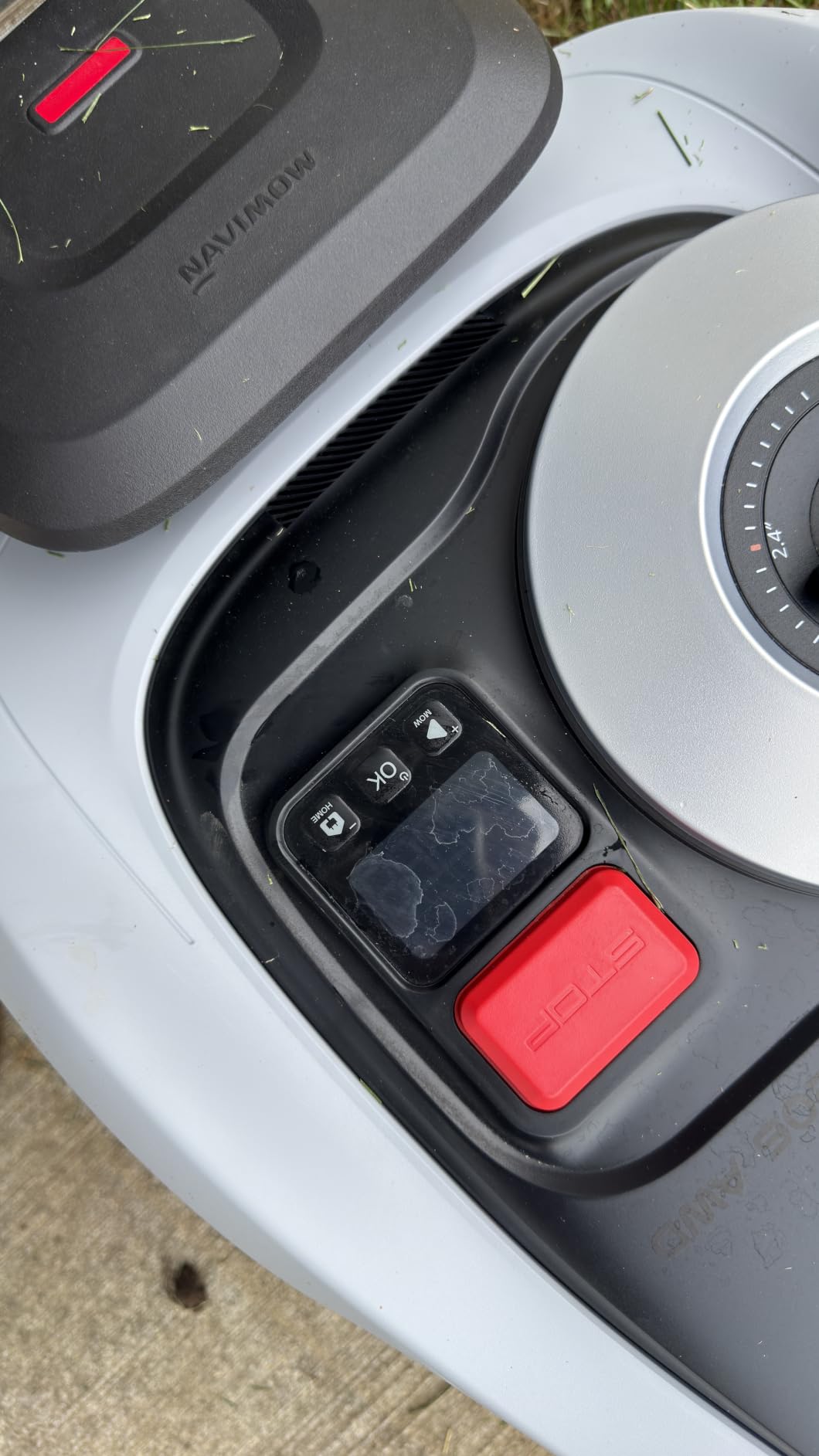
Why zero-turn steering protects uneven lawns
On rough ground, most turf damage happens during turns, not during straight runs. A pivoting chassis rotates in place, so it never drags a driven wheel across a slope. On a small, kink-filled yard that is often the difference between a lawn that looks mown and one that looks chewed.
The 45% ceiling and what it means for you
Forty-five percent is about 24 degrees. That covers most suburban undulation with room to spare, but it leaves very little margin on a steep back slope. Measure first. If your steepest grade is above roughly 30%, this class is the wrong place to spend your money.
Mapping fragility is the real long-term cost
A lost map on a rough lawn is more annoying than on a flat one, because re-walking a perimeter across uneven ground is a chore. Owners on forums rate stuck count and remap frequency far higher than the spec sheet suggests, and here the reviews are not flattering.
6. Segway Navimow i215 LiDAR – Quietest Operation and Satellite-Free Mapping
Segway Navimow i215 LiDAR Robot Lawn Mower, Wire Free Robotic Lawn Mower for 0.37 Acre, LiDAR & Vision Dual Fusion, Auto Mapping, Off-Road Wheels for 45% Slopes, Quiet 59 dB(A) Mowing
Solid-state LiDAR plus vision
Off-road wheels,45% slopes
59 dB(A)
32.4 lb
Pros
- Satellite-free navigation out of the box
- Off-road wheels suit demanding terrain
- Very low 59 dB(A) operating noise
- 20 editable zones on a realistic map
- GPS geofence and lift detection
Cons
- Higher entry cost than 2WD Navimow models
- Newer listing with a smaller owner base
- Maps must be walked or auto-mapped before the first cut
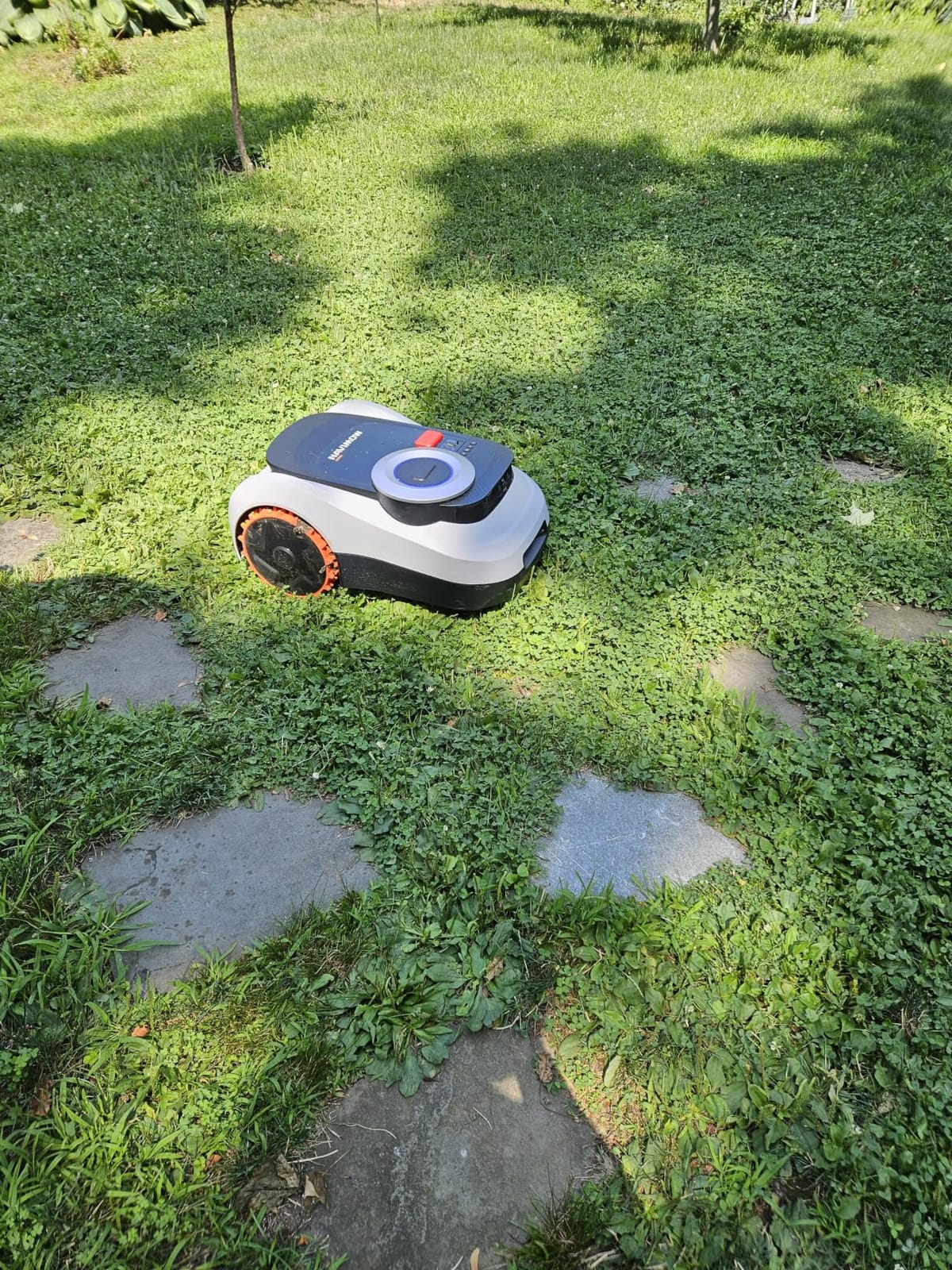
The i215 LiDAR is the quietest machine in the group at 59 dB(A), and at 32.4 pounds it is light enough to move by hand without a fight. That combination matters on a rough lawn, because the times you will handle it most are the times it has stopped and needs repositioning.
Off-road wheels and electronic stability control handle slopes up to 45%, while solid-state LiDAR fused with onboard vision gives 3D awareness day or night with no satellite requirement at all. AI VisionFence detects more than 200 obstacle types at 0.4 inch accuracy, which is a useful figure next to root and rock detection.
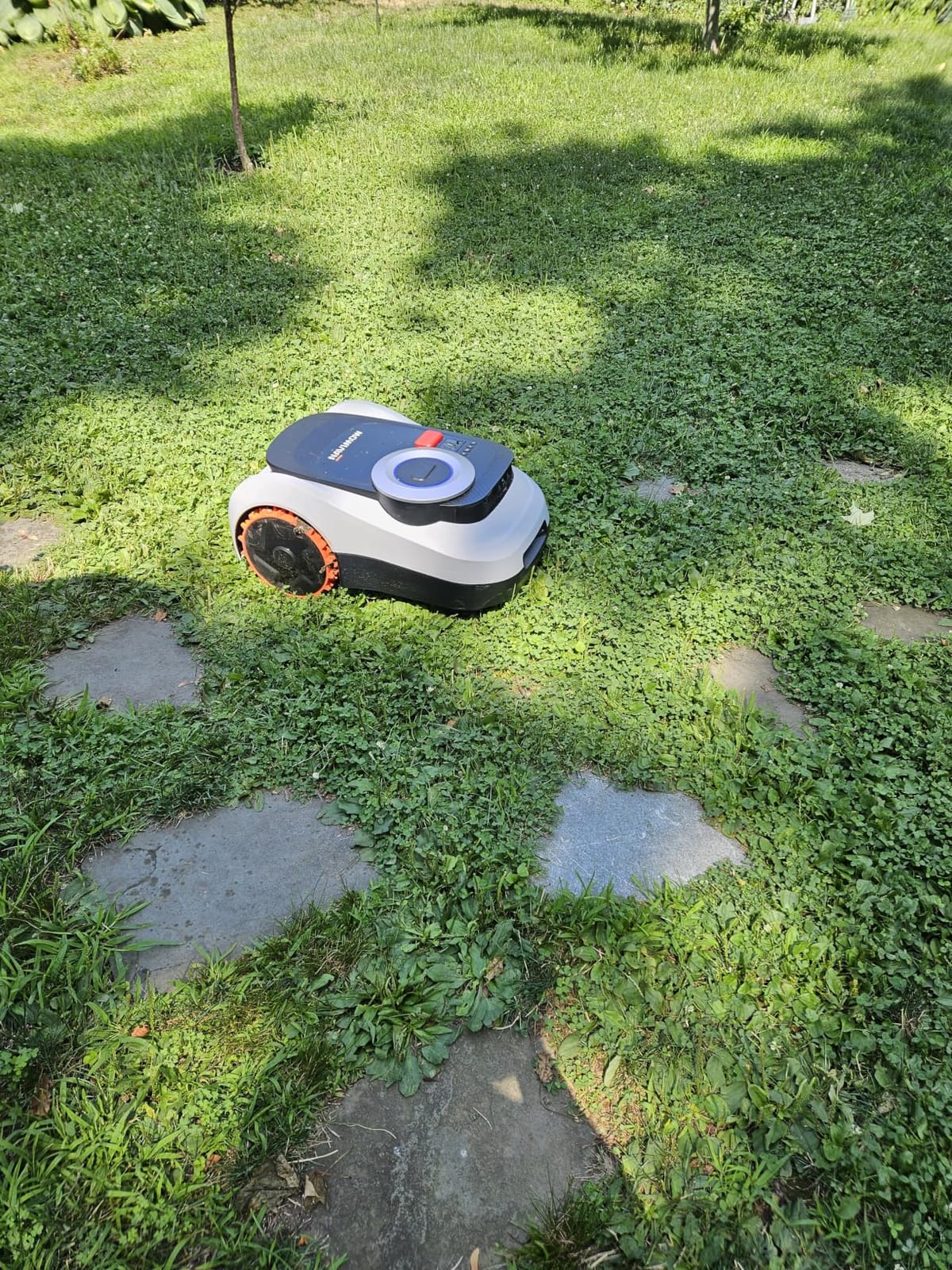
GeoSketch precision mapping and ride-on edge cutting with EdgeSense give you 20 editable mowing zones on an interactive map, plus a Drop and Mow mode and voice control through Alexa or Google Home. Security features include GPS, geo-fence, lift detection and Apple Find My alerts, and the unit can auto-dock in extreme weather.
The limitations are honest ones. It costs more than the two-wheel-drive Navimow models, it is a newer listing with a smaller owner base, and long-term durability data is limited simply because fewer people have owned it through several seasons.
Navigation that does not care about tree cover
Satellite positioning degrades under canopy, and that is the reason many wire-free mappers struggle on shaded, rooty properties. A solid-state LiDAR builds a map from what the machine sees rather than what a satellite reports, so tree cover stops being a reliability question and becomes irrelevant.
What a 59 dB(A) machine means in practice
That figure is low enough to run early in the morning or late at night without neighbourhood friction. On a property where you plan to mow three or four times a week, the machine spending several hours outside at low noise is a genuine practical advantage.
Where it fits against the 80% machines
Forty-five percent again puts this machine in the mid-tier for slope. The off-road wheels and stability control handle moderate unevenness very well, so the rating is a real limit only if your grade is steep.
7. Sunseeker X5 AWD – The Floating Deck That Holds an Even Cut on Contours
Sunseeker X5 AWD Robot Lawn Mower, RTK, Vision AI, 0.5 Acre, Wire-Free
AWD 60% slopes
Independent front suspension
8.7 in floating deck
RTK VSLAM and vision
Pros
- AWD traction holds on sloped uneven ground
- Navigates shaded areas without losing position
- Straight striping in any direction
- Very quiet
- Rain sensor delays mowing two hours
Cons
- Writes the boundary far from edges leaving up to 18 inches
- Tall grass treated as an obstacle and avoided
- Catches on small humps at surface transitions
What separates the X5 from the pack is the 8.7 inch floating cut deck, which follows ground contours with a cutting height range of 1.6 to 3.2 inches. On a lawn with gradual changes in level rather than sharp bumps, that is the feature that keeps the stripe colour even.
Rugged tires and independent front suspension deliver slopes up to 30 degrees, or 60%, which is a useful middle ground: well clear of the 45% class, without the bulk of an 80% machine. Capacity is 0.5 acre, or 21,780 square feet, and it handles passages as narrow as 31.5 inches.
Reviewers with hills specifically report that the AWD chassis keeps it going where a two-wheel-drive unit would stall, and shaded-yard owners report no signal loss under tree cover thanks to RTK, VSLAM and Vision AI together. Up to five maps, virtual boundaries, smart zones and no-go areas are all available, with a 2-year warranty and US-based support.
The most-reported weakness is boundary placement. It writes the line well back from the edges, leaving up to 18 inches of grass for a string trimmer, and it treats tall grass as an obstacle to avoid, which means frequent send-outs during a growth spurt. It also catches on small humps such as the transition from grass to sidewalk, and some owners report the app and programming as unreliable.
Floating deck versus fixed deck on a bumpy lawn
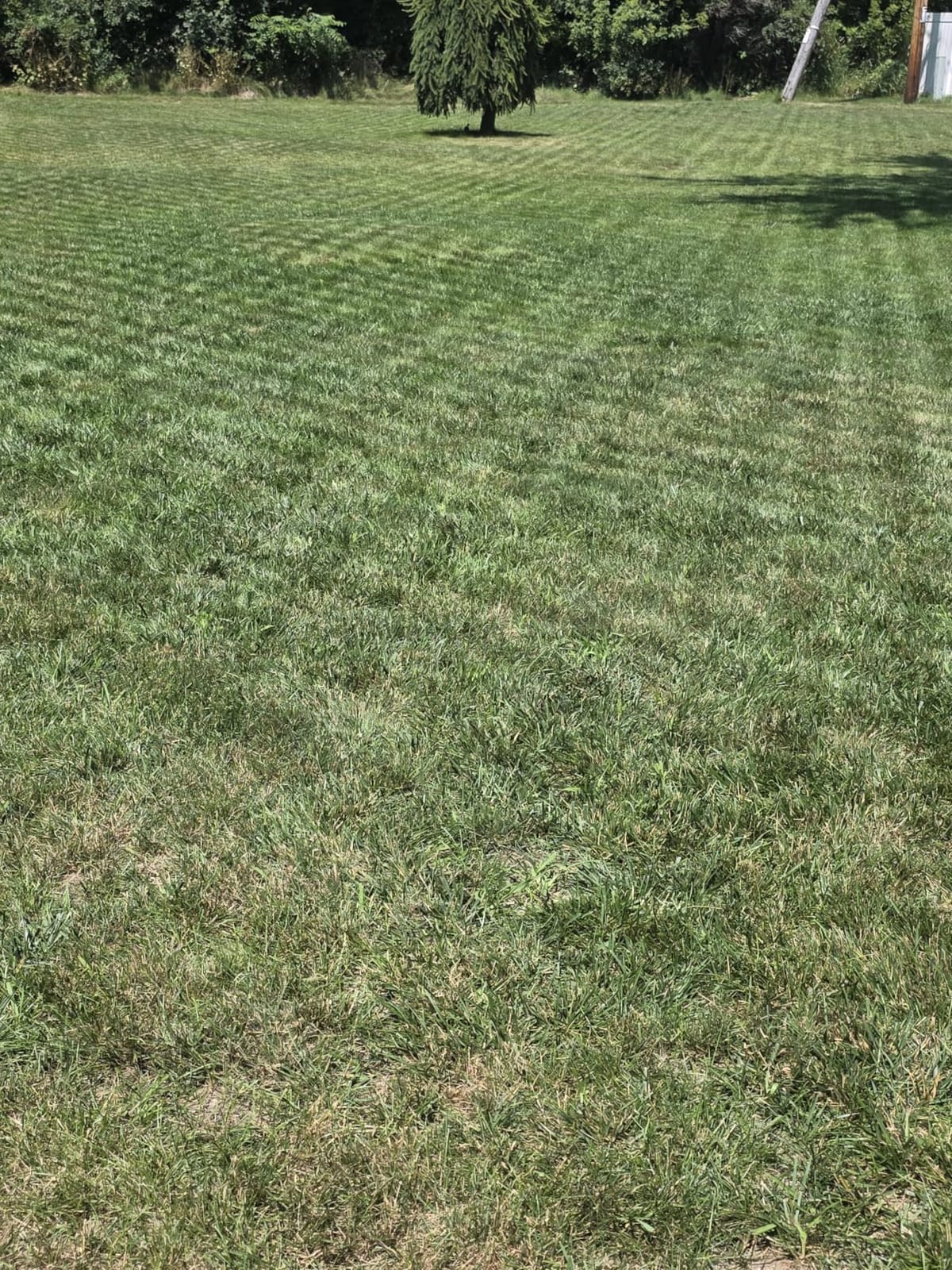
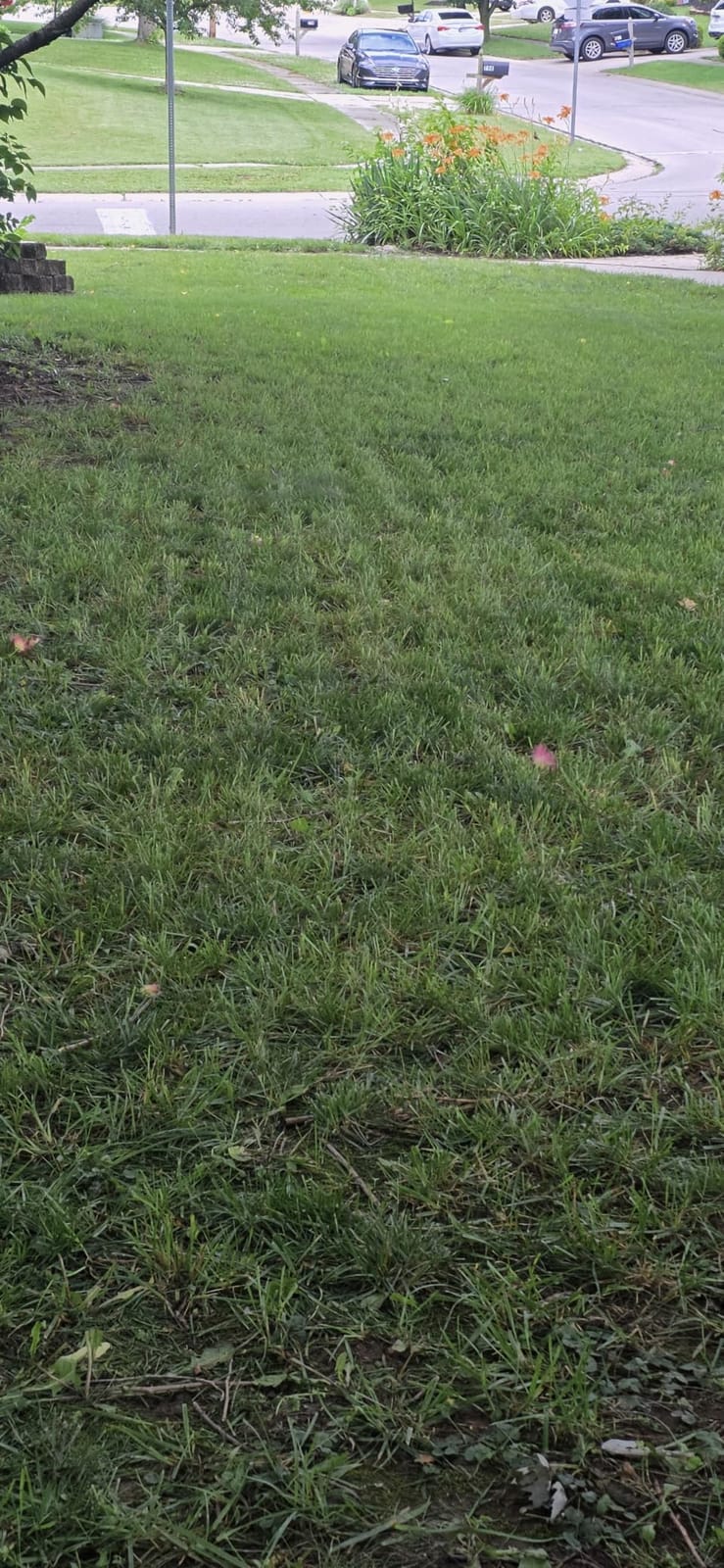
A fixed deck pivots with the chassis, so when one wheel drops into a dip the cutting height changes across the whole machine. A floating deck moves vertically to keep the blade at the same distance from the turf. The result is fewer light and dark bands, which is the single most visible quality difference on uneven ground.
Navigation that survives a shaded yard
RTK supplies the position fix, VSLAM holds the map through shade, and Vision AI covers coverage under trees. For a property that is heavily planted, that three-part stack is a sensible reason to choose this machine over a pure RTK model at a similar slope rating.
The edge cut is the trade-off
Up to 18 inches of uncut grass along boundaries means a string trimmer visit every cycle. If tidying edges is the part of lawn care you most want to delete from your routine, weight the floating deck more heavily and look at the cut-to-edge machines instead.
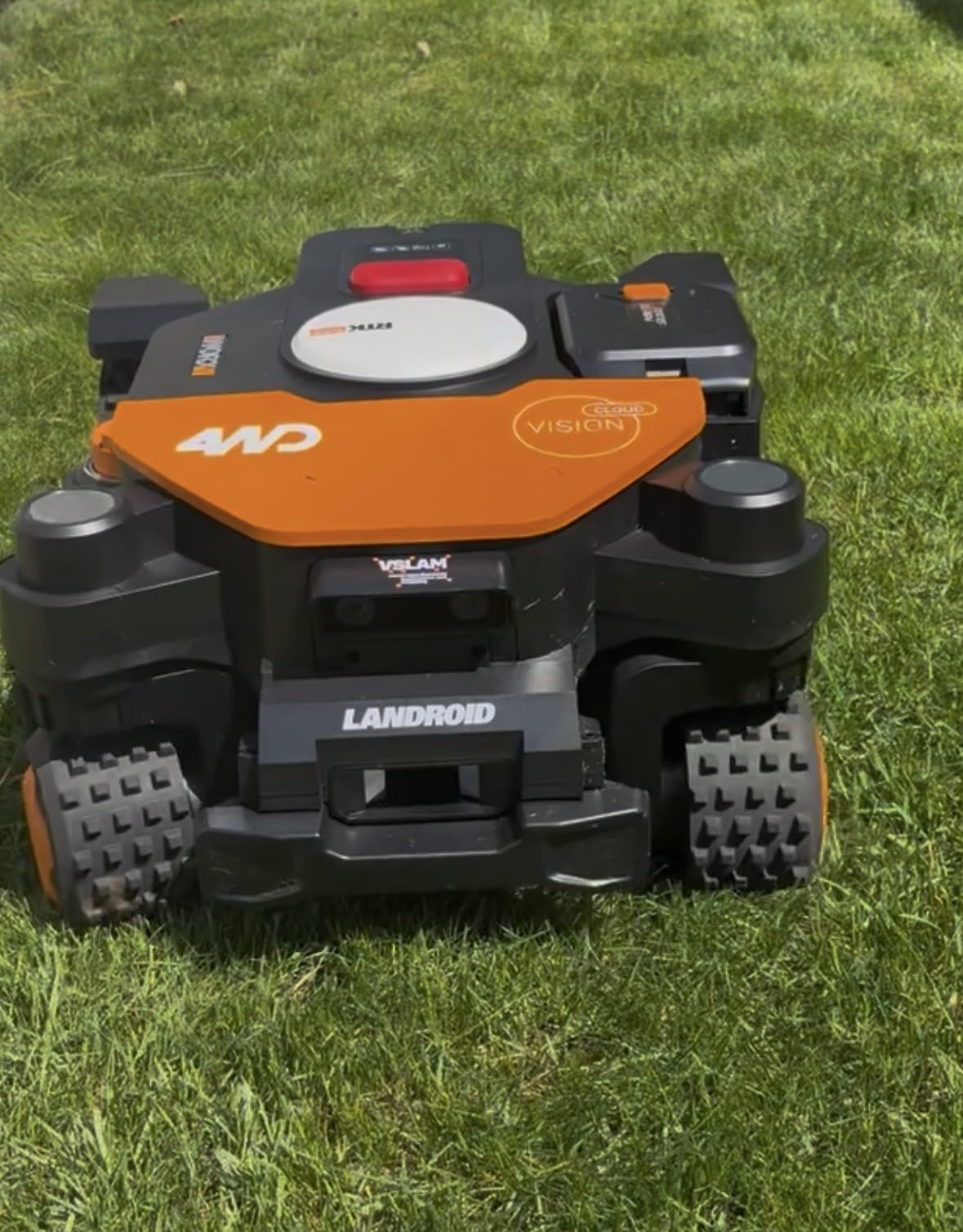
8. WORX Landroid 4WD WR342 – The Steepest Slope Rating in the Group
WORX Robot Lawn Mower 4WD for 1/2 Acre, No Perimeter Wire, WR342
4WD 84% slopes
Terrain-adaptive chassis
RTK Cloud, no antenna
True front-wheel steering
Pros
- 4WD traction handles steep hilly yards
- True front-wheel steering turns without tearing turf
- RTK Cloud means no antenna and no subscription
- Very quiet
- Zoned mapping achievable in about an hour
Cons
- App cannot edit or split a finished map
- No headlight in the US package
- Edge cutting still needs regular string trimming
The WR342 posts the highest climbing figure in this roundup at 84%, roughly 40 degrees, and the way it achieves that is a terrain-adaptive chassis designed to keep all four wheels planted on uneven ground and raised borders. Owners with 20 to 30 degree back-yard slopes report clean results where a push mower was unsafe or impractical.
RTK comes from the cloud rather than a local antenna, so there is nothing to install on the roof and no recurring cloud fee, and the 3-year manufacturer warranty is the longest alongside the MOVA. True front-wheel steering gives precise turns without tearing turf, and unlimited mowing zones with custom pathways and no-go areas are available.
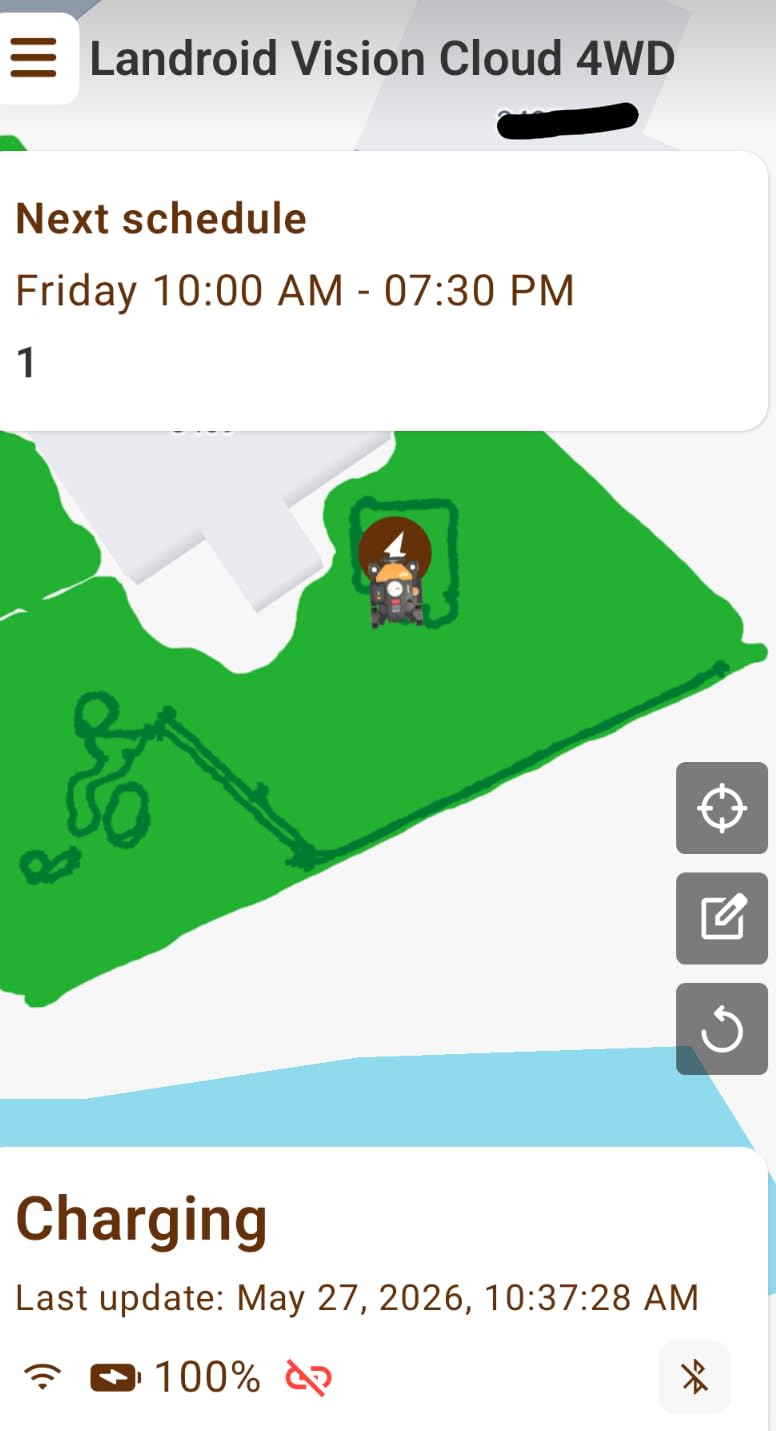
Criticism of this machine is almost entirely about software rather than hardware. The app cannot edit or split a map after it is created, manual driving controls are clunky for precise positioning, there is no headlight in the US package so it stops early in low light, and tall dandelions and tall grass are avoided as obstacles rather than cut. Edge cutting is inconsistent and still needs regular string trimming.
Run time is roughly one hour with about an hour of charge time, which on rough ground means more dock returns than the 80% competitors. Support is described as responsive by email but thin on documentation.
Why an 84% rating matters on a real hill
Slope ratings above 70% are rarely necessary, but they are useful as headroom. Grass that is wet, or a lawn that has been softened by rain, changes the effective grade a mower sees. Buying above your measured slope gives you a margin instead of operating exactly at the limit.
Cloud RTK as an installation decision
Eliminating the antenna removes the single most common installation complaint in this category. It also means no line-of-sight requirement, so it works next to a house wall or a tree line. The trade is a dependence on cellular coverage through your service provider.
The map you get is the map you keep
Being unable to split or edit a finished map is a real limitation on a complex uneven property, where you may want a mow-free zone around a bed or a soft patch. Plan the zones before you map rather than after.
9. MOVA LiDAX Ultra 3000 AWD – Fastest Coverage, Lowest Rating
MOVA LiDAX Ultra 3000 AWD Robot Lawn Mower Wire Free RTK Free for up to 0.75 Acre*Dual Maps, 360° 3D LiDAR & AI Dual Vision Mapping, Robotic Mower with 4G, for 80% Slopes, Cutting Height 1.2”–3.9“
AWD 80% slopes
2.4 in obstacle clearance
15.8 inch dual-disc
3 years free 4G
Pros
- Four 116W hub motors take 80% slopes
- RTK-free setup needs no roof beacon
- Floating discs and suspension handle uneven ground
- 15.8 inch width covers ground fast
- 3 years of free 4G and 3-year warranty
Cons
- Front wheels can slide downhill when mowing across a slope
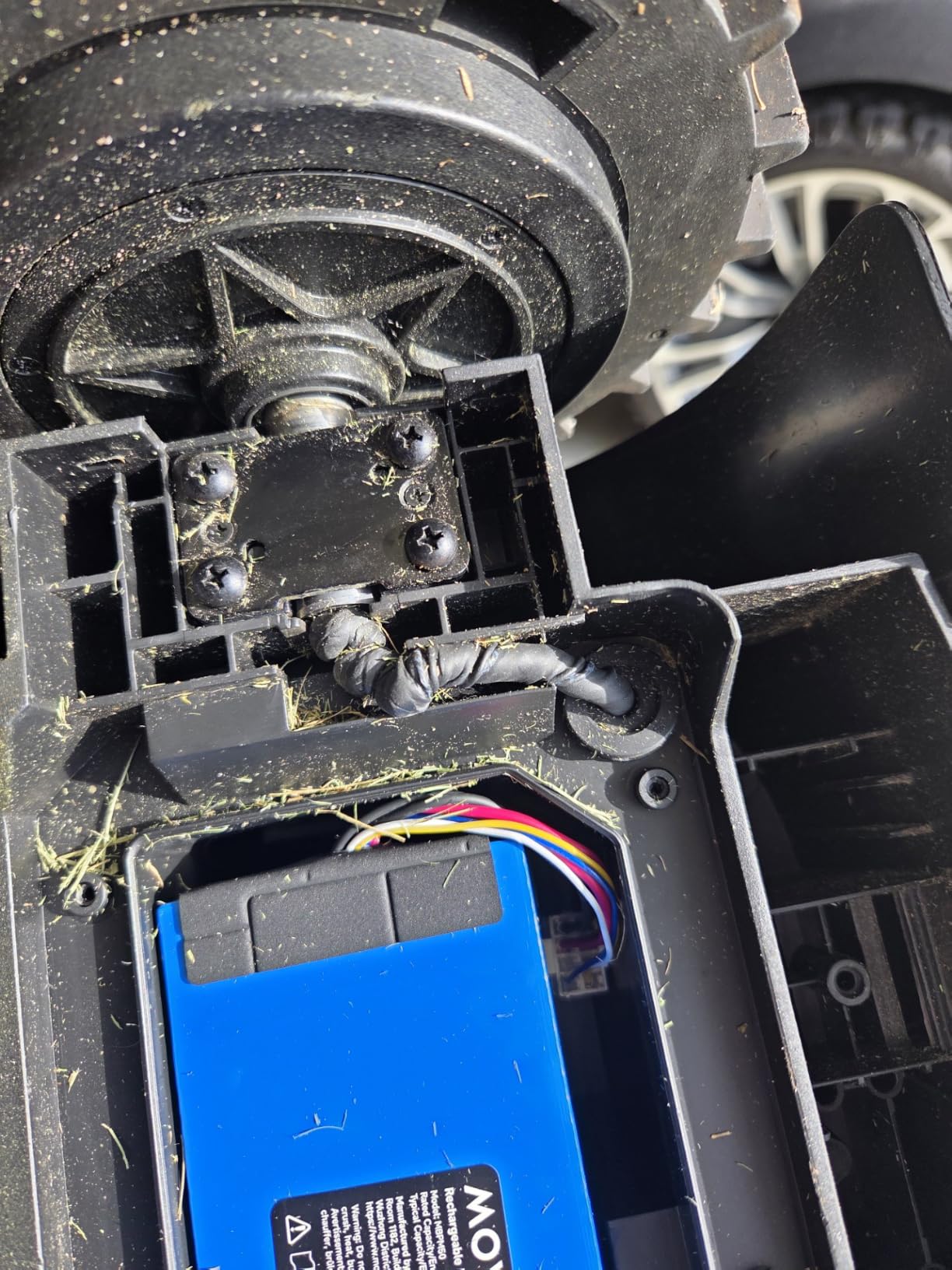
- Front hubcaps fall off repeatedly
- Edge cut leaves about 1.2 inches of grass
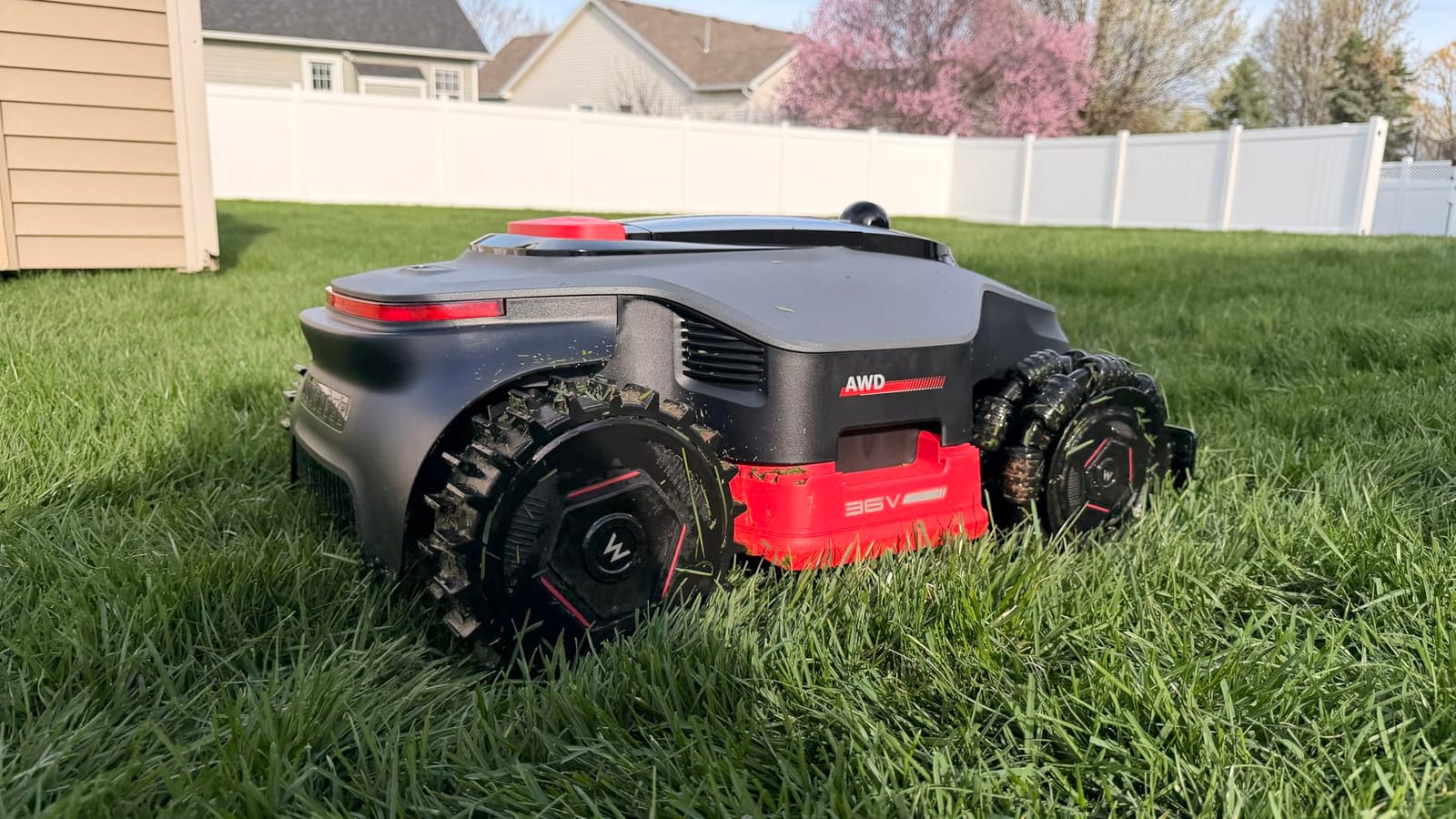
This is the widest-cutting machine in the roundup at 15.8 inches, and on a large rough property the speed difference is obvious. Four high-torque 116W hub motors deliver 80% slope capability and obstacle clearance up to 2.4 inches, which is the highest clearance figure in the group.
It is RTK-free and wire-free, using 360 degree 3D LiDAR with AI dual vision and automatic 3D mapping, so there is no beacon on the roof and no alignment step. Advanced suspension prevents tipping and floating cutting discs adapt to uneven ground. A 36V 243Wh battery mows up to 0.25 acre per charge, with dual maps, multiple zones and per-zone schedules.
It also carries the lowest average rating here at 3.8, and the review pattern explains why. Owners who keep it rate the drivetrain, the RTK-free mapping and the wide cut very highly, with several comparisons favouring it over a previous RTK beacon machine. The criticism clusters on physical details rather than capability.
Front wheels can slide downhill when the mower cuts laterally across a slope and can tear turf, front hubcaps fall off repeatedly, and the edge cut leaves more grass than most competitors so string trimming is needed more often. There is no gate automation, so a fenced-off front yard needs a second base or a second mower, and at least one detailed report describes an early hardware failure and a difficult warranty process.
Obstacle clearance and slope as a matched pair
A 2.4 inch clearance alongside 80% climbing makes this the most capable machine on paper for a lawn with rocks, roots and grade together. Both figures come from the same chassis design, so they reinforce rather than offset each other.
Why RTK-free mapping appeals on rough ground
No beacon means no mast, no sky view requirement and nothing to re-align after a storm. On a property where the mower will be out in all weather across uneven ground, removing the fixed hardware is a genuine reliability argument.
Reading the 3.8 carefully
A low average here is a mix of capability complaints and a small owner base, and the specific physical complaints are addressable. It is worth a read of the negative reviews before you commit rather than a pass on the headline specification.
10. Husqvarna 410iQ – Best Warranty and Support, Weakest Slope Rating
Husqvarna 410iQ ½ Acre Wire-Free, 45% Slope, app Based, Robot Lawn Mower
45% slopes
EPOS positioning
Onboard radar
1 to 4 inch cut height
Pros
- Widest cutting height range in the class
- Radar detection and EPOS positioning
- Larger wheels cross paths and driveways
- 4-year warranty plus a year of free blades
- Hose-washable and US phone support
Cons
- 45% slope rating is well below the 80% leaders
- One-star reviews make up roughly a quarter of ratings
- Heaviest machine here at 59 pounds
The 410iQ is the established-brand option, and its specification list reflects that confidence: EPOS exact positioning, onboard radar for obstacle avoidance, and a wire-free app-driven boundary walk that produces a virtual map with stay-out zones. The 4-year warranty and one year of free replacement blades are the strongest support package in the group.
The widest adjustable cut height range in the class runs from 1 to 4 inches, which no other machine here matches, and larger wheels plus a durable bumper cross paths and driveways reliably. It is hose-washable, weighs 59 pounds, and carries an anti-theft alarm with GPS tracking through the app.
Its 3.6 average is the lowest of the ten, and about a quarter of ratings sit at one star. The shape of that distribution, roughly 55% five-star against 24% one-star, suggests a split customer base: buyers who get the expected result and buyers who do not. The most obvious spec gap is the 45% slope rating, which is well below the 80% class leaders.
At 59 pounds it is also the heaviest machine here, and not all iQ Series variants are available in every market. On genuinely hilly ground, the slope ceiling is the reason this is not our recommendation there.
What a 45% rating rules in and out
Forty-five percent, about 24 degrees, comfortably covers rolling ground, gentle banks and most suburban lawns with a few feet of fall across them. It is genuinely inadequate for a back slope that is straight up a hill, which is the situation this roundup exists to solve.
Cutting height range as the underrated spec
One to four inches lets you mow a fine cool-season lawn at 1 inch and a coarse warm-season lawn at 3.5 inches with the same machine. If your grass type varies across the property, that range removes a compromise that a 1 to 2.7 inch deck forces on you.
Warranty and support as real differentiators
Four years of coverage, a year of free blades and a US-based phone support line reduce the total cost of ownership more than a small spec upgrade does. That matters more over five years than a mower appears to be worth in year one.
What Actually Changes After 30 to 90 Days of Ownership
The spec sheet tells you what a machine can do on day one. Owners on forums are far more consistent about what changes later, and it is rarely the headline slope number.
The stuck count falls, but not to zero. Almost every owner reports a noticeably lower rescue rate after the first few cuts, mostly because the machine learns the rough patches and the owner removes what is genuinely movable. The machines that keep needing rescue are the ones on a 45% rating being asked to handle 50%.
Edge quality is the most common disappointment. Almost every robot mower here leaves a strip against fences, and the ones that write their boundary well back from the edge leave considerably more. If tidying borders is your main irritation with manual mowing, budget for regular string trimming rather than expecting it to disappear.
App reliability matters more than the obstacle count. The most repeated complaints in reviews are software, not mechanics: maps lost after a wheel slips on an incline, no way to split a finished map, zones that cannot be edited afterwards, and apps that need Wi-Fi extenders to reach the far corners of a yard.
Wet grass changes the equation. Owners consistently report that soft, wet ground is harder than dry ground at the same nominal slope. Several machines here carry a rain sensor, which is more useful on a rough lawn than on a flat one because traction varies with moisture.
Tall grass gets treated as an obstacle. This is a widespread behaviour across vision-equipped machines, and it means a growth spurt can slow progress on rough ground. Trimming the tall patches first avoids a mower that keeps circling them.
How to Buy a Robot Mower for Uneven Terrain
Measure your steepest slope, then add a 10% buffer
Walk the steepest part of your lawn with a clinometer app, or use a straight level and a measured length of string. Note the highest reading, then buy a mower rated 10% higher than that number. Moisture, uneven cut and a soft surface all reduce the effective slope a machine can hold, and the buffer is what stops you living at the limit.
For context, 25% is about 14 degrees, 45% is 24 degrees, 60% is 31 degrees and 80% is 39 degrees. If your measurement is in the 30 to 40% range, rule out the 45% machines entirely.
2WD, AWD, 4WD and tracked drivetrains
Two-wheel drive is fine on flat ground and struggles the moment a wheel lifts. AWD distributes torque across all four driven wheels and is the sweet spot for most rough lawns. Four-wheel drive adds traction at the cost of weight and energy use. Tracked drivetrains spread weight over a large contact patch and are genuinely capable, but owner discussion around tracked mowers is largely about cost and parts support rather than results, so on this list we have favoured proven AWD and 4WD machines.
RTK, LiDAR and vision under tree cover
RTK gives centimetre accuracy but degrades under canopy. LiDAR builds a map from what the machine sees and does not care about satellites. Vision systems handle object recognition and are usually paired with one of the other two. A tri-fusion or dual-fusion machine, such as the LUBA 3 or the Sunseeker X5, is the most robust answer for a heavily planted property.
Floating decks and cut consistency
If your unevenness is gradual rather than abrupt, a floating deck matters more than a bigger obstacle clearance number. If your lawn is punctuated with roots and holes, climb height and suspension travel matter more. Most buyers have both, so check the deck first and the drive second.
Wire-free versus boundary wire on rough ground
Burying wire is the activity rough ground punishes hardest, because you are trenching across divots and roots with a machine that will later run over your work. Wire-free is the default on all ten picks here. The trade is that a wire-free map can be lost, and remapping a complex uneven lawn is a real chore.
Prepare the lawn before the first mow
Fill any hole deeper than 2 inches, remove stones and branches, pre-trim tall grass, and mark genuinely impassable areas as no-go zones in the app. Ten minutes of preparation is the difference between a first cut that goes smoothly and a first afternoon spent recovering a mower from a hole.
If you are weighing a robot against a conventional walk-behind, the best zero turn mowers handle flat acreage quickly, while a Cub Cadet or a all-terrain machine still gets the job done on slopes a robot cannot. Neither saves you the walk.
Frequently Asked Questions
Can robot mowers cope with uneven ground?
Yes, but only with the right drivetrain and slope rating. A robot mower on uneven ground needs all-wheel or four-wheel drive, a maximum climbing slope above your steepest measured grade, and a floating or terrain-adaptive deck. Standard two-wheel-drive units high-center on divots, lose traction on inclines and skip patches in dips. Fill holes deeper than 2 inches and remove stones before the first mow.
What is the maximum slope a robot mower can handle?
It depends on the model, and the range in this roundup runs from 45% to 84%. A 45% rating is about 24 degrees, 60% is about 31 degrees and 80% is about 39 degrees. Most rough suburban lawns need 45% or more. Buy at least 10% above your steepest measured grade so wet or soft ground does not push the machine past its limit.
Which robotic lawn mower is best for rough terrain?
The Mammotion LUBA mini 2 AWD 1500H is our pick for rough terrain because its four-wheel drive and adaptive suspension handle holey, root-filled lawns, and it has the largest owner base in this group. For the steepest hills, the WORX Landroid 4WD WR342 claims 84%. The Sunseeker X5 AWD is the pick when a floating deck and an even cut matter more than maximum climbing ability.
Are robot lawn mowers any good on uneven ground?
They are good on uneven ground in the sense that owners on rough properties report the stuck count drops sharply after the first few weeks. What does not improve is edge quality: nearly every model leaves a strip against fences, and several write their boundary well back from the edge, so regular string trimming is still part of the routine.
What type of mower is best for rough and uneven ground?
Among robot mowers, an all-wheel-drive or four-wheel-drive machine with a 60% to 80% slope rating and a floating deck is the best fit. AWD distributes torque across all four driven wheels, which is what prevents high-centering on divots and roots. Tracked mowers spread weight well but attract less owner feedback on parts support. For flat acreage, a conventional zero turn mower is faster.
Which Robot Mower Fits Your Rough Ground
If you want one answer, take the Mammotion LUBA mini 2 AWD 1500H. It has the deepest owner history on rough ground, four-wheel drive with suspension rated to 45mm, and 80% climbing, and it is the machine most often described as finally replacing a push mower.
If your lawn is steep enough that 45% feels thin, look at the WORX Landroid 4WD WR342 for its 84% rating and terrain-adaptive chassis, or the Mammotion LUBA 3 AWD 3000 for a larger property with a 50mm suspension and a tri-fusion navigation stack. If tree cover is your main problem rather than slope, the Segway Navimow i215 LiDAR needs no satellite signal at all and runs quietly at 59 dB(A).
For cut consistency on gradual undulation rather than roots, the Sunseeker X5 AWD floating deck is the one to beat, accepting a wider unmowed edge. The Husqvarna 410iQ makes sense when support and a four-year warranty matter more than climbing ability.
Measure your steepest slope before you buy anything, fill the holes deeper than 2 inches, and pick the machine rated above that number. This roundup of the best robot mowers for uneven terrain is updated for 2026, and the buttons below take you straight to the current listing.
Leave a Reply