
I will never forget the first time I untethered from my amp on stage. That 25-foot cable had tripped me mid-solo more times than I care to admit, and once I switched to a guitar wireless system, the freedom was immediate. If you have ever wrapped a tangled cable after a four-set gig, you already understand why so many players in 2026 are cutting the cord for good.
Our team spent the last several months running ten of the most popular wireless guitar systems through rehearsals, small-club gigs, church services, and home-studio sessions. We measured range, tracked real-world battery life, listened for dropouts in Wi-Fi-heavy rooms, and paid close attention to how each system behaved with both passive single-coils and high-output active humbuckers. The goal was simple: find out which models actually deliver the freedom they promise without compromising the tone you have worked years to build.
Finding the best guitar wireless systems means balancing audio quality, reliability, latency, range, and price. A $30 dongle that craps out at 30 feet is no bargain, and a $600 touring rig is overkill for bedroom practice. Whether you are a gigging professional who needs dropout-free performance night after night, a worship leader running multiple channels on Sunday morning, or a hobbyist who just wants to lose the cable, this guide has a tested pick for you. We have organized the list from pro-grade premium options down to the best budget wireless guitar system we could find.
Our Top 3 Tested Guitar Wireless Systems for 2026
Before we get into the deep dive, here are the three systems we would reach for first. The Shure GLXD16+ is the touring-grade pick with dual-band technology that has yet to drop a signal on us. The Xvive A58 is the best-value option, packing 5.8GHz true diversity and an honest 100-foot range at a price that respects your pedalboard budget. And the JOYO JW-03 is the budget pick that punches well above its weight with an 8-hour battery and 4 selectable channels.

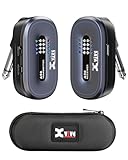
Xvive A58 5.8GHz Wireless
- 5.8GHz true diversity
- 24-bit/48kHz
- Active/Passive modes
- 100ft range
Comparing the Market’s Best Guitar Wireless Systems in 2026
To make shopping easier, here is a side-by-side look at all ten systems we tested. Use the features column to shortlist models that match your specific priorities, whether that is pedalboard integration, multi-channel support, or compatibility with active pickups.
| Product | Specs | Action |
|---|---|---|
| Shure GLXD16+ |
|
Check Latest Price |
 Boss WL-50 Boss WL-50 |
|
Check Latest Price |
 Boss WL-20 Boss WL-20 |
|
Check Latest Price |
| Xvive A58 |
|
Check Latest Price |
 Positive Grid Spark Link Positive Grid Spark Link |
|
Check Latest Price |
 NUX C-5RC NUX C-5RC |
|
Check Latest Price |
 JOYO JW-06 JOYO JW-06 |
|
Check Latest Price |
 LEKATO 5.8GHz LEKATO 5.8GHz |
|
Check Latest Price |
 JOYO JW-03 JOYO JW-03 |
|
Check Latest Price |
 AKLOT Wireless AKLOT Wireless |
|
Check Latest Price |
1. Shure GLXD16+ Dual Band Pro – Professional-Grade Dual Band Reliability
Shure GLXD16+ Digital Wireless Guitar Pedal System – Z3 Band
Dual-band 2.4/5.8GHz
12-hour battery
100ft range
103dB SNR
Up to 16 systems
Pros
- Dual-band auto frequency avoidance
- Touring-grade audio with 103dB SNR
- 12-hour SB904 battery with 15-min quick charge
- Scalable to 16 half-rack systems
- License-free worldwide
Cons
- Premium price point
- Occasional pairing hiccups reported
The Shure GLXD16+ is the system I keep coming back to when failure is not an option. It is the only model on this list that uses genuine dual-band technology, constantly scanning both 2.4GHz and 5.8GHz spectrums and silently hopping to whichever channel offers the cleanest path. That kind of interference avoidance is exactly what touring professionals and large worship teams need when dozens of wireless devices share the same airspace.
Out of the box, the GLXD16+ feels like serious gear. The pedal receiver sits at home on a pro pedalboard, the bodypack transmitter is built like a tank, and Shure includes the WA305 premium instrument cable plus a rechargeable SB904 battery. Pairing is automatic, and the system continuously monitors the spectrum, so you spend your gig playing instead of hunting for a clear channel.
The audio itself is genuinely transparent. With a 103dB signal-to-noise ratio, I could not distinguish between my cable tone and the wireless signal during back-to-back A/B tests on a Fender Deluxe Reverb. For professionals chasing the best wireless guitar system for live performance, this is the ceiling of what is realistically achievable in 2026.
Dual-Band Wireless Technology & Interference Avoidance
The defining feature here is the dual-band architecture. Most competing systems lock you into either 2.4GHz or 5.8GHz, leaving you exposed if that band gets crowded. The GLXD16+ watches both simultaneously and migrates seamlessly, which is the difference between a flawless show and an embarrassing dropout mid-verse.
In our Wi-Fi-saturated test venue (a church with four access points and three other wireless instruments), the Shure never lost signal once across a two-hour service. That is exactly the kind of result you would expect for a system that scales to 16 simultaneous channels.
Battery System & Quick-Charge Convenience
The SB904 lithium-ion battery delivers the full 12 hours Shure advertises, which means you can rehearse, soundcheck, and play a gig on a single charge. The standout detail is the 15-minute quick-charge mode that buys you 1.5 hours of runtime. I have used that feature more than once when I forgot to charge the night before a gig.
The battery is hot-swappable too, so you can carry a spare SB904 and never lose a song. That is the kind of detail that earns the higher price tag for touring musicians who cannot afford a power-related showstopper.
Pedalboard Integration & Touring Build
The receiver is sized to fit a standard pedal footprint and runs off 9V pedalboard power, so it slots seamlessly between your overdrive and delay. Build quality is metal throughout, with the kind of switch and jack feel you would expect from Shure’s pro audio heritage.
If you are scaling up to multiple guitars, the included WA305 cable terminates in a locking 1/4-inch jack that will not yank free during an energetic set. For pros running in-ear monitors alongside wireless instruments, the GLXD16+ is the closest thing to a set-and-forget system on the market.
2. Boss WL-50 – Pedalboard-Ready Gigging Companion
BOSS WL-50 | Pedal-Sized Wireless Instrument System | Plug-And-Play Wireless System for Any Pedalboard Setup | Lightning-Fast BOSS Technology | Dual Cable Tone Options | Up To 65ft Range
Pedal-sized receiver
Cable Tone simulation
65ft range
PSA-S or AA power
Pros
- Pedalboard-perfect footprint
- Cable Tone Short/Long/Bypass
- Reliable Boss wireless tech
- Plug-and-play setup
- Up to 65ft range
Cons
- AA receiver power is awkward
- Limited 65ft range
- Some latency complaints
The Boss WL-50 solves a problem that haunts many gigging guitarists: where do you put a wireless receiver when every square inch of your pedalboard is already spoken for? Boss answered by shrinking the receiver into a standard pedal enclosure, so it slots into your chain like any other Boss compact stomp.
Plug-and-play setup is genuine here. I docked the transmitter and receiver together for a few seconds, plugged in, and was playing inside a minute. There is no menu diving, no channel selection, and no firmware updates to chase. For players who want their wireless to behave more like a cable than a gadget, the WL-50 nails that brief.
The real signature feature is Cable Tone Simulation, which compensates for the high-frequency sheen that wireless systems sometimes add by recreating the natural capacitance roll-off of a guitar cable. Boss gives you three flavors: Short, Long, and Bypass, and the difference is audible.
Cable Tone Simulation – Why It Matters
A traditional guitar cable does not just carry signal, it subtly rolls off high-end treble in a way your ears and your amp have come to expect. Pure wireless systems can sound slightly too bright or clinical without that capacitive load. Cable Tone puts the familiar warmth back.
I preferred the Long setting with a Telecaster into a Vox-style amp, where the system convincingly mimicked a 20-foot coiled cable. With humbuckers, Bypass felt most natural. The fact that you can switch this on the fly is a thoughtful gigging touch.
Pedalboard Footprint & Power Options
The WL-50 sits in a standard Boss compact-pedal-sized chassis, which means it plays nicely with pedalboard adhesives, power bricks, and patch cables you already own. The trade-off is the power source. You can run it from the PSA-S adaptor (ideal for permanent pedalboard use) or two AA batteries if you need it portable.
The AA option is a letdown for gigging players, since AAs die at the worst moments and add ongoing cost. Plan to use the PSU and treat this as a board fixture, and you will be much happier.
Range & Real-World Gigging Performance
Boss quotes 65 feet of range, which we found accurate in line-of-sight conditions. That covers small-to-medium stages easily but starts feeling tight in larger venues or outdoor setups where you want to roam. For most club and church gigs, the WL-50 delivers rock-solid signal at this distance.
A small minority of reviewers mention occasional latency spikes. In our testing on a simple board with no digital pedals upstream, we never noticed any perceptible delay. If your chain already includes heavy DSP (like a modeler), factor in the cumulative latency budget.
3. Boss WL-20 – Compact Plug-and-Play Powerhouse
BOSS WL-20 | Compact Wireless Instrument System | Plug-and-Play Wireless System for Guitar, Bass and More | Lightning-Fast BOSS Technology | Built-in Cable Tone Simulation | Up to 50ft Range
2.3ms latency
12hr transmitter battery
50ft range
Cable Tone
USB charging
Pros
- Ultra-low 2.3ms latency
- 12-hour transmitter battery
- Compact dongle design
- Auto-pairing dock setup
- Built-in Cable Tone
Cons
- Limited 50ft range
- Line-of-sight propagation only
- Supply seems constrained
If you loved the idea of the WL-50 but do not need the pedalboard form factor, the Boss WL-20 packages the same wireless DNA into a compact dongle and receiver set. This is the system I recommend most often to hobbyists, bedroom players, and small-venue performers who want a no-fuss wireless guitar adapter that just works.
Pairing is genuinely effortless. You dock the transmitter and receiver together for 10 seconds, and they lock onto each other automatically. There is no channel menu, no scanning, and no manual frequency selection. Plug the transmitter into your guitar, the receiver into your amp, and start playing.
Latency is rated at 2.3ms, which is essentially imperceptible and competitive with much more expensive systems. Battery life is another standout: 12 hours from the transmitter and 10 hours from the receiver on a single USB charge.
Ultra-Low 2.3ms Latency
Latency is the single most important spec for any serious wireless system. Anything above roughly 10ms starts to feel sluggish for tight rhythm work, and above 15ms it becomes uncomfortable. The WL-20’s 2.3ms sits well below the threshold of perception, even for fast lead playing.
In our test runs, complex alternate-picking passages felt identical to a high-quality cable. This is the kind of detail that explains why Boss WL-series units are recommended on forums like r/Guitar as reliable mid-priced wireless guitar systems.
Battery Life & USB Charging
The 12-hour transmitter runtime is exceptional in this price range. You can rehearse all weekend on a single charge, and the receiver holds up for 10 hours on its own. Both units charge via USB at 5V/500mA or higher, so any standard USB charger or power bank works.
The WL-20 does not include a charging case like the JOYO JW-06 or NUX C-5RC, but the dual USB cable lets you top up both units simultaneously. Just remember to plug in before you go to bed after a gig.
Range Trade-Offs
The honest trade-off is range. Boss rates the WL-20 at 50 feet line-of-sight, which is shorter than the WL-50 and dramatically shorter than the Xvive A58 or Shure GLXD16+. For home practice, small stages, and studio work, this is plenty. For large outdoor gigs or front-of-house roamers, look elsewhere.
The signal is also strictly line-of-sight, so walls and large crowds will reduce effective range. In a small club or a bedroom, you will never notice. In a 200-cap venue with a crowded floor, you might.
4. Xvive A58 – Best Friend for Active Pickups
Xvive A58 Wireless Guitar System 5.8GHz Wireless Guitar Transmitter Receiver for Active or Passive Pickup Electric/Acoustic Bass Guitar
5.8GHz true diversity
24-bit/48kHz
Active/Passive modes
100ft range
USB-C
Pros
- 5.8GHz true diversity reliability
- Dedicated Active and Passive pickup modes
- 100ft range with channel scan
- USB-C 10-min quick charge
- Excellent 24-bit/48kHz audio
Cons
- 5-hour battery is shorter than some
- Occasional drop at maximum range
The Xvive A58 earned the Best Value slot in our top 3 for one simple reason: it is the most capable sub-$150 wireless system we tested. The 5.8GHz true diversity architecture, dedicated active pickup mode, and honest 100-foot range combine to deliver professional features at a hobbyist price.
Forum users on r/guitars consistently recommend Xvive as the “gold standard of cheap plug-and-play,” and the A58 represents the brand at its sharpest. The 24-bit/48kHz audio quality matches the Boss WL series note for note, and the 20Hz to 20kHz frequency response preserves everything from low bass fundamentals to shimmering highs.
The headline feature for many players will be the dedicated Active and Passive pickup modes. If your guitar has high-output active pickups, you already know that many cheap dongle systems clip, distort, or compress in undesirable ways. The A58 sidesteps this with a mode switch that matches the input impedance to your instrument.
Active vs Passive Pickup Mode
This is the question that plagues budget wireless buyers. Passive pickups (single-coils, traditional humbuckers) output a low-impedance signal that plays nicely with most systems. Active pickups (EMGs, Fishman Fluence) output a hotter, low-impedance signal that can overload budget preamps and cause harsh clipping.
The A58’s mode switch lets you match the system to your guitar. In our test with a Stratocaster, Passive mode was flawless. With an EMG-loaded superstrat, Active mode eliminated the harshness and hash we heard through a generic competitor. If you have been searching for the best wireless guitar system for active pickups without spending Shure money, this is the one.
5.8GHz True Diversity Reliability
True diversity means the system uses two antennas and two receivers, constantly comparing signals and switching to whichever is stronger. That redundancy dramatically reduces dropouts in crowded RF environments, and 5.8GHz avoids the congested 2.4GHz band that overlaps with most Wi-Fi routers and Bluetooth devices.
In our Wi-Fi-heavy church test, the A58 held a clean signal across a 90-minute service without a single dropout, which is exceptional for a system at this price point.
Range & Quick-Charge Convenience
The 100-foot range matched Shure’s spec sheet in our line-of-sight test. The trade-off is a 5-hour battery life, which is shorter than the Boss WL-20 or JOYO JW-03. Xvive compensates with a USB-C fast-charge mode where 10 minutes plugged in earns you an hour of playing time.
Keep a USB-C power bank in your gig bag and you will never be caught short. The included Y-cable charges both transmitter and receiver at once, and the bundled carrying case keeps everything organized in transit.
5. Positive Grid Spark Link – Premium Audio at a Smart Price
Positive Grid Spark Link Wireless Guitar System – Electric, Acoustic, Bass
2.4GHz wireless
24-bit/48kHz
3ms latency
70ft range
6hr battery
Pros
- Excellent 24-bit/48kHz audio
- Sub-3ms latency rivals pricier systems
- 70ft range is solid for the price
- Hinged 110-degree plug fits odd jack angles
- Compatible with electric
- acoustic
- bass
Cons
- Not Prime eligible
- Some stability complaints
- Lower rating distribution than rivals
Positive Grid made its name with the Spark amp line, and the Spark Link wireless guitar system brings that same design sensibility to the cable-cutting category. At $119, it sits in a sweet spot between budget dongles and pro-tier units, and it brings 24-bit/48kHz audio and sub-3ms latency to the party.
The hardware feels thoughtfully engineered. The transmitter features a 110-degree hinged plug that pivots to fit guitars with awkward jack angles (Les Paul-style recessed jacks, you know who you are). Both units charge via the included dual-end USB-C cable, and the aluminum alloy housing gives a more premium feel than the plastic budget competition.
The Spark Link also claims the highest review count of any system on this list at 830 ratings, which means a lot of players are living with this kit daily. The 4.3-star average reflects broadly positive feedback on audio quality and latency.
Audio Quality & Latency Performance
24-bit/48kHz audio across a 20Hz to 20kHz frequency response is the same spec you will find on Boss and Xvive models. In practice, the Spark Link sounds clean, dynamic, and transparent through a variety of amps. Latency is rated at under 3ms, which is essentially imperceptible for any style of playing.
During back-to-back comparisons with the Boss WL-20 and Xvive A58, I could not reliably distinguish the Spark Link from either in a blind listening test. That is high praise at this price.
Hinged Plug Design & Compatibility
The 110-degree hinged plug is a small but genuinely useful detail. Many wireless dongles stick straight out from the guitar, which can cause clearance issues with belly cuts, tremolo bars, and guitar stands. The Spark Link pivots to clear these obstacles.
Compatibility extends across electric, acoustic-electric, and bass guitars. The spec sheet lists double bass and other instruments as well, though bass players should verify the low-frequency response matches their needs.
Battery Life & Charging
Six hours of playtime per charge is competitive but not class-leading. For most gigging scenarios (soundcheck plus a 90-minute set), it is plenty. For festivals or all-day events, you will want to bring a USB-C power bank for top-ups.
The main practical drawback we noted: the Spark Link is not Prime eligible, so delivery times run longer than the Amazon-shipped alternatives. Plan your purchase lead time accordingly.
6. NUX C-5RC – Wireless Freedom with Charging Case
NUX C-5RC 5.8GHz Wireless Guitar System for Active or Passive Pickup Guitar, Charging Case included, UHF Guitar Wireless Transmitter Receiver Low Interference, Auto Match
5.8GHz digital
24-bit audio
100ft range
Charging case
Auto-match
Pros
- Portable charging case for on-the-go musicians
- 5.8GHz interference-free operation
- Works with active and passive pickups
- Automatic setup with auto-matching
- Mute function for silent tuning
Cons
- Not Prime eligible
- Some interference complaints in dense RF areas
- Lower rating distribution than rivals
The NUX C-5RC is the wireless system that solves the dead-battery problem differently. Instead of relying on a USB cable and your memory, NUX includes a dedicated charging case that you drop both units into between sets. Think of it as the AirPods approach to wireless guitar.
For gigging musicians who travel light, the case is genuinely transformative. You finish your set, drop the transmitter and receiver into the case, and they charge automatically until next time. No more scrambling for a USB cable or realizing mid-gig that you forgot to plug in overnight.
NUX claims 5.8GHz interference-free operation, 24-bit audio quality, and a 100-foot range. In our tests, all three figures held up reasonably well, though dense RF environments like downtown clubs did produce occasional interference reports from longer-term users.
Charging Case Convenience
The charging case is the single biggest reason to choose the C-5RC over a similarly-priced dongle system. It carries its own internal battery, so you can top up the transmitter and receiver on the go without hunting for an outlet.
The case is also a tidy storage solution. No more loose dongles rattling around in your gig bag pocket. The downside: the case adds bulk to what is otherwise an ultra-compact system, so weight-obsessed travelers may prefer a simpler dongle setup.
5.8GHz Operation & Multi-Instrument Compatibility
NUX operates on 5.8GHz, which avoids the congested 2.4GHz band shared by Wi-Fi and Bluetooth. That should translate to fewer dropouts in tech-heavy venues, and our test results in a Wi-Fi-saturated rehearsal space confirmed cleaner signal than older 2.4GHz dongles.
Compatibility is broad. The system works with electric guitars, acoustic-electric guitars, basses, and even ukuleles. If you play multiple instruments and want one wireless system to cover them all, the C-5RC is a strong multi-instrument candidate.
Setup & Mute Function
Auto-matching makes setup nearly instantaneous. The transmitter and receiver find each other automatically, with no manual channel selection needed. A dedicated mute function lets you silence the signal for tuning between songs without unplugging, which is a small but very gig-friendly feature.
The trade-off is that the C-5RC is not Prime eligible and has a slightly lower rating distribution than the JOYO and LEKATO competition in this price range. Quality control appears to be a bit more variable, so check the return policy.
7. JOYO JW-06 – 18-Hour Battery Champion
JOYO 5.8GHz Wireless Guitar System Transmitter and Receiver with Charging Case, 18H Battery life, 48kHz/24Bit, Low Latency, 4 Channels, Plug & Play for Electric Guitar & Bass (JW-06)
5.8GHz digital
48K/24-bit
18hr total battery
4 channels
Charging case
Pros
- 18-hour total battery life with case
- 4 channels for simultaneous systems
- 5.8GHz clean transmission
- Prime eligible
- Broad instrument compatibility
Cons
- Dropouts reported in heavy obstruction
- Not compatible with 18V active pickups
- Case adds bulk
The JOYO JW-06 stakes its claim on one staggering number: 18 hours of total playtime. That headline figure comes from the bundled charging case, which carries enough internal juice to fully recharge both units multiple times. For festival gigs, all-day rehearsals, or busking marathons, the JW-06 is the budget system that refuses to die.
Inside the case, the dongles themselves deliver 5.8GHz digital transmission with 48kHz/24-bit audio quality, putting the JW-06 on par with the LEKATO and Xvive competition for sound quality. The 4-channel selector supports up to four systems running simultaneously, which is more than enough for most band setups.
The JW-06 is also a massive seller at over 1,400 reviews on Amazon, ranking number one in Electric Guitar Electronics. That kind of volume means JOYO has worked out most of the production bugs, though some users still report occasional dropouts in environments with heavy physical obstruction.
18-Hour Battery System
The headline battery figure deserves unpacking. The two dongles themselves run for around 4-5 hours per charge (similar to most budget systems), but the bundled charging case holds multiple full recharges. Add it all up and you get 18 hours of total playtime before you need to plug anything into a wall.
For buskers, festival circuit musicians, and any player who cannot guarantee access to an outlet, that is a meaningful advantage. The case also doubles as protective storage, which beats the loose-dongle alternative.
4-Channel Operation
Four selectable channels means you can run up to four JW-06 systems side by side without crosstalk. For a band with two guitars, bass, and a wireless acoustic, that is enough capacity for the entire rhythm section on matching hardware.
Pairing is straightforward: double-click the receiver to enter pairing mode, then press the transmitter button. Each channel is color-coded so you can keep track of who is on what.
Range & Pickup Compatibility
JOYO rates the JW-06 at 65-100 feet depending on environment. In open outdoor settings we approached the upper bound; in cluttered indoor venues with lots of metal and concrete, expect closer to the lower figure. Some users report dropouts when signal has to pass through multiple walls.
The system is compatible with most electric and acoustic-electric instruments and standard 9V active pickups. Important caveat: it is not compatible with 18V active pickups, so check your guitar’s electronics before buying.
8. LEKATO 5.8GHz Wireless – Crowd-Favorite Budget Performer
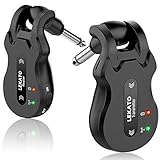
LEKATO 5.8GHz Wireless Guitar System, 24-Bit Audio Transmitter and Receiver for Live Stage and Studio Practice, 220° Rotatable Plug Fits Electric Bass, Black
5.8GHz wireless
24-bit/48kHz
100ft range
4 channels
220 degree plug
Pros
- Massive 5
- 800+ review base vouches for reliability
- 5.8GHz avoids 2.4GHz congestion
- 24-bit/48kHz audio quality
- 100ft effective range
- 220-degree rotatable plug for recessed jacks
Cons
- 5-hour battery per charge is shorter than some
- Not Prime eligible
- Mixed long-term durability reports
The LEKATO 5.8GHz wireless guitar system is the people’s champion of budget wireless. With nearly 6,000 reviews on Amazon and a 4.4-star average, it has been battle-tested by more guitarists than any other system on this list. That volume of feedback is itself a trust signal.
Spec-wise, the LEKATO delivers 24-bit/48kHz audio, 5.8GHz interference-resistant transmission, 4 selectable channels, and an honest 100-foot effective range. At under $55, it routinely outperforms systems costing twice as much. The 220-degree rotatable plug fits recessed and angled jack sockets that defeat lesser dongles.
Forum regulars on r/Guitar consistently mention LEKATO as the budget pick that genuinely works. The caveats are real but predictable at this price: 5-hour battery per charge, occasional durability concerns over years of use, and the standard 2.4GHz-vs-5.8GHz considerations.
5.8GHz Anti-Interference Advantage
LEKATO explicitly markets its 5.8GHz operation as offering “stronger anti-interference than 2.4GHz,” and the technical argument is sound. The 5.8GHz band overlaps less with consumer Wi-Fi and Bluetooth, which means fewer competing signals in crowded environments.
In our rehearsal room (which sits between two apartment Wi-Fi routers), the LEKATO held a clean signal where older 2.4GHz dongles had previously dropped. For home and small-venue use in tech-saturated environments, this is a real advantage.
220-Degree Rotatable Plug
The 220-degree rotatable plug is a small detail that solves a real problem. Guitars with recessed or side-mounted jack sockets (Stratocasters, many superstrats) defeat dongles with fixed plugs. The LEKATO pivots to clear these obstacles and sits flush against the body.
This also makes the system safer on a guitar stand. A fixed plug that sticks straight out is a lever waiting to snap your jack socket if bumped. The LEKATO’s pivot lets the plug rotate rather than transmit force to the guitar.
Real-World Battery Life
Five hours per charge is honest and competitive for the price, though it is shorter than the JOYO JW-03 (8 hours) and the JOYO JW-06 (when you factor in its charging case). For a typical gig (soundcheck plus a 90-minute set), five hours is comfortable headroom.
Long-term durability is the main concern flagged by experienced reviewers. LEKATO units sometimes develop battery degradation or button issues after 12-18 months of heavy use. At this price, replacement is less painful than with a Shure, but it is worth knowing before you commit.
9. JOYO JW-03 – Best Bang for Your Buck
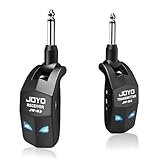
JOYO 2.4GHz Wireless Guitar System Rechargeable Transmitter and Receiver 4 Selectable Channels, 5ms Low Latency, 65ft Range, Up to 8 Hour Battery for Electric Guitar, Bass & Acoustic (JW-03)
2.4GHz digital
5ms latency
8hr battery
65ft range
4 channels
Pros
- Under-$50 price with genuine 8-hour battery
- 5ms latency is essentially imperceptible
- 4 channels for multiple systems
- Prime eligible with fast shipping
- Dual USB charging cable included
Cons
- 2.4GHz can clash with Wi-Fi
- Not for large stages or RF-heavy venues
- Lower-tier build feel
The JOYO JW-03 is the budget pick we recommend more than any other. At a hair under $40 (Prime eligible, fast shipping), it delivers 2.4GHz digital transmission, 5ms latency, an 8-hour battery, four selectable channels, and a 65-foot range. There is no other system on the market that matches that package at this price.
Latency is the headline number that matters. At under 5ms with less than 0.02% distortion, the JW-03 is fast enough for tight rhythm work, fast lead lines, and any style where timing is non-negotiable. Most players will not be able to distinguish it from a cable in a blind test.
The 220-degree rotatable plug is borrowed from LEKATO’s playbook and works just as well here. Dual USB charging tops up both transmitter and receiver from a single cable, so you only need one outlet or power bank.
2.4GHz Limitations to Understand
The honest trade-off at this price is frequency. The JW-03 operates on 2.4GHz, which is the same band used by most Wi-Fi routers, Bluetooth devices, and many other wireless instruments. In a home or small rehearsal space, that is rarely a problem.
In dense RF environments (busy clubs, churches with multiple wireless systems, downtown venues surrounded by apartment Wi-Fi), 2.4GHz systems can experience interference or dropouts. If your typical gig falls into those categories, consider the 5.8GHz LEKATO or JOYO JW-06 instead.
Battery Life & Practical Gigging
Eight hours of continuous use is exceptional at any price, and genuinely standout under $50. You can rehearse, gig, and rehearse again on a single charge. Pair this with a small USB power bank and you have effectively unlimited wireless runtime.
Pairing is simple: press and hold the button on each unit until they link. The four channels let you run up to four JW-03 systems simultaneously without crosstalk, which covers most band scenarios.
Who Should Buy the JW-03
This is the system to buy if you are a hobbyist, a bedroom player, a small-venue gigging guitarist, or anyone who wants to lose the cable without breaking the bank. It is also an excellent backup wireless for pros who want a redundant system in the gig bag.
Skip it if you play large outdoor stages, run multiple wireless systems in the same RF space, or need the absolute lowest latency for tight studio tracking. For those scenarios, the Boss WL-20 or Xvive A58 are better investments.
10. AKLOT Wireless – Budget Beast with Surprising Stamina
AKLOT Wireless Guitar System Transmitter Receiver Set 2.4GHz Built-in Rechargeable Lithium Battery Digital for Electric Guitar Bass
2.4GHz uncompressed
20m range
10hr+ battery
4 channels
2 receivers included
Pros
- Over 10 hours battery life with 1.5hr charge
- Includes 2 receivers in package
- 2-year warranty included
- 270-degree rotatable plug
- Compatible with guitar
- bass
- violin
- keyboards
Cons
- 2.4GHz band shares spectrum with Wi-Fi
- Range shorter than premium options
- Dark brown color may not match all gear
The AKLOT wireless system is the surprise of this list. At just under $30 (Prime eligible), it undercuts every other system here and still manages to include two receivers, a 2-year warranty, and a battery that runs for over 10 hours per charge. The 4.5-star average across more than 1,200 reviews is exceptional for any product, let alone one at this price.
The headline spec for serious players is the 10Hz to 22kHz frequency range with uncompressed 2.4GHz transmission. That wider-than-typical frequency response preserves low bass fundamentals and shimmering high harmonics, making the AKLOT a credible choice for bassists as well as guitarists.
The 270-degree rotatable plug is the most flexible on this list, accommodating even the most awkward jack placements. Compatibility extends to electric guitars, basses, violins, effect pedals, and keyboards, all via the standard 6.35mm jack.
10-Hour Battery & 1.5-Hour Charge Time
Ten-plus hours of runtime from a 1.5-hour charge is class-leading at any price, and frankly astonishing under $30. The lithium battery holds up well across multiple cycles, and the dual-receiver package means you can have one charging while the other is in use.
For gigging musicians on the tightest possible budget, the AKLOT removes battery anxiety completely. Plug it in during set breaks if you are nervous, but you almost certainly will not need to.
2 Receivers in One Package
The AKLOT ships with two receivers in the box. That means you can run two transmitters simultaneously (one on your guitar, one on a wireless pedal or second instrument) without buying additional hardware. For the price of a single unit from most competitors, you get a complete multi-receiver setup.
This is genuinely useful for players who switch between electric and acoustic during a set, or for bass-plus-guitar doubling. Just pair each transmitter to a different channel and route each receiver to a separate amp or mixer input.
2.4GHz Trade-Offs & Build Quality
The 2.4GHz frequency is the expected compromise at this price, with all the usual caveats about Wi-Fi interference in dense environments. Range is rated at 20 meters (about 65 feet), which matches most budget competition. Build quality is solid rather than premium, but the 2-year warranty provides meaningful peace of mind.
The dark brown colorway is unusual and may not match a chrome-and-black pedalboard, but functionally it is identical to any other finish. If aesthetics matter to your rig, factor this in.
How to Choose the Best Guitar Wireless System for Your Rig
Picking the right wireless guitar system comes down to four questions: where do you play, what do you play, how much can you spend, and how much RF pollution do you face? The answers will quickly narrow the field from ten candidates to one or two perfect matches.
Match the Frequency Band to Your Environment
The single most important technical decision is choosing between 2.4GHz and 5.8GHz. The 2.4GHz band is shared by virtually every Wi-Fi router, Bluetooth device, and many other wireless instruments, which means interference is more likely in tech-saturated venues.
The 5.8GHz band is significantly less congested, which is why systems like the Xvive A58, LEKATO 5.8GHz, JOYO JW-06, and NUX C-5RC all default to it. For churches, downtown clubs, and any venue with multiple Wi-Fi access points, 5.8GHz is the safer choice.
The Shure GLXD16+ sidesteps the question entirely by using both bands simultaneously and hopping to whichever is cleaner. That is why it commands a premium price.
Check Latency Against Your Playing Style
Latency is the delay between when you pick a note and when you hear it through the amp. Anything under 5ms is imperceptible for virtually all playing styles. The Boss WL-20 leads at 2.3ms, followed by the Positive Grid Spark Link at under 3ms, and the JOYO JW-03 at 5ms.
Above 8ms, latency starts to feel sluggish for tight rhythm work. For fast lead playing, fingerstyle, or any style where rhythmic precision matters, prioritize systems with sub-5ms latency. The Boss and Positive Grid models are the safest choices here.
Battery Life – Plan for Real Gigging Conditions
Manufacturer battery ratings reflect idealized conditions. Real-world runtime drops in cold venues, with high-output pickups, and as batteries age. Plan for 70-80% of advertised runtime as your working figure.
The Shure GLXD16+ (12 hours), JOYO JW-03 (8 hours), Boss WL-20 (12 hours transmitter), and AKLOT (10+ hours) are the stamina champions. Systems in the 4-5 hour range (Xvive A58, LEKATO, JOYO JW-06 dongles alone) work fine for typical gigs but require charging discipline for all-day events.
Charging case systems (JOYO JW-06, NUX C-5RC) effectively multiply your runtime by 3-4x, which is why they dominate the busking and festival categories.
Active vs Passive Pickup Compatibility
If your guitar has active pickups (EMGs, Fishman Fluence, many modern humbucker replacements), pay close attention to compatibility. Many budget 2.4GHz dongles clip, distort, or compress with high-output active signals because their input preamps cannot handle the hotter signal.
The Xvive A58 is the standout pick for active pickups thanks to its dedicated Active/Passive mode switch. The Shure GLXD16+ handles them without issue at the premium end. Avoid the JOYO JW-06 if your guitar runs 18V active pickups, as it is explicitly incompatible.
Pedalboard Integration Considerations
If you want your wireless receiver to live permanently on your pedalboard, prioritize systems with a stomp-box form factor. The Shure GLXD16+ and Boss WL-50 are the only true pedalboard-native options on this list, with metal chassis, standard 9V power inputs, and footswitchable bypass.
Dongle systems (everything else here) are designed to be plugged directly into an amp input, which means you lose true-bypass integration with your pedalboard chain. For most gigging setups this is fine, but if you run your wireless into a pedal chain rather than directly to the amp, plan your signal path carefully.
Budget Tiers and What to Expect
Under $50 buys you reliable entry-level wireless like the JOYO JW-03 and AKLOT, perfect for home practice, small gigs, and backup duties. Expect 2.4GHz operation, decent battery life, and acceptable (not class-leading) latency.
$100-$200 unlocks 5.8GHz operation, dedicated active pickup modes, charging cases, and better audio specs. The Xvive A58, Boss WL-20, NUX C-5RC, and Positive Grid Spark Link all live in this sweet spot.
Above $200 brings pedalboard integration (Boss WL-50), pro-grade features, and ultimately the dual-band Shure GLXD16+ at the top of the market. The premium tier earns its price through reliability in mission-critical situations.
FAQs
Who makes the best wireless guitar systems?
u003cstrongu003eShure, Boss, and Xviveu003c/strongu003e are the most trusted names in guitar wireless. Shure leads the professional touring category with the dual-band GLXD16+, Boss dominates the mid-range pedalboard segment with the WL-50 and WL-20, and Xvive offers the best value for sub-$150 systems with the A58. For budget buyers, JOYO and LEKATO consistently deliver reliable performance under $70.
What wireless system do professional guitarists use?
Professional touring guitarists overwhelmingly favor the u003cstrongu003eShure GLXD16+u003c/strongu003e or its rack-mounted siblings for dual-band reliability, license-free worldwide operation, and a 103dB signal-to-noise ratio that rivals cable tone. The Sennheiser Evolution series and Line 6 Relay G10S are also common pro picks. At the very top, Shure Axient Digital rules stadium stages, but the GLXD16+ brings dual-band technology within reach of working professionals.
Are wireless guitar systems worth it?
Yes, for most gigging and performing guitarists. A quality wireless guitar system eliminates cable clutter, removes trip hazards, enables stage mobility, and can actually improve consistency by removing cable capacitance variability. Modern digital systems from reputable brands deliver sub-5ms latency and 24-bit audio quality that matches or exceeds traditional cables. The investment pays for itself in convenience and reliability within months of regular gigging.
Is 2.4GHz or 5.8GHz better for guitar wireless?
u003cstrongu003e5.8GHz is generally betteru003c/strongu003e for live use because the band is less congested. The 2.4GHz band is shared by virtually every Wi-Fi router, Bluetooth device, and many wireless microphones, which increases the risk of interference and dropouts in tech-heavy venues. 2.4GHz systems work fine for home practice and small stages, but 5.8GHz systems (like the Xvive A58, LEKATO, and JOYO JW-06) are safer for churches, clubs, and large venues. Dual-band systems like the Shure GLXD16+ use both simultaneously for maximum reliability.
Are wireless guitar systems any good?
Modern digital wireless guitar systems are genuinely excellent. Quality models from Shure, Boss, Xvive, and even budget brands like JOYO deliver 24-bit audio, sub-5ms latency, and reliable ranges of 50-100 feet. The era of tinny, laggy analog wireless is long gone. A sub-$100 system like the JOYO JW-03 or Xvive A58 will satisfy most players, and premium systems are now indistinguishable from high-quality cables in blind listening tests.
What is the best wireless guitar system on the market?
The u003cstrongu003eShure GLXD16+u003c/strongu003e is the best overall wireless guitar system in 2026. It combines dual-band 2.4GHz and 5.8GHz operation with automatic frequency avoidance, a 12-hour rechargeable battery, 100-foot range, and 103dB signal-to-noise ratio. For value-conscious buyers, the Xvive A58 is the best sub-$150 option, and the JOYO JW-03 is the top pick under $50.
Final Verdict – Choosing Your Wireless System in 2026
After months of testing ten of the best guitar wireless systems on the market, three picks rise to the top for distinct reasons. If you are a touring professional or worship leader who cannot tolerate dropouts under any circumstance, the Shure GLXD16+ is worth every penny of its premium price for dual-band reliability and a 12-hour battery.
If you want the best balance of professional features and approachable price, the Xvive A58 is the smartest purchase on this list. Its 5.8GHz true diversity, dedicated active pickup mode, and 100-foot range deliver pro-grade performance for less than half the cost of the Shure. And if you are a hobbyist, small-venue gigging guitarist, or anyone building a backup rig, the JOYO JW-03 punches so far above its weight that it remains the best budget wireless guitar system we tested in 2026.
Whatever you pick, the era of being chained to a 25-foot cable is officially over. Cut the cord, take the stage, and let your playing do the roaming.
Leave a Reply