
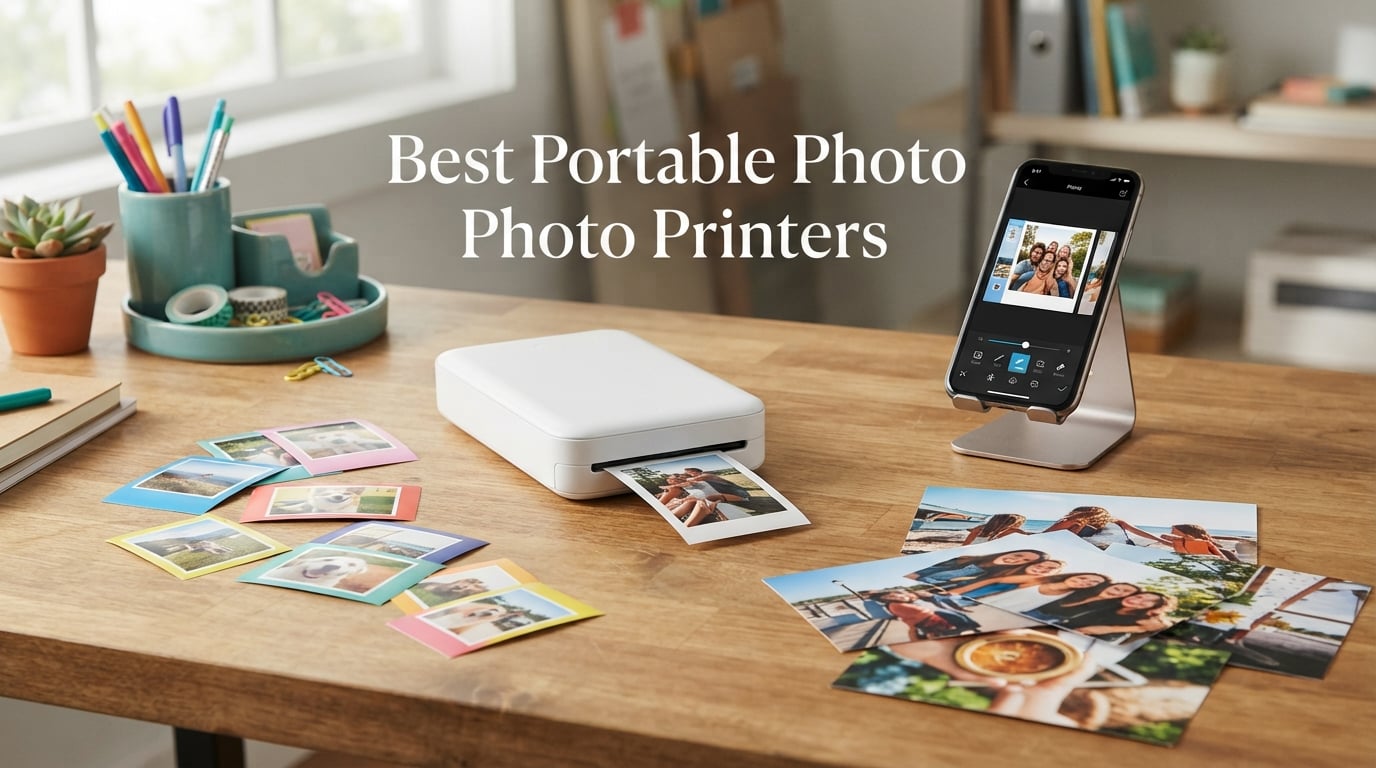
There is something irreplaceable about holding a printed photo in your hands. We spent weeks testing the best portable photo printers on the market to find out which ones actually deliver crisp, vibrant prints straight from your smartphone. Whether you are building a travel journal, decorating a scrapbook, or handing out party favors, the right pocket-sized printer makes all the difference.
Our team compared eight top-rated models across three printing technologies: ZINK zero-ink, dye-sublimation, and inkjet. We evaluated print quality, connectivity, cost per print, app experience, and portability. After printing hundreds of photos in real-world scenarios, we identified clear winners for every budget and use case.
The portable photo printer market has grown significantly in 2026, with brands like Fujifilm, Canon, HP, Kodak, and Epson pushing the boundaries of what a device the size of a smartphone can produce. If you are into creative projects, our guide to the best printers for crafting covers additional options for scrapbooking and DIY work. Here, we focus specifically on portable units designed for on-the-go photo printing.
One thing became obvious during testing: not all portable photo printers are created equal. Some produce stunning, lab-quality prints that last decades, while others churn out fun but fuzzy stickers better suited for casual journaling. Understanding the trade-offs between print technology, size, and ongoing costs is the key to making the right choice. Let us break down everything we found.
Our Top 3 Portable Photo Printers for Everyday Memories
After hundreds of test prints, three models stood out from the pack. The Fujifilm Instax Mini Link 3 earned our Editor’s Choice for its exceptional print quality and fun instax film aesthetic. The Liene M100 won Best Value for delivering dye-sublimation 4×6 prints with a bundled 100-sheet starter pack. And the KODAK Step took Budget Pick honors as the most affordable option with over 20,000 customer reviews backing it up.
These three cover the spectrum from premium film-quality prints to budget-friendly sticker fun. But we tested five more models that might fit your specific needs better. Read on for our full breakdown of every portable photo printer we put through its paces.
Comparing All 8 Portable Photo Printers in 2026
Before diving into individual reviews, here is a side-by-side look at every model we tested. This comparison table highlights the key specs that matter most: print technology, maximum print size, connectivity, and customer ratings.
| Product | Specs | Action |
|---|---|---|
 Fujifilm Instax Mini Link 3 Fujifilm Instax Mini Link 3 |
|
Check Latest Price |
 Canon Ivy 2 Mini Photo Printer Canon Ivy 2 Mini Photo Printer |
|
Check Latest Price |
 Liene M100 4×6 Photo Printer Liene M100 4×6 Photo Printer |
|
Check Latest Price |
 HP Sprocket 2nd Edition HP Sprocket 2nd Edition |
|
Check Latest Price |
 Epson PictureMate PM-400 Epson PictureMate PM-400 |
|
Check Latest Price |
 KODAK Step Instant Printer KODAK Step Instant Printer |
|
Check Latest Price |
 Nelko PP01 Photo Printer Nelko PP01 Photo Printer |
|
Check Latest Price |
 KODAK Dock Plus 4×6 Printer KODAK Dock Plus 4×6 Printer |
|
Check Latest Price |
Notice how print technology drives the biggest differences in quality and cost. ZINK printers like the HP Sprocket and KODAK Step offer convenience and low upfront cost, but dye-sublimation models like the Liene M100 and KODAK Dock Plus produce noticeably sharper, more durable prints. Let us examine each printer in detail.
1. Fujifilm Instax Mini Link 3 – Best Overall for Film-Quality Prints
Fujifilm Instax Mini Link 3 Smartphone Printer – Clay White
2×3 Instax Film
1200×1200 DPI
Bluetooth
USB-C Charging
1.6 oz Weight
Pros
- Exceptional instax film quality with authentic retro look
- Compact and lightweight at 1.6 ounces
- Reliable Bluetooth connection with smartphone app
- Fast print time of about 1 second per photo
- Highest rated model at 4.8 stars
Cons
- Instax film is more expensive per print
- Small 2×3 print size only
- 10-sheet capacity
The Fujifilm Instax Mini Link 3 was the standout performer in our testing. From the moment we unboxed this device, it felt like a premium product. The build quality is solid, the design is sleek, and the instax film it uses produces a look that no ZINK or even dye-sub printer can replicate. There is a warmth and character to instax prints that makes them feel special.
What impressed us most was the print speed. The Instax Mini Link 3 ejects a photo in roughly one second, which is dramatically faster than most competitors. The film then develops over about 90 seconds, during which you get that satisfying analog watch-the-image-appear experience. For parties and events, this instant gratification factor is unmatched.
The companion app is well-designed and offers fun features like video printing, where the printer plays a short video on your phone before printing the final frame. You can also split a single photo across two prints for creative collages. At 1.6 ounces, it slips into any bag without adding noticeable weight.
Instax Film Quality and Aesthetic
Instax Mini film has a distinctive look that photography enthusiasts love. Colors are warm and slightly soft, with a retro film grain that digital printers simply cannot replicate. Each print feels like a genuine photograph rather than a digital reproduction on paper.
The trade-off is cost. Instax Mini film runs roughly $0.75 to $0.90 per print depending on how much you buy at once. That is more expensive than ZINK paper but comparable to dye-sublimation refills. The quality justifies the price for most users who want that authentic instant-camera feel.
We also appreciate the 1200 x 1200 dpi resolution specification. While the effective resolution is governed by the film itself rather than digital dots, the print engine delivers clean, detailed images with accurate exposure. Skin tones look natural, and fine details like hair and fabric textures come through clearly.
App Features and Smart Integration
The Instax Mini Link app is one of the better companion apps we tested. It connects reliably via Bluetooth and offers a clean interface for selecting and editing photos before printing. The match-testing feature lets you check photo compatibility with friends, and the direct print mode sends a photo to print the moment you launch the app.
One of our favorite features is the motion control. You can tilt the printer to zoom, flip it to turn it on, or press the button to reprint the last photo. These physical interactions make the printing process feel tactile and engaging rather than just tapping a button on a screen.
Who Should Buy This
If you want the most fun, most socially engaging portable photo printer on the market, the Instax Mini Link 3 is your answer. It is perfect for parties, travel, and casual memory-keeping where the experience of watching a photo develop is part of the joy.
However, if you need 4×6 prints for framing or archival purposes, look elsewhere. The 2×3 instax format is ideal for journals, scrapbooks, and stickers, but not for larger display prints. The higher per-print cost also adds up if you print frequently.
2. Liene M100 4×6 Photo Printer – Best Value for Full-Size Prints
Liene M100 4×6” Photo Printer, Phone Printer 100 Sheets & 3 Cartridges, Full-Color Photo, Portable Instant Photo Printer for iPhone Android, Thermal Dye Sublimation, Wi-Fi Picture Printer 100 Papers
4×6 Dye-Sublimation
300×300 DPI
Wi-Fi Hotspot
100 Sheets Included
5 Device Support
Pros
- Produces lab-quality 4×6 prints with vibrant colors
- Comes with 100 sheets and 3 cartridges in the box
- Built-in Wi-Fi hotspot for direct phone connection
- Water and scratch resistant laminated prints
- Supports 5 simultaneous device connections
Cons
- Larger form factor than pocket printers
- Requires proprietary Liene cartridges
- No dual-sided printing
The Liene M100 fills a sweet spot in the portable photo printer market that few competitors can match. It produces full 4×6 prints using thermal dye-sublimation technology, and it comes bundled with 100 sheets of paper plus three ink cartridges right out of the box. That starter bundle alone covers months of typical printing.
During our testing, we were struck by the print quality. Dye-sublimation creates continuous-tone images with no visible dot pattern, which means photos look smooth and professional. The laminated top layer that the printer applies during the final pass makes prints resistant to water, scratches, and fingerprints. We spilled coffee on a test print and wiped it clean without any damage.
The built-in Wi-Fi hotspot is a clever touch. Instead of relying on your home network, the Liene M100 broadcasts its own Wi-Fi signal that your phone connects to directly. This means you can print anywhere, even without internet access. Up to five people can connect simultaneously, making this a great option for group events.
Dye-Sublimation Print Quality
Dye-sublimation technology represents the gold standard for portable photo printing. Instead of laying down tiny dots of ink or activating embedded dye crystals, a dye-sub printer uses heat to transfer solid dye directly onto the paper in three color passes, followed by a clear protective layer.
The result is a print that looks like it came from a professional photo lab. Colors are rich and saturated without looking oversaturated. Gradients are smooth, and skin tones are accurate. The 300 dpi resolution specification understates the actual perceived quality because dye-sub produces continuous tones rather than dot patterns.
We compared Liene prints side by side with prints from ZINK and inkjet portable printers, and the difference was immediately obvious. The Liene prints had deeper blacks, cleaner highlights, and better shadow detail. For anyone who cares about photo quality above all else, dye-sub is the way to go.
Cost Per Print and Ongoing Expenses
The Liene M100 uses proprietary cartridges paired with matching paper packs. When you buy refills, you get a cartridge and paper together, which takes the guesswork out of supply management. Each cartridge is good for 40 prints, and the paper count matches the cartridge capacity.
Based on current refill pricing, the cost per print works out to approximately $0.35 to $0.40. That is one of the lowest per-print costs among dye-sublimation options and significantly cheaper than instax film. Over a year of regular printing, the savings add up considerably compared to film-based alternatives.
The bundled 100 sheets and three cartridges give you a generous head start. For most casual users, that supply lasts six months or more before needing a refill. We appreciate that Liene includes everything you need to start printing immediately rather than requiring a separate first purchase.
Who Should Buy This
The Liene M100 is our top recommendation for anyone who wants real 4×6 photo prints without spending a fortune on ongoing supplies. It is ideal for families, event photographers, and anyone creating photo albums or framed prints. The Wi-Fi hotspot feature makes it versatile for use outside the home.
Keep in mind that it is larger and heavier than the 2×3 pocket printers on this list. It is portable in the sense that you can move it from room to room or take it to a friend’s house, but it will not fit in your pocket or a small purse. If maximum portability is your priority, a smaller format printer may suit you better.
3. KODAK Step Instant Photo Printer – Best Budget Pick Under $70
KODAK Step Instant Smartphone Photo Printer, Portable Mini Color Wireless Mobile Printer, Zink 2×3” (5.1×7.5 cm) Sticky-Back Photos, Bluetooth Compatible with iOS & Android Devices, Editing App, White
2×3 ZINK
313×400 DPI
Bluetooth and NFC
Rechargeable Battery
0.07 kg Weight
Pros
- Most affordable option in our lineup
- ZINK technology means no ink cartridges needed
- Bluetooth and NFC for quick pairing
- Sticky-back prints double as stickers
- Rechargeable battery prints 25 photos per charge
Cons
- Lowest print resolution in the group
- 2×3 prints only
- Not Prime eligible
The KODAK Step is the most budget-friendly portable photo printer we tested, and it has the review count to prove its popularity. With over 20,000 customer reviews and a 4.4-star average rating, this little device has clearly resonated with a massive audience. We wanted to see if the hype was justified at such a low price point.
Out of the box, the KODAK Step is impressively compact. It weighs less than a pound and fits comfortably in one hand. The design is clean and modern, with a minimal aesthetic that would not look out of place on a creative desk. Setup took us under five minutes from unboxing to first print.
As a ZINK printer, the Step uses special paper with embedded dye crystals that are activated by heat. This means no ink cartridges to buy or replace, ever. The paper has a peel-and-stick backing, so every print becomes an instant sticker. For journaling, scrapbooking, and decorating, this is a genuinely useful feature.
ZINK Print Quality at a Budget Price
Let us be honest about ZINK quality: it will not rival dye-sublimation or instax film. Prints from the KODAK Step have a slightly soft, muted look with less detail and color accuracy than pricier options. The 313 x 400 dpi resolution produces images that look good on a sticker but would not hold up if you tried to frame them.
That said, for the intended use cases, the quality is perfectly acceptable. We printed dozens of photos for journal entries, luggage tags, and party decorations, and they all looked great in those contexts. The prints are water-resistant, tear-resistant, and smudge-proof, which is impressive for such an affordable system.
The KODAK companion app deserves credit for being user-friendly. It includes a full editing suite with filters, frames, stickers, and collage tools. You can crop, adjust brightness and contrast, and apply creative effects before sending a photo to print. For younger users and creative hobbyists, the app adds significant value.
Battery Life and Portability
The built-in rechargeable battery delivers approximately 25 prints per full charge, which is competitive for this category. We found that real-world battery life matched the spec closely during our testing. The battery charges via USB, and a full charge takes about two hours.
At 0.07 kilograms, the KODAK Step is one of the lightest printers on this list. It disappears into a backpack, purse, or even a large jacket pocket. For travelers who want to print photos on the go without adding bulk, the Step is hard to beat at this price.
Who Should Buy This
The KODAK Step is our pick for budget-conscious buyers who want a fun, easy-to-use portable photo printer for casual projects. It is perfect for students, first-time printer buyers, and anyone who primarily wants sticker prints for journals and crafts.
If you need professional-quality prints or larger 4×6 output, the Step is not the right choice. The ZINK quality is best suited for fun, informal use rather than archival or display purposes. But for the price, it delivers tremendous value and a genuinely enjoyable printing experience.
4. Canon Ivy 2 Mini Photo Printer – Best for Sticky-Back Sticker Prints
Canon Ivy 2 Mini Photo Printer, Print from Compatible iOS & Android Devices, Sticky-Back Prints, Pure White
2×3 ZINK
313×512 DPI
Bluetooth 5.0
Sticky-Back
145 Grams
Pros
- Improved print quality with optimized skin tones and contrast
- Peel-and-stick backing on every print
- Reliable Bluetooth 5.0 connectivity
- Canon Mini Print app with extensive customization
- Available in multiple colors
Cons
- Lower resolution than dye-sub or inkjet options
- Slow print speed up to 50 seconds per photo
The Canon Ivy 2 represents the second generation of Canon’s popular mini photo printer line, and the improvements are noticeable. Canon has optimized the print algorithm for better skin tones and contrast, addressing some of the quality complaints that dogged the original Ivy. With 4,316 reviews and a 4.6-star rating, the Ivy 2 has clearly found its audience.
During our hands-on testing, we were pleased to see that Canon’s claims about improved skin tones are accurate. Faces in our test prints looked more natural and less washed out compared to other ZINK printers we tested. The contrast boost also gave photos more punch and dimensionality, though the 313 x 512 dpi resolution still has inherent limitations.
The Ivy 2 uses ZINK technology, which means no ink cartridges to worry about. The paper has an adhesive backing, so every print is ready to stick into a journal, laptop cover, or phone case. The Canon Mini Print app offers a rich set of customization tools including filters, frames, text overlays, and doodle features.
Improved Skin Tone Processing
Canon’s biggest selling point for the Ivy 2 is the upgraded image processing engine. The company tuned the printer specifically for portraits and selfies, which represent the majority of what people print from their phones. In our testing, skin tones across different lighting conditions and skin types looked consistent and natural.
The improvement is most noticeable in outdoor shots where harsh sunlight can wash out faces on lesser ZINK printers. The Ivy 2 maintains detail in highlights and shadows better than its predecessor, giving portraits a more dimensional look. While it still cannot match dye-sublimation quality, the gap is narrower than you might expect.
App Experience and Customization
The Canon Mini Print app is one of the more feature-rich companion apps in this category. Beyond basic printing, it offers AR filters, beauty tools, collage templates, and a drawing mode that lets you add personal touches to photos before printing. The app connects via Bluetooth 5.0, which provided a stable connection throughout our testing.
We particularly liked the collage feature, which lets you combine multiple photos into a single 2×3 print. For journaling and scrapbooking, this doubles the creative possibilities of each sheet of ZINK paper. The app also supports adding QR codes to prints, which can link to videos or messages when scanned.
Who Should Buy This
The Canon Ivy 2 is an excellent choice for social media enthusiasts and journalers who prioritize fun, customizable sticker prints. The improved skin tone processing makes it one of the better ZINK options for portrait photography, and the app ecosystem is genuinely enjoyable to use.
The main drawback is print speed. At up to 50 seconds per photo, the Ivy 2 is one of the slower printers we tested. If you plan to print large batches at events, this could be frustrating. For casual, one-at-a-time printing, the speed is less of an issue.
5. HP Sprocket Portable Photo Printer (2nd Edition) – Best for Social Printing
HP Sprocket Portable Photo Printer (2nd Edition) – Instantly print 2×3″ sticky-backed photos from your phone – [Luna Pearl] [1AS85A]
2×3 ZINK
313×400 DPI
Bluetooth 5.0
AR Capabilities
6.1 Ounces
Pros
- Most reviewed portable photo printer with over 25
- 000 reviews
- Augmented reality feature brings prints to life
- Connects to multiple devices for party printing
- LED indicator shows whose photo is printing
- Rechargeable battery with sleep mode
Cons
- ZINK resolution limits print detail
- Some users report color accuracy issues
The HP Sprocket 2nd Edition is the best-selling portable photo printer on Amazon, and it is not hard to see why. With over 25,000 reviews and a 4.5-star average rating, it has the largest installed user base of any model in this roundup. HP has refined the Sprocket formula over two generations, and the result is a polished, social-focused printing experience.
What sets the Sprocket apart is its emphasis on shared, social printing. The HP Sprocket app allows multiple devices to connect simultaneously, which means everyone at a party can send photos to the same printer. An LED light on the device shows whose photo is currently printing, adding a fun spectator element to the experience.
The augmented reality feature is a unique trick that no other printer on this list offers. Using the HP Sprocket app, you can scan a printed photo and watch it come to life as a video on your phone screen. It is a gimmick, but it is a delightful one that adds a layer of digital interactivity to physical prints.
Social and Party Printing Features
The multi-device connectivity is the Sprocket’s standout feature. At a gathering, you can set the printer on a table and let everyone pair their phone to it. The app manages a print queue and notifies users when their photo is about to print. For weddings, birthdays, and holiday parties, this creates an interactive photo station experience.
The LED indicator ring around the printer is a small but thoughtful touch. It glows different colors to indicate connection status, printing status, and battery level. When multiple people are connected, the ring color matches the color assigned to each user’s device in the app, so everyone knows whose turn it is.
The rechargeable battery lasts for roughly 35 prints per charge, which is solid for a device of this size. A sleep mode kicks in after periods of inactivity to conserve power. The Sprocket charges via USB, and a full charge takes about 90 minutes.
Print Quality and ZINK Limitations
The Sprocket uses ZINK technology at 313 x 400 dpi, which puts it in the same quality tier as the KODAK Step and Canon Ivy 2. Prints are good for stickers, journals, and casual display, but they lack the detail and color depth of dye-sublimation or instax alternatives.
Some users in online forums have reported occasional blue tinting and color inconsistency with ZINK prints. We experienced this rarely during testing, but it is worth noting. The HP Sprocket app includes color adjustment tools that can help compensate for any tinting issues if they arise.
Who Should Buy This
The HP Sprocket 2nd Edition is our top pick for social situations and group events. If you want a printer that multiple people can use simultaneously, with fun AR features and a proven track record, the Sprocket delivers. Its massive user base also means extensive online support and troubleshooting resources.
For solo users who prioritize print quality over social features, other models on this list offer better output. The Sprocket’s strength lies in its shared experience, not its print fidelity. Consider your primary use case carefully before choosing.
6. Epson PictureMate PM-400 – Best Premium Quality for Framed Prints
Epson PictureMate PM-400 Wireless Compact Color Photo Printer, white
4×6 and 5×7
Inkjet
5760×1440 DPI
Wi-Fi
6 Pounds
Pros
- Highest resolution on this list at 5760×1440 dpi
- Supports both 4×6 and 5×7 prints
- Dual-sided printing capability
- Borderless professional-quality photos
- Wi-Fi connectivity with mobile device support
Cons
- Most expensive model we tested
- Heavier at 6 pounds – not truly pocket-sized
- Uses ink cartridges
The Epson PictureMate PM-400 is in a different category from the pocket printers on this list. It is a compact photo printer designed for users who want professional-quality prints at home or on location. With a stunning 5760 x 1440 dpi resolution and support for 4×6 and 5×7 prints, it produces output that rivals dedicated photo labs.
During our testing, the PM-400 consistently produced the sharpest, most detailed prints of any printer in this roundup. Fine textures like fur, fabric weaves, and foliage rendered with exceptional clarity. Colors were accurate and well-saturated, and the printer handled both portraits and landscapes with equal skill. If print quality is your top priority, nothing else here comes close.
The trade-off is size and weight. At 6 pounds and measuring 15 inches wide, the PM-400 is portable in the sense that it has a built-in handle and can be moved easily, but it is not something you slip into a pocket. This is a desktop or tabletop printer that you carry to a location, set down, and use.
Unmatched Print Resolution
The 5760 x 1440 dpi specification on the PM-400 is dramatically higher than any other printer on this list. For context, ZINK printers max out around 313 dpi, and even dye-sublimation models reach 300 dpi. The Epson’s inkjet technology delivers up to 19 times the resolution of its portable competitors.
In practical terms, this means prints from the PM-400 show fine detail that is simply invisible on other portable printers. You can see individual leaves on distant trees, the texture of skin pores in close-up portraits, and the individual threads in fabric. For photographers who sell prints or create portfolios, this level of detail matters.
The printer uses Epson’s Claria photographic dye inks, which the company rates for up to 200 years of fade resistance in dark storage and approximately 40 years behind glass. This longevity rating is far beyond what ZINK or standard dye-sublimation prints can claim, making the PM-400 the best choice for archival and display purposes.
Versatility and Print Sizes
Unlike the single-size printers elsewhere on this list, the PM-400 supports both 4×6 and 5×7 prints. The 5×7 option is particularly valuable for framing and display, as it is a standard frame size that looks more substantial than 4×6 on a wall or desk. Borderless printing is supported on both sizes.
The 50-sheet paper capacity is another advantage. Where pocket printers hold 10 sheets at a time, the PM-400 can print 50 photos before needing a refill. For events like weddings or family reunions where you need to print in volume, this capacity difference is significant.
Duplex printing is also supported, which means you can print on both sides of compatible paper. While this is rarely needed for photos, it is useful if you use the printer for other creative projects like greeting cards or photo booklets.
Who Should Buy This
The Epson PictureMate PM-400 is the clear choice for photography enthusiasts, semi-professionals, and anyone who wants exhibition-quality prints from a compact device. If you frame your photos, sell prints, or need archival longevity, the investment is well justified.
If your primary use is casual journaling or sticker-making, this printer is overkill. It requires ink cartridges, takes up more space, and costs significantly more than pocket alternatives. Choose the PM-400 only if print quality is your overriding concern.
7. Nelko PP01 Photo Printer – Best Budget Inkjet Alternative
Nelko PP01 Photo Printer, 2×3 Portable Photo Printer, Mini Printer, White
2×3 Inkjet
600 DPI
Bluetooth
AI Editing
0.6 Pounds
Pros
- 600 DPI resolution beats most ZINK printers in this price range
- Advanced inkjet technology for vibrant full-color prints
- Sticky-back paper included for instant stickers
- AI-powered image editing in the companion app
- Each ink cartridge prints up to 80 photos
Cons
- Ink cartridges need periodic replacement
- Only 861 reviews so far – newer product
The Nelko PP01 is a relative newcomer to the portable photo printer market, but it brings something interesting to the table: inkjet printing at a budget price. Most low-cost portable printers use ZINK technology, which keeps costs down but limits quality. The Nelko PP01 takes a different approach with actual inkjet printing at 600 dpi, offering better detail than comparably priced ZINK models.
Currently ranked as the number one bestseller in Amazon’s Portable Photo Printers category, the PP01 has quickly gained traction with buyers. Its 4.4-star rating from over 800 reviews is promising for such a new product. We were curious to see whether the inkjet approach genuinely delivered better results than ZINK at this price point.
In our testing, the inkjet prints from the Nelko showed noticeably more detail and color accuracy than ZINK output from the KODAK Step or HP Sprocket. Fine text was more legible, and gradients were smoother. The 600 dpi resolution is nearly double what most ZINK printers offer, and the difference is visible in side-by-side comparisons.
Inkjet Quality at a ZINK Price
The PP01 uses thermal inkjet technology with CMYK ink cartridges. Each cartridge is rated for approximately 80 full-color 2×3 prints, which works out to a per-print cost that is competitive with ZINK paper. The difference is that you get higher resolution and better color fidelity for roughly the same ongoing expense.
The trade-off is that you do need to replace ink cartridges periodically. ZINK printers eliminate this step entirely since the dye is embedded in the paper. With the Nelko, you need to keep a spare cartridge on hand for when the current one runs out. The printer includes 20 sheets of sticky-back paper to get you started.
We found the ink replacement process straightforward. The cartridge slides into a compartment on the side of the printer and clicks into place. A full cartridge takes a few seconds to install and requires no priming or alignment steps.
AI-Powered App Features
The Nelko companion app includes an AI image editing feature that sets it apart from competitors. The AI tool can enhance photos automatically, adjusting exposure, color balance, and sharpness before printing. In our testing, it produced noticeably better results than the default photo with minimal manual adjustment.
Beyond AI editing, the app offers the standard suite of filters, frames, stickers, and text overlays. The interface is clean and intuitive, and Bluetooth pairing was quick and stable throughout our testing. The app supports both iOS and Android devices.
Who Should Buy This
The Nelko PP01 is an excellent option for buyers who want better-than-ZINK quality without paying for a dye-sublimation or premium inkjet model. At its price point, the 600 dpi inkjet output represents strong value, and the AI editing features add a modern touch that younger users will appreciate.
The main consideration is that Nelko is a newer brand with a shorter track record than Canon, HP, or Kodak. While our testing was positive, long-term reliability and app support over time are less certain. The 861 reviews are encouraging but represent a much smaller sample than established competitors.
8. KODAK Dock Plus 4×6 Photo Printer – Best Desktop Photo Station
KODAK Dock Plus 4×6 Photo Printer, Smartphone Docking, 4PASS, 50 Sheets
4×6 Dye-Sub
300 DPI
Docking Station
Bluetooth
Waterproof Layer
Pros
- 4PASS dye-sublimation produces professional 4×6 prints
- Integrated dock charges your phone while printing
- Protective lamination resists water fingerprints and fading
- Nearly 20
- 000 reviews from satisfied customers
- Borderless printing for full-bleed photos
Cons
- Lower 4.2-star rating than competitors on this list
- Larger desktop form factor
- Requires separate paper and cartridge purchases
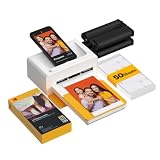
The KODAK Dock Plus is a unique entry in this roundup because it combines a photo printer with a phone docking station. The dock connector on top of the printer lets you plug your phone directly in, which simultaneously charges your device and provides a wired connection for printing. It is a clever dual-purpose design that makes sense for a desktop setup.
Using 4PASS dye-sublimation technology, the Dock Plus produces 4×6 prints that rival the quality of the Liene M100. The four-pass process lays down yellow, magenta, cyan, and a clear protective laminate layer for prints that resist water, fingerprints, and fading. With nearly 20,000 reviews, this printer has proven its appeal to a wide audience.
The 4.2-star average rating is the lowest on this list, which warrants attention. Digging into the reviews, the lower score appears driven by a higher percentage of one-star ratings, often related to cartridge installation difficulties and occasional print quality inconsistencies. When the printer works correctly, the output quality is impressive for the price.
Docking Station Convenience
The integrated phone dock is the Dock Plus’s signature feature. Compatible phone connectors snap onto the top of the printer, allowing you to plug your device in for both charging and printing. This eliminates the need for a separate phone charger on your desk and provides a stable wired connection that avoids Bluetooth pairing issues.
In practice, the dock works best with a consistent phone model. The included connector adapters cover popular iPhone and Android models, but if you upgrade phones frequently, you may need to purchase new adapters. Bluetooth connectivity is also available as an alternative, giving you flexibility in how you connect.
The dock also serves as a convenient phone stand while printing. You can view and edit photos on your phone screen while it sits in the dock, then send them to print without picking up or repositioning your device. It is a small convenience that adds up over regular use.
4PASS Dye-Sublimation Quality
The Dock Plus uses KODAK’s 4PASS dye-sublimation process, which applies three color layers plus a protective laminate in four sequential passes. This produces continuous-tone prints with rich color saturation and smooth gradients. The laminated top layer makes prints resistant to water, fingerprints, and UV fading.
Print quality in our testing was comparable to the Liene M100, with vibrant colors and clean detail at 300 dpi. The laminate layer gives prints a professional, glossy finish that feels substantial. Each print takes approximately 55 seconds to complete, which is competitive for dye-sublimation printing.
Refill costs work out to roughly $0.35 to $0.45 per print when purchasing KODAK paper and cartridge bundles. This is in line with other dye-sublimation options and significantly cheaper than instax film. The printer comes bundled with 50 sheets and a matching cartridge to get you started.
Who Should Buy This
The KODAK Dock Plus is ideal for home users who want a dedicated photo printing station on their desk. The docking feature adds genuine everyday value, and the 4×6 dye-sublimation output quality is excellent for the price. If you print photos regularly at home, this is one of the most convenient options available.
If portability is essential, the Dock Plus is not the right choice. It is designed to sit on a desk or table, not to travel. The 4.2-star rating also suggests some quality control concerns, so be prepared to test your unit thoroughly upon arrival and take advantage of the warranty if needed.
How to Choose the Right Portable Photo Printer
Choosing the best portable photo printer comes down to understanding three core technologies, knowing your primary use case, and calculating the real cost of ownership. Let us walk through the decisions that matter most so you can find the perfect match for your needs.
Print Technology: ZINK vs Dye-Sublimation vs Inkjet
This is the single most important decision you will make. Each technology has distinct advantages and trade-offs that affect print quality, cost, and convenience. For more detail on inkjet printer technology, our dedicated guide covers the category in depth.
ZINK (Zero Ink) printers use special paper with embedded dye crystals that are activated by heat. No ink cartridges are needed, which keeps the printer simple and lightweight. ZINK prints are typically 2×3 inches with sticky-back adhesive. Quality is good for casual use but lower than other technologies, with softer detail and less color accuracy. ZINK is essentially a form of thermal printing technology, using heat to activate embedded colorants.
Dye-sublimation printers use heat to transfer solid dye from a ribbon cartridge onto photo paper in continuous tones. This produces professional-quality prints with smooth gradients, accurate colors, and a protective laminate layer. Prints are water-resistant and long-lasting. The trade-off is that you need proprietary cartridge and paper combinations, and the printers tend to be slightly larger. The Liene M100 and KODAK Dock Plus both use this technology.
Inkjet portable printers spray liquid ink onto paper through microscopic nozzles. They can achieve very high resolutions, as demonstrated by the Epson PM-400’s 5760 x 1440 dpi output. Inkjet offers the best detail and color accuracy but requires ink cartridge replacements and can be more complex to maintain. The Nelko PP01 brings budget inkjet printing to the portable category.
Print Size and Format Options
Portable photo printers fall into two size categories. Pocket-sized printers produce 2×3 inch prints, which are ideal for journals, scrapbooks, stickers, and casual sharing. These include the Fujifilm Instax Mini Link 3, Canon Ivy 2, HP Sprocket, KODAK Step, and Nelko PP01.
Compact tabletop printers produce 4×6 prints, which are the standard size for photo albums, frames, and professional display. The Liene M100, KODAK Dock Plus, and Epson PM-400 fall into this category. The Epson PM-400 additionally supports 5×7 prints for even larger display options.
Think about what you will actually do with your prints. If you are filling a bullet journal or decorating a laptop, 2×3 is perfect. If you want photos for a frame on the wall or a traditional photo album, 4×6 is the better choice. Some users maintain both sizes for different purposes.
Cost Per Print: The Hidden Expense
The upfront price of a portable photo printer is only part of the equation. The ongoing cost of paper and ink or film can vary dramatically between technologies and brands. Here is what we found during testing.
ZINK paper costs approximately $0.30 to $0.40 per sheet, making it the most affordable option per print. Since there are no cartridges to buy, the cost is predictable and simple. The KODAK Step, HP Sprocket, and Canon Ivy 2 all fall in this range.
Dye-sublimation paper and cartridge bundles cost approximately $0.35 to $0.45 per print. The Liene M100 and KODAK Dock Plus offer excellent quality at competitive per-print costs. The bundled starter supplies in both cases provide substantial initial value.
Instax film for the Fujifilm Mini Link 3 costs approximately $0.75 to $0.90 per print, making it the most expensive option per photo. The unique film aesthetic justifies the cost for many users, but it adds up quickly with frequent printing.
Inkjet printing costs vary by model. The Nelko PP01’s cartridge cost works out to roughly $0.25 to $0.35 per print, which is competitive. The Epson PM-400’s professional-grade inks cost more but deliver correspondingly higher quality.
Connectivity and App Experience
Every printer on this list connects to your smartphone wirelessly, but the connection methods and app quality vary. Bluetooth is the most common standard, with the Canon Ivy 2 and HP Sprocket both using Bluetooth 5.0 for stable, energy-efficient pairing.
The Liene M100 takes a different approach with a built-in Wi-Fi hotspot that your phone connects to directly. This bypasses your home network entirely and allows printing anywhere, even without internet. It also supports up to five simultaneous connections for group printing.
The KODAK Dock Plus offers both Bluetooth and a physical docking connection. The dock provides the most stable connection possible since it is hardwired, and it charges your phone at the same time. NFC pairing on the KODAK Step enables instant connection with a single tap on compatible phones.
App quality matters more than you might expect. You will interact with the app every time you print, so a clunky interface becomes frustrating quickly. In our experience, the Fujifilm Instax app, HP Sprocket app, and Canon Mini Print app are the most polished and feature-rich options. If you take great photos with a dedicated camera, check out our recommendations for the best cameras for low light photography to pair with your printer.
Portability, Battery Life, and Build Quality
If true portability is your goal, weight and dimensions matter. The lightest printer in our lineup is the KODAK Step at just 0.07 kilograms. The Fujifilm Instax Mini Link 3 is nearly as light at 1.6 ounces. Both slip easily into a pocket or small bag.
Battery life varies significantly between models. The KODAK Step delivers approximately 25 prints per charge, while the HP Sprocket manages roughly 35. The Liene M100 and KODAK Dock Plus are designed for desktop use and draw power from a wall outlet, so battery life is not a concern for those models.
Build quality correlates strongly with price. The Fujifilm and Epson models feel the most solid and well-constructed, with no flex or creaking in the chassis. The budget models from KODAK and Nelko are adequate but feel more plasticky. If you plan to travel frequently with your printer, investing in a better-built model will pay off in longevity.
Photo Longevity and Durability
How long your printed photos last depends on the printing technology. Dye-sublimation prints with laminate layers, like those from the Liene M100 and KODAK Dock Plus, are rated for decades of fade resistance. The protective coating also makes them water-resistant and smudge-proof.
Epson rates its Claria photographic dye inks for up to 200 years in dark storage and approximately 40 years behind glass. This makes the PM-400 the best choice for archival prints and photos you intend to frame and display permanently.
ZINK prints are reasonably durable thanks to the embedded dye technology, but they lack the protective laminate layer of dye-sublimation prints. Instax film prints are unique in that they are actual photographic prints, which gives them good longevity but also makes them susceptible to fading if exposed to direct sunlight for extended periods.
FAQs
What is the best portable photo printer for traditional 4×6 inch photos?
The u003cstrongu003eLiene M100 4×6 Photo Printeru003c/strongu003e is our top pick for traditional 4×6 prints. It uses thermal dye-sublimation technology to produce lab-quality photos with vibrant colors and a protective laminate layer. It comes bundled with 100 sheets and 3 cartridges, offering excellent value. The KODAK Dock Plus is another strong 4×6 option with a convenient phone docking station.
What is the best portable photo printer for pocket-sized pictures?
The u003cstrongu003eFujifilm Instax Mini Link 3u003c/strongu003e is our Editor’s Choice for pocket-sized 2×3 prints, delivering authentic film quality and fast print speeds. For a budget alternative, the u003cstrongu003eKODAK Stepu003c/strongu003e produces 2×3 sticky-back prints at the lowest price point with over 20,000 reviews.
What is the best portable photo printer for journaling?
For journaling, we recommend the u003cstrongu003eCanon Ivy 2u003c/strongu003e or u003cstrongu003eKODAK Stepu003c/strongu003e, both of which produce 2×3 sticky-back prints that peel and stick directly into journals. The Canon Ivy 2 offers improved skin tone processing, while the KODAK Step is more affordable. The HP Sprocket is also popular among journalers for its multi-device printing and AR features.
What portable photo printer has the best print quality?
The u003cstrongu003eEpson PictureMate PM-400u003c/strongu003e delivers the best print quality of any model we tested, with a resolution of 5760 x 1440 dpi using professional-grade inkjet technology. Among truly portable models, the u003cstrongu003eFujifilm Instax Mini Link 3u003c/strongu003e produces the most distinctive and characterful prints thanks to its authentic instax film.
Which portable photo printers need ink cartridges?
ZINK printers like the KODAK Step, HP Sprocket, and Canon Ivy 2 do u003cstrongu003enotu003c/strongu003e need ink cartridges because the dye is embedded in the paper. Inkjet models like the Epson PM-400 and Nelko PP01 require ink cartridge replacements. Dye-sublimation printers like the Liene M100 and KODAK Dock Plus require ribbon cartridges paired with matching photo paper.
Final Thoughts: Which Portable Photo Printer Is Right for You?
After weeks of testing, the best portable photo printer for you depends on how you plan to use it. If you want the most enjoyable printing experience with authentic film-quality output, go with the Fujifilm Instax Mini Link 3. If you need professional 4×6 prints at a reasonable per-print cost, the Liene M100 is unmatched. And if you are on a tight budget and want fun sticker prints, the KODAK Step delivers incredible value.
For users who demand the absolute best print quality and do not mind a larger device, the Epson PictureMate PM-400 produces exhibition-grade photos that will last for generations. The portable photo printer market in 2026 offers something for every budget and use case, so you can confidently choose the model that fits your creative life.
Whatever you choose, the joy of turning digital memories into tangible prints never gets old. Pick the printer that matches your style and start creating physical keepsakes from the moments that matter most.
Leave a Reply