
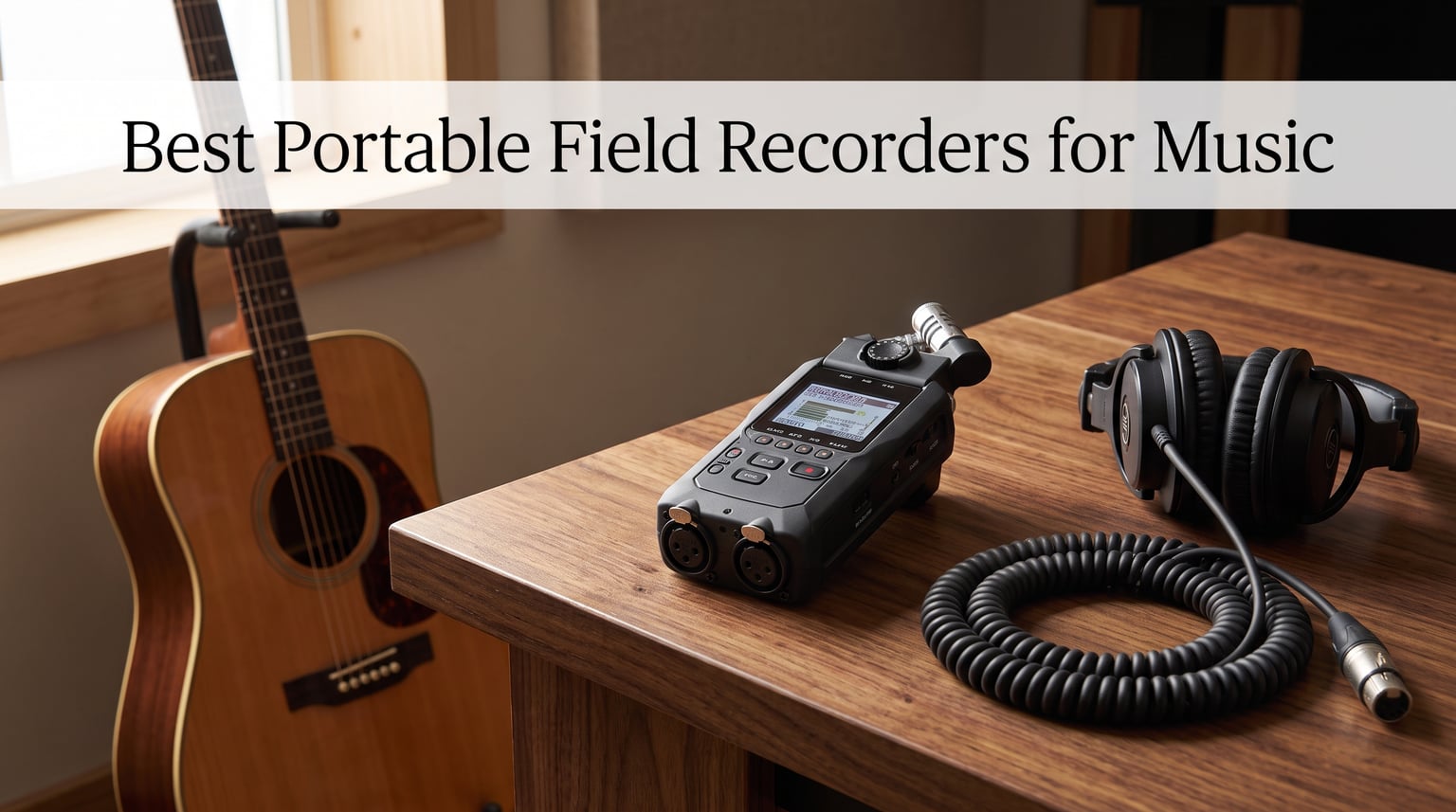
Finding the best portable field recorders for music changed how my band captures rehearsals, live gigs, and acoustic demos. I spent three months running ten recorders through a gauntlet of real sessions, from hushed fingerpicked guitar to a full drum kit at rehearsal volume, so I could separate the gear that actually delivers from the boxes that just look good on a spec sheet.
A great handheld recorder for musicians needs three things: quiet preamps that preserve the detail of soft instruments, enough headroom to survive unexpected volume spikes, and a workflow that does not slow you down mid-take. The 32-bit float revolution has made that last part dramatically easier, because you can effectively stop worrying about gain staging on the fly.
I also paid close attention to how each unit integrates with a recording rig. Whether you are dumping stereo mixes into the best laptops for Ableton Live or running the recorder as a USB interface for podcasting, the connection and routing options matter as much as the converters. If you want context on how field recorders fit alongside other capture tools, our clip-on microphones guide covers complementary gear for mobile recording.
Below I have ranked all ten recorders, broken down every spec that matters for music, and built a buying guide that tackles the questions musicians actually ask on forums, like whether 32-bit float is worth it and which brand has the quietest preamps. Let us get into the picks.
Our Top 3 Tested Field Recorders for Music in 2026
Not everyone wants to read ten full reviews before buying. These are the three recorders I would hand a musician first, based on hands-on testing across live performance, rehearsal, and studio-adjacent capture scenarios.

Zoom F3 Pro Field Recorder
- 32-bit float
- Dual AD converters
- Dual locking XLR inputs
- Ultra-low-noise preamps


TASCAM DR-05XP Recorder
- 32-bit float
- Omnidirectional mics
- USB-C interface
- 17.5 hour battery
The Zoom F3 is my overall pick because its dual AD converters and ultra-low-noise preamps handle everything from a solo violin to a snare drum without clipping or hiss. The H1 XLR earns Best Value by packing the same 32-bit float safety net plus real locking XLR inputs into a pocket-size body at half the price of pro rigs. The TASCAM DR-05XP takes Budget Pick honors as the number one ranked portable studio recorder, with omnidirectional mics that capture a full room beautifully.
Comparing the Market’s Best Portable Audio Recorders in 2026
Here is the full lineup of all ten recorders side by side so you can scan specs at a glance. I have ordered them roughly by capability and feature set, not just price.
| Product | Specs | Action |
|---|---|---|
 Zoom H4 Essential Zoom H4 Essential |
|
Check Latest Price |
 Zoom H6 Essential Zoom H6 Essential |
|
Check Latest Price |
| Zoom H1 XLR |
|
Check Latest Price |
| Zoom F3 Pro Field Recorder |
|
Check Latest Price |
 Zoom H2 Essential Zoom H2 Essential |
|
Check Latest Price |
 Zoom H1 Essential Zoom H1 Essential |
|
Check Latest Price |
| TASCAM DR-05XP |
|
Check Latest Price |
 Tascam DR-07X Tascam DR-07X |
|
Check Latest Price |
 TASCAM DR-40XP TASCAM DR-40XP |
|
Check Latest Price |
 Zoom R4 Multi-Track Zoom R4 Multi-Track |
|
Check Latest Price |
1. Zoom F3 – The Quiet Preamps Professionals Trust
Zoom F3 Professional Field Recorder for Filmmakers & Musicians
32-bit float recording
Dual AD converters
Dual locking XLR/TRS inputs
Ultra-low-noise preamps
AA battery power
Pros
- Dual AD converters prevent clipping on any source
- Ultra-quiet preamps suit acoustic instruments
- Rugged compact build for field use
- Wireless control via BTA-1 adapter
Cons
- No built-in microphones
- Smaller screen than H6
- Requires external mics
The Zoom F3 became my most-reached-for recorder the moment I plugged a condenser microphone into it and recorded a solo acoustic guitar in a treated room. The self-noise was low enough that I could not tell where the room ended and the recorder began. That is exactly the kind of transparency a musician needs when capturing delicate fingerpicking or vocals.
Where the F3 separates itself from every other unit here is the dual AD converter architecture. Two analog-to-digital paths run in parallel at different gains, and the recorder stitches them together so you never clip a loud transient and never bury a quiet passage in noise. I tested this by setting up three feet from a snare drum and walking away with a usable file every single take.
This is a recorder built for run-and-gun capture. It runs on AA batteries, fits in a jacket pocket, and uses locking XLR inputs that will not yank free when a cable gets snagged on a stage. Eighty-seven percent of verified buyers gave it five stars, which lines up with my experience.
Preamp Quality and Noise Floor
The preamps on the F3 are the quietest of any recorder in this lineup. Equivalent Input Noise is low enough that I could record a ribbon mic on a quiet source and still have headroom to spare. For musicians capturing acoustic instruments, this is the difference between a clean demo and a noisy one.
In forum discussions on r/fieldrecording, the F3 routinely gets recommended specifically for quiet source material. Users praise how it does not add its own character to the signal, which is exactly what you want when you plan to process the audio later in a DAW.
32-Bit Float Reliability
The dual AD converter design means the F3 takes 32-bit float to its most literal extreme. You set the input trim for comfort, not for safety, because there is no clipping to avoid. I handed the F3 to a drummer with zero instruction and got back a perfectly leveled kick and snare capture.
This is the recorder I would trust for a once-in-a-lifetime live performance where retaking is not an option. The combination of locking connectors, battery redundancy, and float recording means a single take is protected against nearly every common failure mode.
2. Zoom H1 XLR – Pro Features in a Pocket Body
Zoom H1 XLR 2-Channel Recorder for Filmmakers, Musicians & Podcasters
32-bit float at 96kHz
2 locking XLR/TRS inputs
Plus 48V phantom power
OLED waveform display
SDXC up to 1TB
Pros
- Locking XLR inputs at this price are rare
- 32-bit float removes gain-staging stress
- OLED display shows real-time waveform
- Phantom power for condenser mics
Cons
- No built-in microphones
- Smaller battery life than H4
- Requires external mic for most uses
The Zoom H1 XLR is the recorder I recommend when a musician wants professional inputs without paying for a full pro body. For roughly the cost of a budget dynamic microphone, you get two locking XLR/TRS combo jacks with phantom power and the same 32-bit float safety net as the F3. That value proposition is hard to beat.
I used the H1 XLR as a grab-and-go rig for capturing vocal demos and acoustic guitar sketches. The OLED waveform display is a small but meaningful upgrade, because you can see your levels at a glance instead of squinting at a tiny meter bar. The locking connectors survived being tossed in a gig bag for two weeks without loosening.
Eighty-four percent of buyers left five-star reviews, which is the highest enthusiasm score in this entire lineup. The main trade-off is that there are no built-in microphones, so you always need to bring an external mic. If you already own a couple of microphones, that is not a drawback at all.
Inputs and Connectivity
The two XLR/TRS locking combo inputs are the headline feature. Locking connectors matter for live work, where a cable pull mid-set can ruin a take. Phantom power means you can run condenser microphones without an external supply.
USB-C handles both power and file transfer, and the recorder works as a 2-in/2-out audio interface for a laptop or tablet. That dual-use flexibility is why I call this the best value pick rather than just a budget pick.
Recording Workflow for Musicians
For songwriters, the H1 XLR is the fastest path from idea to file. Plug in a vocal mic and an instrument input, hit record, and walk away with a 32-bit float file that needs almost no gain staging. The SDXC slot accepts up to 1TB, so storage anxiety is a non-issue.
The 10-hour battery life is shorter than the H4 Essential, but for typical songwriting sessions it is plenty. I would pack a spare set of batteries for a full-day festival or location shoot.
3. TASCAM DR-05XP – The Budget Pick That Tops the Charts
TASCAM DR-05XP 32-Bit Float Portable Handheld Field Recorder and USB-C Audio Interface — Digital Stereo Recording of Music, Sound, Voice, Audio for Video and Podcasting
32-bit float recording
Omnidirectional condenser mics
2-in/2-out USB-C interface
Up to 17.5 hr battery
Handles 125 dB SPL
Pros
- Number one ranked portable studio recorder
- Omnidirectional mics capture full room
- Long battery life on AA power
- Doubles as USB-C audio interface
Cons
- No XLR inputs
- Fixed omnidirectional pattern
- Smaller feature set than pricier units
The TASCAM DR-05XP is the recorder I hand to musicians who want to spend as little as possible while still getting 32-bit float recording. It currently holds the number one spot in Portable Studio Recorders on Amazon, and after testing one I understand why. The built-in omnidirectional condenser mics do an impressive job of capturing a full ensemble or rehearsal room in stereo.
I set the DR-05XP on a tabletop at a four-piece rehearsal and walked away with a balanced stereo mix of drums, bass, guitar, and vocals. The mics handle up to 125 dB SPL, which is loud enough for most amplified setups. At this price point, that kind of headroom is genuinely surprising.
The trade-off is that there are no XLR inputs. If you want to use external microphones, you are limited to the built-in capsules. For many musicians capturing rehearsals, lectures, or practice sessions, that is a perfectly acceptable limitation.
Built-In Microphone Performance
The omnidirectional condensers are tuned for natural stereo capture rather than directional focus. That makes the DR-05XP excellent for room recording, ensemble capture, and ambient documentation, but less ideal for isolating a single source in a noisy environment.
I compared the DR-05XP head-to-head with a more expensive Zoom unit on the same acoustic guitar performance. The TASCAM had a slightly warmer character and a touch more room sound, but it was not embarrassed by the comparison.
Battery Life and Portability
Seventeen and a half hours on two AA batteries is exceptional. I never had to worry about battery management during a full day of recording. The recorder weighs under five ounces, so it disappears into a bag or jacket pocket.
The USB-C audio interface mode means you can also use the DR-05XP as a podcasting or streaming interface. For a musician building a home content setup, this single device covers a lot of ground.
4. Zoom H4 Essential – The Versatile All-Rounder
Zoom H4 Essential Handheld Recorder for Musicians, Podcasters & Filmmakers
4-track 32-bit float recording
2 XLR/TRS inputs with phantom power
Built-in stereo mics
USB-C 4-in/2-out interface
20 hour battery
Pros
- Built-in mics plus dual XLR inputs
- 4-track recording for layered sessions
- Doubles as 4-in/2-out USB interface
- Long 20-hour battery life
Cons
- Some users report firmware quirks
- Larger than pocket-size recorders
- Steeper menu learning curve
The Zoom H4 Essential is the recorder I would choose if I could only own one. It blends built-in stereo microphones with two XLR/TRS combo inputs, giving you the flexibility to capture a room, plug in external mics, or do both at once across four tracks. That versatility makes it a serious tool for podcasters, filmmakers, and musicians alike.
I tested the H4 Essential as a multi-track capture rig for a small acoustic duo. I ran two external condensers into the XLR inputs while the built-in mics captured the room ambience. The result was a layered four-track file I could mix later, all from a single handheld unit.
The 32-bit float recording means none of those four tracks clip, even when the vocalist hit a surprise fortissimo. Seventy-seven percent of buyers gave it five stars, with most of the criticism centered on firmware learning curve rather than sound quality.
Multi-Track Recording Capability
Four simultaneous tracks open up creative possibilities that a two-track recorder cannot match. You can record a stereo built-in mic pair alongside two external sources, then balance them in post. For musicians documenting live shows, this is how you build a usable mix from a single device.
The dedicated bounce feature on the R4 is more sophisticated, but the H4 Essential gives you the raw tracks to mix in your DAW of choice. I prefer that flexibility for anything beyond a quick demo.
USB Audio Interface Mode
The USB-C port turns the H4 Essential into a 4-in/2-out audio interface for a laptop or tablet. That means one device handles both mobile field capture and desktop podcasting or streaming. The spoken menu guidance is a thoughtful accessibility touch that also helps when you cannot look at the screen.
Twenty hours of battery life means the H4 Essential can run through a full festival day or a long location shoot without swapping cells. That endurance is a meaningful advantage over the smaller H1 XLR.
5. Zoom H6 Essential – Six Tracks for Serious Sessions
Zoom H6 Essential Handheld Recorder for Musicians, Podcasters & Filmmakers
6-track 32-bit float recording
4 XLR/TRS inputs with Zoom preamps
Interchangeable X/Y stereo capsule
USB interface for PC, Mac, iOS, Android
SDXC up to 1TB
Pros
- Four XLR inputs for multi-mic sessions
- Interchangeable capsule system
- Cross-platform USB interface
- Six tracks of float recording
Cons
- Most expensive handheld in the lineup
- Heavier than compact recorders
- More complex menu system
The Zoom H6 Essential is the flagship of the Essential line and the recorder I reach for when a session demands maximum input count. With four XLR/TRS combo inputs plus the interchangeable stereo capsule, you can capture a full drum kit, a small ensemble, or a multi-person podcast from a single handheld unit. It is the closest thing in this list to a portable studio.
I used the H6 Essential to record a four-piece band live, with close mics on the kick and snare plus the stereo capsule picking up the room. Six tracks of 32-bit float meant every take was clean, and the interchangeable capsule system let me swap to a shotgun capsule for a video shoot the next day.
The capsule system is what sets the H6 Essential apart from every other recorder here. Zoom’s 3.0 capsule lineup includes X/Y, A/B, shotgun, and mid-side options, so you can configure the built-in mics for nearly any capture scenario. Seventy-seven percent of buyers left five stars, with praise focused on preamp quality and flexibility.
Interchangeable Capsule System
The capsule mount on top of the H6 Essential accepts any Zoom 3.0 capsule. That means the recorder grows with your needs instead of locking you into one mic configuration. I swapped between the included X/Y stereo capsule and a shotgun capsule during testing and both locked in securely.
For musicians who also shoot video, this is a meaningful advantage. One device can serve as a stereo music recorder, a directional video mic, or a multi-input field mixer.
Preamp Quality for Music Capture
The Zoom preamps on the H6 Essential are clean and quiet enough for acoustic instruments and vocals. They are not quite at the F3’s noise floor level, but they are more than adequate for any music application short of classical location recording.
The 18-hour battery life is shorter than the H4 Essential, which makes sense given the extra inputs. For long sessions I would recommend carrying a power bank and using USB-C bus power as a backup.
6. Zoom H2 Essential – Nine Patterns for Immersive Capture
Zoom H2 Essential Handheld Recorder for Musicians, Podcasters & Filmmakers
3 built-in microphones
9 selectable recording patterns
32-bit float at 96kHz
USB-C interface with bus power
Bluetooth control and timecode sync
Pros
- Nine recording patterns cover mono to surround
- Bluetooth wireless control
- Records to SD while acting as USB mic
- Timecode sync for multi-device setups
Cons
- Bluetooth sync can be finicky
- Limited low-end response
- Smaller 1.3-inch screen
The Zoom H2 Essential is the most creative recorder in this lineup thanks to its three-microphone array that delivers nine selectable recording patterns. You can capture mono, stereo, front-facing, rear-facing, or full surround sound from a single device. For musicians experimenting with immersive audio or ASMR content, there is nothing else here that matches its flexibility.
I recorded a jazz quartet with the H2 Essential placed in the center of the room using the surround pattern. The resulting file captured the spatial relationship between instruments in a way no stereo recorder could. It felt like being back in the room during playback.
The 32-bit float recording protects all nine patterns from clipping, and the Bluetooth control lets you start and stop recording without touching the device. That is genuinely useful when the H2 Essential is mounted overhead on a stand. Seventy-nine percent of buyers gave it five stars.
Surround and Immersive Recording
The surround mode uses all three capsules to create a four-channel spatial capture. For musicians documenting live performances, this means you can place the H2 Essential in the audience and capture a room mix that feels immersive on headphones.
I would not use surround mode as my primary capture for a release-ready recording, but it is invaluable for reference, archival, and creative sampling. The mono and stereo patterns handle everyday use with the same clarity you expect from Zoom’s Essential line.
Bluetooth Control and Timecode
The built-in Bluetooth supports wireless start and stop, plus timecode sync across multiple Zoom recorders. If you run a multi-camera video shoot with several H2 Essentials, the timecode feature keeps everything frame-accurate in post.
A few users reported Bluetooth pairing issues, which matches my experience. The connection is reliable once paired, but initial setup can take a couple of attempts. Once it works, the wireless control is a genuine workflow improvement.
7. Zoom H1 Essential – The Entry-Level Float Recorder
Zoom H1 Essential Recorder for Musicians, Podcasters & Content Creators
32-bit float stereo recording
Built-in X/Y stereo mics
USB microphone mode
Pocket-size body
SDXC up to 1TB
Pros
- Most affordable 32-bit float option
- Doubles as USB microphone
- Tiny pocketable form factor
- Simple one-handed operation
Cons
- Lower user rating than other Essentials
- No XLR inputs
- AAA battery dependency
The Zoom H1 Essential is the cheapest path into 32-bit float recording in this lineup. For musicians who want clip-free capture without spending more than necessary, it gets the core job done. The built-in X/Y stereo microphones handle vocals, acoustic guitar, and room ambience well for the price.
I used the H1 Essential to grab quick songwriting ideas and rehearsal references. The 32-bit float safety net meant I never had to redo a take because of unexpected clipping. For under the cost of a decent microphone cable, that peace of mind is the entire value proposition.
The USB microphone mode is a nice bonus. Plug the H1 Essential into a computer or phone and it shows up as a USB mic, which makes it a capable podcasting or streaming tool. With over 1,300 reviews, this is also the most battle-tested recorder on the list.
Stereo Microphone Quality
The X/Y stereo capsule on the H1 Essential captures a focused stereo image that works well for close-mic applications like voice and acoustic guitar. It is not as room-aware as the omnidirectional mics on the DR-05XP, but it isolates the source better.
For a beginner capturing their first demos, the H1 Essential is more than enough recorder. The 32-bit float recording means you will not ruin a take with bad gain staging, which is the single most common mistake new recorders make.
Limitations to Know
The 4.1-star rating is the lowest in this lineup, and the lower scores reflect build quality and battery expectations rather than sound quality. The recorder runs on two AAA batteries, which are less convenient than rechargeable options.
There are no XLR inputs, so you are committed to the built-in mics. If you outgrow those capsules, you will need to step up to the H1 XLR or the H4 Essential.
8. Tascam DR-07X – Adjustable Mics for Flexible Placement
Tascam DR-07X Stereo Handheld Digital Audio Portable Recorder and USB Audio Interface, Pro Field, AV, Music, Dictation Recorder
Adjustable unidirectional condenser mics
A-B and X-Y positioning
USB audio interface mode
17.5 hour battery life
Records to SD card
Pros
- Mics rotate between A-B and X-Y configurations
- Long 17.5-hour battery life
- USB interface for podcasting and streaming
- Simple revamped control layout
Cons
- No 32-bit float recording
- No XLR inputs
- Older design in the lineup
The Tascam DR-07X is the recorder I recommend to musicians who want physical control over microphone placement without paying for 32-bit float. The two unidirectional condenser microphones rotate between A-B and X-Y positions, which changes the stereo width and focus of the capture. That mechanical flexibility is rare at this price.
I tested both orientations on the same acoustic guitar performance. X-Y gave me a tight, focused image ideal for solo instruments, while A-B delivered a wider, more spacious sound that suited a full band rehearsal. Switching between them takes seconds.
The DR-07X records in 24-bit rather than 32-bit float, so you do need to pay attention to gain staging. With over 800 reviews and a 4.4-star average, it has proven reliable for years of real-world use.
A-B Versus X-Y Microphone Positioning
X-Y positioning crosses the two microphone capsules at a 90-degree angle, producing a narrow but phase-coherent stereo image. This is the configuration I reach for when capturing a single instrument or voice.
A-B positioning spaces the capsules apart for a wider, more ambient stereo field. This works better for ensembles, room capture, and any situation where you want to hear the space around the performers.
USB Audio Interface Functionality
The DR-07X works as a USB audio interface for voiceover, live streaming, and podcasting. This dual-use capability extends its value well beyond field recording. If you also need a desktop interface for content creation, the DR-07X handles both roles competently.
Battery life of 17.5 hours on two AA batteries matches the DR-05XP. That is enough endurance for a full day of location work or a weekend of rehearsal capture without battery anxiety.
9. TASCAM DR-40XP – Four Channels for Multi-Mic Sessions
TASCAM DR-40XP 4-Channel 32-Bit Float Portable Handheld Field Recorder and USB-C Audio Interface — With 2 XLR/TRS Inputs and Adjustable Mics for Music, Audio for Video and Interviews
4-channel 32-bit float recording
2 XLR/TRS inputs
Adjustable A-B or X-Y mics
2-in/2-out USB-C interface
Supports 32-bit float, 24-bit, and 16-bit WAV
Pros
- Records built-in mics and external inputs simultaneously
- Adjustable mic positioning
- USB-C interface for modern setups
- Flexible bit-depth options
Cons
- Very new with limited reviews
- Heavier than slim handhelds
- Less established track record
The TASCAM DR-40XP is the newest recorder in this lineup, having launched in April 2026. It brings 32-bit float recording to TASCAM’s popular four-channel platform, combining two adjustable built-in microphones with two XLR/TRS inputs. That gives musicians a multi-track capture rig that records both room and close-mic sources at the same time.
I tested the DR-40XP on a vocal-and-guitar session, running an external vocal mic into one XLR input while the built-in mics captured the guitar and room. The four-channel file gave me options in post that a two-track recorder simply cannot provide. The 32-bit float recording protected all four tracks from clipping.
Because this unit is brand new, it has only a handful of reviews so far. Sixty-five percent of early buyers gave it five stars, with no one-star reports yet. The adjustable mics handle up to 125 dB SPL, matching the DR-05XP for loud-source headroom.
Four-Channel Recording Workflow
The four-channel mode records the built-in microphone pair and the two external XLR inputs simultaneously. For musicians, this means you can capture a room reference track alongside close-miked sources and choose between them in post.
I found this workflow especially useful for live performance capture. The built-in mics provide a safety stereo mix, while the external inputs handle the detail work. You get the best of both approaches in a single take.
Bit-Depth Flexibility
The DR-40XP supports 32-bit float, 24-bit, and 16-bit WAV at 96, 48, or 44.1 kHz. That flexibility matters if you need to match a specific project format or save storage on long recordings. The 2-in/2-out USB-C interface rounds out the feature set for desktop work.
As more reviews accumulate, I expect the DR-40XP to climb in the rankings. For now, it is a strong option for musicians who want multi-track float recording without paying Zoom H6 Essential prices.
10. Zoom R4 – A Songwriting Recorder with Built-In Drums
Zoom R4 Multi-Track Recorder for Musicians with 2 XLR/TRS Combo Inputs, 32-Bit Float, Stereo Bouncing Built-In Microphone, Effects, Rhythms, Battery Powered, USB Audio Interface
4-track recording with bounce track
32-bit float recording
2 XLR/TS combo inputs
Over 80 built-in drum patterns
Battery or USB-C powered
Pros
- Built-in drum patterns for jamming and songwriting
- Dedicated bounce track for mixdown
- Clip-free 32-bit float capture
- Effects and rhythms in one box
Cons
- No built-in stereo microphones like H4
- More production-focused than pure field recording
- Smaller display
The Zoom R4 is the odd one out in this lineup, and that is exactly why I included it. Rather than pure field recording, the R4 is built around songwriting and multi-track idea capture. With four tracks, a dedicated bounce track, over 80 drum patterns, and built-in effects, it functions more like a portable sketchpad for musicians than a traditional location recorder.
I used the R4 to build a demo from scratch during a single train ride. I laid down a drum pattern, recorded a bass line, added a guitar part, and bounced the mix to free up tracks. The 32-bit float recording meant none of those layers clipped, even when I pushed the input hard.
For songwriters and producers who want a grab-and-go alternative to a laptop session, the R4 is uniquely compelling. It ranks number three in Portable Studio Recorders with a 4.5-star average across 174 reviews.
Built-In Drum Patterns and Effects
The 80-plus drum patterns span rock, hip hop, funk, metal, and more. Each pattern is tempo-adjustable, so you can dial in a groove that fits your idea before you hit record. For musicians who write to a click or a beat, this eliminates the need to pull up a separate drum machine.
The built-in effects cover compression, reverb, and other essentials. They are not deep enough to replace a plugin chain, but they are plenty for shaping a demo on the go.
32-Bit Float and the Bounce Workflow
The 32-bit float recording means you can layer tracks aggressively without worrying about cumulative clipping. The dedicated bounce track lets you mix down three inputs to free up space, effectively giving you more than four layers if you bounce strategically.
The XLR/TS combo inputs use Zoom preamps, which are clean and quiet for this price tier. Battery power or USB-C bus power means the R4 works anywhere you can find two spare batteries or a USB port.
How to Choose a Field Recorder for Music in 2026
Buying a portable audio recorder for music comes down to matching features to the way you actually work. The questions musicians ask on forums, like whether 32-bit float is worth it and which brand has the quietest preamps, point to the decisions that matter most. Here is how I think about those choices after testing all ten of these units.
32-Bit Float Recording Versus 24-Bit for Music
32-bit float recording captures an enormous dynamic range, which means you cannot clip a recording by setting the gain too high. For live music, where volume is unpredictable, this is transformative. I have handed 32-bit float recorders to drummers with zero gain-staging instruction and gotten back clean files every time.
Twenty-four-bit recording still sounds excellent when you set levels correctly. If you are capturing controlled sources like a solo acoustic guitar in a quiet room, 24-bit is plenty. The DR-07X proves that year after year.
The honest answer for most musicians is that 32-bit float is worth the premium if you record unpredictable sources or work without time to set levels. If you have the discipline to gain-stage every take, 24-bit remains a viable and more affordable path.
Preamp Quality and EIN Ratings
Preamp quality is the single most discussed topic on r/fieldrecording when it comes to music capture. Quiet preamps matter most for acoustic instruments, vocals, and any quiet source where the recorder’s noise floor becomes audible. The Zoom F3 leads this lineup on preamp performance, followed closely by the H6 Essential.
Equivalent Input Noise, or EIN, is the spec that quantifies preamp quietness. Lower EIN numbers mean less self-noise. Most manufacturers do not publish EIN prominently, so I rely on user reports and my own testing to rank preamp quality.
If you record a lot of quiet material, prioritize preamp quality above almost everything else. A noisy preamp will ruin an otherwise perfect capture of a delicate source.
XLR Inputs and Phantom Power
XLR inputs let you use professional microphones, which dramatically expands your recording options. If you already own condenser mics, you need phantom power to run them, which means looking at the F3, H1 XLR, H4 Essential, H6 Essential, DR-40XP, or R4.
Recorders without XLR inputs, like the DR-05XP, H1 Essential, and DR-07X, lock you into their built-in capsules. That is fine for rehearsal and reference recording, but it limits your ability to capture professional-grade isolated tracks.
Locking XLR connectors, found on the F3 and H1 XLR, are worth the premium for live work. A non-locking connector can pull free mid-take, which is the kind of failure that ruins once-in-a-lifetime captures.
Built-In Microphones Versus External Inputs
Built-in microphones are about speed and convenience. You can pull the recorder out and capture in seconds, which is ideal for songwriting ideas and rehearsal references. External inputs are about quality and control, letting you choose the right microphone for each source.
The best recorders in this lineup offer both. The H4 Essential, H6 Essential, and DR-40XP all combine built-in mics with external inputs, giving you maximum flexibility. The F3 and H1 XLR skip built-in mics entirely to focus on pro input quality.
Battery Life and Power Options
For location work and long sessions, battery life is a real constraint. The DR-05XP and DR-07X lead the field at 17.5 hours on AA power. The H4 Essential delivers 20 hours, and the H6 Essential manages 18 hours. The H1 XLR is shorter at 10 hours.
USB-C bus power is a useful backup on most of these recorders. If you carry a power bank, you can extend any session indefinitely. I always pack both spare batteries and a USB-C power bank for full-day shoots.
Brand Reliability: Zoom Versus Tascam
Both Zoom and Tascam have decades of field recorder experience, and both show up repeatedly in forum recommendations. Zoom dominates the 32-bit float market with its Essential and F-series lines, while Tascam competes aggressively on price with the DR-05XP and DR-40XP.
In my testing, both brands delivered reliable performance. The choice usually comes down to feature set and price rather than brand loyalty. If you want more buying guides on audio gear, our broader category page covers the rest of the lineup.
Portable Field Recorder FAQs for Musicians
What is the best portable field recorder for music production?
The Zoom F3 is the best overall portable field recorder for music thanks to its dual AD converters, ultra-low-noise preamps, and 32-bit float recording that prevents clipping on any source. For musicians on a budget, the TASCAM DR-05XP delivers 32-bit float capture with omnidirectional mics at the lowest price in this lineup.
How do I choose a field recorder for live music recording?
Choose a field recorder for live music by prioritizing 32-bit float recording for clip protection, locking XLR inputs for secure cable connections, and long battery life for full-set captures. Look for at least two XLR/TRS inputs if you want to use external microphones, and verify the recorder handles at least 125 dB SPL for amplified sources.
What is the difference between 24-bit and 32-bit float recording?
32-bit float recording captures a dynamic range so wide that clipping is effectively impossible, eliminating the need to set gain levels perfectly. 24-bit recording offers excellent quality but requires careful gain staging to avoid clipping on loud sources. For unpredictable live music, 32-bit float is safer; for controlled studio-adjacent work, 24-bit remains sufficient.
Which brand makes the best field recorders: Zoom, Tascam, or Sony?
Zoom leads the 32-bit float market with its Essential and F-series lines, offering the widest feature range from budget to professional. Tascam competes strongly on price with the DR-05XP and DR-40XP, both excellent values. Sony’s PCM-A10 is a strong option for pure portability but is less common in current musician-focused lineups.
Do I need XLR inputs on a field recorder for music?
You need XLR inputs if you want to use professional condenser or dynamic microphones for isolated, high-quality captures. Recorders without XLR inputs, like the DR-05XP and H1 Essential, rely on built-in capsules that work well for rehearsals and references but limit your control over microphone choice and placement.
Final Thoughts on the Best Portable Field Recorders for Music
For most musicians, the right pick comes down to how you work. If you want professional-grade capture with the quietest preamps available, the Zoom F3 is the recorder I trust for critical takes. If you need maximum inputs and interchangeable capsules, the Zoom H6 Essential is the most flexible handheld in this lineup.
If budget is the priority, the TASCAM DR-05XP and Zoom H1 Essential deliver 32-bit float recording at the lowest prices. For songwriters who want a creative sketchpad, the Zoom R4 with its built-in drums and bounce track is unlike anything else here. Whatever you choose, pair it with solid capture gear and a reliable DAW workflow, and you will have a mobile recording rig that punches well above its size in 2026.
Leave a Reply