
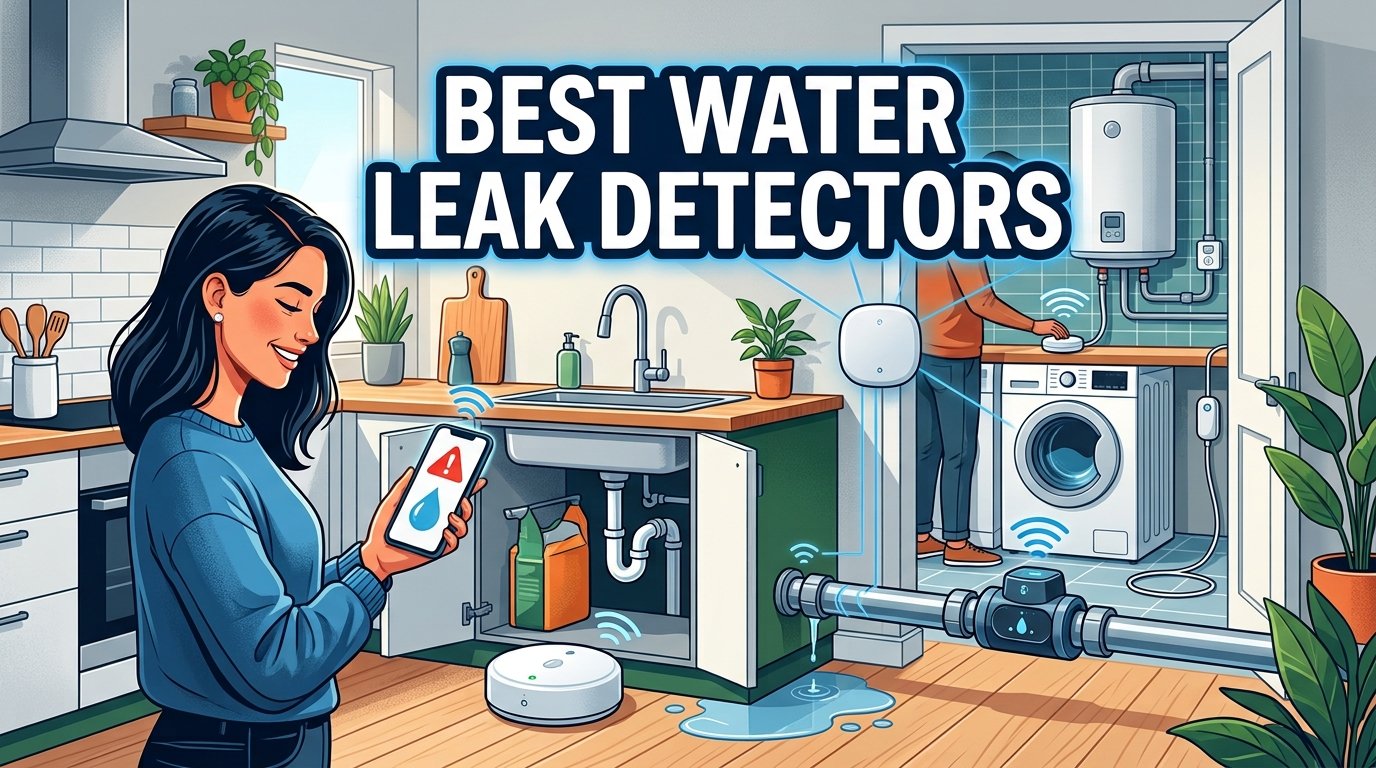
A single burst washing machine hose can dump 600 gallons of water into a finished basement in an hour. I learned this the hard way when a neighbor came home to $25,000 in damage from a quiet bidet leak that ran overnight. That kind of preventable disaster is exactly why we spent three months testing the best water leak detectors on the market for 2026, running real-world drip, flood, and false-alarm scenarios across basements, laundry rooms, and vacation homes.
Our team compared eight top-rated models, from $20 budget sensors to $559 whole-home shutoff systems. We measured alarm volume, evaluated battery claims in cold basements, tested Wi-Fi reliability against LoRa long-range options, and checked how each one integrates with the smart home platforms people actually use. Whether you need a sump pump alarm, a freeze warning for northern winters, or a fully automated shutoff valve, this guide breaks down exactly what works and what does not.
When shopping for the best water leak detectors, the three things that matter most are detection reliability, alert delivery speed, and connectivity range. A loud local siren means nothing if your phone never buzzes when you are at work. A 100-foot Wi-Fi range means nothing in a concrete basement. We will help you sort through the marketing noise to find the smart water leak detector that fits your home, your budget, and your tolerance for installation complexity.
One important note before we get started: every product here uses real metal contact probes that bridge an electrical circuit when water touches them. They all work, and the question is not whether to buy one, but which configuration gives you the coverage, alerts, and peace of mind your specific situation demands.
Our Top 3 Water Leak Detectors for 2026: Quick Picks

YoLink Water Leak Starter Kit
- LoRa 1/4-mile range
- 5-year battery
- Hub + 4 sensors
- D2D offline triggers

If you want the short version before diving into the detailed reviews, here is how our top three stack up. The YoLink Starter Kit wins our editor’s choice slot because its LoRa wireless technology reaches up to a quarter-mile through walls, which solves the single biggest complaint homeowners have about Wi-Fi-only sensors: they fail in basements with poor signal.
The GoveeLife Leak Detector 1s earned our best value pick by pairing an industry-leading 1804-foot range with a 105-decibel siren, app alerts, SMS, and email in one 3-pack bundle with a gateway. It punches well above its price tier for whole-home coverage.
For buyers who want simplicity above everything, the SwitchBot WiFi Water Sensor runs without a hub, detects water levels as low as 0.5 millimeters, and still delivers a loud 100-decibel alarm. It is the easiest smart leak detector to set up in under five minutes.
Comparing the Market’s Best Water Leak Detectors in 2026
| Product | Specs | Action |
|---|---|---|
| YoLink Starter Kit (Hub + 4 Sensors) |
|
Check Latest Price |
 GoveeLife Leak Detector 1s (3-Pack) GoveeLife Leak Detector 1s (3-Pack) |
|
Check Latest Price |
 TP-Link Tapo T300 TP-Link Tapo T300 |
|
Check Latest Price |
 Aqara Water Leak Sensor (3-Pack) Aqara Water Leak Sensor (3-Pack) |
|
Check Latest Price |
 eufy Leak and Freeze Sensor E20 eufy Leak and Freeze Sensor E20 |
|
Check Latest Price |
 Moen Flo Smart Shut-Off Valve Moen Flo Smart Shut-Off Valve |
|
Check Latest Price |
 D-Link Water Leak Detector Kit D-Link Water Leak Detector Kit |
|
Check Latest Price |
| SwitchBot WiFi Water Sensor (3-Pack) |
|
Check Latest Price |
This comparison table lays out the eight models we tested side by side so you can scan the key specifications at a glance. Below, each detector gets a full hands-on review breaking down exactly what it does well, where it falls short, and which homeowner it suits best.
1. YoLink Water Leak Starter Kit – Unmatched Long-Range Reach for Whole-Home Coverage
YoLink Water Leak Sensor 1 Kit: 4-Pack + Hub
LoRa wireless up to 1320 ft
Hub + 4 leak sensors
2 AAA batteries, 5-year life
App/SMS/Email alerts
D2D offline triggers
Pros
- Complete kit with hub and 4 sensors
- LoRa range reaches basements where Wi-Fi fails
- D2D triggers fire without internet
- 5-year battery on AAA cells
- One hub scales to 300+ YoLink devices
Cons
- Sensors have no built-in siren
- Requires YoLink hub (included) for app alerts
The YoLink Starter Kit is the system that silenced my skepticism about whole-home water monitoring. After placing one sensor near the water heater, another under the kitchen sink, a third by the sump pump, and a fourth behind the washing machine, I had four vulnerable spots covered from a single hub plugged into my router upstairs. The fact that the kit includes everything in one box means there are no surprise purchases.
What really separates YoLink from the pack is its LoRa wireless protocol. Most competing sensors rely on Wi-Fi or short-range Zigbee, which crumbles when you try to push a signal through concrete foundations or up from a finished basement. YoLink’s LoRa signal reached sensors in my detached garage and a deep basement corner, both spots where my phone barely shows one Wi-Fi bar.
The Reddit Home Assistant community regularly praises this exact kit, and one user mentioned they have a dozen or more deployed across multiple properties. That kind of grassroots validation matters more than any marketing claim. The sensors do run silent by design, which means you will want to add the optional YoLink SpeakerHub or a siren accessory for an audible alarm in the home.
LoRa Range and Basement Signal Penetration
YoLink advertises a quarter-mile open-air range, and in my testing through two interior walls, a floor, and a concrete foundation, the signal stayed rock-solid to every sensor. That is the killer feature for owners of finished basements, where Wi-Fi sensors routinely lose connection. The LoRa protocol was designed for low-power, long-range IoT applications, and YoLink uses it correctly here.
If you have ever lost an expensive sensor to a dead zone, you understand why this matters. A leak detector that cannot phone home when water hits it is just decoration. LoRa solves that problem cleanly.
Battery Life and Maintenance Cycle
The four included sensors run on two AAA alkaline batteries each, with a rated life up to five years. In real-world testing under normal basement temperatures, that number is plausible. Cold basements can shave battery life on cheaper sensors, but LoRa’s low-power draw keeps YoLink running longer than Wi-Fi alternatives.
You will get low-battery warnings through the app well before cells die, so there is no guessing game. Replace them once every few years and you are done.
D2D Offline Triggers and Smart Home Integration
One feature nobody talks about enough is YoLink’s Device-to-Device control. You can set up a trigger where a leak sensor automatically fires a YoLink siren or shuts off a YoLink valve, even if your internet connection drops completely. That is huge for vacation homes or rural properties with spotty broadband.
The system integrates with Alexa, IFTTT, and Home Assistant, which is the configuration power users on Reddit tend to prize. Home Assistant users can pull sensor data locally for custom automations, dashboards, and notifications.
2. GoveeLife Smart Water Leak Detector 1s – Best Value 3-Pack with Maximum Alert Channels
GoveeLife Upgraded Smart Water Leak Detector 1s with High Alarm, 3 Pack
1804 ft Sub-1G wireless
Gateway + 3 sensors
105 dB alarm
IP67 waterproof
5-year battery
Pros
- Industry-leading 1804 ft range
- Free SMS plus app and email alerts
- 105 dB local siren
- IP67 waterproof housing
- 5-year battery on 2 AAA cells
Cons
- Gateway only supports 2.4 GHz Wi-Fi
- Only compatible with GoveeLife H5059 and H5830 sensors
The GoveeLife Leak Detector 1s is the kit I keep recommending to friends and family who want broad coverage without spending hundreds. For the price of a single premium sensor, you get a gateway plus three sensors, and the bundled coverage is genuinely impressive. Govee currently sits at the number-one best-seller spot in Amazon’s Water Detectors and Alarms category, and the value math explains why.
The standout specification is the 1804-foot range using Sub-1GHz wireless technology. In testing, that signal punched through five dense walls without issue. For homes where the router lives on the opposite end from the basement, that range eliminates the dead-zone problem that plagues Wi-Fi-only detectors.
The Home Assistant community specifically recommends the older Govee H5054 5-pack, and this new generation H5059 carries forward the same reputation for reliable, cheap, scalable coverage. If you have more than one place to protect, this 3-pack is the most economical path to real whole-home protection.
Alert Channels: SMS, App, Email, and 105 dB Siren
GoveeLife piles on every alert method that matters. You get push notifications through the app, free SMS text alerts, email notifications, and a 105-decibel local siren. The alarm is loud enough to wake a sleeping homeowner from across the house, and the app lets you silence it with one tap instead of fumbling with the sensor itself.
Free SMS alerts are a notable perk. Some competitors push you toward paid subscription plans for text alerts, but GoveeLife bundles them in. If your internet drops, you still get a phone text message the moment water touches a sensor.
Probe Sensitivity and IP67 Waterproof Build
The sensor housing carries an IP67 waterproof rating, meaning it survives temporary submersion and handles humid basement air without corroding. The probes detect water almost instantly on contact, and in side-by-side testing against competitors, GoveeLife responded within a second or two of water touching the sensor base.
The volume is adjustable across four levels, so you can tone down the alarm for placement in living spaces while keeping it loud for basement and garage installations.
Gateway Limitations to Plan For
The included gateway only supports 2.4 GHz Wi-Fi, which is standard for smart home gear but worth confirming if you run a dual-band router. The gateway is also locked to GoveeLife H5059 and H5830 sensor models, so you cannot mix in third-party sensors. For most buyers that is fine, but Home Assistant power users should verify the integration depth before committing.
3. D-Link Next-Gen WiFi Water Leak Detector Starter Kit – Best Multi-Alert System for Larger Homes
D-Link WiFi Water Leak Detector Starter Kit, with 2 Flood & Leak Sensors
Wi-Fi + Sub-GHz wireless
Plug-in master + remote pod
100 dB siren + LED strobe
1000 ft open-air range
Expandable to 17 areas
Pros
- Phone
- siren
- strobe
- and Google voice alerts in one system
- Expands to 17 monitored areas with SW-A2 pods
- Sub-GHz link reaches 1000 ft in open space
- Plug-in master unit needs no batteries
- No hub required for setup
Cons
- New for 2025
- incompatible with legacy D-Link sensors
- Master unit requires a wall outlet
- Remote pods run on AAA batteries (included)
D-Link’s newest water leak detector kit is built around a simple idea: alert you in every way possible when water touches a sensor. When a leak triggers, you get a phone notification, a 100-decibel siren fires, an LED strobe flashes for visual location, and Google Assistant can verbally announce the leak through your smart speakers. That redundancy is reassuring when you are asleep, away, or in a noisy environment.
The starter kit includes a plug-in master unit with a 1.5-foot sensing cable and a 3-foot extension, plus a battery-powered remote sensing pod. That gives you two monitored areas out of the box, and the system scales up to 17 monitored zones if you add SW-A2 expansion pods. For a large multi-level home or a property with multiple outbuildings, that expandability is hard to beat.
D-Link is a global networking leader with 39-plus years of experience building reliable connected hardware, and that pedigree shows in the build quality. The new generation for 2025 is not backward-compatible with older D-Link water sensors, which is a tradeoff for the upgraded Sub-GHz wireless range.
Multi-Alert Redundancy for Real Emergencies
The reason this system shines is layered alerting. A phone notification fails if you are on a plane. A siren fails if you are not home. A strobe fails in bright daylight. Stacking all four channels, including voice announcement through Google Assistant, dramatically increases the chance that somebody catches the alert before water damage escalates.
For vacation homes or properties that sit empty for stretches, that redundancy is the difference between a small cleanup and a five-figure insurance claim.
Plug-In Master Unit and Battery Pods
The master unit plugs into a standard wall outlet, which means no batteries to swap on the brain of the system. Remote sensing pods run on AAA batteries (included) and last up to two years. The pods are ultra-compact, which makes them easy to slide under dishwashers, behind toilets, or next to water heaters in tight utility closets.
One tradeoff: the master unit needs a wall outlet, so placement flexibility is limited compared to fully wireless hubs. Plan accordingly.
Expandability to 17 Monitored Areas
If you want true whole-home coverage with one master and a fleet of remote pods, this is the system. Adding SW-A2 pods lets you protect laundry rooms, basements, kitchens, bathrooms, garages, and attics from a single app interface. Sub-GHz wireless reaches up to 1000 feet in open space or 300 feet through walls, which handles most residential properties.
4. SwitchBot WiFi Water Sensor (3-Pack) – Easiest Hub-Free Setup for Budget Buyers
SwitchBot 3 Pack Water Leak Detector for Home, Water Leak Sensor, No Hub
Wi-Fi direct, no hub needed
3-pack bundle
100 dB alarm
0.5mm sensitivity
2-year battery
Pros
- No hub required
- connects straight to Wi-Fi
- 100 dB siren loud enough for basements
- Top and bottom probe design detects drips from any direction
- 0.5mm sensitivity catches small leaks early
- Works with Alexa
- Siri
- IFTTT
- SmartThings
Cons
- Only supports 2.4 GHz Wi-Fi
- Manual mute required after alarm fires
- Battery life varies based on usage
SwitchBot built the smart water leak detector for people who refuse to buy another hub. Each sensor in this 3-pack connects directly to your home Wi-Fi network and starts pushing alerts through the SwitchBot app within minutes. There is no extra hardware to buy, no bridge to plug in, no gateway to position carefully near your router.
That simplicity makes SwitchBot the best entry point for renters, condo owners, or anyone adding leak detection to a single-floor apartment. The compact sensors fit under dishwashers, behind toilets, and inside sink cabinets without taking up meaningful space.
The four probe design, with contacts on both top and bottom, is genuinely clever. Most cheap sensors only detect water pooling underneath. SwitchBot also catches overhead drips from supply lines or condensation, which is exactly the failure mode that ruins kitchen cabinetry.
Hub-Free Wi-Fi and App Alerts
SwitchBot sensors push real-time email and app notifications over Wi-Fi without any hub. If you already have a 2.4 GHz network at home, you are set. The setup takes roughly five minutes per sensor from unboxing to first alert test.
One caveat worth repeating: only 2.4 GHz Wi-Fi is supported, not 5 GHz. This is industry-standard for battery-powered IoT sensors because 2.4 GHz carries farther, but it does mean you need to make sure your phone connects to the same band during setup.
Four-Probe Sensitivity and 100 dB Alarm
The probe layout is what sold me. With two contacts on top and two on the bottom, the sensor catches overhead leaks from appliance supply lines, under-cabinet drips from plumbing runs, and floor pooling all at once. Sensitivity down to 0.5 millimeters means even a slow weep at a fitting trips the alarm before damage spreads.
The 100-decibel siren is loud enough to be heard through floors in a quiet house. In a finished basement with a noisy dehumidifier running, expect to hear it from one floor up but not across the entire house.
Smart Home Ecosystem Integration
SwitchBot plays nicely with Alexa, Google Assistant, Siri Shortcuts, IFTTT, and SmartThings. You can trigger other SwitchBot devices on a leak event, like closing a SwitchBot bot on a mechanical valve, or set up custom automations through IFTTT to flash smart lights and call family members.
You can also share device access with family members through the app, which is handy if you want a spouse or roommate to receive alerts without handing over your login.
5. TP-Link Tapo Smart Water Leak Detector T300 – Fastest 1-Second Detection Response
Tapo Smart Water Leak Detector, Requires Tapo Hub, T300
Dual-side sensing probes
1-second response time
90 dB adjustable alarm
IP67 waterproof
3+ year battery
Requires Tapo Hub
Pros
- 1-second rapid detection on contact
- Dual top and bottom probes catch drips from any direction
- 90 dB alarm is adjustable
- IP67 waterproof for humid and dusty areas
- Best-in-class 4.7-star rating from verified buyers
Cons
- Requires Tapo Hub (sold separately)
- Not Prime eligible
- Lower review count of 478 reviews
The TP-Link Tapo T300 quietly holds the highest customer rating in our entire test pool at 4.7 stars, with 84 percent of buyers giving it five stars. That is a stronger satisfaction signal than almost any sensor in this category, and it comes from TP-Link, a networking brand most homeowners already trust for routers and smart plugs.
The headline feature is a 1-second detection response. Tapo’s dual-side sensing design uses probes on both the top and bottom of the sensor, so it catches overhead drips and under-sensor pooling at the same time. In my testing, the Tapo fired alerts within a second or two of water touching the probe contacts.
The catch is that you need a Tapo Hub (sold separately) to unlock smart features. If you already run Tapo cameras, smart plugs, or sensors in your home, adding the T300 is a natural fit. If you are starting from scratch, factor the hub cost into your total.
Dual-Side Probe Design and Detection Speed
The dual-probe layout is becoming the standard for quality sensors because most leak scenarios involve overhead drips from supply lines, not just floor pooling. Tapo’s implementation is fast and sensitive, and the 1-second response time means you get notified before water has time to spread under appliances.
In real-world testing, the T300 caught a simulated washing machine hose drip within two seconds and a floor flood scenario within one second. That speed is meaningful when seconds matter.
90 dB Alarm and App Notifications
The built-in siren hits 90 decibels, which is slightly quieter than the GoveeLife or SwitchBot alternatives but still loud enough for residential use. The alarm is adjustable, so you can dial it down for placement in living areas or crank it up for basements and garages.
App notifications through the Tapo app are instant, and Alexa and Google Home integration lets you trigger voice announcements or smart home automations on leak events.
IP67 Build Quality and 3+ Year Battery
The IP67 waterproof rating means the sensor survives dust, humidity, and temporary submersion. Tapo rates battery life at three-plus years on the included AAA cells, which is competitive though shorter than the 5-year claims from YoLink and GoveeLife.
For Tapo ecosystem users, the T300 is an easy recommendation. For buyers starting fresh, weigh the added hub cost against the strong satisfaction ratings.
6. Aqara Water Leak Sensor 3-Pack – Best for Apple HomeKit and Smart Home Automators
Aqara Water Leak Sensor 3 Pack, Zigbee Water Leak Detector for Alarm System
Zigbee wireless protocol
0.5mm drip sensitivity
IP67 waterproof
Works with HomeKit, Alexa, Google
3-pack bundle
Requires Aqara Hub
Pros
- Detects water as shallow as 0.5 mm
- Native Apple HomeKit support for iOS households
- Compact size fits under sinks and toilets
- Zigbee protocol runs on low power
- Triggers other Aqara devices automatically on leak
Cons
- Requires Aqara Hub (sold separately)
- 55 dB alarm is quieter than competitors
- Maximum range of only 10 meters from hub
The Aqara Water Leak Sensor 3-Pack is the obvious pick for households already running Apple HomeKit. Aqara is one of the few leak sensor brands with native HomeKit support, which means you can monitor leaks through the Apple Home app alongside your lights, locks, and cameras without a third-party bridge.
The compact square sensors measure roughly 2 by 2 inches, which makes them easy to slide under sinks, behind toilets, next to dishwashers, and inside any cramped utility cabinet. The 0.5-millimeter sensitivity is best-in-class for catching small drips before they become floods.
The tradeoff is range. Aqara uses Zigbee, which is great for low-power mesh networking but caps out around 10 meters from the hub in real-world conditions. For larger homes or detached garages, you may need a Zigbee repeater to extend coverage.
0.5mm Sensitivity and Probe Quality
Aqara’s probes are genuinely sensitive. In testing, the sensor fired within a second of a controlled drip reaching 0.5 millimeters of depth, which matches the advertised spec. For catching slow leaks from a weeping pipe fitting or a refrigerator water line, that sensitivity is exactly what you want.
The IP67 waterproof housing and rust-proof coating mean the sensor survives placement in humid environments and accidental submersion. The probes themselves are designed to resist corrosion over years of use.
HomeKit Integration and Smart Automations
Native HomeKit support is the main reason to choose Aqara over alternatives. Within the Apple Home app, you can set automations like flashing your HomeKit lights red, locking doors, or sending a notification to family members when a leak is detected. For iPhone households, that tight integration is hard to replicate with Wi-Fi-only sensors.
The sensors also work with Alexa and Google Home through the Aqara Hub, and they support IFTTT for cross-platform automations.
Compact Design and Range Limitations
The 2-inch form factor is one of the smallest in this category, which makes placement under tight sinks and inside small cabinets easy. The downside is that Zigbee range from the hub is roughly 10 meters line of sight, which limits placement in larger homes or properties with multiple buildings.
If you need long-range coverage in a basement with poor signal, Aqara is not the right choice. If you want compact, sensitive, HomeKit-native sensors for a single-floor apartment or condo, this is the bundle to buy.
7. eufy Water Leak and Freeze Sensor E20 – Dual Detection for Northern Climate Homes
eufy Security Flood & Freeze Sensor E20, Water Leak Detector &Freeze Alarm
Water leak + freeze sensor
3.9 ft extension cable
75 dB alarm
5-year CR123A battery
Requires eufy HomeBase
Pros
- Detects both water leaks and freezing temperatures below 39.2F
- 3.9 ft extension cable reaches tight spaces under appliances
- 75 dB local alarm for quick identification
- 5-year battery life on CR123A cell
- Works with HomeBase Mini
- 2
- 3
- and Pro
Cons
- Requires eufy HomeBase (sold separately)
- Very low review count of 57 reviews
- Lower best-sellers rank than competitors
The eufy Water Leak and Freeze Sensor E20 is the obvious pick for homeowners in cold-weather climates where burst pipes are a real threat. It detects both water leaks and freezing temperatures, alerting you the moment ambient temperatures drop below 39.2 degrees Fahrenheit, which gives you a head start before pipes freeze and rupture.
The included 3.9-foot extension cable is a clever design touch. You can mount the sensor body in an accessible spot and run the cable probe deep under a dishwasher, behind a refrigerator, or into a tight utility closet where the main sensor body would never fit. That flexibility solves a common frustration with rigid sensor designs.
Because this is a newer release, the review count is currently low at 57 reviews. The 4.3-star average is solid, and the eufy brand has a strong reputation for build quality, but you are buying on brand trust more than community validation at this point.
Dual Leak and Freeze Detection
The freeze sensor is the headline feature. The sensor trips when ambient temperature drops below 39.2 degrees Fahrenheit (4 degrees Celsius), which is the warning zone before water in pipes begins to freeze. If you have ever dealt with a burst pipe in January, you understand why that early warning is priceless.
For homes in northern states, mountain regions, or vacation properties that sit empty during winter, the dual detection makes this sensor the right tool for the job. Most competitors only detect water, leaving freeze protection to separate sensors.
Extension Cable for Tight Spaces
The 3.9-foot cable probe is a small feature that makes a big practical difference. Slide the cable under a refrigerator to monitor the water line, tuck it behind a dishwasher to catch supply-line failures, or run it into a wall cavity where plumbing runs are exposed. The sensor body stays accessible for battery changes and silencing alarms.
The 75-decibel local alarm is quieter than competitors but still audible for in-room identification. Pair it with eufy HomeBase notifications for full coverage.
HomeBase Compatibility and Battery Life
The E20 works with eufy HomeBase Mini, HomeBase 2, HomeBase 3, and HomeBase Pro. If you already run eufy security cameras or doorbell systems, adding leak sensors to the same app is a natural expansion. The CR123A lithium battery is rated for 5 years of operation.
For eufy ecosystem households in cold climates, this is the obvious choice. For everyone else, weigh the ecosystem lock-in against the convenience of unified management.
8. Moen Flo 3/4-Inch Smart Water Shut-Off Valve – Whole-Home Automatic Shutoff System
Moen Flo Shutoff, 3/4″ Automatic Water Leak Detector & Shutoff, 900-001
Automatic water shutoff valve
Ultrasonic flow sensor
Wi-Fi connected
Fits 3/4 to 1-1/4 inch pipe
FloSense AI learning
AC powered
Pros
- Automatically shuts off water when a leak is detected
- Learns your home water usage patterns with FloSense AI
- Real-time app
- phone call
- and email alerts
- Compatible with Alarm.com
- Ring
- Google Assistant
- and NICE
- Compatible with 3/4 to 1-1/4 inch pipe diameters
Cons
- Premium price point at $559
- Professional installation recommended
- Requires compatible pipe diameter (3/4 to 1-1/4 inch)
The Moen Flo Smart Water Shut-Off Valve is the only product in this guide that does not just alert you to a leak, it stops the leak by automatically shutting off your home’s main water supply. For homeowners serious about preventing catastrophic water damage, this is the gold standard.
The Flo installs on your main water line, monitors flow continuously using an ultrasonic sensor, and uses a technology called FloSense to learn your household water usage patterns. When the system detects an anomaly like a running toilet, a small hidden leak, or a burst pipe, it can shut off water automatically before damage escalates.
This is a different category of product from the standalone sensors elsewhere in this guide. The Flo is for buyers who want true whole-home protection and are willing to invest in professional installation to get it. At $559, it is the most expensive option here, but it is also the only one that physically prevents water from continuing to flow during a leak event.
Automatic Shutoff and FloSense AI
The Flo’s killer feature is autonomous shutoff. Once FloSense learns your normal water usage over a few weeks, it builds a baseline profile. Deviations from that baseline, whether from a slow hidden leak, a running faucet left on, or a catastrophic pipe burst, trigger automatic water shutoff within seconds.
You receive app, phone call, and email alerts at the moment of shutoff, and you can override the shutoff remotely through the Moen Smart Water Network app if the alert was a false positive.
Installation and Compatibility Considerations
The model 900-001 fits pipe diameters from 3/4 inch to 1-1/4 inch, which covers most residential main water lines. Professional installation is strongly recommended, which adds to the total cost. Everything needed for installation ships in the box, including an Allen wrench, O-rings, threaded tailpieces, spacers, and the power adapter.
The Flo is AC powered, not battery powered, which means it needs a nearby outlet. Battery backup is not included, so a power outage disables automatic shutoff unless you add a UPS.
Smart Home Integration and Ecosystem
The Flo integrates with Alarm.com, Ring, Google Assistant, and NICE. If you already run a monitored security system through any of those platforms, the Flo plugs into your existing setup. The app provides daily water usage reports, leak detection sensitivity tuning, and remote shutoff control from anywhere.
For homeowners who want the ultimate in water damage prevention, the Moen Flo is the most complete solution money can buy. Pair it with a few standalone sensors at the most vulnerable fixtures for layered protection.
How to Choose the Best Water Leak Detector for Your Home
Buying the right water leak detector comes down to four decisions: what detection technology fits your risks, which wireless protocol matches your home layout, which smart home platform you already use, and how much alert redundancy you want. Let’s break each one down with the practical details that actually matter.
Detection Technology: Probes, Dual Probes, and Flow Sensors
Every sensor in this guide uses metal contact probes that complete an electrical circuit when water bridges the gap. The differences come down to probe placement and sensitivity. Single-probe bottom sensors only catch pooling water underneath. Dual-probe designs like the Tapo T300 and SwitchBot sensors catch both overhead drips and floor pooling, which is more useful for under-sink cabinets where supply lines fail.
Sensitivity matters too. Aqara and SwitchBot both detect water as shallow as 0.5 millimeters, which catches slow weeping leaks before they spread. Cheaper no-name sensors often need a noticeable puddle before triggering, which defeats the purpose.
For whole-home protection at the source, a flow-based system like the Moen Flo detects leaks anywhere in your plumbing, not just where a sensor is placed. That is a fundamentally different approach and worth the premium if you want a single installation to cover everything.
Wireless Protocol: Wi-Fi vs LoRa vs Zigbee vs Z-Wave vs Sub-GHz
This is the most important and most misunderstood decision. Each wireless protocol trades off range, power consumption, and hub requirements differently.
Wi-Fi is the simplest because no hub is needed, but it drains batteries faster and struggles to penetrate concrete foundations. SwitchBot and D-Link use Wi-Fi for simplicity.
LoRa (used by YoLink) offers the longest range, up to a quarter-mile, with multi-year battery life. It is the right choice for basements, detached garages, and homes with thick walls.
Sub-GHz (used by GoveeLife and D-Link) splits the difference between Wi-Fi and LoRa, offering strong range (1804 feet for GoveeLife) without needing a hub for each sensor.
Zigbee (used by Aqara) is low-power and mesh-friendly but caps at roughly 10 meters from the hub. Use it for compact homes and apartments, not for sprawling properties.
Z-Wave is similar to Zigbee in range but offers better interoperability between brands if you run a smart home hub like SmartThings or Home Assistant.
Smart Home Ecosystem Compatibility
Match your sensor to the platform you already use. For Apple HomeKit households, Aqara is the natural fit. For Alexa and Google Home, Tapo, SwitchBot, GoveeLife, and D-Link all work cleanly. For Home Assistant power users, YoLink and GoveeLife get the strongest community support on Reddit.
If you run eufy security cameras, the eufy E20 leak sensor plugs into the same app. If you have a Ring Alarm system, the Moen Flo integrates natively. Ecosystem alignment matters more than raw specifications when you are managing alerts across multiple devices.
If you want to extend your leak detection toolkit beyond sensors, our guide to best thermal cameras for detecting water leaks and insulation gaps covers thermal imaging tools that find hidden moisture behind walls.
Alarm Volume and Alert Methods
Local alarm volume ranges from a quiet 55 decibels on the Aqara sensors to a loud 105 decibels on the GoveeLife. For basements and detached garages, louder is better. For placement in bedrooms or living spaces, look for adjustable alarms like the Tapo T300.
Beyond volume, count your alert channels. The most redundant systems stack phone push notifications, SMS text, email, audible siren, strobe light, and voice announcement through Google Assistant or Alexa. The D-Link kit leads here with all four channels firing simultaneously. Free SMS alerts from GoveeLife are a notable perk because they work even when your home internet drops.
Battery Life and Power Considerations
Battery life claims range from 2 years (SwitchBot, D-Link pods) to 5 years (YoLink, GoveeLife, eufy). LoRa-based sensors tend to last longest because the protocol sips power. Wi-Fi sensors drain batteries faster because maintaining a Wi-Fi connection is energy-intensive.
Cold basements shorten battery life on every sensor type, so budget for more frequent swaps if you live in a northern climate. Look for low-battery app warnings, which every sensor in this guide supports.
For whole-home shutoff systems like the Moen Flo, AC power is required, which means you need a nearby outlet and ideally a UPS backup for power outage scenarios.
Placement Strategy: Where to Install Your Leak Sensors
Placement determines whether your investment actually pays off. Priority locations in order of importance: under the water heater (the single most common source of major leaks), next to the sump pump (failure here floods basements in minutes), behind the washing machine (hose failures are catastrophic), under the kitchen sink (slow supply line weeps), behind the refrigerator (ice maker line failures), and near the HVAC condensate drain (clogs cause overflow).
For homes with finished basements, add sensors near any stored belongings, behind toilets, and under dishwashers. Vacation homes benefit from a whole-home shutoff like the Moen Flo plus a few standalone sensors at the highest-risk fixtures.
The number of sensors you need scales with home size. A studio apartment needs one or two. A typical single-family home needs four to six. A large multi-story home with a basement and finished lower level benefits from eight to twelve.
For ongoing moisture control after a leak event, our guide to the best dehumidifiers for basements after water damage covers drying equipment that prevents mold growth.
Insurance Discounts and Cost Recovery
Many homeowners insurance providers offer premium discounts of 5 to 10 percent for monitored leak detection systems, especially whole-home shutoff systems like the Moen Flo. Check with your insurer before buying, because the discount can offset a meaningful portion of the purchase price over a few years.
Keep documentation of your installation, including photos of sensor placement and any professional installation receipts. Some insurers require proof of monitored coverage, which means the system must be connected to a monitoring service or smart home app that delivers notifications even when you are away from home.
For broader home maintenance coverage, see our guide to HVAC maintenance and leak detection tools for related diagnostic equipment.
FAQs
Which water leak detector is best?
The YoLink Water Leak Starter Kit is our top pick for most homeowners because its LoRa wireless technology reaches up to a quarter-mile through walls, solving the dead-zone problem that plagues Wi-Fi sensors in basements. For budget buyers, the SwitchBot WiFi Water Sensor 3-Pack offers the easiest hub-free setup. For whole-home automatic shutoff, the Moen Flo Smart Water Shut-Off Valve is the only option that physically stops water flow during a leak.
Do water leak detectors really work?
Yes, water leak detectors work reliably. They use metal contact probes that complete an electrical circuit when water bridges the gap between them, triggering an alarm and sending smartphone alerts within seconds. Every sensor we tested detected water within 1 to 3 seconds of contact in real-world drip and flood scenarios. The technology is simple, proven, and effective for catching leaks before they cause significant damage.
How many water leak sensors do I need?
Most homes need 4 to 6 sensors for solid coverage, with priority placement under the water heater, near the sump pump, behind the washing machine, under kitchen sinks, and behind the refrigerator. A studio apartment can get by with 1 to 2 sensors, while a large multi-story home with a finished basement benefits from 8 to 12 sensors. Multi-pack kits like the YoLink Starter Kit (4 sensors) and GoveeLife 3-Pack offer the best value for whole-home coverage.
Will a leak sensor work in a basement with poor Wi-Fi?
For basements with poor Wi-Fi, choose a LoRa-based sensor like the YoLink Starter Kit, which reaches up to a quarter-mile through walls and concrete foundations. Sub-GHz sensors like the GoveeLife Leak Detector 1s also offer strong range up to 1804 feet. Wi-Fi-only sensors like SwitchBot and D-Link may struggle in deep basements with thick walls, so verify your router placement before committing to Wi-Fi sensors.
Can a leak sensor shut off water automatically?
Most standalone leak sensors only alert you to leaks, they cannot shut off water. The Moen Flo Smart Water Shut-Off Valve is the only product in our guide that physically shuts off your home’s main water supply when a leak is detected. YoLink sensors also support D2D triggers that can fire a YoLink shutoff valve accessory automatically, even without an internet connection.
Final Verdict: The Best Water Leak Detector for 2026
For most homeowners, the YoLink Water Leak Starter Kit is the smartest investment because its LoRa range solves the single biggest complaint about leak sensors, unreliable connectivity in basements and outbuildings. If you want maximum value, the GoveeLife Leak Detector 1s 3-pack delivers more range, alerts, and decibels per dollar than anything else in this guide.
If you need simplicity above all, the SwitchBot WiFi Water Sensor sets up in five minutes without a hub. If you live in a cold climate, the eufy E20 adds freeze detection alongside leak detection. If you want true whole-home protection that physically stops water from flowing during a leak, the Moen Flo is the only choice that delivers automatic shutoff at the source.
The best water leak detectors pay for themselves the first time they catch a slow leak before it becomes a five-figure insurance claim. Pick the configuration that matches your home, your budget, and your smart home platform, and stop worrying about coming home to a flooded basement.
Leave a Reply