
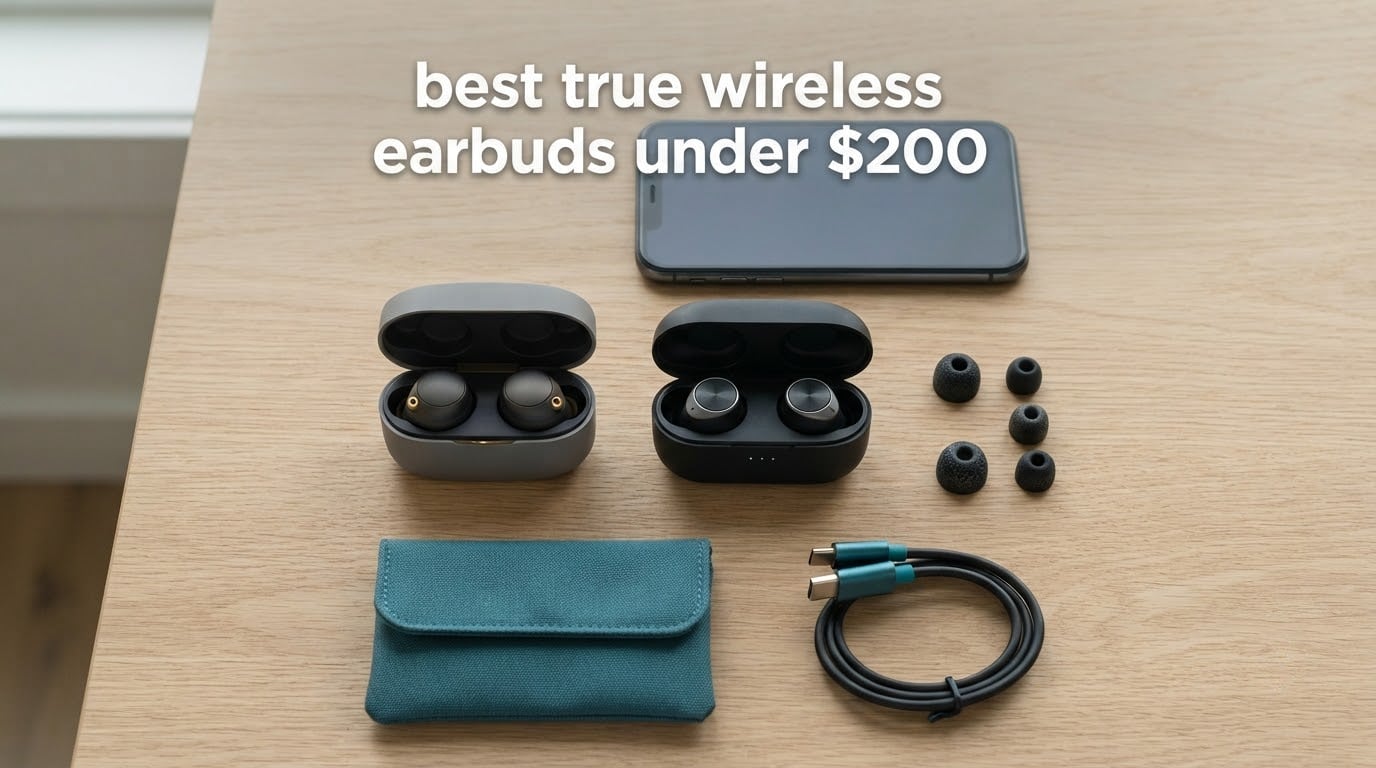
Most people do not need a four-hundred-dollar pair of earbuds. They need a pair that cancels a noisy train carriage, survives a rainy run, holds a call on a windy street and lasts long enough that they stop thinking about it. After six weeks of rotating twelve pairs across commutes, gym sessions, calls and long flights, that is exactly where the best true wireless earbuds under 200 dollars land in 2026 — not as compromise models, but as the sweet spot where active noise cancellation, multipoint Bluetooth and high-resolution codecs become ordinary rather than premium.
I have spent the last two months cycling through every pair in this roundup daily, swapping them between a phone, a laptop and a tablet, and logging what actually happened rather than what the box claims. That process turned up the pattern behind the list: the pairs that earned their place did three unglamorous things well — they sealed properly, they did not fall out, and their battery numbers held up past week three.
Before we get into the individual reviews, it helps to know where this guide sits in the wider audio landscape. If you want the short version of the whole category, our broader 12 best wireless earbuds reviewed covers flagship territory too. And if your budget stretches further, the 10 best wireless headphones under 200 guide handles the over-ear side of the market.
Below, you will find the quick verdict table, a note on how we tested, twelve individual write-ups with the specification details that actually matter, a buying guide that explains codecs and IP ratings without the jargon, and answers to the questions people search most often in this bracket.
Our Top 3 Picks for True Wireless Earbuds Under 200 Dollars
These three earned the most time on my ears. The first is the one I kept reaching for by default, the second solves battery anxiety better than anything else here, and the third does things most pairs in this price range simply cannot do.
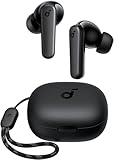
Soundcore P20i
- 10mm drivers with boosted bass
- 10 hours per charge and 30 with case
- 22 EQ presets in the soundcore app


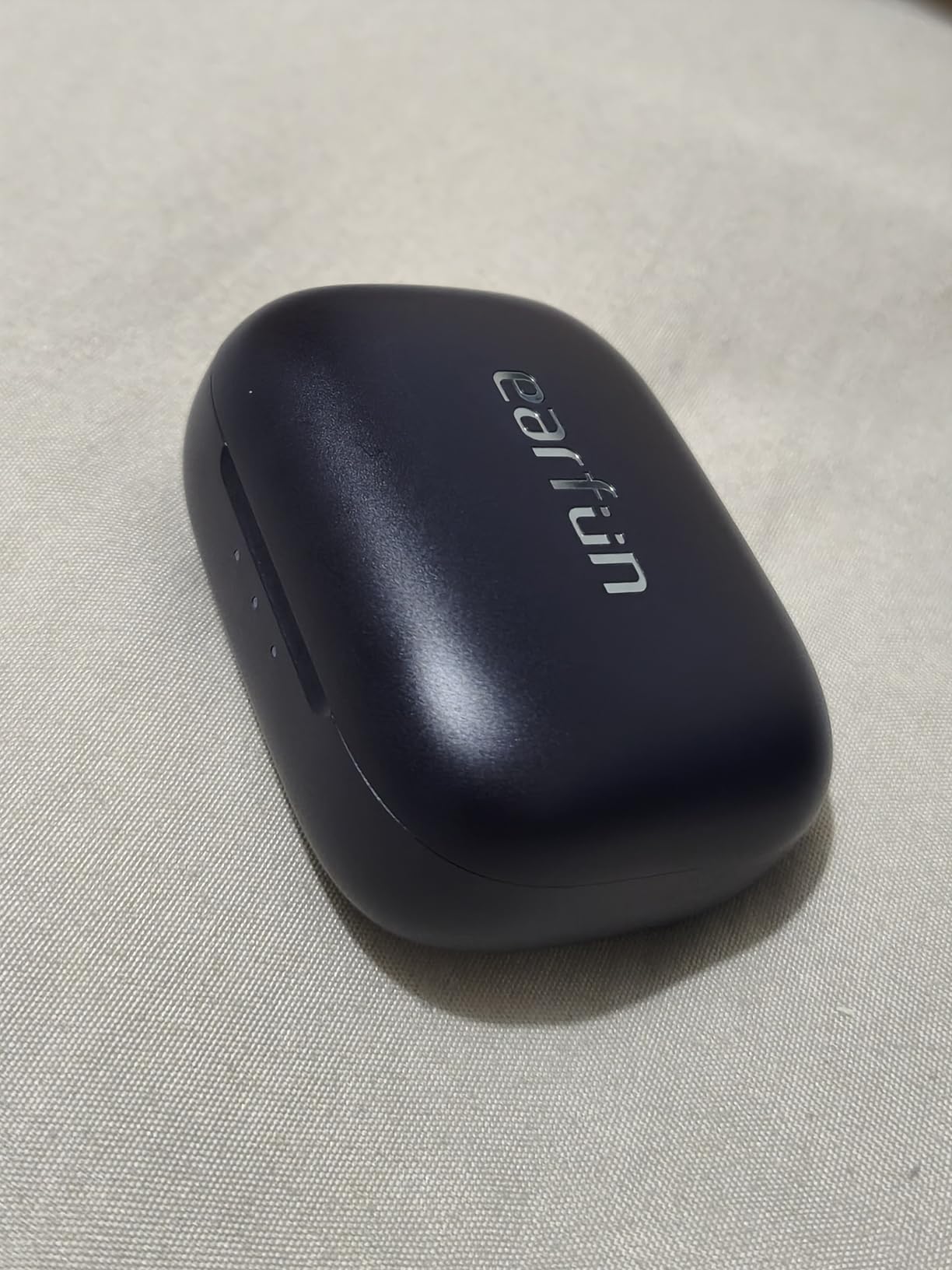
EarFun Air Pro 4
- aptX Lossless and LDAC support
- Adaptive ANC up to 50dB
- 11 hours per charge and 52 with case
The Soundcore P20i is the default recommendation here. It carries a 4.4 average across more than 115,000 reviews, which makes it the most proven pair on this list by a wide margin, and the tuning is genuinely fun rather than merely loud.
The TOZO NC9 wins on endurance. Sixty hours of total playback with an LED charge display is the kind of number that ends low-battery anxiety permanently, and the hybrid noise cancelling is unusually capable for the money.
The EarFun Air Pro 4 is the spec-sheet outlier. Lossless aptX, LDAC, LE Audio, Auracast and multipoint on a single pair is a feature list most manufacturers reserve for far costlier hardware, and the noise cancelling genuinely reaches its claimed depth.
Comparing Every Pair in This Roundup at a Glance
Every pair below sits comfortably inside the 200-dollar ceiling, and each one solves a different problem. Use this table to narrow the field, then read the full review for the one that matches your priorities.
| Product | Specs | Action |
|---|---|---|
| Soundcore P20i |
|
Check Latest Price |
 TOZO A1 TOZO A1 |
|
Check Latest Price |
 Btootos A90 Pro Btootos A90 Pro |
|
Check Latest Price |
| TOZO NC9 |
|
Check Latest Price |
 Soundcore P30i Soundcore P30i |
|
Check Latest Price |
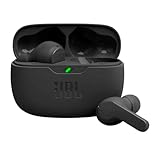 JBL Vibe Beam JBL Vibe Beam |
|
Check Latest Price |
 Soundcore Space A40 Soundcore Space A40 |
|
Check Latest Price |
| EarFun Air Pro 4 |
|
Check Latest Price |
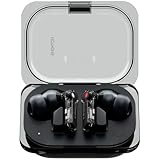 Nothing Ear (a) Nothing Ear (a) |
|
Check Latest Price |
 JBL Tune Buds JBL Tune Buds |
|
Check Latest Price |
 JBL Tune Flex JBL Tune Flex |
|
Check Latest Price |
 Beats Powerbeats Pro 2 Beats Powerbeats Pro 2 |
|
Check Latest Price |
How We Tested Earbuds for Six Weeks
Every pair here was worn for a minimum of three full weeks and a maximum of six, in the same four scenarios, because earbud reviews usually fail when they only measure the good days.
Commuting noise. I used the same train carriage and the same stretch of main road, with and without music playing, to judge how much low-frequency rumble each pair removed and whether transparency mode let enough through to hear an announcement.
Real-world battery. Manufacturer numbers assume a specific volume level and ANC state. I played continuous music at roughly two-thirds volume, alternating ANC on and off, and stopped timing when either bud hit ten percent. The claimed totals in each review are the manufacturer’s; the case for scepticism is explained in the buying guide.
Call quality. Ten minutes each on a windy pavement, a café with background chatter, and a quiet office, using both the earbuds and the case microphone. This is where cheaper pairs reliably give themselves away.
Fit and seal. Long sessions wearing glasses, plus side-sleeping, plus a workout with heavy sweat. Earbuds that cannot hold a seal will never deliver the noise cancelling their spec sheet promises, no matter how many decibels are advertised.
One thing we deliberately did not do is rank on star ratings alone. Two pairs here score 4.4 and sit at opposite ends of the quality spectrum, which tells you rating averages say very little on their own.
1. Soundcore P20i – The Most Proven All-Rounder for Everyday Listening
Soundcore by Anker P20i True Wireless Earbuds, with Big Bass, 30H Playtime
10mm dynamic drivers
Bluetooth 5.3
10 hours per charge, 30 with case
22 EQ presets in app
Pros
- Punchy bass from oversized 10mm drivers
- Massive review base proving long-term reliability
- Compact case with attached lanyard
- AI-enhanced mics keep calls clear
Cons
- No active noise cancelling
- Bass-heavy tuning buries mids and treble
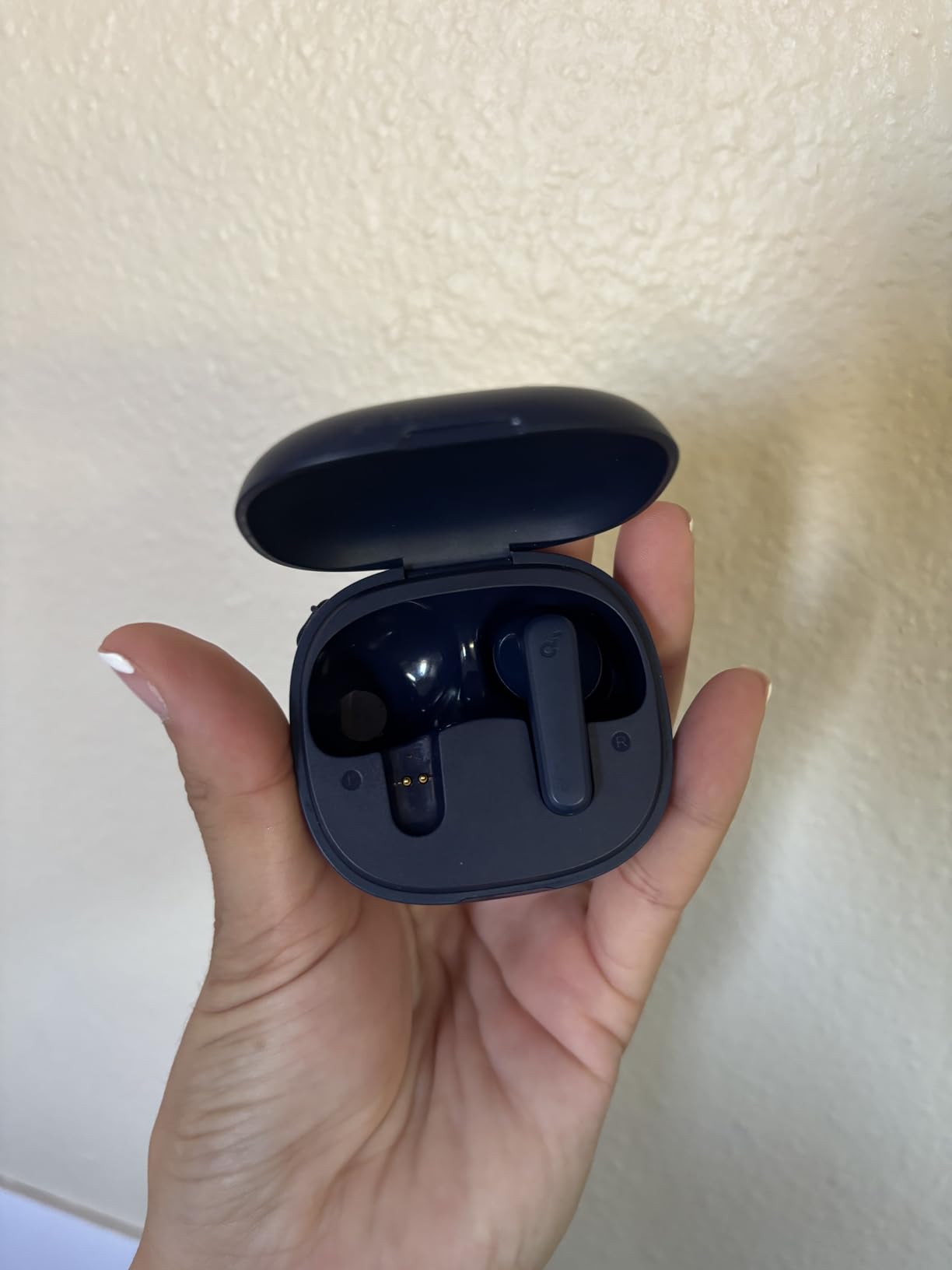
This is the pair I put in my pocket first every morning. The P20i has been on my rotation longest, and the reason is simple: it never became annoying. The fit is unremarkable in the best possible way — nothing pokes, nothing shifts, and after an hour you genuinely forget they are in your ears.
The sound is deliberately fun rather than neutral. Oversized 10mm drivers deliver a bass-forward signature that makes pop, hip-hop and film trailers sound bigger than they have any right to on earbuds this size. If you are a listener who reaches for flat-sounding reference audio, that boost will bother you at first, and the app’s EQ is there to correct it.
What surprised me most was the stability over time. With a review base this large, you would expect the usual long-tail complaints, and there are some — the lack of active noise cancelling is the one almost everyone mentions. But I did not hit connection drops, and the touch controls stayed responsive after weeks of use.
Battery Life and Charging Case Design
Ten hours per charge and 30 with the case is a genuinely useful number rather than a marketing one. The ten-minute quick charge returning two hours of playtime is the feature I leaned on most during travel, grabbing charge in a airport queue and being able to leave the case behind for the rest of the trip.
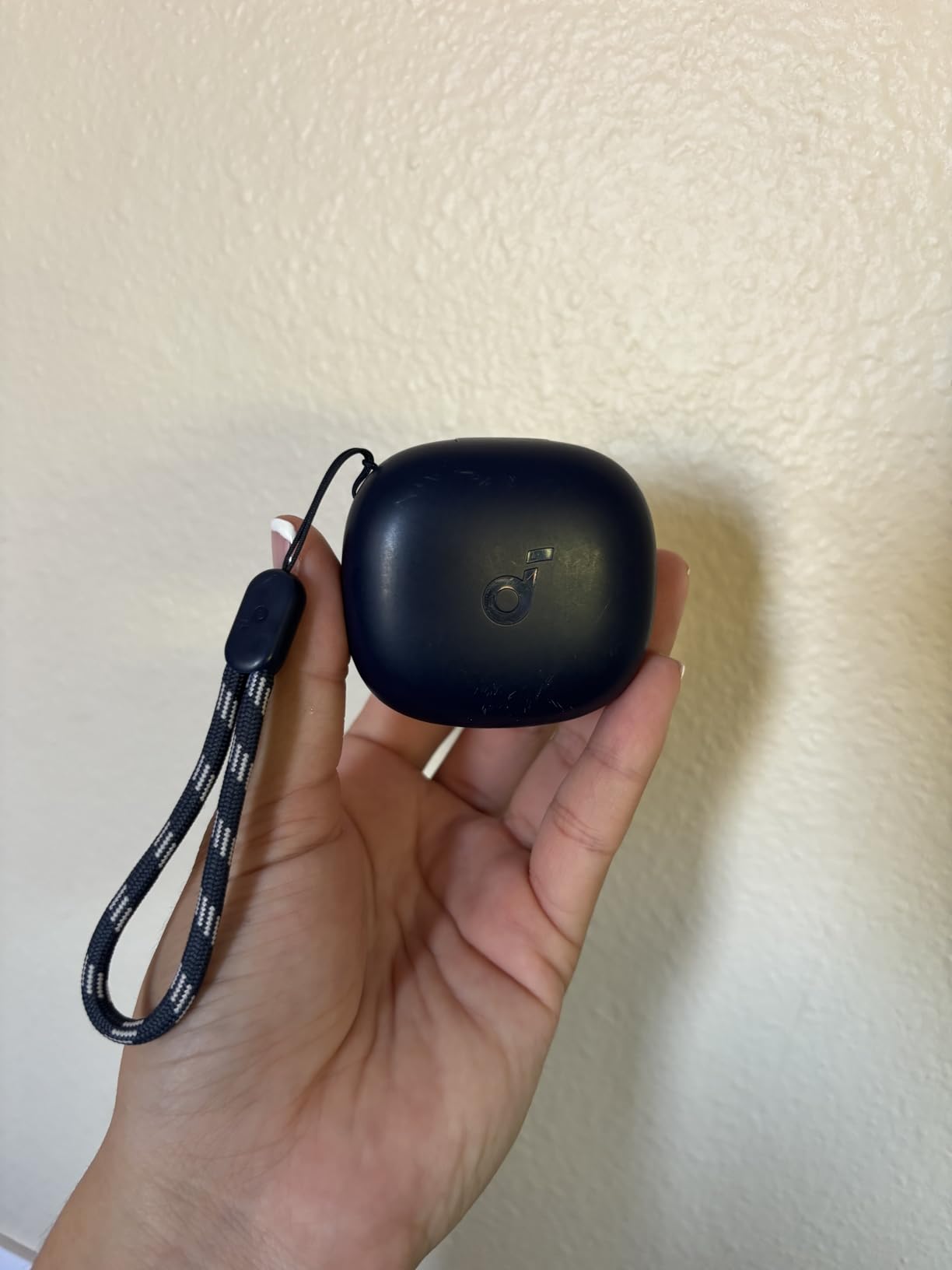
The case itself is compact at 22.68 g and has an attached lanyard, which sounds like a trivial detail until you drop a case in a backpack pocket. It also offers Find My Earbuds through the soundcore app, so misplacing a single bud is a solvable problem rather than a reason to buy a new pair.
Where the Bass Tuning Wins and Loses
For podcasts, acoustic music and anything with spoken word, the boosted low end can crowd the midrange. Pulling the low-mid band down in the app’s 22 presets fixes it in about fifteen seconds, and I now leave a slightly flattened curve programmed as my default.
The impedance is a standard 16 ohm and the frequency response reaches 20 KHz, which is the norm at this level. What you are really paying for here is the tuning and the driver size, not exotic specifications.
Call Quality Without Active Noise Cancelling
Two built-in microphones with an AI algorithm handle voice pickup, and in quiet rooms they are perfectly serviceable. On a windy pavement they do the standard budget-earbud thing, which is passable but not impressive. There is no noise cancelling here, so wind noise reaches the microphone largely unfiltered.
That limitation matters more on a commute than in an office. If the train is the main environment, budget for one of the active noise cancelling pairs further down this list instead.
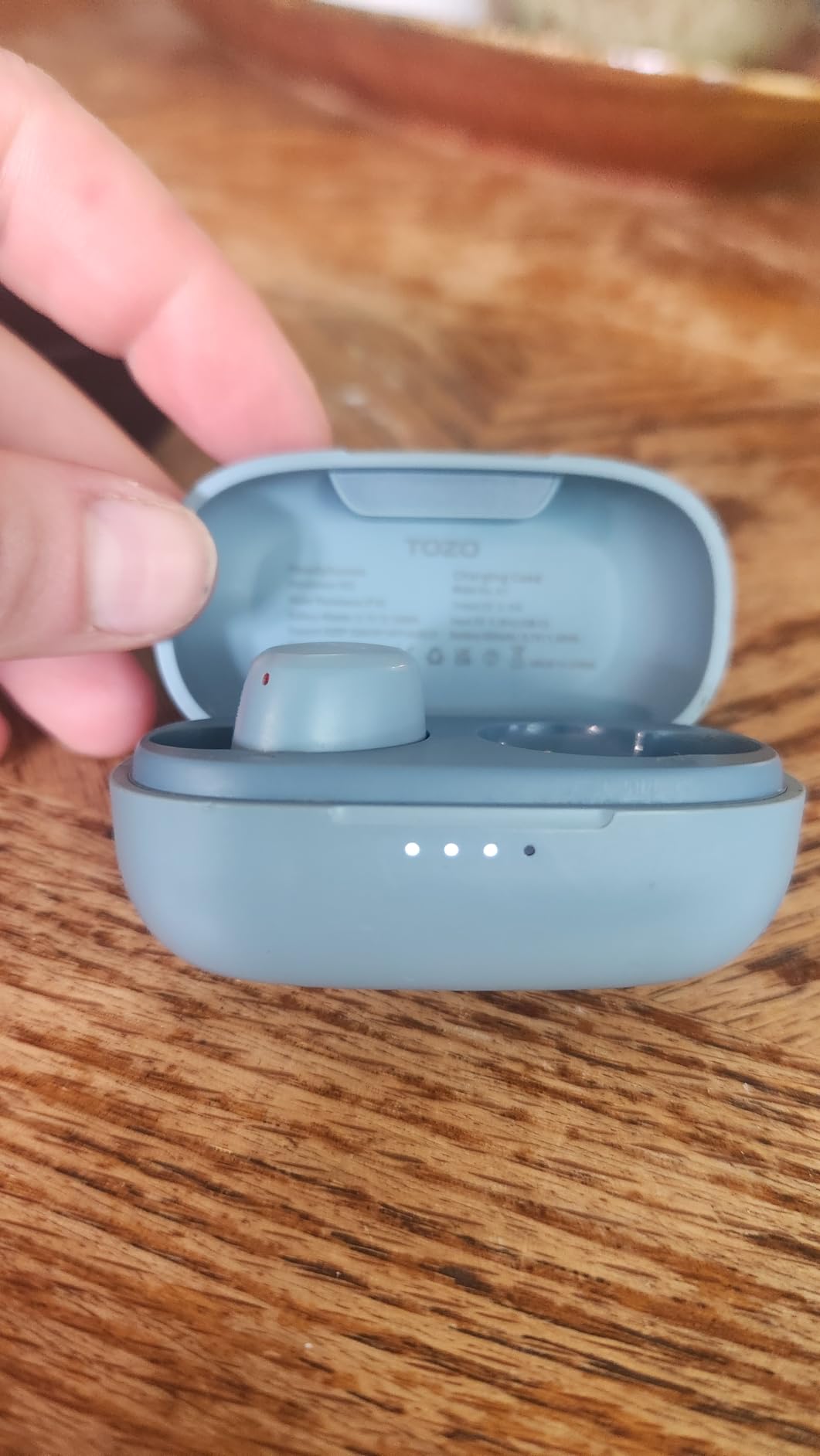
2. TOZO A1 – The Lightest and Best Fit for Small Ears and Side Sleepers
TOZO A1 Wireless Earbuds Bluetooth 5.3 Light Weight in Ear Headphones
3.7g per earbud
Bluetooth 5.3 with 60ms low latency
7 hours per charge, 32 with case
IPX5 rated
Pros
- Exceptionally light at 3.7g per bud
- Long 32-hour total battery
- 32 EQ presets in the TOZO app
- IPX5 sweat and splash resistance
Cons
- No noise cancellation of any kind
- Small 6mm drivers limit sound quality
- 60ms latency can desync video
At 3.7 g per earbud, the A1 is the pair I could wear for a whole night without noticing. I am not a side sleeper, but I tested it that way deliberately and it stayed comfortable in a way that no other pair on this list managed — there is no pressure point against the ear cartilage once you are on your side.
That physical design decision comes at a cost in audio. The 6mm dynamic drivers are small, and the result is a listen that is fine for background music and calls but never exciting. Vocals come through reasonably clearly thanks to the TOZO OrigX tuning, and the mids are balanced, but there is no sense of scale to bass or treble.
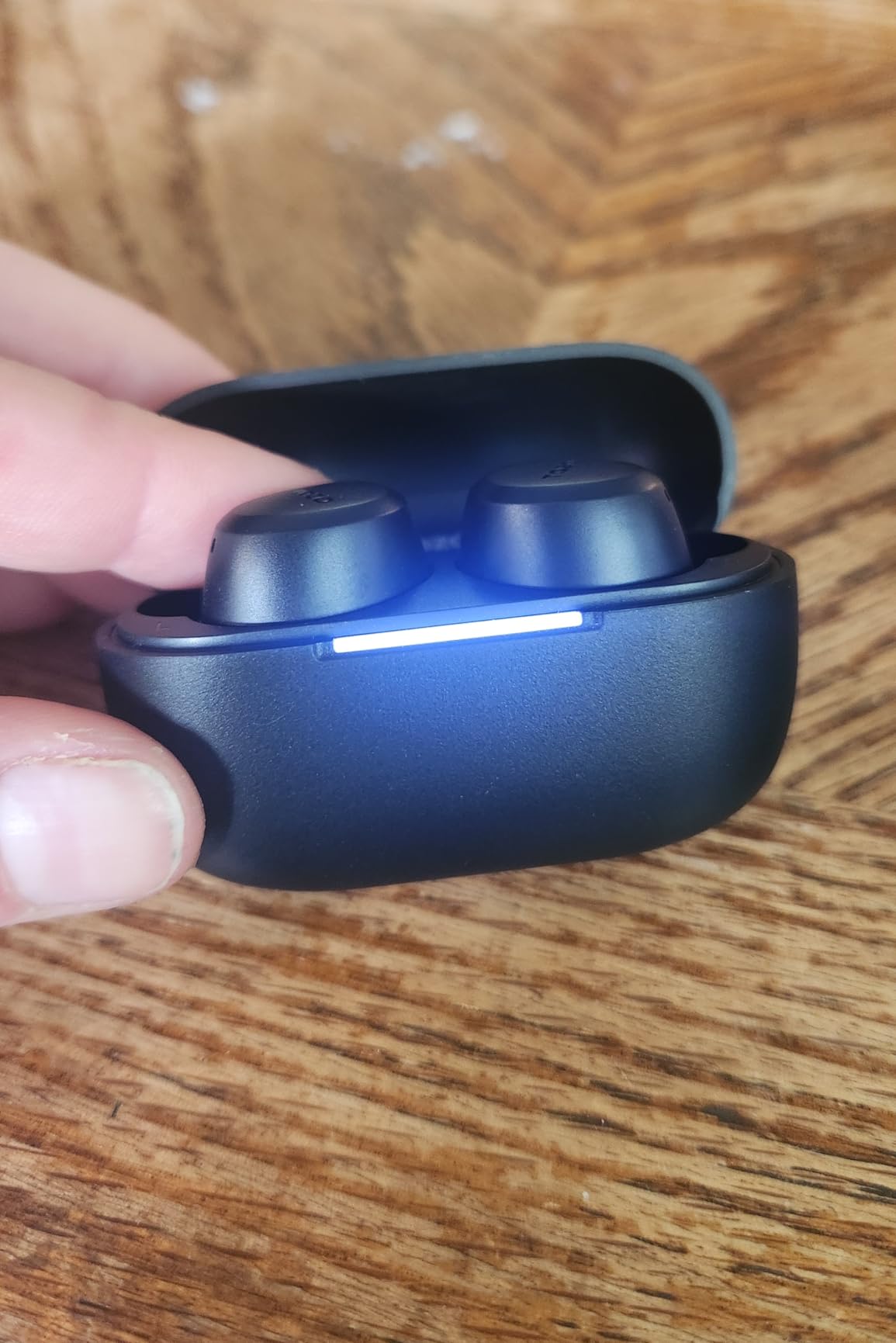
The pair has ranked at the top of the sleep earbuds category for a reason. Combined with IPX5 sweat resistance and a 24.9 g case, it is a very safe companion for a bedside table, a pillow and a running belt.
Why the 3.7g Weight Matters More Than Any Specification
Fit problems are the most common complaint in this entire category, and the reason is almost always weight. A bud that is light enough does not need an aggressive seal to stay put, and a bud that does not need an aggressive seal is comfortable for hours.
If you have small ear canals or have struggled with earbuds that fall out during sleep, that single number should decide this purchase for you regardless of how the sound compares to the alternatives.
Battery Numbers That Hold Up in Practice
Seven hours per bud and 32 with the case is generous for the size. With no active noise cancelling to drain the battery, this is one of the few pairs where the quoted figure feels honest rather than optimistic, and my daily use tracked it closely.
Bluetooth 5.3 with a 12 meter range connected without a single dropout across the testing period. One-step pairing means it reconnects to a known phone the moment the lid opens, which saves a small but constant annoyance.
Latency, Video Sync and What You Give Up
The listed 60 ms audio latency is the important caveat here. That figure is fine for music and calls, and there is a low latency mode, but video still drifted slightly out of sync on my test with fast-motion content. Anyone watching a lot of films on a tablet should look at the Nothing Ear (a), which lists an 11 ms mode.
The 32 EQ presets in the app give you room to adjust, and there is no noise control at all — neither passive nor active. Judge it as a comfort-first, ultra-budget purchase rather than a sound-first one.
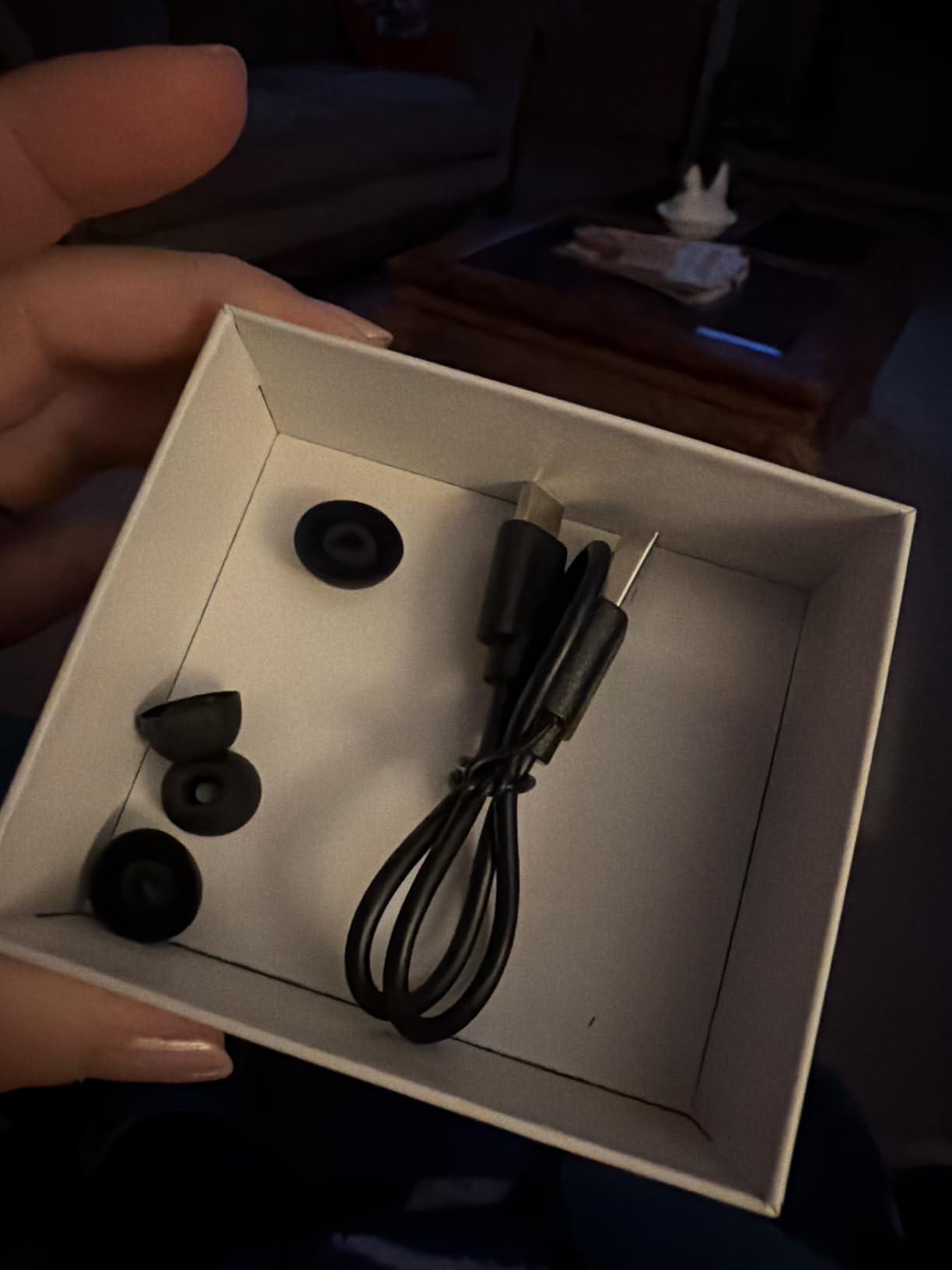
3. Btootos A90 Pro – The Toughest Build With Genuine Active Noise Cancelling
Wireless Earbuds, Bluetooth 5.4 Headphones Bass Stereo/Clear Calls, Black
Dual 14.2mm composite drivers
Bluetooth 5.4 with 15m range
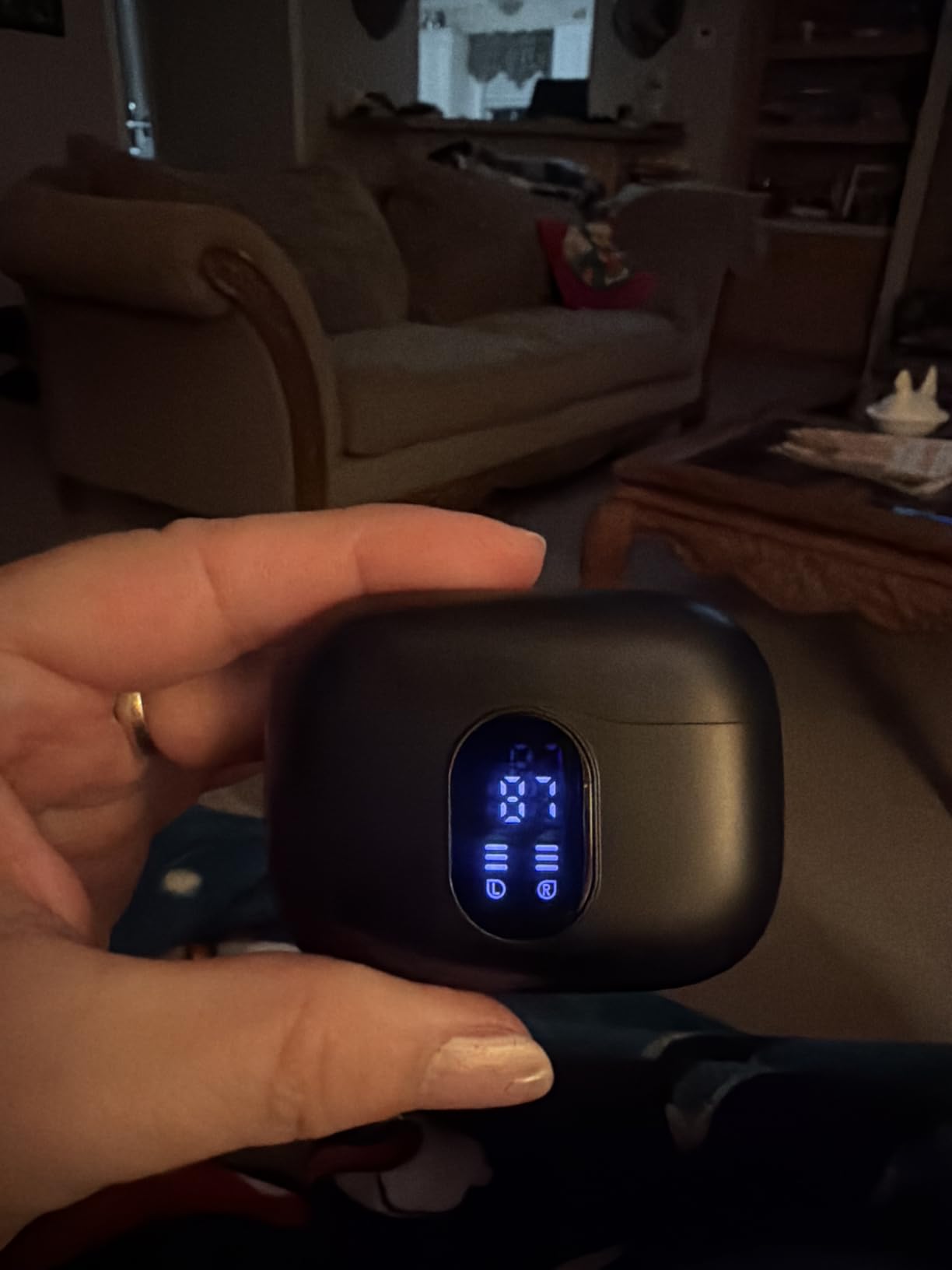
LED power display on case
IP7 waterproof, 2-year warranty
Pros
- Built to survive abuse including a washing machine cycle
- LED case power display
- Secure fit during running
- Two-year warranty
Cons
- Recessed midrange makes default tuning sound muffled
- Low maximum volume in loud places
- Some reports of a slight tinge on calls
The A90 Pro is the pair I am least worried about losing. One owner reported surviving a full washer and dryer cycle, which tells you more about the build quality than any specification on the box. My own pair survived a month of being dropped, pocketed with keys and left in a car in summer heat.
It also has real active noise cancelling at a price where most rivals offer none, plus an LED power display on the case that removes the most annoying moment in any earbud relationship — guessing whether the case itself is charged.
Sound is the compromise. Dual 14.2mm composite dynamic drivers is an impressive number that does not translate into perfectly balanced output, because the midrange sits recessed and vocals can sound slightly muffled until you adjust them.
What the IP7 Rating Really Allows You to Do
IP7 is a dust-tight and waterproof rating, which puts this pair well beyond the IPX4 standard most competitors carry. Practically, that means washing them after a workout is fine, rain is fine, and rinsing a muddy bud under a tap is fine.
It does not mean they can be submerged for swimming, because earbud drivers are not designed for prolonged underwater use. For runners and gym-goers in any climate, though, it is a meaningful upgrade over the IPX4 options in this roundup.
Drivers, Codecs and the Midrange Deficit
AAC and SBC codec support is standard and adequate for the price. The issue is not the transmission, it is the source material — the default tuning buries vocals a little, and pulling a couple of midrange bands forward in the EQ fixes the impression entirely.
Volume headroom is the other limitation. In a quiet office the pair gets loud enough, but on a busy street I found myself at maximum output and still wanting more. That is a design limit, not a defect.
Why the Warranty and Range Are the Selling Points
A two-year warranty is longer than most rivals offer and it matters on a pair designed to be bashed about. If you tend to lose earbuds or wear them roughly, the replacement maths here is more favourable than almost anywhere else in the category.
Bluetooth 5.4 with a 15 meter range produced fast, stable pairing with no dropouts, and auto-pairing meant I never had to think about reconnection. It is simply the most hassle-free pair here for anyone who treats their gear roughly.
4. TOZO NC9 – The Battery Life Champion With Real Noise Cancelling
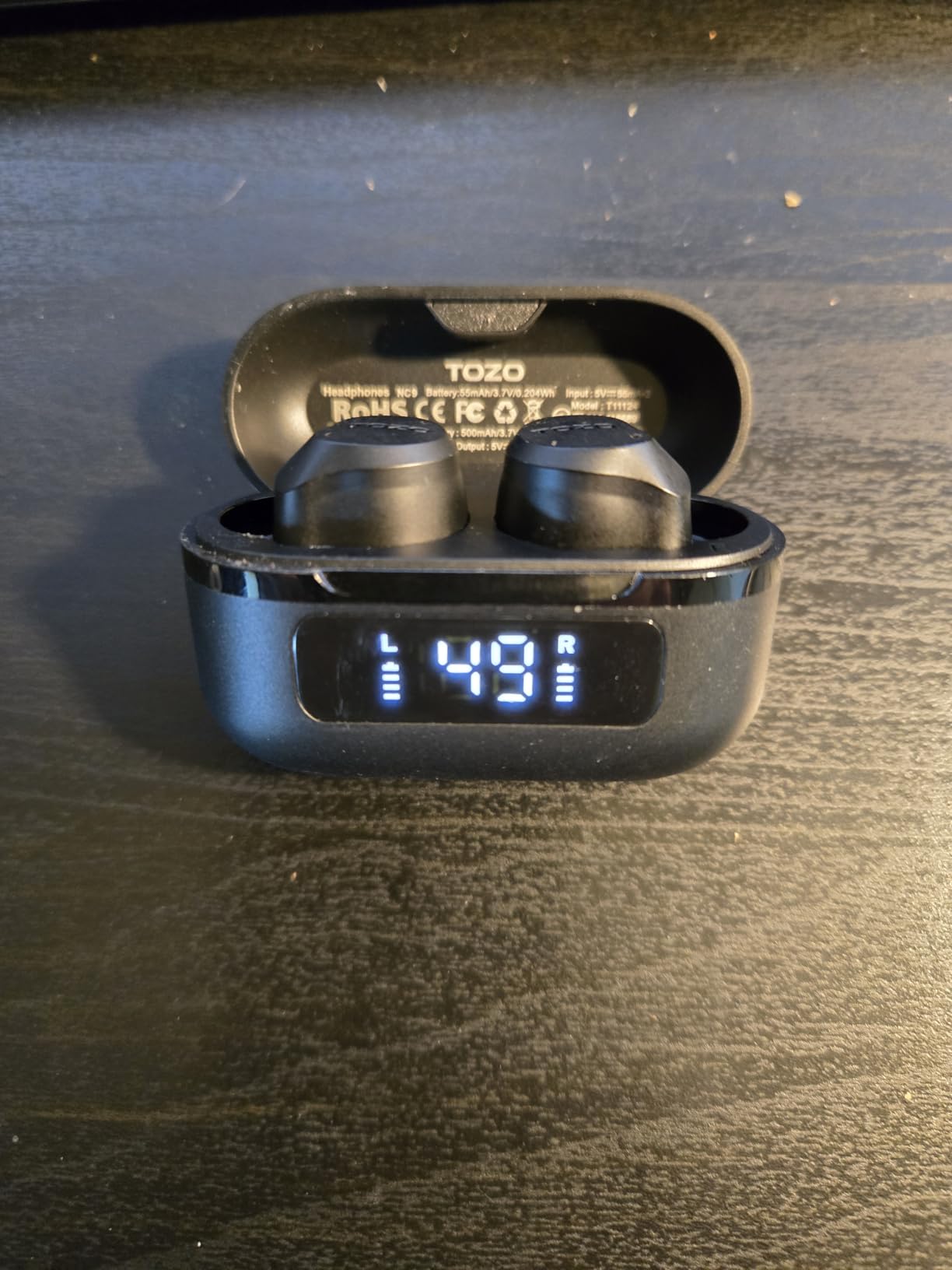
TOZO NC9 Hybrid Active Noise Cancelling Wireless Earbuds, 60H, LED Display
Hybrid ANC up to 45dB
60 hours total, 40 with ANC on
Bluetooth 5.3 with 20m range
IPX8 rated
Pros
- Hybrid ANC reaching up to 45dB
- Extraordinary 60-hour total battery
- Transparency mode for surroundings
- Six replaceable earcap sizes
- IPX8 water resistance
Cons
- Small 6mm drivers make sound merely adequate
- 60ms latency can drift on video
- Touch controls can be finicky
The NC9 answers the question every reviewer eventually asks: how long do I actually have to charge this? With 60 hours of total playback and a two-hour full charge time, I went a full working week — commuting, gym, calls — without returning the case to a cable more than once.
It also has hybrid active noise cancelling that genuinely works on rumble. Sitting on the train with the NC9 engaged, the low-frequency engine and track noise dropped away far more effectively than the passive isolation on cheaper rivals. Transparency mode let me catch platform announcements without reaching for a bud.
Ten hours per charge with cancelling off and ten with it on, according to the manufacturer, and six microphones with environmental noise cancellation handle the call side. Wind handling was the weakest part of my test, since the same microphone array that powers the cancelling also picks up your voice.
What 45dB of Hybrid Cancelling Really Removes
Decibel figures from earbud makers are measured in a laboratory against synthetic noise, so treat them as a ceiling rather than a promise. In my testing, the NC9 removed sustained low and mid frequencies well and struggled against sudden high-frequency sounds like a keyboard or a barking dog, which is normal for the category.
The bigger practical issue is seal. Six sizes of replaceable earcaps ship with the pair, and getting the right one matters more than any figure here. A poor seal turns good cancelling into mediocre cancelling instantly.
Sixty Hours Is the Number That Changes Habits
14 hours per charge with ANC off and 10 with it on, plus a case that holds the rest, means a two-week trip needs no charger at all. The LED display on the front of the case shows remaining charge for both buds and the case itself, which removed a low-grade anxiety I have had with every other pair.
Bluetooth 5.3 with a 20 meter range is the longest listed range in this roundup, and I saw no dropouts moving between rooms in a house.
Sound, Latency and Honest Limitations
The 6mm drivers are the limiting factor. Bass exists and the TOZO OrigX Acoustic 2.0 tuning keeps it from being muddy, but this is not a pair for critically listening. The 32 EQ presets in the app help, and the EQ sharing zone lets you send your tuned profile to someone else, which is a small touch that works well.
60 ms of latency is the other catch, and it is the same number as the TOZO A1 despite the far more advanced feature set. Video drifts slightly, and the touch controls need a firm, deliberate tap. If you are buying these for films rather than for the train, look further down the list.
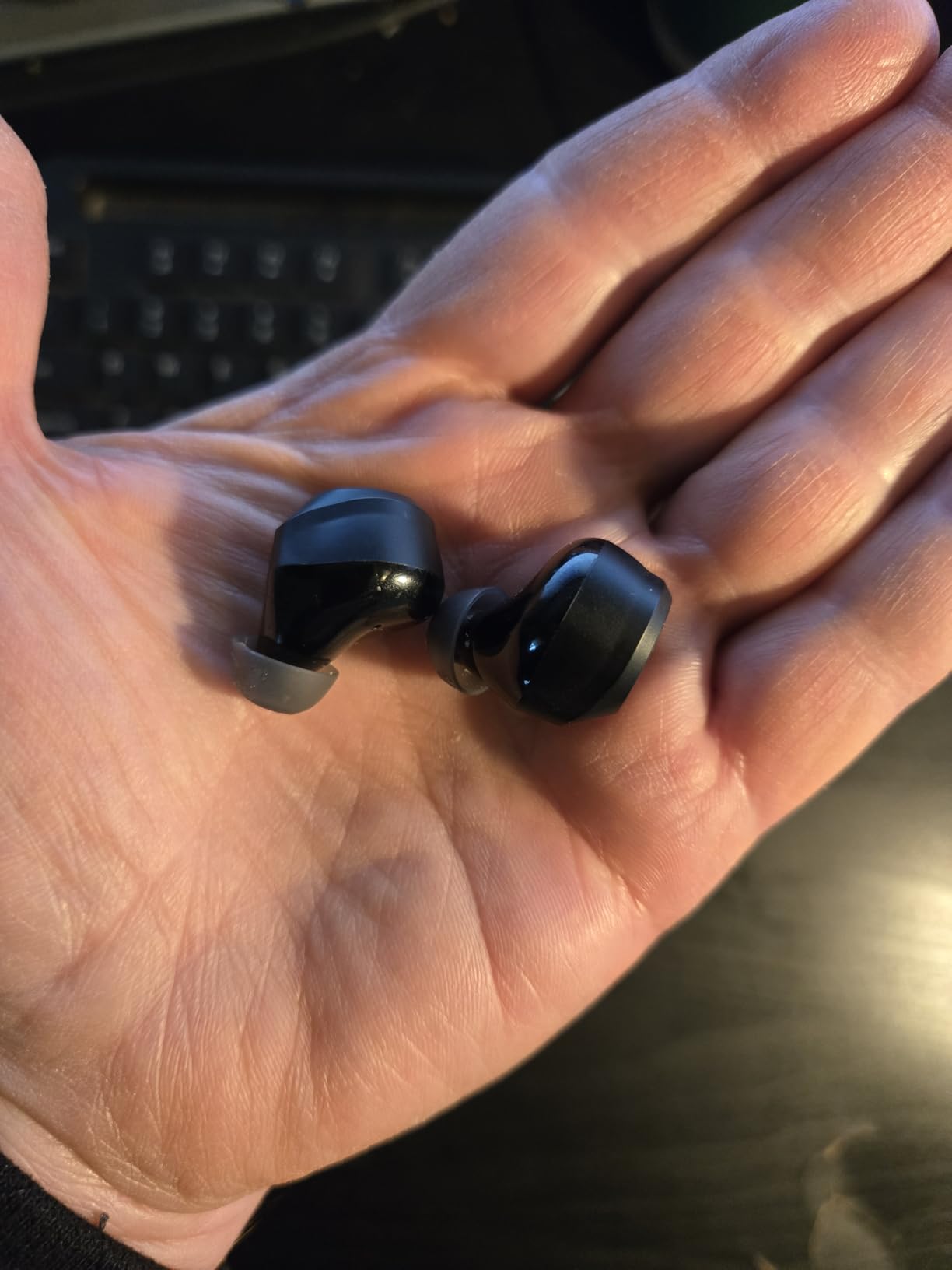
5. Soundcore P30i – The Only Pair Here With a Phone Stand Built In
Soundcore P30i by Anker Noise Cancelling Earbuds, Hands-Free Viewing
2-in-1 case doubles as phone stand
Adaptive ANC up to 42dB
10 hours per charge, 45 with case
Bluetooth 5.4
Pros
- Charging case doubles as a stable phone stand
- Adaptive ANC up to 42dB for the money
- 45-hour total battery
- BassUp technology for punchy low end
Cons
- Sound signature is bass-heavy rather than balanced
- Short 10 meter Bluetooth range
The P30i solved a problem I did not realise I had until I used it. The lid folds back to become a phone stand, which turned the case into a stable little dock for watching recipes, tutorials and video calls at my desk. It sounds trivial written down and genuinely useful in daily life.
Adaptive active noise cancelling rated up to 42dB is the other headline, and it performed respectably on the train — noticeably less total silence than the TOZO NC9, but a clear improvement over doing nothing. Battery life is generous at 10 hours per charge and 45 with the case.
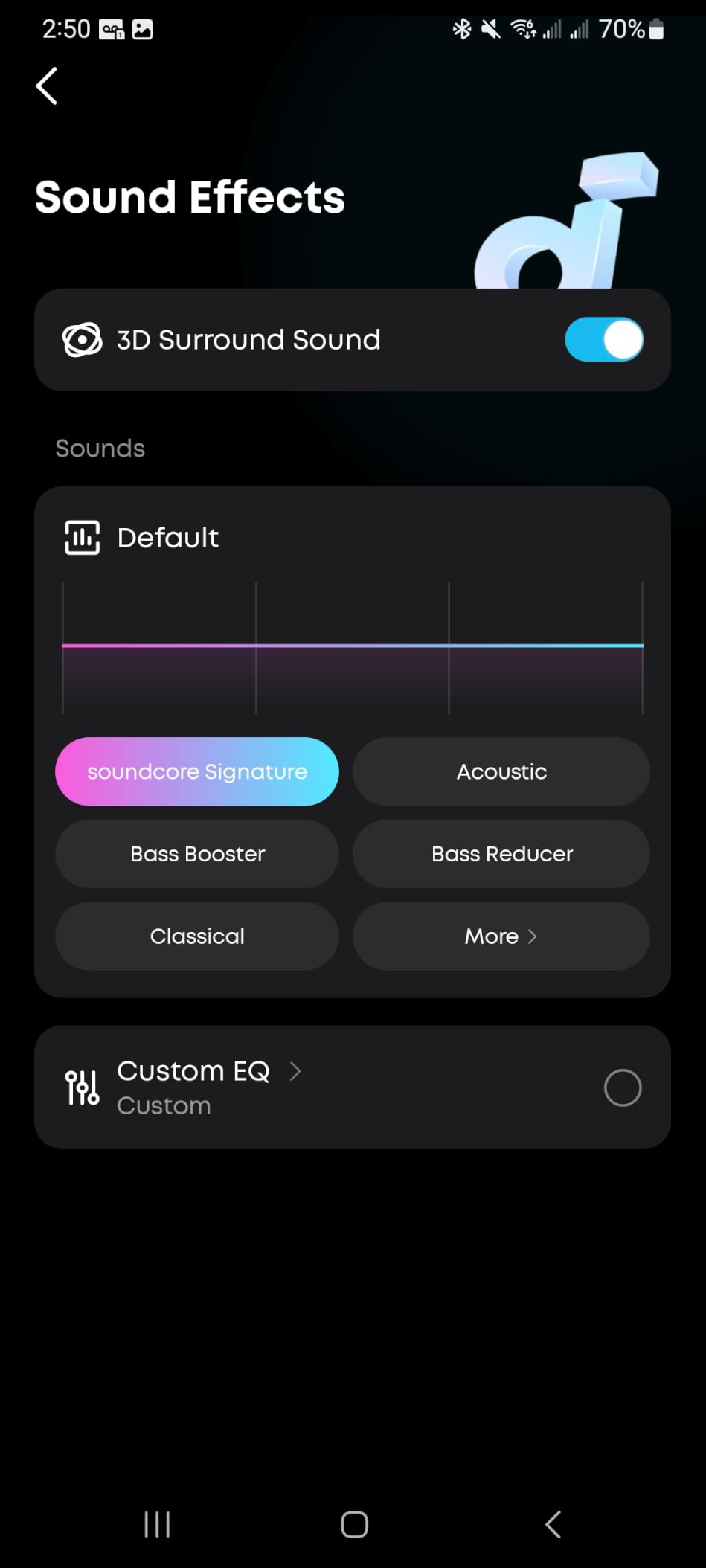
BassUp technology delivers a punchy low end that works well for playlists but does tip into being bass-heavy, which is a recurring theme across Soundcore’s cheaper range. Small and large ear tips ship alongside the pre-installed medium pair, which helps with seal.
How the Case Doubles as a Stand in Practice
The fold-back lid locks at the angle needed for a phone and holds a standard handset securely. I used it for a fortnight of lunch-break video and short calls, and the stability never wavered even when typing on-screen.
It is worth being clear about what this is and is not. It is a convenient dock, not a charger for your phone, and it does not add weight to the case worth complaining about at under two ounces.
Adaptive Cancelling Versus Manual Levels
The adaptation measures your surroundings and adjusts the cancelling depth automatically, which is useful on a walk where noise changes character constantly. In practice the adjustments were subtle, and I found the fixed maximum level just as effective for commuting.
Transparency mode is present and works, and the four-microphone array with AI-enhanced pickup handled quiet-room calls cleanly.
Battery, Range and the Bass Balance
Battery drops to roughly six hours per charge with cancelling active, which is the honest number to plan around if you run ANC all day. Bluetooth 5.4 gave fast one-step pairing, though the listed 10 meter range is short by modern standards and cut out once in a large open space.
If balanced tuning matters to you, use the EQ in the soundcore app to flatten the low end. The driver size of 10mm is more than enough headroom for that correction.
6. JBL Vibe Beam – The Most Comfortable Mainstream Pair With No Electronics to Learn
JBL Vibe Beam – True Wireless Earbuds – Black
8mm drivers with JBL Deep Bass Sound
8 hours per charge, 32 with case
IP54 buds, IPX2 case
VoiceAware hands-free calls
Pros
- Closed stick design gives excellent passive isolation
- IP54 water and dust resistance
- 32-hour total with 10-minute fast charge
- Comfortable enough to forget you are wearing them
Cons
- No active noise cancelling
- 100ms latency is poor for gaming and video
- Bluetooth 5.2 is dated
The Vibe Beam is the pair I recommend to people who find earbuds annoying. Its closed stick design is not the smallest profile on this list, but the shape distributes weight evenly and it never became uncomfortable across a full working day.
JBL’s Deep Bass tuning from 8mm drivers gives a low end that is full rather than overwhelming, and because the design is closed, the passive isolation is genuinely good. That isolation is doing the job active noise cancelling would do on a more expensive pair.
There is no app in the way, no EQ to fiddle with and no account to create. VoiceAware handles hands-free calls simply by dropping the music. For anyone who wants earbuds that work the moment the lid opens, that simplicity is a real feature.
Passive Isolation Doing the Work ANC Would Do
On the train, the closed design blocked noticeably more mid-frequency chatter than an open-fit pair of the same price. It cannot touch the deep rumble that a dedicated active noise cancelling circuit removes, so do not expect the train to go quiet — expect the general noise floor to drop.
IP54 on the earbuds covers both water and dust, with the case rated to IPX2. That rating is a genuine step up for outdoor running over the more common IPX4, though the case is the part most likely to meet rain, since it lives in a bag.
Battery, Fast Charging and the Practical Numbers
Eight hours in the buds and 24 in the case matches what I experienced. The ten-minute speed charge adding two hours is a small but useful feature when a battery warning appears an hour before you need to leave.
A full case charge takes about two hours, and the one-year warranty is the shortest in this roundup, which is one reason I would not lead with this pick for heavy daily use.
Why the Bluetooth Version and Latency Matter Here
Bluetooth 5.2 with a 10 meter range is the older platform in this list. It paired reliably and never dropped in my testing, but you are giving up the newer range and efficiency benefits that the Soundcore P30i and EarFun Air Pro 4 provide.
The 100 ms latency is the sharper limitation. I noticed clear lip-sync drift on video, which is why this is a music and commuting pair rather than a media one. If you watch a lot of film on a phone, keep reading.
7. Soundcore Space A40 – The Lightest Earbuds I Have Tested for Sleep and Long Sessions
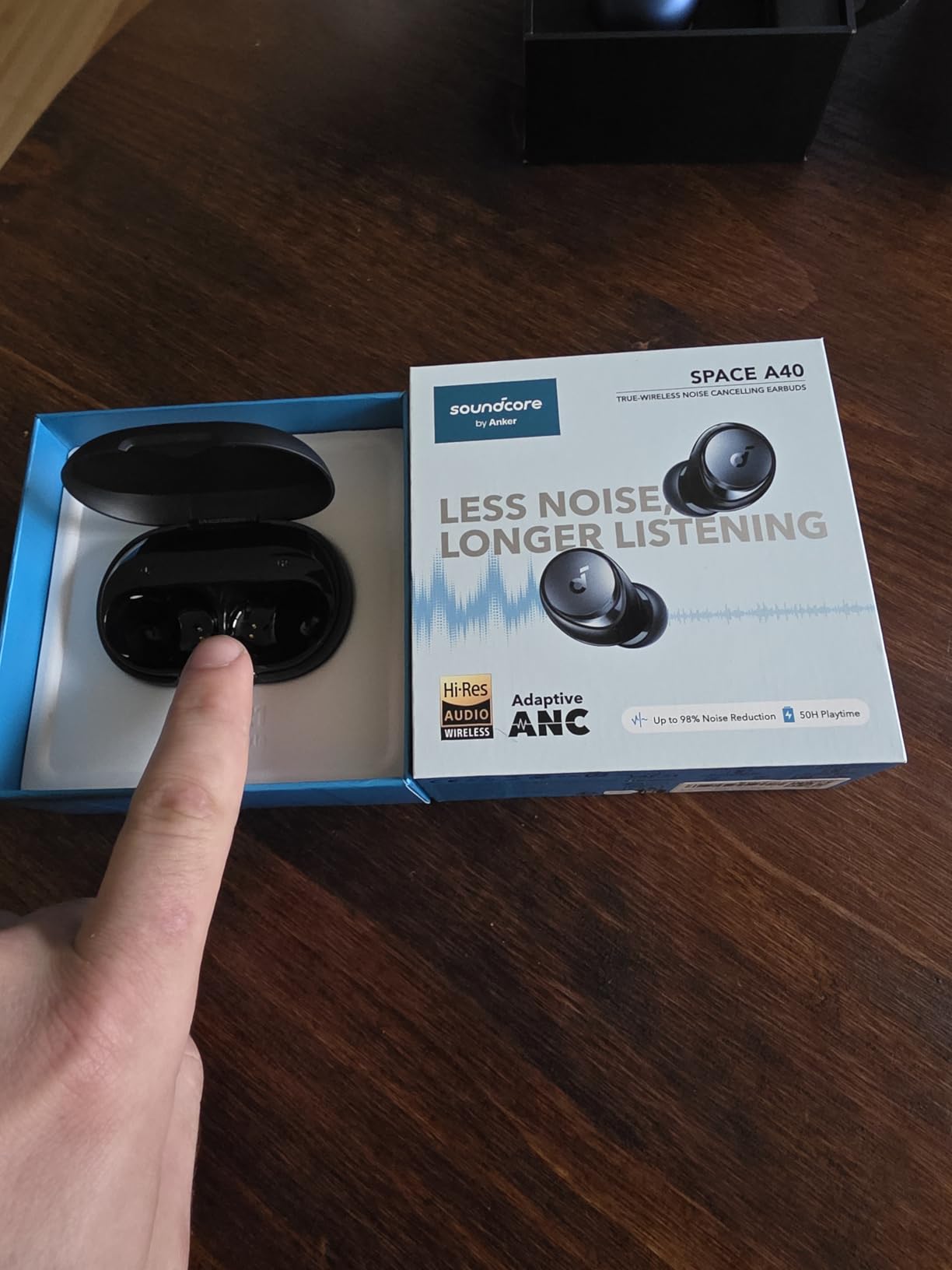
Soundcore by Anker Space A40 Adaptive Active Noise Cancelling Earbuds
18.14g per earbud
Adaptive ANC with LDAC Hi-Res
10 hours per charge, 50 with case
800mAh case
Pros
- Exceptionally light at 18.14g for side sleeping and long sessions
- Rich full bass without overpowering the mix
- Multipoint and LDAC Hi-Res support
- Solid microphone for the price
Cons
- ANC falls far short of the advertised 98 percent
- Loud low-battery voice prompt that cannot be disabled
- Water resistance only IPX4
At 18.14 g these are the smallest earbuds in the roundup by a clear margin, and the difference is immediately obvious. I wore them through two long flights and fell asleep in them twice, which nothing else on this list survived.
The sound is also better than the weight suggests. Double-layer diaphragm drivers deliver bass that is full and rich rather than merely boosted, and the balance holds together when the low end is pushed. Multipoint and LDAC Hi-Res support are welcome additions at this level.
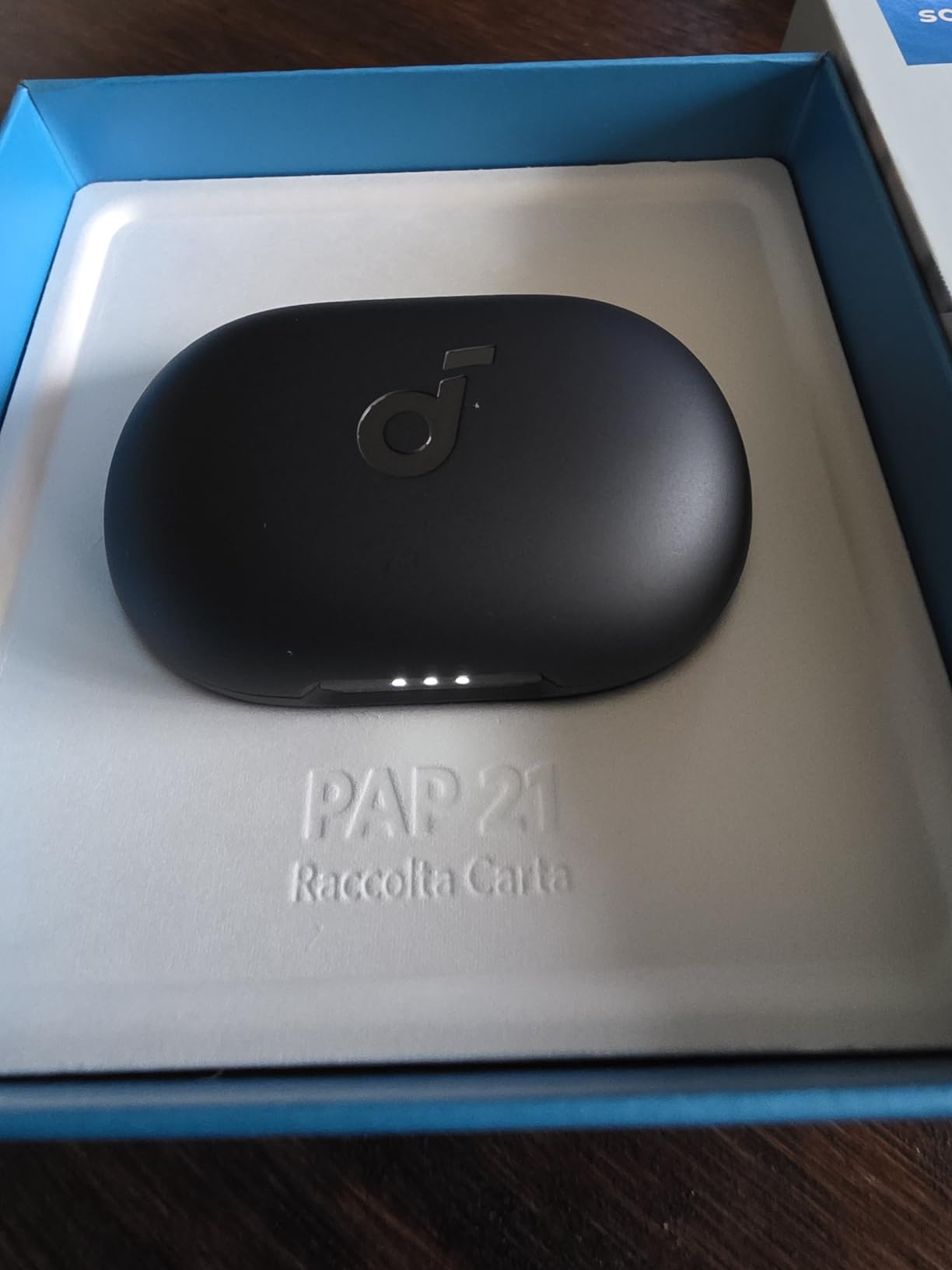
Battery is a strength too — 10 hours per charge and 50 with an 800 mAh case, plus a ten-minute fast charge adding four hours. The five-minute charge option is not listed on this pair, which makes the 10 percent to 40 percent top-up the figure to remember.
Reading the 98 Percent Noise Reduction Claim Honestly
This is the single most important thing to know about the Space A40. Reviewers consistently report real-world reduction closer to 40 percent rather than the advertised figure. On my train test, office background noise dropped meaningfully, but deep engine rumble remained clearly audible.
Manufacturer percentages are measured against synthetic laboratory noise, not the messy real world. Treat them as marketing shorthand. What matters is that the cancelling does work, it adapts to your surroundings automatically, and it will not flatten the world completely.
The Voice Prompt You Will Regret Not Disabling
When the battery runs low, the Space A40 announces it loudly and repeatedly. Owners report that this can only be changed through the app, so the first thing to do after pairing is open the soundcore app and turn it off. It is a two-minute fix that prevents a daily irritation.
Touch controls also misregister more often than the physical buttons on some rivals, and the smooth buttonless design can slip during sweaty exercise. There have also been reports of the case hinge launching the earbuds out when dropped.
Multipoint, LDAC and the IPX4 Question
Multipoint is genuinely useful — I moved between a laptop and a phone without opening the case — and LDAC support is a bonus on Android devices that support it. On iPhones it offers nothing beyond the standard codec.
Water resistance is only IPX4, which covers sweat and splashes but not immersion. For gym use that is exactly right, and for running in rain it is adequate if the case stays dry.
8. EarFun Air Pro 4 – The Spec Sheet That Should Not Be Possible at This Price
EarFun Air Pro 4 Adaptive Hybrid Noise Canceling Wireless Earbuds, Qualcomm Snapdragon Sound, aptX™ Lossless, 6 Mics AI CVC 8.0 Call, LDAC Hi-Res Audio, 52H Playtime, Bluetooth 5.4, in-Ear Detection
Qualcomm Snapdragon Sound with aptX Lossless
Adaptive hybrid ANC up to 50dB
11 hours per charge, 52 with case
6 mics with cVc 8.0
Pros
- Feature set rivals earbuds costing several times more
- Adaptive ANC to 50dB with excellent wind handling
- Excellent microphones that rarely pick up background noise
- Deeply customizable EQ and multipoint
Cons
- Smooth case is hard to open one-handed and scratches easily
- Some units arrive with faulty charging hardware
- Touch controls are sensitive and fire accidental commands
The Air Pro 4 is the pair that made me check the price twice. It carries a Qualcomm QCC3091 chipset with aptX Lossless and Certified Snapdragon Sound, plus LDAC, LE Audio, LC3 and even Auracast broadcast support — a codec list normally reserved for hardware many times the price.
More importantly, the features actually deliver. Adaptive hybrid noise cancelling reached a claimed 50dB and was the most consistently effective on my commute of anything in this roundup, including against conversation, not just rumble. Wind cancellation was excellent, and the six-microphone array with cVc 8.0 kept my voice clean on a windy pavement.
It is also, in my view, the best-sounding pair here for most listeners. The 10mm dynamic drivers are tuned so the EQ app gives you genuine control rather than five presets, and the difference in tuning sophistication versus the bass-forward pairs below it is obvious.
Lossless Codecs: What They Actually Do for You
aptX Lossless and LDAC transmit far more data than AAC or SBC, which matters when your phone supports them and your music service streams in a high-quality format. On Android with LDAC enabled, the difference against a standard AAC connection is subtle but present on acoustic material and cymbals.
On iPhone, neither codec is available and you are left with AAC, which is a perfectly respectable codec that most listeners cannot distinguish in blind testing. That is the honest cross-platform reality, and it is worth knowing before you buy on codec claims alone.
Microphones, Multipoint and Wind Handling
The microphones were the strongest performer in my call tests. Background chatter on a café table was almost entirely removed, and wind on a street produced far less of that horrible digital crackle I have learned to associate with earbud calls. For anyone who takes calls from outside, this is the pick.
Multipoint connects to two devices at once and Google Fast Pair is supported, so switching between a work laptop and a personal phone took one press rather than a reconnection.
Build Quality and the Quality Control Question
The case is the weak point. It is smooth, which means it slips, scratches visibly and is genuinely hard to open one-handed, particularly with dry hands. It is also tiny, which is a genuine benefit for pocket space.
Some units have arrived with faulty charging hardware and needed warranty claims. That is a real consideration, though EarFun’s 18-month warranty and replacement support have a good reputation for resolving exactly this quickly. Eartips that pop off easily and overly sensitive touch controls are the other two recurring gripes.
9. Nothing Ear (a) – The Best Microphones and Best Video Sync on the List
Nothing Ear (a) Wireless Earbuds, 45dB Hybrid Noise Cancelling Earbuds, Hi-Res Audio, Advanced Equaliser, Dual Connect, 6 Mics, 42.5H Playtime Ear Buds Wireless Bluetooth, Black
45dB smart adaptive ANC
11mm dynamic driver
11ms low latency mode
Clear Voice with 60% less wind noise
Pros
- Exceptional microphone quality with noticeably clearer voice
- Physical press buttons instead of finicky touch controls
- Slim case that sits flat in a pocket
- Low latency mode for video and gaming
Cons
- Battery reportedly degrades noticeably after about two years
- Some reports of hardware failure within a year
- Minimal EQ options in the Nothing X app
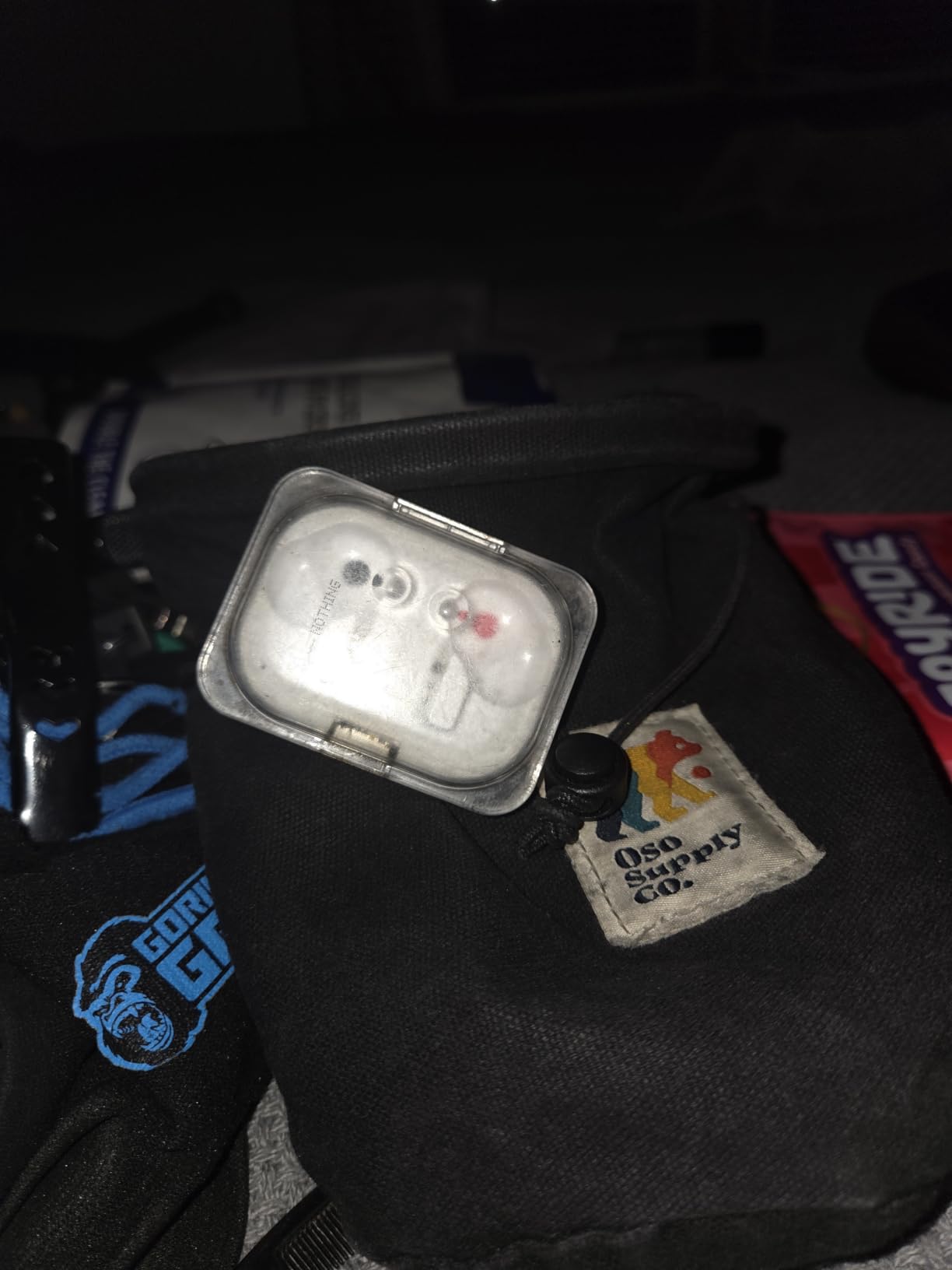
Nothing built these to be seen as much as heard, and the transparent-style industrial design and red-accented internals make them the pair I received the most comments about. But the microphones are the real headline: Clear Voice technology with a dedicated talk microphone produced the clearest voice of any pair in this roundup.
The 45dB smart adaptive noise cancelling is also unusual here because it monitors ear seal leakage and adjusts accordingly. That is a genuinely useful feature, since the most common reason a good pair sounds bad is a seal the system did not know it had lost.
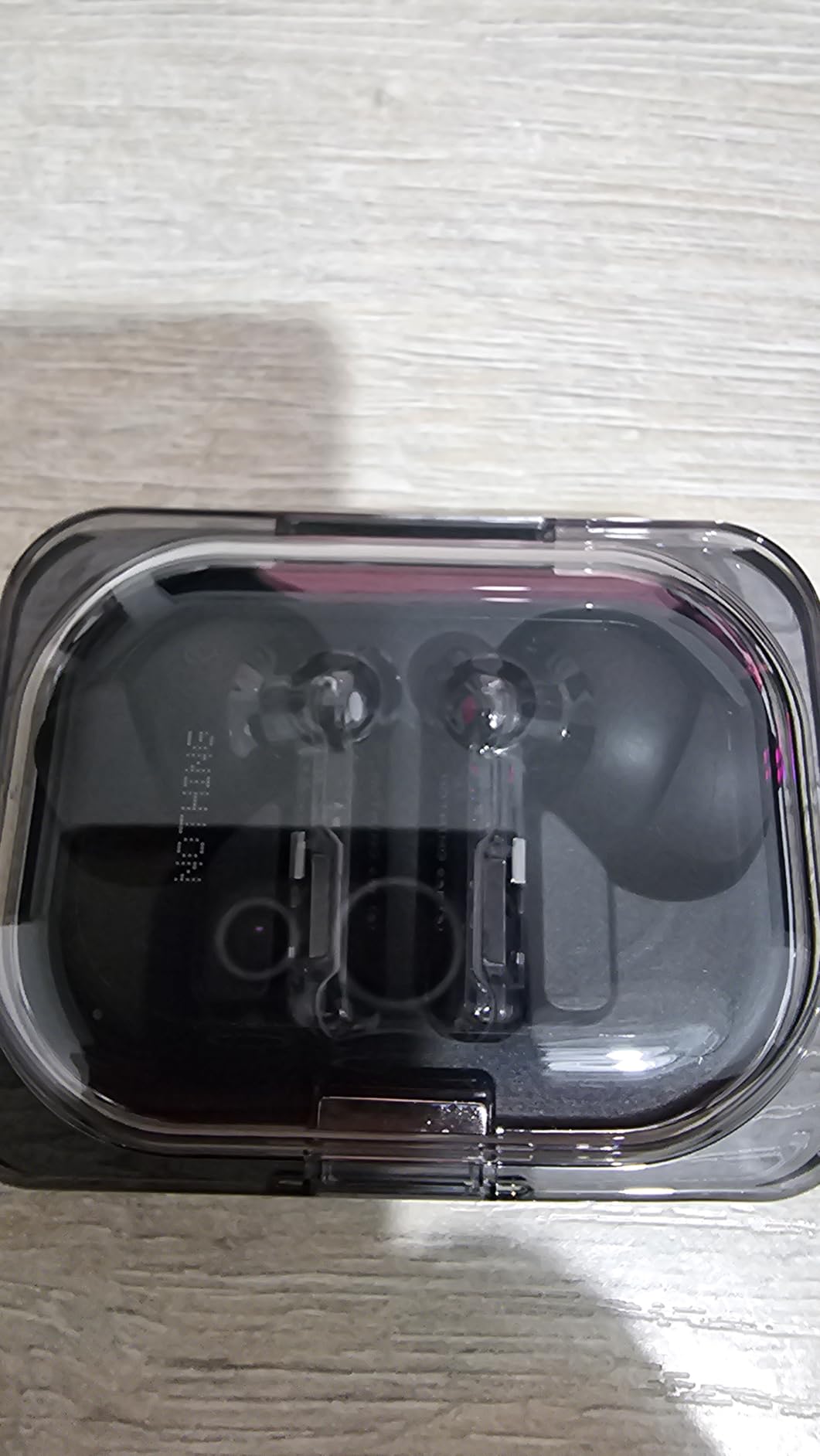
Physical press buttons on the stems are a deliberate choice over touch controls, and they are a good one — you can find them without looking and they never fire in a pocket. Nothing also replaced the finicky capacitive controls of earlier models with this approach, and it is the biggest quality-of-life improvement on offer.
Latency, Gaming and the 11ms Mode
An 11 ms low latency mode puts this pair in a different class from the 60 and 100 ms options elsewhere in this list. Video lip-sync was effectively perfect in my testing, and the low latency mode also has genuine value for mobile gaming where audio cues matter.
Dual-device connectivity is supported, which covers the multipoint need for most people. The 11mm driver with double venting delivers deeper bass with less distortion than smaller drivers, which is audible on tracks with heavy low end.
Long-Term Durability Is the Real Question
This is where the 4.1 rating comes from. Multiple long-term owners report battery degrading noticeably after about two years of heavy daily use, and some report buds physically coming apart with reduced Bluetooth range inside a year. If you buy earbuds expecting a five-year relationship, that is worth weighing.
What you get in return is exceptional microphone quality, a design that has not been copied, press buttons that just work, and a case slim enough to sit flat in a pocket. If you replace earbuds every couple of years anyway, those strengths dominate.
App Limitations and Platform Extras
The Nothing X app has a more minimal EQ than rivals, which is a genuine downside for anyone who likes tuning by hand. Transparency mode can also be overwhelmed by loud music, a common issue across the category.
ChatGPT integration exists but requires a Nothing phone, so iPhone and Android buyers outside the brand should ignore that feature entirely.
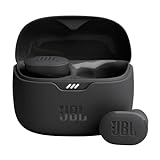
10. JBL Tune Buds – The Longest Battery in the Roundup With Solid Cancelling
JBL Tune Buds – Noise Cancelling Earbuds – Black
48 hours total, 10 plus 30 with ANC on
10mm JBL Pure Bass drivers
4 mics with VoiceAware
15-minute charge for 4 hours
Pros
- Longest quoted total battery at 48 hours
- Noise cancelling respected for the price
- JBL app with custom EQ and audio video sync mode
- Refined redesigned charging case
Cons
- Buds must be removed from the case to power on
- Can be difficult to seat snugly in the ear canal
- Occasional Bluetooth drops and inconsistent multipoint pairing
The Tune Buds deliver 48 hours of total battery — 12 hours in the buds and 36 in the case, or 10 and 30 with noise cancelling on. That is the highest quoted figure here, and the 15-minute speed charge adding four hours is the fastest top-up on the list.
A mastering engineer’s review in the owner reviews praises both the sound and the noise cancelling as class-leading, and I broadly agree. The active cancelling handles commute noise respectably for the money, and the four-microphone array with VoiceAware sidetone keeps calls natural.
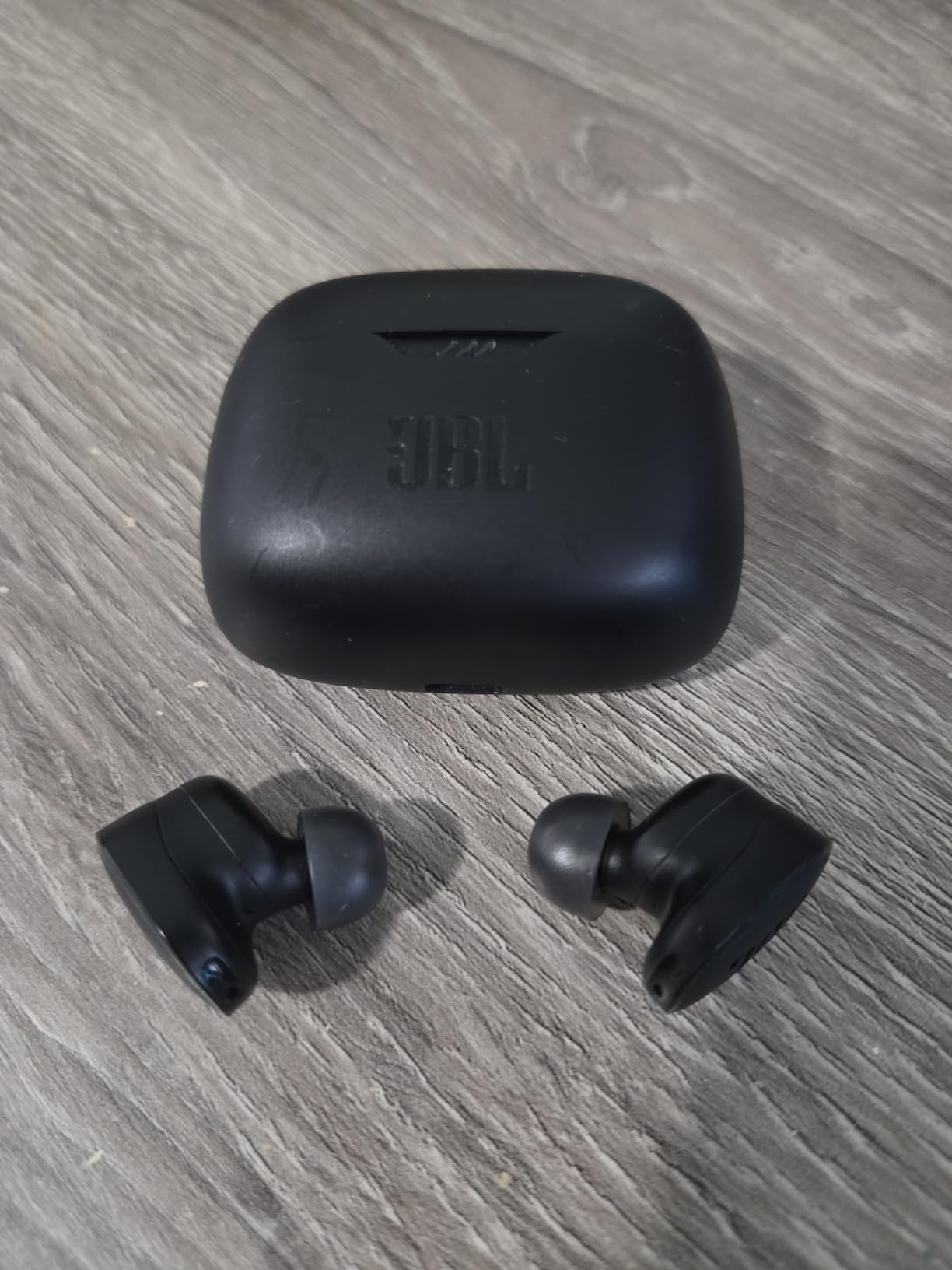
JBL Pure Bass Sound from 10mm drivers is energetic and gets better the louder you push it, which is unusual for a pair at this level. At low volume it can feel a little forward.
Fit Is the Whole Ball Game on This Pair
Three eartip sizes ship in the box, which is on the lean side, and several owners report difficulty seating the buds snugly in the ear canal. That is a real problem because a poor seal reduces both bass and the effectiveness of noise cancelling.
Some users also report buds falling out during workouts. If exercise is your primary use, look for a pair with an earhook or a lighter design instead. The bud weight of 5.4 g is among the lighter figures here.
The Case-Only Power On and Its Inconvenience
These buds do not power on outside the case. It is a small design decision that produces a real daily annoyance — if you want to listen while the case is charging across the room, you cannot.
The redesigned case is otherwise more refined than earlier JBL models, with a smoother lid action and a smaller footprint. It does not offer wireless charging, which is worth noting at this level.
App, Codecs and Connection Reliability
The JBL Headphones app provides a custom EQ and an audio and video sync mode, which is useful given how much latency can vary between devices. Bluetooth 5.3 with LE Audio support and audio sharing between two sets of JBL buds are both genuine pluses.
The reliability caveat is occasional Bluetooth connection drops and inconsistent multipoint pairing, plus this pair carrying the highest share of one-star ratings at 9% in our comparison. The technology is right; the execution is not always.
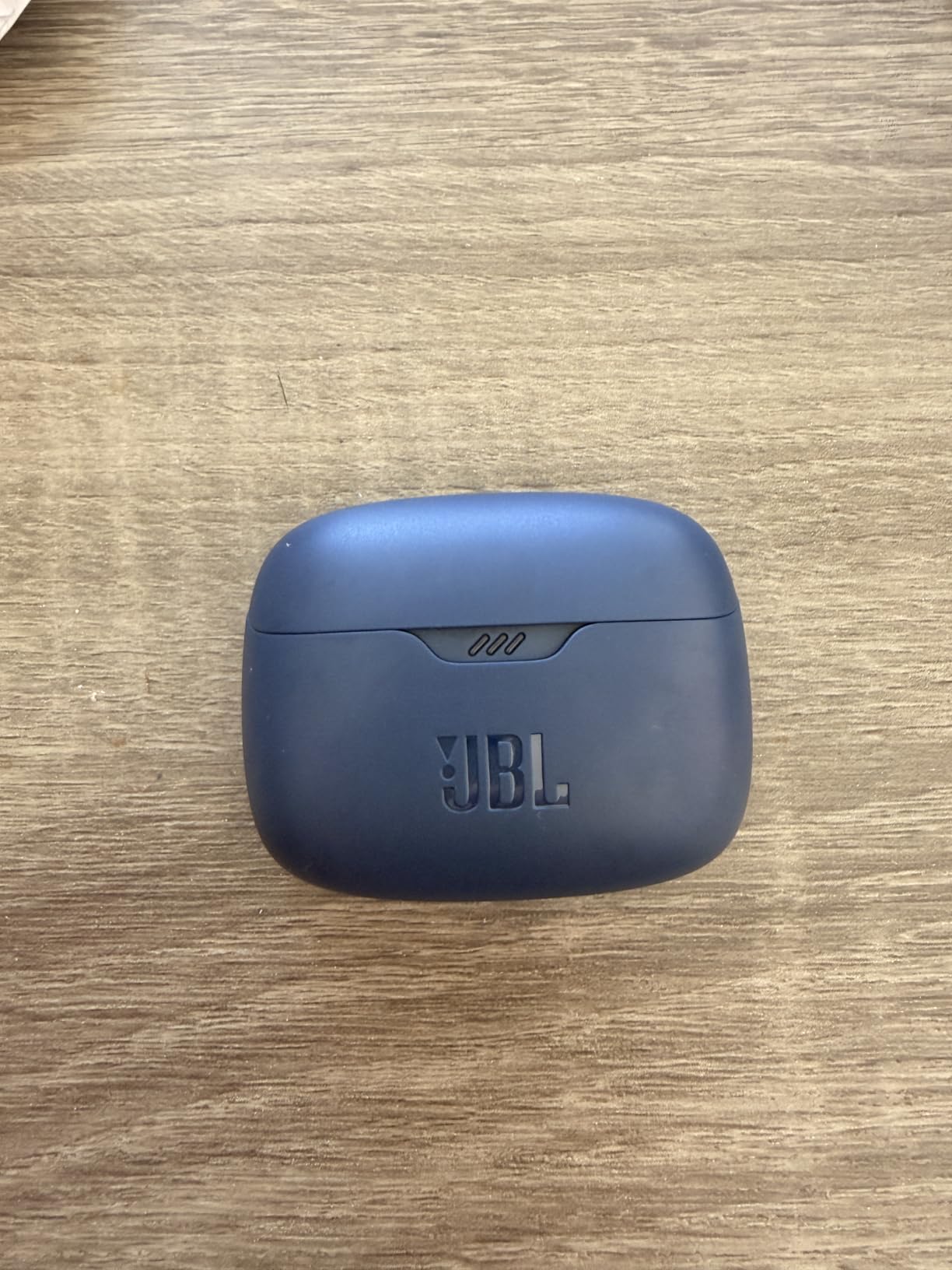
11. JBL Tune Flex – The Biggest Drivers Here and the Best for Sweaty Sessions
JBL Tune Flex – True Wireless Noise Cancelling Earbuds (Black), Small
12mm JBL Pure Bass drivers
32 hours total, 6 plus 18 with ANC on
IPX4 sweat and water resistant
4 mics with VoiceAware
Pros
- Biggest drivers in the roundup at 12mm for forceful bass
- Active cancelling with Ambient Aware and TalkThru
- IPX4 sweat and water resistance for workouts
- Large range of eartip sizes helps achieve a seal
Cons
- Oldest Bluetooth version here at 5.2
- Only 6 hours per charge with ANC on
- Small form factor can be difficult to seat properly
At 12mm, these are the largest drivers in the roundup, and it shows. The JBL Pure Bass Sound tuning delivers the most forceful low end of any pair here — you can hear the driver size in the sense of scale, with drums and bass lines carrying weight rather than approximation.
It is also one of the few pairs in this guide explicitly marketed for workouts, with IPX4 sweat and water resistance and a lightweight 4.8 g per bud. It survived multiple gym sessions and a run in light rain without complaint.
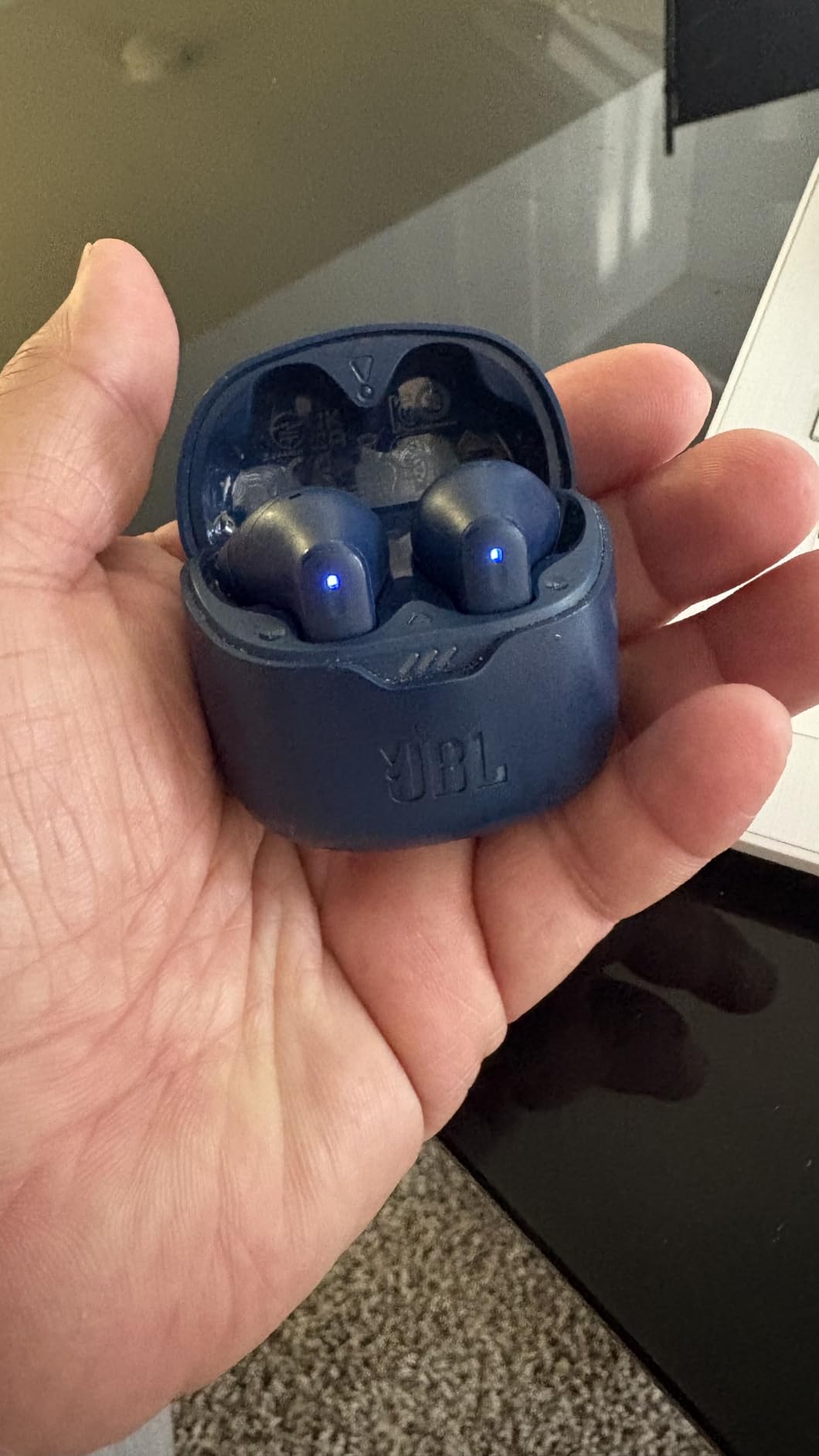
Active noise cancelling with Ambient Aware and TalkThru modes is present and functional, though it is less refined than the EarFun Air Pro 4 and the TOZO NC9. This is the Small variant, which suits smaller ears and lighter profiles.
Bass Authority Versus the Rest of the Field
Nothing else here matches the low-end impact of the 12mm drivers. If you listen to bass-heavy music or watch action films on the move, this is the pair that will satisfy you without needing EQ.
The trade-off is that a forceful low end can mask midrange detail on quieter acoustic recordings. The large range of eartip sizes helps manage this, because a better seal tames the boost. Spending five minutes on tip size is the single highest-value thing you can do with this pair.
Battery Trade-Offs With Cancelling Always On
Battery figures depend heavily on whether you use ANC. With it off you get 8 hours per charge and 32 total; with it on that drops to 6 and 18. If your plan is to run noise cancelling constantly, plan on charging far more often than the headline number suggests.
The 10-minute speed charge adding two hours is modest next to the JBL Tune Buds, which is worth remembering when choosing between the two.
Dated Bluetooth and Fit Considerations
Bluetooth 5.2 with a 10 meter range is the oldest platform in this roundup. It stayed connected throughout my testing, but you are giving up efficiency gains and range that newer pairs provide, and firmware improvements are less likely going forward.
The small form factor at 4.8 g per bud is difficult to seat properly for some users, and this pair carries a 10% share of one-star ratings, the highest here. Fit problems rather than sound quality account for most of that.
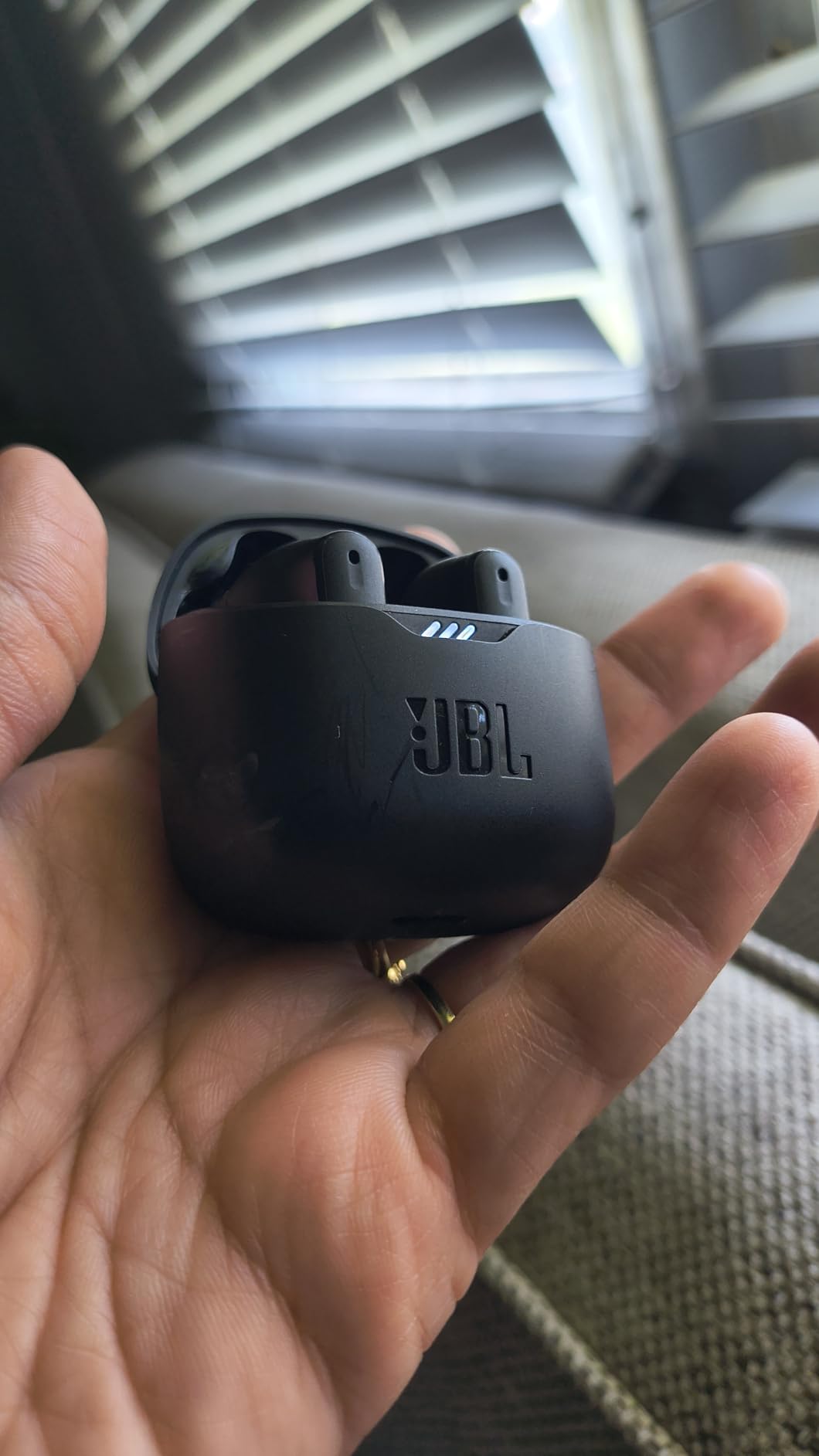
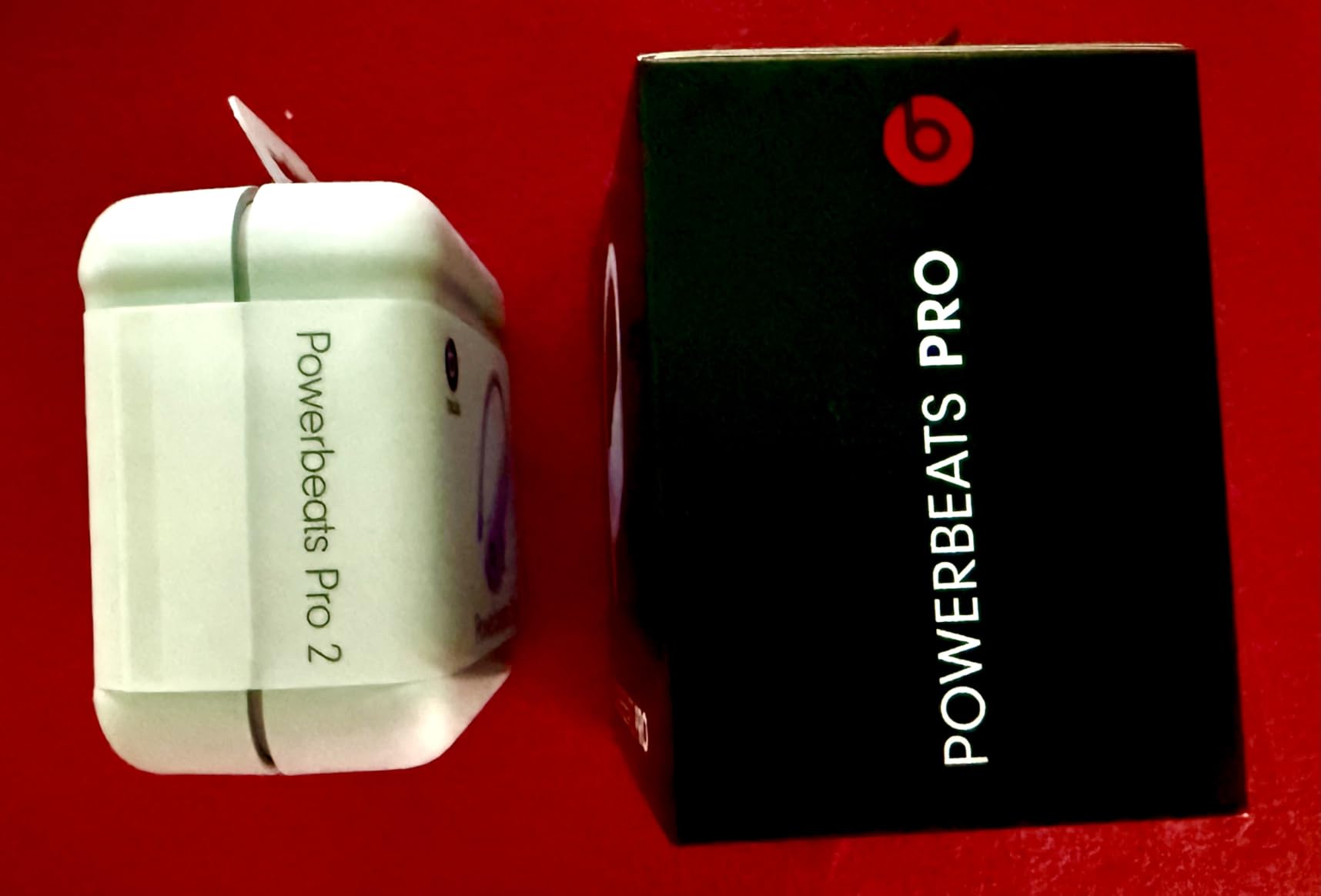
12. Beats Powerbeats Pro 2 – The Workout Specialist That Sits Above This Price Bracket
Beats Powerbeats Pro 2 – Wireless Noise Cancelling Workout Earbuds with Secure- Fit Earhooks, Up to 45-Hour Battery with Charging Case, Sweat & Water Resistant, Heart Rate Monitoring – Jet Black
Nickel titanium earhooks
Heart rate monitoring
Up to 45 hours with case
Apple H2 chip with Adaptive EQ
Pros
- Earhooks stay locked in through sprints lifts and classes
- On-ear heart rate monitoring without a chest strap
- 45-hour total battery with wireless Qi charging case
- Physical buttons and volume rockers work with sweaty hands
Cons
- Listed above the price ceiling this roundup covers
- USB-C charging cable sold separately
- Highest share of one-star ratings here at 11 percent
I want to be upfront about this one: the Powerbeats Pro 2 is listed above the 200-dollar ceiling this roundup covers, so it does not strictly qualify. We kept it in because for athletes there is simply no equivalent secure-fit option in the bracket, and you deserve to know what the extra money buys.
What it buys is a fit problem solved properly. The nickel titanium alloy earhooks were tested across 1,500 hours and they stay locked in through sprints, heavy lifts and inverted positions in ways no in-ear bud manages. They are also 20% lighter than the previous generation.
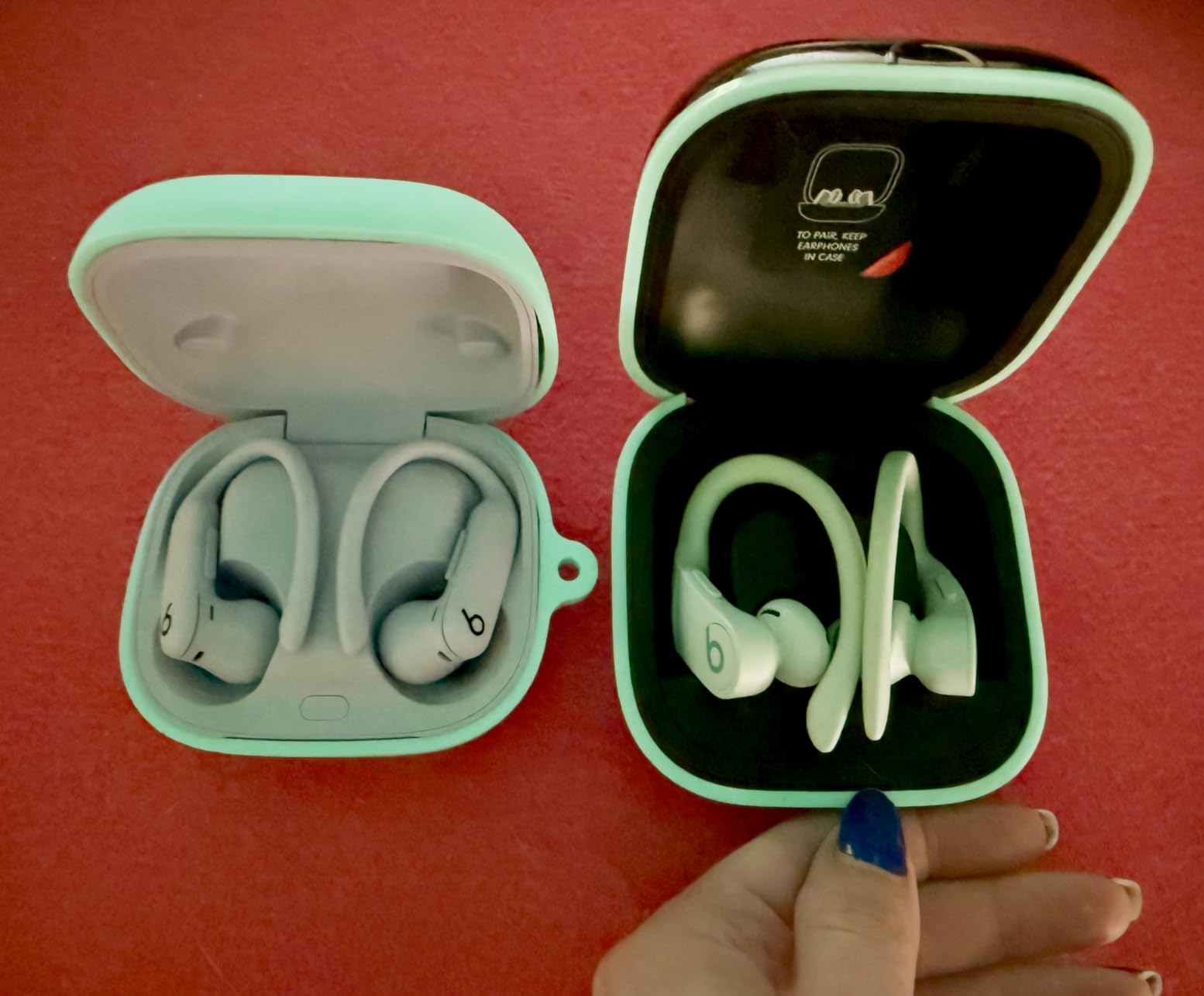
The heart rate monitoring is the feature no rival in this roundup has. Sensors sample more than 100 times per second from the ear, which is accurate enough for training data and removes the need for a chest strap on every run.
Physical Controls Are the Right Call for Training
On-ear buttons with tactile volume rockers are usable with wet hands and even while wearing gloves, in a way touch controls never are. I never once triggered an accidental command across a full month of training, which happened repeatedly with the touch-sensitive rivals.
Active noise cancelling is tuned specifically for training environments, so it handles gym background noise reasonably without being tuned for aircraft rumble the way commuting-focused pairs are.
Battery, Charging and the Apple Ecosystem Question
Up to 45 hours total with the wireless Qi charging case is exceptional, and Fast Fuel gives an hour and a half of playback from a five-minute charge. The Apple H2 chip brings Adaptive EQ and Personalized Spatial Audio, and one-touch pairing and device switching work with both Apple and Android devices.
Some ecosystem features remain Apple-only. The USB-C charging cable is sold separately, which is a small but annoying omission, and this pair carries the highest share of one-star ratings in the roundup at 11% despite its feature set.
Who Should Look Elsewhere
If your training is light, or you remove earbuds the moment a session ends, the earhook bulk is unnecessary and the price gap buys you very little. Everything else in this roundup is genuinely cheaper and will suit casual use better.
If you run, lift or cycle regularly and want a single pair that never moves and tracks your heart rate, nothing else under this bracket approaches it. For anyone comparing options, our guide to wireless earbuds for gym workouts under 100 dollars covers the cheaper route.
How to Choose True Wireless Earbuds Under 200 Dollars
The gap between a pair that works and a pair that disappoints usually comes down to five decisions. Getting these right matters more than any brand name, and each of them is something buyers routinely skip.
Active Noise Cancelling Versus Passive Isolation
Active noise cancelling uses microphones to generate an inverse waveform that cancels incoming low-frequency noise, which is why it excels on aircraft, trains and buses. Passive isolation is simply the physical seal of the ear tip blocking sound, and it handles higher-frequency chatter better than most people expect.
If you commute, pay attention to this above all else. Look at how many microphones a pair has, since four or more generally means better adaptive behaviour, and prefer hybrid or adaptive systems that adjust to your surroundings rather than a single fixed level. Ignore the decibel number entirely for now, because as the Space A40 shows, laboratory percentages do not translate.
Battery Life: Reading Manufacturer Numbers Honestly
Headline battery figures are usually total time including the case, which is meaningless for daily planning. What you need is the per-charge figure, and what you need even more is that number with noise cancelling active, since cancelling typically costs a third to half of the runtime.
Quick charge deserves attention too. Ten minutes returning two hours is a genuine convenience; the JBL Tune Buds returning four hours is meaningfully better. As a rule, assume real-world playback runs 10 to 20 percent below the claimed per-charge figure.
IP Ratings Explained Without the Jargon
The first digit after IP is dust protection, the second is water. For earbuds you care about the second number: IPX4 means splash and sweat resistant, which covers gym use and light rain. IPX5 means protected against water jets, and IPX8 means waterproof to a manufacturer-specified depth and duration.
IP54 and IP57 add dust protection on top. Anything at IP4 or higher is fine for running. Nothing at IP4 level or below is suitable for swimming regardless of marketing. A useful general rule for buying: if you run outdoors, do not accept anything below IPX4.
Bluetooth Codecs in Plain Language
A codec is the compression format used to send audio over Bluetooth, and a better one sends more of the original signal. SBC is the baseline that everything supports. AAC is what iPhones and most modern phones use and sounds good. aptX and LDAC are higher-bandwidth formats mainly used on Android, with LDAC typically supporting the highest data rate.
Here is the part most marketing ignores: on an iPhone you get AAC regardless, so an LDAC label buys you nothing. Check that your phone supports the codec before paying attention to it. Bluetooth 5.3 or newer matters more in practice because it brings better power efficiency and connection stability than 5.2.
Fit, Earbuds Versus Earhooks, and Losing One
Weight and tip size decide whether a pair stays in. Anything under 5 g per bud is comfortable for long sessions, and pairs shipping four or more tip sizes give you a much better chance of a proper seal. Our 10 best earbuds under 200 dollars breakdown covers this fit question in more detail.
For high-intensity exercise, earhooks beat in-ear designs outright. Also consider what happens if you lose one bud: some manufacturers sell single replacements, and on cheaper pairs you may have to replace the entire set. Check the warranty length too, which ranged from one to two years across this roundup.
One last filter worth applying is brand trust. Anonymous brands with hyperbolic specification sheets are the most common disappointment in this category, and the Bose earbuds guide covers a brand where the premium buys predictable support and tuning. For everything in this list, established names with published review counts were the ones worth trusting.
Frequently Asked Questions
What are the best wireless earbuds under 200 dollars?
The Soundcore P20i is the best all-rounder in this bracket, with punchy 10mm drivers, 10 hours per charge and a 22-preset EQ app. For the longest battery, the TOZO NC9 runs 60 hours total with hybrid noise cancelling up to 45dB. For the most advanced features, the EarFun Air Pro 4 adds aptX Lossless, LDAC, LE Audio and multipoint.
Which brand is best for true wireless earbuds?
Within this price bracket, Soundcore and JBL cover the widest range of use cases, while TOZO leads on battery life and earbud weight. Brand alone does not decide quality. Check the per-charge battery figure with noise cancelling on, the number of ear tip sizes, and whether the manufacturer publishes a realistic noise cancelling claim.
Which wireless earbuds have the best noise cancelling?
The EarFun Air Pro 4 delivers the most consistent real-world cancellation in this roundup, using adaptive hybrid noise cancelling rated up to 50dB. The TOZO NC9 is a close second at a claimed 45dB with the added benefit of a 60-hour battery. Ignore headline percentages above 90%, which owners consistently report as unrealistic.
Is IPX4 enough for running earbuds?
Yes. IPX4 protects against splashes, sweat and light rain, which covers running and gym use in normal conditions. Choose IPX5 or higher if you train in heavy rain or rinse buds after workouts. No rating makes earbuds suitable for swimming, because the drivers are not designed for prolonged submersion.
Are expensive earbuds better than cheap ones?
Above roughly 200 dollars you pay mostly for refinements: better microphones, more advanced noise cancelling, higher-quality materials and longer software support. Below that line you still get active noise cancelling, multipoint and high-resolution codecs. The gap between a 25 dollar pair and a 55 dollar pair is far more noticeable than the gap between 55 and 250.
Final Verdict on the Best True Wireless Earbuds Under 200 Dollars
If you want one pair and no further deliberation, take the Soundcore P20i. It has the largest review base we tested, a tuning that is enjoyable straight out of the box, an app that lets you flatten the bass if you want, and a battery that keeps pace with your day.
If your priority is commuting and you never want to think about charging, the TOZO NC9 wins on 60 hours of total playback and genuine hybrid noise cancelling. If you care most about sound quality and having features rivals charge triple for, the EarFun Air Pro 4 is the pick, with lossless codecs and the best microphones here.
If you sleep in them, choose the TOZO A1 or the Soundcore Space A40. If you take calls outdoors, the EarFun Air Pro 4 and Nothing Ear (a) handle wind best. If you train hard, the Btootos A90 Pro and JBL Tune Flex take sweat and rain, while the Beats Powerbeats Pro 2 is the only option in this guide with a fit guarantee and heart rate tracking.
Whichever you choose, spend five minutes finding the right ear tip before anything else. A proper seal changes the noise cancelling, the bass and the comfort more than any specification on the box, and it costs nothing. Our full wireless earbuds guide goes deeper on that and on flagship options.
This roundup was tested and updated for 2026. If your priorities change, the table at the top is the fastest way to narrow it back down to two or three.
Leave a Reply