
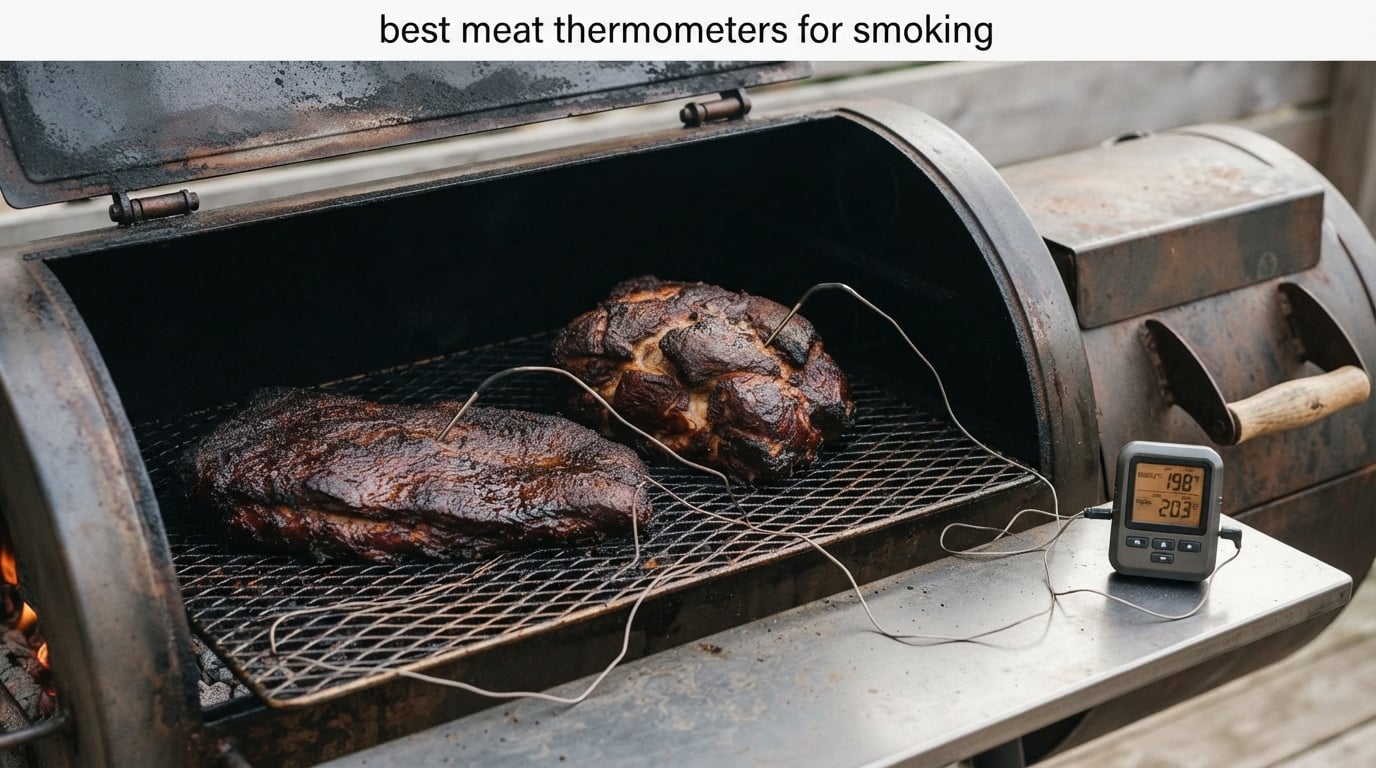
The best meat thermometers for smoking are the TempPro TempSync TP-20 for overall reliability, the TempPro TempTrack TP-16 if you want the simplest wired option, and the ThermoMaven WT10 when your cooker has thick steel walls. A good leave-in probe removes the guesswork from a 12-hour brisket and tells you the pit has drifted without you lifting the lid.
My team has been cooking low and slow for well over a decade, mostly on offset smokers and pellet cookers, and we have buried more probes in more cuts of meat than we would like to admit. Probes die, cables get pinched in the door seal, and phone apps lose connection at exactly the wrong moment. Those failures shaped every pick below.
We narrowed a very large category down to 12 units using one rule: a thermometer has to earn its place on a cook that lasts longer than four hours. Anything that cannot survive an overnight pork butt or report back without you standing over the cooker got cut.
Two things came out of that process that you will not find on most competitor pages. First, probe battery drain has far more to do with how fast the temperature is changing than with elapsed time. Second, wireless range claims are almost always measured in open air, which is the one condition a smoker never sees. We dig into both in the buying guide.
If your setup leans on WiFi and you want a broader look at connected cooking gear, our picks for WiFi meat thermometers cover that category on its own. And if you are still building out your fuel setup, start with our guide to smoking wood chunks before you worry about gear.
Our Top 3 Picks for Long, Unattended Smokes


The TempSync TP-20 wins because it does the least and does it best. No app, no account, no pairing ritual, and a 500-foot RF link that punches through a steel cooker without complaint.
For anyone who just wants a probe and a timer, the TP-16 is the honest answer. It is wired, which is a limitation, but a cable that cannot drop out is worth more than wireless range you never use.
The ThermoMaven WT10 solves the problem that trips up most Bluetooth probes. Its Sub-1G radio is built for obstructions, and the base has a screen so you can set a target temperature without opening an app.
Comparing All 12 Meat Thermometers Side by Side
Every pick below appears here with its connection type, probe count, and the feature that actually matters on a long cook. Read the table first, then jump to the full review for the two or three that match how you cook.
| Product | Specs | Action |
|---|---|---|
| TempPro TempSync TP-20 |
|
Check Latest Price |
 TempPro TempTrack TP-16 TempPro TempTrack TP-16 |
|
Check Latest Price |
| ThermoMaven WT10 |
|
Check Latest Price |
 MEATER Plus MEATER Plus |
|
Check Latest Price |
 CHEF iQ Sense Gen3 CHEF iQ Sense Gen3 |
|
Check Latest Price |
 TempPro TempTrack TP-17 TempPro TempTrack TP-17 |
|
Check Latest Price |
 ThermoMaven P2 ThermoMaven P2 |
|
Check Latest Price |
 Inkbird IB-0960 Inkbird IB-0960 |
|
Check Latest Price |
 Inkbird INT-14 Inkbird INT-14 |
|
Check Latest Price |
 ThermoMaven X2 ThermoMaven X2 |
|
Check Latest Price |
 Govee WiFi Meat Thermometer Govee WiFi Meat Thermometer |
|
Check Latest Price |
 JoyBear FM2205 JoyBear FM2205 |
|
Check Latest Price |
1. TempPro TempSync TP-20 – The Most Reliable Wireless Thermometer for Long Smokes
TempPro TempSync 500FT Wireless Meat Thermometer for Grilling and Smoking
500FT RF range
Two probes
14°F to 572°F
3 second response
Pros
- Rock solid RF signal through smoker walls
- No app or pairing required
- Two probes track meat and pit at once
- Reads down to 14°F for brining
Cons
- No low battery indicator
- Probe readings can vary a few degrees
- Batteries must be removed to power down
This is the thermometer I hand to anyone who is annoyed by smart thermometers. The TempSync TP-20 ships with a receiver, a transmitter, two probes, and a clip, and that is the entire setup. Nothing to pair, no account to create, no phone anywhere in the process.
On a 14-hour brisket that is a feature, not a limitation. Nothing to drop out at hour nine because your phone wandered to the other room. The receiver clips to a belt or a shelf and shows both probe temperatures and the timer on a backlit display you can read from several feet away.
Long-term owners in the review data report four to five years of service from these, which is longer than most wireless probes here manage. The 500-foot claim is RF rather than Bluetooth, which is why the signal holds through a metal door where Bluetooth-only units start complaining.
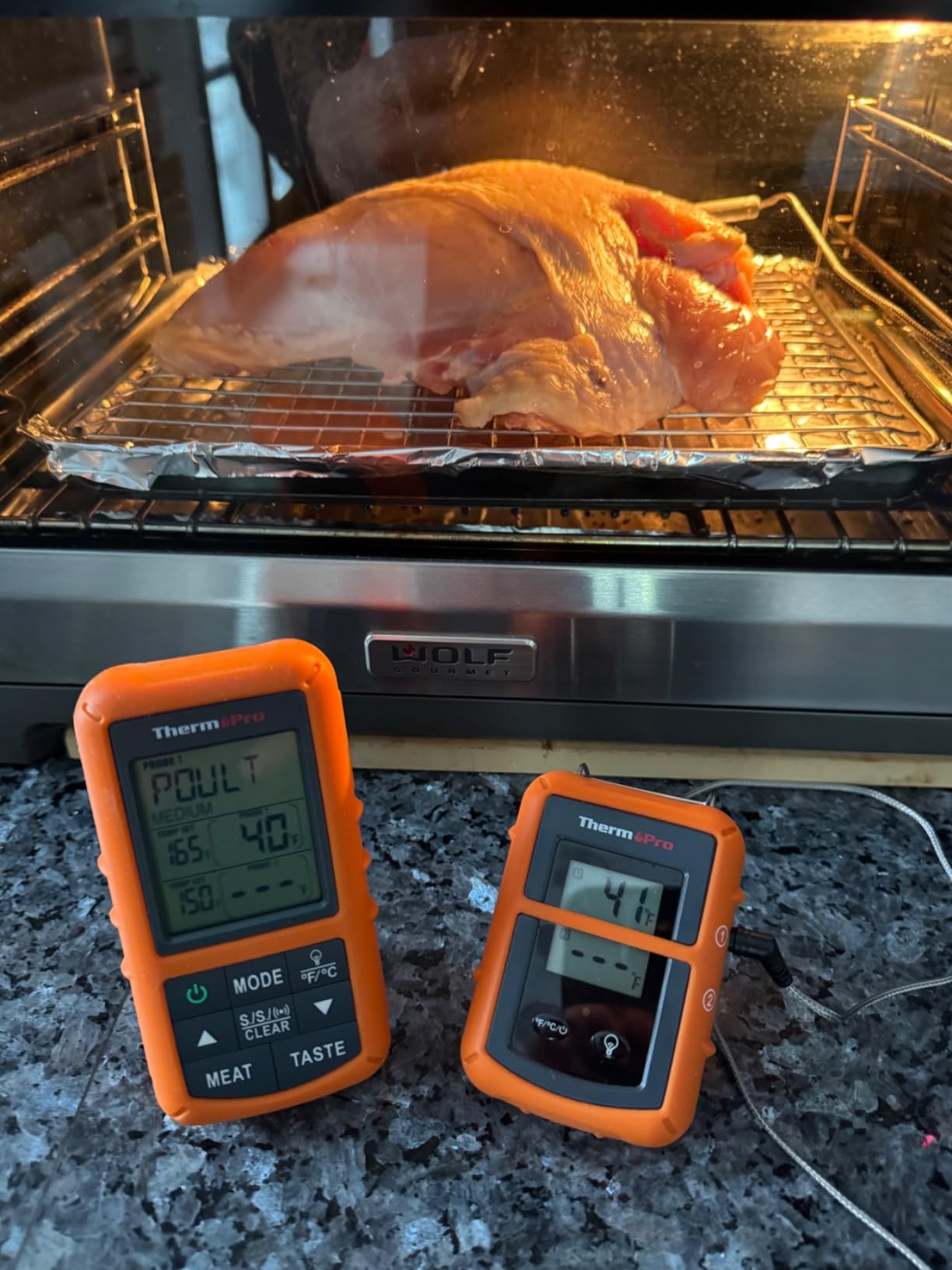
Two probes are the minimum for real smoking work. One goes in the meat, one measures the air around it, and that pairing tells you whether a stalled climb is the fire or the cook.
Why RF Beats Bluetooth on a Smoker
Bluetooth was designed for a phone ten feet away. A smoker puts steel, insulation, and sometimes a wrapped butcher paper barrier between the probe and the receiver, and every one of those eats the signal. RF at 500 feet behaves more like a walkie-talkie, which is exactly the behavior you want when the cooker is at the far end of the yard.
The trade-off is that RF is one-directional. The receiver only reports what the transmitter sends it, so there is no remote access from a phone and no cook history stored anywhere but the device in your hand.
Reading Accuracy and Probe Variance
Temperature range runs from 14°F to 572°F, which covers brining, cold holding, and finishing temperatures without a gap. Response time is three seconds, more than fast enough for a probe you are not moving around.
The honest weakness is probe-to-probe consistency. Reviewers do report that the two probes can read a few degrees apart when placed side by side in the same piece of meat, so avoid using one probe as a calibration standard for the other.
Good For, and When to Skip It
Choose this if you want alerts without a phone, run a cooker more than 100 feet from where you sit, or cook multiple racks and need to see more than one temperature at a glance. Skip it if you want cook history, phone notifications, or an estimate of when the meat will be done.
2. TempPro TempTrack TP-16 – The Simple Wired Thermometer That Refuses to Die
TempPro TempTrack Large LCD Digital Meat Thermometer for Cooking, Smoking
32°F to 716°F
0.5 second response
6.5 inch probe
40 inch cable
Pros
- Largest review base in this roundup
- 99 hour 59 minute timer
- USDA presets for smoker and oven
- Magnetic back and stand
Cons
- Wired cable must run through the cooker door
- Single probe only
- No remote monitoring
There is a reason this unit has accumulated more reviews than anything else on this list. It is not clever, and that is the point. A wired thermometer has no radio to fail, no battery percentage to worry about, and no app to argue with at two in the morning.
On a smoker, the practical limit of a wired probe is the door seal. The TP-16 uses a step-down stainless steel tip with a 40-inch mesh cable, and that mesh is stiff enough to discourage a rodent and flexible enough that a closed door does not pinch it flat.
The timer runs to 99 hours and 59 minutes, so you can set a target and walk away from an overnight cook without babysitting a countdown. USDA presets cover meat, oven, smoker, and stovetop, which takes the guesswork out of setting a pit alarm for the first time.
Where the Wired Approach Wins and Loses
A cable cannot lose a connection, and it will keep reporting through a metal lid that would drop a wireless signal. It also means you are tethered, so a probe left in a shoulder while the whole cut gets moved to a resting area has to come with you.
The 716°F probe and wire rating covers searing and hot finishing, though the useful cooking range is listed as 32°F to 572°F. That is well above anything a low-and-slow smoker produces.
Display and Placement Options
The magnetic back, hanging hole, lanyard, and fold-out stand mean you can mount the unit on a grill shelf, hang it from a hook, or set it on a side table. Response time of half a second makes it usable as an instant-read as well as a leave-in.
With one probe, you cannot watch the pit and the meat at the same time. If ambient monitoring matters to you, run this alongside a second unit or pair it with one of the dual-probe picks later in this roundup.
Who Should Buy This One
It suits a first smoker, a tight budget, and anyone who has been burned by an app that stopped pairing. It is also the sensible backup piece to keep in the garage, because a wired unit that works today is a wired unit that works next season.
3. ThermoMaven WT10 – The Best Thermometer for Thick Smoker Walls
ThermoMaven Sub-1G Smart Wireless Meat Thermometer with Standalone Base
Sub-1G at 3000 feet
NIST ±0.5°F
Standalone base
221°F internal
Pros
- Signal penetrates thick steel
- Base works without an app
- NIST certified six sensors
- Probe rated to 752°F ambient
Cons
- Single probe with no spares sold separately
- Limited recipe library
- Needs 2.4GHz for app features
Most wireless probe problems in a smoker are radio problems. The ThermoMaven WT10 sidesteps them with a Sub-1G radio, a lower-frequency signal that travels through obstructions far better than the 2.4GHz Bluetooth used by most competitors.
Reviewers who moved over from Bluetooth-only probes single out the connection as the deciding factor, reporting that it holds through heavy smoker walls without dropouts. The stated range is around 3000 feet unobstructed and 700 feet with obstructions, which is the number that matters.

The second thing that sets it apart is the base. It has its own display and buttons, so you set a target temperature directly on the unit instead of opening a phone app. The app is optional rather than mandatory.
What NIST Certification Actually Changes
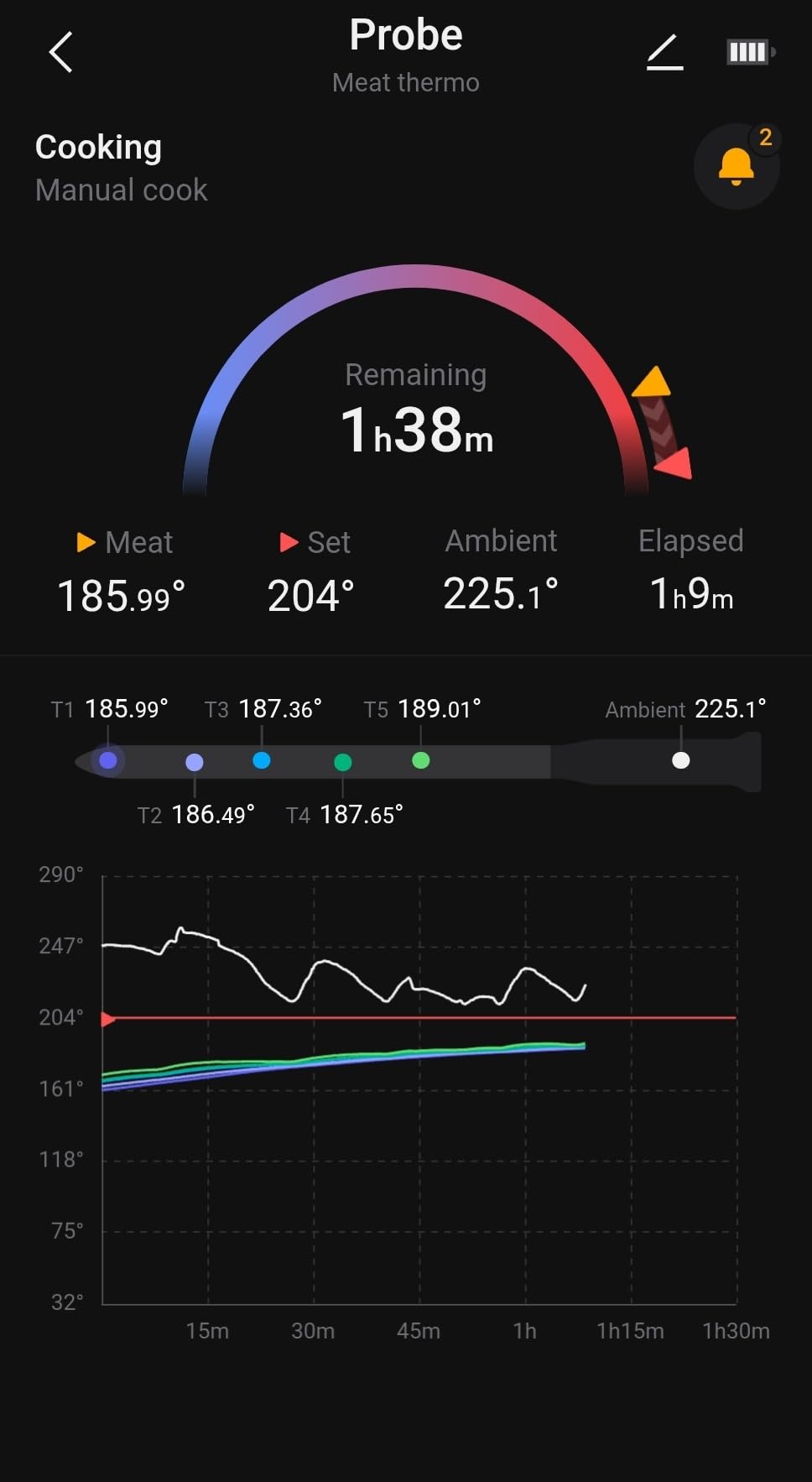
The WT10 carries six sensors per probe, five internal and one external, and is NIST certified to plus or minus 0.5°F with 0.01°F resolution. On a brisket flat where the difference between pulling too early and holding too long is a handful of degrees, that headroom matters.
Internal readings cover up to 221°F and ambient readings to 752°F, so the probe can stay in place during a hard sear at the end of a cook. It is also IPX8 rated and safe for the dishwasher, which matters more than it sounds after a full day of smoke and rub.
One Charge and One Probe
A single charge runs more than ten hours of cooking, and a top-up takes a few minutes on USB-C. That comfortably covers an overnight cook, though anyone running a 20-hour brisket should plan a mid-cook charge.
The limitation is that it ships as a single probe and spare probes are not sold separately. That is a real problem if you plan to run two cuts or want a dedicated pit sensor, and it is why the two-probe version later in this roundup deserves a look.
Best For, and When to Pass
This is the pick for a heavy insulated offset smoker, a pellet hopper far from the house, or anyone tired of walking to the cooker to check a phone. Pass if you need more than one cut monitored at a time.
4. MEATER Plus – The Best App-Guided Wireless Probe for Casual Smokers
MEATER Plus Smart Meat Thermometer, Honey, Bluetooth, 165ft, Grill & Oven
Bluetooth and WiFi
165ft range
6.18 inch probe
212°F and 527°F sensors
Pros
- Completely cable-free probe
- Guided cook system with finish estimates
- Bluetooth repeater built into the charger
- Five minute charge gives two hours
Cons
- No battery indicator on the probe
- Base must stay close to the probe
- Grease on charging contacts stops charging
The MEATER Plus is the name most people picture when they think smart meat thermometer, and for good reason. The probe is genuinely cable-free, and the bamboo charging base doubles as a Bluetooth repeater that stretches the usable distance from a modest 165 feet to something more forgiving.
That repeater is also the source of the most common complaint. Because the base extends the signal, the base has to sit reasonably near the cooker. Push it across the yard to get a better phone connection and you can trade one weak link for another.
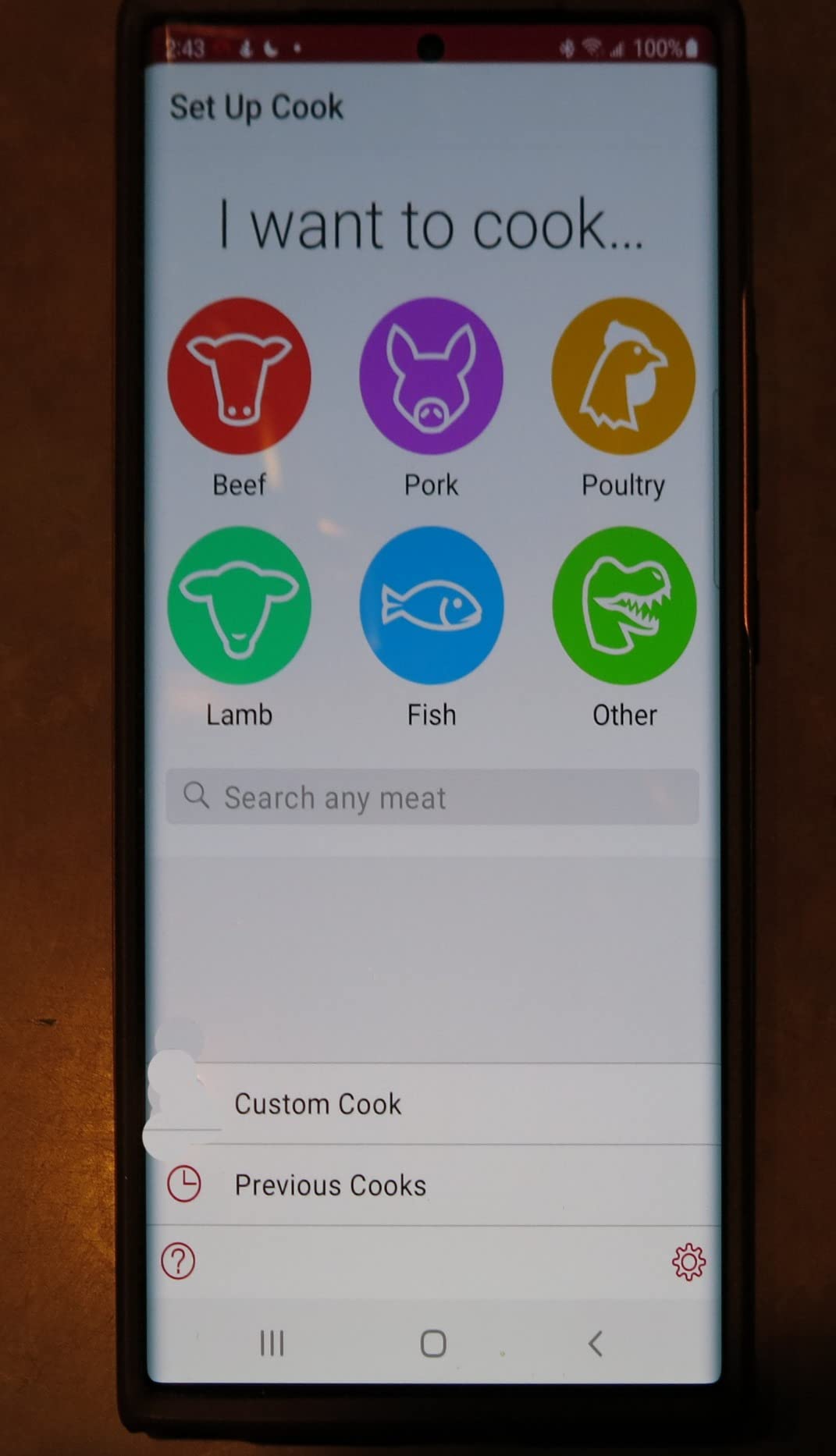
The app is the strongest part of the package. A guided cook system walks you through steps, estimates finish times, and pushes alerts at your target, which is genuinely useful if you are new to long cooks and do not want to compute a stall.
Dual Sensors and the Ambient Question
Two sensors read internal temperature up to 212°F and the surrounding air up to 527°F at the same time. Watching both numbers together is how you tell the difference between a fire problem and a cook problem, and it is the reason the ambient channel matters on a smoker.
Keep in mind the probe is six inches and needs meat around it to read properly. Wings, ribs, and thin cuts do not give the sensor enough material, so an instant-read unit should stay in your kit even with this in the meat.
Battery Behaviour on a Long Cook
Five minutes on the charger buys about two hours of cook time, and owners report the battery holding through long smokes including cold weather, where capacity naturally drops. The catch is that the probe shows no battery gauge, so you manage it by habit rather than by warning.
Grease and smoke residue on the charging contacts will quietly stop a probe from taking a charge. Wipe the contacts before you dock it, and treat that as part of the cleanup routine rather than a fault.
The Case Against and the Case For
Skip it if you dislike app dependence, want a device that works with no phone, or run a cooker far enough away that the repeater base becomes awkward. Choose it if you are learning to smoke and value step-by-step guidance and finish-time estimates over raw data.
5. CHEF iQ Sense Gen3 – The Best Probes for High-Heat Finishing
CHEF iQ Sense | Smart Wireless Meat Thermometer | 2 Ultra-Thin Probes | WiFi Unlimited Range | 1000°F Heat Safe | 5 Sensors | BBQ, Grill, Oven, Smoker, Air Fryer | Gen3
Two 4.75 inch probes
1000°F heat rating
Hub with speaker
WiFi plus Bluetooth
Pros
- Handles searing without overheating errors
- Hub reads alerts aloud
- Up to 40 hours of probe battery
- Numbered color-coded probes
Cons
- Cloud account required before use
- Hub has no screen
- Occasional connection dropouts
Most leave-in probes are designed to survive a smoker, not a finishing sear. The CHEF iQ Sense is rated to 1000°F, which means you can take a pork shoulder from a 225°F cook to a hot sear without pulling the probe and accepting a gap in your data.
The probes are thin at 4.75 inches, and that thinness is the point. A thin probe punctures less, bleeds fewer juices, and gives a reading closer to the temperature in the middle of the muscle than a thick one does.
The hub is the unusual element. It relays between the probes and your phone over WiFi and Bluetooth, and it has a built-in speaker that reads alerts out loud. If you are hosting people and cannot feel a phone buzz in your pocket, that solves a real problem.
The Account Requirement and Why It Matters
This is the loudest criticism in the reviews. The app and hub will not function until you create a cloud account and sign in to WiFi. Several buyers describe that as a dealbreaker, and if you dislike handing an email address to a kitchen appliance, this is not the one.
For everyone else, the payoff is a preset library that runs into the hundreds of proteins, USDA doneness guides, estimated finish times, and video-guided recipes. A three-year warranty is also longer than most of the field.
Runtime Across a Full Day of Smoking
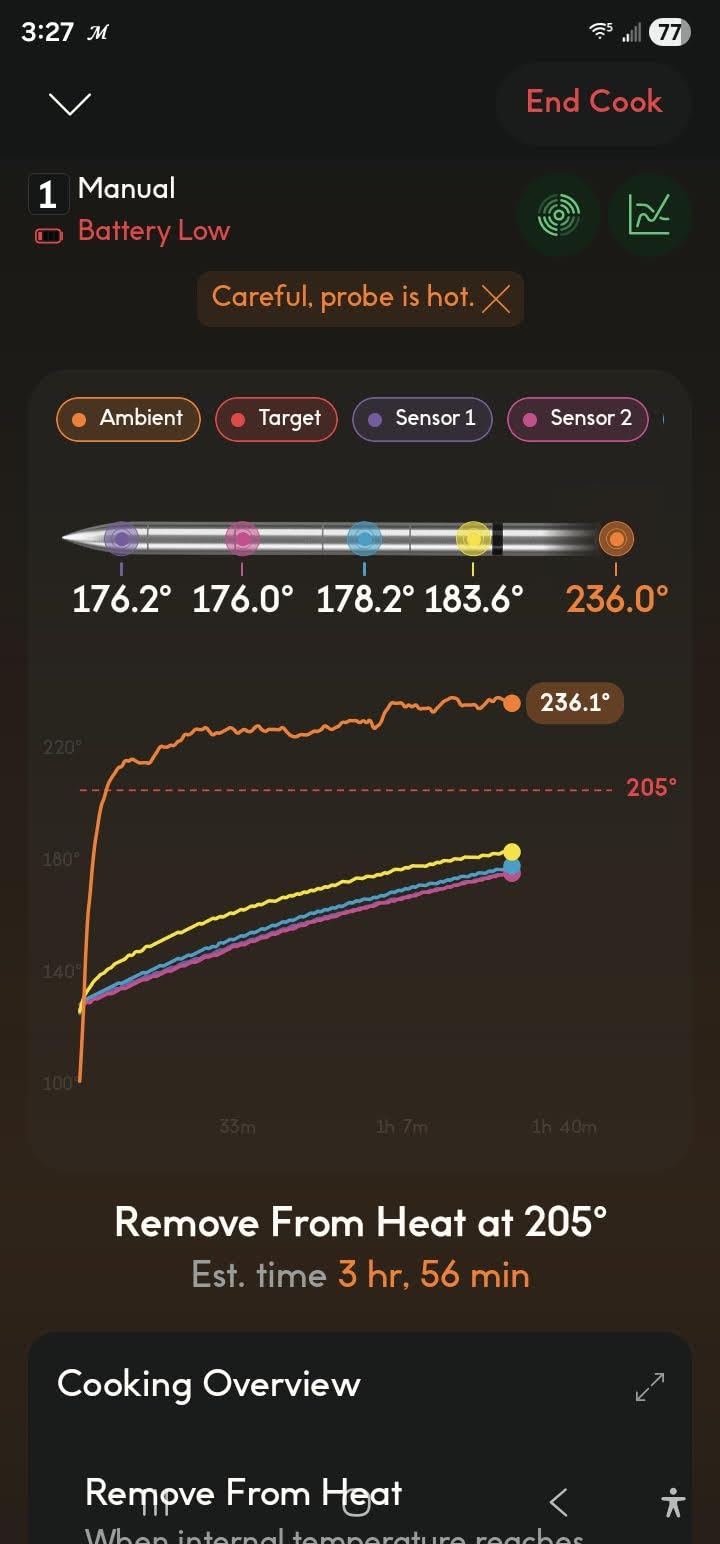
Up to 40 hours of probe battery per full charge comfortably covers a long weekend of cooking without a mid-cook top-up. Both probes are waterproof and dishwasher safe, and they are color-coded and numbered so you do not pull the wrong reading off a multi-rack cook.
There are reports of probes going unresponsive and requiring warranty claims, and of connection dropouts that usually recover on their own. Treat the two-probe setup as a pair rather than a redundant system, and cross-check with an instant read before you commit to a long rest.
Where It Shines on a Smoker
Pick this for reverse-seared steak, a shoulder that gets seared at the end, or a cook where you want audible alerts without watching a screen. Pass if privacy, offline use, or minimal setup matters more than features.
6. TempPro TempTrack TP-17 – The Best Dual-Probe Thermometer for Pit Alarms
TempPro TempTrack Digital Cooking Meat Thermometer with Dual Meat Probe
Dual wired probes
HI and LOW range alarm
14°F to 572°F
0.5 second response
Pros
- Smoker-specific HI and LOW alarm
- Dual probes without extra gear
- Backlit display shows both temps
- Twenty six thousand review history
Cons
- Some probe accuracy drift reported
- Plastic housing
- No remote or app monitoring
The feature that separates the TP-17 from a generic dual-probe thermometer is the HI and LOW range alarm, which was built for smokers rather than adapted from a kitchen timer. Set a band of 225°F to 250°F for the pit and the unit tells you the moment you drift outside it.
That is genuinely useful on a cook where you are not standing at the cooker. A wired pit alarm has no battery percentage, no pairing, and no firmware update to break, which makes it the most reliable notification method we tested.
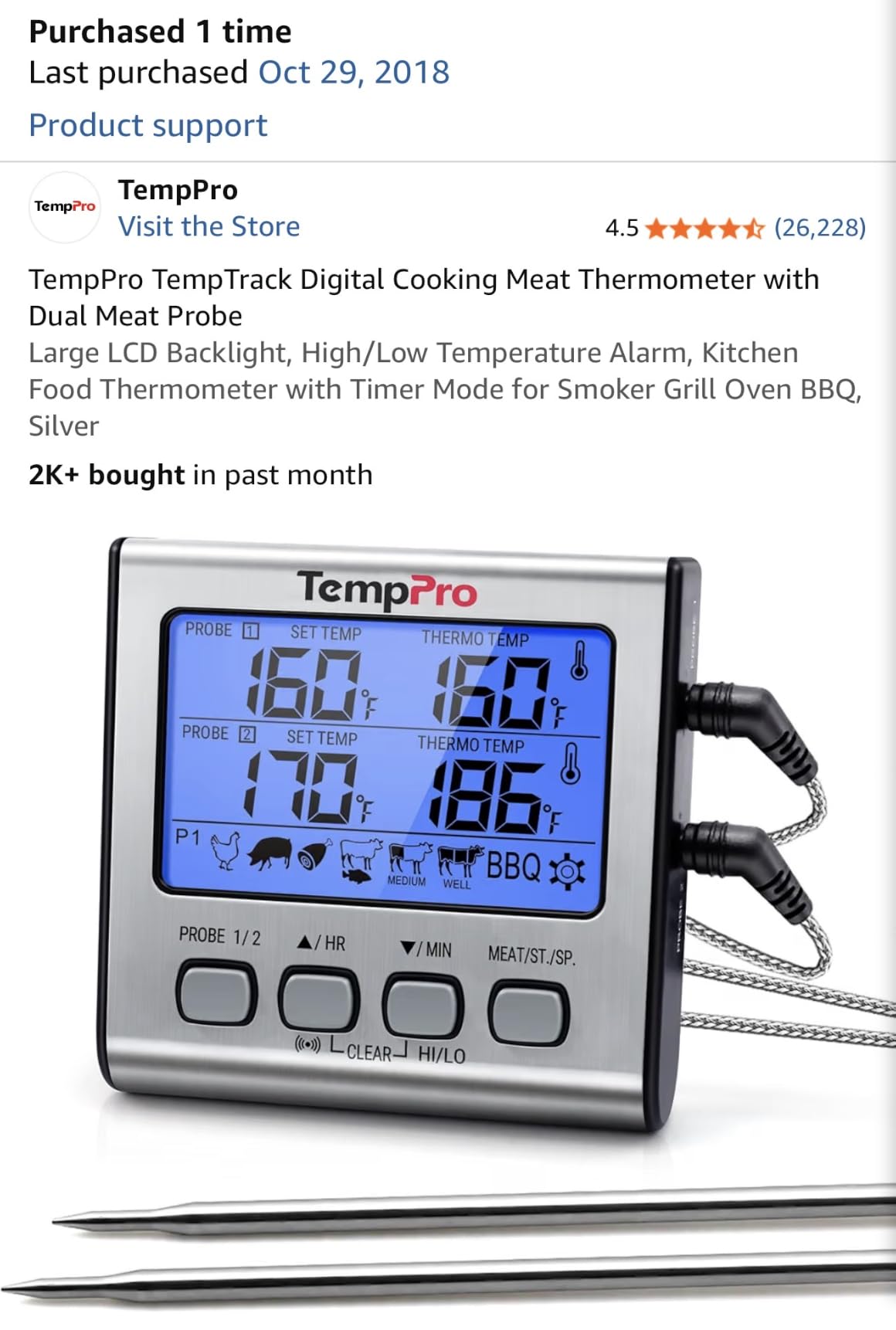
Two probes let you track two cuts, or one cut plus pit temperature, without buying a second device. Reviewers who moved over from instant-read thermometers consistently describe the change as the moment smoking became relaxing instead of nerve-wracking.
Accuracy Across the Smoking Range
Accuracy is stated at plus or minus 1.8°F across a 14°F to 572°F range, with 0.1°F resolution and a half-second response time. Some owners report individual probes reading a few degrees off, and replacement probe tips from other brands are not compatible, so treat the accuracy claim as typical rather than guaranteed.
The eight-inch immersion depth suits a whole brisket flat or a large shoulder where a short probe would never reach the center. The housing is predominantly plastic, which is the part most likely to suffer if you drop it off the side table.
Working Around the Cables
Thin cables pass through a closed oven or smoker door without breaking the seal, and a flip-out stand plus magnetic back give you options for where the unit lives during the cook. A one-year warranty is the shortest in this roundup, so treat it as a working tool rather than a long-term investment.
Because it is wired, this is not the pick for anyone whose cooker sits far from the house. That limitation is exactly what the wireless units later in this roundup are built to solve.
Best Fit for a Pit and a Cut
Choose the TP-17 when your smoker has a door that can stay closed and you want the simplest possible way to watch two temperatures. Skip it when a dangling cable through a gasket is a dealbreaker.
7. ThermoMaven P2 – The Best WiFi Multi-Probe Setup for Two Cuts
ThermoMaven WiFi Wireless Meat Thermometer, 2 Probes, Smart Base, 6 Sensors
Two wireless probes
2.4GHz WiFi
NIST ±0.5°F
Internal to 221°F
Pros
- Unlimited range from base to phone
- Base sets targets without an app
- Probes stay in during searing
- Two hour base and two minute probe charge
Cons
- Requires a 2.4GHz network
- Base has a small screen
- Costs more than single-probe models
The ThermoMaven P2 is the smallest complete WiFi setup in this roundup, and that is its main argument. Two probes, a base with a display, and a connection that does not depend on Bluetooth range at all.
The base talks to your phone over 2.4GHz WiFi, so there is no distance ceiling between the cooker and where you are sitting. For a smoker at the end of a driveway, that removes the single most common failure mode people complain about.
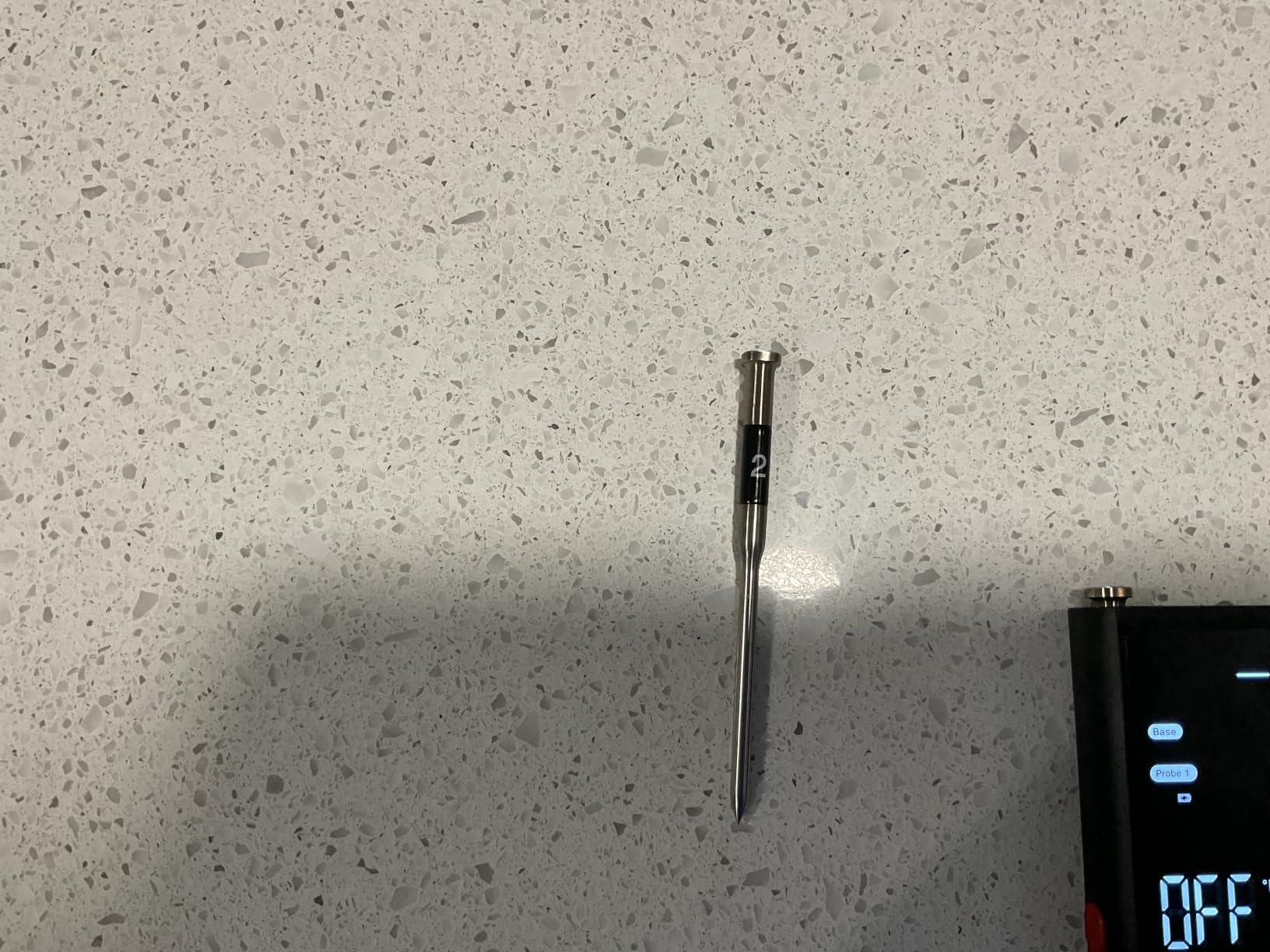
Each probe carries six sensors, five internal and one external, NIST certified to plus or minus 0.5°F with 0.01°F resolution. Two ultra-thin probes let you watch two dishes at once while puncturing less and keeping more juice in the meat.
Two Probes, Two Very Different Cuts
Use one probe in a brisket flat and one in a pork butt, and you can see within a few minutes whether one is lagging because of the cut or because of airflow on that rack. That is a level of insight a two-meat-plus-pit wired setup cannot give you, because it has no spare channel.
Probes track internal readings to 221°F and ambient to 752°F, so they can remain in place through a sear. That is unusual for probes this thin and worth considering if your finishing method involves heat.
Charging, Network, and the Base Screen
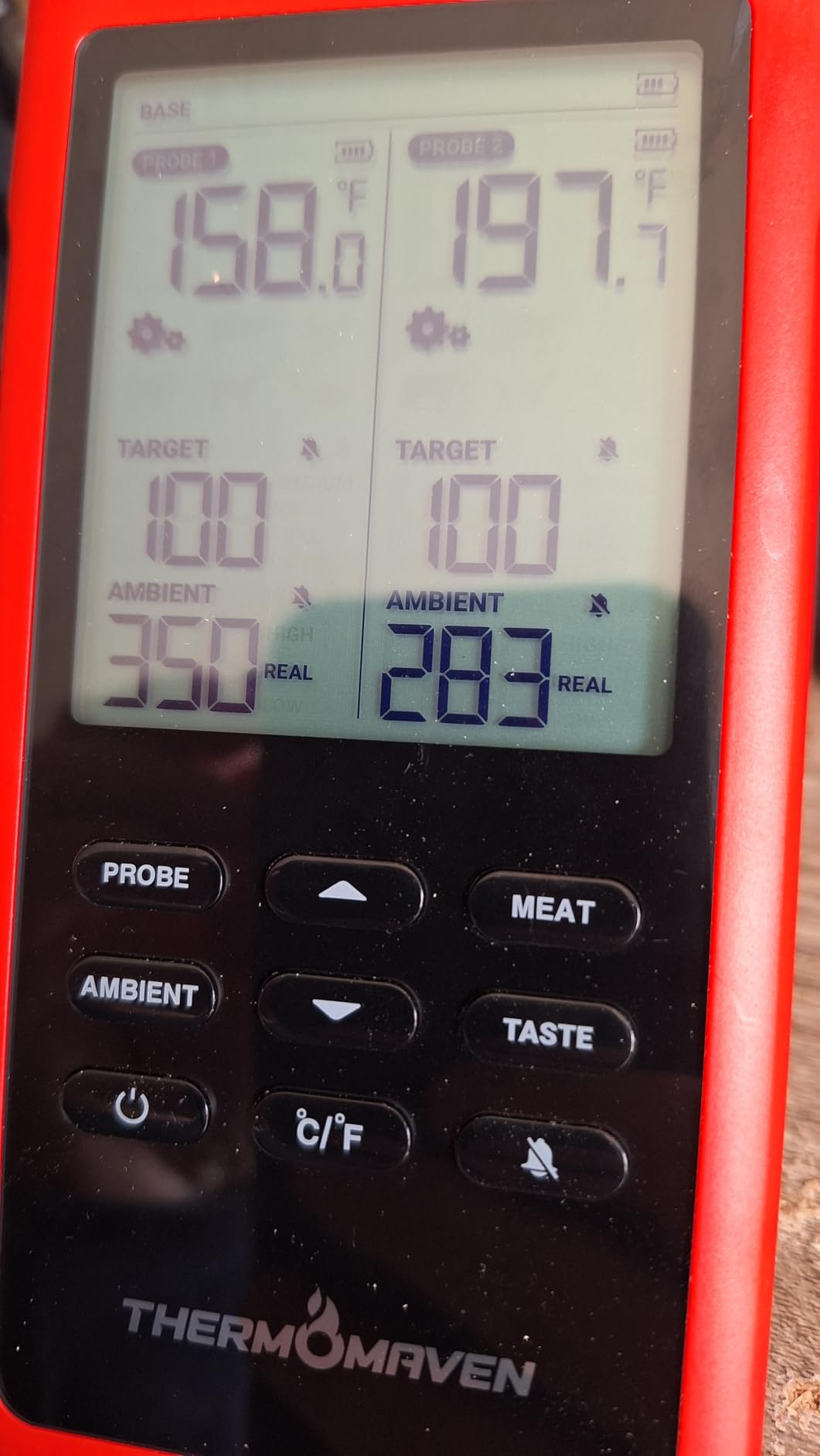
The base takes about two hours to charge and the probes top up in roughly two minutes, with a stated 24 hours of battery life. The base display lets you set a target without touching the app, though reviewers note the screen is small enough that the app is still the better interface for anything detailed.
The 2.4GHz requirement is the practical snag. If your router broadcasts both bands, you may need to select the 2.4GHz network manually before setup. There is also an eighteen-month warranty, which is respectable but not generous.
Who This Suits
This is the pick for a cook who regularly runs two proteins at once and wants phone alerts without range anxiety. Pass if one probe is enough for you, because the single-probe models give you more runtime per charge for the money.
8. Inkbird IB-0960 – The Best Four-Probe Thermometer for Multiple Racks
Wireless Meat Thermometer with 4 Probes, INKBIRD WiFi Meat Thermometer Digital Wireless for Rotisserie Grill Oven,Unlimited Range Dishwasher Waterproof Bluetooth Thermometer for iOS & Android
Four wireless probes
WiFi, Bluetooth and offline
±1.8°F
25 hours per charge
Pros
- Four probes with dual sensors
- Works offline with no app needed
- Backlit base shows all four
- IP67 dishwasher-safe probes
Cons
- App temperature ceiling around 203°F
- Plastic parts rated only to 176°F
- Reported probe variance of 7-15°F
When a question comes up about monitoring several racks at once, four probes is the answer, and the Inkbird IB-0960 is the most established way to get them. Each probe has two sensors, so four probes give you four internal readings and four ambient readings simultaneously.
Four-probe Bluetooth units from this brand are a recurring recommendation on r/smoking and r/grilling for exactly that reason. The community pattern is clear: one probe in the meat, one in the pit, and the remaining channels spread across a vertical smoker’s racks.
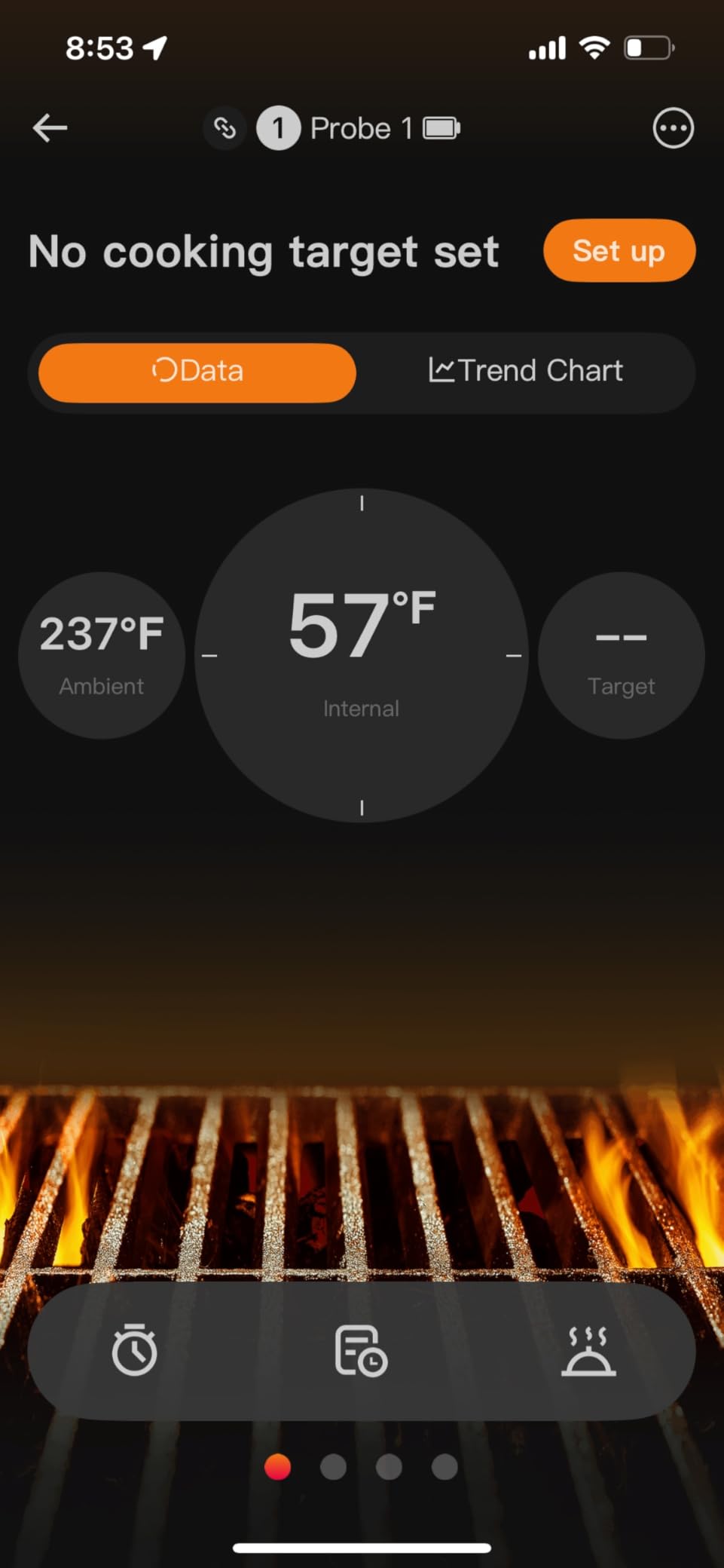
Three operating modes matter more than they sound. Use 2.4GHz WiFi for unlimited range, Bluetooth for roughly 300 feet, or offline local mode where the base records on its own and syncs to the app history later.
Two Limitations You Need to Know Before Buying
The app caps the maximum set temperature at roughly 203°F. That is fine for most of a low-and-slow cook, but it will not accommodate a finishing temperature or a hot reverse-seared sear, so plan to pull the probes before that stage or use a separate instant read.
The plastic base and probes are rated to about 176°F, which means the unit cannot be left in a hot pit. Keep the probes in meat and use a separate high-heat thermometer for anything hotter.
Probe Variance and Calibration Reality
Accuracy is stated at plus or minus 1.8°F, but the app offers no calibration function, and reviewers report probe-to-probe variance of 7-15°F along with the occasional probe failure. Cross-check probes against each other in the same piece of meat before a long cook, not during it.
There are also reports of connection dropouts through insulated doors and foil wrapping. Twenty-five hours of battery per charge and IP67 probes that rinse clean are the practical strengths.
Best For Multi-Rack Monitoring
Choose this for a vertical smoker, a competition cook, or any setup where you genuinely need more than two channels. Pass if two probes cover your needs or if you need a high finishing temperature inside the pit.
9. Inkbird INT-14 – The Four-Probe Unit With Per-Probe Calibration
4-Probe WiFi Wireless Meat Thermometer with 360°Readable LCD Standalone Base, WiFi and Bluetooth 5.3 Unlimited Range, IPX8 Waterproof Food Kitchen Thermoemter for BBQ, Grill, Smoker, Oven, Rotisserie
Four probes
360 degree LCD base
Per-probe calibration
1 second response
Pros
- Calibration for each probe individually
- Readable from any angle base
- Three connection modes
- 25 hours from a 25 minute charge
Cons
- Probes must stay within about 20 feet of base
- No audio alerts on the base
- Calibration must be done manually
The INT-14 solves one specific complaint about four-probe thermometers: you cannot correct a probe that reads wrong. This model offers a calibration function with plus or minus 1.8°F accuracy per probe, so a single loose sensor does not have to sink the whole cook.
The base is the other story. A 360-degree readable full-view LCD shows all four probe temperatures, and the strong magnetic back attaches it to a grill shelf or a pellet hopper where you can read it without walking over.
Reviewers like the combination of flexibility in a single unit, since it runs on 2.4GHz WiFi, Bluetooth 5.4, or fully offline local mode. Thirty minutes of offline storage sync to the app history graph later, which covers a smoke or a quick wrap check without a signal.
The Distance Limit Nobody Expects
This is the specification to read carefully. Probes need to stay within roughly 19.68 feet of the base for a stable connection, which is a short leash for a smoker sitting at the end of a patio. Both of its Inkbird siblings share that design, so plan the layout before you start the fire.
Unlike some competing bases, this one carries no audio alerts, so notifications depend entirely on the app. If you plan to be away from your phone, that is a real limitation.
Probes, Charging, and the Too-Hot Warning
Four food-grade stainless steel probes with zirconia ceramic handles fully charge in about 25 minutes and run up to 25 hours. The app includes 28 USDA meat menus, custom temperatures, count-up and count-down timers, and temperature pre-alarms.
The app issues a probe too hot warning if a thin probe is not inserted straight past the safe line, so seat each probe carefully rather than shying away from a thicker cut. Food range is 14°F to 212°F with ambient to 572°F.
When to Choose This Over a Two-Probe Unit
Pick it when you run several cuts, want to calibrate, and will keep the base within about 20 feet of the cooker. Pick a two-probe model instead when your cooker is far from where the base will sit.
10. ThermoMaven X2 – The Best No-Account Thermometer for Long Cooks
ThermoMaven 3000FT Wireless Meat Thermometer, No App Needed, 2 Probes
Sub-1G at 3000 feet
No app or sign-up
Two ultra-thin probes
±0.5°F NIST
Pros
- Works immediately with no account
- Large standalone base display
- Sub-1G signal holds through walls
- Probes rated to 752°F
Cons
- No app means no remote alerts
- Two probes limit large cooks
- Newer model with a smaller review base
The X2 is the direct answer to people who bought a smart thermometer and never used half of it. No app, no account, no sign-up, and no personal information required. You take it out of the box, turn on the base, and cook.
It keeps the Sub-1G radio that made the WT10 work through heavy walls, with a stated range up to 3000 feet. Buyers coming from app-dependent smart thermometers tend to appreciate how little there is to set up.
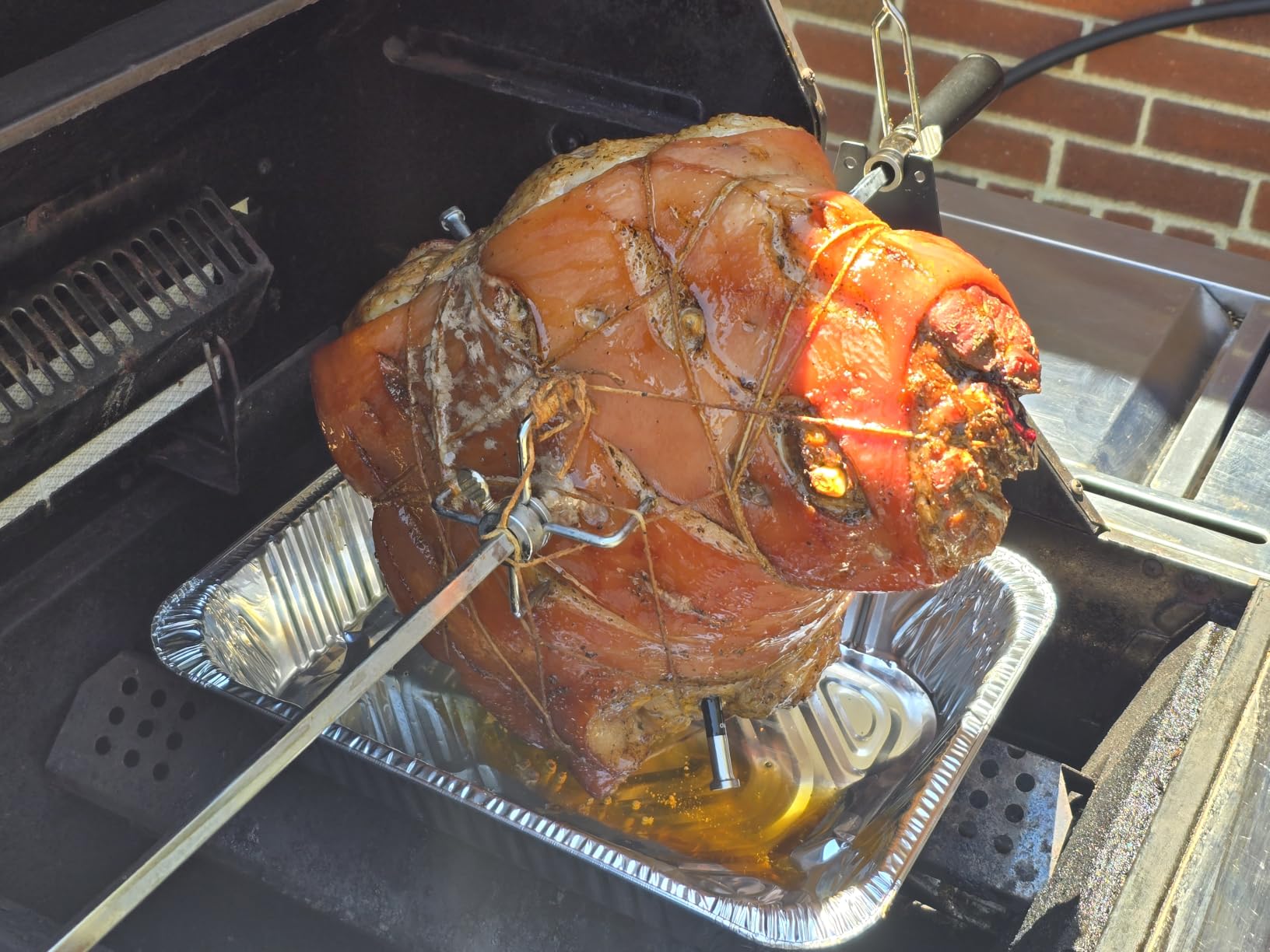
Two ultra-thin probes each carry six NIST-certified sensors with plus or minus 0.5°F accuracy, rated to 752°F and IPX8 dishwasher safe. The magnetic base mount keeps the display on a hopper or a shelf where it stays visible.
What You Give Up by Skipping the App
There are no remote notifications and no phone-based monitoring, which means the base has to be somewhere you can see or hear. On a long cook, that is workable if the base is mounted at the cooker and you are nearby, and unhelpful if you planned to sit two rooms away.
Two probes is the practical limit for multi-cut cooks. If you need more channels, the four-probe models later in this roundup cover that, and they are the ones with a full-view base display.
Build and Accuracy in the Same Package
The thin probes are a genuine advantage for whole-muscle cuts because they puncture less and lose less juice. Six sensors per probe with 0.5°F accuracy gives you more confidence than a single-sensor probe at the same cook.
Probes rated to 752°F ambient can stay in a hot pit without cooking themselves, and IPX8 means you can rinse and dishwasher them. An eighteen-month warranty covers the reasonable service life of the unit.
Who This Is For
Choose the X2 if you want the strong radio of the Sub-1G models without giving an app your email address. Pass if the phone alerts are the reason you were considering a smart thermometer in the first place.
11. Govee WiFi Meat Thermometer – The Best Two-Probe Pick for App Alerts
Govee WiFi Meat Thermometer Digital for Grilling & Smoking, Timer & Alert
Two probes
WiFi monitoring
32°F to 572°F
2 second response
Pros
- Unlimited WiFi monitoring
- App alerts with cook-time estimates
- Battery rated for 120 four-hour sessions
- Records 24 hours of curves
Cons
- No user calibration option
- Proprietary probe connectors
- Occasional app syncing issues
The Govee WiFi thermometer is the simplest way to get phone notifications without a hub, a base, or a repeater. The probe connects straight to your network, so the only thing that has to be within range is your WiFi signal.
Two heat-resistant probes let you watch two cuts or two zones at once, which is the minimum for useful smoking work. Reviewers highlight that the readings held up against trusted thermometers in ice, in boiling water, and inside a smoker.
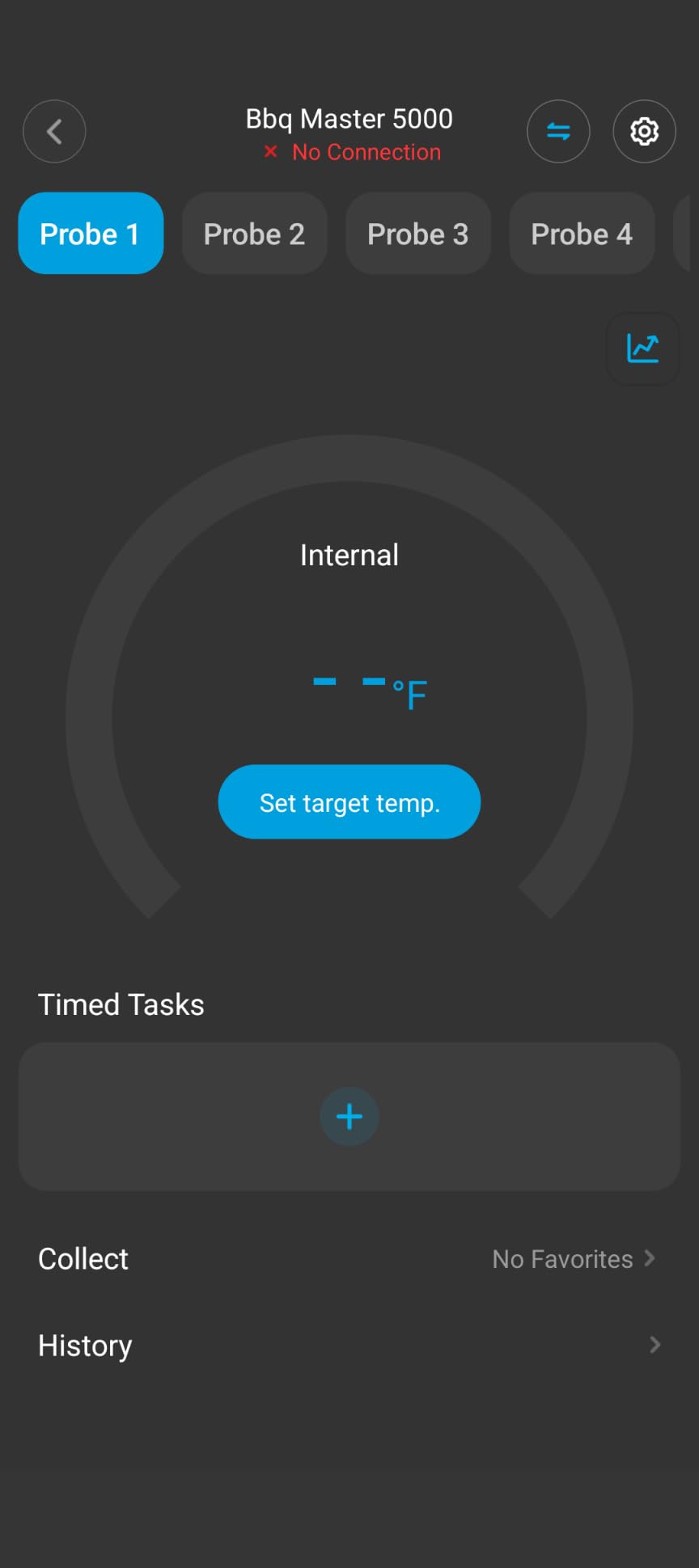
The app is feature-heavy for the category: alerts at target doneness, cook-time estimates, recipe presets, one-tap timers for flipping and basting, and exportable temperature history. Recording up to 24 hours of curves means you can review how a cook actually went after the fact.
Battery Life Measured in Sessions
The stated figure is unusual and useful: up to 120 four-hour barbecue sessions or 50 turkey roasts per set of batteries. It runs on two AA cells, so there is no charging cable to lose and no battery gauge to read.
The trade-off is that AA cells mean no recharge cycle and a fixed runtime rather than a variable one. Reviewers also report that WiFi and Bluetooth range drops with walls and distance, and that the app occasionally needs a force-close to resync.
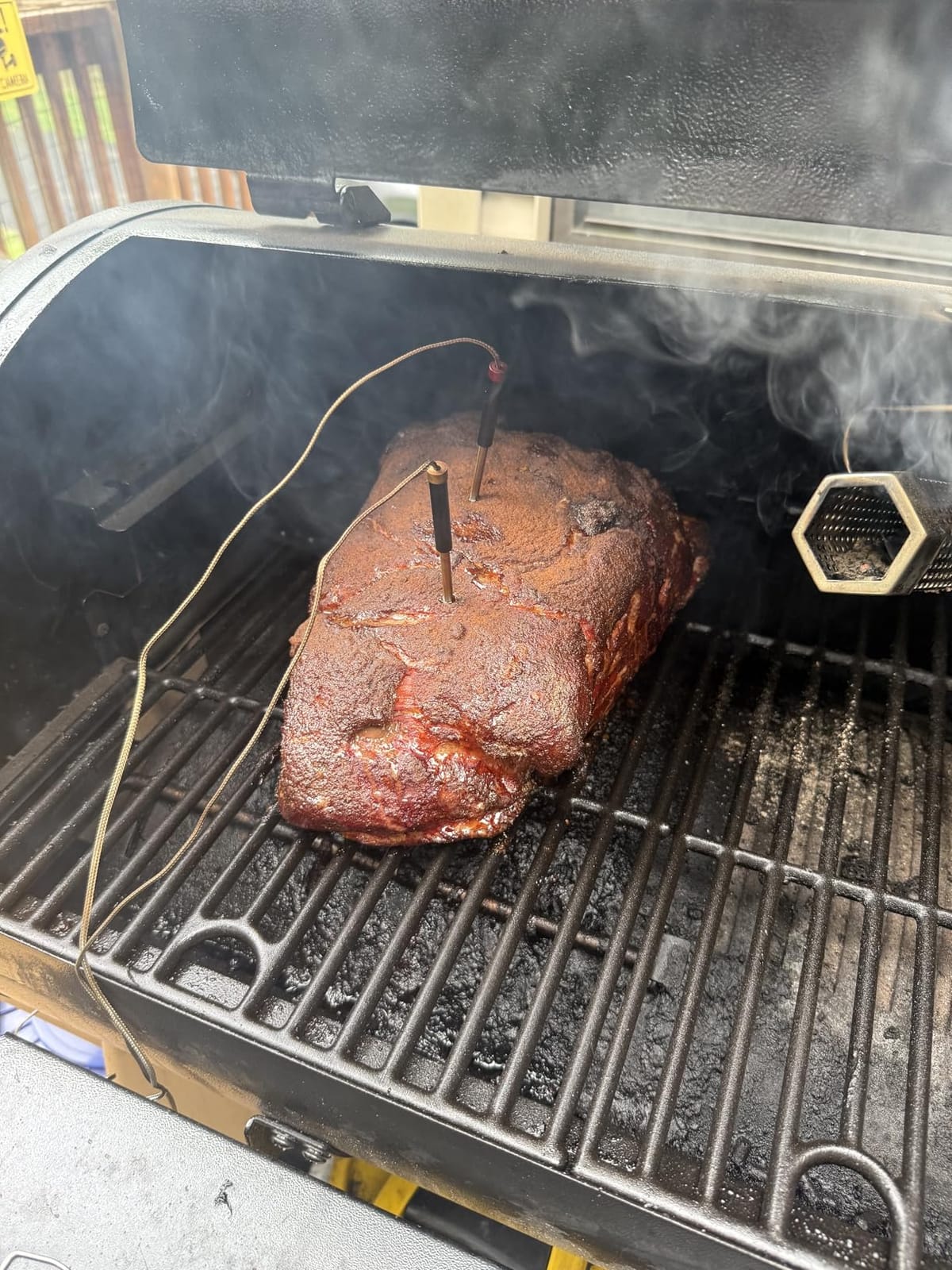
Calibration and Connector Limits
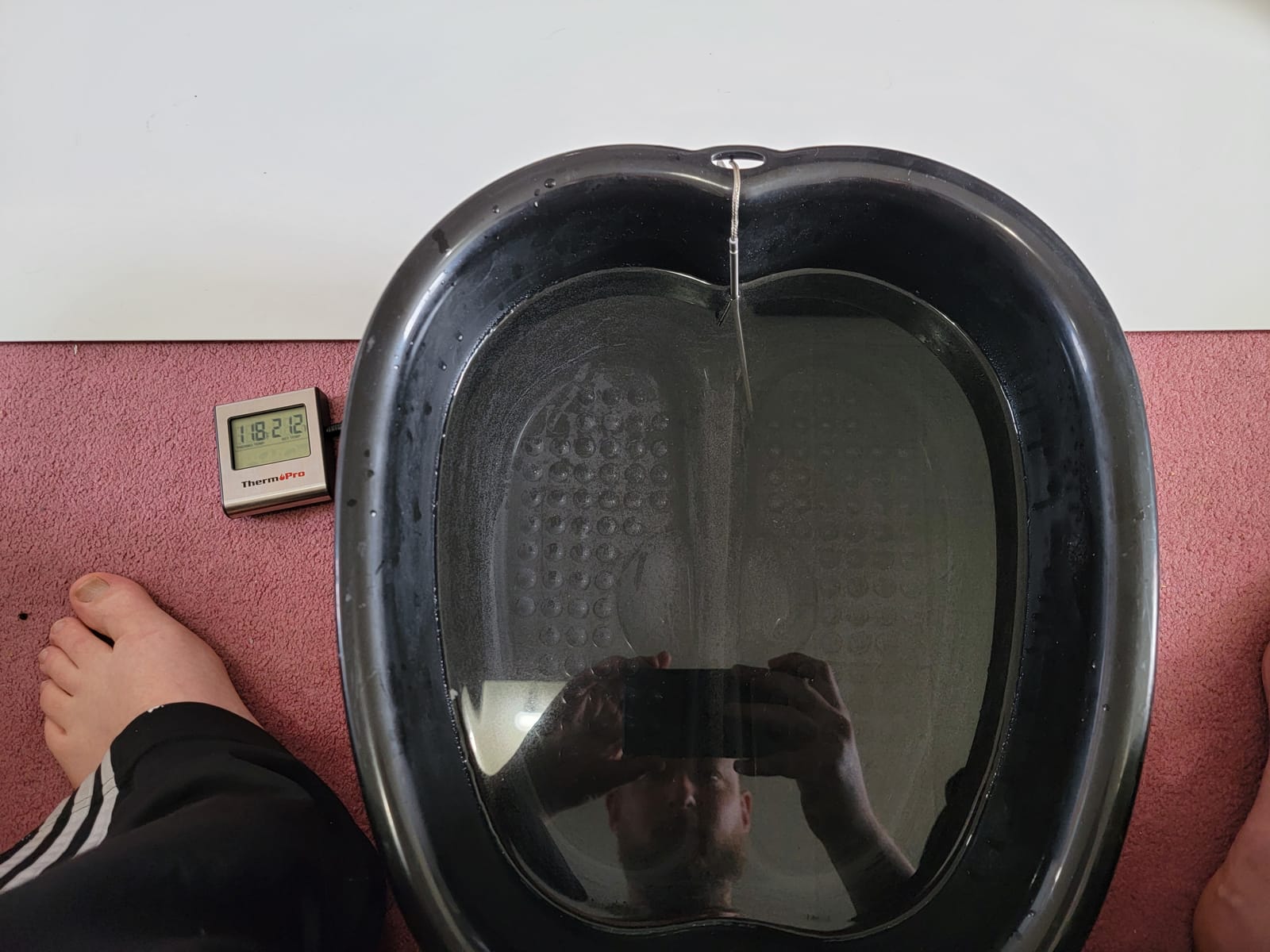
There is no user calibration, so a small share of these arrive reading noticeably off. If accuracy is your first priority, verify a new unit against ice water before you commit it to an overnight cook.
Probe jacks are a proprietary size, which means probes from other brands will not fit and replacements come from Govee alone. Plan for that before you need it, and note that the stated accuracy is plus or minus 1.8°F over 32°F to 572°F.
Best For App-Centered Cooks
This suits someone who wants alerts and history in the same app they already use for other kitchen devices, and who does not want to manage a separate base. Pass if you need a display you can read at the smoker, since there is not one here.
12. JoyBear FM2205 – The Best Precision Reading With a Standalone Display
Smart Bluetooth Wireless Meat Thermometer with 6 Sensors,0.5S Instant Read
±0.5°F NIST accuracy
0.5 second response
Two ultra-thin probes
48 hour runtime
Pros
- Highest rated unit in this roundup
- Large base display needs no app
- 0.5 second instant read
- NIST certified six sensors
Cons
- Bluetooth only so range is limited
- Only two probes included
- Less established brand
The JoyBear FM2205 carries the highest average rating of anything we analyzed, at 4.7 stars, and the reasons are specific rather than vague. Six NIST-certified sensors per probe, plus or minus 0.5°F accuracy, and a 0.5-second response time that is the fastest figure in this roundup.
Those numbers matter on a thin cut and on a finishing check. When you press a probe into a chicken thigh and the answer is immediate and stable, you are not waiting through a long averaging cycle to find out whether it is done.
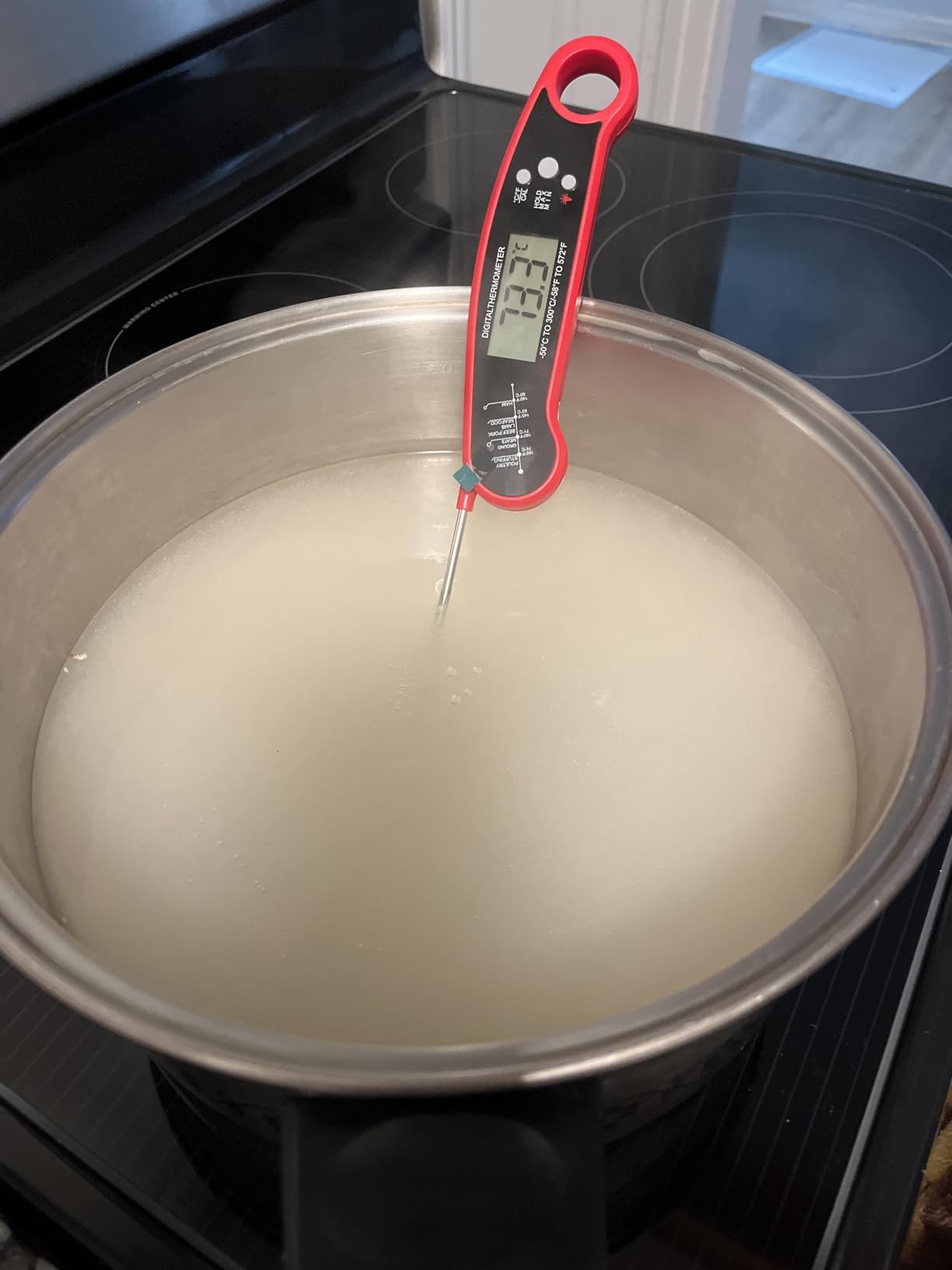
Two ultra-thin wireless probes track two meats or two temperatures at once with a low puncture footprint, and the base has a large screen with simple buttons so you can read and set values without opening the app.
Bluetooth Range and the Base Display
This is a Bluetooth unit, so range is shorter than the WiFi and Sub-1G models here. That is fine when the base sits on the side table next to the cooker, and it becomes a problem the moment the smoker is around a corner or at the far end of a yard.
Reviewers report fewer overall complaints than with the WiFi-dependent models, which is a fair trade for a smaller feature set. The Bluetooth app still offers control with custom food menu presets and real-time sync for beef, turkey, duck, and seafood.
Runtime and Cleaning
Probe runtime is stated at 48 hours from a 25-minute fast charge, which is the longest single-probe figure in this roundup and easily covers an overnight cook plus a rest. Probes are IP67 waterproof and oil-resistant, so they rinse off or go in the dishwasher.
Only two probes are included, which is the main constraint on multi-cut cooking. The trade-off to weigh is a smaller brand with a shorter track record against the best rating and best stated accuracy in this list.
Who Should Buy It
Choose it for quick finishing checks, thin cuts, and anyone who values a fast accurate number over wireless range. Pass if your cooker is far from where the base can sit, or if you need more than two channels.
How to Choose a Meat Thermometer for Smoking
Most buying guides for thermometers are written for cooking a steak. This section is written for a cook that runs eight to sixteen hours, where the failure modes are completely different. The questions that matter are how the signal behaves through steel, how the battery behaves when the temperature is climbing, and what happens when a probe dies on a Sunday afternoon.
Decide How Many Probes You Actually Need
The most common question on smoking forums is not about accuracy. It is about how to monitor a smoker with more than one rack without opening the door. One probe tells you about one zone. Two probes let you separate meat from pit, which is the minimum for diagnosing a stall. Four probes are what a vertical smoker or a competition cook actually requires, and only the multi-probe units in this roundup deliver that.
A pit probe is worth more than people expect. Once the bark sets, pit and meat temperatures diverge, and a cook who is only watching the meat cannot tell whether a rising internal reading means the fire caught up or the cook is just progressing.
Learn the Difference Between Open-Air and Obstructed Range
Wireless range claims are measured in the best possible conditions: clear line of sight, no walls, nothing in the way. A real smoker is a steel box with insulation, sometimes wrapped in foil, sitting behind a closed door. Every manufacturer’s number drops substantially once you add those obstacles.
That is why radio type matters more than the headline number. Sub-1G operates at a lower frequency and travels through obstructions far better than 2.4GHz Bluetooth, which is why the ThermoMaven units specify obstructed range alongside open-air range. WiFi removes the distance ceiling entirely but adds a network dependency and, on some models, a 2.4GHz band requirement.
Understand Why Probe Batteries Drain Fast
This is the single most misunderstood spec in the category, and it is the one that generates the most forum complaints. A wireless probe transmits far more often when the temperature is changing quickly than when it has settled into a long holding pattern. The work of the radio, not the mere passage of hours, is what drains the cell.
The practical consequence is that a probe can lose a large share of its charge in the first hour of a brisket, when the meat is climbing through the danger zone, and then hold that charge for many hours during the plateau. Community testing has documented probes dropping from full to around 80 percent within an hour of rapid change, against steady readings holding for well over ten hours at a constant temperature.
Three habits help. Top the probe up in its cradle for a few minutes mid-cook, choose a sampling or signal setting matched to your cook length rather than the most sensitive one, and clean the charging contacts before docking so the recharge actually takes.
Place the Probe Where the Heat Is Real
Insert the tip into the thickest part of the muscle, away from bone and away from the fat seam, without pushing all the way through to the grate. For a brisket, that is the flat side at the thick end. For a pork butt, the shoulder end. For a whole turkey, deep into the breast near the bone without touching it.
Offsetting is normal. An instant-read thermometer inserted into a hot piece of meat can read several degrees high at first because the probe has not equilibrated with the interior. Let it sit for the recommended interval and re-read rather than adjusting the number in your head.
Do not forget carryover. Meat continues to cook after it leaves the heat, so a brisket pulled at a given reading will finish noticeably above it. Plan the rest as part of the cook, not as a pause in it.
Check the Specs That Survive Year Three
Probe lifespan is the honest weak point of this whole category. Community reports describe leave-in probes failing anywhere from a year and a half to six years, and the replacement is rarely cheap. Before you commit to a wireless unit, find out whether spare probes are sold separately, because that single fact separates the picks that age well from the ones that frustrate you.
Warranty length is a rough proxy for how the maker expects the product to be treated. Anything at a year or less is telling you something. Longer coverage on rechargeable probes often signals confidence in the cells and the seals, which are the parts that usually fail first.
Finally, run an ice-water check on any new thermometer. A glass of ice with just enough water to slush should read close to 32°F. It takes two minutes and it tells you immediately whether the unit you are about to trust for twelve hours is honest.
Cleaning is the last thing and the most-skipped. Probes that are dishwasher safe or IP67 or IPX8 rated can go straight in, which matters more for wireless models with sealed contacts and internal batteries than for a simple wired stem. Wipe down any non-waterproof unit instead, and never submerge a display base.
If your interest runs beyond meat, our guides to wine thermometers and candy thermometers cover the same accuracy and calibration thinking for other temperature-sensitive work, and cold smoking generators covers the low-temperature end where probe range matters even more.
Frequently Asked Questions
What is the most accurate thermometer for smoking meat?
For accuracy, the ThermoMaven WT10 and ThermoMaven P2 stand out with NIST-certified sensors rated at plus or minus 0.5°F and 0.01°F resolution. The JoyBear FM2205 matches that figure with a 0.5-second response time. On a practical level, we trust the TempPro TempSync TP-20 most because it pairs plus or minus 1°F-class readings with a connection that does not drop. Verify any new thermometer in an ice-water bath before a long cook.
Which is better, ThermoPro or ThermoWorks?
Among the units we tested, TempPro is the stronger choice for smoking, with wired and RF wireless options that need no app and no account. ThermoWorks is widely respected for accuracy in general cooking, but the models that dominate smoking discussions are not the ones built for overnight unattended cooks. If you want a pit alarm and two channels with nothing to pair, the TempPro TempTrack TP-17 and TempSync TP-20 cover it.
What is the best digital thermometer for a smoker?
The best digital thermometer for a smoker is the TempPro TempSync TP-20 if you want wireless with no app, or the TempPro TempTrack TP-17 if a wired dual-probe setup with a HI and LOW range alarm suits your cooker. For a base display you can read at the pit without a phone, the ThermoMaven WT10 is the pick. All three report pit and meat temperature separately, which is what a smoker cook actually needs.
What meat thermometer does America’s Test Kitchen recommend?
America’s Test Kitchen has historically leaned toward instant-read thermometers for accuracy on quick cooks, and that advice still holds for wrap checks and resting. For smoking specifically, we would pair that habit with a leave-in probe rather than choose one or the other. An instant-read tells you the surface and shallow readings instantly; a leave-in wireless probe is what carries a ten-hour brisket. Keep both in the kit.
Which is better, Meater or ThermoPro?
It depends on whether you want guidance or reliability. The MEATER Plus offers the better app, guided cook steps, and finish-time estimates, which helps beginners. The TempPro TempSync TP-20 never drops a connection because there is no app to pair, and its RF link holds through smoker walls. If you dislike account requirements and phone pairing entirely, TempPro is the safer answer for long unattended cooks.
Do I need a wireless meat thermometer for smoking?
You do not need one, but it changes the experience. A wired probe cannot lose a signal and cannot run out of charge mid-cook, which is why the wired TempPro units remain strong picks. Wireless lets you monitor from indoors and get alerts, which matters on long cooks. Whichever you choose, add an instant-read thermometer for wrap checks, since no leave-in probe handles thin cuts or basting well.
Which Thermometer Fits Your Cook
If you want the most dependable long-cook experience with no app and no account, start with the TempPro TempSync TP-20. It is our editor’s choice because the signal holds, the two probes separate meat from pit, and the timer runs past any cook you will attempt.
If you want the simplest possible setup with no app and no technology to learn, the TempPro TempTrack TP-16 is the honest pick. A cable cannot fail to connect, and the 99-hour timer covers every overnight cook on the calendar.
If your cooker has thick steel walls or sits away from the house, choose the ThermoMaven WT10 for its Sub-1G signal and NIST accuracy, or the ThermoMaven X2 if you want the same radio with no app at all. For two cuts, the ThermoMaven P2 adds WiFi range and a second probe. For four racks, the Inkbird IB-0960 or INT-14 gives you the channels, with the INT-14 adding per-probe calibration.
Whichever you choose, keep an instant-read thermometer in the same bag. Wrap checks, thin cuts, and resting all happen too fast for a leave-in probe, and the best meat thermometers for smoking are the ones that give you both answers. Use the buttons below to see the current listing for any of these picks.
Leave a Reply