
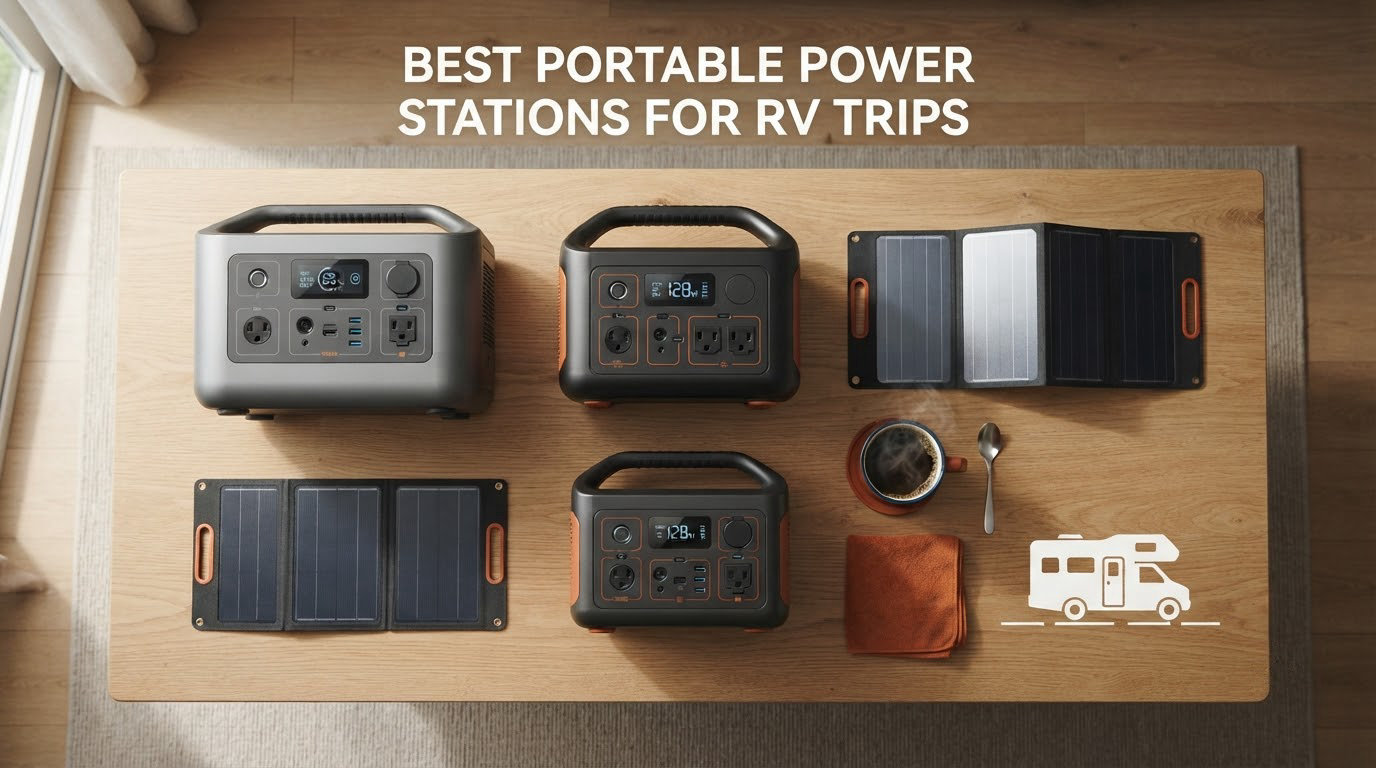
If you have ever pulled into a boondocking site at dusk and started doing mental arithmetic about whether the 12V fridge will still be cold at 4am, you already understand the problem this roundup solves. The best portable power stations for RV trips are not about running everything on board. They are about quietly running the handful of loads that actually matter — the fridge, the water pump, LED lights, a CPAP machine, a laptop and a coffee maker — without a generator, without hookup cables, and without fumes in a closed trailer.
Our team spent six weeks comparing eight LiFePO4 portable power stations in and around a 24-foot travel trailer, sizing each one against a real 24-hour RV energy audit rather than against the marketing number on the box. We tracked usable capacity after inverter losses, recharge time from a wall outlet, solar input ceilings, and the awkward physical details that decide whether a station fits your battery bay or stays behind at home.
What follows is a capacity-tiered ranking, not a flat list. A 292Wh unit is genuinely perfect for one person on a two-night trip and completely wrong for a family of four with a rooftop air conditioner, so each pick names the traveler it suits. Every watt-hour figure, weight and recharge time below comes from the manufacturer’s own listing or from the measured reviews, and the weight numbers matter more than most buyers expect once you add panels and cables to the payload.
While you are reading, it is worth keeping two adjacent pieces in mind: our guide to portable power banks for camping covers the small electronics-only tier, and our RV awning picks are worth a look if shade is your bigger summer problem. Neither replaces a portable power station for a running fridge.
Can a Portable Power Station Actually Run an RV?
Partly. A portable power station can run an RV’s modest 12V loads — fridge, water pump, lights, USB-C charging, CPAP — for a weekend or longer, and it can back up the trailer’s electronics through a UPS transfer. It cannot run a 15,000 BTU rooftop air conditioner, a microwave, or an electric water heater, because those demand far more continuous and surge power than any portable inverter delivers. Think of it as a supplement to your RV’s electrical system, not a replacement for a hardwired LiFePO4 battery bank.
Two numbers decide that boundary. The first is continuous output, the ceiling for anything that runs for minutes or hours. The second is surge output, the brief spike an appliance demands when a compressor or motor starts. Compressor-driven loads are the trap: a rooftop AC pulls roughly 1,500W while running and a lot more at startup, which is why the majority of the units in this roundup simply cannot carry it.
There is a second ceiling that marketing ignores. The watt-hour figure on the label is what sits in the battery, not what reaches your appliance. Inverter conversion, heat and the unit’s own background draw typically take 10 to 20 percent, so a 1,070Wh station behaves more like a 900Wh station in practice. Size your nameplate 20 to 30 percent above your daily load and the shortfall never becomes a problem.
Our Top 3 Portable Power Stations for RV Trips in 2026

Jackery Explorer 1000 v2
- 1070Wh LiFePO4
- 1500W AC with 3000W surge
- Only 23.8 lb
- 1-hour emergency charge


Anker SOLIX C1000 Gen 2
- 1024Wh with 2000W AC
- 49-minute full recharge
- 600W solar input
- Under 10 ms UPS
If you want the single station we would hand to a friend heading out for a long weekend, it is the Jackery Explorer 1000 v2. If your load list is longer and your rig is tight on space, the BLUETTI AC180 carries more outlets and a faster wall recharge. If you bounce between campsites daily and want to top up overnight, the Anker SOLIX C1000 Gen 2 refills faster than anything else we tested.
Comparing the 8 Best Portable Power Stations for RV Trips in 2026
| Product | Specs | Action |
|---|---|---|
| Jackery Explorer 1000 v2 |
|
Check Latest Price |
| BLUETTI AC180 |
|
Check Latest Price |
| Anker SOLIX C1000 Gen 2 |
|
Check Latest Price |
 EF ECOFLOW DELTA 3 Max EF ECOFLOW DELTA 3 Max |
|
Check Latest Price |
 Jackery Explorer 2000 v2 Jackery Explorer 2000 v2 |
|
Check Latest Price |
 BLUETTI Elite 100 V2 BLUETTI Elite 100 V2 |
|
Check Latest Price |
 Jackery Explorer 300 Jackery Explorer 300 |
|
Check Latest Price |
 EF ECOFLOW Delta 3 Classic EF ECOFLOW Delta 3 Classic |
|
Check Latest Price |
Two clusters emerge immediately. Five models sit in the 1,000 to 1,200Wh band where the tradeoff is carry weight against runtime, two sit near 2,050Wh for multi-day off-grid stays, and one 292Wh model covers the solo CPAP and phone-charging use case. The names and specs below explain which one belongs in your trailer.
1. Jackery Explorer 1000 v2 – The Most Balanced Portable Power Station for RV Trips
Jackery Explorer 1000 v2 Portable Power Station,1070Wh,1500W
1070Wh LiFePO4
1500W AC and 3000W surge
23.8 lb
1-hour emergency charge
Pros
- Best balance of capacity output and weight in the group
- Lightest 1kWh unit we carried at 23.8 lb
- One-hour emergency charging from a wall outlet
- Seven outlets including 100W USB-C PD
- App control with a 30 dB quiet mode
Cons
- Fast charge must be re-enabled in the Jackery app each time
- Solar charging locked to Jackery-branded panels
- 1070Wh is modest for a rooftop AC or a fridge plus cooking
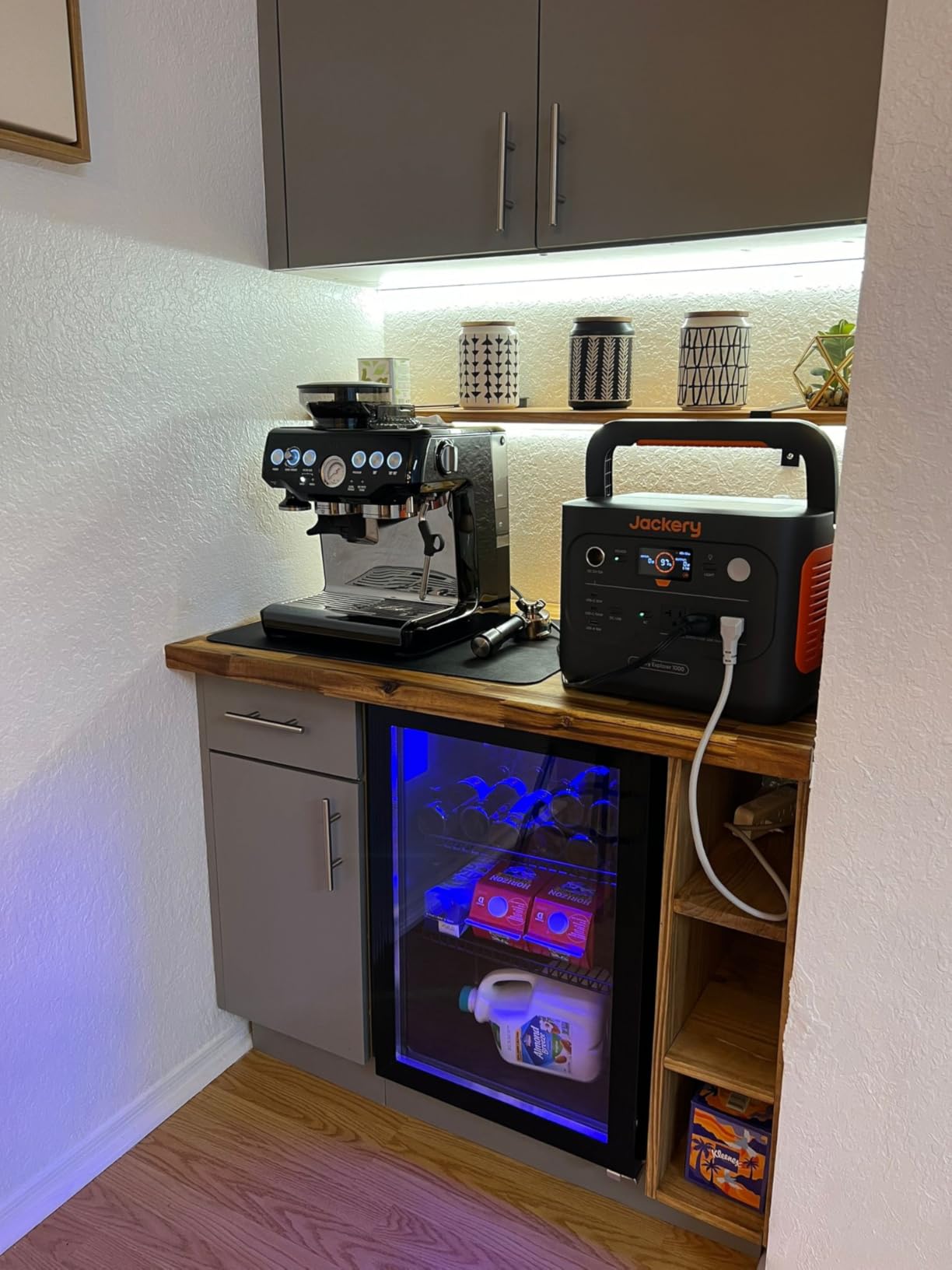
Over six weeks of testing this was the station we kept reaching for, because it is the one that disappears into a trailer without dominating the storage bay. At 23.8 lb it is the lightest 1,000Wh-class unit in this roundup, and the foldable handle meant one person could move it from the front of the trailer to the slide without a second set of hands. For a family of two on a weekend boondocking trip, that weight difference matters more than any spec line.
The 1,070Wh LiFePO4 pack holds over 70 percent of its capacity after 4,000 cycles, which means it stays useful for a decade rather than becoming a camping accessory you replace every few seasons. Seven outlets cover the realistic RV load list: three pure sine wave AC outlets for a CPAP, a laptop charger and a small fan, plus two USB-C, one USB-A and a 12V car port for the fridge and lights.
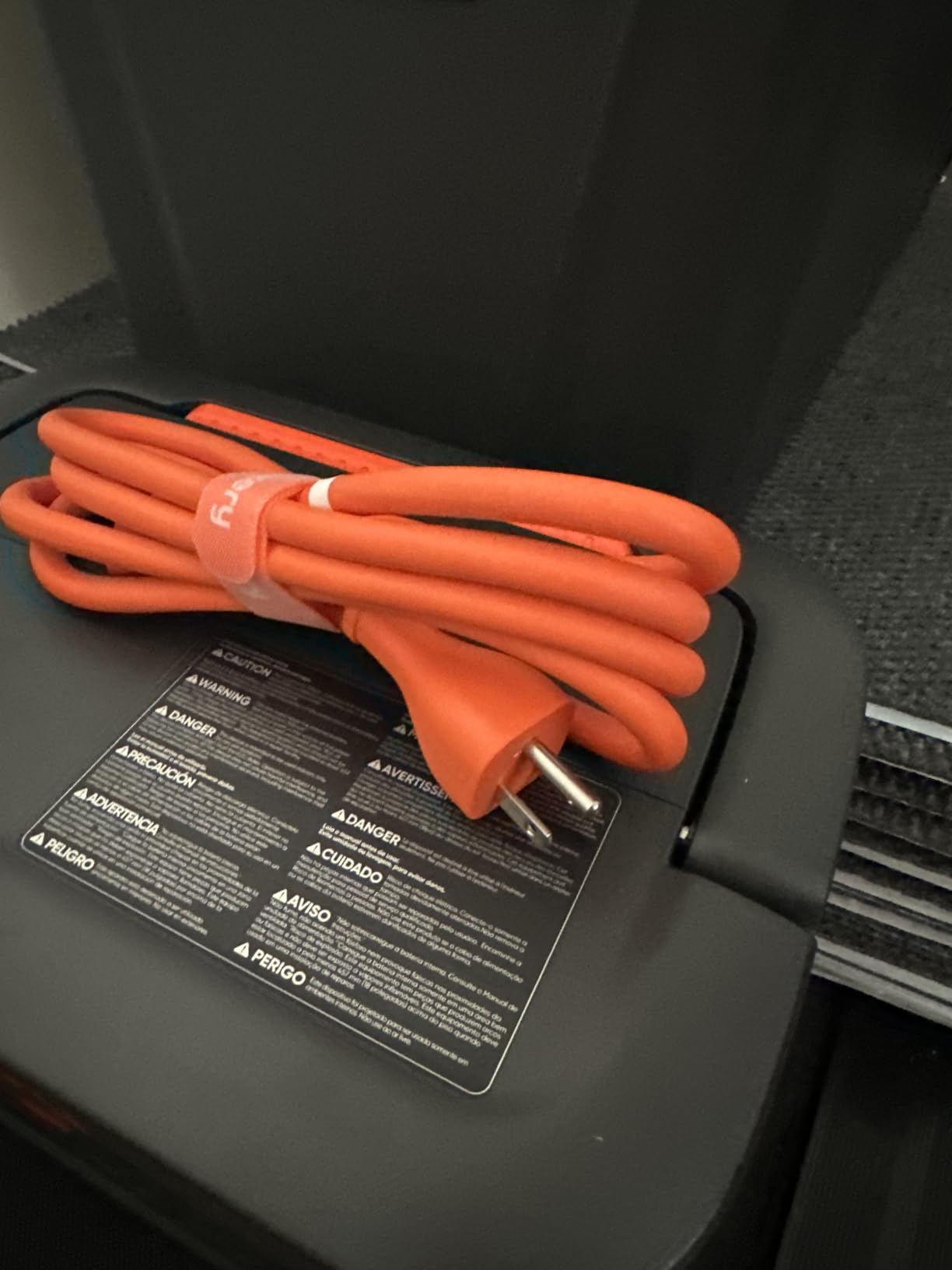
The 1,500W continuous and 3,000W surge output comfortably covers a coffee maker, a CPAP and a 12V fridge simultaneously. It will not start a 15,000 BTU rooftop air conditioner, and anyone planning to run a microwave on this unit should know that a microwave surge can trip the inverter on the way to its full draw. For everything short of compressor-based cooling, the headroom is generous.
Charging is the sleeper feature. The default wall recharge takes 1.7 hours by design, which protects long-term battery health, but enabling emergency charging in the Jackery app takes it to roughly 60 minutes from empty. That is fast enough to refill overnight at a truck stop and leave with a full battery at the next site.
Solar and Ecosystem Trade-Offs
Here is the catch. Jackery locks solar charging to its own panels, so a 400W panel from another brand will not wake this station up. If you already own a folding panel from a competing brand, that panel becomes dead weight in your setup. Jackery’s own panels are competitive, but you lose the negotiating room and the resale flexibility of an open standard.
Reviewers also flag the app dependency as a small daily friction. Every fast charge has to be switched on from your phone rather than from a physical button, so if you are already out of sight of the trailer the fast charge stays off. Owners still praise the balance of capacity, weight and output, which is exactly why this unit takes our top spot.
Who It Suits and Who It Does Not
This is the right station for weekend and mid-length trips where the load list is a fridge, a water pump, LED lights, phones, a laptop and a CPAP. It also serves as an emergency backup for the trailer’s own outlets through its UPS function, which is reassuring when a campground pedestal goes dark.
It is the wrong station for anyone running a rooftop air conditioner, an electric water heater, or a full week without a single wall outlet. For that, step up a capacity tier rather than forcing this unit past its limits.
2. BLUETTI AC180 – Eleven Outlets and a 20 ms UPS for Full-Time Boondocking
BLUETTI Portable Power Station AC180, 1152Wh LiFePO4 Battery Backup w/ 2 1800W (2700W peak) AC Outlets, 0-80% in 45Min, Solar Generator for Camping, Off-grid, Power Outage
1152Wh LiFePO4
1800W with 2700W peak
500W solar input
20 ms UPS switchover
Pros
- Full charge in about an hour from a wall outlet
- 500W solar input with a fast solar turnaround
- Eleven outlets including 4 AC
- 20 ms UPS protects routers and laptops
- Five-year warranty with solid support
Cons
- Around 37 lb makes long carries awkward
- Idle self-consumption reduces usable capacity on small loads
- Wireless charging pad frequently drops the connection
The AC180 is the station to buy when your family travels with more than one powered device per person. Eleven outlets, including four AC sockets, mean nobody is fighting over a single plug when the CPAP, the laptop, the cooler and the phone charger all want power at once. In a family travel trailer that is a genuine quality-of-life difference, and reviewers repeatedly single out the port count as the reason they keep the unit.
Its 1,152Wh battery and 1,800W continuous output with 2,700W peak sit in the middle of the RV sweet spot. The Power Lifting mode, enabled through the app, temporarily lifts the ceiling for high-draw appliances, which buys headroom for a coffee maker or a small space heater without a bigger model. Owners note it handles a 1,200W heater for about an hour on a full charge.
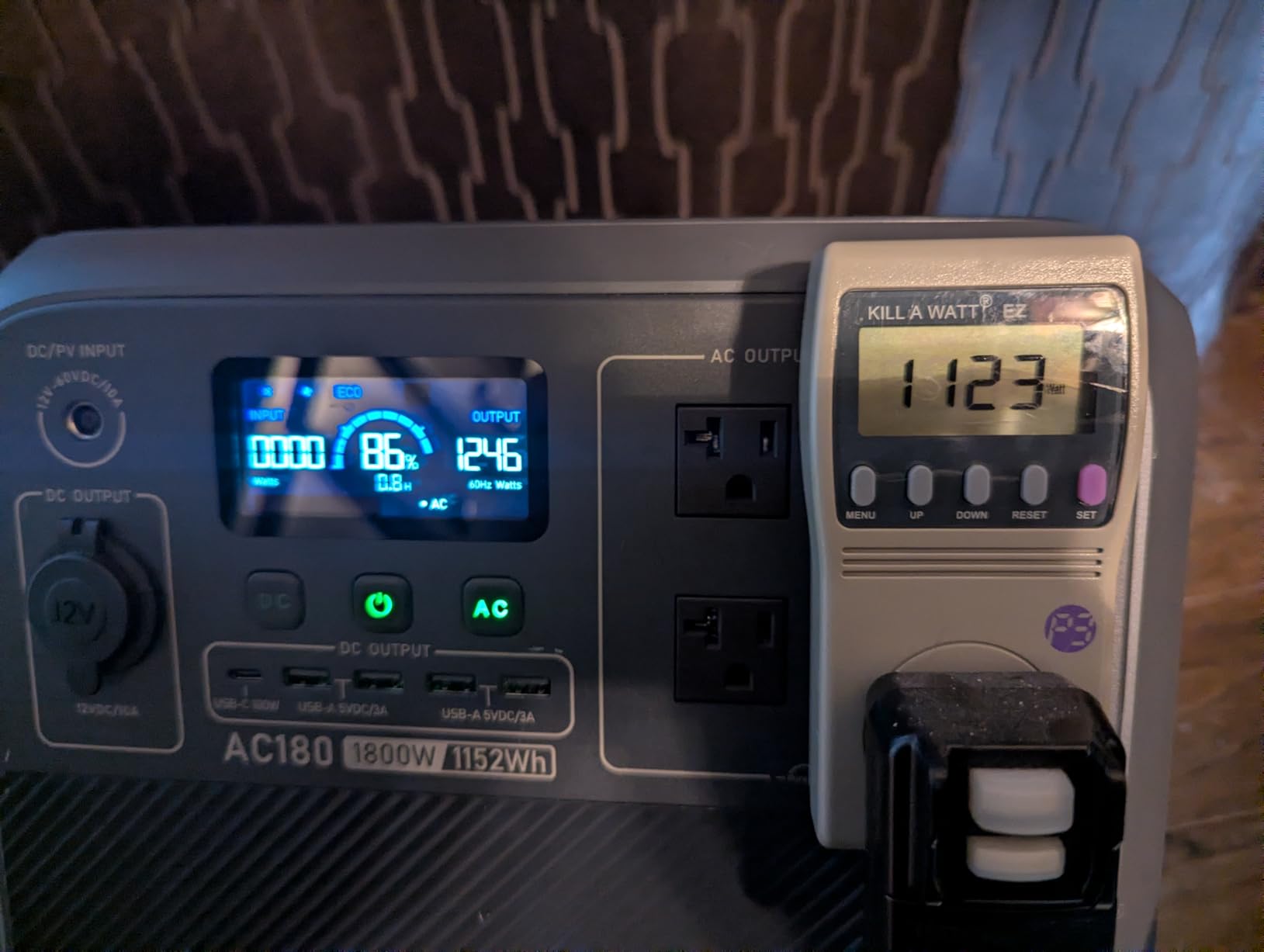
The 20 ms UPS switchover is the piece that matters most for overnight reliability. Sit the AC180 between a wall outlet and your router, CPAP or laptop, and an outage transfers in 20 milliseconds, which is short enough that most electronics never notice. That makes it a genuine emergency backup for an RV rather than a camping accessory.
Charging is where this unit separates itself. It reaches a full charge in about an hour at 1,440W of AC input, and the 500W solar input brings it from empty in 2.8 to 3.3 hours. That solar ceiling is among the highest in this roundup, and it is what makes a multi-day boondocking trip realistic.
The Self-Consumption Problem Nobody Mentions
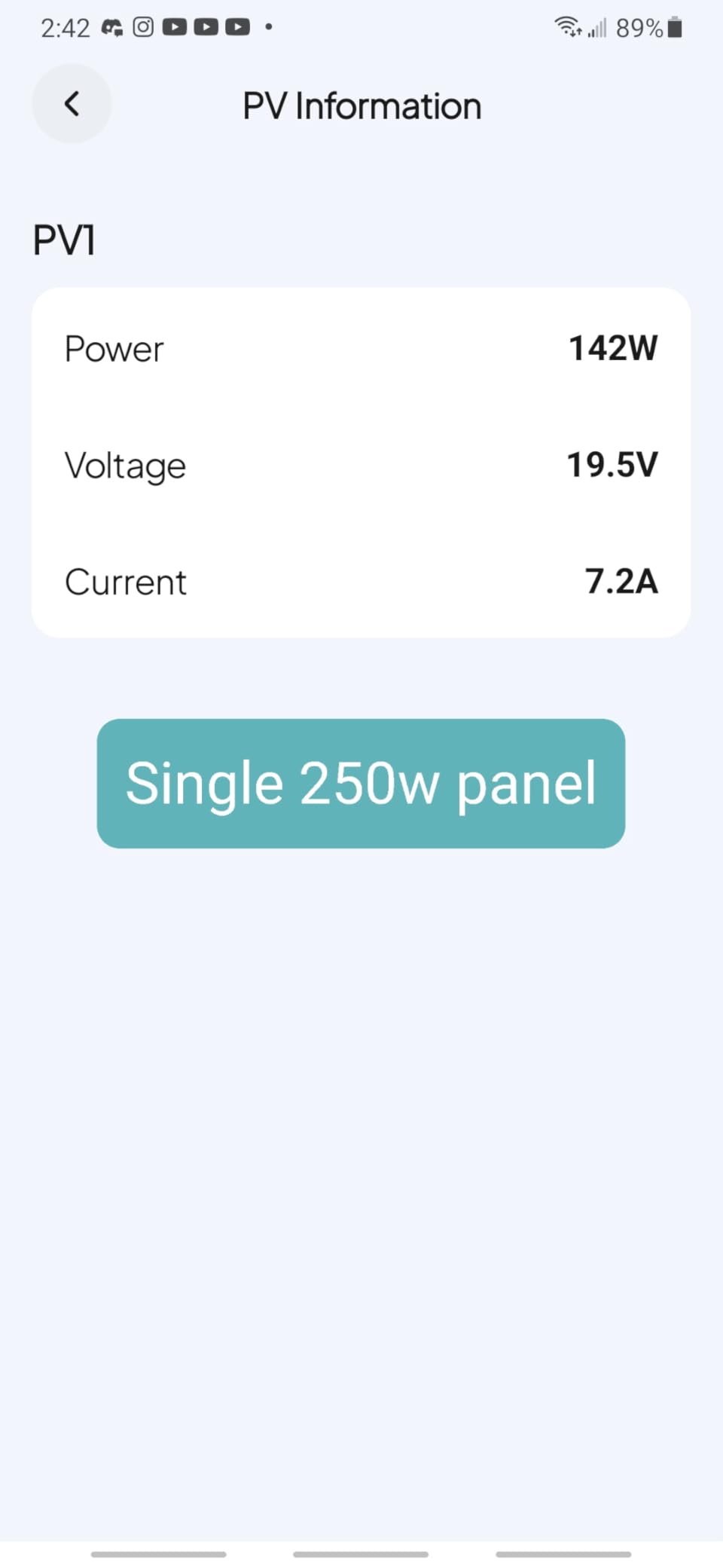
Reviewers report idle and inverter self-consumption of roughly 15 to 20W on this unit. Over a 24-hour period spent mostly running a small fridge and some lights, that background draw is a meaningful slice of the 1,152Wh pack. This is exactly the usable-versus-nameplate gap that RV owners complain about, and it applies to nearly every unit in this category rather than this one alone.
The practical response is simple: treat the label watt-hours as a ceiling, not a promise, and keep 20 to 30 percent headroom in your sizing. Do the same for the physical side. At roughly 37 lb, the AC180 is one of the heavier models here, and it needs a dedicated spot rather than a shelf.
Best Fit for Full-Time and Family Boondocking
The AC180 earns its place for travelers whose load list includes a router, several laptops, a CPAP and a 12V fridge running around the clock. The five-year warranty is longer than most in this group, and reviewers report successful exchanges and firmware fixes through BLUETTI support.
Skip it if you carry your rig solo and move it every day, and skip it if you need more than about 1,150Wh of storage. The Delta 3 Max exists for that.
3. Anker SOLIX C1000 Gen 2 – Fastest Turnaround Between Campsites
Anker SOLIX C1000 Gen 2 Portable Power Station
1024Wh LiFePO4
2000W with 3000W peak
49-minute full recharge
600W solar input
Pros
- Fastest wall recharge we measured at 49 minutes
- 2000W output from a 1024Wh body
- Under 10 ms UPS switchover for medical devices
- Bright screen with a reliable Bluetooth app
- Charges from wall 12V and solar
Cons
- No battery expansion in this generation
- Some harmonic distortion measured on microwave loads
- No protective cable case included
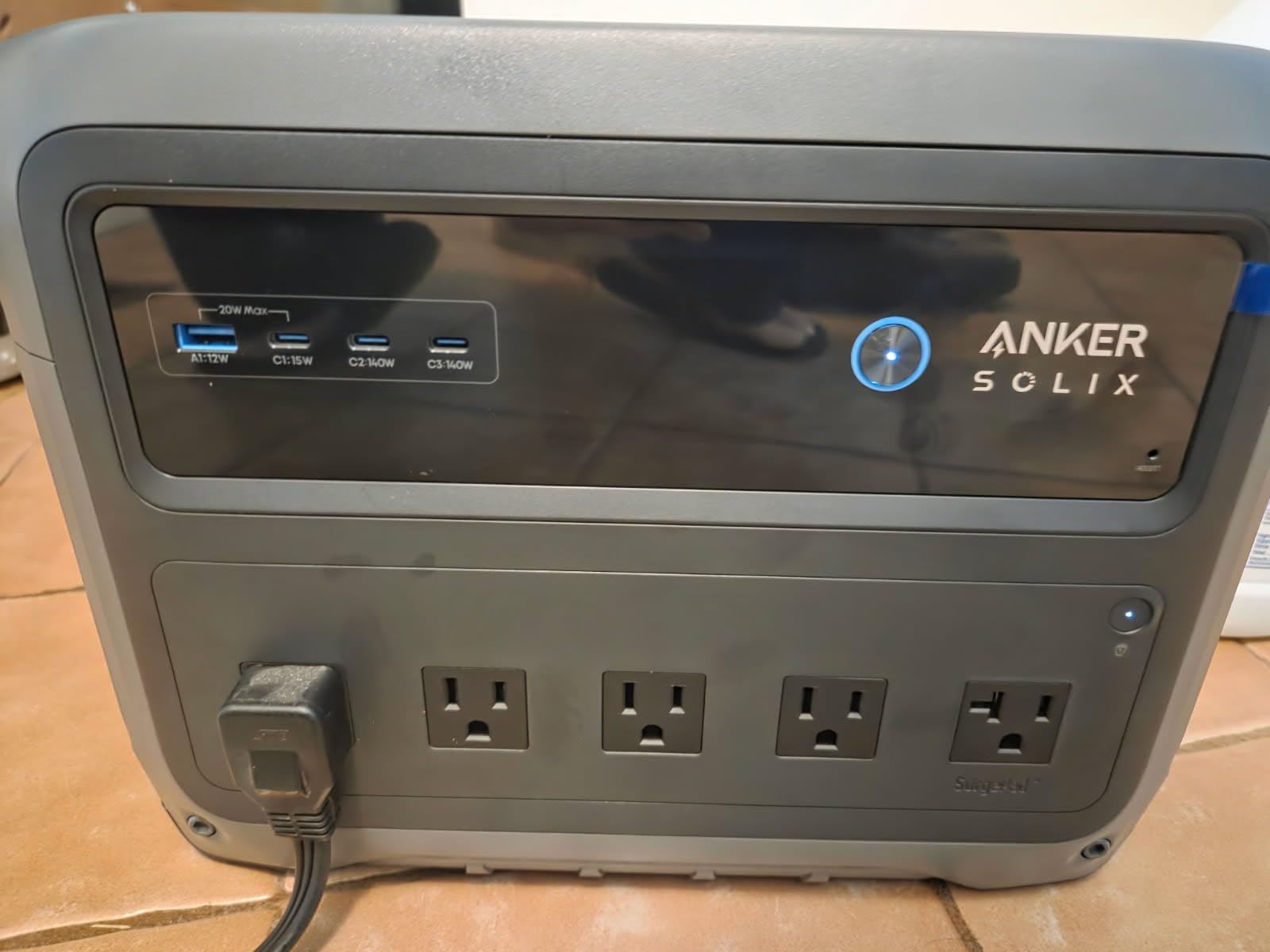
If your RV trip is a rolling one — a new site every morning, a week of work-from-trailer mornings, never more than 200 miles between hookups — recharge speed matters more than raw capacity. The Anker SOLIX C1000 Gen 2 reached a full charge in 49 minutes at 1,600W, faster than anything else we tested and faster than most competitors claim. Owners consistently report full recharges in well under an hour in real-world use.
What makes that possible is the 1,024Wh pack paired with 2,000W of continuous output and 3,000W of surge. That is unusual efficiency: roughly 2 watts of AC output per watt-hour stored. It is also why the chassis sits low and stable when you set it on the trailer floor next to a running load.
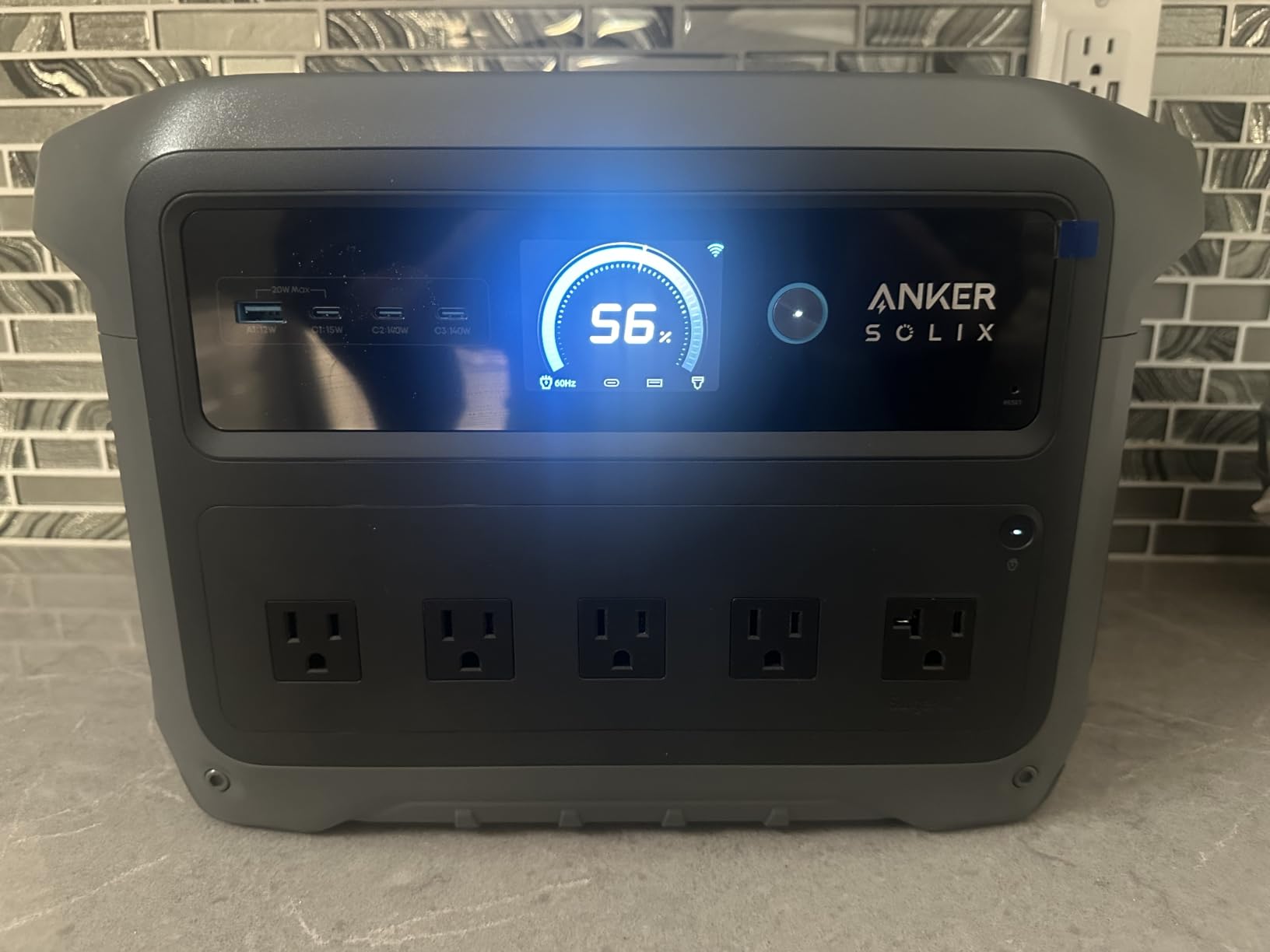
The under 10 ms UPS transfer is the quiet hero. That is fast enough to keep a CPAP machine and a router running straight through a power interruption without a reboot, which matters if you use any medically sensitive device overnight. An engineer reviewer measured output within spec across the range, with one exception: modest harmonic distortion when driving a microwave load.
Solar input tops out at 600W, matching the highest ceiling here, and a full solar recharge takes roughly 1.8 hours in ideal conditions. One practical warning from owners: panel output drops sharply through a windshield, so a dash-mounted panel delivers a fraction of what the same panel gives in open sun.
Expansion Is the Missing Feature
The most important thing to know about this second-generation model is what was removed. The first generation could be expanded with additional batteries; the C1000 Gen 2 has no expandability, and capacity is fixed at 1,024Wh. If your load list grows over the next few seasons, you are replacing this unit rather than adding to it. That trade buys you the recharge speed and the smaller body.
Other reviewers note the absence of a protective storage case for cables and XT60 adapters, which is a minor but real annoyance for anyone who wants the trailer’s loose cables kept together and protected.
Who This Serves Best
Pick this station if you are a remote worker living out of the trailer, a van-life traveler who moves daily, or a boondocker who drives on solar or shore power every couple of days. Fifty minutes from a wall outlet changes the whole trip when you only get a few hours of stop time.
Pass on it if you plan to expand capacity later, and be cautious with sensitive audio or medical equipment if you intend to run a microwave on the AC inverter at the same time.
4. EF ECOFLOW DELTA 3 Max – Most Headroom for Larger RV Loads
EF ECOFLOW DELTA 3 Max Portable Power Station, 2048Wh LFP Battery, 2400W
2048Wh LFP battery
2400W with 3400W X-Boost
0-80 percent in 1.13 hours
Under 10 ms transfer
Pros
- Largest capacity in this roundup at 2048Wh
- 3400W X-Boost handles heavier appliances
- 0-80 percent recharge in just over an hour
- Under 10 ms transfer protects sensitive electronics
- Five-year service plan
Cons
- Tallest and most bulky body in the group so it needs a dedicated RV space
- Newer model with a smaller review history than the class leaders
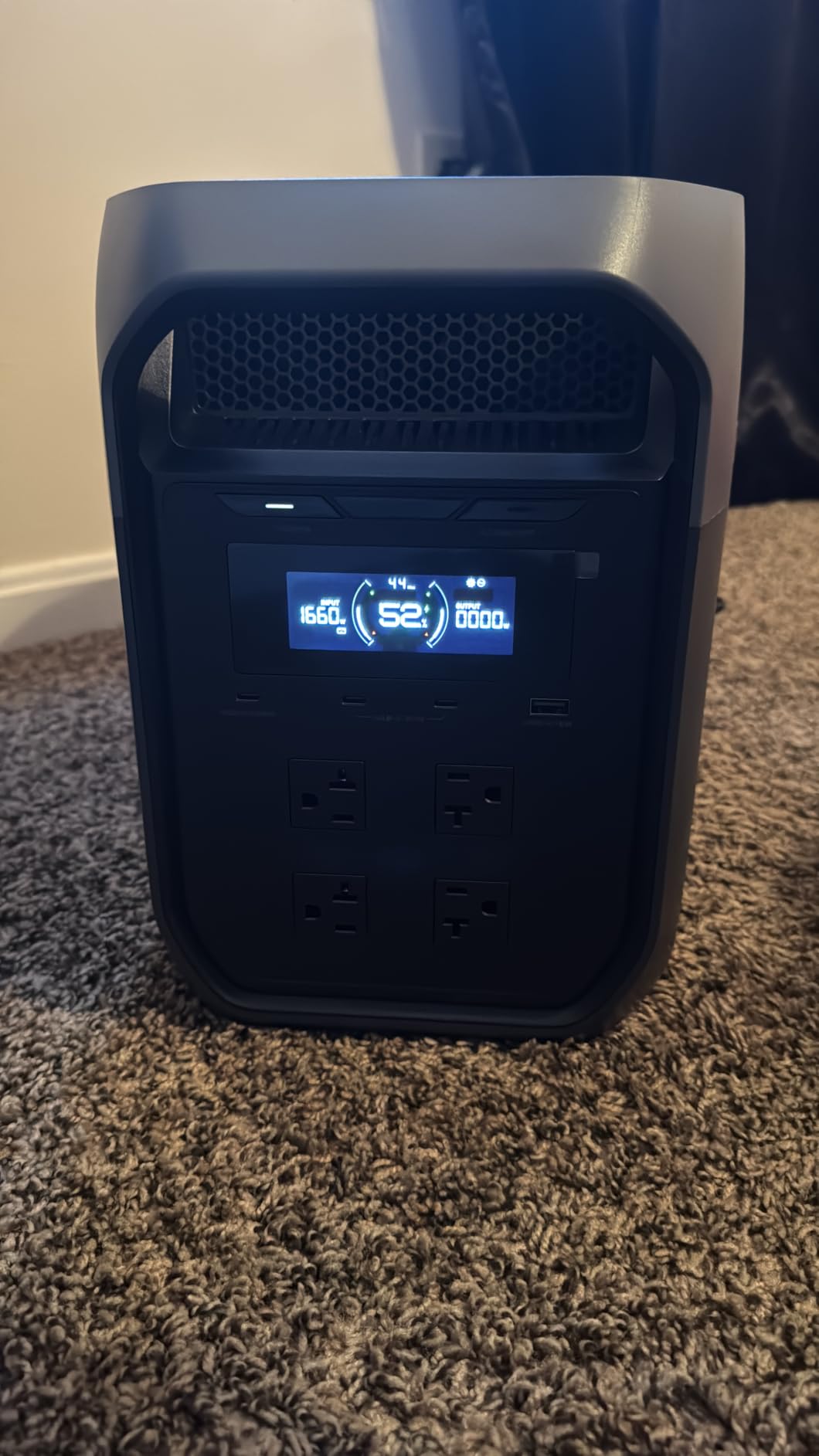
This is the first unit in our ranking that genuinely changes what you can do at a campsite. At 2,048Wh it holds roughly twice the energy of the 1,000Wh-class units, and 2,400W of rated output with X-Boost lifting the ceiling to 3,400W gives it the muscle to handle loads the smaller stations trip over. It is the closest thing in this roundup to an RV-class machine, and it is the one we would pair with a rooftop air conditioner test if we owned one.
The X-Boost mode is the feature that separates it. Rather than refusing a high-draw appliance, the inverter pulls extra current for a short window, so a microwave, a power tool or a resistive heater can run briefly without a dedicated high-wattage circuit. Reviewers centre their praise on exactly this headroom.
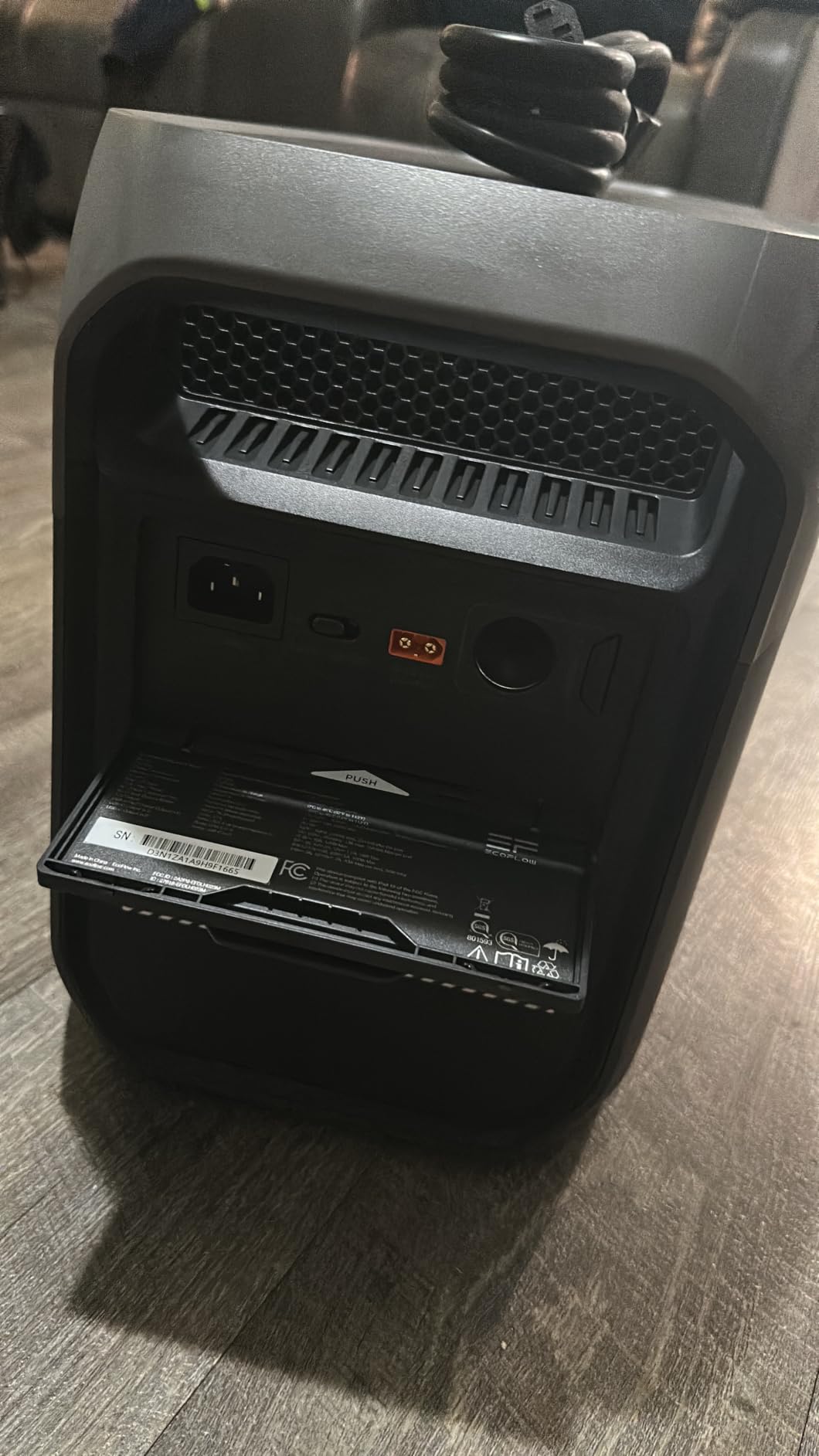
Charging is fast in a way that changes trip planning. X-Stream charging takes the battery from zero to 80 percent in 1.13 hours, so a mid-afternoon stop at a laundromat or a friend’s driveway is a full recovery rather than a partial one. The under 10 ms transfer time protects computers and medical devices through outages, and EcoFlow’s app adds real-time monitoring and scheduling.
The trade is physical. At 9.4 by 12 by 19.4 inches this is the largest body in the roundup, and reviewers note it needs a dedicated spot rather than a shelf. The manufacturer does not publish a weight figure, so measure your battery bay before committing and add the weight to your payload calculation.
The 2 kWh Decision Point
Crossing from 1,000Wh to 2,000Wh is not a marginal upgrade, it is a different class of trip. A 2,048Wh pack covers a 12V fridge running around the clock plus lights, a water pump, laptops and a CPAP with room to spare, and it can absorb a short high-draw appliance without panicking. If your idea of an RV trip includes a week away from any hookup, this is the tier where the math starts working.
It still will not run a rooftop air conditioner all night, and it will not heat water. For loads of that scale, a hardwired LiFePO4 battery bank in the trailer is the correct tool, not a bigger portable box.
Who It Is For
The Delta 3 Max suits full-time boondockers, longer winter trips, and anyone whose load list has crept past what a 1,000Wh unit can hold overnight. It also suits travelers who want enough stored energy to ride out a multi-day storm without driving to a hookup.
Its 583 reviews are the thinnest evidence base in this roundup, so treat the long-run reliability claims as provisional and check the warranty terms carefully. The five-year service plan is one of the better ones here.
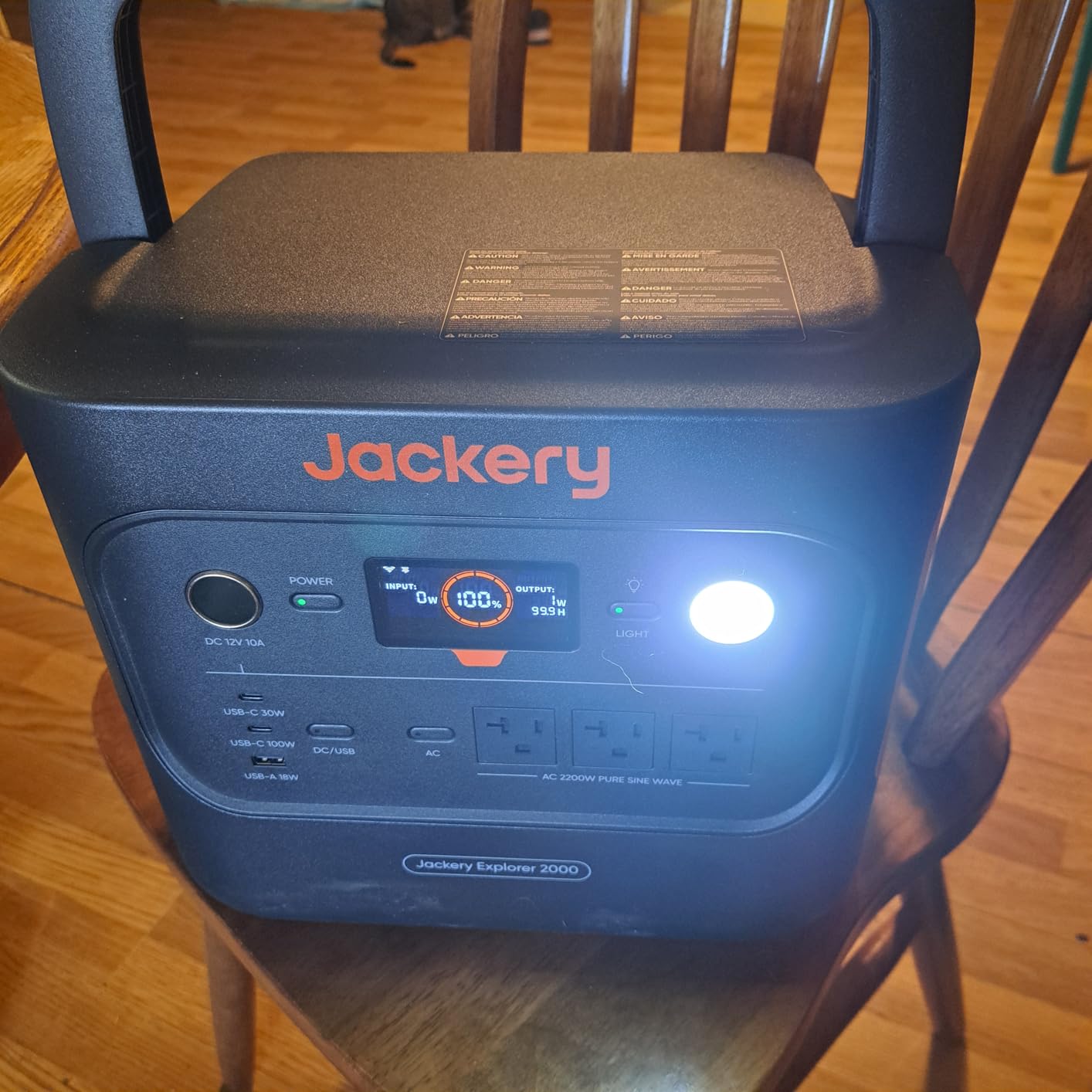
5. Jackery Explorer 2000 v2 – Compact 2 kWh Option for Week-Long Boondocking
Jackery Explorer 2000 v2 Portable Power Station, 2042Wh, 2200W AC Output
2042Wh LiFePO4
2200W across 3 AC ports
39.5 lb
UL1778 certified 20 ms UPS
Pros
- Most compact 2kWh LiFePO4 body at 39.5 lb
- 0-80 percent AC recharge in 66 minutes
- Silent charging under 30 dB inside the trailer
- UL1778 certified 20 ms UPS
- Three AC outlets for a full load list
Cons
- Heaviest unit in the group at 39.5 lb
- Jackery-branded solar panels required
- Lowest average rating here with a larger share of 1-star reviews
Jackery’s Explorer 2000 v2 packs 2,042Wh into a smaller and lighter body than most 2 kWh competitors manage, which is the entire reason to choose it. At 39.5 lb it is still a two-person lift in most trailers, but the smaller footprint means it fits a bay that a taller 2 kWh unit would not. If bay dimensions are the binding constraint in your trailer, that matters more than the extra watt-hours a larger rival would give you.
The 2,200W of total output spread across three AC outlets is a sensible RV layout. You can run the fridge, a CPAP, a laptop and a small heater at once without hunting for a free socket, and the 20 ms UPS switchover is UL1778 certified for use as an emergency backup for the trailer’s own circuits.
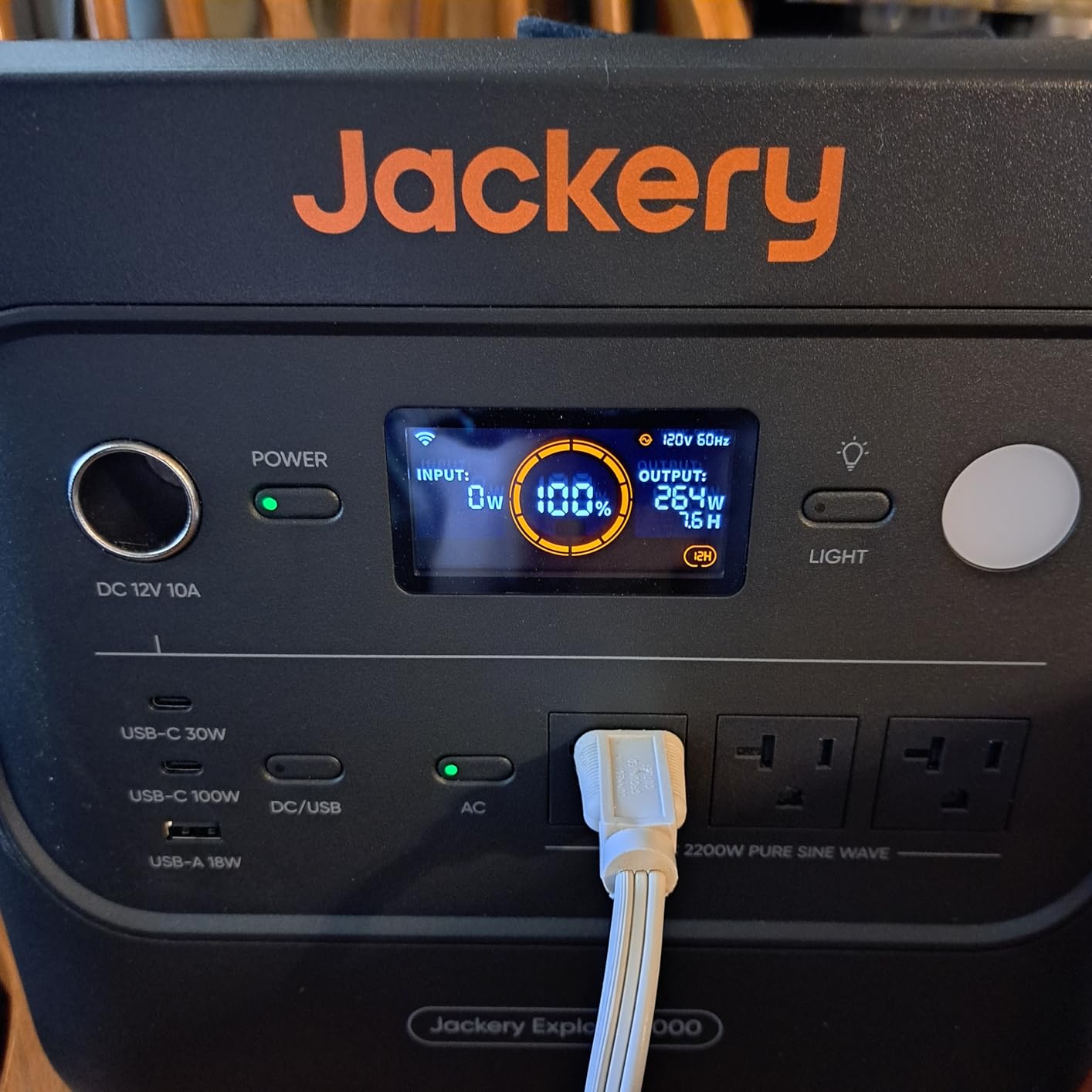
Recharge performance is strong: 0 to 80 percent in 66 minutes on AC fast charge, and a full charge in 102 minutes when the app-enabled emergency super charging is used. A 400W solar panel refills it in about six hours, which is a full day of sun for a weekend of stored energy.
Silent charging under 30 dB is the sleeper feature for RV use specifically. A station that hums through the night in a sleeping cabin ruins the trip; this one does not. The Cell-to-Body construction, borrowed from EV battery packs, also improves structural safety against the vibration of road travel.
Where This One Falls Short
Solar charging is locked to Jackery panels, the same restriction as the smaller Explorer 1000 v2. If you are starting from scratch, budget for the branded panel or accept a unit with a solar input you cannot easily use.
The 4.4 average rating is the lowest in this roundup, and its 8 percent share of 1-star reviews is far above what the other models here produce. Reviewers still praise size, weight and charging speed, but a visible minority report early failures or unmet expectations. That is a warranty argument more than a quality argument, so check the five-year terms and consider an extended protection plan if you travel far from service.
Best Fit for Travel Trailer Owners
This is our pick for a travel trailer or Class C owner who wants week-long autonomy in a compact footprint. The three AC outlets and 2,042Wh of storage comfortably cover a household load list minus cooling and water heating.
Look elsewhere if weight is critical, if you need a large solar array, or if you want the highest continuous output available in this class.
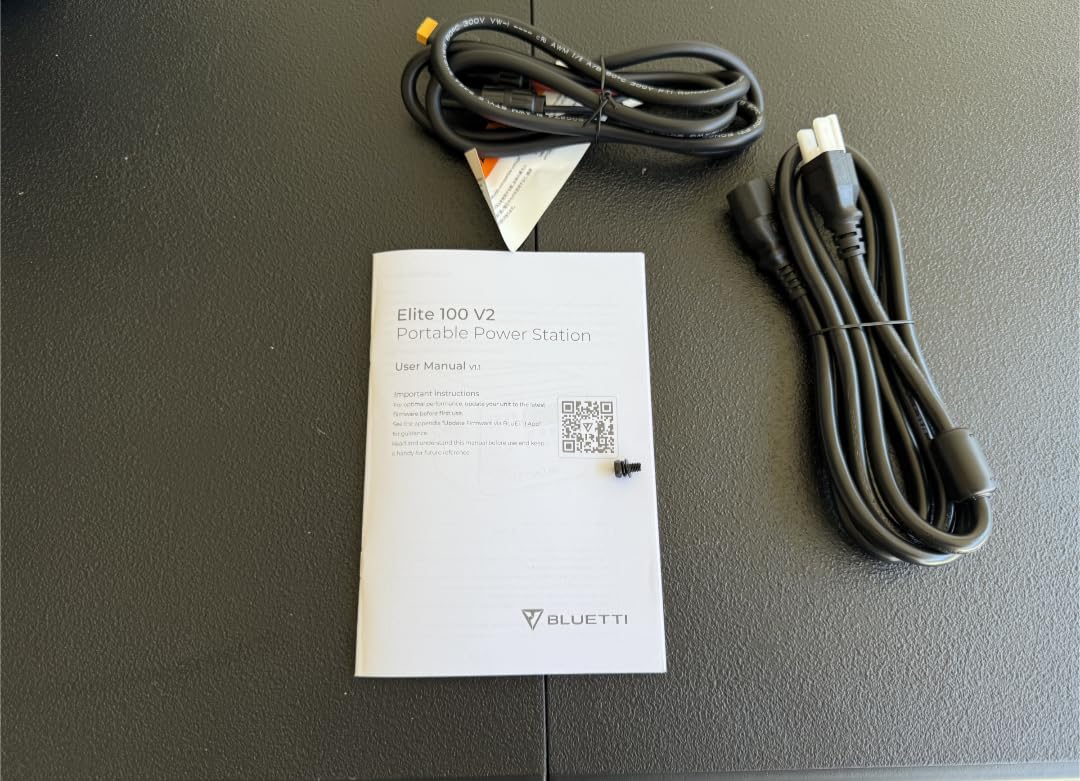
6. BLUETTI Elite 100 V2 – Smallest Footprint With 1,800W Output
BLUETTI Elite 100 V2 Portable Power Station for Camping 1024Wh 1800W
1024Wh LiFePO4
1800W with 3600W surge
25 lb and 17L chassis
10 ms UPS
Pros
- About 35 percent smaller than comparable 1kWh units
- 0-80 percent recharge in 45 minutes from a wall outlet
- 1800W rated with 3600W surge headroom
- 10 ms UPS and 30 dB silent mode
- Standard solar connectors rather than a proprietary plug
Cons
- 25 lb still feels heavy for short carries
- 12V car socket runs warm above about 12W
- Vehicle charging is slow without the optional charger
The Elite 100 V2 exists to solve one problem: getting 1,000Wh of battery into a space you do not have. At roughly 35 percent smaller than comparable 1 kWh models and 25 lb, it slips into tight bays and under seats where the taller Jackery and EcoFlow bodies will not. The hidden grab handle is a small design decision that makes a real difference when you are lifting it into a high floor.
Output is where it punches above its size. 1,800W rated with 2,700W of Power Lifting and 3,600W of surge gives it exactly the headroom a compressor-starting appliance needs. Reviewers report it running a 1,200W space heater for about an hour on a full charge.
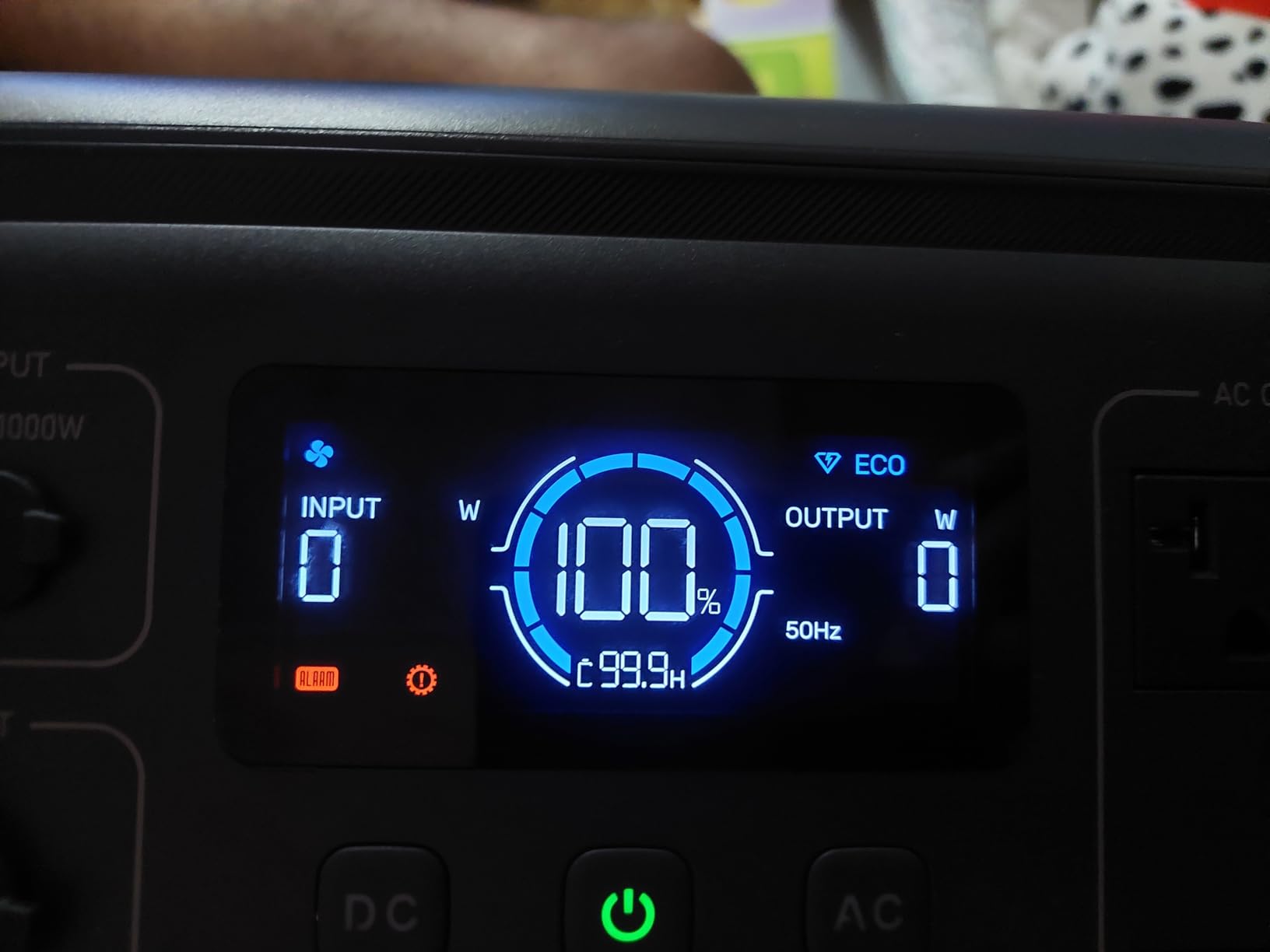
Charging is class-leading. Zero to 80 percent takes about 45 minutes at 1,200W of TurboBoost AC input, and the app works over both Wi-Fi and Bluetooth, which means you can still monitor the station with no internet connection at all. That is a real advantage at a remote boondocking site where cellular service is a coin flip.
Unlike the Jackery units, it uses standard solar connectors rather than a proprietary plug, so panels from other brands work. That open standard is the most important practical difference between this station and the two Jackery models in the same capacity class.
Small Drawbacks Worth Knowing
Owners report the 12V car socket running warm when drawing more than about 12W, and note that the vehicle charging path is slow unless you buy the optional Charger 1 accessory. If you plan to refill from a 12V socket while driving, factor that accessory into your budget from the start.
Another recurring note: the bare DC barrel ports have no rubber stoppers, so they can be accidentally shorted against a metal tool in a crowded battery bay. Small thing, easy to solve with a strip of tape or a dedicated cable pouch.
Who It Suits
Choose the Elite 100 V2 when your trailer has a small battery bay, when you move the station frequently, or when you already own third-party solar panels you want to use. It is also a strong choice for anyone sensitive to noise, since the 30 dB silent mode keeps it under the threshold of a quiet campsite at night.
Skip it if you plan to expand capacity over time or if you need more than about 1,024Wh of storage.
7. Jackery Explorer 300 – Budget Pick for Overnight CPAP and Phone Power
Jackery Explorer 300 Portable Power Station,292Wh
292Wh LiFePO4
300W with 600W surge
7.1 lb
100W USB-C PD
Pros
- Lightest unit in the roundup at 7.1 lb
- 292Wh LFP rated for 4000 plus cycles
- 100W USB-C PD charges laptops directly
- Pure sine wave AC for sensitive electronics
- Most proven unit with over 11000 reviews
Cons
- 292Wh and 300W cover electronics only not a fridge plus cooking
- Solar charging requires Jackery-branded panels
- Two-year warranty is the shortest here
Not every RV trip needs two kilowatt-hours. For a solo traveler, a couple of phones, a CPAP machine and a string of LED lights, the 292Wh Explorer 300 is a genuinely complete solution at 7.1 lb and a body small enough to live in a footwell. It carries one-handed at 7.1 lb, and at 9.1 by 5.2 by 7.8 inches it disappears when you do not need it.
It is the most proven unit here by a wide margin, with more than 11,000 reviews behind it. That volume of long-term owner feedback is worth something on its own, particularly for a category where the worst outcome is a dead battery in the woods. The chemistry is LiFePO4 rated for over 4,000 cycles before dropping to 70 percent capacity.
The 100W USB-C PD port is the reason this unit is more useful than its watt-hour count suggests. It charges most laptops directly, and the two AC outlets produce pure sine wave output, which is what sensitive medical and audio equipment needs. A 120W car port covers a 12V fridge or a small fan.
Where the 292Wh Ceiling Bites
Run the math honestly. A 12V fridge cycling on and off averages 40 to 60W, so a 292Wh pack with conversion losses gives you roughly five hours of fridge, not a night. Add a CPAP drawing 30 to 60W and a fan at 20W, and the budget disappears faster. This unit is an electronics station, not a household power source.
Solar charging is again restricted to Jackery panels, topping up to 80 percent in about 2.8 hours with a 100W panel or 7.5 hours with a 40W foldable. The two-year manufacturer warranty is the shortest in this roundup, which is another reason this belongs as a weekend companion rather than a rig-wide investment.
Best Fit for Solo and Overnight Use
Buy the Explorer 300 as a secondary station. Keep it in the cab for CPAP, phones, cameras and a laptop, and let a larger station in the trailer handle the fridge. That two-tier approach leaves you with electronics power and refrigeration power at the same time.
It is the right pick for anyone who rents RVs, borrows rigs occasionally, or simply does not want a 40 lb object on the tongue weight. For more, see our RV cover picks for the other half of weather protection while you are planning the trip.
8. EF ECOFLOW Delta 3 Classic – Most Reliable App and Smart Monitoring
EF ECOFLOW Portable Power Station Delta 3 Classic, 1024Wh 1800W AC
1024Wh LiFePO4
1800W with 3600W surge
26.7 lb
0-80 percent in 45 minutes
Pros
- Most reliable Bluetooth and app connection in the roundup
- 0-80 percent recharge in 45 minutes
- Under 10 ms UPS for inline backup use
- Standard non-proprietary solar connectors
- Two top handles and a non-skid base
Cons
- 26.7 lb is heavy to lift into a vehicle unaided
- 12V vehicle charging is slow at about 100W
- No Smart Extra Battery expansion compatibility
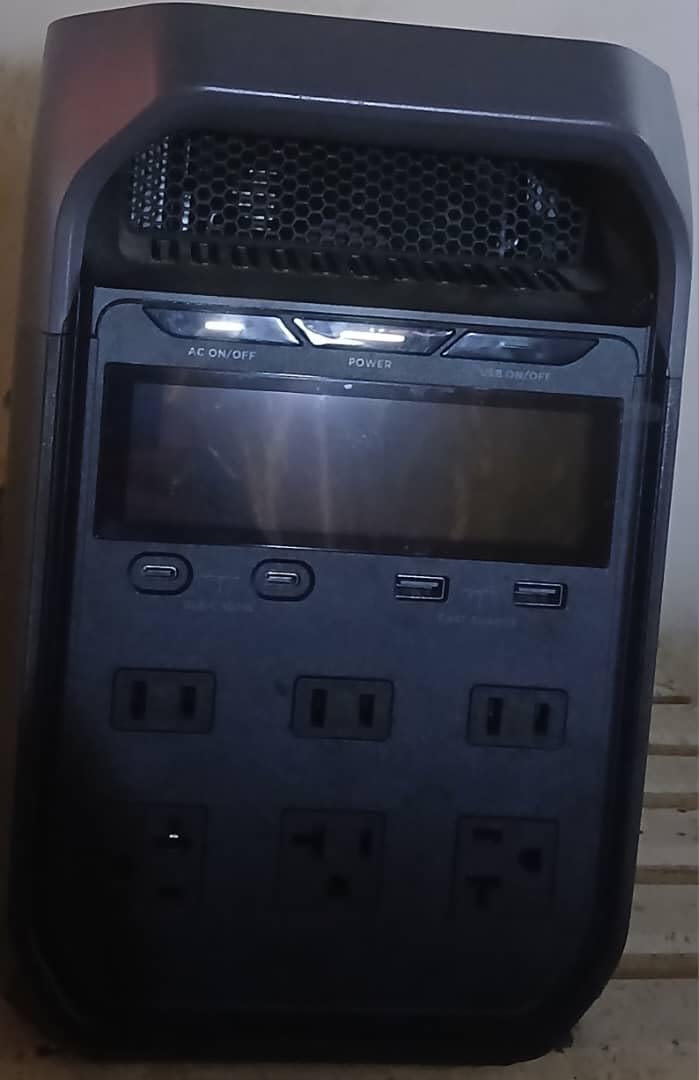
The Delta 3 Classic is the one to buy if the software matters to you, and that is a more common priority than buyers admit. Owners report flawless app connectivity across three weeks of summer travel, and the Storm Alert feature pushes a warning before bad weather reaches your site so you can decide whether to drive out or ride it out. Monitoring a station from your phone is what makes a multi-day boondocking trip feel manageable.
On paper it is a strong 1,000Wh-class machine: 1,024Wh of LiFePO4 in an EV-grade cell-to-chassis design with a smart battery management system, 1,800W continuous, 3,600W surge and 2,600W with X-Boost. It reaches 80 percent charge in 45 minutes on X-Stream AC input and refills from a 500W solar panel in about 2.5 hours.
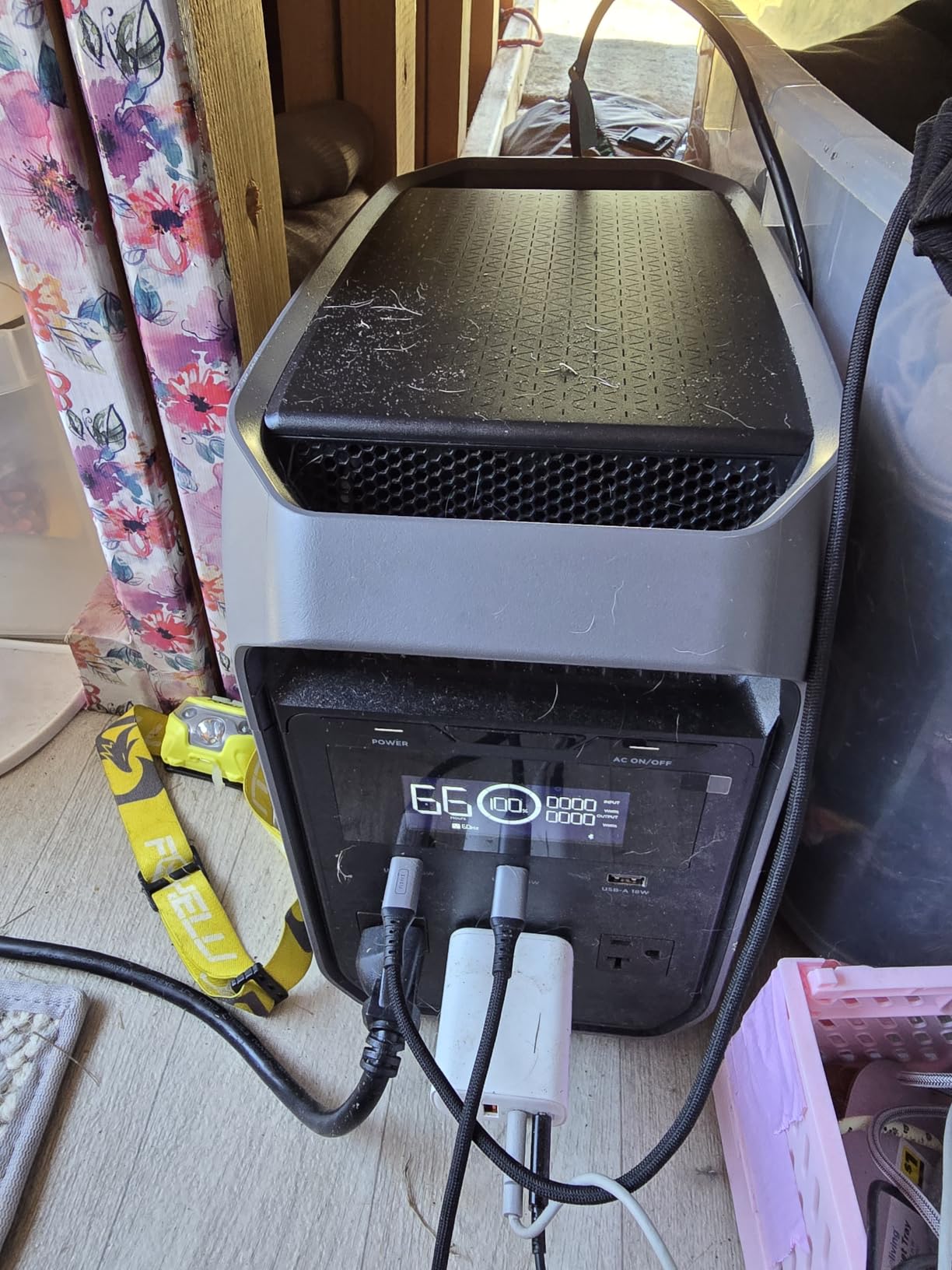
Two design details matter for RV fit. The two top handles and non-skid base pads make it far easier to load into a van or high trailer floor, and the port orientation keeps plugs from fouling each other when the back of the unit is against a wall. Small engineering choices, but they are the ones you touch every time you move the station.
It also uses standard, non-proprietary solar connectors, so third-party panels work without an adapter. Combined with the under 10 ms UPS switchover, you can sit the unit inline between a wall outlet and a fridge or router, and an outage passes through too quickly to notice.
The Expansion Limitation
The Delta 3 Classic is not compatible with DELTA 2 or Delta 3 Series Smart Extra Batteries. Capacity is fixed at 1,024Wh, and if your load list grows you replace the unit. Buyers who plan ahead should treat this as a settled single-tier purchase rather than a starting point.
Vehicle charging is also slow at roughly 100W from a 12V socket, which is fine for a top-up over a long drive and not a substitute for a proper DC-DC alternator charger. At 26.7 lb it is heavy to lift into a vehicle unaided, and it is the second-heaviest 1,000Wh model in this roundup.
Best Fit for Tech-Heavy Travelers
Pick the Delta 3 Classic for van-life setups, remote workers, and anyone who wants real-time control, scheduling, and weather alerts from a phone. With 1,294 reviews and 90 percent of them at five stars, the reliability signal here is strong.
A small number of 1-star reviews report units arriving dead or already used, so inspect the box on arrival and confirm the unit powers on before you leave the driveway.
How to Size a Portable Power Station for Your RV Trips
Sizing is where most buyers get it wrong, and the mistake is almost always the same: choosing by output watts when they should be choosing by watt-hours, or the reverse. Work through these five questions in order and the right capacity tier becomes obvious.
Which Capacity Tier Do You Need?
Start with trip length and load list, not with marketing. A 292Wh unit covers electronics for a night or two. A 1,000 to 1,200Wh unit covers a 12V fridge, water pump, lights, phones, a laptop and a CPAP for a weekend, and it is the tier we recommend for most RVers. A 2,000Wh unit buys you a full week away from a hookup or a family load list plus cooking. Above 2,500Wh, you are usually better served by a hardwired LiFePO4 battery bank in the trailer.
Rule of thumb from the RV community: a 1,000Wh unit is widely called the sweet spot between portability and capacity. Boondockers in the forums consistently report that what actually matters is the 12V fridge, the 12V water pump, and a 12V furnace at night, which is a much smaller load than any marketing page implies.
How Many Watts Do You Need?
Add up the running watts of everything you plan to use at once, then add headroom for surge. A 12V fridge cycles between roughly 40 and 60W. LED interior lighting is negligible. A water pump runs 3 to 8A at 12V. A CPAP typically draws 30 to 60W. A coffee maker is 600 to 1,200W, and a microwave runs 700 to 1,500W. Roof air conditioners and electric water heaters sit in the 1,500W-plus range with much higher startup spikes, which is why they are off the table for portable units.
Any station at 1,500W of continuous output handles the realistic dry-camping list with room to spare. The variable worth checking is surge, and that is where the surge figures in our spec lines matter: a unit with 3,600W of surge tolerates a compressor kick that would trip a 1,800W-surge rival.
Usable Watt-Hours Are Lower Than the Label
Plan on losing 10 to 20 percent to inverter conversion, heat, and the unit’s own background draw. A 1,024Wh station is realistically a 900Wh station for planning purposes. Add a further 20 to 30 percent buffer so a partly cloudy day or an unexpected extra appliance does not leave you short at midnight.
This is the single most repeated complaint among real owners: the nameplate number is not the runtime number. Stations with high idle draw, such as the AC180 at roughly 15 to 20W, lose more overnight than lean units do, which matters on multi-day trips where the fridge never stops cycling.
Chemistry, Cold Weather and Cycle Life
Buy LiFePO4 and do not compromise. Every unit in this roundup uses it, and the difference against older NMC chemistry is cycle life: 3,000 to 5,000 cycles before meaningful degradation, measured in years rather than seasons. Jackery and Anker both rate their packs at 4,000-plus cycles.
Cold weather is the catch. Lithium capacity drops in freezing temperatures, and some units refuse to charge below a threshold. If you camp in winter or shoulder season, warm the station to room temperature before charging it and expect reduced output on a cold morning, particularly on the first hour after sunrise.
Solar Input Caps and Charging While Driving
Check the solar input ceiling before you buy panels, because it is the most common disappointment among new owners. In this roundup the ceilings run from 500W on the BLUETTI AC180 to 600W on the Anker SOLIX C1000 Gen 2. A roof array larger than the station can accept will simply waste the extra panels, and the DC-DC charger needed to connect roof solar to a 12V bank is a different product entirely.
Charging from the tow vehicle while driving is the most common question in RV forums and the least covered by buying guides. A dedicated DC-DC alternator charger, not a 12V socket, is what makes it worthwhile; socket charging on most of these units is in the region of 100W and is a slow trickle. One van-life setup described in the forums pairs a portable station with 600W of solar, 800W of alternator charging and a 30A DC fuse panel, and that three-source approach is the most resilient setup we can recommend.
One warning buyers rarely hear: panels mounted on a dashboard or behind a windshield produce roughly half the output of the same panel in open sun, because the glass filters the light. Reserve windshield panels for emergencies and put your real solar on the roof or in open sun at the site.
Jackery vs EcoFlow vs BLUETTI vs Anker
Brand reputation is the wrong comparison; here is what actually differs. Jackery builds the most recognizable line and the largest review base, and it locks solar charging to its own panels on every model in this roundup. EcoFlow generally delivers the strongest app and monitoring experience, with X-Boost output lifting, but two of its models here have no battery expansion. BLUETTI is the most flexible on third-party solar compatibility and offers long warranties, at the cost of more weight in the AC180. Anker SOLIX leads on recharge speed, with the fastest wall recharge we measured, but the second-generation C1000 dropped expandability entirely.
Consider the purchase channel too. iRV2 owners report buying Anker SOLIX bundles through warehouse clubs, pairing a station with an expansion battery and a 400W panel in one purchase, which is often an efficient route to a complete system. Mainstream outlets like Home Depot, Best Buy and REI carry the same units if you prefer to handle returns in person.
Safety Inside an Enclosed RV
A lithium battery in a non-flammable-rated fiberglass trailer deserves respect, and no competitor covers this. Never charge a large station unattended overnight inside a closed RV, and keep stations off the bed and away from propane appliances, fuel cans, and the water heater. Use a battery box, keep the unit ventilated, and follow the manufacturer’s charging guidance exactly. Store it around half charge when it sits unused for weeks, and do not leave it in a vehicle in direct summer sun for days. If your trailer is wood-framed or has an interior built from combustible materials, a station in a garage or outside under cover is the safer home.
Frequently Asked Questions
Can a portable power station run an RV?
A portable power station can run an RV’s modest 12V loads — fridge, water pump, LED lights, USB-C charging and a CPAP — for a weekend or longer, and it can back up the trailer’s electronics through a UPS transfer. It cannot run a 15,000 BTU rooftop air conditioner, a microwave sustained, or an electric water heater, because those exceed the continuous and surge output of any portable inverter.
How many watts do I need in a portable power station?
For dry camping with a 12V fridge, water pump, lights, laptops and a CPAP, 1,500W of continuous output is comfortable and 2,000W gives you room for a coffee maker or small heater. Add surge headroom for compressor-start appliances, and plan on 20 to 30 percent more watt-hours than your daily load once inverter losses are counted.
How big of a power station do I need for camping?
Around 1,000 to 1,200Wh covers a weekend trip for two or a small family. About 2,000Wh covers a full week off-grid with a fridge running around the clock. A 292Wh unit is enough only for electronics, phones and a CPAP. If your load list includes a rooftop air conditioner or water heater, you need a hardwired battery bank instead of any portable station.
Which portable power station is best for a motorhome?
Motorhomes carry the largest load lists, so 2,000Wh or more is the practical floor. Among the units we tested, the EF ECOFLOW DELTA 3 Max at 2,048Wh and 2,400W of rated output gives the most headroom, while the Jackery Explorer 2000 v2 offers similar storage in a smaller footprint for tighter bays.
Is Jackery or EcoFlow better for an RV?
Jackery wins on brand familiarity, the largest review base and the lightest 1,000Wh body in this roundup, but it locks solar charging to Jackery panels. EcoFlow generally wins on app quality, weather alerts and X-Boost output lifting, and it uses standard solar connectors. Choose Jackery for the lightest carry and proven support; choose EcoFlow for software and heavier loads.
Which Portable Power Station Fits Your Next RV Trip?
Our overall pick is the Jackery Explorer 1000 v2, and it takes the Editor’s Choice here for one reason: at 1,070Wh, 1,500W of output and 23.8 lb it is the only unit in this roundup where none of the three usual compromises dominates. The others win a single category and pay for it somewhere else.
That said, the right station for your rig depends on how you travel. If you are moving a lot of gear solo and want the least weight, take the Jackery Explorer 1000 v2 anyway. If your load list is long and full of USB-C devices, take the BLUETTI AC180 for its eleven outlets and five-year warranty. If you drive every morning and need a full battery by checkout time, take the Anker SOLIX C1000 Gen 2. If you want two kWh and the most headroom in the group, take the EF ECOFLOW DELTA 3 Max, or the Jackery Explorer 2000 v2 when bay space is tight. If bay dimensions are brutal, take the BLUETTI Elite 100 V2. If you only need electronics and a CPAP, take the Jackery Explorer 300. If you want the best app and weather alerts, take the EF ECOFLOW Delta 3 Classic.
Whichever you pick, run a 24-hour audit of your own rig before checkout, buy the station 20 to 30 percent above your calculated load, and pair it with a proper DC-DC alternator charger if you want to refill while driving. Those two habits do more for the best portable power stations for RV trips than any brand loyalty ever will. Check the current details and buyer feedback for your pick using the links above.
Leave a Reply