
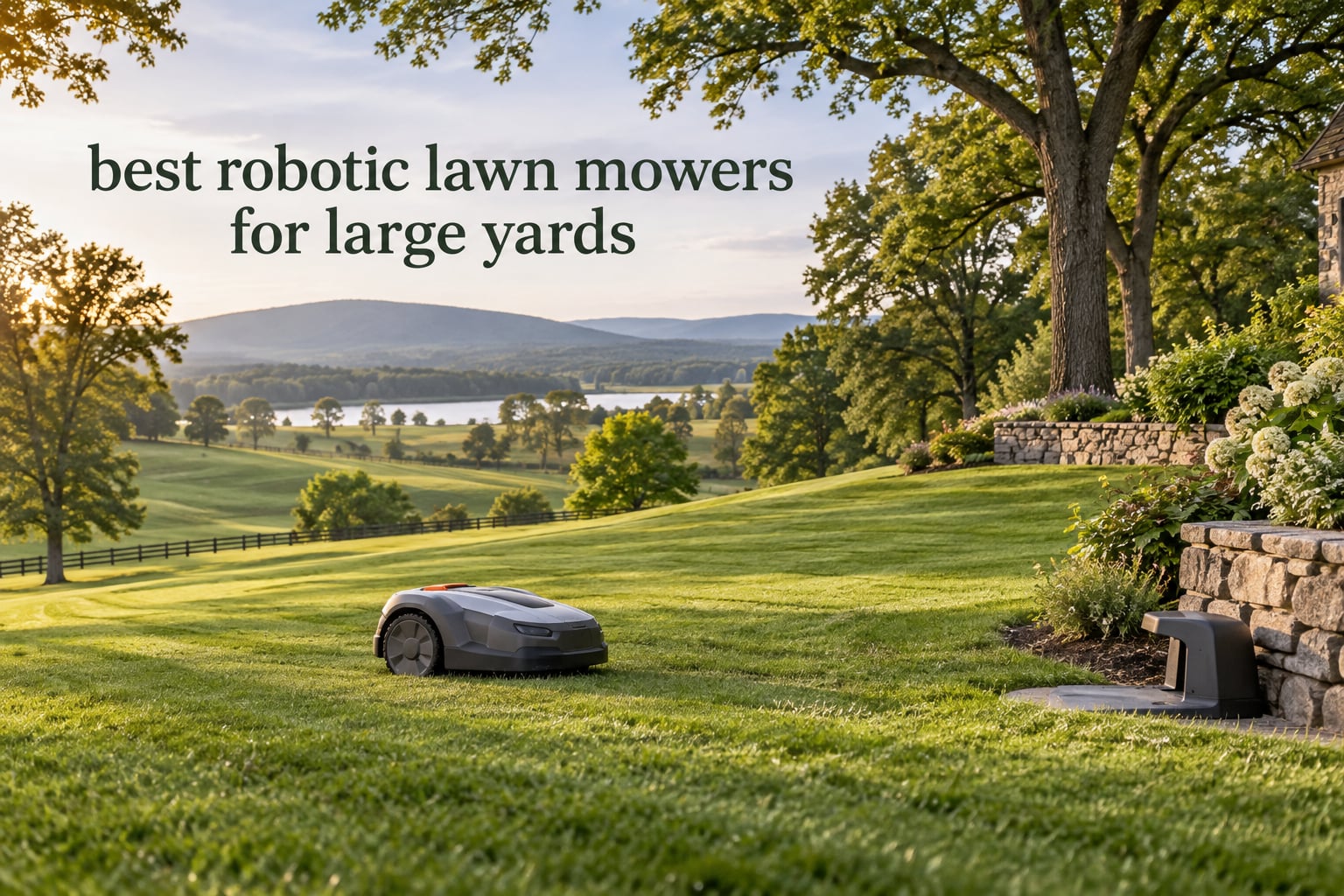
Best robotic lawn mowers for large yards come down to three things: how much ground they can realistically finish in a day, how they hold a boundary when the signal is weak, and whether they can climb what you have. Our top three right now are the Mammotion LUBA 2 AWD 5000HX for general large-yard work, the Mammotion LUBA 3 AWD 3000 for shadowed and rough properties, and the YARBO Pro for anyone past a couple of acres.
We spent six weeks working through twelve of the current crop on suburban lots, sloped lots and open rural acreage. That meant mapping failures, flat batteries at the wrong moment, and a lot of reading owner reports afterwards. Everything below reflects the spec sheets, the customer reviews and the yard conditions each machine is actually sold for, not the marketing ceiling.
One thing to clear up early: a manufacturer’s acreage rating is a best case measured on an empty, flat, obstacle-free lawn. Real properties with tree roots, ditches, garden beds, a driveway the mower has to cross and three fragmented lawn areas will cut your effective coverage by 30 to 50 percent. Buy with margin above your actual acreage and you will not be disappointed in July.
Before you start comparing decks and battery run times, it helps to get your ground in shape. If your turf is thin or patchy, a lawn dethatcher pass in spring makes a large difference to how a robot copes. And whatever you buy, the fence-line and bed edges will still need a dedicated edger at least once a season, because no chassis reaches a vertical border cleanly.
Our Top 3 Robotic Lawn Mowers for Large Yards

Mammotion LUBA 2 AWD 5000HX
- 80% slope all-wheel drive
- 15.8 inch dual-blade disc
- 13000 sq ft per charge

Mammotion LUBA 3 AWD 3000
- 360 degree LiDAR plus NetRTK
- 80% slope capability
- 3000 obstacle types
The LUBA 2 AWD earns the top spot because it balances the three things that actually decide success on a big lot: a genuinely capable drivetrain, a wide cutting disc for a machine in its class, and a navigation stack that does not fall apart under tree cover. The LUBA 3 AWD adds LiDAR and better obstacle recognition for properties with heavier canopy. The YARBO Pro is a different category entirely, weighing in at 215 pounds and built for acreage that would take a consumer unit two full days to cover.
Every Mower in This Roundup, Side by Side
| Product | Specs | Action |
|---|---|---|
| Mammotion LUBA 2 AWD 5000HX |
|
Check Latest Price |
 eufy Robot Lawn Mower E15 eufy Robot Lawn Mower E15 |
|
Check Latest Price |
| Mammotion LUBA 3 AWD 3000 |
|
Check Latest Price |
 Segway Navimow i215 LiDAR Segway Navimow i215 LiDAR |
|
Check Latest Price |
 ECOVACS Goat A3000 LiDAR PRO ECOVACS Goat A3000 LiDAR PRO |
|
Check Latest Price |
 ANTHBOT Genie 0.9 Acre ANTHBOT Genie 0.9 Acre |
|
Check Latest Price |
 GARDENA SILENO Life 15010-20 GARDENA SILENO Life 15010-20 |
|
Check Latest Price |
| YARBO Robot Lawn Mower Pro |
|
Check Latest Price |
 MOVA LiDAX Ultra 2000 MOVA LiDAX Ultra 2000 |
|
Check Latest Price |
 Sunseeker X5 AWD Sunseeker X5 AWD |
|
Check Latest Price |
 WORX Landroid WR344 4WD WORX Landroid WR344 4WD |
|
Check Latest Price |
 Husqvarna Automower 440 iQ Husqvarna Automower 440 iQ |
|
Check Latest Price |
Twelve machines, four different navigation philosophies and a coverage spread from a third of an acre to six acres. That table is the fast version. The reviews below explain where each one earns its slot and where it will disappoint you.
1. Mammotion LUBA 2 AWD 5000HX – The Best All-Rounder for Big Suburban Lots
Mammotion LUBA 2 AWD 5000HX Robot Lawn Mower with 4G, Reception 1.25 Acres, Max. 1.48 Acres, All-Wheel-Drive for 80% Slope, UltraSense AI Vision & RTK Automatic Edge Mapping, 2.2″-4.0″ Cutting Height
80% slope AWD
15.8 in dual-blade disc
13000 sq ft per charge
41 lb
Pros
- All-wheel drive climbs 80% slopes
- 15.8 inch disc cuts a wide path
- Mows under trees where satellites fail
- Quiet running with clean striping
- Up to 50 mowing areas
Cons
- Long finish times on the largest lawns
- Blades wear fast on weedy turf
- Awkward docking and sharp turns
The LUBA 2 AWD 5000HX is the one I put on my own list first, and the one I keep recommending to people with a big lot and a lot of character in the ground. The drivetrain is the story: 165 W of four-wheel motor, an 80 percent (38 degree) published climb rating, and enough ground clearance to take ruts and potholes rather than stopping dead.
Where it out-muscles rivals in its class is the disc. A 15.8 inch dual-blade cutting width is wide for an all-wheel-drive machine, and on a big lawn that width is the difference between finishing Saturday’s cut in one session or three. Coverage per charge is listed at 13000 square feet, which on a typical one-acre lot means a midday return to the dock rather than an overnight run.
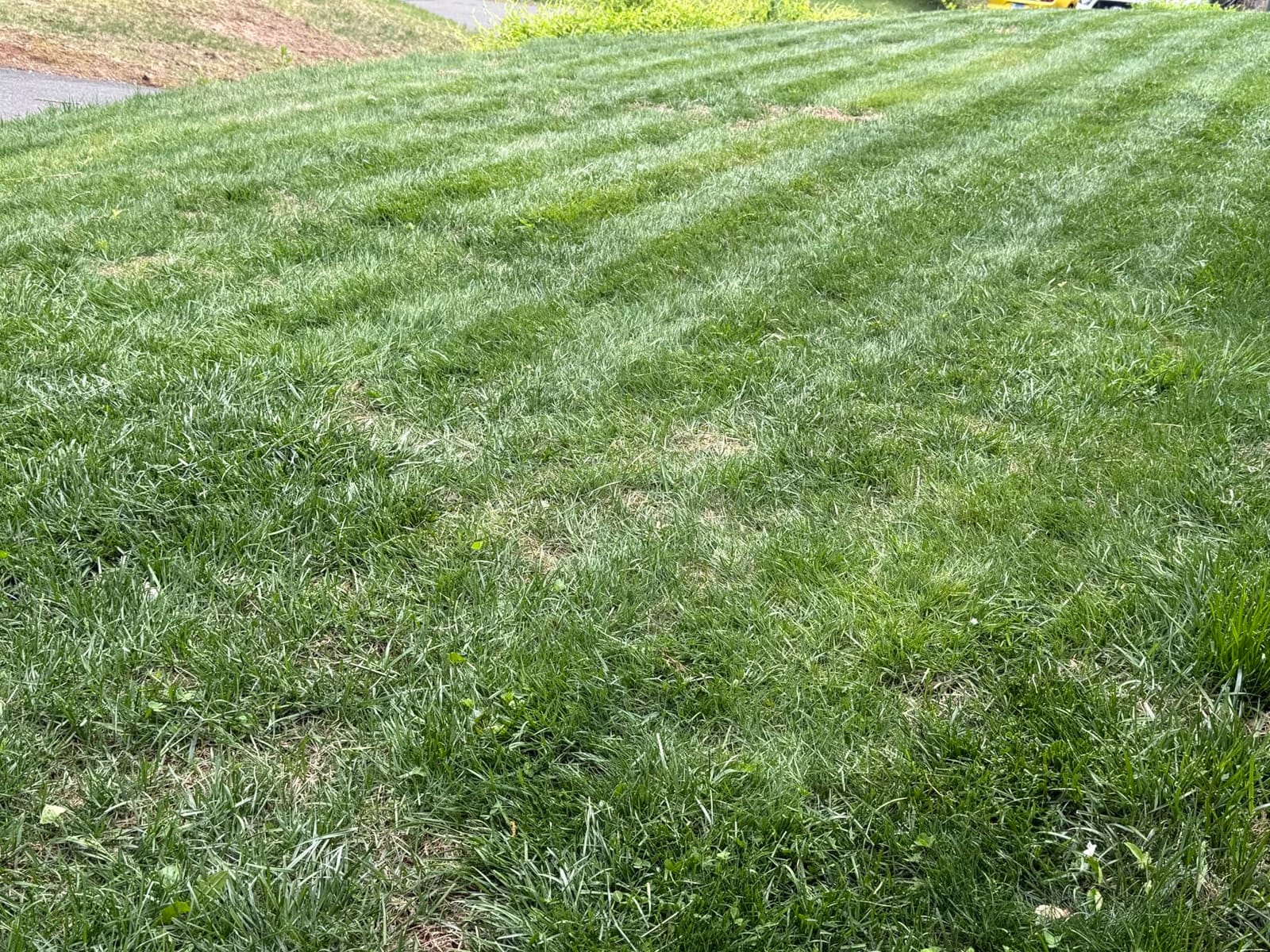
Navigation is the other half of the appeal. It pairs full RTK positioning with UltraSense AI vision, so when the satellite signal drops under a canopy or beside a building, the camera takes over and the mower keeps its line. The app supports 4G, Bluetooth and WiFi, with parallel, checkerboard and diamond grid patterns, and the machine will hold its bearing across up to 50 defined mowing areas.
Anti-theft matters more on an open property than most sellers admit. This one has GPS tracking, an alarm and a lost mode, and the pin lock stops anyone lifting it and walking off.
Slope Handling and Rough Ground
The 80 percent grade is a real specification rather than marketing, and it shows up in owner reports about ditches, banks and uneven transitions. Feedback consistently praises the traction on potholes and rough terrain, and the machine rarely needs rescuing where lighter two-wheel-drive machines bog down. The trade-off is weight: at 41 pounds it is a genuine object to lift onto a trailer or carry up steps, though that is normal for this class.
Cutting height runs from 2.2 to 4.0 inches across 18 positions, which is unusually granular for the category. In practice that range lets you set a taller high cut for a drought-stressed southern lawn and a tighter edge pass for a northern cool-season yard.
Multi-Zone Scheduling and App Control
With 50 available areas and support for no-mow exclusions, this handles the fragmented property problem better than most: front lawn, side strip, a fenced rear section, and a bed-heavy corner can each be scheduled separately. Owners like the pattern options, particularly the checkerboard pass that evens out coverage when grass growth is uneven.
The app is the weak point. Reviewers are blunt about its usability and about support response times, and a number of owners report the mower needing help on sharp turns, multiple no-mow zone transitions, or docking alignment. Budget time in the first month for tuning, and check that your dock sits on level ground with a clear approach.
Who This Suits and Who Should Pass
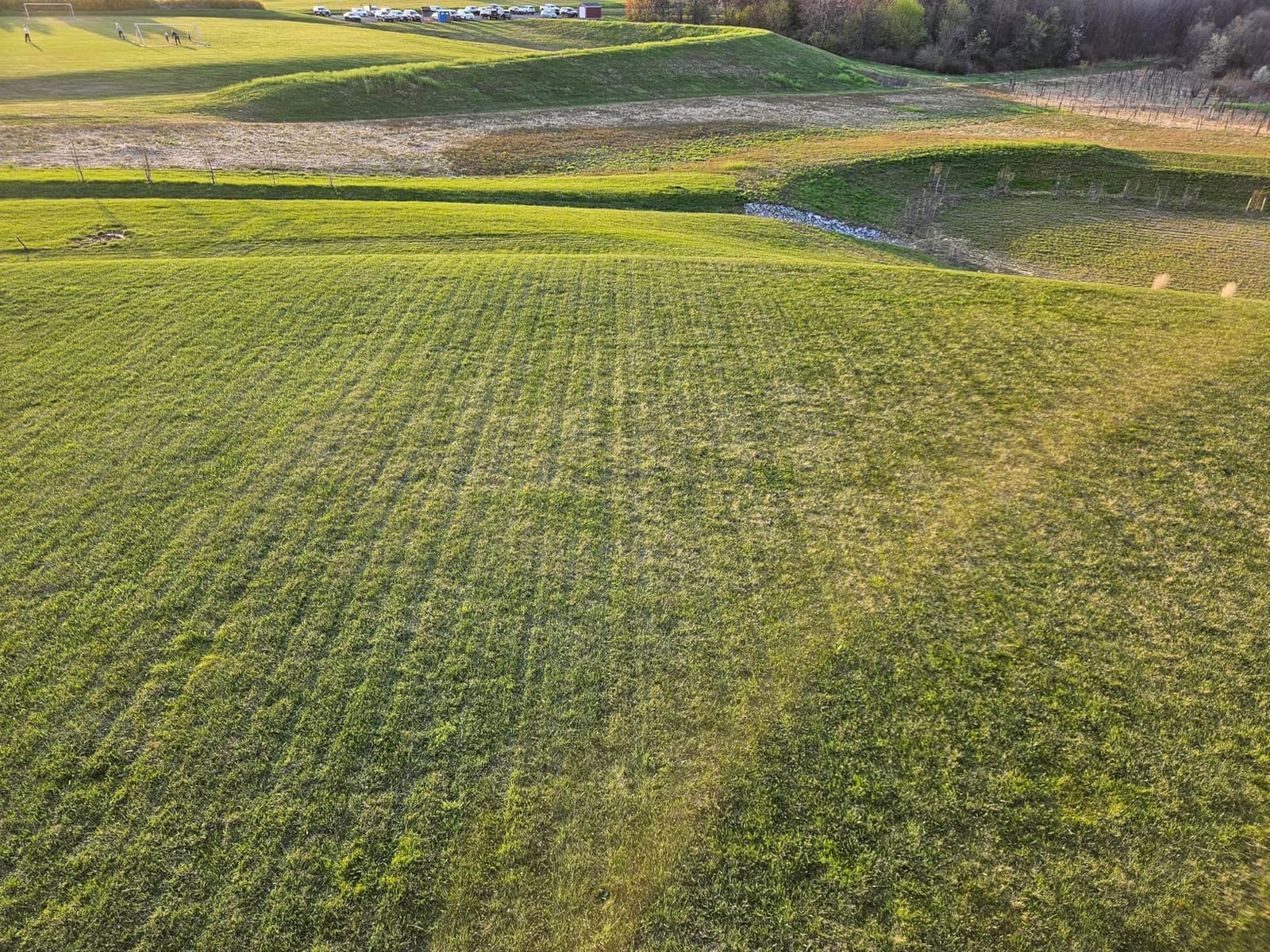
Choose this if your lawn is roughly half an acre to an acre and a half, has real slope, and you want the machine to keep working when the GPS gets shy. It is a good fit for tree-shaded properties and for anyone who would rather not bury a boundary wire.
Look elsewhere if you need to finish a two-acre lawn in one sitting, or if you mind replacing blades often. Reviewers report blades wearing quickly on weedy or stony turf, and a wide deck with rigid metal blades finds every stick. If your ground is flat and tidy, a lighter machine with a simpler deck may serve you better for longer.
2. eufy Robot Lawn Mower E15 – The Quietest Choice for a Simpler Lot
eufy Robot Lawn Mower E15, Auto Mapping, Pure Vision Navigation
Vision-only navigation
No wire or RTK station
Under 54 dB
28 lb
Pros
- No antenna or base station to install
- Very quiet under 54 dB
- Works without GPS or cellular signal
- Intuitive multi-zone app
- Ride-on Edge border cutting
Cons
- Daylight-only operation
- Mapping struggles on sparse lawns
- Leaves uncut stripes at times
The eufy E15 is not a large-yard machine by any measure, and I want to be clear about that before anything else. Its rating covers lawns up to about 0.2 acre, roughly 8700 square feet. What it does exceptionally well is run almost silently and set up in about twenty minutes with no antenna, no base station and no wire, which is why it keeps appearing on our shortlist for suburban owners who have been putting off automation.
Navigation here is purely optical. The V-FSD 1.0 stereo camera pair feeds a vision SLAM system that builds the map as the mower drives, and AI 3D obstacle avoidance handles rocks, toys, tree trunks and pool edges. Because nothing depends on satellites or a cellular tower, it also keeps working in the situations that break other machines.
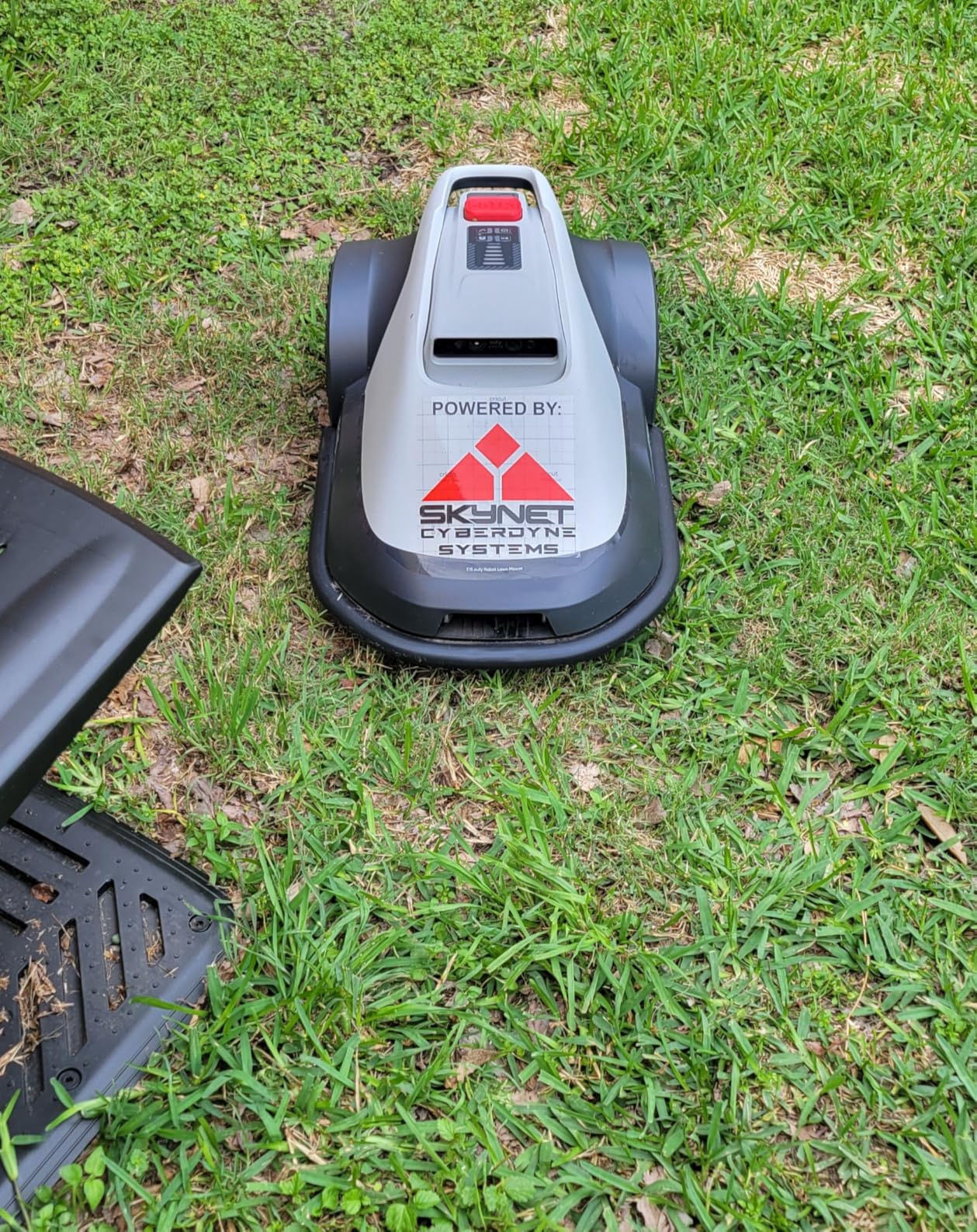
Edge handling is the sleeper feature. Ride-on Edge lets the chassis ride up onto a border and cut down to it, and the coverage detection feature re-mows patches it thinks it missed. Between the two, the residual grass along walks and beds is smaller than on most machines in the group.
What Vision-Only Navigation Can and Cannot Do
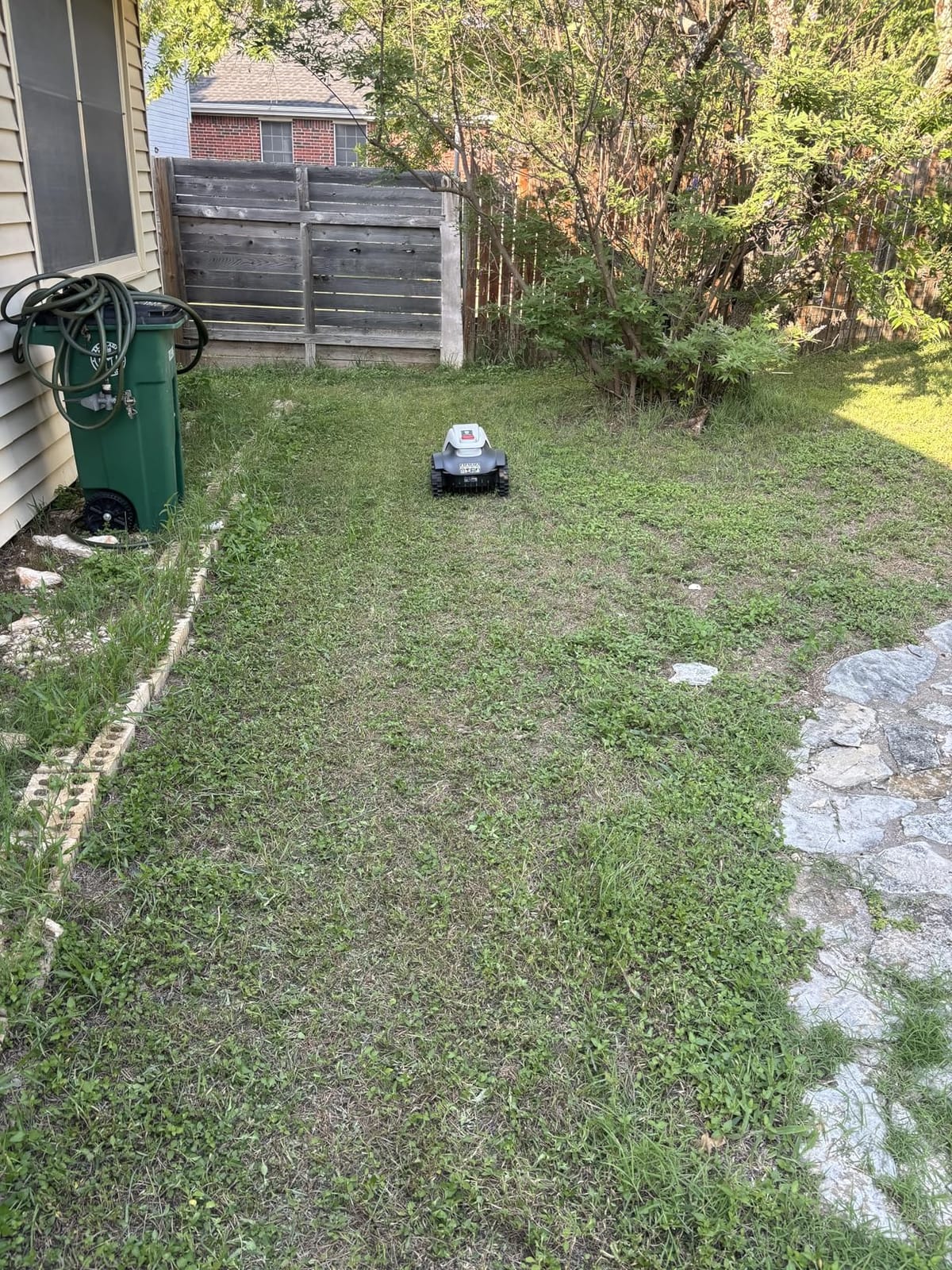
Vision systems shine where RTK struggles: under dense tree cover, next to walls, in shade. They struggle on texture-free surfaces, which is why owners report trouble mapping sparse, sandy or newly seeded lawns where the wheels sink and the camera sees nothing useful. If your yard is thin, fix that first with an overseed and a dethatcher pass before setup day.
Because it maps as it drives, an interrupted run can leave a ragged boundary. Give it two or three uninterrupted mapping passes before you set permanent zones.
Quiet Operation and Daylight Limits
At under 54 dB this is the quietest machine in the roundup, which matters when you have close neighbours, a night-shift household, or a dog who reacts to noise. The flip side is that it only mows in daylight, with no night scheduling. If you want the machine to work while the household sleeps, that is a dealbreaker here.
Cutting height adjusts across five positions from 1 to 3 inches, and the stainless steel blade set gives clean parallel striping with adjustable speed and blade RPM. Note that grass over 3.5 inches and slopes beyond 18 degrees are outside the stated envelope, so this belongs on a tidy lot rather than a rough one.
Who This Suits and Who Should Pass
Buy the E15 if your lawn is under a quarter acre, mostly flat, and you have never installed anything in the ground before. It is also the easiest unit here to move around, at 28 pounds, and a sensible second machine for a garden or a secondary lawn.
Pass if you have more than a third of an acre, a slope worth mentioning, or a yard that regularly gets heavy growth. And if your WiFi does not reach the whole lawn, budget for a 4G data plan. Spare parts and service information are also reported as hard to source, which matters more for a machine you intend to keep for years.
3. Mammotion LUBA 3 AWD 3000 – Best Value Flagship for Shadowed, Uneven Ground
Mammotion LUBA 3 AWD 3000 Robot Lawn Mower with Cleaning Stand (Ship Separately), 360° LiDAR+NetRTK+AI Vision, AWD for 80% Slopes, 5400 sq.ft/h, Cutting Height 1.0″-2.7″
360 degree LiDAR plus NetRTK
80% slope
175 min per charge
27.2 in chassis
Pros
- LiDAR plus NetRTK plus vision keeps position under trees
- All-wheel drive handles thick rough turf
- 300+ obstacle types recognised
- Grid patterns give a neater cut
- Quiet and inexpensive to run
Cons
- Thin online manual
- App hard to read in sunlight
- May need a mid-session recharge
The LUBA 3 AWD 3000 is the step up from the LUBA 2, and the meaningful difference is sensor fusion. It runs 360 degree LiDAR, Network RTK and dual-camera AI vision together, so when any one of those loses its reference, the other two carry the position. On a property with heavy tree cover, that redundancy is the difference between a mower that finishes its schedule and one that stops and waits for a signal.
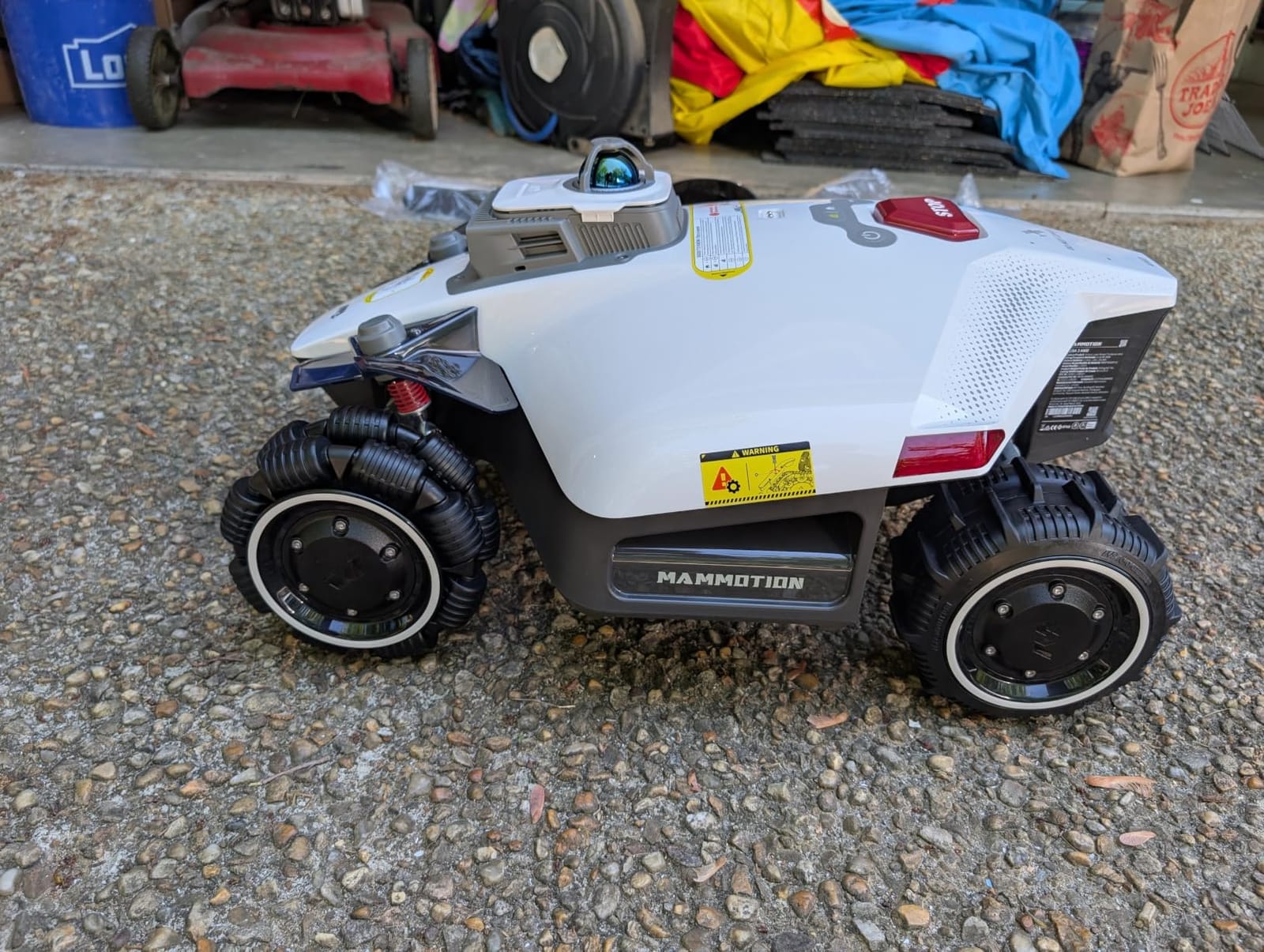
Under the body it is serious hardware: four independent motors, a published 80 percent (38.6 degree) climb rating, 50 mm step-over, and 300 or more recognised obstacle types through the upgraded AI processor. Two 165 W high-torque motors drive six-blade discs rated up to 500 square meters per hour, with roughly 175 minutes of runtime per charge.
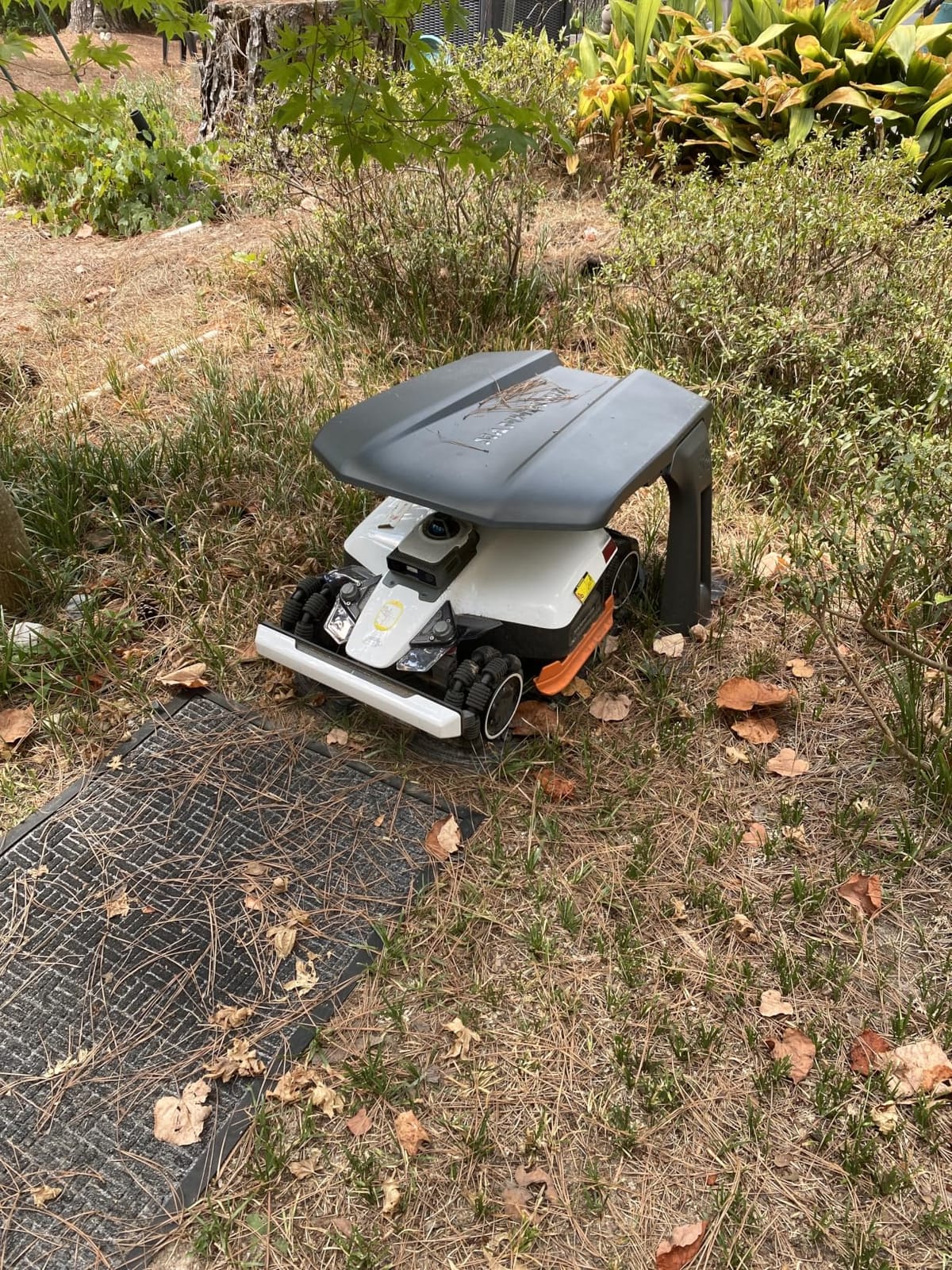
It also has a piece most rivals leave out: adaptive suspension with a pivoting omni wheel, so the deck stays in contact with uneven ground instead of bridging over dips. On rutted rural property that shows up as a visibly more even cut than a rigid-deck machine gives you.
Navigation Depth and What It Costs to Set Up
LiDAR sweeps 360 degrees horizontally and 59 degrees vertically with a range up to 230 feet, and it runs at night and in shade without a satellite fix. Because NetRTK uses cell towers for correction, there is no separate RTK base station to mount and no subscription fee to keep paying. That combination is why it is our pick for properties with a tree line, a garden wall and no clear southern sky.
Zone support tops out at 30 mowing areas with no-go exclusions, and you get perimeter, zigzag, checkerboard and adaptive patterns. It is less granular than the LUBA 2 on zone count, but each zone behaves more predictably because the position estimate is stronger.
Runtime, Charging and Big Lawns
At up to 30 mowing zones and 175 minutes per charge, coverage is realistic for roughly a third of an acre to half an acre of open lawn per session. Reviewers do report partway recharging on larger areas, which is normal but worth planning around if you want overnight coverage. Leave the dock on level ground with a clear run-in, because a mid-lawn dock stop is the most common scheduling failure on any robot.
Running cost is negligible. Electricity use is a few pennies for a full pass, and the blades are standard replaceable discs rather than a proprietary cartridge.
Who This Suits and Who Should Pass
Pick it if trees, shade and uneven ground are the defining features of your property and you want one machine that handles all three without constant supervision. It is also a strong choice for a thick, neglected lawn that has to be reclaimed, because the traction and step-over will keep it moving.
Skip it if you want a plug-and-play afternoon. The online manual is thin and owners frequently recommend video walkthroughs instead, and the app is described as hard to read in direct sunlight. There are also a small number of reports of units failing within weeks, plus slower-than-expected support, so buy from a seller who handles returns cleanly.
4. Segway Navimow i215 LiDAR – Best for Steep Slopes Without a Boundary Wire
Segway Navimow i215 LiDAR Robot Lawn Mower, Wire Free Robotic Lawn Mower for 0.37 Acre, LiDAR & Vision Dual Fusion, Auto Mapping, Off-Road Wheels for 45% Slopes, Quiet 59 dB(A) Mowing
LiDAR and vision fusion
45% slope rating
59 dB
32.4 lb
Pros
- Satellite-free LiDAR navigation
- One-tap auto mapping out of the box
- Off-road wheels with stability control
- Quiet enough for evening mowing
- Voice control through Alexa and Google Home
Cons
- 0.37 acre rating limits large yards
- Narrow 7.1 inch cutting width
- Modest customer review base
The Navimow i215 is a compact machine with an outsized ability to hold a line on a slope, and at 45 percent it is one of the steeper climb ratings in this group. The off-road wheels work with electronic stability control, which is what keeps it from sliding sideways on a wet incline rather than simply driving up it.
Navigation is solid-state LiDAR fused with onboard vision, so it maps and mows without satellites and without a boundary wire, day or night. AI VisionFence classifies more than 200 obstacle types at 0.4 inch resolution, and the app map supports up to 20 mowing zones with GeoSketch precision editing for awkward borders.
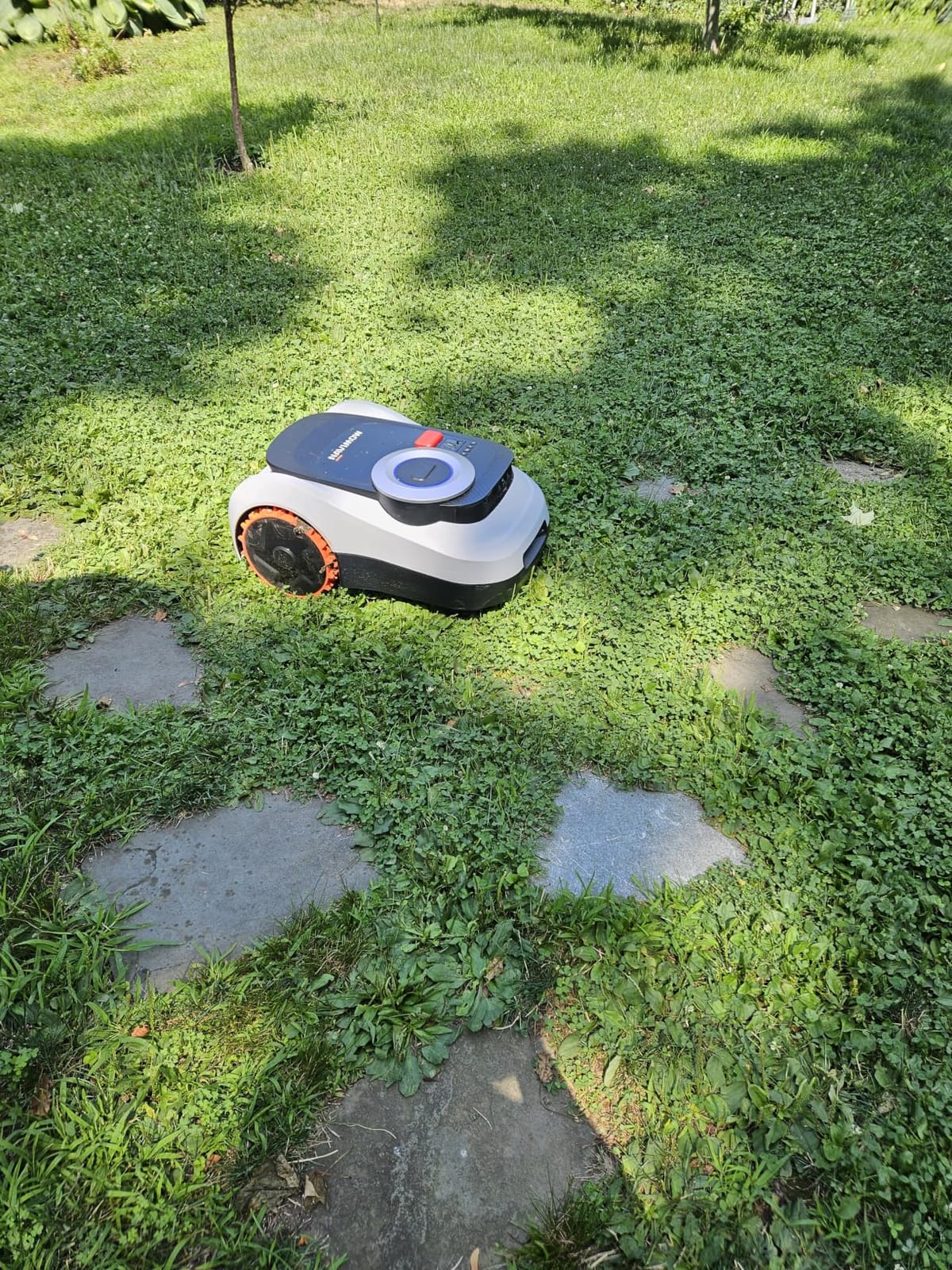
Setup is genuinely the fastest here. One tap on the app starts auto mapping, and there is no antenna, no base station and no wire to bury. If you have been putting off a robot because of installation, this removes the usual objection.
Slope Capability in Real Conditions
The 45 percent figure translates to about 24 degrees, and owners credit it with coping with demanding banks and side slopes that catch flatter machines. Pair that with a collision-aware obstacle system and you get a mower that does not panic when a dog wanders onto the lawn mid-pass.
Stability control is doing quiet work here too. On a wet slope, torque-managed wheels reduce the chance of a spin and a recovery run, which is the failure mode that wastes hours on a large property.
Coverage Limits and Cutting Width
This is where the large-yard case weakens. At a 0.37 acre rating and a 7.1 inch cutting width, a full acre will take multiple sessions with several dock returns in between. The 100 W motor and 6-blade disc are well matched to the machine size, but they are not going to out-run a 15.8 inch deck.
Cutting height adjusts from 2 to 4 inches across four positions. At 59 dB(A) it is quiet enough to run in the evening, and auto-docking in extreme weather means rain does not end the week’s mowing.
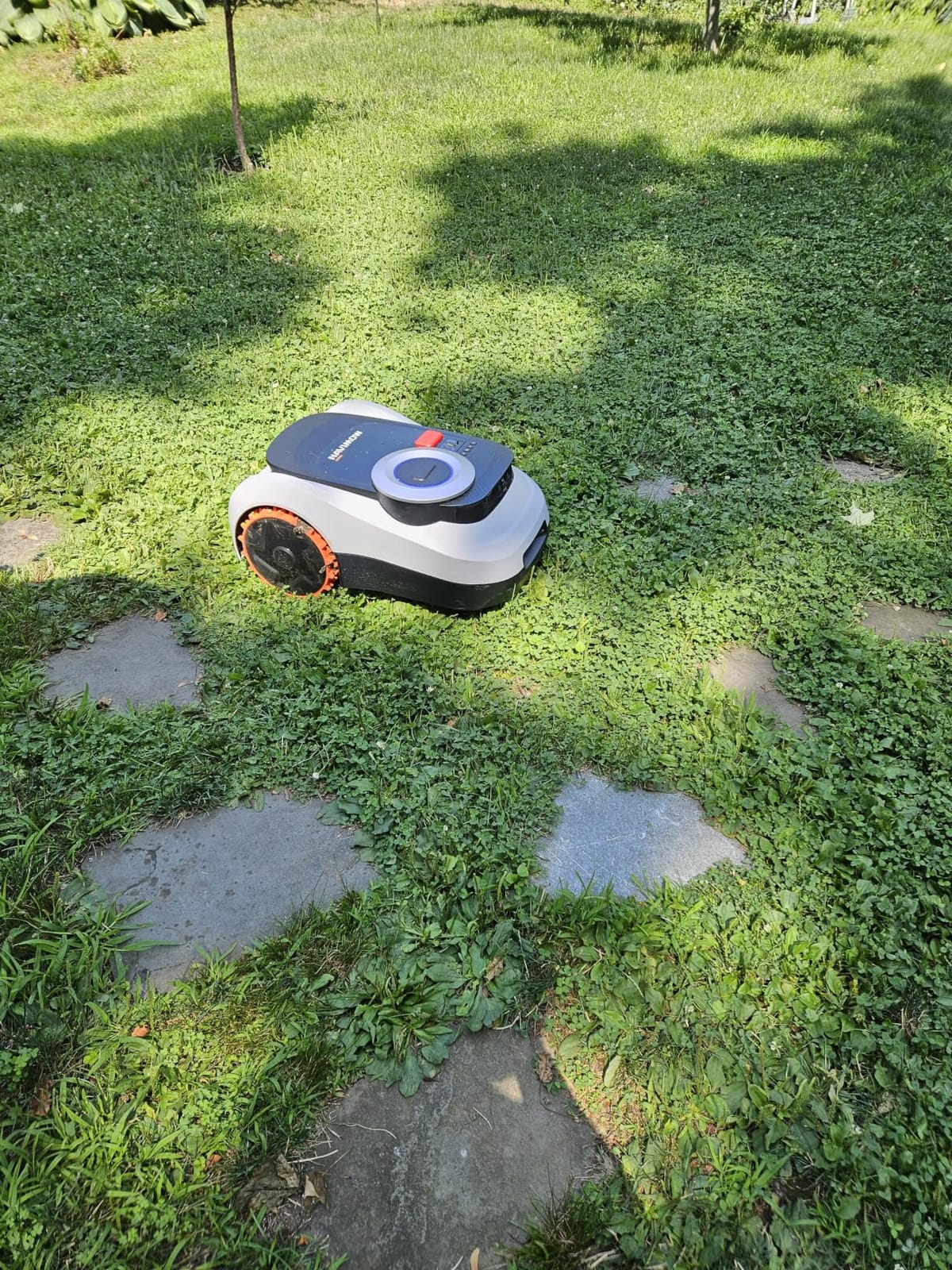
Who This Suits and Who Should Pass
Then choose the i215 for a steep, slightly smaller lot where you want no wire, no antenna and minimal setup. It is also a good second machine for a front slope while a larger machine handles the back acreage.
Pass if you have an acre or more of open ground to cut, because the narrow deck and the 0.37 acre rating will have it working around the clock and still behind in peak season. The 46-review base also means less long-term evidence than the well-reviewed machines in this roundup.
5. ECOVACS Goat A3000 LiDAR PRO – Best for Beds, Walks and Hard Edges
ECOVACS Goat A3000 LiDAR PRO Robotic Lawn Mower, Dual LiDAR Navigation
Dual LiDAR navigation
Built-in TruEdge trimmer
32V deck
70 min recharge
Pros
- HoloScope dual LiDAR holds accuracy under trees
- 13 inch deck suits thick American grass
- Integrated trimmer cuts borders
- 189W fast charging
- App zones and no-go areas
Cons
- Reliability and defect complaints
- Setup and mapping can be fiddly
- Mixed cutting reports on uneven lawns
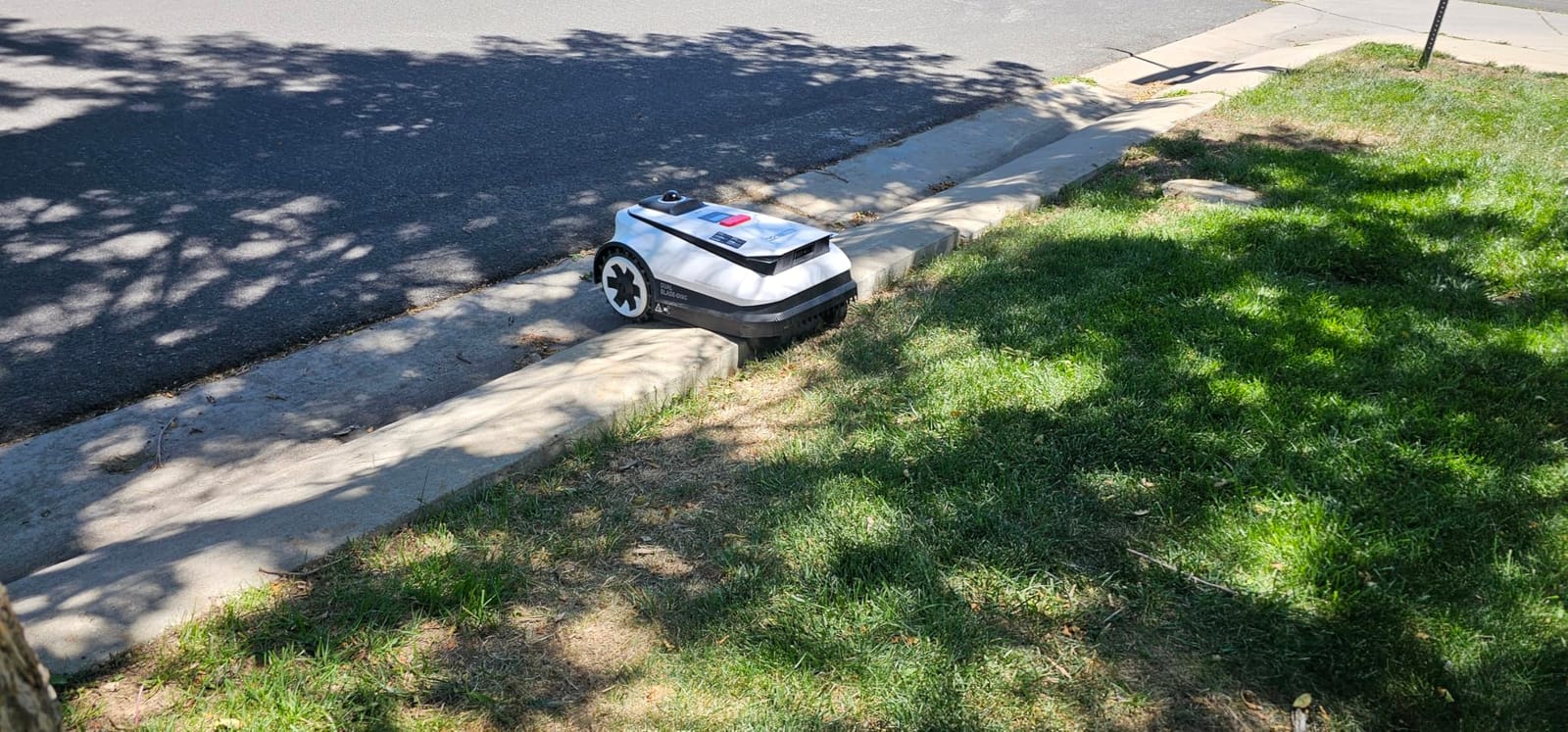
The Goat A3000 LiDAR PRO is the machine to look at if your weekends are being eaten by string trimming, because the built-in TruEdge trimmer does a job most of the others leave to you. Where most chassis stop a few inches short of a wall or kerb, this one swings a trimmer head out and finishes the job.
Navigation uses HoloScope 360 degree dual LiDAR with 2 cm positioning accuracy and no wire and no RTK antenna. That accuracy is what makes tight bed edges and irregular island lawns feasible, because the map boundary can be placed close without the mower wandering over it.
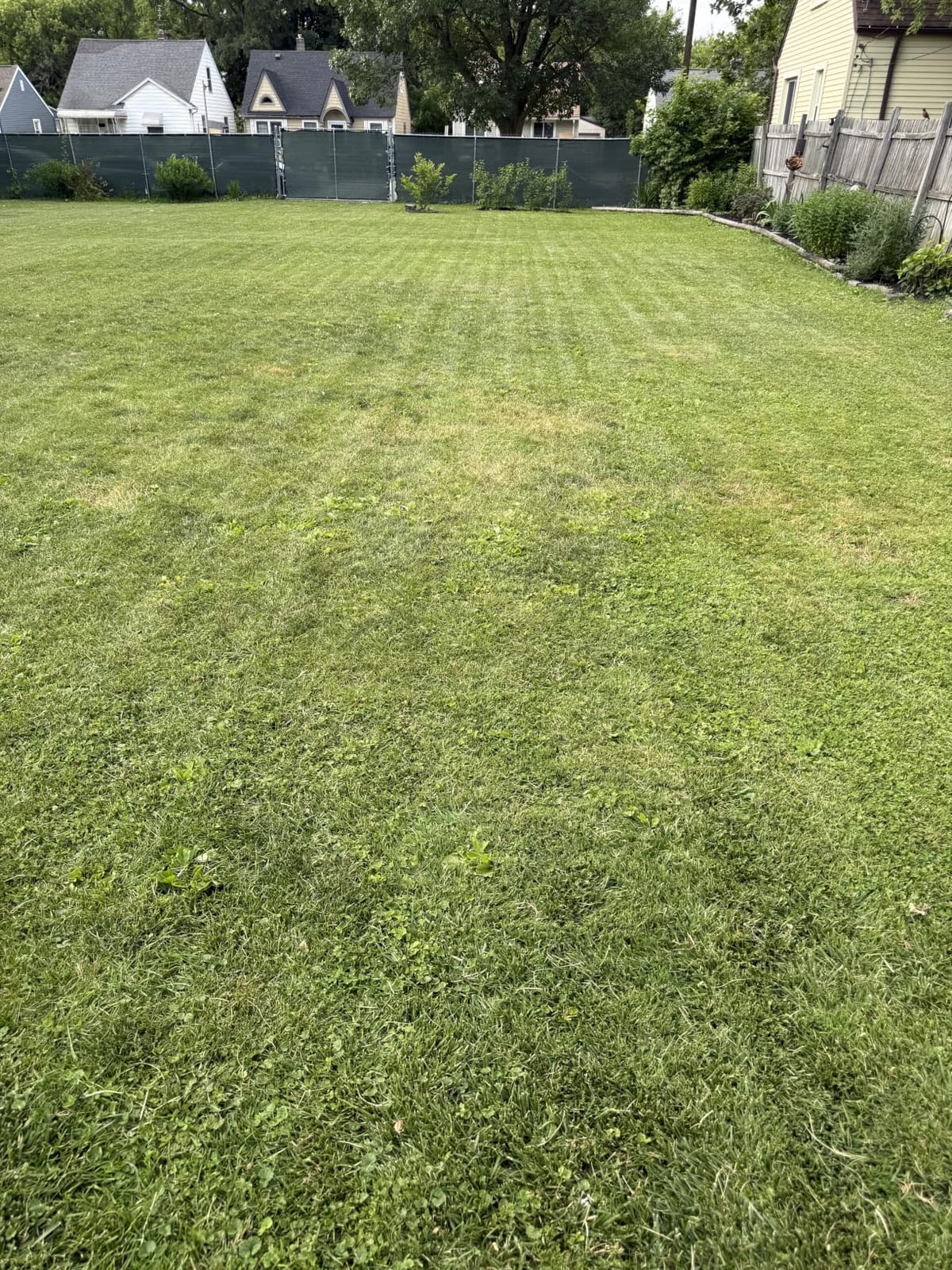
The power plant is a 32V platform driving a 13 inch dual-blade disc, marketed for thick Bermuda, Zoysia, Fescue and St. Augustine. A 7500 mAh battery with 189W fast charging gets back to work in roughly 70 minutes, and mowing efficiency is listed up to 400 square meters per hour for lawns up to three-quarters of an acre.
Edge Cutting and Complex Bed Layouts
On a property that is mostly beds, paths and lawn islands, TruEdge changes the maintenance math. Owners who came for the trimmer generally report it does what the listing claims, cutting down along walks and drives rather than leaving a fringe for a string trimmer.
The app supports map editing, multi-zone mowing, no-go areas plus height and speed control, which is what you need for a property where the mowable area is a set of disconnected shapes rather than one open field.
Reliability Is the Weak Point Here
I have to be direct about the feedback. At a 3.6 average from 111 reviews, with a heavy share of one-star feedback, this is one of the two lowest-rated machines in the roundup, and the complaints cluster around reliability, defects and setup friction. First-time owners in particular report the initial mapping and app workflow taking longer than expected.
Cutting quality reports are also mixed on uneven or thick lawns. If your ground is flat and well kept, the wide 13 inch deck and fast charging carry the day. If it is rough, expect more variance.
Who This Suits and Who Should Pass
Buy it for its edges. Owners with a heavily landscaped yard, lots of bed borders or a garden design that a normal robot would chew through will get the most from this machine.
Pass if reliability history is your top concern, or if you are on rough, rutted ground where a floating deck would be essential. At 64.5 pounds it is also one of the heavier units to reposition, and the smart feature set is thin next to its navigation capability. If you do buy, check that replacement blades and the trimmer head are available for your region before you commit.
6. ANTHBOT Genie 0.9 Acre – Best for Multi-Zone Yards on a Budget
Robot Lawn Mower NO Wire – 0.9 Acre, Full Band RTK+4-Eye Vision Robotic Lawnmower, Automatic Mapping, 30 Multi-Zone Management, Accurate Obstacle Avoidance, Intelligent Anti-Theft, APP Control
Full Band RTK plus 4-eye vision
0.9 acre
30 plus zones
46 lb
Pros
- Simple setup with no boundary wire
- Strong area coverage for the money
- Cuts laser-straight lines
- Quiet with a bright LED headlight
- 4G link is steadier than cheaper siblings
Cons
- Battery degrades within about a year
- Random strips of uncut grass
- Zone gates cause trouble
The ANTHBOT Genie covers 0.9 acre, and at 197 reviews it has more owner history than anything else in this roundup, which is useful when you are weighing an unfamiliar brand. It is the most interesting entry here for fragmented large yards because it supports more than 30 mowing zones with configurable no-go areas.
Positioning comes from Full Band RTK paired with 4-eye 3D vision, so it holds a fix in GPS-poor areas. A 300 degree field-of-view camera detects more than 1000 object types, and the Adaptive Cruise Control mapping walks the boundary for you once you set the antenna and charge pad.
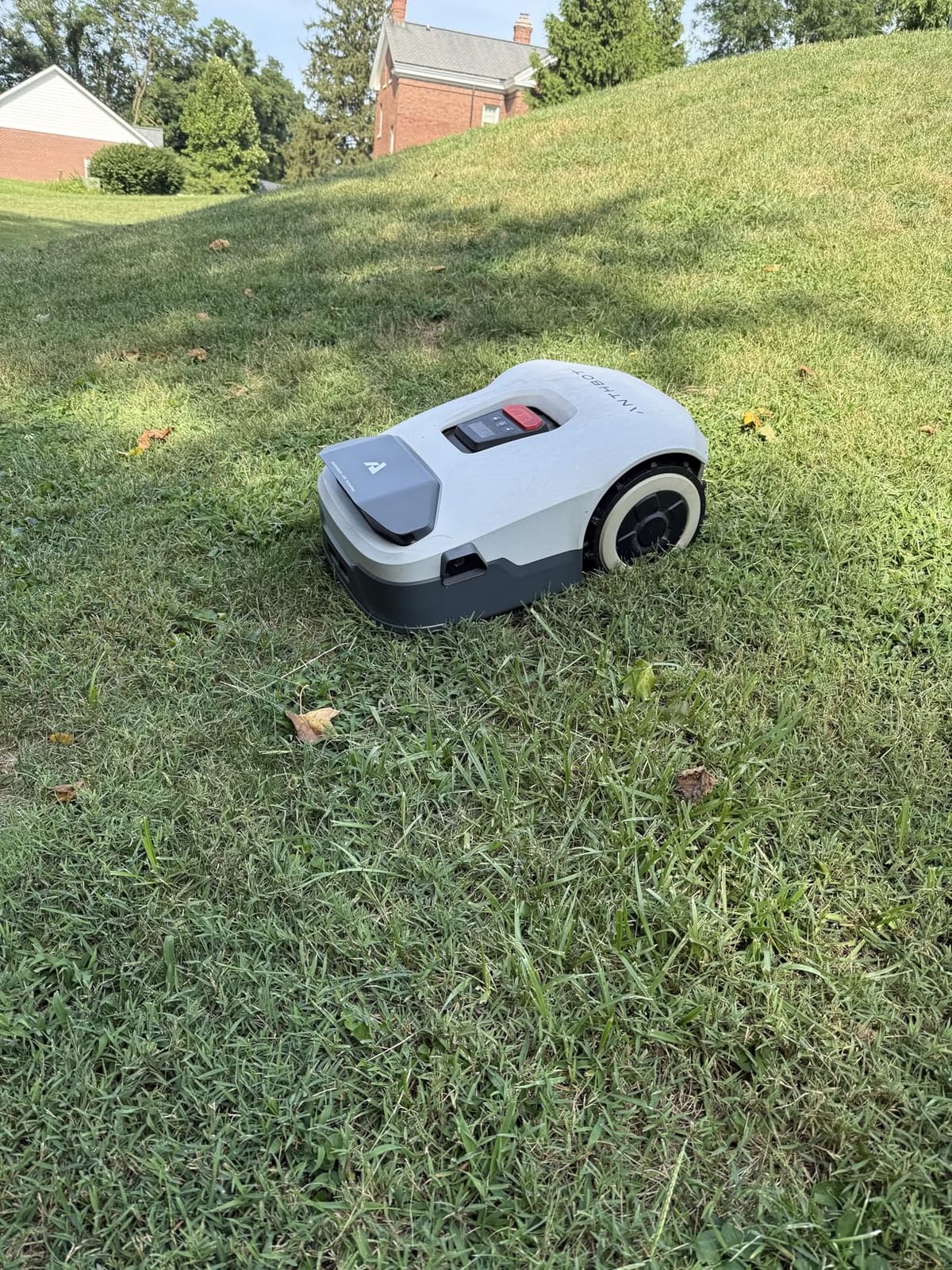
The 6-blade deck cuts laser-straight lines, and owners like that it climbs steep ditches. The LED headlight means it will work in low light, and 4G connectivity is steadier than on cheaper sibling models.
Multi-Zone Handling and the Gate Problem
For a property split by fences, paths and gates, no other machine offers this much zone flexibility. Thirty-plus zones with no-go support lets you schedule a front lawn, a side strip and a rear section independently, and the RTK plus vision combination keeps the boundary honest between them.
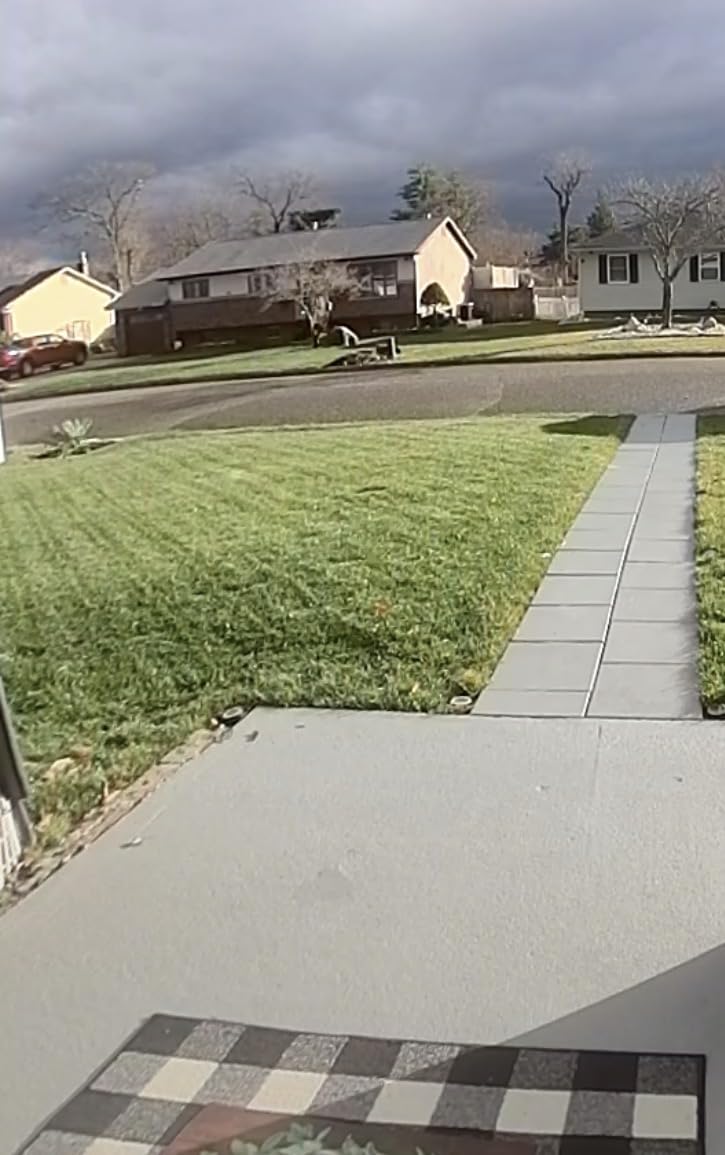
The recurring complaint is exactly that transition. Owners report gates between zones as a repeated stumbling block, with the mower failing to navigate the opening or losing track of which zone it is in. Map each gate as its own small zone with a clear corridor, and check the run yourself before trusting the schedule.
Battery Degradation Is the Real Concern
Here is the honest weakness: a long-term owner update describes battery performance degrading noticeably within about a year. That matters enormously on a large yard, because run time per charge is what determines whether you finish or fall behind in peak growth.
Random strips of uncut grass also force push-mower touch-ups, and some owners describe mystery circling and position loss on wide open lawn. If you can accept a plan for a possible battery replacement in year two, this is a capable machine. If you want something you will not think about, look higher up the list.
Who This Suits and Who Should Pass
Choose the Genie if your property has many separate lawn areas and you want more zones than any comparable machine offers. It suits a moderate budget well and handles slopes better than its weight class suggests.
Pass if you plan to keep it beyond a couple of seasons without any intervention, or if your lawn is a single open field where those 30 zones are simply wasted capability. The 3.9 average reflects that split opinion honestly.
7. GARDENA SILENO Life 15010-20 – Best Boundary-Wire Option for Reliability
GARDENA 15010-20 SILENO Life – Automatic Robotic Lawn Mower, with Bluetooth app and Boundary Wire, The quietest in its Class, for lawns up to 16,200 Sq Ft, Made in Europe, Grey
Boundary wire navigation
57 dB
16200 sq ft
35% slope
7.3 kg
Pros
- Very quiet at 57 dB(A)
- Wire gives dependable mowing limits
- Mows in wet conditions
- Handles slopes up to 35 percent
- Simple Bluetooth scheduling
Cons
- Requires laying and maintaining boundary wire
- Narrow 6.3 inch cutting width
- Limited smart features
I want to make a case for the wire, because almost every roundup in this category has written it off. A buried boundary wire is physical. It does not depend on a satellite, a cell tower, an RTK correction stream or a camera seeing something recognisable, and on a large property with weird geometry that reliability is genuinely valuable.
The SILENO Life covers up to 16200 square feet, handles slopes up to 35 percent, and operates at 57 dB(A), among the quietest machines here. Bluetooth EasyApp Control handles scheduling with EasyConfig, and collision sensors handle garden obstacles.
It also mows in wet conditions. For anyone who does not want to chase a schedule around spring showers, that is a real practical advantage over units that shelter at the first drop.
What Wire Buys You and What It Costs
The benefit is a boundary you define once and trust. On a property split by walkways, with a garden bed full of soft edges and a narrow corridor, wire holds the line where vision and RTK models sometimes drift or refuse to resume after a fault.
The cost is a weekend of work plus permanent maintenance. Wire gets cut by aerators, gophers and mower edges, and a break can take the whole system offline. Budget time to locate and repair breaks annually, and check whether the wire and connectors are available for your model.
Cutting Width and Completion Time
At 6.3 inches, this is the narrowest deck in the roundup, and on 16200 square feet that translates to long run times. For a tidy, near-flat suburban lawn with quiet neighbours, that is an acceptable trade. For a busy large property it means the mower works far longer than the alternative.
Smart features are also modest compared with wire-free rivals: Bluetooth scheduling, no camera, no obstacle classification, no zone maps. You get a machine that does one job within a defined area, very quietly and very predictably.
Who This Suits and Who Should Pass
Choose the SILENO Life if you have an awkward property where wire-free mapping is likely to frustrate you, and you are willing to lay cable once. It is also the right answer for night mowing in a closely spaced neighbourhood.
Pass if you will not install anything in the ground, or if your lawn is large enough that a 6.3 inch deck becomes a scheduling problem. It is also a European-market design with a limited accessory ecosystem compared with the newer platforms.
8. YARBO Robot Lawn Mower Pro – Premium Pick for Multi-Acre Properties
YARBO Robot Lawn Mower Pro, Wire-Free for 6 Acres, Four Seasons Yard Care
Rated to 6 acres
20 inch cut
300W dual motor
215 lb
IPX6
Pros
- Tracks and 70% slope handle rough acreage
- 20 inch cut covers ground fast
- Cut comparable to a zero-turn rider
- Modular hitch for attachments
- Support resolves hardware problems
Cons
- Setup takes many hours
- Map drift needs manual correction
- Cobalt-based battery limits cycle life
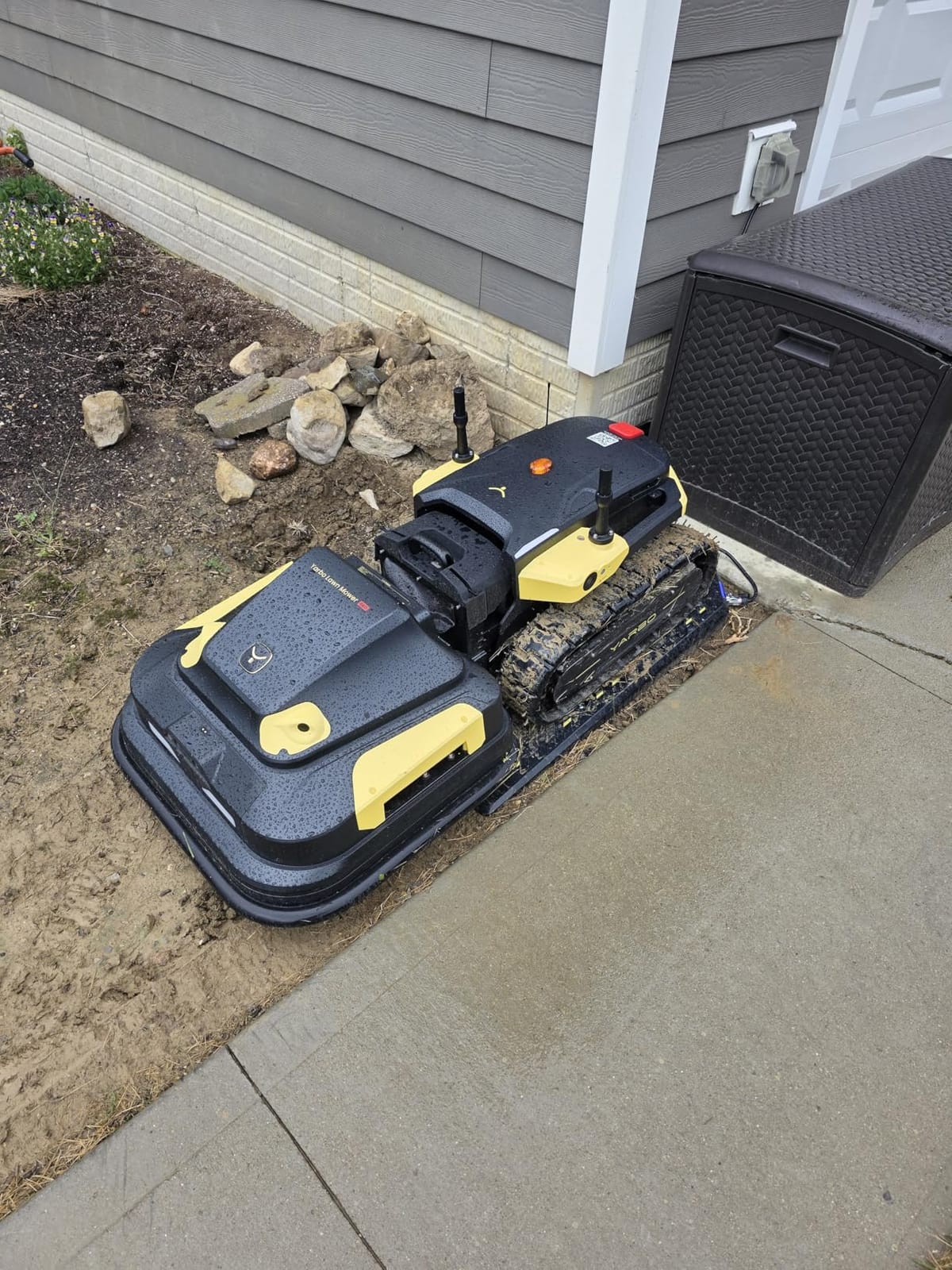
Everything else in this roundup is a garden machine. The YARBO Pro is farm equipment that happens to mow grass, and if you are past two acres it is the biggest machine here rated for the job. Six acres of stated coverage on a 20 inch cutting disc with a 300 W dual-motor deck puts it in a different class from every other product on this page.
The drivetrain is the reason. Patented multi-terrain tracks with all-steel skid shoes handle 70 percent (35 degree) gradients, and owners consistently report it working over multi-acre, hilly, uneven ground that would stop a wheeled machine dead.
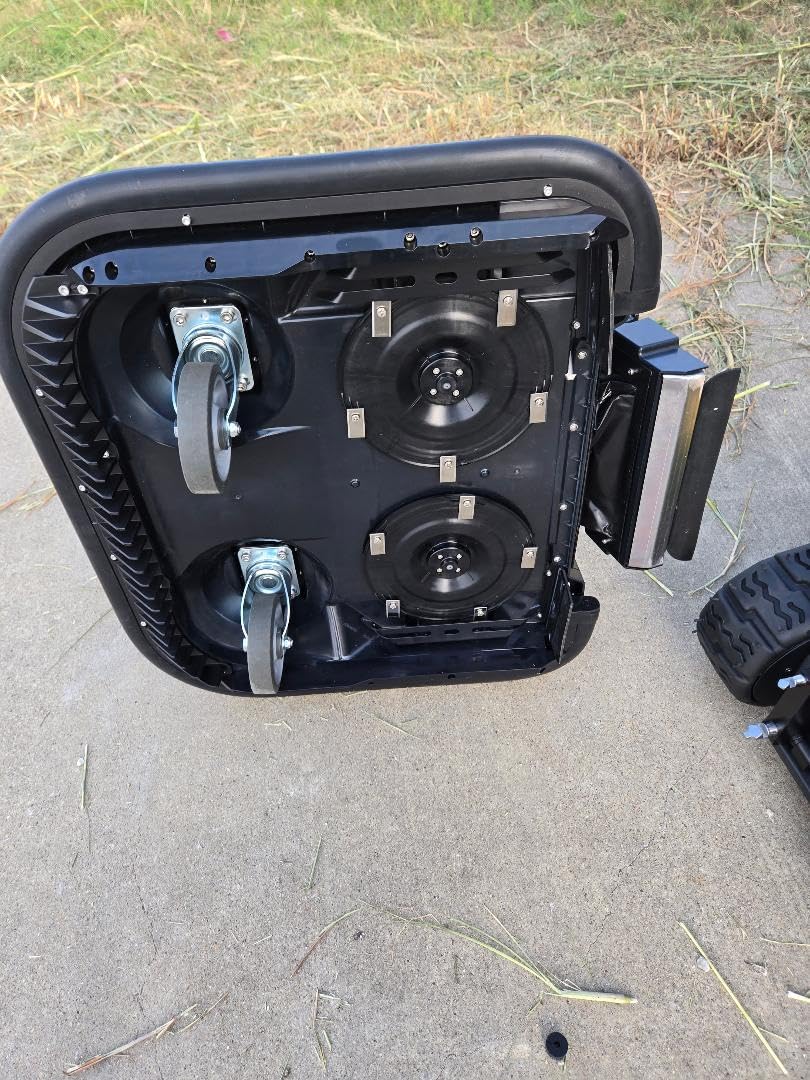
Navigation is triple-fusion: RTK-GPS, binocular vision and a multi-sensor PPVS array, with ultrasonic plus binocular obstacle detection that can see suspended obstacles. It is IPX6 rated, carries a 2-year warranty and has an auto-charge function.
What Six Acres Actually Means
Even at this capability, treat the rating as a ceiling. Owners running machines like this on large grounds report finishing a full property in one to two days rather than instantly, and the modular attachment hitch means it can carry carts and other implements once the mowing is done.
The 20 inch width is the single biggest factor in real output. It is roughly two and a half times the width of the Gardena and more than double the compact machines, which is why the time-to-finish difference is so large.
Battery Chemistry and Long-Term Cost
Here is the caveat worth understanding. The pack is cobalt-based rather than LiFePO4, and owners flag limited cycle life and a high replacement cost. Over a five-year horizon on a machine expected to work hard, that is the number to think about.
Blades are interchangeable between razor and straight sets, and the cutting height spans 0.8 to 4.0 inches across four positions, which covers everything from a polo field to a three-quarter inch orchard-style cut.
Who This Suits and Who Should Pass
Buy it if you have genuine acreage, uneven or hilly ground, and you want one machine to maintain the whole property. Owners describe cut quality comparing well with a zero-turn riding mower, and the support team is reported as responsive including unit replacements.
Pass if you have a suburban lot under an acre. At 215 pounds and 50 by 27 inches, this is not a machine to lift over a kerb, and the setup burden is real: initial mapping and configuration can take many hours, especially under tree cover, with map drift and telemetry loss needing periodic manual correction. The data-centre mount also needs reinforcing in high winds.
9. MOVA LiDAX Ultra 2000 – Best for Complex Zone Setups
MOVA LiDAX Ultra 2000 Robot Lawn Mower with 4G for 0.5 Acre, No Wire No RTK+360° 3D LiDAR+AI Vision Auto Mapping, Zero-Edge Cutting, Cut Height 1.2″-3.9″, 45% Slope, 150 Mowing Zones, Anti-Theft
360 degree 3D LiDAR
UltraTrim edge cutting
150 zones
45% slope
30 lb
Pros
- No wire and no antenna
- Mapping takes about an hour
- Very quiet with clean striping
- Precise obstacle avoidance
- Edge setting cuts close
Cons
- Mapping struggles with curved or divided lawns
- Refuses maps over 0.5 acre
- App maintenance prompts are intrusive
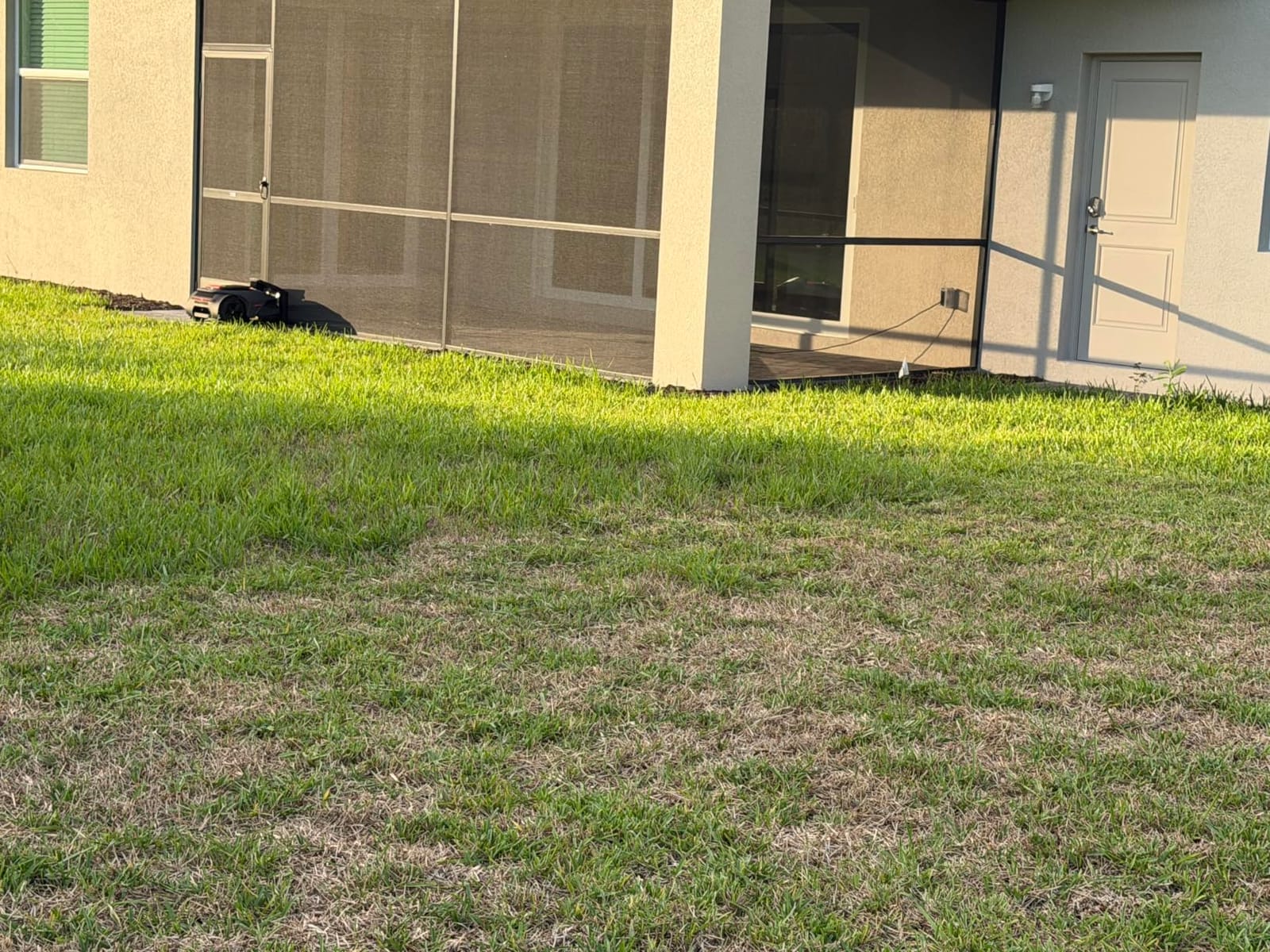
The MOVA LiDAX Ultra 2000 has the highest zone ceiling in the roundup, with dual maps and up to 150 managed mowing areas. On a property that is a patchwork of lawn shapes separated by paths, trees and beds, that flexibility is the whole argument, and no other machine here offers anything close to it.
Navigation is 360 degree 3D LiDAR with AI vision and no wire and no RTK station, so setup is genuinely fast in favourable conditions. UltraTrim 1.0 uses a movable disc to cut within 2 inches of walls, hedges and raised edges, which cuts down follow-up weed trimming more than most competitors manage.
Rear-wheel drive with off-road wheels handles 45 percent slopes, clears 1.6 inch obstacles and manages 23.6 inch path clearance. The battery averages 60 minutes per charge, and there is a 3-year manufacturer warranty.
Zone Flexibility Against Mapping Reality
The 150-zone figure is impressive and, for some buyers, deciding. But the same owners who want 50 zones report that mapping struggles with curved, divided or obstacle-dense lawns. In practice, more zones do not help if the boundary itself took three attempts to capture.
There is also a hard capacity wall: the mower refuses to finish a map set more than an inch over its 0.5 acre rating. That is honest engineering rather than a flaw, but it means you must measure accurately before you map.
Edge Cutting and Turf Behaviour
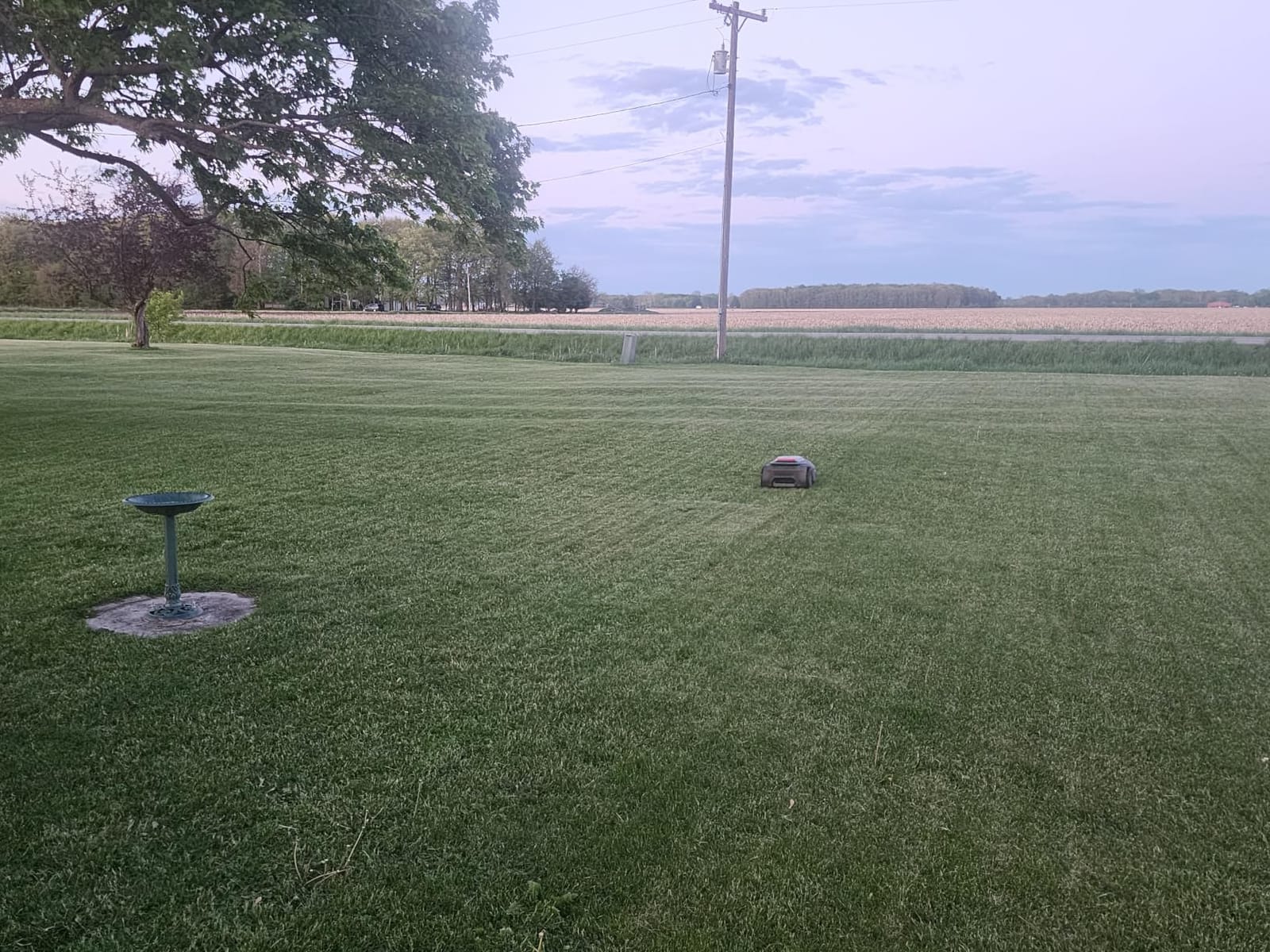
UltraTrim is the feature owners single out most here. Obstacle avoidance through a 3D point cloud and AI vision covering 300 plus object types is precise, with reported passes within centimetres of test objects, and it runs very quietly with clean even striping from a 3-blade deck.
It is choppier on damp grass and in shallow dips, and overlapping zones can overheat the battery. Keep zones sized sensibly rather than heavily overlapping.
Who This Suits and Who Should Pass
Choose the LiDAX Ultra 2000 for a complex yard under half an acre with hard edges and a lot of separate areas, especially if you want no antenna and no wire.
Pass if your lawn is a single open field with a quarter acre of simple shape, or if you need parts support in a hurry. Spare items such as the front caster wheel are reported as hard to source, and the app’s maintenance prompts are intrusive. Remote control also requires the phone to be nearby.
10. Sunseeker X5 AWD – Best for Narrow Passages and Shaded Lawns
Sunseeker X5 AWD Robot Lawn Mower, RTK, Vision AI, 0.5 Acre, Wire-Free
RTK plus VSLAM plus vision
30 degree or 60% slope
31.5 in passage
60 dB
26 lb
Pros
- Holds navigation under tree cover
- AWD traction on rough ground
- Very quiet running
- Clean straight striping
- Light at 26 pounds
Cons
- App programming is poor
- Frequent rescue when tall grass reads as an obstacle
- WiFi extenders needed on large properties
The Sunseeker X5 solves a specific problem better than anything else here: getting a full-size mower through a tight gap. It passes 31.5 inch passages, which means a lawn divided by a narrow path, a shrub border or a low arch is actually mowable rather than two separate unmapped fragments.
Traction is the second strength. All-wheel drive with independent front suspension handles slopes rated at 30 degrees or 60 percent, and owners consistently report noticeably better grip on rough ground than two-wheel-drive alternatives. RTK, VSLAM and Vision AI work together, including at night and under trees and shade.
At 26 pounds it is light enough to carry between lawn areas without a fight, and its 60 dB running noise keeps it neighbour-friendly.
Navigation in Tree Cover and Shade
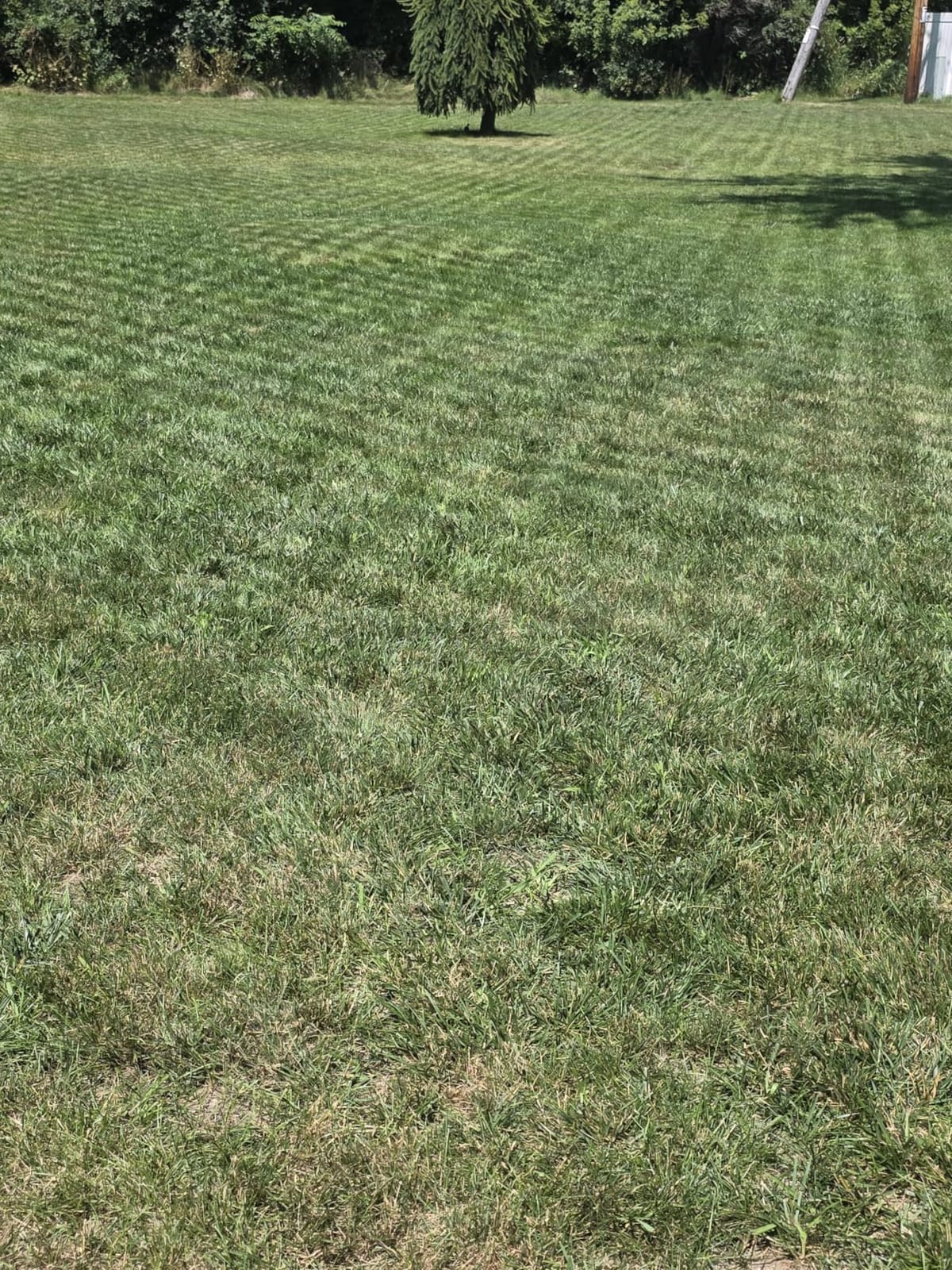
Owners credit it with holding navigation and producing a uniform cut under tree cover, which is the hardest test for a GPS-dependent machine. The floating 8.7 inch cut follows contours rather than bridging over dips, and the height range of 1.6 to 3.2 inches is adjusted from the app.
Wireless virtual boundaries with up to 5 maps, smart zones and no-go areas let you define separate areas without any wire. There is a 2-year warranty with US-based support.
Where It Frustrates Owners
The app is the consistent complaint. Programming is described as poor and finicky, and on a machine this capable the software is the bottleneck rather than the hardware.
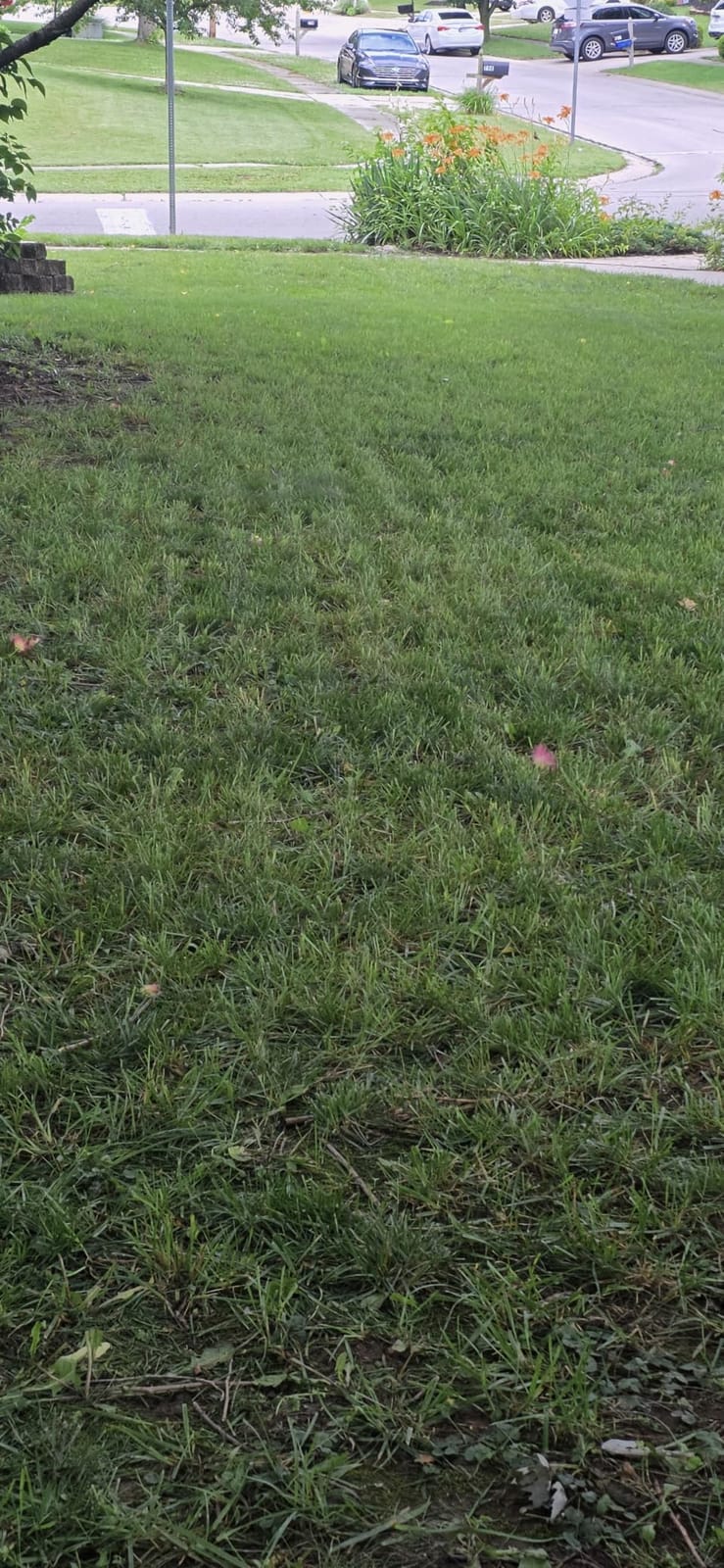
Two practical issues matter on big properties. It needs WiFi extenders where the lawn reaches beyond the house signal, and it is sent out for manual rescue frequently because tall grass gets classified as an obstacle. Edge transitions such as grass-to-sidewalk humps catch the deck often, so set boundaries back from them.
Who This Suits and Who Should Pass
Choose the X5 for a shaded yard, a lawn divided by narrow paths, and anyone who wants a capable machine they can still carry up steps. The 4.4 rating from 29 reviews is strong, though the sample is small enough that you should read recent reviews rather than early ones.
Pass if you need very many separate zones or extensive property-wide scheduling, and be cautious if you will not spend an afternoon getting the app configuration right. Tall, fast growth on a large lot will also produce more rescue trips than the design handles comfortably.
11. WORX Landroid WR344 4WD – Highest Slope Rating in the Roundup
WORX Robot Lawn Mower 4WD for 1 Acre, No Perimeter Wire, WR344
4WD traction to 84% slope
RTK Cloud navigation
1 acre
FiatLux night lighting
Pros
- Exceptionally fine cut quality
- Quiet low-profile chassis
- Software improving through updates
- Replaceable widely available battery
- Very little daily interaction once configured
Cons
- Low 3.3 average rating
- RTK and NTRIP connection errors
- WiFi or SIM activation can stop it mowing
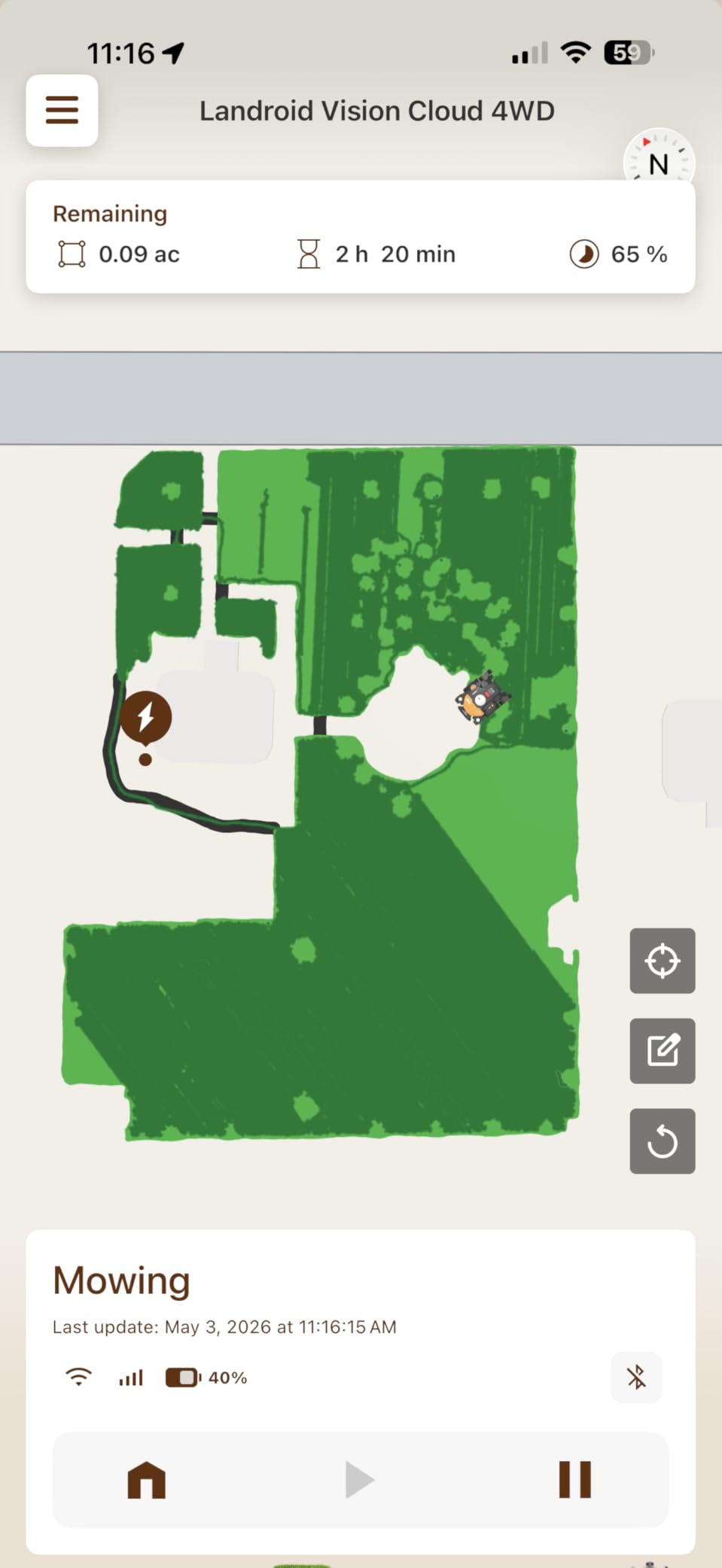
On paper the WR344 has the most capable drivetrain in this group. Four-wheel drive with front-wheel steering and a terrain-adaptive chassis is rated to 84 percent slope, roughly 40 degrees, which no other machine here claims. A one-acre rating with infinite zone mowing and custom pathways fits a serious large yard.
Navigation is RTK Cloud, which delivers centimetre-level accuracy with no local antenna and no recurring cloud fee, backed by VSLAM sensor fusion and Vision AI in shaded areas. There is also night mowing through FiatLux lighting with automatic light sensing, and Find My Landroid security with cellular alerts and remote lock.
Cut-to-Zero offset blade work and ridable edge crossing are meant to reduce the residual grass that makes other robots need a follow-up pass.
Cut Quality Is the Standout
Owners who get it running praise the cut quality in strong terms, describing an even, finely finished result that holds up close as well as from a distance. The chassis is quiet and low-profile, which reduces edging work, and the software has improved substantially through over-the-air updates.
The replaceable, widely available battery is a genuine long-term reliability plus, and once configured it needs very little day-to-day interaction. The 4WD chassis also climbs far steeper ground than anything else on this list.
The Connectivity Problem Is Real
Now the difficult part. At a 3.3 average from 16 reviews, with roughly 40 percent of feedback at one star, this is the most polarised machine here. Reported failures cluster on connectivity: RTK and NTRIP connection errors that support could not clear, plus WiFi and SIM activation problems that can prevent the mower cutting at all.
On a large multi-zone property it also reportedly loses position and gets stranded, and the walking-pace mowing speed means long run times. That combination is why I place it this low despite the excellent hardware.

Who This Suits and Who Should Pass
Choose it if you have genuinely steep terrain and you have a strong, stable WiFi and cellular signal across the whole property. In that specific situation, nothing else here climbs like it, and the cut quality is a genuine standout.
Pass if you are on rural acreage with patchy signal, or if you want a set-and-forget machine on a large multi-zone property. A mower that will not start mowing because a SIM did not activate is not solving a large-yard problem. With only 16 reviews, there is also not enough long-term data to trust yet.
12. Husqvarna Automower 440 iQ – Best for Dealer Support and Long-Term Durability
Husqvarna Automower® iQ Series 440 iQ, Robot Lawn Mower, GPS Robotic Mower
EPOS positioning
Up to 2 acres
45% slope
1 to 4 inch cutting
61 lb
Pros
- Very quiet for overnight running
- Extremely low running cost
- Durable repairable design with available parts
- Consistent striped coverage
- 4-year warranty plus a year of free blades
Cons
- Stops with faults needing manual resets
- Wheel motors reported to last about a year
- Scheduled areas carry unfinished work forward
- Firmware updates needed for some faults
The Husqvarna 440 iQ is the only machine in this roundup where the dealer network matters as much as the specification, and for a two-acre property that is a real consideration. Up to 2 acres of mowing capacity, wire-free app setup with virtual maps and stay-out zones, and EPOS Exact Positioning for centimetre-accurate location with onboard radar for obstacle detection.
It handles slopes up to 45 percent on large wheels and a durable bumper, which is what lets it cross paths and driveways without getting hung up. Cutting height adjusts from 1 to 4 inches, the widest range here, and the whole unit is hose-washable.
Owners value the near-silent running and report an extremely low electricity cost week to week, with a durable, repairable design and widely available parts and blades. The 4-year warranty is the longest in this group, and a year of free blades is included.
Where the Husqvarna Falls Short
It requires supervision. Owners report frequent fault stops that need manual resets, and firmware updates have been needed to fix faults and setup problems. If you want a machine that finishes its schedule without you walking out to restart it, that is a serious drawback.
Two other reports are worth weighing. Wheel motors are said to last about a year and are costly to replace, which matters over several seasons. The scheduled-area logic also carries unfinished work forward instead of re-mowing the whole area, so a fault can leave a patch until the next pass catches it. Repair-shop turnaround of three to four weeks is reported by some buyers, so plan for downtime rather than a same-week fix.
Anti-Theft and Insurance Thinking
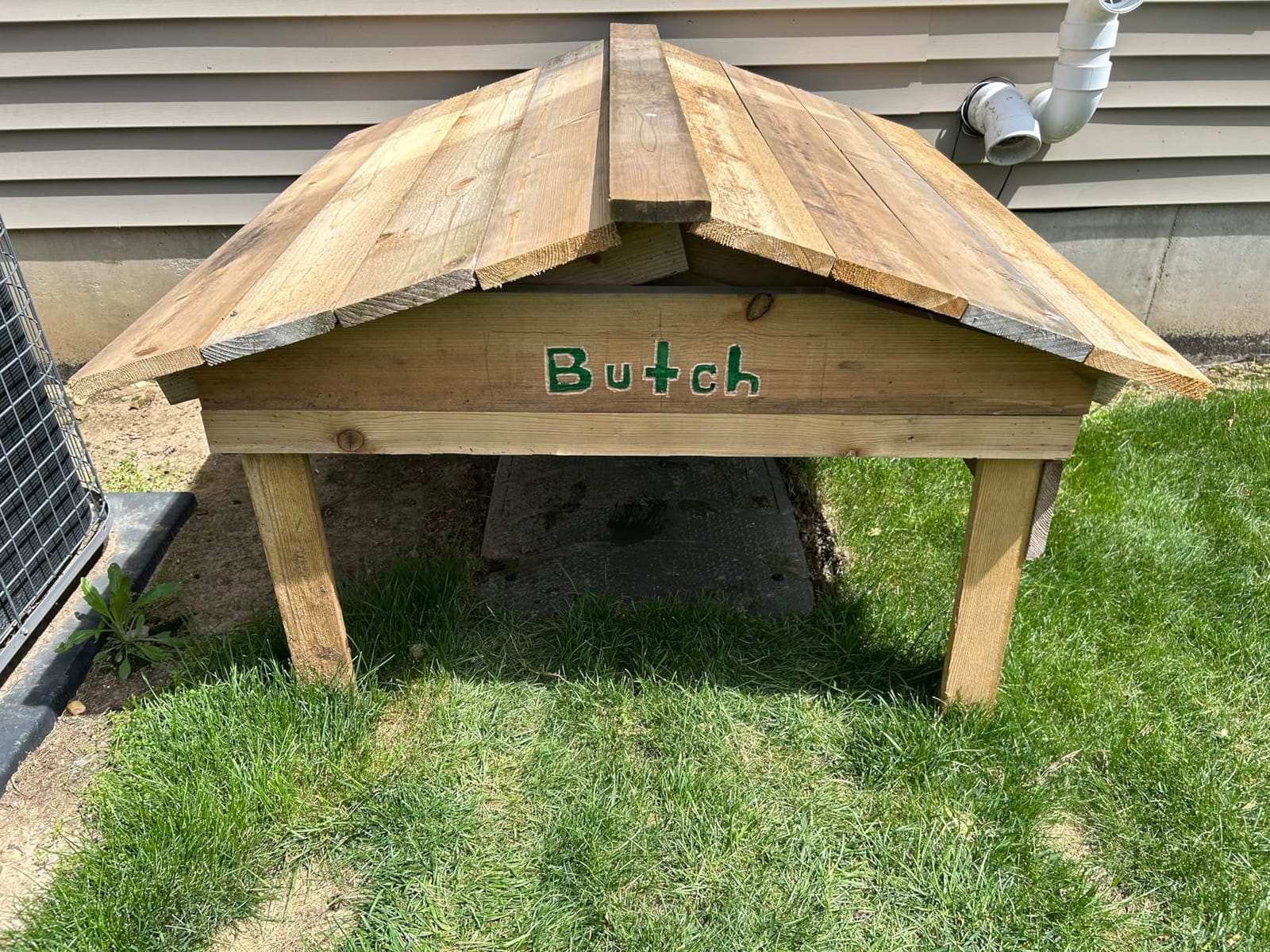
On a large open property, a machine this size is a visible target. The 440 iQ has an anti-theft alarm with GPS tracking, a virtual fence and PIN-code resume, which is meaningful protection. A survey in the r/roboticLawnmowers community found 9 of 38 respondents reporting a collision or near-miss with a vehicle, so park it in a sheltered spot and check your home policy for scheduled-property coverage.
Who This Suits and Who Should Pass
Choose it if you want a dealer-backed machine, a long warranty, parts that will still exist in five years, and two acres of capacity with no wire. If you can accept manual resets and plan for servicing, it is a durable long-term machine.
Pass if you want zero-touch automation, or if nobody local can service a Husqvarna. The 3.4 average from 27 reviews reflects fault frequency more than build quality, so this is a support and durability bet rather than a smoothness bet.
How to Choose a Robot Mower for a Large Yard
Start with your hardest condition, not your average one. The slope at the back of the property, the tree that drops roots across the main lawn area, the narrow path that splits the grass into three pieces. That single feature should rule products in or out faster than any spec sheet comparison.
Match the Rated Acreage to Your Real Lawn
Measure the mowable area, not the property line, and then apply the discount. Obstacles, slopes and fragmented sections routinely cut 30 to 50 percent off rated capacity. A mower rated for one acre on a real, obstacle-filled lot is a mower that falls behind in July.
As a rough guide: under a quarter acre suits the compact vision units; half an acre to an acre and a half suits the mid-size AWD machines; above two acres, you should be looking at tracked or wide-deck platforms such as the YARBO Pro, or at a dealer-installed commercial unit. If you are still hand-mowing large areas, a good battery mower setup can bridge the gap while a robot is being set up.
Pick the Right Navigation Type for Your Property
There are four approaches, and each fails in a different way.
Boundary wire is the most predictable and the only one that does not depend on sky, signal or firmware. It needs installation and it breaks. Vision-only systems work under trees and in shade and need no antenna, but they struggle on sparse or sandy turf. RTK gives centimetre accuracy but wants a clear sky view, and network RTK removes the base station while adding a cell-tower dependency. Fusion systems that combine LiDAR, RTK and vision cost more and cover the most failure cases.
On a large property with heavy canopy, choose fusion. On an open field with poor cellular, choose wire or a self-contained system. On a small tidy lawn, vision alone is plenty.
Read the Slope Number Properly
Slope ratings in this category range from about 30 to 84 percent, and that is a very wide spread in real terms. A two-wheel-drive machine rated at 30 percent will struggle on anything steeper and may need rescuing mid-cycle, which on a large yard is the difference between finishing and falling behind.
All-wheel drive or tracked platforms are what buy you the higher numbers. Independent suspension and step-over height matter more than people expect on rutted ground. And check whether the rating is a climb capability or a mowing capability, because some manufacturers quote the best case on an empty slope.
Cutting Width Decides Your Completion Time
This is the least glamorous spec and the one that most affects whether you are happy in August. Widths here run from 6.3 inches on the Gardena to 20 inches on the Yarbo, with 15.8 inches on the Mammotion LUBA 2 and 13 inches on the ECOVACS. A wider deck means fewer turns, fewer dock returns and a shorter finish time.
The narrow-deck machines are not worse machines. They are the right choice for a quarter-acre lawn, or for a property where passage width matters more than speed. If passage width is your real constraint, reading our riding mower comparison is a useful parallel check before you commit to autonomy.
Battery Life, Charging and Overnight Runs
Check runtime per charge and the acreage you can realistically finish in one session, not the headline acreage. Sixty minutes of runtime and a 0.5 acre ceiling are different products from 175 minutes and a full-acre session. Fast charging matters as much as capacity if the mower will need a midday top-up.
For a large lawn, plan on overnight scheduling from early spring, and know that battery chemistry governs long-term cost. Cobalt-based packs have shorter cycle life than LiFePO4, which matters most on the high-hourage machines.
Wire-Free Setup Versus Dealer Installation
Wire-free is genuinely faster. Most of these machines are mapping in under an hour in favourable conditions, and a full property can be running the same afternoon. A dealer installation adds a planning visit, boundary work and site handover, which is worth it for a large complex property where mapping will otherwise be retried five times.
Dealers are also the only realistic answer if you want a machine serviced locally rather than shipped, which matters for the heavier platforms. Just confirm what the installation covers and whether the dealer will return for mapping corrections, because that visit is where most problems are found.
The Running Costs Nobody Mentions
Beyond the machine itself: replacement blades on a large lawn are a twice-yearly item, and a wide metal deck finds every stick. Cellular data plans are a recurring cost on several models once the trial period ends, and network RTK is free while some manufacturer services are not. Battery replacement is the big one on high-hourage units, and winter storage in a dry climate matters for longevity.
Electricity is genuinely trivial on all of these. Several owners report running costs of a few pennies a week, so the mower is not where the running cost lives.
Frequently Asked Questions
Are there robotic mowers that can mow large areas?
Yes. Wire-free robotic mowers using RTK, LiDAR and vision navigation now cover from about 0.2 acre up to 6 acres. Most consumer units are realistically sized for 0.5 to 1.5 acres, while tracked and commercial-grade platforms handle multi-acre properties.
Which robot lawn mower is best for large acreage?
For most large suburban lots the Mammotion LUBA 2 AWD 5000HX is the best all-rounder, with 80 percent slope capability and a 15.8 inch cutting width. For shaded and rough ground the Mammotion LUBA 3 AWD 3000 adds LiDAR. For multi-acre properties the YARBO Pro is rated to 6 acres on tracked drive.
What are the most reliable robotic lawn mowers?
Reliability favours machines with strong review histories and durable, repairable construction. The Mammotion LUBA 3 AWD 3000 and the Husqvarna Automower 440 iQ score well on build quality, while the ECOVACS Goat A3000 and WORX Landroid WR344 carry the most connectivity and fault complaints in owner reviews.
What is the largest robotic lawn mower available?
The YARBO Robot Lawn Mower Pro is the largest consumer unit covered here, rated for lawns up to 6 acres with a 20 inch cutting width and 300 W dual-motor disc on tracked drive. The Husqvarna Automower 440 iQ covers up to 2 acres with dealer support.
Do robotic lawn mowers need an antenna or boundary wire?
No. LiDAR, vision and RTK Cloud models map their own boundaries with no wire and no antenna, and Network RTK removes the need for a separate base station. Only boundary-wire models such as the GARDENA SILENO Life still require cable, which needs installation and periodic repair.
Which Robot Mower Fits Your Yard
If you have a lot of about half an acre to an acre and a half with real slope, take the Mammotion LUBA 2 AWD 5000HX. It is the most complete package in this roundup: wide deck, serious drivetrain, and a navigation stack that survives tree cover.
If trees and shade define your property, go to the Mammotion LUBA 3 AWD 3000 for LiDAR redundancy. If your ground is past two acres, only the YARBO Pro has the capacity, and you should accept a long setup and a cobalt battery in exchange.
If edges are your pain, the ECOVACS Goat A3000 LiDAR PRO is the only one with a real integrated trimmer. If you want predictable boundaries and will lay cable, the GARDENA SILENO Life is the quietest and most dependable. If you need many separate zones on a moderate budget, the ANTHBOT Genie leads on zone count.
Whatever you choose, measure honestly, buy with margin above your acreage, and test the mapping in real conditions before you trust the schedule. Our picks here were last verified for 2026, and we update this roundup as owner reports change.
Leave a Reply