
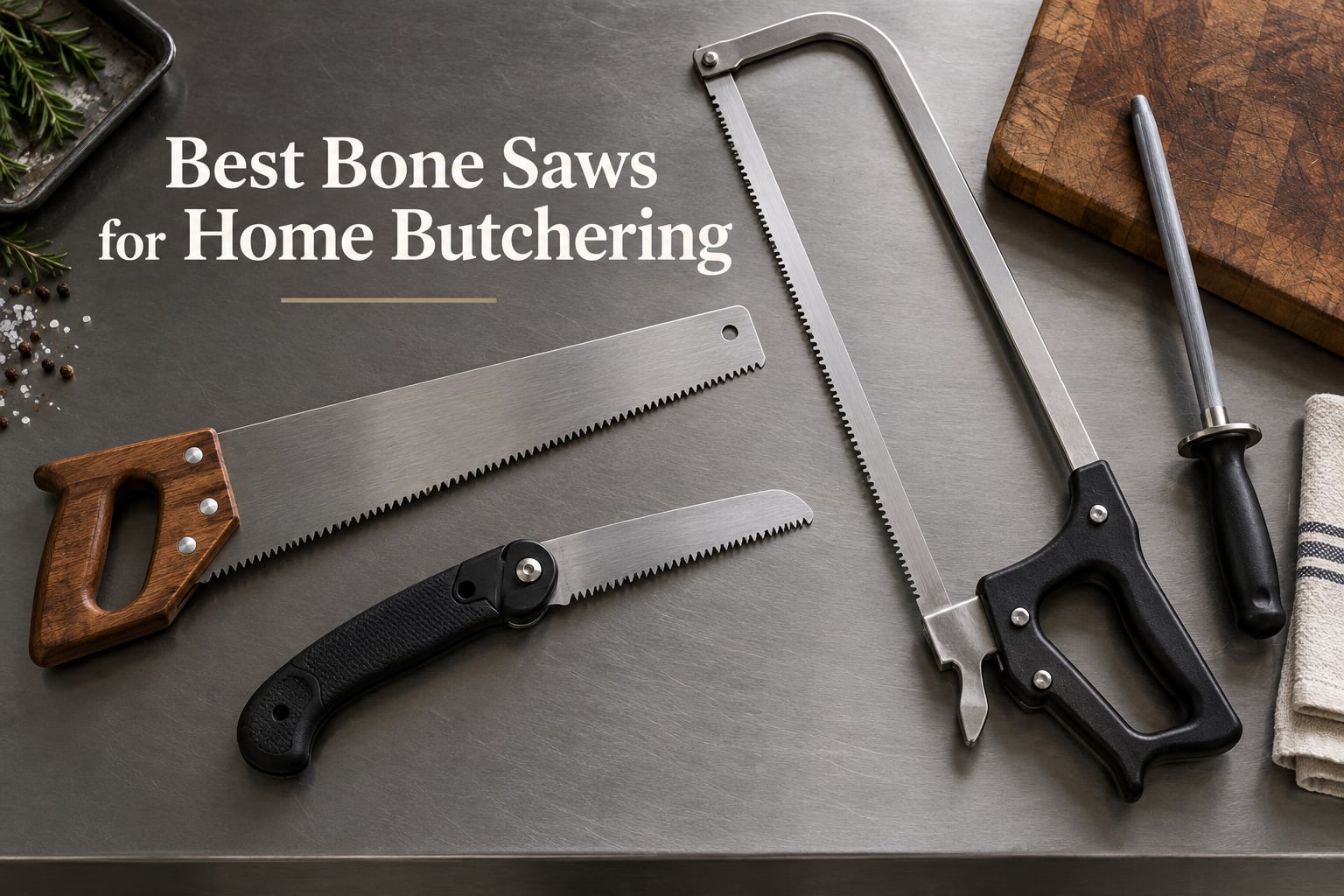
A bone saw is a coarse-toothed, food-safe hand saw built to cut ribs, pelvises, hocks and joints during home butchering without shattering bone or shredding the meat around it. It is a different tool from a hacksaw, a pruning saw, and a reciprocating blade, and picking the wrong one is the reason most first-time processors stall halfway through a carcass. I have run whole deer and hogs through garage butchery sessions for years, and the saw is the single tool that decides whether the job takes two hours or six.
Below is my list of the best bone saw options available right now, ordered by how they perform on real home butchering work rather than by how they look on a shelf. Every pick below went through the same filter: blade material that survives repeated washing, enough blade length to clear a thick bone in a few strokes, and a handle that stays put when your hands are wet and gloved.
First, the short version. If you break down one or two animals a year in a garage, a 16-inch stainless butcher saw will do nearly everything you need. If you are in the woods with a deer on a pack, you want something under a pound with a scabbard. And if you process frozen beef and pork blocks every winter, blade length matters more than any other single spec, because a short blade turns you into a crouching, cramping mess at the butchering block.
One note before we get into the picks: this is a manual saw roundup. There are no electric bone saws in this list, and that is deliberate. Once you understand where a saw is actually required in a carcass, you will find a reciprocating saw or a good 5-inch boning knife covers most of the rest, which we cover in detail further down. If you want a broader look at saw categories before you commit, our miter saw guide and masonry saw guide cover the other major saw families.
Our Top 3 Bone Saws for Home Butchering in 2026
These three cover the widest range of home butchering situations, from a full-size deer carcass in a garage to a shoulder cut in a tent at 40 degrees. Everything else in the list is a strong specialist, but these are the ones I hand to friends and family first.

Weston 16 Inch Butcher Saw
- 16 inch stainless steel blade
- Quick release handle
- Trigger lock blade tension
- 1.8 pound frame

LEM Products 16 Inch Meat Saw
- Cam locked taut blade
- High speed tool steel blade
- 10 TPI half inch blade width
- Nickel plated frame
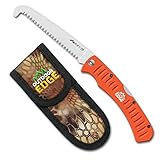
Outdoor Edge Flip N Zip Saw
- 4.4 inch 65Mn spring steel blade
- Triple ground teeth
- 2.5 ounce folding weight
- Nylon sheath and belt clip
Quick Overview: Every Bone Saw in This Roundup Compared
Here is the whole list at a glance, with the blade material and length that actually matter when you are working a carcass. Every saw below is a manual, food-safe design suitable for home butchering, and none require a power source.
| Product | Specs | Action |
|---|---|---|
| Weston 16 Inch Butcher Saw |
|
Check Latest Price |
| LEM Products 16 Inch Meat Saw |
|
Check Latest Price |
| Outdoor Edge Flip N Zip Saw |
|
Check Latest Price |
 HME Compact Fixed Bone Saw HME Compact Fixed Bone Saw |
|
Check Latest Price |
 GreatNeck 22 Inch Bone Saw GreatNeck 22 Inch Bone Saw |
|
Check Latest Price |
 Outdoor Edge GrizSaw T-Handle Outdoor Edge GrizSaw T-Handle |
|
Check Latest Price |
 KATA 20 Inch Butcher Meat Saw KATA 20 Inch Butcher Meat Saw |
|
Check Latest Price |
 Hooyman MegaBite Combo Saw Hooyman MegaBite Combo Saw |
|
Check Latest Price |
 RUITOOL 12 TPI Meat Saw RUITOOL 12 TPI Meat Saw |
|
Check Latest Price |
 Ceoighe 22 Inch Butcher Saw Ceoighe 22 Inch Butcher Saw |
|
Check Latest Price |
What Is a Bone Saw, and Where Do You Actually Need One?
A bone saw has aggressive, widely spaced teeth that rip rather than slice, so each stroke removes chips instead of binding in the kerf. A long, deep blade clears a thick bone in a single pass, and a food-grade stainless or carbon steel blade resists corrosion after the washing a carcass demands. A hacksaw frame is too light and its fine tooth count bakes in heat and stalls; a pruning saw is designed for green wood, not through a femur.
The honest answer to where you need one is narrower than most saw marketing suggests. On a deer, the saw is genuinely required at the pelvis, the hock, the brisket and rib plate, and the shoulder. Everywhere else, a boning knife and a good sharpening habit are faster and produce a cleaner cut than any saw can. The rest of this guide is built around that distinction, so you spend money on the four cuts that need a saw instead of on a fancier version of the wrong tool.
1. Weston 16 Inch Butcher Saw with Quick Release Handle – Best Overall
Weston Butcher Meat and Bone Saw with 16 Inch Stainless Steel Serrated Blade with Quick Release Handle (47-1601)
16 inch stainless blade
Trigger lock tension
1.8 pounds
Manual, no power needed
Pros
- Cuts through muscle
- sinew and bone on large field cuts
- Trigger lock holds blade tension steady
- Ergonomic handle reduces fatigue on long sessions
- Stainless steel blade and frame
- Quick release handle for fast blade changes
Cons
- Blade can loosen under heavy cutting strokes
- Serrated teeth are harder to resharpen than straight teeth
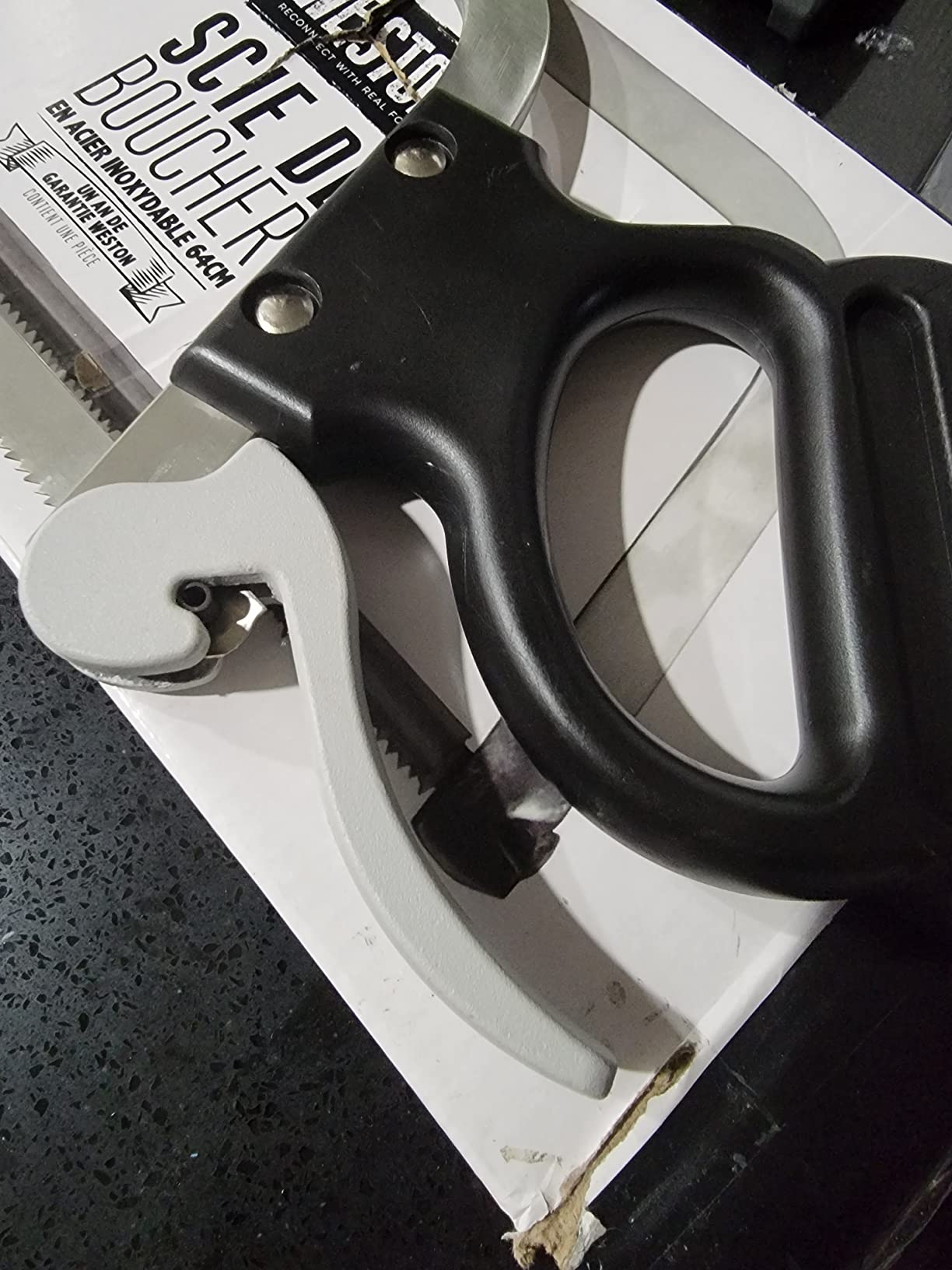
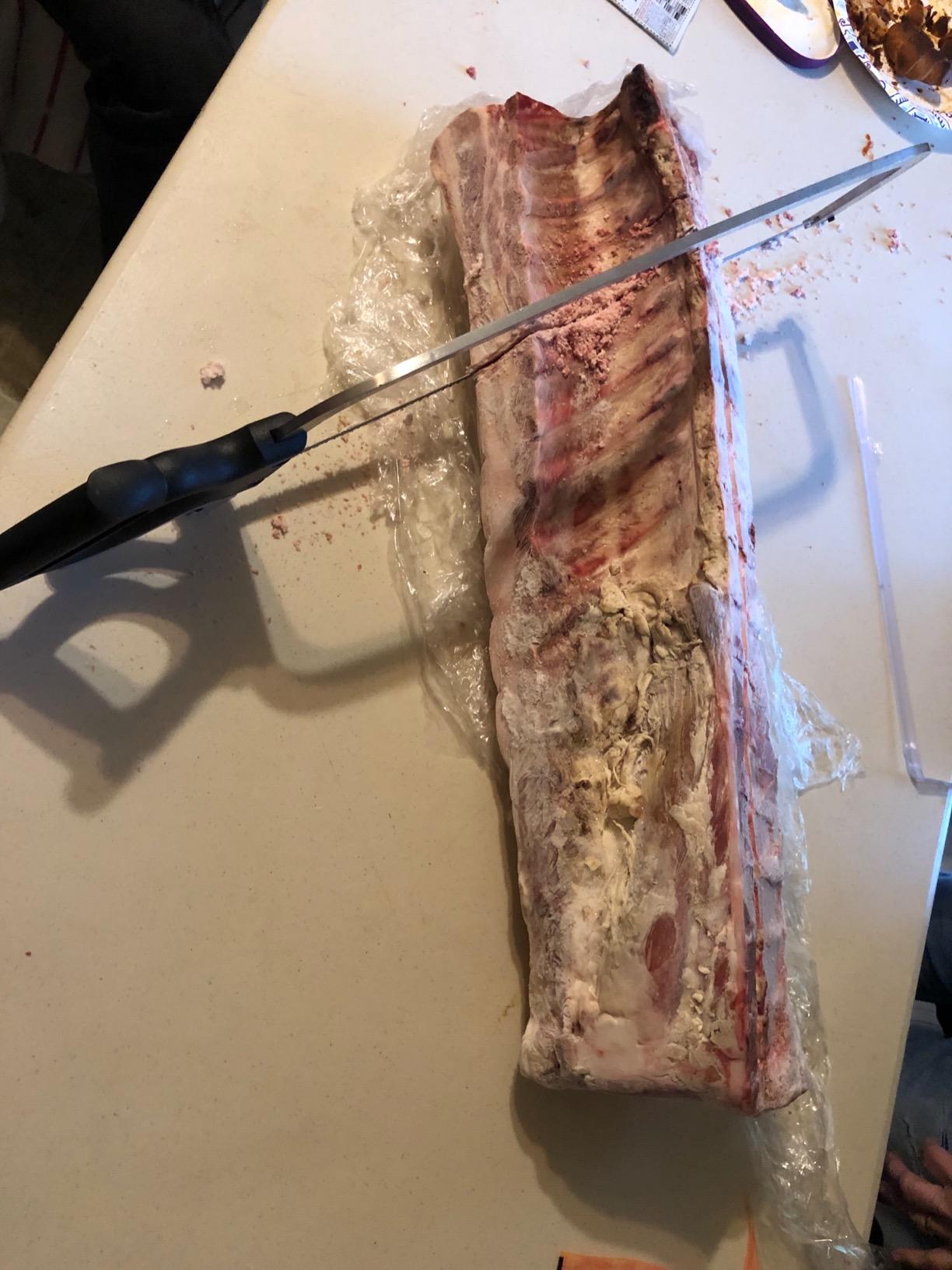
The Weston 16-inch is the saw I hand to people who have never broken down a whole animal before. The 16-inch stainless blade gives you enough reach to clear a deer pelvis in a short, controlled stroke, and the trigger lock keeps tension consistent so the teeth do not skip out of the cut when the blade starts to go dull. At 1.8 pounds it stays comfortable through a full session.
Buyers consistently describe it as cutting straight through muscle, sinew and bone without a fight, and the quick release handle is the detail that matters most day to day, because it lets you tension or swap a blade in seconds instead of fumbling with a wing nut at 9pm after a full day of work. With more than 2,300 reviews averaging 4.4 stars, it is the most proven saw in this list by a wide margin.
Stainless Steel Blade and Corrosion Resistance
Stainless is the right call for home butchering because the blade gets washed within minutes of finishing a carcass. A carbon steel blade in that cycle will show rust bloom within a day unless it is dried immediately, and the reviewer pattern here is clear: the Weston’s stainless construction is why it stays serviceable season after season rather than disappearing into corrosion.
The serrated tooth pattern is aggressive enough to self-clear as you cut through wet connective tissue, which matters more than it sounds. A fine-tooth saw clogs with meat fiber and then stops cutting, and this saw avoids that problem in the way you want for ribs and brisket work.
Trigger Lock Tension and Blade Tracking
The trigger lock is the small feature with the biggest effect on cut quality. A saw that loses tension mid-stroke wanders, and a wandering saw means more passes, more fatigue, and a rougher surface on the primal. Reviewers report the tension stays steady even on the heaviest strokes, which is what separates this from lighter frame saws that flex under load.
The trade-off that shows up in reviews is that a minority of buyers report the blade can loosen during heavy cutting, so it is worth checking tension at the start of a job and again after the first few strokes. It is a thirty-second habit that prevents most complaints people write about.
Handle Comfort Over a Full Processing Day
The ergonomic handle is a molded grip that keeps the saw from twisting out of your hand when you are pushing through a thick joint. That matters more at hour four than at minute one, and the review pattern for this saw is that comfort is what makes the difference between finishing a carcass and stopping halfway.
On the other side, serrated teeth are harder to sharpen than straight-ground teeth. If you do not have a file and do not plan to learn, budget for replacement blades rather than resharpening, and read our cleaning section before the first job.
2. LEM Products 16 Inch Meat Saw with Tightening Cam – Premium Pick
LEM Products 16″ Meat Saw with Tightening Cam
16 inch hand saw
Half inch wide 10 TPI blade
Cam locked tension
1.4 pounds
Pros
- Nickel plated frame resists flex under load
- Locking cam holds blade taut for faster strokes
- High speed tool steel blade cuts meat and bone
- Ergonomic handle reduces hand fatigue
- One year factory warranty with long parts support
Cons
- Black handle surface shows grime after large game
- Some users wish the blade were slightly wider for thick bone
The LEM 640 carries a 4.6 average across more than 1,200 reviews, and the reason is the cam lock rather than the blade. A cam-locked tension system holds the blade dead taut, so every stroke removes material instead of flexing around it, and on a long butchering session that translates directly into fewer strokes and a much easier job on the hands.
Reviewers who break down deer and hogs describe it as a professional-style hand saw that holds up, with roughly an 80 percent five-star share across more than 1,200 reviews. The half-inch wide blade at 10 teeth per inch is a proven, meat-focused combination that cuts smoothly through both soft tissue and bone in the same stroke.
Why Blade Tension Changes Everything
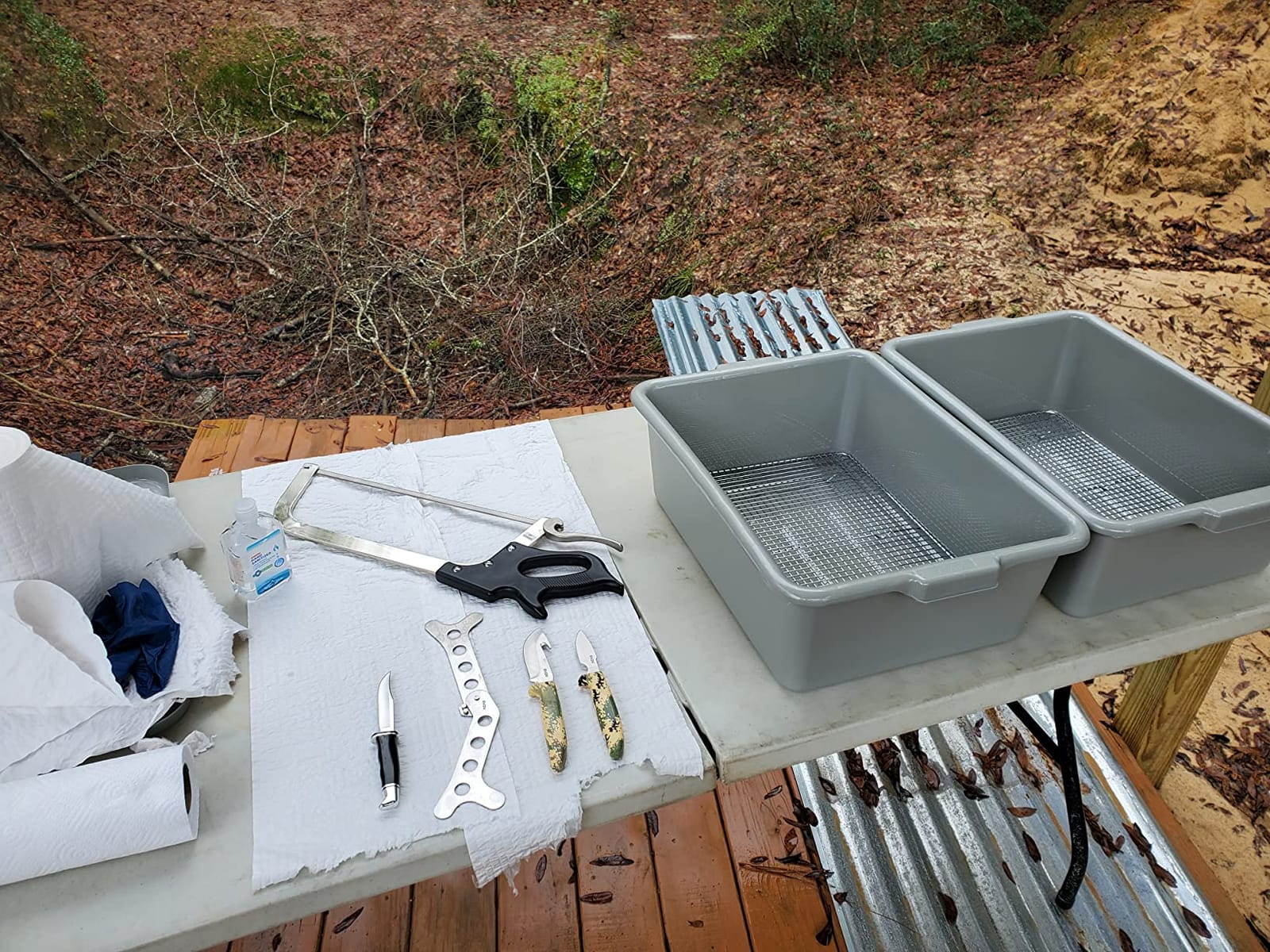
Loose blade tension is the number one reason a manual saw feels impossible. When the blade flutters, your strokes eat energy and your cut wanders off the line, and no amount of arm strength fixes it. The LEM tightening cam solves that with a single lever motion, and once you feel the difference on a stiff hock joint you will not go back to a wing nut.
The nickel-plated frame is another quiet advantage. It resists flexing under load, and rigid frame plus taut blade is the combination that produces a straight cut through a thick pelvis rather than a long, angled grind.
Blade Width and Teeth per Inch Choices
The blade is listed at 10 teeth per inch and half an inch wide, which is a good meat-and-bone compromise. More teeth cut smoother but bind faster in frozen material; fewer teeth rip faster but leave a rougher surface. Reviewers who work thick bone sometimes wish the blade were slightly wider, which is a fair limitation for anyone breaking down very large leg bones repeatedly.
Because the blade is tool steel rather than stainless, dry it promptly after washing. That is the single habit that keeps this saw sharp across multiple seasons, and it is the reason we include the sanitizing section below rather than leaving it to guesswork.
Comfort on Long Carcass Breakdowns
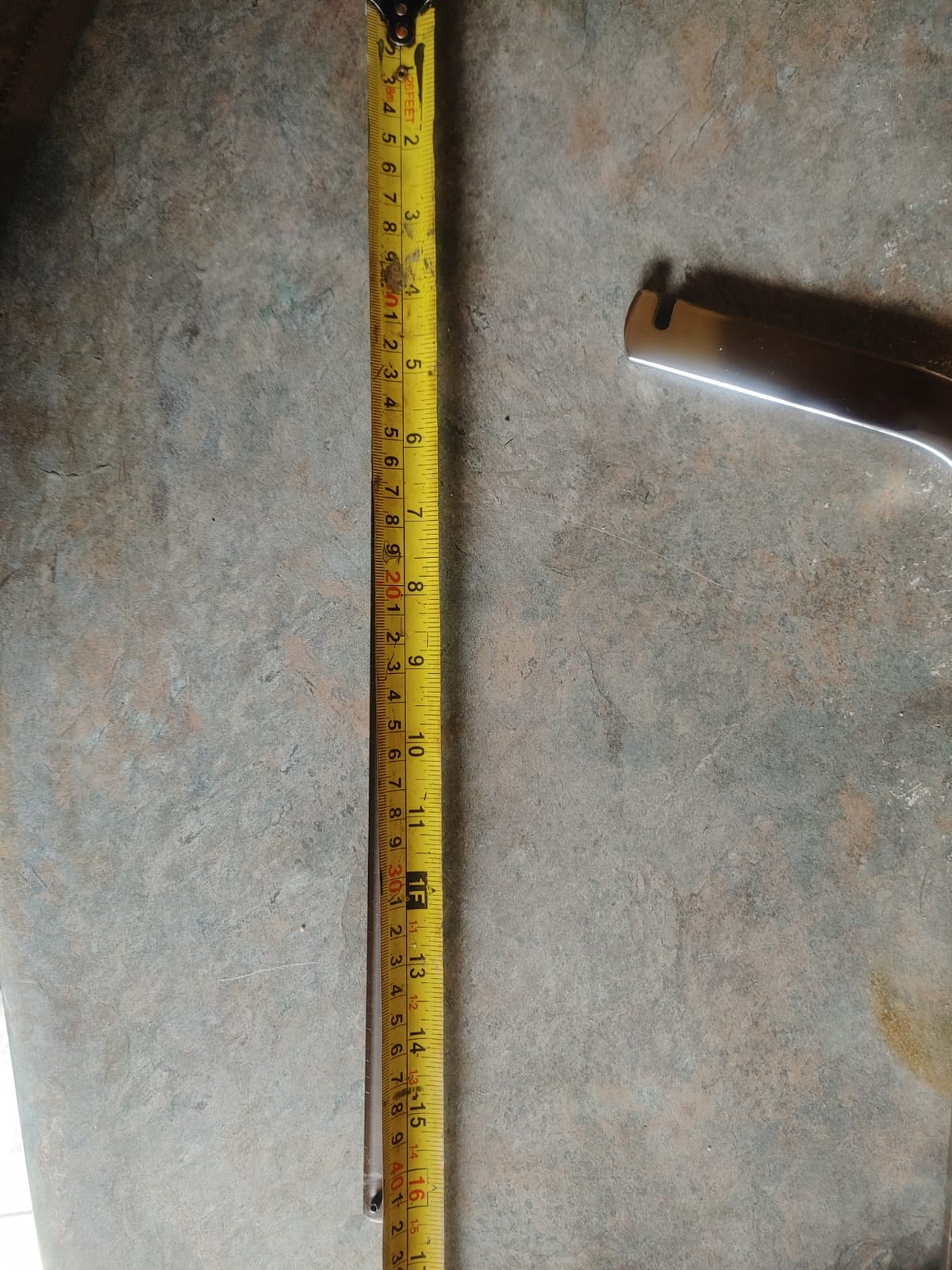
The ergonomic handle is designed for carcass work specifically, and owners who process whole animals report noticeably less hand fatigue than with lighter duty saws. Weight is 1.4 pounds, so it sits in the sweet spot between enough mass to keep the blade stable and enough lightness to keep your shoulders out of it.
One practical note: the black handle surface shows grime after processing large game, so have a damp cloth and a small brush ready as you work. It does not affect performance, and it is the only cosmetic complaint that shows up repeatedly in reviews.
3. Outdoor Edge 4.4 Inch Flip N Zip Saw – Best for Field Dressing
Outdoor Edge 4.4″ Flip N’ Zip Saw – Lightweight Folding Aluminum Handle Outdoor-Hunting Saw with 65Mn Spring Steel Blade and Triple Ground Teeth for Bone and Wood with Nylon Sheath
4.4 inch 65Mn spring steel blade
Triple ground teeth
Folds to pocket size
2.5 ounces
Pros
- Triple ground teeth tear through bone
- hide and wood
- Lock back mechanism holds blade firm under load
- Feather light at 2.5 ounces
- Bright orange handle is easy to spot if dropped
- Nylon sheath and belt clip included
Cons
- Short 4.4 inch blade needs more strokes on larger bones
- Gut hook tip is not for prying or hardwood
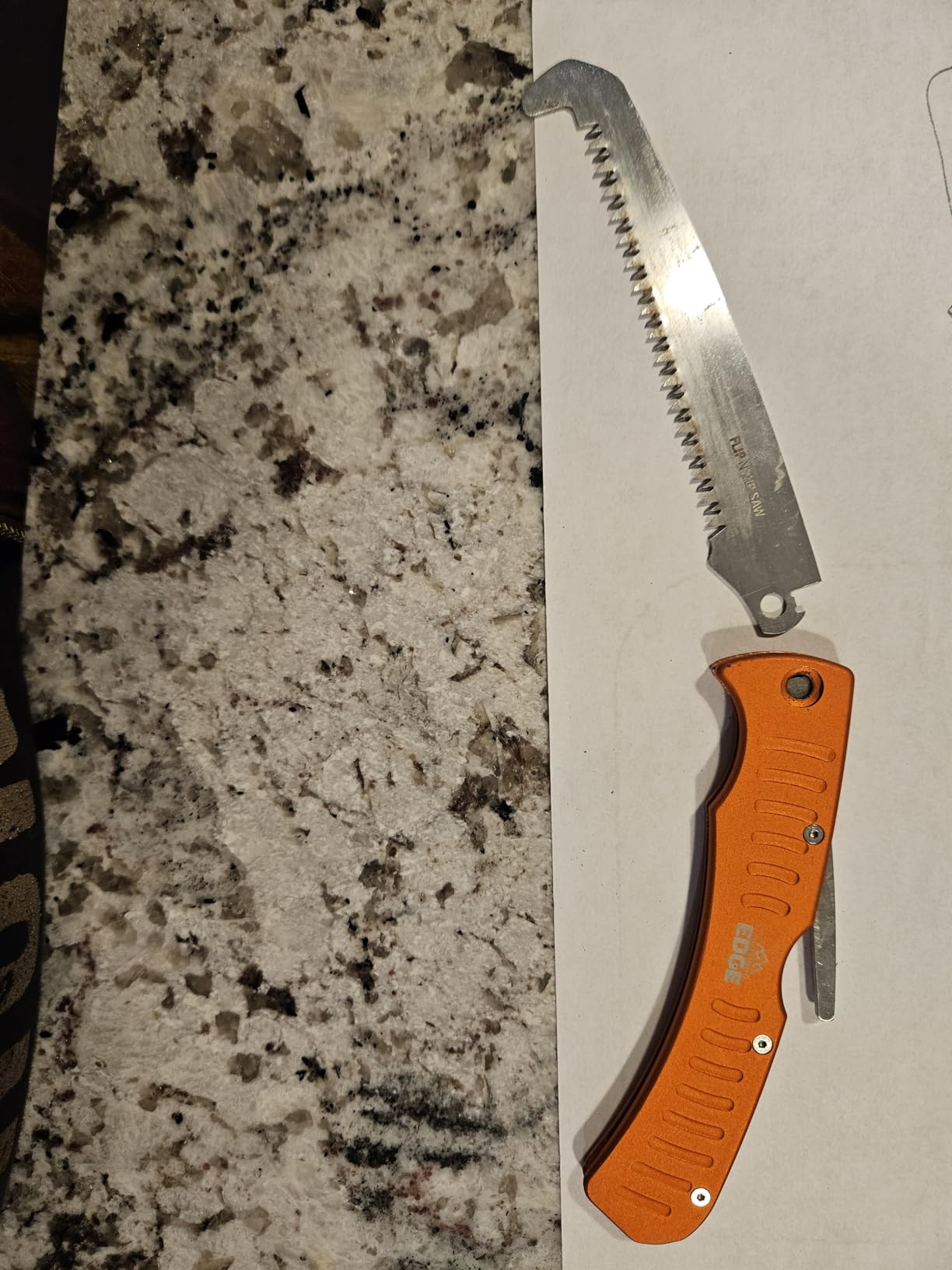
When the animal is still in the woods, the deciding factor is not blade length, it is whether the saw disappears into your pack. The Outdoor Edge Flip N Zip weighs 2.5 ounces and folds into a nylon sheath with a belt clip, which means it is on your hip rather than back in the truck when you find a better tree to hang from.
That said, the lock-back handle is aircraft-grade anodized aluminum rather than plastic, so it stays rigid when you are sawing, and the 65Mn spring steel blade with triple-ground teeth handles the rib and brisket work that field dressing actually requires. It is rated 4.5 stars across more than 900 reviews from hunters who know the difference between a toy and a tool.
Triple-Ground 65Mn Teeth for Bone and Hide
Triple-ground teeth are ground on three sides, which gives a tooth profile that is aggressive at the tip and durable along the flank. In practice that means the saw cuts hide and bone with the same stroke pattern, and it holds its edge through the kind of dirty, gritty work that dulls a conventional blade in one session.
The alloy is spring steel rather than stainless, so the trade is cutting aggression against corrosion resistance. Dry it before you pack it away and it stays sharp for many seasons. This is the standard trade hunters accept when the priority is weight and packability.
Packability and the Lock-Back Handle
The lock-back mechanism is the safety feature worth having on a folding saw in the field, because it resists accidental opening under pressure in a pack. It also removes the play you get in a cheap folding pivot, and that rigidity is why the blade tracks straight through bone instead of wandering.
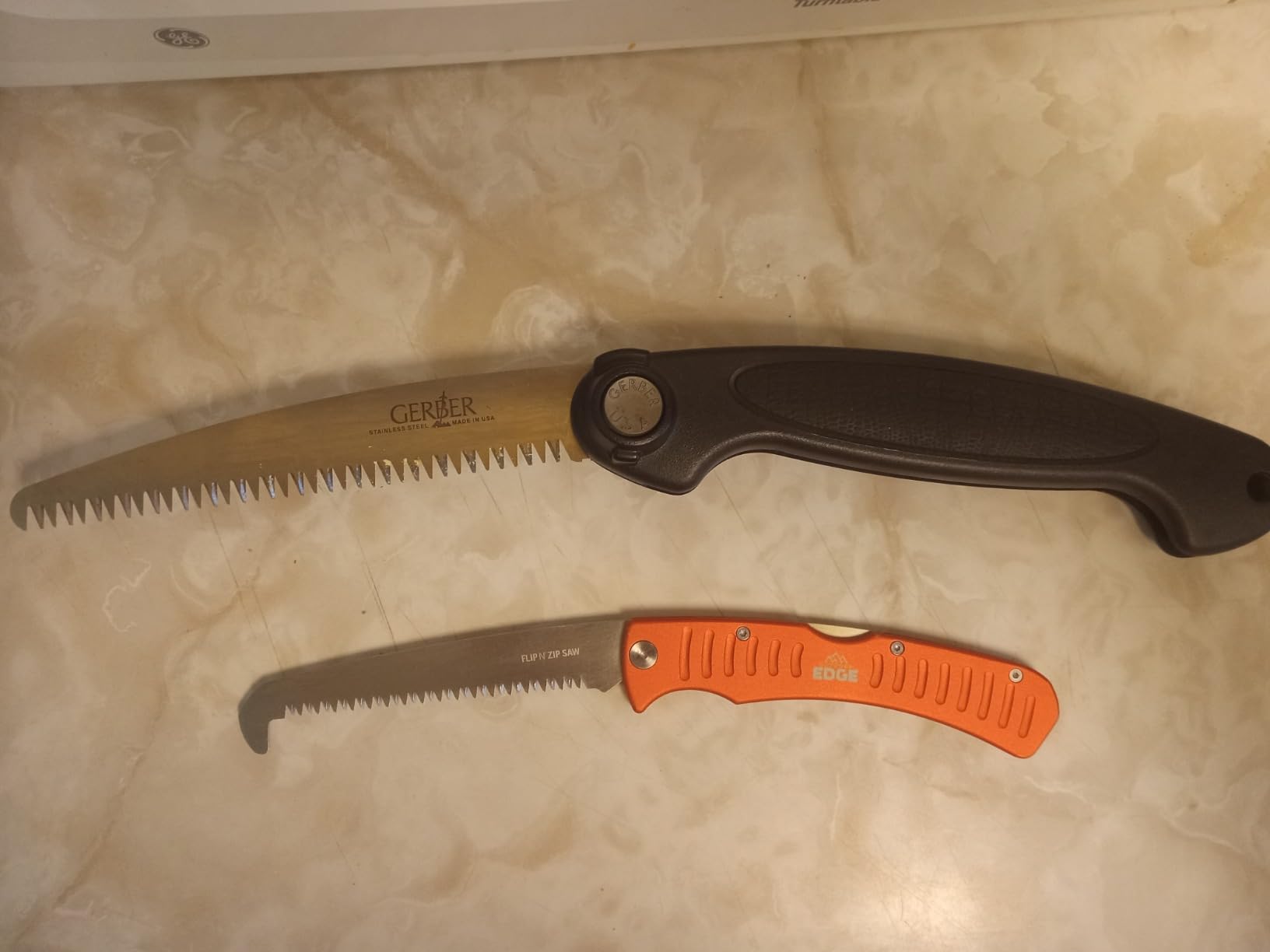
The bright orange anodized handle solves a problem most hunters underestimate. Dropped saws in leaves and grass are genuinely hard to find, and high-visibility handles have become a common request in hunting forums for exactly that reason.
Where a 4.4 Inch Blade Runs Out
Short blades are efficient because they clear sawdust and chips fast, but they mean more strokes for a big cut. Reviewers are straightforward that a 4.4-inch blade needs noticeably more strokes on larger bones, and you will feel that most on a deer pelvis or a hock.
The gut hook tip at the front is for opening the chest cavity, not for prying or hardwood. Treat it as a cutting feature, not a lever, and this saw stays sharp for far longer.
4. HME 5 Inch Compact Fixed Bone Saw – Budget Pick
HME Hunting Compact Fixed Stainless Steel Bone Saw with Scabbard
5 inch stainless steel blade
31 teeth
Fixed blade with scabbard
3.2 ounces
Pros
- Cuts rib and riblet bones quickly with little effort
- Compact and light enough to carry on every hunt
- Blade holds its sharpness season after season
- Non-slip grip stays secure with wet or gloved hands
- Included scabbard with belt loop
Cons
- Thin handle can be uncomfortable on long cuts
- Teeth feel coarse for very fine bone work
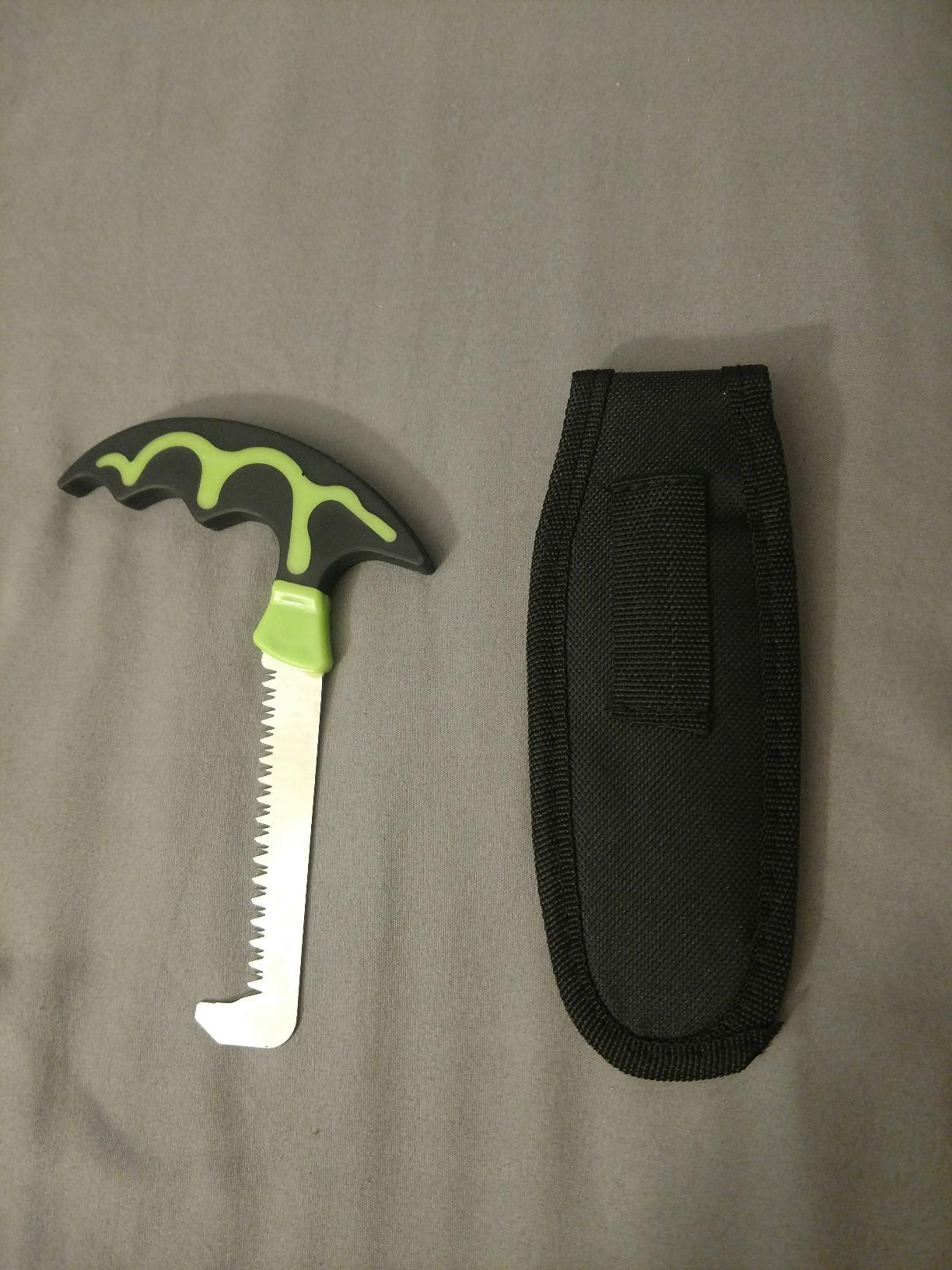
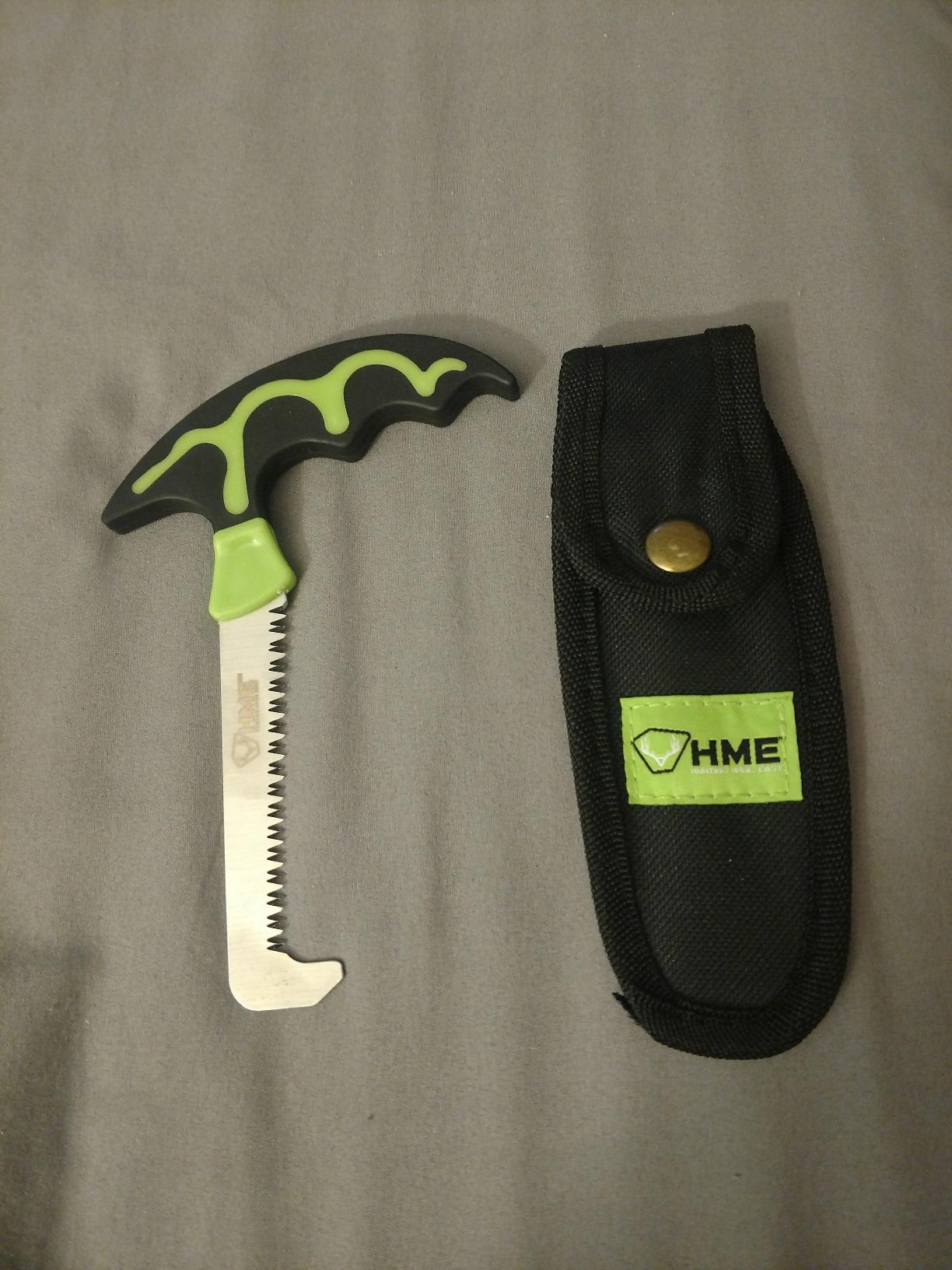
The HME is the answer for the common case of a hunter who needs to open a rib cage and get it done, without spending serious money or carrying a full-size butcher saw up a tree. At 3.2 ounces with a fixed 5-inch stainless blade and a scabbard, it does the two or three cuts that matter in the field and then rides on your belt for the rest of the season.
Reviewers rate it 4.4 stars across more than 500 reviews and describe it as a fast, durable backup for opening rib cages and brisket, and the fact that buyers report the blade retains sharpness season after season is the key trust signal here. Stainless steel plus a thin, light frame is a combination that works for small job after small job.
Blade Sharpness and Tooth Count
With 31 teeth on a 5-inch blade the tooth spacing is coarse, and that is deliberate. Coarse teeth shed material quickly and do not clog when the blade is wet with blood and connective tissue, which is exactly the condition you will be cutting in.
Some users report the teeth feel coarse for very fine bone work, and that is worth understanding before you buy. If your plans include trimming a delicate joint where you need a clean finish rather than a fast cut, this is the wrong tool, and a knife is a better answer anyway.
Fixed Blade Construction and the Scabbard
A fixed blade has no folding joint, so there is no play under load and no lock mechanism to fail. That rigidity is why the saw tracks straight through rib bones, and it is the structural difference you feel immediately compared with a folding saw of the same length.
The fixed blade does mean you must use the included scabbard when carrying it, and the scabbard with belt loop is part of the package rather than an accessory. Keep it on your belt and the saw is always where you need it.
Grip Security With Wet or Gloved Hands
The non-slip grip is the most important comfort feature in the field, because cold hands and gloves make everything slippery, and a saw that rotates in your hand on a rib cut is how people get hurt. Reviewers specifically call out that the grip stays secure in wet conditions.
A few buyers find the thin handle uncomfortable on longer cuts, which is fair. This is a short job tool, and pairing it with a full-size saw in the garage rather than as a sole tool is the sensible setup.
5. GreatNeck 22 Inch Bone Saw – Best for Large Carcasses
GreatNeck 22-Inch Bone Saw for Meat Processing with High-Carbon Blade
22 inch high carbon steel blade
6 inch cut depth
Alloy steel frame
2 pounds
Pros
- Solid steel frame with high carbon steel blade
- High tension adjustment screw for quick blade changes
- Smooth splinter-free cuts through meat and bone
- Oversized hardwood handle reduces hand fatigue
- 6 inch cut depth handles large game and poultry
Cons
- Hardwood handle can swell if left wet
- Blade may need re-tensioning after heavy jobs
The GreatNeck pairs a 22-inch blade with a listed cut depth of 6 inches, and that length is the whole argument. When you are working a large hog or splitting a heavy deer pelvis, stroke count is what wears you out, and a longer blade converts dozens of strokes into a handful.
At 4.2 stars from more than 500 reviews it sits in the middle of this roundup’s ratings, and the reason is consistent rather than a defect: the hardwood handle and the blade tension both need care after heavy work. Buyers who treat that as routine report smooth, splinter-free cuts and a frame they consider very solid.
Blade Length and Cut Depth for Big Animals
Blade length is the most underrated number on any butcher saw. A 22-inch blade reaches across a whole leg bone in a single sweep, which means fewer resets, fewer chances to drift off the cut line, and far less shoulder strain over a long job. Smaller saws make you work in a crouched posture that is hard on the back.
High carbon steel is a harder, sharper material than the spring steel used on field saws, and it holds an aggressive edge longer. The cost is corrosion: a high carbon blade needs to be dried promptly, every time, or you will find rust on a blade that should still be sharp.
High Tension Adjustment and Frame Rigidity
The high-tension adjustment screw lets you take up slack as the blade stretches, and that is a real advantage on a long blade where a little stretch goes a long way. Some users report needing to re-tension after heavy jobs, which is a maintenance fact of life rather than a flaw.
The alloy steel frame is what keeps the blade from flexing. Flex at the tang makes a cut wander and wastes energy, and a rigid frame is why this saw produces the splinter-free results buyers describe even on frozen material.
Hardwood Handle Comfort and Its One Weakness
The oversized hardwood handle gives you a large, solid grip surface that reduces hand fatigue on long breakdowns, and hardwood absorbs vibration better than molded plastic. For anyone processing a full deer or a large hog, that comfort difference is real by the second hour.
The clear weakness is moisture. Reviews specifically mention the handle can swell if it is left wet after processing, so wipe it down and hang the saw somewhere dry. Manage that one habit and the handle stays comfortable for years.
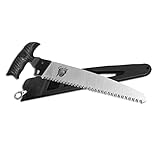
6. Outdoor Edge GrizSaw 8 Inch T-Handle Saw – Best T-Handle Comfort
Outdoor Edge GrizSaw – Lightweight T-Handle Fixed Blade Outdoor-Hunting Saw with 8.0″, 65Mn Spring Steel Blade for Cutting Tough Bone and Wood and Locking Zytel Sheath with Swivel Clip Belt Attachment
8 inch triple ground 65Mn blade
T-shaped handle
11.3 inches overall
Locking Zytel sheath
Pros
- T-shaped handle allows straight wrist cutting from any angle
- Triple ground chrome coated 65Mn blade penetrates tough bone and wood
- Fixed blade gives full rigid cutting power
- Light enough to carry all day in the field
- Lifetime service and warranty support
Cons
- Fixed blade requires a sheath to carry safely
- Shorter reach than a full size butcher saw
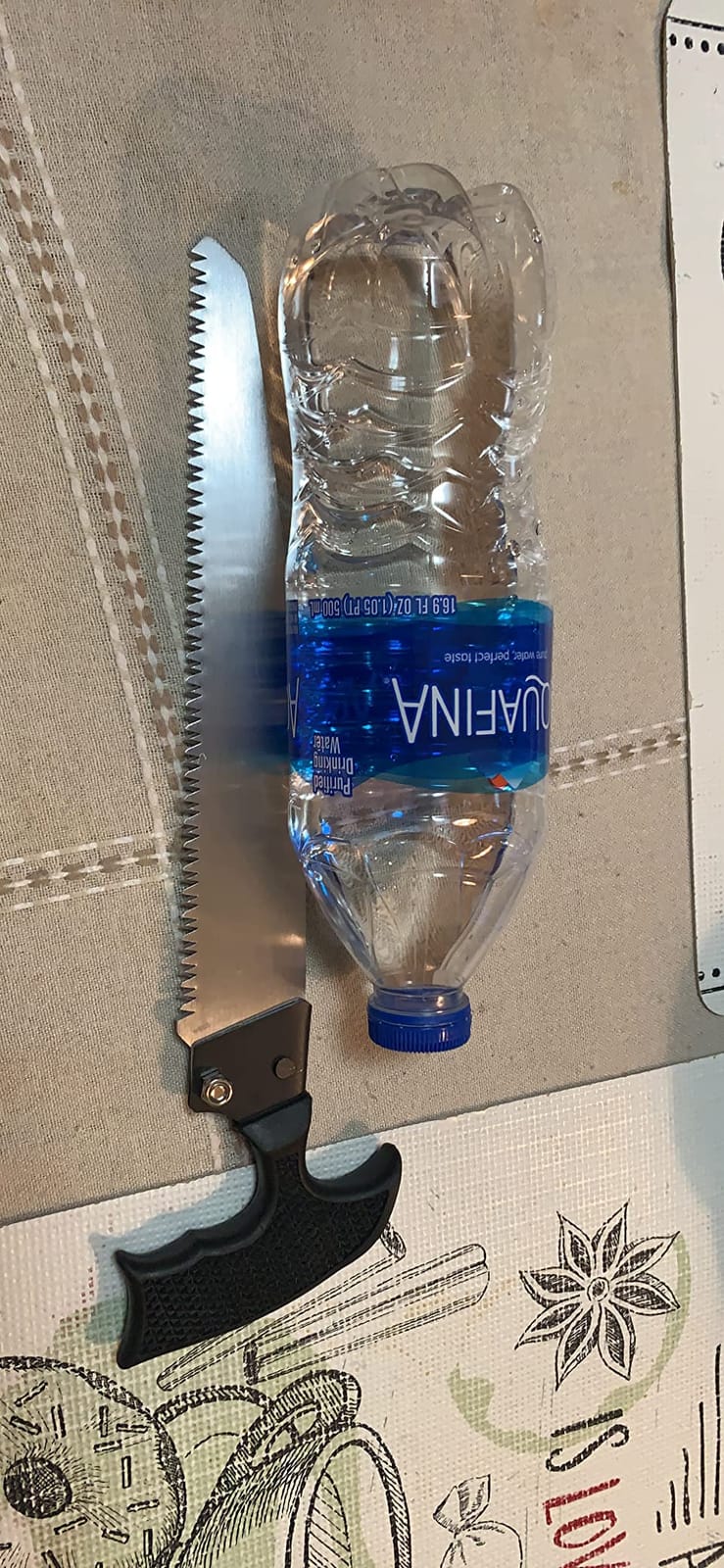
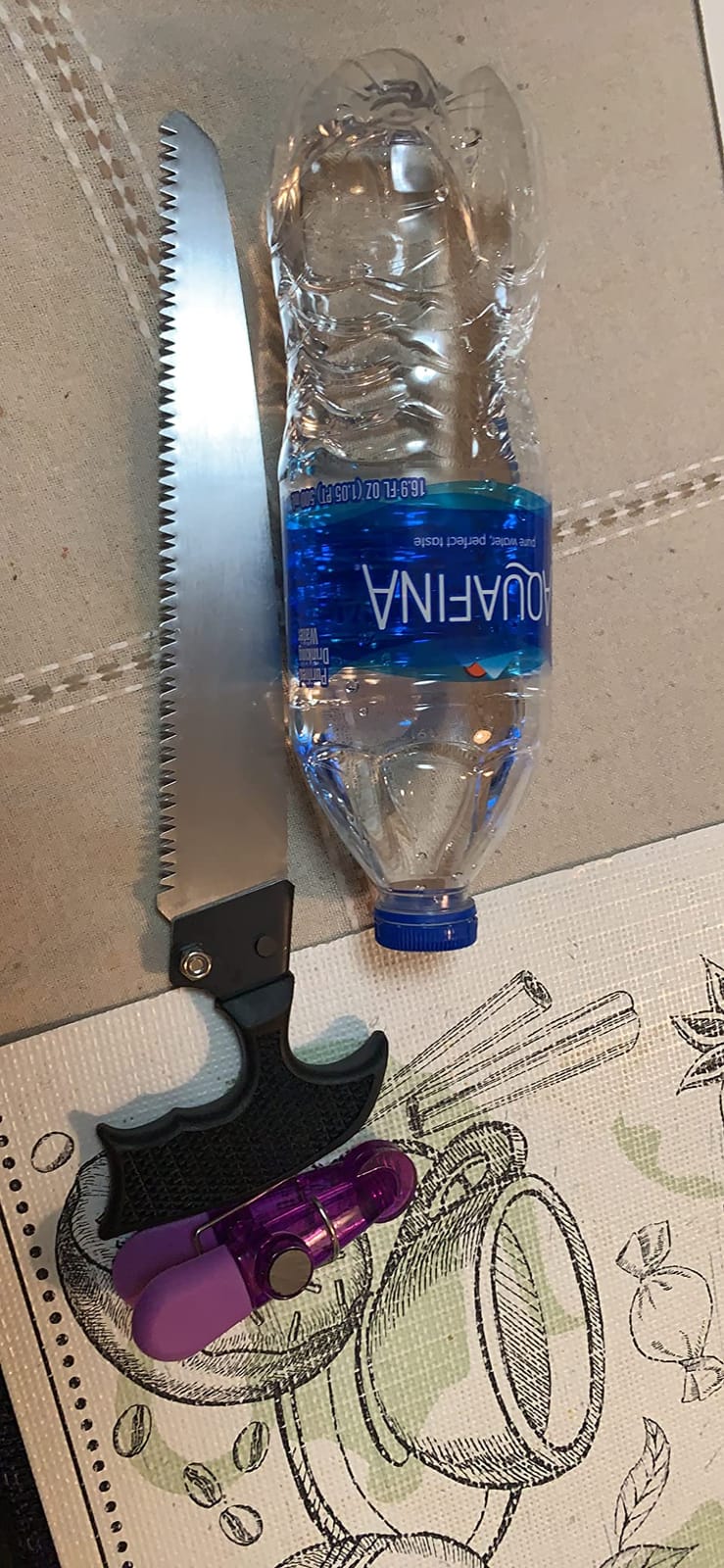
The GrizSaw is the one to look at if conventional straight-handle saws bother your wrist. The T-shaped handle keeps your wrist in line with the stroke rather than bent around a narrow grip, and on a long cutting session that single ergonomic difference removes a lot of the hand and forearm fatigue that ends processing days early.
With an 8-inch triple-ground chrome-coated 65Mn blade and a fixed, non-folding frame, it delivers the rigidity hunters want from a bone saw. It rates 4.4 stars from more than 370 reviews, and the maker backs it with a service for life warranty, which is uncommon in this category.
Why a T-Handle Reduces Fatigue
A T-handle spreads the load across your palm and keeps the stroke linear, so the blade tracks where you point it without your wrist fighting the saw. For people who already have wrist or grip issues, or who are simply processing a lot of animal, that is a meaningful upgrade over a straight handle.
It also changes the angle you can work at. Because your wrist is not the limiting joint, you can saw a rib plate or a hock from an awkward position on a hanging carcass without twisting your forearm into a position that causes strain.
Triple Ground Blade and Chrome Coating
Triple-ground teeth plus a chrome coating give a tooth pattern that stays aggressive and a surface that wipes clean and resists staining. Blade and tooth configuration like this is why this saw handles tough bone and wood alike, which is useful when you also need to cut through a leg brace or a bit of hide.
The fixed blade design gives full rigid cutting power with no folding joint to introduce play, and 11.3 inches overall at 8 inches of blade is a genuinely portable size that still has enough reach for real work.
Carrying a Fixed Blade Safely
Because the blade is fixed, you need the sheath to carry it, and the included quick-release Zytel sheath with a swivel clip handles that job well. Clipped to a belt or a pack strap, the saw stays accessible and the teeth are covered.
The honest limitation is reach. Reviewers note it has less reach than a full-size 20-inch-plus butcher saw, so for a large hog or a heavy deer pelvis you will still want a longer saw in the garage. Think of this as the field and camp saw that complements a bigger tool rather than replacing one.
7. KATA 20 Inch Butcher Meat Saw – Best for Frozen Meat
KATA Butcher Meat Saw, Manual Bone Saw for Frozen Meat, Deer Processing 20″
20 inch SK5 steel blade
Stainless steel frame
Polypropylene handle
2.6 pounds
Pros
- 20 inch blade handles large deer
- pig and rib cuts with fewer strokes
- Cuts through bone without binding or jamming
- Simple tension lever makes disassembly and cleaning easy
- Ergonomic polypropylene handle for repeated cuts
- Needs no electricity so it works anywhere
Cons
- Steel blade rusts if not dried promptly
- Some units arrive with a dull blade
- Heavier than field saws at 2.6 pounds
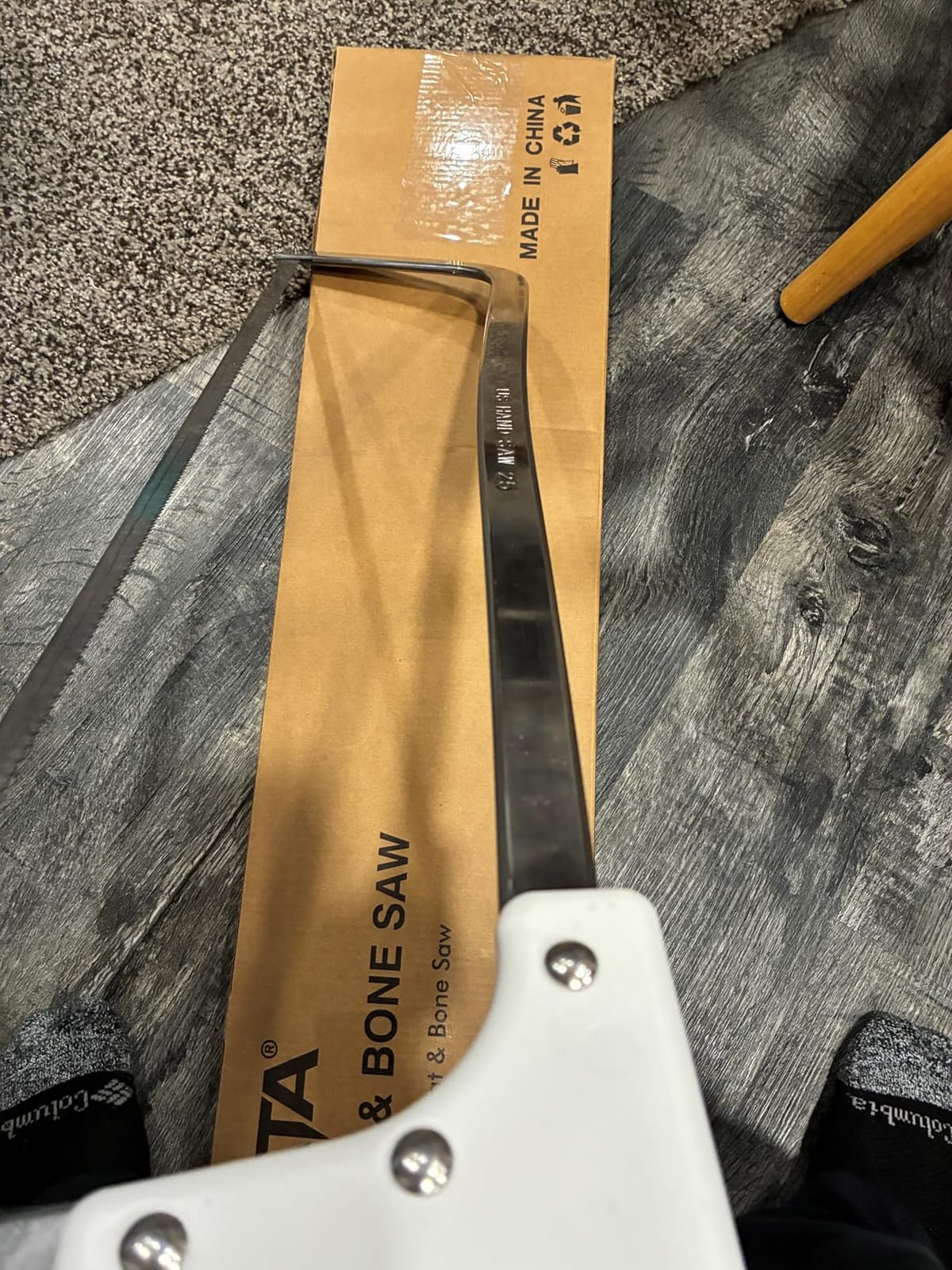
The KATA is the frozen meat specialist here. A 20-inch SK5 steel blade is long enough that a whole block of frozen beef needs a handful of strokes instead of an endurance event, and owners report it cuts through bone without binding, which is the failure mode that ends most frozen cutting jobs.
It is also available in 18 inch, 20 inch and 25 inch lengths, so if you process big blocks regularly the same design scales up with the job. The rating is 4.1 from more than 300 reviews, and the reviews focus on one theme above all: the blade must be dried quickly after washing or it will rust.
Why Blade Length Wins on Frozen Meat
Frozen meat is the hardest cutting condition in home butchering. The exterior is hard enough to blunt a fine-tooth blade, and the interior is slick and wet the moment the blade gets through. Coarse teeth plus a long blade handles both problems, because the blade sheds chips and clears the cut in fewer, heavier passes.
Hunting forum regulars repeatedly make the same point about frozen meat: cut it just shy of frozen, so the outside is firm enough to saw cleanly and the inside is not rock hard. Combined with a 20-inch blade, that one habit is the difference between a fast job and an exhausting one.
SK5 Steel and the Rust Trade-Off
SK5 is a high carbon tool steel that holds an edge well and is easy to resharpen, which is exactly what a frozen cutting job rewards. The tradeoff is the same one as any high carbon blade: it is not stainless, so owners who report surface rust are describing normal behavior for this material, not a defect.
The fix is simple and non-negotiable. Wash, dry, oil, and store somewhere dry. A blade that is dried immediately after every use will outlast one that is soaked and left overnight, and the difference shows within a season.
Cleaning, Disassembly and the No-Power Advantage
The simple tension lever makes the saw easy to disassemble and clean, and in butchering that matters more than it sounds, because a frame that comes apart in seconds gets washed properly, while a fixed frame gets wiped and recontaminated.
There is no motor, no cord and no outlet, so it works in a camp, a field tent, a farm building or a home kitchen with no setup. At 2.6 pounds it is heavier than field saws, which is the cost of the steel and the length, and it is not the tool you want to carry up a tree.
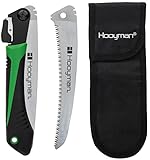
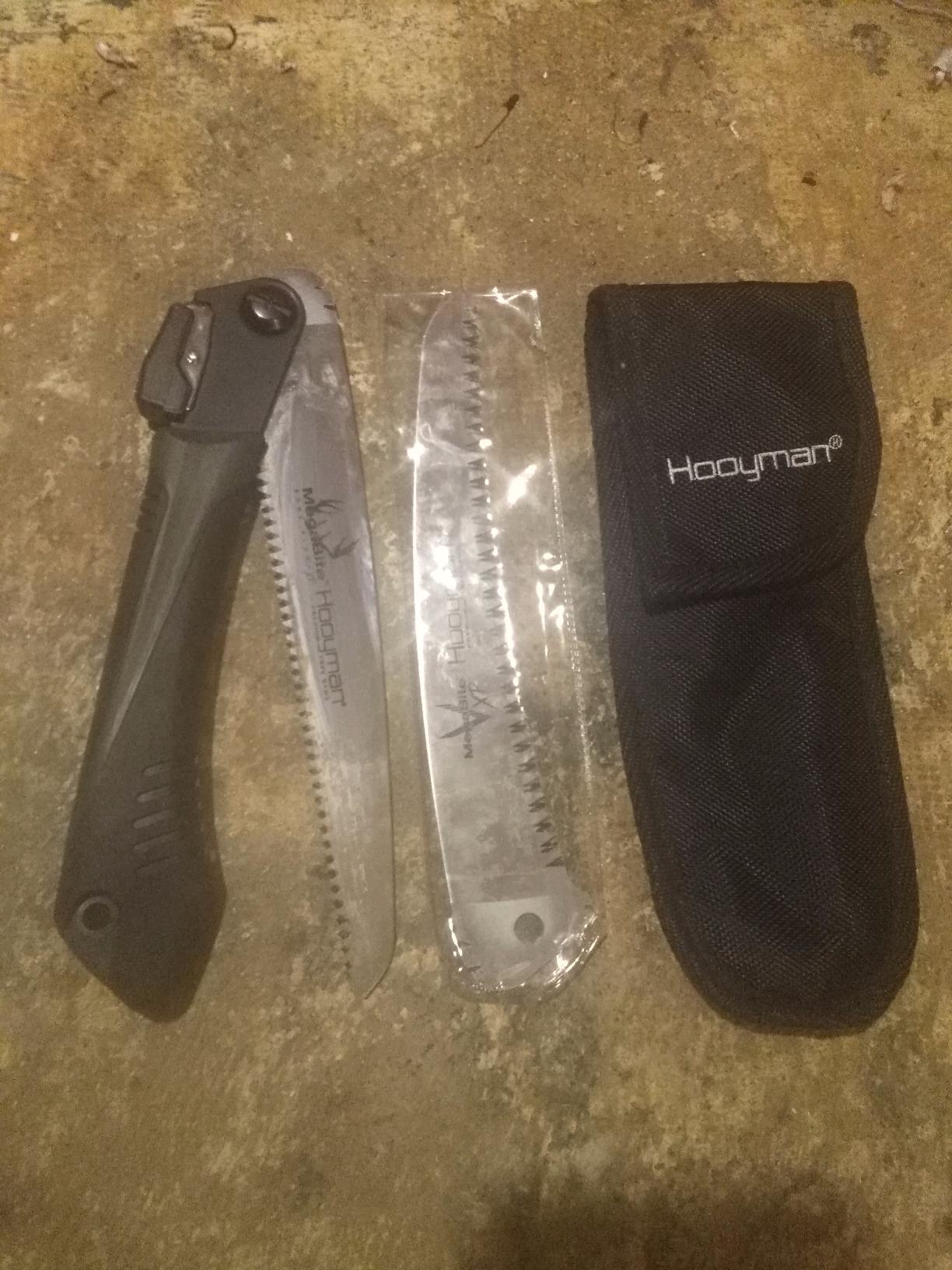
8. Hooyman MegaBite Combo Saw – Best Two-Blade Setup
Hooyman MegaBite Hunter’s Combo Bone Saw with Heavy Duty Construction, High Carbon Steel Blade, Impulse Hardened Teeth, and Ergonomic Over-Molded Handle for Camping, Hunting, and Outdoors
9.5 inch high carbon blade
Interchangeable bone and wood blades
Collapses to 9.5 inches
0.9 pounds
Pros
- Interchangeable wood and bone blades cover trimming and butchering
- Impulse hardened 4-edge teeth hold an edge for long life
- Folds to 9.5 inches and weighs under a pound
- Two locking positions with double molded handle
- Limited lifetime warranty
Cons
- Swapping blades takes practice
- Fold release button is easy to hit accidentally
- Bone blade cuts slower than dedicated bone saws
The Hooyman MegaBite solves a problem most single-purpose saws ignore. In the field you cut a bone, then you cut a leg brace or a bit of wood for a stand, and swapping saws for that is a waste of time. This one carries an interchangeable bone blade and wood blade in the same handle, so you change the blade rather than the tool.
It is rated 4.6 stars from more than 160 reviews, with owners calling it well built and versatile for elk, moose and branch work. It extends to 17 inches, collapses to 9.5 inches and weighs 9.6 ounces, which is a serious amount of capability in a packable package.
Interchangeable Blades and Tooth Hardening
The bone and wood blade pairing is genuinely useful rather than a gimmick, because the bone blade is optimized for a fast rip cut and the wood blade gives you a controlled, finer cut for camp work. Impulse-hardened 4-edge teeth are treated at the tooth level, which is why reviewers report the blade holding an edge for a long time.
The limitation is honest and comes from several reviews: the bone blade cuts slower than a dedicated bone saw of the same length. If your priority is fast bone work on a full carcass, buy the dedicated saw. If your priority is one animal and a camp, this covers it in one tool.
Folding Design, Locking Positions and the Release Button
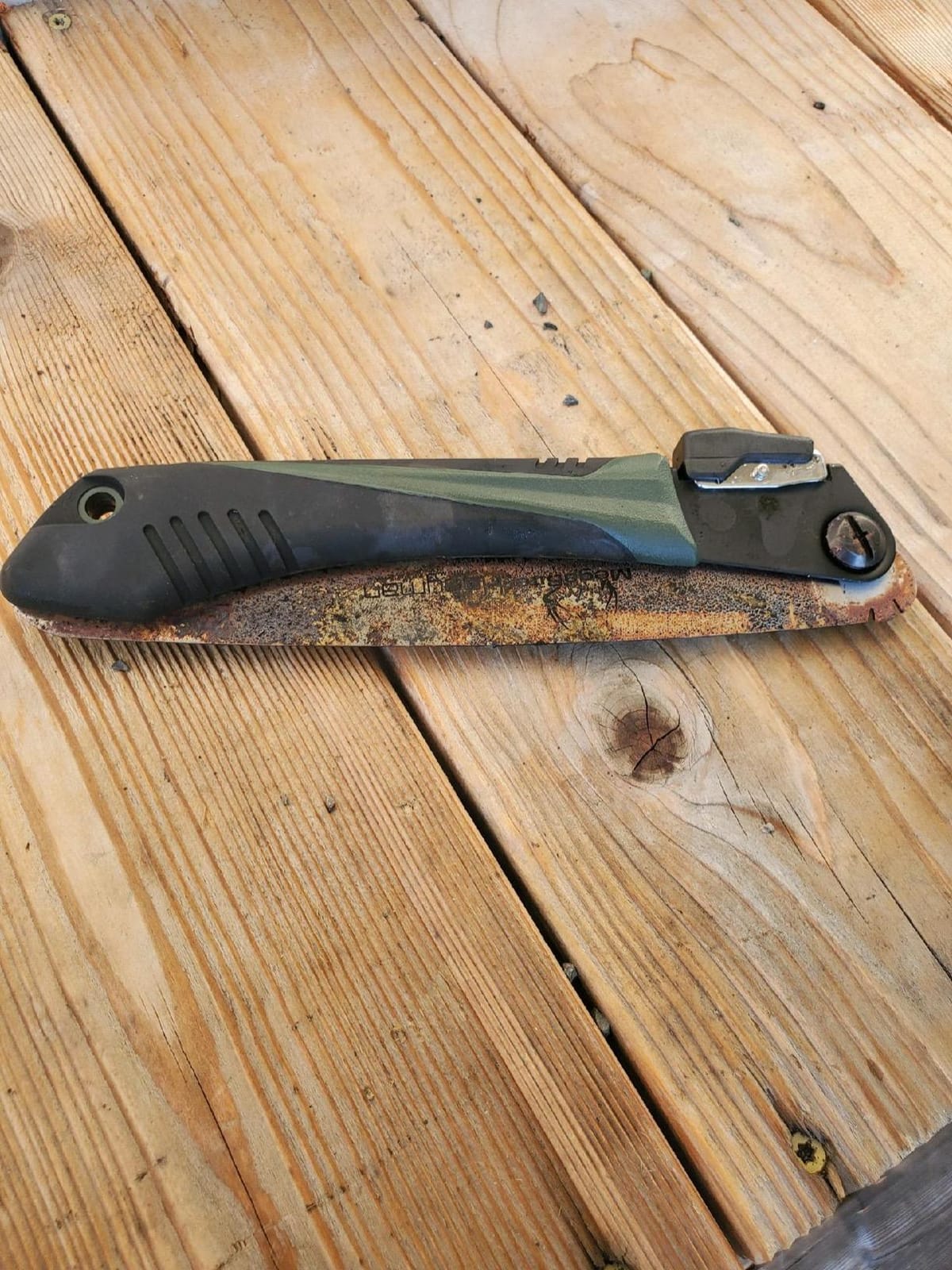
Two locking positions let you run the saw fully extended or partly collapsed, and the double-molded rubber handle stays secure when it is wet. Collapsing to 9.5 inches means the saw fits in a pack side pocket rather than hanging off your belt all day.
One genuine safety complaint: the fold release button is easy to hit accidentally when you are sawing two-handed. Some users find this frustrating rather than dangerous, and it is worth knowing about before you rely on the saw for one-handed cuts over a hanging carcass.
Swapping Blades Without Losing Sharpness
Blade changes take a bit of practice at first, and users say so plainly. Once you learn the swap, the two-blade system means you always have the right blade for the material rather than forcing a bone blade into a wood cut or the reverse.
The limited lifetime warranty is worth factoring in for a tool you will likely keep for years, and combined with the high carbon SK5 steel construction it is one of the better-backed saws in the field category.
9. RUITOOL 12 TPI Meat Saw – Best for Camp Butchering
RUITOOL Meat Saw for Butchering, Bone Saw for Hunting&Camping, 12 TPI Blade
7 inch high carbon steel blade
12 TPI triple ground teeth
Non-slip TPR handle
Manual, hand powered
Pros
- High carbon steel triple ground teeth hold a sharp edge
- Non-slip TPR handle stays comfortable when wet or gloved
- Blade and handle wipe clean easily after processing
- Lightweight and portable for camping and hunting
- An inexpensive backup saw that works
Cons
- Some buyers report trouble with thicker bone
- Some units arrive without the sheath
- 7 inch blade is short for large rib cages
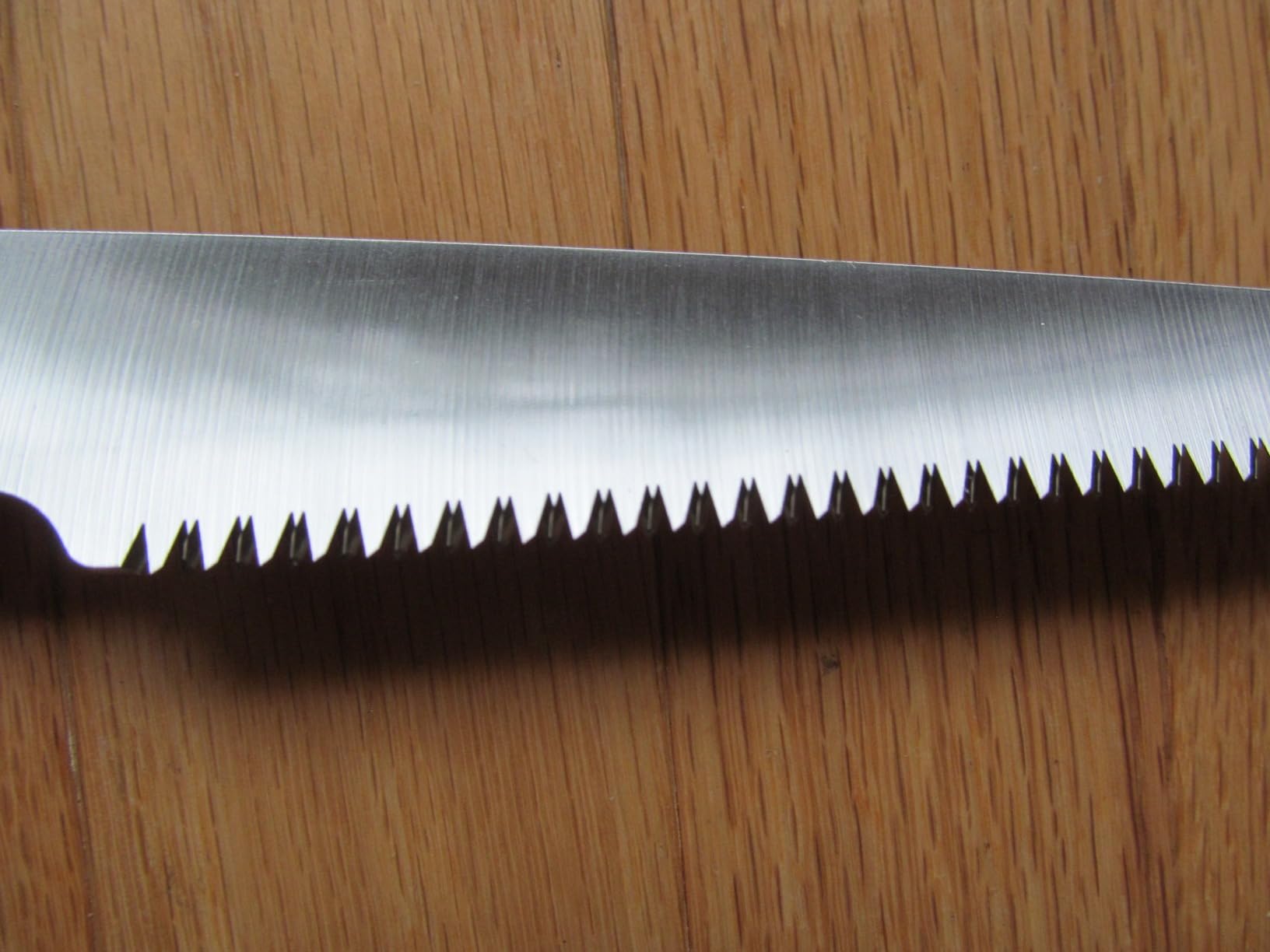
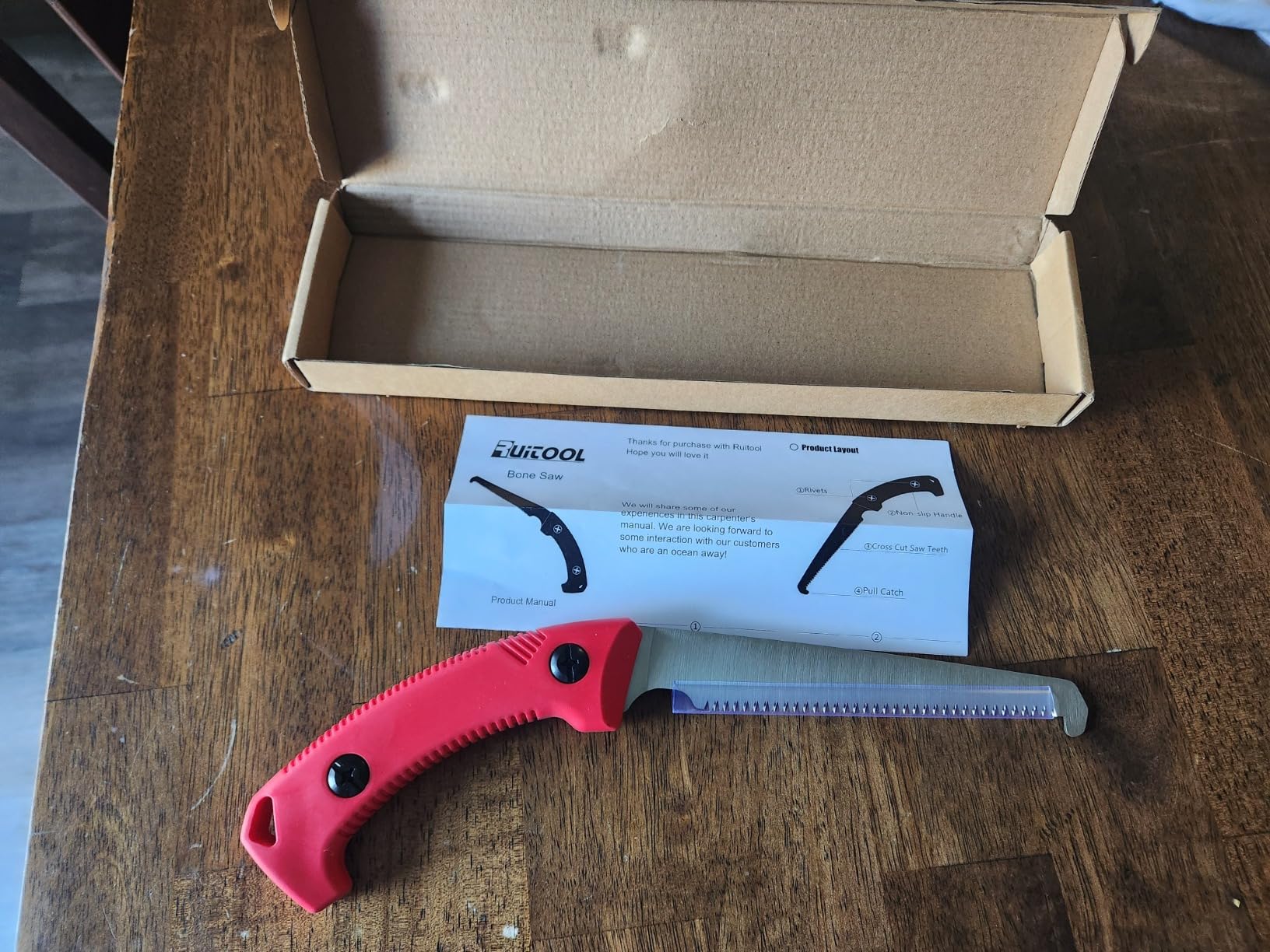
The RUITOOL is a compact 12 TPI saw built for the camp table, not the garage. At 7 inches with a high carbon steel blade and triple-ground three-sided teeth, it handles the medium cuts you run into when you are field dressing away from a truck, and the non-slip TPR handle is the feature that keeps it usable with cold or wet hands.
It comes in at 4.1 stars from more than 110 reviews, and the reviews are consistent: buyers like the sharpness, the grip and how easily it wipes clean, while a portion report poor performance on thicker bone. Read that as a scope limit rather than a quality verdict, because 7 inches is a short blade and thick bone is exactly what short blades are weakest on.
Understanding 12 TPI on a Compact Blade
Twelve teeth per inch on a 7-inch blade sits in the middle of the range, which is a sensible compromise for mixed work. It is fine enough to leave a reasonably clean surface on meat and coarse enough not to clog in wet connective tissue, and the three-sided ground tooth pattern gives a sharper tip than a simple mill tooth.
Where it falls short is sustained work on thick bone. Reviewers who bought it for big joints report that it struggles, and no tooth pattern fixes a short blade. Match the saw to the job size, and this is a very capable compact saw.
Grip, Cleanability and Camp Use
The TPR handle is non-slip and shaped to reduce hand fatigue, and reviewers specifically call out that it stays comfortable in wet or gloved hands. That is the single most important thing in a camp setting, where the saw is often used with cold hands right after dark.
Because the blade and handle surfaces wipe clean easily, sanitation after field use is straightforward. Some units arrive without the sheath shown in the listing, so treat the sheath as a separate purchase and do not pack the saw uncovered in a pack.
When a Compact Saw Is the Right Answer
A 7-inch saw is right when you are trimming a rack, opening a small rib section, or working a single animal in a camp. It is wrong for a large hog or a full deer breakdown, where a longer blade cuts stroke count dramatically.
As a second saw alongside a bigger one, the price and the packing footprint make it easy to justify. Hunters who carry a dedicated field saw often add a compact one because it handles the small cuts without them having to carry the big tool into rough ground.
10. Ceoighe 22 Inch Butcher Saw – Best Rigid Frame
Ceoighe 22 Inch Butcher Saw Meat Bone Cutting Stainless Steel Blade
22 inch 304 stainless blade
Carbon steel blade holder
Trigger lock tension
3 pounds
Pros
- Carbon steel frame resists bending under heavy cuts
- Quick release cam lock makes blade changes fast and secure
- Trigger lock maintains blade tension for controlled strokes
- Serrated 304 stainless blade does not bend in use
- Ergonomic ABS handle reduces hand fatigue
Cons
- Stock blade tooth pitch is fine for fast bone work
- Silver finish can flake on some units
- Heavy at 3 pounds for casual field dressing
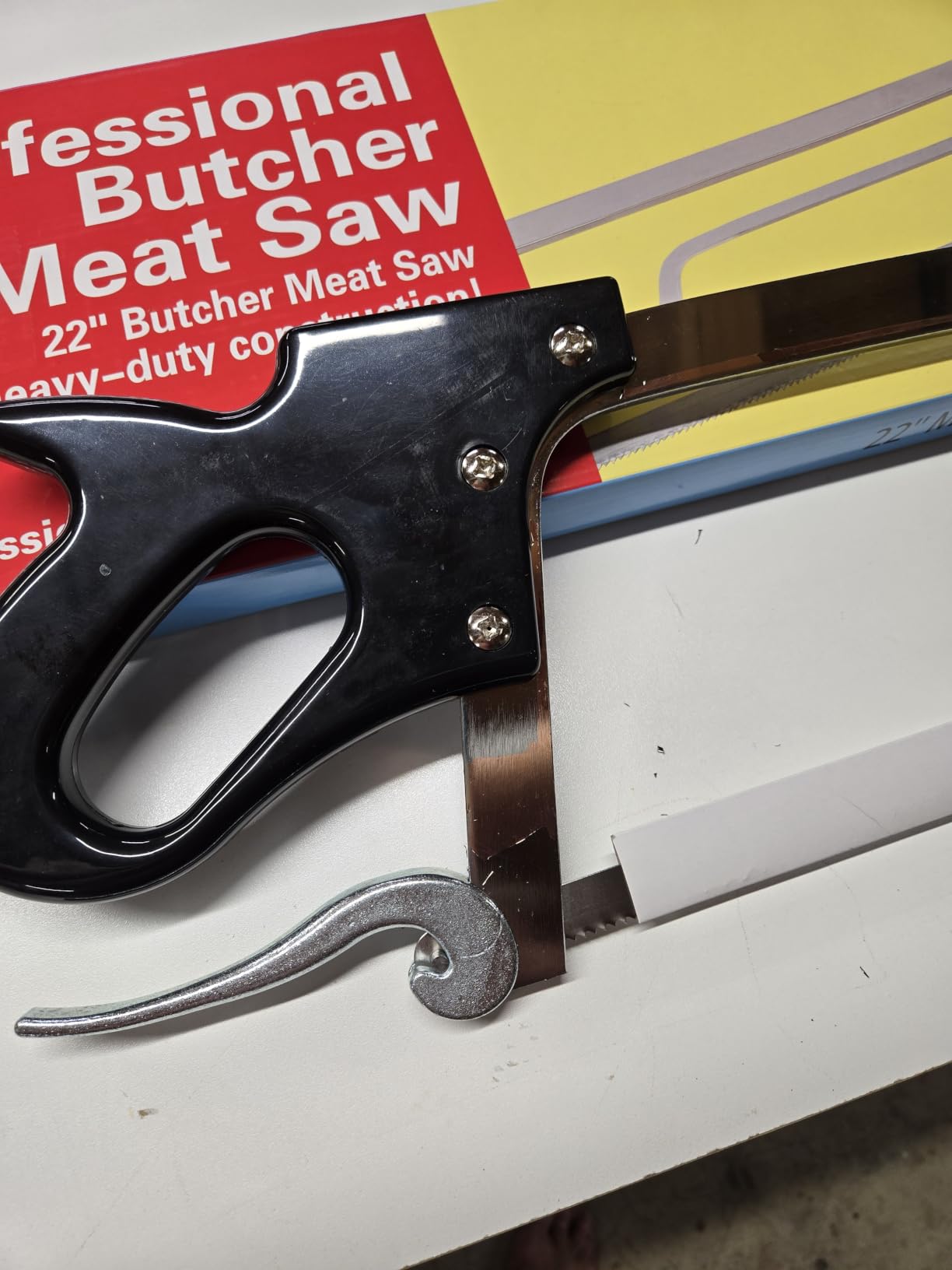
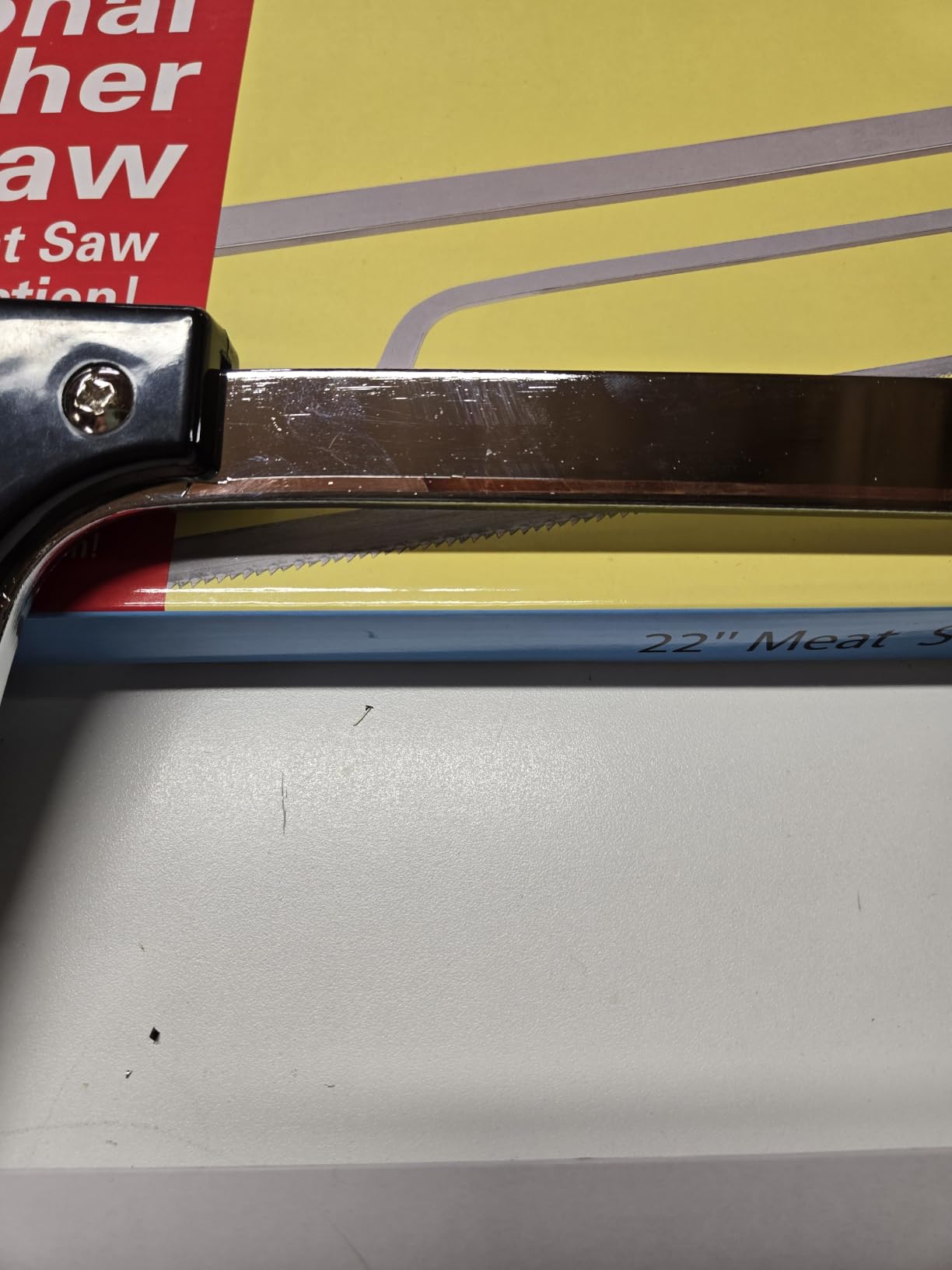
The Ceoighe combines the two things you want in a long saw: a 22-inch 304 stainless blade and a solid carbon steel blade holder. That pairing is why reviewers report the frame resists bending and the blade does not flex in use, and at 4.6 stars from 48 reviews the sentiment is strongly positive even on a small review base.
It is also available in a 25-inch length, and the quick release cam lever makes blade changes fast and secure. At 3 pounds it is the heaviest saw in this list, which is fine at a butchering block and wrong for a day in the woods, so match it to the setting.
Frame Rigidity and Blade Tension
Frame rigidity is what makes a long blade usable. A 22-inch blade in a flimsy holder flexes, and a flexing blade wanders off the cut line and wastes your effort. The carbon steel solid blade holder on this saw is the feature reviewers single out most often, paired with the trigger lock that holds tension through the stroke.
The quick release cam lever is a genuine convenience at a processing session, because you can change or re-tension a blade in seconds rather than working a small fastener with cold hands. That matters more than it sounds at hour three of a full carcass.
Stainless Blade Material and Its Limits
304 stainless is corrosion resistant, which means this saw tolerates repeated washing better than the high carbon options in this list. Buyers report the blade does not bend in use and produces clean cuts through meat and bone.
The trade-off appears in several reviews: the stock blade tooth pitch is fine, so bone cuts run slower than a coarser blade would. If you are buying this saw for hard bone work, budget for a coarser replacement blade, and check that a compatible one is available for your frame before you commit.
Weight, Finish and the Garage Setting
At 3 pounds, this is a saw for a fixed workstation. Owners use it for butcher shop, restaurant and home game processing tasks where the animal is on a table and the extra weight becomes stability rather than burden.
A few buyers report the silver finish flaking off new units, so inspect the blade and handle before first use and before the first wash. The molded ABS handle is ergonomic and does reduce hand fatigue on long breakdowns, which is the main ergonomic claim in reviews.
Manual Saw vs Reciprocating Saw vs Electric Saw
A dedicated manual bone saw is the right answer for most home butchering, but it is not the only one. The honest comparison is between three approaches, and the winner depends heavily on how many animals you process in a year and whether you already own a reciprocating saw.
Manual bone saws give you total control, a silent operation, no cord to trip over, and a very low cost per cut. They cost you effort, and on a large hog the arm fatigue reported by forum users is real. Reciprocating saws are dramatically faster and handle a whole carcass in a fraction of the time, but users report the blade can shatter bone and scatter fragments into the meat if you push it, and a frozen block will walk away from the cut.
Electric saws are the fastest option of all and are worth it for very high volume, but they bring sanitation, storage, and noise problems into a home setting. Hunters who already own a reciprocating saw often report that the saw never gets used, because the recip saw already did the four cuts that need sawing. Before you buy anything, check that list.
If you want to see how saws compare across other categories, our scroll saw guide covers a much finer class of blade work.
How to Choose a Bone Saw Blade: TPI, Steel and Length
Blade length is the first thing to decide, because it determines how much work a cut takes. Below about 5 inches you are packing a field tool for rib and brisket work. Between 8 and 10 inches you get a camp saw with usable reach. From 16 inches upward you have a garage saw that clears a thick leg bone or pelvis in a small number of strokes. A 22-inch saw reduces stroke count further still, and anyone breaking down several large animals a year will feel the difference by hour four.
Next, steel type. Stainless steel resists corrosion and takes a wash without immediate consequence, which suits anyone who cannot guarantee a dry blade every night. High carbon steel and alloys like SK5, 65Mn and tool steel hold a sharper, more aggressive edge and are the better choice for dry, skilled use, but they will show rust if you leave them wet. Know your own habits before choosing.
Then teeth per inch, or TPI. Low TPI means few, large teeth that rip fast, clear chips easily and tolerate frozen material. High TPI means many small teeth that cut smoothly but bind quickly in wet or frozen meat and generate heat. For general home butchery, something in the range of 10 to 12 TPI covers ribs, joints and frozen blocks well. A 5-inch field saw running 31 teeth is a deliberate choice for fast rib work rather than fine finishing.
Tooth pattern matters too. Triple-ground teeth are ground on three sides for a sharper, more aggressive tip, and induction or impulse-hardened teeth resist dulling. Serrated and straight teeth split into two camps: serrations cut faster through soft tissue, while straight teeth are much easier to sharpen and resharpen at home.
Finally, tension system. Wing-nut tension is fine for occasional work, a cam lock is faster and holds better under load, and a trigger lock keeps tension steady through a stroke. If you process more than one animal a year, a trigger lock or cam lock is worth the small step up, because consistent tension is what keeps a cut straight.
One rule applies to every purchase in this category: the blade must be food-contact safe. Painted or plated blades that are not rated for food contact can flake onto meat, and that is a deal-breaker. Stainless steel and bare high carbon steel are the two safe defaults, and every saw in this roundup is one or the other.
Bone Saw Technique: Pelvis, Hock and Rib Cage
Start at the hock, not the pelvis. A deer hock joint is the cleanest first cut on the animal and it teaches you the stroke, the angle, and how much pressure the saw actually needs. Keep the blade roughly level and let the saw do the work, because pushing down hard just makes the teeth bind and dull faster.
The pelvis is the cut that scares people, and the fix is technique rather than equipment. Saw from the side of the bone, not straight down onto it, and use short controlled strokes until you break through, then open the blade up for the long sweep. A saw that flexes here is usually a short saw, which is why the 16-inch and 20-inch models exist.
For the rib cage, work from the spine toward the sternum on the plate, and stop before the breast bone if your cuts allow it, because the breast bone is a good place to switch to a knife. For the shoulder, take the arm off above the knee, then saw the shoulder joint from underneath with the blade flat against the meat side so the teeth stay in meat and bone rather than in open air.
Keep your non-cutting hand on the animal, not on the blade path, and saw so the teeth travel away from your body. Those two rules prevent the overwhelming majority of saw injuries, and they are the reason a dedicated saw beats a reciprocating saw for inexperienced hands.
For the frozen cuts, cut meat just shy of frozen. A plastic spatula between the meat and the saw blade reduces tearing in soft tissue, a tip that shows up repeatedly in hunting forum advice. On the whole-animal question, longtime forum users name a small group of tools over and over: the Gerber E-Z Saw, the Havalon Baracuta for its bright, easy-to-spot color and replaceable blades, and Casstrom models in the 5-inch and 3.5-inch blade sizes alongside the Sagen saw, all chosen for replaceable blades. Other regulars name the Wyoming saw for shipping with both a bone blade and a wood blade. Several longtime processors argue a single quality boning knife is all a small animal ever needs, and that argument deserves a real hearing.
When You Do Not Need a Saw
A sharp boning knife is the correct tool for most of a carcass, and for small poultry it is the only sensible option. Poultry, rabbits, small game and most of the trimming on a deer are knife work. Reach for the saw only at the four structural cuts: the pelvis, the hock, the rib plate and the shoulder.
A good boning knife with a thin, flexible blade follows the natural seams of a carcass, and a saw cannot do that at all. Many experienced processors break down an entire small animal with one knife, and the money you do not spend on a saw is money better spent on a sharpening stone.
The reverse is also true: a boning knife should never be used to cut a joint. Forcing a thin knife through a hock or a pelvis is how you snap a blade and waste the knife, which is a poor trade for a cut that takes a saw fifteen seconds.
How to Clean and Sanitize a Bone Saw
Cleaning is what separates a saw that stays sharp for years from one that ends up rusted and blunt after a single season, and it takes less time than most people expect if you do it immediately.
First, knock the blade along the spine of the saw with the flat of a scraper or the back of a knife to push meat and bone chips off the teeth. Do this before any washing, because debris driven into the teeth during a wash is harder to remove and dulls the blade faster.
Second, wash the blade and frame in hot soapy water and scrub the tooth line with a stiff nylon brush, working along the blade rather than across the teeth. Third, rinse thoroughly, since trapped soap and protein are what actually harbor odor and bacteria.
Fourth, dry it immediately and completely. High carbon and spring steel blades must be dried before they sit in a closed case, and this is the step that decides whether your blade is still sharp next season. Wipe it dry, then let it air dry fully.
Fifth, apply a light coat of food-grade cutting oil to the blade and the tang, which protects against corrosion and makes the next cut cleaner. Sixth, store it loose or hanging rather than clamped in a wet case, and never immerse a powered tool, since water in the housing is what kills electric saws.
For a saw that contacts a carcass, wash and sanitize before every use on a new animal, and sanitize the blade and handle between tasks if you are working through multiple cuts in a single session.
Home Butchering Safety and Legal Basics
Check your state and local rules before you process an animal for anything other than your own family. Rules on slaughter, on where you may butcher, and on disposal of waste vary widely, and several states restrict home butchering on property you do not own. A short call to your state agriculture department answers most of it in five minutes.
The critical legal line is sale. Meat from your own animals, processed at home for your own consumption, is generally fine. Selling home-raised meat is a different matter entirely, and in most states it requires a licensed facility and a USDA or state inspected process. This is the single area where home butchering commonly runs into a real problem, and it is worth knowing before you process more than one animal.
On the safety side, use a cut-resistant glove on the non-cutting hand, keep the saw blade path clear of your support hand, saw with the teeth traveling away from your body, and work on a stable surface at a height where you are not bent over. Many saw injuries in a home setting are repetitive strain injuries from bad working posture rather than cuts, so raise the carcass rather than crouching under it.
And keep the job clean. Wash hands, wash the saw, and do not let a carcass sit in the heat while you take breaks, because food safety failures in home butchering are almost always temperature and time problems rather than equipment problems.
Frequently Asked Questions
What saws can cut through bones?
A dedicated bone saw, a pruning saw with coarse teeth, a hand hacksaw and a reciprocating saw with a coarse-tooth blade can all cut bone, but they are not equal. A bone saw has aggressive, widely spaced teeth and a deep, rigid frame that clears a thick bone in one pass without shattering it. A hacksaw cuts bone but bakes in heat and stalls. A reciprocating saw is fast on thin bone but can shatter thick bone. A reciprocating saw on frozen meat also risks blade breakage. For home butchering, a long stainless or high carbon bone saw is the most controllable choice.
What type of saw blade is best for cutting bone?
For most home butchering, a coarse-toothed blade in a food-contact-safe steel is best. Stainless steel resists corrosion and handles repeated washing, while high carbon steel holds a sharper edge for aggressive work but must be dried promptly. For teeth per inch, 10 to 12 TPI is the general-purpose range for ribs, joints and frozen blocks. Fewer teeth rip faster and clear chips better; more teeth cut smoothly but bind quickly in wet or frozen meat. Triple-ground teeth give a sharper tip than plain mill teeth.
What is the best electric saw for cutting meat and bone?
For a home user, an electric saw rarely beats a good manual bone saw. Electric saws are the fastest option available, but they cost more, need cleaning and storage, and are noisy in a home setting. They make sense for very high volume processing, such as several large animals a month or a small farm business. If you already own a reciprocating saw, you already own the fastest tool most home processors will ever need, and spending on a manual bone saw for the four cuts that require one is the better move.
What type of knife is best for cutting through meat bones?
No knife is the best tool for cutting through meat bones, and forcing a boning knife through a joint will usually snap the blade. Use a sharp boning knife or cleaver for separating meat along natural seams, and reserve the saw for the structural cuts at the pelvis, hock, rib plate and shoulder. For small poultry and small game, a good boning knife is the correct and sufficient tool for the entire breakdown.
What is the best TPI for cutting bone?
Around 10 to 12 teeth per inch is the best general range for home butchering. That tooth spacing cuts smoothly through meat and bone in the same stroke without clogging in wet connective tissue. Coarser teeth, below 8 TPI, rip faster and tolerate frozen material better. Finer teeth, above 14 TPI, leave a smoother surface but generate heat and bind quickly in frozen or wet meat. A coarse field saw running around 30 teeth is designed for fast rib work, not for fine finishing cuts.
How do I keep a bone saw sharp?
Keep it sharp by preventing heat and keeping it clean. Knock meat and bone chips off the teeth along the spine of the blade after every use, wash in hot soapy water, scrub the tooth line with a stiff nylon brush, and dry it immediately. High carbon and spring steel blades must be dried before being stored or they will rust within days. A light coat of food-grade cutting oil protects the blade between sessions. Serrated teeth are difficult to resharpen, so resharpen straight-tooth blades with a file and plan on replacing serrated blades instead.
Final Verdict: Which Bone Saw Should You Buy?
If you break down one or two animals a year in a garage and want the least second-guessing, the Weston 16-inch is the pick. Its stainless blade tolerates the wash cycle, the trigger lock keeps your cut straight, and the strongest combination of rating and review count on our list is the Weston 16-inch. If you want the best-rated saw on the list and you are willing to dry the blade after every use, the LEM 16-inch at 4.6 stars is the stronger tool, and its cam lock is the reason.
If you are working in the woods rather than the garage, the Outdoor Edge Flip N Zip at 2.5 ounces is the one that will actually be on your hip when you need it, and the HME 5-inch is the budget pick that does the rib and brisket work and nothing more. If your problem is frozen blocks, blade length wins: the KATA 20-inch and the GreatNeck 22-inch convert a long job into a short one. If your wrists are the limiting factor, the T-handle on the Outdoor Edge GrizSaw changes how the work feels.
Whichever you choose, the saw is only a small part of the job. Know the four cuts that need a saw, keep the blade clean and dry, and check your local rules before you process anything you intend to share. Run the right tool, at the right length, for the four cuts that need it, and the best bone saw in 2026 is the one that lets you finish the animal before dark.
Leave a Reply