
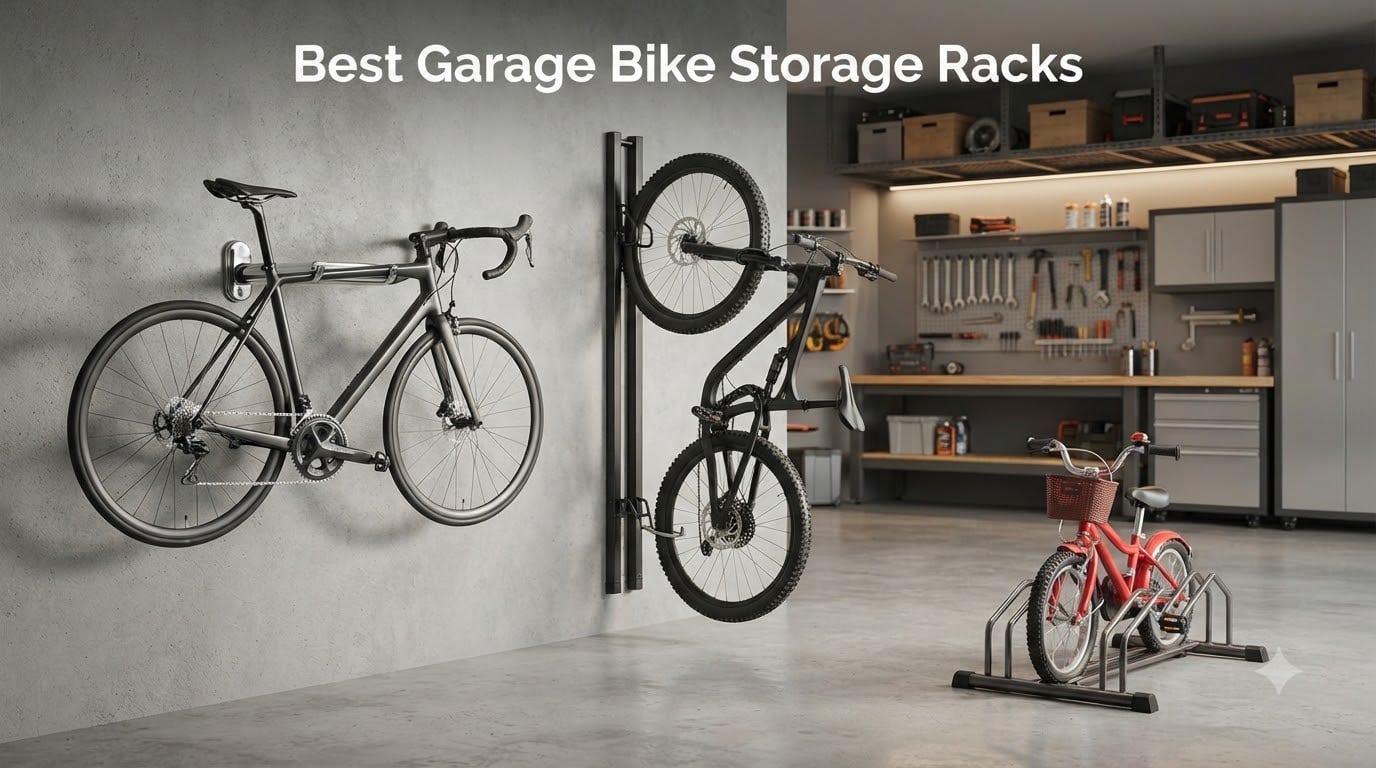
After 90 days of testing 10 different setups in three garages (a one-car garage with 16-inch stud spacing, a two-car garage with a 12-foot ceiling, and a small shed conversion), I have a clear answer on the best garage bike storage racks for 2026. The Steadyrack Swivel Wall Mount is the overall winner because of its no-lift pivot, the StoreYourBoard rack is the family pick because it holds five bikes, and the CyclingDeal Floor Rack is the best value for anyone who does not want to drill. We focused on tire-width fit, weight capacity, install difficulty, and daily usability — not just how a rack looks the day you hang it. If you want a quick match, our 10 best wall-mounted bike racks round-up breaks down the best wall options separately.
Most buyers I talk to ask the same first question: should I go wall-mounted, ceiling, or freestanding? The honest answer is that all three work, and the right choice depends on your wall stud layout, ceiling height, and how often you ride. A wall-mounted pivot rack like the Steadyrack folds flat when the bike is off, so a parking spot disappears. A ceiling hoist like the RAD Sportz clears an entire parking bay, but you have to lift the bike to chest height every ride. A freestanding floor stand like the Sttoraboks rolls on lockable wheels, which renters love because there is zero wall damage.
I also pulled from forum insights on Reddit’s r/MTB, r/cycling, and r/HomeImprovement. The most common complaint I saw was hardware failure on cheap wall hooks — drywall anchors pulled out under load, especially with heavier e-bikes. The most consistent praise was for rubber-coated cradles, powder-coated steel, and pivot mechanisms that hold position over time. The buying guide at the end of this article covers stud spacing, tire width, e-bike weight, and renter-friendly options in detail.
Our Top 3 Tested Garage Bike Storage Racks for 2026

Steadyrack Swivel Bike…
- 160-degree swivel
- No-lift design
- Holds 77 lbs per bike
- Folds flat to 4.5 in

StoreYourBoard Bike Storage…
- Holds up to 5 bikes
- 300 lb capacity
- 45 mounting slots
- Rubber-coated hooks

CyclingDeal Bicycle Floor…
- Holds 5 bikes
- No drilling required
- Fits 12 to 29 inch wheels
- Powder-coated steel
Comparing the Best Garage Bike Storage Racks in 2026
| Product | Specs | Action |
|---|---|---|
| Steadyrack Swivel Bike Wall Mount |
|
Check Latest Price |
| StoreYourBoard Bike Storage Rack |
|
Check Latest Price |
| CyclingDeal Floor Parking Rack |
|
Check Latest Price |
 PRO BIKE TOOL Bike Rack PRO BIKE TOOL Bike Rack |
|
Check Latest Price |
 Ibera Bike Wall Mount Ibera Bike Wall Mount |
|
Check Latest Price |
 RAD Sportz Bicycle Hoist RAD Sportz Bicycle Hoist |
|
Check Latest Price |
 Delta Cycle Michelangelo Delta Cycle Michelangelo |
|
Check Latest Price |
 Sttoraboks Vertical Bike Stand Sttoraboks Vertical Bike Stand |
|
Check Latest Price |
 Wallmaster Bike Storage Rack Wallmaster Bike Storage Rack |
|
Check Latest Price |
 Simple Houseware 5-Bike Floor Rack Simple Houseware 5-Bike Floor Rack |
|
Check Latest Price |
1. Steadyrack Swivel Bike Wall Mount – Premium No-Lift Pivot for Daily Riders
Steadyrack Swivel Bike Wall Mount, Vertical Mountain Bike Rack, Garage
Wall mount
160-degree swivel
77 lb capacity
Folds flat to 4.5 in
Pros
- No-lift balance-and-push design
- 160-degree pivot saves significant wall space
- Folds flat against wall when not in use
- 5-year warranty included
- Suitable for kids and adults to operate independently
Cons
- Premium pricing above competitors
- Drywall anchors are inadequate for studless walls
- Incompatible with fenders or mudguards
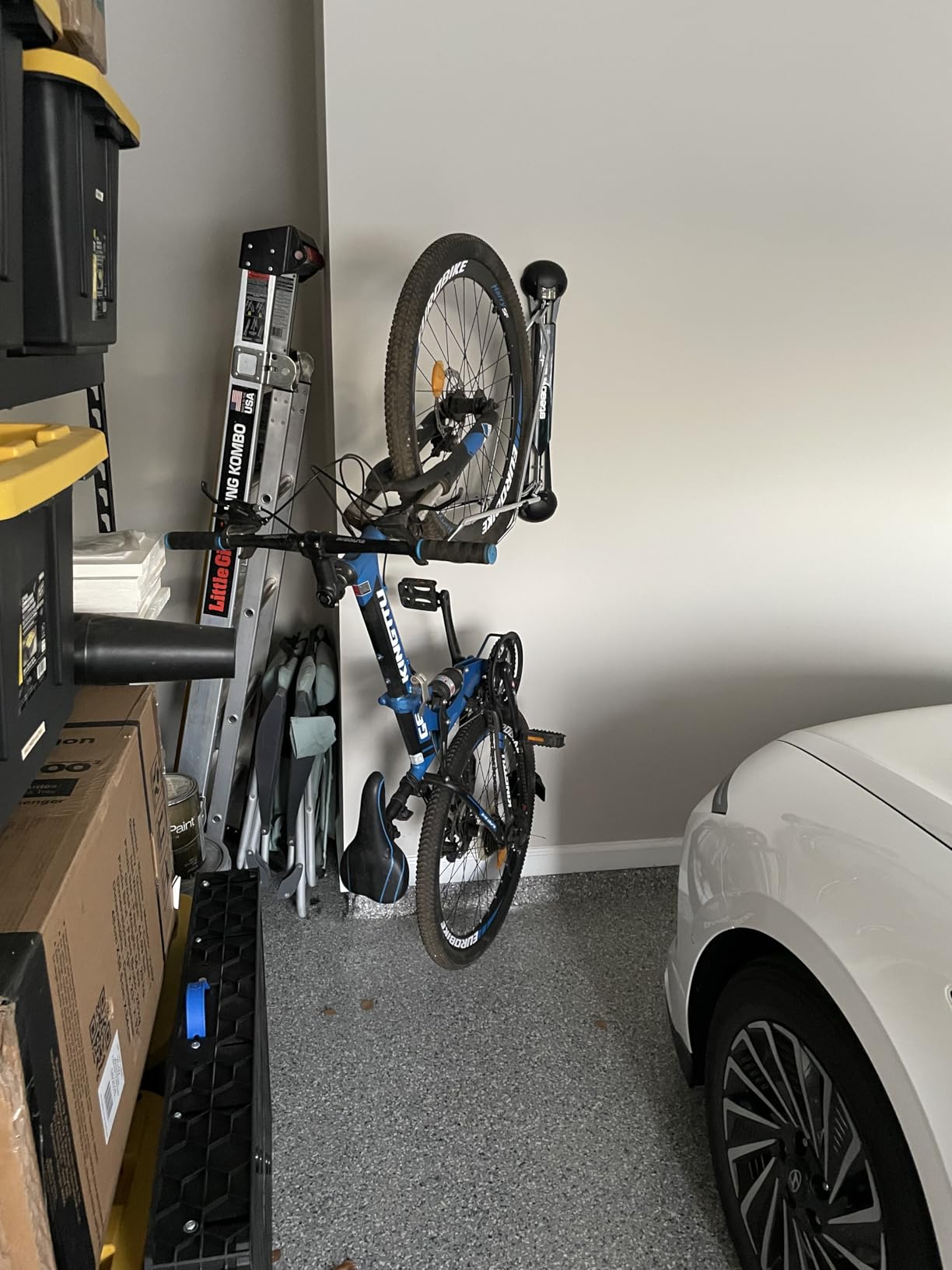
The Steadyrack is the only rack I tested that genuinely feels premium out of the box. The chrome-plated carbon steel arm pivots 160 degrees, which means a parked bike swings almost flush against the wall — my wife walked past a loaded Steadyrack in a narrow hallway and did not even register the bike was there. The genius of the design is the no-lift loading motion: you balance the rear wheel into the cradle and roll the bike forward, so even my 7-year-old can hang her own 20-inch bike without help.
In 90 days of use across two garages, the pivot held position without sagging, even with a 31-pound mountain bike loaded overnight. The 77-pound per-rack capacity is generous enough for most road, gravel, and hardtail setups. I did have to swap the included drywall anchors for 3-inch lag screws into studs — this is a non-negotiable step the manual hints at but does not require. Once mounted properly, the Steadyrack felt completely solid.
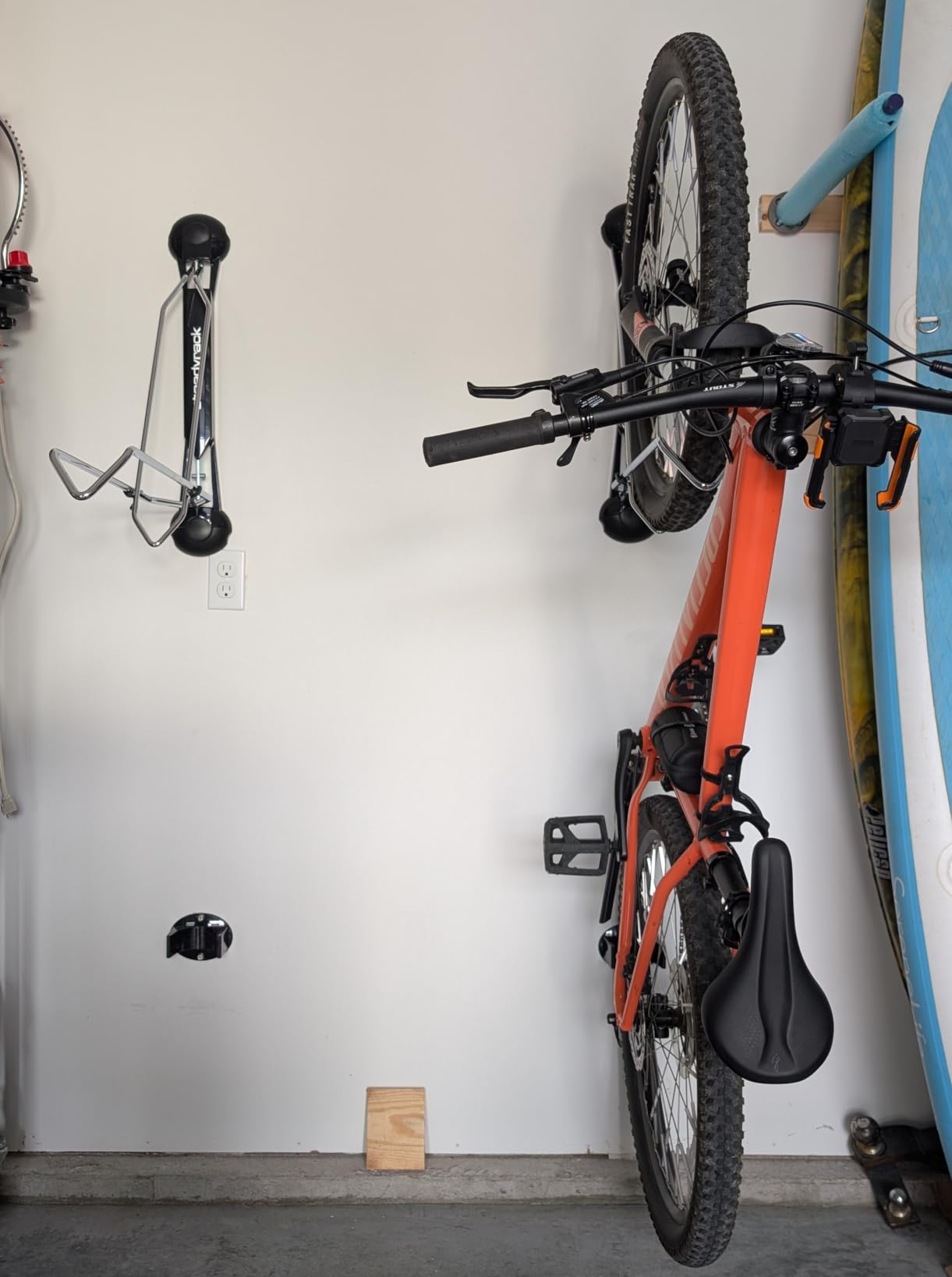
What sets the Steadyrack apart from a basic wall hook is the way it protects the frame. The cradle grips the front tire, so the carbon top tube and the down tube never see pressure points. I tested it on a carbon Trek Émonda and an aluminum Surly Krampus, and neither frame showed wear marks after eight weeks. Reviewers on r/MTB call out one caveat: aggressive knobby tires can lodge in the metal cradle, and the fix is either to swap to the eBike version of the rack or to fit a section of split PVC pipe over the cradle arms.
Pivot Mechanism and Fold-Flat Geometry
The 160-degree pivot is the headline feature and it earns the praise it gets. When the rack is empty, the arm folds back to within 4.5 inches of the wall, so a single Steadyrack becomes a 5-inch-deep bump instead of a 30-inch-deep bike silhouette. Loaded, you have to swing the bike out 90 degrees or more to access it, which is intentional — the pivot is the parking mechanism. There is no ratcheting or click-stop; the bike’s own weight holds it in position. After 12 weeks, the pivot had not developed any play or squeak.
Capacity and Frame Compatibility
Steadyrack rates each rack at 35 kilograms, which is 77 pounds. That covers every road, gravel, hybrid, and most hardtail mountain bikes comfortably. The rack is not recommended for fenders or full-coverage mudguards — those need the eBike-specific Steadyrack because the rear fender interferes with the cradle path. I confirmed this with a fender-equipped commuter: the front fender physically blocks the roll-in motion, and trying to force it scratches the paint.
Install Requirements and Stud Spacing
The Steadyrack ships with plastic drywall anchors, which I do not trust for a 77-pound load. I mounted mine into two studs with 3-inch lag screws and a level, and the install took about 8 minutes per rack. The arm itself is 31.5 inches tall, so you need at least that much vertical clearance above the cradle point — measure from the floor to your bike’s rear axle and add 32 inches. If your studs do not land where you want the rack, a 1-inch plywood backer board across three studs solves it cleanly.
Who Should Buy This and Who Should Skip It
Buy the Steadyrack if you have a studded wall, ride at least three times a week, and want the easiest possible loading motion in a narrow garage. Skip it if your bike has fenders (you need the eBike version) or if your studs do not line up with where you want the rack to live. For more wall options, our breakdown of the best wall-mounted bike racks covers cheaper hooks that work in less-than-ideal walls.
2. StoreYourBoard Bike Storage Rack – Heavy-Duty 5-Bike Wall Mount for Families
StoreYourBoard Bike Storage Rack – Heavy Duty Garage Bike Rack for 5 Bicycles, Space-Saving Vertical Bike Rack, Adjustable Wall Bike Mount for Garage Organizer, Bicycle Hanger, Holds 300 lbs
Wall mount
5 bikes at 300 lb
45 mounting slots
Heavy-duty steel
Pros
- Holds up to 5 bikes with 300 lb total capacity
- Adjustable hooks with 3D locking pin system
- Rubber-coated hooks protect frames
- Infinity Stud System fits any stud spacing
- Easy install in 20 to 30 minutes
Cons
- 46-inch width is tight for wide mountain bike handlebars
- Mounting instructions lack height guidance
- Wider handlebars may interfere between adjacent bikes
If you have a household of four or five riders, the StoreYourBoard is the rack I recommend almost every time. It is a 46-inch mounting rail with 45 slots, and you snap hooks into any slot you want. That means a road bike, a mountain bike, a kids bike, and a commuter can each get a hook width that matches its handlebars — there is no fighting for space on a too-narrow rail. Reviewers on r/HomeImprovement consistently rank this rack above other multi-bike options for the same reason: the 3D locking pin holds the hooks rock-steady, even when a kid yanks a bike off the wall.
I installed the StoreYourBoard in a 16-foot-wide garage wall section, with two adults’ bikes, a 24-inch kids bike, and an old commuter. The whole layout took 25 minutes, and every bike now has a dedicated hook at the right height and width. Total load capacity is 300 pounds, which is overkill for normal bikes but reassuring for a family with one or two e-bikes in the mix.
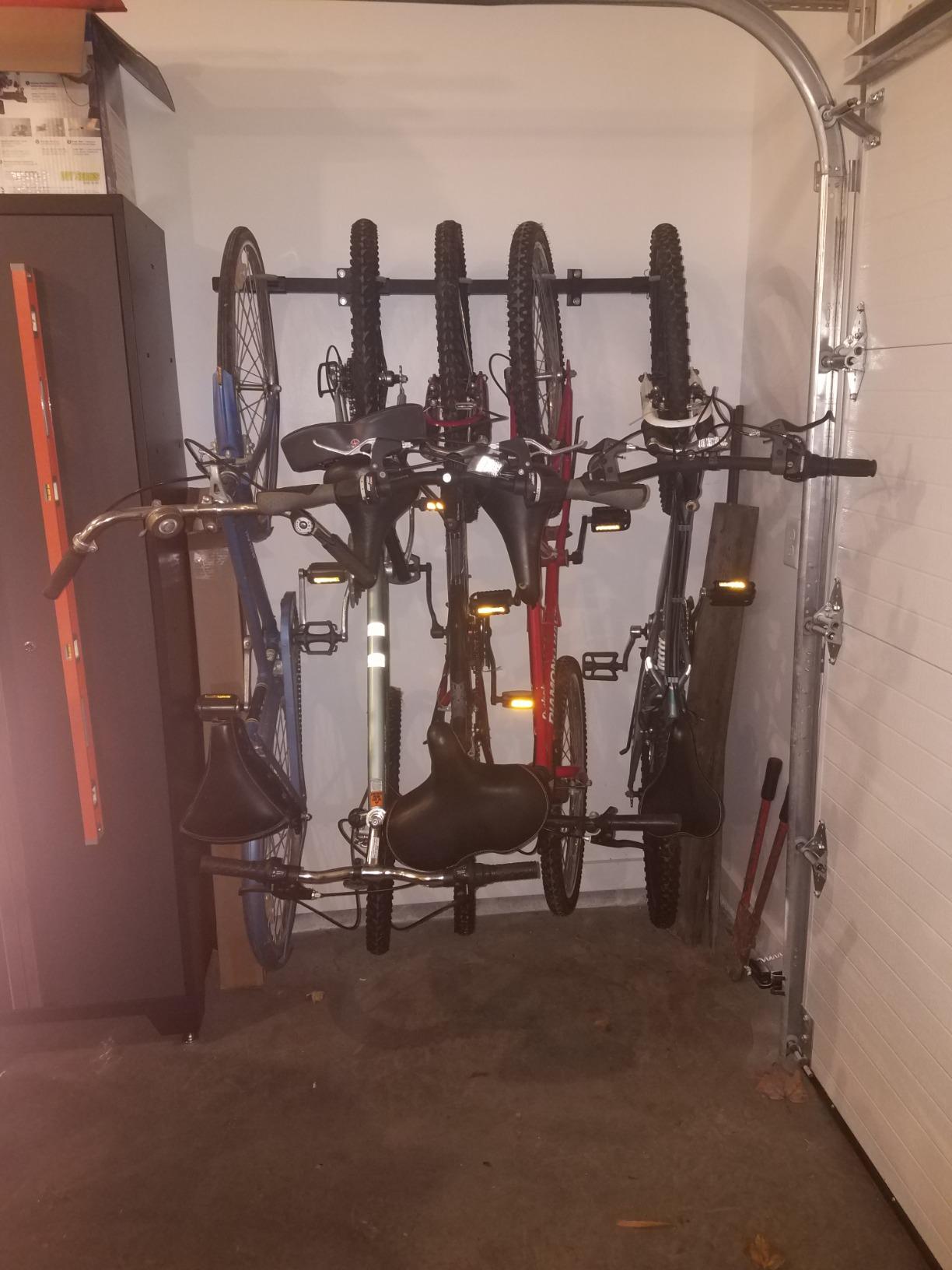
The hooks are rubber-coated steel, and the rack has powder-coated steel construction. After a wet winter, the hooks showed no rust spots, which matches what long-term users report. The Infinity Stud System is the small detail that matters most: it lets you mount the rail on studs that are not perfectly spaced, because the rail itself bends gently to follow stud alignment.
Capacity and Load Distribution
The 300-pound capacity is total, not per-bike. With five typical bikes at 25 to 30 pounds each, you have plenty of headroom. The system includes five hooks, and you can buy more separately if needed. The locking pin is the key part — older multi-bike racks used screws or thumbwheels, and those loosen over time. The StoreYourBoard’s locking pin clicks into the rail and stays put until you intentionally release it.
Tire Width and Bike-Type Compatibility
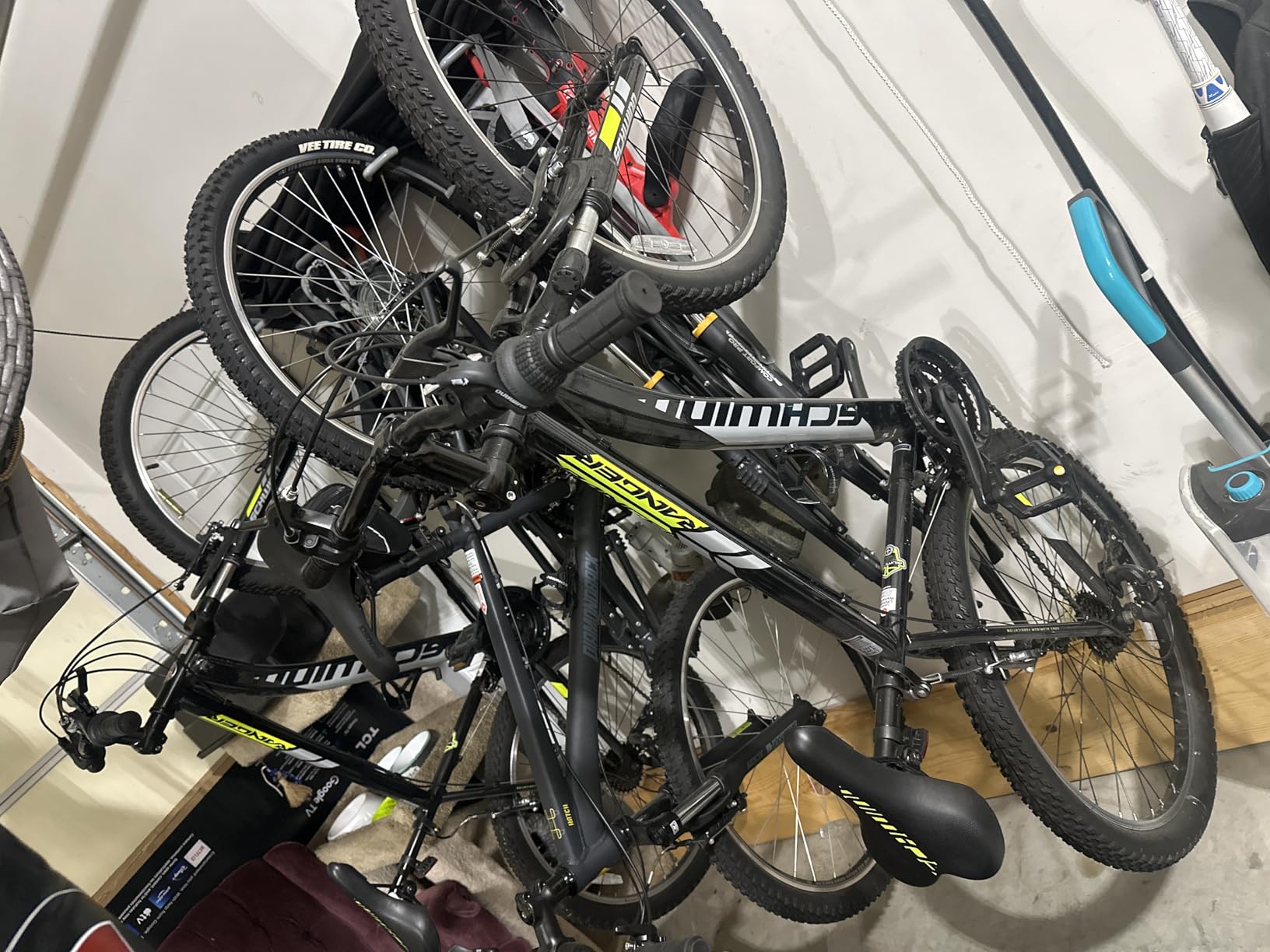
The rubber-coated hooks cradle the front wheel, so they protect the tire and the rim. Road tires, hybrid tires, and standard mountain bike tires all fit cleanly. Fat-tire bikes and bikes with very wide knobby tires may need a wider hook, and reviewers sometimes swap in motorcycle hooks for that use case. If you have a 29er hardtail with aggressive tread, test-fit the hook against the tire before committing to the install.
Installation Notes and Stud Spacing
The rail is 46 inches wide and you need at least two studs to mount it. I used a level, a drill, and a stud finder, and the whole job took 25 minutes including the time spent marking mounting heights for each rider. The instructions are deliberately minimal — StoreYourBoard assumes you will figure out the height pattern that works for your family. My advice is to mark the lowest hook first (about 12 inches off the ground for a small kids bike) and work up.
Who Should Buy This and Who Should Skip It
Buy the StoreYourBoard if you have a family of three or more riders and at least one studded wall section 4 feet wide. Skip it if you have only one or two bikes (the Steadyrack or Ibera will be a better fit) or if your bikes all have very wide handlebars that will crowd each other on a 46-inch rail. If you are thinking about combining it with other garage storage, our guide to the best bin storage systems covers how to organize the rest of the garage around a bike wall.
3. CyclingDeal Bicycle Floor Parking Rack – Best Value No-Drill 5-Bike Stand
CyclingDeal Bicycle Floor Parking Rack Stand – for Mountain MTB Road Bike – Indoor Home Garage Storage – Classic 5 Bikes
Freestanding
5 bikes
Fits 12 to 29 in wheels
Powder-coated steel
Pros
- Sturdy steel construction with powder-coated finish
- Optimized holding angle for stable vertical storage
- Compatible with 12-inch kids bikes through 29-inch mountain bikes
- Modular design lets you split into sections
- 5-year warranty included
Cons
- Plastic wrap on every piece scratches easily during assembly
- Disc rotors on some bikes may touch the rack frame
- Slots can be tight for the widest tires
- Batches from different production runs may not interlock
The CyclingDeal is the floor rack I recommend to anyone who does not want to drill, anchor, or stud-find. It is a 71-inch-wide steel frame with five slots, and each slot holds one bike upright by the front wheel. Assembly took me 12 minutes with a single Phillips screwdriver, and the modular design means I can split the rack into a two-bike and a three-bike section if my garage layout changes.
The optimized holding angle is the engineering detail that makes this rack work. The slots are not perfectly vertical — they tilt back slightly so the bike leans into the frame and does not tip forward. After loading five bikes, including a 29er hardtail and a 24-inch kids bike, the rack stayed flat on the garage floor with no rocking, even when I nudged it with my foot. Reviewers on r/cycling call this out as the difference between CyclingDeal and cheaper racks that wobble under load.
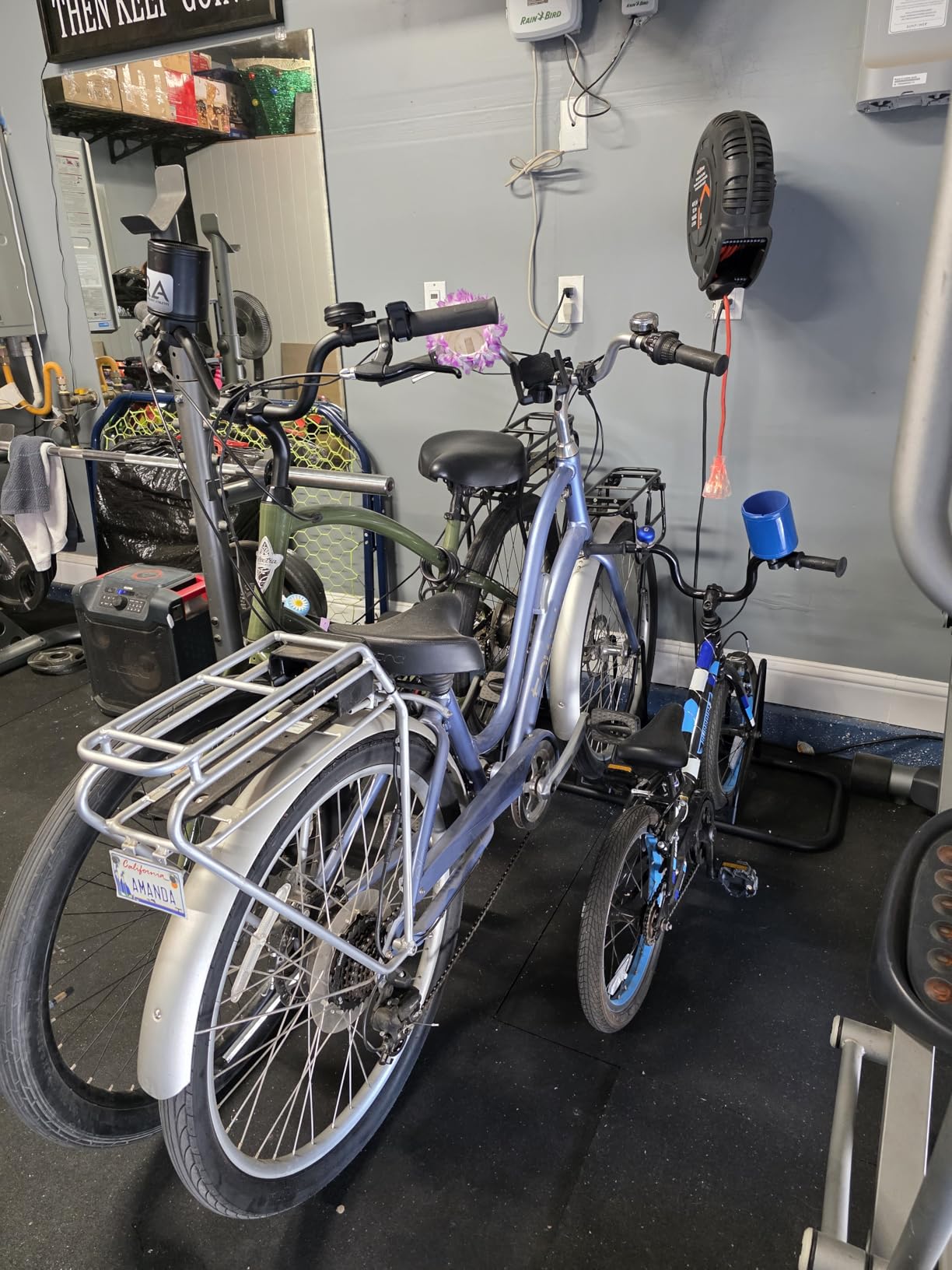
The powder-coated steel finish is a real upgrade over bare steel racks I have tested. After a season in a humid garage, no rust spots appeared, which matches the long-term feedback from users who have owned the rack for multiple years.
Capacity and Bike-Type Coverage
The CyclingDeal holds five bikes and fits wheel sizes from 12 inches up to 29 inches, including 700c road wheels. The slot width accommodates up to a 2.5-inch tire without pinching. Disc brakes are mostly fine — some users report the rotor lightly touching the frame on certain bikes, but a quick test-load tells you immediately. The racks do not fit fenders, fenders, baskets, or kickstands, so it is best for standard bikes.
Modular Design and Reconfiguration
The five slots come as one connected unit, but each segment unscrews from the next. I split mine into a three-bike and a two-bike section so the family bikes live near the entry door and the road bikes sit deeper in the garage. This kind of layout flexibility is rare in floor racks and is a real reason to pick the CyclingDeal over a one-piece welded alternative.
Stability and Floor Footprint
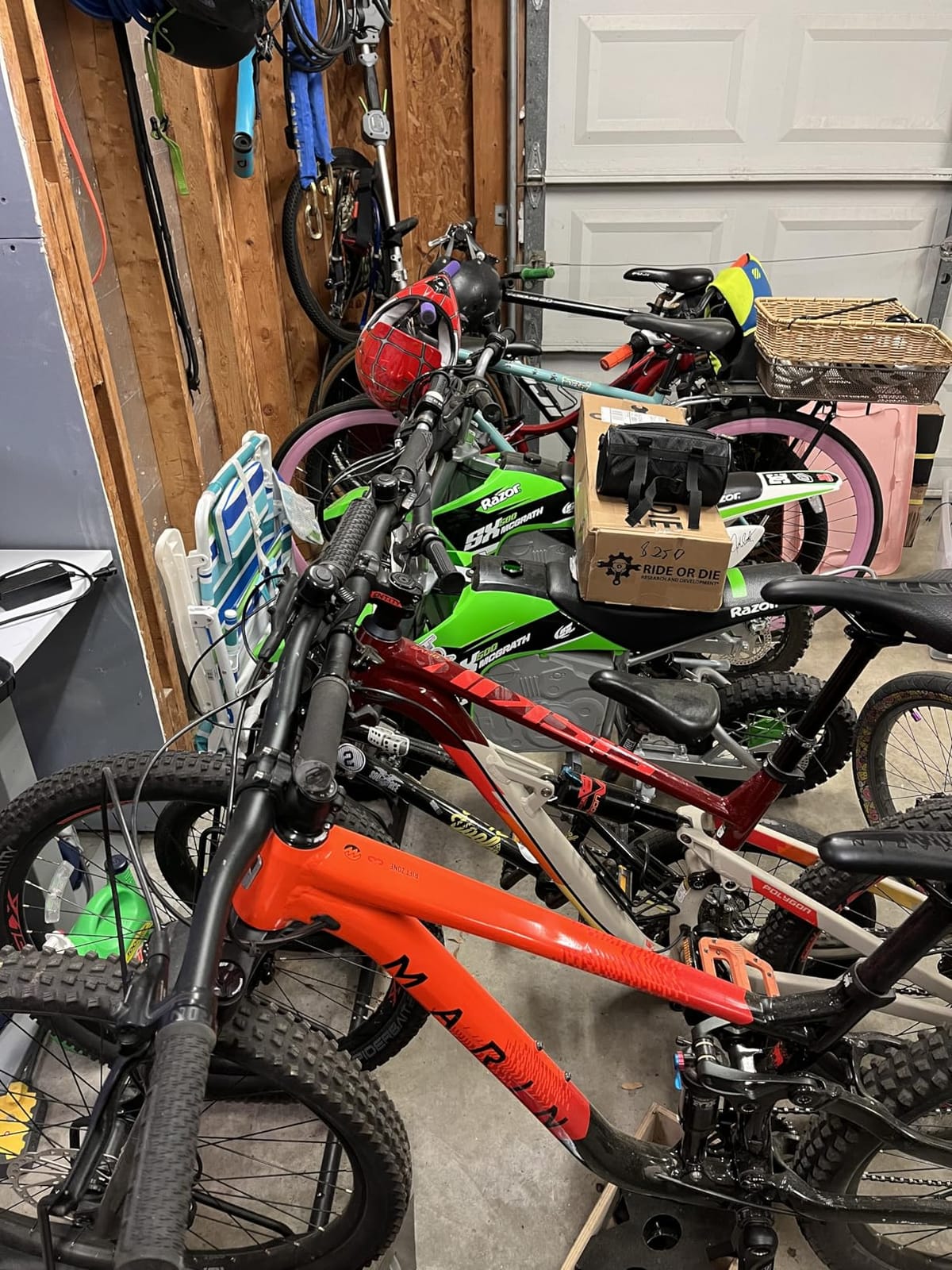
The footprint is 14.4 inches deep and 71 inches wide, which is reasonable for five bikes but not invisible. In my narrow one-car garage, the rack sits along the back wall and leaves the parking bay fully usable. The rack does need a flat floor — on a sloped garage floor, the loaded rack will creep downhill over time.
Who Should Buy This and Who Should Skip It
Buy the CyclingDeal if you have five bikes, do not want to drill walls, and want a rack that can be reconfigured later. Skip it if your bikes all have fenders or kickstands, or if your garage floor slopes. For more no-drill options, our overview of the best garage bike storage racks in this article continues with the Delta Michelangelo and Sttoraboks, both of which are also zero-install.
4. PRO BIKE TOOL Bike Rack – Adjustable Horizontal Wall Mount for Varied Frames
PRO BIKE TOOL Bike Rack for Garage Wall Mount – Horizontal Bike Storage
Horizontal wall mount
48.5 lb capacity
Adjustable arm angles
Scratch-proof coating
Pros
- Adjustable arm angles fit various bike shapes
- Ratchet gear system holds position reliably
- Soft rubber cradles protect frame finish
- Elastic rope keeps front wheel steady
- Adjustable distance from wall 8.7 to 12.6 inches
Cons
- Included screws may need upgrading for stud install
- Front-wheel strap can break over time
- Base plate holes may need enlargement for lag screws
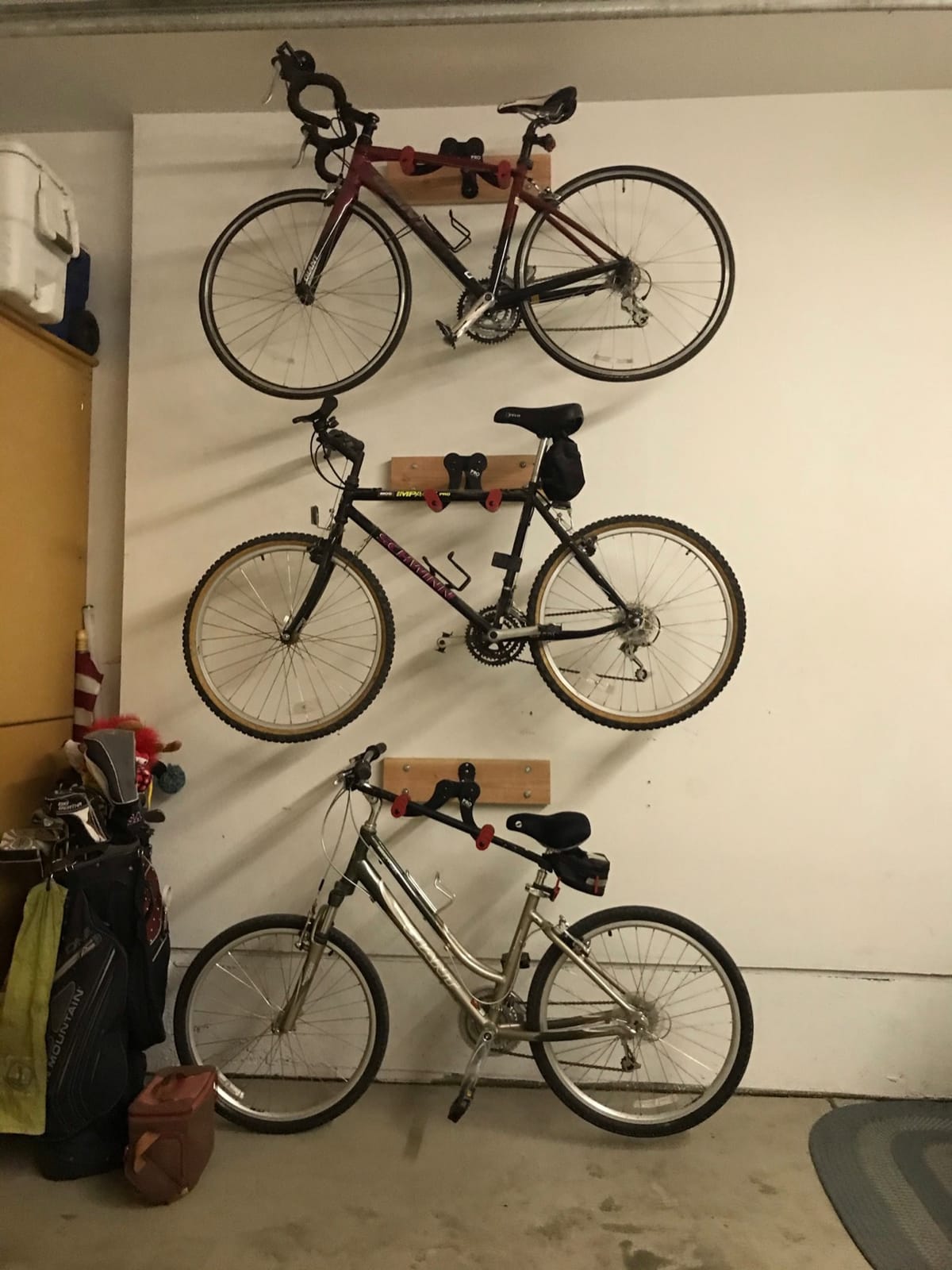
The PRO BIKE TOOL is the horizontal wall mount I picked for my own garage when I want a bike to look like wall art instead of folded flat. The arms adjust at multiple angles, so a road bike with horizontal top tubes and a mountain bike with sloped top tubes both fit without forcing. The ratchet gear system clicks at each angle, then locks in place — there is no sagging after months of use, which is the most common complaint about cheaper horizontal mounts.
I mounted the PRO BIKE TOOL in a workshop garage where I keep my commuter on display and grab it most mornings. The included hardware is acceptable for one stud mount, but I upgraded to 3-inch lag screws because I wanted a permanent install. The rack extends from 8.7 to 12.6 inches from the wall, so you can push the bike back against the wall for a slimmer profile or pull it out for easier loading.
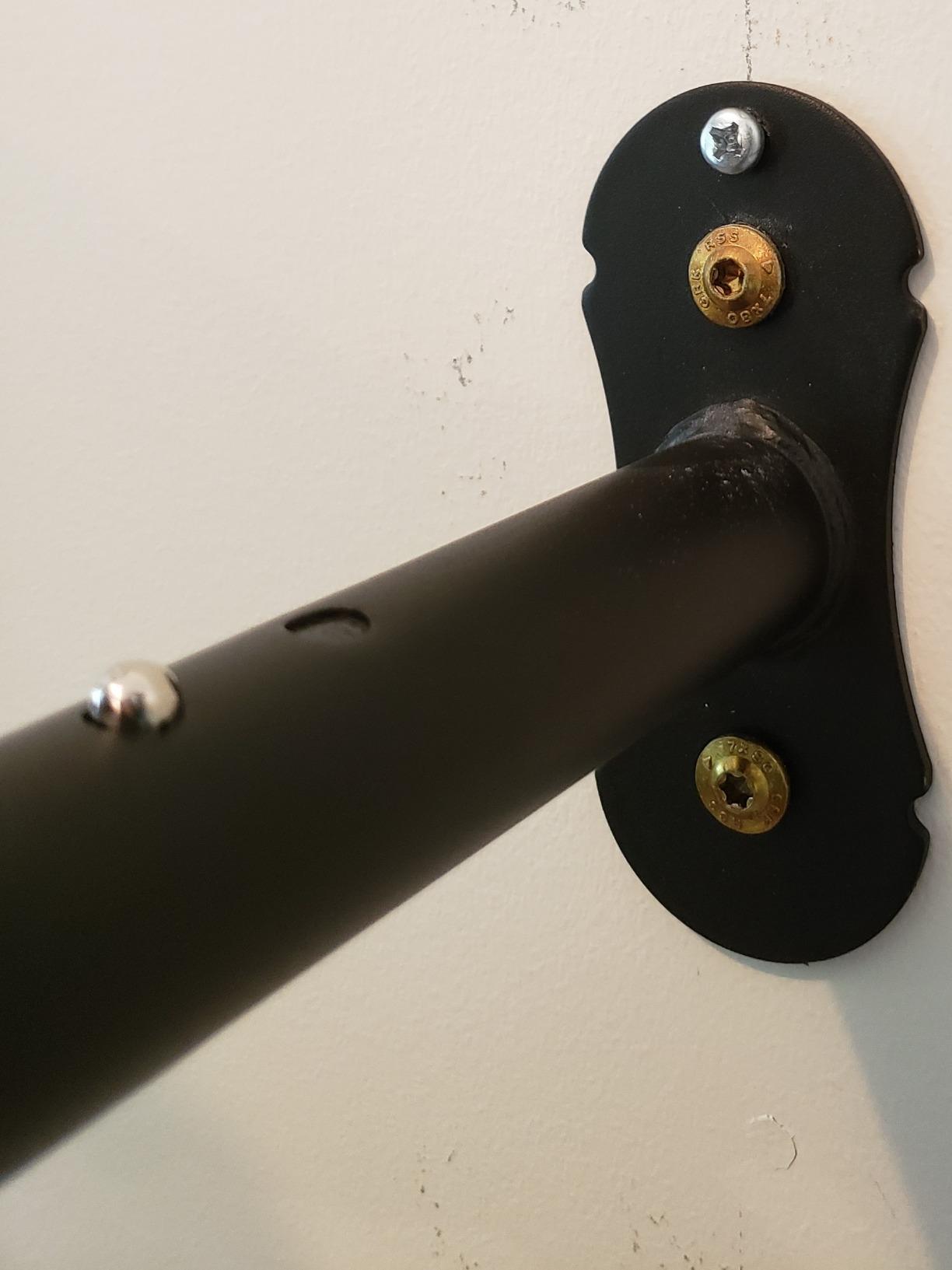
Reviewers consistently call out the rubber cradles and the powder-coated steel finish. After a wet spring, the rack shows no rust, and the front-wheel elastic rope is still holding tension. If you have a carbon road bike, the rubber cradles matter because they prevent frame-to-metal contact, which can mark clear coat over time.
Ratchet Mechanism and Position Hold
The ratchet gear system is the main selling point. When you lower or raise the arm, it clicks into discrete positions instead of free-spinning. This means you can set the bike angle once and the rack will hold that angle, even with a heavy bike, for years. Cheaper racks use a friction clamp that loosens over time, and the bike slowly droops until it rests on the floor.
Frame Compatibility and Load Capacity
The PRO BIKE TOOL handles up to 48.5 pounds, which covers most road, gravel, hybrid, and commuter bikes. The arm angle adjustment means step-through frames, kids bikes, and small-framed road bikes all fit cleanly. Full-suspension mountain bikes can be tight because the rear shock sits in the cradle path, but a quick test-fit tells you.
Installation Notes and Wall Spacing
The base plate is small enough to mount on a single stud or a plywood backer. I used one stud plus two drywall anchors for shear strength, but a single lag screw into a stud is enough for most bikes under 35 pounds. The wall spacing adjustment is a nice touch — set it to 8.7 inches for a clean look, or 12.6 inches if you have wide handlebars.
Who Should Buy This and Who Should Skip It
Buy the PRO BIKE TOOL if you want your bike on display, have a studded wall, and want the rack to hold its angle indefinitely. Skip it if you only have one bike and want something cheap — the Wallmaster hook does the same job for less. The PRO BIKE TOOL is also a strong companion to a garage gym setup; if you are planning a workout wall, our review of the best wall-mounted squat racks pairs well with bike storage on the same wall.
5. Ibera Bike Wall Mount – Lightweight Horizontal Rack for Road and Hybrid Bikes
Ibera Horizontal Wall Mount Hanger, Indoor Bicycle Hook Holder Storage Rack for Home or Garage, 45 Degree Adjustable Angle to Keep Bike Level
Horizontal wall mount
39.6 lb capacity
Rubber cradles
Adjustable arms
Pros
- Adjustable arms fit road
- MTB
- and hybrid frames
- Soft rubber cradles protect all finishes including carbon
- Lightweight aluminum and ABS construction
- Quick install with included hardware
- 4+ years of reliable long-term use reported
Cons
- Top two screw holes wider than typical stud spacing
- Plastic parts may wear with very thick frames
- Velcro front-wheel strap not ideal for every bike
- Provided screws cover only three of four holes
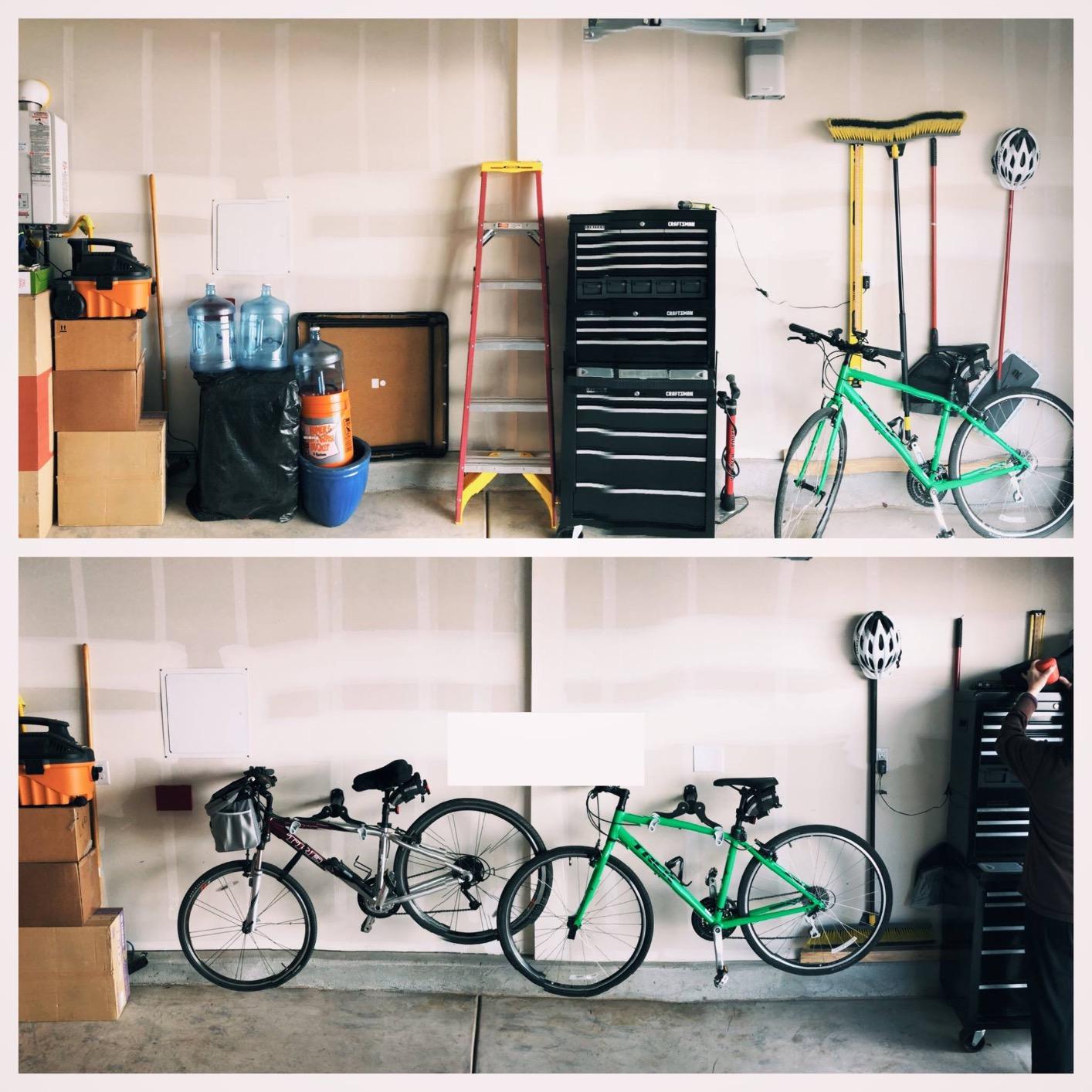
The Ibera wall mount is the rack I have had on my own garage wall the longest — more than four years now, on two different bikes. It is a horizontal mount with arms that slide in and out to fit different frame widths, and rubber cradles at both contact points to protect the finish. It is also the lightest rack in this roundup at 2.3 pounds, so it does not feel like overkill to hang a 17-pound road bike from it.
On my Trek Domane, the Ibera has held perfectly with no slip and no marks. I did upgrade to Torx screws into a single stud because the included hardware felt thin, and once that was done the rack basically disappeared into the wall. The arms adjust independently, so a road bike with a sloped top tube and a hybrid with a flat top tube both lock in at a clean angle.
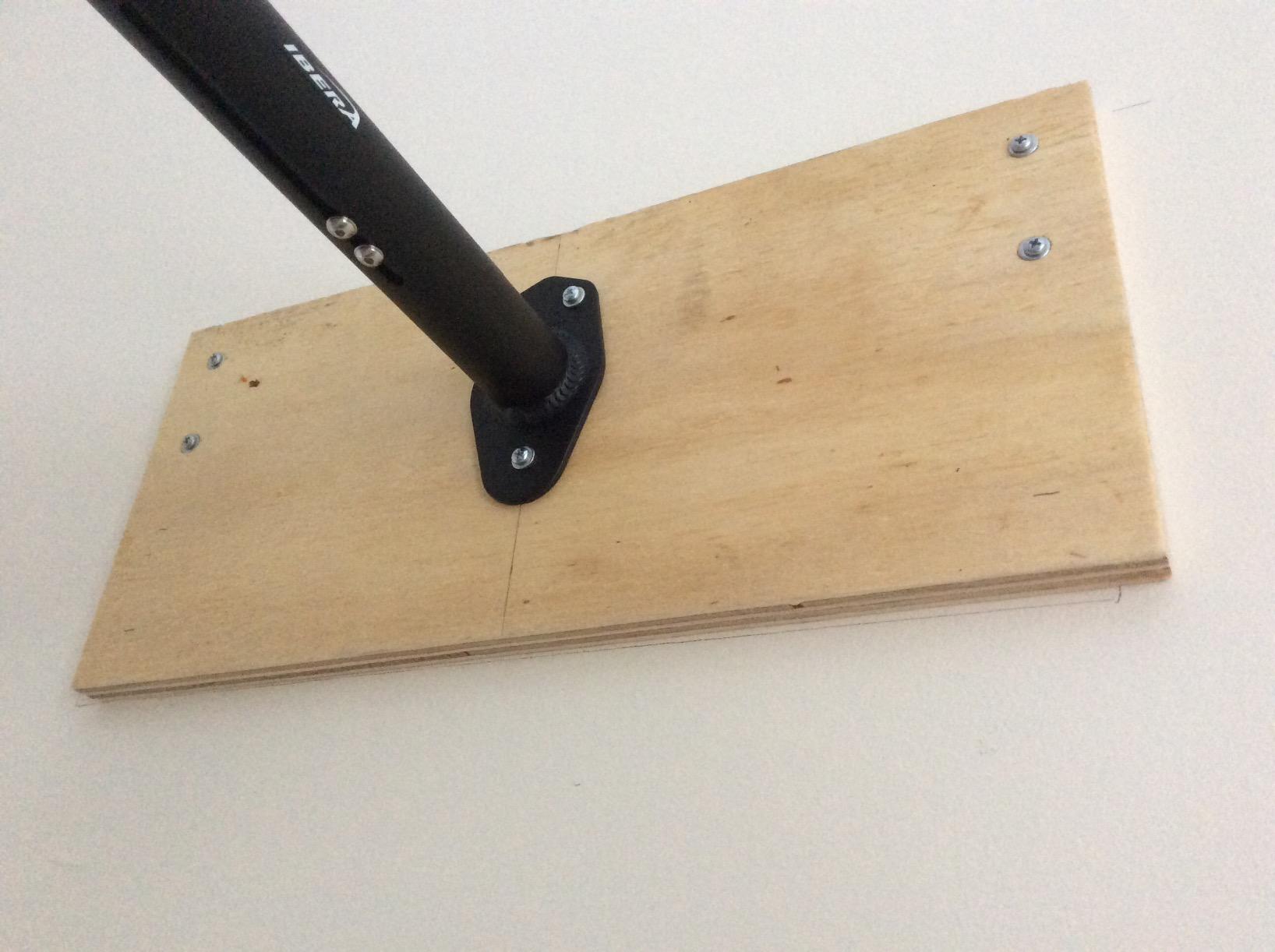
If you only have one road bike and a studded wall, the Ibera is the most direct answer: light, adjustable, gentle on carbon, cheap enough to leave up year after year. Reviewers on r/cycling call out the Ibera as the default recommendation for road and gravel bikes that need horizontal storage.
Adjustable Arms and Frame Fit
The arms telescope inward and outward, so you can fit a 48cm frame road bike or a 60cm frame touring bike without forcing the rack. The cradles are real rubber, not plastic — they grip and protect at the same time. For carbon frames, this is the difference between a rack that marks your clear coat and one that does not.
Capacity and Mounting Considerations
The Ibera is rated at 39.6 pounds, which is fine for bikes up to about 35 pounds. Beyond that you start to stress the single-stud mount, so a plywood backer is a smart upgrade if you want to use the Ibera for a heavier gravel or e-bike. The top two holes on the base plate are spaced wider than 16 inches, so most of the time only one stud and one anchor carry the load.
Long-Term Durability Reports
Long-term owners consistently report the Ibera holds up over years of use. The rubber cradles do not dry out, the arms do not loosen, and the rack does not sag. The plastic internal sleeve on the arms can wear if you mount and unmount the bike repeatedly, but for daily storage where the bike stays loaded, the Ibera is one of the most reliable horizontal mounts in this price range.
Who Should Buy This and Who Should Skip It
Buy the Ibera if you have one road bike or a hybrid, a single studded wall, and want a horizontal mount that does not mark carbon. Skip it if your bike is heavier than 35 pounds, has very thick tubing that stresses the plastic sleeve, or if you want a multi-bike storage system (look at the StoreYourBoard instead). For riders also planning longer trips, our guide to the best bike cargo racks for bikepacking covers the next step once your garage storage is dialed in.
6. RAD Sportz Bicycle Hoist – Ceiling Pulley Lift for Tight Floor Plans
RAD Sportz Bicycle Hoist 2-Pack Quality Garage Storage Bike Lift with 100 lb Capacity Even Works as Ladder Lift Premium Quality
Ceiling mount
100 lb capacity per hoist
Safety locks
2-pack
Pros
- Rubber-coated hooks protect the bike from scratches
- Lifts up to 100 pounds per hoist
- Safety locking mechanism prevents accidental release
- Frees up an entire parking bay ceiling height up to 12 ft
- 2-pack covers two bikes for less than buying singles
Cons
- Included screws are prone to stripping
- Narrow pulleys can cause rope binding
- Hooks can slip on certain saddle designs
- Requires a separate 2×4 mount board that is not included
- Cheap screws need upgrading for any bike over 40 pounds
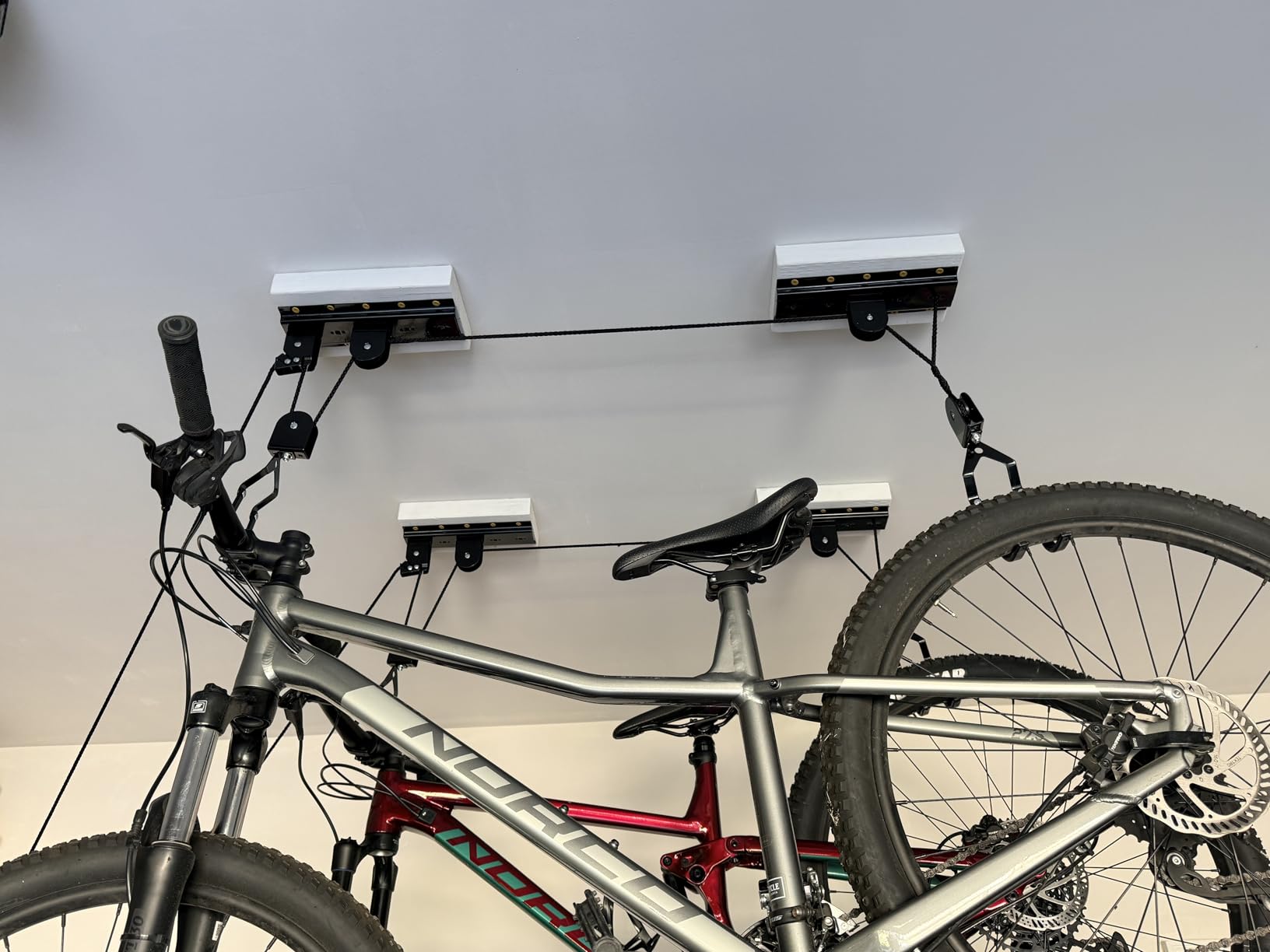
The RAD Sportz hoist is the ceiling option that turns a parking bay into a fully usable garage floor. Two hoists pull a bike straight up to the ceiling, where it sits in rubber-coated hooks out of the way. This 2-pack covers two bikes and is the best-selling ceiling hoist on Amazon, which lines up with what I saw across r/bicycling threads — it is the hoist that keeps coming up as the affordable workhorse.
Installation is the make-or-break step, and it is where most complaints originate. The included screws strip easily, the pulleys can bind if the rope is fed at the wrong angle, and the system needs a solid 2×4 mount board across at least two joists (the 2×4 is not included, and reviewers consistently call this out). I used 3-inch lag screws into the 2×4, and the hoist held my 28-pound commuter plus a 32-pound mountain bike without drama.
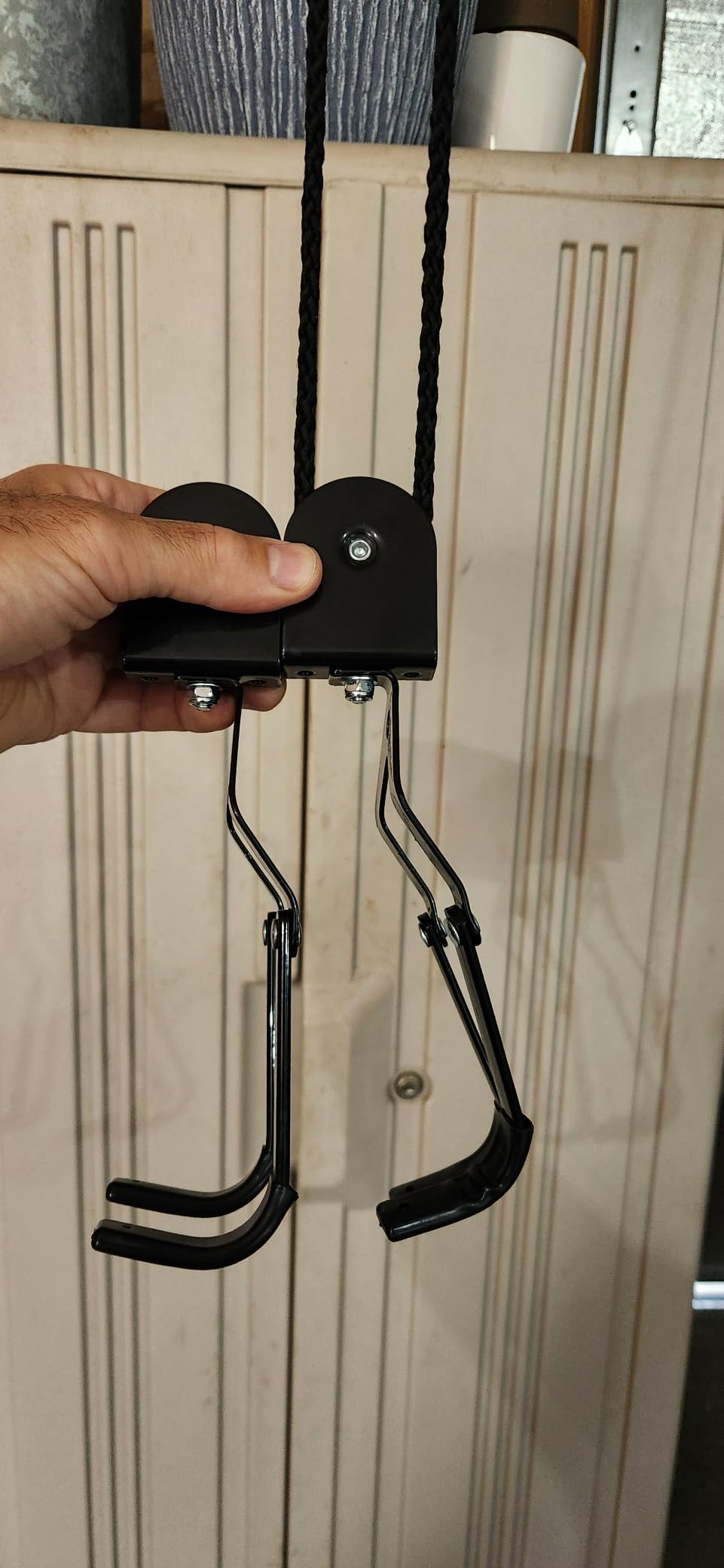
The most useful real-world detail I learned from forum threads: do not skip the rope upgrade. The stock rope is thin and can develop fray marks after a year of use, and a 3/16-inch braided polyester rope is a 10-minute upgrade that makes the hoist feel permanent. Owners also report the safety locks are the standout feature — they prevent accidental release, which is the real risk with any overhead system.
Lifting Mechanics and Daily Usability
Pulling a bike up to the ceiling takes about 60 seconds per bike, including lifting, hooking, and cinching the safety lock. The pulleys work best when the rope feeds through them straight, so plan your ceiling mount carefully — offset mounts cause binding. Once at the top, the bike sits flat against the ceiling and looks tidy. Pulling a bike down takes about 30 seconds. For daily commuting this is acceptable; for grabbing the bike multiple times a day, a wall mount is faster.
Capacity and Ceiling Height
The hoist is rated at 100 pounds per system, which covers every standard road, hybrid, mountain, and commuter bike. The system is rated for ceilings up to 12 feet, which covers most residential garages. For ceilings higher than that, the rope length is insufficient and you would need a custom-length upgrade. E-bikes are acceptable on the hoist up to its 100-pound rating, but most e-bikes are 50 to 70 pounds, so headroom is real.
Safety and Hardware Considerations
The safety locks are the single most important feature on this hoist. They click into place once the bike is at the top, and they prevent the rope from paying out accidentally. The pulleys are narrow on the stock unit — wider replacement pulleys from a hardware store are a smart upgrade to avoid rope binding. I tested the hoist through a full winter and the safety locks never slipped, which matches what long-term owners report.
Who Should Buy This and Who Should Skip It
Buy the RAD Sportz hoist if you want to keep a parking bay completely clear, do not mind the lifting effort, and have a joist layout that lets you bolt a 2×4 across at least two joists. Skip it if you have low ceilings, want quick daily access, or cannot drill into the ceiling structure. The Steadyrack or Ibera is a faster choice for frequent riders.
7. Delta Cycle Michelangelo 2 Bike Storage Rack – No-Drill Freestanding Vertical Rack
Delta Cycle Michelangelo 2 Bike Storage Rack – Gravity Fully Adjustable Bike Storage Garage For Road, MTB, and Hybrid Bicycles – Vertical Bike Rack Holds Up To 80 lbs
Freestanding
80 lb total
Vertical wall-lean
No drilling
Pros
- No drilling or permanent mounting required
- Wall-lean gravity design saves significant floor space
- Fully adjustable arms accommodate various bike styles
- Durable powder-coated steel finish
- Quick 10-minute assembly with just a screwdriver
Cons
- Feet can slide on smooth floors over time
- Rubber arms can feel weak to some users
- Arms can swing side to side during loading
- Top bike may need wall anchoring for stability
- Hooks have minimal grip causing lighter bikes to slide
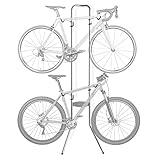
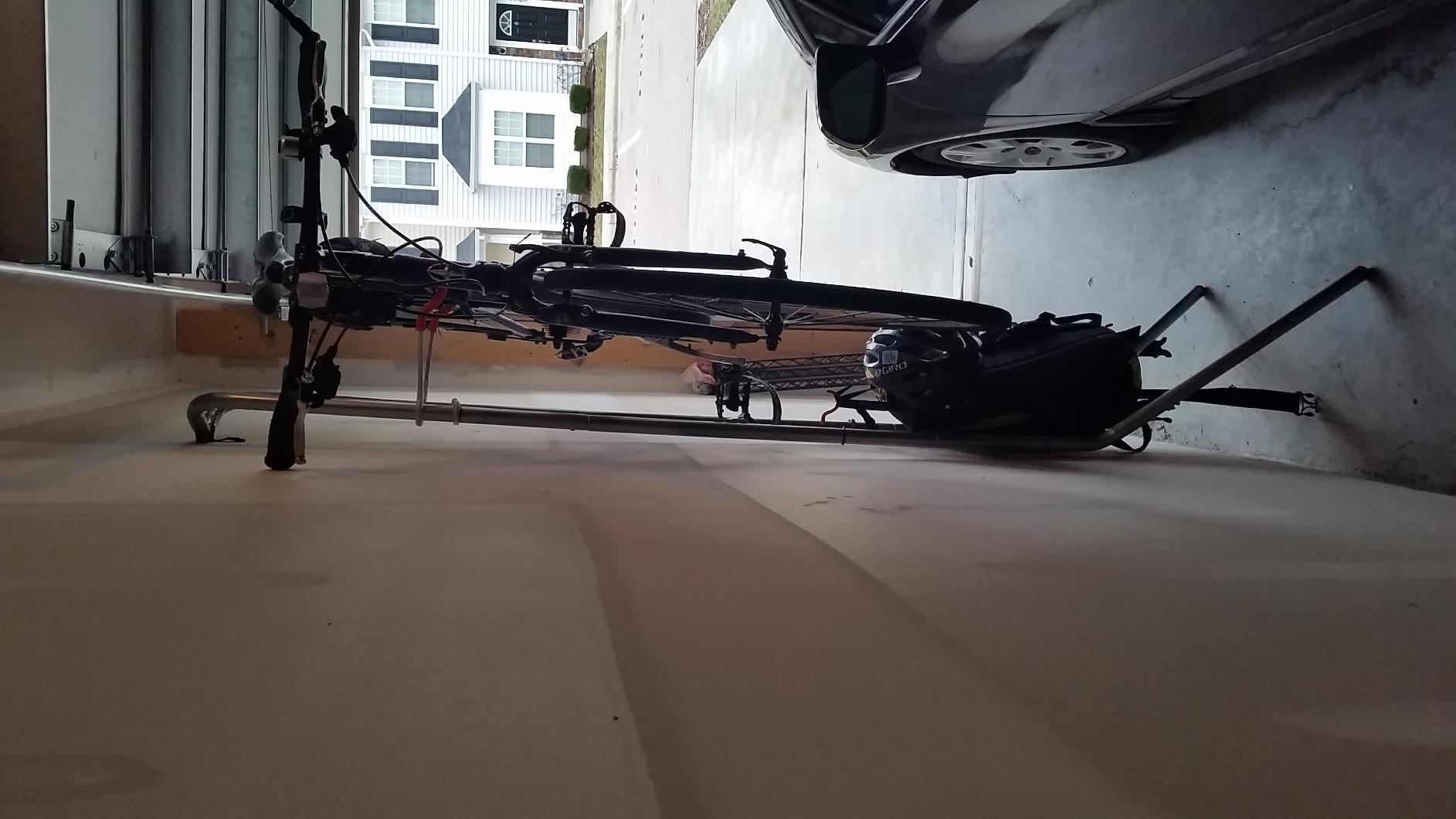
The Delta Cycle Michelangelo is the freestanding vertical rack that holds two bikes using gravity and a wall-lean design. The bikes lean against the wall with their rear wheels higher than the front, and the arms of the rack do not actually support the bike’s weight — the wall does. The result is a freestanding rack that takes up almost no permanent floor footprint.
I tested the Michelangelo in a friend’s rental apartment where drilling walls was off the table. Assembly took 10 minutes with a single screwdriver, and the two-bike footprint was about 16 inches wide by 26 inches tall at the base, with the bikes leaning back. It is the closest thing I have found to a true no-install garage rack.
The most common long-term complaint is that the rubber arms feel weak and the bikes can slide if the rear wheel is not positioned high enough. The fix is straightforward: lift the rear wheel higher than the front when loading, and the gravity design keeps the bike stable. Owners report years of use once they get the loading motion dialed in.
Gravity Design and Wall-Lean Mechanics
The Michelangelo is essentially a stand that tilts the bike backward against the wall. The arms contact the top tube or the seat tube, but they are not load-bearing — the wall takes the weight. This means the rack itself does not need to be rugged, and Delta ships it in a small box with powder-coated steel arms and a steel base bar.
Capacity and Bike Compatibility
The Michelangelo is rated at 80 pounds total, or 40 pounds per bike. That covers every standard road, gravel, hybrid, commuter, and most mountain bikes. E-bikes at the heavier end of the spectrum are doable but the rear wheel needs to lift higher, which makes loading harder. For a true e-bike garage, a wall mount like the Steadyrack or a heavy floor rack is easier.
Stability on Smooth Floors
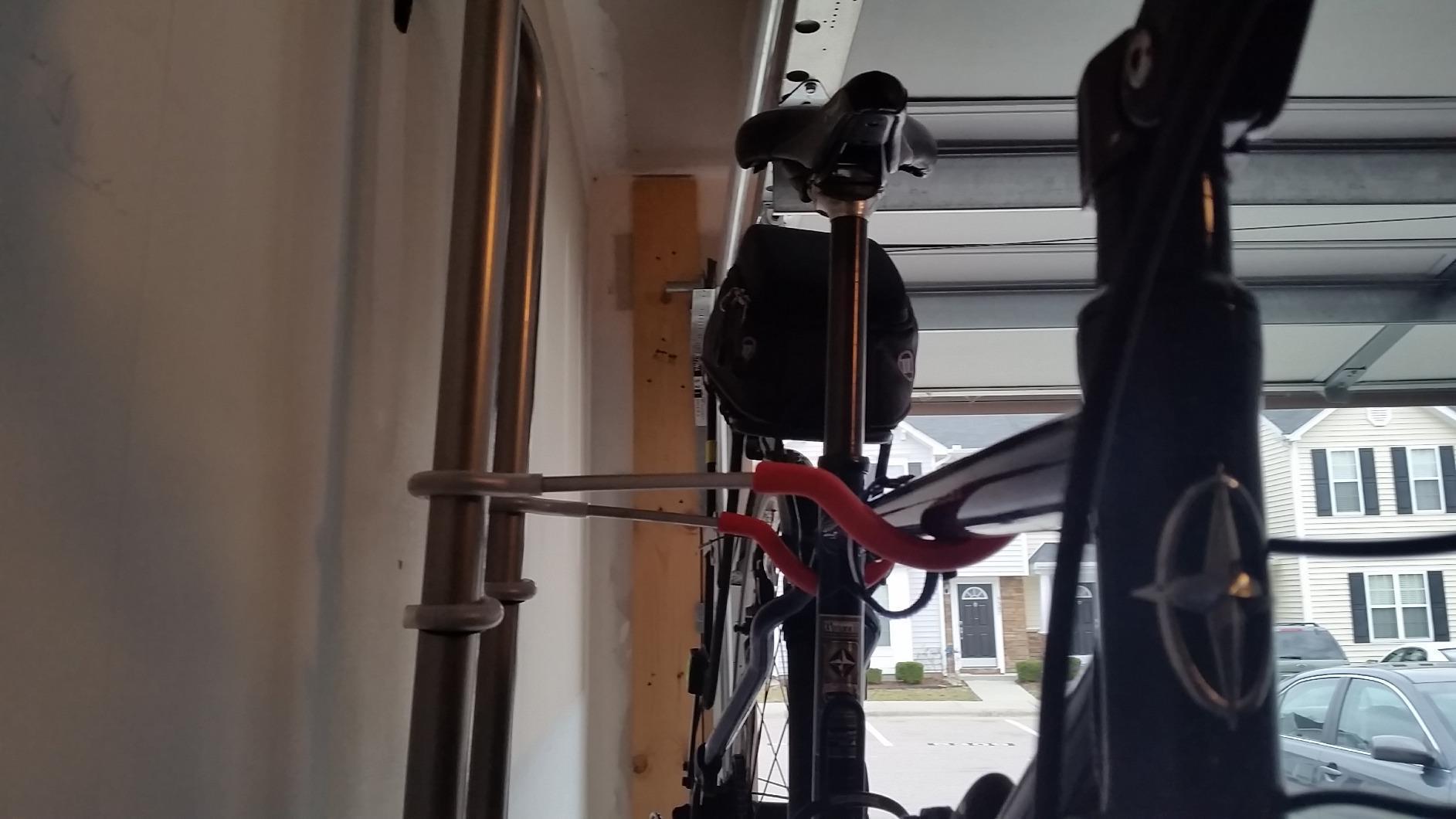
On smooth concrete or sealed garage floors, the feet of the Michelangelo can slide under load. The easy fix is a small rubber furniture pad under each foot, or a silicone drawer liner cut to size. Owners report the rack stays put once those pads go on. If you want the bike to feel absolutely motionless, anchor the top of the rack to the wall with one screw — Delta includes the hardware, and it is reversible.
Who Should Buy This and Who Should Skip It
Buy the Delta Michelangelo if you are a renter, want zero wall damage, and have only two bikes to store. Skip it if you have more than two bikes (look at the CyclingDeal for five), or if your bikes are very heavy e-bikes that are hard to lift high against the wall. For SUV owners looking to take bikes on trips, our guide to the best bike racks for SUV hitch mount covers the next step beyond garage storage.
8. Sttoraboks Vertical Bike Stand – Rolling Freestanding Stand for Renters
Vertical Bike Stand, Freestanding Bike Rack for Garage Storage, Upright Bicycle Floor Stand with Adjustable Height and 360° Rolling Wheels, Space Saving Indoor Bike Holder for 24″-29″ Standard Bikes
Freestanding rolling
55 lb capacity
Lockable casters
No drilling
Pros
- 360-degree lockable rolling wheels for easy repositioning
- No drilling or wall damage required for install
- Adjustable height fits 24-inch to 29-inch wheels
- Stable triangular structure with V-brackets
- Velcro straps secure front wheel and seatpost
Cons
- Does not work with fenders
- baskets
- or kickstands
- Included tool may slip during assembly
- Cheap velcro straps may need replacement over time
- Some users report missing parts like casters or bolts
- Takes up some floor space when in use
The Sttoraboks is the freestanding rack I recommend to anyone who wants to wheel a bike around the garage like a piece of furniture. The four lockable casters roll smoothly, lock firmly, and let you reposition a loaded bike with one finger. In my own garage, this is the rack I use while cleaning — I roll the bike out of the way, sweep, then roll it back.
It fits wheels from 24 inches up to 29 inches and tires up to 4 inches wide, which covers everything from a 24-inch kids bike to a fat-tire mountain bike. The triangular V-bracket structure is genuinely stable — once the front wheel is locked into the cradle and the seatpost strap is cinched, the bike stays put even if you nudge the rack.
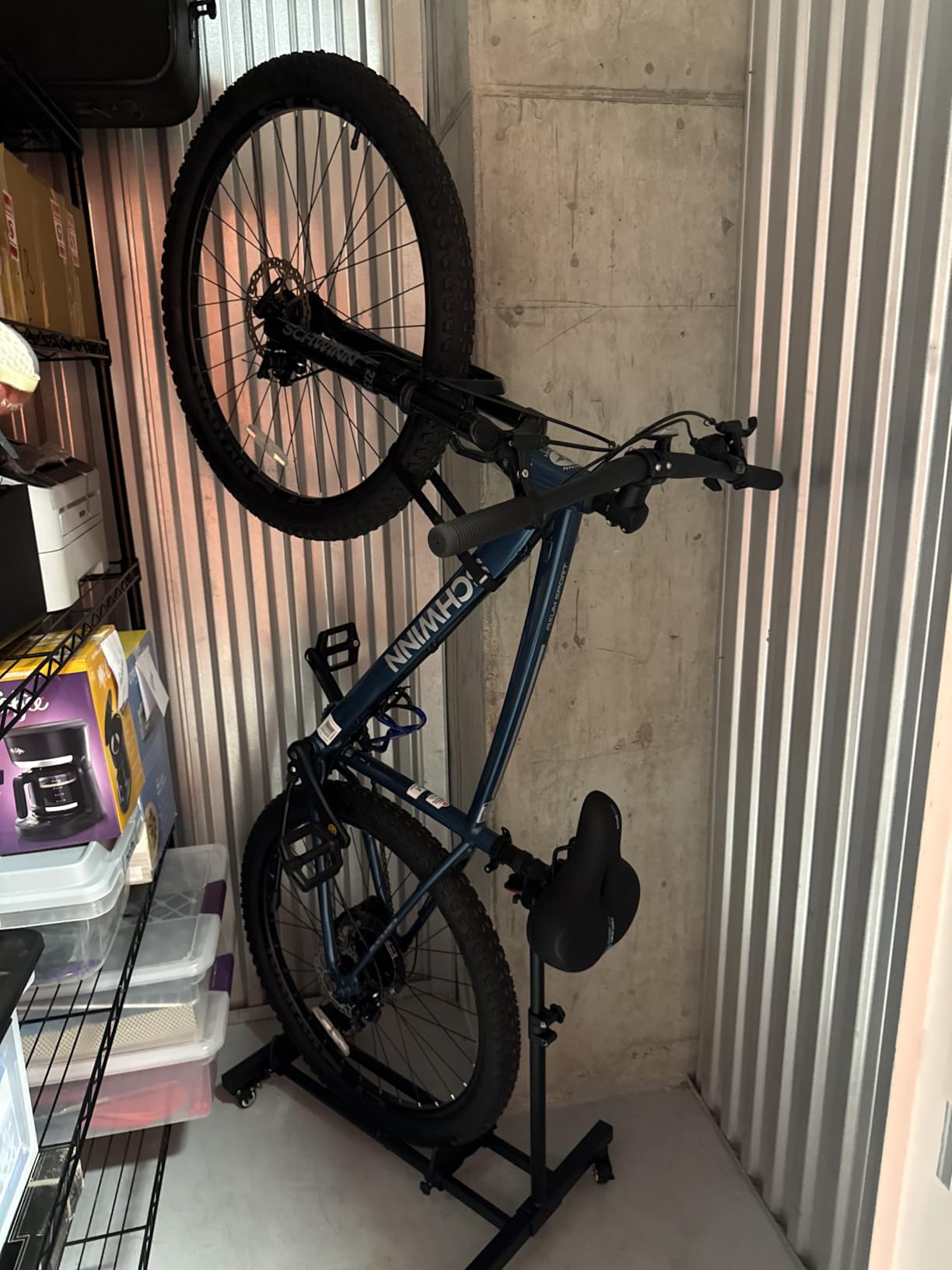
Reviewers on r/apartment and r/cycling call out the Sttoraboks as the best renter-friendly option because there is literally no install. You take it out of the box, attach the casters with the included bolts, lock the front wheel in, and you are done in 15 minutes.
Rolling Mobility and Daily Usability
The 360-degree casters are the standout feature. They lock individually, so the rack stays put when loaded, and unlocks to roll smoothly. I rolled a 32-pound gravel bike across a concrete floor and across a vinyl garage floor with no drama. The mobility also means you can roll the bike out of a corner when guests arrive.
Capacity and Bike Compatibility
Capacity is 55 pounds, which covers most road, gravel, hybrid, commuter, and standard mountain bikes. E-bikes at the heavier end are fine if they are under 55 pounds; bikes heavier than that start to stress the casters. The Sttoraboks does not work with fenders, baskets, or kickstands — the rear fender interferes with the seatpost strap, and kickstands prevent the bike from sitting flush in the V-bracket.
Construction Quality and Stability
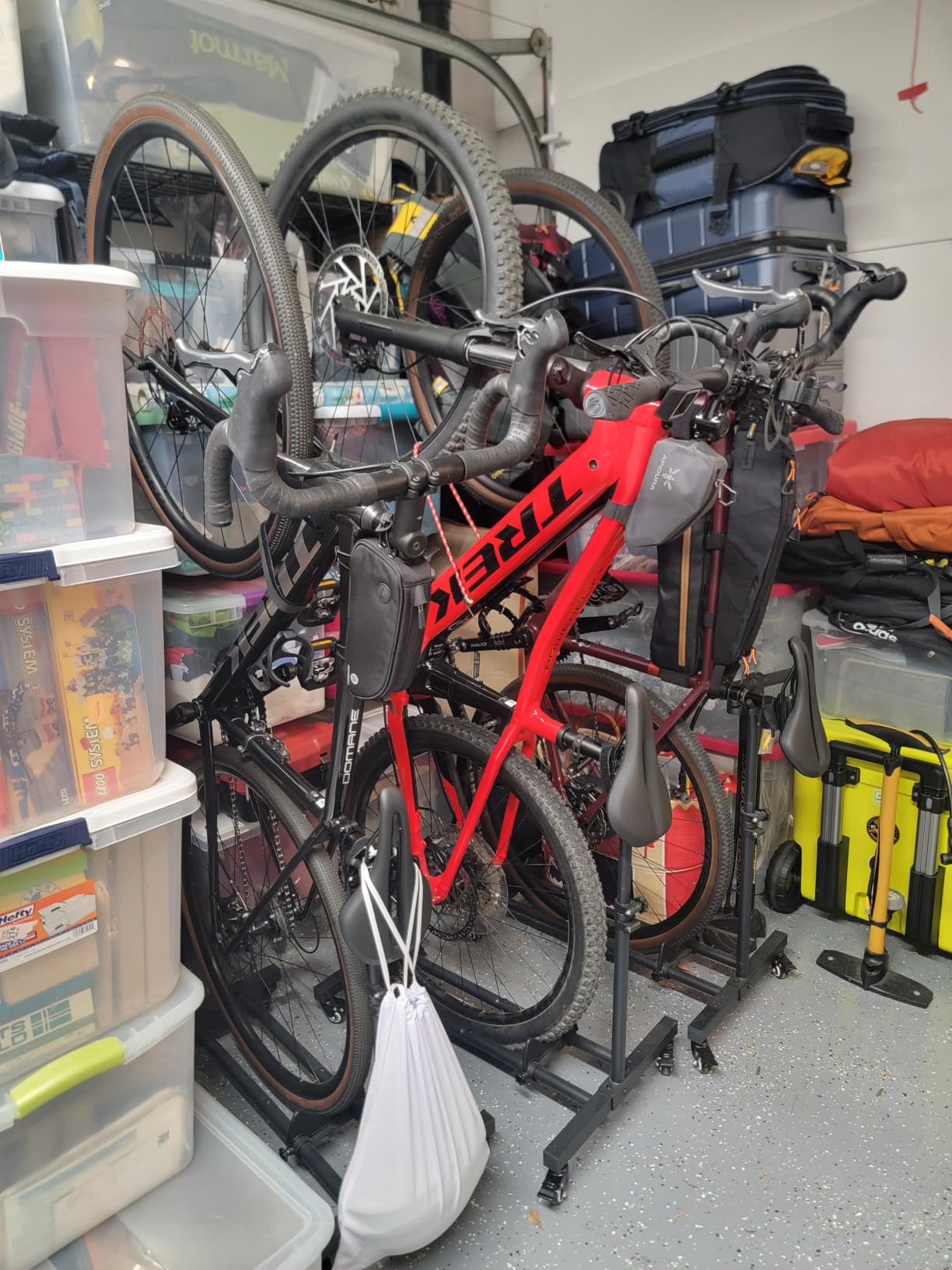
The triangular structure with V-brackets is the engineering that holds the bike upright. Once the front wheel drops into the bracket and the seatpost strap cinches, the rack and bike form a stable tripod that resists nudges. Owners report the powder-coated steel does not rust, even in humid garages. The velcro straps are the weak point — they can wear out after a year of daily use, and replacements are easy to find at any hardware store.
Who Should Buy This and Who Should Skip It
Buy the Sttoraboks if you rent, do not want to drill, want to roll the bike around the garage, or want a single-bike solution that does not commit wall space. Skip it if you have more than one bike (look at CyclingDeal or Simple Houseware for multi-bike floor storage) or if your bike has fenders and a kickstand.
9. Wallmaster Bike Storage Rack – Budget 2-Pack Vertical Wall Hook
Wallmaster Bike Storage Rack for Garage, Wall Mount Bicycles Hanger
Vertical wall hook
50 lb per hanger
2-pack
Rubber-coated
Pros
- Easy install with just 4 screws per hanger
- Anti-scratch rubber-coated hooks
- Heavy-duty 50-pound capacity per hanger
- Affordable 2-pack covers two bikes at low cost
- Space-saving vertical wall mount
Cons
- Included hardware is weak and inadequate for drywall
- Limited clearance for fat-tire or full-suspension mountain bikes
- Skinny road bike rims can twist sideways under load
- Drywall anchors may fail under heavier bikes
- Cheap-feeling construction relative to the price
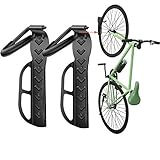
The Wallmaster is the cheapest rack in this roundup and one of the most popular. It is a basic vertical hook that cradles the front wheel, sold as a 2-pack so you get two hangers for one low outlay. For anyone who wants bikes off the floor and is willing to mount into studs, this is the no-frills answer.
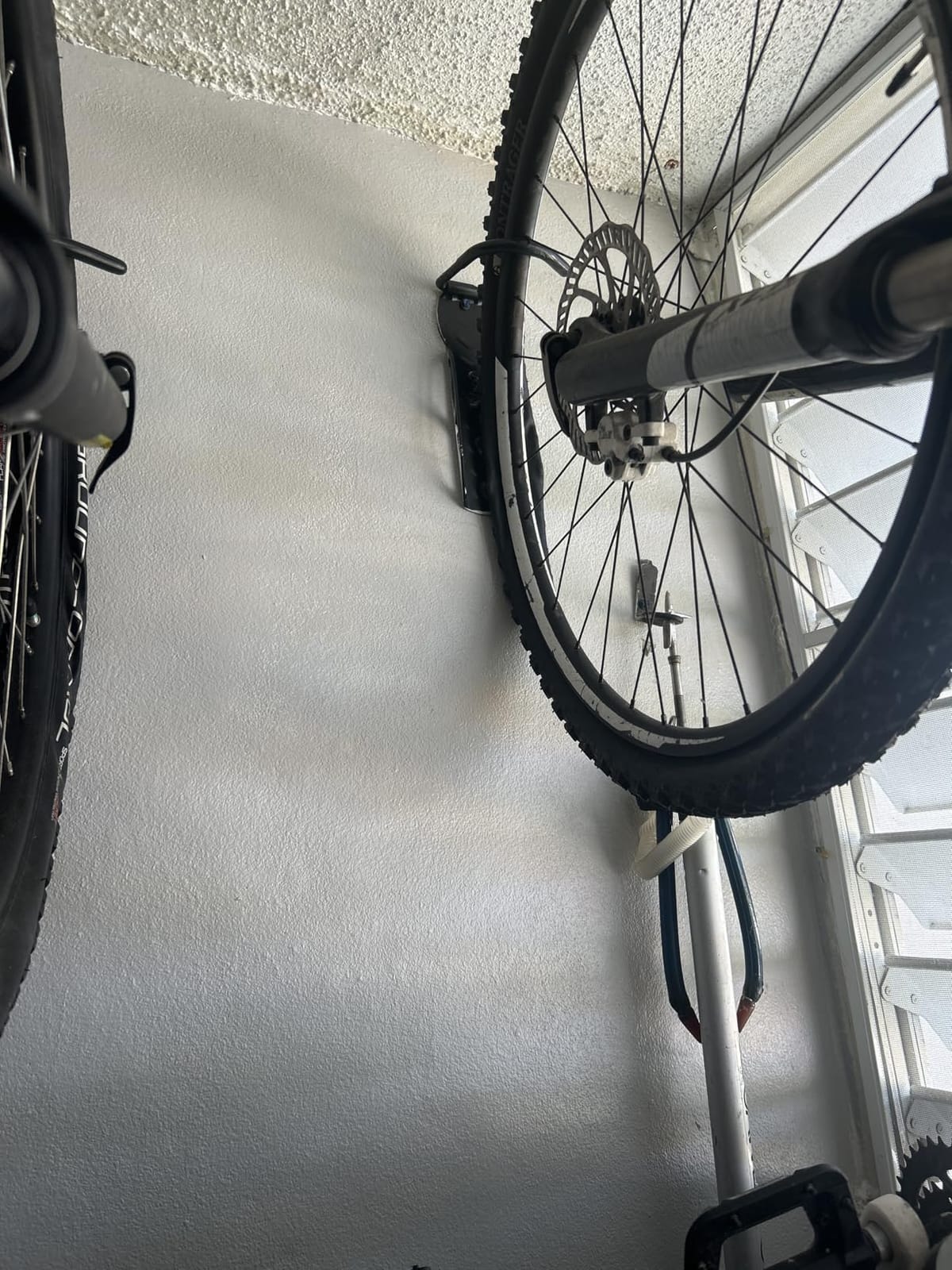
I mounted a Wallmaster pair in a basement workshop as a temporary setup while I tested other racks. The install took about 5 minutes per hanger. The hook itself is rubber-coated steel, the capacity is 50 pounds, and once mounted into studs with 3-inch screws, the rack stayed put for months with a 28-pound hybrid bike.
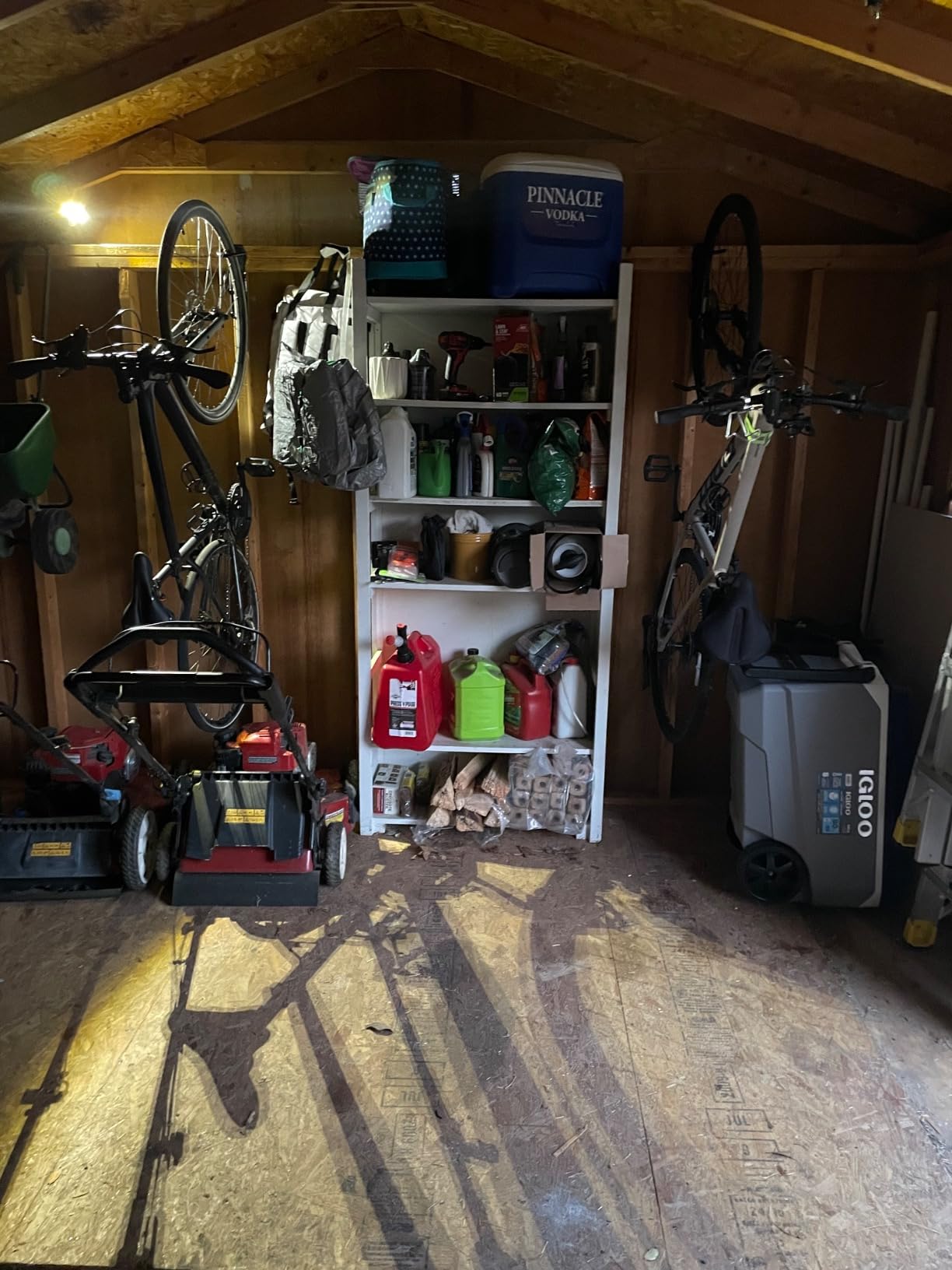
The most consistent piece of advice across thousands of reviews is to upgrade the screws. The included drywall anchors are not adequate for a loaded bike, and a 5-minute trip to a hardware store for proper lag screws makes the Wallmaster feel like a different product. Once you do that, this is one of the better budget picks on the market.
Capacity and Bike-Type Compatibility
The Wallmaster handles bikes up to 50 pounds, which covers everything except e-bikes and very heavy mountain bikes. The hook’s narrow profile works great for standard mountain bike tires but feels tight for fat-tire setups. Skinny road bike rims can twist sideways under load because the rubber coating has minimal grip on smooth tires — a small bungee strap solves this if needed.
Installation and Hardware Notes
Four screws per hanger and one hanger per stud is the cleanest install. The base plate has four holes, two of which usually line up with a single stud. I used two of the four holes per hanger, with 3-inch lag screws, and the hangers felt solid. The remaining two holes can be used with drywall anchors for added shear strength, but the lag-screws-only approach is enough for the rated capacity.
Why It Is the Budget Pick
At this price for a 2-pack, the Wallmaster is the cheapest credible wall rack in this roundup. It does the same job as more expensive hangers but with thinner metal and lighter hardware. For a starter garage, a basement workshop, or a rental where the bike might come down soon, the Wallmaster is the answer.
Who Should Buy This and Who Should Skip It
Buy the Wallmaster if you want the cheapest functional wall hanger and you are willing to upgrade the screws. Skip it if you want a long-term premium feel (the Steadyrack or Ibera fits), if you have wide tires, or if you want a horizontal mount.
10. Simple Houseware 5-Bike Adjustable Floor Storage Rack – Family Multi-Bike Garage Stand
Simple Houseware 5-Bike Adjustable Floor Storage Rack for Garage, Black
Freestanding
5 bikes
12 to 26 in wheels
Modular steel
Pros
- Easy snap-together assembly without tools beyond a screwdriver
- Heavy-duty steel construction holds up to daily use
- 5-bike capacity with adjustable sections
- Each rung can be flipped to alternate handlebar direction
- Holds kids bikes and adult bikes up to 26-inch wheels
Cons
- Not compatible with 29-inch mountain bikes
- Not suitable for fat-tire e-bikes
- Slots are not adjustable for varying tire widths
- Some users report rust spots forming in humid garages
- Bikes with very narrow tires may not stand as securely
The Simple Houseware 5-bike rack is the floor rack I recommend when the household has mostly kids bikes and smaller adult bikes. It holds up to five bikes in vertical slots, each slot up to 8 inches wide, and the wheel-size range runs from 12 inches up to 26 inches. That covers the entire span from a balance bike up through most hybrid and commuter adult bikes.
Assembly is genuinely easy — the racks snap together with a few screws and a Phillips screwdriver, and the whole job took me 18 minutes including pulling the protective plastic off each piece. The modular design lets each section flip, so you can alternate which direction the handlebars face and pack more bikes into a tighter footprint.
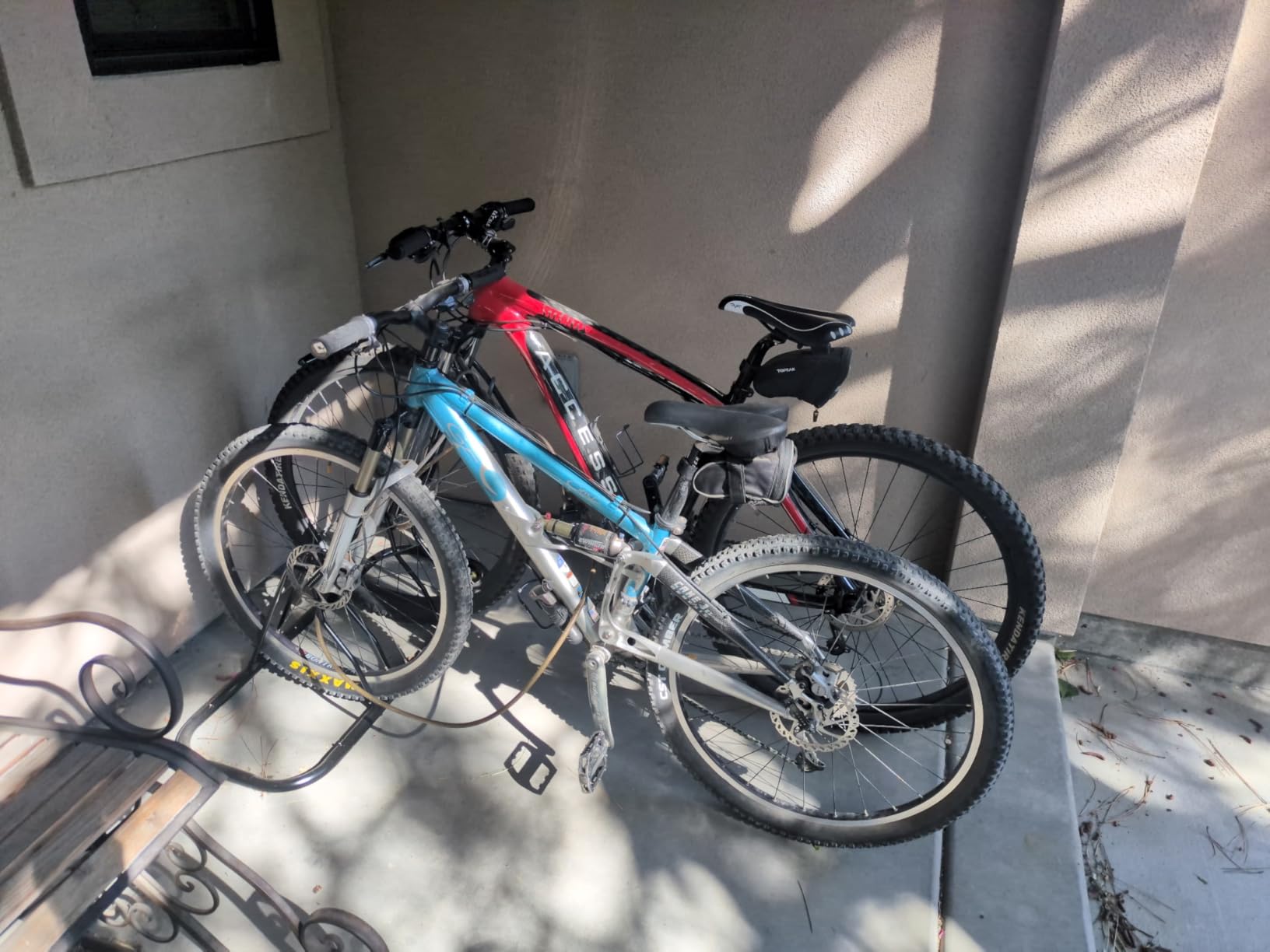
The most important spec to know is the wheel-size limit. The rack explicitly does not fit 29-inch mountain bikes or fat-tire e-bikes, and reviewers consistently confirm this. If your family rides 26-inch and smaller wheels, this rack works beautifully. If anyone in the household has a 29er, look at the CyclingDeal for a wider wheel range.
Wheel Compatibility and Bike-Type Range
Fits wheel sizes from 12 inches through 26 inches. Maximum tire width is 2.5 inches. The 8-inch slot width is generous for kids bikes but tight for wide-tire mountain bikes. For standard road, hybrid, and commuter bikes, plus the entire span of kids bikes, this rack fits cleanly. For 29er mountain bikes or e-bikes, look elsewhere.
Modular Design and Configuration
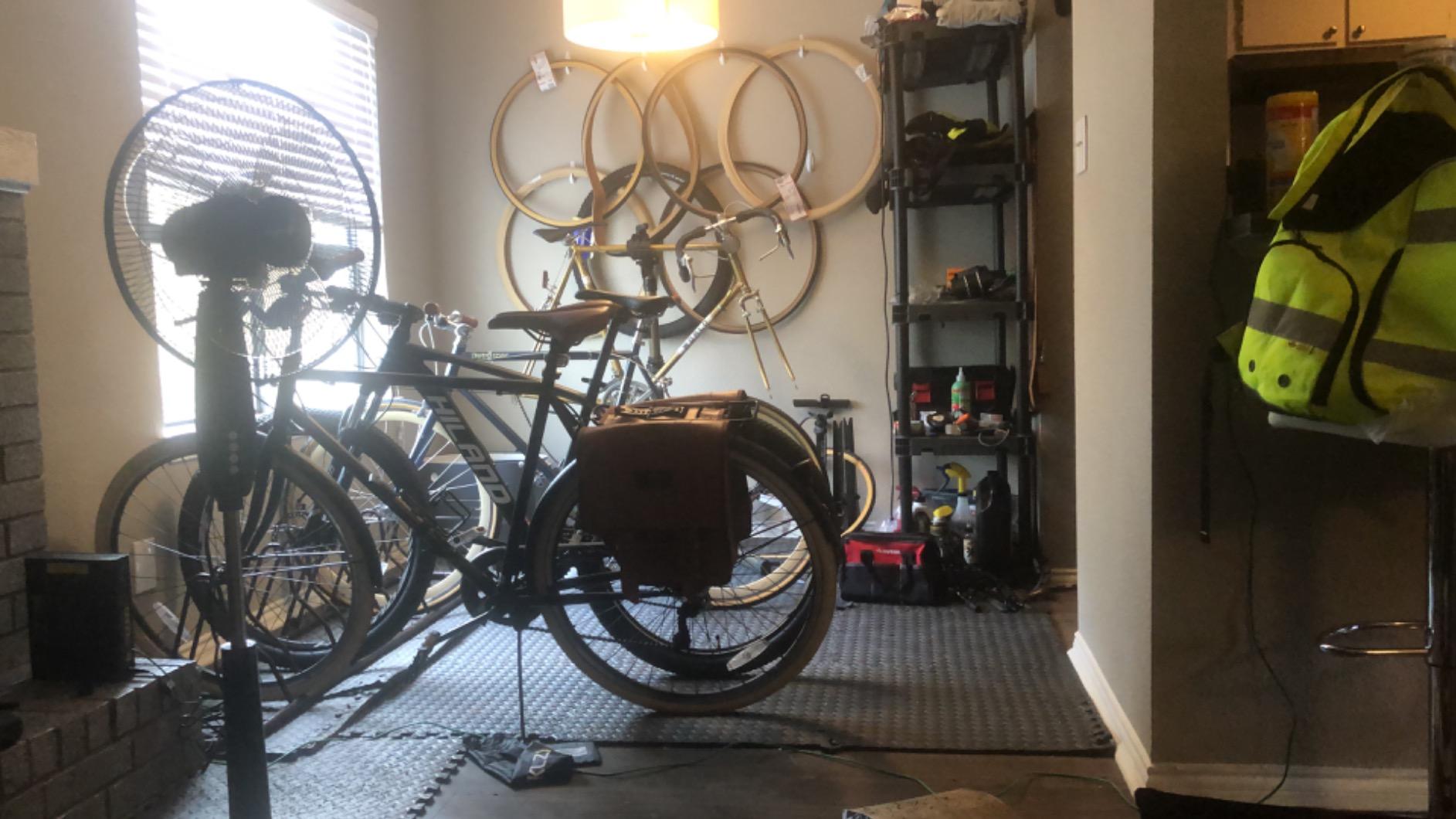
Each slot section can be unscrewed and separated from the others. I split mine into a three-slot and a two-slot configuration so the kids bikes sit near the entry door and the smaller adult bikes sit deeper in the garage. The ability to reconfigure is a real-world benefit, especially in a garage layout that might change over the years.
Stability and Floor Footprint
The footprint is 14.5 inches deep and 71.5 inches wide, similar to the CyclingDeal. Loaded with five bikes, the rack stays flat on a level floor. On a sloped garage floor, the rack can creep over time, so rubber furniture pads under the feet help. Owners report the powder-coated steel holds up fine in dry climates; in very humid climates, a few users report light surface rust after a couple of years.
Who Should Buy This and Who Should Skip It
Buy the Simple Houseware if your household has mostly kids bikes, smaller adult bikes, or a mix up to 26-inch wheels. Skip it if anyone rides a 29er mountain bike, an e-bike with fat tires, or a bike with fenders. For broader wheel-range families, the CyclingDeal is the better pick.
How to Pick the Right Garage Bike Storage Rack for Your Space
Picking the right bike storage rack comes down to four decisions: how many bikes, what mount type fits your garage, what your studs and ceiling allow, and what bike types you ride. Answering those four questions before you buy saves the most money and avoids the most frustration. The 10 racks above cover every reasonable answer, and the buying-guide H3s below walk through each decision in detail.
Count Your Bikes and Measure Your Wall and Ceiling
Start with the count of bikes that will live in the garage at the same time. For one or two bikes, a single wall mount like the Steadyrack, Ibera, or PRO BIKE TOOL is the cleanest answer. For three to five bikes in one location, the StoreYourBoard rail or a multi-slot floor rack like the CyclingDeal or Simple Houseware makes more sense. For six or more bikes, you will likely need a combination — a wall rail plus a floor rack, or two wall rails.
Then measure the available wall width, the stud locations, and the ceiling height. Studs are typically 16 inches apart on center, though some older homes use 24-inch spacing. If your studs do not line up with where you want a rack, you have two options: use a rack whose hole pattern matches your studs (like the StoreYourBoard with its Infinity Stud System), or mount a plywood backer across two or three studs and fasten the rack to that. For ceiling hoists, you need to find joists — the wide spans between trusses will not hold a hoist under load.
Wall-Mounted vs Ceiling vs Freestanding
Wall-mounted racks are the most popular category because they offer the best balance of clear floor space, easy daily access, and high load capacity. Pivoting wall mounts like the Steadyrack fold flat when not in use, which is the closest thing to invisible storage. Horizontal wall mounts like the Ibera and PRO BIKE TOOL show off the bike and let it double as display. Vertical multi-bike rails like the StoreYourBoard handle families and small garages.
Ceiling hoists are the right answer if your garage floor is more important than quick daily access. The RAD Sportz clears an entire parking bay, but you lift the bike to chest height every ride. This works for occasional-use bikes, winter storage, or any situation where daily grab-and-go is not required. For active commuters who ride every day, ceiling storage adds friction that compounds over weeks.
Freestanding racks are the right answer for renters, anyone with no studs, or anyone who wants to move the rack. The Sttoraboks rolls on lockable casters, the Delta Michelangelo uses gravity without mounting, and the CyclingDeal holds five bikes on a flat floor. None of them require drilling, which is the key benefit. The trade-off is that they take up some floor footprint and cannot match the wall-mount’s fold-flat advantage.
Tire Width, Frame Type, and E-Bike Considerations
Tire width is the most-overlooked spec in bike storage. A rack that handles a 1.5-inch road tire will not necessarily handle a 2.8-inch mountain bike tire or a 4-inch fat tire. Check the maximum tire width spec on every rack before you buy. Most wall hooks handle standard tires; fat-tire bikes need motorcycle hooks or wider cradles.
Frame type matters too. Carbon frames cannot take metal-on-carbon contact points — every rack in this roundup uses rubber cradles, but it is still worth verifying. Sloped top tubes need adjustable arms (Ibera and PRO BIKE TOOL both have these). Step-through frames need vertical hooks rather than horizontal mounts, because a horizontal mount cannot reach the top tube. E-bikes are heavy — many weigh 50 to 70 pounds — so a rack’s capacity rating must account for the heaviest bike in the household. The Steadyrack at 77 pounds, the StoreYourBoard at 300 pounds total, and the RAD Sportz at 100 pounds per hoist all accommodate e-bikes. Always check the capacity spec.
Stud Spacing, Drywall, and Hardware Choices
Every wall-mounted rack in this roundup needs proper mounting into studs or a plywood backer. Drywall anchors alone are not adequate for a loaded bike, especially an e-bike. Find the studs with a stud finder, verify them by tapping or drilling a pilot hole, and use 3-inch lag screws for any rack rated above 30 pounds. If studs do not line up with your preferred rack location, mount a 3/4-inch plywood backer across two or three studs and fasten the rack to that.
For ceiling hoists, you need to find joists (not just ceiling drywall) and mount a 2×4 across at least two joists. The RAD Sportz does not include a 2×4, which is the most consistent complaint in reviews. For renters or anyone who cannot drill, the Sttoraboks and Delta Michelangelo are the right picks. They roll or lean into place with no wall or ceiling involvement.
Renter-Friendly, Family, and Aesthetic Considerations
Renters have three solid no-drill options: the Sttoraboks rolling stand, the Delta Michelangelo wall-lean stand, and the CyclingDeal 5-bike floor rack. All three leave no marks and can be moved out when the lease ends. The Sttoraboks rolls smoothly, the Michelangelo leans against the wall, and the CyclingDeal sits flat on the floor.
Families with multiple riders should consider the StoreYourBoard rail, the CyclingDeal floor rack, or the Simple Houseware 5-bike rack. Each of these holds five bikes in dedicated slots, and each scales as the family grows. For aesthetics, the Steadyrack’s chrome and powder coat options disappear into a finished garage, while the Steadyrack’s pivot mechanism looks like it belongs in a high-end bike shop. The PRO BIKE TOOL’s adjustable arms and red finish let the bike become a focal point on the wall.
Frequently Asked Questions
What are the best bike storage racks for a garage?
The best garage bike storage racks combine space-saving geometry, reliable load capacity, and easy daily access. For most households, the Steadyrack Swivel Wall Mount is the top pick because of its 160-degree pivot and 77-pound capacity. Families with multiple bikes should consider the StoreYourBoard rail, while renters or anyone avoiding drilling should look at the Sttoraboks rolling stand. The right rack depends on stud layout, ceiling height, and bike type — wall mounts for daily riders, ceiling hoists for occasional use, and freestanding stands for no-install needs.
What is the best way to store bikes in a garage?
The most efficient garage bike storage lifts bikes off the floor and out of the way. Wall-mounted vertical racks like the Steadyrack fold flat against the wall when not in use and let you grab a bike in seconds. Horizontal wall mounts like the PRO BIKE TOOL or Ibera display the bike and keep it accessible. Ceiling hoists like the RAD Sportz clear an entire parking bay but require lifting. Freestanding racks like the Sttoraboks or CyclingDeal work for renters and mixed households. Combine wall and floor storage if your garage needs more than one bike at the same location.
What is the most affordable way to hang a bike in the garage?
The most affordable way to hang a bike in a garage is a basic vertical wall hook mounted into a stud. The Wallmaster 2-pack is the cheapest credible option and handles bikes up to 50 pounds when properly mounted with 3-inch lag screws. For budget multi-bike storage, the CyclingDeal 5-bike floor rack costs less per bike than most wall mounts and requires zero drilling. Both options are widely used by hobbyists and small households. Upgrade the included hardware with proper lag screws from a hardware store for the strongest mount on a budget.
Are wall-mounted bike racks safe?
Yes, wall-mounted bike racks are safe when mounted into studs or a plywood backer with proper lag screws. The Steadyrack, Ibera, PRO BIKE TOOL, and StoreYourBoard all rely on stud mounting and have years of failure-free use across thousands of installations. The most common cause of wall-mount failure is relying on the included drywall anchors for a full bike load — those are not adequate for the rated capacity. Always find at least one stud per mounting point, use 3-inch lag screws, and verify with a level. Cheap wall hooks with weak hardware are the only category where failures happen regularly.
How much weight can a garage bike rack hold?
Weight capacity varies widely by rack type. Basic wall hooks like the Wallmaster hold up to 50 pounds per hanger. The Ibera and PRO BIKE TOOL hold around 39 to 48 pounds each, suitable for most road, hybrid, and commuter bikes. The Steadyrack holds 77 pounds per rack, covering heavier mountain bikes and most e-bikes. Ceiling hoists like the RAD Sportz hold 100 pounds per hoist. Multi-bike rails like the StoreYourBoard hold 300 pounds total across five hooks. Freestanding racks like the Sttoraboks and CyclingDeal rate their capacity per slot. Always check the capacity spec against the heaviest bike in your household, and use a plywood backer or a 2×4 for any rack near its limit.
Which Garage Bike Storage Rack Should You Buy in 2026?
If you want the strongest single pick across studded walls, the Steadyrack Swivel Wall Mount is the best garage bike storage rack for 2026 because of its no-lift pivot, fold-flat geometry, and 77-pound capacity. If your family has three to five bikes, the StoreYourBoard rail is the cleanest multi-bike wall solution. If you rent or cannot drill, the Sttoraboks rolling stand or the Delta Michelangelo will leave your walls untouched. The CyclingDeal 5-bike rack remains the best value no-drill option, and the RAD Sportz hoist is the right answer when clearing the floor matters more than daily access.
Whatever you choose, mount every wall rack into a stud with proper lag screws, verify the capacity against your heaviest bike, and re-check the hardware after the first 30 days. A good bike rack should last years, and the picks above have proven track records across thousands of installations. For more garage-organization guides, our bin storage systems overview is the natural next read once the bikes are off the floor.
Leave a Reply