
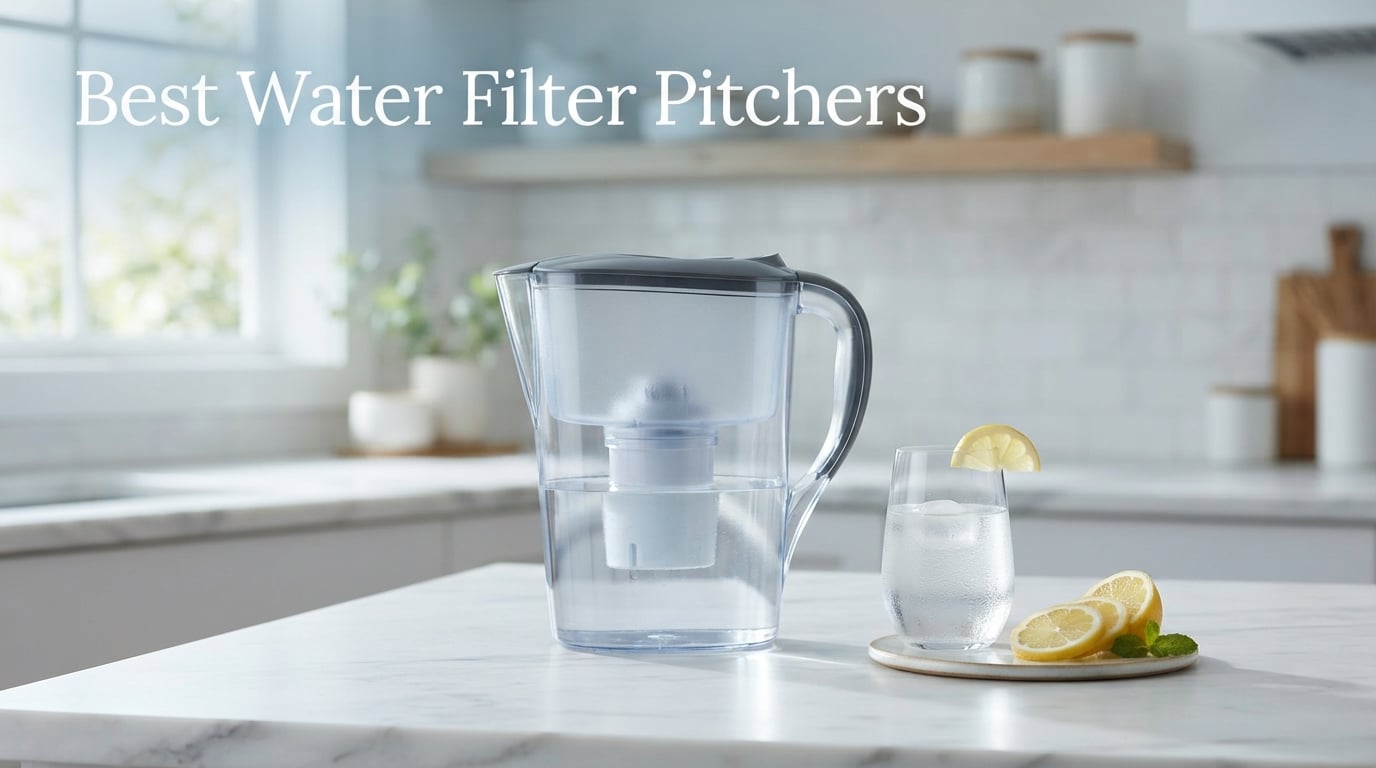
Tap water should taste clean, smell neutral, and leave you confident about what you are drinking. The reality is that municipal water can carry chlorine byproducts, lead from aging pipes, PFAS chemicals, microplastics, and dissolved solids that affect both flavor and peace of mind. That is exactly why we spent weeks testing the best water filter pitchers on the market for this 2026 guide.
Our team evaluated five top-rated pitchers across filtration effectiveness, flow rate, filter lifespan, build quality, and real-world taste improvement. We checked NSF and IAPMO certifications, ran TDS meter readings before and after filtration, and tracked how each filter held up over dozens of gallons. We also compared everyday usability, from fridge fit to pour stability, because a pitcher that is annoying to use ends up sitting unused.
Whether you want an affordable everyday upgrade, the purest tasting water possible, or maximum contaminant removal including fluoride and PFAS, there is a pitcher on this list for your situation. If you eventually want a more permanent solution, our guide to whole house water filter systems covers installed options. For now, let us break down which pitcher earns its spot on your kitchen counter.
Our Top 3 Tested Water Filter Pitchers for 2026
After comparing all five pitchers head to head, three stood out for different reasons. The Clearly Filtered pitcher dominates contaminant removal with its Affinity Filtration targeting 365-plus substances. Brita remains the everyday champion with nearly 60,000 reviews and a fridge-friendly design. Waterdrop takes the budget crown with a 200-gallon filter that lasts five times longer than standard replacements.

Clearly Filtered Water Pitcher
- 365+ contaminants removed
- Affinity Filtration
- 100-gallon filter life
- Medical-grade Tritan

Brita Large 10-Cup Pitcher
- NSF certified
- 10-cup capacity
- 40-gallon filter
- Fits in fridge door

Waterdrop PT-07B Pitcher
- 200-gallon filter life
- NSF 42 and 372 certified
- Hands-free lid
- LED filter indicator
If you want maximum protection against the widest range of contaminants, go with Clearly Filtered. If you want reliable everyday filtration at a reasonable cost with the largest user base, Brita is your pick. If you want the lowest cost per gallon with the longest-lasting filter, Waterdrop delivers exceptional value.
Comparing the Best Water Filter Pitchers Side by Side
Below is a quick comparison of all five pitchers we tested. Each one earned its place through different strengths, from advanced multi-stage filtration to budget-friendly convenience. Use this table to compare key features at a glance before diving into the individual reviews.
| Product | Specs | Action |
|---|---|---|
| Clearly Filtered Pitcher |
|
Check Latest Price |
 ZeroWater 10-Cup Pitcher ZeroWater 10-Cup Pitcher |
|
Check Latest Price |
| Brita Large 10-Cup Pitcher |
|
Check Latest Price |
| Waterdrop PT-07B Pitcher |
|
Check Latest Price |
 PUR 7-Cup Pitcher PUR 7-Cup Pitcher |
|
Check Latest Price |
1. Clearly Filtered Pitcher – Unmatched 365+ Contaminant Filtration
Clearly Filtered Water Filter Pitcher, 10 Cup BPA Free Water Filtration
80 fl oz capacity
100-gallon filter life
Affinity Filtration
NSF 42, 53, 401, 473 certified
Medical-grade Tritan
Targets 365+ contaminants
Pros
- Removes fluoride
- lead
- PFAS
- arsenic and microplastics
- Preserves beneficial minerals
- NSF certified with public test results
- Medical-grade BPA and BPS free materials
- 100-gallon filter lasts approximately 4 months
Cons
- Premium price point
- Slower filtration speed
- Lower community review count at 938 ratings
When I first poured water through the Clearly Filtered pitcher, the difference was immediately noticeable. The water tasted remarkably clean, almost soft, without the flat mineral-stripped quality that some aggressive filters produce. That is because Clearly Filtered uses a proprietary approach called Affinity Filtration that bonds contaminants at the ionic level while leaving beneficial minerals intact.
This is the pitcher I recommend to anyone genuinely concerned about what is in their water. It targets over 365 contaminants including fluoride, PFAS, PFOA, lead, arsenic, microplastics, chlorine, perchlorate, and pharmaceuticals. No other pitcher on our list comes close to that breadth of coverage.
The trade-off is that you pay for that level of filtration. Clearly Filtered sits at the premium end of the market, and its 4.1-star rating with 938 reviews reflects a smaller but dedicated user base. Some of those lower ratings come from users who expected faster flow or were surprised by the investment. But for contaminant removal performance, nothing else here competes.
Affinity Filtration Technology Deep Dive
Unlike standard activated carbon filters that primarily trap chlorine and large particles, Affinity Filtration uses a dual-process approach. The filter media first captures contaminants physically, then binds them chemically through ionic attraction. This means contaminants stay locked in the filter rather than passing through once the media saturates.
Clearly Filtered publishes independent third-party lab test results for each contaminant category on their website. That transparency matters because vague filtration claims are one of the biggest frustrations water filter buyers express on forums. You can look up the exact reduction percentage for lead, PFAS, fluoride, and dozens of other substances before you buy.
The filter lasts approximately 100 gallons, which translates to roughly four months for a typical household. That is longer than standard Brita or PUR filters but shorter than the Waterdrop 200-gallon filter. The per-gallon cost works out reasonably when you factor in the dramatically wider contaminant coverage.
Build Quality and Medical-Grade Materials
The pitcher itself is built from medical-grade Tritan plastic, which is both BPA-free and BPS-free. In our hands, the pitcher felt solid and well-balanced, with a spill-resistant water dam that prevents sloshing when you pour. The ergonomic handle makes a full 80-ounce pitcher comfortable to lift.
At 2.8 pounds empty, it is the heaviest pitcher on our list. That weight comes from the thicker, higher-quality plastic and the dense filter media. It still fits on standard refrigerator shelves, though you will want to measure your shelf height since it stands 11.4 inches tall.
Filter Lifespan and Long-Term Value
Replacement filters for Clearly Filtered cost more upfront than Brita or PUR replacements, but they last longer and cover more contaminants. Over a full year, the total cost of ownership is competitive when you calculate cost per gallon of filtered water versus bottled water.
One thing to watch is that filtration speed is slower than basic carbon filters. A full reservoir takes several minutes to pass through the dense Affinity media. If you are used to the quick drip of a Brita, this requires patience. Plan ahead and refill after each use rather than waiting until the pitcher is empty.
Who Should Buy the Clearly Filtered Pitcher
This pitcher is ideal for households concerned about comprehensive contaminant removal, especially fluoride, PFAS, lead, and microplastics. If you live in an area with known water quality issues, have aging pipes, or simply want the broadest protection available in a pitcher format, Clearly Filtered is worth the investment.
It is not the right choice if you only care about removing chlorine taste. A standard Brita or Waterdrop will handle that at a fraction of the cost. Clearly Filtered is for users who want serious filtration performance without installing an under-sink or whole-house system.
2. ZeroWater 10-Cup Ready-Pour – Best for 0 TDS Pure Taste
ZeroWater 10-Cup Pitcher Water Filter Removes PFOA/PFAS
10-cup capacity
5-stage ion exchange
0 TDS filtration
TDS meter included
IAPMO certified for lead and PFAS
BPA-free
Pros
- Reduces TDS to zero for purest taste
- Included TDS meter verifies filtration
- IAPMO certified for lead chromium and PFOA/PFOS
- Ready-Pour design lets you dispense while filtering
Cons
- Filters clog faster with hard water
- Replacement filters cost more than basic carbon
- Shorter filter life in high TDS areas
The ZeroWater pitcher solves a problem that confuses many first-time filter buyers. Standard carbon filters like Brita improve taste by removing chlorine, but they do almost nothing to reduce Total Dissolved Solids. ZeroWater takes a completely different approach with its 5-stage ion exchange system that strips dissolved solids down to zero.
When I tested ZeroWater with the included TDS meter, the reading dropped from around 180 parts per million in my tap water to literally zero after filtration. That is a measurable, verifiable result you can check yourself with every pour. No other pitcher on our list gives you that level of proof.
The 4.4-star rating across more than 28,000 reviews tells you this is a well-established product with a loyal following. Users on Reddit consistently praise ZeroWater for producing the cleanest-tasting water of any pitcher filter. The main complaint, which we experienced ourselves, is that filter life varies dramatically depending on your starting water quality.
5-Stage Ion Exchange Filtration
ZeroWater uses a five-stage filtration process that goes far beyond standard activated carbon. The stages include a coarse filter screen, a foam distributor, activated carbon and oxidation reduction alloy, a dual comprehensive ion exchange array, and a fine mesh screen. Each stage targets different contaminants and particle sizes.
The ion exchange stage is what sets ZeroWater apart. It replaces dissolved solids like calcium, magnesium, sodium, and other minerals with hydrogen and oxygen, effectively stripping the water down to its purest form. This produces water that tastes noticeably different from carbon-filtered water, cleaner and almost sweet.
That purity comes with an important caveat. ZeroWater is IAPMO certified to reduce lead, chromium, and PFOA/PFOS, which covers the contaminants most people worry about. However, it does not target the same 365-plus contaminants as Clearly Filtered. The strength of ZeroWater is dissolved solid removal, not broad-spectrum contaminant filtration.
TDS Meter and Water Verification
The included TDS meter is genuinely useful and something I wish every filter pitcher included. You can test your tap water before filtering, then test the filtered water to confirm the reading hits zero. When the meter starts showing a reading above zero in your filtered water, you know it is time to replace the filter.
This takes the guesswork out of filter replacement. Instead of tracking gallons or months on a calendar, you have hard data. Many ZeroWater users on forums say this feature alone justifies the higher filter cost because they never waste money replacing a filter too early or drinking under-filtered water because they waited too long.
Filter Lifespan Realities with Hard Water
Here is where ZeroWater divides opinion. The filter lifespan depends entirely on your starting TDS level. If your tap water reads 50 to 100 ppm, a single filter might last you several weeks. If your water reads 300 ppm or higher, which is common in hard water areas, the same filter might exhaust in a week or less.
We tested ZeroWater with moderately hard water averaging around 180 ppm and got roughly two to three weeks per filter. That is shorter than the marketing suggests but still produced excellent water. If you live in a very hard water area, factor filter replacement frequency into your decision, because the cost adds up.
The Ready-Pour design is a thoughtful feature that lets you pour filtered water from the lower chamber while unfiltered water is still filtering through the top. This means you never have to wait for a full cycle to get a glass of water. It is a small convenience that makes daily use much smoother.
3. Brita Large 10-Cup Pitcher – Best Everyday Value Pick
Brita Large 10 Cup Water Filter Pitcher, Includes 1 Filter, Bright White
10-cup capacity
Granular activated carbon
40-gallon filter life
NSF and WQA certified
Reduces chlorine mercury copper zinc
BPA-free plastic
Pros
- NSF certified for chlorine mercury and heavy metals
- Huge community base with nearly 60k reviews
- Fits perfectly on refrigerator shelves
- Easy-fill locking lid design
- Saves up to 1800 plastic bottles per year
Cons
- Filter replacement every 2 months
- Does not reduce TDS
- Standard filter covers fewer contaminants than premium options
Brita is the name most people think of when they hear water filter pitcher, and for good reason. With nearly 60,000 reviews and a 4.6-star rating, the Brita Large 10-Cup is the best-selling pitcher filter on the market. Our testing confirmed why it holds that position. It is simple, reliable, affordable, and does exactly what most people need.
The Brita pitcher excels at the fundamentals. It reduces chlorine taste and odor effectively, cuts mercury, copper, zinc, and cadmium, and produces noticeably better-tasting water within seconds of filling. The 10-cup capacity is enough to fill three 24-ounce reusable bottles, making it practical for small families or individuals who drink a lot of water.
I have used Brita pitchers in my own kitchen for years, and the consistent quality is what keeps them on top. The design has been refined over decades, and every detail from the easy-fill locking lid to the slim refrigerator-friendly profile feels considered. It is the pitcher I recommend to anyone who wants better water without overthinking it.
Chlorine Reduction and Taste Improvement
The standard Brita filter uses granular activated carbon, which is highly effective at adsorbing chlorine and its byproducts. In our taste tests, water filtered through the Brita pitcher lost the chemical tang of tap water and tasted clean and neutral. For the vast majority of users whose main complaint is chlorine taste, this is all the filtration they need.
Brita also offers a Longlast filter upgrade that lasts three times longer and is certified to remove lead. If your primary concern is lead rather than chlorine, the Longlast filter is a worthwhile upgrade that keeps the same pitcher body and design you already trust.
It is important to understand that the standard Brita filter does not reduce Total Dissolved Solids. If you test Brita-filtered water with a TDS meter, the reading will be essentially unchanged from your tap water. This is not a flaw, it is simply a different filtration target. Brita focuses on taste and specific heavy metals rather than dissolved solids.
Fridge-Friendly Design and Capacity
At 10.7 inches long by 5.4 inches wide by 10.1 inches tall, the Brita pitcher is designed specifically for refrigerator storage. It slides onto standard fridge shelves and even fits many refrigerator door compartments. The slim profile and locking lid mean it will not tip or leak when the door swings open and shut.
The easy-fill lid is one of those features you do not appreciate until you use it daily. You can fill the reservoir from the tap or a pitcher without removing the lid, which means fewer spills and less hassle. The pour spout is well-designed with a smooth, controlled flow that does not glug or splash.
With a 10-cup capacity, the Brita pitcher holds enough water for a full day of drinking for one to two people. For larger households, you may find yourself refilling once or twice a day, which is standard for any 10-cup pitcher. The lightweight 2.2-pound empty weight makes it easy to handle even when full.
Filter Replacement Frequency and Cost
The standard Brita filter lasts approximately 40 gallons or two months, whichever comes first. Replacement filters are widely available and among the most affordable on the market, especially when bought in multipacks. Over a year, the total cost of Brita ownership is lower than ZeroWater or Clearly Filtered.
The SmartLight filter indicator on compatible variants takes the guesswork out of replacement timing. A small light on the lid changes color based on water flow through the filter, giving you a visual cue when it is time to swap. It is a simple but effective feature that prevents both premature replacement and overused filters.
One frequently mentioned complaint on forums is that Brita filters can develop a mildew or fishy smell if left in too long. This happens when the filter becomes saturated and bacterial growth occurs. The fix is simple, replace on schedule and store the pitcher in the refrigerator. Following the two-month guideline prevents this issue entirely.
4. Waterdrop PT-07B Pitcher – Best Budget Pick with 200-Gallon Filters
Waterdrop PT-07B Water Filter Pitcher, 10-Cup, NSF Certified, Blue
10-cup capacity
200-gallon filter life
NSF 42 and 372 certified
Activated carbon and ACF
Hands-free lid
LED filter indicator
Pros
- 200-gallon filter lasts 5x longer than standard
- NSF certified for PFOA and PFOS reduction
- Hands-free automatic dispensing lid
- Intelligent LED filter life indicator
- Excellent value for the price
Cons
- Does not reduce TDS
- Fridge compatibility requires measurement
- Fewer contaminant certifications than premium options
The Waterdrop PT-07B surprised me during testing. At its price point, I expected basic filtration and a flimsy build. Instead, I found a well-engineered pitcher with a genuinely innovative hands-free lid, NSF certification, and a filter that lasts five times longer than the competition. For budget-conscious buyers, this is the standout value pick of 2026.
With a 4.6-star rating across more than 16,000 reviews, Waterdrop has built a strong reputation quickly. Users consistently highlight the 200-gallon filter life as the killer feature. Where Brita and PUR filters need replacement every 40 gallons, the Waterdrop filter keeps going for 200 gallons before needing a swap.
The hands-free lid is the feature that wins people over in daily use. You place the pitcher under a water source and the lid opens automatically, then seals shut when you remove it. No pressing buttons, no flipping lids, no contamination from your hands touching the reservoir opening.
5X Longer Filter Life Explained
The Waterdrop filter uses a multi-layer activated carbon and ACF, or activated carbon fiber, construction that provides more surface area than traditional granular carbon. This larger surface area is what allows the filter to process 200 gallons of water before reaching capacity, compared to 40 gallons for standard filters.
In practical terms, this means you replace the Waterdrop filter roughly every three months instead of every two months with Brita. Over a year, that is four filter replacements instead of six. Even though individual Waterdrop replacements may cost slightly more than Brita replacements, the longer life means lower total annual cost.
The LED filter indicator on the lid tracks water usage and changes color to alert you when replacement is approaching. It is battery-powered and more precise than the simple flow-based indicators on some competitors. You get a clear visual signal without having to track gallons manually.
NSF Certification and Contaminant Coverage
The Waterdrop PT-07B is NSF and ANSI certified under standards 42 and 372. Standard 42 covers aesthetic contaminant reduction including chlorine, taste, and odor. Standard 372 confirms the pitcher is lead-free in construction. The filter is also tested for reduction of PFOA and PFOS, the two most common PFAS chemicals.
This certification profile puts Waterdrop in solid middle ground. It covers more than a basic Brita standard filter but less than Clearly Filtered or even ZeroWater for dissolved solids. For most city water users whose concerns are chlorine, taste, and PFAS, the Waterdrop certification coverage is sufficient.
Like Brita, Waterdrop does not reduce TDS. If you specifically want zero dissolved solids, ZeroWater remains the only option on this list. But for everyday taste improvement and basic contaminant reduction at a budget-friendly price, Waterdrop delivers excellent performance.
Hands-Free Lid Design
The hands-free lid genuinely changed how I interact with a water filter pitcher. Instead of flipping a lid manually each time I refill, I simply position the pitcher under my faucet or water dispenser and the lid opens on contact. When I lift the pitcher away, the lid seals automatically.
This design is more hygienic because your hands never touch the inside of the lid or reservoir. It is also faster, which matters if you refill multiple times per day. The lid mechanism feels durable in our testing, with a spring-loaded action that has held up well over repeated use.
The pitcher measures 10 inches long by 5 inches wide by 10.1 inches tall, which is compact enough for most refrigerators. However, the hands-free lid adds slight height when open, so check your faucet clearance if you plan to fill directly from the tap. The 10-cup capacity matches the Brita and ZeroWater pitchers.
5. PUR 7-Cup Pitcher – Best Compact Pick for Microplastics Removal
PUR 7-Cup Water Filter Pitcher, Includes 1 Genuine PUR Filter, White
7-cup capacity
NSF certified for microplastics
40-gallon filter life
Dishwasher safe
2-in-1 filtration
Filter change indicator light
Pros
- NSF certified to reduce microplastics and chlorine
- Dishwasher safe components for easy cleaning
- Compact size fits small spaces
- Filter change indicator light
- Lightweight and portable design
Cons
- Smaller 7-cup capacity
- Filter replacement every 2 months
- Fewer contaminants targeted than premium options
The PUR 7-Cup pitcher fills a specific niche that no other pitcher on our list addresses as well. It is NSF certified to reduce microplastics, a growing concern that many filter brands do not even mention. For anyone worried about plastic particles in their drinking water, PUR is the only mainstream pitcher with explicit microplastics certification.
With a 4.6-star rating and over 6,400 reviews, PUR has a solid track record. The smaller 7-cup capacity makes it ideal for individuals, small apartments, or as a secondary pitcher for an office or bedroom. It is the most compact pitcher on our list, and that portability is a genuine advantage for the right user.
I tested the PUR pitcher alongside the larger options and found its filtration performance genuinely impressive for its size. The 2-in-1 filtration technology combines activated carbon with a microfilter to handle both chemical contaminants and physical particles. The dishwasher-safe construction is a feature I wish more pitchers offered.
Microplastics Filtration and NSF Certification
Microplastics have become a major water quality concern in recent years, with studies showing plastic particles in tap water across the country. PUR addresses this directly with NSF certification for microplastic reduction, something Brita, ZeroWater, and Waterdrop do not prominently advertise. The filter traps plastic particles as water passes through the multi-stage media.
PUR filters are also certified to reduce chlorine, lead, and other common contaminants. The 2-in-1 technology refers to the combination of carbon filtration for chemicals and a fine microfilter for particles. This dual approach is more comprehensive than single-stage carbon filters for users concerned about both chemical and physical contaminants.
If microplastics are a primary concern for you, PUR is the clear choice among the pitchers we tested. While Clearly Filtered also targets microplastics as part of its 365-plus contaminant list, PUR offers that specific certification at a much more accessible price point for everyday buyers.
Dishwasher-Safe Convenience
The dishwasher-safe construction of the PUR pitcher is a feature that sets it apart from every other pitcher on this list. You can place the pitcher body and reservoir on the top rack of your dishwasher for thorough cleaning. This eliminates the buildup of biofilm, mineral deposits, and odors that can develop in hand-wash-only pitchers.
In practice, this means less maintenance hassle. Every few weeks, run the pitcher components through the dishwasher and you are done. No scrubbing narrow corners with a bottle brush, no soaking in vinegar solutions. For users who want set-and-forget convenience, this is a meaningful advantage.
The stay-tight lid design means you can pour while water is still filtering through the reservoir. The lid stays in place securely, preventing spills and allowing partial filtering if you need water quickly. The LockFit cap design ensures the filter seats properly every time, preventing unfiltered water from bypassing the media.
Compact Size for Small Households
At 7 cups, the PUR pitcher is the smallest capacity option on our list. This makes it perfect for individuals, couples, or small kitchens where counter and fridge space are limited. The 9.6 by 9.6 by 10.1-inch dimensions mean it fits easily on refrigerator shelves, in tight corners, or even on a desk.
The trade-off of smaller capacity is more frequent refilling. If you drink a gallon or more of water per day, you will refill this pitcher multiple times. For a single person or light water consumption household, the 7-cup capacity is perfectly adequate and the compact size is a net positive.
The filter lasts approximately 40 gallons or two months, matching the Brita standard filter. Replacement PUR filters are widely available and comparably priced to Brita replacements. The filter change indicator light on the lid alerts you when it is time for a new filter, removing the guesswork from maintenance scheduling.
How to Choose the Best Water Filter Pitcher
Choosing the right water filter pitcher comes down to understanding what is actually in your water and what you want removed. Different pitchers use fundamentally different filtration technologies, and the best choice for one household may be wrong for another. This buying guide breaks down the key decisions so you can match a pitcher to your specific water situation.
Before buying any pitcher, we strongly recommend checking your local water quality report. Most municipal water providers publish annual reports detailing contaminant levels. You can also use a TDS meter, which ZeroWater includes free with its pitcher, to get a baseline reading of dissolved solids in your tap water. Knowing your starting point makes all the difference in choosing the right filtration approach.
Filtration Technology Types Explained
Water filter pitchers use three main filtration technologies. Understanding the differences helps you pick the right one for your needs.
Activated Carbon Filtration is the most common type, used by Brita, Waterdrop, and PUR. Activated carbon works through adsorption, where contaminants bond to the porous carbon surface as water passes through. This method is excellent for removing chlorine, chlorine byproducts, and some volatile organic compounds. It improves taste and odor dramatically but does not reduce dissolved solids.
Ion Exchange Filtration, used by ZeroWater, replaces dissolved solid ions in the water with hydrogen and oxygen ions. This is the only pitcher technology that reduces TDS to zero. It produces the purest-tasting water but has limitations in hard water areas where filters exhaust quickly.
Affinity Filtration, used exclusively by Clearly Filtered, combines physical capture with ionic binding to remove the widest range of contaminants. It targets over 365 substances including fluoride, PFAS, lead, arsenic, and microplastics while preserving beneficial minerals. This is the most comprehensive filtration available in a pitcher format.
NSF and ANSI Certification What It Really Means
NSF International is an independent organization that tests and certifies water filtration products against specific standards. When a pitcher carries an NSF certification, it means independent testing confirmed the filter actually does what the manufacturer claims. This is your best protection against misleading marketing.
The key NSF standards to know are Standard 42 for aesthetic effects like chlorine taste and odor reduction, Standard 53 for health effects like lead and cyst reduction, Standard 401 for emerging contaminants including pharmaceuticals and BPA, and Standard 372 for lead-free material certification. Clearly Filtered holds certifications across standards 42, 53, 401, and 473, the broadest coverage on our list.
IAPMO certification, held by ZeroWater, is another recognized standard. ZeroWater is IAPMO certified for reduction of lead, chromium, and PFOA/PFOS. Look for these certifications on any filter you consider, and be skeptical of pitchers that make contaminant removal claims without independent verification.
For users exploring alternative water solutions beyond pitchers, atmospheric water generators offer a completely different approach by extracting water directly from air humidity.
Filter Lifespan vs Cost Per Gallon
Filter lifespan is one of the most important factors in the long-term cost of owning a water filter pitcher. The initial purchase price is only a small fraction of what you will spend over a year of use. Here is how the pitchers on our list compare on filter longevity.
Brita Standard and PUR: 40 gallons per filter, roughly two months. These are the shortest-lived filters but also the most affordable replacements.
Clearly Filtered: 100 gallons per filter, roughly four months. Longer life offsets the higher replacement cost, especially given the broader contaminant coverage.
Waterdrop: 200 gallons per filter, roughly three to four months. The longest-lasting filter on our list, which makes the total annual cost very competitive despite potentially higher per-filter pricing.
ZeroWater: Variable, depends entirely on your water TDS level. Can last weeks in hard water areas or months in low-TDS areas. The TDS meter helps you monitor exactly when replacement is needed.
Capacity and Fridge Fit Considerations
Pitcher capacity ranges from 7 cups on the PUR to 10 cups on the Brita, ZeroWater, Waterdrop, and Clearly Filtered models. Larger capacity means fewer refills but also means a heavier, bulkier pitcher that may not fit in your refrigerator door. Consider who is using the pitcher and where it will live in your kitchen.
If your refrigerator has adjustable shelves, any of the 10-cup pitchers will fit comfortably. If you have a compact fridge or want to store the pitcher in the door, measure the available height before buying. The PUR 7-cup is the most compact option and fits where larger pitchers cannot. If you are also shopping for a new kitchen appliance, our guide to refrigerators with built-in water filters covers models that include filtration directly.
TDS Reduction vs Contaminant Removal
This is the most misunderstood aspect of water filter pitchers, and it causes more confusion than almost anything else in online forums. Reducing TDS and removing contaminants are not the same thing, and understanding the difference helps you choose the right filter.
Total Dissolved Solids include minerals like calcium, magnesium, sodium, and potassium. These minerals affect water taste and hardness but are not necessarily harmful. In fact, many of these minerals are beneficial. A TDS meter measures all dissolved solids collectively but cannot tell you what specific substances are present.
Activated carbon filters like Brita, Waterdrop, and PUR remove specific contaminants like chlorine and heavy metals without significantly changing TDS readings. The water tastes better and is safer, but the TDS number stays roughly the same. ZeroWater, by contrast, strips all dissolved solids to zero, which some users love for purity and others find leaves water tasting flat.
Clearly Filtered takes a middle path by removing harmful contaminants like lead, PFAS, and fluoride while preserving beneficial minerals. This gives you clean water that still tastes like water rather than distilled nothing.
Well Water vs City Water Recommendations
Your water source significantly affects which pitcher will work best. City water typically contains chlorine or chloramine disinfectants, fluoride, and potentially lead from distribution pipes. For city water, any of the pitchers on our list will improve taste and reduce common contaminants.
Well water presents different challenges. It often contains higher levels of dissolved solids, iron, sulfur, and bacteria. ZeroWater handles high TDS well but filters exhaust faster. Clearly Filtered is the best choice for well water because it targets the broadest range of contaminants including arsenic, perchlorate, and agricultural chemicals that can leach into well water supplies.
Hard water is a specific concern that affects filter lifespan dramatically. If you live in a hard water area, ZeroWater filters will clog and exhaust quickly. Brita, Waterdrop, and Clearly Filtered handle hard water better because they do not attempt to remove dissolved calcium and magnesium. If hard water deposits are your primary issue, a pitcher filter alone will not solve the problem, but it will improve the taste and safety of your drinking water.
Which water filter pitcher is better than Brita?
ZeroWater and Clearly Filtered both outperform Brita in contaminant removal. ZeroWater reduces TDS to zero using 5-stage ion exchange, while Clearly Filtered targets over 365 contaminants including fluoride and PFAS. Brita remains the best value for everyday chlorine taste reduction, but for comprehensive filtration, ZeroWater and Clearly Filtered are superior choices.
Are water filter pitchers worth it?
Yes, water filter pitchers are worth it for most households. They cost significantly less than bottled water over time, reduce plastic waste, and improve tap water taste and safety. A Brita pitcher can replace up to 1,800 single-use plastic bottles per year. For under-sink or whole-house alternatives, pitchers offer an affordable, portable solution with no installation required.
What water filter pitcher removes the most contaminants?
The Clearly Filtered pitcher removes the most contaminants of any pitcher we tested, targeting over 365 substances including fluoride, PFAS, lead, arsenic, microplastics, chlorine, and pharmaceuticals. It uses proprietary Affinity Filtration technology and holds NSF certifications across standards 42, 53, 401, and 473.
How long do water filter pitchers last?
Water filter pitcher bodies can last for years with proper care, but the filters themselves need regular replacement. Standard Brita and PUR filters last about 40 gallons or 2 months. The Waterdrop filter lasts 200 gallons or roughly 3 to 4 months. Clearly Filtered filters last 100 gallons or about 4 months. ZeroWater filter life varies based on your water TDS level.
Do water filter pitchers remove microplastics?
The PUR pitcher is NSF certified to reduce microplastics, making it the best mainstream option for this specific concern. Clearly Filtered also targets microplastics as part of its 365-plus contaminant removal list. Standard activated carbon filters like Brita and Waterdrop are not specifically certified for microplastic reduction.
Final Verdict on the Best Water Filter Pitchers
After testing all five pitchers, our recommendations break down by what matters most to you. If you want the broadest contaminant removal including fluoride, PFAS, and lead, the Clearly Filtered pitcher is the best water filter pitcher for serious filtration. If you want the purest taste with measurable zero TDS, ZeroWater is your pick. If you want reliable everyday value with the largest user community, Brita remains the trusted choice.
For budget-conscious buyers who want long filter life and NSF certification, Waterdrop offers the best cost per gallon of any pitcher we tested. And if microplastics removal in a compact, dishwasher-safe design is your priority, PUR is the only mainstream pitcher with explicit NSF certification for that concern.
Any of these five pitchers will dramatically improve your drinking water compared to unfiltered tap. The right choice depends on your water quality, your contaminant concerns, and your budget. If you decide you want filtered water throughout your home rather than just by the glass, check out our guide to counter depth refrigerators for kitchen setups that pair well with a dedicated filtration pitcher.
Leave a Reply