
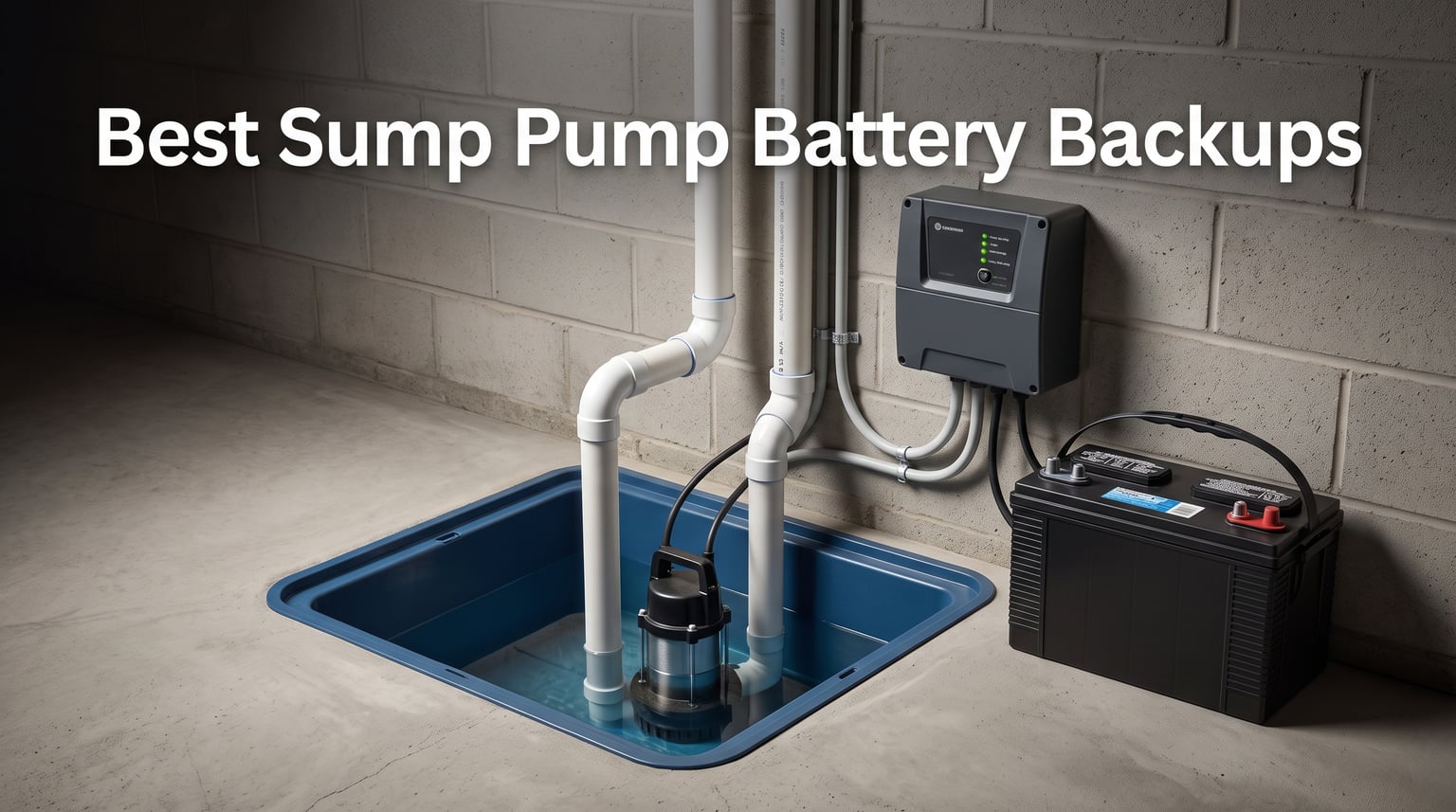
Basement flooding almost always hits during the exact moment you lose power — heavy storms, ice storms, hurricanes, or that one branch that takes out a transformer for three days. Your primary sump pump runs on 120V AC, which means the second the grid drops, your pump goes silent and water starts rising. That gap is exactly what the best sump pump battery backups are built to close. I have spent the past several months comparing the top-selling backup systems on the market, looking at how real owners use them in actual outage situations, and pulling apart the specs that actually matter when water is climbing in your pit.
The right battery backup system for your home depends on a few things: how often your power goes out, how high your water table sits, whether you want smart alerts, and how much runtime you realistically need. Some homeowners only need a few hours of coverage for short blips. Others — especially anyone in hurricane zones, lake-adjacent lots, or areas with aging grid infrastructure — need a system that can cycle for a full day or more. We tested systems ranging from compact inverter-style backups to full DC submersible backup pumps, and the differences are bigger than spec sheets suggest.
In this guide, I cover the five best sump pump battery backups available in 2026, with hands-on detail on flow rate, runtime, charger quality, battery compatibility, and installation difficulty. I also break down battery type selection (AGM vs wet cell vs lithium), sizing math, and the well-water and water-powered alternatives that some homeowners overlook. If you want the short answer up front: the Basement Watchdog Special CONNECT is the strongest all-around pick, the Zoeller Aquanot 508 is the plumber-favorite premium unit, and the PumpSpy 2000W is the best value if you want an inverter backup that keeps your existing AC pump running.
Our Top 3 Tested Sump Pump Battery Backups for 2026


These three systems cover three different buyer needs: a dedicated backup pump with smart monitoring, a heavy-duty USA-built unit trusted by plumbers, and an inverter-style system that keeps your existing AC pump alive during an outage. Each has trade-offs in cost, runtime, and installation complexity — keep reading for the full breakdown.
Comparing the Best Sump Pump Battery Backups in 2026
Here is a quick side-by-side of all five systems we tested. The table covers flow rate, runtime considerations, charger capacity, and the battery type each unit pairs with. All five are standalone backup systems that require a separate deep-cycle battery unless noted.
| Product | Specs | Action |
|---|---|---|
| Basement Watchdog Special CONNECT |
|
Check Latest Price |
| Zoeller Aquanot 508 |
|
Check Latest Price |
| PumpSpy 2000W Backup System |
|
Check Latest Price |
 VIOPUMPO 2500W Backup System VIOPUMPO 2500W Backup System |
|
Check Latest Price |
 Superior Pump 92910 12V Superior Pump 92910 12V |
|
Check Latest Price |
1. Basement Watchdog Special CONNECT — Best All-Around Backup Sump Pump
The Basement Watchdog Special CONNECT Battery Backup Sump Pump System w/Copper-Wound Motor, 2,890 GPH (BWSP); WiFi-Capable w/Add-on Module
2,890 GPH backup pump
Dual float switch
WiFi-capable
2-year warranty
Pros
- Compact enough for narrow sump pits
- Copper-wound motor built to last
- Control panel with maintenance warning lights
- Battery fluid level sensor included
- Dual float switch for redundancy
Cons
- Battery sold separately
- WiFi module requires separate purchase
The Basement Watchdog Special CONNECT (model BWSP) sits at the top of my list because it nails the things that actually matter during a real outage. This is a dedicated DC backup pump, not an inverter — meaning it drops a second pump into your pit alongside your primary AC unit. When power fails (or your main pump dies), the controller activates this backup pump and your water keeps moving. Glentronics has been making these systems for decades, and the engineering polish shows up in the small details.
What stood out most is the control panel. Instead of cryptic beeps or a single red LED, the Watchdog panel lights up with a specific warning and tells you exactly what to do. Battery fluid low? The panel says so. Pump didn’t run when expected? It tells you that too. For homeowners who do not want to dig out a manual every spring, this kind of plain-language feedback is genuinely useful. Reviewers repeatedly call out how much easier routine maintenance becomes with this panel.
Pumping Capacity and Real-World Flow
The Watchdog Special CONNECT is rated at 2,500 GPH at zero feet of lift, dropping to 1,730 GPH at 10 feet of lift. That is more than enough for most residential sump pits that discharge out a basement wall and up a few feet. The 0.25 HP copper-wound motor is a step up from cheaper aluminum-wound designs and tends to survive longer under frequent cycling. If your pit cycles every few minutes during heavy spring rain, copper windings are worth it.
One thing to remember: this is a backup, not a primary replacement. It is sized to keep your basement dry until the power comes back or your primary pump gets serviced. For most homes that means it runs intermittently during an outage, not continuously. Pair it with a quality Group 27 or Group 31 deep-cycle battery and you can expect 6 to 12 hours of intermittent cycling, sometimes more.
Dual Float Switch and Smart Monitoring
The dual float switch is one of those features you do not appreciate until your single float hangs up on the side of the pit and your basement floods anyway. Two floats give you redundancy — if one sticks, the other still triggers the pump. Glentronics includes a controller, charger, dual float switch, pump, and battery box in the package. You supply the deep-cycle battery.
The unit is WiFi-capable but the WiFi module is sold separately. If remote alerts matter to you (you travel, you own a vacation home, you just want push notifications when something goes sideways), budget for that module. Note from forum threads: WiFi only works when your router has power. If your router dies with the grid, the alerts will not reach you unless your router itself is on a small UPS.
Installation and Fit
This is the right pick for homeowners with small or unusually shaped sump pits. The pump measures 9 x 5 x 7.63 inches and fits into spaces that competitors like the Zoeller 508 cannot. Installation is a mid-level DIY project: you are adding a second pump, a check valve, a tee in your discharge pipe, and the controller. Most reasonably handy homeowners can handle it in a weekend. If you are not comfortable with PVC glue and basic wiring, a plumber will charge a few hundred dollars plus the system itself.
Who Should Buy the Watchdog Special CONNECT
Buy this if you want a proven, well-engineered backup pump with the best control panel on the market and you value plain-language maintenance feedback. Skip it if you specifically want to keep your existing AC pump running on battery power (an inverter-style system like the PumpSpy is better for that), or if you need 36-month warranty coverage (the Zoeller 508 extends to 36 months with a Zoeller battery).
2. Zoeller Aquanot 508 — Best Premium USA-Built Backup System
Zoeller 508-0005 Aquanot 508 Battery Back-Up System
12V DC backup pump
40 GPM flow rate
USA hand-built
Integrated check valve
Pros
- Hand-built and 100% tested in USA
- Noncorrosive pump construction
- Integrated check valve included
- Quick disconnect discharge
- 36-month warranty with Zoeller battery
Cons
- Battery sold separately
- Not Prime eligible
- Requires professional install for full warranty
The Zoeller Aquanot 508 is the unit that comes up again and again when you ask plumbers what they install. Zoeller is a family-owned manufacturer in Indianapolis that hand-builds and 100% tests every pump before it ships. That sounds like marketing fluff until you handle one — the construction feels noticeably more substantial than the thermoplastic competitors, and the noncorrosive pump body is built for decades of wet pit service.
The Aquanot 508 is a 12V DC submersible backup pump rated at 40 GPM. It includes an integrated check valve, a quick-disconnect discharge fitting, an aluminum seal pocket, and a cooling plate. Those last two details matter more than they sound — they extend motor life by managing heat during long duty cycles. Reviewers consistently praise the build quality and report years of trouble-free operation.
Flow Rate and Lift Performance
At 40 GPM (2,400 GPH), the Aquanot 508 is one of the higher-flow DC backup pumps on the market. That matters most for homes with deep pits, high discharge heads, or pumps that need to push water up and out through long horizontal runs. The integrated check valve means you do not need to source and install a separate one, which simplifies the plumbing side of the install.
Compared to the Watchdog Special CONNECT, the Zoeller trades slightly smaller dimensions for a more substantial pump body and a higher flow rate. The trade-off is price — the Aquanot 508 sits at the top of the price range in this roundup. For homeowners who have already been through one flood and never want to repeat the experience, the premium is easy to justify.
Warranty and Plumber Reputation
Zoeller’s standard warranty on the Aquanot 508 is 12 months from installation or 18 months from the manufacture date. Here is the part most buyers miss: if you purchase a Zoeller Aquanot battery alongside the pump, the warranty extends to 36 months. That is a meaningful upgrade for a system you hope to forget about for years at a time. One important caveat — Zoeller typically requires professional installation to honor the full warranty terms, which is something the Watchdog does not demand.
Forum discussions on r/HomeImprovement and plumbing forums consistently highlight the Aquanot 508 as the “just works” choice. Plumbers like it because the parts are standard, the construction is repairable, and the failure rate in the field is low. If you are the type of buyer who values long-term reliability over the latest smart features, this is the unit.
Installation Considerations
The Aquanot 508 measures 10.25 x 7.75 x 10.25 inches, which is slightly larger than the Watchdog. If you have a narrow sump pit, measure before ordering. Installation requires adding the backup pump to your pit, plumbing it into the discharge line with the included check valve, and wiring the controller to a deep-cycle battery. Zoeller’s controller is straightforward but does not have the plain-language warning panel that the Watchdog does — you get standard alarm and indicator LEDs.
Who Should Buy the Zoeller Aquanot 508
Buy this if you want the longest-warrantied, plumber-recommended backup pump on the market and you are willing to pay for USA construction and a pro install. Skip it if you want a DIY-friendly system, smart alerts, or the most compact footprint — the Watchdog wins on all three.
3. PumpSpy 2000W — Best Inverter-Style Backup for Existing AC Pumps
PumpSpy 2000W Sump Pump Battery Backup System, Safe Back Up System for Emergency and Power Outage, Superior Home Silent Sump Pump Backup Power Supply with Intelligent Cooling
2000W pure sine wave inverter
Powers two AC pumps
Smart cooling
CE-certified
Pros
- Powers two primary sump pumps simultaneously
- Pure sine wave 120V output
- Trickle charge battery maintenance
- Smart cooling extends system life
- Built and tested in Kalamazoo Michigan
Cons
- Battery sold separately
- Requires 12V deep-cycle battery
- Limited to 16.6 Amps combined draw
The PumpSpy 2000W takes a completely different approach to backup than the Watchdog or Zoeller. Instead of dropping a second DC pump into your pit, it is an inverter that converts 12V DC battery power into clean 120V AC power and feeds it to your existing primary pump. When grid power fails, the PumpSpy switches on automatically and your regular pump keeps running as if nothing happened. For a lot of homeowners, this is actually the cleaner solution.
The big advantage is that you are not running a weaker backup pump in an emergency — you are running your full-size primary pump at full capacity. The 2000W output handles pumps up to a combined 16.6 Amps, which covers the vast majority of residential 1/3 HP and 1/2 HP primary pumps. PumpSpy includes two grounded outlets and even a USB charge port, so you can use it for other small electronics in a pinch.
Pure Sine Wave Output Quality
The PumpSpy produces a pure sine wave output, which is the same waveform your utility power delivers. Modified sine wave inverters are cheaper but can damage motor windings over time, cause pumps to run hot, and shorten motor life. Pure sine wave is what you want for any motor-driven appliance, especially a sump pump you expect to cycle dozens of times during a multi-day outage. This is a meaningful quality upgrade over budget inverters.
Reviewers consistently highlight the smooth switching behavior — when grid power fails, the PumpSpy transfers to battery power without the pump ever missing a cycle. For homes with high water tables where the pump runs every few minutes, that gap-free transfer is what actually prevents flooding. A modified sine wave unit with a clunky transfer switch can leave your pump dark for a few critical seconds.
Battery Management and Cooling
PumpSpy includes a smart cooling feature that ramps fans up only when needed, extending component life. The system also trickle-charges your battery once it is full, which is critical — a battery left in a constant high-charge state will sulfate and die prematurely. You supply your own 12V deep-cycle battery (PumpSpy recommends their Maintenance Free Deep Cycle units, but any quality AGM or wet cell deep-cycle battery works).
Battery runtime depends entirely on the battery you pair it with. A Group 27 deep-cycle battery typically delivers 4 to 8 hours of continuous primary pump operation, or 15 to 30 hours of intermittent cycling during a normal sump pattern. Pair it with a Group 31 or parallel two batteries if you want multi-day coverage for hurricane-season outages.
Build Quality and Support
PumpSpy is assembled and tested in Kalamazoo, Michigan with CE-certified components. The unit weighs 10.5 pounds and measures 17.5 x 6.75 x 4 inches, which means it wall-mounts cleanly next to your sump pit. Their US-based technical support team gets consistent praise in reviews for actually picking up the phone and helping with installation questions. For an electrical backup device, that level of accessible support matters more than most people realize until something is beeping at 2 a.m.
Who Should Buy the PumpSpy 2000W
Buy this if you have a high-quality primary pump you want to keep running during outages, if you have two pumps that need simultaneous backup power, or if you prefer the inverter approach over adding a second pump to your pit. Skip it if you specifically want a redundant pump (a DC backup can save you even if your primary pump mechanically fails — an inverter cannot).
4. VIOPUMPO 2500W — Best Pure Sine Wave Inverter with Remote Monitoring
2500 Watt Sump Pump Backup Battery System, Automatic Switching to Battery Inverter Power, Professional Backup System in Case of Power Failure, Pure Sine Wave Output Remote Controller with LCD Screen
2500W pure sine wave
25A built-in charger
LCD remote controller
12-month warranty
Pros
- Highest rating in this roundup at 4.8 stars
- Built-in 25A charger for fast and trickle charging
- LCD remote shows voltage power and charge status
- Compatible with lithium AGM and deep-cycle batteries
- Multiple safety protections built in
Cons
- Battery sold separately
- Not compatible with non-deep-cycle batteries
- Limited review count so far
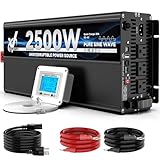
The VIOPUMPO 2500W is the newest entrant in this roundup and currently holds the highest customer rating at 4.8 stars. Like the PumpSpy, it is an inverter-style backup system — it converts 12V DC battery power to clean 120V AC pure sine wave output that keeps your existing primary pump running through an outage. The headline upgrades over the PumpSpy are higher peak output (2500W vs 2000W), a built-in 25A battery charger, and an LCD remote controller that displays real-time voltage, power draw, and battery charge status.
The 25A built-in charger is the standout feature. Most inverter backups use a smaller 5A to 10A charger, which means a deeply discharged Group 27 battery can take 12 to 24 hours to fully recharge after an outage. A 25A charger can bring the same battery back in 4 to 8 hours, which matters a lot if you live somewhere with back-to-back storms or rolling outages. The charger also handles fast and trickle charging modes automatically and supports deep-cycle lithium, AGM, and other deep-cycle battery types.
LCD Remote and Safety Protections
The LCD remote controller is genuinely useful for monitoring. You mount it at eye level near the pit and you can see at a glance whether the system is charging, how full the battery is, and how much power your pump is drawing. That kind of visibility is what you want when you are trying to decide whether to run a generator or ride out the rest of the outage on battery.
The VIOPUMPO also packs in the full safety suite: overheat protection, short circuit protection, low voltage protection, overcharge protection, and an overload protector. Multiple mounting options (flat or wall mount) and side fixing holes mean you can place it however fits your installation best. Installation is essentially plug-and-play — assemble the AC and DC cables, plug your sump pump into the AC socket, and you are running.
Runtime Expectations and Battery Selection
Runtime on the VIOPUMPO depends entirely on the battery you pair it with, just like the PumpSpy. Because it is pure sine wave and has very low conversion losses, you get slightly more runtime per amp-hour than cheaper modified sine wave units. For typical residential primary pumps (1/3 HP), expect roughly 5 to 10 hours of continuous duty from a Group 27 AGM battery and 15 to 30 hours of intermittent cycling. Lithium iron phosphate (LiFePO4) batteries extend that significantly and pair cleanly with the 25A charger.
The main caveat is the limited review count so far — 53 reviews at the time of this writing. The ratings are exceptional (87% five-star), but the long-term reliability track record is still being established. If you want maximum proven longevity, the Zoeller and PumpSpy both have more field data behind them.
Who Should Buy the VIOPUMPO 2500W
Buy this if you want the largest inverter output in this roundup, the fastest battery recharge time, and the best real-time monitoring. The 25A charger alone is worth the upgrade if you live in a storm-prone area where outages can repeat within days. Skip it if you want the longest track record of field reliability — the Zoeller and PumpSpy have years more data behind them.
5. Superior Pump 92910 12V — Best Budget Backup Pump for DIY Builds
Superior Pump 92910 12V Battery Back Up Submersible Sump Pump with Vertical Switch
12V DC submersible
1,380 GPH
25 ft vertical lift
Vertical float switch
Pros
- Most affordable backup pump in this roundup
- 1
- 380 GPH capacity with 25 ft lift
- Tough thermoplastic construction
- Vertical float switch for automatic operation
- 100% factory tested
Cons
- Requires separate battery backup controller
- Not Prime eligible
- Lower stock levels at times
The Superior Pump 92910 is the budget-friendly pick for homeowners who already have a battery and controller, or who want to build a custom backup system piece by piece. This is a 12V DC submersible backup pump — just the pump itself, not a full kit. It pairs with whatever battery, charger, and controller you choose to assemble around it. If you already own a deep-cycle battery from an RV, boat, or solar setup, this approach can save you meaningful money.
The 92910 moves up to 1,380 GPH and lifts water up to 25 feet of vertical height. That is more than enough for typical basement sump installations, including homes with deep discharge runs or those that pump up to a higher grade outside. The thermoplastic construction is lighter than cast iron but still tough, and the unit is 100% factory tested before it ships. The vertical float switch handles automatic on/off operation.
Flow Rate and Sizing Reality Check
At 1,380 GPH, the Superior Pump 92910 is the lowest-flow unit in this roundup. That is still plenty for most homes — a typical residential sump pit only needs to move a few gallons per minute to keep up with normal groundwater infiltration. But if you live in an area with serious water volume (high water table, near a lake, hurricane flood zones), you may want a higher-capacity pump like the Watchdog or Zoeller.
The 25-foot vertical lift rating is generous and gives you plenty of headroom for basement ceilings, raised discharge exits, and long horizontal runs after the wall exit. Most homes only need 8 to 12 feet of lift, so you have margin to spare.
DIY Build Considerations
Because the Superior Pump 92910 is sold as a pump only, you need to source a few additional components to build a complete backup system. At minimum you need a 12V deep-cycle battery, a battery charger or controller, a float switch (the pump includes one, but you may want a backup), check valves, and the right PVC fittings. If you are a competent DIYer with plumbing experience, this is a satisfying weekend project. If you are not, the parts add up and you may be better off buying a complete kit like the Watchdog.
The pump uses a 1-1/4 or 1-1/2 inch NPT discharge, which matches the most common residential discharge pipe sizes. The 10-foot power cord gives you flexibility on battery placement. Note that the controller side of the equation is on you — the pump itself does not include automatic grid-fail switching. You will need a relay or a dedicated battery backup controller (sold separately) to make the system activate when the power drops.
Who Should Buy the Superior Pump 92910
Buy this if you want the lowest entry cost, you already own a compatible battery or controller, or you want a simple backup pump to pair with an existing setup. Skip it if you want a complete out-of-the-box system, smart features, or the highest flow rate — the Watchdog, Zoeller, and PumpSpy all deliver more for more money.
How to Choose the Right Sump Pump Battery Backup in 2026
Picking the right backup system comes down to four core questions: how much water do you need to move, how long your outages typically last, what kind of battery you want to maintain, and whether you prefer a second pump (DC backup) or an inverter (keeps your AC pump running). I walk through each below with the same logic I use when friends and family ask which system to buy.
Backup Pump vs Inverter — The First Big Decision
A dedicated DC backup pump (like the Watchdog Special CONNECT, Zoeller Aquanot 508, or Superior Pump 92910) adds a second physical pump to your pit. When your primary pump fails mechanically OR when power drops, the backup pump kicks in. This gives you redundancy against two failure modes — both grid outages and primary pump death. The trade-off is that the backup pump is usually smaller and slower than your primary.
An inverter-style backup (like the PumpSpy 2000W or VIOPUMPO 2500W) keeps your existing AC primary pump running on battery power. You get full primary pump capacity during an outage, which is great for high-volume pits. The trade-off is that if your primary pump mechanically fails, the inverter cannot save you — it is feeding power to a broken pump. Many homeowners in high-risk areas combine both approaches: a small DC backup pump plus an inverter for the primary.
Sizing Flow Rate to Your Pit
The right flow rate depends on how quickly your pit fills during heavy rain. A simple way to measure: time how long it takes your pit to fill from the pump-off level to the pump-on level during a normal cycle, then divide the pit volume by that time. Most homes need 1,500 to 3,000 GPH of backup capacity. The Watchdog (2,890 GPH) and Zoeller (2,400 GPH) cover most situations comfortably. The Superior Pump 92910 (1,380 GPH) works for lower-volume pits.
For homes on high water tables, near bodies of water, or in hurricane zones, size up. A backup pump that cannot keep up with inflow is worse than no backup at all — it runs constantly, drains the battery fast, and floods the basement anyway once the battery dies.
Runtime Math — How Long Will the Battery Actually Last
Runtime is the question I get most often, and the honest answer is always “it depends.” The math is straightforward once you know three numbers: battery capacity in amp-hours (Ah), pump current draw in amps, and your pump’s duty cycle (what percentage of the time it actually runs during an outage). A Group 27 deep-cycle battery typically holds 90 to 100 Ah. A 12V backup pump draws roughly 8 to 12 amps while running.
If your pump cycles 10% of the time (typical for normal groundwater), a 100 Ah battery gives you roughly 8 to 12 hours of total runtime. If your pump runs 30% of the time (high water table), the same battery gets you 3 to 4 hours. For multi-day outage coverage, you need either a larger battery (Group 31, or parallel multiple batteries) or a generator to top things up. The forum complaints about “battery dies faster than expected” almost always trace back to underestimating duty cycle.
Battery Type — AGM vs Wet Cell vs Lithium
AGM (Absorbed Glass Mat) is the most popular choice for sump pump backups and the type Consumer Reports and most plumbers recommend. AGM batteries are sealed, maintenance-free, can be mounted in any orientation, and resist vibration well. They cost more than wet cell but eliminate the need to check fluid levels. Typical lifespan: 3 to 5 years.
Flooded (wet cell) deep-cycle batteries are the cheapest option per amp-hour and the type the Watchdog’s fluid sensor is designed to monitor. They require periodic distilled water top-ups but deliver solid performance. Typical lifespan: 3 to 5 years with maintenance.
Lithium iron phosphate (LiFePO4) is the premium option and the type the VIOPUMPO explicitly supports. Lithium batteries last 8 to 10 years, weigh half as much, accept faster charging, and can be discharged deeper without damage. The downside is upfront cost — typically 2 to 3 times an equivalent AGM. For a system you want to install and forget for a decade, lithium is increasingly the right answer.
Charger Quality — The Hidden Spec
The charger is the most overlooked spec on a backup system, and it is the one that determines how long your battery actually lasts over years of service. A good charger maintains a float voltage without overcharging, switches to a maintenance trickle when the battery is full, and brings a deeply discharged battery back safely. The VIOPUMPO’s 25A charger is the strongest in this roundup. The Watchdog and Zoeller include quality purpose-built chargers as part of their controllers. Avoid systems with no-name chargers or no overcharge protection — those will sulfate and kill your battery in 18 months.
WiFi and Smart Features — Honest Caveats
WiFi monitoring is genuinely useful — when your router has power. The Watchdog Special CONNECT supports an add-on WiFi module for remote alerts, and several competitors offer similar features. The catch forum users repeatedly point out: if your router dies with the grid, the alerts never reach you. For real protection during extended outages, you need your router on a small UPS, or you need a cellular-based alert system like PumpSpy offers separately. Smart features are a nice-to-have, not a replacement for a properly sized battery.
Well Water and City Water Considerations
For homes on well water, an inverter-style backup (PumpSpy or VIOPUMPO) has a hidden limitation: if your well pump also loses power, your sump pit is not gaining new water from the well, but it may still be gaining groundwater. A DC backup pump is unaffected by well pump status. For homes on city water, water-powered backup pumps (like the Basepump brand) are a viable alternative — they use municipal water pressure to pump pit water out, with no battery at all. The trade-off is they only work if you have city water, they use water continuously while running, and they are banned in some jurisdictions due to cross-contamination concerns.
DIY vs Professional Installation
Most of these systems are installable by a confident DIYer with basic plumbing and electrical skills. The Watchdog Special CONNECT is the most DIY-friendly thanks to its clear control panel and compact size. The Zoeller Aquanot 508 prefers professional installation to honor the full warranty. Inverter systems like the PumpSpy and VIOPUMPO are the simplest mechanically — wall-mount the unit, connect battery cables, plug your pump in — but you should be comfortable working with batteries and DC wiring. A typical plumber install runs a few hundred dollars on top of the system cost.
Sump Pump Battery Backup FAQs
Are sump pump battery backups worth it?
Yes, for most homeowners with a finished basement, a high water table, or a history of power outages. A single basement flood typically costs far more than a complete battery backup system, and the systems last 5 to 10 years with basic maintenance. If you have ever lost power during a storm, a battery backup pays for itself the first time it runs.
How long will a battery backup last on a sump pump?
Typical runtime ranges from 6 to 30 hours depending on battery size and how often the pump cycles. A Group 27 deep-cycle battery paired with a standard backup pump usually delivers 8 to 12 hours of intermittent cycling. Larger Group 31 batteries, parallel battery banks, or lithium batteries extend that significantly. Continuous high-cycle operation drains any battery faster.
What size battery backup do I need for a sump pump?
Match backup pump capacity to your pit inflow rate. Most homes need 1,500 to 3,000 GPH of backup capacity. For battery size, a Group 27 (90 to 100 Ah) deep-cycle battery covers most residential outages. High water tables and storm-prone areas should upgrade to a Group 31 or run parallel batteries for multi-day coverage.
What type of battery is best for a sump pump?
AGM (Absorbed Glass Mat) deep-cycle batteries are the most popular choice — sealed, maintenance-free, and 3 to 5 year lifespan. Flooded wet-cell batteries are cheaper but require periodic fluid top-ups. Lithium iron phosphate (LiFePO4) batteries last 8 to 10 years and accept faster charging but cost 2 to 3 times more upfront. Never use a standard car battery — it cannot handle deep discharge cycles.
Final Verdict — Which Sump Pump Battery Backup Should You Buy?
For most homeowners, the Basement Watchdog Special CONNECT is the right call — it has the best control panel, fits tight pits, and includes dual float redundancy. If you want the longest warranty and plumber-grade USA construction, go with the Zoeller Aquanot 508. If you want to keep your existing AC primary pump running through outages, the PumpSpy 2000W is the best value inverter and the VIOPUMPO 2500W is the top-rated upgrade with the fastest battery recharge. For a budget DIY build, the Superior Pump 92910 pairs cleanly with a deep-cycle battery you already own.
Whatever you pick from this list of the best sump pump battery backups in 2026, the most important thing is to install it before the next outage — not after. Test the system twice a year, replace the battery every 3 to 5 years (or upgrade to lithium for 8 to 10 years of service), and your basement stays dry through whatever the grid throws at you.
Leave a Reply