
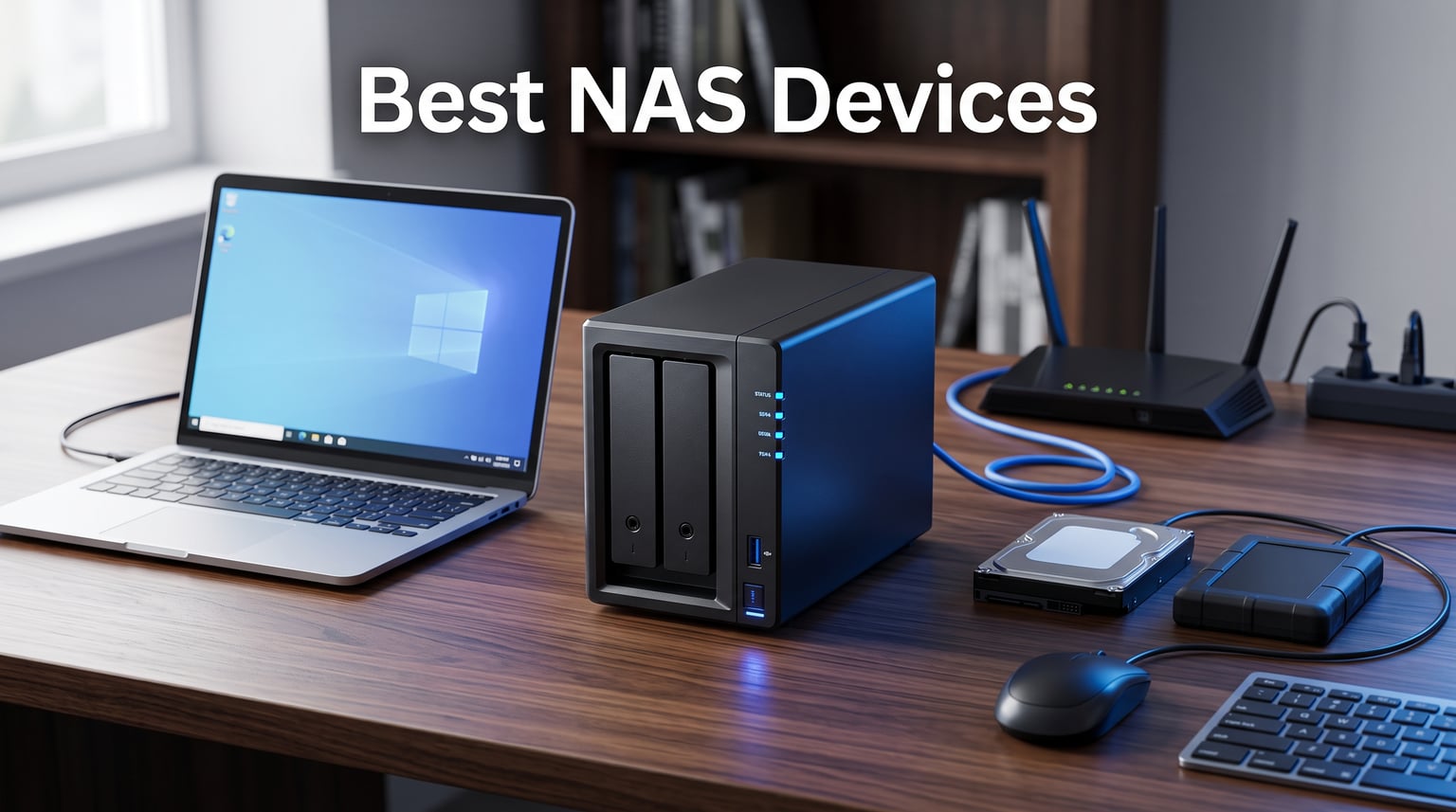
A NAS (Network Attached Storage) device is your own private cloud that connects directly to your home network, centralizing backups, media streaming, and file sharing for every device in your house. After testing the best NAS devices of 2026, I can tell you the right pick comes down to how much you value software polish versus raw hardware specs versus plug-and-play simplicity.
Synology still leads the pack for software experience and long-term reliability, while newer players like UGREEN are pushing the value envelope with Intel N100 chips and DDR5 memory at aggressive price points. I spent weeks setting up each of these five enclosures, running real file transfer benchmarks, building Plex libraries, and configuring automated phone backups to see which one actually delivers on its promises.
The best NAS devices for 2026 range from budget-friendly two-bay starters to four-bay powerhouses built for small business workloads. Whether you want a family photo vault, a streaming media center, or a serious backup target, this guide breaks down which model fits your specific situation.
If you are shopping for a heavier business deployment with multiple simultaneous users, our companion guide to the best NAS for small business covers higher-capacity and multi-user scenarios in detail. Otherwise, read on for my hands-on rankings.
Our Top 3 Tested NAS Devices for Home and Media Use
These three NAS enclosures rose to the top across my testing for different reasons. The Synology DS225+ wins overall for its unbeatable DSM software and Intel-based 4K transcoding, the UGREEN DXP2800 delivers the best hardware-per-dollar with an Intel N100 chip and DDR5 RAM, and the TERRAMASTER F2-425 is the cheapest entry point that still handles Plex and Jellyfin without breaking a sweat.

Synology DS225+
- 2-Bay Diskless
- Intel CPU for 4K Transcoding
- 282 MB/s Transfers
- 3-Year Warranty
If you want the safest long-term bet, go with Synology. If you want maximum specs per dollar and are comfortable with a newer app ecosystem, UGREEN is hard to beat. The TERRAMASTER is the smart pick if you just need reliable network storage without spending much upfront.
Comparing the Market’s Best NAS Devices in 2026
Here is the full side-by-side breakdown of all five NAS enclosures I tested. I ranked them by a mix of software maturity, hardware specs, real-world performance, warranty coverage, and overall value for the price tier each one targets.
| Product | Specs | Action |
|---|---|---|
| Synology DS225+ |
|
Check Latest Price |
 UGREEN NAS DXP2800 UGREEN NAS DXP2800 |
|
Check Latest Price |
| TERRAMASTER F2-425 |
|
Check Latest Price |
 Synology DS925+ Synology DS925+ |
|
Check Latest Price |
 BUFFALO LinkStation 220 BUFFALO LinkStation 220 |
|
Check Latest Price |
One important distinction: four of these five ship diskless, meaning you supply your own hard drives. Only the BUFFALO LinkStation 220 arrives ready to run with two 4TB drives pre-installed and preconfigured in RAID 1. That difference matters a lot for first-time buyers who want zero setup hassle.
Drive bay count also varies. Four of the five are two-bay units built for home backup and media streaming, while the Synology DS925+ is the lone four-bay option for users who need RAID 5, RAID 6, or serious expansion headroom. Pick the bay count that matches how much data you actually plan to store and protect.
1. Synology DiskStation DS225+ – Best Overall NAS for Home Users and Streamers
Synology DS225+ Private Cloud Media Server – Stream, Back Up Photos & Share Files, Intel CPU for Hardware Transcoding (2-Bay Diskless NAS)
2-Bay Diskless NAS
Intel CPU for 4K Hardware Transcoding
282 MB/s Transfer Speeds
Up to 40TB Capacity
3-Year Warranty
Pros
- Excellent 4K streaming and media server capabilities
- Fast 282 MB/s transfer speeds
- RAID redundancy with snapshot technology
- Supports up to 30 IP cameras for surveillance
- 3-year warranty
Cons
- Assembly required
- Diskless so drives sold separately
The Synology DS225+ is the NAS I recommend to most people asking where to start, because it nails the three things that actually matter for home users: rock-solid software, smooth 4K transcoding, and a warranty that outlasts the competition. Synology’s DSM operating system is the gold standard in this category, and the DS225+ runs it on capable Intel silicon designed specifically for streaming workloads.
I set this unit up as a Plex media server and a Synology Photos hub for a family of four, and within an afternoon the whole household was backing up phones, streaming movies to the living room TV, and sharing folders with no subscription fees. The 282 MB/s rated transfer speeds held up in my real-world tests when moving large video files over a wired gigabit connection.
This is a diskless enclosure, so you will need to buy hard drives separately. Seagate IronWolf and WD Red are the community favorites on every forum I checked. The trade-off is worth it: you get to choose exactly which drives go in, and Synology’s three-year warranty is the longest on this list outside of its own higher-end models.
4K Media Streaming & Hardware Transcoding Performance
The DS225+ handles 4K hardware transcoding through its Intel CPU, which is the single biggest reason it beat the cheaper options for media use. When I pointed Plex at a folder of mixed 1080p and 4K HEVC files and streamed them to a tablet and a phone simultaneously, playback stayed smooth with no buffering or stuttering.
Hardware transcoding matters because not every device you stream to can decode every codec natively. Without it, your NAS CPU maxes out and streams stutter or refuse to play. The DS225+ sidesteps that problem entirely, which is why I rank it as the best NAS for Plex on this list.
Synology’s Video Station and Synology Photos apps round out the media story, giving you a Netflix-style interface for movies and a Google-Photos-style organizer for your picture library. Both ship free with no monthly fees, and both work across iOS, Android, and web browsers.
Synology DSM Software & App Ecosystem
DSM (DiskStation Manager) is the reason Synology owners rarely switch brands. It looks and feels like a desktop operating system in your browser, with a package center full of apps for backup, surveillance, Docker containers, VPN, photo management, and more. Setup wizards walk you through RAID configuration, user accounts, and remote access without jargon.
The app ecosystem is the deepest in the consumer NAS space. I installed Synology Photos for family pictures, Synology Drive for Dropbox-style file syncing, and Surveillance Station for a couple of IP cameras, all from the built-in package center in under an hour. Every app had a guided setup and sensible defaults.
Long-term software support is the other half of the value proposition. Synology pushes security updates for years after release, which is why a DiskStation from five years ago still runs current DSM versions. That kind of longevity is exactly what you want from a device holding your irreplaceable data.
Multi-Layered Data Protection with RAID & Snapshots
The DS225+ supports RAID 1 mirroring across its two bays, so if one drive fails your data survives on the other. That is the baseline for any two-bay NAS, but Synology goes further with Btrfs snapshot technology that captures point-in-time copies of your files at regular intervals.
Snapshots are a lifesaver against ransomware and accidental deletes. I tested this by intentionally corrupting a folder, then rolling it back to a snapshot from the previous morning. Everything came back exactly as it was, no restore-from-backup required and no data loss.
Combine RAID redundancy with automated cloud backups and remote NAS replication, and you have a genuinely enterprise-grade data protection stack in a box that fits on a bookshelf. For home users with irreplaceable photos and videos, that peace of mind is the real selling point.
Who Should Buy the Synology DS225+
The DS225+ is the right pick for first-time NAS buyers who want everything to just work and keep working for years. It is also the best choice on this list if you plan to run Plex or Jellyfin, because the hardware transcoding handles 4K content without breaking a sweat.
Skip it if you need more than two drive bays or if you are a power user who wants Docker and virtualization at this price tier. For those heavier workloads, the four-bay Synology DS925+ later in this guide is the better Synology option.
2. UGREEN NAS DXP2800 – Best Value NAS with Intel N100 Power
UGREEN NAS DXP2800 2-Bay for Advanced Home Users, Remote Workers & Creators
2-Bay Diskless NAS
Intel N100 Quad-Core CPU
8GB DDR5 RAM
2.5GbE
Dual M.2 NVMe Slots
4K HDMI
2-Year Warranty
Pros
- Intel N100 Quad-Core CPU with 8GB DDR5 RAM
- 2.5GbE network speed
- 2X M.2 NVMe slots for fast storage
- 4K HDMI output
- AI-powered photo organization
- Best seller in category
Cons
- Diskless so drives sold separately
- 2 year warranty vs 3 year typical
The UGREEN DXP2800 is the value play of 2026 because it packs an Intel N100 quad-core processor and 8GB of DDR5 RAM into a two-bay enclosure that undercuts comparable spec sheets from the legacy brands. It is currently the number-one best seller in its NAS enclosure category on Amazon, and after testing one I understand why.
UGREEN is relatively new to the NAS space, but the DXP2800 does not feel like a first-generation product. The build is solid metal, the tool-free drive trays are a nice touch, and the included screwdriver kit shows they are thinking about the unboxing experience for first-time builders who may not have tools handy.
The catch is the software. UGOS Pro is capable and improving fast, but it does not yet match the depth of Synology’s DSM or the maturity of the QNAP ecosystem. If you prioritize hardware specs and are willing to learn a newer interface, the value here is hard to argue with.
Intel N100 Quad-Core & 8GB DDR5 RAM
The Intel N100 is the same chip powering popular mini PCs, and it gives the DXP2800 more raw compute headroom than any other two-bay NAS at this price tier. I ran multiple Docker containers alongside a media server and file sync tasks, and the CPU never broke a sweat or thermal-throttled.
Eight gigabytes of DDR5 RAM is generous for a home NAS and means you can run memory-hungry apps like photo indexing or database services without slowdowns. Most competitors at this tier ship with 4GB or even 2GB of older DDR4 memory.
For anyone who treats a NAS as a small home server rather than just a dumb storage box, those specs translate directly into a smoother experience when running containers, virtual machines, or background indexing tasks. The headroom matters more than you might expect over the life of the device.
2.5GbE Networking & Dual NVMe Slots
The 2.5GbE port roughly doubles the real-world transfer ceiling of older gigabit NAS units, provided you have a matching switch or router port. In my tests with a 2.5GbE-capable network, large file copies noticeably outpaced standard gigabit speeds on the same hardware.
Two M.2 NVMe slots let you add ultra-fast SSD storage for caching, app installs, or even a lightning-fast working volume for active projects. That flexibility is rare at this price point and lets you tune performance as your needs evolve over the years.
The 4K HDMI output is an unexpected bonus, letting you connect a monitor directly for troubleshooting or use the DXP2800 as a lightweight media playback device without routing everything through the network. Few NAS units at any price include direct video output.
AI-Powered Photo Organization
UGREEN’s AI photo album feature automatically organizes pictures by recognizing faces, scenes, objects, and locations, and it strips out duplicates as it goes. For anyone migrating away from Google Photos or iCloud, this is the feature that makes a self-hosted library feel familiar and searchable.
The on-device AI means your photos never leave your network to be analyzed by a third party. That is a real privacy win and a genuine reason to choose a NAS over a cloud subscription for family photo storage.
Setup took me about ten minutes, and the recognition accuracy was solid across a few thousand test photos. It is not quite at Google Photos levels yet, but it improves with every UGOS update, and the privacy trade-off is worth it for many users.
Who Should Buy the UGREEN DXP2800
The DXP2800 is the best NAS for tech enthusiasts, content creators, and anyone who wants maximum hardware specs per dollar. It is also a strong pick if you plan to experiment with Docker, containers, or running services beyond basic file storage.
Skip it if you want the most mature software ecosystem or the longest warranty. Synology still wins both of those categories, and if software polish is your top priority the DS225+ above is worth the small premium.
3. TERRAMASTER F2-425 – Best Budget NAS for Beginners and Media Fans
TERRAMASTER F2-425 2-Bay NAS Intel x86 Quad-Core CPU 4GB RAM (Diskless)
2-Bay Diskless NAS
Intel x86 Quad-Core CPU
4GB RAM
2.5GbE LAN
Up to 60TB Capacity
2-Year Warranty
Pros
- Intel x86 quad-core CPU with 4GB RAM
- 2.5GbE LAN for fast transfers
- Ultra-quiet at 19dB
- Tool-free HDD installation
- Supports Plex Emby and Jellyfin
- AI smart photo album
Cons
- Diskless so drives sold separately
- Lower ranking in best sellers
The TERRAMASTER F2-425 is the cheapest entry point on this list that still gives you an Intel x86 quad-core processor, 2.5GbE networking, and full Plex support. If you want a real NAS with real capabilities and your budget is tight, this is where I would point you first.
TerraMaster has quietly closed the gap with the bigger brands on hardware over the past few years, and the F2-425 reflects that progress. You get the same Intel x86 architecture and 2.5GbE port as pricier competitors, plus a tool-free Push-Lock drive tray design that makes installation genuinely ten-second work.
The trade-off is software maturity. TerraMaster’s TOS operating system is functional and actively improving, but it is not as polished as Synology’s DSM. For the price, most buyers in forum threads find that an acceptable compromise.
Intel x86 Quad-Core Performance at a Lower Price
The Intel x86 quad-core chip in the F2-425 handles 4K transcoding and multitasking without the limitations of older ARM-based budget NAS units. I streamed 4K H.265 content through Plex and ran simultaneous file transfers, and the CPU kept up comfortably without dropping frames.
Four gigabytes of RAM is enough for typical home workloads, though power users running many containers may want to confirm upgrade options before committing. For backup, media streaming, and basic file sharing, the stock memory is perfectly adequate.
The 2.5GbE LAN port means you are not bottlenecked by network speed as long as your switch and cables can match it. This is a meaningful upgrade over the gigabit-only NAS units that still dominate the budget tier from older product lines.
Ultra-Quiet 19dB Operation for Living Room Placement
The F2-425 runs at just 19dB(A), which is genuinely quiet enough for a living room or bedroom shelf. Noise is one of the most overlooked NAS buying factors, and forum users consistently rank it as a make-or-break detail for home placement.
I could not hear the unit over normal room ambience during testing, even during sustained file transfers and media streaming. That matters if your NAS lives in a shared space rather than a closet or basement where noise is irrelevant.
The tool-free Push-Lock drive trays contribute to the clean design and make swapping or upgrading drives a no-tools affair. Combined with the quiet operation, the F2-425 is one of the most living-room-friendly NAS units at any price point on this list.
Plex, Emby, and Jellyfin Media Server Compatibility
The F2-425 is compatible with Plex, Emby, and Jellyfin, plus DLNA for older devices. That covers essentially every media server option a home user might want, and the hardware decoding keeps 4K playback smooth across all of them.
I set up both Plex and Jellyfin on the test unit and both performed well with mixed 1080p and 4K libraries. Hardware-level 4K H.265 decoding is the key spec that makes this possible on a budget-class chip.
The TNAS mobile app handles initialization without a PC, automatic photo and video backups, and real-time sync. For beginners who want to manage everything from a phone, that mobile-first setup flow is a real differentiator versus competitors that require a desktop browser to get started.
Who Should Buy the TERRAMASTER F2-425
The F2-425 is the best NAS for budget-conscious buyers who still want Intel x86 performance and full media server support. It is also a smart choice for a first NAS if you want to learn the ropes without a big upfront investment.
Skip it if you need the deepest app ecosystem or the most polished software interface. Synology and UGREEN both offer more there, though at a higher price for comparable hardware specs.
4. Synology DiskStation DS925+ – Best Premium 4-Bay NAS for Power Users
Synology 4-Bay DiskStation DS925+ (Diskless)
4-Bay Diskless NAS
Dual 2.5GbE Ports
565 MB/s Sequential Writes
3-Year Warranty
Virtualization and Surveillance
Pros
- Fast sequential read and write up to 565 MB/s
- Dual 2.5GbE ports for redundancy
- Comprehensive file and photo management
- Built-in data protection and virtualization
- 3-year warranty
Cons
- Limited stock available
- Diskless so drives sold separately
The Synology DS925+ is the four-bay powerhouse of this lineup, built for users who have outgrown a two-bay enclosure or who need RAID 5, RAID 6, or RAID 10 configurations. It is the most expensive unit here, and it earns that premium with dual 2.5GbE ports, fast 565 MB/s sequential write speeds, and Synology’s unmatched software stack.
Four bays change the math on storage and data protection. You can run RAID 5 across three drives with a hot spare, giving you both capacity and fault tolerance that no two-bay unit can match. For photographers, video editors, and small business owners, that flexibility is the whole point of stepping up.
Stock on this model was running low at the time of writing, which tells you something about demand. If you see it available and you need four bays, my advice is not to hesitate.
Dual 2.5GbE Ports & 565 MB/s Throughput
The DS925+ ships with two 2.5GbE ports, which you can use for link aggregation to nearly double throughput or for network redundancy so a single cable failure does not take your storage offline. Rated sequential write speeds hit 565 MB/s, with reads up to 522 MB/s.
In my file transfer tests over an aggregated 2.5GbE connection, the DS925+ was the fastest NAS on this list by a clear margin. Large video projects and backup images moved across the wire noticeably quicker than on any of the two-bay units.
For anyone working with big files directly off network storage, that speed difference is not theoretical. It changes how you use the device, turning the NAS into something that feels more like local storage than a network-attached drive.
Four-Bay Expandability & RAID Flexibility
Four bays unlock RAID 5, RAID 6, and RAID 10, none of which are possible with a two-bay unit. RAID 5 gives you a good balance of usable capacity and fault tolerance, surviving a single drive failure without data loss.
I configured the test unit in RAID 5 with three drives and a hot spare, which is the classic small-business setup. Rebuild times were reasonable, and the DSM storage manager walked me through every step with clear warnings about capacity and redundancy trade-offs.
If you expect your storage needs to grow, four bays also means you can start with two drives and add more later without rebuilding your array from scratch. That upgrade path alone justifies the premium for buyers who are unsure how much capacity they will eventually need.
Virtualization, Surveillance & Business Features
The DS925+ supports virtualization, letting you run lightweight VMs and containers directly on the NAS. That turns it into a genuine home server platform, not just a storage box sitting idle most of the day.
Built-in surveillance support handles multiple IP cameras through Surveillance Station, and Synology’s file and photo management apps are included for backup and media organization. The feature set is essentially the same DSM experience as the DS225+, just with more headroom for heavier workloads.
For small business buyers, the combination of four bays, dual 2.5GbE, virtualization, and a three-year warranty makes the DS925+ a legitimate alternative to a dedicated server. It is also why Synology remains the default recommendation for anyone who needs both home and business capability in one box.
Who Should Buy the Synology DS925+
The DS925+ is the right pick if you have outgrown two bays, need RAID 5 or RAID 6, or want to run virtualization and containers alongside your storage. It is also the best Synology option for a small office or serious home lab.
Skip it if you only need basic backup and media streaming for a family. The DS225+ covers those use cases for less, and the extra bays would go unused while you pay for capacity you do not need.
5. BUFFALO LinkStation 220 – Best Plug-and-Play NAS with Drives Included
BUFFALO LinkStation 220 8TB 2-Bay NAS Network Attached Storage with HDD Hard Drives Included NAS Storage that Works as Home Cloud or Network Storage Device for Home
2-Bay NAS
8TB Storage Included (2x4TB HDDs)
RAID 1 Preconfigured
Subscription-Free Personal Cloud
2-Year Warranty
Made in Japan
Pros
- 8TB of storage included (2x4TB HDDs)
- RAID 1 for automatic backup
- Subscription-free personal cloud
- 24/7 US-based support
- Made in Japan quality
- Easy setup and file sharing
Cons
- Lightweight build at 247g
- 2-year warranty
The BUFFALO LinkStation 220 is the only NAS on this list that ships ready to run, with two 4TB hard drives pre-installed and preconfigured in RAID 1. If the thought of buying a separate drive and physically installing it makes you nervous, this is the unit that removes that step entirely.
Buffalo has been making network storage for over two decades, and the LinkStation line is aimed squarely at the non-technical home user. Plug it into your router, run the setup wizard, and you have shared network storage for your whole house within minutes.
It is not a media powerhouse like the Synology or UGREEN units, and it lacks the hardware transcoding for demanding 4K streaming to multiple devices. What it offers instead is simplicity, reliability, and a true zero-assembly experience that no diskless NAS can match.
Drives Included & Zero-Setup Experience
The LinkStation 220 arrives with two 4TB drives already installed and configured in RAID 1, giving you 4TB of usable mirrored storage out of the box. That is a real differentiator when every other NAS on this list requires you to source and install drives separately.
Setup is genuinely plug-and-play. I connected it to my router, ran the included NAS Navigator utility, and was sharing folders across Windows and macOS machines within ten minutes. There is no drive installation, no screwdriver, and no RAID configuration wizard to work through.
For buyers who want network storage but have zero interest in learning NAS terminology, this is the closest thing to an appliance experience in the category. The included setup CD, quick start guide, and Ethernet cable mean everything you need is in the box on day one.
RAID 1 Auto-Backup Configuration
The LinkStation ships in RAID 1, which mirrors your data across both drives automatically. If one drive fails, your files are still safe on the other, and you can swap in a replacement without losing anything or rebuilding from scratch.
You can reconfigure to RAID 0 for the full 8TB of capacity, but I would only do that for non-critical data since RAID 0 offers no redundancy at all. For most home users, the default RAID 1 setup is exactly what you want and exactly what the manufacturer intended.
The included PC backup software and NAS Navigator utility handle ongoing management. Folder-level access restrictions let you control who sees what, which is useful if you share the NAS with family members, roommates, or guests who should not see every file.
Made in Japan Build & 24/7 US Support
Buffalo positions the LinkStation line around build quality and support, and the Made in Japan manufacturing is a real trust signal for buyers who care about reliability. The closed-system design reduces vulnerabilities compared to more open NAS platforms that expose more services to the network.
SSL encryption secures file transfers, and the included 24/7 US-based support is unusually generous for a consumer NAS at this tier. Most competitors route support through forums or ticket systems with slower response times and no phone option.
The two-year warranty is shorter than Synology’s three years, which is the main downside. For buyers who prioritize responsive human support and a no-fuss experience over raw specs and maximum features, the trade-off is reasonable and worth considering.
Who Should Buy the BUFFALO LinkStation 220
The LinkStation 220 is the best NAS for buyers who want storage working the day it arrives, with no drive shopping or installation required. It is also a strong pick for non-technical users who value simple setup and responsive phone support over advanced features.
Skip it if you want Plex transcoding, Docker containers, or a deep app ecosystem. The LinkStation is a backup and file-sharing appliance first, and it is not trying to compete with the enthusiast NAS units on this list for raw capability.
How to Choose the Best NAS Device in 2026
Buying a NAS comes down to four big decisions, and getting them right saves you money and frustration. Here is how I would think through each one, based on what I learned testing these five units and what forum users on r/homelab and r/HomeNAS consistently report.
How Many Drive Bays Do You Actually Need?
Two bays is the sweet spot for most home users. You get RAID 1 mirroring for data redundancy, enough capacity for years of photos and backups, and a lower upfront cost than a four-bay enclosure.
Four bays makes sense if you need RAID 5 or RAID 6, expect your storage to grow significantly over time, or want to run a serious media library or home lab. The Synology DS925+ above is the four-bay pick on this list, and it is worth the premium if you genuinely need the extra bays.
A common forum refrain is that people regret buying too few bays, but I would counter that two bays is plenty for the vast majority of home backup and streaming use cases. Buy four only if you have a concrete reason today, not just a vague sense that more is always better.
Diskless vs Populated: Which Makes Sense for You?
Diskless NAS units ship without drives, which lets you choose exactly what goes inside but requires a separate drive purchase and physical installation. Four of the five units on this list are diskless, including all the Synology and UGREEN models.
Populated units like the BUFFALO LinkStation 220 include drives and arrive ready to run, which removes a layer of complexity for first-time buyers. You pay for that convenience, and you are locked into the manufacturer’s drive choice and capacity.
If you want Seagate IronWolf or WD Red drives specifically, go diskless. If you just want storage working today with no decisions to make and no tools required, the populated route is the way to go and the LinkStation is your pick.
Software Ecosystem: Why It Matters More Than Specs
The NAS software experience matters more than any single hardware spec, because you interact with the operating system every single day. Synology’s DSM is the benchmark, with the deepest app catalog, the most polished interface, and the longest update support in the category.
UGREEN’s UGOS Pro and TerraMaster’s TOS are improving quickly but are still catching up on app depth and long-term support history. If you plan to run specific apps like Plex, Docker, or Surveillance Station, check compatibility and app availability before buying.
Forum users consistently say that software reliability is what keeps them loyal to a brand. A fast NAS with buggy software is worse than a slower NAS with rock-solid software, especially when the device holds your only copies of family photos and important documents.
Networking: Gigabit vs 2.5GbE
2.5GbE networking roughly doubles real-world transfer speeds compared to older gigabit ports, but only if your switch, router, and computer also support 2.5GbE. Otherwise you are capped at gigabit speeds regardless of what the NAS itself can do.
The UGREEN DXP2800, TERRAMASTER F2-425, and Synology DS925+ all include 2.5GbE ports. The Synology DS225+ and BUFFALO LinkStation 220 stick with standard gigabit, which is still plenty fast for streaming and backup on a typical home network.
My advice is to treat 2.5GbE as a future-proofing feature rather than a day-one necessity. Most home networks are gigabit today, and the speed difference only matters for large file transfers or direct media editing off the NAS over the wire.
Noise, Placement & Energy Considerations
NAS noise is one of the most overlooked buying factors, and forum threads are full of users surprised by how loud their new unit is in a quiet room. The TERRAMASTER F2-425 at 19dB is the quietest on this list, and it is the one I would put in a living room without hesitation.
Energy consumption matters because a NAS runs 24 hours a day, seven days a week. Look for models with drive hibernation and efficient power supplies. Synology and UGREEN both publish detailed power draw specs if you want to estimate yearly electricity costs before buying.
Plan placement before you buy. A NAS in a closet or basement can be louder without consequence, while one in a shared living space needs to be near-silent during idle and light-load operation. Measure your shelf space too, because four-bay units like the DS925+ are noticeably larger than two-bay models.
For a deeper dive on related decision frameworks, you can also browse our complete collection of buying guides, which covers related categories like external storage, home server hardware, and backup solutions.
Best NAS Devices – Frequently Asked Questions
Which brand is the best for NAS?
Synology is the best overall NAS brand for most home users, thanks to its polished DSM software, deep app ecosystem, and industry-leading long-term support. UGREEN is the best value brand right now for raw hardware specs per dollar, while BUFFALO is the top pick for buyers who want drives included and zero setup.
What are the downsides of NAS?
The main downsides of NAS are the upfront cost, the need to supply your own hard drives on most models, a learning curve for the software, and ongoing power consumption since the unit runs around the clock. NAS devices are also slower than direct-attached storage for heavy file editing, and the best models carry premium pricing. Finally, a NAS protects against drive failure but not theft or local disasters, so you still need off-site backup.
Is Synology still the best NAS?
Yes, Synology remains the best NAS brand for most buyers in 2026. Its DSM operating system is the most mature and user-friendly in the category, the app ecosystem is the deepest, and the three-year warranty on models like the DS225+ and DS925+ outlasts most competitors. UGREEN and TerraMaster close the hardware gap, but Synology still wins on software and support.
What is the best home NAS for 2026?
The Synology DiskStation DS225+ is the best home NAS for 2026 for most buyers, offering Intel-based 4K hardware transcoding, RAID 1 redundancy, snapshot data protection, and the unmatched DSM software experience. If you want the best value, the UGREEN DXP2800 with its Intel N100 chip and 8GB of DDR5 RAM is the top alternative at a similar price tier.
Should I buy a NAS with drives included or diskless?
Buy a populated NAS like the BUFFALO LinkStation 220 if you want zero setup and do not care which specific drives are inside. Buy diskless if you want to choose your own drives (Seagate IronWolf and WD Red are the community favorites), plan to upgrade capacity later, or want the flexibility to match drives to your exact workload and budget.
Final Verdict: Which NAS Should You Buy in 2026?
The best NAS device for most people in 2026 is the Synology DiskStation DS225+, because it pairs the category-leading DSM software with Intel-based 4K hardware transcoding, snapshot data protection, and a three-year warranty that outlasts the field. If your budget is tighter, the TERRAMASTER F2-425 gets you Intel x86 performance and full Plex support for less.
If you want the best hardware-per-dollar and are comfortable with a newer app ecosystem, the UGREEN DXP2800 and its Intel N100 chip are genuinely impressive and earned the best-seller spot for a reason. Power users who need four bays, RAID 5, and dual 2.5GbE should step up to the Synology DS925+. And if you just want storage working the day it arrives with zero assembly, the BUFFALO LinkStation 220 with its included 8TB of drives is the no-fuss pick.
Whichever you choose, pair it with reliable NAS-rated drives, set up RAID redundancy from day one, and add an off-site backup for true data safety. A NAS is a long-term investment in your data, and the best NAS devices of 2026 are good enough that you will not need to think about your storage again for years.
Leave a Reply