
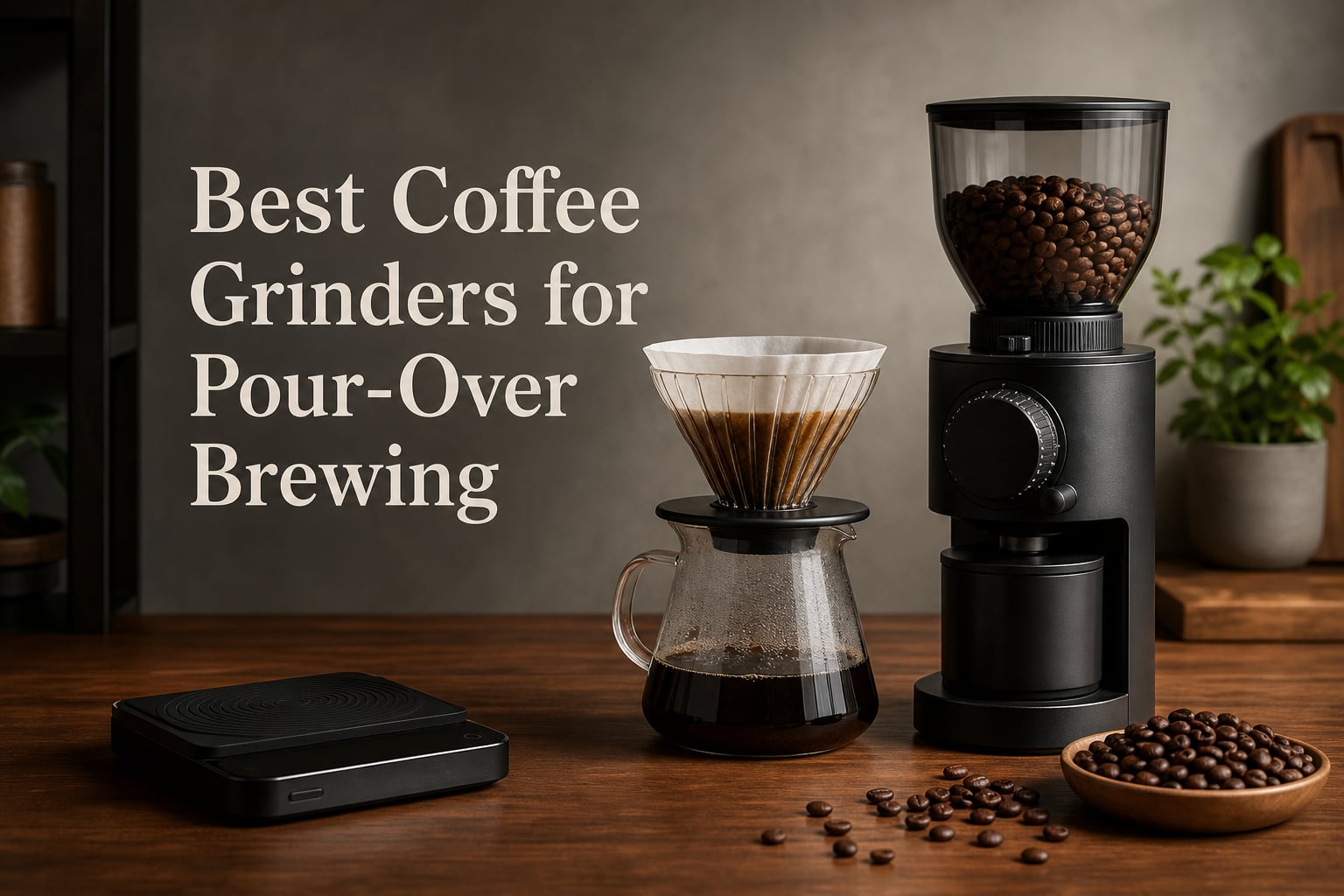
The best coffee grinders for pour over brewing make one change that a nicer kettle cannot: they create a more uniform bed of coffee. A burr grinder crushes beans at a set gap instead of randomly chopping them, so water moves through a V60, Chemex, or Kalita Wave more predictably.
I built this list around the details that matter at the brewer: burr type, usable adjustment, capacity, cleanup, and whether the grinder suits filter coffee rather than merely claiming broad versatility. I also checked the listed ratings and review counts, then weighed the concerns pour-over drinkers repeatedly raise, including stray fines, retention, noise, bean switching, and travel use.
For a quick answer, the Fellow Ode Gen 2 is the dedicated electric filter choice here because its 64mm flat burrs, single-dose format, and 31 settings are made for brewed coffee. The MAVO Phantox Pro is the most precision-led manual option on this list, while the AMZCHEF makes a convincing case for an electric grinder with a large hopper, timer, and anti-static workflow.
Do not read this as a promise that one setting will fit every coffee. A light, dense bean often needs a different setting and pour than a darker roast, and the right move is to adjust based on drawdown and taste. If you are pairing a grinder with another appliance, our guide to an espresso machine with built-in grinder covers a separate, espresso-oriented path.
Community discussions put good reason behind this focus. People coming from blade grinders often describe a jump in cup clarity after moving to burrs, while experienced brewers care about easy bean swaps and low retained grounds. That is why I included both compact hand grinders and hopper-fed electric models rather than treating every home routine as the same.
Our top three picks answer the fastest pour-over decisions
Choose the Fellow Ode Gen 2 when filter coffee is your main event and you want flat burrs, single dosing, quiet operation, and a catch cup designed to reduce mess. Pick the MAVO Phantox Pro if deliberate hand grinding and very fine adjustment appeal more than pushing a button.
The AMZCHEF suits households that want a larger bean supply ready to go, cup selection on a touchscreen, and less static cleanup. These are different answers to the same question, so choose by your morning routine rather than chasing a single universal winner.
This quick overview compares all eight pour-over grinders
The table below keeps the decision short: manual models favor portability and direct control, while the electric choices favor repeatable batches and less physical work. Every model below has burrs; that is the baseline I would use for a serious pour-over setup.
| Product | Specs | Action |
|---|---|---|
 MAVO Phantox Pro MAVO Phantox Pro |
|
View Product |
 TIMEMORE Chestnut C3S Pro TIMEMORE Chestnut C3S Pro |
|
View Product |
 KINGrinder K6 KINGrinder K6 |
|
View Product |
 Aromaster Conical Burr Aromaster Conical Burr |
|
View Product |
 1Zpresso J 1Zpresso J |
|
View Product |
 SHARDOR Professional SHARDOR Professional |
|
View Product |
 AMZCHEF Conical Burr AMZCHEF Conical Burr |
|
View Product |
 Fellow Ode Gen 2 Fellow Ode Gen 2 |
|
View Product |
MAVO Phantox Pro gives manual brewers unusually fine adjustment
Pros
- 45mm star-tooth burr
- 120-click adjustment
- Low-fines design
- Storage bag included
Cons
- Manual operation
- Dry-clean only
The MAVO Phantox Pro earns its spot with a 45mm self-developed, seven-axis Star-Tooth-45 grinding core and a 30g capacity. Its 4.9 rating comes from 103 reviews, which is a smaller sample than several electric choices here but a notably strong one.
I would look at this model if the ritual of hand grinding is part of why you make pour-over. The listed 160 spikes are intended to reduce fine powder, a useful goal because excess fines can slow a V60 drawdown and bring harshness into an otherwise sweet coffee.
The tradeoff is straightforward: you supply the energy. That is a feature for someone who brews one careful cup, not necessarily for a household preparing several large carafes before work.
The 45mm burr targets a cleaner particle spread
The burr is larger than the compact burr sets common in entry hand grinders, and MAVO describes its geometry as having 160 spikes. We cannot infer a taste result from geometry alone, but the stated low-fines emphasis lines up directly with what pour-over brewers seek: fewer tiny particles alongside the main grind size.
Use that potential properly by changing only one variable at a time. If a coffee runs slowly and tastes dry, step a little coarser; if it finishes quickly and tastes thin or sour, step a little finer.
The 120-click system gives methodical dialing-in room
MAVO specifies 120 clicks per loop and 0.0167mm per click, making this the most explicitly fine-grained adjustment claim in the group. That helps a brewer move in small increments when a recipe is nearly right instead of making a large jump that changes drawdown too far.
Keep a note of your position, coffee, dose, and brew time. An external number system is convenient, but a repeatable log is what makes those small changes meaningful from one bag to the next.
The bearing and body make hand use the real decision point
The grinder lists built-in bearings, a non-slip body, and a comfortable handle intended to make turning easier. It also ships with a brush, non-slip ring, storage pocket, and stainless steel bowl, so its compact setup is well suited to a shelf, suitcase, or brew kit.
Cleaning needs a dry approach because the maker says it is not washable with water. Brush the burr chamber after each bag change and keep moisture away from the mechanism rather than treating it like a rinsable kitchen tool.
TIMEMORE Chestnut C3S Pro makes travel-friendly grinding simpler
TIMEMORE Chestnut C3S Pro Manual Coffee Grinder, Stainless Steel S2C Conical Burr Coffee Grinder, Hand Coffee Grinder with Foldable Handle, Adjustable Grind Setting for Travel/Camping/Home, Black
S2C conical burr
36 levels
Foldable handle
Pros
- Metal body
- S2C conical burr
- Foldable handle
- Easy disassembly
Cons
- Manual operation
- 430g build may feel light
The TIMEMORE Chestnut C3S Pro is a 430g manual grinder with a full-metal aluminum body, a foldable crank handle, and roughly 36 adjustment levels. Its listed 4.8 rating is backed by 1,678 reviews, giving it one of the larger review samples among the manual picks.
This is the straightforward recommendation for someone who wants to take a grinder camping, to an office, or between kitchens without adding much bulk. Its foldable handle is more useful in those routines than it may sound, since nothing protrudes into a bag.
For pour-over, the key question is whether its step spacing works with your favorite brewer and coffee. Thirty-six levels give meaningful control, though not the ultra-fine resolution claimed by the MAVO or KINGrinder models.
The S2C conical burr focuses on practical consistency
TIMEMORE uses an S2C patent hexagonal conical burr with a stated hardness of 55–58HRC. A conical burr format is common in compact manual grinders because it fits a narrow body and can produce grounds for a broad range of brew methods.
That broad range is helpful when a V60 is not your only brewer. Start around the middle-to-coarser part of the grinder’s range for pour-over, then judge the cup and drawdown rather than treating a click count from another grinder as transferable.
The foldable handle rewards portable brew routines
The folding crank is the C3S Pro’s clearest convenience advantage. It reduces the awkward shape of a hand grinder during storage and leaves a smaller kit beside a dripper, scale, filters, and a compact kettle.
The body also uses aluminum, which the listing describes as helping durability and heat dissipation. Hand grinding is slow enough that heat is not the chief concern for one serving, but a solid metal body can matter when a grinder travels often.
The tool-free cleaning design keeps flavor carryover lower
TIMEMORE says the C3S Pro is easy to disassemble for cleaning. That matters when you move between a chocolatey darker coffee and a floral light coffee, because old retained grounds can blur the first cup of a new bag.
Do not over-clean by washing burrs or leaving water in the chamber. A dry brush and occasional careful disassembly are the appropriate routine unless the manufacturer gives a different instruction.
KINGrinder K6 offers external adjustment for repeatable recipes
【Sliver】KINGrinder K6 Manual Coffee Grinder Straight Handle Stainless Burr
Stainless burr
16 microns per click
25-35g hopper
Pros
- External adjustment
- Dual bearings
- Metal body
- Tool-free cleaning
Cons
- 25-35g capacity
- Manual operation
The KINGrinder K6 pairs a stainless steel burr with external adjustment, 60 clicks per rotation, and stated 16-micron changes per click. It holds roughly 25–35g of beans, which fits one generous cup or a small two-cup pour-over more naturally than a crowd-sized batch.
Its 4.6 rating is drawn from 875 reviews. That is useful evidence of broad ownership, and community discussion often calls out this model’s bang-for-buck appeal, though the right choice still depends on whether you want to turn a handle every morning.
I especially like the logic of an external adjustment collar for a brewer who maintains several recipes. You can return to a recorded setting without opening the grinder, then make small moves as the coffee ages.
The external dial makes recipe changes more visible
The K6’s adjustment is external rather than hidden inside the body. With 60 clicks per rotation and 16 microns per click, it is designed for close control from fine through coarse settings.
For filter coffee, this kind of resolution lets you adapt to a fast-draining flat-bottom brewer or a slower V60 without changing dose first. The sensible order is to settle your ratio and pour technique, then let the grind setting correct extraction.
The dual bearings support steady burr alignment
KINGrinder lists a dual-bearing construction, stainless steel burr, and full-metal build. Burr stability matters because wobble can create a broader spread of particle sizes, which makes an even extraction harder to achieve.
No specification replaces tasting the cup, but the construction is a good fit for someone who has outgrown a basic hand grinder. It gives a serious home brewer a format that remains compact enough for travel.
The 25–35g hopper sets the batch-size limit
The stated hopper volume is a benefit for single brewing because it discourages leaving beans exposed in a large hopper. It is also the limitation: a large Chemex recipe may mean refilling and grinding a second dose.
The tool-free disassembly makes routine brushing less of a chore. For people switching coffees often, that is more useful than an oversized bin because it helps keep a delicate washed coffee from tasting like yesterday’s dark roast.
Aromaster delivers timed electric grinding with less counter mess
Aromaster Conical Coffee Bean Grinder with 48 Gind Settings,Burr Coffee Grinder for Home Use,Stainless Steel,40 Seconds Adjustable Timer,Anti-static,Easy to Clean with Brush,Classic Silver
48 settings
40-second timer
Anti-static design
Pros
- 48 settings
- Timer control
- Anti-static system
- Removable ring burr
Cons
- 120V 60Hz only
- Corded electric
The Aromaster moves the list toward everyday convenience with 48 grind settings, stainless steel conical burrs, a timer adjustable to 40 seconds, and anti-static technology. Its 4.6 rating comes from 780 reviews, and it has a 3.9-ounce bean capacity.
This is a sensible electric grinder for a brewer who wants to grind at the push of a button but does not need a single-dose routine. The timer gives you a repeatable starting point, although you should still weigh the ground coffee when dialing in a new bean.
Its listed range runs from fine espresso to coarse French press, so pour-over occupies the practical middle. That general-purpose design brings flexibility, but a model built solely for filter coffee can be the better fit when cup clarity is the only goal.
The 48-setting range covers common filter methods
Forty-eight settings leave enough room to locate a workable zone for a V60, Chemex, or automatic filter brewer. Rather than starting at the finest end, begin around a medium setting and observe whether your target brew time is reached without bitterness or a hollow finish.
A conical burr grinder is a major improvement over a blade unit because the gap governs particle size. The point is not perfectly identical particles; it is a much narrower spread that lets water extract more evenly.
The timer adds convenience but a scale adds accuracy
Aromaster specifies an adjustable 40-second timer. Time-based dosing is handy once you know your bean and setting, yet bean density, roast level, and hopper level can change the amount that comes through in a given time.
I would use the timer to make a weekday routine quicker, then verify the dose on a scale at the start of each new bag. That combination is more dependable than assuming a timer equals a fixed coffee dose forever.
The anti-static and removable burr address cleanup
Static is not just cosmetic: grounds stuck to a chute or bin can become retained coffee that appears in the next brew. Aromaster’s anti-static design and removable ring burr are practical features for keeping the counter and grinding path tidier.
The unit needs 120V, 60Hz power, so it is not a universal travel choice. Keep the supplied brush near the brewer and clean dry grounds from the burr area before they harden into old residue.
1Zpresso J brings a large conical burr to compact filter brewing
1Zpresso J Manual Coffee Grinder Silver with Assembly Stainless Steel Conical Burr – Numercial Internal Adjustable Setting for Pour Over French Press Cold Brew.
48mm conical burr
30 clicks
Foldable handle
Pros
- 48mm burr
- Factory calibrated
- Tool-free cleaning
- Long stated burr life
Cons
- Manual operation
- Not Prime eligible
The 1Zpresso J is a manual grinder with 48mm stainless steel conical burrs, numerical internal adjustment, and a foldable handle. It is explicitly positioned for pour-over, French press, and cold brew, making its brewed-coffee focus clearer than many all-purpose hand grinders.
Its 4.6 rating is based on 372 reviews. The body measures 7.28 by 2.24 by 6.69 inches, a narrow shape that fits easily among a dripper and server without making the station feel crowded.
This is the manual pick I would consider for someone who wants a larger listed burr than the MAVO but does not mind internal adjustment. The compact format also makes sense for a traveler who refuses to settle for pre-ground coffee.
The 48mm burr prioritizes efficient hand grinding
1Zpresso lists 48mm stainless steel conical burrs for faster, efficient grinding. Larger burrs can help make the manual process less drawn out, though bean density and your selected setting will still change how much effort a dose takes.
For a pour-over coffee grinder, that matters most with light roasts. Dense light beans can make small hand grinders feel slow, so a larger burr is a practical comfort feature as well as a specification.
The numerical internal adjustment rewards consistent notes
The J uses an internal system with 30 clicks per rotation. Internal adjustment is less immediate than an external dial, but a numerical reference still gives you a way to record successful settings and find them again.
Write the setting down before cleaning or changing recipes. If you brew both French press and V60, a short note for each method avoids beginning the dialing-in process from scratch every time.
The calibrated build supports a long ownership cycle
The listing says the J is factory calibrated to reduce wobble and gives a stated grinding life of 100 to 200kg, alongside a one-year warranty. Those details speak to long-term use more than a flashy display or timer would.
It can be dismantled without tools, which makes dry brushing simple after oily beans or a big change in roast style. Avoid water around burrs and bearings unless the manufacturer specifically says otherwise.
SHARDOR provides a large hopper and touchscreen timing for shared kitchens
Pros
- Large locking hopper
- LCD timer
- Anti-static burr
- Low-speed grinding
Cons
- 2.44kg weight
- Interface may feel complex
The SHARDOR Professional is for the brewer who would rather keep a larger bean supply in the grinder than weigh a single dose each time. Its 9.7-ounce locking hopper, 48 settings, low-speed conical burr operation, and LCD touchscreen make that role clear.
The grinder has a listed 4.5 rating from 1,541 reviews. That substantial review count makes its feedback useful, while the 2.44kg weight confirms that this is a counter appliance rather than a portable tool.
I would choose it for routine and capacity, especially where more than one person makes coffee from the same beans. If you rotate between coffees frequently, a smaller single-dose option will involve less clearing of the hopper and chute.
The locking 9.7-ounce hopper favors repeated use
A large hopper saves a refill step across several brews, and the locking system is intended to support safe operation. It suits a household that goes through one coffee steadily rather than a curious brewer opening several bags each week.
Beans stay freshest when stored properly, so do not treat a hopper as permanent storage. Fill only what you expect to use soon and keep the main coffee bag sealed away from heat and light.
The one-second timer changes make dosing easier to repeat
SHARDOR’s electronic timer adjusts in one-second increments up to 40 seconds through an LCD touchscreen. It gives a more specific starting routine than holding a button, and the timer can be refined after weighing a few grinds.
The interface may take a moment to learn, which is a fair trade for someone who values repeatability. Once set, it reduces the small daily decisions that can make a morning brew feel slower than it needs to be.
The low-speed conical burr protects a practical workflow
The manufacturer describes the conical burr as operating at low speed to minimize heat and preserve oils. For pour-over, the concrete advantage is its 48-setting flexibility and a controlled grind path, not a guarantee that any setting will create a perfect cup.
The upgraded anti-static feature helps grounds flow rather than cling to surfaces. Brush around the exit and empty the grounds container after use, because even an anti-static system cannot eliminate every trace of retained coffee.
AMZCHEF combines a 40mm burr with an easy high-capacity routine
AMZCHEF Conical Burr Coffee Grinder, 48 Grind Settings, Anti-Static Burr Mill with Precision Timer & LED Touchscreen, for Espresso, Drip, Pour Over, Cold Brew & French Press, Stainless Steel, Silver
40mm conical burr
48 settings
10.6oz hopper
Pros
- 40mm burr
- 2-12 cup control
- Anti-static design
- UV-tinted hopper
Cons
- Finest-setting variation
- Touchscreen needs dry hands
The AMZCHEF combines 40mm stainless steel conical burrs, 48 settings, a 2-to-12-cup touchscreen selection, and a 10.6-ounce removable hopper. It is one of the most feature-dense electric options in this group for someone who wants guided controls rather than a manual crank.
Its 4.6 rating is based on 1,413 reviews, and its anti-static system speaks directly to the everyday frustration of grounds clinging to a bin or countertop. The UV-blocking tint on the hopper is another thoughtful detail for beans kept in the grinder briefly.
It is relevant to pour-over because it gives enough adjustment range for a medium filter grind without forcing a specialized single-dose routine. Still, reports of occasional inconsistency at the finest settings make it wiser to judge it as a filter and broad-brewing grinder, not to buy it solely for very fine grinding.
The 40mm conical burr aims for uniform everyday grounds
AMZCHEF specifies 40mm stainless steel conical burrs and describes them as producing uniform grounds. A consistent grind has an outsized effect on pour-over because water has only a few minutes to move through the coffee bed.
For a V60, begin with a medium-fine range rather than an espresso-fine setting. If drawdown stalls, move coarser before changing your pouring pattern, since too many fine particles are often the simpler explanation.
The touchscreen supports batch decisions rather than exact dosing
The LED touchscreen offers a 2-to-12-cup selection and grinding times up to 40 seconds. That is useful for a shared kitchen because it gives each person a quick repeatable control, whether they are filling a small dripper or a larger brewer.
“Cup” controls are only estimates because different beans flow differently. Use the selection as a starting point, weigh the result, and then save the combination of setting and time that reaches your normal dose.
The removable hopper and anti-static feature aid cleanup
The 10.6-ounce hopper removes for cleaning and uses a UV-blocking tint. If you stick to one coffee for several days, that capacity is convenient; if you switch coffees by the cup, emptying and purging it takes more effort than a single-dose design.
Keep hands dry when using the touchscreen, as users report it can be less responsive when wet. A dry brush around the removable hopper and burr area will keep the anti-static advantage from being undermined by accumulated grounds.
Fellow Ode Gen 2 is the dedicated electric choice for filter coffee
Fellow Ode Gen 2 64mm Flat Burr Coffee Grinder, Single Dose, Electric
64mm flat burrs
31 settings
Single dose
Pros
- 64mm flat burrs
- Quiet operation
- Magnetic catch cup
- Anti-static system
Cons
- Not for espresso
- Mixed quality feedback
The Fellow Ode Gen 2 is the clearest filter-first machine in this lineup: it has 64mm stainless steel flat burrs, 31 settings, a single-dose layout, and stated use for pour-over, French press, cold brew, and AeroPress. It is explicitly not designed for espresso, which makes its focus pleasantly honest.
Its listed 4.1 rating comes from 822 reviews, including 69% five-star ratings and 14% one-star ratings. That uneven feedback deserves attention: many people praise its quiet, low-mess approach, while the higher share of low ratings signals that you should read current ownership feedback before choosing it.
For a brewer devoted to filter coffee, this remains the strongest feature match in the group. Flat burrs and a single-dose system address the taste and workflow priorities that come up most often in serious pour-over discussions: clarity, bean swapping, low retention, and a cleaner counter.
The 64mm flat burrs focus the grinder on brewed coffee
Fellow describes its Gen 2 64mm flat burrs as using two-stage grinding geometry for sweet, balanced flavor. Flat and conical burrs are not simple good-versus-bad categories, but a larger flat-burr design is a common choice for people pursuing a particular filter-coffee profile.
For light-roast pour-over, give the grinder a consistent recipe before judging it. Use the same dose, water temperature, and pouring approach across a few small grind moves so the burr geometry is not being credited or blamed for a changing method.
The 31-setting adjustment keeps the focus on brewed methods
Ode’s 31 settings are intended for pour-over, French press, cold brew, and similar brewed coffee methods. Because it does not attempt espresso, the dial is not asking you to find a tiny espresso window before reaching the useful filter range.
That simplification can be a relief for a new home barista. Start near the suggested filter zone in the manual, taste the coffee, and make one modest adjustment rather than jumping across several settings.
The catch cup and anti-static design simplify bean switching
The magnetic catch cup, grinds knocker, and anti-static technology are the workflow details that make a single-dose grinder appealing. You add the beans you want now, grind them, clear the exit path, and move to another coffee without managing a full hopper.
Fellow also describes the grinder as quiet and includes a cleaning brush, while its warranty is two years plus an additional year with registration. If roommates or early mornings shape your buying decision, those practical details matter as much as the burr size.
A good pour-over grinder starts with burrs and a matching routine
A burr coffee grinder uses two abrasive surfaces set at a controlled gap to crush beans into a narrower range of sizes. A blade grinder chops randomly, creating more fines and boulders; in pour-over, that unevenness can cause a cup to taste both bitter and sour because different particles extract at different rates.
The goal is not laboratory perfection. It is repeatable brewing: a setting that reaches a sensible drawdown, tastes balanced, and can be found again tomorrow when you use the same coffee and recipe.
Manual grinders suit small doses, travel, and hands-on control
Choose manual when you commonly brew one or two servings, want a compact kit, or enjoy direct control over the dose. The MAVO, TIMEMORE, KINGrinder, and 1Zpresso options here avoid cords and make it easy to carry fresh grinding to a campsite or office.
Choose electric when speed, lower physical effort, and repeated household brewing matter more. The Aromaster, SHARDOR, AMZCHEF, and Fellow models provide timers, hoppers, or single-dose convenience, though their counter footprint is the tradeoff.
Conical and flat burrs make different workflow promises
Conical burrs are common in the manual grinders and versatile electric choices here. They fit compact designs well and cover several brewing methods, which suits a household that changes between pour-over, French press, and other brewed coffee.
Flat burrs appear in the Fellow Ode Gen 2, whose 64mm set is designed for filter coffee. Pick flat burrs when that specific filter-focused approach and single-dose routine appeal to you; pick a conical burr when broad versatility or portability is more important.
Adjustment range matters only when you can repeat it
More clicks or settings can be helpful, but a clear reference system matters more than a huge number. The KINGrinder’s external dial and MAVO’s 120-click system offer close changes, while timed electric grinders let you repeat a workflow once you have weighed the resulting dose.
Keep a small coffee log. Note the bean, roast style, setting, dose, water amount, drawdown, and taste; this is the fastest way to learn whether a sour cup needs a finer grind or a bitter cup needs a coarser one.
Hopper size should match how often you switch coffee
A large hopper like those on the AMZCHEF and SHARDOR is convenient for a household using one coffee repeatedly. A single-dose format like the Ode, or a manual grinder filled per brew, is easier for someone rotating through several coffees.
Retention matters most when switching beans. Grind only what you need, brush the exit area regularly, and consider a short purge if the grinder has held a different coffee since the previous brew.
Cleaning preserves the flavor clarity you bought the grinder for
Brush loose grounds from the catch cup, chute, and burr area on a regular schedule, particularly after darker or oilier coffees. Most burr assemblies should be kept dry, and the MAVO specifically says not to wash it with water.
For a deeper clean, follow the exact product instructions before removing burrs or bearings. Reassemble carefully and confirm the adjustment reference before grinding a full dose, since an incorrectly seated burr can undo your calibration.
A beginner should improve one variable before chasing upgrades
A beginner can start with a dependable burr grinder, a simple recipe, and a scale, then improve grind consistency before buying extra accessories. The TIMEMORE C3S Pro, Aromaster, and AMZCHEF present accessible routes depending on whether you prefer manual or electric grinding.
As your palate develops, closer adjustment, lower retained coffee, larger burrs, or a filter-only setup may become worthwhile. That progression is more sensible than buying features meant for espresso or large-batch service when your daily habit is one V60.
If you need a brewer to go with the grinder, our current coffee maker for your pour-over setup guide can help you compare complementary equipment. Keep the grinder decision separate from flashy extras: fresh, evenly ground coffee is still the part that affects every cup.
These pour-over grinder FAQs give direct buying answers
What is the best coffee grinder for pour over?
The Fellow Ode Gen 2 is the strongest dedicated electric filter choice here because it has 64mm flat burrs, 31 brewed-coffee settings, and a single-dose design. Choose the MAVO Phantox Pro instead if you want manual grinding with exceptionally fine listed adjustment.
Are expensive coffee grinders worth it for pour over?
A more capable burr grinder can be worthwhile when it gives you repeatable adjustment, lower retention, better workflow, or a burr design that fits your filter-coffee goals. Upgrade after you can identify a limitation in your current routine, not simply because a grinder has more features.
What is the difference between blade and burr grinders?
A blade grinder chops beans randomly, while a burr grinder crushes them between surfaces set at a controlled gap. Burr grinders produce a more uniform grind, which helps pour-over water extract coffee more evenly and reduces the chance of bitter fines and under-extracted large particles.
How much should I spend on a coffee grinder for pour over?
Spend according to the repeatability and workflow you need, not a fixed number. A manual burr grinder can suit single cups and travel, while an electric grinder adds timer, hopper, or single-dose convenience; prioritize burrs, usable adjustment, and dry cleaning access.
Should I choose a manual or electric coffee grinder for pour over?
Choose manual for portability, small doses, and hands-on control. Choose electric for quick repeated batches, lower effort, and features such as timers or anti-static systems; both can make excellent pour-over grounds when they use burrs and have usable adjustment.
The right grinder depends on how you actually brew each morning
For a dedicated electric filter setup, choose the Fellow Ode Gen 2; for very close manual adjustment, choose the MAVO Phantox Pro; and for a fuller hopper-and-timer routine, choose the AMZCHEF or SHARDOR. The TIMEMORE C3S Pro, KINGrinder K6, and 1Zpresso J remain strong manual routes for compact brewing, while the Aromaster is a simple timed electric alternative.
The best coffee grinders for pour over brewing in 2026 are the ones that let you repeat a good cup without turning every morning into guesswork. Choose the workflow you will use, begin with one recipe, and adjust in small steps until your coffee tastes clear, sweet, and balanced.
Leave a Reply