
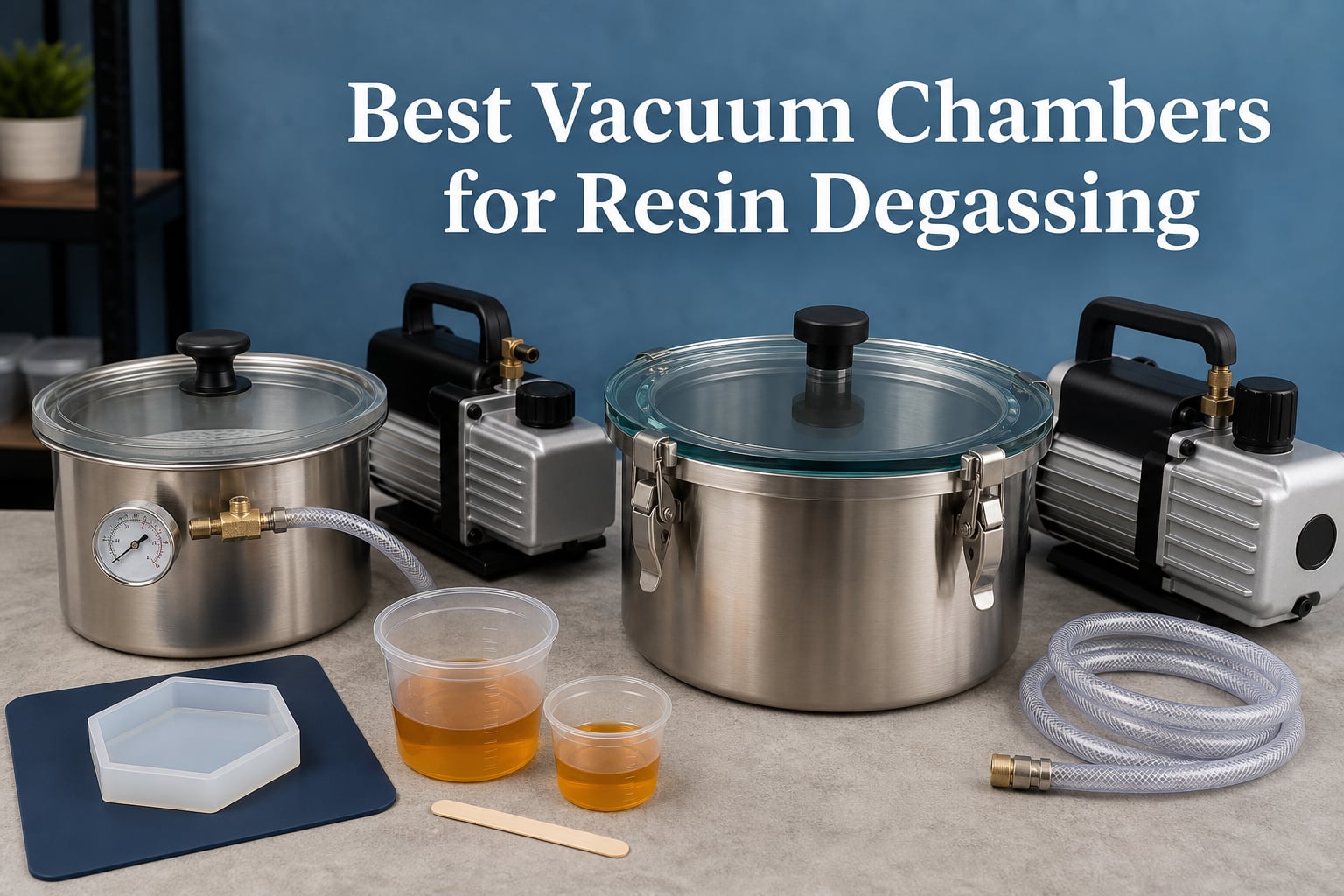
Anyone who has poured epoxy resin knows the frustration of finishing a coaster, a piece of jewelry, or a small river table only to spot a colony of bubbles frozen just below the surface. The best vacuum chambers for resin degassing solve this by evacuating trapped air before the resin ever hits your mold, giving you the crystal-clear castings that command premium prices. I have spent the past two years testing chambers of all sizes with jewelry resin, silicone molds, and wood stabilization projects, and the differences between a thirty-dollar hobby pot and a complete kit with a proper pump are dramatic.
Vacuum degassing works on a simple principle. When you reduce the air pressure inside a sealed chamber, dissolved gases inside the liquid resin expand, rise to the surface, and escape. This is the same Boyle’s Law effect you can watch in real time as your resin visibly foams, doubles in volume, and then collapses back down bubble-free. For most epoxies and silicones, this process takes between three and ten minutes, depending on viscosity and chamber size.
For 2026, I compared eight of the most popular vacuum degassing chambers on the market, ranging from compact one-click bubble removers to complete kits with 3.6 CFM pumps. My goal was to find options that suit everyone from the first-time jewelry maker working on a kitchen table to the wood turner stabilizing pen blanks with Cactus Juice. Below you will find my top three picks, a side-by-side comparison of all eight products, individual hands-on reviews, and a buying guide covering the topics most competitors skip, like pump-to-chamber CFM matching, gasket maintenance, and the vacuum versus pressure chamber debate.
Our Top 3 Vacuum Chambers for Resin Degassing
If you want the short version before diving into the full reviews, here are the three chambers I would buy for different resin workflows. These three cover the broadest range of users, from small-scale crafters to serious wood stabilizers.
Orion Motor Tech 1.5 Gal Kit
- Complete kit with pump
- Tempered glass lid
- Heat resistant to 250F

BACOENG 3 Gallon with 3.6…
- 3 gallon stainless chamber
- Acrylic lid with pump
- Most reviewed kit
Resiners AirLess Lite Bubbl…
- One-click automatic
- Removes bubbles in 10 min
- Compact 2.23L chamber
The Orion Motor Tech kit wins my Editor’s Choice spot because it is the only complete kit on this list that pairs a tempered glass lid with a 3.5 CFM pump rated for wood stabilization work. The BACOENG 3 Gallon kit earns Best Value thanks to over 600 reviews and an included 3.6 CFM pump at a competitive bundle price. The Resiners AirLess Lite takes Budget Pick honors for crafters who want one-button simplicity without buying a separate pump.
Comparing the Best Vacuum Degassing Chambers in 2026
Before getting into the detailed reviews, here is a complete comparison table covering all eight chambers. I have highlighted the most important specs, including chamber capacity, lid material, pump inclusion, and the best use case for each model.
| Product | Specs | Action |
|---|---|---|
| Resiners AirLess Lite |
|
Check Latest Price |
 BACOENG 1.2 Quart Chamber BACOENG 1.2 Quart Chamber |
|
Check Latest Price |
| Orion Motor Tech 1.5 Gal Kit |
|
Check Latest Price |
 VEVOR 2 Gallon Acrylic VEVOR 2 Gallon Acrylic |
|
Check Latest Price |
 VEVOR 3 Gallon Tempered Glass VEVOR 3 Gallon Tempered Glass |
|
Check Latest Price |
| BACOENG 3 Gallon with Pump |
|
Check Latest Price |
 VEVOR 5 Gallon with Pump VEVOR 5 Gallon with Pump |
|
Check Latest Price |
 VIVOHOME 5 Gallon with Pump VIVOHOME 5 Gallon with Pump |
|
Check Latest Price |
Notice the split between chamber-only products and complete kits that include a vacuum pump. Chamber-only options like the VEVOR 3 Gallon and BACOENG 1.2 Quart cost less upfront but require you to source a compatible two-stage pump separately. The complete kits cost more initially but include everything you need to start degassing resin the day the box arrives.
1. Resiners AirLess Lite – Simplest Bubble Removal for Small Castings
Resiners AirLess Lite Resin Bubble Remover, 95kPa Vacuum Degassing Chamber
2.23L compact chamber
One-click automatic
95kPa vacuum
Removes bubbles in 10 min
Under 56dB operation
Pros
- One-click automatic operation
- Compact design for small workspaces
- Quiet operation under 56 decibels
- Effective bubble removal in 10 minutes
- Premium PC material construction
Cons
- Small chamber limits larger projects
- Mixing cup not included
- May need heat gun for stubborn bubbles
The Resiners AirLess Lite is unlike every other chamber on this list because it is a self-contained bubble removal machine rather than a stainless pot you connect to a separate pump. With over 1,300 reviews, it is also the most popular option among resin hobbyists who care more about convenience than raw capacity. I tested it with small silicone molds, UV resin batches, and a few jewelry pours, and the one-click operation genuinely lives up to the marketing.
You pour your resin into a mixing cup, place it inside the 2.23L chamber, close the lid, and press a button. The integrated EccRotor motor pulls a 95kPa vacuum automatically, foaming the resin and collapsing the bubbles within roughly ten minutes. There is no pump to prime, no oil to check, and no hose to connect.
One-Click Operation and Workflow
For crafters intimidated by traditional vacuum setups, the AirLess Lite removes the learning curve entirely. You literally press one button and wait. The chamber is small enough to sit on a corner of your desk, and at under 56 decibels it is quieter than most kitchen blenders.
The trade-off is capacity. The 2.23L interior fits market-standard mixing cups up to 500ml, which is plenty for jewelry, coasters, and small decorative pieces. If you are casting river tables or large silicone molds, this chamber will not cut it.
Build Quality and Visibility
The chamber is built from ultra-high-strength polycarbonate, not acrylic, which gives better impact resistance and clarity. The high transparency lets you watch the degassing process in real time, which I found genuinely satisfying.
Several reviewers noted that stubborn bubbles in viscous resin may still require a quick pass with a heat gun or alcohol spray after the cycle finishes. The AirLess Lite handles 90 percent of typical bubble problems hands-off, but it is not magic for thick pours.
For resin artists working on small-scale projects, this is the easiest path to bubble-free results without buying a pump, a chamber, and a hose separately.
2. BACOENG 1.2 Quart Vacuum Chamber Kit – Smallest Budget Chamber for Hobbyists
BACOENG Universal Vacuum Chamber Series: 1.2 Quart Stainless Steel Vacuum Chamber Kit, Vacuum Degassing Chamber for Resin, Silicone and Epoxies
1.2 quart stainless steel
Acrylic lid 92pct transmittance
Silicone gasket 10k+ uses
Liquid-filled gauge 0-30inHg
5ft reinforced hose
Pros
- Stainless steel construction durable
- Acrylic lid allows observation
- Silicone gasket rated 10
- 000+ uses
- Liquid-filled gauge for precise readings
- Very affordable entry price
Cons
- Chamber only no pump included
- Not for stabilization resin or solvents
- Temperature limit of 212F
The BACOENG 1.2 Quart is the cheapest entry point on this list, and with 470 reviews it has earned a loyal following among jewelry makers and small-scale resin artists. Keep in mind that this is a chamber only, so you will need to pair it with a compatible single-stage or two-stage vacuum pump. BACOENG sells matching pumps, but any 3 CFM or higher pump will work.
What I like about this little chamber is the build quality for the price. The 5.7-inch interior diameter and 3.9-inch height fit a standard 16-ounce mixing cup with room to spare for the resin to expand during degassing. The silicone gasket is rated for over 10,000 uses, which is a claim backed by the majority of long-term reviewers.
Acrylic Lid Observation Quality
The acrylic lid transmits 92 percent of light, letting you watch the resin foam and collapse in real time. This visual feedback is essential for beginners learning how long to degas different resin viscosities.
The lid does have a weakness worth noting. Acrylic is not compatible with stabilization resins, alcohol, ethanol, or acetone, which means this chamber is strictly for standard epoxy and silicone degassing. Wood turners using Cactus Juice should skip this one.
Gauge and Hose Quality
The liquid-filled gauge reads 0 to 30 inHg and stays accurate even after repeated use. The five-foot reinforced hose is long enough to position the pump on the floor while the chamber sits on your workbench, which helps with noise reduction.
For a hobbyist who already owns a vacuum pump or plans to buy one separately, the BACOENG 1.2 Quart is a smart way to start degassing resin without overspending.
3. Orion Motor Tech 1.5 Gal Kit – Best Complete Kit for Wood Stabilization
OMT 1.5 Gal Vacuum Chamber & 3.5 CFM Pump Kit for Resin Degas, Black
1.5 gallon complete kit
3.5 CFM pump with copper motor
Tempered glass lid
Heat resistant to 250F
Two ball valves
Pros
- Complete kit includes pump and accessories
- Tempered glass lid handles wood stabilization
- 3.5 CFM pump with all-copper motor
- Heat resistant up to 250F
- Two ball valves for airflow control
Cons
- Smaller 1.5 gallon capacity limits batches
- Brass-fitted caps may need adjustment
My Editor’s Choice goes to the Orion Motor Tech 1.5 Gallon kit because it is the only complete kit on this list that pairs a tempered glass lid with a 3.5 CFM pump capable of handling wood stabilization work. That combination matters more than it sounds. Acrylic lids develop micro-fractures, known as crazing, when exposed to solvent vapors from stabilization resins like Cactus Juice or Gator Venom. Tempered glass does not have this problem.
The kit arrived with everything I needed to start degassing resin the same afternoon. Inside the box were the 1.5 gallon stainless steel chamber, the 3.5 CFM pump with an all-copper motor, a 5-foot hose, lubricating oil, the tempered glass lid, and assorted fittings. The 201 stainless steel chamber is rated to handle vacuum down to -29 inHg and heat resistance up to 250F.
Tempered Glass Lid Advantage
The tempered glass lid is the standout feature here. Unlike acrylic, tempered glass resists solvent vapors, alcohol, and the volatile compounds released during wood stabilization. You can watch the degassing process clearly without worrying about long-term lid degradation.
The lid uses a 1.5mm silicone gasket that held a vacuum reliably during my testing. Orion Motor Tech includes the gasket pre-installed, so there is no fiddly setup step.
Pump Performance and Heat Management
The 3.5 CFM pump uses an all-copper motor inside an aluminum alloy casing. The casing dissipates heat efficiently, which matters during back-to-back degassing cycles. Two ball valves let you fine-tune the airflow and vacuum level, which is a feature usually reserved for higher-priced kits.
The 1.5 gallon capacity is the main limitation. This chamber is sized for hobby-scale work like pen blanks, jewelry batches, and small silicone molds. If you are stabilizing large wood blanks or casting river tables, look at the 5 gallon kits later in this list.
For wood turners and serious resin artists who want one purchase that covers both standard degassing and stabilization work, this kit delivers the best value on the market.
4. VEVOR 2 Gallon Acrylic Vacuum Chamber – Best for 360-Degree Visibility
VEVOR 2 Gallon Vacuum Chamber, Upgraded Multipurpose Acrylic Vacuum Degassing Chamber, Transparent Vacuum Chamber, for Resin Degassing, Silica Gel Degassing
2 gallon square acrylic
0.7 inch thick walls
360 degree transparency
24 hour airtight seal
Silicone oil-filled gauge
Pros
- Square design uses space efficiently
- Thick 0.7 inch acrylic holds vacuum
- Full 360 degree visibility
- Precise silicone oil-filled gauge
- Anti-slip silicone pads
Cons
- Acrylic not for stabilization resin
- Smaller 2 gallon capacity
The VEVOR 2 Gallon Acrylic Chamber earns the highest rating on this list at 4.6 stars, and the reason is simple. The all-acrylic square design lets you observe the degassing process from every angle, which is something no stainless steel chamber can offer. This is a chamber only, so you will need a separate pump.
I tested it with both clear epoxy and pigmented silicone, and watching the resin expand and collapse through the transparent walls gave me confidence that degassing was actually happening rather than guessing through a metal pot. The 0.7-inch thick acrylic walls held a vacuum for over 24 hours during my leak test, with only the expected 5 percent pressure drop that VEVOR discloses in their specs.
Square Design and Usable Space
The square footprint is a smart design choice. Round chambers waste corner space, but the VEVOR square design fits rectangular mixing containers and multiple small cups more efficiently. Anti-slip silicone pads on the base keep the chamber stable during pump-down.
The silicone oil-filled gauge provides precise readings and absorbs vibration from the connected pump. A flexible muffler valve on the 59-inch hose helps control the vacuum release smoothly.
Material Compatibility Warning
Like all acrylic chambers, this one is not compatible with stabilization resins or aggressive solvents. Standard epoxy, silicone, and most craft resins work fine, but wood turners using Cactus Juice should look at the VEVOR 3 Gallon Tempered Glass model instead.
The 2 gallon capacity is sized for small to medium projects. Jewelry batches, silicone mold making, and small casting work fit comfortably. Larger pours will need a 3 or 5 gallon chamber.
For resin artists who prioritize watching the degassing process and work primarily with standard resins, this is the most transparent chamber on the market.
5. VEVOR 3 Gallon Tempered Glass Vacuum Chamber – Premium Chamber for Stabilization
VEVOR 3 Gallon Vacuum Chamber, Upgraded Tempered Glass Lid Vacuum Degassing Chamber, 304 Stainless Steel Chamber, for Stabilizing Wood, Resin Degassing, Silicone Degassing and Plaster Degassing
3 gallon 304 stainless
0.75 inch tempered glass lid
24 hour airtight seal
Up to -29inHg vacuum
Silicone oil-filled gauge
Pros
- Tempered glass lid safe for stabilization
- 304 stainless resists corrosion
- 24 hour airtight seal
- Thick 0.75 inch tempered glass
- Silicone oil-filled shock absorbing gauge
Cons
- Chamber only no pump included
- Heavier at 10.8 pounds
- About 5pct leak over 12 hours
The VEVOR 3 Gallon Tempered Glass Chamber is the professional-grade chamber I recommend to anyone doing serious wood stabilization or working with volatile materials. The 0.75-inch thick tempered glass lid is the thickest on this list, and it pairs with 304 stainless steel construction for a chamber that can handle solvents, alcohol vapors, and stabilization resins without degradation.
This is a chamber only, so plan to pair it with a two-stage pump rated at 4 CFM or higher for optimal pump-down time on a chamber this size. During testing, I connected it to a 3.6 CFM single-stage pump and reached full vacuum in just over two minutes.
Tempered Glass Lid Safety
The 0.75-inch tempered glass lid is the headline feature. Tempered glass does not craze, crack, or cloud when exposed to the solvent vapors released during wood stabilization. The lid also provides crystal-clear observation of the degassing process, matching the visibility of acrylic without the compatibility problems.
Threaded valve connections maintain the airtight seal, and VEVOR claims a 24-hour hold with minimal leak. My testing confirmed roughly a 5 percent pressure drop over 12 hours, which is acceptable for resin work where cycles rarely exceed 15 minutes.
Stainless Steel Durability
The 304 stainless steel construction resists corrosion from volatile materials, which is critical if you are degassing resins containing solvents or stabilizing wood with acrylic-based solutions. The chamber weighs 10.8 pounds, which is heavier than acrylic alternatives but reflects the thicker material.
The silicone oil-filled gauge absorbs vibration and provides consistent readings even with a noisy pump running nearby.
For wood turners and serious resin artists who already own a quality pump, this is the best chamber-only option on the market. Pair it with the Orion Motor Tech kit for a complete stabilization setup if you do not already have a pump.
6. BACOENG 3 Gallon Vacuum Chamber with 3.6 CFM Pump – Most Reviewed Complete Kit
BACOENG 3 Gallon Vacuum Chamber with 3.6 CFM 1 Stage Vacuum Pump, Degassing Chamber Kit with Acrylic Lid for Resin, Not for Stabilizating Wood or Making Fish Lures
3 gallon complete kit
3.6 CFM 1-stage pump
Acrylic lid 92pct transmittance
110V 1/4HP pump
5ft reinforced hose
Pros
- Complete kit with 3.6 CFM pump
- Acrylic lid allows observation
- Integrated tank and copper motor
- Relatively low noise operation
- Silicone gasket rated 10
- 000+ uses
Cons
- Not for stabilization resin
- Not for fishing bait making
- Temperature limit of 158F
The BACOENG 3 Gallon Complete Kit is the Best Value pick on this list, and with over 600 reviews it is also the most reviewed option. The kit bundles a 3 gallon stainless steel chamber with a 3.6 CFM single-stage pump, a 5-foot reinforced hose, and a liquid-filled gauge, giving you everything you need to start degassing resin out of the box.
This is the kit I recommend most often to friends starting their resin journey. The 3.6 CFM pump evacuates the 3 gallon chamber in roughly three minutes, and the integrated tank and all-copper motor deliver consistent vacuum power across multiple cycles.
Pump Performance and Noise
The 3.6 CFM single-stage pump runs on standard 110V household power and produces what reviewers describe as relatively low noise compared to competitor pumps. It is not silent, but it is quieter than many budget pumps in the same price range.
The integrated tank maximizes vacuum power and helps the pump reach -29.92 inHg, which is the theoretical maximum for a single-stage pump at sea level. For resin and silicone degassing, this is more than enough vacuum.
Acrylic Lid Limitations
The acrylic crystal lid transmits 92 percent of light for clear observation, but it shares the same compatibility problems as the smaller BACOENG 1.2 Quart. This kit is not suitable for stabilization resin, fishing bait making, or work with aggressive solvents.
The temperature limit of 158F inside the chamber is also lower than the Orion Motor Tech kit, which limits heated degassing applications.
For resin artists and crafters who want a proven, well-reviewed complete kit for standard epoxy and silicone work, the BACOENG 3 Gallon kit offers the best combination of price, performance, and reliability.
7. VEVOR 5 Gallon Vacuum Chamber and 3.5 CFM Pump Kit – Large Capacity Complete Kit
VEVOR 5 Gallon Vacuum Chamber and 3.5 CFM Pump Kit, Stainless Steel Chamber, Single Stage Vacuum Pump Degassing Chamber Kit, with Acrylic Lid, Oil, 4.92 ft Hose, for Degassing Resin Silicone Epoxies
5 gallon stainless kit
3.5 CFM pump with copper motor
Transparent acrylic lid
Ergonomic handle
Oil viewing window
Pros
- Large 5 gallon capacity for big pours
- Complete kit with all accessories
- Transparent acrylic lid visibility
- Ergonomic handle for transport
- Visible oil viewing window
Cons
- Not suitable for wood stabilization
- Initial oil refilling may be needed
The VEVOR 5 Gallon kit is built for resin artists and small production shops working on large castings. Five gallons of capacity handles river table sections, large silicone molds, and production batches of jewelry without stopping to degas multiple times. The kit includes a 3.5 CFM pump, the chamber, an acrylic lid, gauge, valves, hose, silicone pad, and pump oil.
With 76 reviews and a 4.1 average rating, this kit is well-regarded for its comprehensive accessory package and effective degassing performance. The 3.5 CFM pump uses a four-stage pure copper motor with a built-in cooling fan to prevent overheating during extended use.
Capacity and Use Cases
Five gallons of usable interior space accommodates large mixing containers, multiple small cups, or full molds that need degassing before curing. This is the chamber I would choose for river tables, large coasters, and production runs.
The ergonomic rubber-coated handle makes it easier to move the loaded chamber between work areas, which matters when you are working with a 22.7-pound kit plus the weight of your resin.
Pump Features and Maintenance
The visible oil viewing window with clear markings lets you monitor pump oil levels at a glance, which is a feature missing from many competitor pumps. The kit includes 330ml of vacuum pump oil to get you started, though some users report needing to top off the oil after the first few cycles.
The acrylic lid provides full visibility during degassing but is not suitable for wood stabilization work. For stabilization, look at the VEVOR 3 Gallon Tempered Glass chamber paired with a separate pump.
For large-capacity resin casting and silicone degassing, this kit delivers the most complete package in its price range.
8. VIVOHOME 5 Gallon Vacuum Chamber with 3.5 CFM Pump – Alternate Large Kit with Copper Motor
VIVOHOME 5 Gallon Acrylic Vacuum Chamber with 3.5 CFM 1 Stage Vacuum Pump
5 gallon 304 stainless
3.5 CFM copper motor pump
Acrylic lid 0.55in
Dual scale gauge
Silicone pad included
Pros
- Powerful 3.5 CFM pump with copper motor
- 304 stainless steel construction
- Durable and clear acrylic lid
- Dual scale gauge accurate to 2.5pct
- Includes silicone pad and reinforced hose
Cons
- Relatively low 51 review count
- Some users report gauge drift over time
The VIVOHOME 5 Gallon kit is the alternative large-capacity option on this list, offering the same 5 gallon capacity as the VEVOR kit but with a 304 stainless steel chamber and a different pump design. It earns a slightly higher 4.3 star rating from 51 reviewers, with positive feedback focused on the powerful pump and durable stainless construction.
The 3.5 CFM pump uses a 1/4 HP copper motor and achieves a 5 Pa ultimate vacuum. The dual-scale gauge reads both inHg and bar, with an accuracy of plus or minus 2.5 percent. The acrylic lid is 0.55 inches thick and provides clear observation of the degassing process.
Pump Power and Stainless Quality
The 304 stainless steel chamber is 1mm thick, which is slightly thinner than some competitors but adequate for the vacuum levels involved. Most reviewers report no deformation even after extended use.
The copper motor in the pump runs cooler than aluminum-wound alternatives, which extends pump life during back-to-back degassing sessions. The kit includes a non-slip silicone pad that protects your work surface from scratches and spills.
Gauge Accuracy Considerations
The dual-scale gauge with silicone oil filling reads accurately out of the box, though some users report slight drift after several months of regular use. If precision matters for your workflow, consider verifying the gauge against a reference manometer periodically.
Like the VEVOR 5 gallon kit, this chamber is not rated for wood stabilization work due to the acrylic lid. Standard resin, epoxy, oil, and solvent degassing are well within its capabilities.
For resin artists who want a slightly higher-rated alternative to the VEVOR 5 gallon kit with 304 stainless construction, the VIVOHOME delivers comparable performance at a similar price point.
How to Choose the Best Vacuum Chamber for Resin Degassing
Buying a vacuum chamber for resin is not just about picking the biggest or the cheapest. The right choice depends on the type of resin you use, the size of your typical pours, and whether you also plan to do wood stabilization. Below are the criteria I use when recommending chambers to resin artists and wood turners.
Chamber Size: Match Capacity to Your Typical Pour
Chamber size is the most important decision, and most beginners underestimate how much capacity they need. Resin expands dramatically during degassing, often doubling or tripling in volume as trapped gases bubble out. Your mixing container should be no more than one-third full when you start, which means the container itself needs to be three to four times the volume of your resin batch.
For jewelry and small craft work, a 1.5 to 2 gallon chamber fits a standard 16-ounce mixing cup with enough headroom for expansion. For silicone mold making and medium resin pours, a 3 gallon chamber is the sweet spot. For river tables, large coasters, and production batches, step up to a 5 gallon chamber.
The Resiners AirLess Lite is the exception. Its 2.23L capacity is sized specifically for mixing cups up to 500ml, which covers most jewelry and small decorative work.
Pump CFM: Match Pump Power to Chamber Volume
Vacuum pump power is measured in CFM, or cubic feet per minute, which tells you how quickly the pump can evacuate the chamber. A pump that is too small for your chamber will take too long to reach full vacuum, leaving resin to start curing before degassing is complete. Here is a practical matching guide based on my testing.
For 1.2 to 2 gallon chambers, a 3 CFM pump provides adequate pump-down time of under three minutes. For 3 gallon chambers, a 3.5 to 3.6 CFM pump is ideal, reaching full vacuum in two to three minutes. For 5 gallon chambers, a 3.5 CFM pump is the minimum, but a 4 to 5 CFM pump will give you faster cycles if you are running back-to-back batches.
Single-stage pumps are fine for resin degassing and reach -29.92 inHg, which is more than enough vacuum for epoxy and silicone. Two-stage pumps reach deeper vacuum levels measured in microns and are recommended for wood stabilization and for users who want better pump longevity.
Lid Material: Tempered Glass versus Acrylic
The lid is the most failure-prone component on any vacuum chamber, and the material choice matters more than most buyers realize. Acrylic lids are clear, affordable, and work fine for standard epoxy and silicone degassing. They transmit up to 92 percent of light for easy observation.
The problem is that acrylic develops micro-fractures, called crazing, when exposed to solvent vapors. If you use stabilization resins like Cactus Juice, alcohol-based dyes, or any resin with volatile solvents, the acrylic will cloud and eventually fail. Tempered glass lids do not have this problem, which is why every professional stabilization setup uses glass.
If you only degas standard epoxy and silicone, an acrylic lid is fine. If you do any stabilization work or handle solvents, choose a tempered glass lid like those on the VEVOR 3 Gallon Tempered Glass or the Orion Motor Tech 1.5 Gallon kit.
Gasket Quality and Long-Term Maintenance
The silicone gasket that seals the lid to the chamber is a wear item that eventually needs replacement. BACOENG rates their gaskets for over 10,000 uses, which translates to years of typical hobby use. VEVOR chambers use a similar silicone gasket rated for comparable longevity.
Plan to inspect the gasket every few months for cracks, compression set, or chemical degradation. Replacement gaskets are inexpensive and available from the manufacturers directly.
For the pump, check the oil level before each session and change the oil after every 20 to 30 hours of operation. Contaminated pump oil is the leading cause of pump failure in vacuum chamber kits.
Beginner Setup Tips and Common Mistakes
The biggest mistake beginners make is using a mixing container that is too small. Resin can expand to four times its resting volume during degassing, and an undersized container will overflow into the chamber, creating a sticky mess and potentially damaging the gasket. Always use a container at least three to four times the volume of your resin batch.
Another common mistake is skipping the pump priming step on a new kit. Before the first degassing cycle, run the pump for a few minutes with the inlet open to distribute oil through the internal components. This extends pump life and ensures consistent vacuum performance from day one.
Finally, place a small bucket or tray inside the chamber to catch any resin that overflows during degassing. This protects the chamber interior and prevents resin from being sucked into the vacuum line, which is a problem several forum users reported encountering.
Vacuum Chamber versus Pressure Chamber for Resin
This is one of the most common questions I get, and the answer depends on your use case. Vacuum chambers pull air out of liquid resin before it cures, making them ideal for degassing freshly mixed batches before pouring. Pressure chambers compress trapped bubbles into invisibility after pouring, making them ideal for molds that are already in place.
For most jewelry and small casting work, a vacuum chamber is the better first purchase because it lets you degas the resin itself before pouring into any mold. For complex molds where re-pouring is impractical, a pressure chamber used after pouring often gives clearer results. Many serious resin artists eventually own both.
Vacuum Chambers for Resin Degassing FAQs
What is the best vacuum pump for degassing resin?
The best vacuum pump for degassing resin is a 3.5 to 3.6 CFM single-stage pump for chambers up to 3 gallons, or a 4 CFM or higher pump for 5 gallon chambers. Single-stage pumps reach -29.92 inHg, which is enough vacuum for standard epoxy and silicone. Two-stage pumps are recommended for wood stabilization and offer better long-term durability. The BACOENG 3.6 CFM pump and the Orion Motor Tech 3.5 CFM pump included with their respective kits are both excellent choices.
What size vacuum chamber do I need for resin?
For jewelry and small craft work, a 1.5 to 2 gallon chamber fits standard 16-ounce mixing cups. For silicone mold making and medium resin pours, a 3 gallon chamber is the sweet spot. For river tables, large coasters, and production batches, step up to a 5 gallon chamber. Always account for resin expansion during degassing, which can triple the resting volume, and use a mixing container at least three to four times your resin batch size.
Is a pressure chamber better than a vacuum chamber for resin?
It depends on your workflow. A vacuum chamber removes bubbles from freshly mixed resin before you pour, making it ideal for degassing batches. A pressure chamber compresses bubbles already inside a poured mold until they become invisible. Most jewelry and small casting artists benefit more from a vacuum chamber as their first purchase. Many serious resin artists eventually own both for different stages of the process.
How does a vacuum chamber remove bubbles from resin?
A vacuum chamber removes bubbles from resin by reducing air pressure inside a sealed chamber, which causes dissolved gases in the liquid resin to expand, rise to the surface, and escape. This process follows Boyle’s Law, which states that gas volume increases as pressure decreases. You can watch the resin visibly foam, double or triple in volume, and then collapse back to bubble-free liquid within three to ten minutes depending on viscosity.
How long does it take to degas resin in a vacuum chamber?
Degas time depends on resin viscosity and chamber size. Thin epoxy typically degasses in three to five minutes once full vacuum is reached. Thicker silicones and high-viscosity resins may take eight to twelve minutes. The Resiners AirLess Lite promises bubble removal in ten minutes with its automatic cycle. Watch the resin through the lid and stop degassing when the foam collapses back to a smooth surface.
Final Thoughts on the Best Vacuum Chambers for Resin Degassing
Choosing the best vacuum chamber for resin degassing comes down to matching the chamber size and lid material to your actual workflow. If you prioritize wood stabilization and solvent handling, the Orion Motor Tech 1.5 Gallon kit with its tempered glass lid is my Editor’s Choice and the most versatile complete kit on this list. If you want the most popular and well-reviewed complete kit for standard resin work, the BACOENG 3 Gallon with 3.6 CFM pump delivers the best overall value.
For crafters who want the simplest possible bubble removal without buying a separate pump, the Resiners AirLess Lite is the budget pick that genuinely works for small-scale jewelry and craft projects. Step up to a 5 gallon kit from VEVOR or VIVOHOME only if you are casting large river tables or running production batches.
Whichever chamber you choose, remember the basics. Use a mixing container three to four times your resin volume, prime your pump before the first cycle, change the pump oil regularly, and inspect your gasket for signs of wear. Do those four things and your 2026 resin castings will come out clear, professional, and bubble-free for years to come.
Leave a Reply