
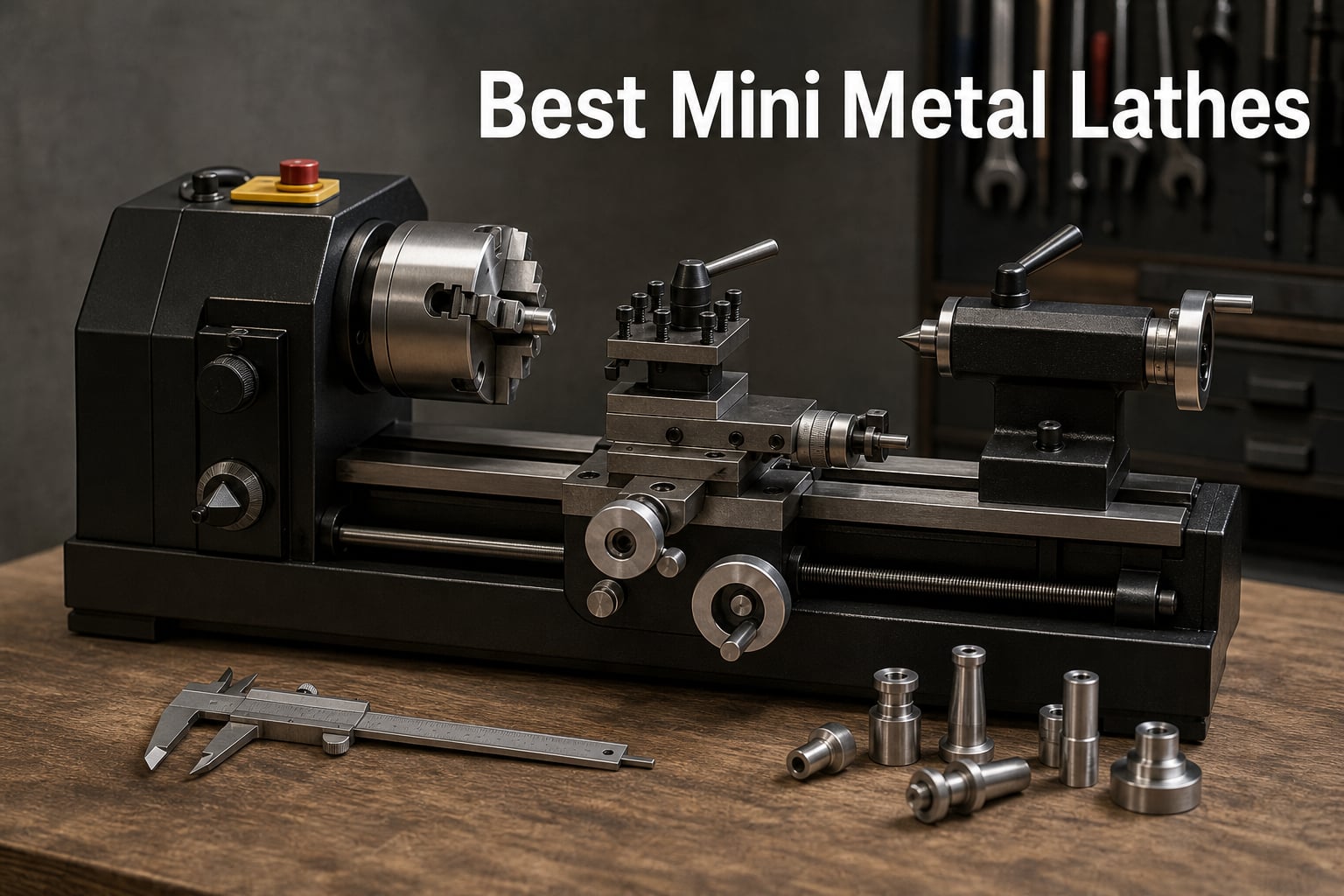
Finding the Best Mini Metal Lathes is less about chasing the biggest motor number and more about matching capacity, weight, threading needs, and setup patience to the parts you will actually make. A compact lathe can cut bushings, spacers, threaded adapters, model-engine pieces, and repair parts without taking over a home workshop, but it will not behave like a much heavier industrial machine.
I compared the eight listed machines by their published swing over bed, distance between centers, motor and drive design, spindle-speed range, threading provisions, included workholding, ratings, and review volume. I also treated low review counts carefully: a high average from a small sample is useful context, not proof that every delivered machine will arrive perfectly adjusted.
A mini metal lathe rotates stock against a fixed cutting tool, letting you reduce diameters, face ends, bore holes, cut tapers, and make threads. Most benchtop choices here sit in the 7- to 8.3-inch swing class, which means their practical work is small, deliberate, and best supported close to the chuck.
Forum discussions from hobby machinists repeatedly raise the same point: many compact import machines benefit from inspection and adjustment before serious work. Plan time for cleaning shipping grease, mounting the machine, checking gibs, verifying tailstock alignment, and measuring spindle runout with a dial indicator rather than assuming a catalog specification tells the whole story.
For 2026, my shortest advice is simple: choose bed length and rigidity first, then choose the speed, threading, and workholding features that support your projects. If you expect to turn long shafts, cut many threads, or take aggressive cuts in steel, the extra machine mass and center distance matter more than a long accessory list.
The three leading choices answer three different home-shop needs
The INTSUPERMAI is the broad-capacity pick because it combines an 8.27-inch swing, 15.75 inches between centers, an 1100W brushless motor, and panel-based imperial/metric selection. The WEN ML712 makes more sense for a buyer who values documented threading options and its two-year warranty, while the ZHRUI is the tiny specialized option for light materials and multi-face work.


The badges are a starting point rather than a substitute for measuring your work. A 7-inch machine is capable of useful close-in work, while a longer, heavier machine is a better match for jobs that need more stock support and less vibration.
The all-eight overview makes capacity differences easy to spot
Read the first two measurements together: swing over bed is the largest diameter that clears the bed, while distance between centers sets the nominal length of work supported between a chuck and a live center. Motor output and speed range then help explain how comfortably a machine can take light, controlled cuts in the material you choose.
| Product | Specs | Action |
|---|---|---|
| INTSUPERMAI 8×16 Gearless |
|
View Details |
 VEVOR 7×12 550W VEVOR 7×12 550W |
|
View Details |
 VEVOR 7×14 Digital VEVOR 7×14 Digital |
|
View Details |
 VEVOR 7×13.78 Belt Drive VEVOR 7×13.78 Belt Drive |
|
View Details |
 VEVOR 8.3×29.5 Brushless VEVOR 8.3×29.5 Brushless |
|
View Details |
| ZHRUI 4-Axis Micro Lathe |
|
View Details |
 VEVOR 8×14 650W VEVOR 8×14 650W |
|
View Details |
| WEN ML712 7×12 |
|
View Details |
Ratings range from 3.7 to 4.8 among these listings, and review samples range from 10 to 284. That spread is why I would inspect the individual specifications before treating any single star average as the deciding fact.
1. The INTSUPERMAI 8×16 gives a serious hobbyist the widest all-round specification
INTSUPERMAI Mini Metal Lathe 8″×16″ Inch/Metric Benchtop Lathe Electronic Gearless Auto Change of Metric/Inch Hobby DIY Metal Wood Plastic Lathe 1100W with 4 Jaw/3 Jaw Chuck 110V
8.27 inch swing
15.75 inch centers
1100W brushless
50-2500 RPM
Pros
- Gearless imperial and metric selection
- 1100W brushless motor
- 3-jaw and 4-jaw chucks
- 50-2500 RPM range
Cons
- 179 pound machine
- 10-review sample
This is the most substantial machine in the group on published motor output and listed capacity. Its 8.27-inch swing over bed and 15.75-inch center distance give a home machinist more room for moderate-diameter work and longer pieces than the 7×12 choices.
I would put it at the top of the list for a buyer who wants one benchtop machine to cover varied turning and occasional four-jaw work. The 4.8 rating is encouraging, though it comes from 10 reviews, so the specification sheet deserves more weight than the average alone.
The gearless imperial and metric selection reduces thread-change interruptions
The published gearless arrangement changes between imperial and metric settings through a panel rather than requiring gear swaps. That is useful when a project moves between measurement systems or when a beginner is still learning how thread settings relate to pitch.
The listing also describes manual, automatic, and delay-automatic turning starts. Treat those controls as convenience features, not permission to walk away: a lathe needs active attention whenever stock and tooling are in motion.
The 1100W brushless motor gives this machine the strongest stated power figure here
Its brushless motor is rated at 1100W, with spindle speed listed from 50 to 2500 RPM. Low speed matters when you need control near a shoulder or when facing a larger diameter, while higher speed can suit small-diameter work in appropriate materials.
The machine is listed at 179 pounds, which helps explain why it belongs on a rigid, level bench rather than a light folding stand. More mass can help resist movement, but proper mounting and conservative cuts still matter.
The included 3-jaw and 4-jaw chucks widen the kinds of work you can hold
A 3-jaw self-centering chuck speeds up round stock setup, while a 4-jaw chuck gives more flexibility for square, irregular, or deliberately off-center work. Having both listed with the machine reduces the chance that your first unusual workpiece stops the project.
The 4.92-inch chuck diameter and 3.94-inch bed width are useful dimensions to keep in mind when planning fixtures. Before cutting a close-tolerance part, indicate the workpiece and confirm that the tailstock and tool height agree with the actual setup.
2. The VEVOR 7×12 is a compact starting point for small turned parts
VEVOR Metal Lathe 7″x12″, Precision Bench Top Mini Metal Lathe, 550W, Variable Speed 50-2500 RPM, Nylon Gear, Movable Lamp for Precision Parts Processing
7 inch swing
550W DC motor
0-2250 RPM
3-jaw chuck
Pros
- Iron bed
- variable speed
- forward and reverse
- quick-change tool post
Cons
- Nylon gears
- 85 pound machine
The VEVOR 7×12 is the smaller conventional benchtop option: a 7-inch cutting diameter, 550W DC motor, 3-jaw self-centering chuck, and stated 0 to 2250 RPM range. Its 85-pound listed weight makes it less demanding to place than the largest machines, although it still needs a firm mounting surface.
For a first mini lathe for beginners, its compact scale can be appealing for spacers, small bushings, knobs, and short repair parts. Its 4.0 average is based on 84 reviews, which is a larger sample than several other listings in this comparison.
The variable speed and reverse controls support careful small-part work
The listing specifies infinitely variable speed from 0 to 2250 RPM and forward/reverse operation at all speeds. That range gives a user room to slow the spindle before learning a new operation and to select a safer cutting speed for the work diameter.
A speed dial does not replace chip control or a sharp tool. Start with light cuts, keep hands out of the rotating zone, and stop the spindle before measuring a part.
The iron bed and 3-jaw chuck make a familiar basic platform
VEVOR describes a high-grade iron bed and an accurate 3-jaw self-centering chuck with stated spindle accuracy within 0.01 mm. A dial indicator is still the right way to check runout on the particular chuck and workpiece in front of you.
The package also lists a professional compound rest and quick-change tool post. A compound is especially handy for controlled tapers and threading approaches, while a quick-change system makes it easier to keep tools repeatable once you have set their heights.
The nylon gear train is the main trade-off to weigh before choosing it
Nylon gears are specifically listed on this model, and that material difference separates it from the metal-geared VEVOR 7×14 below. The product data calls them wear-resistant, but the comparison point remains important if your work will involve frequent drive changes or you simply prefer metal gears.
The movable lamp and emergency-stop button are welcome listed touches for a close bench setup. Good lighting helps, yet clear eye protection, chip management, and a stable workpiece are the parts of safe turning that no lamp can provide.
3. The VEVOR 7×14 adds a digital display and metal gears to a familiar format
VEVOR 7″x14″ Metal Lathe, Upgraded Digital Display, 550W
7.09 inch swing
13.78 inch centers
550W
50-2500 RPM
Pros
- Metal gears
- digital speed display
- 4-way tool post
- LED lamp
Cons
- 3.9 rating
- 284-review feedback includes 14 percent one-star ratings
This 7×14-class VEVOR adds nearly 14 inches between centers, metal gears, a four-way quick-change tool post, and a digital speed display. It is a sensible configuration to examine when short parts are not enough but a very long bench machine is impractical.
The listing has 284 reviews, the largest sample among the eight products, alongside a 3.9 average rating. Its stated distribution includes 14 percent one-star feedback, so I would treat a pre-use inspection as part of the purchase decision rather than an optional extra.
The digital display makes the selected spindle speed easier to repeat
The published range is 50 to 2500 RPM, and the display gives a visible reference for repeated setups. That can be more convenient than returning to an approximate knob position when you are learning which speed works for a certain stock diameter and operation.
The display does not measure surface speed for you. As work diameter rises, reduce RPM as appropriate and listen for chatter, which is a sign that tool geometry, support, speed, or depth of cut needs attention.
The metal gears and four-way post focus on day-to-day durability and tool changes
Metal gears replace nylon on this model, according to the product listing. The four-way tool post lets you stage up to four tools, which can reduce resets when a job needs facing, turning, boring, and parting in sequence.
Each tool still needs to be set at center height. A simple height gauge or a turned test piece can help confirm that the cutting edge is not too high or too low before you commit to a finished workpiece.
The 7.09-inch swing and 13.78-inch center distance suit short shafts and fittings
The stated swing is 7.09 inches and center distance is 13.78 inches, with a high-precision 4-inch 3-jaw chuck. Those dimensions fit small adapters, hobby components, and many repair jobs, not broad discs or very long unsupported rods.
At 103 pounds, it is heavier than the 7×12 VEVOR but still a benchtop machine. Bolt it down, leave access for cleaning chips, and reserve room behind the machine for stock that extends through the spindle area where applicable.
4. The VEVOR 7×13.78 uses a poly-V belt drive for a torque-focused compact machine
VEVOR Metal Lathe Machine, 7” x 13.78”, Precision Benchtop Power Metal Lathe, 0-2200 RPM Continuously Variable Speed, 500W Brush Motor Metal Gears, with Tool Box for Processing Precision Parts
7 inch swing
0-2200 RPM
500W motor
18 imperial threads
Pros
- Poly-V belt drive
- MT2 quick-lock tailstock
- 18 thread types
- protection features
Cons
- 108 pound machine
- 3.9 rating
This 7-inch VEVOR is distinguished by its external poly-V-belt drive and published claim of three-times torque output at a 1:9 ratio. It also specifies a 20 mm spindle bore, a quick-lock MT2 tailstock, and 18 imperial thread types from 12 to 52 TPI.
I would look at this one when thread cutting and the belt-drive design are higher priorities than a digital display. The 3.9 average is drawn from 40 reviews, which makes careful incoming checks and support expectations part of the calculation.
The poly-V belt drive is the key technical difference in this model
The external poly-V-belt system is listed as the source of its torque increase, with continuously variable 0 to 2200 RPM operation. Torque at lower speeds is meaningful when facing or turning tougher material, but a small benchtop machine still rewards shallow, controlled passes.
Keep the belt area guarded as designed and disconnect power before any adjustment or inspection. Belt condition, tension, and pulley alignment affect how smoothly a drive can transfer power.
The MT2 quick-lock tailstock supports repeatable drilling and center work
An MT2 tailstock accepts a common taper family for a live center, drill chuck, and taper-shank tooling. The quick-lock feature and precision dial are listed for this model, which can speed tailstock positioning once alignment has been checked.
Tailstock alignment should be tested under your own conditions, ideally with a test bar or a measured cut. A drill that starts off center or a taper that appears unexpectedly is a setup signal, not a problem to force through with more feed pressure.
The 18 imperial threading settings give the machine a defined thread-cutting role
The published thread range is 18 imperial types from 12 to 52 TPI in forward and reverse. That range covers many common shop threads, though you should verify a required pitch against the manual before selecting any lathe for a specific restoration or fitting project.
The listed chuck-cover protection, overload protection, and circuit-board protector add layers of protection. They do not change the need to remove chuck keys immediately, keep sleeves and hair away from rotation, and support long stock safely.
5. The VEVOR 8.3×29.5 gives long-work capacity in a heavy bench format
VEVOR Metal Lathe, 8.3” x 29.5” Benchtop Metal Lathe 0-2500 RPM Continuously Variable Speed 750W Brushless Motor Metal Gears with LCD Display Metal Lathe Machine
8.3 inch swing
29.5 inch centers
750W brushless
24 thread types
Pros
- Long center distance
- HT200 cast iron
- brushless motor
- LCD display
Cons
- 197 pound machine
- 3.9 rating
This VEVOR is the long-bed choice, listing an 8.3-inch swing and 29.5 inches between centers. That length changes the type of work you can consider, especially longer shafts and parts that need tailstock support rather than hanging far from the chuck.
The listed 197-pound weight and 47.24-inch overall machine length mean this is still compact compared with a floor lathe, but it is not a casual desktop tool. I would measure the bench, delivery path, and clearance at both ends of the bed before committing to it.
The 29.5-inch center distance is the clear reason to choose this model
Distance between centers is often the limiting measurement for a hobby project, not swing. The 29.5-inch figure offers much more length than the other machines here, while the 8.3-inch swing still keeps the machine within a small-lathe class.
A long bed does not make long, thin work automatically rigid. Use a live center, steady rest, or follow rest when appropriate, and expect material support to matter just as much as the machine’s nominal capacity.
The 750W brushless motor and two speed ranges cover low-speed control and higher RPM
The product data lists a 750W brushless motor with a low range of 50 to 1250 RPM and a high range of 100 to 2500 RPM, plus forward and reverse. The separated ranges are useful because low-speed control and high-speed small-diameter work ask different things of the drive.
Brushless construction means the listing does not call for brush replacement, but it does not remove routine care. Keep swarf out of sliding surfaces, oil points according to the machine documentation, and stop to investigate any unusual vibration or heat.
The cast-iron body and 24 threading types make it a broader home-shop platform
VEVOR specifies HT200 cast iron, metal gears, aluminum-alloy handwheels, an LCD display, and 24 thread types: 14 metric and 10 imperial. For a maker moving between imported components and inch-based hardware, that stated range can be more useful than a machine limited to one thread family.
The 3.9 rating from 40 reviews should keep expectations practical. Make a first-session checklist covering bed cleanliness, carriage travel, cross-slide and compound gibs, chuck runout, tailstock center alignment, and emergency-stop operation.
6. The ZHRUI 4-axis micro lathe is for very small soft-material and indexing work
ZHRUI Mini Metal Lathe 60W 12,000 RPM, 4-Axis All-Machine Tool for Soft Metal Wood Acrylic Plastic, Precision Micro Lathe with Safety Guard Quick Indexer 0.02mm Scale (Gold Silver Aluminum Copper)
60W motor
12000 RPM
4-axis machining
0.02mm scales
Pros
- 4-axis indexer
- all-metal build
- 0.02mm handwheels
- 11 pound size
Cons
- 60W limits heavy work
- soft-material focus
The ZHRUI is not a scaled-down 7×12 bench lathe; it is a distinctly smaller 11-pound micro machine with a 60W motor, 150 mm bed length, and 150 mm maximum turning diameter. Its listing targets soft metal, wood, acrylic, plastic, gold, silver, aluminum, and copper.
That material list and low-power format make it a specialized pick for tiny components, craft-oriented pieces, and controlled light work. I would not select it for the steel-turning expectations people often bring to a cast-iron 7-inch hobby metal lathe.
The four-axis arrangement is its unusual capability
The product specifies X, Z, Z1, and A axes, with an A-axis that rotates from negative 90 to positive 90 degrees and offers 2.5-degree indexing accuracy. The quick indexer and digital display make multi-face positioning the part of this machine’s feature set that ordinary micro lathes may not offer.
Indexing can help when a small part needs repeated flats or features at controlled angles. It also adds setup steps, so practice on sacrificial material before cutting a small component that cannot be remade easily.
The 0.02 mm handwheel scales support fine manual positioning
The ZHRUI lists 0.02 mm precision handwheels and an all-metal build with no plastic parts. Fine graduations are helpful, but backlash and tool deflection still need to be accounted for through consistent handwheel direction and a measured final pass.
For micro work, a sharp cutter and a modest feed can matter more than raw motor power. Deburr carefully and support delicate stock because small pieces can bend or grab before a machine reaches its stated dimensional potential.
The 12000 RPM rating and 60W motor define a light-duty operating envelope
A published 12000 RPM maximum is very different from the 2200 to 2500 RPM ranges of the bench lathes. High RPM suits tiny diameters in appropriate materials, while the 12V, 60W specification limits the heavy cuts this machine can reasonably be asked to make.
The listing includes a crash guard and over-current protection. Those features are useful, but secure workholding and very light initial cuts are the safer response when you are learning how a small spindle reacts.
7. The VEVOR 8×14 combines an 8.3-inch swing with a 650W variable-speed layout
VEVOR Mini Metal Lathe 8″x14″ Compact Lathe Machine 2250 PRM Variable Speed
8.3 inch swing
650W motor
50-2250 RPM
MT2 tailstock
Pros
- Cast-iron construction
- variable speed
- 21mm spindle bore
- adjustable tailstock
Cons
- 3.7 rating
- 53-review sample
This VEVOR moves up to an 8.3-inch stated swing while keeping a 14-inch class format, a useful middle ground for buyers who need more diameter clearance than a 7-inch machine. It lists a 650W motor, 50 to 2250 RPM variable speed, a 21 mm spindle bore, and an MT2 tailstock.
The 3.7 rating across 53 reviews is the lowest conventional-lathe average in this lineup, so I would not gloss over it. Buyers who choose it for its capacity should be ready to evaluate fit, adjustment, and smooth operation on arrival.
The 8.3-inch swing expands diameter room without requiring the longest bed
Swing over bed is listed at 8.3 inches, and the product describes a 3.9-inch three-jaw chuck. More nominal swing can be useful for a wider workpiece, though cross-slide clearance and tool reach can reduce the practical diameter in a real setup.
Measure the feature you need to machine, not just the outside diameter of raw stock. A part that technically clears the bed may still be awkward if it needs boring, a compound angle, or tailstock support.
The 21 mm spindle bore matters for stock that passes through the headstock
The published 0.8-inch, or 21 mm, spindle bore gives a clear reference for bar stock that can pass through the spindle. Passing stock through can make repeated short pieces easier to produce without needing a long stick projecting from the chuck.
Any stock extending from the rear needs to be managed safely. Use an appropriate bar support where needed and never leave a long, whipping length uncontrolled behind a rotating spindle.
The MT2 tailstock and turret post support common home-shop operations
This machine lists an adjustable MT2 tailstock, forward and reverse rotation, and a turret post for quicker tool changes. MT2 tooling is common across several machines in this guide, which can simplify choosing a live center and drill-chuck arbor.
The included-component listing names an oil gun, three jaws, nine cutters, and nine metal gears. That can help a newcomer begin, but I would still budget bench space and attention for measuring tools, safer workholding, and cutters suited to the materials you intend to turn.
8. The WEN ML712 offers documented threading choices and two-way variable speed
WEN 7-by 12-Inch Benchtop Metal Lathe, Variable Speed, Two Direction (ML712)
7×12 capacity
100-2500 RPM
18 thread sizes
two-year warranty
Pros
- Two-direction speed
- 18 thread sizes
- manual or auto feed
- MT3 and MT2 tapers
Cons
- 114.4 pound machine
- 11-review sample
The WEN ML712 is a 7-by-12-inch benchtop metal lathe with stated variable speed from 100 to 2500 RPM in both directions. It lists a threading dial for 18 thread sizes from 12 to 52 TPI, manual or automatic feed, an MT3 spindle taper, an MT2 tailstock taper, and a two-year warranty.
I see its clearly stated threading and taper details as the reason to shortlist it. The 3.7 average comes from 11 reviews, so it is a machine to assess by its published feature set and post-delivery checks rather than a broad owner sample.
The two-direction variable speed makes its operating range easy to understand
The listed 100 to 2500 RPM range works in both directions. Reverse is useful in selected threading and machining situations, but it should be used only after the chuck and workholding direction are understood and secured.
The 4-amp motor places this lathe in the compact home-shop class. Let cut depth, tool sharpness, and work support set the pace instead of trying to copy the heavy cuts seen on larger equipment.
The 18-size threading dial gives beginners a concrete thread-cutting starting point
WEN specifies 18 screw-thread sizes from 12 to 52 TPI. That is a meaningful range for common inch-thread work, though thread cutting still demands a test piece, correct compound setup, and repeated checks with a thread gauge or mating fastener.
A threading dial helps coordinate the carriage with the lead screw, but it does not correct a wrong gear or setting. Read the thread chart, verify the pitch before the final pass, and keep the half-nut sequence consistent.
The MT3 spindle and MT2 tailstock call for compatible accessories
The headstock uses an MT3 spindle taper while the tailstock is MT2, according to the listing. That distinction matters when buying accessories because an arbor or center that fits one end may not fit the other.
The 5/16-inch capacity tool post and three-jaw chuck are ready for basic workholding and cutting tools. Add a dial indicator, a reliable caliper or micrometer, a live center, cutting fluid matched to the material, and a chip brush before expecting consistent results.
The right buying checklist starts with the part you need to make
A mini lathe purchase goes better when you begin with three real examples of future work: the largest diameter, the longest supported length, and the smallest feature or thread you expect to cut. Those examples turn broad terms such as “hobby metal lathe” into measurable capacity requirements.
The swing and center distance should be chosen from finished-part dimensions
Swing over bed describes the maximum nominal diameter that can clear the bed, while distance between centers describes the nominal supported length. Choose beyond your minimum part size, because chuck jaws, a boring tool, tailstock support, and a compound rest can reduce usable room.
A 7-inch swing machine works well for small bushings, fasteners, knobs, and short adapters. An 8.3-inch model adds diameter clearance, while the 29.5-inch VEVOR offers the clearest path in this list for longer shafts and rods.
The machine weight and bench space determine how calm the cut can be
The machines listed here range from 11 pounds for the ZHRUI micro lathe to 197 pounds for the long-bed VEVOR. A heavier cast-iron machine can resist movement better, but every lathe needs a rigid, level mounting surface and clearance for carriage travel, tailstock movement, cleaning, and stock handling.
Measure doorways and the route from delivery point to the shop as well as the bench. A bench should have room for a chip tray, lighting, measuring tools, and a safe place to set a chuck key and cutters without crowding the controls.
The motor and speed range should match material and diameter rather than marketing labels
A higher wattage rating can help a machine maintain cutting effort, but rigidity, cutter geometry, workholding, and low-speed control decide whether a cut is clean. For steel, keep expectations modest: use sharp tooling, suitable cutting fluid, modest depth, and feed that does not provoke chatter.
Electronic or continuously variable speed makes learning easier because you can reduce speed without a large setup change. A two-range drive, such as the long-bed VEVOR’s listed low and high ranges, can give better control across different work diameters.
The threading and taper details prevent expensive accessory mismatches
If you need thread cutting, compare the published thread charts before buying. The WEN and belt-drive VEVOR each list 18 imperial sizes from 12 to 52 TPI, while the long-bed VEVOR lists 14 metric plus 10 imperial thread types.
Also write down the headstock and tailstock taper before ordering a live center, drill chuck arbor, or taper tooling. MT2 is common at the tailstock in this group, while the WEN specifies MT3 at the spindle and MT2 at the tailstock.
The first setup should include fettling checks, not just an initial power-on
Community discussions often call the inspection-and-adjustment process “fettling.” Start by removing shipping preservative, checking fasteners, confirming smooth carriage and cross-slide travel, adjusting loose gibs carefully, and testing the emergency stop before making a part.
Then indicate a known round bar in the chuck, test facing and a short turning pass, and check tailstock alignment with a test cut. If a machine shows an issue, record the measurement and contact the seller rather than filing, bending, or forcing a component without a clear diagnosis.
The tooling list should be planned alongside the lathe, not after it arrives
A productive first setup needs more than a three-jaw chuck. Start with eye protection, a dial indicator and holder, calipers or micrometers, a live center, a drill chuck for the tailstock, cutting tools, a parting tool, a thread gauge if threading, cutting fluid, and a chip brush.
A four-jaw independent chuck becomes helpful for square, eccentric, or irregular parts, while a quick-change tool post can make repeat work less frustrating. Buy accessories to match the taper, tool-post capacity, and real work you plan to hold.
The upgrade path should be decided before the first project outgrows the machine
A mini lathe is a good fit when projects are compact, the bench is limited, and patient light cuts are acceptable. If you regularly need large diameters, long shafts, heavy steel removal, or production-style repetition, it may be smarter to wait for a larger and more rigid benchtop or floor machine.
Forum contributors also point out that used older machines and higher-support brands are alternatives worth researching when fit, finish, and service are your priority. That is not a reason to dismiss a mini lathe; it is a reminder to buy for the next several projects, not only the first one.
These mini metal lathe answers address the questions buyers ask first
What is the best mini lathe for hobbyists?
u003cstrongu003eThe INTSUPERMAI 8×16 is the broadest all-round choice in this listu003c/strongu003e because it publishes an 8.27-inch swing, 15.75 inches between centers, a 1100W brushless motor, a 50-2500 RPM range, and both 3-jaw and 4-jaw chucks. Choose it only if its 179-pound weight and workbench needs fit your shop.
What is the best premium mini lathe?
u003cstrongu003eThe VEVOR 8.3×29.5 is the long-work premium-style pick hereu003c/strongu003e because its published 29.5-inch center distance, 8.3-inch swing, 750W brushless motor, cast-iron construction, and 24 thread types support a wider range of home-shop projects. It requires a substantial bench because it is listed at 197 pounds.
What is the best compact mini lathe?
u003cstrongu003eThe ZHRUI 4-Axis Micro Lathe is the most compact specialized optionu003c/strongu003e at a listed 11 pounds, with a 60W motor, 12000 RPM capability, 0.02 mm handwheel scales, and a quick indexer. Its stated material focus is soft metal, wood, acrylic, and plastic rather than heavy steel work.
What considerations before buying a mini lathe?
u003cstrongu003eCheck capacity, rigidity, speed control, threading, tapers, bench space, and tooling first.u003c/strongu003e Match swing and center distance to your actual parts, verify that tailstock and spindle tapers fit planned accessories, and plan a first-day inspection for runout, gibs, and alignment.
What size mini lathe do I need for beginners?
u003cstrongu003eA 7×12 or 7×14 class machine suits many beginner projects involving short bushings, knobs, spacers, and adapters.u003c/strongu003e Move to an 8-inch swing or longer center distance when the parts demand more diameter clearance or tailstock-supported length; do not select by motor rating alone.
How much does a quality mini metal lathe cost?
u003cstrongu003eQuality is better judged by the complete machine specification than by one listing number.u003c/strongu003e Compare machine mass, bed and gear materials, capacity, motor and speed range, thread options, included workholding, warranty information where supplied, and the measuring and cutting tools needed to make it productive.
The right final choice follows the work rather than the badge
For the widest stated mix of capacity, motor output, gearless measurement selection, and chuck options, choose the INTSUPERMAI 8×16. Choose the VEVOR 8.3×29.5 when longer supported work is central to your plans, the WEN ML712 when documented imperial threading and a two-year warranty matter, or the ZHRUI only when very small soft-material and indexing jobs are the goal.
The Best Mini Metal Lathes for 2026 are the ones whose measurements, workholding, and setup demands match your parts and your bench. Recheck the specification list against one real project, prepare the measuring and safety tools, and then select the machine you can mount, inspect, and learn to use with patience.
Leave a Reply