
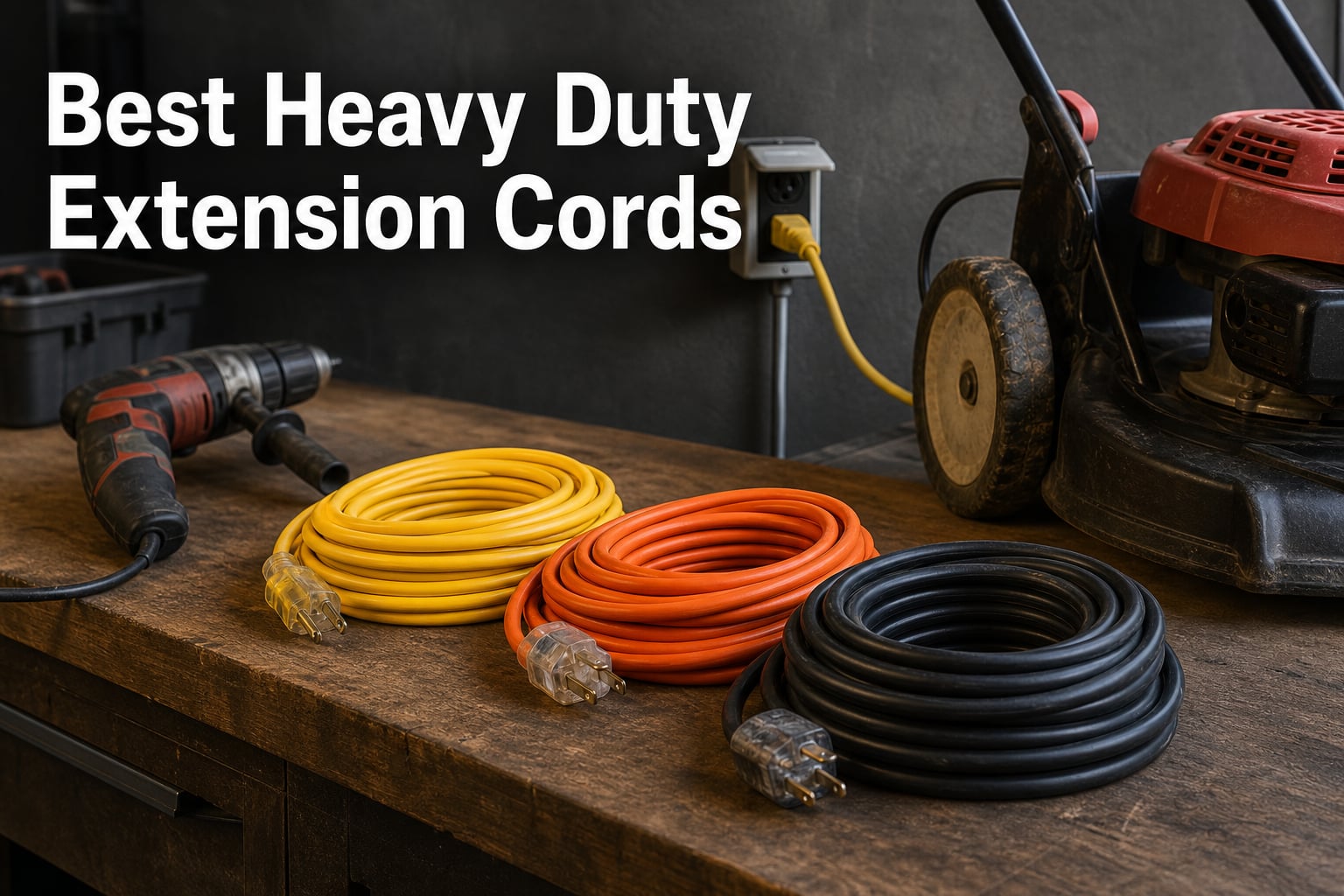
Heavy duty extension cords are not interchangeable with the thin cords that come out for holiday lights. For a saw, pressure washer, mower, shop vacuum, or generator connection, the wire gauge, run length, jacket rating, and plug design decide whether the tool receives power reliably.
I reviewed the seven supplied product listings for conductor size, stated 125V load rating, length, outlet count, weather claims, certification listing, and feedback volume. That approach is deliberately conservative: listing claims such as waterproofing and low-temperature flexibility are reported as claims, not as results from a hands-on lab test.
The short answer is simple: choose the shortest cord that reaches, then choose the lower AWG number when the load is high or the run is long. A 10 AWG cord is thicker than 12 AWG, while 12 AWG is thicker than 14 AWG; that thicker conductor can reduce voltage drop on a long run.
For a home shop, cords are also part of a safer work area. Keep the run visible, protect it from blades and vehicle traffic, and pair it with sensible cable management products so it is not pinched under a door or tangled around tools.
All seven picks here are three-conductor grounded cords rated at 125V in their listings. They are useful choices for outdoor equipment and workshop tools when the tool’s nameplate draw, the receptacle rating, the cord’s stated rating, and the total load all agree.
The top three picks answer the most common tool, garage, and outdoor needs
The Ultra Explorer is the compact 10 AWG choice for a demanding 25-foot connection, the PlugSaf adds three outlets at 50 feet, and the POWGRN combines 10 AWG conductors with a longer single-outlet run. The card below gives the main differences before the deeper reviews.
The quick comparison shows gauge, reach, and outlet count at a glance
Every listing below states a 15A, 125V, 1875W maximum except the 100-foot uboory listing, which states 13A and 1625W in its technical details. That difference matters more than the color of the jacket, particularly when a run is long.
| Product | Specs | Action |
|---|---|---|
 Ultra Explorer 10 Gauge 25 FT Ultra Explorer 10 Gauge 25 FT |
|
Check Latest Price |
 PlugSaf 50 FT 12/3 PlugSaf 50 FT 12/3 |
|
Check Latest Price |
 POWGRN 50 FT 10AWG POWGRN 50 FT 10AWG |
|
Check Latest Price |
 uboory 100 FT 14/3 uboory 100 FT 14/3 |
|
Check Latest Price |
 huanchain 50 FT 14/3 huanchain 50 FT 14/3 |
|
Check Latest Price |
 Deeklify 50 FT 10 Gauge Deeklify 50 FT 10 Gauge |
|
Check Latest Price |
 GreenProsper 12 Gauge 25 FT GreenProsper 12 Gauge 25 FT |
|
Check Latest Price |
Best overall: Ultra Explorer 10 Gauge 25 FT keeps a high-draw connection short
10 Gauge Heavy Duty Extension Cord 25 FT, Black, ETL Listied
10 AWG
25 ft
15A 125V 1875W
Pros
- 10 AWG copper
- Lighted end
- ETL listed
- Wide temperature claim
Cons
- Single outlet
- 25 ft reach
The Ultra Explorer is the right starting point when a wall outlet is close to a demanding tool and minimizing voltage drop is the priority. Its listing specifies a 25-foot, 10-gauge, three-conductor cord with a 15A, 125V, 1875W rating and a single grounded outlet.
I ranked it first because 10 AWG is the thickest conductor offered in this set, yet the 25-foot length stays manageable for a garage bay, workbench, pressure-washer area, or lawn-tool outlet. The listing’s 4.9 rating from 109 reviews is the highest rating in the group, though it is also a much smaller feedback sample than PlugSaf’s.
The 10 AWG copper conductors favor short, demanding tool runs
A lower gauge number means a thicker conductor, so this cord has more conductor material than the 12 AWG and 14 AWG options listed here. That makes it a sensible fit when a short run must feed a tool or appliance within the stated 15A limit.
Do not read 10 AWG as permission to exceed the branch circuit or the tool’s plug rating. The cord’s listing still caps its stated use at 15A, 125V, and 1875W.
The lighted female end answers a simple power-status question
The LED at the outlet end is intended to show that the cord has power, which is handy in a dim garage or outside after sunset. Forum discussions repeatedly flag lighted ends as helpful on dark work areas, and this is one of the clearest real-world conveniences in the listing.
The black vinyl jacket and reinforced blades are presented as outdoor-ready details. Check the entire cord before each use anyway; an indicator cannot reveal internal damage or a loose receptacle.
The stated weather range supports seasonal outdoor use
Ultra Explorer says its jacket remains usable from -40°F to 140°F and protects against moisture, abrasion, and sunlight. Those are useful claims for lawn, garden, and generator-adjacent tasks where a normal indoor cord would be the wrong choice.
The single outlet is the trade-off. If one tool is the plan, that keeps the end tidy; if several loads must run, pick a splitter-style cord and calculate the combined draw first.
Best multi-outlet 12 AWG: PlugSaf 50 FT powers a spread-out outdoor task
PlugSaf 50 FT 12 Gauge Yellow Heavy Duty Outdoor Extension Cord Waterproof
12 AWG
50 ft
3 outlets
Pros
- Three outlets
- IP65 claim
- Lighted end
- ETL cETL listed
Cons
- Shared 15A limit
- 50 ft can be bulky
The PlugSaf is the practical choice when 50 feet of reach and a three-outlet end are more useful than the thickest possible wire. Its product details specify 12/3 conductors, 15A, 125V, 1875W, an SJTW jacket, and three grounded outlets.
The large review base is a meaningful confidence signal: the listing shows a 4.8 rating across 1,342 reviews. Review insights specifically praise the multi-outlet end, light indicator, and weatherproof construction, while the specification list gives us the details needed to judge fit.
The three-outlet end helps one work zone without adding a second cord
Three outlets can serve a bench light, battery charger, and low-draw accessory at the same station, or make seasonal outdoor setup less awkward. The important limitation is that three outlets do not create three separate 15A supplies.
Add the wattage or amperage of everything plugged in, then stay at or below the cord’s stated 15A and 1875W limits. A single high-draw tool may already take most of the available capacity, so do not treat the three-way end as a substitute for more circuit capacity.
The 12/3 construction balances reach with conductor thickness
At 50 feet, 12 AWG makes more sense than a lighter-duty 14 AWG cord for many garage and garden jobs. It is a sensible middle ground for an extension cord for power tools that do not need a 10 AWG run.
Match the cord to the device label rather than guessing from the task name. A modest charger and a circular saw can both live in a workshop, but their current demands are not comparable.
The IP65 and cold-weather claims suit exposed work areas
PlugSaf lists IP65 waterproofing, an SJTW jacket, and a -40°F to 140°F operating range. The yellow outer jacket also makes the run easier to spot across grass, gravel, or a busy driveway.
The manufacturer also describes a hanging hook and a tail tested for repeated bends. Those are useful storage and strain-relief details, but unplug by gripping the plug body rather than pulling the cord itself.
Best cold-weather 10 AWG: POWGRN 50 FT brings thicker wire to a longer run
POWGRN 50 Ft 10AWG Outdoor Extension Cord Waterproof Heavy Duty, Black
10 AWG
50 ft
IP65 jacket
Pros
- 10 AWG at 50 ft
- Lighted end
- Cold-flex claim
- ETL cETL listed
Cons
- Single outlet
- Heavier to move
The POWGRN makes a strong case for buyers who need 50 feet but do not want to step down from 10 AWG. Its listing states 15A, 125V, 1875W, a single NEMA 5-15R outlet, an SJTW jacket, and ETL/cETL listing.
I would put it ahead of a 14 AWG long cord for a higher-draw outdoor tool because its thicker 10-gauge conductors give more headroom against voltage drop across the same distance. The listing’s 4.8 rating comes from 957 reviews, including feedback that calls out cold-weather flexibility.
The 50-foot 10 AWG combination targets voltage-drop concerns
Longer cord length adds resistance, which can reduce the voltage that reaches the tool while it is working. That is why contractors in forum discussions often prefer a 100-foot 10-gauge cord on job sites; among the supplied picks, this is the closest heavy-conductor answer at 50 feet.
Use the shortest suitable extension cord anyway. A thick 50-foot cord is not automatically better than a 25-foot cord if the outlet is near the work.
The -58°F flexibility claim addresses stiff-cord frustration
POWGRN says this cord stays flexible at -58°F and resists heat to 158°F. Cold stiffness is a recurring user complaint, because a rigid cord is harder to coil and more likely to be dragged or kinked around equipment.
Those conditions are manufacturer claims, so inspect the jacket before winter use and stop if it is cracked, cut, swollen, or warm. A cold-rated jacket does not protect a damaged conductor.
The strain relief and lighted end help in outdoor handling
The listing describes a strain-relief design tested through more than 20,000 bends and anti-skid lines for grip. It also includes an LED power indicator at the outlet end, removing one small source of confusion when a tool will not start.
This is still a single-outlet cord. That limitation is good for a single saw, compressor, or pressure washer connection, but it is less convenient when several accessories need power in the same area.
Best long reach: uboory 100 FT 14/3 reaches across a lawn or large garage
Pros
- 100 ft reach
- Copper conductors
- UL listed
- Cold-resistant claim
Cons
- 13A stated rating
- Single outlet
The uboory is the clear answer when reach is the problem. It is a 100-foot, 14/3 SJTW cord with copper conductors, a single grounded outlet, and a UL listing; its technical details specify a 13A, 125V, 1625W rating.
That 13A and 1625W detail deserves emphasis because the general product field also lists 15A and 1875W. When a listing contains conflicting figures, the safer decision is to respect the lower stated rating until the product label itself confirms otherwise.
The 100-foot reach solves distance but raises the importance of load matching
A hundred feet can get from a garage outlet to a far corner of a yard or across a larger work area without chaining cords. Avoid chaining anyway: every connection is another place for poor contact, heat, moisture, or an accidental unplug.
Length is not free electrically. A 14 AWG, 100-foot cord is better suited to modest loads within its lower 13A stated limit than to a tool that pulls near the maximum for extended periods.
The 14/3 SJTW jacket brings outdoor-focused features
uboory lists a waterproof, flame-resistant, weather-resistant, corrosion-resistant jacket with a cold-resistance claim down to -50°C. It also says the cord has a long strain relief that passed more than 5,000 repeated tests.
The orange jacket adds daytime visibility, a small but practical benefit where mowers, trimmers, and foot traffic cross the route. Route it around the perimeter of the work area rather than across the tool’s expected travel line.
The copper conductors and UL listing are useful buying checks
The listing calls out 100% copper construction and UL listing, two details worth verifying on any heavy duty outdoor extension cord. Certification listing is not a substitute for correct setup, but it is a better starting point than a cord with no stated listing.
Choose this cord for reach, not for the heaviest continuous draw. Buyers who need long reach for a demanding tool should look for a longer 10 AWG or 12 AWG option rather than assuming every 100-foot cord has the same capacity.
Best flexible 14 AWG: huanchain 50 FT handles lighter outdoor equipment
HUANCHAIN 14/3 Gauge Heavy Duty Outdoor Extension Cord 50 FT Waterproof
14 AWG
50 ft
IP65 claim
Pros
- Cold-flex claim
- Lighted socket
- ETL cETL listed
- Storage straps
Cons
- 14 AWG conductors
- Single outlet
The huanchain is a lighter-conductor, 50-foot option for lawn equipment, yard lighting, and other outdoor jobs that do not call for 10 AWG. Its listing gives 14 AWG, 15A, 125V, 1875W, a lighted grounded socket, and ETL/cETL listing.
Its 4.7 average is lower than most of the other products here, but the 476-review sample still gives it a solid base of buyer feedback. The recurring highlights are a soft, flexible feel, cold-weather claims, and an outlet-end indicator.
The flexible vinyl jacket is the main reason to choose this cord
huanchain lists IP65 weather resistance, flame resistance, corrosion resistance, and cold resistance to -50°C. For a homeowner who repeatedly uncoils and recoils a cord in chilly weather, that flexibility can matter as much as raw length.
The product listing says its strain-relief design passed 20,000 bend tests and that each cord receives a 2500V high-voltage test before shipment. Treat these as manufacturer-provided durability details, not a reason to skip inspection.
The 14 AWG conductor works best when the tool draw is modest
14 AWG is the thinnest conductor size in this roundup, so this is not my first choice for a long, heavy load. It can be a reasonable 50-foot utility run if the device’s current draw remains comfortably within the listed rating.
For a high-demand saw, heater, air compressor, or similar appliance, step up to 12 AWG or 10 AWG and check the appliance manual. The cord can only deliver what the circuit and plug arrangement safely support.
The lighted socket makes troubleshooting faster outdoors
The outlet-end indicator shows whether the cord is energized, which can help isolate a tripped breaker, GFCI reset, or tool problem. It is a convenience feature, but it makes a difference when the outlet is far from the panel.
This is a one-outlet model with storage straps, so it suits a simple one-tool workflow. If the work area needs several devices, a dedicated multi-outlet product is less cluttered than piling adapters at the end of a cord.
Best 10 AWG splitter: Deeklify 50 FT feeds a controlled workshop station
Deeklify 50FT 10 Gauge Extension Cord with Multiple Outlets Outdoor Yellow
10 AWG
50 ft
3 outlets
Pros
- 10 AWG conductors
- Three outlets
- Indicator light
- ETL listed
Cons
- Shared 15A limit
- Heavy 50 ft build
The Deeklify is the specialty pick for a workshop station that benefits from both 10 AWG conductors and a three-outlet splitter. Its listing specifies 50 feet, 15A, 125V, 1875W, an ETL listing, a yellow SJTW jacket, and a NEMA 5-15P to three 5-15R setup.
It is heavier than a basic 14 AWG cord, which is expected with thicker conductors and a triple outlet end. The 4.7 rating from 110 reviews is a smaller sample than several picks above, but the product data directly matches the multi-tool workshop use case.
The 10 AWG conductors support a longer workshop route
This is one of only three 10 AWG products in the list, and it is the only one that pairs 10 AWG with three outlets at 50 feet. That combination is helpful when a workbench is far from the receptacle and the station has several lower-draw needs.
Do not plug three demanding tools into it at the same time. All outlets share the same cord and circuit capacity, so total draw remains limited to the stated 15A and 1875W.
The triple outlet and indicator suit a fixed work zone
A three-way end can reduce the need for loose adapter blocks near the bench. The listing also calls out a lighted outlet and a built-in hook with storage straps, which help with setup and pack-up.
Keep the splitter end off wet ground and away from standing water even though the listing says IP65 water and dust resistance. Outdoor rating is not a reason to immerse electrical connections or use a damaged cap or receptacle.
The SJTW jacket adds stated weather and abrasion resistance
Deeklify lists a flexible, UV-resistant SJTW vinyl jacket, IP65 resistance, a -40°F to 140°F range, and an abrasion-resistant build. It also reports a 5,000-plus bend lifespan and a 1500V high-voltage rating.
For a garage workshop, its yellow color offers better trip visibility than a dark cord. Coil it loosely after use and avoid sharp kinks, which are hard on any cord regardless of the stated bend-test figure.
Best compact 12 AWG: GreenProsper 25 FT fits a nearby garden or garage outlet
Pros
- 12 AWG copper
- Flame-retardant jacket
- UL listed
- Short useful reach
Cons
- Single outlet
- 25 ft reach
The GreenProsper is the compact 12 AWG alternative for a lawn tool, bench tool, or appliance that is not far from the outlet. The listing calls for 25 feet, 12 AWG, three conductors, 15A, 125V, 1875W, a single grounded outlet, and UL listing.
It has the lowest average rating in this group at 4.6 from 216 reviews, so I would not make it the default pick over the higher-rated Ultra Explorer or PlugSaf. Still, the real product data shows a useful mix of pure copper conductor, PVC jacket, flame-retardant construction, and a short route that helps avoid unnecessary voltage drop.
The 12 AWG copper construction suits medium-length tool connections
12 AWG is a practical middle size when 10 AWG feels more than the task needs but 14 AWG feels too light. At 25 feet, it offers a sensible setup for a nearby outdoor outlet and a single power tool or lawn appliance within the stated maximum.
Never choose solely by the “heavy duty” label. Compare the tool’s nameplate amps with the cord’s label, and account for continuous use rather than only the startup moment.
The flame-retardant PVC jacket addresses ordinary outdoor exposure
GreenProsper lists a weatherproof, flame-retardant, UV-resistant PVC sheath that withstands -40°F to 140°F. It also identifies the cord as suitable for indoor and outdoor use.
That does not make it a permanent outdoor wiring method. Bring it in when the temporary job is done, and do not run it through walls, ceilings, door gaps, or under rugs where heat and damage can be hidden.
The single grounded outlet keeps the load decision straightforward
A single 3-prong outlet discourages the casual addition of several devices to one run. That simplicity is a benefit for a one-tool task such as running a mower, trimmer, pressure washer, or bench tool from a nearby source.
The product includes a one-year warranty according to its listing. Store it loosely coiled, dry, and out of direct sun when it is not needed, because long-term jacket care is still important for an outdoor extension cord.
The right gauge and length prevent most extension-cord mistakes
The lower the AWG number, the thicker the conductor. For these seven products, 10 AWG is the strongest starting point for a high-draw tool or a longer temporary run, 12 AWG is the versatile middle choice, and 14 AWG belongs with lighter loads or shorter-demand tasks.
Choose 10 AWG when the load is demanding or the run is long
The Ultra Explorer, POWGRN, and Deeklify are the 10 AWG picks in this guide. Their stated rating is still 15A, 125V, and 1875W, but the thicker conductor is useful when resistance over distance is the concern.
A simple voltage-drop rule is that longer wire runs have more resistance, and higher current increases the voltage lost across that resistance. If a tool struggles, overheats, or loses performance on a long run, stop and reassess the cord gauge, length, circuit, and tool requirement rather than adding another extension.
Choose 12 AWG for many garage tools and 50-foot outdoor jobs
The PlugSaf gives 12 AWG at 50 feet with three outlets, while GreenProsper gives 12 AWG at 25 feet with one outlet. Both list 15A, 125V, and 1875W, but their different lengths and outlet layouts make them better for different work zones.
For typical DIY garage work, forum users often report satisfaction with 50-foot 12 AWG cords. The correct pick still follows the actual equipment label, not what worked for another person’s tool.
Choose 14 AWG only after checking the load and the distance
The uboory and huanchain provide 14 AWG options, with the uboory reaching 100 feet and stating a lower 13A, 1625W rating in its technical details. That makes long reach possible, but it also makes careful load matching more important.
Do not treat a 14 AWG cord as a universal replacement for 12 AWG or 10 AWG. The longer the run and the more demanding the appliance, the stronger the argument for thicker wire.
The SJTW marking and jacket claims tell you where a cord belongs
SJTW is a common designation seen on the supplied listings. In plain language, it identifies a junior service cord with thermoplastic insulation and a weather-resistant designation; it is a useful outdoor-use signal when it appears alongside the product’s stated electrical rating and certification listing.
Pick an outdoor-rated jacket for lawn, garden, and exposed work
All seven listings identify outdoor-oriented features, while several specifically state IP65 resistance and low-temperature flexibility. For an outdoor connection, inspect both ends, use a GFCI-protected outlet where required, keep connections out of standing water, and protect the route from mowers and vehicles.
Indoor cords are not a substitute just because the forecast is dry. Sunlight, abrasion, moisture, and cold all stress a cord jacket over time.
Read waterproof claims as protection, not permission for immersion
“Waterproof” or IP65 on a product listing means the manufacturer makes a water-resistance claim for the cord or jacket. It does not mean an energized plug-and-receptacle connection is safe in a puddle, under a sprinkler, or left uncovered in rain.
Set the connection above grade, use appropriate weather covers, and disconnect power before handling a wet or damaged cord. If moisture has entered a connector, let a qualified person inspect it rather than forcing use.
Check the certification listing and the printed label before use
Several product records state ETL/cETL listing, while the uboory and GreenProsper records state UL listing. These marks are useful signals to check, but the label on the specific cord in hand is the authority because online listing text can change or contain inconsistent fields.
Also look for the gauge, wire count, maximum rating, jacket designation, and physical condition. A cord with a missing ground pin, split jacket, loose blades, discoloration, or a warm plug should be removed from service.
The multi-outlet end is useful only when the combined load stays within one limit
PlugSaf and Deeklify have three outlets, which makes them convenient for a localized work or outdoor setup. They remain one 15A, 125V, 1875W cord according to their listings, not three independent circuits.
Add the loads before plugging in a multi-outlet cord
Find watts or amps on each device nameplate. If using watts, divide watts by 125V for an approximate current figure, then add each device’s current; if using amps, add the listed amps directly.
For example, two devices marked 600W draw about 9.6A together at 125V before accounting for any other item. That leaves less room than many people expect, and a motorized tool can have a higher startup demand.
Use a power strip only for the right low-draw electronics
A power strip is not the right way to turn an extension cord into a high-load appliance hub. For desk electronics and USB charging needs, see our guide to power strips with USB charging; keep that separate from the heavy-tool use described here.
Avoid daisy chains of extension cords, adapters, and power strips. Each extra connection can loosen, trap moisture, and add resistance where heat may develop.
Safe extension-cord habits protect the cord, the tool, and the people nearby
Heavy duty does not mean permanent wiring. OSHA-focused guidance and electrician discussions converge on a practical rule: use an extension cord as a temporary connection, inspect it before use, and replace it when it is damaged.
Keep the cord visible, fully extended, and away from heat
Uncoil the cord fully when it is carrying a significant load. A tightly coiled cord can retain heat, and a buried cord cannot be checked for damage or accidental contact.
Keep it away from sharp edges, hot exhaust, moving parts, and pinch points. Do not cover it with rugs or route it through walls, ceilings, windows, or doors.
Use dedicated circuits for high-draw heating appliances
Space heaters should generally plug directly into a wall receptacle rather than an extension cord, unless the heater manufacturer explicitly permits a correctly rated cord and the entire setup is appropriate. Read our space heater safety guide before setting up supplemental heat.
The same caution applies to any appliance with a high continuous draw. A thicker cord cannot fix an overloaded household circuit or a poor outlet connection.
Stop using a cord when physical damage or heat appears
Feel for unusual warmth only after disconnecting power and allowing the plug to cool if needed. Scorching, melted plastic, a loose receptacle, exposed conductors, or a bent ground pin are stop signs, not minor wear.
Do not repair a compromised cord with household tape. Replace it or have it evaluated by a qualified professional according to the situation and local requirements.
Heavy duty extension cord FAQs give direct gauge and brand answers
What is the heaviest grade extension cord?
Among common consumer extension cords, **10 AWG** is heavier-duty than 12 AWG or 14 AWG because the lower gauge number means a thicker conductor. It is a strong choice for higher-draw tools or longer temporary runs, but the cord, tool, plug, and circuit ratings must still match.
What’s the best gauge for a heavy duty extension cord?
**10 AWG** is best when a high-draw tool or longer run makes voltage drop a concern. **12 AWG** is a versatile choice for many garage and outdoor jobs, while **14 AWG** fits lighter loads after checking the device rating and cord length.
Is a 10-gauge or 12-gauge extension cord better?
**10-gauge is thicker** and generally better for demanding loads or longer runs; **12-gauge is lighter** and works well for many medium-duty tools. Neither is automatically better: choose the shortest cord with a gauge and stated amperage rating that meet the equipment label.
Which brand extension cord is best?
The best choice depends on the specific cord’s gauge, length, outlet count, stated rating, jacket designation, and certification listing. In this guide, the Ultra Explorer 10 AWG 25 FT is the best short high-draw pick, while PlugSaf is the strongest 50-foot three-outlet choice based on the supplied product data.
The best final choice depends on your tool load and the distance from power
The Ultra Explorer is my first choice for a short, high-draw connection because it combines 10 AWG with a 25-foot run, a lighted end, and an ETL listing. Pick POWGRN when you need 10 AWG at 50 feet, PlugSaf when three outlets and 12 AWG fit the plan, and Deeklify when that three-outlet layout also needs 10 AWG conductors.
For long reach, uboory provides 100 feet but calls for special care with its 14 AWG construction and lower stated 13A technical rating. huanchain and GreenProsper suit lighter, single-outlet outdoor work where cold-flex claims or compact 12 AWG reach matter most.
The best heavy duty extension cords in 2026 are the ones that match the device label, outlet circuit, weather exposure, and shortest practical length. Check the product card that fits your job, then confirm the cord label before connecting power.
Leave a Reply